EP1482425A2 - System and method of query transformation - Google Patents
System and method of query transformation Download PDFInfo
- Publication number
- EP1482425A2 EP1482425A2 EP04012614A EP04012614A EP1482425A2 EP 1482425 A2 EP1482425 A2 EP 1482425A2 EP 04012614 A EP04012614 A EP 04012614A EP 04012614 A EP04012614 A EP 04012614A EP 1482425 A2 EP1482425 A2 EP 1482425A2
- Authority
- EP
- European Patent Office
- Prior art keywords
- components
- tables
- structured query
- query language
- sql
- Prior art date
- Legal status (The legal status is an assumption and is not a legal conclusion. Google has not performed a legal analysis and makes no representation as to the accuracy of the status listed.)
- Withdrawn
Links
Images


Classifications
-
- G—PHYSICS
- G06—COMPUTING OR CALCULATING; COUNTING
- G06F—ELECTRIC DIGITAL DATA PROCESSING
- G06F16/00—Information retrieval; Database structures therefor; File system structures therefor
- G06F16/20—Information retrieval; Database structures therefor; File system structures therefor of structured data, e.g. relational data
- G06F16/24—Querying
- G06F16/245—Query processing
- G06F16/2453—Query optimisation
- G06F16/24534—Query rewriting; Transformation
- G06F16/24547—Optimisations to support specific applications; Extensibility of optimisers
-
- G—PHYSICS
- G06—COMPUTING OR CALCULATING; COUNTING
- G06F—ELECTRIC DIGITAL DATA PROCESSING
- G06F16/00—Information retrieval; Database structures therefor; File system structures therefor
- G06F16/20—Information retrieval; Database structures therefor; File system structures therefor of structured data, e.g. relational data
- G06F16/24—Querying
- G06F16/242—Query formulation
- G06F16/2433—Query languages
- G06F16/244—Grouping and aggregation
-
- G—PHYSICS
- G06—COMPUTING OR CALCULATING; COUNTING
- G06F—ELECTRIC DIGITAL DATA PROCESSING
- G06F16/00—Information retrieval; Database structures therefor; File system structures therefor
- G06F16/20—Information retrieval; Database structures therefor; File system structures therefor of structured data, e.g. relational data
- G06F16/28—Databases characterised by their database models, e.g. relational or object models
- G06F16/283—Multi-dimensional databases or data warehouses, e.g. MOLAP or ROLAP
-
- Y—GENERAL TAGGING OF NEW TECHNOLOGICAL DEVELOPMENTS; GENERAL TAGGING OF CROSS-SECTIONAL TECHNOLOGIES SPANNING OVER SEVERAL SECTIONS OF THE IPC; TECHNICAL SUBJECTS COVERED BY FORMER USPC CROSS-REFERENCE ART COLLECTIONS [XRACs] AND DIGESTS
- Y10—TECHNICAL SUBJECTS COVERED BY FORMER USPC
- Y10S—TECHNICAL SUBJECTS COVERED BY FORMER USPC CROSS-REFERENCE ART COLLECTIONS [XRACs] AND DIGESTS
- Y10S707/00—Data processing: database and file management or data structures
- Y10S707/953—Organization of data
- Y10S707/954—Relational
-
- Y—GENERAL TAGGING OF NEW TECHNOLOGICAL DEVELOPMENTS; GENERAL TAGGING OF CROSS-SECTIONAL TECHNOLOGIES SPANNING OVER SEVERAL SECTIONS OF THE IPC; TECHNICAL SUBJECTS COVERED BY FORMER USPC CROSS-REFERENCE ART COLLECTIONS [XRACs] AND DIGESTS
- Y10—TECHNICAL SUBJECTS COVERED BY FORMER USPC
- Y10S—TECHNICAL SUBJECTS COVERED BY FORMER USPC CROSS-REFERENCE ART COLLECTIONS [XRACs] AND DIGESTS
- Y10S707/00—Data processing: database and file management or data structures
- Y10S707/99931—Database or file accessing
-
- Y—GENERAL TAGGING OF NEW TECHNOLOGICAL DEVELOPMENTS; GENERAL TAGGING OF CROSS-SECTIONAL TECHNOLOGIES SPANNING OVER SEVERAL SECTIONS OF THE IPC; TECHNICAL SUBJECTS COVERED BY FORMER USPC CROSS-REFERENCE ART COLLECTIONS [XRACs] AND DIGESTS
- Y10—TECHNICAL SUBJECTS COVERED BY FORMER USPC
- Y10S—TECHNICAL SUBJECTS COVERED BY FORMER USPC CROSS-REFERENCE ART COLLECTIONS [XRACs] AND DIGESTS
- Y10S707/00—Data processing: database and file management or data structures
- Y10S707/99931—Database or file accessing
- Y10S707/99933—Query processing, i.e. searching
-
- Y—GENERAL TAGGING OF NEW TECHNOLOGICAL DEVELOPMENTS; GENERAL TAGGING OF CROSS-SECTIONAL TECHNOLOGIES SPANNING OVER SEVERAL SECTIONS OF THE IPC; TECHNICAL SUBJECTS COVERED BY FORMER USPC CROSS-REFERENCE ART COLLECTIONS [XRACs] AND DIGESTS
- Y10—TECHNICAL SUBJECTS COVERED BY FORMER USPC
- Y10S—TECHNICAL SUBJECTS COVERED BY FORMER USPC CROSS-REFERENCE ART COLLECTIONS [XRACs] AND DIGESTS
- Y10S707/00—Data processing: database and file management or data structures
- Y10S707/99931—Database or file accessing
- Y10S707/99933—Query processing, i.e. searching
- Y10S707/99934—Query formulation, input preparation, or translation
-
- Y—GENERAL TAGGING OF NEW TECHNOLOGICAL DEVELOPMENTS; GENERAL TAGGING OF CROSS-SECTIONAL TECHNOLOGIES SPANNING OVER SEVERAL SECTIONS OF THE IPC; TECHNICAL SUBJECTS COVERED BY FORMER USPC CROSS-REFERENCE ART COLLECTIONS [XRACs] AND DIGESTS
- Y10—TECHNICAL SUBJECTS COVERED BY FORMER USPC
- Y10S—TECHNICAL SUBJECTS COVERED BY FORMER USPC CROSS-REFERENCE ART COLLECTIONS [XRACs] AND DIGESTS
- Y10S707/00—Data processing: database and file management or data structures
- Y10S707/99931—Database or file accessing
- Y10S707/99933—Query processing, i.e. searching
- Y10S707/99935—Query augmenting and refining, e.g. inexact access
Definitions
- the invention relates generally to data access middleware, and in particular to a system and method of query transformation.
- a typical data access environment has a multi-tier architecture. For description purposes, it can be separated into three distinct tiers:
- the web server contains a firewall and one or more gateways. All web communication is performed through a gateway.
- a gateway is responsible for passing on requests to the application server, in tier 2, for execution.
- the applications tier contains one or more application servers.
- the application server runs requests, such as reports and queries that are forwarded by a gateway running on the web server.
- a query engine which is data access middleware that provides universal data access to a variety of heterogeneous database systems.
- the query engine formulates queries (typically SQL) and passes them on to the data tier, through a native database API (such as ODBC) for execution.
- the data tier contains database management systems (DBMS), which manage raw data stored in a database.
- DBMS database management systems
- Examples of such systems include Oracle, DB2, and Microsoft SQL Server.
- a multi-tier architecture can be configured in several different ways, a typical configuration places each tier on a separate computer (server).
- a database server is typically a "high end" server, and thus can process queries at a relatively fast speed.
- An application server cannot generally process queries as quickly as a database server.
- a query engine may generate SQL queries that utilize the SQL/OLAP technology introduced in the SQL-99 standard.
- SQL queries would have to be performed on the report server that is generally slower than the database server. It is desirable to have as much processing performed on the database server.
- a Structured query language tagging system for tagging Structured query language commands.
- the system comprises a parsing unit for parsing a structured query language string into components, an analysis unit for analyzing the components and applying associated tags to the components, and a string generation unit for concatenating the components with associated tags into a new string.
- a method of tagging structured query language commands comprises the steps of parsing an incoming structured query language statement and producing an input tree representation, and traversing the input tree representation while generating a structured query language string with embedded extensible markup language tags.
- a method of tagging structured query language commands comprises the steps of parsing a structured query language string into components, analyzing the components and applying associated tags to the components, and concatenating the components with associated tags into a new string.
- a WITH clause transformation system comprising a WITH clause analysis module for analysing structured query language / online analytical programming (SQL/OLAP) windowed aggregates that are not supported by a target database system, and a WITH clause transformation module for Transforming SQL/OLAP windowed aggregates into semantically equivalent standard aggregate functions that are supported by the target database system.
- SQL/OLAP structured query language / online analytical programming
- a method of WITH clause transformation comprises the steps of analysing a query containing SQL/OLAP windowed aggregates that are not supported by a target database system, and transforming the query into a semantically equivalent query, having a WITH clause, that is supported by the target database system.
- a parallel detail join system for merging elements in a plurality of tables.
- the system comprises a parallel detail analysis module for obtaining related elements in a plurality of tables, and a parallel detail transformation module for merging the related elements in a singe table.
- the related elements merged such that the number of rows of a single element equals a largest cardinality of the single element and the number of columns equals the number of tables.
- a method of merging elements in a plurality of tables comprises the steps of obtaining related elements in a plurality of tables, and merging the elements are merged into a single table such that the number of rows of a single element equals a largest cardinality of the single element and the number of columns equals the number of tables.
- a method of merging elements in a plurality of tables comprises the steps of analyzing elements in a plurality of tables, creating a single table, and placing the properties of each respective element in the single table in a number of rows equal to a largest cardinality of the respective element.
- the single table having a number of columns equal to the number of tables plus one, and a number of rows equal to the total of the largest cardinality of the elements in each table.
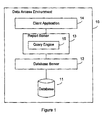
- Figure 1 shows a typical data access environment 10 for processing data.
- data is stored in a database 11.
- a DBMS running on a database server 12 accesses the raw data stored in the database 11.
- a query engine 15, running on an application server 12 is used to generate reports on the raw data and instruct the DBMS on the database server 12 to obtain information pertaining to the raw data in the database 11.
- the query engine 15 provides universal data access to a variety of heterogeneous database systems.
- An end user uses a client application 14, running on a client workstation, to facilitate application server 13 operations.
- a query engine 15 In order to solve many business questions, a query engine 15 generates SQL queries that utilize the SQL/online analytical programming (OLAP) technology introduced in the SQL-99 standard. These SQL queries include SQL/OLAP functions (windowed aggregates). However, many database systems 12 do not support this technology. In order to prevent or reduce the amount of local (application server) processing required to process these types of queries, the query engine 15 attempts to generate semantically equivalent queries that can be processed on the database server 12 by the target database system. These semantically equivalent queries include standard aggregate functions and the GROUP BY operator.
- OLAP online analytical programming
- FIG. 2 shows an example of a structured query language (SQL) tagging system 20, in accordance with an embodiment of the present invention.
- the SQL tagging system 20 comprises a parsing unit 21 for parsing a structured query language string into components, an analysis unit 22 for analyzing the components and applying associated tags to the components, and a string generation unit 23 for concatenating the components with associated tags into a new string.
- the parsing unit 21 comprises an extensible markup language (XML) parser built into a query engine application that implements the SQL tagging system 20.
- the SQL tagging system 20 may comprise a separately implemented SQL parser.
- the tagging of components may be performed by a universal data access (UDA). Components may be added to, or removed from, the SQL tagging system 20.
- UDA universal data access
- the SQL tagging system 20 may be implemented as a component of the report server 13, or as a component of the query engine 15 to a data access environment 10.
- the SQL tagging system 20 may be implemented as a component of the database server 12.
- a further alternative has the SQL tagging system 20 implemented as a separate component between the report server 13 and the database server 12 in a data access environment 10.
- FIG 3 shows in a flowchart an example of a method of tagging SQL commands (30), in accordance with the structured query language tagging system 20.
- the method (30) begins with parsing an incoming SQL statement and producing an input tree (ITREE) representation (31). Next, the ITREE is traversed while generating a SQL string with the appropriate XML tags embedded (32). The method (30) is done (33).
- ITREE input tree
- the SQL tagging system 20 allows various components of a SQL statement to be extracted and analyzed by a query engine.
- the query engine can then us this information to simplify the SQL as much as possible, keeping only the minimal set of tables and joins needed to obtain values for the selected query items.
- the query engine which implements the SQL tagging system 20 does not need to implement a full-blown SQL parser.
- the query engine can use its existing XML parser to construct a document object model (DOM) tree for the purpose of extraction and analysis of various components of a SQL statement.
- DOM document object model
- this embodiment of the invention saves on development and maintenance costs since, as mentioned above, CQE does not need to develop (and therefore maintain) a SQL parser for producing a DOM tree. New functionality in the SQL language can be handled easily by simply introducing new XML tags.
- Figure 4 shows in a flowchart another example of a method of tagging Structured query language commands (40), in accordance with the structured query language system 20.
- the method (40) begins with parsing a SQL string into components (41). Once the components are parsed (41), the components may be analysed to apply associated tags to the components (42). Once the associated tags are applied to the components, the components with associated tags may be concatenated into a new string (43). The method (40) is done (44) and a query engine may use the new string. Steps may be added to, or removed from, the method (40).
- SQL tagging involves parsing a SQL string and producing a new string containing XML tags.
- An example of a collection of tags is given below: XML Tag Description ⁇ field> Identifies a value expression in select list. ⁇ column> Identifies a column reference in value expression. ⁇ alias> Identifies a derived column name for value expression in select list or a correlation name appearing in the FROM clause. ⁇ subquery> Identifies a subquery.
- ⁇ orderby> Identifies a list of one or more sort columns in an ORDER BY clause
- groupby> Identifies a list of one or more grouping columns in an GROUP BY clause
- ⁇ having> Identifies a HAVING clause predicate.
- ⁇ summaryfilter> Identifies a FILTER (summary filter) clause predicate.
- ⁇ window> Identifies a WINDOW clause.
- ⁇ distinct> Identifies the DISTINCT qualifier in a select list.
- ⁇ qualify> Identifies a QUALIFY predicate.
- filter> Identifies a WHERE clause predicate.
- ⁇ joinedtable> Identifies a joined table (INNER JOIN, LEFT OUTER JOIN, RIGHT OUTER JOIN, FULL OUTER JOIN, or CROSS JOIN) in the FROM clause.
- ⁇ derivedtable> Identifies a derived table in the FROM clause.
- ⁇ table> Identifies a simple table reference in the FROM clause.
- ⁇ nativesql> Identifies database-specific SQL.
- ⁇ passthroughSQL> Identifies standalone database-specific SQL.
- ⁇ procedure> Identifies a stored procedure call. ⁇ with> Identifies a WITH clause specification.
- ⁇ view> Identifies a common table expression referenced in the FROM clause.
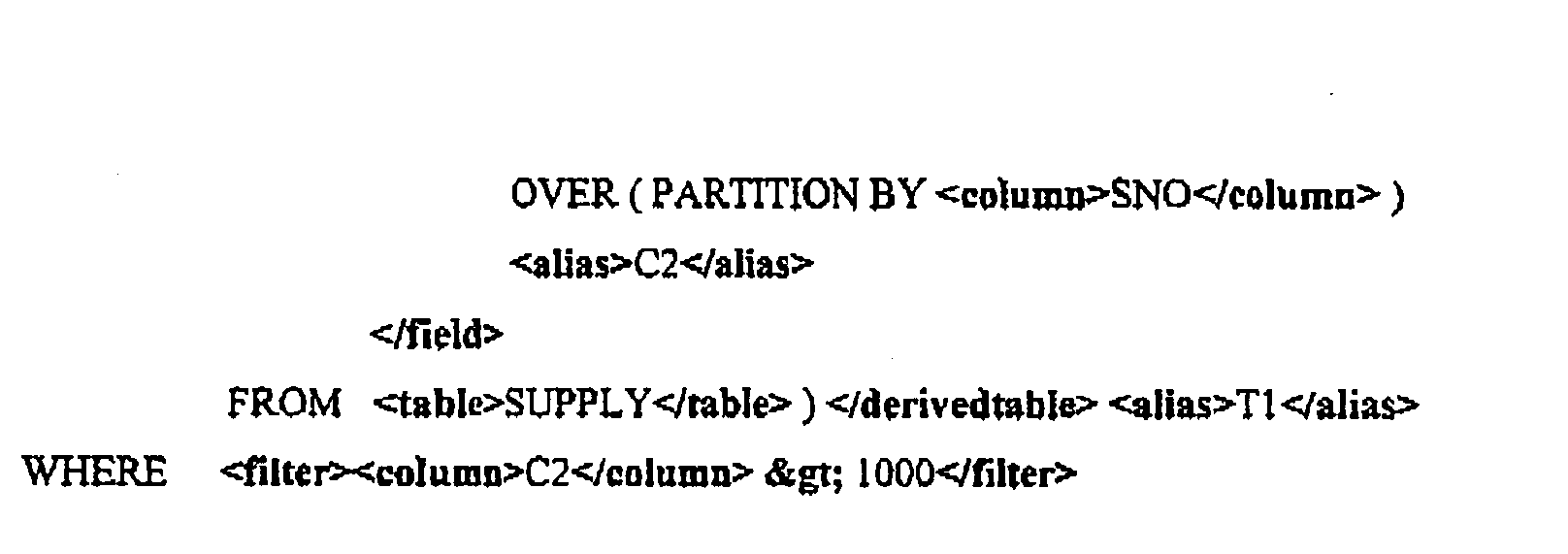
- the above example shows the introduction of specialized XML tags (in bold) into the original SQL statement.
- Each tag identifies a particular part of the SQL statement.
- the tagged SQL can be easily parsed by any XML parser (the original SQL cannot) to produce a DOM tree.
- FIG. 5 shows a WITH clause transformation system 50, in accordance with an embodiment of the present invention.
- the WITH clause query transformation system 50 comprises a WITH clause analysis module 51 for analysing SQL/OLAP windowed aggregates that are not supported by a target database system, and a WITH clause transformation module 52 for transforming SQL/OLAP windowed aggregates into semantically equivalent standard aggregate functions that are supported by the target database system.
- the WITH clause transformation system 50 may be implemented as a sub-system of the query engine 15 in the data access environment 10. This transformation system 50 may generate queries that can be processed in their entirety on the database server 12, or queries that require processing on both the application server 13 and the database server 12.
- the WITH clause transformation system 50 reduces processing that might otherwise be required on the application server, thereby improving performance in many cases.
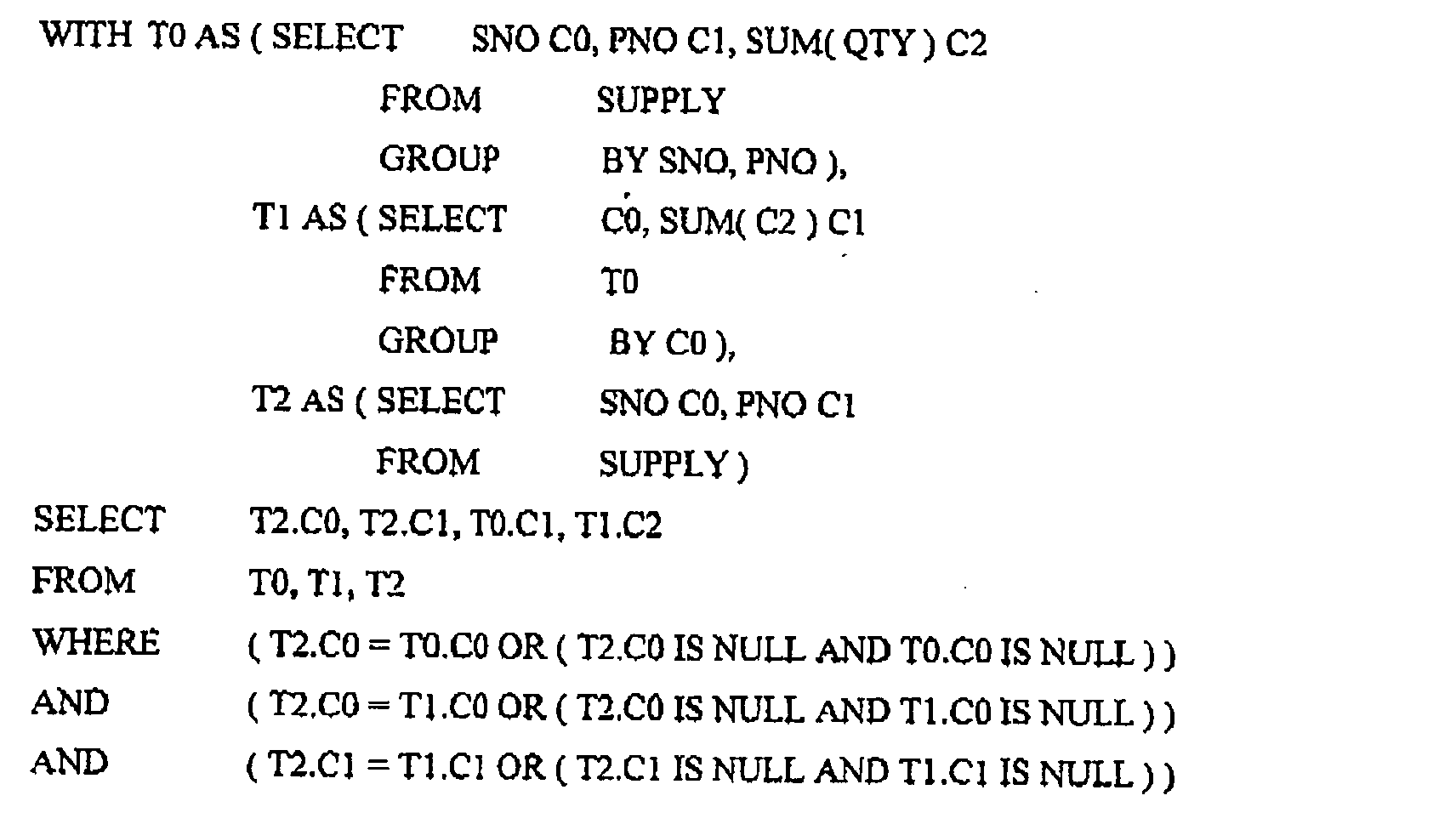
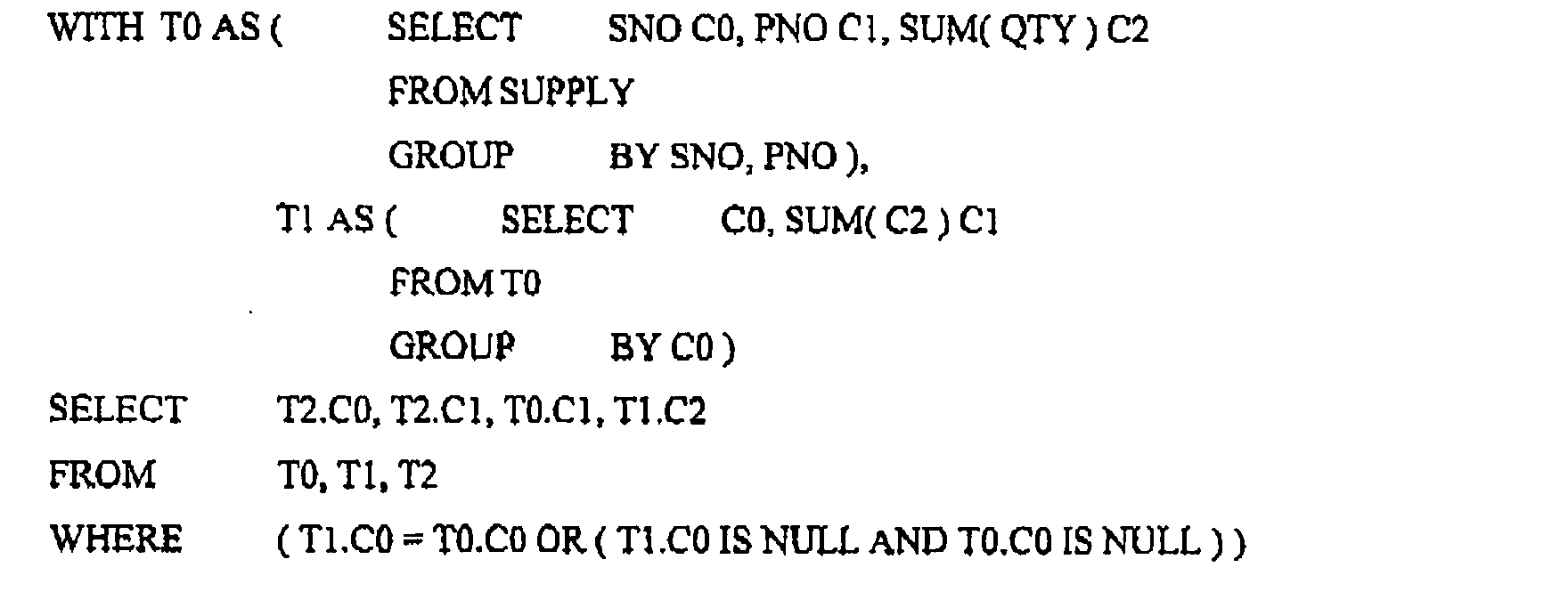
- the WITH clause transformation system uses the WITH clause and common table expressions to express a semantically equivalent query.
- the group query transformation of SQL-99 query involves mapping windowed OLAP functions into a semantically equivalent query involving derived tables and the standard WITH clause.
- Figure 6 shows in a flowchart an example of a method of WITH clause transformation (60), in accordance with an embodiment of the WITH clause transformation system 50.
- the method (60) begins with analysing a query containing SQL/OLAP windowed aggregates that are not supported by a target database system (61). Next, the query is transformed into a semantically equivalent query, having a WITH clause, that is supported by the target database system (62). The method (60) is done (63).
- Parallel detail join solves the problem of producing a meaningful result from a many-to-one-to-many relationship using a single structured query language (SQL) statement.
- SQL structured query language
- FIG. 7 shows an example of a parallel detail join system 70 for merging elements in a plurality of tables, in accordance with an embodiment of the present invention.
- the parallel detail join system 70 comprises a parallel detail analysis module 71 for obtaining related elements in a plurality of tables, and a parallel detail transformation module 72 for merging the related elements in a singe table.
- the related elements may have different cardinalities in each original table.
- the related elements are merged such that the number of rows equals the largest cardinality and the number of columns equals the number of tables.
- the parallel detail join system 70 may be implemented as a component of the report server 13, or as a component of the query engine 15 to a data access environment 10.
- the parallel detail join system 70 may be implemented as a component of the database server 12.
- a further alternative has the parallel detail join system 70 implemented as a separate component between the report server 13 and the database server 12 in a data access environment 10.
- Figure 8 shows in a flowchart an example of a method of merging elements in a plurality of tables (80), in accordance with an embodiment of the parallel detail join system 60.
- the method (80) begins with obtaining related elements in a plurality of tables (81). Next, the elements are merged into a single table (82). The method (80) is done (83).
- the parallel detail join system reduces processing that might otherwise be required on the application server, thereby improving performance in many cases.
- Figure 9 shows in a flowchart another example of a method of merging elements in a plurality of tables (90), in accordance with an embodiment of the parallel detail join system 60.
- the method (90) begins with analyzing elements in a plurality of tables (91). Next, a single table is created, having a number of columns equal to the number of tables plus one, and a number of rows equal to the total of the largest cardinality of the elements in each table (92)- Next, the properties of each respective element are placed in the table in a number of rows equal to the largest cardinality of the respective element (93).
- the method (90) is done (94).
- the systems and methods according to the present invention may be implemented by any hardware, software or a combination of hardware and software having the above described functions.
- the software code either in its entirety or a part thereof, may be stored in a computer readable memory.
- a computer data signal representing the software code that may be embedded in a carrier wave may be transmitted via a communication network.
- Such a computer readable memory and a computer data signal are also within the scope of the present invention, as well as the hardware, software and the combination thereof.
Landscapes
- Engineering & Computer Science (AREA)
- Theoretical Computer Science (AREA)
- Databases & Information Systems (AREA)
- Physics & Mathematics (AREA)
- Data Mining & Analysis (AREA)
- General Engineering & Computer Science (AREA)
- General Physics & Mathematics (AREA)
- Computational Linguistics (AREA)
- Mathematical Physics (AREA)
- Information Retrieval, Db Structures And Fs Structures Therefor (AREA)
Abstract
Description
- Web server
- Applications
- Data
| XML Tag | Description |
| <field> | Identifies a value expression in select list. |
| <column> | Identifies a column reference in value expression. |
| <alias> | Identifies a derived column name for value expression in select list or a correlation name appearing in the FROM clause. |
| <subquery> | Identifies a subquery. |
| <orderby> | Identifies a list of one or more sort columns in an ORDER BY clause |
| <groupby> | Identifies a list of one or more grouping columns in an GROUP BY clause |
| <having> | Identifies a HAVING clause predicate. |
| <summaryfilter> | Identifies a FILTER (summary filter) clause predicate. |
| <window> | Identifies a WINDOW clause. |
| <distinct> | Identifies the DISTINCT qualifier in a select list. |
| <qualify> | Identifies a QUALIFY predicate. |
| <filter> | Identifies a WHERE clause predicate. |
| <joinedtable> | Identifies a joined table (INNER JOIN, LEFT OUTER JOIN, RIGHT OUTER JOIN, FULL OUTER JOIN, or CROSS JOIN) in the FROM clause. |
| <derivedtable> | Identifies a derived table in the FROM clause. |
| <table> | Identifies a simple table reference in the FROM clause. |
| <nativesql> | Identifies database-specific SQL. |
| <passthroughSQL> | Identifies standalone database-specific SQL. |
| <procedure> | Identifies a stored procedure call. |
| <with> | Identifies a WITH clause specification. |
| <view> | Identifies a common table expression referenced in the FROM clause. |






| EMPLOYEES | |
| ID | NAME |
| 1 | Stan |
| 2 | Mike |
| 3 | John |
| BILLINGS | |
| ID | AMOUNT |
| 1 | 100 |
| 1 | 400 |
| 1 | 500 |
| 3 | 600 |
| SKILLS | |
| ID | SKILL |
| 1 | Cobol |
| 1 | C |
| 2 | Pascal |
| 2 | Visual Basic |
| The desired result is shown below: | |||
| ID | NAME | AMOUNT | SKILL |
| 1 | Stan | 100 | Cobol |
| 1 | Stan | 400 | C |
| 1 | Stan | 500 | |
| 2 | Mike | Pascal | |
| 2 | Mike | Visual Basic | |
| 3 | John | 600 |

Claims (10)
- A structured query language tagging system for tagging structured query language commands, the system comprising:a parsing unit for parsing a structured query language string into components;an analysis unit for analyzing the components and applying associated tags to the components; anda string generation unit for concatenating the components with associated tags into a new string.
- The system as claimed in claim 1, further comprising a repository for holding a list of tags associated with structured query language components.
- A method of tagging structured query language commands, the method comprising the steps of:parsing an incoming structured query language statement and producing an input tree representation; andtraversing the input tree representation while generating a structured query language string with embedded extensible markup language tags.
- A method of tagging structured query language commands, the method comprising the steps of:parsing a structured query language string into components;analyzing the components and applying associated tags to the components; andconcatenating the components with associated tags into a new string.
- The method as claimed in claim 4, wherein:the analyzing step comprises the steps of:comparing a component with a collection of tags; anddetermining which tags is associated with the component; andthe step of applying comprises the step of adding an associated tag to the component.
- A WITH clause transformation system comprising:a WITH clause analysis module for analysing structured query language / online analytical programming (SQL/OLAP) windowed aggregates that are not supported by a target database system; anda WITH clause transformation module for transforming SQL/OLAP windowed aggregates into semantically equivalent standard aggregate functions that are supported by the target database system.
- A method of WITH clause transformation, the method comprising the steps of:analysing a query containing SQL/OLAP windowed aggregates that are not supported by a target database system; andtransforming the query into a semantically equivalent query, having a WITH clause, that is supported by the target database system.
- A parallel detail join system for merging elements in a plurality of tables, the system comprising:a parallel detail analysis module for obtaining related elements in a plurality of tables; anda parallel detail transformation module for merging the related elements in a singe table, the related elements merged such that the number of rows of a single element equals a largest cardinality of the single element and the number of columns equals the number of tables.
- A method of merging elements in a plurality of tables, the method comprising the steps of:obtaining related elements in a plurality of tables; andmerging the elements are merged into a single table such that the number of rows of a single element equals a largest cardinality of the single element and the number of columns equals the number of tables.
- A method of merging elements in a plurality of tables, the method comprising the steps of:analyzing elements in a plurality of tables;creating a single table having a number of columns equal to the number of tables plus one, and a number of rows equal to the total of the largest cardinality of the elements in each table; andplacing the properties of each respective element in the single table in a number of rows equal to a largest cardinality of the respective element.
Applications Claiming Priority (2)
| Application Number | Priority Date | Filing Date | Title |
|---|---|---|---|
| CA002429910A CA2429910A1 (en) | 2003-05-27 | 2003-05-27 | System and method of query transformation |
| CA2429910 | 2003-05-27 |
Publications (2)
| Publication Number | Publication Date |
|---|---|
| EP1482425A2 true EP1482425A2 (en) | 2004-12-01 |
| EP1482425A3 EP1482425A3 (en) | 2005-12-14 |
Family
ID=33102849
Family Applications (5)
| Application Number | Title | Priority Date | Filing Date |
|---|---|---|---|
| EP04012614A Withdrawn EP1482425A3 (en) | 2003-05-27 | 2004-05-27 | System and method of query transformation |
| EP04012613A Withdrawn EP1482424A3 (en) | 2003-05-27 | 2004-05-27 | System and method of query transformation |
| EP04076566A Withdrawn EP1482429A3 (en) | 2003-05-27 | 2004-05-27 | System and method of query transformation |
| EP04012615A Withdrawn EP1482426A3 (en) | 2003-05-27 | 2004-05-27 | System and method of query transformation |
| EP04012635A Withdrawn EP1482427A3 (en) | 2003-05-27 | 2004-05-27 | System and method of query transformation |
Family Applications After (4)
| Application Number | Title | Priority Date | Filing Date |
|---|---|---|---|
| EP04012613A Withdrawn EP1482424A3 (en) | 2003-05-27 | 2004-05-27 | System and method of query transformation |
| EP04076566A Withdrawn EP1482429A3 (en) | 2003-05-27 | 2004-05-27 | System and method of query transformation |
| EP04012615A Withdrawn EP1482426A3 (en) | 2003-05-27 | 2004-05-27 | System and method of query transformation |
| EP04012635A Withdrawn EP1482427A3 (en) | 2003-05-27 | 2004-05-27 | System and method of query transformation |
Country Status (3)
| Country | Link |
|---|---|
| US (7) | US7765222B2 (en) |
| EP (5) | EP1482425A3 (en) |
| CA (1) | CA2429910A1 (en) |
Cited By (1)
| Publication number | Priority date | Publication date | Assignee | Title |
|---|---|---|---|---|
| WO2017049911A1 (en) * | 2015-09-21 | 2017-03-30 | 中兴通讯股份有限公司 | Method, device, and database server for implementing distributed transaction |
Families Citing this family (62)
| Publication number | Priority date | Publication date | Assignee | Title |
|---|---|---|---|---|
| CA2429910A1 (en) * | 2003-05-27 | 2004-11-27 | Cognos Incorporated | System and method of query transformation |
| US7729789B2 (en) | 2004-05-04 | 2010-06-01 | Fisher-Rosemount Systems, Inc. | Process plant monitoring based on multivariate statistical analysis and on-line process simulation |
| CA2510644A1 (en) * | 2005-06-23 | 2006-12-23 | Cognos Incorporated | Quality of service feedback for technology-neutral data reporting |
| US20070074112A1 (en) * | 2005-09-23 | 2007-03-29 | Business Objects | Apparatus and method for consolidating reporting formulas |
| US7464084B2 (en) * | 2006-01-30 | 2008-12-09 | International Business Machines Corporation | Method for performing an inexact query transformation in a heterogeneous environment |
| CN101093495B (en) * | 2006-06-22 | 2011-08-17 | 国际商业机器公司 | Data processing method and system based on network relation dimension |
| US20080065590A1 (en) * | 2006-09-07 | 2008-03-13 | Microsoft Corporation | Lightweight query processing over in-memory data structures |
| US9740735B2 (en) * | 2007-11-07 | 2017-08-22 | Microsoft Technology Licensing, Llc | Programming language extensions in structured queries |
| US8694060B2 (en) * | 2008-06-17 | 2014-04-08 | Rosemount Inc. | Form factor and electromagnetic interference protection for process device wireless adapters |
| US20090319501A1 (en) * | 2008-06-24 | 2009-12-24 | Microsoft Corporation | Translation of streaming queries into sql queries |
| US9910892B2 (en) | 2008-07-05 | 2018-03-06 | Hewlett Packard Enterprise Development Lp | Managing execution of database queries |
| US20100082599A1 (en) * | 2008-09-30 | 2010-04-01 | Goetz Graefe | Characterizing Queries To Predict Execution In A Database |
| US8498996B2 (en) | 2008-11-03 | 2013-07-30 | Sas Institute Inc. | Computer-implemented method and system for handling and transforming database queries in a fourth generation language |
| US20100241893A1 (en) | 2009-03-18 | 2010-09-23 | Eric Friedman | Interpretation and execution of a customizable database request using an extensible computer process and an available computing environment |
| US9665620B2 (en) | 2010-01-15 | 2017-05-30 | Ab Initio Technology Llc | Managing data queries |
| US20120215810A1 (en) * | 2011-02-11 | 2012-08-23 | Prometheus Research, LLC | Database query mechanism using links as an aggregate base |
| US9116955B2 (en) | 2011-05-02 | 2015-08-25 | Ab Initio Technology Llc | Managing data queries |
| US9098312B2 (en) | 2011-11-16 | 2015-08-04 | Ptc Inc. | Methods for dynamically generating an application interface for a modeled entity and devices thereof |
| US8909641B2 (en) | 2011-11-16 | 2014-12-09 | Ptc Inc. | Method for analyzing time series activity streams and devices thereof |
| US9576046B2 (en) | 2011-11-16 | 2017-02-21 | Ptc Inc. | Methods for integrating semantic search, query, and analysis across heterogeneous data types and devices thereof |
| US9183254B1 (en) * | 2012-05-04 | 2015-11-10 | Paraccel Llc | Optimizing database queries using subquery composition |
| EP2973047A4 (en) | 2013-03-15 | 2016-11-02 | Ptc Inc | Methods for managing applications using semantic modeling and tagging and devices thereof |
| US9575819B2 (en) | 2013-09-06 | 2017-02-21 | Sap Se | Local buffers for event handlers |
| US9639572B2 (en) | 2013-09-06 | 2017-05-02 | Sap Se | SQL enhancements simplifying database querying |
| US9430523B2 (en) | 2013-09-06 | 2016-08-30 | Sap Se | Entity-relationship model extensions using annotations |
| US9176801B2 (en) | 2013-09-06 | 2015-11-03 | Sap Se | Advanced data models containing declarative and programmatic constraints |
| US9354948B2 (en) | 2013-09-06 | 2016-05-31 | Sap Se | Data models containing host language embedded constraints |
| US9442977B2 (en) | 2013-09-06 | 2016-09-13 | Sap Se | Database language extended to accommodate entity-relationship models |
| US9361407B2 (en) | 2013-09-06 | 2016-06-07 | Sap Se | SQL extended with transient fields for calculation expressions in enhanced data models |
| US9619552B2 (en) | 2013-09-06 | 2017-04-11 | Sap Se | Core data services extensibility for entity-relationship models |
| EP3077904B1 (en) | 2013-12-06 | 2018-04-11 | AB Initio Technology LLC | Source code translation |
| US9350791B2 (en) | 2014-03-21 | 2016-05-24 | Ptc Inc. | System and method of injecting states into message routing in a distributed computing environment |
| US9560170B2 (en) | 2014-03-21 | 2017-01-31 | Ptc Inc. | System and method of abstracting communication protocol using self-describing messages |
| US10313410B2 (en) | 2014-03-21 | 2019-06-04 | Ptc Inc. | Systems and methods using binary dynamic rest messages |
| US9462085B2 (en) | 2014-03-21 | 2016-10-04 | Ptc Inc. | Chunk-based communication of binary dynamic rest messages |
| US9350812B2 (en) | 2014-03-21 | 2016-05-24 | Ptc Inc. | System and method of message routing using name-based identifier in a distributed computing environment |
| WO2015143416A1 (en) | 2014-03-21 | 2015-09-24 | Ptc Inc. | Systems and methods for developing and using real-time data applications |
| US9762637B2 (en) | 2014-03-21 | 2017-09-12 | Ptc Inc. | System and method of using binary dynamic rest messages |
| US9961058B2 (en) | 2014-03-21 | 2018-05-01 | Ptc Inc. | System and method of message routing via connection servers in a distributed computing environment |
| US9467533B2 (en) | 2014-03-21 | 2016-10-11 | Ptc Inc. | System and method for developing real-time web-service objects |
| US10025942B2 (en) | 2014-03-21 | 2018-07-17 | Ptc Inc. | System and method of establishing permission for multi-tenancy storage using organization matrices |
| US9633070B2 (en) | 2014-03-31 | 2017-04-25 | International Business Machines Corporation | Increase database performance by reducing required communications and information transfers |
| US9846724B2 (en) * | 2014-11-13 | 2017-12-19 | Sap Se | Integration of calculation models into SQL layer |
| US10437819B2 (en) | 2014-11-14 | 2019-10-08 | Ab Initio Technology Llc | Processing queries containing a union-type operation |
| US10417281B2 (en) * | 2015-02-18 | 2019-09-17 | Ab Initio Technology Llc | Querying a data source on a network |
| EP3274875B1 (en) * | 2015-03-26 | 2020-12-09 | Caswil Corporation | System and method for querying data sources |
| US9946781B2 (en) * | 2015-06-02 | 2018-04-17 | Sap Se | System and method of implementing table aliases |
| WO2017015792A1 (en) * | 2015-07-24 | 2017-02-02 | Cai Yongcheng Eddy | Sql performance recommendations and scoring |
| US10089356B2 (en) | 2015-08-28 | 2018-10-02 | International Business Machines Corporation | Processing window partitioning and ordering for on-line analytical processing (OLAP) functions |
| US9846725B2 (en) | 2016-05-06 | 2017-12-19 | InsightSoftware.com International | SQL double counting resolver |
| US11347796B2 (en) | 2016-08-11 | 2022-05-31 | Sisense Ltd. | Eliminating many-to-many joins between database tables |
| US10452652B2 (en) * | 2016-09-15 | 2019-10-22 | At&T Intellectual Property I, L.P. | Recommendation platform for structured queries |
| CN107193957A (en) * | 2017-05-23 | 2017-09-22 | 努比亚技术有限公司 | Generation method, terminal and the computer-readable recording medium of SQL |
| CN110020333A (en) * | 2017-07-27 | 2019-07-16 | 北京嘀嘀无限科技发展有限公司 | Data analysing method and device, electronic equipment, storage medium |
| CN110781211B (en) * | 2018-07-31 | 2022-04-05 | 网宿科技股份有限公司 | Data analysis method and device |
| US11093223B2 (en) | 2019-07-18 | 2021-08-17 | Ab Initio Technology Llc | Automatically converting a program written in a procedural programming language into a dataflow graph and related systems and methods |
| CN111143397B (en) * | 2019-12-10 | 2021-04-13 | 跬云(上海)信息科技有限公司 | Hybrid data query method and device and storage medium |
| US11212370B1 (en) * | 2020-08-07 | 2021-12-28 | Sap Se | Context aware capabilities |
| CN113609141B (en) * | 2021-10-11 | 2021-12-24 | 武大吉奥信息技术有限公司 | Non-invasive cross-database data fusion method based on API splicing |
| CN116610697B (en) * | 2023-05-31 | 2025-11-28 | 中电科金仓(北京)科技股份有限公司 | Query method, storage medium and device for database query statement |
| CN118689879B (en) * | 2024-08-23 | 2024-11-29 | 浙江大华技术股份有限公司 | Target index recommendation method, electronic device and computer-readable storage medium |
| US12596720B2 (en) | 2024-08-27 | 2026-04-07 | Klaviyo, Inc. | Electronic categorization of sub-users of a database for receiving an electronic action |
Family Cites Families (45)
| Publication number | Priority date | Publication date | Assignee | Title |
|---|---|---|---|---|
| US5742806A (en) * | 1994-01-31 | 1998-04-21 | Sun Microsystems, Inc. | Apparatus and method for decomposing database queries for database management system including multiprocessor digital data processing system |
| US5963936A (en) * | 1997-06-30 | 1999-10-05 | International Business Machines Corporation | Query processing system that computes GROUPING SETS, ROLLUP, and CUBE with a reduced number of GROUP BYs in a query graph model |
| US6339775B1 (en) * | 1997-11-07 | 2002-01-15 | Informatica Corporation | Apparatus and method for performing data transformations in data warehousing |
| US6199063B1 (en) * | 1998-03-27 | 2001-03-06 | Red Brick Systems, Inc. | System and method for rewriting relational database queries |
| US6341281B1 (en) * | 1998-04-14 | 2002-01-22 | Sybase, Inc. | Database system with methods for optimizing performance of correlated subqueries by reusing invariant results of operator tree |
| US6128612A (en) * | 1998-06-30 | 2000-10-03 | International Business Machines Corporation | Method and system for translating an ad-hoc query language using common table expressions |
| US6009432A (en) * | 1998-07-08 | 1999-12-28 | Required Technologies, Inc. | Value-instance-connectivity computer-implemented database |
| US6460027B1 (en) * | 1998-09-14 | 2002-10-01 | International Business Machines Corporation | Automatic recognition and rerouting of queries for optimal performance |
| US6714928B1 (en) * | 1999-03-19 | 2004-03-30 | Sybase, Inc. | Development system providing HTML database control object |
| US6370524B1 (en) * | 1999-04-02 | 2002-04-09 | Oracle Corp. | System and method for processing queries having an inner query block containing a grouping operator |
| US6847962B1 (en) * | 1999-05-20 | 2005-01-25 | International Business Machines Corporation | Analyzing, optimizing and rewriting queries using matching and compensation between query and automatic summary tables |
| US7167853B2 (en) * | 1999-05-20 | 2007-01-23 | International Business Machines Corporation | Matching and compensation tests for optimizing correlated subqueries within query using automatic summary tables |
| US6438537B1 (en) * | 1999-06-22 | 2002-08-20 | Microsoft Corporation | Usage based aggregation optimization |
| DE60004385T2 (en) * | 1999-07-21 | 2004-06-24 | Torben Bach Pedersen | METHODS AND SYSTEMS TO MAKE OLAP HIERARCHIES COMBINABLE |
| US6345272B1 (en) * | 1999-07-27 | 2002-02-05 | Oracle Corporation | Rewriting queries to access materialized views that group along an ordered dimension |
| EP1081610A3 (en) | 1999-09-03 | 2003-12-03 | Cognos Incorporated | Methods for transforming metadata models |
| CA2281331A1 (en) * | 1999-09-03 | 2001-03-03 | Cognos Incorporated | Database management system |
| US7185016B1 (en) | 2000-09-01 | 2007-02-27 | Cognos Incorporated | Methods and transformations for transforming metadata model |
| US6370541B1 (en) * | 1999-09-21 | 2002-04-09 | International Business Machines Corporation | Design and implementation of a client/server framework for federated multi-search and update across heterogeneous datastores |
| US6766330B1 (en) * | 1999-10-19 | 2004-07-20 | International Business Machines Corporation | Universal output constructor for XML queries universal output constructor for XML queries |
| US20020029207A1 (en) * | 2000-02-28 | 2002-03-07 | Hyperroll, Inc. | Data aggregation server for managing a multi-dimensional database and database management system having data aggregation server integrated therein |
| US6934712B2 (en) * | 2000-03-21 | 2005-08-23 | International Business Machines Corporation | Tagging XML query results over relational DBMSs |
| US6684204B1 (en) * | 2000-06-19 | 2004-01-27 | International Business Machines Corporation | Method for conducting a search on a network which includes documents having a plurality of tags |
| JP4465147B2 (en) * | 2000-07-13 | 2010-05-19 | オラクル・インターナショナル・コーポレイション | Method for calculating spreadsheets in a database system |
| US6519604B1 (en) * | 2000-07-19 | 2003-02-11 | Lucent Technologies Inc. | Approximate querying method for databases with multiple grouping attributes |
| US6735587B2 (en) * | 2000-07-28 | 2004-05-11 | International Business Machines Corporation | Maintaining pre-computed aggregate views incrementally in the presence of non-minimal changes |
| US6574623B1 (en) * | 2000-08-15 | 2003-06-03 | International Business Machines Corporation | Query transformation and simplification for group by queries with rollup/grouping sets in relational database management systems |
| US6611838B1 (en) * | 2000-09-01 | 2003-08-26 | Cognos Incorporated | Metadata exchange |
| US6567802B1 (en) * | 2000-09-06 | 2003-05-20 | The Trustees Of The University Of Pennsylvania | Systematic approach to query optimization |
| US6795825B2 (en) * | 2000-09-12 | 2004-09-21 | Naphtali David Rishe | Database querying system and method |
| US6728697B2 (en) * | 2000-12-29 | 2004-04-27 | Cognos Incorporated | Partial delegation of complex OLAP queries with application to zero suppression condition evaluation |
| US6651055B1 (en) * | 2001-03-01 | 2003-11-18 | Lawson Software, Inc. | OLAP query generation engine |
| US6665663B2 (en) * | 2001-03-15 | 2003-12-16 | International Business Machines Corporation | Outerjoin and antijoin reordering using extended eligibility lists |
| US7761403B2 (en) * | 2001-06-20 | 2010-07-20 | Oracle International Corporation | Run-time optimizations of queries with SQL spreadsheet |
| US6799184B2 (en) * | 2001-06-21 | 2004-09-28 | Sybase, Inc. | Relational database system providing XML query support |
| US6857118B2 (en) | 2001-07-25 | 2005-02-15 | The Mathworks, Inc. | Function values in computer programming languages having dynamic types and overloading |
| US20030115194A1 (en) * | 2001-08-01 | 2003-06-19 | Pitts Theodore H. | Method and apparatus for processing a query to a multi-dimensional data structure |
| WO2003038662A1 (en) | 2001-10-31 | 2003-05-08 | University Of Medicine & Dentistry Of New Jersey | Conversion of text data into a hypertext markup language |
| DE10217300C1 (en) * | 2002-04-18 | 2003-11-20 | Fraunhofer Ges Forschung | Location-dependent information reproduction with adaptation of a geographical selection parameter |
| US7120645B2 (en) | 2002-09-27 | 2006-10-10 | Oracle International Corporation | Techniques for rewriting XML queries directed to relational database constructs |
| CA2418163A1 (en) * | 2003-01-31 | 2004-07-31 | Ibm Canada Limited - Ibm Canada Limitee | Method of query transformation using window aggregation |
| US8005854B2 (en) * | 2003-03-14 | 2011-08-23 | Sybase, Inc. | System with methodology for executing relational operations over relational data and data retrieved from SOAP operations |
| CA2429910A1 (en) * | 2003-05-27 | 2004-11-27 | Cognos Incorporated | System and method of query transformation |
| US7759769B2 (en) * | 2006-07-20 | 2010-07-20 | System General Corp. | Semiconductor structure of a high side driver |
| US7917463B2 (en) * | 2008-10-10 | 2011-03-29 | Business.Com, Inc. | System and method for data warehousing and analytics on a distributed file system |
-
2003
- 2003-05-27 CA CA002429910A patent/CA2429910A1/en not_active Abandoned
-
2004
- 2004-05-27 EP EP04012614A patent/EP1482425A3/en not_active Withdrawn
- 2004-05-27 US US10/854,638 patent/US7765222B2/en not_active Expired - Lifetime
- 2004-05-27 US US10/856,306 patent/US7428532B2/en not_active Expired - Lifetime
- 2004-05-27 US US10/856,747 patent/US20050010569A1/en not_active Abandoned
- 2004-05-27 US US10/856,748 patent/US20050010570A1/en not_active Abandoned
- 2004-05-27 EP EP04012613A patent/EP1482424A3/en not_active Withdrawn
- 2004-05-27 EP EP04076566A patent/EP1482429A3/en not_active Withdrawn
- 2004-05-27 US US10/855,078 patent/US7318058B2/en not_active Expired - Lifetime
- 2004-05-27 US US10/856,305 patent/US8676821B2/en not_active Expired - Fee Related
- 2004-05-27 EP EP04012615A patent/EP1482426A3/en not_active Withdrawn
- 2004-05-27 EP EP04012635A patent/EP1482427A3/en not_active Withdrawn
-
2008
- 2008-09-09 US US12/283,194 patent/US8108415B2/en not_active Expired - Fee Related
Cited By (1)
| Publication number | Priority date | Publication date | Assignee | Title |
|---|---|---|---|---|
| WO2017049911A1 (en) * | 2015-09-21 | 2017-03-30 | 中兴通讯股份有限公司 | Method, device, and database server for implementing distributed transaction |
Also Published As
| Publication number | Publication date |
|---|---|
| US7428532B2 (en) | 2008-09-23 |
| EP1482424A3 (en) | 2005-09-21 |
| US20090063441A1 (en) | 2009-03-05 |
| EP1482427A2 (en) | 2004-12-01 |
| EP1482425A3 (en) | 2005-12-14 |
| US20050038782A1 (en) | 2005-02-17 |
| CA2429910A1 (en) | 2004-11-27 |
| EP1482427A3 (en) | 2005-09-21 |
| US7318058B2 (en) | 2008-01-08 |
| EP1482424A2 (en) | 2004-12-01 |
| EP1482426A3 (en) | 2005-09-21 |
| US20050038778A1 (en) | 2005-02-17 |
| US20050010569A1 (en) | 2005-01-13 |
| US20050015369A1 (en) | 2005-01-20 |
| US20050015393A1 (en) | 2005-01-20 |
| US8676821B2 (en) | 2014-03-18 |
| EP1482426A2 (en) | 2004-12-01 |
| EP1482429A3 (en) | 2005-09-21 |
| US20050010570A1 (en) | 2005-01-13 |
| US8108415B2 (en) | 2012-01-31 |
| US7765222B2 (en) | 2010-07-27 |
| EP1482429A2 (en) | 2004-12-01 |
Similar Documents
| Publication | Publication Date | Title |
|---|---|---|
| US7765222B2 (en) | Query transformation | |
| US8219563B2 (en) | Indexing mechanism for efficient node-aware full-text search over XML | |
| US5590319A (en) | Query processor for parallel processing in homogenous and heterogenous databases | |
| US7426520B2 (en) | Method and apparatus for semantic discovery and mapping between data sources | |
| US7747610B2 (en) | Database system and methodology for processing path based queries | |
| US6708186B1 (en) | Aggregating and manipulating dictionary metadata in a database system | |
| US7120645B2 (en) | Techniques for rewriting XML queries directed to relational database constructs | |
| US7716257B2 (en) | Universal drill-down system for coordinated presentation of items in different databases | |
| US6832219B2 (en) | Method and system for storing and querying of markup based documents in a relational database | |
| US8935273B2 (en) | Method of processing and decomposing a multidimensional query against a relational data source | |
| US20050102613A1 (en) | Generating a hierarchical plain-text execution plan from a database query | |
| US9244979B2 (en) | Determining predicate selectivity in query costing | |
| US20110131200A1 (en) | Complex path-based query execution | |
| US7711704B2 (en) | System and method of providing date, arithmetic and other relational functions for OLAP sources | |
| CN109739882A (en) | A kind of big data enquiring and optimizing method based on Presto and Elasticsearch | |
| US8639717B2 (en) | Providing access to data with user defined table functions | |
| US20050154715A1 (en) | Dynamic return type generation in a database system | |
| US20060161525A1 (en) | Method and system for supporting structured aggregation operations on semi-structured data | |
| CN110147396A (en) | A mapping relationship generation method and device | |
| CA2468403A1 (en) | System and method of query transformation | |
| US20060136483A1 (en) | System and method of decomposition of multiple items into the same table-column pair | |
| US7058620B1 (en) | Cross-platform subselect metadata extraction | |
| CA2468617C (en) | System and method of query transformation | |
| CA2468398C (en) | System and method of query transformation | |
| US11977582B2 (en) | Global index with repartitioning operator |
Legal Events
| Date | Code | Title | Description |
|---|---|---|---|
| PUAI | Public reference made under article 153(3) epc to a published international application that has entered the european phase |
Free format text: ORIGINAL CODE: 0009012 |
|
| AK | Designated contracting states |
Kind code of ref document: A2 Designated state(s): AT BE BG CH CY CZ DE DK EE ES FI FR GB GR HU IE IT LI LU MC NL PL PT RO SE SI SK TR |
|
| AX | Request for extension of the european patent |
Extension state: AL HR LT LV MK |
|
| PUAL | Search report despatched |
Free format text: ORIGINAL CODE: 0009013 |
|
| AK | Designated contracting states |
Kind code of ref document: A3 Designated state(s): AT BE BG CH CY CZ DE DK EE ES FI FR GB GR HU IE IT LI LU MC NL PL PT RO SE SI SK TR |
|
| AX | Request for extension of the european patent |
Extension state: AL HR LT LV MK |
|
| 17P | Request for examination filed |
Effective date: 20060613 |
|
| AKX | Designation fees paid |
Designated state(s): AT BE BG CH CY CZ DE DK EE ES FI FR GB GR HU IE IT LI LU MC NL PL PT RO SE SI SK TR |
|
| 17Q | First examination report despatched |
Effective date: 20060727 |
|
| RAP1 | Party data changed (applicant data changed or rights of an application transferred) |
Owner name: INTERNATIONAL BUSINESS MACHINES CORPORATION |
|
| STAA | Information on the status of an ep patent application or granted ep patent |
Free format text: STATUS: THE APPLICATION IS DEEMED TO BE WITHDRAWN |
|
| 18D | Application deemed to be withdrawn |
Effective date: 20121201 |