EP1482641A2 - Vielfachfehlergeschützter spannungsseitiger Schalter mit Stromerfassung - Google Patents
Vielfachfehlergeschützter spannungsseitiger Schalter mit Stromerfassung Download PDFInfo
- Publication number
- EP1482641A2 EP1482641A2 EP04011211A EP04011211A EP1482641A2 EP 1482641 A2 EP1482641 A2 EP 1482641A2 EP 04011211 A EP04011211 A EP 04011211A EP 04011211 A EP04011211 A EP 04011211A EP 1482641 A2 EP1482641 A2 EP 1482641A2
- Authority
- EP
- European Patent Office
- Prior art keywords
- transistor
- current
- switch
- current mirror
- semiconductor device
- Prior art date
- Legal status (The legal status is an assumption and is not a legal conclusion. Google has not performed a legal analysis and makes no representation as to the accuracy of the status listed.)
- Withdrawn
Links
Images




Classifications
-
- H—ELECTRICITY
- H03—ELECTRONIC CIRCUITRY
- H03K—PULSE TECHNIQUE
- H03K17/00—Electronic switching or gating, i.e. not by contact-making and –breaking
- H03K17/08—Modifications for protecting switching circuit against overcurrent or overvoltage
- H03K17/082—Modifications for protecting switching circuit against overcurrent or overvoltage by feedback from the output to the control circuit
- H03K17/0822—Modifications for protecting switching circuit against overcurrent or overvoltage by feedback from the output to the control circuit in field-effect transistor switches
Definitions
- the present invention relates to integrated electronics. More particularly, the present invention relates to an integrated semiconductor high side switch with multi-fault protection.
- Automotive electronic systems monitor or control many aspects of a vehicle's operation.
- Automotive electronic systems use various sensors (resistive sensors, inductive sensors, pressure sensors, and the like) to detect and monitor operational parameters such as fuel mixture, vehicle speed, engine temperature, safety mechanisms, and the like.
- sensors resistive sensors, inductive sensors, pressure sensors, and the like
- Automotive electronic systems use the data collected by the various sensors to control and operate the respective electronic systems.
- automotive electronic systems operate in a harsh environment that cannot be readily changed.
- electronic systems used in vehicles must survive the environment and be able to withstand extreme temperatures, nearly constant vibrations, and other physical jolts.
- automotive electronic systems may also be subject to extreme voltages (both high and low voltages) and short circuits to either ground or other voltage levels.
- a properly designed electrical system should survive the various fault conditions and isolate other electronics that may be affected by the fault conditions.
- a properly designed electrical system insures that current, for example, does not flow back into a voltage supply and that voltage spikes do not harm the electrical system.
- the present invention relates to an integrated semiconductor device. More particularly, the present invention relates to an integrated high side switch that provides protection from multiple fault conditions.
- One embodiment of the present inventions is an integrated high side switch that provides protection from an over current fault condition, a short to battery fault condition or other short circuit fault conditions, and an over voltage fault condition while providing a current sense output.
- an integrated semiconductor device includes a high side switch.
- the switch has a high voltage lateral DMOS transistor and an extended drain PMOS transistor that can tolerate higher voltages that occur in some fault conditions.
- the series connection of the transistors permits a higher reverse battery connection across the high side switch.
- the supply voltage is connected with the source of the lateral DMOS transistor.
- an extended drain PMOS transistor is placed in series with the lateral DMOS transistor. The extended drain device is reversed such that the drain is connected with the supply voltage.
- the source of the first transistor is connected with the source of the second transistor.
- Additional transistors connected in a similar manner as the transistors in the high side switch are configured to mirror the current flowing through the switch.
- a first current mirror is configured to generate a current sense that can be used to monitor the current delivered to a load through the switch.
- a second current mirror is configured to monitor the current flowing through the switch. The second current mirror is used to generate an over current signal that causes the switch to be shut off in the event that excessive current is detected.
- a feedback circuit insures that the voltage at the output of the switch and that the voltages at the outputs of the current mirrors are equal. The feedback circuit thus ensures that a scaled copy of the current of the switch is delivered through each current mirror.
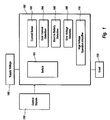
- Figure 1 is a block diagram of an integrated high side switch that provides protection from multiple fault conditions including over current detection, short to battery detection, and over voltage detection;
- Figure 2 is a block diagram of an integrated high side switch and a pair of current mirrors that generate scaled versions of current delivered through the switch;
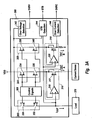
- Figure 3A is one embodiment of a high side switch with current sense, over current detection, short to battery detection, and over voltage detection;
- Figure 3B is one embodiment of an over voltage detection circuit that is integrated with a high side switch
- Figure 3C illustrates one embodiment of a short to battery detection circuit that is integrated with a high side switch
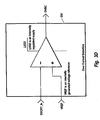
- Figure 3D illustrates one embodiment of an over current detection circuit that is integrated with a high side switch
- Figure 4 illustrates one embodiment of operational amplifier that is protected from high voltages
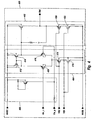
- Figure 5 illustrates another embodiment of a high side switch with fault protection.
- the present invention relates to an integrated semiconductor device that includes a high side switch.
- the present invention further relates to an integrated multi-fault protected high side switch.
- One advantage of the present invention is that the integrated semiconductor device is a single component that is less expensive than discrete components and that is more accurate than several discrete components implemented at a board level.
- the integrated semiconductor device described herein is typically more reliable than a group of discrete components.
- a high side switch typically refers to the fact that the switch is placed or located between a high potential or supply voltage and the load to which the supply voltage delivers power.
- Figure 1 is a block diagram that illustrates an integrated semiconductor device that includes a multi-fault protected high side switch.
- the high side switch as well as other electronic components such as the supply voltage or the load, can be protected from various fault conditions.
- the integrated semiconductor device 100 provides a current sense output 102, over current detection 104, short to battery detection 106, and over voltage detection 108.
- the integrated semiconductor device 100 also includes a high voltage operational amplifier 110 that can survive various fault conditions.
- the integrated semiconductor device 100 is usually configured to deliver power or current to a load 120 when the switch 101 is engaged or on.
- the load 120 can be, for example, a sensor or other electronic device.
- the integrated semiconductor device 100 receives control signals 130 through control inputs.
- the control signals turn the switch 101. on or off.
- the control signals 130 are typically received through a high output impedance level shifter in one embodiment.
- the ability to turn the high side switch 101 on and off is often useful in the operation of the load 120.
- the load 120 may be a sensor that is sampled periodically. As previously stated, however, fault conditions may occur and it is often necessary to protect the high side switch 101, a power source to the high side switch 101 such as the supply voltage 140, or the load 120 from these fault conditions that can potentially cause significant damage.
- the integrated semiconductor device 100 is also protected from the fault conditions that may occur during operation.
- the integrated semiconductor device 100 includes a current sense 102 that is fully integrated with the semiconductor device 100 in this embodiment.
- the output of the current sense 102 is smaller than the current delivered to the load 120 through the switch 101 by some factor.
- the output of the current sense 102 is typically measured by a microprocessor.
- the current sense 102 can then be used to monitor the current that is delivered to the load 120. For example, the current fluctuations of the current sense 102 can be interpreted by a microprocessor and used to monitor or control operational parameters of the vehicle.
- the over current detection 104 is also integrated with the semiconductor device 100 in this example.
- the over current detection 104 protects the integrated semiconductor device 100 from delivering potentially damaging currents to the load 120 or from currents that the integrated semiconductor device 100 cannot handle. High currents, for example, often produce significant heat that can breech the thermal limits of the integrated semiconductor device 100.
- the over current detection 104 measures a current that is also a scaled version of the current delivered through the switch 101.
- the current used by the over current detection 104 can be small as it is internal to the switch 100.
- the current detected by the over current detection 104 is measured and when the current reaches a threshold, the high side switch is turned off.
- the over current detection 104 can ensure that the switch 101 does not carry a current that would damage the integrated semiconductor device 100.
- the short to battery detection 106 is configured to protect the integrated semiconductor device 100 or other electrical devices from a short circuit fault condition.
- a short to battery fault condition occurs, for example, when the output of the high side switch 101 becomes shorted to an external battery supply or to any voltage that is higher than the supply voltage of the high side switch 101.
- Automotive electrical systems typically contain circuitry that would be damaged by the voltage delivered by a standard 12 volt supply.
- many of the electronic systems in vehicles have a regulated voltage that should deliver a safe and consistent voltage.
- the supply voltage to a particular sensor may be regulated at 5 volts.
- the short to battery fault condition is dangerous because the high side switch 101 cannot determine which way current is flowing. Thus, current could be fed into the regulated supply, thereby damaging the supply, the switch, and/or other components using the regulated supply.
- the short to battery detection 106 detects this condition and generates a signal that causes the integrated semiconductor device 100 to be shut off.
- the over voltage detection 108 protects against excessive voltages that can occur.
- An excessive voltage may appear, for example, during a load dump.
- a load dump occurs when current moving through a wire is suddenly shut off. This quick interruption creates a momentary voltage increase that could damage circuitry in the electrical systems of the vehicle including the integrated semiconductor device described herein. This type of problem may occur, for example, when a dead battery is "jump-started.”
- the integrated semiconductor device 100 also utilizes a high voltage operational amplifier 110 that can survive the extreme voltages experienced during the various fault conditions.
- FIG. 2 is a block diagram that illustrates one embodiment of an integrated semiconductor device 200 with multi-fault protection.
- the integrated semiconductor device 200 receives power from a supply voltage 224 (VDD) and is also connected with ground or a negative supply represented by VSS 222 (which may be ground).
- VDD supply voltage
- VSS 222 which may be ground.
- the control signals 206 and 210 are usually generated by a microprocessor and are used to control the switch 202, the current mirror 204, and the current mirror 208. More specifically, the control signals 206 and 210 turn the switch 202 and the current mirrors 204, 208 on and off. In one embodiment, the control signals 206 and 210 are the same control signals.
- the output impedance of the control signals is typically large in order to protect, for example, the microprocessor during a fault condition when current may flow into the microprocessor or to the supply voltage through the control signals.
- the switch 202 When the switch 202 is turned on, the switch 202 becomes a resistive path that delivers current to a load 120. When the switch 202 is turned off, the load 120 does not receive current.
- a current mirror 204 is included in the integrated semiconductor device 200 and is also controlled by the control signals 206.
- the current mirror 204 generates a sense current 218.
- a feedback circuit 214 is connected between the switch 202 and the current mirror 204.
- the feedback circuit 214 ensures that the voltage at the output of the switch 202 and the voltage at the output of the current mirror 204 are the same. This permits the sense current to be a scaled by a predetermined factor. In one embodiment, the sense current 218 is scaled by a factor of 10.
- the current mirror 208 is also integrated into the semiconductor device 200 and is controlled by the control signals 210.
- the current generated by the current mirror is used by the over current detection 220 to provide protection against an over current fault condition.
- the feedback circuit 216 ensures that the voltage at the output of the switch 202 is matched to the voltage at the output of the current mirror 208.
- the current mirror 208 can scale the current through the switch 202 by a larger factor. In one embodiment, the current mirror 208 scales the switch current by a factor of 105.
- the over current detection 220 monitors the current of the current mirror 208 and if the current of the current mirror 208 exceeds a certain level, then an OVCR signal 226 is generated.
- a microprocessor or other control logic upon receiving the OVCR signal 226, generates the necessary control signals to turn the switch 202, the current mirror 204, and the current mirror 208 off.
- the control signals 206, 210 may be generated using combinational logic or by a microprocessor. As described below, the integrated semiconductor device generates outputs that indicate fault conditions. The outputs generated by the semiconductor device 200 are provided as inputs to the microprocessor or combinational logic. When one or more of these signal outputs is asserted, the control signals are changed to turn the integrated semiconductor device off.
- the control signals 206, 210 are generated, in one embodiment, using level shifters. In order to prevent the level shifters from providing a path back to the supply voltage in a short to battery (STB) fault condition, the level shifters typically have a large output impedance.
- FIG. 3A is a block diagram of an exemplary embodiment of the present invention.
- the integrated semiconductor device 300 provides a high side switch 302.
- the switch 302 includes a lateral DMOS and a High Voltage extended drain PMOS transistors 330 and 332 connected in series between the supply voltage VDD and the load 370.
- the transistor 330 is not connected in a traditional manner. Rather, the drain of the extended drain PMOS 330 is connected with the supply voltage VDD and the source of the transistor 330 is connected with the source of the lateral DMOS 332. This effectively permits a double side protected transistor to be formed from two single side protected transistors.
- the transistors 330 and 332 require less substrate area.
- the on-state resistance of the transistors 330 and 332 would normally include a symmetrical double extended transistor that is almost four times the size of its non-extended counterpart. This embodiment, however, uses only approximately twice the area of its non-extended counterpart. Thus, there is a savings in die area and this embodiment provides the same level of high voltage protection as a double extended device.
- the transistors 330 and 332 are turned on and off by the control signals 306.
- the transistors 334 and 336 form a current mirror 304 while the transistors 338 and 340 form a current mirror 308.
- the transistors 334, 336, 338, and 340 are also PMOS transistors in one embodiment and are turned on and off by the control signals.
- the transistors 334 and 336 are connected at their respective sources.
- the transistors 338 and 340 are similarly connected.
- Figures 3B through Figure 3D illustrate examples of circuitry that is used to indicate the presence of a fault condition to a microprocessor or other control system.
- the control logic that receives the signals generated by the circuitry illustrated in Figures 3B through 3D generates the control signals that turn the switch and/or the current mirrors off, thereby providing protection. from the detected fault condition.
- the over voltage detection 342 ( Figure 3A) measures the supply voltage and sends a signal to a microprocessor or other control system if the supply voltage reaches a given threshold.
- the switch of the integrated semiconductor device 300 is disabled by the control signals generated by the microprocessor or control system.
- An exemplary over voltage detection circuit is illustrated generally in Figure 3B at 350.
- the OVRV signal is generated when the supply voltage exceeds a reference voltage.
- the reference voltage is generated internally by the integrated semiconductor device.
- the supply voltage is scaled in this example.
- the STB detection 344 ( Figure 3A) protects the semiconductor device and the supply voltage when the drain to substrate diode of the output transistor of the switch becomes forward biased, a fault condition that may feed current back into the supply voltage.
- the transistors in the switch as well as other integrated circuitry provides further protection and is considered, in one embodiment, as part of the STB detection 344.
- the STB detection 344 When the voltage at the output of the switch 302 becomes higher than the supply voltage, then the STB detection 344 generates a signal that is used to close the high side switch and the current mirrors.
- the over current protection 346 uses the current generated by the current mirror 308 to determine when the current in the output of the switch 302 reaches a threshold. If the threshold is reached, the over current protection generates a signal that causes the switch 302 to be turned off.
- the STB detection 352 compares the supply voltage with the-output of the switch or the voltage at the load. If the voltage at the load is higher than the supply voltage, then it is possible for current to be fed into the supply, thereby causing damage. This can occur even if the switch is turned off because the diode formed by the drain and the substrate of the output diode can become forward biased, thereby feeding a potentially large current back into the supply. Resistors or transistors can be used to limit the back fed current.
- Figure 3C illustrates that a STB signal is generated when the STB fault occurs.
- a microprocessor or other control logic upon receiving the STB signal, causes the control signals to turn the switch and current mirrors off. To properly turn a PMOS transistor off, the gate voltage needs to be tied to the highest potential. Thus, the control signals are at the output of a high output impedance level shifter to prevent the current from being fed back into the control logic or microprocessor.
- Figure 3D illustrates an example of the over current detection 346 shown in Figure 3A.
- the over current detection 354 asserts the OVRC signal if the current generated by the current mirror 308 exceeds a threshold. This can be determined, for example, by a reference voltage that is compared to the voltage at the output of the current mirror 308.
- the high side switch of the integrated semiconductor device is shut off if this fault condition is detected until the fault condition is resolved.
- the current mirrors are also shut off by the control signals.
- Figure 4 illustrates one embodiment of the operational amplifier that is included in the feedback circuitry 314 and 318 of Figure 3A.
- the feedback circuit 314 includes an operational amplifier 316 and transistor 317 that regulate the drain voltages of the current mirror 304 and the switch 302.
- the transistor 317 is connected at the output of the current mirror 304.
- the feedback circuit 318 also includes an operational amplifier ---320 and a transistor to monitor the drain voltages at the output of the current mirror 308.
- the operational amplifiers 316 and 318 in this embodiment, are common mode range biased to the supply voltage.
- the operational amplifier 400 includes a differential stage 404 and an output stage 402.
- the transistors 408 and 410 are NMOS transistors in this embodiment.
- the transistors 412 and 414 permit the input common mode voltages to approach the upper supply.
- the transistors 412 and 414 also have a high reverse breakdown voltage as added protection to the operational amplifier 400. This is necessary, for example, because the of a low voltage drop across the high side switch.
- Block 406 protects the input of the transistors 410 and 408 during a STB fault condition.
- the transistors 416, 418, 420, and 422 are used to bias the operational amplifier 400 and provide a more stable current bias over temperature and process changes.
- Figure 5 illustrates another embodiment of an integrated semiconductor device that is a multi-fault protected high side switch.
- the device 500 includes a switch 502, a current mirror 504 and a current mirror 506.
- the feedback circuits 512 and 514 each include an operational amplifier and a transistor as previously described to insure that the currents generated by the current mirrors are scaled versions of the current delivered through the switch 502.
- the transistors 516, 518, and 520 provide protection, for example, in a STB fault condition.
- the transistor 518 for example, shuts the channel of the transistor 550 when the transistor 518 is on. In other words, the transistor 518 creates a short between the gate and the drain of the transistor 550 when the transistor 518 is on.
- the transistor 518 also protects the transistor 554.
- the transistor 520 performs a similar function for the transistors 552 and 556.
- the transistors 516, 518, and 520 also protect the current mirror 506.
- the transistors 550 and 554 are lateral DMOS FET transistors that have a gate to drain breakdown voltage of approximately 44 volts and a gate to source breakdown voltage of approximately 13 volts.
- the transistors 552 and 556 are extended drain PMOS FET transistors that have a gate to drain breakdown voltage of approximately 13 volts and a gate to source breakdown voltage of approximately 5 volts.
Landscapes
- Electronic Switches (AREA)
- Semiconductor Integrated Circuits (AREA)
- Amplifiers (AREA)
Applications Claiming Priority (2)
| Application Number | Priority Date | Filing Date | Title |
|---|---|---|---|
| US10/442,630 US7372685B2 (en) | 2003-05-20 | 2003-05-20 | Multi-fault protected high side switch with current sense |
| US442630 | 2003-05-20 |
Publications (2)
| Publication Number | Publication Date |
|---|---|
| EP1482641A2 true EP1482641A2 (de) | 2004-12-01 |
| EP1482641A3 EP1482641A3 (de) | 2006-01-04 |
Family
ID=33131524
Family Applications (1)
| Application Number | Title | Priority Date | Filing Date |
|---|---|---|---|
| EP04011211A Withdrawn EP1482641A3 (de) | 2003-05-20 | 2004-05-11 | Vielfachfehlergeschützter spannungsseitiger Schalter mit Stromerfassung |
Country Status (2)
| Country | Link |
|---|---|
| US (1) | US7372685B2 (de) |
| EP (1) | EP1482641A3 (de) |
Cited By (1)
| Publication number | Priority date | Publication date | Assignee | Title |
|---|---|---|---|---|
| DE102008032556B3 (de) * | 2008-07-10 | 2009-09-10 | Infineon Technologies Austria Ag | Leistungsschalter mit einer Überstromschutzvorrichtung |
Families Citing this family (15)
| Publication number | Priority date | Publication date | Assignee | Title |
|---|---|---|---|---|
| TW576008B (en) * | 2002-09-10 | 2004-02-11 | Richtek Technology Corp | High-voltage side short-circuit protection apparatus and method for DC/DC converter |
| JP4315125B2 (ja) * | 2005-05-11 | 2009-08-19 | トヨタ自動車株式会社 | 電圧駆動型半導体素子の駆動装置 |
| DE102005046993B3 (de) * | 2005-09-30 | 2007-02-22 | Infineon Technologies Ag | Vorrichtung und Verfahren zum Erzeugen eines Leistungssignals aus einem Laststrom |
| JP4842614B2 (ja) * | 2005-10-27 | 2011-12-21 | ルネサスエレクトロニクス株式会社 | 電流検出回路 |
| US7711967B2 (en) * | 2006-01-17 | 2010-05-04 | Broadcom Corporation | Apparatus and method for multi-point detection in power-over ethernet detection mode |
| US7619864B1 (en) | 2007-04-04 | 2009-11-17 | National Semiconductor Corporation | Regulator short-circuit protection circuit and method |
| US7679878B2 (en) * | 2007-12-21 | 2010-03-16 | Broadcom Corporation | Capacitor sharing surge protection circuit |
| US8373449B2 (en) * | 2010-12-30 | 2013-02-12 | Infineon Technologies Ag | Circuit arrangement including a common source sense-FET |
| DE102012109979A1 (de) * | 2012-10-19 | 2014-05-15 | Dspace Digital Signal Processing And Control Engineering Gmbh | Schutzschaltungsanordnung und Verfahren zum Schutz einer elektrischen Schaltungseinrichtung sowie Vorrichtung mit der zu schützenden Schaltung und der Schutzschaltungsanordnung |
| US9360879B2 (en) * | 2014-04-28 | 2016-06-07 | Microsemi Corp.-Analog Mixed Signal Group, Ltd. | Sense current generation apparatus and method |
| CN107947124B (zh) * | 2017-12-04 | 2019-04-16 | 合肥中感微电子有限公司 | 改进的电池保护系统 |
| US10848142B2 (en) * | 2018-05-10 | 2020-11-24 | Texas Instruments Incorporated | Constant resistance input pass switch with overvoltage protection |
| US11502674B2 (en) | 2020-07-20 | 2022-11-15 | Texas Instruments Incorporated | Optimized low Ron flatness gate driver |
| US12040785B2 (en) | 2021-09-24 | 2024-07-16 | Qualcomm Incorporated | Robust transistor circuitry |
| US12181963B2 (en) | 2021-09-24 | 2024-12-31 | Qualcomm Incorporated | Robust circuitry for passive fundamental components |
Family Cites Families (27)
| Publication number | Priority date | Publication date | Assignee | Title |
|---|---|---|---|---|
| US4750079A (en) * | 1986-05-27 | 1988-06-07 | Motorola, Inc. | Low side switch integrated circuit |
| US5184272A (en) * | 1989-03-31 | 1993-02-02 | Hitachi, Ltd. | High-side switch with overcurrent protecting circuit |
| US5164659A (en) * | 1991-08-29 | 1992-11-17 | Warren Schultz | Switching circuit |
| JP3084982B2 (ja) * | 1992-11-25 | 2000-09-04 | 富士電機株式会社 | 半導体装置 |
| JPH07146722A (ja) * | 1993-10-01 | 1995-06-06 | Fuji Electric Co Ltd | トランジスタ用過電流保護装置 |
| US5438489A (en) * | 1993-09-30 | 1995-08-01 | Judy; Steven W. | Solenoid driver circuit and diagnostics |
| US5459732A (en) * | 1993-11-19 | 1995-10-17 | Delco Electronics Corporation | Method and apparatus for anti-lock brake single channel wheel speed processing with diagnosis |
| US5372410A (en) * | 1994-02-02 | 1994-12-13 | National Semiconductor Corporation | Anti-lock braking system |
| KR100202635B1 (ko) * | 1995-10-13 | 1999-06-15 | 구본준 | 리서프 이디모스 트랜지스터와 이를 이용한 고전압 아날로그의 멀티플렉서회로 |
| EP0918997A1 (de) * | 1996-08-14 | 1999-06-02 | Siemens Aktiengesellschaft | Schaltungsanordnung zum erfassen des laststroms eines leistungs-halbleiterbauelements mit sourceseitiger last |
| US5825218A (en) * | 1996-10-24 | 1998-10-20 | Stmicroelectronics, Inc. | Driver circuit including slew rate control system with improved voltage ramp generator |
| ITMI981217A1 (it) * | 1997-06-05 | 1999-12-02 | Denso Corp | Struttura perfezionata per un circuito di misura di corrente |
| EP0978143B1 (de) * | 1997-10-28 | 2010-07-14 | Nxp B.V. | Halbleiterbauelement mit einem halbbrücken-schaltkreis |
| US6028438A (en) * | 1997-10-31 | 2000-02-22 | Credence Systems Corporation | Current sense circuit |
| DE19844665C1 (de) * | 1998-09-29 | 2000-03-30 | Siemens Ag | Schaltungsanordnung zur Steuerung und Erfassung des Laststromes durch eine Last |
| US6347028B1 (en) * | 1999-06-21 | 2002-02-12 | Lutron Electronics Co., Inc. | Load control system having an overload protection circuit |
| DE69939535D1 (de) * | 1999-08-20 | 2008-10-23 | Em Microelectronic Marin Sa | System zur Steuerung eines Zweirichtungs-Schalters mit zwei Transistoren |
| US6154012A (en) * | 1999-10-13 | 2000-11-28 | Xicor, Inc. | Gas gauge implementation |
| FR2802360B1 (fr) * | 1999-12-14 | 2002-03-01 | Legrand Sa | Procede et dispositif d'alimentation electrique d'une charge par un variateur a au moins un interrupteur commande |
| US6330143B1 (en) * | 2000-02-23 | 2001-12-11 | Ford Global Technologies, Inc. | Automatic over-current protection of transistors |
| US6323703B1 (en) * | 2000-05-04 | 2001-11-27 | Exar Corporation | Indirect output current sensing |
| US6678829B1 (en) * | 2000-06-19 | 2004-01-13 | Texas Instruments Incorporated | System and method of regulating the distribution of power throughout a system through the use of uni-directional and bi-directional switches |
| DE10042585C1 (de) * | 2000-08-30 | 2002-11-14 | Infineon Technologies Ag | Schaltungsanordnung zur Erfassung des Stromes in einem Lasttransistor |
| US6407532B1 (en) * | 2000-12-29 | 2002-06-18 | Nokia Mobile Phones, Ltd. | Method and apparatus for measuring battery charge and discharge current |
| US6509781B2 (en) * | 2001-03-20 | 2003-01-21 | Koninklijke Philips Electronics N.V. | Circuit and method for controlling a dynamic, bi-directional high voltage analog switch |
| DE10129353C1 (de) * | 2001-06-19 | 2002-10-10 | Siemens Ag | Schaltungstopologie für einen bidirektionalen Energietransfer |
| US6836148B2 (en) * | 2002-04-08 | 2004-12-28 | Texas Instruments Incorporated | Versatile high voltage outputs using low voltage transistors |
-
2003
- 2003-05-20 US US10/442,630 patent/US7372685B2/en not_active Expired - Lifetime
-
2004
- 2004-05-11 EP EP04011211A patent/EP1482641A3/de not_active Withdrawn
Cited By (1)
| Publication number | Priority date | Publication date | Assignee | Title |
|---|---|---|---|---|
| DE102008032556B3 (de) * | 2008-07-10 | 2009-09-10 | Infineon Technologies Austria Ag | Leistungsschalter mit einer Überstromschutzvorrichtung |
Also Published As
| Publication number | Publication date |
|---|---|
| US7372685B2 (en) | 2008-05-13 |
| EP1482641A3 (de) | 2006-01-04 |
| US20040233604A1 (en) | 2004-11-25 |
Similar Documents
| Publication | Publication Date | Title |
|---|---|---|
| US7372685B2 (en) | Multi-fault protected high side switch with current sense | |
| US8013612B2 (en) | Ground fault detection circuit for use in high voltage motor drive applications | |
| US6650520B2 (en) | Power supply reverse bias protection circuit for protecting both analog and digital devices coupled thereto | |
| CN108512534B (zh) | 半导体器件和具有半导体器件的电子控制系统 | |
| US8116052B2 (en) | Power supply control circuit including overvoltage protection circuit | |
| US6392392B1 (en) | Over-current detecting circuit | |
| US20090268360A1 (en) | Protection circuit | |
| US10686323B2 (en) | Charge/discharge control circuit and battery device including the same | |
| US5483406A (en) | Overvoltage protection circuit | |
| US20060170462A1 (en) | Reliability comparator with hysteresis | |
| US5543996A (en) | Protective circuit for protecting transistor from thermal destruction | |
| US9733284B2 (en) | Current detection circuit | |
| CN112240950A (zh) | 反向电流负载状况期间的鲁棒电流感测 | |
| US12047062B2 (en) | Electronic circuit and sensor system | |
| TWI388100B (zh) | 形成整合式電壓保護裝置及結構之方法 | |
| CN102474094B (zh) | 具有保护电路的电子装置 | |
| EP3306767B1 (de) | Schaltungsschutzanordnung | |
| US6956425B2 (en) | Clamping circuit for high-speed low-side driver outputs | |
| JP4882710B2 (ja) | 負荷駆動装置の故障検出装置および負荷駆動用ic | |
| US6643111B1 (en) | Electronic transducer device | |
| US5498912A (en) | Majority voted two fault tolerant power switch | |
| US6292341B1 (en) | Bidirectional electronic switch | |
| KR20180112699A (ko) | 차량용 안전 유닛을 위한 활성화 전압의 제공을 위한 장치 및 방법, 그리고 안전 장치 | |
| US7336122B2 (en) | Low power high side current monitor which operates at high voltages and method therefor | |
| US11855450B2 (en) | ESD protection circuit with GIDL current detection |
Legal Events
| Date | Code | Title | Description |
|---|---|---|---|
| PUAI | Public reference made under article 153(3) epc to a published international application that has entered the european phase |
Free format text: ORIGINAL CODE: 0009012 |
|
| AK | Designated contracting states |
Kind code of ref document: A2 Designated state(s): AT BE BG CH CY CZ DE DK EE ES FI FR GB GR HU IE IT LI LU MC NL PL PT RO SE SI SK TR |
|
| AX | Request for extension of the european patent |
Extension state: AL HR LT LV MK |
|
| PUAL | Search report despatched |
Free format text: ORIGINAL CODE: 0009013 |
|
| AK | Designated contracting states |
Kind code of ref document: A3 Designated state(s): AT BE BG CH CY CZ DE DK EE ES FI FR GB GR HU IE IT LI LU MC NL PL PT RO SE SI SK TR |
|
| AX | Request for extension of the european patent |
Extension state: AL HR LT LV MK |
|
| AKX | Designation fees paid | ||
| STAA | Information on the status of an ep patent application or granted ep patent |
Free format text: STATUS: THE APPLICATION IS DEEMED TO BE WITHDRAWN |
|
| 18D | Application deemed to be withdrawn |
Effective date: 20060705 |
|
| REG | Reference to a national code |
Ref country code: DE Ref legal event code: 8566 |