EP1482643A2 - Verfahren und Vorrichtung zur Decodierung eines Low Density Partity Check (LDPC) Codes in einem Kommunikationssystem - Google Patents
Verfahren und Vorrichtung zur Decodierung eines Low Density Partity Check (LDPC) Codes in einem Kommunikationssystem Download PDFInfo
- Publication number
- EP1482643A2 EP1482643A2 EP04012500A EP04012500A EP1482643A2 EP 1482643 A2 EP1482643 A2 EP 1482643A2 EP 04012500 A EP04012500 A EP 04012500A EP 04012500 A EP04012500 A EP 04012500A EP 1482643 A2 EP1482643 A2 EP 1482643A2
- Authority
- EP
- European Patent Office
- Prior art keywords
- value
- values
- bit
- decoding
- ldpc
- Prior art date
- Legal status (The legal status is an assumption and is not a legal conclusion. Google has not performed a legal analysis and makes no representation as to the accuracy of the status listed.)
- Granted
Links
Images


Classifications
-
- H—ELECTRICITY
- H03—ELECTRONIC CIRCUITRY
- H03M—CODING; DECODING; CODE CONVERSION IN GENERAL
- H03M13/00—Coding, decoding or code conversion, for error detection or error correction; Coding theory basic assumptions; Coding bounds; Error probability evaluation methods; Channel models; Simulation or testing of codes
- H03M13/03—Error detection or forward error correction by redundancy in data representation, i.e. code words containing more digits than the source words
- H03M13/05—Error detection or forward error correction by redundancy in data representation, i.e. code words containing more digits than the source words using block codes, i.e. a predetermined number of check bits joined to a predetermined number of information bits
- H03M13/11—Error detection or forward error correction by redundancy in data representation, i.e. code words containing more digits than the source words using block codes, i.e. a predetermined number of check bits joined to a predetermined number of information bits using multiple parity bits
-
- H—ELECTRICITY
- H03—ELECTRONIC CIRCUITRY
- H03M—CODING; DECODING; CODE CONVERSION IN GENERAL
- H03M13/00—Coding, decoding or code conversion, for error detection or error correction; Coding theory basic assumptions; Coding bounds; Error probability evaluation methods; Channel models; Simulation or testing of codes
- H03M13/37—Decoding methods or techniques, not specific to the particular type of coding provided for in groups H03M13/03 - H03M13/35
- H03M13/39—Sequence estimation, i.e. using statistical methods for the reconstruction of the original codes
- H03M13/3905—Maximum a posteriori probability [MAP] decoding or approximations thereof based on trellis or lattice decoding, e.g. forward-backward algorithm, log-MAP decoding, max-log-MAP decoding
- H03M13/3927—Log-Likelihood Ratio [LLR] computation by combination of forward and backward metrics into LLRs
-
- H—ELECTRICITY
- H03—ELECTRONIC CIRCUITRY
- H03M—CODING; DECODING; CODE CONVERSION IN GENERAL
- H03M13/00—Coding, decoding or code conversion, for error detection or error correction; Coding theory basic assumptions; Coding bounds; Error probability evaluation methods; Channel models; Simulation or testing of codes
- H03M13/03—Error detection or forward error correction by redundancy in data representation, i.e. code words containing more digits than the source words
- H03M13/05—Error detection or forward error correction by redundancy in data representation, i.e. code words containing more digits than the source words using block codes, i.e. a predetermined number of check bits joined to a predetermined number of information bits
- H03M13/11—Error detection or forward error correction by redundancy in data representation, i.e. code words containing more digits than the source words using block codes, i.e. a predetermined number of check bits joined to a predetermined number of information bits using multiple parity bits
- H03M13/1102—Codes on graphs and decoding on graphs, e.g. low-density parity check [LDPC] codes
- H03M13/1105—Decoding
- H03M13/1111—Soft-decision decoding, e.g. by means of message passing or belief propagation algorithms
- H03M13/1117—Soft-decision decoding, e.g. by means of message passing or belief propagation algorithms using approximations for check node processing, e.g. an outgoing message is depending on the signs and the minimum over the magnitudes of all incoming messages according to the min-sum rule
-
- H—ELECTRICITY
- H03—ELECTRONIC CIRCUITRY
- H03M—CODING; DECODING; CODE CONVERSION IN GENERAL
- H03M13/00—Coding, decoding or code conversion, for error detection or error correction; Coding theory basic assumptions; Coding bounds; Error probability evaluation methods; Channel models; Simulation or testing of codes
- H03M13/03—Error detection or forward error correction by redundancy in data representation, i.e. code words containing more digits than the source words
- H03M13/05—Error detection or forward error correction by redundancy in data representation, i.e. code words containing more digits than the source words using block codes, i.e. a predetermined number of check bits joined to a predetermined number of information bits
- H03M13/11—Error detection or forward error correction by redundancy in data representation, i.e. code words containing more digits than the source words using block codes, i.e. a predetermined number of check bits joined to a predetermined number of information bits using multiple parity bits
- H03M13/1102—Codes on graphs and decoding on graphs, e.g. low-density parity check [LDPC] codes
- H03M13/1105—Decoding
- H03M13/1111—Soft-decision decoding, e.g. by means of message passing or belief propagation algorithms
- H03M13/1117—Soft-decision decoding, e.g. by means of message passing or belief propagation algorithms using approximations for check node processing, e.g. an outgoing message is depending on the signs and the minimum over the magnitudes of all incoming messages according to the min-sum rule
- H03M13/112—Soft-decision decoding, e.g. by means of message passing or belief propagation algorithms using approximations for check node processing, e.g. an outgoing message is depending on the signs and the minimum over the magnitudes of all incoming messages according to the min-sum rule with correction functions for the min-sum rule, e.g. using an offset or a scaling factor
-
- H—ELECTRICITY
- H03—ELECTRONIC CIRCUITRY
- H03M—CODING; DECODING; CODE CONVERSION IN GENERAL
- H03M13/00—Coding, decoding or code conversion, for error detection or error correction; Coding theory basic assumptions; Coding bounds; Error probability evaluation methods; Channel models; Simulation or testing of codes
- H03M13/03—Error detection or forward error correction by redundancy in data representation, i.e. code words containing more digits than the source words
- H03M13/05—Error detection or forward error correction by redundancy in data representation, i.e. code words containing more digits than the source words using block codes, i.e. a predetermined number of check bits joined to a predetermined number of information bits
- H03M13/11—Error detection or forward error correction by redundancy in data representation, i.e. code words containing more digits than the source words using block codes, i.e. a predetermined number of check bits joined to a predetermined number of information bits using multiple parity bits
- H03M13/1102—Codes on graphs and decoding on graphs, e.g. low-density parity check [LDPC] codes
- H03M13/1105—Decoding
- H03M13/1131—Scheduling of bit node or check node processing
-
- H—ELECTRICITY
- H03—ELECTRONIC CIRCUITRY
- H03M—CODING; DECODING; CODE CONVERSION IN GENERAL
- H03M13/00—Coding, decoding or code conversion, for error detection or error correction; Coding theory basic assumptions; Coding bounds; Error probability evaluation methods; Channel models; Simulation or testing of codes
- H03M13/65—Purpose and implementation aspects
- H03M13/6502—Reduction of hardware complexity or efficient processing
- H03M13/6505—Memory efficient implementations
-
- H—ELECTRICITY
- H03—ELECTRONIC CIRCUITRY
- H03M—CODING; DECODING; CODE CONVERSION IN GENERAL
- H03M13/00—Coding, decoding or code conversion, for error detection or error correction; Coding theory basic assumptions; Coding bounds; Error probability evaluation methods; Channel models; Simulation or testing of codes
- H03M13/65—Purpose and implementation aspects
- H03M13/6577—Representation or format of variables, register sizes or word-lengths and quantization
- H03M13/658—Scaling by multiplication or division
-
- H—ELECTRICITY
- H03—ELECTRONIC CIRCUITRY
- H03M—CODING; DECODING; CODE CONVERSION IN GENERAL
- H03M13/00—Coding, decoding or code conversion, for error detection or error correction; Coding theory basic assumptions; Coding bounds; Error probability evaluation methods; Channel models; Simulation or testing of codes
- H03M13/65—Purpose and implementation aspects
- H03M13/6577—Representation or format of variables, register sizes or word-lengths and quantization
- H03M13/6588—Compression or short representation of variables
Definitions
- the present invention relates generally to a Forward Error Correction (FEC) apparatus and method for use in a digital communication system, and more particularly to an apparatus and method for decoding an FEC code in a digital communication system for transmitting high-speed data.
- FEC Forward Error Correction
- a wireless communication system based on the 3GPP or 3GPP2 specification proposed using convolutional codes to transmit voice and control signals, and also proposed using turbo codes to effectively transmit high-speed data.
- the turbo code for high-speed data transmission has an advantage in that it has an extremely low BER (Bit Error Rate) at a low SNR (Signal to Noise Ratio), but it has a number of disadvantages in its performance and implementation.
- the turbo code has a relatively short minimum distance of a codeword. Therefore, when decoding a signal coded with the turbo code, there may arise an error floor at a desired BER location.
- the turbo code has another disadvantage in that it has a relatively high undetected error probability in association with a codeword for generating errors in a decoding mode.
- a decoding process of the turbo code requires an effective decoding stop function to reduce not a decoding time and its power consumption, such that it requires either a CRC (Cyclic Redundancy Check) process to detect errors for every iterative decoding process, or an additional algorithm to perform a decoding stop process, resulting in implementation of an effective decoding stop function.
- CRC Cyclic Redundancy Check
- an algorithm for decoding the turbo code cannot be implemented in the form of a parallel architecture, resulting in limitation in improving a decoding speed.
- the LDPC code contains a very small number of a specific number "1" in individual rows and columns of a parity check matrix for code definition, and its architecture can be defined by a factor graph comprising a check node, a variable node, and an edge for interconnecting the check node and the variable node.
- the LDPC code has a longer minimum distance as compared to the turbo code, such that an error floor occurs at a very lower BER as compared to the turbo code and undetected error probability for an erroneous codeword is a very low value experimentally approximating zero.
- the LDPC code can be implemented in the form of a parallel architecture, resulting in a reduced decoding time.
- the LDPC code can perform an effective decoding stop function without using either an overhead, such as a CRC, or a specific decoding stop algorithm having been added through the use of a parity check process performed for each iterative decoding process.
- the LDPC code is a linear block code in which most elements of a parity check matrix H are each equal to '0', and uses a probable iterative decoding method using a simple parity check equation, resulting in improvement of performance.
- the decoding method for the LDPC is designed to search for the most probable codeword by which the multiplication of a reception signal vector and a parity check matrix satisfies a specific value of '0'.
- a Sum-Product algorithm acting a representative LDPC-code decoding method performs a soft-decision iterative decoding process using a probability value to search for the above codeword. More specifically, the Sum-Product algorithm updates a probability value of each bit using a reception vector and a channel characteristic for every iterative decoding process, such that it can search for a codeword having the multiplied result '0' associated with the parity check matrix.
- LLR-BP LLR-Belicf Propagation
- LLR-BP Log-Likelihood Ratio
- the LLR-BP algorithm can be considered to be the same algorithm as the Sum-Product algorithm.
- the LLR-BP algorithm has excellent performance because it approximates Shannon's theoretical channel capacitance boundary on the assumption that the length of a codeword is sufficiently long.
- the LLR-BP algorithm uses a log function and a hyper-tangent (tanh) function for use in the iterative decoding process, thereby increasing calculation complexity and difficulty in its real implementation.
- the above algorithms are a UMP-BP (Uniformly Most Powerful-Belief Propagation) algorithm and a Normalized-BP (Normalized-Belief Propagation) algorithm, which reduce iterative decoding complexity and encounter less performance deterioration as compared to the conventional LLR-BP algorithm.
- the UMP-BP algorithm prevents a log function and a tanh function from being used in a row-directional iterative decoding process of the LLR-BP algorithm, selects a bit value having the lowest LLR from among a plurality of bits associated with a given parity check equation, and approximates the selected bit value, considerably reduced complexity.
- the Normalized-BP algorithm approximates the row-directional iterative decoding process in the same manner as in the UMP-BP algorithm, largely reducing calculation complexity.
- the UMP-BP method has introduced a standardized factor concept, such that it prevents a message value from being higher than that of the LLR-BP algorithm due to the LLR omission in such approximation. Therefore, the UMP-BP algorithm can implement performance similar to that of the LLR-BP algorithm.
- the UMP-BP algorithm adapts a specific omission part to reduce complexity, such that its bit-average LLR is higher than that of the LLR-BP algorithm.
- the Normalized-BP algorithm adapts a normalization factor alpha scheme to reduce the difference between the above two LLRs, such that it allows an average value of individual LLRs to be similar to that of the LLR-BP algorithm, resulting in excellent performance superior to that of the UMP-BP algorithm.
- Fig. 1 is a conceptual diagram illustrating a relationship between check nodes and variable nodes to explain a factor process for decoding the LDPC code.
- symbols coded by the LDPC code matrix are transmitted via wireless channel environments, and individual coded symbols enter bit nodes (..., 111, 112, 113, 114, ).
- the bit nodes (..., 111, 112, 113, 114, ...) receive LLR values of entry coded symbols, and transmit the received LLR values to individual check nodes (..., 121, 122, 123, 124, 125, ).
- Individual check nodes (..., 121, 122, 123, 124, 125, %) perform their operations using different using the aforementioned methods, and transmit the operation results to the bit nodes (..., 111, 112, 113, 114, ). It is determined whether the values transmitted to the bit nodes (..., 111, 112, 113, 114, %) satisfy parity check requirements in a temporary decoding process. If it is determined that the parity check requirements have been satisfied, a decoding process for corresponding symbols is terminated.
- values to be detected are re-calculated using a transmission/operation method between bit nodes (..., 111, 112, 113, 114, ...) and check nodes (..., 121, 122, 123, 124, 125, ).
- Fig. 2 is a flow chart illustrating the Normalized-BP algorithm.
- the LDPC decoder upon receiving coded symbols from a wireless channel, performs an initialization process at step 200.
- the initialization process determines values Z mn of bit nodes, and determines the values Z mn to be values of individual initial-entry coded symbols y n .
- the values Z mn of the bit nodes identify an LLR ranging from a bit node N to a check node m.
- individual bit nodes (..., 111, 112, 113, 115, ...) of the LDPC decoder perform operations for bits to be calculated in a row-directional iterative decoding process at step 202. Such operation determines an initial-entry value as shown in Equation 1, and operates a modulo-2-sum operation of the remaining bits using all parity check equations associated with bits to be calculated on the basis of the determined values.
- ⁇ mn is represents values received from a bit node 'm' to an n-th check node
- ⁇ m is a value determined by an m-th bit node
- Equation 2 integrates an initially-received value and calculation values of individual parity check equations as one value, such that it determines a bit code to be calculated.
- Equation 2 represents a row-directional iterative decoding process for the Normalized-BP algorithm, where Z mn is an LLR of the bit 'n' propagated from the bit 'n' to a parity check equation 'm', and ⁇ is a standardized factor for use in the Normalized-BP algorithm.
- LLR values of individual bits are initialized to a reception value.
- the LDPC decoder performs a column-directional iterative decoding process at step 206.
- the column-directional iterative decoding process is a process for updating the value of Z mn , and it can be represented by the Equation 3:
- the LDPC decoder determines whether the number of iterative decoding times is equal to a prescribed maximum number of iterative decoding times at step 208.
- the maximum number of iterative decoding times is used to halt the decoding operation on the condition that very-low decoding success probability is provided when continuously performing an iterative decoding operation. If the LDPC decoder has performed the decoding operation the maximum decoding times at step 208, it performs a decoding failure process at step 212. However, if the LDPC decoder not has performed the decoding operation the maximum decoding times, it performs a temporary decoding process at step 210.
- the temporary decoding process can be performed using Equation 4:
- the value of Z n can be calculated using Equation 4, such that values of c and of code symbols are determined, the LDPC decoder performs a parity cheek such that it determines whether a parity check result is satisfied or not at step 214.
- the LDPC decoder terminates the decoding process for corresponding symbols at step 216. However, when the parity check process is not satisfied, the LDPC decoder returns to step 202 to re-perform the aforementioned steps, such that the iterative decoding steps are continuously performed.
- Fig. 3 is a simulation result graph for the comparison between performances according to methods for decoding an LDPC code having a block length of 20000. Referring to Fig. 3, the BER of the Normalized-BP algorithm is less than that of the LLR-BP algorithm by about 0.07 dB. More specifically, the Normalized-BP algorithm has a disadvantage in that it unavoidably encounters performance deterioration.
- the present invention has been designed in view of the above and other problems, and it is an object of the present invention to provide an apparatus and method for improving decoding performance of the Normalized-BP algorithm in an LDPC-code decoder.
- an Low Density Parity Check (LDPC)-code decoding apparatus for decoding symbols coded with LDPC-codes, comprising: a syndrome calculator for receiving parity values of the coded symbols, calculating a syndrome value using the received parity values, and generating the calculated syndrome value as a parity value; a comparison/selection unit for receiving channel reliability values of the coded symbols, receiving the syndrome value, selecting a reliability value having a lowest LLR (Log-Likelihood Ratio) from among the channel reliability values, and generating the selected reliability value; a switch for switching an output signal of the comparison/selection unit to one of three output terminals according to one of first to third switching control signals, respectively; first through third multipliers in which the three output terminals of the switch are connected to a first standardization factor ⁇ 1 , a second standardization factor ⁇ 2 , and a third standardization factor ⁇ 3 , respectively, such that they output their reliability values
- LLR Log-Likelihood Ratio
- the predetermined condition comprises: a first condition in which the first switching control signal connects the output value of the comparison/selection unit to the second multiplier when a resultant value of LLR-associated reliabilities having been modulo-operated using a specific value '2' is equal to '0'; a second condition in which the second switching control signal connects the output value of the comparison/selection unit to the third multiplier when the modulo-operation result is equal to '1', an input symbol value is a minimum value, and a bit node input value of the LDPC code is equal to the minimum value, and a third condition in which the third switching control signal connects the output value of the comparison/selection unit to the first multiplier when the modulo-operation result is equal to '1', the input symbol value is not equal to a minimum value, and the bit node input value of the LDPC code is not equal to the minimum value.
- a Low Density Parity Check (LDPC)-code decoding method for decoding symbols coded with LDPC-codes, comprising the steps of: a) receiving initial coded symbols; b) performing initialization using individual values of received symbols; c) modulo-operating a sum of individual messages applied to bit nodes of the LDPC codes using a specific value of 2, and determining values of individual bit nodes; d) determining whether the determined values of the bit nodes are each equal to a specific value of 0; e) performing a row-directional iterative decoding process using a second standardization factor ⁇ 2 when the value of 0 is determined at the step (d); f) determining whether a current bit node value is equal to a minimum value when the value of 1 is determined at the step (d); g) performing a row-directional iterative decoding process using a first standardization factor ⁇ 1 when the current bit node value is not equal to the minimum value;
- LDPC Low Density Parity Check
- Fig. 4 is a flow chart illustrating a control method for use in an LDPC-code decoder in accordance with a preferred embodiment of the present invention.
- the LDPC decoder performs an initialization process at step 400. This initialization process is the same as that of the conventional art illustrated in Fig. 2.
- the LDPC decoder After performing the initialization process at step 400, the LDPC decoder performs a row-directional iterative decoding process for updating values ⁇ mn and ⁇ n at step 402 in the same manner as described in conjunction with Fig. 2. More specifically, the LDPC decoder calculates the sum of coded symbols received in a specific check node from among individual bit nodes using the mod-2 scheme as shown in Equation 1.
- the LDPC decoder determines whether the value of ⁇ m is equal to '1' at step 404.
- Step 404 determines whether the value of ⁇ m is equal to '1' is determined by LDPC-code characteristics.
- the value of ⁇ m calculated at a specific time while performing either all reception coded symbols or an iterative decoding process has always been designed to be the value of 1 when there are errors.
- the value of ⁇ m comprises the sum of several values, instead of only one value, such that there are two cases in which the value of ⁇ m has the value of 1. More specifically, the first case occurs when the probability of generating such errors is in a low level. The second case occurs when the probability of generating such errors is in a high level.
- step 404 if the check result of the above step 404 corresponds to the aforementioned two cases, i.e., if the value of ⁇ m has the value of 1, the LDPC decoder proceeds to step 408. However, if the check result of the step 404 does not correspond to the two cases, the LDPC decoder proceeds to step 406. If the LDPC decoder proceeds to step 406, this means there are no errors, such that it performs a second iterative decoding process in a row direction according to the present invention.
- Equation 6 [Equation 6] (-1) ⁇ m ⁇ mn min n' ⁇ N ( m ) ⁇ n
- Equation 6 has a value of a different from that of Equation 2 described in the conventional art.
- the present invention more precisely divides the tanh-curve standardization step for reducing the number of LLR-value calculations on the basis of the aforementioned reference. Therefore, the present invention more precisely divides not only a standardization factor used when only one or more odd errors occur, but also other factors, such that it can determine an appropriate factor value.
- the first case in which there is an error in factor values, and the remaining cases having no error in such factor values will be described in more detail herein below.
- the LDPC decoder performs a row-directional iterative decoding process using a second standardization factor ⁇ 2 shown in Equation 6 at step 406.
- the LDPC decoder determines whether the value of Z mn is a minimum value at step 408. If it is determined that the value of Z mn is the minimum value at stcp 408, the LDPC decoder proceeds to step 412. However, if the value of Z mn is not equal to the minimum value at step 408, the LDPC decoder proceeds to step 410.
- the LDPC decoder proceeds to step 412, such that it performs a row-directional iterative decoding process using a third standardization factor according to the present invention at step 412.
- a method for performing the row-directional iterative decoding using the third standardization factor can be represented by the following equation 7: [Equation 7] (-1) ⁇ m ⁇ mn min n ' ⁇ N ( m ) ⁇ n
- Equation 7 has ⁇ value of a different from that of Equation 2 described in the conventional art. If the value of Z mn is not equal to the minimum value, i.e., if error generation probability is low, the LDPC decoder proceeds to step 410, such that it performs the row-directional iterative decoding process using the first standardization factor ⁇ 1 , as shown in Equation 8: [Equation 8] (-1) ⁇ m ⁇ mn min n ' ⁇ N ( m ) ⁇ n
- Equation 9 [Equation 9] ⁇ 1 > ⁇ 2 > ⁇ 3
- the second standardization factor ⁇ 2 from among individual standardization factors of the present invention may be equal to the standardization factor ⁇ described in the conventional art, and may have other values different from the standardization factor ⁇ . Individual standardization factors of the present invention must always maintain the relationship denoted by Equation 9, regardless of the second standardization factor ⁇ 2 .
- the LDPC decoder proceeds to step 414 after the row-directional iterative decoding process has been completed at step 406, 410, or 412.
- the LDPC decoder performs a column-directional iterative decoding process for updating the value of Z mn equal to the aforementioned LLR.
- the column-directional iterative decoding process performs an iterative decoding process using Equation 3 in the same manner as in the conventional art.
- the LDPC decoder Upon completing the column-directional iterative decoding process, the LDPC decoder proceeds to step 416, such that it determines whether the number of current iterative times reaches a maximum number of iterative times at step 416. If it is determined that the number of current iterative times is equal to the maximum number of iterative times at step 416, the LDPC decoder informs corresponding reception coded symbols of a decoding failure at step 418 in such a way that it performs a corresponding process accompanied with the decoding failure.
- the LDPC decoder proceeds to step 420, such that it performs a temporary decoding process as shown in Equation 4.
- the LDPC decoder proceeds to step 422, such that it performs a parity check process using the temporary decoded result. If the parity check process has been satisfied according to the parity check result, the LDPC decoder finishes decoding currently-received coded symbols at step 424. However, if the parity check process has not been satisfied according to the parity check result, the LDPC decoder returns to step 402, such that it repeats the above described steps 402 to 422. As a result, the LDPC decoder can more correctly decode the LDPC.
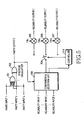
- Fig. 5 is a block diagram illustrating the LDPC-code decoder in accordance with a preferred embodiment of the present invention.
- two operators 501 and 502 for calculating syndrome values, upon receiving parity input values are syndrome calculators that can also be used for the Normalized-BP algorithm described in the conventional art, such that their detailed descriptions will herein be omitted for the convenience of description.
- the present invention enters the syndrome value in a Comparison & Selection unit 503
- the conventional art uses the syndrome value calculated by the Normalized-BP algorithm as a parity output value only.
- the Comparison & Selection unit 503 receives reliability values of individual coded symbols as input values.
- the Comparison & Selection unit 503 selects one reliability value from among the reliability values using the parity output value, and outputs the selected reliability value.
- the output reliability value of the Comparison & Selection unit 503 is determined to be reliability of a bit having a lowest LLR from among a plurality of bits associated with the parity check equation, such that the Comparison & Selection unit 503 outputs the determined reliability value.
- the selected value is transmitted to a controller 510 and a switch 504.
- the controller 510 outputs a switching control signal using the output value of the Comparison & Selection unit 503.
- the controller 510 uses the output value of the Comparison & Selection unit 503 as reliability values, such that it may directly receive/process such reliability values if needed.
- the controller 510 determines whether the value of ⁇ m illustrated in Fig. 4 is equal to '1'. If it is determined that the value of ⁇ m is equal to '1', the controller 510 calculates the received value to determine whether the value of Z mn is equal to a minimum value.
- the controller 510 If it is determined that the value of Z mn is not equal to the minimum value, the controller 510 outputs a switching control signal to connect the switch 504 to a second multiplier 506. If the value of Z mn is equal to the minimum value, the controller 510 outputs a switching control signal to connect the switch 504 to a third multiplier 507. If the value of Z mn is not equal to the minimum value, the controller 510 outputs a switching control signal. In the meantime, if it is determined that the value of ⁇ m is not equal to '1', the controller 510 outputs a switching control signal to connect the switch 504 to a first multiplier 505.
- the number of output terminals of the switch 504 is 3, and individual multipliers 505, 506, and 507 are connected to individual output terminals.
- the first multiplier 505 adapts a predetermined value to be divided by the first standardization factor ⁇ 1 as another input value
- the second multiplier 506 adapts a predetermined value to be divided by the second standardization factor ⁇ 2 as another input value
- the third multiplier 507 adapts a predetermined value to be divided by the third standardization factor ⁇ 2 as another input value. Therefore, the value passing through the switch 504 after having been generated from the Comparison & Selection unit 503 is divided by a corresponding factor, such that it is generated in the form of changed reliability values of the present invention.
- a temporary decoding and its associated parity check devices are not shown in the annexed drawings because the temporary decoding and its associated parity check devices can also be implemented in the form of the same configuration as in the conventional art.
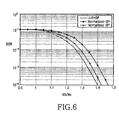
- Fig. 6 is a graph illustrating an SNR simulation result among the inventive algorithm, the LLR-BP algorithm, and the Normalized-BP algorithm in the case of decoding an LDPC code having a block length of 20000 in accordance with a preferred embodiment of the present invention.
- the inventive graph is denoted by "Modified Normalized-BP" in Fig. 6.
- the inventive method of the present invention can improve decoding-process performance much more than the conventional Normalised-BP algorithm.
- the algorithm compared with the Normalized-BP algorithm does not require additional multiplication operation, except for a process selecting an appropriate standardization factor value, such that it also has advantages of the conventional Normalized-BP algorithm in association with complexity.
- the inventive method approximates about 0.02dB of the LLR-BP algorithm at the same complexity as in the Normalized-BP algorithm.
- the present invention is adapted to the LDPC-code decoding process for use in a communication system, such that it can prevent performance deterioration and can also perform such a decoding operation using only a simple circuit configuration.
Landscapes
- Physics & Mathematics (AREA)
- Probability & Statistics with Applications (AREA)
- Engineering & Computer Science (AREA)
- Theoretical Computer Science (AREA)
- Computing Systems (AREA)
- Error Detection And Correction (AREA)
Applications Claiming Priority (2)
| Application Number | Priority Date | Filing Date | Title |
|---|---|---|---|
| KR2003033456 | 2003-05-26 | ||
| KR1020030033456A KR20040101743A (ko) | 2003-05-26 | 2003-05-26 | 통신 시스템에서 저밀도 패리티 검사 코드의 복호 장치 및방법 |
Publications (3)
| Publication Number | Publication Date |
|---|---|
| EP1482643A2 true EP1482643A2 (de) | 2004-12-01 |
| EP1482643A3 EP1482643A3 (de) | 2005-05-11 |
| EP1482643B1 EP1482643B1 (de) | 2006-07-19 |
Family
ID=36794439
Family Applications (1)
| Application Number | Title | Priority Date | Filing Date |
|---|---|---|---|
| EP04012500A Expired - Lifetime EP1482643B1 (de) | 2003-05-26 | 2004-05-26 | Verfahren und Vorrichtung zur Decodierung eines Low Density Partity Check (LDPC) Codes in einem Kommunikationssystem |
Country Status (5)
| Country | Link |
|---|---|
| US (1) | US20040243917A1 (de) |
| EP (1) | EP1482643B1 (de) |
| KR (1) | KR20040101743A (de) |
| CN (1) | CN1574650A (de) |
| DE (1) | DE602004001548T2 (de) |
Cited By (5)
| Publication number | Priority date | Publication date | Assignee | Title |
|---|---|---|---|---|
| WO2006123543A1 (en) * | 2005-05-20 | 2006-11-23 | Mitsubishi Denki Kabushiki Kaisha | Normalized belief propagation decoding |
| WO2010012072A1 (en) * | 2008-07-30 | 2010-02-04 | Nortel Networks Limited | Low density parity check (ldpc) decoder using broadcast messaging |
| EP1881610A4 (de) * | 2005-05-13 | 2010-10-06 | Nec Corp | Codierer und decodierer durch ldpc-codierung |
| EP1990921A3 (de) * | 2007-05-07 | 2013-05-22 | Broadcom Corporation | Auf die Betriebsparameter anpassbarer LDPC (Low Density Parity Check-) Dekodierer |
| US9455861B2 (en) | 2012-12-03 | 2016-09-27 | Ln2 Db, Llc | Systems and methods for advanced iterative decoding and channel estimation of concatenated coding systems |
Families Citing this family (26)
| Publication number | Priority date | Publication date | Assignee | Title |
|---|---|---|---|---|
| KR100594818B1 (ko) * | 2004-04-13 | 2006-07-03 | 한국전자통신연구원 | 순차적 복호를 이용한 저밀도 패리티 검사 부호의 복호장치 및 그 방법 |
| JP4282558B2 (ja) * | 2004-06-30 | 2009-06-24 | 株式会社東芝 | 低密度パリティチェック符号復号器及び方法 |
| DE602006011240D1 (de) * | 2005-06-21 | 2010-02-04 | Samsung Electronics Co Ltd | Vorrichtung und Methode zum Übermitteln/Empfangen von Daten in einem Mehrantennenkommunikationssystem unter Verwendung eines strukturierten Low Density Parity Check (LDPC) Codes |
| KR100804793B1 (ko) * | 2005-10-07 | 2008-02-20 | 삼성전자주식회사 | 저밀도 패러티 검사 복호기에서의 검사 노드 갱신 방법 |
| CN101064591B (zh) * | 2006-04-24 | 2010-05-12 | 中兴通讯股份有限公司 | 低密度奇偶校验码的译码方法及其校验节点更新电路 |
| TWI318507B (en) * | 2006-05-19 | 2009-12-11 | Univ Nat Chiao Tung | Method and apparatus for self-compensation on belief-propagation algorithm |
| KR100950661B1 (ko) * | 2006-05-20 | 2010-04-02 | 삼성전자주식회사 | 통신 시스템에서 신호 수신 장치 및 방법 |
| US7752529B2 (en) * | 2006-07-26 | 2010-07-06 | Broadcom Corporation | Combined LDPC (low density parity check) encoder and syndrome checker |
| US8255763B1 (en) * | 2006-11-08 | 2012-08-28 | Marvell International Ltd. | Error correction system using an iterative product code |
| JP4743156B2 (ja) * | 2007-04-27 | 2011-08-10 | ソニー株式会社 | 復号装置 |
| WO2009078644A1 (en) * | 2007-12-15 | 2009-06-25 | Electronics And Telecommunications Research Institute | Decoding apparatus and method based on variable error correction value |
| KR20090064268A (ko) | 2007-12-15 | 2009-06-18 | 한국전자통신연구원 | 가변 보정값을 이용한 복호화 장치 및 그 방법 |
| US8572460B2 (en) * | 2009-03-17 | 2013-10-29 | Broadcom Corporation | Communication device employing binary product coding with selective additional cyclic redundancy check (CRC) therein |
| CN102111241B (zh) * | 2011-03-04 | 2013-07-03 | 四川虹微技术有限公司 | 低密度奇偶校验迭代译码提前终止的方法 |
| US8767889B2 (en) | 2011-08-23 | 2014-07-01 | Texas Instruments Incorporated | Normalization of soft bit information for FEC decoding |
| KR101837099B1 (ko) * | 2012-07-05 | 2018-03-09 | 에스케이하이닉스 주식회사 | 가변 구조의 에러 정정 부호화기 |
| KR102080069B1 (ko) * | 2013-09-25 | 2020-04-14 | 삼성전자주식회사 | 비이진 ldpc 부호를 사용하는 수신기에서 데이터를 복호하는 방법 및 장치 |
| CN104393875A (zh) * | 2014-10-23 | 2015-03-04 | 天津师范大学 | 基于优化llp-bp算法的信道译码方法 |
| US20170288697A1 (en) * | 2016-03-31 | 2017-10-05 | Silicon Motion Inc. | Ldpc shuffle decoder with initialization circuit comprising ordered set memory |
| KR102534044B1 (ko) * | 2016-08-12 | 2023-05-19 | 삼성전자 주식회사 | 이동 통신 시스템에서 데이터 디코딩 방법 및 장치 |
| US10969785B2 (en) * | 2017-07-24 | 2021-04-06 | Motional Ad Llc | Automated vehicle operation to compensate for sensor field-of-view limitations |
| KR102543059B1 (ko) * | 2017-11-22 | 2023-06-14 | 삼성전자주식회사 | 저밀도 패리티 체크 코드의 디코딩 방법, 이를 수행하는 디코더 및 시스템 |
| CN109361491A (zh) * | 2018-09-26 | 2019-02-19 | 西安科技大学 | 基于ldpc的多输入多输出系统的译码方法、设备和存储介质 |
| CN110190856B (zh) * | 2019-06-27 | 2024-06-04 | 本征信息技术(苏州)有限公司 | 一种ldpc码的解码方法和解码装置 |
| CN110752852B (zh) * | 2019-09-26 | 2023-10-03 | 浙江科睿微电子技术有限公司 | 极化码的bp译码方法、装置、系统、设备及存储介质 |
| KR102774217B1 (ko) * | 2023-11-21 | 2025-02-26 | 전남대학교산학협력단 | 통신 시스템을 위한 다중 모드 인덱스 변조를 수행하는 직교 주파수 분할 다중화 방식의 부호화 및 복호 방법 및 장치 |
Family Cites Families (2)
| Publication number | Priority date | Publication date | Assignee | Title |
|---|---|---|---|---|
| US7000174B2 (en) * | 1999-12-20 | 2006-02-14 | Research In Motion Limited | Hybrid automatic repeat request system and method |
| KR100891782B1 (ko) * | 2002-06-11 | 2009-04-07 | 삼성전자주식회사 | 고속 데이터 전송 시스템에서 순방향 오류 정정 장치 및방법 |
-
2003
- 2003-05-26 KR KR1020030033456A patent/KR20040101743A/ko not_active Ceased
-
2004
- 2004-05-26 DE DE602004001548T patent/DE602004001548T2/de not_active Expired - Lifetime
- 2004-05-26 EP EP04012500A patent/EP1482643B1/de not_active Expired - Lifetime
- 2004-05-26 US US10/854,597 patent/US20040243917A1/en not_active Abandoned
- 2004-05-26 CN CNA2004100714258A patent/CN1574650A/zh active Pending
Cited By (10)
| Publication number | Priority date | Publication date | Assignee | Title |
|---|---|---|---|---|
| EP1881610A4 (de) * | 2005-05-13 | 2010-10-06 | Nec Corp | Codierer und decodierer durch ldpc-codierung |
| US8140930B1 (en) | 2005-05-13 | 2012-03-20 | Nec Corporation | Encoder and decoder by LDPC coding |
| WO2006123543A1 (en) * | 2005-05-20 | 2006-11-23 | Mitsubishi Denki Kabushiki Kaisha | Normalized belief propagation decoding |
| EP1990921A3 (de) * | 2007-05-07 | 2013-05-22 | Broadcom Corporation | Auf die Betriebsparameter anpassbarer LDPC (Low Density Parity Check-) Dekodierer |
| WO2010012072A1 (en) * | 2008-07-30 | 2010-02-04 | Nortel Networks Limited | Low density parity check (ldpc) decoder using broadcast messaging |
| US8230294B2 (en) | 2008-07-30 | 2012-07-24 | Ciena Corporation | Low density parity check (LDPC) decoder using broadcast messaging |
| US9455861B2 (en) | 2012-12-03 | 2016-09-27 | Ln2 Db, Llc | Systems and methods for advanced iterative decoding and channel estimation of concatenated coding systems |
| US9461863B2 (en) | 2012-12-03 | 2016-10-04 | Ln2 Db, Llc | Systems and methods for advanced iterative decoding and channel estimation of concatenated coding systems |
| EP2926462A4 (de) * | 2012-12-03 | 2016-11-09 | Systeme und verfahren für erweiterte iterative decodierung und kanalschätzung von verketteten codierungssystemen | |
| US10135567B2 (en) | 2012-12-03 | 2018-11-20 | Ln2 Db, Llc | Systems and methods for advanced iterative decoding and channel estimation of concatenated coding systems |
Also Published As
| Publication number | Publication date |
|---|---|
| EP1482643B1 (de) | 2006-07-19 |
| EP1482643A3 (de) | 2005-05-11 |
| CN1574650A (zh) | 2005-02-02 |
| KR20040101743A (ko) | 2004-12-03 |
| DE602004001548T2 (de) | 2007-06-21 |
| DE602004001548D1 (de) | 2006-08-31 |
| US20040243917A1 (en) | 2004-12-02 |
Similar Documents
| Publication | Publication Date | Title |
|---|---|---|
| EP1482643A2 (de) | Verfahren und Vorrichtung zur Decodierung eines Low Density Partity Check (LDPC) Codes in einem Kommunikationssystem | |
| US7716561B2 (en) | Multi-threshold reliability decoding of low-density parity check codes | |
| US8006161B2 (en) | Apparatus and method for receiving signal in a communication system using a low density parity check code | |
| US7137060B2 (en) | Forward error correction apparatus and method in a high-speed data transmission system | |
| KR101431162B1 (ko) | 주변 신뢰도에 따른 서열화를 이용한 메시지 전달 디코딩 방법 | |
| US7453960B1 (en) | LDPC encoder and encoder and method thereof | |
| EP1004182B1 (de) | Kommunikationssysteme und verfahren mit paralleler verschachtelungsloser kodierung | |
| EP1525664B9 (de) | Methode und verfahren für die speicherverwaltung in low density parity check (ldpc) decodern | |
| JP3958764B2 (ja) | ディジタル通信システムにおけるターボ復号を利用したビットエラー率及びフレームエラー率を減少させる装置及び方法 | |
| US8010869B2 (en) | Method and device for controlling the decoding of a LDPC encoded codeword, in particular for DVB-S2 LDPC encoded codewords | |
| US7203893B2 (en) | Soft input decoding for linear codes | |
| US6192503B1 (en) | Communications system and methods employing selective recursive decording | |
| US8209579B2 (en) | Generalized multi-threshold decoder for low-density parity check codes | |
| US9806743B2 (en) | System and method of belief propagation decoding | |
| US7774678B2 (en) | Apparatus and method for encoding and decoding a low density parity check code with maximum error correction and error detection capability | |
| US7249304B2 (en) | Apparatus and method for error correction in a CDMA mobile communication system | |
| US20170093528A1 (en) | Staggered parity | |
| US7391826B2 (en) | Decoding method and apparatus | |
| US8510642B2 (en) | System and method for map detector for symbol based error correction codes | |
| US20070210941A1 (en) | Apparatus and method for receiving signal in a communication system | |
| Feng et al. | A novel high-rate polar-staircase coding scheme | |
| US8019020B1 (en) | Binary decoding for correlated input information | |
| CN101273531B (zh) | 低密度奇偶校验码的改进turbo-译码消息传递方法、设备和系统 | |
| US20050050433A1 (en) | Method of decoding a data word | |
| US20070011600A1 (en) | Decoding method and apparatus |
Legal Events
| Date | Code | Title | Description |
|---|---|---|---|
| PUAI | Public reference made under article 153(3) epc to a published international application that has entered the european phase |
Free format text: ORIGINAL CODE: 0009012 |
|
| 17P | Request for examination filed |
Effective date: 20040526 |
|
| AK | Designated contracting states |
Kind code of ref document: A2 Designated state(s): AT BE BG CH CY CZ DE DK EE ES FI FR GB GR HU IE IT LI LU MC NL PL PT RO SE SI SK TR |
|
| AX | Request for extension of the european patent |
Extension state: AL HR LT LV MK |
|
| PUAL | Search report despatched |
Free format text: ORIGINAL CODE: 0009013 |
|
| AK | Designated contracting states |
Kind code of ref document: A3 Designated state(s): AT BE BG CH CY CZ DE DK EE ES FI FR GB GR HU IE IT LI LU MC NL PL PT RO SE SI SK TR |
|
| AX | Request for extension of the european patent |
Extension state: AL HR LT LV MK |
|
| RIC1 | Information provided on ipc code assigned before grant |
Ipc: 7H 03M 13/11 A |
|
| 17Q | First examination report despatched |
Effective date: 20050705 |
|
| GRAP | Despatch of communication of intention to grant a patent |
Free format text: ORIGINAL CODE: EPIDOSNIGR1 |
|
| AKX | Designation fees paid |
Designated state(s): DE FI FR GB IT SE |
|
| GRAS | Grant fee paid |
Free format text: ORIGINAL CODE: EPIDOSNIGR3 |
|
| GRAA | (expected) grant |
Free format text: ORIGINAL CODE: 0009210 |
|
| AK | Designated contracting states |
Kind code of ref document: B1 Designated state(s): DE FI FR GB IT SE |
|
| PG25 | Lapsed in a contracting state [announced via postgrant information from national office to epo] |
Ref country code: IT Free format text: LAPSE BECAUSE OF FAILURE TO SUBMIT A TRANSLATION OF THE DESCRIPTION OR TO PAY THE FEE WITHIN THE PRESCRIBED TIME-LIMIT;WARNING: LAPSES OF ITALIAN PATENTS WITH EFFECTIVE DATE BEFORE 2007 MAY HAVE OCCURRED AT ANY TIME BEFORE 2007. THE CORRECT EFFECTIVE DATE MAY BE DIFFERENT FROM THE ONE RECORDED. Effective date: 20060719 |
|
| REG | Reference to a national code |
Ref country code: GB Ref legal event code: FG4D |
|
| REF | Corresponds to: |
Ref document number: 602004001548 Country of ref document: DE Date of ref document: 20060831 Kind code of ref document: P |
|
| REG | Reference to a national code |
Ref country code: SE Ref legal event code: TRGR |
|
| ET | Fr: translation filed | ||
| PLBE | No opposition filed within time limit |
Free format text: ORIGINAL CODE: 0009261 |
|
| STAA | Information on the status of an ep patent application or granted ep patent |
Free format text: STATUS: NO OPPOSITION FILED WITHIN TIME LIMIT |
|
| 26N | No opposition filed |
Effective date: 20070420 |
|
| PGRI | Patent reinstated in contracting state [announced from national office to epo] |
Ref country code: IT Effective date: 20080601 |
|
| REG | Reference to a national code |
Ref country code: FR Ref legal event code: PLFP Year of fee payment: 13 |
|
| REG | Reference to a national code |
Ref country code: FR Ref legal event code: PLFP Year of fee payment: 14 |
|
| PGFP | Annual fee paid to national office [announced via postgrant information from national office to epo] |
Ref country code: FR Payment date: 20170516 Year of fee payment: 14 Ref country code: GB Payment date: 20170420 Year of fee payment: 14 |
|
| PGFP | Annual fee paid to national office [announced via postgrant information from national office to epo] |
Ref country code: SE Payment date: 20170421 Year of fee payment: 14 Ref country code: IT Payment date: 20170517 Year of fee payment: 14 Ref country code: FI Payment date: 20170420 Year of fee payment: 14 |
|
| PGFP | Annual fee paid to national office [announced via postgrant information from national office to epo] |
Ref country code: DE Payment date: 20170621 Year of fee payment: 14 |
|
| REG | Reference to a national code |
Ref country code: DE Ref legal event code: R119 Ref document number: 602004001548 Country of ref document: DE |
|
| REG | Reference to a national code |
Ref country code: SE Ref legal event code: EUG |
|
| GBPC | Gb: european patent ceased through non-payment of renewal fee |
Effective date: 20180526 |
|
| PG25 | Lapsed in a contracting state [announced via postgrant information from national office to epo] |
Ref country code: FI Free format text: LAPSE BECAUSE OF NON-PAYMENT OF DUE FEES Effective date: 20180526 Ref country code: SE Free format text: LAPSE BECAUSE OF NON-PAYMENT OF DUE FEES Effective date: 20180527 |
|
| PG25 | Lapsed in a contracting state [announced via postgrant information from national office to epo] |
Ref country code: IT Free format text: LAPSE BECAUSE OF FAILURE TO SUBMIT A TRANSLATION OF THE DESCRIPTION OR TO PAY THE FEE WITHIN THE PRESCRIBED TIME-LIMIT Effective date: 20180526 Ref country code: FR Free format text: LAPSE BECAUSE OF NON-PAYMENT OF DUE FEES Effective date: 20180531 Ref country code: GB Free format text: LAPSE BECAUSE OF NON-PAYMENT OF DUE FEES Effective date: 20180526 Ref country code: DE Free format text: LAPSE BECAUSE OF NON-PAYMENT OF DUE FEES Effective date: 20181201 |