EP1482726A1 - Verfahren und Vorrichtung zur Bearbeitung einer Bildsequenz - Google Patents
Verfahren und Vorrichtung zur Bearbeitung einer Bildsequenz Download PDFInfo
- Publication number
- EP1482726A1 EP1482726A1 EP03012380A EP03012380A EP1482726A1 EP 1482726 A1 EP1482726 A1 EP 1482726A1 EP 03012380 A EP03012380 A EP 03012380A EP 03012380 A EP03012380 A EP 03012380A EP 1482726 A1 EP1482726 A1 EP 1482726A1
- Authority
- EP
- European Patent Office
- Prior art keywords
- processing
- images
- image
- average picture
- picture level
- Prior art date
- Legal status (The legal status is an assumption and is not a legal conclusion. Google has not performed a legal analysis and makes no representation as to the accuracy of the status listed.)
- Ceased
Links
Images


Classifications
-
- G—PHYSICS
- G06—COMPUTING OR CALCULATING; COUNTING
- G06T—IMAGE DATA PROCESSING OR GENERATION, IN GENERAL
- G06T5/00—Image enhancement or restoration
- G06T5/90—Dynamic range modification of images or parts thereof
- G06T5/92—Dynamic range modification of images or parts thereof based on global image properties
-
- G—PHYSICS
- G06—COMPUTING OR CALCULATING; COUNTING
- G06T—IMAGE DATA PROCESSING OR GENERATION, IN GENERAL
- G06T5/00—Image enhancement or restoration
- G06T5/40—Image enhancement or restoration using histogram techniques
-
- G—PHYSICS
- G06—COMPUTING OR CALCULATING; COUNTING
- G06T—IMAGE DATA PROCESSING OR GENERATION, IN GENERAL
- G06T5/00—Image enhancement or restoration
- G06T5/50—Image enhancement or restoration using two or more images, e.g. averaging or subtraction
-
- H—ELECTRICITY
- H04—ELECTRIC COMMUNICATION TECHNIQUE
- H04N—PICTORIAL COMMUNICATION, e.g. TELEVISION
- H04N5/00—Details of television systems
- H04N5/14—Picture signal circuitry for video frequency region
- H04N5/21—Circuitry for suppressing or minimising disturbance, e.g. moiré or halo
-
- G—PHYSICS
- G06—COMPUTING OR CALCULATING; COUNTING
- G06T—IMAGE DATA PROCESSING OR GENERATION, IN GENERAL
- G06T2207/00—Indexing scheme for image analysis or image enhancement
- G06T2207/10—Image acquisition modality
- G06T2207/10016—Video; Image sequence
-
- G—PHYSICS
- G06—COMPUTING OR CALCULATING; COUNTING
- G06T—IMAGE DATA PROCESSING OR GENERATION, IN GENERAL
- G06T2207/00—Indexing scheme for image analysis or image enhancement
- G06T2207/20—Special algorithmic details
- G06T2207/20004—Adaptive image processing
- G06T2207/20008—Globally adaptive
-
- H—ELECTRICITY
- H04—ELECTRIC COMMUNICATION TECHNIQUE
- H04N—PICTORIAL COMMUNICATION, e.g. TELEVISION
- H04N5/00—Details of television systems
- H04N5/14—Picture signal circuitry for video frequency region
- H04N5/147—Scene change detection
Definitions
- the present invention relates to a method of processing a sequence of images as well as to a corresponding apparatus and a corresponding computer program product.
- the present invention relates to a method, apparatus or computer program product for processing a sequence of images, wherein a temporally recursive filter or a coring filter is employed to smooth a processing parameter so as to obtain an adapted processing parameter useful for inhibiting the generation of flicker as well as perceptible discontinuities during the processing of the image sequence.
- Imaging processing Numerous methods of image processing are known that can be applied to either an individual image or to a sequence of image. Such methods include, but are not limited to, contrast enhancement, image sharpening, morphing, noise removal, edge detection, color enhancement and pedestal processing.
- a common method of avoiding flicker or perceptible discontinuities is to reduce a ratio at which a processed image is mixed with the original image prior to visual presentation. Due to the moderate amount of processing, e.g. contrast enhancement, in the image as a whole, the human visual system does not perceive any flicker or discontinuities. Unfortunately, a reduction of the effective total amount of processing to the image brings about a proportionate reduction in performance.
- U.S. Patent 5,808,697 discloses a video contrast enhancer that enhances luminance contrast by dividing each video frame or field into blocks, calculating a mean luminance level for each block, selecting mapping functions on the basis of these mean luminance levels over a series of frames or fields, and mapping the video luminance levels according to the selected mapping functions.
- Color-saturation contrast is enhanced by modifying the amplitude of the modulated chrominance signal by the histogram equalization method, preferably by making a single linear modification in each period of the chrominance signal, so that color phase is not affected.
- these enhancements are preferably restricted to the picture area. If a black offset is present, it is preferably removed.
- the average luminance level of the blocks is used to select the mapping curves for a histogram equalization technique over several frames.
- the mapping curves preferably only change when the average luminance levels change consistently over a certain number of consecutive frames and flicker can be avoided.
- Pedestal processing can be effected by reducing the luminance of each pixel in an image by a calculated amount, i.e. by subtracting a calculated offset from each pixel in the image. This darkening operation can be followed by a stretching operation that stretches the image along the luminance axis to make use of the full dynamic range available.
- Pedestal processing is useful e.g. for converting an NTSC standard signal to another transmission standard since the black level of an NTSC standard image is 10% higher than the clamping level. It is likewise useful for removing clamping errors that may have arisen in the long chain from the camera to the display device as well as for eliminating undesired shifts in the black level that may have arisen in the course of image "enhancement" processing, e.g . in histogram equalization processing. To achieve this aim, one can estimate the intended level of the darkest part of the image from a cumulative histogram (also called a cumulative distribution function). However, due to disturbances in the images such as noise or quantization error, the estimated level may differ so significantly from field to field that a correspondingly pedestal processed sequence of images appears to flicker or is perceived as discontinuous.
- a cumulative histogram also called a cumulative distribution function
- Figure 1 shows an exemplary embodiment of a temporally recursive filter 10 as used in a wide variety of applications e.g. for noise reduction in image sequences.
- the filter illustrated in Figure 1 is a first order temporally recursive filter and comprises two multiplying units 11a and 11b, an adding unit 12, a signal tap 13 and a signal delay 14.
- An input signal for instance image data corresponding to a single frame in a sequence of images, is weighted in multiplying unit 11a with a weighting factor k and passed on to the adding unit 12.
- the adding unit 12 adds a delayed, weighted signal to the input signal and outputs the resultant signal as an output signal.
- Signal tap 13 creates a feedback signal from the output signal and directs this feedback signal to the signal delay 14.
- the signal delay stores the feedback signal, e.g. in a field memory, for a set amount of time, e.g. for one half of the field period of an image sequence, and then outputs the delayed feedback signal to the multiplying unit 11b, where the delayed feedback signal is weighted by a weighting factor, e.g. 1-k.
- the resultant, delayed feedback signal is then added, in the adding unit 12 to a subsequent input signal, thus completing the feedback loop.
- the output of such a filter is not only dependent on the current input signal, but also on previous input signals. Consequently, any change in the current input over previous input will be reduced, i.e. the output signal will be smoothed, in accordance with the smoothing, i.e. controlling, coefficient of the temporally recursive filter, i.e. in accordance with the ratio between weighting of the input signal and weighting of the feedback signal.
- the controlling coefficient k can adopt a value between 0 and 1. The lower the value of k, the stronger the smoothing effect of the temporally recursive filter.
- FIGS. 2A and 2B illustrate typical response functions 21, 21' of a coring filter.
- Typical of the coring technique is that an input having a value below a given threshold value (thr) evokes response of a coring value, e.g. zero, and an output corresponding to a given function of the input signal in accordance with the response function 21, 21' for all other values.
- Coring filters are thus useful for cancelling small amplitude artifacts in the input signal.
- HE histogram equalization
- a mapping curve is calculated from a histogram.
- the histogram can be calculated e.g . from the original image, an edge-masked version thereof or both.
- Histogram equalization based on a histogram calculated from the edge-masked image comprises several advantages over HE based on a histogram calculated from the original images.
- the former method improves contrast and prevents details of the image from being lost. Consequently, the mapping curve underlying histogram equalization is based is preferably calculated from a histogram derived from an edge-masked version of the image to be processed.
- histogram equalization based on histograms calculated from edge-masked images is particularly prone to inducing visual artifacts such as flicker and/or perceptible discontinuities due to the problem of so-called "histogram discontinuities.”
- an object of the invention to provide an improved method of and apparatus for processing a sequence of images. It is moreover an object of the invention to provide a method of and apparatus for the processing of a sequence of images that inhibits the creation of undesirable artifacts during said image processing such as flicker and/or perceptible discontinuities in the sequence of images.
- the invention can be seen in a method of processing a sequence of images comprising the steps of adapting a processing parameter with regard to one or more visually perceptible image parameters of one or more sets of said images to obtain an adapted processing parameter and processing a set of one or more of said images including a current image, said processing including a processing step based on the adapted processing parameter.
- the invention can be likewise seen in a corresponding apparatus or a corresponding computer program product.
- the employment of a processing parameter that has been adapted with regard to one or more visually perceptible image parameters provides the invention with an "awareness" of image parameters perceivable by an image observer. Consequently, the method / apparatus of the invention can regulate processing such that flicker and/or perceptible discontinuities do not arise or are significantly inhibited.
- the one or more visually perceptible image parameters includes one or more average picture levels obtained from a respective set of one or more images of the sequence.
- the processing parameter is preferably adapted based on a difference between the respective average picture levels of two temporally distinct sets of images of the sequence.
- the average picture level of an image is comparatively simple to calculate and is a parameter to which human visual perception is rather sensitive. Derivations of the average picture level, e.g. the difference between the average picture level of two different images, are useful for capturing the relationship of the average picture level to other image parameters, e.g. changes of the image in the time domain. The average picture level and its derivations are consequently an advantageous parameter for use in the method / apparatus of the invention.
- an average picture level obtained from a set of images can be, for example, the average picture level of one image or an average picture level calculated as an average value, as a mean value or in any other suitable fashion from several images constituting the set.
- temporally distinct sets of images of the sequence designates sets whose content differs with respect to its placement in the sequence of images. That is to say, a set comprising at least one image, e.g. frame or field, of the sequence that is not comprised by another set, is temporally distinct from that other set.
- the concept of temporally distinct images is separate from the concept of spatially distinct images, i.e. images whose (pixel) content is different, e.g. due to processing of one image vis-à-vis another, original / unprocessed image.
- the processing parameter is adapted with regard to a change in a visually perceptible image parameter between two sets of images, the sets each consisting of a respective one of the two images immediately previous to the current image in the sequence.
- the adapting of the processing parameter comprises the application of a temporally recursive filter to the processing parameter.
- Temporally recursive filters are a simple-to-implement, yet effective means for smoothing, over time, a signal input thereto. Moreover, the degree of smoothing can be readily adapted, in real time, by varying the ratio of the input signal to the feedback, i.e. recursive, signal. In this specification and the associated claims, this ratio is designated as the "controlling coefficient" of the temporally recursive filter.
- Temporally recursive filters are also advantageous in their ability to alter the signal input thereto in a step-less, infinitely variable manner.
- the temporal recursive filter of the invention may be of any degree, i.e . a first, second, third or higher degree temporally recursive filter may be used.
- a first degree filter is advantageous in that it is less costly to implement.
- a controlling coefficient of the temporally recursive filter is adapted based on a difference between a first average picture level determined from a first set of images and a second average picture level determined from a second set of images distinct from the first set.
- the average picture level is not particularly prone to disturbances.
- the average picture level of an image is comparatively simple to calculate and is a parameter to which human visual perception is rather sensitive.
- Derivations of the average picture level e.g. the difference between the average picture level of two temporally distinct image sets, are useful for capturing the relationship of the average picture level to other image parameters, e.g. changes of the image in the time domain.
- the average picture level and its derivatives are an appropriate choice or measure for the controlling coefficient of a temporally recursive filter to be applied in the course of obtaining a processing parameter suitably adapted for inhibiting the creation of undesirable artifacts during image processing such as flicker and/or perceptible discontinuities.
- a look-up table is employed for choosing a controlling coefficient. Accordingly, a difference between a current average picture level and a prior average picture level can be suitably employed as an input to the look-up table.
- a look-up table can be useful in reducing computational load, e.g. in reducing the computational processing necessary to determine a suitable controlling coefficient.
- the controlling coefficients contained in the look-up table may be empirical values, i.e. controlling coefficients that have been determined, by experiment, to be advantageous for a particular average picture level, change in the average picture level, derivative thereof, etc.
- all images of the first set are previous to the current image in the sequence and all images of the second set are previous and not adjacent to the current image in the sequence.
- the adapting of the processing parameter comprises the application of a coring filter to the processing parameter.
- coring filters provide unaltered output in response to controlling input signals below a predetermined threshold, i.e. provide a simple-to-implement, yet effective means for disregarding control signals of insignificant value / amplitude. It follows that sensible application of a coring filter to a processing parameter provides a means for influencing the processing parameter when, and only when, an appropriately chosen control parameter attains a significant level. That is to say, the processing parameter can be adapted in a manner such that only significant occurrences with regard to the chosen, controlling image parameter evoke a correspondingly strong processing operation. Consequently, coring techniques are suitable for inhibiting extraneous flicker and/or perceptible discontinuities in an image processed sequence of images.
- both the transfer function of the coring function and the threshold of the coring function are preferably empirically determined and fixed.
- a difference between an average picture level determined from a third set of images of the sequence and an average picture level determined from a fourth set of images of the sequence that is distinct from the third set is preferably employed as a controlling input to the coring filter.
- the average picture level of an image is comparatively simple to calculate and is a parameter to which human visual perception is rather sensitive.
- Derivations of the average picture level e.g. the difference between the average picture level of two different images, are useful for capturing the relationship of the average picture level to other image parameters, e.g. changes of the image in the time domain.
- the difference in average picture level may be calculated e.g. between image sets comprising at least a respective one of two consecutive or roughly consecutive images, thus allowing the processing operation to respond effectively to significant changes in the average picture level as regards e.g. the current image and its (near) predecessor.
- response i.e. the amount of processing in the resultant image, can be toned down in the case of insignificant changes in the average picture level.
- all images of the third set are previous to the current image in the sequence and all images of the fourth set are previous and not adjacent to the current image in the sequence.
- the present invention is of particular utility if the processing step comprises histogram equalization or pedestal processing.
- histogram equalization in particular when based on histograms derived from an edge-masked image, is susceptible to incurring visual artifacts such as flicker and/or perceptible discontinuities when applied to a sequence of images. Consequently, the aforementioned features of the invention are particularly advantageous in combination with a processing step comprising histogram equalization.
- particularly effective image processing can be achieved in conjunction with histogram equalization based on a mapping curve that is calculated from one or more histograms that have been subjected to frequency domain low pass filtering, recursive low pass filtering, cascaded low pass filtering or zero-phase forward and backward low pass filtering.
- Such techniques are the subject of unpublished European patent application number 02 004 428.5, which is noted above as disclosing histogram equalization techniques that yield excellent equalization. The combination of those techniques with the further features of the present invention thus leads to a highly advantageous configuration.
- particularly effective image processing can be achieved in conjunction with histogram equalization based on a mapping curve that has been calculated using average picture level adaptation, in particular a mapping curve based on a histogram that has been subjected to average picture level adaptation.
- the processing parameter comprises any one of a cumulative distribution function determined from one or more of the images of the sequence, a histogram of an image of the sequence, a histogram equalization curve obtained on the basis of one or more of the images of the sequence, a degree to which processed image data is to be mixed to unprocessed image data, or pixels associated with one or more of the images of the sequence.
- a cumulative distribution function, a histogram, etc. or a sequence thereof can be “smoothed” so as to be “in synch” with visually perceptible frame and/or scene changes in an image sequence.
- This "smoothed" image / image sequence data can be employed to regulate the processing operation such that the processed sequence of images is likewise "in synch” with visually perceptible frame and/or scene changes in the original image sequence.
- the one or more images, image or image data preferably comprises the current image / data associated the current image so as to establish a direct relationship between the processing parameter and the image being processed.
- the processing parameter comprises a degree of change of a black level of an image.
- the degree of adjustment to the black level i.e. the luminance of the darkest pixels, of a respective image can be adapted to be "in synch" with visually perceptible frame and/or scene changes in an image sequence.
- the processing parameter comprises a difference between an average picture level determined from a set of images of the sequence and an average picture level determined from pre-processed versions of the images of that set. That is to say, the processing parameter may be a difference between spatially distinct image sets, i.e. a difference between particular image information of a set of images before and after pre-processing.
- the average picture level does not change abruptly, i.e. significant changes in the average picture level (APL) only occur together with scene changes.
- the controlling coefficient of a temporally recursive filter to changes in the average picture level e.g. of the current frame or selected recent frames of an image sequence vis-à-vis a corresponding previous frame or set of frames, in particular changes in the APL between two consecutive frames, the output of the temporally recursive filter can be made smoother when the image sequence is smooth, while allowing abrupt changes in the output of the temporally recursive filter e.g. when scene changes occur.
- controlling coefficient is preferably increased (resulting in more input signal to less feedback -> less smoothing) as changes in the average picture level increase, and the controlling coefficient is preferably decreased (resulting in less input signal to more feedback -> more smoothing) as changes in the average picture level decrease.
- a temporally recursive filter controlled in this manner is applied for smoothing e.g. a mapping curve for histogram equalization or an estimated black level for pedestal processing
- the output data i.e. the output mapping curve or the output estimated black level
- the output data will be remain the same or change only slightly if the average picture level does not change significantly or only changes slightly, and the change will be very smooth due to the property of the temporally recursive filter.
- a histogram or a black level from the current frame image can be smoothed with those of previous frame images for overcoming e.g. histogram discontinuities.
- an adaptive temporally recursive filter e.g. a temporally recursive filter that is adapted to a difference in an average picture level e.g. of two consecutive fields is useful in overcoming the aforementioned problem of histogram discontinuities.
- the relationship between the APL difference and the temporally recursive filter coefficient can be stored in a look-up table.
- a coring filter In lieu of or in addition to a temporally recursive filter, one can likewise use a coring filter to combat discontinuities such as those leading to flicker and other perceptible discontinuities. Moreover, a coring filter is simpler to implement than a temporally recursive filter.
- a coring filter as preferably employed by the present invention comprises an input, a controlling input and an output.
- the response of the coring filter is characterized by a threshold and a response function. If the value of the controlling input is below the threshold (or, in the case of a bi-directional response function, below a positive threshold and above a negative threshold), the coring filter alters the input by a coring value of zero, i.e . responds with an output identical to the input. If the value of the controlling input is above the threshold, the coring filter alters the input in accordance with the response function, i.e. responds with an output equal to the input plus the response function times the input.
- Output Input + (Input • Response_Function(Controlling_Input)) where Response_Function is e.g. as shown in Fig. 2A or 2B having a value of zero below a predetermined threshold.
- FIG. 2C schematically illustrates a preferred embodiment of a coring filter 20 in accordance with the invention.
- coring filter 20 preferably employed by the invention employs a response function 21 that characterizes a relative alteration that coring filter 20 effects upon an input signal in response to a controlling input.
- a controlling input having a value below a given threshold value (thr) evokes a response of a coring value, e.g. zero, i.e. results in an output identical to the input.
- All other values for the controlling input evoke a response in accordance with the non-trivial segments of response function 21, i.e. results in a relative change of the input function in proportion with response function 21.
- Figure 3A schematically depicts an apparatus 30A for processing a sequence of images in accordance with a preferred first embodiment of the invention comprising an image processor 31, a temporally recursive filter 32A, an average picture level (APL) calculation unit 33, a signal delay unit 34, an adding unit 35, an optional look-up table 36, a processing parameter derivation unit 37 as well as an optional delay 34'.
- APL average picture level
- An input signal e.g. image data
- image processor 31 processing parameter derivation unit 37 and APL calculation unit 33.
- Input of the input signal to APL calculation unit 33 may optionally be delayed for a predetermined period of time, e.g. for the period of time between consecutive frames in the image sequence, by delay 34'.
- APL calculation unit 33 calculates an average picture level from the input signal including, as the case may be, previous input data and outputs a calculated APL signal to both delay unit 34 and a first input of adding unit 35.
- Delay unit 34 delays the calculated APL signal for a predetermined period of time, e.g.
- Look-up table 36 selects an appropriate look-up value based on the APL difference signal input thereto and supplies the look-up value to temporally recursive filter 32A for use as a controlling coefficient therein.
- Look-up table 36 is a purely optional feature of this embodiment. In absence of look-up table 36, the APL difference signal may be supplied directly to temporally recursive filter 32A for use as a controlling coefficient therein.
- Processing parameter derivation unit 37 derives a processing parameter from the input signal directed thereto.
- processing parameter derivation unit 37 could determine a black level, a histogram, a cumulative distribution function, a histogram equalization mapping curve for the current frame image, or a mixing level at which a processed image data should be mixed to original image data.
- processing parameter derivation unit 37 could do no processing and simply output the input signal in unmodified form. Such a case, however, would constitute no refinement of the input signal and could thus burden the subsequent processing units with an unduly high computational load.
- the processing parameter output from processing parameter derivation unit 37 is directed to temporally recursive filter 32A, where it is smoothed in accordance with the current value of the controlling coefficient as described in detail above, inter alia with reference to Figure 1.
- the smoothed processing parameter is directed to image processor 31, where it constitutes a processing parameter in the processing of the original input signal for generating the output signal of the apparatus as a whole.
- the input signal is an image, frame or field of an image sequence and processing parameter derivation unit 37 is configured and adapted to derive one of the aforementioned processing parameters, including an unmodified input signal.
- Image processor 31 is preferably configured and adapted to carry out histogram equalization or pedestal processing.
- Histogram discontinuities can be particularly reduced if the input to temporally recursive filter 32A is a calculated histogram, a cumulative distribution function, a HE mapping curve of the current frame image, or a desired mixing amount between a processed image and the original one.
- the current input image may be used as an input to temporally recursive filter 32A.
- a histogram can be calculated from the filtered image, and the histogram can, in turn, serve as a basis for obtaining a refined histogram equalization mapping curve.
- pedestal processing aims to make the darkest pixels in an image truly black.
- the luminance value in the darkest part of the image is measured so that this measured value can then be removed from dark parts of the image or the entire image, e.g. by subtraction.
- this measuring result may be affected by e.g. image noise and therefore may be different from frame to frame, even if the true luminance value of the darkest pixels does not change. Consequently, the resulting image sequence may unintentionally appear to flicker or be perceptibly discontinuous.
- temporally recursive filter 32A e.g. to filter the measured black level from the current picture with that from the previous picture or to effect inter-frame smoothing the amount by which a black level is changed, undesired flickering and perceptible discontinuities can be avoided.
- FIG. 3B schematically depicts an apparatus 30B for processing a sequence of images in accordance with a preferred second embodiment of the invention.
- Apparatus 30B is analogous in its configuration and operation to the configuration and operation of apparatus 30A described above, but employs a coring filter 32B in place of temporally recursive filter 32A as a simpler means for effecting a smoothing of the processing parameter. Accordingly, the output of adding unit 35 is fed to coring filter 32B as a controlling input thereof.
- the response function 21 of coring filter 32B can be designed so as to eliminate the necessity of look-up table 36.
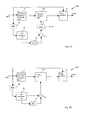
- Figure 4A contains a schematic depiction of an apparatus 40A for processing a sequence of images in accordance with a preferred third embodiment of the invention comprising a mapping unit 41, two temporally recursive filters 42A and 42A' comprising respective signal delay units 44 and 44', two APL calculation units 43 and 43', a mapping curve calculation unit 47 and a pedestal correction unit 49. Adding unit 45.
- An input signal e.g. a sequence of image data
- mapping unit 41 e.g. a sequence of image data
- mapping curve calculation unit 47 calculates a mapping curve, e.g. a histogram equalization mapping curve, an outputs the calculated mapping curve to temporally recursive filter 42A.
- Temporally recursive filter 42A smooths the mapping curve on the basis of a controlling coefficient k in a temporally recursive process as described above, e.g. with reference to Fig. 1, employing delay unit 44.
- Controlling coefficient k is determined with regard to a difference between respective average picture levels of two temporally distinct sets of images as described e.g.
- apparatus 40A will comprise a configuration, not shown, for determining controlling coefficient k analogous to the corresponding configuration of Fig. 3A.
- Temporally recursive filter 42A outputs the smoothed mapping curve to mapping unit 41 that carries out a mapping, e.g. histogram equalization, of the input signal directed thereto on the basis on the smoothed mapping curve.
- mapping unit 41 Assuming that mapping unit 41 carries out some processing of the input signal, the resultant, mapped input signal will typically be spatially distinct from the original, unaltered input signal.
- Mapping unit 41 outputs the mapped input signal to pedestal correction unit 49 and to APL calculation unit 43.
- APL calculation unit 43 calculates an average picture level on the basis of the mapped input signal and outputs the calculated average picture level to adding 34', whereas APL calculation unit calculates an average picture level on the basis of an unaltered input signal and likewise outputs the calculated average picture level to adding 34'. Based on these two, spatially distinct inputs, adding 34' determines an APL difference signal in the spatial domain.
- This APL difference signal is fed to and smoothed by temporally recursive filter 42A' whose configuration and operation is analogous to that of temporally recursive filter 42A.
- the smoothed APL difference signal is input to pedestal correction unit 49 as a controlling input, i.e. an input determining the degree to which a black level of mapped input signal fed to pedestal correction unit 49 will be altered by pedestal correction unit 49.
- controlling coefficient p of temporally recursive filter 42A' may be chosen / determined on the basis of different content than that on the basis of which controlling coefficient k is chosen / determined.
- temporally recursive filters 42A and 42A' may comprise respective look-up tables, not shown, in their respective configurations for determining controlling coefficients k and p. The contents of such look-up tables will typically not be identical.
- Figure 4B schematically depicts an apparatus 40B for processing a sequence of images in accordance with a preferred fourth embodiment of the invention.
- Apparatus 40B is analogous in its configuration and operation to the configuration and operation of apparatus 40A described above, but employs coring filters 42B and 42B' in place of temporally recursive filters 42A and 42A' as a simpler means for effecting a smoothing of the respective processing parameters fed to mapping unit 41 and pedestal correction unit 49. Accordingly, the output of mapping curve calculation unit 47 is fed to coring filter 42B, and the output of adding 34' is fed to coring filter 42B'.
- the preferred embodiments described above are preferably implemented as an application specific integrated circuit as known in the art, particularly the art of signal processors, for the sake of improving processing speed and mass manufacturability.
- the preferred embodiments disclosed herein can be implemented in the form of a computer program product as known in the art, e.g. the arts of digital signal processing and computer programming.
Landscapes
- Engineering & Computer Science (AREA)
- Physics & Mathematics (AREA)
- General Physics & Mathematics (AREA)
- Theoretical Computer Science (AREA)
- Multimedia (AREA)
- Signal Processing (AREA)
- Image Processing (AREA)
Priority Applications (1)
| Application Number | Priority Date | Filing Date | Title |
|---|---|---|---|
| EP03012380A EP1482726A1 (de) | 2003-05-30 | 2003-05-30 | Verfahren und Vorrichtung zur Bearbeitung einer Bildsequenz |
Applications Claiming Priority (1)
| Application Number | Priority Date | Filing Date | Title |
|---|---|---|---|
| EP03012380A EP1482726A1 (de) | 2003-05-30 | 2003-05-30 | Verfahren und Vorrichtung zur Bearbeitung einer Bildsequenz |
Publications (1)
| Publication Number | Publication Date |
|---|---|
| EP1482726A1 true EP1482726A1 (de) | 2004-12-01 |
Family
ID=33104115
Family Applications (1)
| Application Number | Title | Priority Date | Filing Date |
|---|---|---|---|
| EP03012380A Ceased EP1482726A1 (de) | 2003-05-30 | 2003-05-30 | Verfahren und Vorrichtung zur Bearbeitung einer Bildsequenz |
Country Status (1)
| Country | Link |
|---|---|
| EP (1) | EP1482726A1 (de) |
Cited By (1)
| Publication number | Priority date | Publication date | Assignee | Title |
|---|---|---|---|---|
| EP3379822B1 (de) * | 2015-11-18 | 2021-07-28 | Tencent Technology (Shenzhen) Company Limited | Verfahren zur optimierung von videos, endgerät und nichtflüchtiges computerlesbares speichermedium |
Citations (2)
| Publication number | Priority date | Publication date | Assignee | Title |
|---|---|---|---|---|
| EP0501728A2 (de) | 1991-02-27 | 1992-09-02 | Matsushita Electric Industrial Co., Ltd. | Gradationskorrekturanordnung |
| EP1111578A1 (de) | 1999-05-10 | 2001-06-27 | Matsushita Electric Industrial Co., Ltd. | Bildanzeigevorrichtung und bildanzeigeverfahren |
-
2003
- 2003-05-30 EP EP03012380A patent/EP1482726A1/de not_active Ceased
Patent Citations (2)
| Publication number | Priority date | Publication date | Assignee | Title |
|---|---|---|---|---|
| EP0501728A2 (de) | 1991-02-27 | 1992-09-02 | Matsushita Electric Industrial Co., Ltd. | Gradationskorrekturanordnung |
| EP1111578A1 (de) | 1999-05-10 | 2001-06-27 | Matsushita Electric Industrial Co., Ltd. | Bildanzeigevorrichtung und bildanzeigeverfahren |
Cited By (1)
| Publication number | Priority date | Publication date | Assignee | Title |
|---|---|---|---|---|
| EP3379822B1 (de) * | 2015-11-18 | 2021-07-28 | Tencent Technology (Shenzhen) Company Limited | Verfahren zur optimierung von videos, endgerät und nichtflüchtiges computerlesbares speichermedium |
Similar Documents
| Publication | Publication Date | Title |
|---|---|---|
| US7953286B2 (en) | Automatic contrast enhancement | |
| JP3187348B2 (ja) | 画質改善回路及びその方法 | |
| CN106846270B (zh) | 一种图像边缘增强方法及装置 | |
| CN103854259B (zh) | 图像处理设备以及处理图像的方法 | |
| US8391598B2 (en) | Methods for performing local tone mapping | |
| US8406547B2 (en) | Visual processing device, visual processing method, program, display device, and integrated circuit | |
| EP2833317B1 (de) | Bildanzeigevorrichtung und/oder verfahren dafür | |
| GB2357649A (en) | Image enhancement using inverse histogram based pixel mapping | |
| JP5887303B2 (ja) | 画像信号処理装置,撮像装置および画像処理プログラム | |
| US20080129875A1 (en) | Motion and/or scene change detection using color components | |
| IES20080497A2 (en) | Image processing method and apparatus | |
| JP4069943B2 (ja) | ノイズ除去の強弱を画面内でコントロールする画像処理装置、画像処理プログラム、画像処理方法、および電子カメラ | |
| TWI536319B (zh) | 去雜訊方法以及影像系統 | |
| JP4273428B2 (ja) | 画像処理装置、画像処理方法、画像処理方法のプログラム及び画像処理方法のプログラムを記録した記録媒体 | |
| KR20050013151A (ko) | 움직임 검출 장치 및 그것을 이용한 잡음 제거 장치 | |
| US20070041636A1 (en) | Apparatus and method for image contrast enhancement using RGB value | |
| Lee et al. | Improved spatiotemporal noise reduction for very low-light environments | |
| EP1482726A1 (de) | Verfahren und Vorrichtung zur Bearbeitung einer Bildsequenz | |
| EP1482447A1 (de) | Verfahren und Vorrichtung zum Bildhistogrammausgleich | |
| JP5219771B2 (ja) | 映像処理装置および映像処理装置の制御方法 | |
| Cvetkovic | Image enhancement circuit using nonlinear processing curve and constrained histogram range equalization | |
| JPS62171282A (ja) | 相関適応式雑音低減装置 | |
| JPH03291080A (ja) | 動き適応型走査線補間装置 | |
| JP3937541B2 (ja) | 輝度調整回路 | |
| JP3644421B2 (ja) | 画像変換方法及び画像変換装置 |
Legal Events
| Date | Code | Title | Description |
|---|---|---|---|
| PUAI | Public reference made under article 153(3) epc to a published international application that has entered the european phase |
Free format text: ORIGINAL CODE: 0009012 |
|
| AK | Designated contracting states |
Kind code of ref document: A1 Designated state(s): AT BE BG CH CY CZ DE DK EE ES FI FR GB GR HU IE IT LI LU MC NL PT RO SE SI SK TR |
|
| AX | Request for extension of the european patent |
Extension state: AL LT LV MK |
|
| 17P | Request for examination filed |
Effective date: 20050209 |
|
| AKX | Designation fees paid |
Designated state(s): DE FR GB |
|
| RAP1 | Party data changed (applicant data changed or rights of an application transferred) |
Owner name: SONY DEUTSCHLAND GMBH |
|
| RAP1 | Party data changed (applicant data changed or rights of an application transferred) |
Owner name: SONY DEUTSCHLAND GMBH |
|
| 17Q | First examination report despatched |
Effective date: 20081127 |
|
| STAA | Information on the status of an ep patent application or granted ep patent |
Free format text: STATUS: THE APPLICATION HAS BEEN REFUSED |
|
| 18R | Application refused |
Effective date: 20130720 |