EP1483111B1 - Verbundnanoparktikelmaterialien und herstellungsverfahren dafür - Google Patents
Verbundnanoparktikelmaterialien und herstellungsverfahren dafür Download PDFInfo
- Publication number
- EP1483111B1 EP1483111B1 EP03742804A EP03742804A EP1483111B1 EP 1483111 B1 EP1483111 B1 EP 1483111B1 EP 03742804 A EP03742804 A EP 03742804A EP 03742804 A EP03742804 A EP 03742804A EP 1483111 B1 EP1483111 B1 EP 1483111B1
- Authority
- EP
- European Patent Office
- Prior art keywords
- composite nanoparticle
- oxygen storage
- oxygen
- cores
- nanoparticle material
- Prior art date
- Legal status (The legal status is an assumption and is not a legal conclusion. Google has not performed a legal analysis and makes no representation as to the accuracy of the status listed.)
- Expired - Lifetime
Links
Images


Classifications
-
- H—ELECTRICITY
- H01—ELECTRIC ELEMENTS
- H01G—CAPACITORS; CAPACITORS, RECTIFIERS, DETECTORS, SWITCHING DEVICES, LIGHT-SENSITIVE OR TEMPERATURE-SENSITIVE DEVICES OF THE ELECTROLYTIC TYPE
- H01G4/00—Fixed capacitors; Processes of their manufacture
- H01G4/002—Details
- H01G4/018—Dielectrics
- H01G4/06—Solid dielectrics
- H01G4/08—Inorganic dielectrics
- H01G4/12—Ceramic dielectrics
- H01G4/1209—Ceramic dielectrics characterised by the ceramic dielectric material
- H01G4/1218—Ceramic dielectrics characterised by the ceramic dielectric material based on titanium oxides or titanates
- H01G4/1227—Ceramic dielectrics characterised by the ceramic dielectric material based on titanium oxides or titanates based on alkaline earth titanates
-
- B—PERFORMING OPERATIONS; TRANSPORTING
- B01—PHYSICAL OR CHEMICAL PROCESSES OR APPARATUS IN GENERAL
- B01J—CHEMICAL OR PHYSICAL PROCESSES, e.g. CATALYSIS OR COLLOID CHEMISTRY; THEIR RELEVANT APPARATUS
- B01J13/00—Colloid chemistry, e.g. the production of colloidal materials or their solutions, not otherwise provided for; Making microcapsules or microballoons
- B01J13/02—Making microcapsules or microballoons
-
- B—PERFORMING OPERATIONS; TRANSPORTING
- B01—PHYSICAL OR CHEMICAL PROCESSES OR APPARATUS IN GENERAL
- B01J—CHEMICAL OR PHYSICAL PROCESSES, e.g. CATALYSIS OR COLLOID CHEMISTRY; THEIR RELEVANT APPARATUS
- B01J2/00—Processes or devices for granulating materials, e.g. fertilisers in general; Rendering particulate materials free flowing in general, e.g. making them hydrophobic
- B01J2/006—Coating of the granules without description of the process or the device by which the granules are obtained
-
- B—PERFORMING OPERATIONS; TRANSPORTING
- B01—PHYSICAL OR CHEMICAL PROCESSES OR APPARATUS IN GENERAL
- B01J—CHEMICAL OR PHYSICAL PROCESSES, e.g. CATALYSIS OR COLLOID CHEMISTRY; THEIR RELEVANT APPARATUS
- B01J23/00—Catalysts comprising metals or metal oxides or hydroxides, not provided for in group B01J21/00
- B01J23/10—Catalysts comprising metals or metal oxides or hydroxides, not provided for in group B01J21/00 of rare earths
-
- B—PERFORMING OPERATIONS; TRANSPORTING
- B01—PHYSICAL OR CHEMICAL PROCESSES OR APPARATUS IN GENERAL
- B01J—CHEMICAL OR PHYSICAL PROCESSES, e.g. CATALYSIS OR COLLOID CHEMISTRY; THEIR RELEVANT APPARATUS
- B01J33/00—Protection of catalysts, e.g. by coating
-
- B—PERFORMING OPERATIONS; TRANSPORTING
- B01—PHYSICAL OR CHEMICAL PROCESSES OR APPARATUS IN GENERAL
- B01J—CHEMICAL OR PHYSICAL PROCESSES, e.g. CATALYSIS OR COLLOID CHEMISTRY; THEIR RELEVANT APPARATUS
- B01J35/00—Catalysts, in general, characterised by their form or physical properties
- B01J35/19—Catalysts containing parts with different compositions
-
- B—PERFORMING OPERATIONS; TRANSPORTING
- B01—PHYSICAL OR CHEMICAL PROCESSES OR APPARATUS IN GENERAL
- B01J—CHEMICAL OR PHYSICAL PROCESSES, e.g. CATALYSIS OR COLLOID CHEMISTRY; THEIR RELEVANT APPARATUS
- B01J35/00—Catalysts, in general, characterised by their form or physical properties
- B01J35/40—Catalysts, in general, characterised by their form or physical properties characterised by dimensions, e.g. grain size
-
- B—PERFORMING OPERATIONS; TRANSPORTING
- B01—PHYSICAL OR CHEMICAL PROCESSES OR APPARATUS IN GENERAL
- B01J—CHEMICAL OR PHYSICAL PROCESSES, e.g. CATALYSIS OR COLLOID CHEMISTRY; THEIR RELEVANT APPARATUS
- B01J35/00—Catalysts, in general, characterised by their form or physical properties
- B01J35/40—Catalysts, in general, characterised by their form or physical properties characterised by dimensions, e.g. grain size
- B01J35/45—Nanoparticles
-
- B—PERFORMING OPERATIONS; TRANSPORTING
- B22—CASTING; POWDER METALLURGY
- B22F—WORKING METALLIC POWDER; MANUFACTURE OF ARTICLES FROM METALLIC POWDER; MAKING METALLIC POWDER; APPARATUS OR DEVICES SPECIALLY ADAPTED FOR METALLIC POWDER
- B22F1/00—Metallic powder; Treatment of metallic powder, e.g. to facilitate working or to improve properties
- B22F1/16—Metallic particles coated with a non-metal
-
- B—PERFORMING OPERATIONS; TRANSPORTING
- B22—CASTING; POWDER METALLURGY
- B22F—WORKING METALLIC POWDER; MANUFACTURE OF ARTICLES FROM METALLIC POWDER; MAKING METALLIC POWDER; APPARATUS OR DEVICES SPECIALLY ADAPTED FOR METALLIC POWDER
- B22F1/00—Metallic powder; Treatment of metallic powder, e.g. to facilitate working or to improve properties
- B22F1/17—Metallic particles coated with metal
-
- B—PERFORMING OPERATIONS; TRANSPORTING
- B22—CASTING; POWDER METALLURGY
- B22F—WORKING METALLIC POWDER; MANUFACTURE OF ARTICLES FROM METALLIC POWDER; MAKING METALLIC POWDER; APPARATUS OR DEVICES SPECIALLY ADAPTED FOR METALLIC POWDER
- B22F1/00—Metallic powder; Treatment of metallic powder, e.g. to facilitate working or to improve properties
- B22F1/18—Non-metallic particles coated with metal
-
- B—PERFORMING OPERATIONS; TRANSPORTING
- B82—NANOTECHNOLOGY
- B82Y—SPECIFIC USES OR APPLICATIONS OF NANOSTRUCTURES; MEASUREMENT OR ANALYSIS OF NANOSTRUCTURES; MANUFACTURE OR TREATMENT OF NANOSTRUCTURES
- B82Y30/00—Nanotechnology for materials or surface science, e.g. nanocomposites
-
- C—CHEMISTRY; METALLURGY
- C01—INORGANIC CHEMISTRY
- C01B—NON-METALLIC ELEMENTS; COMPOUNDS THEREOF; METALLOIDS OR COMPOUNDS THEREOF NOT COVERED BY SUBCLASS C01C
- C01B13/00—Oxygen; Ozone; Oxides or hydroxides in general
- C01B13/02—Preparation of oxygen
- C01B13/0229—Purification or separation processes
- C01B13/0248—Physical processing only
- C01B13/0259—Physical processing only by adsorption on solids
- C01B13/0281—Physical processing only by adsorption on solids in getters
-
- C—CHEMISTRY; METALLURGY
- C01—INORGANIC CHEMISTRY
- C01F—COMPOUNDS OF THE METALS BERYLLIUM, MAGNESIUM, ALUMINIUM, CALCIUM, STRONTIUM, BARIUM, RADIUM, THORIUM, OR OF THE RARE-EARTH METALS
- C01F17/00—Compounds of rare earth metals
- C01F17/20—Compounds containing only rare earth metals as the metal element
- C01F17/206—Compounds containing only rare earth metals as the metal element oxide or hydroxide being the only anion
- C01F17/224—Oxides or hydroxides of lanthanides
- C01F17/235—Cerium oxides or hydroxides
-
- C—CHEMISTRY; METALLURGY
- C01—INORGANIC CHEMISTRY
- C01G—COMPOUNDS CONTAINING METALS NOT COVERED BY SUBCLASSES C01D OR C01F
- C01G25/00—Compounds of zirconium
-
- C—CHEMISTRY; METALLURGY
- C04—CEMENTS; CONCRETE; ARTIFICIAL STONE; CERAMICS; REFRACTORIES
- C04B—LIME, MAGNESIA; SLAG; CEMENTS; COMPOSITIONS THEREOF, e.g. MORTARS, CONCRETE OR LIKE BUILDING MATERIALS; ARTIFICIAL STONE; CERAMICS; REFRACTORIES; TREATMENT OF NATURAL STONE
- C04B35/00—Shaped ceramic products characterised by their composition; Ceramics compositions; Processing powders of inorganic compounds preparatory to the manufacturing of ceramic products
- C04B35/50—Shaped ceramic products characterised by their composition; Ceramics compositions; Processing powders of inorganic compounds preparatory to the manufacturing of ceramic products based on rare-earth compounds
-
- C—CHEMISTRY; METALLURGY
- C04—CEMENTS; CONCRETE; ARTIFICIAL STONE; CERAMICS; REFRACTORIES
- C04B—LIME, MAGNESIA; SLAG; CEMENTS; COMPOSITIONS THEREOF, e.g. MORTARS, CONCRETE OR LIKE BUILDING MATERIALS; ARTIFICIAL STONE; CERAMICS; REFRACTORIES; TREATMENT OF NATURAL STONE
- C04B35/00—Shaped ceramic products characterised by their composition; Ceramics compositions; Processing powders of inorganic compounds preparatory to the manufacturing of ceramic products
- C04B35/622—Forming processes; Processing powders of inorganic compounds preparatory to the manufacturing of ceramic products
- C04B35/626—Preparing or treating the powders individually or as batches ; preparing or treating macroscopic reinforcing agents for ceramic products, e.g. fibres; mechanical aspects section B
- C04B35/62605—Treating the starting powders individually or as mixtures
- C04B35/62645—Thermal treatment of powders or mixtures thereof other than sintering
- C04B35/6265—Thermal treatment of powders or mixtures thereof other than sintering involving reduction or oxidation
-
- C—CHEMISTRY; METALLURGY
- C04—CEMENTS; CONCRETE; ARTIFICIAL STONE; CERAMICS; REFRACTORIES
- C04B—LIME, MAGNESIA; SLAG; CEMENTS; COMPOSITIONS THEREOF, e.g. MORTARS, CONCRETE OR LIKE BUILDING MATERIALS; ARTIFICIAL STONE; CERAMICS; REFRACTORIES; TREATMENT OF NATURAL STONE
- C04B35/00—Shaped ceramic products characterised by their composition; Ceramics compositions; Processing powders of inorganic compounds preparatory to the manufacturing of ceramic products
- C04B35/622—Forming processes; Processing powders of inorganic compounds preparatory to the manufacturing of ceramic products
- C04B35/626—Preparing or treating the powders individually or as batches ; preparing or treating macroscopic reinforcing agents for ceramic products, e.g. fibres; mechanical aspects section B
- C04B35/62605—Treating the starting powders individually or as mixtures
- C04B35/62645—Thermal treatment of powders or mixtures thereof other than sintering
- C04B35/62675—Thermal treatment of powders or mixtures thereof other than sintering characterised by the treatment temperature
-
- C—CHEMISTRY; METALLURGY
- C04—CEMENTS; CONCRETE; ARTIFICIAL STONE; CERAMICS; REFRACTORIES
- C04B—LIME, MAGNESIA; SLAG; CEMENTS; COMPOSITIONS THEREOF, e.g. MORTARS, CONCRETE OR LIKE BUILDING MATERIALS; ARTIFICIAL STONE; CERAMICS; REFRACTORIES; TREATMENT OF NATURAL STONE
- C04B35/00—Shaped ceramic products characterised by their composition; Ceramics compositions; Processing powders of inorganic compounds preparatory to the manufacturing of ceramic products
- C04B35/622—Forming processes; Processing powders of inorganic compounds preparatory to the manufacturing of ceramic products
- C04B35/626—Preparing or treating the powders individually or as batches ; preparing or treating macroscopic reinforcing agents for ceramic products, e.g. fibres; mechanical aspects section B
- C04B35/628—Coating the powders or the macroscopic reinforcing agents
-
- C—CHEMISTRY; METALLURGY
- C04—CEMENTS; CONCRETE; ARTIFICIAL STONE; CERAMICS; REFRACTORIES
- C04B—LIME, MAGNESIA; SLAG; CEMENTS; COMPOSITIONS THEREOF, e.g. MORTARS, CONCRETE OR LIKE BUILDING MATERIALS; ARTIFICIAL STONE; CERAMICS; REFRACTORIES; TREATMENT OF NATURAL STONE
- C04B35/00—Shaped ceramic products characterised by their composition; Ceramics compositions; Processing powders of inorganic compounds preparatory to the manufacturing of ceramic products
- C04B35/622—Forming processes; Processing powders of inorganic compounds preparatory to the manufacturing of ceramic products
- C04B35/626—Preparing or treating the powders individually or as batches ; preparing or treating macroscopic reinforcing agents for ceramic products, e.g. fibres; mechanical aspects section B
- C04B35/628—Coating the powders or the macroscopic reinforcing agents
- C04B35/62802—Powder coating materials
- C04B35/62805—Oxide ceramics
-
- C—CHEMISTRY; METALLURGY
- C04—CEMENTS; CONCRETE; ARTIFICIAL STONE; CERAMICS; REFRACTORIES
- C04B—LIME, MAGNESIA; SLAG; CEMENTS; COMPOSITIONS THEREOF, e.g. MORTARS, CONCRETE OR LIKE BUILDING MATERIALS; ARTIFICIAL STONE; CERAMICS; REFRACTORIES; TREATMENT OF NATURAL STONE
- C04B35/00—Shaped ceramic products characterised by their composition; Ceramics compositions; Processing powders of inorganic compounds preparatory to the manufacturing of ceramic products
- C04B35/622—Forming processes; Processing powders of inorganic compounds preparatory to the manufacturing of ceramic products
- C04B35/626—Preparing or treating the powders individually or as batches ; preparing or treating macroscopic reinforcing agents for ceramic products, e.g. fibres; mechanical aspects section B
- C04B35/628—Coating the powders or the macroscopic reinforcing agents
- C04B35/62802—Powder coating materials
- C04B35/62805—Oxide ceramics
- C04B35/62807—Silica or silicates
-
- C—CHEMISTRY; METALLURGY
- C04—CEMENTS; CONCRETE; ARTIFICIAL STONE; CERAMICS; REFRACTORIES
- C04B—LIME, MAGNESIA; SLAG; CEMENTS; COMPOSITIONS THEREOF, e.g. MORTARS, CONCRETE OR LIKE BUILDING MATERIALS; ARTIFICIAL STONE; CERAMICS; REFRACTORIES; TREATMENT OF NATURAL STONE
- C04B35/00—Shaped ceramic products characterised by their composition; Ceramics compositions; Processing powders of inorganic compounds preparatory to the manufacturing of ceramic products
- C04B35/622—Forming processes; Processing powders of inorganic compounds preparatory to the manufacturing of ceramic products
- C04B35/626—Preparing or treating the powders individually or as batches ; preparing or treating macroscopic reinforcing agents for ceramic products, e.g. fibres; mechanical aspects section B
- C04B35/628—Coating the powders or the macroscopic reinforcing agents
- C04B35/62802—Powder coating materials
- C04B35/62805—Oxide ceramics
- C04B35/6281—Alkaline earth metal oxides
-
- C—CHEMISTRY; METALLURGY
- C04—CEMENTS; CONCRETE; ARTIFICIAL STONE; CERAMICS; REFRACTORIES
- C04B—LIME, MAGNESIA; SLAG; CEMENTS; COMPOSITIONS THEREOF, e.g. MORTARS, CONCRETE OR LIKE BUILDING MATERIALS; ARTIFICIAL STONE; CERAMICS; REFRACTORIES; TREATMENT OF NATURAL STONE
- C04B35/00—Shaped ceramic products characterised by their composition; Ceramics compositions; Processing powders of inorganic compounds preparatory to the manufacturing of ceramic products
- C04B35/622—Forming processes; Processing powders of inorganic compounds preparatory to the manufacturing of ceramic products
- C04B35/626—Preparing or treating the powders individually or as batches ; preparing or treating macroscopic reinforcing agents for ceramic products, e.g. fibres; mechanical aspects section B
- C04B35/628—Coating the powders or the macroscopic reinforcing agents
- C04B35/62802—Powder coating materials
- C04B35/62805—Oxide ceramics
- C04B35/62815—Rare earth metal oxides
-
- C—CHEMISTRY; METALLURGY
- C04—CEMENTS; CONCRETE; ARTIFICIAL STONE; CERAMICS; REFRACTORIES
- C04B—LIME, MAGNESIA; SLAG; CEMENTS; COMPOSITIONS THEREOF, e.g. MORTARS, CONCRETE OR LIKE BUILDING MATERIALS; ARTIFICIAL STONE; CERAMICS; REFRACTORIES; TREATMENT OF NATURAL STONE
- C04B35/00—Shaped ceramic products characterised by their composition; Ceramics compositions; Processing powders of inorganic compounds preparatory to the manufacturing of ceramic products
- C04B35/622—Forming processes; Processing powders of inorganic compounds preparatory to the manufacturing of ceramic products
- C04B35/626—Preparing or treating the powders individually or as batches ; preparing or treating macroscopic reinforcing agents for ceramic products, e.g. fibres; mechanical aspects section B
- C04B35/628—Coating the powders or the macroscopic reinforcing agents
- C04B35/62802—Powder coating materials
- C04B35/62805—Oxide ceramics
- C04B35/62818—Refractory metal oxides
- C04B35/62821—Titanium oxide
-
- C—CHEMISTRY; METALLURGY
- C04—CEMENTS; CONCRETE; ARTIFICIAL STONE; CERAMICS; REFRACTORIES
- C04B—LIME, MAGNESIA; SLAG; CEMENTS; COMPOSITIONS THEREOF, e.g. MORTARS, CONCRETE OR LIKE BUILDING MATERIALS; ARTIFICIAL STONE; CERAMICS; REFRACTORIES; TREATMENT OF NATURAL STONE
- C04B35/00—Shaped ceramic products characterised by their composition; Ceramics compositions; Processing powders of inorganic compounds preparatory to the manufacturing of ceramic products
- C04B35/622—Forming processes; Processing powders of inorganic compounds preparatory to the manufacturing of ceramic products
- C04B35/626—Preparing or treating the powders individually or as batches ; preparing or treating macroscopic reinforcing agents for ceramic products, e.g. fibres; mechanical aspects section B
- C04B35/628—Coating the powders or the macroscopic reinforcing agents
- C04B35/62802—Powder coating materials
- C04B35/62805—Oxide ceramics
- C04B35/62818—Refractory metal oxides
- C04B35/62823—Zirconium or hafnium oxide
-
- C—CHEMISTRY; METALLURGY
- C04—CEMENTS; CONCRETE; ARTIFICIAL STONE; CERAMICS; REFRACTORIES
- C04B—LIME, MAGNESIA; SLAG; CEMENTS; COMPOSITIONS THEREOF, e.g. MORTARS, CONCRETE OR LIKE BUILDING MATERIALS; ARTIFICIAL STONE; CERAMICS; REFRACTORIES; TREATMENT OF NATURAL STONE
- C04B35/00—Shaped ceramic products characterised by their composition; Ceramics compositions; Processing powders of inorganic compounds preparatory to the manufacturing of ceramic products
- C04B35/622—Forming processes; Processing powders of inorganic compounds preparatory to the manufacturing of ceramic products
- C04B35/626—Preparing or treating the powders individually or as batches ; preparing or treating macroscopic reinforcing agents for ceramic products, e.g. fibres; mechanical aspects section B
- C04B35/628—Coating the powders or the macroscopic reinforcing agents
- C04B35/62802—Powder coating materials
- C04B35/62842—Metals
-
- C—CHEMISTRY; METALLURGY
- C04—CEMENTS; CONCRETE; ARTIFICIAL STONE; CERAMICS; REFRACTORIES
- C04B—LIME, MAGNESIA; SLAG; CEMENTS; COMPOSITIONS THEREOF, e.g. MORTARS, CONCRETE OR LIKE BUILDING MATERIALS; ARTIFICIAL STONE; CERAMICS; REFRACTORIES; TREATMENT OF NATURAL STONE
- C04B35/00—Shaped ceramic products characterised by their composition; Ceramics compositions; Processing powders of inorganic compounds preparatory to the manufacturing of ceramic products
- C04B35/622—Forming processes; Processing powders of inorganic compounds preparatory to the manufacturing of ceramic products
- C04B35/626—Preparing or treating the powders individually or as batches ; preparing or treating macroscopic reinforcing agents for ceramic products, e.g. fibres; mechanical aspects section B
- C04B35/628—Coating the powders or the macroscopic reinforcing agents
- C04B35/62886—Coating the powders or the macroscopic reinforcing agents by wet chemical techniques
-
- C—CHEMISTRY; METALLURGY
- C04—CEMENTS; CONCRETE; ARTIFICIAL STONE; CERAMICS; REFRACTORIES
- C04B—LIME, MAGNESIA; SLAG; CEMENTS; COMPOSITIONS THEREOF, e.g. MORTARS, CONCRETE OR LIKE BUILDING MATERIALS; ARTIFICIAL STONE; CERAMICS; REFRACTORIES; TREATMENT OF NATURAL STONE
- C04B35/00—Shaped ceramic products characterised by their composition; Ceramics compositions; Processing powders of inorganic compounds preparatory to the manufacturing of ceramic products
- C04B35/622—Forming processes; Processing powders of inorganic compounds preparatory to the manufacturing of ceramic products
- C04B35/626—Preparing or treating the powders individually or as batches ; preparing or treating macroscopic reinforcing agents for ceramic products, e.g. fibres; mechanical aspects section B
- C04B35/628—Coating the powders or the macroscopic reinforcing agents
- C04B35/62894—Coating the powders or the macroscopic reinforcing agents with more than one coating layer
-
- C—CHEMISTRY; METALLURGY
- C09—DYES; PAINTS; POLISHES; NATURAL RESINS; ADHESIVES; COMPOSITIONS NOT OTHERWISE PROVIDED FOR; APPLICATIONS OF MATERIALS NOT OTHERWISE PROVIDED FOR
- C09C—TREATMENT OF INORGANIC MATERIALS, OTHER THAN FIBROUS FILLERS, TO ENHANCE THEIR PIGMENTING OR FILLING PROPERTIES ; PREPARATION OF CARBON BLACK ; PREPARATION OF INORGANIC MATERIALS WHICH ARE NO SINGLE CHEMICAL COMPOUNDS AND WHICH ARE MAINLY USED AS PIGMENTS OR FILLERS
- C09C1/00—Treatment of specific inorganic materials other than fibrous fillers; Preparation of carbon black
-
- C—CHEMISTRY; METALLURGY
- C09—DYES; PAINTS; POLISHES; NATURAL RESINS; ADHESIVES; COMPOSITIONS NOT OTHERWISE PROVIDED FOR; APPLICATIONS OF MATERIALS NOT OTHERWISE PROVIDED FOR
- C09C—TREATMENT OF INORGANIC MATERIALS, OTHER THAN FIBROUS FILLERS, TO ENHANCE THEIR PIGMENTING OR FILLING PROPERTIES ; PREPARATION OF CARBON BLACK ; PREPARATION OF INORGANIC MATERIALS WHICH ARE NO SINGLE CHEMICAL COMPOUNDS AND WHICH ARE MAINLY USED AS PIGMENTS OR FILLERS
- C09C1/00—Treatment of specific inorganic materials other than fibrous fillers; Preparation of carbon black
- C09C1/04—Compounds of zinc
- C09C1/043—Zinc oxide
-
- C—CHEMISTRY; METALLURGY
- C09—DYES; PAINTS; POLISHES; NATURAL RESINS; ADHESIVES; COMPOSITIONS NOT OTHERWISE PROVIDED FOR; APPLICATIONS OF MATERIALS NOT OTHERWISE PROVIDED FOR
- C09C—TREATMENT OF INORGANIC MATERIALS, OTHER THAN FIBROUS FILLERS, TO ENHANCE THEIR PIGMENTING OR FILLING PROPERTIES ; PREPARATION OF CARBON BLACK ; PREPARATION OF INORGANIC MATERIALS WHICH ARE NO SINGLE CHEMICAL COMPOUNDS AND WHICH ARE MAINLY USED AS PIGMENTS OR FILLERS
- C09C1/00—Treatment of specific inorganic materials other than fibrous fillers; Preparation of carbon black
- C09C1/36—Compounds of titanium
- C09C1/3607—Titanium dioxide
- C09C1/3653—Treatment with inorganic compounds
- C09C1/3661—Coating
-
- C—CHEMISTRY; METALLURGY
- C09—DYES; PAINTS; POLISHES; NATURAL RESINS; ADHESIVES; COMPOSITIONS NOT OTHERWISE PROVIDED FOR; APPLICATIONS OF MATERIALS NOT OTHERWISE PROVIDED FOR
- C09C—TREATMENT OF INORGANIC MATERIALS, OTHER THAN FIBROUS FILLERS, TO ENHANCE THEIR PIGMENTING OR FILLING PROPERTIES ; PREPARATION OF CARBON BLACK ; PREPARATION OF INORGANIC MATERIALS WHICH ARE NO SINGLE CHEMICAL COMPOUNDS AND WHICH ARE MAINLY USED AS PIGMENTS OR FILLERS
- C09C3/00—Treatment in general of inorganic materials, other than fibrous fillers, to enhance their pigmenting or filling properties
- C09C3/06—Treatment with inorganic compounds
- C09C3/063—Coating
-
- B—PERFORMING OPERATIONS; TRANSPORTING
- B22—CASTING; POWDER METALLURGY
- B22F—WORKING METALLIC POWDER; MANUFACTURE OF ARTICLES FROM METALLIC POWDER; MAKING METALLIC POWDER; APPARATUS OR DEVICES SPECIALLY ADAPTED FOR METALLIC POWDER
- B22F2998/00—Supplementary information concerning processes or compositions relating to powder metallurgy
-
- C—CHEMISTRY; METALLURGY
- C01—INORGANIC CHEMISTRY
- C01P—INDEXING SCHEME RELATING TO STRUCTURAL AND PHYSICAL ASPECTS OF SOLID INORGANIC COMPOUNDS
- C01P2002/00—Crystal-structural characteristics
- C01P2002/80—Crystal-structural characteristics defined by measured data other than those specified in group C01P2002/70
- C01P2002/88—Crystal-structural characteristics defined by measured data other than those specified in group C01P2002/70 by thermal analysis data, e.g. TGA, DTA, DSC
-
- C—CHEMISTRY; METALLURGY
- C01—INORGANIC CHEMISTRY
- C01P—INDEXING SCHEME RELATING TO STRUCTURAL AND PHYSICAL ASPECTS OF SOLID INORGANIC COMPOUNDS
- C01P2004/00—Particle morphology
- C01P2004/30—Particle morphology extending in three dimensions
- C01P2004/32—Spheres
-
- C—CHEMISTRY; METALLURGY
- C01—INORGANIC CHEMISTRY
- C01P—INDEXING SCHEME RELATING TO STRUCTURAL AND PHYSICAL ASPECTS OF SOLID INORGANIC COMPOUNDS
- C01P2004/00—Particle morphology
- C01P2004/60—Particles characterised by their size
- C01P2004/62—Submicrometer sized, i.e. from 0.1-1 micrometer
-
- C—CHEMISTRY; METALLURGY
- C01—INORGANIC CHEMISTRY
- C01P—INDEXING SCHEME RELATING TO STRUCTURAL AND PHYSICAL ASPECTS OF SOLID INORGANIC COMPOUNDS
- C01P2004/00—Particle morphology
- C01P2004/60—Particles characterised by their size
- C01P2004/64—Nanometer sized, i.e. from 1-100 nanometer
-
- C—CHEMISTRY; METALLURGY
- C01—INORGANIC CHEMISTRY
- C01P—INDEXING SCHEME RELATING TO STRUCTURAL AND PHYSICAL ASPECTS OF SOLID INORGANIC COMPOUNDS
- C01P2004/00—Particle morphology
- C01P2004/80—Particles consisting of a mixture of two or more inorganic phases
- C01P2004/82—Particles consisting of a mixture of two or more inorganic phases two phases having the same anion, e.g. both oxidic phases
- C01P2004/84—Particles consisting of a mixture of two or more inorganic phases two phases having the same anion, e.g. both oxidic phases one phase coated with the other
-
- C—CHEMISTRY; METALLURGY
- C01—INORGANIC CHEMISTRY
- C01P—INDEXING SCHEME RELATING TO STRUCTURAL AND PHYSICAL ASPECTS OF SOLID INORGANIC COMPOUNDS
- C01P2006/00—Physical properties of inorganic compounds
- C01P2006/12—Surface area
-
- C—CHEMISTRY; METALLURGY
- C04—CEMENTS; CONCRETE; ARTIFICIAL STONE; CERAMICS; REFRACTORIES
- C04B—LIME, MAGNESIA; SLAG; CEMENTS; COMPOSITIONS THEREOF, e.g. MORTARS, CONCRETE OR LIKE BUILDING MATERIALS; ARTIFICIAL STONE; CERAMICS; REFRACTORIES; TREATMENT OF NATURAL STONE
- C04B2235/00—Aspects relating to ceramic starting mixtures or sintered ceramic products
- C04B2235/02—Composition of constituents of the starting material or of secondary phases of the final product
- C04B2235/30—Constituents and secondary phases not being of a fibrous nature
- C04B2235/32—Metal oxides, mixed metal oxides, or oxide-forming salts thereof, e.g. carbonates, nitrates, (oxy)hydroxides, chlorides
- C04B2235/3205—Alkaline earth oxides or oxide forming salts thereof, e.g. beryllium oxide
- C04B2235/3208—Calcium oxide or oxide-forming salts thereof, e.g. lime
-
- C—CHEMISTRY; METALLURGY
- C04—CEMENTS; CONCRETE; ARTIFICIAL STONE; CERAMICS; REFRACTORIES
- C04B—LIME, MAGNESIA; SLAG; CEMENTS; COMPOSITIONS THEREOF, e.g. MORTARS, CONCRETE OR LIKE BUILDING MATERIALS; ARTIFICIAL STONE; CERAMICS; REFRACTORIES; TREATMENT OF NATURAL STONE
- C04B2235/00—Aspects relating to ceramic starting mixtures or sintered ceramic products
- C04B2235/02—Composition of constituents of the starting material or of secondary phases of the final product
- C04B2235/30—Constituents and secondary phases not being of a fibrous nature
- C04B2235/32—Metal oxides, mixed metal oxides, or oxide-forming salts thereof, e.g. carbonates, nitrates, (oxy)hydroxides, chlorides
- C04B2235/3205—Alkaline earth oxides or oxide forming salts thereof, e.g. beryllium oxide
- C04B2235/3213—Strontium oxides or oxide-forming salts thereof
-
- C—CHEMISTRY; METALLURGY
- C04—CEMENTS; CONCRETE; ARTIFICIAL STONE; CERAMICS; REFRACTORIES
- C04B—LIME, MAGNESIA; SLAG; CEMENTS; COMPOSITIONS THEREOF, e.g. MORTARS, CONCRETE OR LIKE BUILDING MATERIALS; ARTIFICIAL STONE; CERAMICS; REFRACTORIES; TREATMENT OF NATURAL STONE
- C04B2235/00—Aspects relating to ceramic starting mixtures or sintered ceramic products
- C04B2235/02—Composition of constituents of the starting material or of secondary phases of the final product
- C04B2235/30—Constituents and secondary phases not being of a fibrous nature
- C04B2235/32—Metal oxides, mixed metal oxides, or oxide-forming salts thereof, e.g. carbonates, nitrates, (oxy)hydroxides, chlorides
- C04B2235/3205—Alkaline earth oxides or oxide forming salts thereof, e.g. beryllium oxide
- C04B2235/3215—Barium oxides or oxide-forming salts thereof
-
- C—CHEMISTRY; METALLURGY
- C04—CEMENTS; CONCRETE; ARTIFICIAL STONE; CERAMICS; REFRACTORIES
- C04B—LIME, MAGNESIA; SLAG; CEMENTS; COMPOSITIONS THEREOF, e.g. MORTARS, CONCRETE OR LIKE BUILDING MATERIALS; ARTIFICIAL STONE; CERAMICS; REFRACTORIES; TREATMENT OF NATURAL STONE
- C04B2235/00—Aspects relating to ceramic starting mixtures or sintered ceramic products
- C04B2235/02—Composition of constituents of the starting material or of secondary phases of the final product
- C04B2235/30—Constituents and secondary phases not being of a fibrous nature
- C04B2235/32—Metal oxides, mixed metal oxides, or oxide-forming salts thereof, e.g. carbonates, nitrates, (oxy)hydroxides, chlorides
- C04B2235/3217—Aluminum oxide or oxide forming salts thereof, e.g. bauxite, alpha-alumina
-
- C—CHEMISTRY; METALLURGY
- C04—CEMENTS; CONCRETE; ARTIFICIAL STONE; CERAMICS; REFRACTORIES
- C04B—LIME, MAGNESIA; SLAG; CEMENTS; COMPOSITIONS THEREOF, e.g. MORTARS, CONCRETE OR LIKE BUILDING MATERIALS; ARTIFICIAL STONE; CERAMICS; REFRACTORIES; TREATMENT OF NATURAL STONE
- C04B2235/00—Aspects relating to ceramic starting mixtures or sintered ceramic products
- C04B2235/02—Composition of constituents of the starting material or of secondary phases of the final product
- C04B2235/30—Constituents and secondary phases not being of a fibrous nature
- C04B2235/32—Metal oxides, mixed metal oxides, or oxide-forming salts thereof, e.g. carbonates, nitrates, (oxy)hydroxides, chlorides
- C04B2235/3224—Rare earth oxide or oxide forming salts thereof, e.g. scandium oxide
-
- C—CHEMISTRY; METALLURGY
- C04—CEMENTS; CONCRETE; ARTIFICIAL STONE; CERAMICS; REFRACTORIES
- C04B—LIME, MAGNESIA; SLAG; CEMENTS; COMPOSITIONS THEREOF, e.g. MORTARS, CONCRETE OR LIKE BUILDING MATERIALS; ARTIFICIAL STONE; CERAMICS; REFRACTORIES; TREATMENT OF NATURAL STONE
- C04B2235/00—Aspects relating to ceramic starting mixtures or sintered ceramic products
- C04B2235/02—Composition of constituents of the starting material or of secondary phases of the final product
- C04B2235/30—Constituents and secondary phases not being of a fibrous nature
- C04B2235/32—Metal oxides, mixed metal oxides, or oxide-forming salts thereof, e.g. carbonates, nitrates, (oxy)hydroxides, chlorides
- C04B2235/3224—Rare earth oxide or oxide forming salts thereof, e.g. scandium oxide
- C04B2235/3225—Yttrium oxide or oxide-forming salts thereof
-
- C—CHEMISTRY; METALLURGY
- C04—CEMENTS; CONCRETE; ARTIFICIAL STONE; CERAMICS; REFRACTORIES
- C04B—LIME, MAGNESIA; SLAG; CEMENTS; COMPOSITIONS THEREOF, e.g. MORTARS, CONCRETE OR LIKE BUILDING MATERIALS; ARTIFICIAL STONE; CERAMICS; REFRACTORIES; TREATMENT OF NATURAL STONE
- C04B2235/00—Aspects relating to ceramic starting mixtures or sintered ceramic products
- C04B2235/02—Composition of constituents of the starting material or of secondary phases of the final product
- C04B2235/30—Constituents and secondary phases not being of a fibrous nature
- C04B2235/32—Metal oxides, mixed metal oxides, or oxide-forming salts thereof, e.g. carbonates, nitrates, (oxy)hydroxides, chlorides
- C04B2235/3224—Rare earth oxide or oxide forming salts thereof, e.g. scandium oxide
- C04B2235/3227—Lanthanum oxide or oxide-forming salts thereof
-
- C—CHEMISTRY; METALLURGY
- C04—CEMENTS; CONCRETE; ARTIFICIAL STONE; CERAMICS; REFRACTORIES
- C04B—LIME, MAGNESIA; SLAG; CEMENTS; COMPOSITIONS THEREOF, e.g. MORTARS, CONCRETE OR LIKE BUILDING MATERIALS; ARTIFICIAL STONE; CERAMICS; REFRACTORIES; TREATMENT OF NATURAL STONE
- C04B2235/00—Aspects relating to ceramic starting mixtures or sintered ceramic products
- C04B2235/02—Composition of constituents of the starting material or of secondary phases of the final product
- C04B2235/30—Constituents and secondary phases not being of a fibrous nature
- C04B2235/32—Metal oxides, mixed metal oxides, or oxide-forming salts thereof, e.g. carbonates, nitrates, (oxy)hydroxides, chlorides
- C04B2235/3224—Rare earth oxide or oxide forming salts thereof, e.g. scandium oxide
- C04B2235/3229—Cerium oxides or oxide-forming salts thereof
-
- C—CHEMISTRY; METALLURGY
- C04—CEMENTS; CONCRETE; ARTIFICIAL STONE; CERAMICS; REFRACTORIES
- C04B—LIME, MAGNESIA; SLAG; CEMENTS; COMPOSITIONS THEREOF, e.g. MORTARS, CONCRETE OR LIKE BUILDING MATERIALS; ARTIFICIAL STONE; CERAMICS; REFRACTORIES; TREATMENT OF NATURAL STONE
- C04B2235/00—Aspects relating to ceramic starting mixtures or sintered ceramic products
- C04B2235/02—Composition of constituents of the starting material or of secondary phases of the final product
- C04B2235/30—Constituents and secondary phases not being of a fibrous nature
- C04B2235/32—Metal oxides, mixed metal oxides, or oxide-forming salts thereof, e.g. carbonates, nitrates, (oxy)hydroxides, chlorides
- C04B2235/3231—Refractory metal oxides, their mixed metal oxides, or oxide-forming salts thereof
- C04B2235/3232—Titanium oxides or titanates, e.g. rutile or anatase
-
- C—CHEMISTRY; METALLURGY
- C04—CEMENTS; CONCRETE; ARTIFICIAL STONE; CERAMICS; REFRACTORIES
- C04B—LIME, MAGNESIA; SLAG; CEMENTS; COMPOSITIONS THEREOF, e.g. MORTARS, CONCRETE OR LIKE BUILDING MATERIALS; ARTIFICIAL STONE; CERAMICS; REFRACTORIES; TREATMENT OF NATURAL STONE
- C04B2235/00—Aspects relating to ceramic starting mixtures or sintered ceramic products
- C04B2235/02—Composition of constituents of the starting material or of secondary phases of the final product
- C04B2235/30—Constituents and secondary phases not being of a fibrous nature
- C04B2235/32—Metal oxides, mixed metal oxides, or oxide-forming salts thereof, e.g. carbonates, nitrates, (oxy)hydroxides, chlorides
- C04B2235/3231—Refractory metal oxides, their mixed metal oxides, or oxide-forming salts thereof
- C04B2235/3232—Titanium oxides or titanates, e.g. rutile or anatase
- C04B2235/3234—Titanates, not containing zirconia
- C04B2235/3236—Alkaline earth titanates
-
- C—CHEMISTRY; METALLURGY
- C04—CEMENTS; CONCRETE; ARTIFICIAL STONE; CERAMICS; REFRACTORIES
- C04B—LIME, MAGNESIA; SLAG; CEMENTS; COMPOSITIONS THEREOF, e.g. MORTARS, CONCRETE OR LIKE BUILDING MATERIALS; ARTIFICIAL STONE; CERAMICS; REFRACTORIES; TREATMENT OF NATURAL STONE
- C04B2235/00—Aspects relating to ceramic starting mixtures or sintered ceramic products
- C04B2235/02—Composition of constituents of the starting material or of secondary phases of the final product
- C04B2235/30—Constituents and secondary phases not being of a fibrous nature
- C04B2235/32—Metal oxides, mixed metal oxides, or oxide-forming salts thereof, e.g. carbonates, nitrates, (oxy)hydroxides, chlorides
- C04B2235/3231—Refractory metal oxides, their mixed metal oxides, or oxide-forming salts thereof
- C04B2235/3244—Zirconium oxides, zirconates, hafnium oxides, hafnates, or oxide-forming salts thereof
-
- C—CHEMISTRY; METALLURGY
- C04—CEMENTS; CONCRETE; ARTIFICIAL STONE; CERAMICS; REFRACTORIES
- C04B—LIME, MAGNESIA; SLAG; CEMENTS; COMPOSITIONS THEREOF, e.g. MORTARS, CONCRETE OR LIKE BUILDING MATERIALS; ARTIFICIAL STONE; CERAMICS; REFRACTORIES; TREATMENT OF NATURAL STONE
- C04B2235/00—Aspects relating to ceramic starting mixtures or sintered ceramic products
- C04B2235/02—Composition of constituents of the starting material or of secondary phases of the final product
- C04B2235/30—Constituents and secondary phases not being of a fibrous nature
- C04B2235/32—Metal oxides, mixed metal oxides, or oxide-forming salts thereof, e.g. carbonates, nitrates, (oxy)hydroxides, chlorides
- C04B2235/3284—Zinc oxides, zincates, cadmium oxides, cadmiates, mercury oxides, mercurates or oxide forming salts thereof
-
- C—CHEMISTRY; METALLURGY
- C04—CEMENTS; CONCRETE; ARTIFICIAL STONE; CERAMICS; REFRACTORIES
- C04B—LIME, MAGNESIA; SLAG; CEMENTS; COMPOSITIONS THEREOF, e.g. MORTARS, CONCRETE OR LIKE BUILDING MATERIALS; ARTIFICIAL STONE; CERAMICS; REFRACTORIES; TREATMENT OF NATURAL STONE
- C04B2235/00—Aspects relating to ceramic starting mixtures or sintered ceramic products
- C04B2235/02—Composition of constituents of the starting material or of secondary phases of the final product
- C04B2235/30—Constituents and secondary phases not being of a fibrous nature
- C04B2235/32—Metal oxides, mixed metal oxides, or oxide-forming salts thereof, e.g. carbonates, nitrates, (oxy)hydroxides, chlorides
- C04B2235/3289—Noble metal oxides
-
- C—CHEMISTRY; METALLURGY
- C04—CEMENTS; CONCRETE; ARTIFICIAL STONE; CERAMICS; REFRACTORIES
- C04B—LIME, MAGNESIA; SLAG; CEMENTS; COMPOSITIONS THEREOF, e.g. MORTARS, CONCRETE OR LIKE BUILDING MATERIALS; ARTIFICIAL STONE; CERAMICS; REFRACTORIES; TREATMENT OF NATURAL STONE
- C04B2235/00—Aspects relating to ceramic starting mixtures or sintered ceramic products
- C04B2235/02—Composition of constituents of the starting material or of secondary phases of the final product
- C04B2235/30—Constituents and secondary phases not being of a fibrous nature
- C04B2235/34—Non-metal oxides, non-metal mixed oxides, or salts thereof that form the non-metal oxides upon heating, e.g. carbonates, nitrates, (oxy)hydroxides, chlorides
- C04B2235/3418—Silicon oxide, silicic acids or oxide forming salts thereof, e.g. silica sol, fused silica, silica fume, cristobalite, quartz or flint
-
- C—CHEMISTRY; METALLURGY
- C04—CEMENTS; CONCRETE; ARTIFICIAL STONE; CERAMICS; REFRACTORIES
- C04B—LIME, MAGNESIA; SLAG; CEMENTS; COMPOSITIONS THEREOF, e.g. MORTARS, CONCRETE OR LIKE BUILDING MATERIALS; ARTIFICIAL STONE; CERAMICS; REFRACTORIES; TREATMENT OF NATURAL STONE
- C04B2235/00—Aspects relating to ceramic starting mixtures or sintered ceramic products
- C04B2235/02—Composition of constituents of the starting material or of secondary phases of the final product
- C04B2235/30—Constituents and secondary phases not being of a fibrous nature
- C04B2235/44—Metal salt constituents or additives chosen for the nature of the anions, e.g. hydrides or acetylacetonate
- C04B2235/441—Alkoxides, e.g. methoxide, tert-butoxide
-
- C—CHEMISTRY; METALLURGY
- C04—CEMENTS; CONCRETE; ARTIFICIAL STONE; CERAMICS; REFRACTORIES
- C04B—LIME, MAGNESIA; SLAG; CEMENTS; COMPOSITIONS THEREOF, e.g. MORTARS, CONCRETE OR LIKE BUILDING MATERIALS; ARTIFICIAL STONE; CERAMICS; REFRACTORIES; TREATMENT OF NATURAL STONE
- C04B2235/00—Aspects relating to ceramic starting mixtures or sintered ceramic products
- C04B2235/02—Composition of constituents of the starting material or of secondary phases of the final product
- C04B2235/50—Constituents or additives of the starting mixture chosen for their shape or used because of their shape or their physical appearance
- C04B2235/52—Constituents or additives characterised by their shapes
- C04B2235/528—Spheres
-
- C—CHEMISTRY; METALLURGY
- C04—CEMENTS; CONCRETE; ARTIFICIAL STONE; CERAMICS; REFRACTORIES
- C04B—LIME, MAGNESIA; SLAG; CEMENTS; COMPOSITIONS THEREOF, e.g. MORTARS, CONCRETE OR LIKE BUILDING MATERIALS; ARTIFICIAL STONE; CERAMICS; REFRACTORIES; TREATMENT OF NATURAL STONE
- C04B2235/00—Aspects relating to ceramic starting mixtures or sintered ceramic products
- C04B2235/02—Composition of constituents of the starting material or of secondary phases of the final product
- C04B2235/50—Constituents or additives of the starting mixture chosen for their shape or used because of their shape or their physical appearance
- C04B2235/54—Particle size related information
- C04B2235/5409—Particle size related information expressed by specific surface values
-
- C—CHEMISTRY; METALLURGY
- C04—CEMENTS; CONCRETE; ARTIFICIAL STONE; CERAMICS; REFRACTORIES
- C04B—LIME, MAGNESIA; SLAG; CEMENTS; COMPOSITIONS THEREOF, e.g. MORTARS, CONCRETE OR LIKE BUILDING MATERIALS; ARTIFICIAL STONE; CERAMICS; REFRACTORIES; TREATMENT OF NATURAL STONE
- C04B2235/00—Aspects relating to ceramic starting mixtures or sintered ceramic products
- C04B2235/02—Composition of constituents of the starting material or of secondary phases of the final product
- C04B2235/50—Constituents or additives of the starting mixture chosen for their shape or used because of their shape or their physical appearance
- C04B2235/54—Particle size related information
- C04B2235/5418—Particle size related information expressed by the size of the particles or aggregates thereof
- C04B2235/5454—Particle size related information expressed by the size of the particles or aggregates thereof nanometer sized, i.e. below 100 nm
-
- C—CHEMISTRY; METALLURGY
- C04—CEMENTS; CONCRETE; ARTIFICIAL STONE; CERAMICS; REFRACTORIES
- C04B—LIME, MAGNESIA; SLAG; CEMENTS; COMPOSITIONS THEREOF, e.g. MORTARS, CONCRETE OR LIKE BUILDING MATERIALS; ARTIFICIAL STONE; CERAMICS; REFRACTORIES; TREATMENT OF NATURAL STONE
- C04B2235/00—Aspects relating to ceramic starting mixtures or sintered ceramic products
- C04B2235/02—Composition of constituents of the starting material or of secondary phases of the final product
- C04B2235/50—Constituents or additives of the starting mixture chosen for their shape or used because of their shape or their physical appearance
- C04B2235/54—Particle size related information
- C04B2235/549—Particle size related information the particle size being expressed by crystallite size or primary particle size
-
- C—CHEMISTRY; METALLURGY
- C04—CEMENTS; CONCRETE; ARTIFICIAL STONE; CERAMICS; REFRACTORIES
- C04B—LIME, MAGNESIA; SLAG; CEMENTS; COMPOSITIONS THEREOF, e.g. MORTARS, CONCRETE OR LIKE BUILDING MATERIALS; ARTIFICIAL STONE; CERAMICS; REFRACTORIES; TREATMENT OF NATURAL STONE
- C04B2235/00—Aspects relating to ceramic starting mixtures or sintered ceramic products
- C04B2235/70—Aspects relating to sintered or melt-casted ceramic products
- C04B2235/80—Phases present in the sintered or melt-cast ceramic products other than the main phase
-
- Y—GENERAL TAGGING OF NEW TECHNOLOGICAL DEVELOPMENTS; GENERAL TAGGING OF CROSS-SECTIONAL TECHNOLOGIES SPANNING OVER SEVERAL SECTIONS OF THE IPC; TECHNICAL SUBJECTS COVERED BY FORMER USPC CROSS-REFERENCE ART COLLECTIONS [XRACs] AND DIGESTS
- Y10—TECHNICAL SUBJECTS COVERED BY FORMER USPC
- Y10T—TECHNICAL SUBJECTS COVERED BY FORMER US CLASSIFICATION
- Y10T428/00—Stock material or miscellaneous articles
- Y10T428/12—All metal or with adjacent metals
- Y10T428/12181—Composite powder [e.g., coated, etc.]
-
- Y—GENERAL TAGGING OF NEW TECHNOLOGICAL DEVELOPMENTS; GENERAL TAGGING OF CROSS-SECTIONAL TECHNOLOGIES SPANNING OVER SEVERAL SECTIONS OF THE IPC; TECHNICAL SUBJECTS COVERED BY FORMER USPC CROSS-REFERENCE ART COLLECTIONS [XRACs] AND DIGESTS
- Y10—TECHNICAL SUBJECTS COVERED BY FORMER USPC
- Y10T—TECHNICAL SUBJECTS COVERED BY FORMER US CLASSIFICATION
- Y10T428/00—Stock material or miscellaneous articles
- Y10T428/29—Coated or structually defined flake, particle, cell, strand, strand portion, rod, filament, macroscopic fiber or mass thereof
- Y10T428/2913—Rod, strand, filament or fiber
- Y10T428/2933—Coated or with bond, impregnation or core
- Y10T428/294—Coated or with bond, impregnation or core including metal or compound thereof [excluding glass, ceramic and asbestos]
-
- Y—GENERAL TAGGING OF NEW TECHNOLOGICAL DEVELOPMENTS; GENERAL TAGGING OF CROSS-SECTIONAL TECHNOLOGIES SPANNING OVER SEVERAL SECTIONS OF THE IPC; TECHNICAL SUBJECTS COVERED BY FORMER USPC CROSS-REFERENCE ART COLLECTIONS [XRACs] AND DIGESTS
- Y10—TECHNICAL SUBJECTS COVERED BY FORMER USPC
- Y10T—TECHNICAL SUBJECTS COVERED BY FORMER US CLASSIFICATION
- Y10T428/00—Stock material or miscellaneous articles
- Y10T428/29—Coated or structually defined flake, particle, cell, strand, strand portion, rod, filament, macroscopic fiber or mass thereof
- Y10T428/2982—Particulate matter [e.g., sphere, flake, etc.]
- Y10T428/2991—Coated
-
- Y—GENERAL TAGGING OF NEW TECHNOLOGICAL DEVELOPMENTS; GENERAL TAGGING OF CROSS-SECTIONAL TECHNOLOGIES SPANNING OVER SEVERAL SECTIONS OF THE IPC; TECHNICAL SUBJECTS COVERED BY FORMER USPC CROSS-REFERENCE ART COLLECTIONS [XRACs] AND DIGESTS
- Y10—TECHNICAL SUBJECTS COVERED BY FORMER USPC
- Y10T—TECHNICAL SUBJECTS COVERED BY FORMER US CLASSIFICATION
- Y10T428/00—Stock material or miscellaneous articles
- Y10T428/29—Coated or structually defined flake, particle, cell, strand, strand portion, rod, filament, macroscopic fiber or mass thereof
- Y10T428/2982—Particulate matter [e.g., sphere, flake, etc.]
- Y10T428/2991—Coated
- Y10T428/2993—Silicic or refractory material containing [e.g., tungsten oxide, glass, cement, etc.]
-
- Y—GENERAL TAGGING OF NEW TECHNOLOGICAL DEVELOPMENTS; GENERAL TAGGING OF CROSS-SECTIONAL TECHNOLOGIES SPANNING OVER SEVERAL SECTIONS OF THE IPC; TECHNICAL SUBJECTS COVERED BY FORMER USPC CROSS-REFERENCE ART COLLECTIONS [XRACs] AND DIGESTS
- Y10—TECHNICAL SUBJECTS COVERED BY FORMER USPC
- Y10T—TECHNICAL SUBJECTS COVERED BY FORMER US CLASSIFICATION
- Y10T428/00—Stock material or miscellaneous articles
- Y10T428/31—Surface property or characteristic of web, sheet or block
- Y10T428/315—Surface modified glass [e.g., tempered, strengthened, etc.]
Definitions
- This invention relates to a composite nanoparticle material and, more particularly, to a composite nanoparticle material having a shell-core morphology.
- Fiber-reinforced plastic composites combine the mechanical strength of fibers with the processability and toughness of a polymer matrix to create a lightweight structural material.
- Nanoparticles have unique properties that result from their small particle size, such as high surface area, high reactivity per mass, and discrete particulate morphology. Applications environments, however, are often averse to maintaining the properties associated with the discrete, small particulate nature of nanoparticles.
- WO 01/88540 A1 discloses a plurality of nanoparticles, each of said nanoparticles comprising a core and a shell, with each of the shells comprising silica.
- the present invention relates to a composite nanomaterial having a shell-core morphology.
- the composite material includes a plurality of substantially spherical nanocrystalline cores.
- Each core comprises at least one metal or metal oxide.
- a shell encapsulates each core.
- Each shell in one example comprises at least one metal oxide and optionally at least one metal or additional metal oxide.
- the invention in another example, relates to a composite nanomaterial having a shell-core morphology.
- the material includes a plurality of substantially spherical nanocrystalline particles.
- Each particle in one example comprises at least one metal or metal oxide.
- Each particle is encapsulated within a shell.
- the shell in one example comprises at least one metal oxide.
- the shell comprises at least one metal oxide and at least one metal or at least one additional metal oxide.
- the invention relates to a composite nanomaterial comprising a nanoparticle having a defined BET specific surface area.
- the nanoparticle comprises a substantially spherical nanocrystalline particle of at least one metal or metal oxide.
- a shell encapsulates each particle.
- the shell in one example comprises at least one metal oxide.
- the shell could comprise one metal oxide and at least one metal or one additional metal oxide.
- the weight of the core and the weight of the shell in one example have a ratio of from about 60:40 to about 98:2.
- the invention is directed to a method of preparing a composite nanomaterial having a shell-core morphology.
- the method comprises mixing a powder comprising substantially spherical nanocrystalline particles with a coating precursor.
- the mixture is carried out at a temperature, in an environment, and for a time that is effective for the coating precursor to wet the particles and form the shell thereon.
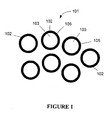
- the composite nanomaterial comprises a discrete shell-core encapsulate 101.
- the shell-core encapsulate 101 in one example comprises a plurality of nanoparticles 102.
- Each nanoparticle 102 comprises a substantially spherically nanocrystalline core 103.
- Core 103 can have multiple shapes, such as substantially spherical or equi-axed.
- the mean diameter of core 103 can vary. Examples include from about 1 nm to about 900 nm, from about 2 nm to about 100 nm, from about 5 nm to about 40 nm.
- Cores 103 typically constitute from about 60 to about 98 percent, by weight, of the discrete shell-core encapsulate 101.
- each core 103 in one example includes at least one metal or metal oxide.
- Other constituents may be present in core 103 in nominal amounts. Examples of these include, but are not limited to, surfactants, salts, residual solvents and processing aids, such as dispersants.
- Each core 103 is encapsulated by a shell 105.
- the composition of shell 105 in one example comprises a metal oxide, either alone or in combination with a metal or another metal oxide.
- Shell 105 may be applied to be as thick as desired for conferring an improvement in application properties. For example, 4-wt % of a metal alkoxide or metal benzylate precursor encapsulating approximately 85% of the nanoparticle surface area of a nanoparticle with a BET of 20 m 2 /g can render the core compatible with an application environment, such as high temperature or extreme pH.
- Shell 105 comprises one layer or multiple layers. For example, if shell 105 comprises two layers, each layer either could have the same composition, or one layer could have a first composition, and the other layer could have a second composition.
- the composition of the layer (or layers) is selected to impart particular properties to the nanomaterial. For example, a zirconium oxide shell imparts a thermally stable oxygen storage capacity to a cerium oxide core and a silicon oxide shell imparts pH-stability to a zinc oxide core.
- each layer may have the same thickness or, alternatively, a different thickness.
- Each individual layer may be applied as thick as desired for conferring an application function.
- Shell layer thickness and texture may differ because of shell precursor reactivity, shell precursor molecular size, or application need.
- the layers may be deposited so that the interface between the layers is smooth. Alternatively, the interface between the layers may be textured, with peaks, ridges, and/or undulations. For instance one layer may have peaks while the other layer has depressions; the peaks from the one layer are imbedded within the other layer. Having a textured interface increases the BET surface area of the core.
- titanium dioxide in an anatase crystalline form, may need to be rendered UV-stable and chemically compatible with an organic matrix.
- an inner shell of aluminum oxide is applied at approximately 10% nanoparticle surface coverage to enable UV-stability (by forming electron-hole recombination sites) and a subsequent functionalized silicon oxide coating is applied at 80% to 100% nanoparticle surface coverage to provide chemical compatibility with the polymer matrix.
- the interface in this example is textured because the inner shell layer is not complete. But some applications may require complete inner shells and a smooth inter-shell interface.
- the method comprises introducing a powder comprising a plurality of nanoparticles into a coating vessel that is capable of mixing and heating its contents under a controlled environment.
- a suitable device is a Buchi Rotovap, available from Brinkmann Instruments, located in Des Plains, IL.
- the powder is mixed with a coating precursor and heated in an environment to a pre-determined temperature and for a time effective for the coating precursor to wet the particles and form a shell thereon.
- coating precursors include, but are not limited to, metal alkoxides and metal benzylates. Volatile by-products, such as alcohols, may be driven off as the coated powder is heated.
- the nanopowder and the coating precursor are added in quantities effective to enable a specific application - low degree of coverage for UV -stability to complete, or near complete, coverage for chemical compatibility - thus forming the shell-core structure.
- the amount of coating precursor used is directly related to the particle surface area or the particle size. Particle size is measured by nitrogen adsorption using the "BET" technique.
- 4-wt % of a metal alkoxide or metal benzylate precursor encapsulates approximately 85% of the nanoparticle surface area for a nanoparticle with a BET of 20 m 2 /g. If the nanoparticle has a BET of 40 m 2 /g, twice the precursor would be required to encapsulate and equivalent amount of the nanoparticle surface area.
- the composite nanomaterial described above can be used for a variety of applications. Several example applications, for which the composite nanomaterial can be employed, are now described for illustrative purposes.
- a composite nanomaterial comprises a composite oxygen storage catalyst 201.
- catalyst 201 includes a plurality of particles 202.
- Each particle 202 comprises a core 203 made of an oxygen storage material.
- Each core 203 can have a variety of shapes, such as substantially spherical, or equiaxed.
- Each core 203 is encapsulated by a shell 205 made of an oxygen transport material.
- the shell acts to prevent the catalyst cores 203 from sintering together.
- the separation of cores 203 optimizes the oxygen storage capacity of the catalyst at typical catalytic process temperatures by preventing a decrease in the active surface area of the oxygen storage catalyst (the cores).
- Oxygen transport through shell 250 depends on the chemical properties of the shell and the shell thickness.
- each core 203 includes at least one metal oxide where the metal is selected from the lanthanides (atomic numbers 58-71), scandium, yttrium, and lanthanum.
- each core 203 comprises lanthanium oxides.
- core 203 comprises oxides and mixed oxides of cerium.
- each core 203 may comprise a combination of oxides or mixture of oxides (e.g., 10% may comprise an oxide of yttrium, 20% may comprise an oxide of lanthanum, 30% may comprise an oxide of scandium, and 40% may comprise an oxide of cerium).
- Other constituents may be present in each core 203 in nominal amounts. Examples include surfactants, salts, residual solvents and processing aids such as dispersants and plasticizers.
- Shell 205 in one example comprises an oxide.
- shell 205 comprises an oxide in combination with at least one metal or another metal oxide.
- shell 205 comprises an oxide and a catalytic metal.
- more than one component, including zirconium oxide is used in shell 205. Examples include, but are not limited to, zirconium oxide, platinum oxide-zirconium oxide, platinum-zirconium oxide.
- the percentage of zirconium oxide in the oxygen storage catalyst can vary. Example ranges of zirconium oxide in the oxygen storage catalyst shell 205 include but are not limited to about 51 to about 100%, by total weight of shell 205, about 75 to about 100%, by total weight of shell 205, about 90 to about 100%, by total weight of the shell 205.
- Shell 205 may be applied to be as thick as desired for conferring an improvement in oxygen transport and oxygen storage capacity.
- 8-wt % of a zirconium alkoxide or zirconium benzylate processor encapsulates approximately 85% of the surface area for cerium oxide nanoparticles with a BET of 40 m 2 /g.
- the resulting zirconium oxide shell is approximately 4-wt% of the shell-core composite particle (the weight difference between shell precursor and shell results from volatile reaction by-products of the shell precursor).
- Shell 205 can comprise one layer or multiple layers of oxygen transport material. For example, if shell 205 comprises two layers, each layer could have the same composition. In another example, one layer could have a first composition, such as zirconium oxide, and the other layer could have a second composition, such as zirconium oxide and platinum. The composition of the layer (or layers) is selected to impart particular properties to the nanomaterial. Shells comprised of zirconium transport oxygen to and from the oxygen storage catalyst cores. The addition of platinum to the shell imparts additional catalytic function to the particles.
- the layers of oxygen transport material may have a substantially uniform thickness or the layers may each have a different thickness.
- the individual layers may be applied as thick as desired for conferring an improvement in oxygen transport and oxygen storage capacity at application conditions.
- 16-wt% shell precursor is required to encapsulate 85% of the available core surface area for cores with a BET of 80 m 2 /g.
- the layers may be deposited so that the interface between the layers is smooth.
- the interface between the layers may be textured, with peaks, ridges, and/or undulations. For instance, one layer may have peaks while the other layer has depressions; the peaks from the one layer are imbedded within the other layer. Having a textured interface increases the BET surface area of the core. Textured shells may increase oxygen transport in certain applications.
- core 203 and shell 205 are present in a ratio ranging from about 60:40 to about 98:2 for core 203 and shell 205, by weight.
- Other exemplary ranges include, but are not limited to, from about 75:30 to about 98:2, and from about 90:10 to about 98:2, by weight.
- the BET specific surface area of the oxygen storage catalyst 201 was measured before and after being subjected to sequential cycles of oxidation and reduction, as described above in the definition of "oxygen storage capacity,” and quantifies particle size.
- the oxygen storage catalyst generally retained a relative OSC of about 1, with respect to unheated, uncoated, oxygen storage material at catalytic process temperatures, despite any reduction in the BET surface area.
- FIG. 2 schematically illustrates two states 250, 252 of catalyst 201 in accordance with the present invention.
- State 250 depicts the unsintered nature of individual coated catalyst cores 203 after heating to a temperature of about 600°C.
- State 252 shows that after heating to a temperature typical of catalytic processes, such as about 1050°C, shells 205 surrounding adjacent catalyst cores 203 sinter together to form a reticulated network 207.
- the individual catalyst cores 203 are embedded in the network 207 of the shell material, which prevents cores 203 from sintering together.
- the composite catalyst particles thus possess a reduced specific surface area and a higher OSC, relative to uncoated catalysts, after heating to elevated temperatures.
- Reticulated network 207 is formed when the composite shell-core morphology is heated above the sintering temperature of the shell material.
- the sintering temperature will vary depending on the shell material but thermal excursions above this temperature will always generate reticulated network 207 where the continuous phase of network 207 will be the shell material and the discontinuous phase will be the core material.
- reticulated network 207 quenches possible sintering of the core catalyst and prevents degradation in catalyst activity that would otherwise be attributed to a decrease in active surface area of catalyst nanoparticle at temperatures above the sintering temperature. Catalytic function is retained in this example because the shell material is also an oxygen transport material and enables rapid transport of oxygen across the shell, or continuous phase of the reticulated network.
- reticulated network 207 is a general consequence of the shell-core composites and may be employed to enable a range of applications.
- the composite nanomaterial comprises an oxygen storage material.
- the oxygen storage material includes a plurality of oxygen storage catalyst particles and an oxygen transport material. Each particle is encapsulated within the oxygen transport material as a result of mixing a powder comprising the oxygen storage catalyst particles with a coating precursor at temperature, environment, and for a time effective for the coating precursor to wet the particles and form an oxygen transport shell thereon.
- the oxygen storage material so formed has a shell and a core, wherein each particle is a core.
- the cores/particles, the shell, and the oxygen storage materials are as described above and have the properties as described above.
- the composite nanomaterial comprises an oxygen storage material having a defined BET specific surface area.
- the oxygen storage material comprises a plurality of oxygen storage catalyst cores and an oxygen transport shell encapsulating each of the cores.
- the shell prevents the cores from sintering together, so that the oxygen storage material retains a relative oxygen storage capacity of about one, with respect to the unheated, uncoated oxygen storage material, despite any reduction in the BET surface area.
- the method comprises introducing a powder containing a plurality of oxygen storage catalyst particles into a coating vessel that is capable of mixing and heating its contents under a controlled environment.
- a suitable device is a Buchi Rotovap, available from Brinkmann Instruments, located in Des Plains, IL.
- suitable coating precursors include but are not limited to zirconium alkoxides and benzylates such as zirconium 1-butoxide, Zr[O(CH 2 ) 3 CH 3 ] 4 ; zirconium benzylate, Zr[OCH 2 C 6 H 5 ] 4 ; zirconium isopropoxide, Zr[OCH(CH 3 ) 2 ] 4 , and combinations thereof.
- the coating precursors react with water to form a metal oxide by condensation reactions with the respective ligated alcohol byproduct.
- Heating can be conducted within various temperature ranges. Examples include but are not limited to from about 60°C to about 160°C, from about 70°C to about 120°C, and from about 80°C to about 95°C.
- a water or oil bath is typically employed as a means of maintaining a uniform temperature.
- the heating step is conducted for a time sufficient for wetting the powder, reacting the coating precursor, and possibly removing process solvents and/or reaction byproducts.
- the rate of heating is process scale dependent.
- the environment used should be substantially inert; it may comprise predominately nitrogen or any other inert gases such as argon, or combinations thereof.
- the oxygen storage material may be stored at room temperature and conditions. Or the oxygen storage material may be further heated to remove remaining organics in the shell.
- the powder prior to the step of mixing the powder with the coating precursor, the powder may be heated, with mixing, to a temperature that facilitates facile wetting of the powder surface by the coating precursor. After the powder has attained the desired temperature, the precursor coating is then introduced, and the two components are heated and mixed as described above.
- One having ordinary skill in the art would be able to determine a suitable mixing speed, heating rates, reaction temperatures and times.
- the method may include a cooling step, wherein the oxygen storage material is cooled to ambient temperature prior to being removed from the coating vessel.
- the cooling step is also process scale dependent.
- Cerium oxide is an oxygen storage material and is used as a co-catalyst for purifying automobile exhaust gases. Cerium oxide absorbs oxygen under an oxidizing atmosphere and desorbs oxygen under a reducing atmosphere and is a component of a three-way catalyst to improve the efficiency of catalytic converters in purifying automotive exhaust gases containing hydrocarbons(HC)/carbon monoxide(CO)/nitrogen oxides (NO x ).
- Cerium oxide provides oxygen required to oxidize CO and HC to CO 2 and H 2 O.
- cerium oxide absorbs oxygen to be used in the oxygen poor cycle.
- cerium oxide The oxygen-absorbing and -desorbing property of cerium oxide is thermally sensitive. At temperatures above 600°C cerium oxide particles sinter together causing a decrease in the cerium oxide particle surface area and degrading the ability of cerium oxide to act as an oxygen storage material. The degree to which cerium oxide particles sinter together increases with temperature and limits the application temperature of particulate oxygen storage catalysts. This is particularly true as the particle size of the oxygen-storage material is decrease to below 40-nm.
- a series of oxygen storage materials having a cerium oxide catalyst core was prepared with three types of coating precursors at different concentrations to form a zirconium oxide shell.
- the precursors included zirconium butoxide, zirconium propoxide, and zirconium benzylate, zirconium compounds obtained from Sigma-Aldrich, Milwaukee, WI, or Advanced Materials, New Hill, NC. Both precursors react to form zirconium oxide by condensation reactions with the respective ligated alcohol byproduct.
- Table 1 identifies the coating precursors and the concentrations used.
- the OSC of the coated cerium oxide, and uncoated cerium oxide was quantified by thermogravimetric analysis on a Hi-Res TGA 2950 Thermogravimetric Analyzer, available from TA Instruments, New Castle, DE.
- the analyzer measured the weight of the sample as a function of temperature; independent variables included the temperature cycle, the sample size, and the atmosphere for analysis.
- the coated cerium oxide was subjected to oxidation-reduction as follows: (a) the coated cerium oxide was heated to 600°C under oxygen [10°C/minute] to fully oxidize the cerium oxide, (b) the cerium oxide was then reduced with hydrogen and nitrogen gas in a weight ratio of 2:98 for 15 - 45 minutes at 600°C, and (c) the cerium oxide was next oxidized with oxygen for 10 - 30 minutes at 600°C. The oxidation-reduction cycle was repeated up to three times.
- FIGS. 3-5 are thermogravimetric analyses (TGA) of selected oxygen storage materials in Table 1.
- Table 1 reports the BET specific surface area and the OSC for the oxygen storage materials and uncoated cerium oxide.
- Table 1 reports the BET specific surface area and the OSC for the oxygen storage materials and uncoated cerium oxide.
- Table 1. Composition of oxygen storage materials and their BET specific surface area and OSC Oxygen Storage Material Coating precursor % Coating precursor Calcination Temp, °C BET SSA (m 2 /g) Catalyst OSC ( ⁇ moles O 2 /g) Uncoated Cerium Oxide None -- Uncalcined 90 72 None -- 600 76 77 None -- 850 27 59 None -- 1050 5 12.5 A Zirconium 1-butoxide 12.20 Uncalcined 69 1050 1.5 25 B Zirconium benzylate 22.72 Uncalcined 53 1050 5.0 50 C Zirconium 1-butoxide 17.83 Uncalcined 59 1050 2.7 38 D Zirconium benzylate, 80 wt % in 1-BuOH 22.72 Uncalcined 56
- Oxygen storage materials were prepared in accordance with the method described in Example 1, using 9.26 grams zirconium benzylate (80 wt% in 1-butanol) as the coating precursor.
- the OSC and BET specific surface area were measured and compared against that of uncoated cerium oxide. Results are shown in Table 2.
- Example 1 The materials in Example 1 where the core-shell morphology is converted to cores surrounded by a reticulated morphology that also allows oxygen transport to encapsulated oxygen storage cores.
- Nanoparticles are important optical materials because their small size renders them transparent in the visible region of light yet they may interact strongly with the ultraviolet (UV) or infrared (IR) radiation.
- Composite core-shell nanoparticles are unique because specific properties of a nanoparticle core, such as refractive index or scattering cross section, are tailored by the addition of a shell to meet specific application requirements.
- Specific examples of uses of the composite nanomaterial in an electromagnetic implementation include, but are not limited to:
- the composite nanoparticles are added to coatings and devices to control the transport of radiation through the material.
- composite shell-core nanoparticles fabricated to match the refractive index of a coating material will be transparent and render the coating wear and scratch resistant.
- Composite shell-core nanoparticles with tailored, refractive index may be incorporated into a lens to enable radiation to be focused or defocused.
- High dielectric constant nanoparticle cores barium titanium oxide
- controlled dielectric shells zirconium oxide, or barium calcium strontium oxide
- the rheology of fluids may be controlled by subjecting fluids filled with an electro-active material to electromagnetic radiation.
- the fillers in a fluid will respond to the applied radiation and the fluid viscosity will change.
- Composite core-shell nanoparticles incorporated into fluids enable large, rapid responses to radiation of a specific frequency.
- composite nanomaterial is as a chemically passive material. Every application has a unique chemical environment and in some instances the interfacial region surrounding a nanoparticle must be rendered chemically passive. Composite core-shell nanoparticles can enable these applications.
- Composite core-shell nanoparticles where the core is aluminum oxide and the shell is comprised of a thermally stable material such as yttrium stabilized zirconium oxide enable high temperature ceramic composites by preventing grain growth.
- composite shell-core nanoparticles may be substituted in existing material systems to yield materials with a substantial economic advantage.
- Conductive materials are polymeric systems that contain conductive salts and/or particles.
- the use of a composite nanoparticle comprised of an inexpensive core and a conductive shell will yield coatings of equivalent conductivity but lower cost. Examples include silver or copper shells on aluminum oxide or silicon oxide cores.
- Thermal fluids are limited with respect to usage temperature and thermal efficiency.
- the incorporation of a composite nanoparticle comprised of a high thermal capacity core and a thermally conductive and corrosion resistant shell into conventional thermal fluids will yield materials with higher temperature capability, greater thermal efficiency, and lower cost of ownership. Examples include zinc oxide shells (provide corrosion protection) on copper cores.
Landscapes
- Chemical & Material Sciences (AREA)
- Engineering & Computer Science (AREA)
- Organic Chemistry (AREA)
- Ceramic Engineering (AREA)
- Manufacturing & Machinery (AREA)
- Materials Engineering (AREA)
- Inorganic Chemistry (AREA)
- Structural Engineering (AREA)
- Chemical Kinetics & Catalysis (AREA)
- Physics & Mathematics (AREA)
- Power Engineering (AREA)
- Nanotechnology (AREA)
- Thermal Sciences (AREA)
- Crystallography & Structural Chemistry (AREA)
- Microelectronics & Electronic Packaging (AREA)
- Dispersion Chemistry (AREA)
- Composite Materials (AREA)
- Condensed Matter Physics & Semiconductors (AREA)
- General Physics & Mathematics (AREA)
- Analytical Chemistry (AREA)
- General Chemical & Material Sciences (AREA)
- Life Sciences & Earth Sciences (AREA)
- Geology (AREA)
- Inorganic Compounds Of Heavy Metals (AREA)
- Catalysts (AREA)
- Exhaust Gas Treatment By Means Of Catalyst (AREA)
- Oxygen, Ozone, And Oxides In General (AREA)
Claims (41)
- Nanopartikelverbundmaterial, umfassend mehrere Kerne und mehrere Schalen, wobei jede der Schalen mindestens ein Metalloxid und ein zweites Metall oder Metalloxid umfasst, wobei jeder der Kerne durch eine der Schalen verkapselt ist und mindestens zwei der mehreren Schalen miteinander unter Bildung eines retikulierten Netzwerks versintern können.
- Nanopartikelverbundmaterial nach Anspruch 1, wobei es sich bei den Kernen um weitgehend sphärische nanokristalline Partikel handelt.
- Nanopartikelverbundmaterial nach Anspruch 1, wobei die Kerne jeweils mindestens ein Metall oder Metalloxid umfassen.
- Nanopartikelverbundmaterial nach Anspruch 1, wobei die mehreren Kerne mehr als eine Art von Material umfassen.
- Nanopartikelverbundmaterial nach Anspruch 1, wobei die mehreren Kerne einen mittleren Durchmesser von 1 nm bis 900 nm aufweisen.
- Nanopartikelverbundmaterial nach Anspruch 5, wobei die mehreren Kerne einen mittleren Durchmesser von 2 nm bis 100 nm aufweisen.
- Nanopartikelverbundmaterial nach Anspruch 6, wobei die mehreren Kerne einen mittleren Durchmesser von 5 nm bis 40 nm aufweisen.
- Nanopartikelverbundmaterial nach Anspruch 1, wobei die mehreren Kerne 51 bis 100 Gewichtsprozent des Nanopartikelverbundmaterials ausmachen.
- Nanopartikelverbundmaterial nach Anspruch 8, wobei die mehreren Kerne 75 bis 100 Gewichtsprozent des Nanopartikelverbundmaterials ausmachen.
- Nanopartikelverbundmaterial nach Anspruch 9, wobei die mehreren Kerne typischerweise 90 bis 100 Gewichtsprozent des Nanopartikelverbundmaterials ausmachen.
- Nanopartikelverbundmaterial nach Anspruch 1, wobei die Schale mindestens zwei Schichten des Verbundmaterials umfasst.
- Nanopartikelverbundmaterial nach Anspruch 1, wobei:es sich bei den mehreren Kernen um Sauerstoffspeicherkatalysatorkerne handelt undes sich bei den mehreren Schalen um Sauerstofftransportschalen handelt, wobei jeder der Sauerstoffspeicherkatalysatorkerne durch eine der Sauerstofftransportschalen verkapselt ist.
- Nanopartikelverbundmaterial nach Anspruch 12, wobei die mehreren Sauerstoffspeicherkatalysatorkerne während und nach dem Erhitzen des Sauerstoffspeichermaterials auf eine Temperatur für katalytische Verfahren im Bereich von 600°C bis 1300°C getrennt bleiben.
- Nanopartikelverbundmaterial nach Anspruch 12, wobei jeder der mehreren Sauerstoffspeicherkatalysatorkerne ein weitgehend sphärisches nanokristallines Partikel umfasst.
- Nanopartikelverbundmaterial nach Anspruch 12, wobei jeder der mehreren Sauerstoffspeicherkatalysatorkerne mindestens ein Metalloxid aus einer Gruppe umfassend Lanthanide, Scandium, Yttrium und Lanthan umfasst.
- Nanopartikelverbundmaterial nach Anspruch 15, wobei jeder der mehreren Sauerstoffspeicherkatalysatorkerne ein Lanthanoxid umfasst.
- Nanopartikelverbundmaterial nach Anspruch 15, wobei jeder der mehreren Sauerstoffspeicherkatalysatorkerne ferner mindestens ein Mischoxid von Cer umfasst.
- Nanopartikelverbundmaterial nach Anspruch 15, wobei jeder der mehreren Sauerstoffspeicherkatalysatorkerne ferner eine Kombination oder Mischung von Oxiden umfasst.
- Nanopartikelverbundmaterial nach Anspruch 12, wobei jede der mehreren Sauerstofftransportschalen ein Oxid aus einer Gruppe umfassend Zirconiumoxid, Yttriumoxid, Platinoxid und Lanthanoxid umfasst.
- Nanopartikelverbundmaterial nach Anspruch 19, wobei es sich bei dem Oxid um Zirconiumoxid handelt.
- Nanopartikelverbundmaterial nach Anspruch 19, wobei jede der mehreren Sauerstofftransportschalen ferner ein Metall oder Metalloxid aus der Gruppe umfassend Platin, Yttriumoxid, Platinoxid und Lanthanoxid umfasst.
- Nanopartikelverbundmaterial nach Anspruch 21, wobei jede der mehreren Sauerstofftransportschalen Zirconiumoxid in einer Menge von 51 bis 100%, bezogen auf das Gesamtgewicht aller Oxide in jeder Schale, umfasst.
- Nanopartikelverbundmaterial nach Anspruch 22, wobei jede der mehreren Sauerstofftransportschalen Zirconiumoxid in einer Menge von 75 bis 100%, bezogen auf das Gesamtgewicht aller Oxide in jeder Schale, umfasst.
- Nanopartikelverbundmaterial nach Anspruch 23, wobei jede der mehreren Sauerstofftransportschalen Zirconiumoxid in einer Menge von 90 bis 100%, bezogen auf das Gesamtgewicht aller Oxide in jeder Schale, umfasst.
- Nanopartikelverbundmaterial nach Anspruch 12, wobei die mehreren Sauerstoffspeicherkatalysatorkerne mehrere Typen von Sauerstoffspeicherkatalysatorkernen umfassen.
- Nanopartikelverbundmaterial nach Anspruch 12, wobei die mehreren Sauerstoffspeicherkatalysatorkerne einen mittleren Durchmesser von 1 nm bis 900 nm aufweisen.
- Nanopartikelverbundmaterial nach Anspruch 26, wobei die mehreren Sauerstoffspeicherkatalysatorkerne einen mittleren Durchmesser von 2 nm bis 100 nm aufweisen.
- Nanopartikelverbundmaterial nach Anspruch 27, wobei die mehreren Sauerstoffspeicherkatalysatorkerne einen mittleren Durchmesser von 5 nm bis 40 nm aufweisen.
- Nanopartikelverbundmaterial nach Anspruch 12, wobei die mehreren Kerne 51 bis 100 Gewichtsprozent des Sauerstoffspeichermaterials ausmachen.
- Nanopartikelverbundmaterial nach Anspruch 29, wobei die mehreren Kerne 75 bis 100 Gewichtsprozent des Sauerstoffspeichermaterials ausmachen.
- Nanopartikelverbundmaterial nach Anspruch 30, wobei die mehreren Kerne 90 bis 100 Gewichtsprozent des Sauerstoffspeichermaterials ausmachen.
- Nanopartikelverbundmaterial nach Anspruch 12, wobei jede der mehreren Sauerstofftransportschalen eine erste Materialschicht, die dem Sauerstoffspeichermaterial thermische Stabilität verleiht, und eine zweite Schicht, die katalytische Aktivität in dem Sauerstoffspeichermaterial stimuliert, umfasst.
- Nanopartikelverbundmaterial nach Anspruch 12, wobei mindestens zwei der Sauerstofftransportschalen miteinander unter Bildung eines retikulierten Netzwerks versintern.
- Nanopartikelverbundmaterial nach Anspruch 12, wobei jede der mehreren Sauerstofftransportschalen ein Sauerstofftransportmaterial umfasst.
- Nanopartikelverbundmaterial nach Anspruch 12, wobei das Sauerstoffspeichermaterial eine relative Sauerstoffspeicherkapazität bei Temperaturen für katalytische Verfahren von etwa 1 gegenüber nicht erhitztem, unbeschichtetem Sauerstoffspeichermaterial bei Temperaturen für katalytische Verfahren aufweist, wobei:die Sauerstoffspeicherkapazität die Fähigkeit des Sauerstoffspeichermaterials zur Absorption von Sauerstoff in einer oxidativen Atmosphäre und Desorption von Sauerstoff in weitgehend inerter Atmosphäre ist unddie Sauerstoffspeicherkapazität durch Verwendung eines Geräts für die thermogravimetrische Analyse zur Messung des Gewichts des Sauerstoffspeichermaterials als Funktion der Temperatur nach aufeinanderfolgenden Oxidations-Reduktions-Zyklen bestimmt wird, wobei jeder Oxidations-Reduktions-Zyklus das Erhitzen des Sauerstoffspeichermaterials auf 600°C unter Sauerstoff mit 10°C pro Minute zur vollständigen Oxidation des Materials, die Reduktion des Materials mit einem Wasserstoff-Stickstoff-Gas mit einer 2%/98%-Molbasis über einen Zeitraum von 15 bis 45 Minuten bei 600°C und die Oxidation des Materials mit Sauerstoff über einen Zeitraum von 10 bis 30 Minuten bei 600°C umfasst; unddie Sauerstoffspeicherkapazität des Materials, ausgedrückt in Mol Sauerstoff pro Gramm Katalysator, folgendermaßen berechnet wird:

- Nanopartikelverbundmaterial nach Anspruch 35, wobei die Temperaturen für katalytische Verfahren im Bereich von 600°C bis 1300°C liegen.
- Nanopartikelverbundmaterial nach Anspruch 36, wobei die Temperaturen für katalytische Verfahren im Bereich von 750°C bis 1200°C liegen.
- Nanopartikelverbundmaterial nach Anspruch 37, wobei die Temperaturen für katalytische Verfahren im Bereich von 900°C bis 1100°C liegen.
- Verfahren zur Herstellung des Nanopartikelverbundmaterials nach Anspruch 12, bei dem man mehrere Sauerstoffspeicherkatalysatorkerne mit Sauerstofftransportschalenvorstufen mischt und die mehreren Sauerstoffspeicherkatalysatorkerne und Sauerstofftransportschalenvorstufen so lange erhitzt, dass die Schalenvorstufen die Pulveroberfläche benetzen und die Schale um die Sauerstoffspeicherkatalysatorkerne bilden.
- Verfahren nach Anspruch 39, bei dem man ferner die mehreren Sauerstoffspeicherkatalysatorkerne und die Sauerstofftransportschalenvorstufen so lange erhitzt, dass das Pulver benetzt wird, die Beschichtungsvorstufen reagieren und Verfahrenslösungsmittel oder Reaktionsnebenprodukte entfernt werden.
- Verfahren nach Anspruch 40, bei dem man ferner die mehreren Sauerstoffspeicherkatalysatorkerne und die Sauerstofftransportschalenvorstufen so lange erhitzt, dass das Pulver benetzt wird, die Beschichtungsvorstufen reagieren, Verfahrenslösungsmittel oder Reaktionsnebenprodukte entfernt werden und mindestens zwei der mehreren Schalen miteinander unter Bildung eines retikulierten Netzwerks versintern können.
Applications Claiming Priority (3)
| Application Number | Priority Date | Filing Date | Title |
|---|---|---|---|
| US35756702P | 2002-02-15 | 2002-02-15 | |
| US357567P | 2002-02-15 | ||
| PCT/US2003/004805 WO2003070810A2 (en) | 2002-02-15 | 2003-02-18 | Composite nanoparticle materials and method of making the same |
Publications (3)
| Publication Number | Publication Date |
|---|---|
| EP1483111A2 EP1483111A2 (de) | 2004-12-08 |
| EP1483111A4 EP1483111A4 (de) | 2006-06-07 |
| EP1483111B1 true EP1483111B1 (de) | 2013-01-30 |
Family
ID=27757641
Family Applications (1)
| Application Number | Title | Priority Date | Filing Date |
|---|---|---|---|
| EP03742804A Expired - Lifetime EP1483111B1 (de) | 2002-02-15 | 2003-02-18 | Verbundnanoparktikelmaterialien und herstellungsverfahren dafür |
Country Status (6)
| Country | Link |
|---|---|
| US (1) | US7052777B2 (de) |
| EP (1) | EP1483111B1 (de) |
| JP (1) | JP2005517625A (de) |
| AU (1) | AU2003211127B2 (de) |
| CA (1) | CA2473923C (de) |
| WO (1) | WO2003070810A2 (de) |
Cited By (1)
| Publication number | Priority date | Publication date | Assignee | Title |
|---|---|---|---|---|
| EP3257815A4 (de) * | 2015-02-15 | 2018-03-21 | Tianjin University | Mikrometerskaliger ceroxidpartikel mit mehrkern-einzelhüllen-struktur und herstellungsverfahren dafür |
Families Citing this family (81)
| Publication number | Priority date | Publication date | Assignee | Title |
|---|---|---|---|---|
| JP2005519756A (ja) * | 2001-06-20 | 2005-07-07 | ナノフェイズ テクノロジーズ コーポレイション | ナノ結晶性金属酸化物の非水系分散体 |
| US7442227B2 (en) * | 2001-10-09 | 2008-10-28 | Washington Unniversity | Tightly agglomerated non-oxide particles and method for producing the same |
| WO2004000916A2 (en) * | 2002-02-04 | 2003-12-31 | Nanophase Technologies Corporation | Stable dispersions of nanoparticles in aqueous media |
| WO2003070810A2 (en) * | 2002-02-15 | 2003-08-28 | Nanophase Technologies Corporation | Composite nanoparticle materials and method of making the same |
| US6669823B1 (en) * | 2002-06-17 | 2003-12-30 | Nanophase Technologies Corporation | Process for preparing nanostructured materials of controlled surface chemistry |
| JP3797313B2 (ja) * | 2002-10-28 | 2006-07-19 | トヨタ自動車株式会社 | 金属酸化物粒子の製造法及び排ガス浄化用触媒 |
| US20080199701A1 (en) * | 2003-02-25 | 2008-08-21 | Kuehnle Manfred R | Encapsulated nanoparticles for the absorption of electromagnetic energy |
| CN100431946C (zh) * | 2003-05-20 | 2008-11-12 | 苏黎世联合高等工业学校 | 生产金属氧化物的方法及所述方法生产的金属氧化物和用途 |
| US7384888B2 (en) | 2003-09-15 | 2008-06-10 | Toyota Jidosha Kabushiki Kaisha | Cerium-zirconium composite metal oxide |
| US11582065B2 (en) * | 2007-06-12 | 2023-02-14 | Icontrol Networks, Inc. | Systems and methods for device communication |
| US7422995B2 (en) * | 2004-04-30 | 2008-09-09 | Basf Catalysts Llc | Process for the preparation of a supported catalyst |
| US7846977B2 (en) * | 2004-04-30 | 2010-12-07 | Basf Corporation | Processes using a supported catalyst |
| FR2872061B1 (fr) * | 2004-06-23 | 2007-04-27 | Toulouse Inst Nat Polytech | Composition solide divisee formee de grains a depot metallique atomique continu et son procede d'obtention |
| US20060065989A1 (en) * | 2004-09-29 | 2006-03-30 | Thad Druffel | Lens forming systems and methods |
| CA2583486C (en) * | 2004-10-08 | 2016-02-09 | Sdc Materials, Llc | An apparatus for and method of sampling and collecting powders flowing in a gas stream |
| CN1295074C (zh) * | 2005-02-03 | 2007-01-17 | 蒋姝华 | 纳米钙塑纤维毡复合汽车内饰衬板及其制造方法 |
| US20060177660A1 (en) * | 2005-02-09 | 2006-08-10 | Challa Kumar | Core-shell nanostructures and microstructures |
| WO2008140785A1 (en) | 2005-04-19 | 2008-11-20 | Sdc Materials, Inc. | Water cooling system and heat transfer system |
| JP2006324637A (ja) * | 2005-04-21 | 2006-11-30 | Tdk Corp | 共材粒子、その製造方法、電極ペースト、電子部品の製造方法 |
| CN101247912B (zh) | 2005-07-21 | 2010-08-04 | 株式会社丰田中央研究所 | 复合材料、复合材料基材、复合材料分散流体、及其制造方法 |
| US7465497B2 (en) * | 2005-11-23 | 2008-12-16 | General Electric Company | High dielectric constant nanocomposites, methods of manufacture thereof, and articles comprising the same |
| US8277785B2 (en) * | 2005-12-13 | 2012-10-02 | Avon Products, Inc. | Cosmetic compositions with encapsulated pigments and a method for using |
| WO2007069735A1 (ja) * | 2005-12-15 | 2007-06-21 | Mitsui Mining & Smelting Co., Ltd. | 脱酸素剤及び脱酸素剤の製造方法 |
| FR2896436B1 (fr) * | 2006-01-26 | 2009-03-06 | Peugeot Citroen Automobiles Sa | Revetement catalytique comportant des nanoparticules a proprietes catalytiques, procedes de fabrication de ces nanoparticules et de ce revetement, et reacteur catalytique le comportant. |
| WO2007086267A1 (ja) * | 2006-01-27 | 2007-08-02 | Konica Minolta Medical & Graphic, Inc. | コア・シェル構造を有するナノ半導体粒子およびその製造方法 |
| US20080176076A1 (en) * | 2006-05-11 | 2008-07-24 | University Of Victoria Innovation And Development Corporation | Functionalized lanthanide rich nanoparticles and use thereof |
| US20080132429A1 (en) * | 2006-05-23 | 2008-06-05 | Uchicago Argonne | Biological microarrays with enhanced signal yield |
| US7803148B2 (en) | 2006-06-09 | 2010-09-28 | Neurosystec Corporation | Flow-induced delivery from a drug mass |
| US20080145439A1 (en) * | 2006-07-31 | 2008-06-19 | Neurosystec Corporation | Nanoparticle drug formulations |
| US8227372B2 (en) * | 2006-08-30 | 2012-07-24 | Umicore Ag & Co. Kg | Core / shell-type catalyst particles comprising metal or ceramic core materials and methods for their preparation |
| US8288308B2 (en) | 2006-08-30 | 2012-10-16 | Umicore Ag & Co. Kg | Core/shell-type catalyst particles and methods for their preparation |
| TW200846026A (en) * | 2006-12-20 | 2008-12-01 | Avon Prod Inc | Nanocomposite pigments in a topical cosmetic application |
| TW200846027A (en) * | 2006-12-20 | 2008-12-01 | Avon Prod Inc | Nanocomposite pigments in a topical cosmetic application |
| US9345649B2 (en) | 2006-12-21 | 2016-05-24 | Avon Products, Inc. | Cosmetic composition containing novel fractal particle-based gels |
| JP2008289971A (ja) * | 2007-05-23 | 2008-12-04 | Toyota Motor Corp | コアシェル構造体及びその製造方法並びに当該コアシェル構造体を含む排ガス浄化用触媒 |
| DE102007041027A1 (de) | 2007-08-29 | 2009-03-05 | Eckart Gmbh | Effektpigmente auf Basis von aus anorganisch-organischen Mischphasen gebildeten Substraten, deren Herstellung und Verwendung |
| JP2009078946A (ja) * | 2007-09-26 | 2009-04-16 | Fujifilm Corp | コア−シェル型金属酸化物粒子及びその製造方法 |
| US8507401B1 (en) | 2007-10-15 | 2013-08-13 | SDCmaterials, Inc. | Method and system for forming plug and play metal catalysts |
| US9662389B2 (en) * | 2008-03-31 | 2017-05-30 | Duke University | Functionalized metal-coated energy converting nanoparticles, methods for production thereof and methods for use |
| TWI411448B (zh) | 2007-12-27 | 2013-10-11 | Avon Prod Inc | 適合用於化妝品之光學模糊色素組合物 |
| USD627900S1 (en) | 2008-05-07 | 2010-11-23 | SDCmaterials, Inc. | Glove box |
| US20100057068A1 (en) * | 2008-08-29 | 2010-03-04 | Kwangyeol Lee | Gold nanostructure and methods of making and using the same |
| JP2010285336A (ja) * | 2009-06-12 | 2010-12-24 | Seoul National Univ Research & Development Business Foundation | 誘電物質用焼結物質およびその製造方法、並びにコア−シェル微細構造を有する誘電物質用焼結物質およびその製造方法 |
| KR101616465B1 (ko) | 2009-11-02 | 2016-04-28 | 펄스 테라퓨틱스, 인코포레이티드 | 기자성 스테이터 시스템 및 마그네틱 로터의 무선제어 방법 |
| WO2011063539A2 (en) * | 2009-11-30 | 2011-06-03 | Oc Oerlikon Balzers Ag | Electronic battery with nano-composite |
| JP2013512554A (ja) * | 2009-11-30 | 2013-04-11 | オーツェー エリコン バルザーズ アーゲー | 電子電池に応用されるコア−シェルナノ粒子 |
| US8557727B2 (en) | 2009-12-15 | 2013-10-15 | SDCmaterials, Inc. | Method of forming a catalyst with inhibited mobility of nano-active material |
| US8803025B2 (en) | 2009-12-15 | 2014-08-12 | SDCmaterials, Inc. | Non-plugging D.C. plasma gun |
| US9126191B2 (en) | 2009-12-15 | 2015-09-08 | SDCmaterials, Inc. | Advanced catalysts for automotive applications |
| US8470112B1 (en) | 2009-12-15 | 2013-06-25 | SDCmaterials, Inc. | Workflow for novel composite materials |
| US9149797B2 (en) | 2009-12-15 | 2015-10-06 | SDCmaterials, Inc. | Catalyst production method and system |
| US8652992B2 (en) | 2009-12-15 | 2014-02-18 | SDCmaterials, Inc. | Pinning and affixing nano-active material |
| US9039916B1 (en) | 2009-12-15 | 2015-05-26 | SDCmaterials, Inc. | In situ oxide removal, dispersal and drying for copper copper-oxide |
| US8545652B1 (en) | 2009-12-15 | 2013-10-01 | SDCmaterials, Inc. | Impact resistant material |
| US9415373B2 (en) | 2010-03-08 | 2016-08-16 | Cerion, Llc | Structured catalytic nanoparticles and method of preparation |
| FR2960235B1 (fr) * | 2010-05-18 | 2013-11-01 | Inst Francais Du Petrole | Procede d'oligomerisation des olefines utilisant une composition comprenant un complexe organometallique contenant un ligand alcoxy fonctionnalise par un hetero-atome. |
| US8580701B2 (en) * | 2010-11-19 | 2013-11-12 | Corning Incorporated | Method of controlling Ce:Zr ratio in oxide nanoparticles |
| US8669202B2 (en) | 2011-02-23 | 2014-03-11 | SDCmaterials, Inc. | Wet chemical and plasma methods of forming stable PtPd catalysts |
| RU2014110365A (ru) | 2011-08-19 | 2015-09-27 | ЭсДиСиМАТИРИАЛЗ, ИНК. | Подложки с покрытием для использования в катализе, каталитические конвертеры и способы покрытия подложек композициями покрытия из оксида |
| US9139737B1 (en) | 2011-11-21 | 2015-09-22 | Nanophase Technologies Corporation | Multifunctional coated powders and high solids dispersions |
| US9987621B2 (en) | 2012-01-12 | 2018-06-05 | Nitto Denko Corporation | Transparent photocatalyst coating |
| EP2841055A4 (de) * | 2012-04-04 | 2015-09-16 | Univ Duke | Verfahren zur verwendung von ceriumoxidnanopartikeln zur verringerung oder zum schutz vor strahlenschäden |
| US9883878B2 (en) | 2012-05-15 | 2018-02-06 | Pulse Therapeutics, Inc. | Magnetic-based systems and methods for manipulation of magnetic particles |
| EP3443916A3 (de) | 2012-05-15 | 2019-04-24 | Pulse Therapeutics, Inc. | Magnetbasierte systeme |
| US9533286B2 (en) * | 2012-08-21 | 2017-01-03 | Toyota Motor Engineering & Manufacturing North America, Inc. | Sinter resistant catalytic material and process of producing the same |
| US9156025B2 (en) | 2012-11-21 | 2015-10-13 | SDCmaterials, Inc. | Three-way catalytic converter using nanoparticles |
| US9511352B2 (en) | 2012-11-21 | 2016-12-06 | SDCmaterials, Inc. | Three-way catalytic converter using nanoparticles |
| CN105592921A (zh) | 2013-07-25 | 2016-05-18 | Sdc材料公司 | 用于催化转化器的洗涂层和经涂覆基底及其制造和使用方法 |
| MX2016004759A (es) | 2013-10-22 | 2016-07-26 | Sdcmaterials Inc | Composiciones para trampas de oxidos de nitrogeno (nox) pobres. |
| US9427732B2 (en) | 2013-10-22 | 2016-08-30 | SDCmaterials, Inc. | Catalyst design for heavy-duty diesel combustion engines |
| EP3119500A4 (de) | 2014-03-21 | 2017-12-13 | SDC Materials, Inc. | Zusammensetzungen für passive nox-adsorptionssysteme |
| ES2558183B1 (es) * | 2014-07-01 | 2016-11-11 | Consejo Superior De Investigaciones Científicas (Csic) | Capa catalítica y su uso en membranas permeables al oxigeno |
| DE102014215112A1 (de) * | 2014-07-31 | 2016-02-04 | Johnson Matthey Public Limited Company | Verfahren zur Herstellung eines Katalysators sowie Katalysator-Artikel |
| JP6557594B2 (ja) * | 2015-12-24 | 2019-08-07 | キヤノン株式会社 | インストールを制御するプログラム、情報処理装置およびデバイスドライバーのインストール方法 |
| EP3287011A1 (de) | 2016-08-25 | 2018-02-28 | Solid Chemicals GmbH | Kern-hüllen-struktur mit titandioxid-kern |
| US10555892B1 (en) | 2017-03-09 | 2020-02-11 | Nanophase Technologies Corporation | Functionalized siloxane or polysiloxane coated particles with enhanced light filtering properties |
| US10590278B2 (en) | 2017-04-10 | 2020-03-17 | Nanophase Technologies Corporation | Coated powders having high photostability |
| US11918315B2 (en) | 2018-05-03 | 2024-03-05 | Pulse Therapeutics, Inc. | Determination of structure and traversal of occlusions using magnetic particles |
| EP3604212B1 (de) * | 2018-07-30 | 2020-12-02 | Diehl Aviation Gilching GmbH | Sauerstoffgenerator und verfahren zur abstimmung der sauerstoffproduktionsrate in eines sauerstoffgenerators |
| CN109011707B (zh) * | 2018-08-28 | 2020-09-25 | 江苏大学 | 一种基于建筑废弃物的油水分离材料及其制备方法 |
| US12171443B1 (en) | 2021-03-09 | 2024-12-24 | Pulse Therapeutics, Inc. | Magnetically controlled flow generation |
Citations (2)
| Publication number | Priority date | Publication date | Assignee | Title |
|---|---|---|---|---|
| WO2001088540A1 (en) * | 2000-05-17 | 2001-11-22 | University Of Florida | Coated nanoparticles |
| WO2003070810A2 (en) * | 2002-02-15 | 2003-08-28 | Nanophase Technologies Corporation | Composite nanoparticle materials and method of making the same |
Family Cites Families (13)
| Publication number | Priority date | Publication date | Assignee | Title |
|---|---|---|---|---|
| US5023139A (en) * | 1989-04-04 | 1991-06-11 | Research Corporation Technologies, Inc. | Nonlinear optical materials |
| DE19543204C2 (de) * | 1995-11-20 | 1997-09-18 | Bayer Ag | Verfahren zur Herstellung von nanodispersem Titandioxid und seine Verwendung |
| US5905000A (en) * | 1996-09-03 | 1999-05-18 | Nanomaterials Research Corporation | Nanostructured ion conducting solid electrolytes |
| US6162530A (en) * | 1996-11-18 | 2000-12-19 | University Of Connecticut | Nanostructured oxides and hydroxides and methods of synthesis therefor |
| US6344272B1 (en) * | 1997-03-12 | 2002-02-05 | Wm. Marsh Rice University | Metal nanoshells |
| KR100769157B1 (ko) * | 1997-05-13 | 2007-10-23 | 리챠드 에드먼드 토드 | 연성을 갖도록 코팅된 경질 분말과 이것의 소결제품 |
| US6045925A (en) * | 1997-08-05 | 2000-04-04 | Kansas State University Research Foundation | Encapsulated nanometer magnetic particles |
| US6607829B1 (en) * | 1997-11-13 | 2003-08-19 | Massachusetts Institute Of Technology | Tellurium-containing nanocrystalline materials |
| US6036886A (en) * | 1998-07-29 | 2000-03-14 | Nanocrystals Technology L.P. | Microemulsion method for producing activated metal oxide nanocrystals |
| US6602932B2 (en) | 1999-12-15 | 2003-08-05 | North Carolina State University | Nanoparticle composites and nanocapsules for guest encapsulation and methods for synthesizing same |
| US20020032123A1 (en) * | 2000-02-23 | 2002-03-14 | Ford Global Technologies, Inc. | Exhaust gas catalyst and method of manufacturing same |
| EP1166855B1 (de) * | 2000-06-27 | 2009-06-17 | ICT Co., Ltd. | Abgasreinigungskatalysator |
| WO2002003430A2 (en) * | 2000-06-29 | 2002-01-10 | California Institute Of Technology | Aerosol process for fabricating discontinuous floating gate microelectronic devices |
-
2003
- 2003-02-18 WO PCT/US2003/004805 patent/WO2003070810A2/en not_active Ceased
- 2003-02-18 US US10/368,941 patent/US7052777B2/en not_active Expired - Fee Related
- 2003-02-18 AU AU2003211127A patent/AU2003211127B2/en not_active Ceased
- 2003-02-18 EP EP03742804A patent/EP1483111B1/de not_active Expired - Lifetime
- 2003-02-18 CA CA002473923A patent/CA2473923C/en not_active Expired - Fee Related
- 2003-02-18 JP JP2003569714A patent/JP2005517625A/ja active Pending
Patent Citations (2)
| Publication number | Priority date | Publication date | Assignee | Title |
|---|---|---|---|---|
| WO2001088540A1 (en) * | 2000-05-17 | 2001-11-22 | University Of Florida | Coated nanoparticles |
| WO2003070810A2 (en) * | 2002-02-15 | 2003-08-28 | Nanophase Technologies Corporation | Composite nanoparticle materials and method of making the same |
Cited By (1)
| Publication number | Priority date | Publication date | Assignee | Title |
|---|---|---|---|---|
| EP3257815A4 (de) * | 2015-02-15 | 2018-03-21 | Tianjin University | Mikrometerskaliger ceroxidpartikel mit mehrkern-einzelhüllen-struktur und herstellungsverfahren dafür |
Also Published As
| Publication number | Publication date |
|---|---|
| AU2003211127B2 (en) | 2006-06-15 |
| WO2003070810A2 (en) | 2003-08-28 |
| WO2003070810A3 (en) | 2003-12-24 |
| AU2003211127A1 (en) | 2003-09-09 |
| JP2005517625A (ja) | 2005-06-16 |
| EP1483111A2 (de) | 2004-12-08 |
| EP1483111A4 (de) | 2006-06-07 |
| US7052777B2 (en) | 2006-05-30 |
| CA2473923A1 (en) | 2003-08-28 |
| US20040009349A1 (en) | 2004-01-15 |
| CA2473923C (en) | 2009-11-10 |
Similar Documents
| Publication | Publication Date | Title |
|---|---|---|
| EP1483111B1 (de) | Verbundnanoparktikelmaterialien und herstellungsverfahren dafür | |
| US6569518B2 (en) | Nanotechnology for electrochemical and energy devices | |
| JP4755988B2 (ja) | 金属酸化物固溶体、その製造および用途 | |
| Padmanabhan et al. | A simple sol− gel processing for the development of high-temperature stable photoactive anatase titania | |
| US7670679B2 (en) | Core-shell ceramic particulate and method of making | |
| US20080138267A1 (en) | Nanoparticles of rare earth oxides | |
| Brutchey et al. | Positive Temperature Coefficient of Resistivity in Donor‐Doped BaTiO3 Ceramics derived from Nanocrystals synthesized at Low Temperature | |
| WO2013162029A1 (ja) | 酸化鉄-ジルコニア系複合酸化物とその製造方法、および排ガス浄化触媒 | |
| Khan et al. | Sm 2 O 3 and Sm 2 O 3-based nanostructures for photocatalysis, sensors, CO conversion, and biological applications | |
| CN102531580A (zh) | 一种利用铝硅复合氧化物包覆纳米钛酸锶钡介质储能材料及其制备方法 | |
| JP6517012B2 (ja) | 誘電体セラミックス粒子の製造方法および誘電体セラミックス | |
| WO1998049120A1 (en) | SOLUTION COATED HYDROTHERMAL BaTiO3 FOR LOW-TEMPERATURE FIRING | |
| Shih et al. | Controlled morphological structure of ceria nanoparticles prepared by spray pyrolysis | |
| CN114829304A (zh) | 包覆的氧化锆微粒和其制造方法 | |
| JP5690372B2 (ja) | 酸化鉄−ジルコニア系複合酸化物およびその製造方法 | |
| WO2006090488A1 (ja) | 組成物の製造方法 | |
| JP6855326B2 (ja) | 酸素貯蔵材料の製造方法 | |
| Sun et al. | Perovskite as a Promising Candidate for Treating Typical Contaminants in Medical Wastewater: Synthesis, Progress, and Mechanism | |
| Fadojutimi et al. | Mesoporous Metal Oxides as Catalysts: Design, Properties, and Performance | |
| KR102944361B1 (ko) | 약물 방출용 지르코니아 분말 및 이의 제조방법 | |
| US20080075866A1 (en) | Method for low temperature densification of ceramic materials | |
| KR20150101230A (ko) | 디스프로슘 산화물 복합체, 복합 유전체 분말 및 적층 세라믹 전자부품 |
Legal Events
| Date | Code | Title | Description |
|---|---|---|---|
| PUAI | Public reference made under article 153(3) epc to a published international application that has entered the european phase |
Free format text: ORIGINAL CODE: 0009012 |
|
| 17P | Request for examination filed |
Effective date: 20040830 |
|
| AK | Designated contracting states |
Kind code of ref document: A2 Designated state(s): AT BE BG CH CY CZ DE DK EE ES FI FR GB GR HU IE IT LI LU MC NL PT SE SI SK TR |
|
| AX | Request for extension of the european patent |
Extension state: AL LT LV MK RO |
|
| A4 | Supplementary search report drawn up and despatched |
Effective date: 20060504 |
|
| RIC1 | Information provided on ipc code assigned before grant |
Ipc: B05D 7/14 20060101ALI20060427BHEP Ipc: B32B 5/16 20060101AFI20040901BHEP Ipc: H01G 4/12 20060101ALI20060427BHEP Ipc: B01J 23/10 20060101ALI20060427BHEP Ipc: B05D 7/00 20060101ALI20060427BHEP Ipc: B01J 33/00 20060101ALI20060427BHEP Ipc: C04B 35/628 20060101ALI20060427BHEP Ipc: B22F 1/02 20060101ALI20060427BHEP Ipc: B01J 13/02 20060101ALI20060427BHEP Ipc: B01J 35/00 20060101ALI20060427BHEP |
|
| 17Q | First examination report despatched |
Effective date: 20070510 |
|
| GRAP | Despatch of communication of intention to grant a patent |
Free format text: ORIGINAL CODE: EPIDOSNIGR1 |
|
| GRAS | Grant fee paid |
Free format text: ORIGINAL CODE: EPIDOSNIGR3 |
|
| GRAA | (expected) grant |
Free format text: ORIGINAL CODE: 0009210 |
|
| AK | Designated contracting states |
Kind code of ref document: B1 Designated state(s): AT BE BG CH CY CZ DE DK EE ES FI FR GB GR HU IE IT LI LU MC NL PT SE SI SK TR |
|
| REG | Reference to a national code |
Ref country code: GB Ref legal event code: FG4D |
|
| REG | Reference to a national code |
Ref country code: CH Ref legal event code: EP |
|
| REG | Reference to a national code |
Ref country code: CH Ref legal event code: EP Ref country code: AT Ref legal event code: REF Ref document number: 595636 Country of ref document: AT Kind code of ref document: T Effective date: 20130215 |
|
| REG | Reference to a national code |
Ref country code: IE Ref legal event code: FG4D |
|
| REG | Reference to a national code |
Ref country code: DE Ref legal event code: R096 Ref document number: 60343221 Country of ref document: DE Effective date: 20130328 |
|
| REG | Reference to a national code |
Ref country code: AT Ref legal event code: MK05 Ref document number: 595636 Country of ref document: AT Kind code of ref document: T Effective date: 20130130 |
|
| REG | Reference to a national code |
Ref country code: NL Ref legal event code: VDEP Effective date: 20130130 |
|
| PG25 | Lapsed in a contracting state [announced via postgrant information from national office to epo] |
Ref country code: ES Free format text: LAPSE BECAUSE OF FAILURE TO SUBMIT A TRANSLATION OF THE DESCRIPTION OR TO PAY THE FEE WITHIN THE PRESCRIBED TIME-LIMIT Effective date: 20130511 Ref country code: BE Free format text: LAPSE BECAUSE OF FAILURE TO SUBMIT A TRANSLATION OF THE DESCRIPTION OR TO PAY THE FEE WITHIN THE PRESCRIBED TIME-LIMIT Effective date: 20130130 Ref country code: BG Free format text: LAPSE BECAUSE OF FAILURE TO SUBMIT A TRANSLATION OF THE DESCRIPTION OR TO PAY THE FEE WITHIN THE PRESCRIBED TIME-LIMIT Effective date: 20130430 Ref country code: CY Free format text: LAPSE BECAUSE OF FAILURE TO SUBMIT A TRANSLATION OF THE DESCRIPTION OR TO PAY THE FEE WITHIN THE PRESCRIBED TIME-LIMIT Effective date: 20130130 Ref country code: AT Free format text: LAPSE BECAUSE OF FAILURE TO SUBMIT A TRANSLATION OF THE DESCRIPTION OR TO PAY THE FEE WITHIN THE PRESCRIBED TIME-LIMIT Effective date: 20130130 Ref country code: SE Free format text: LAPSE BECAUSE OF FAILURE TO SUBMIT A TRANSLATION OF THE DESCRIPTION OR TO PAY THE FEE WITHIN THE PRESCRIBED TIME-LIMIT Effective date: 20130130 |
|
| PG25 | Lapsed in a contracting state [announced via postgrant information from national office to epo] |
Ref country code: GR Free format text: LAPSE BECAUSE OF FAILURE TO SUBMIT A TRANSLATION OF THE DESCRIPTION OR TO PAY THE FEE WITHIN THE PRESCRIBED TIME-LIMIT Effective date: 20130501 Ref country code: PT Free format text: LAPSE BECAUSE OF FAILURE TO SUBMIT A TRANSLATION OF THE DESCRIPTION OR TO PAY THE FEE WITHIN THE PRESCRIBED TIME-LIMIT Effective date: 20130530 Ref country code: NL Free format text: LAPSE BECAUSE OF FAILURE TO SUBMIT A TRANSLATION OF THE DESCRIPTION OR TO PAY THE FEE WITHIN THE PRESCRIBED TIME-LIMIT Effective date: 20130130 Ref country code: SI Free format text: LAPSE BECAUSE OF FAILURE TO SUBMIT A TRANSLATION OF THE DESCRIPTION OR TO PAY THE FEE WITHIN THE PRESCRIBED TIME-LIMIT Effective date: 20130130 Ref country code: FI Free format text: LAPSE BECAUSE OF FAILURE TO SUBMIT A TRANSLATION OF THE DESCRIPTION OR TO PAY THE FEE WITHIN THE PRESCRIBED TIME-LIMIT Effective date: 20130130 |
|
| PG25 | Lapsed in a contracting state [announced via postgrant information from national office to epo] |
Ref country code: MC Free format text: LAPSE BECAUSE OF NON-PAYMENT OF DUE FEES Effective date: 20130228 |
|
| REG | Reference to a national code |
Ref country code: CH Ref legal event code: PL |
|
| PG25 | Lapsed in a contracting state [announced via postgrant information from national office to epo] |
Ref country code: LI Free format text: LAPSE BECAUSE OF NON-PAYMENT OF DUE FEES Effective date: 20130228 Ref country code: SK Free format text: LAPSE BECAUSE OF FAILURE TO SUBMIT A TRANSLATION OF THE DESCRIPTION OR TO PAY THE FEE WITHIN THE PRESCRIBED TIME-LIMIT Effective date: 20130130 Ref country code: CZ Free format text: LAPSE BECAUSE OF FAILURE TO SUBMIT A TRANSLATION OF THE DESCRIPTION OR TO PAY THE FEE WITHIN THE PRESCRIBED TIME-LIMIT Effective date: 20130130 Ref country code: EE Free format text: LAPSE BECAUSE OF FAILURE TO SUBMIT A TRANSLATION OF THE DESCRIPTION OR TO PAY THE FEE WITHIN THE PRESCRIBED TIME-LIMIT Effective date: 20130130 Ref country code: DK Free format text: LAPSE BECAUSE OF FAILURE TO SUBMIT A TRANSLATION OF THE DESCRIPTION OR TO PAY THE FEE WITHIN THE PRESCRIBED TIME-LIMIT Effective date: 20130130 Ref country code: CH Free format text: LAPSE BECAUSE OF NON-PAYMENT OF DUE FEES Effective date: 20130228 |
|
| REG | Reference to a national code |
Ref country code: IE Ref legal event code: MM4A |
|
| PLBE | No opposition filed within time limit |
Free format text: ORIGINAL CODE: 0009261 |
|
| STAA | Information on the status of an ep patent application or granted ep patent |
Free format text: STATUS: NO OPPOSITION FILED WITHIN TIME LIMIT |
|
| PG25 | Lapsed in a contracting state [announced via postgrant information from national office to epo] |
Ref country code: IT Free format text: LAPSE BECAUSE OF FAILURE TO SUBMIT A TRANSLATION OF THE DESCRIPTION OR TO PAY THE FEE WITHIN THE PRESCRIBED TIME-LIMIT Effective date: 20130130 |
|
| 26N | No opposition filed |
Effective date: 20131031 |
|
| PG25 | Lapsed in a contracting state [announced via postgrant information from national office to epo] |
Ref country code: IE Free format text: LAPSE BECAUSE OF NON-PAYMENT OF DUE FEES Effective date: 20130218 |
|
| REG | Reference to a national code |
Ref country code: DE Ref legal event code: R097 Ref document number: 60343221 Country of ref document: DE Effective date: 20131031 |
|
| REG | Reference to a national code |
Ref country code: FR Ref legal event code: PLFP Year of fee payment: 13 |
|
| PG25 | Lapsed in a contracting state [announced via postgrant information from national office to epo] |
Ref country code: TR Free format text: LAPSE BECAUSE OF FAILURE TO SUBMIT A TRANSLATION OF THE DESCRIPTION OR TO PAY THE FEE WITHIN THE PRESCRIBED TIME-LIMIT Effective date: 20130130 |
|
| PG25 | Lapsed in a contracting state [announced via postgrant information from national office to epo] |
Ref country code: HU Free format text: LAPSE BECAUSE OF FAILURE TO SUBMIT A TRANSLATION OF THE DESCRIPTION OR TO PAY THE FEE WITHIN THE PRESCRIBED TIME-LIMIT; INVALID AB INITIO Effective date: 20030218 Ref country code: LU Free format text: LAPSE BECAUSE OF NON-PAYMENT OF DUE FEES Effective date: 20130218 |
|
| REG | Reference to a national code |
Ref country code: FR Ref legal event code: PLFP Year of fee payment: 14 |
|
| REG | Reference to a national code |
Ref country code: FR Ref legal event code: PLFP Year of fee payment: 15 |
|
| REG | Reference to a national code |
Ref country code: FR Ref legal event code: PLFP Year of fee payment: 16 |
|
| PGFP | Annual fee paid to national office [announced via postgrant information from national office to epo] |
Ref country code: DE Payment date: 20190227 Year of fee payment: 17 Ref country code: GB Payment date: 20190227 Year of fee payment: 17 |
|
| PGFP | Annual fee paid to national office [announced via postgrant information from national office to epo] |
Ref country code: FR Payment date: 20190225 Year of fee payment: 17 |
|
| REG | Reference to a national code |
Ref country code: DE Ref legal event code: R119 Ref document number: 60343221 Country of ref document: DE |
|
| GBPC | Gb: european patent ceased through non-payment of renewal fee |
Effective date: 20200218 |
|
| PG25 | Lapsed in a contracting state [announced via postgrant information from national office to epo] |
Ref country code: FR Free format text: LAPSE BECAUSE OF NON-PAYMENT OF DUE FEES Effective date: 20200229 Ref country code: GB Free format text: LAPSE BECAUSE OF NON-PAYMENT OF DUE FEES Effective date: 20200218 Ref country code: DE Free format text: LAPSE BECAUSE OF NON-PAYMENT OF DUE FEES Effective date: 20200901 |