EP1484030A2 - Verfahren zur Herstellung vollkeramischer Inlays, Kronen, Brücken, Teilbrücken, Gerüste für Implantate oder Superstrukturen in der Zahntechnik - Google Patents
Verfahren zur Herstellung vollkeramischer Inlays, Kronen, Brücken, Teilbrücken, Gerüste für Implantate oder Superstrukturen in der Zahntechnik Download PDFInfo
- Publication number
- EP1484030A2 EP1484030A2 EP04021649A EP04021649A EP1484030A2 EP 1484030 A2 EP1484030 A2 EP 1484030A2 EP 04021649 A EP04021649 A EP 04021649A EP 04021649 A EP04021649 A EP 04021649A EP 1484030 A2 EP1484030 A2 EP 1484030A2
- Authority
- EP
- European Patent Office
- Prior art keywords
- slip
- stump
- glass
- ceramic
- bridges
- Prior art date
- Legal status (The legal status is an assumption and is not a legal conclusion. Google has not performed a legal analysis and makes no representation as to the accuracy of the status listed.)
- Withdrawn
Links
- 239000000919 ceramic Substances 0.000 title claims abstract description 32
- 238000004519 manufacturing process Methods 0.000 title claims description 14
- 239000007943 implant Substances 0.000 title claims description 9
- 238000000034 method Methods 0.000 claims abstract description 62
- 239000011521 glass Substances 0.000 claims abstract description 44
- 239000000463 material Substances 0.000 claims abstract description 27
- 239000003795 chemical substances by application Substances 0.000 claims abstract description 13
- 239000007788 liquid Substances 0.000 claims abstract description 6
- 238000000926 separation method Methods 0.000 claims abstract description 6
- 238000003801 milling Methods 0.000 claims description 14
- 229910010293 ceramic material Inorganic materials 0.000 claims description 11
- 238000002360 preparation method Methods 0.000 claims description 10
- 239000000853 adhesive Substances 0.000 claims description 8
- 230000001070 adhesive effect Effects 0.000 claims description 8
- 238000005516 engineering process Methods 0.000 claims description 8
- PNEYBMLMFCGWSK-UHFFFAOYSA-N aluminium oxide Inorganic materials [O-2].[O-2].[O-2].[Al+3].[Al+3] PNEYBMLMFCGWSK-UHFFFAOYSA-N 0.000 claims description 7
- MCMNRKCIXSYSNV-UHFFFAOYSA-N Zirconium dioxide Chemical compound O=[Zr]=O MCMNRKCIXSYSNV-UHFFFAOYSA-N 0.000 claims description 6
- 230000010485 coping Effects 0.000 claims description 6
- 238000010304 firing Methods 0.000 claims description 5
- 235000019353 potassium silicate Nutrition 0.000 claims description 5
- 238000010438 heat treatment Methods 0.000 claims description 4
- 238000005245 sintering Methods 0.000 claims description 4
- 229910052596 spinel Inorganic materials 0.000 claims description 2
- 239000011029 spinel Substances 0.000 claims description 2
- 239000011888 foil Substances 0.000 abstract description 6
- 239000004053 dental implant Substances 0.000 abstract 1
- 239000010408 film Substances 0.000 description 46
- BASFCYQUMIYNBI-UHFFFAOYSA-N platinum Chemical compound [Pt] BASFCYQUMIYNBI-UHFFFAOYSA-N 0.000 description 19
- 230000008595 infiltration Effects 0.000 description 11
- 238000001764 infiltration Methods 0.000 description 11
- 239000008187 granular material Substances 0.000 description 10
- 239000000843 powder Substances 0.000 description 9
- 229910052697 platinum Inorganic materials 0.000 description 8
- XLYOFNOQVPJJNP-UHFFFAOYSA-N water Substances O XLYOFNOQVPJJNP-UHFFFAOYSA-N 0.000 description 5
- 238000002844 melting Methods 0.000 description 4
- 230000008018 melting Effects 0.000 description 4
- 239000000203 mixture Substances 0.000 description 4
- 238000001035 drying Methods 0.000 description 3
- 238000007789 sealing Methods 0.000 description 3
- 239000002002 slurry Substances 0.000 description 3
- 239000010409 thin film Substances 0.000 description 3
- 229910001369 Brass Inorganic materials 0.000 description 2
- 244000089486 Phragmites australis subsp australis Species 0.000 description 2
- 239000010951 brass Substances 0.000 description 2
- 239000011248 coating agent Substances 0.000 description 2
- 238000000576 coating method Methods 0.000 description 2
- 238000001816 cooling Methods 0.000 description 2
- 229910052751 metal Inorganic materials 0.000 description 2
- 239000002184 metal Substances 0.000 description 2
- 238000002156 mixing Methods 0.000 description 2
- 239000011148 porous material Substances 0.000 description 2
- 229920006300 shrink film Polymers 0.000 description 2
- 229920002379 silicone rubber Polymers 0.000 description 2
- 239000004945 silicone rubber Substances 0.000 description 2
- 206010006784 Burning sensation Diseases 0.000 description 1
- 230000001133 acceleration Effects 0.000 description 1
- 239000005391 art glass Substances 0.000 description 1
- 239000012298 atmosphere Substances 0.000 description 1
- 238000005452 bending Methods 0.000 description 1
- 238000007664 blowing Methods 0.000 description 1
- 239000003086 colorant Substances 0.000 description 1
- 238000010276 construction Methods 0.000 description 1
- 230000000694 effects Effects 0.000 description 1
- 238000011049 filling Methods 0.000 description 1
- 238000000227 grinding Methods 0.000 description 1
- 238000005338 heat storage Methods 0.000 description 1
- 238000009413 insulation Methods 0.000 description 1
- 229910052746 lanthanum Inorganic materials 0.000 description 1
- FZLIPJUXYLNCLC-UHFFFAOYSA-N lanthanum atom Chemical compound [La] FZLIPJUXYLNCLC-UHFFFAOYSA-N 0.000 description 1
- 239000000990 laser dye Substances 0.000 description 1
- 239000002905 metal composite material Substances 0.000 description 1
- 150000002739 metals Chemical class 0.000 description 1
- 239000006060 molten glass Substances 0.000 description 1
- 239000003973 paint Substances 0.000 description 1
- 239000011505 plaster Substances 0.000 description 1
- 239000004033 plastic Substances 0.000 description 1
- 230000008092 positive effect Effects 0.000 description 1
- 238000005488 sandblasting Methods 0.000 description 1
- 239000007787 solid Substances 0.000 description 1
- 238000010186 staining Methods 0.000 description 1
- 239000000758 substrate Substances 0.000 description 1
- 238000009423 ventilation Methods 0.000 description 1
- 230000037303 wrinkles Effects 0.000 description 1
Images



Classifications
-
- B—PERFORMING OPERATIONS; TRANSPORTING
- B05—SPRAYING OR ATOMISING IN GENERAL; APPLYING FLUENT MATERIALS TO SURFACES, IN GENERAL
- B05C—APPARATUS FOR APPLYING FLUENT MATERIALS TO SURFACES, IN GENERAL
- B05C17/00—Hand tools or apparatus using hand held tools, for applying liquids or other fluent materials to, for spreading applied liquids or other fluent materials on, or for partially removing applied liquids or other fluent materials from, surfaces
- B05C17/005—Hand tools or apparatus using hand held tools, for applying liquids or other fluent materials to, for spreading applied liquids or other fluent materials on, or for partially removing applied liquids or other fluent materials from, surfaces for discharging material from a reservoir or container located in or on the hand tool through an outlet orifice by pressure without using surface contacting members like pads or brushes
- B05C17/00593—Hand tools of the syringe type
-
- A—HUMAN NECESSITIES
- A61—MEDICAL OR VETERINARY SCIENCE; HYGIENE
- A61C—DENTISTRY; APPARATUS OR METHODS FOR ORAL OR DENTAL HYGIENE
- A61C13/00—Dental prostheses; Making same
- A61C13/0003—Making bridge-work, inlays, implants or the like
-
- A—HUMAN NECESSITIES
- A61—MEDICAL OR VETERINARY SCIENCE; HYGIENE
- A61C—DENTISTRY; APPARATUS OR METHODS FOR ORAL OR DENTAL HYGIENE
- A61C13/00—Dental prostheses; Making same
- A61C13/0003—Making bridge-work, inlays, implants or the like
- A61C13/0004—Computer-assisted sizing or machining of dental prostheses
-
- A—HUMAN NECESSITIES
- A61—MEDICAL OR VETERINARY SCIENCE; HYGIENE
- A61C—DENTISTRY; APPARATUS OR METHODS FOR ORAL OR DENTAL HYGIENE
- A61C13/00—Dental prostheses; Making same
- A61C13/01—Palates or other bases or supports for the artificial teeth; Making same
- A61C13/06—Palates or other bases or supports for the artificial teeth; Making same made by punching
-
- A—HUMAN NECESSITIES
- A61—MEDICAL OR VETERINARY SCIENCE; HYGIENE
- A61C—DENTISTRY; APPARATUS OR METHODS FOR ORAL OR DENTAL HYGIENE
- A61C5/00—Filling or capping teeth
- A61C5/60—Devices specially adapted for pressing or mixing capping or filling materials, e.g. amalgam presses
- A61C5/62—Applicators, e.g. syringes or guns
-
- A—HUMAN NECESSITIES
- A61—MEDICAL OR VETERINARY SCIENCE; HYGIENE
- A61C—DENTISTRY; APPARATUS OR METHODS FOR ORAL OR DENTAL HYGIENE
- A61C5/00—Filling or capping teeth
- A61C5/70—Tooth crowns; Making thereof
- A61C5/77—Methods or devices for making crowns
Definitions
- WO 97/35531 describes a method for producing a framework for inlays, Crowns and bridges known in dental technology.
- the scaffolds e.g. made of alumina
- the scaffolds e.g. made of alumina
- the film is removed from the working model and with the one on it Slip is burned.
- the ceramic mass is burned, it burns Shrink film and the scaffold, e.g. in the form of a cap is obtained.
- the cap is usually infiltrated with a glass mass.
- the dentures produced by this process are absolutely free of metal and thus biocompatible and achieves the strength values of metal composite ceramics. Because of the simplicity of manufacture and the low Material costs can therefore be high quality for large sections of the population Dentures are made available.
- the motor 1 drives a shaft 2 and is up to a speed of about one Adjustable speed per minute.
- the stump 3 usually a plaster stump of the working model, with an adhesive wax 4 attached.
- the stump 3 When inserting the stump 3 into the adhesive wax 4 it is towards make sure that the stump is centered as well as possible in relation to the axis of rotation of the Shaft is attached, which facilitates the application of the slip.
- a film 6 is shrunk onto the preparation of the stump 3. So that one wrinkle-free shrinking is achieved, it is appropriate to the film shrink, as will be explained later with reference to Figure 3.
- the slip is on the Slide 6 applied. It is particularly advantageous if an application device is used, which is shown in Figure 4.
- the slip During and / or after application of the slip, the slip becomes with dried a gas that is warmed to ambient temperature.
- a hair dryer 7 the air outlet temperature of which is adjustable.
- Blowing the slip with heated air accelerates the drying process and allows a uniform drying of the slip mass, what has a positive effect on the structure of the fired ceramic material.
- the film 6 After the slip has dried, the film 6 must be removed from the die 3 become. For this, the hair dryer temperature is increased to 80-120 ° C, which leads to Melt a separation layer, which is between the film 6 and the Preparation of the stump 3 is located. It is therefore easy to remove the film guaranteed.
- the film 6 with the slip on it is then fired, whereby the plastic material of the film burns without residue.
- After so-called infiltration of the baked cap and the usual The veneering ceramic can be built up during processing.
- FIG. 2 1 shows the motor of a CNC milling machine that has a shaft 2 in Rotation offset.
- a saw stump 3 of a working model attached, which has a preparation 3a, the shape of the tooth stump of a patient or an implant.
- the saw stump 3 will expediently attached to the shaft 2 with an adhesive wax 4, one certain form fit between the end of the shaft 2 and the saw stump 3 can be helpful.
- a shrink film 6 is wrinkle-free on the preparation shrunk.
- the film is also the application of a lipstick-like Release agent possible.
- the invention is, however, for the sake of simplicity described below only according to the film process.
- the first step in the CNC process is the surface contour of the over the foil drawn on the object is scanned and stored numerically. As in Modern CNC machines usually do this by means of a laser 8 however mechanical scanning is also possible.
- a slip is applied using a Pipette-like application device 9, which is described in more detail in Figure 4.
- the outlet tip 9a is in this case at a short distance via the rotating film 6 performed, the distance of the outlet tip 9a to the surface of the film the previously stored values of the surface profile are numerically controlled becomes.
- the speed of rotation of the shaft 2 and the exit speed of the Schlickers at the tip 9a are coordinated so that a continuous flow of material from the tip 9a to the surface of the film is guaranteed. Thanks to these measures, the cap already owns this state of the art approximately the desired wall thickness.
- the next step in the process is to mill off the excess material through the numerically controlled milling head 10 with milling machine 11.
- Milling one Contour in dental technology using a CNC milling machine is nothing in itself New things, but this happens basically in the state of the art Milling from the solid.
- controlled slip application the volume to be milled to a minimum reduced, which enables an order of magnitude faster work.
- the arrangement according to the invention described above consisting of a known CNC milling machine, combined according to the invention with a pipette-like dosing device, can also be used to produce a use complete ceramic crown.
- the finished coping after the Infiltrate again onto preparation 3a.
- the one before that Shrink wrap space can be removed by wax or the like Replace material so that a secure hold is guaranteed.
- the ceramic material is - like the slip on the film before - on the Copings applied, the control of the pipette by digital stored values is made that of the desired anatomical shape of the crown correspond.
- a model of the tooth for example made of wax, the surface of which is already in the described way is stored. With this material order is Of course, the shrinkage of the ceramic should be taken into account when firing.
- the ceramic material can be applied from several application pipettes take place that contain material of different colors. By appropriate layering and control can be used to achieve the desired color the crown. This control can be done by adjusting the squeezing pressure in the pipette or via the piston feed, as well as by the Calculator can be created in 3D graphics.
- the film is quick and can be raised without wrinkles.
- a film 13 is through a jig 14 held. Since the film 13 after heating due to its low mass quickly loses heat, are usually (not shown) Heat storage elements provided.
- a granule receiving space 15 the is formed by a wall 16, the granules for holding the Object, here the single stump 3.
- a Filter 17 is provided, which prevents the granules from vacuum is suctioned off below the filter.
- the heated film is placed on the sealing lip 18 and deep-drawn. in this connection it encases the single stump 3. Up to here there is between the invention and the state of the art no difference.
- the funnel 19 according to the invention which has a sealing lip 20 can be provided at the top, surprisingly Tear of the film prevents and a wrinkle-free coating on the single die achieved because the funnel guides the film onto the die in a defined manner during deep drawing, whereby a uniform material thickness is achieved on the stump.
- Another problem with thin films can arise from the granules that usually made of lead in a cylindrical shape with a diameter of about 0.5 mm.
- brass balls with a diameter of 0.2 to 0.5 mm, preferably 0.3 mm are particularly suitable since they do not cover the film perforate.
- the space that is filled by the film in this process has the Function of a placeholder that is desired for crowns and in bridge technology is because this ensures the drainage of the cementation material.
- the stump After cooling, the stump is then covered with a film that Applying the slip is not destroyed and to which the slip adheres well.
- the blank After removal from the working model, the blank is sintered. Liquefied here the release agent according to the invention again and is first of the Ceramic soaked up like a sponge and then at the high one Sinter temperature burned without residue. This will make the one you want Precision achieved.
- the restoration produced in this way is therefore for the adhesive Cementing and particularly suitable for implant technology.
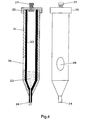
- the application device shown in Figure 4 ensures a constant Liquid / ceramic powder ratio when working.
- the applicator consists of an outer tube 21 which, when in use a brush is in the hand of the dental technician.
- a elastic inner tube 23 preferably made of silicone rubber, inserted with the ceramic mass is filled.
- Outer tube 21 and inner tube 23 taper an order tip 24. Since the interior of the application device by a Cap 25 is closed, by exerting a finger pressure on the Finger pressure opening 26 an overpressure can be achieved, the slip on the Order tip 24 can emerge.
- a vent valve 27 may be provided.
- the order peak can be adapted to the respective working conditions slotted fountain pen or brush-like design.
- the shape of the tip depends on the viscosity of the slip.
- the elastic inner tube 23 can be inserted into the outer tube 21, it is possible according to the invention the slip from the manufacturer of the ceramic powder mix and let fill in the inner tube 23, because when mixing incorrect mixing ratios are easily possible in the dental laboratory.
- the inner tube only has to at both ends then cut open or otherwise opened.
- This construction has the advantage over other conceivable devices that that no mechanical parts such as pistons are required.
- Molten glass does not wet platinum. Because basically with one Excess infiltration powder has to be worked, that flows excess glass on the surface of the scaffold descends on the platinum foil and there forms a glass base on the scaffolding beach, which is laboriously carried out through detailed work Grinding and / or sandblasting must be removed. You may have to part of the excess glass can be removed by heating again. In addition to the considerable amount of work involved, there is also the risk that Scaffolding is damaged during this work.
- FIG. 5 shows a base 28, which is rotationally symmetrical in the present case is trained, which facilitates their manufacture.
- the surface of the pad 28 has a profiled surface structure in the form of a zigzag profile 29. Any other profiling is more or less equally suitable. The important thing is that the raised areas are not too large compared to the scaffolding.
- the base 28 also has a groove 30, which is from an applied Bridge member framework 31 is bridged.
- the pad 28 is made of a porous material that is wetted by glass becomes. On this point, the opposite is required from the state of the art, that starts from non-wettable platinum foils. As a material have become special Proven investment materials that are common in dental technology. In principle, however any ceramic material wettable by glass and therefore suitable.
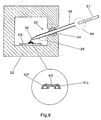
- a conventional ceramic furnace 32 is shown schematically in FIG Dental laboratories are used. Through the wall of the furnace 32 is one of externally movable, pipette-like applicator 33 passed through is expediently mounted in a ball joint 34.
- the application device 33 consists in the case shown of a platinum tube 35 with a tip 36. Since that Tube 35 is slidably mounted within the ball joint 34, the Order tip 36 can be moved three-dimensionally within the furnace 32.
- two caps are first 12a and 12b made of a ceramic slip with a bridge pontic 40 of the same material, e.g. Alumina.
- the pontic can be made manually or by machine by the location of the two copings 12a and 12b on the working model is measured and then computer-controlled from a pre-sintered blank is milled out. The framework is then sintered.
- a glass frit from EP-A-0030851 is usually used as the infiltration glass is already known, or a glass with a high lanthanum content.
- the first step is therefore that the scaffold in the furnace without cooling remains, ideally on a base 28 according to FIG. 5.
- the infiltration glass in the oven 32 melted itself by inserting a glass rod 37 into the tube 35, the first becomes liquid at the tip 36.
- By pushing the Rod 37 is sufficient dosing until the scaffold is full is covered with infiltration glass.
- the veneering ceramic is placed on the bridge framework in a further sintering process applied.
Landscapes
- Health & Medical Sciences (AREA)
- Oral & Maxillofacial Surgery (AREA)
- Veterinary Medicine (AREA)
- Epidemiology (AREA)
- Life Sciences & Earth Sciences (AREA)
- Animal Behavior & Ethology (AREA)
- General Health & Medical Sciences (AREA)
- Public Health (AREA)
- Dentistry (AREA)
- Engineering & Computer Science (AREA)
- Mechanical Engineering (AREA)
- Dental Prosthetics (AREA)
- Dental Tools And Instruments Or Auxiliary Dental Instruments (AREA)
- Dental Preparations (AREA)
- Prostheses (AREA)
- Ceramic Products (AREA)
Abstract
Description
- Fig. 1
- eine Vorrichtung zur Auftragung eines Schlickers auf eine aufgezogene Folie;
- Fig.2
- eine CNC-Maschine, mit der neben dem Schlicker auch die Verblendkeramik aufgetragen werden kann;
- Fig. 3
- eine Vorrichtung zum schnellen und faltenfreiem Aufziehen einer Folie auf einen Einzelstumpf;
- Fig. 4
- eine Vorrichtung zum Auftragen von Schlicker oder anderen Keramikmassen im Querschnitt und Draufsicht;
- Fig. 5
- eine Unterlage für Gerüste während des Infiltriervorgangs;
- Fig. 6
- eine Vorrichtung zum Infiltrieren der vorgesinterten Gerüste mit Glas.
- 1
- Motor
- 2
- Welle
- 3
- Stumpf
- 3a
- Präparation des Stumpfes
- 4
- Klebewachs
- 5
- Auftragungswerkzeug
- 6
- aufgeschrumpfte Folie
- 7
- Fön
- 8
- Laser
- 9
- Auftragsvorrichtung für Schlicker
- 9a
- Austrittsspitze
- 10
- Fräskopf
- 11
- Fräse
- 12
- Käppchen
- 13
- Folie vor dem Aufschrumpfen
- 14
- Einspannungsvorrichtung
- 15
- Granulataufnahmeraum
- 16
- Wandung
- 17
- Filter
- 18
- 1.Dichtlippe
- 19
- Trichter
- 20
- 2.Dichtlippe
- 21
- Außenrohr
- 22
- Keramikmasse
- 23
- Innenrohr
- 24
- Auftragsspitze
- 25
- Kappe
- 26
- Fingerdrucköffnung
- 27
- Belüftungsventil
- 28
- Unterlage
- 29
- Profilierung
- 30
- Nut
- 31
- Brückengliedgerüst
- 32
- Keramikofen
- 33
- Auftragsvorrichtung für Infiltrierglas
- 34
- Kugelgelenk
- 35
- Platinrohr
- 36
- Spitze
- 37
- Glasstab
- 38
- Schmelzkammer
- 39
- Blasebalg
- 40
- Brückenzwischenglied
Claims (11)
- Verfahren zur Herstellung von vollkeramischen Inlays, Kronen, Brücken, Teilbrücken, Gerüste für Implantate oder Superstrukturen in der Zahntechnik durch Herstellung eines Gerüstes aus Spinell, Alumina, Zirconia oder ähnlichen Materialien, wobei der Stumpf eines Arbeitsmodells mit einem Trennmittel überzogen wird, das bei Temperaturen über 45 °C flüssig ist und das bei Raumtemperatur eine lippenstiftartige Konsistenz aufweist, das aufgebrachte Trennmittel mit einem Schlicker versehen wird und nach der Trennung vom Arbeitsmodell das Material gebrannt wird, wobei nach dem Brennen der resultierende Rohling, insbesondere in Form eines Käppchens, mit Glas infiltriert wird.
- Verfahren nach Anspruch 1, dadurch gekennzeichnet, dass während des Schlickerauftrags der Stumpf an einer sich drehenden Welle fixiert ist.
- Verfahren nach Anspruch 2, dadurch gekennzeichnet, dass der Stumpf an der Spitze der Drehwelle einer CNC-Fräsmaschine befestigt wird, dass durch Abtasten des Oberflächenprofils der Präparation, insbesondere mittels Laserstrahlen, dieses Profil gespeichert wird, dass über die gespeicherten Daten eine Dosiervorrichtung gesteuert wird, die den Schlicker gleichmäßig auf das Trennmittel aufbringt, und dass anschließend das aufgebrachte Schlickermaterial mittels der gespeicherten Daten auf eine vorgegebene Stärke abgefräst wird.
- Verfahren nach Anspruch 2 oder 3, dadurch gekennzeichnet, dass der Stumpf an der Drehwelle mit einem Klebewachs fixiert wird.
- Verfahren zur Herstellung von Kronen nach einem der Ansprüche 1-4, dadurch gekennzeichnet, dass das hergestellte Käppchen auf dem an der Drehwelle befindlichem Stumpf befestigt wird, dass auf das Käppchen eine Form aufgesteckt wird, die der gewünschten anatomischen Form der Krone entspricht, dass diese Form abgetastet und gespeichert wird, dass nach Entfernung dieser Form ein Keramikmaterial in der gewünschten Stärke CNC-gesteuert aufgetragen wird und Käppchen plus Keramikmaterial zur fertigen Krone gebrannt wird.
- Verfahren nach einem der Ansprüche 1-4, dadurch gekennzeichnet, dass der Schlicker während und/oder nach dem Schlickerauftrag mit einem über Umgebungstemperatur erwärmten Gas getrocknet wird.
- Verfahren nach Anspruch 6, dadurch gekennzeichnet, dass das Gas Luft ist und auf 25 bis 40 °C erwärmt wird.
- Verfahren nach einem der Ansprüche 1 bis 7, dadurch gekennzeichnet, dass vor dem Auftragen das Trennmittel eingefärbt wird.
- Verfahren nach einem der Ansprüche 1 bis 8, dadurch gekennzeichnet, dass handelsübliche Lippenpflegemittel verwendet werden.
- Verfahren zum Infiltrieren von nach den Ansprüchen 1 bis 4 hergestellten gesinterten Gerüsten, dadurch gekennzeichnet, dass das Gerüst während des Erhitzens auf einer porösen, durch flüssiges Glas benetzbaren Unterlage aufliegt, die das überflüssige Glas aufsaugt.
- Verfahren zum Infiltrieren von nach den Ansprüchen 1 bis 4 hergestellten, gesinterten Gerüsten in einem Keramikofen, dadurch gekennzeichnet, dass ohne Entnahme des Gerüstes aus dem Keramikofen die Glasmasse während und/oder nach dem Sintern bevorzugt in einer im Keramikofen befindlichen Auftragsvorrichtung aufgeschmolzen wird und das flüssige Glas von der Auftragsvorrichtung auf das Gerüst aufgetragen wird.
Applications Claiming Priority (15)
| Application Number | Priority Date | Filing Date | Title |
|---|---|---|---|
| DE19801532 | 1998-01-16 | ||
| DE19801532A DE19801532C2 (de) | 1998-01-16 | 1998-01-16 | Verfahren und Vorrichtung zum Tiefziehen von Folien auf Einzelstümpfe in der Zahntechnik |
| DE19801534 | 1998-01-16 | ||
| DE19801530A DE19801530C1 (de) | 1998-01-16 | 1998-01-16 | Verfahren und Vorrichtung zur Herstellung von Infiltrationskeramik in der Zahntechnik |
| DE19801534A DE19801534C2 (de) | 1998-01-16 | 1998-01-16 | Auftragvorrichtung für Keramikmassen und Innenrohr, vorzugsweise in der Zahntechnik |
| DE19801530 | 1998-01-16 | ||
| DE19812664 | 1998-03-23 | ||
| DE19812664A DE19812664C2 (de) | 1998-03-23 | 1998-03-23 | Verfahren zur Herstellung von Inlays, Teilkronen und Gerüste für Implantate und/oder Suprastrukturen |
| DE19816546 | 1998-04-15 | ||
| DE19816546A DE19816546C1 (de) | 1998-04-15 | 1998-04-15 | Verfahren und Vorrichtung zur Herstellung von Käppchen, Gerüsten für Brücken und Kronen in der Zahntechnik |
| DE19841075A DE19841075C2 (de) | 1998-09-09 | 1998-09-09 | Verfahren zur Herstellung eines Gerüstes für Inlays, Kronen und Brücken in der Zahntechnik |
| DE19841075 | 1998-09-09 | ||
| DE19852740A DE19852740C2 (de) | 1998-11-16 | 1998-11-16 | Verfahren und Keramikbrennofen zur Herstellung von glasinfiltrierten Keramikgerüsten für künstliche Zähne |
| DE19852740 | 1998-11-16 | ||
| EP99906061A EP1047355B1 (de) | 1998-01-16 | 1999-01-14 | Verfahren zur herstellung vollkeramischer inlays, kronen, brücken, teilbrücken, gerüste für implantate oder superstrukturen in der zahntechnik |
Related Parent Applications (2)
| Application Number | Title | Priority Date | Filing Date |
|---|---|---|---|
| EP99906061A Division-Into EP1047355B1 (de) | 1998-01-16 | 1999-01-14 | Verfahren zur herstellung vollkeramischer inlays, kronen, brücken, teilbrücken, gerüste für implantate oder superstrukturen in der zahntechnik |
| EP99906061A Division EP1047355B1 (de) | 1998-01-16 | 1999-01-14 | Verfahren zur herstellung vollkeramischer inlays, kronen, brücken, teilbrücken, gerüste für implantate oder superstrukturen in der zahntechnik |
Publications (2)
| Publication Number | Publication Date |
|---|---|
| EP1484030A2 true EP1484030A2 (de) | 2004-12-08 |
| EP1484030A3 EP1484030A3 (de) | 2006-05-17 |
Family
ID=27561756
Family Applications (2)
| Application Number | Title | Priority Date | Filing Date |
|---|---|---|---|
| EP04021649A Withdrawn EP1484030A3 (de) | 1998-01-16 | 1999-01-14 | Verfahren zur Herstellung vollkeramischer Inlays, Kronen, Brücken, Teilbrücken, Gerüste für Implantate oder Superstrukturen in der Zahntechnik |
| EP99906061A Expired - Lifetime EP1047355B1 (de) | 1998-01-16 | 1999-01-14 | Verfahren zur herstellung vollkeramischer inlays, kronen, brücken, teilbrücken, gerüste für implantate oder superstrukturen in der zahntechnik |
Family Applications After (1)
| Application Number | Title | Priority Date | Filing Date |
|---|---|---|---|
| EP99906061A Expired - Lifetime EP1047355B1 (de) | 1998-01-16 | 1999-01-14 | Verfahren zur herstellung vollkeramischer inlays, kronen, brücken, teilbrücken, gerüste für implantate oder superstrukturen in der zahntechnik |
Country Status (11)
| Country | Link |
|---|---|
| US (1) | US6428725B1 (de) |
| EP (2) | EP1484030A3 (de) |
| CN (1) | CN1248657C (de) |
| AT (1) | ATE285723T1 (de) |
| AU (1) | AU751767B2 (de) |
| BR (1) | BR9907011A (de) |
| CA (1) | CA2318097A1 (de) |
| DE (1) | DE59911367D1 (de) |
| ES (1) | ES2235463T3 (de) |
| PT (1) | PT1047355E (de) |
| WO (1) | WO1999035994A1 (de) |
Cited By (2)
| Publication number | Priority date | Publication date | Assignee | Title |
|---|---|---|---|---|
| EP1747765A1 (de) * | 2005-07-29 | 2007-01-31 | BEGO Bremer Goldschlägerei Wilh. Herbst GmbH & Co. KG | Verfahren zum Herstellen eines glasinfiltrierten dentalen Keramikgerüstes |
| DE102012211332A1 (de) * | 2012-06-29 | 2014-01-02 | Marlis Eichberger | Zahnersatz, Verblendung für einen Zahnersatz und Herstellungsverfahren |
Families Citing this family (14)
| Publication number | Priority date | Publication date | Assignee | Title |
|---|---|---|---|---|
| DE10002921C2 (de) * | 2000-01-25 | 2003-11-20 | Stefan Wolz | Verfahren zur Herstellung vollkeramischer Brücken |
| DE10021437C2 (de) * | 2000-05-03 | 2002-05-08 | Stefan Wolz | Verfahren zur Herstellung vollkeramischer Gerüste, insbesondere aus Alumina, in der Zahntechnik |
| DE10120084A1 (de) * | 2001-04-18 | 2002-10-24 | Wieland Dental & Technik Gmbh | Verfahren zur Herstellung vollkeramischer Dentalformteile |
| EP1392194A1 (de) * | 2001-06-04 | 2004-03-03 | Dentsply International, Inc. | Pipette für dentalmaterial |
| DE10228498A1 (de) * | 2002-06-21 | 2004-01-08 | Wieland Dental Ceramics Gmbh | Austragvorrichtung für dentale Zwecke |
| EP1546052B1 (de) | 2002-07-22 | 2010-11-17 | Enamelite, LLC | Aerosolierte keramikporzellane und glasurzusammensetzungen |
| EP1396237A1 (de) * | 2002-09-05 | 2004-03-10 | Elephant Dental B.V. | Verfestigte keramische Restauration |
| DE10330758B4 (de) * | 2003-07-07 | 2006-07-20 | Sirona Dental Systems Gmbh | Rohling zur Herstellung zahntechnischer Formteile und Verfahren zur Herstellung des Formteils |
| US20110033607A1 (en) * | 2003-07-17 | 2011-02-10 | Enamelite, Llc | Aerosolized fingerprint powder compositions |
| DE102005052113A1 (de) * | 2005-06-03 | 2006-12-28 | Stefan Wolz | Verfahren zur Herstellung von Zahnteilen aus Dentalmetallpulver |
| CN101401746B (zh) * | 2008-10-30 | 2010-11-10 | 华中科技大学 | 一种快速制造可摘局部义齿支架的方法 |
| CN102871759B (zh) * | 2012-10-11 | 2015-07-15 | 深圳市金悠然科技有限公司 | 一种贴面比色板及其制备方法和使用方法 |
| CN110269702A (zh) * | 2019-05-20 | 2019-09-24 | 暨南大学 | 一种纤维桩弹性瓷超嵌体的制作方法 |
| DE102020127477A1 (de) | 2019-10-21 | 2021-04-22 | Wdt-Wolz-Dental-Technik Gmbh | Verfahren zur Herstellung von Formteilen, insbesondere von Zahnersatz durch Hygroskopische, chemische, thermochemische und pyrolytisch zersetzbare Spritz- und/oder Kaltgussformen |
Citations (2)
| Publication number | Priority date | Publication date | Assignee | Title |
|---|---|---|---|---|
| WO1997035531A1 (de) | 1996-03-25 | 1997-10-02 | Stefan Wolz | Verfahren zur herstellung eines gerüstes für inlays, kronen und brücken in der zahntechnik |
| EP2241384A1 (de) | 2008-02-04 | 2010-10-20 | voestalpine Schienen GmbH | Einrichtung zum Härten von Schienen |
Family Cites Families (6)
| Publication number | Priority date | Publication date | Assignee | Title |
|---|---|---|---|---|
| EP0240643A1 (de) | 1986-04-11 | 1987-10-14 | Tyszblat Sadoun, Michèle | Verfahren zur Herstellung von Zahnersatz |
| FR2640495B1 (fr) * | 1988-12-16 | 1991-04-05 | Lyon Ecole Centrale | Nouvelle prothese dentaire fixee et procede de realisation |
| EP0455853B1 (de) * | 1990-05-09 | 1995-04-12 | Siemens Aktiengesellschaft | Vorrichtung zur Erstellung von medizinischen, insbesondere zahnmedizinischen, Prothetik- Passkörpern |
| FR2702649B1 (fr) * | 1993-03-16 | 1995-06-09 | Sofraced Sa | Procede et kit pour realiser une cupule ceramique en vue de preparer une reconstitution dentaire. |
| DK72194A (da) * | 1994-06-20 | 1995-12-21 | Dirk Leonhardt | Fremgangsmåde til fremstilling af keramiske tandrestaureringer og distance-, separations- og substrukturmateriale til gennemførelse af fremgangsmåden |
| DK0701808T3 (da) | 1994-09-19 | 2003-03-24 | Univ Boston | Infunderet keramisk netværk til fremstilling af odontoforme og dentale restaureringer |
-
1999
- 1999-01-14 DE DE59911367T patent/DE59911367D1/de not_active Expired - Fee Related
- 1999-01-14 EP EP04021649A patent/EP1484030A3/de not_active Withdrawn
- 1999-01-14 PT PT99906061T patent/PT1047355E/pt unknown
- 1999-01-14 US US09/600,328 patent/US6428725B1/en not_active Expired - Fee Related
- 1999-01-14 BR BR9907011-1A patent/BR9907011A/pt not_active Application Discontinuation
- 1999-01-14 WO PCT/DE1999/000106 patent/WO1999035994A1/de not_active Ceased
- 1999-01-14 AU AU26094/99A patent/AU751767B2/en not_active Ceased
- 1999-01-14 CA CA002318097A patent/CA2318097A1/en not_active Abandoned
- 1999-01-14 EP EP99906061A patent/EP1047355B1/de not_active Expired - Lifetime
- 1999-01-14 AT AT99906061T patent/ATE285723T1/de not_active IP Right Cessation
- 1999-01-14 ES ES99906061T patent/ES2235463T3/es not_active Expired - Lifetime
- 1999-01-14 CN CNB998021776A patent/CN1248657C/zh not_active Expired - Fee Related
Patent Citations (2)
| Publication number | Priority date | Publication date | Assignee | Title |
|---|---|---|---|---|
| WO1997035531A1 (de) | 1996-03-25 | 1997-10-02 | Stefan Wolz | Verfahren zur herstellung eines gerüstes für inlays, kronen und brücken in der zahntechnik |
| EP2241384A1 (de) | 2008-02-04 | 2010-10-20 | voestalpine Schienen GmbH | Einrichtung zum Härten von Schienen |
Cited By (3)
| Publication number | Priority date | Publication date | Assignee | Title |
|---|---|---|---|---|
| EP1747765A1 (de) * | 2005-07-29 | 2007-01-31 | BEGO Bremer Goldschlägerei Wilh. Herbst GmbH & Co. KG | Verfahren zum Herstellen eines glasinfiltrierten dentalen Keramikgerüstes |
| DE102012211332A1 (de) * | 2012-06-29 | 2014-01-02 | Marlis Eichberger | Zahnersatz, Verblendung für einen Zahnersatz und Herstellungsverfahren |
| DE102012211332B4 (de) | 2012-06-29 | 2023-02-09 | Marlis Eichberger | Zahnersatz, Verblendung für einen Zahnersatz und Herstellungsverfahren |
Also Published As
| Publication number | Publication date |
|---|---|
| EP1047355B1 (de) | 2004-12-29 |
| EP1047355A1 (de) | 2000-11-02 |
| BR9907011A (pt) | 2000-10-24 |
| CN1288366A (zh) | 2001-03-21 |
| AU2609499A (en) | 1999-08-02 |
| EP1484030A3 (de) | 2006-05-17 |
| US6428725B1 (en) | 2002-08-06 |
| PT1047355E (pt) | 2005-05-31 |
| DE59911367D1 (de) | 2005-02-03 |
| WO1999035994A1 (de) | 1999-07-22 |
| AU751767B2 (en) | 2002-08-29 |
| CN1248657C (zh) | 2006-04-05 |
| CA2318097A1 (en) | 1999-07-22 |
| ES2235463T3 (es) | 2005-07-01 |
| ATE285723T1 (de) | 2005-01-15 |
Similar Documents
| Publication | Publication Date | Title |
|---|---|---|
| EP1047355B1 (de) | Verfahren zur herstellung vollkeramischer inlays, kronen, brücken, teilbrücken, gerüste für implantate oder superstrukturen in der zahntechnik | |
| EP0807422B1 (de) | Verfahren zur Herstellung dentaler Rekonstruktionen und Rohling zur Durchführung des Verfahrens | |
| DE3751344T2 (de) | Herstellungsverfahren für Zahnprothesen und durch dieses Verfahren erzielte Prothesen. | |
| EP2779937B1 (de) | Rohling für künstliche zähne mit mehreren unterschiedlichen farbschichten und verfahren zu dessen herstellung | |
| EP0231773A1 (de) | Verfahren und Ofen zur Herstellung von Zahnersatzteilen | |
| DE69818892T2 (de) | Zahnstumpfmodell und Verfahren zur Herstellung einer Prothese auf diesem Modell | |
| DE102005023106A1 (de) | Verfahren zur Herstellung eines Zahnersatzteils, Zahnersatzteil, Bauteil und Rohling hierzu | |
| DE19654055A1 (de) | Halbzeug als Formkörper zur Herstellung von Zahnersatzteilen | |
| DE10021437C2 (de) | Verfahren zur Herstellung vollkeramischer Gerüste, insbesondere aus Alumina, in der Zahntechnik | |
| EP1558170B1 (de) | Verfahren zur herstellung vollkeramischer zahnteile mit vorbestimmter raumform mittels elektrophorese | |
| DE3841902C1 (de) | ||
| DE10342231B4 (de) | Rohling zur Herstellung eines Zahnersatzteils und Verfahren zur Herstellung desselben | |
| DE19816546C1 (de) | Verfahren und Vorrichtung zur Herstellung von Käppchen, Gerüsten für Brücken und Kronen in der Zahntechnik | |
| DE19611734A1 (de) | Verfahren zur Herstellung eines Gerüstes für Inlays, Kronen und Brücken in der Zahntechnik | |
| DE10257208B4 (de) | Muffelsystem | |
| DE1296301B (de) | Verfahren zur Herstellung von Zahnersatz und Teilen fuer die prothetische Zahnbehandlung | |
| DE19801530C1 (de) | Verfahren und Vorrichtung zur Herstellung von Infiltrationskeramik in der Zahntechnik | |
| DE102016203055B4 (de) | Verfahren und System zum Erzeugen einer Dentalrestauration | |
| DE102018128566B4 (de) | Verfahren zur Anpassung einer keramischen Außenschale | |
| DE10251369A1 (de) | Verfahren zur Herstellung vollkeramischer Brückengerüste in der Zahntechnik | |
| DE4210781A1 (de) | Serienmäßig hergestellte Kunstzahnrohlinge | |
| DE19852740A1 (de) | Verfahren und Vorrichtung zur Herstellung von glainfiltrierten Keramikgerüsten für künstliche Zähne | |
| DE19841075C2 (de) | Verfahren zur Herstellung eines Gerüstes für Inlays, Kronen und Brücken in der Zahntechnik | |
| DE4340252A1 (de) | Verfahren und Vorrichtung zur Oberflächen- und/oder Farbgestaltung medizinischer Formkörper, insbesondere Zahnersatz | |
| DE4023088A1 (de) | Vorrichtung und verfahren zum erstellen von zweiteiligen kronen |
Legal Events
| Date | Code | Title | Description |
|---|---|---|---|
| PUAI | Public reference made under article 153(3) epc to a published international application that has entered the european phase |
Free format text: ORIGINAL CODE: 0009012 |
|
| AC | Divisional application: reference to earlier application |
Ref document number: 1047355 Country of ref document: EP Kind code of ref document: P |
|
| AK | Designated contracting states |
Kind code of ref document: A2 Designated state(s): AT CH DE ES FR GB IT LI LU NL PT SE |
|
| REG | Reference to a national code |
Ref country code: HK Ref legal event code: DE Ref document number: 1073990 Country of ref document: HK |
|
| PUAL | Search report despatched |
Free format text: ORIGINAL CODE: 0009013 |
|
| AK | Designated contracting states |
Kind code of ref document: A3 Designated state(s): AT CH DE ES FR GB IT LI LU NL PT SE |
|
| 17P | Request for examination filed |
Effective date: 20060819 |
|
| AKX | Designation fees paid |
Designated state(s): AT CH DE ES FR GB IT LI LU NL PT SE |
|
| 17Q | First examination report despatched |
Effective date: 20090723 |
|
| STAA | Information on the status of an ep patent application or granted ep patent |
Free format text: STATUS: THE APPLICATION IS DEEMED TO BE WITHDRAWN |
|
| 18D | Application deemed to be withdrawn |
Effective date: 20091203 |
|
| REG | Reference to a national code |
Ref country code: HK Ref legal event code: WD Ref document number: 1073990 Country of ref document: HK |