EP1484760A1 - Méthode de lecture d'un signal enregistré sur un support optique - Google Patents
Méthode de lecture d'un signal enregistré sur un support optique Download PDFInfo
- Publication number
- EP1484760A1 EP1484760A1 EP03012525A EP03012525A EP1484760A1 EP 1484760 A1 EP1484760 A1 EP 1484760A1 EP 03012525 A EP03012525 A EP 03012525A EP 03012525 A EP03012525 A EP 03012525A EP 1484760 A1 EP1484760 A1 EP 1484760A1
- Authority
- EP
- European Patent Office
- Prior art keywords
- filter
- signal
- volterra
- read signal
- electronic device
- Prior art date
- Legal status (The legal status is an assumption and is not a legal conclusion. Google has not performed a legal analysis and makes no representation as to the accuracy of the status listed.)
- Withdrawn
Links
- 230000003287 optical effect Effects 0.000 title claims abstract description 17
- 238000000034 method Methods 0.000 title claims abstract description 14
- 238000001914 filtration Methods 0.000 claims abstract description 10
- 238000012544 monitoring process Methods 0.000 claims 1
- 230000006978 adaptation Effects 0.000 description 8
- 238000010586 diagram Methods 0.000 description 5
- 230000003044 adaptive effect Effects 0.000 description 3
- 238000004422 calculation algorithm Methods 0.000 description 3
- 230000005540 biological transmission Effects 0.000 description 2
- 230000000630 rising effect Effects 0.000 description 2
- 238000004364 calculation method Methods 0.000 description 1
- 238000004590 computer program Methods 0.000 description 1
- 230000000694 effects Effects 0.000 description 1
- 238000005530 etching Methods 0.000 description 1
- 238000011084 recovery Methods 0.000 description 1
Images

Classifications
-
- G—PHYSICS
- G11—INFORMATION STORAGE
- G11B—INFORMATION STORAGE BASED ON RELATIVE MOVEMENT BETWEEN RECORD CARRIER AND TRANSDUCER
- G11B20/00—Signal processing not specific to the method of recording or reproducing; Circuits therefor
- G11B20/10—Digital recording or reproducing
- G11B20/10009—Improvement or modification of read or write signals
-
- G—PHYSICS
- G11—INFORMATION STORAGE
- G11B—INFORMATION STORAGE BASED ON RELATIVE MOVEMENT BETWEEN RECORD CARRIER AND TRANSDUCER
- G11B20/00—Signal processing not specific to the method of recording or reproducing; Circuits therefor
- G11B20/10—Digital recording or reproducing
- G11B20/12—Formatting, e.g. arrangement of data block or words on the record carriers
- G11B2020/1264—Formatting, e.g. arrangement of data block or words on the record carriers wherein the formatting concerns a specific kind of data
- G11B2020/1288—Formatting by padding empty spaces with dummy data, e.g. writing zeroes or random data when de-icing optical discs
-
- G—PHYSICS
- G11—INFORMATION STORAGE
- G11B—INFORMATION STORAGE BASED ON RELATIVE MOVEMENT BETWEEN RECORD CARRIER AND TRANSDUCER
- G11B2220/00—Record carriers by type
- G11B2220/20—Disc-shaped record carriers
- G11B2220/25—Disc-shaped record carriers characterised in that the disc is based on a specific recording technology
- G11B2220/2537—Optical discs
- G11B2220/2541—Blu-ray discs; Blue laser DVR discs
Definitions
- the present invention relates to the reading of signals which are recorded on an optical recording medium, and more particularly without limitation, to the compensation of non-linear signal distortions.
- a recording on an optical recording medium can have asymmetries and/or other non-linear distortions due to various reasons.
- US 2002/0060596 A1 shows a method for selective disturbance compensating of a signal which is reproduced from an optical recording medium. This method is based on DC-offset cancellation. A disadvantage of this method is that no higher order distortions are removed.
- the present invention aims to provide an improved method for reading a recorded signal from an optical recording medium as well as a corresponding computer program product and electronic device.
- the present invention provides for a method for reading a recorded signal from an optical recording medium, whereby the discrete read signal is filtered by means of a Volterra filter.
- a Volterra adaptive polynomial filter is used having filter kernels of order 0, 1 and 2. This way the Volterra filter can remove constant, linear and quadratic distortions in the discrete read signal.
- a Volterra series allows to describe non-linear behaviour, whereas all components of the series are linear. This has the advantage that well-known calculation methods can be used.
- Volterra filters have not yet been considered for filtering of the signals obtained from optical recording media.
- the Volterra filtered discrete read signal is then decoded by means of a Viterbi decoder to provide a decoded bit stream.
- the filter coefficients of the Volterra filter are adapted on the basis of the bit stream and the filtered discrete signal.
- the bit stream is filtered by means of a so-called target filter.
- the target filter is a filter which models the transmission function of an idealised channel.
- the output of the target filter and the output of the Volterra filter are subtracted, which provides a control signal for the adaptation of the Volterra filter coefficients.
- a particular advantage of using a Volterra filter having constant, linear and quadratic filter kernels is that this enables to remove asymmetries which are caused by domain bloom. Domain bloom results from under- or over-etching of the marks on the optical recording medium due to non-optimal laser power control.
- control signal for the Volterra filter is monitored in order to detect abrupt changes. When such an abrupt change occurs it takes some time until the Volterra filter coefficients have settled. When the adaptive filter coefficients of the Volterra filter have not settled this corresponds to a high bit-error rate.
- FIR finite impulse response
- Figure 1 shows a block diagram of an electronic device 100 for reading from optical recording media.
- the electronic device 100 can, for example, be part of an apparatus for reading from and/or writing to an optical recording medium, such as a bluray disc.
- an optical recording medium such as a bluray disc.
- the invention is not limited to optical recording media and can also be applied to other types of recording media.
- the electronic device 100 has a Volterra filter 102, which is an adaptive polynomial filter.
- the Volterra filter 102 receives at its input a discrete read signal x(n).
- the discrete read signal x(n) is a sampled output signal of a sensor (not shown) of the apparatus 100.
- the output of the Volterra filter 102 is connected to the input of a Viterbi decoder 104.
- the Viterbi decoder 104 outputs a signal NRZI, which is a bit stream.
- the feedback path includes a target filter 106, which models an ideal channel transmission function.
- the target filter 106 is a fixed coefficient finite impulse response (FIR) filter.
- the signal NZRI is inputted into the target filter 106.
- the output of the target filter 106 is subtracted from the output of the Volterra filter 102, which is a signal y(n), by a subtractor 108.
- the subtractor 108 provides a control signal d(n), which is inputted into a control input of the Volterra filter 102.
- the Volterra filter 102 compensates non-linear signal disturbances in the discrete read signal x(n), in particular non-linear signal disturbances of second order, which are induced by domain bloom or non-linearities of the optical sensor. The compensation of these non-linearities enables a more accurate reproduction of the original signal.
- FIG. 2 shows a block diagram of an example of a Volterra filter 102, which has constant, linear and quadratic filter kernels, i.e. a filter module 200 for the constant kernel h o , a filter module 202 for the linear filter kernel h 1 , and a filter module 204 for the quadratic filter kernel h 2 .
- the Volterra filter has an adaptation module 206 for adaptation of the filter coefficients of the filter modules 200, 202 and 204.
- the adaptation module 206 is implemented by means of a least mean square (LMS) algorithm.
- LMS least mean square
- the discrete read signal x(n) is coupled to the filter modules 200, 202, 204 and 206.
- the outputs of the filter modules 200, 202 and 204 are added by an adder 208 to provide the output signal y(n).
- the adaptation module 206 receives the discrete read signal x(n), the output signal y(n) and the control signal d(n) as input signals for the LMS algorithm.
- the outputs of the adaptation module 206 are coupled to respective control inputs of the filter modules 200, 202 and 204 for adaptation of the respective filter parameters in accordance with the result of the LMS algorithm of the adaptation module 206.
- the Volterra filter 102 of figure 2 does not have higher order kernels.
- the present invention is not limited to Volterra filters having constant, linear and quadratic filter kernels, but that Volterra filters having additional higher order kernels can also be used.
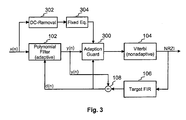
- Figure 3 shows an alternative implementation of the electronic device 100.
- Like elements in figures 1 and 3 are designated by the same reference numerals.
- an adaptation-guard module 300 in the embodiment of Figure 3.
- the adaptation-guard module 300 receives the control signal d(n) in order to monitor the bit-error-rate.
- the adaptation-guard module 300 has a rising-edge detector in order to detect a rising edge of the control signal d(n), which would indicate that the filter coefficients of the Volterra filter 102 are unsettled.
- the apparatus 100 of Figure 3 has a DC removal filter 302 and a fixed equalizer 304.
- the fixed equalizer 304 has fixed filter coefficients.
- the adaptation-guard module 300 is transparent for the signal y(n), i.e. the signal y(n) passes unaltered through the adaptation-guard module 300 and is inputted into the Viterbi decoder 104.
- the adaptation-guard module 300 detects a situation where the filter coefficients of the Volterra filter 102 are unsettled, i.e. a rising edge of the control signal d(n) which surpasses a certain threshold, the adaptation-guard module 300 switches to the output of the fixed equalizer 304 as a replacement for the signal y(n). This way the Volterra filter 102 is temporarily replaced by the filters 302 and 304 in order to bridge the time required for settling of the Volterra filter coefficients.
Landscapes
- Engineering & Computer Science (AREA)
- Signal Processing (AREA)
- Signal Processing For Digital Recording And Reproducing (AREA)
- Optical Recording Or Reproduction (AREA)
Priority Applications (1)
| Application Number | Priority Date | Filing Date | Title |
|---|---|---|---|
| EP03012525A EP1484760A1 (fr) | 2003-06-02 | 2003-06-02 | Méthode de lecture d'un signal enregistré sur un support optique |
Applications Claiming Priority (1)
| Application Number | Priority Date | Filing Date | Title |
|---|---|---|---|
| EP03012525A EP1484760A1 (fr) | 2003-06-02 | 2003-06-02 | Méthode de lecture d'un signal enregistré sur un support optique |
Publications (1)
| Publication Number | Publication Date |
|---|---|
| EP1484760A1 true EP1484760A1 (fr) | 2004-12-08 |
Family
ID=33155137
Family Applications (1)
| Application Number | Title | Priority Date | Filing Date |
|---|---|---|---|
| EP03012525A Withdrawn EP1484760A1 (fr) | 2003-06-02 | 2003-06-02 | Méthode de lecture d'un signal enregistré sur un support optique |
Country Status (1)
| Country | Link |
|---|---|
| EP (1) | EP1484760A1 (fr) |
Cited By (1)
| Publication number | Priority date | Publication date | Assignee | Title |
|---|---|---|---|---|
| EP3179710A1 (fr) | 2015-12-10 | 2017-06-14 | Thomson Licensing | Procédé et appareil pour déterminer des coefficients d'une transformée de couleur non linéaire, procédé et appareil permettant d'appliquer une transformation de couleur non linéaire à des images numériques |
Citations (2)
| Publication number | Priority date | Publication date | Assignee | Title |
|---|---|---|---|---|
| US5159282A (en) * | 1989-12-06 | 1992-10-27 | Kabushiki Kaisha Toshiba | Demodulation apparatus incorporating adaptive equalizer for digital communication |
| US5353307A (en) * | 1991-09-03 | 1994-10-04 | General Electric Company | Automatic simulcast alignment |
-
2003
- 2003-06-02 EP EP03012525A patent/EP1484760A1/fr not_active Withdrawn
Patent Citations (2)
| Publication number | Priority date | Publication date | Assignee | Title |
|---|---|---|---|---|
| US5159282A (en) * | 1989-12-06 | 1992-10-27 | Kabushiki Kaisha Toshiba | Demodulation apparatus incorporating adaptive equalizer for digital communication |
| US5353307A (en) * | 1991-09-03 | 1994-10-04 | General Electric Company | Automatic simulcast alignment |
Non-Patent Citations (4)
| Title |
|---|
| AGAROSSI L ET AL: "EFFECTIVE NONLINEAR RECEIVERS FOR HIGH DENSITY OPTICAL RECORDING", IEICE TRANSACTIONS ON ELECTRONICS, INSTITUTE OF ELECTRONICS INFORMATION AND COMM. ENG. TOKYO, JP, vol. E85-C, no. 9, September 2002 (2002-09-01), pages 1675 - 1683, XP001115978, ISSN: 0916-8524 * |
| AGAROSSI L ET AL: "EQUALIZATION OF NON LINEAR OPTICAL CHANNELS", ICC '98. 1998 IEEE INTERNATIONAL CONFERENCE ON COMMUNICATIONS. CONFERENCE RECORD. NEW CENTURY COMMUNICATIONS. ATLANTA, GA, JUNE 7 - 11, 1998, IEEE INTERNATIONAL CONFERENCE ON COMMUNICATIONS, NEW YORK, NY: IEEE, US, vol. 2 CONF. 5, 7 June 1998 (1998-06-07), pages 662 - 667, XP000890956, ISBN: 0-7803-4789-7 * |
| HERMANN R: "VOLTERRA MODELING OF DIGITAL MAGNETIC SATURATION RECORDING CHANNELS", PROCEEDINGS OF THE INTERNATIONAL MAGNETICS CONFERENCE. (INTERMAG). BRIGHTON, APRIL 17 - 20, 1990, NEW YORK, IEEE, US, 17 April 1990 (1990-04-17), pages EB - 1COMPLEET, XP000221554, ISBN: 1-871966-15-9 * |
| MEGHRICHE K ET AL: "A NON LINEAR ADAPTIVE FILTER FOR DIGITAL DATA COMMUNICATION", INTERNATIONAL SYMPOSIUM ON SIGNAL PROCESSING AND ITS APPLICATIONS. PROCEEDINGS, XX, XX, 13 August 2001 (2001-08-13), pages 304 - 306, XP002186352 * |
Cited By (1)
| Publication number | Priority date | Publication date | Assignee | Title |
|---|---|---|---|---|
| EP3179710A1 (fr) | 2015-12-10 | 2017-06-14 | Thomson Licensing | Procédé et appareil pour déterminer des coefficients d'une transformée de couleur non linéaire, procédé et appareil permettant d'appliquer une transformation de couleur non linéaire à des images numériques |
Similar Documents
| Publication | Publication Date | Title |
|---|---|---|
| KR100580166B1 (ko) | 등화기의 필터 계수를 조절하여 재생 성능을 높이는 장치및 방법 | |
| KR100934063B1 (ko) | 신호처리장치 및 신호처리방법 | |
| US6912100B2 (en) | Device and signal processing circuit for magnetic recording, magnetic recording apparatus | |
| US20050219985A1 (en) | Reproduced signal processor and reproduced signal processing method | |
| JP4707314B2 (ja) | 非対称再生信号におけるオフセットを補償する方法 | |
| KR101147798B1 (ko) | 비대칭 데이터 채널을 위한 비트 복구 방식 | |
| EP1443512A1 (fr) | Circuit électronique pour le décodage d'un signal lu à partir d'un support de stockage optique | |
| CN100466089C (zh) | 用于数据再现的装置及方法 | |
| US8111739B1 (en) | Detector for low frequency offset distortion | |
| JP2006221762A (ja) | 記録情報再生装置 | |
| CN1577566A (zh) | 用于自适应位恢复的方法 | |
| US7243297B2 (en) | Method for bit recovery in an asymmetric data channel | |
| JP4189747B2 (ja) | 信号処理装置 | |
| JP4776604B2 (ja) | 信号処理装置および信号処理方法 | |
| KR100192236B1 (ko) | 디지탈 자기기록 재생장치 | |
| EP1441344A1 (fr) | Circuit électronique pour le décodage d'un signal lu à partir d'un support de stockage optique | |
| KR100936031B1 (ko) | 비선형 변환기를 사용한 이진 신호 검출 장치 | |
| JPH05102793A (ja) | 磁気再生装置 | |
| JP5138794B2 (ja) | 信号処理装置及び信号処理方法 | |
| JP4200113B2 (ja) | 等化器および磁気記録再生装置 | |
| EP1501197A1 (fr) | Méthodes et appareil d'extraction de bits pour un canal de données asymétrique | |
| KR20040092763A (ko) | 이진 데이터 검출 방법 및 그 장치 | |
| JPH10199146A (ja) | 2値化回路 | |
| KR0144817B1 (ko) | 디지탈 재생신호 검출장치 및 그 방법 | |
| JP4043395B2 (ja) | 自動等化器、等化方法、等化プログラム、プログラム記録媒体及びデジタル再生装置 |
Legal Events
| Date | Code | Title | Description |
|---|---|---|---|
| PUAI | Public reference made under article 153(3) epc to a published international application that has entered the european phase |
Free format text: ORIGINAL CODE: 0009012 |
|
| AK | Designated contracting states |
Kind code of ref document: A1 Designated state(s): AT BE BG CH CY CZ DE DK EE ES FI FR GB GR HU IE IT LI LU MC NL PT RO SE SI SK TR |
|
| AX | Request for extension of the european patent |
Extension state: AL LT LV MK |
|
| AKX | Designation fees paid | ||
| REG | Reference to a national code |
Ref country code: DE Ref legal event code: 8566 |
|
| STAA | Information on the status of an ep patent application or granted ep patent |
Free format text: STATUS: THE APPLICATION IS DEEMED TO BE WITHDRAWN |
|
| 18D | Application deemed to be withdrawn |
Effective date: 20050609 |