EP1484872A2 - Vorrichtung und Verfahren zur Flusskontrolle auf Datenwortebene unter Verwendung von freier Bandbreite auf der Verbindung - Google Patents
Vorrichtung und Verfahren zur Flusskontrolle auf Datenwortebene unter Verwendung von freier Bandbreite auf der Verbindung Download PDFInfo
- Publication number
- EP1484872A2 EP1484872A2 EP04010592A EP04010592A EP1484872A2 EP 1484872 A2 EP1484872 A2 EP 1484872A2 EP 04010592 A EP04010592 A EP 04010592A EP 04010592 A EP04010592 A EP 04010592A EP 1484872 A2 EP1484872 A2 EP 1484872A2
- Authority
- EP
- European Patent Office
- Prior art keywords
- data
- word
- flow control
- communication channel
- enhanced
- Prior art date
- Legal status (The legal status is an assumption and is not a legal conclusion. Google has not performed a legal analysis and makes no representation as to the accuracy of the status listed.)
- Granted
Links
Images



Classifications
-
- H—ELECTRICITY
- H04—ELECTRIC COMMUNICATION TECHNIQUE
- H04L—TRANSMISSION OF DIGITAL INFORMATION, e.g. TELEGRAPHIC COMMUNICATION
- H04L47/00—Traffic control in data switching networks
- H04L47/10—Flow control; Congestion control
-
- H—ELECTRICITY
- H04—ELECTRIC COMMUNICATION TECHNIQUE
- H04L—TRANSMISSION OF DIGITAL INFORMATION, e.g. TELEGRAPHIC COMMUNICATION
- H04L25/00—Baseband systems
- H04L25/02—Details ; arrangements for supplying electrical power along data transmission lines
- H04L25/14—Channel dividing arrangements, i.e. in which a single bit stream is divided between several baseband channels and reassembled at the receiver
-
- H—ELECTRICITY
- H04—ELECTRIC COMMUNICATION TECHNIQUE
- H04L—TRANSMISSION OF DIGITAL INFORMATION, e.g. TELEGRAPHIC COMMUNICATION
- H04L25/00—Baseband systems
- H04L25/38—Synchronous or start-stop systems, e.g. for Baudot code
- H04L25/40—Transmitting circuits; Receiving circuits
- H04L25/49—Transmitting circuits; Receiving circuits using code conversion at the transmitter; using predistortion; using insertion of idle bits for obtaining a desired frequency spectrum; using three or more amplitude levels ; Baseband coding techniques specific to data transmission systems
- H04L25/4906—Transmitting circuits; Receiving circuits using code conversion at the transmitter; using predistortion; using insertion of idle bits for obtaining a desired frequency spectrum; using three or more amplitude levels ; Baseband coding techniques specific to data transmission systems using binary codes
- H04L25/4908—Transmitting circuits; Receiving circuits using code conversion at the transmitter; using predistortion; using insertion of idle bits for obtaining a desired frequency spectrum; using three or more amplitude levels ; Baseband coding techniques specific to data transmission systems using binary codes using mBnB codes
-
- H—ELECTRICITY
- H04—ELECTRIC COMMUNICATION TECHNIQUE
- H04L—TRANSMISSION OF DIGITAL INFORMATION, e.g. TELEGRAPHIC COMMUNICATION
- H04L47/00—Traffic control in data switching networks
- H04L47/10—Flow control; Congestion control
- H04L47/30—Flow control; Congestion control in combination with information about buffer occupancy at either end or at transit nodes
-
- H—ELECTRICITY
- H04—ELECTRIC COMMUNICATION TECHNIQUE
- H04L—TRANSMISSION OF DIGITAL INFORMATION, e.g. TELEGRAPHIC COMMUNICATION
- H04L47/00—Traffic control in data switching networks
- H04L47/10—Flow control; Congestion control
- H04L47/35—Flow control; Congestion control by embedding flow control information in regular packets, e.g. piggybacking
Definitions
- FIG. 1 shows a digital communication link 100 comprising a system #1 101 and a system #2 102 connected by a communication link infrastructure 103.
- the system #1 101 and the system #2 102 may include computer systems transmitting streams of serial data to each other over the communication link infrastructure 103.
- the communication link infrastructure 103 may comprise copper wire, optical fiber, or a wireless connection.
- the system #1 101 and the system #2 102 each have a limit to the amount of data that may be buffered up during reception. At some point, the buffers in system #1 101 and/or system #2 102 may get filled up if data is being sent to the systems faster than the systems can empty out the buffers and process the data.
- a concept called flow control is traditionally used to handle the problem of buffers getting filled up.
- flow control if the buffer of the system #1 101 is getting filled up, the system #1 101 tells the system #2 102 to stop transmitting data for awhile until the system # 1 101 can get caught up.
- the system #2 102 may respond in the same manner to the system # 1 101 when the buffer of the system #2 102 is getting filled up.
- a signal on a physical pin was typically used to indicate to another system a flow control status.
- the signal on a physical pin between two systems may indicate "ready to send” or “not ready to send” conditions.
- Flow control status information is also typically sent between two systems as an additional frame that is part of the data stream.
- the additional frame contains the flow control status information that tells the other side of the communication link what to do (e.g., stop transmitting data for now).
- a method for accomplishing word-level flow control in a communication system using a secondary communication channel.
- word-level flow control is provided using a secondary communication channel.
- the method may be implemented on a bi-directional communications link between a first system and a second system.
- a frame of data may be transmitted from the first system to the second system. While the frame is being transmitted, a secondary communications channel in the data being transmitted from the second system to the first system contains embedded flow control information.
- the first system may use that information to stop transmitting a data frame in response to an embedded stop transmission request, without waiting for the end of a frame.
- the stop transmission request may be embedded as a running disparity code that is deliberately coded with the opposite sign normally called for by the running disparity algorithm.
- the stop transmission data may be encoded in every coded word, at selected points within a frame.
- the embedded code may also be built from a predetermined sequence of words within a frame, for example, from every 10 th word or from a group of two or more words at regular intervals.
- Fig. 1 is a diagram illustrating an embodiment of a current digital communication link.
- Fig. 2 is a flowchart illustrating an embodiment of a method providing word-level flow control in a communication system using a secondary communication channel, in accordance with various aspects of the present invention.
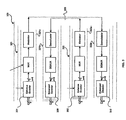
- Fig. 3 is a block diagram of a full duplex system in accordance with an embodiment of the invention.
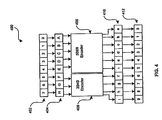
- FIG. 4 is an encoder system that may be utilized for generating standardized 8B/10B encoding as illustrated in the table above.
- FIG. 5 is a block diagram illustrating encoding data packets and idle packets in accordance with an embodiment of the invention.
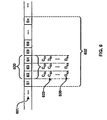
- FIG. 6 is a diagram illustrating the overlaying of a secondary communication channel onto a primary communication channel utilizing the enhanced encoding of FIG. 5, in accordance with an embodiment of the invention.
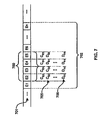
- FIG. 7 is a diagram illustrating the overlaying of a secondary communication channel onto a primary communication channel utilizing the enhanced encoding of FIG. 5, in accordance with an embodiment of the invention.
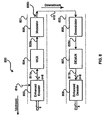
- FIG. 8 is a block diagram of a system for overlaying a secondary communication channel on an encoded primary communication channel in accordance with an embodiment of the invention.
- Certain embodiments of the present invention relate to flow control of data.
- certain embodiments of the present invention relate to providing word-level flow control in a communication system using a secondary communication channel.
- Fig. 2 is a flowchart illustrating an embodiment of a method 200 providing word-level flow control in a communication system using a secondary communication channel, in accordance with various aspects of the present invention.
- a first system transmits a first stream of data to a second system over a communication link infrastructure with first flow control status information embedded within the secondary communication channel of the first stream of data.
- a second system transmits a second stream of data to the first system over the communication link infrastructure with second flow control status information embedded within the secondary communication channel of the second stream of data.
- the first system extracts and processes the second flow control status information from the second stream of data and alters transmission of the first stream of data in response to the second flow control status information.
- the second system extracts and processes the first flow control status information from the first stream of data and alters transmission of the second stream of data in response to the first flow control status information.
- a secondary communication channel refers to any normally unutilized bandwidth in a communication link between at least two systems such as, for example, an inband overlay communication channel as described in provisional application number 60/446,894 (attorney docket number 14219US01) filed on February 12, 2003 which is incorporated herein by reference, or a secondary communication channel in a multi-lane communication channel as described in provisional application number 60/448,703 (attorney docket number 14215US01) filed on February 18, 2003 which is incorporated herein by reference. 8B10B encoding and running disparity strategies may be used to communicate the flow control status information.
- the flow control status information may comprise several bits of information that indicate how close a receiving system's buffer is to becoming full.
- the corresponding transmitting system may employ an algorithm to determine whether or not to proceed with transmitting a next frame of data based on the bits of information.
- the flow control status information from a receiving system may simply indicate to the corresponding transmitting system to stop or start transmitting.
- the secondary channel may emulate the signaling associated with RS-232 compliant interfaces such as RTS/CTS signaling.
- aspects of the invention may include encoding a portion of at least one or more packets in a datastream.
- the coded word may be the first data word.
- a running disparity of the encoded word may be reversed. Hence, if an encoded running disparity of an encoded word is RD positive RD(+), then the running disparity is reversed to RD negative RD(-). Similarly, if an encoded running disparity is RD negative RD(-), then the running disparity is reversed to RD positive RD(+).
- the word may be a data word, control word or an idle word corresponding to a data packet, a control packet and an idle packet, respectively and may appear at any or multiple positions in the data packet.
- FIG. 3 shows a full duplex system useful for an embodiment of this invention 8 bit data is coded into a suitable transmittable format by enhanced coders 301 and 302. Embedded data can be recovered by enhanced decoders 309, 310 as described more fully below.
- FIG. 4 shows a typical coding scheme, where 8 bits of data 402 are converted by a 3B4B/5B6B coder 406, 408 into a 10 bit coded word 412.
- FIG. 5 is a block diagram illustrating encoding data packets and idle packets in accordance with an embodiment of the invention.
- a stream of unencoded packets 501 may include a first unencoded data packet 503a, a second unencoded data 503b and an unencoded idle packet 504.
- the stream of encoded packets 502 may include a first encoded data packet 505a, a second encoded data 505b and an encoded idle packet 506, and are also shown.
- the unencoded idle packet 504 may be located between first unencoded data packet 503a and the second unencoded data packet 503b.
- the first unencoded data packet 503a may include a block or plurality of unencoded data packets and the second unencoded data packet may also include a block or plurality of unencoded data plackets.
- the unencoded idle packet 504 may include a block or plurality of unencoded idle packets.
- the unencoded idle packet 504 may be an unencoded inter-packet gap (IPG).
- IPG unencoded inter-packet gap
- the encoded idle packet 506 may be located between encoded first data packet 505a and the second encoded data packet 505b.
- the first encoded data packet 505a may include a block or plurality of encoded data packets and the second encoded data packet 505b may also include a block or plurality of encoded data packets.
- the encoded idle packet 506 may include a block or plurality of encoded idle packets.
- the encoded idle packet 506 may be an encoded inter-packet gap (IPG), for example.
- IPG encoded inter-packet gap
- the unencoded first and second data packets 503a, 503b may include a stream or block of unencoded data bytes in which each of the data bytes contain eight (8) bits for each data byte.
- the unencoded idle packet 504 may also include a stream or block of unencoded idle bytes in which each of the idle bytes contain eight (8) bits for each idle byte. Other packet sizes may also be utilized.
- a stream of unencoded packets 501 may be encoded according to an enhanced encoding method employed by the enhanced encoder 500 to form a resultant stream of enhanced encoded packets 502.
- the stream of enhanced encoded packets 502 produced by the enhanced encoding method employed by the enhanced encoder 500 may include alternating encoded data packets 505a, 505b and encoded idle packets 506.
- the enhanced encoding method employed by the enhanced encoder 500 may encode data bytes and/or idle bytes according to the rules utilized for generating running disparity, except that certain resultant encoded words within certain encoded packets may be forced to the opposite running disparity of what they normally would be.
- a particular next encoded word would normally be taken from the RD(+) column of an encoding table, it may instead be forced to be taken from the RD(-) column of the encoding table based on secondary channel information 507 provided to the enhanced encoding method 500.
- FIG. 6 is a diagram illustrating the overlaying of a secondary communication channel 600 onto a primary communication channel 601 utilizing the enhanced encoding of FIG. 5, in accordance with an embodiment of the invention.
- a portion of a data stream comprising a data packet 602 for a primary communication channel 601.
- the data packet 602 may include a plurality of unencoded data words E1, E2, E3, E4, E5, E6..., En.
- data packet 602 in the primary communication channel 601 may comprise n encoded data words E1 to En.
- the encoded data packets E2, E3, E4 may form the secondary communication channel 600.
- the secondary communication channel 600 is overlaid onto the primary communication channel 601 and may be referred to as an overlaid channel.
- each encoded data word in the encoded data packet 602 of the primary communication channel 601 will have a certain running disparity RD(+) or RD(-).
- the enhanced encoding method utilized by the enhanced encoder 500 may utilize n data words where n may be greater than or equal to one (1). In another aspect of the invention, n may be less than one (1) representing enhanced coding of at least a portion of a data word. In this regard, more than a portion of one (1) data word may also be enhanced encoded in accordance with various embodiments of the invention.
- the enhanced encoding method utilized by the encoder 500 may utilize, for example, three (3) encoded data words such as E2, E3, E4 in the encoded data packet 602 to create the secondary communication channel 600.
- n is equal to three (3).
- the enhanced encoding method employed by the encoder 300 may switch, reverse or change at least one of the three encoded data words E2, E3, E4 to the opposite running disparity based on the secondary channel information 507.
- the enhanced encoding method may force E4 to come from the RD(-) column instead, in order to encode secondary channel information 507 onto the primary communication channel 601.
- a secondary information channel 600 which may be represented by three (3) bits of information has been created. Since the running disparity of any encoded data word may be either RD(+) or RD(-), the secondary channel of three (3) data bits representing the enhanced encoded data words allows 2 n -1 additional pieces of information to be encoded. In this case, n is equal to three (3) and 2 3 -1 or seven (7) additional pieces of information may be encoded. As a result, three additional bits are required to represent the additional enhanced encoded words.
- the secondary channel may be formed by coding one or more data words at regular intervals.
- the secondary channel could be formed by enhanced coding of three consecutive data words starting with the predetermined data word, such as the first word. For example, if the interval as selected as 64, words E 11 , E 2 , E 3 word form the first coded information and words E 65 , E 66 , and E 67 would form the second coded information. Any pattern that could be predicted by the receiving enhanced decoder could be used.
- the correct running disparity may be represented by C. Accordingly, conventional encoding of E2 would result in a corresponding running disparity of C E2 , conventional encoding of E3 would result in a corresponding running disparity of C E3 , and conventional encoding of E4 would result in a corresponding running disparity of C E4 .
- Enhanced encoding of E2 would result in a corresponding running disparity of D E2
- enhanced encoding of E3 would result in a corresponding running disparity of D E3
- enhanced encoding of E4 would result in a corresponding running disparity of D E4 .
- Reference 405 illustrates E4 being reversed to an opposite running disparity D E4 .
- the single enhanced data word may result in the creation of a primary channel that may provide two additional pieces of information.
- reference 606 illustrates E2 being reversed to an opposite running disparity D E2 , E3 being reversed to an opposite running disparity D E3 , and E4 being reversed to an opposite running disparity D E4 .
- all three (3) enhanced data words may result in the creation of a primary channel that may provide seven (7) additional pieces of information.
- the seven (7) additional pieces of information may require three (3) additional bits of information for encoding.
- the table below illustrates exemplary bit arrangements that may be utilized to represent the data words that may be generated.
- the first entry (1) in the table may represent the correct encoding resulting from conventional encoding.
- the remaining entries two (2) through eight (8) represents at least one bit for at least one data word having a reversed or changed running disparity. Entry eight (8) illustrates a scenario in which all three (3) bits represent a running disparity of all three (3) data words being reversed. For example, 605 shows the coding for row 2 in the table.
- the three (3) additional bits of information provided by the secondary channel 600 may represent certain system overhead information such as routing table information or flow control information. Other status or system information may be encoded into the secondary channel as well.
- the receiver side of the digital communication link will also need to know how to properly decode the secondary communication channel, interpreting data words having reversed running disparity as additional encoded information and not as errors.
- the receiver side may require an enhanced decoder for enhanced decoding of the words that have reversed running disparity.
- the receiver side may be capable of calculating the expected running disparity of the next encoded word received. If the actual running disparity of the next received encoded word turns out to be the opposite of what is expected, then the receiver side may interpret this as additional information and not as an error.
- the enhanced encoding method utilized by the enhanced encoder 500 may be designed so that a required error specification may still be met while still providing an efficient secondary communication channel. Accordingly, some of the possible data words that may be generated by the enhanced encoding method utilized by the enhanced encoder 500 may not be utilized.
- the secondary channel may not be limited to three bits of information. Accordingly, fewer that three, for example two (2), or greater than three (3), for example five (5), encoded data words may be utilized to form a secondary communication channel in the primary communication stream.
- FIG. 7 is a diagram illustrating the overlaying of a secondary communication channel 700 onto a primary communication channel 701 utilizing the enhanced encoding of FIG. 5, in accordance with an embodiment of the invention.
- FIG. 7 is similar to FIG. 6, except that FIG. 7 utilizes four (4) data words for the secondary communication channel 700.
- Data packet 702 may include E1, E2, E3, E4, E5, E6, ... En.
- the correct running disparity is represented by C. Accordingly, conventional encoding of E2 would result in a corresponding running disparity of C E2 , conventional encoding of E3 would result in a corresponding running disparity of C E3 , conventional encoding of E4 would result in a corresponding running disparity of C E4 and conventional encoding of E5 would result in a corresponding running disparity of C E5 .
- Enhanced encoding of E2 would result in a corresponding running disparity of D E2 and enhanced encoding of E3 would result in a corresponding running disparity of D E3
- enhanced encoding of E4 would result in a corresponding running disparity of D E4
- enhanced encoding of E5 would result in a corresponding running disparity of D E5
- Reference 705 illustrates E4 and E5 being reversed to an opposite running disparity D E4 and D E5 .
- the single enhanced data word may result in the creation of a primary channel that may provide two additional pieces of information.
- reference 706 illustrates E2 being reversed to an opposite running disparity D E2 , E3 being reversed to an opposite running disparity D E3 , E4 being reversed to an opposite running disparity D E4 and E5 being reversed to an opposite running disparity D E5 .
- all four (4) enhanced data words may result in the creation of a primary channel that may provide fifteen (15) or (2 4 -1) additional pieces of information.
- Four (4) bits are therefore utilized for encoding to represent the additional fifteen (15) pieces of information.
- the table below illustrates exemplary bit arrangements that may be utilized to represent the data words that may be generated.
- the first entry (1) in the table may represent the correct encoding resulting from conventional encoding.
- the remaining entries, two (2) through sixteen (16) represents at least one bit for at least one data word having a reversed or changed running disparity.
- Entry sixteen (16) illustrates a scenario in which all four (4) bits represents a running disparity of all four (4) data words being reversed. Accordingly, a secondary channel 700 comprising four bits of information overlays the primary channel 701.
- the secondary communication channel may be dynamic.
- the number of data words encoded in the secondary communication channel may change from packet to packet.
- a first packet containing a secondary communication channel may utilize three (3) data words or bits
- a second packet containing a secondary communication channel may utilize five (5) bits
- a third packet containing a secondary communication channel may use two (2) bits.
- Each packet may communicate a different type of information about the system on its secondary communication channel.
- data packets are utilized to illustrate the enhanced encoding employed by the enhanced encoder, the invention is not limited in this regard. Accordingly, data packets, control packets and/or idle packets may be used to encode a secondary communication channel. Additionally, not every packet in the primary communication channel stream may be encoded with a secondary channel. As a result, various levels of tradeoffs may be made between various performance parameters including, for example, DC balance, error detection, transitions and/or additional information transmitted.
- 8B10B encoding is utilized to illustrate various aspects of the enhanced encoding performed by the enhanced encoder 500, the enhanced encoding method 500 may be based on other encoding schemes that use running disparity, in accordance with various embodiments of the present invention. For example, 3B4B and 5B6B encoding schemes may also utilize and benefit from the enhanced encoding method provided by the enhanced encoder 500.
- FIG. 8 is a block diagram of a system for overlaying a secondary communication channel on an encoded primary communication channel in accordance with an embodiment of the invention.
- a communication link 800 illustrating an exemplary communication link 800 having a transmitter side 801 and a receiver side 802.
- the transmitter side 801 may include an enhanced encoder 803, a multiplexer (MUX) 804, and a modulator 805.
- the receiver side 802 may include a demodulator 806, a demultiplexer (DEMUX) 807, and an enhanced decoder 808.
- the transmitter side 801 and the receiver side 802 may be coupled by a link infrastructure 810. Alternatively, the link infrastructure may be a loopback path.
- the loopback may be internal. Otherwise, the loopback may be external. Notwithstanding, the link infrastructure 810 may be, for example, shielded twisted pair, unshielded twisted pair (UTP), copper wire, optical fiber, or wireless.
- the link infrastructure 810 may be, for example, shielded twisted pair, unshielded twisted pair (UTP), copper wire, optical fiber, or wireless.
- the encoder 803 may be adapted to accept raw data bytes from an upstream component or entity of the digital communication system.
- the raw data bytes may be 8-bit words and may have been previously encrypted by an upstream component or entity of a digital communication system or the communication link 800. Prior encryption of the 8-bit words may ensure data integrity while the encrypted data traverses the digital communication link 800.
- the coded words may be coded in an enhanced manner designed to provide reliable transmission and to more efficiently utilize bandwidth, for example, over the digital communication link 800, in accordance with various embodiments of the invention.
- the enhanced encoder 803 may encode each of the 8-bit words into an encoded word having n bits, for example.
- n is greater than eight (8) bits (n>8).
- Encoding the 8-bit words may generally be achieved by translating each 8-bit byte of data into a specially coded word having n bits where n is generally greater than eight (8).
- the additional (n-8) bits of data provide additional transmission overhead.
- the increased number of bits resulting from encoding may also provide data redundancy which may be utilized for error detection, for example.
- the enhanced encoder 803 may encode at least a portion of at least a first word of one or more packets in a datastream.
- the enhanced encoder 803 may reverse a running disparity of the encoded word.
- an encoded running disparity of an encoded word is RD positive RD(+)
- the enhanced encoder 803 reverses the running disparity to RD negative RD(-)
- the enhanced encoder 803 reverses the running disparity to RD positive RD(+).
- the word may be a data word, control word or an idle word corresponding to a data packet, a control packet and an idle packet, respectively.
- the enhanced encoder 803 may also assign n bits of information to each word, where n is greater than or equal to 1, thereby generating 2 n -1 additional enhanced words having reversed running disparities.
- the words with the running disparity may comprise a secondary channel overlaid on the primary communication channel.
- the enhanced encoder 803 may control the secondary channel using the n assigned bits.
- the enhanced encoder 803 may dynamically change or resize the number of words in a packet utilized for enhanced encoding among various packets during enhanced encoding. Words utilized for enhanced encoding may be randomly selected among the packets by the enhanced encoder 803.
- the enhanced encoder may receive secondary channel information 814, which may be utilized for controlling the enhanced encoding of words. In this regard, the enhanced encoder may utilize the secondary channel information to control reversal of the running disparity.
- the resulting coded data 811a may be multiplexed into a serial bitstream 809a by the multiplexer 804.
- the resulting coded data 811a may also be converted a plurality of serial bit streams as in XAUI where 4 parallel lanes are utilized.
- the resulting enhanced multiplexed serial bitstream 809a may subsequently be transferred to the modulator 805 for processing.
- the modulator 805 may perform digital-to-analog conversion on the enhanced serial bitstream 809a, resulting in an equivalent or corresponding enhanced bitstream 809b.
- the resulting enhanced analog serial bitstream 809b may be transferred to the receiver side 802 via the link infrastructure 810.
- the demodulator 806 on the receiver side 802 may be adapted to receive the enhanced analog serial bitstream 809b transferred from the transmitter side 801.
- the demodulator 806 may perform an analog-to-digital conversion on the received enhanced serial bitstream 809b, resulting in an enhanced serial digital bitstream 809c.
- the resulting enhanced serial digital bitstream 809c generated by the demodulator 806 may be transferred to the demultiplexer 807 for processing.
- the demultiplexer 807 may be configured to demultiplex the enhanced serial digital bitstream 809c by executing the opposite of the multiplexing function performed by multiplexer 804.
- the demultiplexer 807 may translate the enhanced serial bitstream 809c back into an enhanced datastream 811b containing enhanced n-bit coded words. For example, in the case of gigabit Ethernet, the demultiplexer 807 may translate the serial bitstream 809c back into enhanced 10-bit coded words. The n-bit enhanced coded words produced by the demultiplexer 807 may subsequently be transferred to the enhanced decoder 608 for processing.
- the enhanced decoder 808 may be adapted to execute the opposite of the enhanced encoder function performed by the enhanced encoder 803. In this regard, the enhanced decoder 808 may convert the n-bit coded words back into 8-bit unencoded bytes.
- the enhanced decoder 808 may receive at least an encoded portion of a packet having a reversed disparity and a determination made as to whether the disparity has been reversed. Upon determining that the disparity has been reversed, the enhanced decoder may reverse the disparity. These 8-bit unencoded bytes, if previously encrypted, may be decrypted by an upstream component of the digital communication link 800, for example.
- FIG. 8 illustrates a half-duplex mode of operation.
- the invention is not limited in this regard and may be similarly applicable to a full-duplex mode of operation.
- FIG. 3 is a block diagram of the exemplary system of FIG. 8 illustrating a duplex configuration in accordance with an embodiment of the invention.
- Each side of the digital communication link may include a transceiver having a transmitter side and a receiver side, operating in full duplex mode.
- each of the transceivers many simultaneously transmit and receive data.
- the first transceiver block 321 may include a transmitter block 321a and a receiver block 321b.
- the second transceiver block 322 may include a transmitter block 322a and a receiver block 322b.
- the transmitter block 321a of first transceiver block 321 and the transmitter block 322a of the second transceiver block 322 may be configured to operate in a manner similar to the transmitter side 801 of FIG. 8.
- the receiver block 321b of first transceiver block 321 and the receiver block 322b of the second transceiver block 322 may be configured to operate in a manner similar to the receiver side 302 of FIG. 8.
- the link infrastructure 330 may couple the transmitter block 321a to receiver block 322b and transmitter block 322a to receiver block 321b.
- flow control status information may be used to control the flow of data from a transmitting system at the word level in real time. Since the flow control status information is embedded in the normal communication channel using a secondary communication channel, the flow control status information is being communicated in real time as part of normal communications. Flow control can be accomplished without special hardware signals or control message protocols. Instead, a system may react to the flow control status information in real time by stopping and starting the transmission of individual data words. Two systems operating in full duplex mode do not need to wait for each other to first finish transmitting whole frames of data before communicating flow control status information to each other.
- flow control could be implemented by reversing the running disparity in every word transmitted from the second system until the first system stops sending.
- additional information about the state of the transmit or receive buffers can be conveyed by combining 2 or more words and detecting reversed running disparity.
- a running disparity of normal, normal, reversed, normal may indicate a receiver buffer state of 0010 or "2" of 0-15 possible states.
- the buffer state may be detected by repeating the pattern every four words or at some other interval.
- the running disparity may be examined for a reversal only on every N th word, where N is relatively small compared to the number of words in the largest frame.
- a series of N th words may be examined to detect a larger number of potential states for the buffer.
- Another arrangement may be to examine for a reversed running disparity at a predetermined interval and treat for resulting bit stream as a low bit rate, in band digital signaling channel.
- the pattern of reversals, or lack of reversals may correspond to other flow control signals besides buffer status, such as device not ready or synchronization lost.
- a method provides flow control in a communication system using a secondary communication channel.
- Flow control status information of a first system may be embedded in the secondary communication channel of a communication channel and communicated to another system in real time as part of normal communications.
- a system can react to the flow control status information in real time and control transmission of data at the word level.
- the present invention may be realized in hardware, software, or a combination of hardware and software.
- the present invention may be realized in a centralized fashion in one computer system, or in a distributed fashion where different elements are spread across several interconnected computer systems. Any kind of computer system or other apparatus adapted for carrying out the methods described herein is suited.
- a typical combination of hardware and software may be a general-purpose computer system with a computer program that, when being loaded and executed, controls the computer system such that it carries out the methods described herein.
- the present invention may also be embedded in a computer program product, which comprises all the features enabling the implementation of the methods described herein, and which when loaded in a computer system is able to carry out these methods.
- Computer program in the present context means any expression, in any language, code or notation, of a set of instructions intended to cause a system having an information processing capability to perform a particular function either directly or after either or both of the following: a) conversion to another language, code or notation; b) reproduction in a different material form.
Landscapes
- Engineering & Computer Science (AREA)
- Computer Networks & Wireless Communication (AREA)
- Signal Processing (AREA)
- Power Engineering (AREA)
- Physics & Mathematics (AREA)
- Spectroscopy & Molecular Physics (AREA)
- Communication Control (AREA)
- Dc Digital Transmission (AREA)
Applications Claiming Priority (6)
| Application Number | Priority Date | Filing Date | Title |
|---|---|---|---|
| US454273 | 1999-12-03 | ||
| US10/454,273 US6859154B2 (en) | 2003-02-12 | 2003-06-04 | Method to overlay a secondary communication channel onto an encoded primary communication channel |
| US10/454,012 US7463651B2 (en) | 2003-02-12 | 2003-06-04 | Method and system for exploiting spare link bandwidth in a multilane communication channel |
| US454012 | 2003-06-05 | ||
| US10/644,204 US7535836B2 (en) | 2003-02-12 | 2003-08-20 | Method and system to provide word-level flow control using spare link bandwidth |
| US644204 | 2003-08-20 |
Publications (3)
| Publication Number | Publication Date |
|---|---|
| EP1484872A2 true EP1484872A2 (de) | 2004-12-08 |
| EP1484872A3 EP1484872A3 (de) | 2006-03-29 |
| EP1484872B1 EP1484872B1 (de) | 2009-07-22 |
Family
ID=33162969
Family Applications (1)
| Application Number | Title | Priority Date | Filing Date |
|---|---|---|---|
| EP04010592A Expired - Lifetime EP1484872B1 (de) | 2003-06-04 | 2004-05-04 | Vorrichtung und Verfahren zur Flusskontrolle auf Datenwortebene unter Verwendung von freier Bandbreite auf der Verbindung |
Country Status (3)
| Country | Link |
|---|---|
| US (1) | US7535836B2 (de) |
| EP (1) | EP1484872B1 (de) |
| DE (1) | DE602004022108D1 (de) |
Families Citing this family (12)
| Publication number | Priority date | Publication date | Assignee | Title |
|---|---|---|---|---|
| US8437352B2 (en) * | 2006-05-30 | 2013-05-07 | Broadcom Corporation | Method and system for power control based on application awareness in a packet network switch |
| US8201071B2 (en) * | 2006-11-15 | 2012-06-12 | Qimonda Ag | Information transmission and reception |
| US9455912B2 (en) * | 2007-12-17 | 2016-09-27 | Broadcom Corporation | Method and system for a distinct physical pattern on an active channel to indicate a data rate transition for energy efficient ethernet |
| CN101540881B (zh) * | 2008-03-19 | 2011-04-13 | 华为技术有限公司 | 实现流媒体定位播放的方法、装置及系统 |
| EP2645257A3 (de) | 2012-03-29 | 2014-06-18 | Prelert Ltd. | System und Verfahren zur Visualisierung des Verhaltens in einer Computerinfrastruktur |
| US9229897B2 (en) * | 2012-06-29 | 2016-01-05 | Intel Corporation | Embedded control channel for high speed serial interconnect |
| US9507746B2 (en) | 2012-10-22 | 2016-11-29 | Intel Corporation | Control messaging in multislot link layer flit |
| US9407394B2 (en) * | 2014-02-03 | 2016-08-02 | Valens Semiconductor Ltd. | Frequent flow control by replacing certain idle words with bitwise complement words |
| US9542243B2 (en) | 2014-03-14 | 2017-01-10 | International Business Machines Corporation | Coalescing stages in a multiple stage completion sequence |
| US9843518B2 (en) * | 2014-03-14 | 2017-12-12 | International Business Machines Corporation | Remotely controlled message queue |
| TWI631835B (zh) | 2014-11-12 | 2018-08-01 | 弗勞恩霍夫爾協會 | 用以解碼媒體信號之解碼器、及用以編碼包含用於主要媒體資料之元資料或控制資料的次要媒體資料之編碼器 |
| US12081376B2 (en) | 2021-11-05 | 2024-09-03 | Samsung Display Co., Ltd. | DC balanced transition encoding |
Family Cites Families (13)
| Publication number | Priority date | Publication date | Assignee | Title |
|---|---|---|---|---|
| GB2016247B (en) | 1978-03-04 | 1982-03-31 | Plessey Co Ltd | Method of signalling supervisory information in digital line transmission systems |
| US5267240A (en) * | 1992-02-20 | 1993-11-30 | International Business Machines Corporation | Frame-group transmission and reception for parallel/serial buses |
| MX9306994A (es) * | 1992-12-15 | 1994-06-30 | Ericsson Telefon Ab L M | Sistema de control de flujo para interruptores de paquete. |
| GB2276292B (en) * | 1993-03-17 | 1997-01-08 | Roke Manor Research | Improvements in or relating to communication systems |
| US5673254A (en) * | 1995-06-07 | 1997-09-30 | Advanced Micro Devices Inc. | Enhancements to 802.3 media access control and associated signaling schemes for ethernet switching |
| US5944797A (en) * | 1997-05-28 | 1999-08-31 | International Business Machines Corporation | Data mover hardware controlled processing in a commanding system and in a commanded system for controlling frame communications on a link |
| US6108736A (en) * | 1997-09-22 | 2000-08-22 | Intel Corporation | System and method of flow control for a high speed bus |
| US6134607A (en) | 1998-04-03 | 2000-10-17 | Avid Technology, Inc. | Method and apparatus for controlling data flow between devices connected by a memory |
| US6377575B1 (en) | 1998-08-05 | 2002-04-23 | Vitesse Semiconductor Corporation | High speed cross point switch routing circuit with word-synchronous serial back plane |
| US6198413B1 (en) * | 1999-07-01 | 2001-03-06 | International Business Machines Corporation | Partitioned DC balanced (0,6) 16B/18B transmission code with error correction |
| GB2360666B (en) | 2000-03-24 | 2003-07-16 | 3Com Corp | Flow control system for network devices |
| US6501396B1 (en) * | 2001-03-30 | 2002-12-31 | Xilinx, Inc. | Scalable physical coding sublayer (PCS) and 8B/10B encoder |
| US6980520B1 (en) * | 2001-06-11 | 2005-12-27 | Advanced Micro Devices, Inc. | Method and apparatus for performing source-based flow control across multiple network devices |
-
2003
- 2003-08-20 US US10/644,204 patent/US7535836B2/en not_active Expired - Fee Related
-
2004
- 2004-05-04 EP EP04010592A patent/EP1484872B1/de not_active Expired - Lifetime
- 2004-05-04 DE DE602004022108T patent/DE602004022108D1/de not_active Expired - Lifetime
Also Published As
| Publication number | Publication date |
|---|---|
| EP1484872A3 (de) | 2006-03-29 |
| US7535836B2 (en) | 2009-05-19 |
| EP1484872B1 (de) | 2009-07-22 |
| DE602004022108D1 (de) | 2009-09-03 |
| US20040156317A1 (en) | 2004-08-12 |
Similar Documents
| Publication | Publication Date | Title |
|---|---|---|
| US7782805B1 (en) | High speed packet interface and method | |
| US7535836B2 (en) | Method and system to provide word-level flow control using spare link bandwidth | |
| US6600753B2 (en) | Sanitizing fibre channel frames | |
| US6930621B2 (en) | Method to overlay a secondary communication channel onto an encoded primary communication channel | |
| US7707475B2 (en) | 64b/66b coding apparatus and method | |
| US20050102419A1 (en) | Extended link monitoring channel for 10 Gb/s Ethernet | |
| US8024558B2 (en) | Method and system for providing synchronous running encoding and encryption | |
| US7050468B2 (en) | Multiplexed signal transmitter/receiver, communication system, and multiplexing transmission method | |
| JPH0575651A (ja) | パケツト伝送方式 | |
| JP2001298490A (ja) | パケット化直列データを符号化するための符号化方法および符号器 | |
| JP2671821B2 (ja) | データ伝送装置 | |
| US7339893B2 (en) | Pre-empting low-priority traffic with high-priority traffic on a dedicated link | |
| JPH08265332A (ja) | データ転送方法とその装置 | |
| US20030219040A1 (en) | Apparatus, method and storage medium for carrying out deskew among multiple lanes for use in division transmission of large-capacity data | |
| US5592160A (en) | Method and apparatus for transmission code decoding and encoding | |
| US6185717B1 (en) | Data reception unit | |
| US9294418B2 (en) | 64B/66B codec for ethernet applications | |
| US20160013885A1 (en) | Long-Distance RapidIO Packet Delivery | |
| US9178692B1 (en) | Serial link training method and apparatus with deterministic latency | |
| US5253274A (en) | Means to differentiate between commands and data on a communications link | |
| US7787502B1 (en) | Port multiplexing apparatus and methods | |
| US20250310306A1 (en) | System and method for encoding and decoding in communication protocol | |
| US8873592B1 (en) | System and method for adding a low data rate data channel to a 100Base-T ethernet link | |
| JP3161686B2 (ja) | パケット伝送装置 | |
| WO2025208024A1 (en) | System and method for encoding and decoding in communication protocol |
Legal Events
| Date | Code | Title | Description |
|---|---|---|---|
| PUAI | Public reference made under article 153(3) epc to a published international application that has entered the european phase |
Free format text: ORIGINAL CODE: 0009012 |
|
| AK | Designated contracting states |
Kind code of ref document: A2 Designated state(s): AT BE BG CH CY CZ DE DK EE ES FI FR GB GR HU IE IT LI LU MC NL PL PT RO SE SI SK TR |
|
| AX | Request for extension of the european patent |
Extension state: AL HR LT LV MK |
|
| PUAL | Search report despatched |
Free format text: ORIGINAL CODE: 0009013 |
|
| AK | Designated contracting states |
Kind code of ref document: A3 Designated state(s): AT BE BG CH CY CZ DE DK EE ES FI FR GB GR HU IE IT LI LU MC NL PL PT RO SE SI SK TR |
|
| AX | Request for extension of the european patent |
Extension state: AL HR LT LV MK |
|
| 17P | Request for examination filed |
Effective date: 20060929 |
|
| 17Q | First examination report despatched |
Effective date: 20061027 |
|
| AKX | Designation fees paid |
Designated state(s): DE FR GB |
|
| RAP1 | Party data changed (applicant data changed or rights of an application transferred) |
Owner name: BROADCOM CORPORATION |
|
| 17Q | First examination report despatched |
Effective date: 20061027 |
|
| GRAP | Despatch of communication of intention to grant a patent |
Free format text: ORIGINAL CODE: EPIDOSNIGR1 |
|
| GRAS | Grant fee paid |
Free format text: ORIGINAL CODE: EPIDOSNIGR3 |
|
| GRAA | (expected) grant |
Free format text: ORIGINAL CODE: 0009210 |
|
| AK | Designated contracting states |
Kind code of ref document: B1 Designated state(s): DE FR GB |
|
| REG | Reference to a national code |
Ref country code: GB Ref legal event code: FG4D |
|
| REF | Corresponds to: |
Ref document number: 602004022108 Country of ref document: DE Date of ref document: 20090903 Kind code of ref document: P |
|
| PLBE | No opposition filed within time limit |
Free format text: ORIGINAL CODE: 0009261 |
|
| STAA | Information on the status of an ep patent application or granted ep patent |
Free format text: STATUS: NO OPPOSITION FILED WITHIN TIME LIMIT |
|
| 26N | No opposition filed |
Effective date: 20100423 |
|
| REG | Reference to a national code |
Ref country code: FR Ref legal event code: ST Effective date: 20110131 |
|
| PG25 | Lapsed in a contracting state [announced via postgrant information from national office to epo] |
Ref country code: FR Free format text: LAPSE BECAUSE OF NON-PAYMENT OF DUE FEES Effective date: 20100531 |
|
| PGFP | Annual fee paid to national office [announced via postgrant information from national office to epo] |
Ref country code: GB Payment date: 20130522 Year of fee payment: 10 |
|
| GBPC | Gb: european patent ceased through non-payment of renewal fee |
Effective date: 20140504 |
|
| PG25 | Lapsed in a contracting state [announced via postgrant information from national office to epo] |
Ref country code: GB Free format text: LAPSE BECAUSE OF NON-PAYMENT OF DUE FEES Effective date: 20140504 |
|
| PGFP | Annual fee paid to national office [announced via postgrant information from national office to epo] |
Ref country code: DE Payment date: 20160531 Year of fee payment: 13 |
|
| REG | Reference to a national code |
Ref country code: DE Ref legal event code: R082 Ref document number: 602004022108 Country of ref document: DE Representative=s name: BOSCH JEHLE PATENTANWALTSGESELLSCHAFT MBH, DE Ref country code: DE Ref legal event code: R081 Ref document number: 602004022108 Country of ref document: DE Owner name: AVAGO TECHNOLOGIES GENERAL IP (SINGAPORE) PTE., SG Free format text: FORMER OWNER: BROADCOM CORP., IRVINE, CALIF., US |
|
| REG | Reference to a national code |
Ref country code: DE Ref legal event code: R119 Ref document number: 602004022108 Country of ref document: DE |
|
| PG25 | Lapsed in a contracting state [announced via postgrant information from national office to epo] |
Ref country code: DE Free format text: LAPSE BECAUSE OF NON-PAYMENT OF DUE FEES Effective date: 20171201 |