EP1484897B1 - Verfahren und Vorrichtung für Senden und Empfangen von Multiprotokolldatenrahmen - Google Patents
Verfahren und Vorrichtung für Senden und Empfangen von Multiprotokolldatenrahmen Download PDFInfo
- Publication number
- EP1484897B1 EP1484897B1 EP20040253369 EP04253369A EP1484897B1 EP 1484897 B1 EP1484897 B1 EP 1484897B1 EP 20040253369 EP20040253369 EP 20040253369 EP 04253369 A EP04253369 A EP 04253369A EP 1484897 B1 EP1484897 B1 EP 1484897B1
- Authority
- EP
- European Patent Office
- Prior art keywords
- data frames
- fcsl
- module
- transmitted
- asynchronous
- Prior art date
- Legal status (The legal status is an assumption and is not a legal conclusion. Google has not performed a legal analysis and makes no representation as to the accuracy of the status listed.)
- Expired - Lifetime
Links
Images


Classifications
-
- H—ELECTRICITY
- H04—ELECTRIC COMMUNICATION TECHNIQUE
- H04L—TRANSMISSION OF DIGITAL INFORMATION, e.g. TELEGRAPHIC COMMUNICATION
- H04L69/00—Network arrangements, protocols or services independent of the application payload and not provided for in the other groups of this subclass
- H04L69/22—Parsing or analysis of headers
-
- A—HUMAN NECESSITIES
- A63—SPORTS; GAMES; AMUSEMENTS
- A63B—APPARATUS FOR PHYSICAL TRAINING, GYMNASTICS, SWIMMING, CLIMBING, OR FENCING; BALL GAMES; TRAINING EQUIPMENT
- A63B53/00—Golf clubs
- A63B53/14—Handles
-
- A—HUMAN NECESSITIES
- A63—SPORTS; GAMES; AMUSEMENTS
- A63B—APPARATUS FOR PHYSICAL TRAINING, GYMNASTICS, SWIMMING, CLIMBING, OR FENCING; BALL GAMES; TRAINING EQUIPMENT
- A63B57/00—Golfing accessories
- A63B57/20—Holders, e.g. of tees or of balls
- A63B57/207—Golf ball position marker holders
-
- A—HUMAN NECESSITIES
- A63—SPORTS; GAMES; AMUSEMENTS
- A63B—APPARATUS FOR PHYSICAL TRAINING, GYMNASTICS, SWIMMING, CLIMBING, OR FENCING; BALL GAMES; TRAINING EQUIPMENT
- A63B60/00—Details or accessories of golf clubs, bats, rackets or the like
- A63B60/06—Handles
- A63B60/16—Caps; Ferrules
-
- H—ELECTRICITY
- H04—ELECTRIC COMMUNICATION TECHNIQUE
- H04L—TRANSMISSION OF DIGITAL INFORMATION, e.g. TELEGRAPHIC COMMUNICATION
- H04L69/00—Network arrangements, protocols or services independent of the application payload and not provided for in the other groups of this subclass
- H04L69/18—Multiprotocol handlers, e.g. single devices capable of handling multiple protocols
-
- H—ELECTRICITY
- H04—ELECTRIC COMMUNICATION TECHNIQUE
- H04L—TRANSMISSION OF DIGITAL INFORMATION, e.g. TELEGRAPHIC COMMUNICATION
- H04L69/00—Network arrangements, protocols or services independent of the application payload and not provided for in the other groups of this subclass
- H04L69/30—Definitions, standards or architectural aspects of layered protocol stacks
- H04L69/32—Architecture of open systems interconnection [OSI] 7-layer type protocol stacks, e.g. the interfaces between the data link level and the physical level
- H04L69/322—Intralayer communication protocols among peer entities or protocol data unit [PDU] definitions
- H04L69/324—Intralayer communication protocols among peer entities or protocol data unit [PDU] definitions in the data link layer [OSI layer 2], e.g. HDLC
-
- A—HUMAN NECESSITIES
- A63—SPORTS; GAMES; AMUSEMENTS
- A63B—APPARATUS FOR PHYSICAL TRAINING, GYMNASTICS, SWIMMING, CLIMBING, OR FENCING; BALL GAMES; TRAINING EQUIPMENT
- A63B2209/00—Characteristics of used materials
- A63B2209/08—Characteristics of used materials magnetic
Definitions
- the present invention relates to a method and an apparatus for transmitting and receiving data frames in various protocols.
- PAN personal area network
- a piconet coordinator for communications in the wireless PAN, all devices in a piconet defined by IEEE 802.15.3 can gain access to a wireless medium (WM) depending on information provided by a piconet coordinator (hereinafter, referred to as a "PNC"). This information is broadcast through a beacon.
- PNC piconet coordinator
- One piconet is determined according to a piconet ID (PNID) and a beacon source ID (BSID) that are defined by the PNC.
- PNID piconet ID
- BSID beacon source ID
- To one piconet may be connected a variety of different devices employing various protocols and different transfer modes such as IEEE 1394, USB and IEEE 802 families.
- Figure 1 is a block diagram illustrating a frame convergence sub-layer model of the related art in which a variety of protocols are used.
- the open systems interconnection (OSI) 7 layer model has a physical layer serving as the lowest layer and a data link layer above the physical layer.
- the data link layer comprises two sub-layers: a medium access control (MAC) sub-layer and a frame convergence sub-layer (FCSL).
- SAPs Service access points
- FCSL SAP Service access points
- FCSL SAPs serving as interfaces, e.g. 1394 SAP for an IEEE 1394 application, 802.2 SAP for an IEEE 802.2 application, USB SAP for an USB application, and XXXX SAPs for other XXXX applications.
- Each of the FCSLs receives packets (including a protocol data unit; hereinafter referred to as "PDU") from an upper protocol layer through the relevant FCSL SAP, classifies the PDU according to classification rule sets, and transfers the classified PDU to the MAC SAP. Further, the FCSL receives the PDU from the MAC SAP and then transfers the received PDU to its upper layer through the relevant FCSL SAP. for example this is disclosed in the presentation device & connection management; John Barr, october 22, 2002.
- PDU protocol data unit
- the present invention provides a FCSL logic link control serving as a service access point of data transferred or received through a MAC SAP when several FCSLs for supporting a variety of different protocols exist on a MAC layer.
- a method for transmitting multi-protocol data frames through a predetermined MAC comprising: (a) receiving data frames transmitted from an upper protocol frame convergence sub-layer(FCSL);(b) providing the received data frames with identification information on the upper protocol FCSL having transmitted the data frame; and (c) transmitting the data frames including identification information.
- an apparatus for transmitting multi-protocol data frames comprising: a plurality of frame convergence sub-layer (FCSL) modules supporting different protocols; a FCSL logic link control (LLC) module configured to receive data frames from at least one module among the FCSL modules and to provide the data frames to identification information so as to allow a receiving apparatus to identify the FCSL having transmitted the data frames, and a medium access control (MAC) module configured to receive data frames from the FCSL LLC module and transmit the data frames to a wireless transmitting medium.
- FCSL frame convergence sub-layer
- LLC FCSL logic link control
- MAC medium access control
- a method for receiving multi-protocol data frames comprising: receiving data frames; determining an upper protocol FCSL to which the received data frames are transmitted, based on identification information included in the received data frames, and transmitting the received data frames to the determined upper protocol FCSL.
- an apparatus for receiving multi-protocol data frames comprising: a plurality of frame convergence sub-layer (FCSL) modules supporting the protocols; and a FCLS logic link control (LLC) module configured to receive data frames transmitted to a wireless transmitting medium through a MAC module and to determines a FCSL module to which the data frames are transmitted, based on identification information included in the data frames, and to transmit the data frames to the determined FCSL module.
- FCSL frame convergence sub-layer
- LLC FCLS logic link control
- Figure 2 shows a structure of a protocol stack according to an exemplary embodiment of the present invention.
- the protocol stack is configured in such a manner that a MAC layer 100 is located on a physical layer (not shown), a frame convergence sub-layer logic link control (FCSL LLC) 400 is located on the MAC layer 100, and a MAC SAP 200 and a MAC layer management entity (MLME) SAP 300, which serve as an interface, are interposed between the layer 100 and the FCSL LLC 400.
- FCSLs for a variety of different protocols may be located above the FCSL LLC 400. For example, there may be a 1394 FCSL for an IEEE 1394 packet, an 802.2 FCSL for an IEEE 802.2 packet, a USB FCSL for an USB packet, and a XXXX FCSL for other packets.
- a FCSL PDU classification process is implemented to allow each FCSL PDU to be mapped into a specific stream index.
- Each stream index is associated with a set of quality of service (QoS) characteristics.
- QoS quality of service
- each FCSL PDU is delivered using QoS parameters specified for the stream index.
- the classification process uses one or more sets of classification parameters to analyze frames entering the respective FCSLs.
- the classification parameters set for the 802.2 FCSL comprise classification priority, stream indexes, and protocol-specific parameters such as destination address, source address or priority parameters.
- the 802.2 FCSL receives an 802.2 frame PDU through the 802.2 FCSL SAP, and then classifies the received PDU according to the destination address, source address and priority parameters.
- the received PDU is mapped into the specific stream index according to the 802.2 FCSL classification rules, and the received PDU source and destination addresses are mapped into 802.15.3 source ID (ScrID) and destination ID (DestID). Then, a valid frame is delivered to the MAC SAP 200. Furthermore, the 802.2 FCSL receives a frame from the MAC SAP 200 and transfers the received frame to the upper layer through the 802.2 FCSL SAP.
- the 802.2 FCSL may transfer and receive frames directly to and from the MAC SAP 200 as explained above.
- another protocol e.g. a 1394 protocol or a USB protocol
- the present invention is configured to implement a new layer, i.e. the FCSL LLC 400, between the specific FCSL and the MAC SAP 200 so that it can be determined which one of various different protocols is used.
- the structure of the FCSL LLC 400 will be described in detail with reference to Figure 3.
- the MAC layer 100 is located between the physical layer (not shown) and the MAC SAP 200.
- the MAC layer 100 refers to beacon information received from a PNC so that the frames from the upper layer are transferred to a wireless medium through the physical layer at an appropriate time.
- the MLME SAP 300 is a SAP used for a MLME (not shown).
- the MLME is used, for example, to reset the MAC layer, perform scanning to determine whether there is any piconet associated with the communication channels, create a new piconet, perform synchronization for a preliminary step for devices associated with a specific piconet, associate devices with a piconet, and/or support a handover mechanism between piconets.
- FIG 3 more specifically illustrates the structure of the FCSL LLC shown in Figure 2.
- the IEEE 802.15.3 MAC supports two kinds of data, i.e. asynchronous data and isochronous data.
- the MAC SAP 200 comprises SAPs for use in the two kinds of data supported by IEEE 802.15.3, i.e. an asynchronous SAP 210 for asynchronous data and an isochronous SAP 220 for isochronous data.
- the MLME SAP 300 is a SAP for the MLME and provides a variety of services for managing the MAC layer 100.
- the FCSL LLC 400 for allowing a variety of different protocols to be used comprises an asynchronous SAP attach module 410, an asynchronous SAP detach module 420, a destination SAP selection module 430, a first request detection module 440, a channel time allocation module 460, a probe request/response module 470, and a stream index storage module 450.
- the asynchronous SAP attach module 410 attaches to a frame an SAP for indicating which specific FCSL the frame is received from, and then delivers the resultant frame to the asynchronous SAP 210. Further, the asynchronous SAP detach module 420 separates the SAP from the frame received from the asynchronous SAP 210 and then delivers the separated SAP to the destination SAP selection module 430. The destination SAP selection module 430 determines which FCSL has forwarded the frame based on the SAP separated from the detach module 420, and then sends the frame to the determined FCSL.
- the first request detection module 440 requests channel time allocation (CTA) from the channel time allocation module 460 when receiving an isochronous data transfer request from the specific FCSL.
- the channel time allocation module 460 is allocated a channel through the MLME SAP 300 from the PNC (not shown). This means receiving a valid stream index.
- the received stream index, a destination SAP thereof and a device ID are stored in the stream index storage module 450.
- the destination SAP has a different value for each FCSL.
- the PNC broadcasts CTA information to all devices through a beacon. Meanwhile, a destination device receives the beacon and sends a probe request to a source device through the probe request/response module 470.
- the requested information element may be one such as a piconet service IE or a vendor specific IE which is not defined by the IEEE 802.15.3 standards.
- the probe request/response module 470 in the source device creates IE based on content stored in the stream index storage module 450 and sends a probe response to the destination device.
- the destination device receives the probe response and stores the IE forwarded by the source device in its own stream index storage module 450.
- the destination SAP selection module 430 in the destination device selects a destination FCSL by referring to the information stored in the stream index storage module 450 on the basis of the stream index and an Originator ID (OriglID) in the frame input through the isochronous SAP 220.
- Originator ID Originator ID
- Figure 4 illustrates an example of a CTA mapping relationship between two devices.
- a first device 500 is a source device operable to transfer data to a second device 600.
- the first device 500 can transfer and receive data in USB protocol and TCP/IP protocol, while the second device 600 can transfer and receive data in TCP/IP protocol, USB protocol, and 1394 protocol.
- the first device 500 may transfer asynchronous and isochronous data in USP protocol and TCP/IP protocol to the second device 600.
- the first device 500 is implemented in such a manner as to function as a PNC, but a separate PNC may also be employed.
- USB PDUs are transferred to the USB FCSL through the USB FCSL SAP (not shown).
- FCSL the transferred PDUs are translated into a frame compatible with the IEEE 15.3 MAC layer 100.
- the frame is delivered to the asynchronous SAP attach module 410.
- the asynchronous SAP attach module 410 attaches SAP information to the frame so that the second device 600 can recognize that the data are transferred through the USB FCSL, and send the frame to the asynchronous SAP 210. That is, the asynchronous SAP attach module 410 attaches an indication that the frame is transferred through the USB FCSL SAP to the relevant frame.
- the frame passed through the asynchronous SAP attach module 410 is delivered to the asynchronous SAP module 210 and then sent to the MAC layer 100.
- the frame is also transferred to the second device 600 through the wireless transfer media after passing through the MAC layer 100 and the physical layer (not shown).
- the asynchronous data are transferred to the asynchronous SAP module 210 via the physical layer and the MAC layer 100.
- the SAP information is separated in the asynchronous SAP detach module 420.
- the destination SAP selection module 430 determines that the frame should be transferred to the USB FCSL based on the SAP information, and delivers the frame to the USB FCSL. Then, the frame is sent to the USB FCSL SAP (not shown) and finally to the USB application.
- the asynchronous data can be transferred with the CTA allocated by the PNC, and the asynchronous data may be alternatively transferred based on a contention access period (CAP) or some management CTA (MCTA).
- CAP contention access period
- MCTA management CTA
- the data in TCP/IP protocol can also be transferred together with the asynchronous data in USB protocol.
- the USB and 802.2 PDUs share the asynchronous CTA.
- the index number of the asynchronous CTA always has a fixed value of "zero".
- USB application data is to be transferred.
- the first request detection module 440 determines whether this request is a first transfer request. If so, the first request detection module 440 requests the channel time allocation module 460 for CTA.
- the channel time allocation module 460 requests the CTA through the MLME SAP 300, and receives a valid stream index through the MLME SAP 300 when being allocated the channel time.
- the CTA is determined by the PNC. For example, assuming that the first device 500 receives the channel index of "1", the stream index storage module 450 stores the allocated stream index (i.e., "1"), a destination SAP value for the allocated stream index, and a device ID.
- the destination SAP is defined to have a unique value for each FCSL.
- the PNC broadcasts the CTA information to all devices through the beacon.
- the second device 600 which has received the beacon, requests the first device 500 for a probe response.
- the first device 500 creates the IE on the basis of the channel index, destination SAP value and device ID, and responds to the second device 600.
- the second device 600 receives the probe response from the first device 500 and stores the channel index, destination SAP value and device ID.
- the data in USB protocol are sent to the MAC layer 100, via the USB FCSL and isochronous SAP 220 in the first device 500, and then to the wireless medium.
- the second device 600 receives the frame forwarded by the first device 500.
- the received frame is transferred to the USB application via the MAC layer 100, the isochronous SAP 200, the destination SAP selection module 430 and the USB FCSL.
- isochronous data in TCP/IP protocol can also be transferred in the same manner as described above.
- the index number "2" is given, which is different from the stream index given to the USB application data.
- a value of "0xFD” is reserved for the stream index for MCTA. Further, a value of "0xFE” is reserved for an unspecified stream.
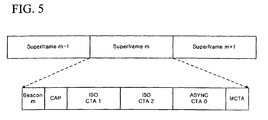
- Figure 5 shows a superframe structure for use in the embodiment shown in Figure 4.
- the superframe is a frame between beacons and may comprise a beacon, a contention access period (CAP), an asynchronous CTA, isochronous CTAs, and MCTA.
- CAP contention access period
- the stream indexes of the asynchronous data, USB data and TCP/IP data have the values of "0", "1", and "2", respectively.
- the superframe has ISO CTA 1 containing USB data, ISO CTA 2 containing TCP/IP data, and ASYNC CTA 0 containing the USB and TCP/IP data.
- the present invention is not limited thereto and is also applicable to the other cases where frame convergence sub-layers for a plurality of protocols are present.
- the present invention is also not limited thereto. Data in other formats, for example, may be transferred, which is also included within the technical scope of the present invention.
- the asynchronous SAP attach module and asynchronous SAP detach module are individually and separately provided, the present invention is also not limited thereto. Both modules may be incorporated into a single module, which also falls within the technical scope of the present invention.
Landscapes
- Engineering & Computer Science (AREA)
- Computer Security & Cryptography (AREA)
- Computer Networks & Wireless Communication (AREA)
- Signal Processing (AREA)
- Health & Medical Sciences (AREA)
- General Health & Medical Sciences (AREA)
- Physical Education & Sports Medicine (AREA)
- Small-Scale Networks (AREA)
- Mobile Radio Communication Systems (AREA)
- Communication Control (AREA)
Claims (24)
- Verfahren zum Senden von Multiprotokoll-Daten-Frarnes über eine vorgegebene Medienzugriffssteuerung (medium access control - MAC), das umfasst.a) Empfangen von Daten-Frames, die von einer Frame-Konvergenz-Teilschicht (frame convergence sub-layer - FCSL) eines oberen Protokolls gesendet werden;b) Versehen der empfangenen Daten-Frames mit Identifizierungsinformationen auf der FCSL des oberen Protokolls, die den Daten-Frame gesendet hat; undc) Senden der Daten-Frames einschließlich der Identifizierungsinformationen.
- Verfahren nach Anspruch 1, wobei die Daten-Frames in dem Medienzugriffssteuerung-Modus auf Basis von Standards nach IEEE 802.15.3 gesendet werden.
- Verfahren nach Anspruch 1 oder 2, wobei die Daten-Frames im Modus entweder einer asynchronen oder isochronen Übertragung übertragen werden.
- Verfahren nach Anspruch 1, wobei die Daten-Frames asynchrone Daten-Frames sind.
- Verfahren nach Anspruch 1, wobeia) die Daten-Frames isochrone Daten-Frames sind;b) die isochronen Daten-Frames mit einem Stream-Index versehen werden, der in einer Frame-Konvergenz-Teilschicht (FCSL) abgebildet ist; undc) die isochronen Daten-Frames während einer Kanalzeitzuweisung (channel time allocation - CTA) des bereitgestellten Stream-Index gesendet werden.
- Verfahren nach Anspruch 5, wobei der Stream-Index, der in einer Frame-Konvergenz-Teilschicht abgebildet ist, die die isochronen Daten gesendet hat, mit der Kanalzeitzuweisung von einem Piconet-Koordinator (piconet coordinator - PNC) bezogen wird.
- Verfahren nach Anspruch 6, das des Weiteren Senden einer Anforderungsantwort mit den Abbildungsinformationen des Stream-Index umfasst, wenn nach Empfang der Kanalzeitzuweisung eine Anforderungsabfrage von einer empfangenden Vorrichtung empfangen worden ist.
- Vorrichtung zum Senden von Multiprotokoll-Daten-Frames, die umfasst:eine Vielzahl von Frame-Konvergenz-Teilschicht (FCSL)-Modulen, die verschiedene Protokolle unterstützen;ein FCSL-LLC (logic link control)-Modul (400), das so konfiguriert ist, dass es Daten-Frames von wenigstens einem Modul unter den FCSL-Modulen empfängt und die Daten-Frames mit ldentifizierungsinformationen versieht, so dass eine empfangende Vorrichtung (600) die Frame-Konvergenz-Teilschicht identifizieren kann, die die Daten-Frames gesendet hat; undein MAC-Modul (100), das so konfiguriert ist, dass es Daten-Frames von dem FCSL-LLC-Modul empfängt und die Daten-Frames zu einem Drahtlos-Sendemedium sendet.
- Vorrichtung nach Anspruch 8, wobei das MAC-Modul auf Standards nach IEEE 802.15.3 basiert.
- Vorrichtung nach Anspruch 8 oder 9, wobei die empfangenen Daten-Frames asynchrone Daten-Frames umfassen und das FCSL-LLC-Modul (400) ein asynchrones Dienstzugangspunkt (service access point - SAP)-Anschlussmodul (410) umfasst, das so konfiguriert ist, dass es die asynchronen Daten-Frames mit Identifzierungsinformationen versieht, so dass die empfangende Vorrichtung (600) die Frame-Konvergenz-Teilschicht identifizieren kann, die die asynchronen Daten-Frames gesendet hat.
- Vorrichtung nach Anspruch 8, 9 oder 10, wobei die von dem FCSL-Modul empfangenen Daten-Frames isochrone Daten-Frames umfassen und das FCSL-LLC-Modul (400) ein Stream-Index-Speichermodul (450) umfasst, das so konfiguriert ist, dass es einen Stream-Index für die Frame-Konvergenz-Teilschicht darin speichert, die die isochronen Daten-Frames gesendet hat, und das MAC-Modul (100) so konfiguriert ist, dass es die isochronen Daten-Frames während Zuweisung der Kanalzeitzuweisung sendet, um über den gespeicherten Stream-Index zu verfügen.
- Vorrichtung nach Anspruch 11, wobei das FCSL-LLC-Modul (400) des Weiteren ein Anforderungsabfrage-/Antwortmodul (470) umfasst, das so konfiguriert ist, dass es auf eine Anforderungsabfrage von der empfangenden Vorrichtung (600) antwortet, wobei der Stream-Index für die Frame-Konvergenz-Teilschicht, die die isochronen Daten-Frames gesendet hat, in dem Stream-Index-Speichermodul (450) gespeichert ist.
- Verfahren zum Empfangen von Multiprotokoll-Daten-Frames, das umfasst:Empfangen von Daten-Frames;Bestimmen einer Frame-Konvergenz-Teilschicht (FCSL) eines oberen Protokolls, zu der die empfangenen Daten-Frames gesendet werden, auf Basis von Identifizierungsinformationen, die in den empfangenen Daten-Frames enthalten sind; undSenden der empfangenen Daten-Frames zu der bestimmten Frame-Konvergenz-Teilschicht des oberen Protokolls.
- Verfahren nach Anspruch 13, wobei die empfangenen Daten-Frames Daten-Frames in dem MAC-Modus auf Basis von Standards nach IEEE 802.15.3 umfassen.
- Verfahren nach Anspruch 13 oder 14, wobei die empfangenen Daten-Frames in einem Modus entweder asynchroner oder isochroner Übertragung übertragen werden.
- Verfahren nach Anspruch 13, wobei die Daten-Frames asynchrone Daten-Frames sind;
- Verfahren nach Anspruch 13, wobei das Verfahren zum Empfangen von Multiprotokoll-Daten-Frames umfasst:Empfangen isochroner Daten-Frames;Bestimmen der Frame-Konvergenz-Teilschicht des oberen Protokolls, zu der die empfangenen isochronen Daten-Frames gesendet werden, als einen Stream-Index der empfangenen isochronen Daten-Frames; undSenden der empfangenen isochronen Daten-Frames zu der bestimmten Schicht des oberen Protokolls.
- Verfahren nach Anspruch 17, wobei der Stream-Index bestimmt wird, wenn ein Piconet-Koordinator (PNC) eine Kanalzeitzuweisung einer empfangenden Vorrichtung zulässt.
- Verfahren nach Anspruch 18, das des Weiteren Senden einer Anforderungsanfrage zu einer sendenden Vorrichtung (500) umfasst, wenn ihr eine Kanalzeitzuweisung zum Senden der isochronen Daten-Frames zugeteilt wird, und das Empfangen einer Anforderungsantwort durch die Sendevorrichtung (500) in Reaktion auf die Anforderungsabfrage mit dem Stream-Index und den Abbildungsinformationen und der Frame-Konvergenz-Teilschicht umfasst, zu der die isochronen Daten-Frames gesendet werden.
- Vorrichtung zum Empfangen von Multiprotokoll-Daten-Frames, die umfasst:eine Vielzahl von Frame-Konvergenz-Teilschicht (FCSL)-Modulen, die die Protokolle unterstützen: undein FCSL-LLC-Modul (400), das so konfiguriert ist, dass es Daten-Frames empfängt, die über ein MAC-Modul (100) zu einem Drahtlos-Übertragungsmedium gesendet werden, und ein FCSL-Modul, zu dem die Daten-Frames gesendet werden, auf Basis von Identifizierungsinformationen bestimmt, die in den Daten-Frames enthalten sind, und die Daten-Frames zu dem bestimmten FCSL-Modul sendet.
- Vorrichtung nach Anspruch 20, wobei das MAC-Modul auf Standards nach IEEE 802.15.3 basiert.
- Vorrichtung nach Anspruch 20 oder 21, wobei die Daten-Frames asynchrone Daten-Frames umfassen und das FCSL-LLC-Modul (400) ein asynchrones Dienstzugangspunkt (SAP)-Trennungsmodul (420) umfasst, das so konfiguriert ist, dass es die enthaltenen Identifizierungsinformationen von den asynchronen Daten-Frames trennt, um zu bestimmen, ob sie der Frame-Konvergenz-Teilschicht entsprechen, zu der die asynchronen Daten-Frames gesendet werden sollen.
- Vorrichtung nach Anspruch 20, 21 oder 22, wobei die Daten-Frames isochrone Daten-Frames umfassen und das FCSL-L LC-Modul (400) ein Stream-Index-Speichermodul (450) umfasst, das so konfiguriert ist, dass es darin Abbildungsinformationen zwischen der Frame-Konvergenz-Teilschicht und dem Stream-Index speichert, d. h. der Frame-Konvergenz-Teilschicht, zu der die isochronen Daten-Frames gesendet werden sollen.
- Vorrichtung nach einem der Ansprüche 20 bis 23, wobei das FCSL-LLC-Modul des Weiteren ein Anforderungsabfrage-/Antwort-Modul (470) umfasst, das so konfiguriert ist, dass es dem Stream-Index-Speichermodul (450) erlaubt, eine Anforderungsabfrage zu empfangen, die Abbildungsinformationen zwischen dem Stream-Index und dem Frame-Konvergenz-Teilschicht enthalten und die Abbildungsinformationen darin zu speichern.
Applications Claiming Priority (2)
| Application Number | Priority Date | Filing Date | Title |
|---|---|---|---|
| KR20030035992A KR100597396B1 (ko) | 2003-06-04 | 2003-06-04 | 멀티 프로토콜 데이터 프레임 송수신 방법 및 장치 |
| KR2003035992 | 2003-06-04 |
Publications (2)
| Publication Number | Publication Date |
|---|---|
| EP1484897A1 EP1484897A1 (de) | 2004-12-08 |
| EP1484897B1 true EP1484897B1 (de) | 2007-01-10 |
Family
ID=33157384
Family Applications (1)
| Application Number | Title | Priority Date | Filing Date |
|---|---|---|---|
| EP20040253369 Expired - Lifetime EP1484897B1 (de) | 2003-06-04 | 2004-06-04 | Verfahren und Vorrichtung für Senden und Empfangen von Multiprotokolldatenrahmen |
Country Status (5)
| Country | Link |
|---|---|
| EP (1) | EP1484897B1 (de) |
| JP (1) | JP3964888B2 (de) |
| KR (1) | KR100597396B1 (de) |
| CN (1) | CN1574837A (de) |
| DE (1) | DE602004004196T2 (de) |
Families Citing this family (8)
| Publication number | Priority date | Publication date | Assignee | Title |
|---|---|---|---|---|
| KR101114084B1 (ko) | 2005-04-11 | 2012-02-21 | 엘지전자 주식회사 | 매개체 무관 핸드오버를 지원하는 통신방법 |
| KR100691288B1 (ko) * | 2005-12-01 | 2007-03-12 | 한국전자통신연구원 | 피코넷 상의 디바이스에서 코디네이터로의 전환 방법 |
| US9143585B2 (en) * | 2006-07-07 | 2015-09-22 | Wi-Lan Inc. | Method and system for generic multiprotocol convergence over wireless air interface |
| CN101242354B (zh) * | 2007-02-09 | 2011-01-05 | 华为技术有限公司 | 一种数据传输的方法、系统及设备 |
| US7720099B2 (en) | 2007-08-13 | 2010-05-18 | Honeywell International Inc. | Common protocol and routing scheme for space data processing networks |
| US8031633B2 (en) | 2007-08-13 | 2011-10-04 | Honeywell International Inc. | Virtual network architecture for space data processing |
| CN101605126B (zh) * | 2008-06-11 | 2012-02-15 | 中国科学院计算技术研究所 | 一种多协议数据分类识别的方法和系统 |
| CN101931605B (zh) * | 2009-06-18 | 2014-03-19 | 中兴通讯股份有限公司 | 板间通信控制装置及板间通信的消息发送、接收方法 |
Family Cites Families (3)
| Publication number | Priority date | Publication date | Assignee | Title |
|---|---|---|---|---|
| AU2001232850A1 (en) | 2000-07-12 | 2002-01-21 | Sharewave, Inc. | Multimedia streams and quality of service in wireless home networks |
| EP1302048A2 (de) * | 2000-07-13 | 2003-04-16 | Sharewave, Inc. | Dienstqualität-erweiterungen für multimedia-anwendungen in drahtlosen rechnernetzwerken |
| JP2005538574A (ja) * | 2001-10-03 | 2005-12-15 | エクストリームスペクトラム,インコーポレイテッド | メディア・アクセス・コントローラの動作方法 |
-
2003
- 2003-06-04 KR KR20030035992A patent/KR100597396B1/ko not_active Expired - Fee Related
-
2004
- 2004-06-01 JP JP2004163769A patent/JP3964888B2/ja not_active Expired - Fee Related
- 2004-06-04 CN CNA2004100452344A patent/CN1574837A/zh active Pending
- 2004-06-04 DE DE200460004196 patent/DE602004004196T2/de not_active Expired - Lifetime
- 2004-06-04 EP EP20040253369 patent/EP1484897B1/de not_active Expired - Lifetime
Also Published As
| Publication number | Publication date |
|---|---|
| JP3964888B2 (ja) | 2007-08-22 |
| JP2004364299A (ja) | 2004-12-24 |
| EP1484897A1 (de) | 2004-12-08 |
| KR100597396B1 (ko) | 2006-07-06 |
| CN1574837A (zh) | 2005-02-02 |
| KR20040105290A (ko) | 2004-12-16 |
| DE602004004196D1 (de) | 2007-02-22 |
| DE602004004196T2 (de) | 2007-11-15 |
Similar Documents
| Publication | Publication Date | Title |
|---|---|---|
| EP1484865A2 (de) | Datenübertragung über ein drahtloses Netz | |
| JP3583667B2 (ja) | 無線端末装置並びにデータ転送方法及び制御情報通知方法 | |
| US8031666B2 (en) | Method for transmitting a data packet and a method of allocating a channel in a wireless network | |
| US8139589B2 (en) | Gateway apparatus for providing multi-channel functionality in sensor network, and method and apparatus for interfacing using serial peripheral interface in the gateway apparatus | |
| KR100472495B1 (ko) | 유무선 데이터 인터페이스방법 및 장치 | |
| US20050281211A1 (en) | Data transfer method and radio terminal for executing transport layer protocol on radio network | |
| JPH10154996A (ja) | ネットワーク接続装置及びネットワーク接続方法 | |
| KR100728291B1 (ko) | 무선 랜 시스템의 프레임 전송 방법 및 그 장치 | |
| US7933217B2 (en) | Wireless network system and method for transmitting and receiving data in the wireless network | |
| US20060098618A1 (en) | Method and bridging device for priortizing transfer of data streams | |
| US20060092844A1 (en) | Apparatus for transmitting WPAN MAC frames and method thereof | |
| US7433353B2 (en) | Data frame construction method and data processing method according to data frame in synchronous Ethernet | |
| US7477630B2 (en) | Transmission controller used in media access control processing apparatus and transmission controlling method thereof | |
| EP1484897A1 (de) | Verfahren und Vorrichtung für Senden und Empfangen von Multiprotokolldatenrahmen | |
| US20040246993A1 (en) | Method and apparatus for transmitting and receiving multi-protocol data frames | |
| US20070086401A1 (en) | Wireless USB host, wireless USB device, method of providing function of dual role device host, and method of performing function of dual role device host | |
| US20060195590A1 (en) | Network switching method and apparatus, wireless access apparatus, and wireless network | |
| EP1659741B1 (de) | Station de contrôle de mobile accès pour le changement des modes de connexion | |
| JP2000115173A (ja) | 無線端末及び無線ノード | |
| US6295280B1 (en) | Method for network node recognition | |
| US20060230146A1 (en) | Method for generating super frame by using sub-frame in residential ethernet system | |
| EP1347456A1 (de) | Datenübertragungssystem, datenübertragungsverfahren und elektronische vorrichtung | |
| JP2004088330A (ja) | ネットワークブリッジ装置及び方法 | |
| KR100763716B1 (ko) | 정보 제어 방법, 정보 처리 장치, 및 정보 제어 시스템 | |
| CA2563970A1 (en) | Method for transceiving data in coordinator-based wireless network and wireless network device employing the same |
Legal Events
| Date | Code | Title | Description |
|---|---|---|---|
| PUAI | Public reference made under article 153(3) epc to a published international application that has entered the european phase |
Free format text: ORIGINAL CODE: 0009012 |
|
| 17P | Request for examination filed |
Effective date: 20040616 |
|
| AK | Designated contracting states |
Kind code of ref document: A1 Designated state(s): AT BE BG CH CY CZ DE DK EE ES FI FR GB GR HU IE IT LI LU MC NL PL PT RO SE SI SK TR |
|
| AX | Request for extension of the european patent |
Extension state: AL HR LT LV MK |
|
| 17Q | First examination report despatched |
Effective date: 20050316 |
|
| AKX | Designation fees paid |
Designated state(s): DE FR GB IT NL |
|
| GRAP | Despatch of communication of intention to grant a patent |
Free format text: ORIGINAL CODE: EPIDOSNIGR1 |
|
| GRAS | Grant fee paid |
Free format text: ORIGINAL CODE: EPIDOSNIGR3 |
|
| GRAA | (expected) grant |
Free format text: ORIGINAL CODE: 0009210 |
|
| AK | Designated contracting states |
Kind code of ref document: B1 Designated state(s): DE FR GB IT NL |
|
| REG | Reference to a national code |
Ref country code: GB Ref legal event code: FG4D |
|
| REF | Corresponds to: |
Ref document number: 602004004196 Country of ref document: DE Date of ref document: 20070222 Kind code of ref document: P |
|
| ET | Fr: translation filed | ||
| PLBE | No opposition filed within time limit |
Free format text: ORIGINAL CODE: 0009261 |
|
| STAA | Information on the status of an ep patent application or granted ep patent |
Free format text: STATUS: NO OPPOSITION FILED WITHIN TIME LIMIT |
|
| 26N | No opposition filed |
Effective date: 20071011 |
|
| PGFP | Annual fee paid to national office [announced via postgrant information from national office to epo] |
Ref country code: GB Payment date: 20140522 Year of fee payment: 11 |
|
| PGFP | Annual fee paid to national office [announced via postgrant information from national office to epo] |
Ref country code: NL Payment date: 20140521 Year of fee payment: 11 Ref country code: DE Payment date: 20140523 Year of fee payment: 11 Ref country code: IT Payment date: 20140528 Year of fee payment: 11 |
|
| PGFP | Annual fee paid to national office [announced via postgrant information from national office to epo] |
Ref country code: FR Payment date: 20140522 Year of fee payment: 11 |
|
| REG | Reference to a national code |
Ref country code: DE Ref legal event code: R119 Ref document number: 602004004196 Country of ref document: DE |
|
| PG25 | Lapsed in a contracting state [announced via postgrant information from national office to epo] |
Ref country code: IT Free format text: LAPSE BECAUSE OF NON-PAYMENT OF DUE FEES Effective date: 20150604 |
|
| GBPC | Gb: european patent ceased through non-payment of renewal fee |
Effective date: 20150604 |
|
| REG | Reference to a national code |
Ref country code: NL Ref legal event code: MM Effective date: 20150701 |
|
| REG | Reference to a national code |
Ref country code: FR Ref legal event code: ST Effective date: 20160229 |
|
| PG25 | Lapsed in a contracting state [announced via postgrant information from national office to epo] |
Ref country code: NL Free format text: LAPSE BECAUSE OF NON-PAYMENT OF DUE FEES Effective date: 20150701 Ref country code: DE Free format text: LAPSE BECAUSE OF NON-PAYMENT OF DUE FEES Effective date: 20160101 Ref country code: GB Free format text: LAPSE BECAUSE OF NON-PAYMENT OF DUE FEES Effective date: 20150604 |
|
| PG25 | Lapsed in a contracting state [announced via postgrant information from national office to epo] |
Ref country code: FR Free format text: LAPSE BECAUSE OF NON-PAYMENT OF DUE FEES Effective date: 20150630 |