EP1486040B1 - Vlan tabellenverwaltungssystem in hardwarebasierten paketvermittlungsstellen für speichereffizientes auslesen und einschreiben - Google Patents
Vlan tabellenverwaltungssystem in hardwarebasierten paketvermittlungsstellen für speichereffizientes auslesen und einschreiben Download PDFInfo
- Publication number
- EP1486040B1 EP1486040B1 EP03726021A EP03726021A EP1486040B1 EP 1486040 B1 EP1486040 B1 EP 1486040B1 EP 03726021 A EP03726021 A EP 03726021A EP 03726021 A EP03726021 A EP 03726021A EP 1486040 B1 EP1486040 B1 EP 1486040B1
- Authority
- EP
- European Patent Office
- Prior art keywords
- memory
- location
- pointer
- key
- data
- Prior art date
- Legal status (The legal status is an assumption and is not a legal conclusion. Google has not performed a legal analysis and makes no representation as to the accuracy of the status listed.)
- Expired - Lifetime
Links
Images





Classifications
-
- H—ELECTRICITY
- H04—ELECTRIC COMMUNICATION TECHNIQUE
- H04L—TRANSMISSION OF DIGITAL INFORMATION, e.g. TELEGRAPHIC COMMUNICATION
- H04L12/00—Data switching networks
- H04L12/28—Data switching networks characterised by path configuration, e.g. LAN [Local Area Networks] or WAN [Wide Area Networks]
- H04L12/46—Interconnection of networks
- H04L12/4641—Virtual LANs, VLANs, e.g. virtual private networks [VPN]
- H04L12/4645—Details on frame tagging
-
- H—ELECTRICITY
- H04—ELECTRIC COMMUNICATION TECHNIQUE
- H04L—TRANSMISSION OF DIGITAL INFORMATION, e.g. TELEGRAPHIC COMMUNICATION
- H04L45/00—Routing or path finding of packets in data switching networks
- H04L45/74—Address processing for routing
- H04L45/745—Address table lookup; Address filtering
Definitions
- the present invention generally relates to the field of data processing and specifically to memory efficient fast VLAN lookups and inserts in hardware-based packet switches.
- a key may be any piece of data used as an index or search criterion for finding additional data, but in a networking context, keys are typically Internet protocol (IP) addresses, media access control (MAC) addresses, virtual local area network (VLAN) tags, and other network identifiers.
- IP Internet protocol
- MAC media access control
- VLAN virtual local area network
- Random access memory stores data at a particular location denoted by an address. When the address is supplied to the RAM, the RAM returns the data stored there. To find the correct address, however, either an index of all the keys needs to be sorted and searched for an address associated with the key or all the associated data entries must be searched for a representation of the key and its associated RAM address.
- CAM content addressable memory
- US-A-6034958 describes a method for looking up connection information in an Asynchronous Transfer Mode (ATM) switch Virtual Path/Virtual Channel connection table based on hashing and binary search. The hash code is used to index into a table sized to correspond to at least the maximum number of active connections the ATM switch is capable of sustaining.
- ATM Asynchronous Transfer Mode
- US-A-6091707 describes a method for preventing under-flow conditions in a multiple-port switching device.
- Fig. 1 is a block diagram of an example computing network system employing example table management engines (TMEs), according to a networking embodiment of the invention
- Fig. 2 is a block diagram of an example TME, according to one embodiment of the invention.
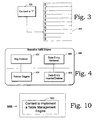
- Fig. 3 is a graphical representation of an example memory being indexed and/or accessed according to the content of a key, in accordance with one embodiment of the invention
- Fig. 4 is a block diagram of an example executive table engine of Fig. 2;
- Fig. 5 is a graphical representation of an example linked-list of free data entry memory locations, in accordance with a data insertion embodiment of the invention.
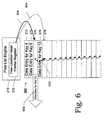
- Fig. 6 is a graphical representation of an example linked-list of free data entry memory locations, in accordance with a data deletion embodiment of the invention.
- Fig. 7 is a flowchart of an example data entry retrieval method, according to one embodiment of the invention.
- Fig. 8 is a flowchart of an example key insertion method, according to one embodiment of the invention.
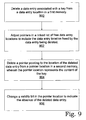
- Fig. 9 is a flowchart of an example data entry deletion method, according to one embodiment of the invention.
- Fig. 10 is a graphical representation of an example storage medium comprising content which, when executed, causes an accessing machine to implement one or more embodiments, aspects, and/or methods of a TME.
- the present invention is generally directed to a method and apparatus for memory efficient fast VLAN lookups and inserts in hardware-based packet switches.
- a table management engine is introduced to accelerate data table searches and management. Because so many computing and networking devices store and retrieve data, a TME can improve the data lookup speed and management performance of many types of tables, lists, and databases. For example, in the data communications field, the TME can speed up devices and applications that use address tables, translation tables, filter tables, and/or VLAN rule tables.
- Fig. 1 is a block diagram of an example computing network 100 in which TMEs 102, 104, 106 accelerate the performance of data packet switching and routing.
- the illustrated example network 100 includes a router 112, two switches 108, 110 and six computing hosts 120-130 communicatively coupled as illustrated.
- the example computing network 100 is logically divided into VLAN A 114, VLAN B 116, and VLAN C 118.
- Example network devices, such as the illustrated switches 108, 110 and router 112 typically use internal tables to associate a source address for each data packet received with destination information stored in the tables.
- each VLAN rule may be one or more port and/or destination addresses and/or other packet directing information. Accordingly, each data packet is sent to a proper hardware address and/or an IP address (depending on the device) as directed by a particular VLAN rule.
- the computing network 100 is depicted as one environment affording a context in which TMEs 102, 104, 106 could be implemented, many other environments and uses are possible.
- TMEs 102, 104, 106 can be situated in the various components that participate in networking, such as in the illustrated router 112 and two switches 108, 110.
- TMEs 102, 104, 106 could be implemented in hosts 120-130 and clients as well.
- TMEs 102, 104, 106 can be used in any part of the computing network 100 where data lookups occur and/or a table of information is kept.
- TMEs 102, 104, 106 can enhance the performance and management of the IP address, port address, and hardware address tables in a computing network 100.
- a TME uses content from the data packet to index directly into a table that stores (or is able to store) a data entry corresponding to the data packet. The data entry is used for other data packets that possess the same content or that can be read and/or hashed to supply the same content.
- the data entry contains the forwarding information.
- content from the data packet is used directly as a memory address for finding the key's associated data entry without further performing a search through a list of keys to find a memory address for the key.
- the key content is substantially used as a memory address.
- TMEs 102, 104, 106 perform this function of addressing memory by content without the addition of known CAM hardware elements.
- a data packet from a first host 120 in VLAN A 114 is received at a first switch 108 having a TME 104.
- the TME 104 reads and/or hashes the data packet for a content, such as the VLAN tag of VLAN A 114.
- This content corresponds to a location in a table that is set up so that the table locations correspond to various contents obtainable (readable and/or hashable) from data packets.
- the content directly provides an address for indexing into the table and obtaining the destination information (or a pointer to the destination information) for the data packet without using a search algorithm to find a memory address corresponding to the content.
- the destination information may be a VLAN rule having port and address information.
- the addressing of the table by content is performed without known CAM hardware elements.
- the data packet is forwarded to the second switch 110 also having a TME 106.
- the TME 106 addresses its data entry table by content as described above, and directs the data packet to the router 112.
- the router also possesses a TME 102 which functions as described above.
- the data packet is directed and routed through various network devices to reach its final destination, the second host 122 in VLAN A 114.
- the TMEs 102, 104, 106 provide faster data packet directing than known non-CAM methods, and in the illustrated example, provide the faster VLAN lookups while making more efficient use of memory than known methods that require a search and/or lookup algorithm to find a memory address for each key.
- Fig. 2 is a block diagram of an example TME 200, according to one implementation of the invention, for accelerating the performance of data tables 203, 205 in one or more memories ("in memory").
- the TME 200 includes a reader/hasher ("reader") 206, a executive table engine 208, a free list engine 210, a free location head pointer register 212, and a control element 214 communicatively coupled as illustrated.
- the TME 200 is coupled to a memory controller 215, which is coupled to the tables 203, 205 in memory. More than one memory controller 215 could be used.
- a first table 203 contains data entries ("data entry table” 203), and a second table 205 contains pointers and validity bits (“pointer table” 205).
- data entry table 203 contains data entries
- second table 205 contains pointers and validity bits (“pointer table” 205).
- pointer table 205 contains pointers and validity bits.
- the first table 203 may also be called the first memory 203 and/or the data entry memory 203.
- the second table 205 may also be called the second memory 205 and/or the pointer memory 205. Accordingly, a specific location in a table may also be called a memory location.
- a specific location in a table may also be called a memory location.
- the example TME 200 receives data, such as a key 216 and/or a data entry 290.
- the key 216 may be a hardware address, software address, and/or VLAN tag included in the header of a data packet/datagram, but in other non-IP applications the key 216 may be any data.
- the content that is obtained from the key 216 is used to directly address and/or index into a table/memory location. "Directly" as used here means that no search algorithm is needed to sort through a list and/or index file containing multiple keys or other data entries to relate a memory address stored in the list/index file to the key 216. For example, as illustrated in Fig.
- an example content value of "7" 302 from a key is substantially the address and/or position of a memory location "7" 304 for the key, thereby providing content addressability to standard types of memory, such as RAM, and avoiding a search through a list of keys, contents, or records.
- the reader 206 obtains a content from the key 216 using all or part of the data in the key 216. That is, in addition to merely reading the key 216 to obtain its content, the reader 206 may also obtain the content by hashing all or part of the key 216. In this regard, the content determined by the reader 206 does not have to be a literal one-to-one translation of data in the key. The only requirement for the reader 206 and for the content obtained is that the same content is always obtainable from a given key 216. In a networking context, this means that data packets yielding the same content will be directed to the same destination(s).
- the content may also be obtained by substituting predetermined content for the actual content read by the reader 206, that is, by bit masking, and/or by other methods that yield a reproducible content from a given key 216.
- Fig. 2 shows a pointer 224 for a key with content "4" at the fourth (counting from “0") location 246 of the second table 205, a pointer 226 for a key with content "6" at the sixth location 250 of the second table 205, and a pointer 228 for a key with content "12" at the twelfth location 262 of the second table 205.
- the actual value of the pointer does not correspond to the content of the key it is associated with, unless coincidentally. Rather, the pointer's address value is directed to a data entry location somewhere in the first table 203.
- Fig. 4 is a block diagram of an example executive table engine of Fig. 2.
- a key indexer 402, a pointer engine 404, a data entry retriever 406, and a data entry inserter/deleter 408 are coupled as shown.
- the key indexer 402 receives a key 216 content from the reader 406, and uses the content to index into the second memory 205.
- the key indexer reads the validity bit stored there to ascertain whether there is a valid data entry associated with the key 216.
- the key indexer 402 addresses the second memory 205 directly using the content of the key 216, because the content of the key 216 is substantially the needed memory address.
- the pointer engine 404 establishes a pointer 224 between a newly inserted data entry at memory location 272 and a memory location 246 corresponding to the content "4" of the key 216 in the second memory 205.
- the pointer 246 established by the pointer engine 404 is the address of the memory location 272 containing the data entry in the first memory 203.
- the pointer engine 304 also deletes the pointer 224 and sets the associated valid bit to zero.
- the pointer engine 404 also performs the function of setting the validity bit when a pointer operation is carried out, that is, sets the validity bit to indicate the presence or absence of a pointer and therefore a data entry associated with a key 216.
- the data entry retriever 406 reads the pointer 224 stored at the memory location 246 provided by the key indexer 402, and follows the pointer 224 to the memory location 272 in the first memory 203, returning the stored data entry.
- the data entry inserter/deleter 408 When the data entry inserter/deleter 408 inserts or deletes a data entry stored in a memory location in the first memory 203 it notifies the pointer engine 404 to add or delete, respectively, the pointer 224 from the second memory 205 and to assign the validity bit at the memory location 246 to reflect the presence or absence, respectively, of the data entry being added or deleted.
- an IP address from the header of a data packet/datagram is often used as the key 216 to find associated information about the packet, such as a destination port number, the sender's access privileges and location on a network, or applicable VLAN rules.
- packet data packet/datagram
- the example TME 200 is used as a VLAN rule table or to manage a VLAN rule table.
- VLAN rules need to be stored and looked up using the VLAN tags of incoming data packets.
- the TME 200 can take advantage of the fact that VLAN tags are 12 bits wide to provide the functionality that a VLAN rule and/or address space would have if implemented in a traditional CAM chip, but without the chip area requirements and/or design complexity of CAM hardware. Like a CAM, the TME 200 can utilize all the memory locations in a selected RAM, preventing packet collisions, and emulating the content addressability of a CAM.
- VLAN rule table manager is better than using a fixed-size hash structure and/or cache to perform VLAN rule lookups, because the TME 200 provides CAM functionality thus guaranteeing (the example 1K) address space by preventing packet collisions.
- the latter feature is critical for chip vendors using the TME 200 who must guarantee that a certain number of entries can be stored.
- various size RAMs can be selected for the first memory 203 and the second memory 205 when implementing a VLAN rule table using the TME 200.
- a 1K RAM (or as large a memory capacity as desired) could be used to store the example 1K VLAN rule entries.
- a complete 4K RAM could be used to store a maximum of 4K pointers and associated validity bits.
- a width of eleven bits is sufficient for a VLAN rule table having a depth of 1K.
- Each memory location in the pointer table 205 could have one bit allotted for the validity bit, and ten bits allotted for the pointer.
- Ten-bit pointers 224, 226, 228 are used in the example, because a binary number having ten bits can represent the desired 1K (1024 bits) memory locations for the VLAN rule entries in the data entry table 202.
- the length of the VLAN rule entries can vary and can be accommodated by selecting a wide- enough memory, for example a 200 bit wide memory for correspondingly wide rule entries.
- the TME 200 provides a convenient, high-speed, and memory efficient VLAN rule table with all the advantages that a CAM chip would provide without using a CAM chip.
- a TME 200 may incorporate a free list engine 210 in some embodiments.
- the free list engine 210 manages and maintains a list of available ("free") memory locations (e.g., 275-276) in the first memory 203.
- the free location head pointer register 212 is included in the free list engine 210 to point to the first available free memory location 275 in a list of free memory locations 275-276.
- the first available free memory location 275 is allocated to the next data entry to be inserted, unless some other occupied data entry location 272-274 becomes free first.
- a linked-list of free memory locations 275-276 is used for storing data entries associated with keys.
- Fig. 5 is a graphical representation of an example linked-list of free memory locations, in accordance with a data insertion aspect of the invention.
- a first memory 203 for storing data entries associated with keys, a free list engine 210, and a free location head pointer register 212 are example components that participate in maintaining the linked-list.
- a data entry for key "13" 502 is inserted into the first available memory location 275.
- the address of the next free memory location 276 is transferred to the free location head pointer register 212 to update the head pointer 504 so that it no longer points to the now occupied memory location 275, but instead points 506 to the next free memory location 276 in the linked-list.
- the next free memory location 276 now becomes the first available free memory location.
- Fig. 6 is a graphical representation of an example linked-list of free memory locations, in accordance with a data deletion aspect of the invention.
- the first memory 203 for storing data entries associated with keys, and a free list engine 210, having a free location head pointer register 212 are among the example components that participate in the operation.
- the free location head pointer register 212 contains the address of the first available free memory location 276, represented by a pointer 604.
- the data entry deletion then occurs: the data entry for key "12" 602 is deleted from its memory location 274.
- the address of the first available free memory location 276 is copied from the free location head pointer register 212 into the newly emptied memory location 274, establishing a pointer 603 pointing from the newly emptied memory location 274 to the (former) first available free memory location 276.
- the address of the newly emptied memory location 274 is copied into the free location head pointer register 212.
- the newly emptied memory location 274 becomes the new first available free memory location at the head of the linked-list of free memory locations.
- the memory location from which the data entry is being deleted always becomes the first available free memory location at the head of the linked-list of free memory locations, in this embodiment.
- the number of memory controllers 215 and the number of memories 203, 205 used can vary.
- the memory control function could also be integrated into the control element 214 instead of using a discrete memory controller 215.
- the first memory 203 and/or the second memory 205 may be totally or partially integrated with the TME 200, but in other embodiments the first memory 203 and second memory 205 can be separate from the TME 200, for instance when a TME 200 is retroactively implemented in a device or design already having memory that the TME 200 can use.
- the TME 200 can perform various functions using the content, for example the TME 200 can perform a key 216 existence search, a data entry retrieval using the key, a key 216 (and associated data entry) insertion, and key 216 (and associated data entry) deletion. Each of the four aforementioned operations will be discussed below.
- Performing a key 216 lookup and performing a data entry retrieval based on a retrieved key 216 are similar.
- some data entries in locations 272, 273, 274) and some related pointers 224, 226, 228 are already present in the tables 203, 205, although initially, before any data insertions, the second table 205 would be empty of pointers and have all validity bits set to "invalid.”
- the first table 203 would have all its memory locations free, and in one embodiment, linked together in a linked-list.
- Fig. 7 is a flowchart of an example data retrieval method, according to one aspect of the invention.
- a key is read and/or hashed for a content 700.
- a pointer memory location corresponding to the content is addressed using the content 702.
- a validity bit in the pointer memory location is read to determine if a data entry associated with the key is present in a first location in a first memory 704, 706. If the validity bit indicates that a data entry for the key is not present, the data entry retrieval ends 708. If the validity bit indicates that a data entry for the key is present, then a pointer stored in the pointer memory location is used to find the data entry in the first location 710.
- the method is particularly suitable for managing a VLAN rule table, in which case the key is a VLAN tag and each data entry is a VLAN rule.
- a TME 200 may be used to perform the method described above.
- the second memory 205 when a key 216 is received by the TME 200 the second memory 205 is arranged and/or selected so that the logical and/or physical position of each memory location 238-262 corresponds to the content of the key 216.
- Each physical and/or logical position (e.g., 238-262) in the second memory 205 stores a pointer and a validity bit that correspond to the content of a possible key 216 that could be received.
- the content of the key describes or represents a physical and/or logical position in the table/memory.
- the executive table engine 208 proceeds to the location in the second memory 205 indicated by the content of the key 216 and reads a validity bit stored at the given location to determine if a pointer directed to a data entry for the key 216 has been stored there. If only a key lookup is being performed and the validity bit is "true," that is, the validity bit indicates that a valid data entry for the key 216 is present, then the key lookup operation is complete and requires no further action. In other words, for key lookups, which test for the mere presence of the key 216, or a representation of the key, the operation does not have to proceed any further than reading the validity bit. A data entry retrieval operation, however, requires additional action.
- the pointer is followed to a data entry for the key in a data entry location in the first memory 203.
- the key 216 content is "4”
- the executive table engine 208 proceeds to memory location "4" 246 of the second memory 205 and reads the validity bit stored at memory location "4" 246 which, in the illustrated example is set to true ("1") indicating the presence of a valid pointer 224 for the key 216.
- the pointer 224 directs the executive table engine 208 to the data entry stored at the memory location 272 of the first memory 203.
- the executive table engine 208 can then retrieve the data entry.
- a validity bit value of "1" indicates the existence of a data entry for the key 216 in the first memory 203 and a "0" indicates the absence of a data entry
- the inverse may well be true, where "0” is used to indicate validity and "1" used to indicate invalidity.
- the TME 200 can perform data entry 290 insertion or data entry 290 deletion operations in addition to the key lookup and data entry retrieval operations described above. Although a TME 200 can be used with a static table of data entries, the insertion and deletion operations may be used in many types of applications that require a table of dynamically changing data entries, not just a static table with a fixed number of data entries.
- Fig. 8 is a flowchart of an example method for performing a "key insertion,” according to one aspect of the invention, that is, inserting a data entry for the key and setting a pointer to the data entry in a memory location representing the key.
- the key insertion method is a method for building a data table.
- a data entry associated with a key is inserted in a first location of a first memory to begin building a table of data entries 800.
- the data entry may be inserted by an executive table engine 208 of a TME 200.
- the data entry inserter/deleter 408 of the TME 200 can be used to perform the insertion.
- a pointer to the data entry is inserted in a second location in a second memory to begin building a table of pointers 802.
- the second location is selected so that a content of the key gives the address and/or position of the second location directly without a search through a list of keys or other entries. Hence, the address and/or position of the second location represents a content of the key.
- a pointer engine 404 component of the executive table engine 208 may be used to perform the pointer insertion.
- a validity bit in the second location is set to indicate the presence of the data entry associated with the key 804. The pointer engine 404 may also be used to set the validity bit.
- the TME 200 first performs the key 216 lookup operation discussed above and reads the validity bit in the memory location 246 representing the key 216 to determine whether a data entry is currently stored for the key 216. Once it has determined that no data entry is already stored for the key 216, the TME 200 receives the data entry 290 to be inserted and the executive table engine 208 stores the data entry 290 in the first available free memory location 272 in the first memory 203. If a list is being kept of free memory locations for data entries, then the memory location used by the inserted data entry is deleted from the list and the free list engine 210 reestablishes a new first available free location.
- the executive table engine 208 then places a pointer 224 pointing to the stored data entry into the memory location 246 in the second memory 205; the memory location 246 corresponding to the content "4" of the key 216. Since the memory location 272 receiving the data entry 290 has an address of "0000000000,” the pointer 224 consists of address "0000000000.” Finally, the executive table engine 208 sets the validity bit for the memory location 246 where the new pointer resides to "valid,” indicating that a valid data entry has been placed for the key 216 with content "4.”
- the validity bit is set last in case an error occurs during the operation, so that the value of the validity bit gives as accurate an indication as possible of the presence or absence of a data entry for a given key. An error will result in the validity bit remaining in an "invalid" state, indicating no data entry for the key 216.
- the data entry deletion operation follows a sequence similar to the insertion sequence, except that a data entry and a pointer are removed instead of inserted.
- Fig. 9 is a flowchart of an example data deletion method, according to one aspect of the invention.
- the data entry associated with a key is deleted from a data entry location in a first memory 900.
- Pointers in a linked-list of free data entry locations are adjusted to include the data entry location freed by the data entry being deleted 902.
- a pointer to the data entry just removed is deleted from a pointer location in a second memory, wherein the pointer location represents the content of the key 904.
- a validity bit in the pointer location is set to indicate the absence of a data entry associated with the key 906.
- a TME 200 may be used to perform the method for deleting a data entry.
- the data entry residing at memory location 272 is deleted by the executive table engine 208.
- the pointer 224 from the memory location 246 in the second memory 205 is also removed.
- the newly freed memory location 272 in the first memory 203 is reintegrated into the list of free data entry memory locations (e.g., memory locations 275-276 and others in the table 203 that are empty).
- the validity bit at the memory location 246 is set to indicate the absence of a data entry for the particular key 216.
- the reintegration of the freed memory location 272 into the list of free data entry memory locations 275-276 may vary in its timing relative to the deletion of a data entry and a pointer. However, in this embodiment, the reintegration of the freed memory space (272 if the data entry there is being deleted) into the list of free data entry memory locations 275-276 is carried out dynamically as pointers to and from the data entry being deleted are rearranged, and is carried out by the free list engine 210.
- Fig.10 is a graphical representation of an article of manufacture comprising a machine-readable medium 1000 having content 1002, that causes a host device to implement one or more embodiments, aspects, and/or methods of a table management engine of the invention.
- the content may be instructions, such as computer instructions, or may be design information allowing implementation.
- the content causes a machine to implement a method and/or apparatus of the invention, including inserting a data entry associated with a key in a data entry location 272 of a first memory 203, inserting a pointer 224 to the data entry in a pointer location in a second memory 205, wherein the address and/or position of the pointer location 246 represents a content of the key, and setting a validity bit in the pointer location 246 to indicate the presence of the data entry associated with the key in the data entry location 272.
- the key received by the hosting machine may be a 12-bit VLAN tag.
- the hosting machine may implement a VLAN rule table having a 1K VLAN rule RAM, wherein each VLAN rule is the data entry for a key.
- a pointer to the VLAN rule is placed in a second RAM, specifically a 4K pointer RAM, at a location in the 4K pointer RAM representing the content of the key.
- the pointer is ten bits in length.
- a validity bit is also stored at the pointer location in the 4K pointer RAM to indicate whether a valid VLAN rule is present for a given key content.
- the TME implemented by the machine addresses the 4K pointer RAM quickly using the content of a received VLAN tag, and quickly ascertains the presence or absence of a valid VLAN rule for the key by merely reading the validity bit.
- the high speed of the TME implemented by the machine is accomplished without the special hardware requirements and/or design complexity of a CAM chip.
- the methods and apparatuses of the invention may be provided partially as a computer program product that may include the machine-readable medium.
- the machine-readable medium may include, but is not limited to, floppy diskettes, optical disks, CD-ROMs, magneto-optical disks, ROMs, RAMs, EPROMs, EEPROMs, magnetic or optical cards, flash memory, or other type of media suitable for storing electronic instructions.
- parts may also be downloaded as a computer program product, wherein the program may be transferred from a remote computer to a requesting computer by way of data signals embodied in a carrier wave or other propagation media via a communication link (e. g. , a modem or network connection).
- the article of manufacture may well comprise such a carrier wave or other propagation media.
Landscapes
- Engineering & Computer Science (AREA)
- Computer Networks & Wireless Communication (AREA)
- Signal Processing (AREA)
- Computer Security & Cryptography (AREA)
- Data Exchanges In Wide-Area Networks (AREA)
- Information Retrieval, Db Structures And Fs Structures Therefor (AREA)
- Storage Device Security (AREA)
Claims (15)
- Vorrichtung (200), umfassend
einen Leser (206), um einen Schlüssel (216) zu lesen und/oder zu zerhacken, um einen Schlüsselinhalt zu bestimmen; und
ein ausführendes Tabellenmodul (208), um
den Schlüsselinhalt vom Leser zu erhalten,
einen Dateneintrag (290), der dem Schlüssel zugeordnet ist, in einer Datenstelle in einem Speicher zu speichern,
der Datenstelle einen Zeiger zuzuweisen,
den Zeiger an einer Zeigerstelle im Speicher zu speichern, wobei die Speicheradresse der Zeigerstelle der Schlüsselinhalt ist, und
ein Gültigkeitsbit (230) in der Zeigerstelle zu setzen, um das Vorhandensein des Dateneintrags in der Datenstelle anzugeben. - Vorrichtung (200) nach Anspruch 1, wobei das ausführunge Tabellenmodul (208) dazu konfiguriert ist, den Dateneintrag (290) aus der Datenstelle zu löschen, den Zeiger aus der Zeigerstelle zu löschen, und das Gültigkeitsbit (230) zurückzusetzen.
- Vorrichtung (200) nach Anspruch 1, ferner umfassend ein Freilistenmodul (210), um eine Liste von freien Speicherstellen für Dateneinträge zu verwalten, und ein Kopfzeigerregister (212), um freie Speicherstellenzeiger in einer Verbunden-Liste der freien Speicherstellen zu unterhalten.
- Vorrichtung (200) nach Anspruch 1, wobei das ausführende Tabellenmodul (208) ferner Folgendes umfaßt:einen Schlüsselindizierer (402), um die Zeigerstelle auf Basis des Schlüsselinhalts zu finden und um das Gültigkeitsbit (230) in der Zeigerstelle zu lesen;einen Dateneintragabrufer (406), um den Dateneintrag (290) abzurufen, wenn das Gültigkeitsbit das Vorhandensein des dem Schlüssel (216) zugeordneten Dateneintrags angibt;einen Dateneintrageinfüger/löscher (418), um den Dateneintrag in die Datenstelle einzufügen und/oder daraus zu löschen; undein Zeigermodul (404), um den Zeiger einzufügen und/oder zu löschen und das Gültigkeitsbit, das der Zeigerstelle zugeordnet ist, zu setzen/zurückzusetzen.
- Verfahren, umfassend:Lesen und/oder Zerhacken eines Schlüssels (216), um einen Schlüsselinhalt zu bestimmen;Einfügen (800) eines Dateneintrags (290), der einem Schlüssel zugeordnet ist, in eine Datenstelle in einem ersten Speicher (203);Einfügen (802) eines Zeigers zu der Datenstelle in eine Zeigerstelle in einem zweiten Speicher (205), wobei die Speicheradresse der Zeigerstelle der Schlüsselinhalt ist; undSetzen (804) eines Gültigkeitsbits (203) in die Zeigerstelle, um das Vorhandensein des dem Schlüssel zugeordneten Dateneintrags anzugeben.
- Verfahren nach Anspruch 5, wobei die Tiefe des ersten Speichers (203) auf einer Zeigerlänge beruht, die im zweiten Speicher (205) verwendet wird.
- Verfahren nach Anspruch 5, wobei leere Dateneintragstellen im ersten Speicher (203) in einer Liste von freien Datenstellen miteinander verbunden sind.
- Verfahren nach Anspruch 7, ferner umfassend das Zeigen zu einer ersten freien Datenstelle in der Liste der freien Datenstellen unter Verwendung eines Kopfzeigerregisters (212).
- Verfahren nach Anspruch 8, wobei die erste freie Datenstelle zum Einfügen des Dateneintrags durch Aktualisieren des Kopfzeigers, damit dieser auf eine nächste freie Datenstelle zeigt, von der Liste von freien Datenstellen entbunden wird.
- Verfahren nach Anspruch 5, wobei im zweiten Speicher (205) eine Zehn-Bit-Zeigerlänge verwendet wird, und im ersten Speicher (203) 1024 Speicherstellen verwendet werden.
- Verfahren, umfassend:Lesen und/oder Zerhacken (700) eines Schlüssels (216), um einen Inhalt zu bestimmen;Lesen (704) eines Gültigkeitsbits (230) in einer Zeigerstelle im Speicher, um zu bestimmen, ob ein Dateneintrag, der dem Schlüssel zugeordnet ist, in einer Datenstelle im Speicher vorhanden ist, wobei die Speicheradresse der Zeigerstelle der Schlüsselinhalt ist; undFolgen (710) einem Zeiger in der Zeigerstelle zum Dateneintrag, wenn das Gültigkeitsbit das Vorhandensein des Dateneintrags im Speicher angibt.
- Verfahren, umfassend:Löschen (900) eines Dateneintrags, der einem Schlüssel zugeordnet ist, aus einer Datenstelle in einem Datenspeicher;Einstellen (902) eines oder mehrerer Zeiger zu freien Speicherstellen, um die Dateneintragstelle in eine Verbunden-Liste von freien Datenstellen aufzunehmen;Löschen (904) eines Zeigers zum Dateneintrag aus einer Zeigerstelle im Speicher, wobei die Speicheradresse der Zeigerstelle ein Schlüsselinhalt eines zugeordneten Schlüssels ist; undZurücksetzen (906) eines Gültigkeitsbits (230) in der Dateneintragszeigerstelle, um das Fehlen des Dateneintrags, der dem Schlüssel zugeordnet ist, anzugeben.
- Verfahren nach einem der Ansprüche 5 bis 12, wobei der Schlüssel eine Kennzeichnung eines virtuellen lokalen Netzes VLAN ist, und der Dateneintrag eine VLAN-Regel ist.
- Verfahren nach Anspruch 13, wobei die VLAN-Kennzeichnung einen Inhalt aufweist, der durch eine Speicherstelle im zweiten Speicher dargestellt ist.
- Gegenstand, umfassend
ein maschinenlesbares Medium, das einen Inhalt enthält, der bei seiner Ausführung verursacht, daß ein Zugriffsmodul das Verfahren nach einem der Ansprüche 5 bis 14 ausführt.
Applications Claiming Priority (3)
| Application Number | Priority Date | Filing Date | Title |
|---|---|---|---|
| US10/103,470 US6842791B2 (en) | 2002-03-20 | 2002-03-20 | Method and apparatus for memory efficient fast VLAN lookups and inserts in hardware-based packet switches |
| US103470 | 2002-03-20 | ||
| PCT/US2003/006641 WO2003081857A1 (en) | 2002-03-20 | 2003-03-04 | Vlan table management for memory efficient lookups and inserts in hardware-based packet switches |
Publications (2)
| Publication Number | Publication Date |
|---|---|
| EP1486040A1 EP1486040A1 (de) | 2004-12-15 |
| EP1486040B1 true EP1486040B1 (de) | 2006-08-02 |
Family
ID=28452370
Family Applications (1)
| Application Number | Title | Priority Date | Filing Date |
|---|---|---|---|
| EP03726021A Expired - Lifetime EP1486040B1 (de) | 2002-03-20 | 2003-03-04 | Vlan tabellenverwaltungssystem in hardwarebasierten paketvermittlungsstellen für speichereffizientes auslesen und einschreiben |
Country Status (8)
| Country | Link |
|---|---|
| US (1) | US6842791B2 (de) |
| EP (1) | EP1486040B1 (de) |
| CN (1) | CN100450073C (de) |
| AT (1) | ATE335334T1 (de) |
| AU (1) | AU2003228273A1 (de) |
| DE (1) | DE60307241T2 (de) |
| TW (1) | TWI293224B (de) |
| WO (1) | WO2003081857A1 (de) |
Families Citing this family (54)
| Publication number | Priority date | Publication date | Assignee | Title |
|---|---|---|---|---|
| US7596139B2 (en) | 2000-11-17 | 2009-09-29 | Foundry Networks, Inc. | Backplane interface adapter with error control and redundant fabric |
| US7356030B2 (en) * | 2000-11-17 | 2008-04-08 | Foundry Networks, Inc. | Network switch cross point |
| US7236490B2 (en) | 2000-11-17 | 2007-06-26 | Foundry Networks, Inc. | Backplane interface adapter |
| US7814204B1 (en) | 2002-02-11 | 2010-10-12 | Extreme Networks, Inc. | Method of and system for analyzing the content of resource requests |
| US7584262B1 (en) | 2002-02-11 | 2009-09-01 | Extreme Networks | Method of and system for allocating resources to resource requests based on application of persistence policies |
| US7447777B1 (en) | 2002-02-11 | 2008-11-04 | Extreme Networks | Switching system |
| FR2837587B1 (fr) * | 2002-03-22 | 2008-04-11 | St Microelectronics Sa | Procede et circuit pour fournir une donnee de contexte d'un dispositif a partir d'une adresse associee a ce dispositif |
| US20090279558A1 (en) * | 2002-05-06 | 2009-11-12 | Ian Edward Davis | Network routing apparatus for enhanced efficiency and monitoring capability |
| US20120155466A1 (en) * | 2002-05-06 | 2012-06-21 | Ian Edward Davis | Method and apparatus for efficiently processing data packets in a computer network |
| US7468975B1 (en) | 2002-05-06 | 2008-12-23 | Foundry Networks, Inc. | Flexible method for processing data packets in a network routing system for enhanced efficiency and monitoring capability |
| US7187687B1 (en) * | 2002-05-06 | 2007-03-06 | Foundry Networks, Inc. | Pipeline method and system for switching packets |
| US7266117B1 (en) | 2002-05-06 | 2007-09-04 | Foundry Networks, Inc. | System architecture for very fast ethernet blade |
| US20040001492A1 (en) * | 2002-07-01 | 2004-01-01 | Johnson Erik J. | Method and system for maintaining a MAC address filtering table |
| US8289836B2 (en) | 2003-02-27 | 2012-10-16 | Intel Corporation | Apparatus and associated methods to introduce diversity in a multicarrier communication channel |
| US6901072B1 (en) | 2003-05-15 | 2005-05-31 | Foundry Networks, Inc. | System and method for high speed packet transmission implementing dual transmit and receive pipelines |
| US7474653B2 (en) * | 2003-12-05 | 2009-01-06 | Hewlett-Packard Development Company, L.P. | Decision cache using multi-key lookup |
| US7817659B2 (en) | 2004-03-26 | 2010-10-19 | Foundry Networks, Llc | Method and apparatus for aggregating input data streams |
| US7822032B1 (en) * | 2004-03-30 | 2010-10-26 | Extreme Networks, Inc. | Data structures for supporting packet data modification operations |
| US8161270B1 (en) | 2004-03-30 | 2012-04-17 | Extreme Networks, Inc. | Packet data modification processor |
| US7304996B1 (en) | 2004-03-30 | 2007-12-04 | Extreme Networks, Inc. | System and method for assembling a data packet |
| US7453874B1 (en) | 2004-03-30 | 2008-11-18 | Extreme Networks, Inc. | Method and system for incrementally updating a checksum in a network data packet |
| US7463628B2 (en) | 2004-03-30 | 2008-12-09 | Extreme Networks, Inc. | Packet data modification processor command instruction set |
| US7649879B2 (en) | 2004-03-30 | 2010-01-19 | Extreme Networks, Inc. | Pipelined packet processor |
| US7613209B1 (en) | 2004-03-30 | 2009-11-03 | Extreme Networks, Inc. | System and method for egress packet marking |
| US7385984B2 (en) | 2004-03-30 | 2008-06-10 | Extreme Networks, Inc. | Packet processing system architecture and method |
| US7292591B2 (en) | 2004-03-30 | 2007-11-06 | Extreme Networks, Inc. | Packet processing system architecture and method |
| US7502374B1 (en) | 2004-03-30 | 2009-03-10 | Extreme Networks, Inc. | System for deriving hash values for packets in a packet processing system |
| US8730961B1 (en) | 2004-04-26 | 2014-05-20 | Foundry Networks, Llc | System and method for optimizing router lookup |
| US7752355B2 (en) * | 2004-04-27 | 2010-07-06 | International Business Machines Corporation | Asynchronous packet based dual port link list header and data credit management structure |
| US7889750B1 (en) | 2004-04-28 | 2011-02-15 | Extreme Networks, Inc. | Method of extending default fixed number of processing cycles in pipelined packet processor architecture |
| US8943050B2 (en) * | 2004-05-21 | 2015-01-27 | Ca, Inc. | Method and apparatus for optimizing directory performance |
| US7646773B2 (en) * | 2004-08-02 | 2010-01-12 | Extreme Networks | Forwarding database in a network switch device |
| US7657703B1 (en) | 2004-10-29 | 2010-02-02 | Foundry Networks, Inc. | Double density content addressable memory (CAM) lookup scheme |
| US7882086B1 (en) * | 2005-12-21 | 2011-02-01 | Network Appliance, Inc. | Method and system for portset data management |
| US8448162B2 (en) | 2005-12-28 | 2013-05-21 | Foundry Networks, Llc | Hitless software upgrades |
| US7817633B1 (en) * | 2005-12-30 | 2010-10-19 | Extreme Networks, Inc. | Method of providing virtual router functionality through abstracted virtual identifiers |
| US7894451B2 (en) * | 2005-12-30 | 2011-02-22 | Extreme Networks, Inc. | Method of providing virtual router functionality |
| US7822033B1 (en) * | 2005-12-30 | 2010-10-26 | Extreme Networks, Inc. | MAC address detection device for virtual routers |
| US7903654B2 (en) | 2006-08-22 | 2011-03-08 | Foundry Networks, Llc | System and method for ECMP load sharing |
| US8238255B2 (en) * | 2006-11-22 | 2012-08-07 | Foundry Networks, Llc | Recovering from failures without impact on data traffic in a shared bus architecture |
| US20090279441A1 (en) | 2007-01-11 | 2009-11-12 | Foundry Networks, Inc. | Techniques for transmitting failure detection protocol packets |
| US8037399B2 (en) | 2007-07-18 | 2011-10-11 | Foundry Networks, Llc | Techniques for segmented CRC design in high speed networks |
| US8271859B2 (en) | 2007-07-18 | 2012-09-18 | Foundry Networks Llc | Segmented CRC design in high speed networks |
| US8149839B1 (en) | 2007-09-26 | 2012-04-03 | Foundry Networks, Llc | Selection of trunk ports and paths using rotation |
| CN101459679A (zh) * | 2007-12-12 | 2009-06-17 | 华为技术有限公司 | 网络存储设备及数据读写控制方法 |
| US7852486B2 (en) * | 2008-02-07 | 2010-12-14 | Board Of Regents, The University Of Texas System | Wavelength and intensity monitoring of optical cavity |
| US8139583B1 (en) | 2008-09-30 | 2012-03-20 | Extreme Networks, Inc. | Command selection in a packet forwarding device |
| US8090901B2 (en) | 2009-05-14 | 2012-01-03 | Brocade Communications Systems, Inc. | TCAM management approach that minimize movements |
| US8599850B2 (en) | 2009-09-21 | 2013-12-03 | Brocade Communications Systems, Inc. | Provisioning single or multistage networks using ethernet service instances (ESIs) |
| US8605732B2 (en) | 2011-02-15 | 2013-12-10 | Extreme Networks, Inc. | Method of providing virtual router functionality |
| US10719387B2 (en) * | 2018-04-25 | 2020-07-21 | Oracle International Corporation | Memory interface with tamper-evident features to enhance software security |
| US10887221B2 (en) * | 2018-08-28 | 2021-01-05 | Mediatek Inc. | Methods of synchronization mode of flow table and apparatus using the same |
| US11334284B2 (en) * | 2018-09-24 | 2022-05-17 | Samsung Electronics Co., Ltd. | Database offloading engine |
| US11615826B1 (en) * | 2021-09-07 | 2023-03-28 | Micron Technology, Inc. | Dual-address command management using content addressable memory |
Family Cites Families (7)
| Publication number | Priority date | Publication date | Assignee | Title |
|---|---|---|---|---|
| US5386532A (en) * | 1991-12-30 | 1995-01-31 | Sun Microsystems, Inc. | Method and apparatus for transferring data between a memory and a plurality of peripheral units through a plurality of data channels |
| US5386578A (en) * | 1992-01-02 | 1995-01-31 | Lin; Min H. | Method for sorting and merging in a data processing system using a matrix of cells |
| US6032207A (en) * | 1996-12-23 | 2000-02-29 | Bull Hn Information Systems Inc. | Search mechanism for a queue system |
| US6034958A (en) | 1997-07-11 | 2000-03-07 | Telefonaktiebolaget Lm Ericsson | VP/VC lookup function |
| US6091707A (en) | 1997-12-18 | 2000-07-18 | Advanced Micro Devices, Inc. | Methods and apparatus for preventing under-flow conditions in a multiple-port switching device |
| US6601150B1 (en) * | 1999-05-10 | 2003-07-29 | Nortel Networks Limited | Memory management technique for maintaining packet order in a packet processing system |
| US6901452B1 (en) | 2000-03-02 | 2005-05-31 | Alcatel | Selectable prioritization for data communication switch |
-
2002
- 2002-03-20 US US10/103,470 patent/US6842791B2/en not_active Expired - Fee Related
-
2003
- 2003-03-04 AU AU2003228273A patent/AU2003228273A1/en not_active Abandoned
- 2003-03-04 WO PCT/US2003/006641 patent/WO2003081857A1/en not_active Ceased
- 2003-03-04 DE DE60307241T patent/DE60307241T2/de not_active Expired - Lifetime
- 2003-03-04 EP EP03726021A patent/EP1486040B1/de not_active Expired - Lifetime
- 2003-03-04 CN CNB038113759A patent/CN100450073C/zh not_active Expired - Fee Related
- 2003-03-04 AT AT03726021T patent/ATE335334T1/de not_active IP Right Cessation
- 2003-03-11 TW TW092105217A patent/TWI293224B/zh not_active IP Right Cessation
Also Published As
| Publication number | Publication date |
|---|---|
| DE60307241D1 (de) | 2006-09-14 |
| TW200305321A (en) | 2003-10-16 |
| CN1653763A (zh) | 2005-08-10 |
| TWI293224B (en) | 2008-02-01 |
| EP1486040A1 (de) | 2004-12-15 |
| US6842791B2 (en) | 2005-01-11 |
| US20030214956A1 (en) | 2003-11-20 |
| AU2003228273A1 (en) | 2003-10-08 |
| WO2003081857A1 (en) | 2003-10-02 |
| CN100450073C (zh) | 2009-01-07 |
| DE60307241T2 (de) | 2007-07-12 |
| ATE335334T1 (de) | 2006-08-15 |
Similar Documents
| Publication | Publication Date | Title |
|---|---|---|
| US6842791B2 (en) | Method and apparatus for memory efficient fast VLAN lookups and inserts in hardware-based packet switches | |
| US5909440A (en) | High speed variable length best match look-up in a switching device | |
| CA2274962C (en) | High speed variable length best match look-up in a switching device | |
| CA2434876C (en) | Method and apparatus for ternary content addressable memory (tcam) table management | |
| US7580408B2 (en) | Configurable packet processor | |
| US6307855B1 (en) | Network routing table using content addressable memory | |
| US6775281B1 (en) | Method and apparatus for a four-way hash table | |
| US7313138B2 (en) | Router device and routing method | |
| CN107528783B (zh) | 利用对前缀长度进行两个搜索阶段的ip路由缓存 | |
| US20040001492A1 (en) | Method and system for maintaining a MAC address filtering table | |
| WO2001005116A2 (en) | Routing method and apparatus | |
| US20190294549A1 (en) | Hash Table-Based Mask Length Computation for Longest Prefix Match Caching | |
| GB2365666A (en) | Controlling data packet transmission through a computer system by means of filter rules | |
| EP1232612B1 (de) | Tabellen-nachschlage-mechanismus zur adressauflösung in einer paket-netzwerkvermittlung | |
| US6925503B2 (en) | Method and system for performing a longest prefix match search | |
| US20050114393A1 (en) | Dynamic forwarding method using binary search | |
| KR20050066903A (ko) | 고속 라우팅 시스템에서의 패킷 포워딩 처리장치 및 그를이용한 라우팅 룩업 방법 | |
| CN112702268B (zh) | 一种配置转发表项的方法及装置 | |
| CN107204926B (zh) | 预处理cache的路由快速查找方法 | |
| KR100459542B1 (ko) | 인터넷 프로토콜 주소 룩-업 장치 | |
| KR20040003258A (ko) | 인터넷 프로토콜 주소 룩-업 방법 | |
| HK1062340B (en) | Method and apparatus for ternary content addressable memory (tcam) table management | |
| KR100421414B1 (ko) | 다중 탐색 트리의 노드 구조를 이용한 트리 검색 및업데이트 방법 |
Legal Events
| Date | Code | Title | Description |
|---|---|---|---|
| PUAI | Public reference made under article 153(3) epc to a published international application that has entered the european phase |
Free format text: ORIGINAL CODE: 0009012 |
|
| 17P | Request for examination filed |
Effective date: 20041007 |
|
| AK | Designated contracting states |
Kind code of ref document: A1 Designated state(s): AT BE BG CH CY CZ DE DK EE ES FI FR GB GR HU IE IT LI LU MC NL PT RO SE SI SK TR |
|
| AX | Request for extension of the european patent |
Extension state: AL LT LV MK |
|
| 17Q | First examination report despatched |
Effective date: 20041222 |
|
| GRAP | Despatch of communication of intention to grant a patent |
Free format text: ORIGINAL CODE: EPIDOSNIGR1 |
|
| GRAS | Grant fee paid |
Free format text: ORIGINAL CODE: EPIDOSNIGR3 |
|
| GRAA | (expected) grant |
Free format text: ORIGINAL CODE: 0009210 |
|
| AK | Designated contracting states |
Kind code of ref document: B1 Designated state(s): AT BE BG CH CY CZ DE DK EE ES FI FR GB GR HU IE IT LI LU MC NL PT RO SE SI SK TR |
|
| PG25 | Lapsed in a contracting state [announced via postgrant information from national office to epo] |
Ref country code: IT Free format text: LAPSE BECAUSE OF FAILURE TO SUBMIT A TRANSLATION OF THE DESCRIPTION OR TO PAY THE FEE WITHIN THE PRESCRIBED TIME-LIMIT;WARNING: LAPSES OF ITALIAN PATENTS WITH EFFECTIVE DATE BEFORE 2007 MAY HAVE OCCURRED AT ANY TIME BEFORE 2007. THE CORRECT EFFECTIVE DATE MAY BE DIFFERENT FROM THE ONE RECORDED. Effective date: 20060802 Ref country code: AT Free format text: LAPSE BECAUSE OF FAILURE TO SUBMIT A TRANSLATION OF THE DESCRIPTION OR TO PAY THE FEE WITHIN THE PRESCRIBED TIME-LIMIT Effective date: 20060802 Ref country code: FI Free format text: LAPSE BECAUSE OF FAILURE TO SUBMIT A TRANSLATION OF THE DESCRIPTION OR TO PAY THE FEE WITHIN THE PRESCRIBED TIME-LIMIT Effective date: 20060802 Ref country code: CZ Free format text: LAPSE BECAUSE OF FAILURE TO SUBMIT A TRANSLATION OF THE DESCRIPTION OR TO PAY THE FEE WITHIN THE PRESCRIBED TIME-LIMIT Effective date: 20060802 Ref country code: CH Free format text: LAPSE BECAUSE OF FAILURE TO SUBMIT A TRANSLATION OF THE DESCRIPTION OR TO PAY THE FEE WITHIN THE PRESCRIBED TIME-LIMIT Effective date: 20060802 Ref country code: SI Free format text: LAPSE BECAUSE OF FAILURE TO SUBMIT A TRANSLATION OF THE DESCRIPTION OR TO PAY THE FEE WITHIN THE PRESCRIBED TIME-LIMIT Effective date: 20060802 Ref country code: SK Free format text: LAPSE BECAUSE OF FAILURE TO SUBMIT A TRANSLATION OF THE DESCRIPTION OR TO PAY THE FEE WITHIN THE PRESCRIBED TIME-LIMIT Effective date: 20060802 Ref country code: RO Free format text: LAPSE BECAUSE OF FAILURE TO SUBMIT A TRANSLATION OF THE DESCRIPTION OR TO PAY THE FEE WITHIN THE PRESCRIBED TIME-LIMIT Effective date: 20060802 Ref country code: LI Free format text: LAPSE BECAUSE OF FAILURE TO SUBMIT A TRANSLATION OF THE DESCRIPTION OR TO PAY THE FEE WITHIN THE PRESCRIBED TIME-LIMIT Effective date: 20060802 Ref country code: NL Free format text: LAPSE BECAUSE OF FAILURE TO SUBMIT A TRANSLATION OF THE DESCRIPTION OR TO PAY THE FEE WITHIN THE PRESCRIBED TIME-LIMIT Effective date: 20060802 Ref country code: BE Free format text: LAPSE BECAUSE OF FAILURE TO SUBMIT A TRANSLATION OF THE DESCRIPTION OR TO PAY THE FEE WITHIN THE PRESCRIBED TIME-LIMIT Effective date: 20060802 |
|
| REG | Reference to a national code |
Ref country code: GB Ref legal event code: FG4D |
|
| REG | Reference to a national code |
Ref country code: CH Ref legal event code: EP |
|
| REG | Reference to a national code |
Ref country code: IE Ref legal event code: FG4D |
|
| REF | Corresponds to: |
Ref document number: 60307241 Country of ref document: DE Date of ref document: 20060914 Kind code of ref document: P |
|
| PG25 | Lapsed in a contracting state [announced via postgrant information from national office to epo] |
Ref country code: SE Free format text: LAPSE BECAUSE OF FAILURE TO SUBMIT A TRANSLATION OF THE DESCRIPTION OR TO PAY THE FEE WITHIN THE PRESCRIBED TIME-LIMIT Effective date: 20061102 Ref country code: DK Free format text: LAPSE BECAUSE OF FAILURE TO SUBMIT A TRANSLATION OF THE DESCRIPTION OR TO PAY THE FEE WITHIN THE PRESCRIBED TIME-LIMIT Effective date: 20061102 Ref country code: BG Free format text: LAPSE BECAUSE OF FAILURE TO SUBMIT A TRANSLATION OF THE DESCRIPTION OR TO PAY THE FEE WITHIN THE PRESCRIBED TIME-LIMIT Effective date: 20061102 |
|
| PG25 | Lapsed in a contracting state [announced via postgrant information from national office to epo] |
Ref country code: ES Free format text: LAPSE BECAUSE OF FAILURE TO SUBMIT A TRANSLATION OF THE DESCRIPTION OR TO PAY THE FEE WITHIN THE PRESCRIBED TIME-LIMIT Effective date: 20061113 |
|
| NLV1 | Nl: lapsed or annulled due to failure to fulfill the requirements of art. 29p and 29m of the patents act | ||
| PG25 | Lapsed in a contracting state [announced via postgrant information from national office to epo] |
Ref country code: PT Free format text: LAPSE BECAUSE OF FAILURE TO SUBMIT A TRANSLATION OF THE DESCRIPTION OR TO PAY THE FEE WITHIN THE PRESCRIBED TIME-LIMIT Effective date: 20070102 |
|
| REG | Reference to a national code |
Ref country code: CH Ref legal event code: PL |
|
| ET | Fr: translation filed | ||
| PLBE | No opposition filed within time limit |
Free format text: ORIGINAL CODE: 0009261 |
|
| STAA | Information on the status of an ep patent application or granted ep patent |
Free format text: STATUS: NO OPPOSITION FILED WITHIN TIME LIMIT |
|
| 26N | No opposition filed |
Effective date: 20070503 |
|
| PG25 | Lapsed in a contracting state [announced via postgrant information from national office to epo] |
Ref country code: MC Free format text: LAPSE BECAUSE OF NON-PAYMENT OF DUE FEES Effective date: 20070331 Ref country code: IE Free format text: LAPSE BECAUSE OF NON-PAYMENT OF DUE FEES Effective date: 20070305 |
|
| PG25 | Lapsed in a contracting state [announced via postgrant information from national office to epo] |
Ref country code: GR Free format text: LAPSE BECAUSE OF FAILURE TO SUBMIT A TRANSLATION OF THE DESCRIPTION OR TO PAY THE FEE WITHIN THE PRESCRIBED TIME-LIMIT Effective date: 20061103 |
|
| PG25 | Lapsed in a contracting state [announced via postgrant information from national office to epo] |
Ref country code: EE Free format text: LAPSE BECAUSE OF FAILURE TO SUBMIT A TRANSLATION OF THE DESCRIPTION OR TO PAY THE FEE WITHIN THE PRESCRIBED TIME-LIMIT Effective date: 20060802 |
|
| PG25 | Lapsed in a contracting state [announced via postgrant information from national office to epo] |
Ref country code: CY Free format text: LAPSE BECAUSE OF FAILURE TO SUBMIT A TRANSLATION OF THE DESCRIPTION OR TO PAY THE FEE WITHIN THE PRESCRIBED TIME-LIMIT Effective date: 20060802 Ref country code: LU Free format text: LAPSE BECAUSE OF NON-PAYMENT OF DUE FEES Effective date: 20070304 |
|
| PG25 | Lapsed in a contracting state [announced via postgrant information from national office to epo] |
Ref country code: TR Free format text: LAPSE BECAUSE OF FAILURE TO SUBMIT A TRANSLATION OF THE DESCRIPTION OR TO PAY THE FEE WITHIN THE PRESCRIBED TIME-LIMIT Effective date: 20060802 Ref country code: HU Free format text: LAPSE BECAUSE OF FAILURE TO SUBMIT A TRANSLATION OF THE DESCRIPTION OR TO PAY THE FEE WITHIN THE PRESCRIBED TIME-LIMIT Effective date: 20070203 |
|
| PGFP | Annual fee paid to national office [announced via postgrant information from national office to epo] |
Ref country code: FR Payment date: 20140311 Year of fee payment: 12 |
|
| REG | Reference to a national code |
Ref country code: FR Ref legal event code: ST Effective date: 20151130 |
|
| PG25 | Lapsed in a contracting state [announced via postgrant information from national office to epo] |
Ref country code: FR Free format text: LAPSE BECAUSE OF NON-PAYMENT OF DUE FEES Effective date: 20150331 |
|
| PGFP | Annual fee paid to national office [announced via postgrant information from national office to epo] |
Ref country code: DE Payment date: 20170228 Year of fee payment: 15 |
|
| REG | Reference to a national code |
Ref country code: DE Ref legal event code: R119 Ref document number: 60307241 Country of ref document: DE |
|
| PG25 | Lapsed in a contracting state [announced via postgrant information from national office to epo] |
Ref country code: DE Free format text: LAPSE BECAUSE OF NON-PAYMENT OF DUE FEES Effective date: 20181002 |
|
| PGFP | Annual fee paid to national office [announced via postgrant information from national office to epo] |
Ref country code: GB Payment date: 20200226 Year of fee payment: 18 |
|
| GBPC | Gb: european patent ceased through non-payment of renewal fee |
Effective date: 20210304 |
|
| PG25 | Lapsed in a contracting state [announced via postgrant information from national office to epo] |
Ref country code: GB Free format text: LAPSE BECAUSE OF NON-PAYMENT OF DUE FEES Effective date: 20210304 |