EP1486458A2 - Système de stockage et de distibution pour gaz issus de liquides réactifs - Google Patents
Système de stockage et de distibution pour gaz issus de liquides réactifs Download PDFInfo
- Publication number
- EP1486458A2 EP1486458A2 EP04008503A EP04008503A EP1486458A2 EP 1486458 A2 EP1486458 A2 EP 1486458A2 EP 04008503 A EP04008503 A EP 04008503A EP 04008503 A EP04008503 A EP 04008503A EP 1486458 A2 EP1486458 A2 EP 1486458A2
- Authority
- EP
- European Patent Office
- Prior art keywords
- gas
- lewis
- liquid
- reactive
- reactive liquid
- Prior art date
- Legal status (The legal status is an assumption and is not a legal conclusion. Google has not performed a legal analysis and makes no representation as to the accuracy of the status listed.)
- Withdrawn
Links
Images

Classifications
-
- C—CHEMISTRY; METALLURGY
- C01—INORGANIC CHEMISTRY
- C01B—NON-METALLIC ELEMENTS; COMPOUNDS THEREOF; METALLOIDS OR COMPOUNDS THEREOF NOT COVERED BY SUBCLASS C01C
- C01B6/00—Hydrides of metals including fully or partially hydrided metals, alloys or intermetallic compounds ; Compounds containing at least one metal-hydrogen bond, e.g. (GeH3)2S, SiH GeH; Monoborane or diborane; Addition complexes thereof
- C01B6/06—Hydrides of aluminium, gallium, indium, thallium, germanium, tin, lead, arsenic, antimony, bismuth or polonium; Monoborane; Diborane; Addition complexes thereof
- C01B6/065—Hydrides of arsenic or antimony
-
- F—MECHANICAL ENGINEERING; LIGHTING; HEATING; WEAPONS; BLASTING
- F17—STORING OR DISTRIBUTING GASES OR LIQUIDS
- F17C—VESSELS FOR CONTAINING OR STORING COMPRESSED, LIQUEFIED OR SOLIDIFIED GASES; FIXED-CAPACITY GAS-HOLDERS; FILLING VESSELS WITH, OR DISCHARGING FROM VESSELS, COMPRESSED, LIQUEFIED, OR SOLIDIFIED GASES
- F17C1/00—Pressure vessels, e.g. gas cylinder, gas tank, replaceable cartridge
-
- F—MECHANICAL ENGINEERING; LIGHTING; HEATING; WEAPONS; BLASTING
- F17—STORING OR DISTRIBUTING GASES OR LIQUIDS
- F17C—VESSELS FOR CONTAINING OR STORING COMPRESSED, LIQUEFIED OR SOLIDIFIED GASES; FIXED-CAPACITY GAS-HOLDERS; FILLING VESSELS WITH, OR DISCHARGING FROM VESSELS, COMPRESSED, LIQUEFIED, OR SOLIDIFIED GASES
- F17C11/00—Use of gas-solvents or gas-sorbents in vessels
-
- F—MECHANICAL ENGINEERING; LIGHTING; HEATING; WEAPONS; BLASTING
- F17—STORING OR DISTRIBUTING GASES OR LIQUIDS
- F17C—VESSELS FOR CONTAINING OR STORING COMPRESSED, LIQUEFIED OR SOLIDIFIED GASES; FIXED-CAPACITY GAS-HOLDERS; FILLING VESSELS WITH, OR DISCHARGING FROM VESSELS, COMPRESSED, LIQUEFIED, OR SOLIDIFIED GASES
- F17C2201/00—Vessel construction, in particular geometry, arrangement or size
- F17C2201/01—Shape
- F17C2201/0104—Shape cylindrical
-
- F—MECHANICAL ENGINEERING; LIGHTING; HEATING; WEAPONS; BLASTING
- F17—STORING OR DISTRIBUTING GASES OR LIQUIDS
- F17C—VESSELS FOR CONTAINING OR STORING COMPRESSED, LIQUEFIED OR SOLIDIFIED GASES; FIXED-CAPACITY GAS-HOLDERS; FILLING VESSELS WITH, OR DISCHARGING FROM VESSELS, COMPRESSED, LIQUEFIED, OR SOLIDIFIED GASES
- F17C2201/00—Vessel construction, in particular geometry, arrangement or size
- F17C2201/03—Orientation
- F17C2201/032—Orientation with substantially vertical main axis
-
- F—MECHANICAL ENGINEERING; LIGHTING; HEATING; WEAPONS; BLASTING
- F17—STORING OR DISTRIBUTING GASES OR LIQUIDS
- F17C—VESSELS FOR CONTAINING OR STORING COMPRESSED, LIQUEFIED OR SOLIDIFIED GASES; FIXED-CAPACITY GAS-HOLDERS; FILLING VESSELS WITH, OR DISCHARGING FROM VESSELS, COMPRESSED, LIQUEFIED, OR SOLIDIFIED GASES
- F17C2201/00—Vessel construction, in particular geometry, arrangement or size
- F17C2201/05—Size
- F17C2201/056—Small (<1 m3)
-
- F—MECHANICAL ENGINEERING; LIGHTING; HEATING; WEAPONS; BLASTING
- F17—STORING OR DISTRIBUTING GASES OR LIQUIDS
- F17C—VESSELS FOR CONTAINING OR STORING COMPRESSED, LIQUEFIED OR SOLIDIFIED GASES; FIXED-CAPACITY GAS-HOLDERS; FILLING VESSELS WITH, OR DISCHARGING FROM VESSELS, COMPRESSED, LIQUEFIED, OR SOLIDIFIED GASES
- F17C2201/00—Vessel construction, in particular geometry, arrangement or size
- F17C2201/05—Size
- F17C2201/058—Size portable (<30 l)
-
- F—MECHANICAL ENGINEERING; LIGHTING; HEATING; WEAPONS; BLASTING
- F17—STORING OR DISTRIBUTING GASES OR LIQUIDS
- F17C—VESSELS FOR CONTAINING OR STORING COMPRESSED, LIQUEFIED OR SOLIDIFIED GASES; FIXED-CAPACITY GAS-HOLDERS; FILLING VESSELS WITH, OR DISCHARGING FROM VESSELS, COMPRESSED, LIQUEFIED, OR SOLIDIFIED GASES
- F17C2203/00—Vessel construction, in particular walls or details thereof
- F17C2203/06—Materials for walls or layers thereof; Properties or structures of walls or their materials
- F17C2203/0602—Wall structures; Special features thereof
- F17C2203/0612—Wall structures
- F17C2203/0614—Single wall
- F17C2203/0617—Single wall with one layer
-
- F—MECHANICAL ENGINEERING; LIGHTING; HEATING; WEAPONS; BLASTING
- F17—STORING OR DISTRIBUTING GASES OR LIQUIDS
- F17C—VESSELS FOR CONTAINING OR STORING COMPRESSED, LIQUEFIED OR SOLIDIFIED GASES; FIXED-CAPACITY GAS-HOLDERS; FILLING VESSELS WITH, OR DISCHARGING FROM VESSELS, COMPRESSED, LIQUEFIED, OR SOLIDIFIED GASES
- F17C2205/00—Vessel construction, in particular mounting arrangements, attachments or identifications means
- F17C2205/01—Mounting arrangements
- F17C2205/0123—Mounting arrangements characterised by number of vessels
- F17C2205/013—Two or more vessels
- F17C2205/0134—Two or more vessels characterised by the presence of fluid connection between vessels
- F17C2205/0146—Two or more vessels characterised by the presence of fluid connection between vessels with details of the manifold
-
- F—MECHANICAL ENGINEERING; LIGHTING; HEATING; WEAPONS; BLASTING
- F17—STORING OR DISTRIBUTING GASES OR LIQUIDS
- F17C—VESSELS FOR CONTAINING OR STORING COMPRESSED, LIQUEFIED OR SOLIDIFIED GASES; FIXED-CAPACITY GAS-HOLDERS; FILLING VESSELS WITH, OR DISCHARGING FROM VESSELS, COMPRESSED, LIQUEFIED, OR SOLIDIFIED GASES
- F17C2205/00—Vessel construction, in particular mounting arrangements, attachments or identifications means
- F17C2205/03—Fluid connections, filters, valves, closure means or other attachments
- F17C2205/0302—Fittings, valves, filters, or components in connection with the gas storage device
- F17C2205/0323—Valves
-
- F—MECHANICAL ENGINEERING; LIGHTING; HEATING; WEAPONS; BLASTING
- F17—STORING OR DISTRIBUTING GASES OR LIQUIDS
- F17C—VESSELS FOR CONTAINING OR STORING COMPRESSED, LIQUEFIED OR SOLIDIFIED GASES; FIXED-CAPACITY GAS-HOLDERS; FILLING VESSELS WITH, OR DISCHARGING FROM VESSELS, COMPRESSED, LIQUEFIED, OR SOLIDIFIED GASES
- F17C2205/00—Vessel construction, in particular mounting arrangements, attachments or identifications means
- F17C2205/03—Fluid connections, filters, valves, closure means or other attachments
- F17C2205/0302—Fittings, valves, filters, or components in connection with the gas storage device
- F17C2205/0338—Pressure regulators
-
- F—MECHANICAL ENGINEERING; LIGHTING; HEATING; WEAPONS; BLASTING
- F17—STORING OR DISTRIBUTING GASES OR LIQUIDS
- F17C—VESSELS FOR CONTAINING OR STORING COMPRESSED, LIQUEFIED OR SOLIDIFIED GASES; FIXED-CAPACITY GAS-HOLDERS; FILLING VESSELS WITH, OR DISCHARGING FROM VESSELS, COMPRESSED, LIQUEFIED, OR SOLIDIFIED GASES
- F17C2205/00—Vessel construction, in particular mounting arrangements, attachments or identifications means
- F17C2205/03—Fluid connections, filters, valves, closure means or other attachments
- F17C2205/0388—Arrangement of valves, regulators, filters
- F17C2205/0391—Arrangement of valves, regulators, filters inside the pressure vessel
-
- F—MECHANICAL ENGINEERING; LIGHTING; HEATING; WEAPONS; BLASTING
- F17—STORING OR DISTRIBUTING GASES OR LIQUIDS
- F17C—VESSELS FOR CONTAINING OR STORING COMPRESSED, LIQUEFIED OR SOLIDIFIED GASES; FIXED-CAPACITY GAS-HOLDERS; FILLING VESSELS WITH, OR DISCHARGING FROM VESSELS, COMPRESSED, LIQUEFIED, OR SOLIDIFIED GASES
- F17C2221/00—Handled fluid, in particular type of fluid
-
- F—MECHANICAL ENGINEERING; LIGHTING; HEATING; WEAPONS; BLASTING
- F17—STORING OR DISTRIBUTING GASES OR LIQUIDS
- F17C—VESSELS FOR CONTAINING OR STORING COMPRESSED, LIQUEFIED OR SOLIDIFIED GASES; FIXED-CAPACITY GAS-HOLDERS; FILLING VESSELS WITH, OR DISCHARGING FROM VESSELS, COMPRESSED, LIQUEFIED, OR SOLIDIFIED GASES
- F17C2223/00—Handled fluid before transfer, i.e. state of fluid when stored in the vessel or before transfer from the vessel
- F17C2223/01—Handled fluid before transfer, i.e. state of fluid when stored in the vessel or before transfer from the vessel characterised by the phase
- F17C2223/0107—Single phase
- F17C2223/0123—Single phase gaseous, e.g. CNG, GNC
-
- F—MECHANICAL ENGINEERING; LIGHTING; HEATING; WEAPONS; BLASTING
- F17—STORING OR DISTRIBUTING GASES OR LIQUIDS
- F17C—VESSELS FOR CONTAINING OR STORING COMPRESSED, LIQUEFIED OR SOLIDIFIED GASES; FIXED-CAPACITY GAS-HOLDERS; FILLING VESSELS WITH, OR DISCHARGING FROM VESSELS, COMPRESSED, LIQUEFIED, OR SOLIDIFIED GASES
- F17C2223/00—Handled fluid before transfer, i.e. state of fluid when stored in the vessel or before transfer from the vessel
- F17C2223/01—Handled fluid before transfer, i.e. state of fluid when stored in the vessel or before transfer from the vessel characterised by the phase
- F17C2223/0107—Single phase
- F17C2223/013—Single phase liquid
-
- F—MECHANICAL ENGINEERING; LIGHTING; HEATING; WEAPONS; BLASTING
- F17—STORING OR DISTRIBUTING GASES OR LIQUIDS
- F17C—VESSELS FOR CONTAINING OR STORING COMPRESSED, LIQUEFIED OR SOLIDIFIED GASES; FIXED-CAPACITY GAS-HOLDERS; FILLING VESSELS WITH, OR DISCHARGING FROM VESSELS, COMPRESSED, LIQUEFIED, OR SOLIDIFIED GASES
- F17C2223/00—Handled fluid before transfer, i.e. state of fluid when stored in the vessel or before transfer from the vessel
- F17C2223/01—Handled fluid before transfer, i.e. state of fluid when stored in the vessel or before transfer from the vessel characterised by the phase
- F17C2223/0146—Two-phase
- F17C2223/0153—Liquefied gas, e.g. LPG, GPL
-
- F—MECHANICAL ENGINEERING; LIGHTING; HEATING; WEAPONS; BLASTING
- F17—STORING OR DISTRIBUTING GASES OR LIQUIDS
- F17C—VESSELS FOR CONTAINING OR STORING COMPRESSED, LIQUEFIED OR SOLIDIFIED GASES; FIXED-CAPACITY GAS-HOLDERS; FILLING VESSELS WITH, OR DISCHARGING FROM VESSELS, COMPRESSED, LIQUEFIED, OR SOLIDIFIED GASES
- F17C2223/00—Handled fluid before transfer, i.e. state of fluid when stored in the vessel or before transfer from the vessel
- F17C2223/03—Handled fluid before transfer, i.e. state of fluid when stored in the vessel or before transfer from the vessel characterised by the pressure level
- F17C2223/033—Small pressure, e.g. for liquefied gas
-
- F—MECHANICAL ENGINEERING; LIGHTING; HEATING; WEAPONS; BLASTING
- F17—STORING OR DISTRIBUTING GASES OR LIQUIDS
- F17C—VESSELS FOR CONTAINING OR STORING COMPRESSED, LIQUEFIED OR SOLIDIFIED GASES; FIXED-CAPACITY GAS-HOLDERS; FILLING VESSELS WITH, OR DISCHARGING FROM VESSELS, COMPRESSED, LIQUEFIED, OR SOLIDIFIED GASES
- F17C2223/00—Handled fluid before transfer, i.e. state of fluid when stored in the vessel or before transfer from the vessel
- F17C2223/03—Handled fluid before transfer, i.e. state of fluid when stored in the vessel or before transfer from the vessel characterised by the pressure level
- F17C2223/035—High pressure (>10 bar)
-
- F—MECHANICAL ENGINEERING; LIGHTING; HEATING; WEAPONS; BLASTING
- F17—STORING OR DISTRIBUTING GASES OR LIQUIDS
- F17C—VESSELS FOR CONTAINING OR STORING COMPRESSED, LIQUEFIED OR SOLIDIFIED GASES; FIXED-CAPACITY GAS-HOLDERS; FILLING VESSELS WITH, OR DISCHARGING FROM VESSELS, COMPRESSED, LIQUEFIED, OR SOLIDIFIED GASES
- F17C2223/00—Handled fluid before transfer, i.e. state of fluid when stored in the vessel or before transfer from the vessel
- F17C2223/04—Handled fluid before transfer, i.e. state of fluid when stored in the vessel or before transfer from the vessel characterised by other properties of handled fluid before transfer
- F17C2223/042—Localisation of the removal point
- F17C2223/043—Localisation of the removal point in the gas
- F17C2223/045—Localisation of the removal point in the gas with a dip tube
-
- F—MECHANICAL ENGINEERING; LIGHTING; HEATING; WEAPONS; BLASTING
- F17—STORING OR DISTRIBUTING GASES OR LIQUIDS
- F17C—VESSELS FOR CONTAINING OR STORING COMPRESSED, LIQUEFIED OR SOLIDIFIED GASES; FIXED-CAPACITY GAS-HOLDERS; FILLING VESSELS WITH, OR DISCHARGING FROM VESSELS, COMPRESSED, LIQUEFIED, OR SOLIDIFIED GASES
- F17C2227/00—Transfer of fluids, i.e. method or means for transferring the fluid; Heat exchange with the fluid
- F17C2227/03—Heat exchange with the fluid
- F17C2227/0302—Heat exchange with the fluid by heating
-
- F—MECHANICAL ENGINEERING; LIGHTING; HEATING; WEAPONS; BLASTING
- F17—STORING OR DISTRIBUTING GASES OR LIQUIDS
- F17C—VESSELS FOR CONTAINING OR STORING COMPRESSED, LIQUEFIED OR SOLIDIFIED GASES; FIXED-CAPACITY GAS-HOLDERS; FILLING VESSELS WITH, OR DISCHARGING FROM VESSELS, COMPRESSED, LIQUEFIED, OR SOLIDIFIED GASES
- F17C2227/00—Transfer of fluids, i.e. method or means for transferring the fluid; Heat exchange with the fluid
- F17C2227/03—Heat exchange with the fluid
- F17C2227/0367—Localisation of heat exchange
- F17C2227/0369—Localisation of heat exchange in or on a vessel
- F17C2227/0376—Localisation of heat exchange in or on a vessel in wall contact
- F17C2227/0379—Localisation of heat exchange in or on a vessel in wall contact inside the vessel
-
- F—MECHANICAL ENGINEERING; LIGHTING; HEATING; WEAPONS; BLASTING
- F17—STORING OR DISTRIBUTING GASES OR LIQUIDS
- F17C—VESSELS FOR CONTAINING OR STORING COMPRESSED, LIQUEFIED OR SOLIDIFIED GASES; FIXED-CAPACITY GAS-HOLDERS; FILLING VESSELS WITH, OR DISCHARGING FROM VESSELS, COMPRESSED, LIQUEFIED, OR SOLIDIFIED GASES
- F17C2260/00—Purposes of gas storage and gas handling
- F17C2260/01—Improving mechanical properties or manufacturing
- F17C2260/011—Improving strength
-
- F—MECHANICAL ENGINEERING; LIGHTING; HEATING; WEAPONS; BLASTING
- F17—STORING OR DISTRIBUTING GASES OR LIQUIDS
- F17C—VESSELS FOR CONTAINING OR STORING COMPRESSED, LIQUEFIED OR SOLIDIFIED GASES; FIXED-CAPACITY GAS-HOLDERS; FILLING VESSELS WITH, OR DISCHARGING FROM VESSELS, COMPRESSED, LIQUEFIED, OR SOLIDIFIED GASES
- F17C2270/00—Applications
- F17C2270/05—Applications for industrial use
- F17C2270/0518—Semiconductors
-
- F—MECHANICAL ENGINEERING; LIGHTING; HEATING; WEAPONS; BLASTING
- F17—STORING OR DISTRIBUTING GASES OR LIQUIDS
- F17C—VESSELS FOR CONTAINING OR STORING COMPRESSED, LIQUEFIED OR SOLIDIFIED GASES; FIXED-CAPACITY GAS-HOLDERS; FILLING VESSELS WITH, OR DISCHARGING FROM VESSELS, COMPRESSED, LIQUEFIED, OR SOLIDIFIED GASES
- F17C2270/00—Applications
- F17C2270/07—Applications for household use
Definitions
- U.S. 4,744,221 discloses the adsorption of AsH 3 onto a zeolite. When desired, at least a portion of the AsH 3 is released from the delivery system by heating the zeolite to a temperature of not greater than about 175 °C. Because a substantial amount of AsH 3 in the container is bound to the zeolite, the effects of an unintended release due to rupture or failure are minimized relative to pressurized containers.
- U.S 5,518,528 discloses delivery systems based on physical sorbents for storing and delivering hydride, halide, and organometallic Group V gaseous compounds at sub-atmospheric pressures. Gas is desorbed by dispensing it to a process or apparatus operating at lower pressure.
- U.S. 5,704,965 discloses sorbents for use in storage systems where the sorbents may be treated, reacted, or functionalized with chemical moieties to facilitate or enhance adsorption or desorption of fluids. Examples include the storage of hydride gases such as arsine on a carbon sorbent.
- U.S. 5,993,766 discloses physical sorbents for sub-atmospheric storage and dispensing of fluids in which the sorbent can be chemically modified to affect its interaction with selected fluids.
- a sorbent material may be functionalized with a Lewis basic amine group to enhance its sorbtive affinity for B 2 H 6 (sorbed as BH 3 ).
- U.S. 6,277,342 discloses a method for delivering Bronsted basic gases via reversibly protonating the gases using at least one polymer support bearing acid groups. The resulting salt formed from the acid/base reaction becomes sorbed to the polymer support.
- This invention relates generally to an improvement in low pressure storage and dispensing systems for the selective storing of gases having Lewis basicity or acidity, and the subsequent dispensing of said gases, generally at pressures of 5 psig and below, typically at subatmospheric pressures, e.g., generally below 760 Torr, by pressure differential, heating, or a combination of both.
- the improvement resides in storing the gases in a reversibly reacted state with a reactive liquid having Lewis acidity or basicity.
- FIG 1 is a schematic perspective representation of a storage and dispensing vessel with associated flow circuitry for the storage and dispensing of gases such as phosphine, arsine, and boron trifluoride.
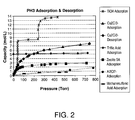
- FIG 2 is a graph of working capacity for phosphine for a number of reactive liquids.
- This invention relates to an improvement in a low-pressure storage and delivery system for gases having Lewis basicity or acidity, particularly hazardous specialty gases such as phosphine, arsine and boron trifluoride, which are utilized in the electronics industry.
- the improvement resides in storing the gases in a continuous liquid medium by effecting a reversible reaction between a gas having Lewis basicity with a reactive liquid having Lewis acidity or, alternatively, a gas having Lewis acidity with a reactive liquid having Lewis basicity.
- the system for storage and dispensing of a gas comprises a storage and dispensing vessel constructed and arranged to hold a liquid-phase medium having a reactive affinity for the gas to be stored, and for selectively flowing such gas into and out of such vessel.
- a liquid-phase medium having a reactive affinity for the gas is disposed in the storage and dispensing vessel.
- a dispensing assembly is coupled in gas flow communication with the storage and dispensing vessel, and constructed and arranged for selective, on-demand dispensing of the gas having Lewis acidity or Lewis basicity, by thermal and/or pressure differential-mediated evolution from the reactive liquid-phase medium.
- the dispensing assembly can be constructed and arranged:
- the invention relates to a system for the storage and delivery of a gas having Lewis basicity, comprising a storage and dispensing vessel containing a reactive liquid having Lewis acidity and having a reactive affinity for the gas having Lewis basicity.
- the invention relates to a system for the storage and delivery of a gas having Lewis acidity, comprising a storage and dispensing vessel containing a reactive liquid having Lewis basicity and having a reactive affinity for the gas having Lewis acidity.
- a further feature of the invention is that the gas reactively stored within the reactive liquid is readily removable from the reactive liquid by pressure-mediated and/or thermally-mediated methods.
- pressure-mediated evolution is meant evolution involving the establishment of pressure conditions, which typically range from 10 -1 to 10 -7 Torr at 25°C, to cause the gas to evolve from the reactive liquid.
- pressure conditions may involve the establishment of a pressure differential between the reactive liquid in the vessel, and the exterior environment of the vessel, which causes flow of the fluid from the vessel to the exterior environment (e.g., through a manifold, piping, conduit or other flow region or passage).
- the pressure conditions effecting gas evolution may involve the imposition on the reactive liquid of vacuum or suction conditions which effect extraction of the gas from the vessel.
- thermally-mediated evolution is meant heating of the reactive liquid to cause the evolution of the gas from the reactive liquid so that the gas can be withdrawn or discharged from the vessel.
- the temperature for thermal-mediated evolution ranges from 30 °C to 150 °C. Because the complexing medium is a continuous liquid, as opposed to a porous solid medium as employed in the prior art processes, heat transfer is facilitated.
- the storage and dispensing system 10 comprises storage and dispensing vessel 12 such as a conventional gas cylinder container of elongate character.
- a liquid 16 of a suitable reactivity with the gas to be stored In the interior volume 14 of such vessel is disposed a liquid 16 of a suitable reactivity with the gas to be stored.
- the vessel 12 is provided at its upper end with a conventional cylinder head gas dispensing assembly 18, which includes valves, regulators, etc., coupled with the main body of the cylinder 12 at the port 19. Port 19 allows gas flow from the reactive liquid retained in the cylinder into the dispensing assembly 18.
- the vessel can be equipped with an on/off valve and the regulator provided at the site for delivery.
- the storage and delivery vessel 12 may be provided with internal heating means (not shown) which serves to thermally assist in shifting the equilibrium such that the gas bonded to the reactive liquid is released. Often, the gas stored in the reactive liquid is at least partially, and most preferably fully, dispensed from the storage and dispensing vessel containing the gas by pressure-mediated evolution. Such pressure differential may be established by flow communication between the storage and dispensing vessel, on the one hand, and a vacuum or low pressure ion implantation chamber, on the other.
- the storage and delivery vessel 12 may also be provided with a means of agitation (not shown) which serves to enhance the rate of gas diffusion from the reactive liquid.
- the storage and delivery vessel 12 may be used as the reactor itself in that a reactive liquid can be transferred into the vessel and the gas subsequently added under conditions for forming the reaction complex in situ within the vessel.
- the reactive complex comprised of the reactive liquid and gas can also be formed external to the storage and delivery system and transferred into the storage vessel 12.
- the key to the process described herein is the use of a reactive, nonvolatile liquid for storage and delivery of the gas having opposing Lewis acidity or Lewis basicity to that of the gas.
- the selection of the reactive liquid for association with the gas, whether Lewis basic or Lewis acidic, is to provide for a working capacity within a pressure range from 20 to 760 Torr of at least 0.5 mole of gas per liter of liquid, preferably greater than 1 mole of gas per liter of liquid, (e.g.
- a suitable reactive liquid has low volatility and preferably has a vapor pressure below about 10 -2 Torr at 25°C and, more preferably, below 10 -4 Torr at 25°C.
- the gas to be evolved from the reactive liquid can be delivered in substantially pure form and without substantial contamination from the reactive liquid carrier.
- Liquids with a vapor pressure higher than 10 -2 Torr may be used if contamination can be tolerated.
- a scrubbing apparatus may be required to be installed between the liquid sorbent and process equipment. In this way, the reactive liquid can be scavenged to prevent it from contaminating the gas being delivered.
- Ionic liquids have low melting points (i.e. typically below room temperature) and typically decompose before vaporizing, usually at temperatures above 200 °C, which make them well suited for this application.
- lonic liquids can act as a reactive liquid, either as a Lewis acid or Lewis base, for effecting reversible reaction with the gas to be stored.
- These reactive ionic liquids have a cation component and an anion component.
- the acidity or basicity of the reactive ionic liquids then is governed by the strength of the cation, the anion, or by the combination of the cation and anion.
- the most common ionic liquids comprise salts of alkylphosphonium, alkylammonium, N-alkylpyridinium or N,N'-dialkylimidazolium cations.
- Common cations contain C 1-18 alkyl groups, and include the ethyl, butyl and hexyl derivatives of N-alkyl-N'-methylimidazolium and N-alkylpyridinium.
- Other cations include pyridazinium, pyrimidinium, pyrazinium, pyrazolium, triazolium, thiazolium, and oxazolium.
- Task-specific ionic liquids bearing reactive functional groups on the cation.
- Such ionic liquids can be prepared using functionalized cations containing a Lewis base or Lewis acid functional group, and these ionic liquids can be used here.
- Task specific ionic liquids often are aminoalkyl, such as aminopropyl; ureidopropyl, and thioureido derivatives of the above cations.
- task-specific ionic liquids containing functionalized cations include salts of 1-alkyl-3-(3-aminopropyl)imidazolium, 1-alkyl-3-(3-ureidopropyl)imidazolium, 1-alkyl-3-(3-thioureidopropyl)imidazolium, 1-alkyl-4-(2-diphenylphosphanylethyl)pyridinium, 1-alkyl-3-(3-sulfopropyl)imidazolium, and trialkyl-(3-sulfopropyl)phosphonium.
- anions can be matched with the cation component of such ionic liquids for achieving Lewis acidity.
- One type of anion is derived from a metal halide.
- the halide most often used is chloride although the other halides may also be used.
- Preferred metals for supplying the anion component, e.g. the metal halide include copper, aluminum, iron, zinc, tin, antimony, titanium, niobium, tantalum, gallium, and indium.
- metal chloride anions are CuCl 2 - , Cu 2 Cl 3 - , AlCl 4 - , Al 2 Cl 7 - , ZnCl 3 - , ZnCl 4 2- , Zn 2 Cl 5 - , FeCl 3 - , FeCl 4 - , Fe 2 Cl 7 - , TiCl 5 - , TiCl 6 2- , SnCl 5 - , SnCl 6 2- , etc.
- the type of metal halide and the amount of the metal halide employed has an effect on the acidity of the ionic liquid.
- the resulting anion may be in the form AlCl 4 - or Al 2 Cl 7 - .
- the two anions derived from aluminum trichloride have different acidity characteristics, and these differing acidity characteristics impact on the type of gases that can be reactively stored.
- Room temperature ionic liquids can be formed by reacting a halide compound of the cation with an anion supplying reactant.
- halide compounds from which Lewis acidic or Lewis basic ionic liquids can be prepared include:
- a preferred reactive liquid is an ionic liquid and the anion component of the reactive liquid is a cuprate or aluminate and the cation component is derived from a dialkylimidazolium salt.
- Gases having Lewis basicity to be stored and delivered from Lewis acidic reactive liquids may comprise one or more of phosphine, arsine, stibene, ammonia, hydrogen sulfide, hydrogen selenide, hydrogen telluride, isotopically-enriched analogs, basic organic or organometallic compounds, etc.
- Lewis basic ionic liquids which are useful for chemically complexing Lewis acidic gases
- the anion or the cation component or both of such ionic liquids can be Lewis basic.
- both the anion and cation are Lewis basic.
- Lewis basic anions include carboxylates, fluorinated carboxylates, sulfonates, fluorinated sulfonates, imides, borates, chloride, etc.
- Common anion forms include BF 4 - , PF 6 - , AsF 6 - , SbF 6 , CH 3 COO - , CF 3 COO - , CF 3 SO 3 - , p-CH 3 -C 6 H 4 SO 3 - , (CF 3 SO 2 ) 2 N - , (NC) 2 N - , (CF 3 SO 2 ) 3 C - , chloride, and F(HF) n - .
- Other anions include organometallic compounds such as alkylaluminates, alkyl- or arylborates, as well as transition metal species.
- Preferred anions include BF 4 - , p-CH 3 -C 6 H 4 SO 3 - , CF 3 SO 3 - , (CF 3 SO 2 ) 2 N - , (NC) 2 N - (CF 3 SO 2 ) 3 C - , CH 3 COO - and CF 3 COO - .
- Lewis basic cations that contain Lewis basic groups may also be used in reference to storing gases having Lewis acidity.
- Lewis basic cations include N,N'-dialkyimidazolium and other rings with multiple heteroatoms.
- a Lewis basic group may also be part of a substituent on either the anion or cation.
- Potentially useful Lewis basic substituent groups include amine, phosphine, ether, carbonyl, nitrile, thioether, alcohol, thiol, etc.
- Gases having Lewis acidity to be stored in and delivered from Lewis basic reactive liquids may comprise one or more of diborane, boron trifluoride, boron trichloride, SiF 4 , germane, hydrogen cyanide, HF, HCl, Hl, HBr, GeF 4 , isotopically-enriched analogs, acidic organic or organometallic compounds, etc.
- Nonvolatile covalent liquids containing Lewis acidic or Lewis basic functional groups are also useful as reactive liquids for chemically complexing gases.
- Such liquids may be discrete organic or organometallic compounds, oligomers, low molecular weight polymers, branched amorphous polymers, natural and synthetic oils, etc.
- liquids bearing Lewis acid functional groups include substituted boranes, borates, aluminums, or alumoxanes; protic acids such as carboxylic and sulfonic acids, and complexes of metals such as titanium, nickel, copper, etc.
- liquids bearing Lewis basic functional groups include ethers, amines, phosphines, ketones, aldehydes, nitriles, thioethers, alcohols, thiols, amides, esters, ureas, carbamates, etc.
- reactive covalent liquids include tributylborane, tributyl borate, triethylaluminum, methanesulfonic acid, trifluoromethanesulfonic acid, titanium tetrachloride, tetraethyleneglycol dimethylether, trialkylphosphine, trialkylphosphine oxide, polytetramethyleneglycol, polyester, polycaprolactone, poly(olefin-alt-carbon monoxide), oligomers, polymers or copolymers of acrylates, methacrylates, or acrylonitrile, etc.
- these liquids suffer from excessive volatility at elevated temperatures and are not suited for thermal-mediated evolution. However, they may be suited for pressure-mediated evolution.
- Total Capacity Moles of gas that will react with one liter of reactive liquid at a given temperature and pressure.
- C w Moles of gas per liter of reactive liquid which is initially stored and is subsequently removable from the liquid during the dispensing operation, specified for a given temperature and pressure range, typically at 20 to 50°C over the pressure range 20 to 760 Torr.
- Percent Reversibility Percentage of gas initially reacted with the liquid which is subsequently removable by pressure differential, specified for a given temperature and pressure range, typically at 20 to 50°C over the pressure range 20 to 760 Torr.
- % Reversibility [(moles of reacted gas - moles of gas remaining after delivery)/(moles of initially reacted gas)]*100.
- This insufficient capacity may be compensated for by selecting a reactive liquid with a higher total capacity (i.e. higher concentration of PH 3 reactive groups). If the magnitude of ⁇ G rxn (and thus, K eq ) is too large, an insufficient amount of PH 3 will be removable at the desired delivery temperature.
- a reactive liquid with a higher total capacity i.e. higher concentration of PH 3 reactive groups.
- the optimum ⁇ G rxn will be about -3 kcal/mol at 25 °C and between 20 to 760 Torr.
- the situation is more complex for other systems, e.g., if the gas and liquid react to give a solid complex, or if more than one equivalent of a gas reacts with a single equivalent of a Lewis acid/base group.
- DFT Density Functional Theory
- Equation 1 The equilibrium constant for this reaction, K eq , is described by equation 1.
- K eq is dependent upon the change in Gibbs free energy for the reaction, ⁇ G rxn , which is a measure of the binding affinity between PH 3 and A.
- ⁇ G, K, and temperature in Kelvin are given in equations 2 and 3.
- the value ⁇ E rxn can be used as an approximate value for the change in enthalpy ( ⁇ H, see equation 2). Also, if it is assumed that the reaction entropy ( ⁇ S) is about the same for similar reactions, e.g., reversible reactions under the same temperature and pressure conditions, the values calculated for ⁇ E rxn can be used to compare against ⁇ G rxn for those reactions on a relative basis, i.e., ⁇ G rxn is approximately proportional to ⁇ E rxn . Thus, the values calculated for ⁇ E rxn can be used to help predict reactive liquids, including ionic liquids having the appropriate reactivity for a given gas.
- a 25 mL or 50 mL stainless steel reactor was charged with a known quantity of a liquid.
- the reactor was sealed, brought out of the glove box, and connected to an apparatus comprising a pressurized cylinder of pure PH 3 or BF 3 , a stainless steel ballast, and a vacuum pump vented to a vessel containing a PH 3 or BF 3 scavenging material.
- the gas regulator was closed and the experimental apparatus was evacuated up to the regulator.
- Helium pycnometry was used to measure ballast, piping and reactor headspace volumes for subsequent calculations.
- the apparatus was again evacuated and closed off to vacuum.
- This Lewis acidic ionic liquid was calculated to have a ⁇ E rxn of 0.71 kcal/mol, which suggests that the reaction is slightly unfavorable, although within the general limitations of error. To clarify the results of modeling, the following reaction was run.
- Delivery of the complex formed to storage and delivery system an be effected by pumping the complex to the vessel.
- the Lewis acidic ionic liquid reacted with 7.6 mmol of PH 3 at room temperature and 674 Torr, corresponding to 1.4 mol PH 3 /L of ionic liquid. Equilibrium data points were not obtained and % reversibility and working capacity were not determined. But, this reactive liquid is expected to have a high % reversibility and, thus, a sufficient working capacity for a storage and delivery system.
- Molecular modeling was used to approximate the effectiveness of BMIM + Cu 2 Cl 3 - as a reactive liquid.
- Structures were determined based on minimum energy geometry optimization using Density Functional Theory (DFT) at the BP level with a double numerical (DN**) basis set. This Lewis acidic ionic liquid was calculated to have an average ⁇ E rxn of -5.5 kcal/mol for its reaction with PH 3 .
- DFT Density Functional Theory
- This reactive liquid outperformed the aluminate-based ionic liquid in Example 1 because it has a higher reactive group concentration (theoretical capacity of 9.7 vs. 3.2 mol/L), and its binding affinity for PH 3 as calculated by ⁇ E rxn and measured by ⁇ G rxn is better matched compared to BMlM + Al 2 Cl 7 - .
- a 50 mL reactor was charged with 9.81 g of BMIM + AlCl 4 - formed by adding AlCl 3 to BMIM + Cl (1:1 stoichiometry) and the general procedure for measuring PH 3 reaction was followed. (It is assumed the anion AlCl 4 - is formed from the reaction stoichiometry 1 equivalent AlCl 3 to 1 equivalent BMIM + Cl - ). The ionic liquid reacted with 0.44 mmol of PH 3 , corresponding to about 0.06 mol PH 3 /L of ionic liquid. The AlCl 4 - anion is not Lewis acidic.
- Triflic Acid Liquid Br ⁇ nsted Acid For PH 3
- the ionic liquid reacted with 100.3 mmol of PH 3 , corresponding to 13.8 mol PH 3 /L of TiCl 4 at an equilibrium vapor pressure of 428 Torr and a temperature of 12°C.
- BMIM + Al 2 Cl 7 - it has a lower total capacity and working capacity (1.6 mol/L between 20 and 760 Torr) than zeolite 5 ⁇ , but 89% of the PH 3 is reversibly bound down to 20 Torr.
- FIG 2 shows methanesulfonic acid has a low capacity (0.9 mol/L at 515 Torr) because it does not react strongly with PH 3 ; however, almost all of the PH 3 is reversibly reacted.
- Triflic acid has a relatively high capacity (5.3 mol/L at 721 Torr), but essentially none of the reacted PH 3 is removable because the reaction (binding affinity) is too strong.
- TiCl 4 reacts with more than a single equivalent of PH 3 and gives a multi-step isotherm. Although TiCl 4 provides a high working capacity (more than 5 mol/L between 44 and 428 Torr), the gas contains impurities as a result of the volatility of the titanium species.
- BMIM + BF 4 - a reactive liquid for the chemical complexation of BF 3 .
- DFT Density Functional Theory
- the ionic liquid reacted with 38.4 mmol of BF 3 at room temperature and 724 Torr, corresponding to 5.2 mol BF 3 /L of ionic liquid.
- tetraethyleneglycol dimethyl ether tetraglyme
- tetraglyme reacts strongly with BF 3 at room temperature. Essentially none of the chemically complexed BF 3 could be removed under vacuum at room temperature. Elevated temperatures may by useful for evolving the complexed BF 3 , but if the delivered gas is contaminated with tetraglyme, the gas may require scrubbing. For applications requiring ambient temperature, the reactive liquid may be better suited for Lewis acids that are weaker than BF 3 .
- the results show that reactive liquids having Lewis acidity or basicity can be used for storing gases having opposing Lewis basicity or acidity and delivering such gases in substantially pure form at operating pressures from 20 to 760 Torr over a temperature range from 0 to 150°C.
Landscapes
- Engineering & Computer Science (AREA)
- Mechanical Engineering (AREA)
- General Engineering & Computer Science (AREA)
- Chemical & Material Sciences (AREA)
- Organic Chemistry (AREA)
- Inorganic Chemistry (AREA)
- Filling Or Discharging Of Gas Storage Vessels (AREA)
- Organic Low-Molecular-Weight Compounds And Preparation Thereof (AREA)
Priority Applications (1)
| Application Number | Priority Date | Filing Date | Title |
|---|---|---|---|
| EP07024835A EP1911724A3 (fr) | 2003-04-15 | 2004-04-07 | Systèmes de stockage et de livraison de gaz à base de liquide réactif |
Applications Claiming Priority (2)
| Application Number | Priority Date | Filing Date | Title |
|---|---|---|---|
| US413787 | 2003-04-15 | ||
| US10/413,787 US7172646B2 (en) | 2003-04-15 | 2003-04-15 | Reactive liquid based gas storage and delivery systems |
Related Child Applications (1)
| Application Number | Title | Priority Date | Filing Date |
|---|---|---|---|
| EP07024835A Division EP1911724A3 (fr) | 2003-04-15 | 2004-04-07 | Systèmes de stockage et de livraison de gaz à base de liquide réactif |
Publications (2)
| Publication Number | Publication Date |
|---|---|
| EP1486458A2 true EP1486458A2 (fr) | 2004-12-15 |
| EP1486458A3 EP1486458A3 (fr) | 2005-04-13 |
Family
ID=33158607
Family Applications (2)
| Application Number | Title | Priority Date | Filing Date |
|---|---|---|---|
| EP07024835A Withdrawn EP1911724A3 (fr) | 2003-04-15 | 2004-04-07 | Systèmes de stockage et de livraison de gaz à base de liquide réactif |
| EP04008503A Withdrawn EP1486458A3 (fr) | 2003-04-15 | 2004-04-07 | Système de stockage et de distibution pour gaz issus de liquides réactifs |
Family Applications Before (1)
| Application Number | Title | Priority Date | Filing Date |
|---|---|---|---|
| EP07024835A Withdrawn EP1911724A3 (fr) | 2003-04-15 | 2004-04-07 | Systèmes de stockage et de livraison de gaz à base de liquide réactif |
Country Status (5)
| Country | Link |
|---|---|
| US (1) | US7172646B2 (fr) |
| EP (2) | EP1911724A3 (fr) |
| JP (2) | JP2004347112A (fr) |
| KR (1) | KR100601121B1 (fr) |
| TW (1) | TWI247627B (fr) |
Cited By (6)
| Publication number | Priority date | Publication date | Assignee | Title |
|---|---|---|---|---|
| EP1607674A1 (fr) | 2004-06-14 | 2005-12-21 | Air Products And Chemicals, Inc. | Liquide contenant un acide de Lewis pour le stockage et la fourniture de bases de Lewis gazeuses |
| EP1614955A1 (fr) * | 2004-07-08 | 2006-01-11 | Air Products And Chemicals, Inc. | Stockage et fourniture de gaz retenus dans un milieu liquide |
| EP1640654A1 (fr) * | 2004-09-23 | 2006-03-29 | Air Products And Chemicals, Inc. | Melange à base de liquide ionique pour livraison et stockage de gaz |
| EP1647761A1 (fr) * | 2004-10-15 | 2006-04-19 | Air Products And Chemicals, Inc. | Liquide contenant une base de Lewis pour le stockage et la fourniture d'acides de Lewis gazeuses |
| US7404845B2 (en) | 2004-09-23 | 2008-07-29 | Air Products And Chemicals, Inc. | Ionic liquid based mixtures for gas storage and delivery |
| US7648682B2 (en) | 2004-07-08 | 2010-01-19 | Air Products And Chemicals, Inc. | Wick systems for complexed gas technology |
Families Citing this family (28)
| Publication number | Priority date | Publication date | Assignee | Title |
|---|---|---|---|---|
| US6879876B2 (en) | 2001-06-13 | 2005-04-12 | Advanced Technology Materials, Inc. | Liquid handling system with electronic information storage |
| US7370661B2 (en) * | 2002-12-09 | 2008-05-13 | Advanced Technology Materials, Inc. | Permeable gas assembly for gas delivery |
| US7653871B2 (en) * | 2003-03-27 | 2010-01-26 | General Electric Company | Mathematical decomposition of table-structured electronic documents |
| US7383946B2 (en) * | 2004-03-26 | 2008-06-10 | Hughes Kenneth D | Materials for storing and releasing reactive gases |
| US8636919B1 (en) | 2004-03-26 | 2014-01-28 | Kenneth D. Hughes | Reactive solutions |
| DE102004044592A1 (de) * | 2004-09-13 | 2006-03-30 | Basf Ag | Verfahren zur Trennung von Chlorwasserstoff und Phosgen |
| US7314506B2 (en) * | 2004-10-25 | 2008-01-01 | Matheson Tri-Gas, Inc. | Fluid purification system with low temperature purifier |
| JP2006198512A (ja) * | 2005-01-20 | 2006-08-03 | Nisshinbo Ind Inc | 有害物質含有ガスの処理方法 |
| WO2006110450A1 (fr) * | 2005-04-07 | 2006-10-19 | Matheson Tri-Gas | Procede et systeme de stockage et de purification de fluide |
| US7638058B2 (en) | 2005-04-07 | 2009-12-29 | Matheson Tri-Gas | Fluid storage and purification method and system |
| TWI552797B (zh) | 2005-06-22 | 2016-10-11 | 恩特葛瑞斯股份有限公司 | 整合式氣體混合用之裝置及方法 |
| US20070221879A1 (en) * | 2006-03-21 | 2007-09-27 | Honeywell Intenational Inc. | Safe storage, transportation and delivery of chlorine |
| WO2007134183A2 (fr) * | 2006-05-13 | 2007-11-22 | Advanced Technology Materials, Inc. | Système d'alimentation en réactif chimique utilisant un milieu de stockage liquide ionique |
| US7736420B2 (en) * | 2006-05-19 | 2010-06-15 | Air Products And Chemicals, Inc. | Contact methods for formation of Lewis gas/liquid systems and recovery of Lewis gas therefrom |
| TW200745140A (en) * | 2006-06-02 | 2007-12-16 | Advanced Tech Materials | Copper (I) amidinates and guanidinates, mixed ligand copper complexes, and compositions for chemical vapor deposition, atomic layer deposition, and rapid vapor deposition of copper |
| CN103778700A (zh) | 2006-07-10 | 2014-05-07 | 高级技术材料公司 | 材料管理系统及材料管理方法 |
| TW200825200A (en) * | 2006-12-05 | 2008-06-16 | Advanced Tech Materials | Metal aminotroponiminates, bis-oxazolinates and guanidinates |
| US20080264803A1 (en) * | 2007-04-20 | 2008-10-30 | Rajat Agrawal | Methods and Apparatus for the Storage of Acetylene in the Absence of Acetone or Dimethylformamide |
| US20100228399A1 (en) * | 2007-12-06 | 2010-09-09 | Udischas Richard J | Pressure regulator assembly and system for the controlled storage and dispensing of a fluid |
| WO2009079218A2 (fr) | 2007-12-06 | 2009-06-25 | L'air Liquide Societe Anonyme Pour L'etude Et L'exploitation Des Procedes Georges Claude | Ensemble régulateur de soupape intégré et système pour le stockage et la distribution contrôlés d'un matériau dangereux |
| US8118913B2 (en) * | 2008-11-17 | 2012-02-21 | Voltaix, Llc | Germane purification |
| US8182589B2 (en) * | 2008-12-05 | 2012-05-22 | Matheson Tri-Gas, Inc. | Acetylene process gas purification methods and systems |
| CA2754117C (fr) * | 2009-03-20 | 2015-09-15 | Bomi P. Framroze | Amelioration de la recuperation de metaux precieux a partir de minerai refractaire recalcitrant |
| US8491720B2 (en) * | 2009-04-10 | 2013-07-23 | Applied Materials, Inc. | HVPE precursor source hardware |
| KR101685320B1 (ko) * | 2013-05-02 | 2016-12-09 | 프랙스에어 테크놀로지, 인코포레이티드 | 농축 셀레늄 이온 주입을 위한 공급 소스 및 방법 |
| US10386121B2 (en) * | 2013-10-21 | 2019-08-20 | Advanced Cooling Technologies, Inc. | Open-loop thermal management process and system |
| US10597773B2 (en) * | 2017-08-22 | 2020-03-24 | Praxair Technology, Inc. | Antimony-containing materials for ion implantation |
| US11098402B2 (en) * | 2017-08-22 | 2021-08-24 | Praxair Technology, Inc. | Storage and delivery of antimony-containing materials to an ion implanter |
Citations (3)
| Publication number | Priority date | Publication date | Assignee | Title |
|---|---|---|---|---|
| US4744221A (en) | 1987-06-29 | 1988-05-17 | Olin Corporation | Zeolite based arsine storage and delivery system |
| US5473904A (en) | 1993-11-12 | 1995-12-12 | New Mexico Tech Research Foundation | Method and apparatus for generating, transporting and dissociating gas hydrates |
| EP0740104A2 (fr) | 1995-03-09 | 1996-10-30 | The BOC Group plc | Procédé pour le stockage d'acétylène |
Family Cites Families (8)
| Publication number | Priority date | Publication date | Assignee | Title |
|---|---|---|---|---|
| US5518528A (en) | 1994-10-13 | 1996-05-21 | Advanced Technology Materials, Inc. | Storage and delivery system for gaseous hydride, halide, and organometallic group V compounds |
| US5993766A (en) | 1996-05-20 | 1999-11-30 | Advanced Technology Materials, Inc. | Gas source and dispensing system |
| US6146608A (en) | 1997-11-24 | 2000-11-14 | Advanced Technology Materials, Inc. | Stable hydride source compositions for manufacture of semiconductor devices and structures |
| US6660063B2 (en) * | 1998-03-27 | 2003-12-09 | Advanced Technology Materials, Inc | Sorbent-based gas storage and delivery system |
| US6277342B1 (en) * | 1999-08-23 | 2001-08-21 | Air Products And Chemicals, Inc. | Storage and safe delivery of hazardous specialty gases by acid/base reactions with ionic polymers |
| AUPR000100A0 (en) * | 2000-09-08 | 2000-10-05 | Australian Magnesium Operations Pty Ltd | Ammonia storage |
| US7303607B2 (en) * | 2004-06-14 | 2007-12-04 | Air Products And Chemicals, Inc. | Liquid media containing Lewis acidic reactive compounds for storage and delivery of Lewis basic gases |
| US7396381B2 (en) * | 2004-07-08 | 2008-07-08 | Air Products And Chemicals, Inc. | Storage and delivery systems for gases held in liquid medium |
-
2003
- 2003-04-15 US US10/413,787 patent/US7172646B2/en not_active Expired - Lifetime
-
2004
- 2004-04-07 EP EP07024835A patent/EP1911724A3/fr not_active Withdrawn
- 2004-04-07 EP EP04008503A patent/EP1486458A3/fr not_active Withdrawn
- 2004-04-12 KR KR1020040024853A patent/KR100601121B1/ko not_active Expired - Fee Related
- 2004-04-13 TW TW093110177A patent/TWI247627B/zh not_active IP Right Cessation
- 2004-04-15 JP JP2004120549A patent/JP2004347112A/ja not_active Withdrawn
-
2009
- 2009-11-02 JP JP2009252207A patent/JP5059831B2/ja not_active Expired - Fee Related
Patent Citations (3)
| Publication number | Priority date | Publication date | Assignee | Title |
|---|---|---|---|---|
| US4744221A (en) | 1987-06-29 | 1988-05-17 | Olin Corporation | Zeolite based arsine storage and delivery system |
| US5473904A (en) | 1993-11-12 | 1995-12-12 | New Mexico Tech Research Foundation | Method and apparatus for generating, transporting and dissociating gas hydrates |
| EP0740104A2 (fr) | 1995-03-09 | 1996-10-30 | The BOC Group plc | Procédé pour le stockage d'acétylène |
Cited By (12)
| Publication number | Priority date | Publication date | Assignee | Title |
|---|---|---|---|---|
| EP1607674A1 (fr) | 2004-06-14 | 2005-12-21 | Air Products And Chemicals, Inc. | Liquide contenant un acide de Lewis pour le stockage et la fourniture de bases de Lewis gazeuses |
| US7303607B2 (en) | 2004-06-14 | 2007-12-04 | Air Products And Chemicals, Inc. | Liquid media containing Lewis acidic reactive compounds for storage and delivery of Lewis basic gases |
| EP1614955A1 (fr) * | 2004-07-08 | 2006-01-11 | Air Products And Chemicals, Inc. | Stockage et fourniture de gaz retenus dans un milieu liquide |
| US7396381B2 (en) | 2004-07-08 | 2008-07-08 | Air Products And Chemicals, Inc. | Storage and delivery systems for gases held in liquid medium |
| US7648682B2 (en) | 2004-07-08 | 2010-01-19 | Air Products And Chemicals, Inc. | Wick systems for complexed gas technology |
| EP1640654A1 (fr) * | 2004-09-23 | 2006-03-29 | Air Products And Chemicals, Inc. | Melange à base de liquide ionique pour livraison et stockage de gaz |
| US7404845B2 (en) | 2004-09-23 | 2008-07-29 | Air Products And Chemicals, Inc. | Ionic liquid based mixtures for gas storage and delivery |
| US7563308B2 (en) | 2004-09-23 | 2009-07-21 | Air Products And Chemicals, Inc. | Ionic liquid based mixtures for gas storage and delivery |
| CN1789783B (zh) * | 2004-09-23 | 2010-10-27 | 气体产品与化学公司 | 用于贮存和输送气体的离子液体基混合物 |
| US8202446B2 (en) | 2004-09-23 | 2012-06-19 | Air Products And Chemicals, Inc. | Ionic liquid based mixtures for gas storage and delivery |
| EP1647761A1 (fr) * | 2004-10-15 | 2006-04-19 | Air Products And Chemicals, Inc. | Liquide contenant une base de Lewis pour le stockage et la fourniture d'acides de Lewis gazeuses |
| US7282084B2 (en) | 2004-10-15 | 2007-10-16 | Air Products And Chemicals, Inc. | Liquid media containing Lewis basic reactive compounds for storage and delivery of Lewis acidic gases |
Also Published As
| Publication number | Publication date |
|---|---|
| TW200420341A (en) | 2004-10-16 |
| EP1911724A3 (fr) | 2009-02-18 |
| KR20040090446A (ko) | 2004-10-25 |
| US20040206241A1 (en) | 2004-10-21 |
| JP2004347112A (ja) | 2004-12-09 |
| KR100601121B1 (ko) | 2006-07-19 |
| JP2010091112A (ja) | 2010-04-22 |
| EP1911724A2 (fr) | 2008-04-16 |
| EP1486458A3 (fr) | 2005-04-13 |
| JP5059831B2 (ja) | 2012-10-31 |
| US7172646B2 (en) | 2007-02-06 |
| TWI247627B (en) | 2006-01-21 |
Similar Documents
| Publication | Publication Date | Title |
|---|---|---|
| US7172646B2 (en) | Reactive liquid based gas storage and delivery systems | |
| CN1789783B (zh) | 用于贮存和输送气体的离子液体基混合物 | |
| JP5059843B2 (ja) | ルイス塩基性ガスの貯蔵及び放出用システム | |
| US7404845B2 (en) | Ionic liquid based mixtures for gas storage and delivery | |
| US7396381B2 (en) | Storage and delivery systems for gases held in liquid medium | |
| EP1988326B1 (fr) | Systèmes de mèche pour technologie de gaz complexés | |
| US7282084B2 (en) | Liquid media containing Lewis basic reactive compounds for storage and delivery of Lewis acidic gases |
Legal Events
| Date | Code | Title | Description |
|---|---|---|---|
| PUAI | Public reference made under article 153(3) epc to a published international application that has entered the european phase |
Free format text: ORIGINAL CODE: 0009012 |
|
| AK | Designated contracting states |
Kind code of ref document: A2 Designated state(s): AT BE BG CH CY CZ DE DK EE ES FI FR GB GR HU IE IT LI LU MC NL PL PT RO SE SI SK TR |
|
| AX | Request for extension of the european patent |
Extension state: AL HR LT LV MK |
|
| PUAL | Search report despatched |
Free format text: ORIGINAL CODE: 0009013 |
|
| AK | Designated contracting states |
Kind code of ref document: A3 Designated state(s): AT BE BG CH CY CZ DE DK EE ES FI FR GB GR HU IE IT LI LU MC NL PL PT RO SE SI SK TR |
|
| AX | Request for extension of the european patent |
Extension state: AL HR LT LV MK |
|
| RIC1 | Information provided on ipc code assigned before grant |
Ipc: 7F 17C 11/00 B Ipc: 7C 01B 6/00 A |
|
| 17P | Request for examination filed |
Effective date: 20050513 |
|
| AKX | Designation fees paid |
Designated state(s): AT BE BG CH CY CZ DE DK EE ES FI FR GB GR HU IE IT LI LU MC NL PL PT RO SE SI SK TR |
|
| STAA | Information on the status of an ep patent application or granted ep patent |
Free format text: STATUS: THE APPLICATION IS DEEMED TO BE WITHDRAWN |
|
| 18D | Application deemed to be withdrawn |
Effective date: 20160608 |