EP1486461B1 - Flammenhydrolytisch hergestelltes Siliciumdioxid, Verfahren zu seiner Herstellung und Verwendung - Google Patents
Flammenhydrolytisch hergestelltes Siliciumdioxid, Verfahren zu seiner Herstellung und Verwendung Download PDFInfo
- Publication number
- EP1486461B1 EP1486461B1 EP04012014A EP04012014A EP1486461B1 EP 1486461 B1 EP1486461 B1 EP 1486461B1 EP 04012014 A EP04012014 A EP 04012014A EP 04012014 A EP04012014 A EP 04012014A EP 1486461 B1 EP1486461 B1 EP 1486461B1
- Authority
- EP
- European Patent Office
- Prior art keywords
- hydrogen
- silica
- silica powder
- value
- oxygen
- Prior art date
- Legal status (The legal status is an assumption and is not a legal conclusion. Google has not performed a legal analysis and makes no representation as to the accuracy of the status listed.)
- Expired - Lifetime
Links
Images

Classifications
-
- C—CHEMISTRY; METALLURGY
- C01—INORGANIC CHEMISTRY
- C01B—NON-METALLIC ELEMENTS; COMPOUNDS THEREOF; METALLOIDS OR COMPOUNDS THEREOF NOT COVERED BY SUBCLASS C01C
- C01B33/00—Silicon; Compounds thereof
- C01B33/113—Silicon oxides; Hydrates thereof
- C01B33/12—Silica; Hydrates thereof, e.g. lepidoic silicic acid
- C01B33/18—Preparation of finely divided silica neither in sol nor in gel form; After-treatment thereof
-
- C—CHEMISTRY; METALLURGY
- C09—DYES; PAINTS; POLISHES; NATURAL RESINS; ADHESIVES; COMPOSITIONS NOT OTHERWISE PROVIDED FOR; APPLICATIONS OF MATERIALS NOT OTHERWISE PROVIDED FOR
- C09D—COATING COMPOSITIONS, e.g. PAINTS, VARNISHES OR LACQUERS; FILLING PASTES; CHEMICAL PAINT OR INK REMOVERS; INKS; CORRECTING FLUIDS; WOODSTAINS; PASTES OR SOLIDS FOR COLOURING OR PRINTING; USE OF MATERIALS THEREFOR
- C09D11/00—Inks
- C09D11/02—Printing inks
- C09D11/03—Printing inks characterised by features other than the chemical nature of the binder
-
- B—PERFORMING OPERATIONS; TRANSPORTING
- B01—PHYSICAL OR CHEMICAL PROCESSES OR APPARATUS IN GENERAL
- B01J—CHEMICAL OR PHYSICAL PROCESSES, e.g. CATALYSIS OR COLLOID CHEMISTRY; THEIR RELEVANT APPARATUS
- B01J21/00—Catalysts comprising the elements, oxides, or hydroxides of magnesium, boron, aluminium, carbon, silicon, titanium, zirconium, or hafnium
- B01J21/06—Silicon, titanium, zirconium or hafnium; Oxides or hydroxides thereof
- B01J21/08—Silica
-
- B—PERFORMING OPERATIONS; TRANSPORTING
- B01—PHYSICAL OR CHEMICAL PROCESSES OR APPARATUS IN GENERAL
- B01J—CHEMICAL OR PHYSICAL PROCESSES, e.g. CATALYSIS OR COLLOID CHEMISTRY; THEIR RELEVANT APPARATUS
- B01J37/00—Processes, in general, for preparing catalysts; Processes, in general, for activation of catalysts
- B01J37/02—Impregnation, coating or precipitation
- B01J37/0238—Impregnation, coating or precipitation via the gaseous phase-sublimation
-
- C—CHEMISTRY; METALLURGY
- C01—INORGANIC CHEMISTRY
- C01B—NON-METALLIC ELEMENTS; COMPOUNDS THEREOF; METALLOIDS OR COMPOUNDS THEREOF NOT COVERED BY SUBCLASS C01C
- C01B33/00—Silicon; Compounds thereof
- C01B33/113—Silicon oxides; Hydrates thereof
- C01B33/12—Silica; Hydrates thereof, e.g. lepidoic silicic acid
- C01B33/18—Preparation of finely divided silica neither in sol nor in gel form; After-treatment thereof
- C01B33/181—Preparation of finely divided silica neither in sol nor in gel form; After-treatment thereof by a dry process
- C01B33/183—Preparation of finely divided silica neither in sol nor in gel form; After-treatment thereof by a dry process by oxidation or hydrolysis in the vapour phase of silicon compounds such as halides, trichlorosilane, monosilane
-
- C—CHEMISTRY; METALLURGY
- C08—ORGANIC MACROMOLECULAR COMPOUNDS; THEIR PREPARATION OR CHEMICAL WORKING-UP; COMPOSITIONS BASED THEREON
- C08K—Use of inorganic or non-macromolecular organic substances as compounding ingredients
- C08K3/00—Use of inorganic substances as compounding ingredients
- C08K3/34—Silicon-containing compounds
- C08K3/36—Silica
-
- C—CHEMISTRY; METALLURGY
- C09—DYES; PAINTS; POLISHES; NATURAL RESINS; ADHESIVES; COMPOSITIONS NOT OTHERWISE PROVIDED FOR; APPLICATIONS OF MATERIALS NOT OTHERWISE PROVIDED FOR
- C09D—COATING COMPOSITIONS, e.g. PAINTS, VARNISHES OR LACQUERS; FILLING PASTES; CHEMICAL PAINT OR INK REMOVERS; INKS; CORRECTING FLUIDS; WOODSTAINS; PASTES OR SOLIDS FOR COLOURING OR PRINTING; USE OF MATERIALS THEREFOR
- C09D7/00—Features of coating compositions, not provided for in group C09D5/00; Processes for incorporating ingredients in coating compositions
- C09D7/40—Additives
- C09D7/60—Additives non-macromolecular
- C09D7/61—Additives non-macromolecular inorganic
-
- C—CHEMISTRY; METALLURGY
- C09—DYES; PAINTS; POLISHES; NATURAL RESINS; ADHESIVES; COMPOSITIONS NOT OTHERWISE PROVIDED FOR; APPLICATIONS OF MATERIALS NOT OTHERWISE PROVIDED FOR
- C09D—COATING COMPOSITIONS, e.g. PAINTS, VARNISHES OR LACQUERS; FILLING PASTES; CHEMICAL PAINT OR INK REMOVERS; INKS; CORRECTING FLUIDS; WOODSTAINS; PASTES OR SOLIDS FOR COLOURING OR PRINTING; USE OF MATERIALS THEREFOR
- C09D7/00—Features of coating compositions, not provided for in group C09D5/00; Processes for incorporating ingredients in coating compositions
- C09D7/40—Additives
- C09D7/66—Additives characterised by particle size
- C09D7/69—Particle size larger than 1000 nm
-
- B—PERFORMING OPERATIONS; TRANSPORTING
- B01—PHYSICAL OR CHEMICAL PROCESSES OR APPARATUS IN GENERAL
- B01J—CHEMICAL OR PHYSICAL PROCESSES, e.g. CATALYSIS OR COLLOID CHEMISTRY; THEIR RELEVANT APPARATUS
- B01J35/00—Catalysts, in general, characterised by their form or physical properties
- B01J35/30—Catalysts, in general, characterised by their form or physical properties characterised by their physical properties
-
- B—PERFORMING OPERATIONS; TRANSPORTING
- B01—PHYSICAL OR CHEMICAL PROCESSES OR APPARATUS IN GENERAL
- B01J—CHEMICAL OR PHYSICAL PROCESSES, e.g. CATALYSIS OR COLLOID CHEMISTRY; THEIR RELEVANT APPARATUS
- B01J35/00—Catalysts, in general, characterised by their form or physical properties
- B01J35/60—Catalysts, in general, characterised by their form or physical properties characterised by their surface properties or porosity
- B01J35/61—Surface area
- B01J35/613—10-100 m2/g
-
- B—PERFORMING OPERATIONS; TRANSPORTING
- B01—PHYSICAL OR CHEMICAL PROCESSES OR APPARATUS IN GENERAL
- B01J—CHEMICAL OR PHYSICAL PROCESSES, e.g. CATALYSIS OR COLLOID CHEMISTRY; THEIR RELEVANT APPARATUS
- B01J35/00—Catalysts, in general, characterised by their form or physical properties
- B01J35/60—Catalysts, in general, characterised by their form or physical properties characterised by their surface properties or porosity
- B01J35/61—Surface area
- B01J35/615—100-500 m2/g
-
- B—PERFORMING OPERATIONS; TRANSPORTING
- B01—PHYSICAL OR CHEMICAL PROCESSES OR APPARATUS IN GENERAL
- B01J—CHEMICAL OR PHYSICAL PROCESSES, e.g. CATALYSIS OR COLLOID CHEMISTRY; THEIR RELEVANT APPARATUS
- B01J35/00—Catalysts, in general, characterised by their form or physical properties
- B01J35/60—Catalysts, in general, characterised by their form or physical properties characterised by their surface properties or porosity
- B01J35/61—Surface area
- B01J35/617—500-1000 m2/g
-
- C—CHEMISTRY; METALLURGY
- C01—INORGANIC CHEMISTRY
- C01P—INDEXING SCHEME RELATING TO STRUCTURAL AND PHYSICAL ASPECTS OF SOLID INORGANIC COMPOUNDS
- C01P2004/00—Particle morphology
- C01P2004/60—Particles characterised by their size
- C01P2004/61—Micrometer sized, i.e. from 1-100 micrometer
-
- C—CHEMISTRY; METALLURGY
- C01—INORGANIC CHEMISTRY
- C01P—INDEXING SCHEME RELATING TO STRUCTURAL AND PHYSICAL ASPECTS OF SOLID INORGANIC COMPOUNDS
- C01P2006/00—Physical properties of inorganic compounds
- C01P2006/12—Surface area
-
- C—CHEMISTRY; METALLURGY
- C01—INORGANIC CHEMISTRY
- C01P—INDEXING SCHEME RELATING TO STRUCTURAL AND PHYSICAL ASPECTS OF SOLID INORGANIC COMPOUNDS
- C01P2006/00—Physical properties of inorganic compounds
- C01P2006/22—Rheological behaviour as dispersion, e.g. viscosity, sedimentation stability
Definitions
- the invention relates to a flame-hydrolysed silica powder, its preparation and use.
- the object of the invention is to provide a silica powder which has a high thickening effect and good incorporability.
- the object of the invention is furthermore to provide a process for the preparation of the silica powder.
- the thickening effect (in mPas) is determined in a dispersion of a silica powder in a polyester.
- the thickening effect of the silica powder according to the invention is at least 3000 mPas. In a preferred embodiment, the thickening effect may be between 3000 and 5000 mPas, with values between 3200 and 4500 being particularly preferred.
- the grindometer value is a measure of the grain fineness of fillers and pigments. He is determined with a grindometer. In this case, the material to be tested is placed on the lowest point of a wedge-shaped milled-out groove in a metal block and pulled out with a ground scraper over its entire length. The point at which granular material in the form of grooves in the smoothed surface is noticeable is given as the fineness in ⁇ m. This is called the grindometer value. It is a measure of the dispersibility of the powder. The lower the grindometer value, the better the dispersibility.
- the grindometer value of the silica powder according to the invention is less than 40 ⁇ m. Preferably, the value may be less than 35 microns, with values less than 30 microns may be particularly preferred.
- the BET surface area of the silica powder according to the invention may preferably be between 50 and 450 m 2 / g. BET surface areas can be particularly preferably between 200 and 400 m 2 / g.
- silica powder according to the invention it is essential for the silica powder according to the invention that both the thickening effect and the grindometer value are within the stated limits. Only within these limits are obtained silica powder, which show a high thickening effect with good incorporability (dispersibility).
- Excess means the proportion of water which exceeds the stoichiometrically required proportion for the hydrolysis of the silica precursor.
- the following examples are intended to further illustrate the beta value: 5.2 kg / h (0.0306 kmol / h) of silicon tetrachloride together with 2.32 m 3 / h (0.104 kmol / h) of hydrogen and 7.3 m 3 / h (0.068 kmol / h) air, but burned without additional steam.
- the reaction of hydrogen and oxygen yields 0.104 kmol / h of water.
- Figure 1 shows the relationship between the gamma value and the amount of water added starting from an example in which 4.00 kg / h of silicon tetrachloride burned in the presence of 2.10 kg / h of hydrogen at a lambda value of 1.16 become.
- the area between the two straight lines represents the area in which the silicon dioxide powder according to the invention is obtained. It can be seen that at high gamma values (maximum 2) little water has to be added, at low gamma values (minimum 1) a lot of water has to be added to stay within this range. At settings below the lower straight line and above the upper straight line no silica powders according to the invention are obtained.
- oxygen-containing gas As fuel gases, hydrogen, methane, ethane, propane, butane, natural gas can be used, with hydrogen being particularly preferred.
- air or oxygen-enriched air can be used as the oxygen-containing gas.
- Suitable silica precursors may be: silicon halides, organochlorosilicon compounds, organosilicon compounds.
- Organochlorosilicon compounds are obtained in the reaction of silicon with organohalides (Müller-Rochow synthesis).
- the fraction sections of the distillation contain different amounts of the aforementioned Organohalogensilicium compounds and organosilicon compounds, which may optionally contain portions of C 1 -C 12 hydrocarbons.
- the proportion of these hydrocarbons may be up to 10 wt .-%, based on a fraction.
- these proportions are between 0.01 and 5 wt .-%, wherein the proportion of C 6 hydrocarbons, such as cis- and trans-2-hexene, cis- and trans-3-methyl-2-pentene, 2.3 -Dimethyl-2-butene, 2-methylpentane, 3-methylpentane usually predominates.
- C 6 hydrocarbons such as cis- and trans-2-hexene, cis- and trans-3-methyl-2-pentene, 2.3 -Dimethyl-2-butene, 2-methylpentane, 3-methylpentane usually predominates.
- the thickening effect is the viscosity value in mPas of the dispersion at 25 ° C., measured by means of a rotational viscometer at a shear rate of 2.7 s -1 .
- the BET surface area is determined according to DIN 66131.
- the mixture of 4.00 kg / h of SiCl 4 in vapor form, 2.10 m 3 / h of hydrogen and 7.00 m 3 / h of air is ignited and burns from the outlet of the burner into the combustion chamber and further into the cooled flame tube.
- the resulting silica powder is separated from the gases and deacidified.
- the physicochemical data of the silica powder are given in Table 1.
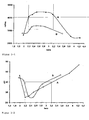
- Figure 3-1 shows the thickening effect (in mPas) of the silica powders of Examples A and B as a function of beta at a constant gamma of 1.99 in the A series and of 1.43 in the B series 3-2 shows the corresponding grindometer values (in ⁇ m) as a function of the beta value.
Landscapes
- Chemical & Material Sciences (AREA)
- Organic Chemistry (AREA)
- Engineering & Computer Science (AREA)
- Materials Engineering (AREA)
- Chemical Kinetics & Catalysis (AREA)
- Wood Science & Technology (AREA)
- Life Sciences & Earth Sciences (AREA)
- Inorganic Chemistry (AREA)
- Health & Medical Sciences (AREA)
- Nanotechnology (AREA)
- Medicinal Chemistry (AREA)
- Polymers & Plastics (AREA)
- General Chemical & Material Sciences (AREA)
- Silicon Compounds (AREA)
- Compositions Of Macromolecular Compounds (AREA)
- Glass Compositions (AREA)
Description
- Die Erfindung betrifft ein flammenhydrolytisch hergestelltes Siliciumdioxidpulver, dessen Herstellung und Verwendung.
- Es ist bekannt, Siliciumdioxid durch Flammenhydrolyse herzustellen. Dabei wird beispielsweise ein Gemisch aus dem Dampf eines Siliciumdioxid-Precursors, eines Brenngases und eines Sauerstoff enthaltenden Gases in einem gekühlten Verbrennungsraum verbrannt. In der Regel werden dabei Siliciumhalogenide, Organochlorsilane oder Mischungen hiervon eingesetzt. Die Knallgasflamme des Brenners liefert dabei sowohl die Energie, als auch die für die Hydrolyse des Siliciumdioxid-Precursors benötigte Wassermenge. Durch Variation der Siliciumdioxid-Precursorkonzentration, der Flammtemperatur, des Brenngas/Luft-Verhältnisses und der Verweilzeit in der Flamme und im Verbrennungsraum können die Teilchengröße, die Teilchengrößenverteilung, die spezifische Oberfläche und die Oberflächenbeschaffenheit des Siliciumdioxides in weiten Grenzen beeinflusst werden.
- Aus
DE-A-2909815 ist bekannt, bei der Flammenhydrolyse Siliciumdioxid-Precursor, Brenngas, Sauerstoff enthaltendes Gas und Wasserdampf vor der Verbrennung zu mischen. Dieses Verfahren ist jedoch für einen großtechnischen Einsatz nicht geeignet, weil Teile des Organochlorsilans bereits vorzeitig von dem eingebrachten Wasserdampf zu Siliciumdioxid hydrolysiert werden, welches in kürzester Zeit die Zuführungsrohre in die Brennkammer verstopft.DE-A-2909815 gibt ferner keine Hinweise, inwieweit die zugesetzte Menge an Wasserdampf die physikalisch-chemischen Eigenschaften des Siliciumdioxides beeinflusst. - Aus
DE-A-2904199 ist bekannt, dass bei der Flammenhydrolyse von Siliciumhalogeniden, oder Organochlorsilanen über den aus der Reaktion eines Brenngases mit Sauerstoff entstandenen Wasserdampf hinaus, zusätzlich Wasserdampf, bevorzugt in einer Menge zwischen 0,1 und 1 kg Wasser pro kg Ausgangsverbindung, in den Brenner oder in die Flamme zugeführt wird. Darunter ist zu verstehen, dass mindestens die stöchiometrisch nötige Menge Wasser zur vollständigen Hydrolyse des Siliciumdioxid-Precursors aus der Reaktion von Sauerstoff und Brenngas bereitgestellt wird und darüber hinaus zusätzlich Wasserdampf dem System zugeführt wird. - Der Wasserdampf kann gemäß
DE-A-2904199 in Form eines Gemisches mit a) dem Brenngas oder b) einem Sauerstoff enthaltenden Gas zugeführt werden. Weiterhin kann er c)vor der Verbrennung mit den Reaktionspartnern gemischt oder d) direkt in die Flamme eingeleitet werden. Die Varianten a)-c) weisen den Nachteil auf, dass der Siliciumdioxid-Precursor vorzeitig hydrolysiert wird und es zu Anbackungen von Siliciumdioxid kommt. Ein solches Verfahren ist wirtschaftlich nicht sinnvoll durchzuführen. Die Variante d) vermeidet diesen Nachteil und ermöglicht es Siliciumdioxidpulver herzustellen mit variabler BET-Oberfläche und Verdickungswirkung herzustellen. - Die Verdickungswirkung spielt bei Verwendung von Siliciumdioxidpulvern als Verdickungs- und Thixotropierungsmittel eine wesentliche Rolle. Wesentlich für diese Anwendungen ist weiterhin die Einarbeitbarkeit dieser Pulver in flüssige Medien.
DE-A-2904199 beschreibt zwar Siliciumdioxidpulver mit hoher Verdickungswirkung, lässt aber dabei den Aspekt der Einarbeitbarkeit außer Betracht. Eine hohe Verdickungswirkung ist nur dann in Anwendungen vorteilhaft einzusetzen, wenn das Siliciumdioxidpulver sich auch leicht einarbeiten lässt. - Aufgabe der Erfindung ist es ein Siliciumdioxidpulver bereitzustellen, welches eine hohe Verdickungswirkung und eine gute Einarbeitbarkeit aufweist. Aufgabe der Erfindung ist es weiterhin ein Verfahren zur Herstellung des Siliciumdioxidpulvers bereitzustellen.
- Gegenstand der Erfindung ist ein flammenhydrolytisch hergestelltes Siliciumdioxidpulver mit einer BET-Oberfläche zwischen 10 und 600 m2/g, dadurch gekennzeichnet, dass es eine Verdickungswirkung von wenigstens 3000 mPas und einen Grindometerwert kleiner als 40 µm aufweist, wobei man zur Bestimmung der Verdickungswirkung 7,5 g Siliciumdioxidpulver in 142,5 g einer Lösung eines ungesättigten Polyesterharzes in Styrol mit einer Viskosität von 1300 +/- 100 mPas bei einer Temperatur von 22°C einbringt und mittels eines Dissolvers bei 3000 min-1 dispergiert.
- Die Verdickungswirkung (in mPas) wird bestimmt in einer Dispersion eines Siliciumdioxidpulvers in einem Polyester. Die Verdickungswirkung des erfindungsgemäßen Siliciumdioxidpulvers beträgt wenigstens 3000 mPas. In einer bevorzugten Ausführungsform kann die Verdickungswirkung zwischen 3000 und 5000 mPas liegen, wobei Werte zwischen 3200 und 4500 besonders bevorzugt sein können.
- Der Grindometerwert ist ein Maß für die Kornfeinheit von Füllstoffen und Pigmenten. Er wird bestimmt mit einem Grindometer. Hierbei wird das zu prüfende Material auf die tiefste Stelle einer in einem Metallblock gegen Null auslaufende, keilförmig eingefrästen Rinne gegeben und mit einem geschliffenen Schaber über deren ganze Länge ausgezogen. Diejenige Stelle, an der sich körniges Material in Form von Riefen in der glattgestrichenen Oberfläche bemerkbar macht, wird als Mahlfeinheit in µm angegeben. Man spricht dabei vom Grindometer-Wert. Er ist ein Maß für die Dispergierbarkeit des Pulvers. Je niedriger der Grindometerwert, desto besser ist die Dispergierbarkeit. Der Grindometerwert des erfindungsgemäßen Siliciumdioxidpulvers ist kleiner als 40 µm. Bevorzugterweise kann der Wert kleiner 35 µm sein, wobei Werte kleiner 30 µm besonders bevorzugt sein können.
- Die BET-Oberfläche des erfindungsgemäßen Siliciumdioxidpulvers kann bevorzugt zwischen 50 und 450 m2/g liegen. Besonders bevorzugt können BET-Oberflächen zwischen 200 und 400 m2/g sein.
- Es ist wesentlich für das erfindungsgemäße Siliciumdioxidpulver, dass sowohl die Verdickungswirkung als auch der Grindometerwert innerhalb der angegebenen Grenzen liegen. Nur innerhalb dieser Grenzen werden Siliciumdioxidpulver erhalten, die eine hohe Verdickungswirkung bei gleichzeitiger guter Einarbeitbarkeit (Dispergierbarkeit) zeigen.
- Ein weiterer Gegenstand der Erfindung ist ein Verfahren zur Herstellung des erfindungsgemäßen Siliciumdioxidpulvers, welches dadurch gekennzeichnet ist, dass man mindestens einen dampfförmigen Siliciumdioxid-Precursor in Gegenwart eines freien Sauerstoff enthaltenden Gases, eines Brenngases und Wasserdampf verbrennt, wobei der Wasserdampf über ein im Brenner zentral angebrachtes Rohr welches umschlossen ist von der Zuführung der Reaktionspartner Siliciumtetrachlorid, Wasserstoff und Luft, in das vorgemischte Gasgemisch enthaltend einen dampfförmige Siliciumdioxid-Precursor, das freien Sauerstoff enthaltende Gas und ein Brenngas, eingebracht wird, und das Reaktionsgemisch in der Verbrennungskammer mit angeschlossenem gekühlten Flammrohr zur Reaktion gebracht wird, wobei der lambda-Wert zwischen 1 und 2 liegt, der gamma-Wert zwischen 1 und 2 liegt und der beta-Wert zwischen 2,2 und 3,2 liegt und wobei gilt: lambda = dem Brenner zugeführter Sauerstoff/stöchiometrisch benötigte Sauerstoffmenge, gamma = dem Brenner zugeführter Wasserstoff/ stöchiometrisch benötigte Wasserstoffmenge und beta = Überschuss Wasser/gebildetes Siliciumdioxid.
- Die Werte lassen sich bei Verwendung anderer Gase entsprechend variieren. Eine ausführlichere Beschreibung der lambda- und gamma-Werte ist in
EP-A-855368 - Überschuss bedeutet den über den stöchiometrisch nötigen Anteil zur Hydrolyse des Siliciumdioxid-Precursors hinausgehenden Anteil an Wasser.
- Folgende Beispiele sollen den beta-Wert weiter erläutern: 5,2 kg/h (0,0306 kmol/h) Siliciumtetrachlorid werden zusammen mit 2,32 m3/h (0,104 kmol/h) Wasserstoff und 7,3 m3/h (0,068 kmol/h) Luft, jedoch ohne zusätzlichen Wasserdampf verbrannt. Die stöchiometrisch notwendige Menge an Wasser zur Hydrolyse des Siliciumtetrachlorids ist 2 x 0,0306 kmol/h = 0,0612 kmol/h. Aus der Reaktion von Wasserstoff und Sauerstoff ergeben sich 0,104 kmol/h Wasser. Der Überschuss an Wasser beträgt demnach (.0,104 - 0,0612) kmol/h = 0,0428 kmol/h. Der beta-Wert ergibt sich demnach zu beta = 0,0428/0,0306 = 1,39.
- Werden zusätzlich 500 g/h (0,0278 kmol/h) Wasserdampf eingespeist, ergibt sich zusammen mit dem Wasser aus der Reaktion von Wasserstoff mit Sauerstoff, insgesamt 0,1318 kmol/h Wasser und damit ein Überschuss von (0,1318 - 0,0612) kmol/h = 0,0706 kmol/h Wasser. Daraus errechnet sich ein beta-Wert von 0,0706/0,0306 = 2,31.
- Figur 1 zeigt den Zusammenhang zwischen dem gamma-Wert und der zugesetzten Wassermenge ausgehend von einem Beispiel in dem 4,00 kg/h Siliciumtetrachlorid in Gegenwart von 2,10 kg/h Wasserstoff bei einem lambda-Wert von 1,16 verbrannt werden. Der Bereich zwischen den beiden Geraden stellt den Bereich dar, in dem das erfindungsgemäße Siliciumdioxidpulver erhalten wird. Man erkennt, dass bei hohen gamma-Werten (maximal 2) wenig Wasser zugeführt werden muss, bei niedrigen gamma-Werten (minimal 1) viel Wasser zugesetzt werden muss, um in diesem Bereich zu bleiben. Bei Einstellungen unterhalb der unteren Geraden und oberhalb der oberen Geraden werden keine erfindungsgemäßen Siliciumdioxidpulver erhalten.
- Als Brenngase können Wasserstoff, Methan, Ethan, Propan, Butan, Erdgas eingesetzt werden, wobei Wasserstoff besonders bevorzugt ist. Bevorzugt kann als sauerstoffhaltiges Gas Luft oder mit Sauerstoff angereicherte Luft eingesetzt werden.
- Geeignete Siliciumdioxid-Precursor können sein: Siliciumhalogenide, Organochlorsiliciumverbindungen, Organosiliciumverbindungen. Insbesonders können SiCl4, CH3SiCl3, (CH3)2SiCl2, (CH3)3SiCl, (CH3)4Si, HSiCl3, (CH3)2HSiCl, CH3C2H5SiCl2, Disilane mit der allgemeinen Formel RnCl3-nSiSiRmCl3-m mit R=CH3 und n+m = 2,3,4,5 und 6, sowie Gemische der vorgenannten Verbindungen eingesetzt werden.
- Organochlorsiliciumverbindungen fallen bei der Umsetzung von Silicium mit Organohalogeniden an (Müller-Rochow-Synthese). Die Fraktionsschnitte der Destillation enthalten unterschiedliche Mengen der vorgenannten Organohalogensilicium-Verbindungen und Organosiliciumverbindungen, die gegebenenfalls noch Anteile von C1-C12- Kohlenwasserstoffen enthalten können. Der Anteil dieser Kohlenwasserstoffe kann bis zu 10 Gew.-%, bezogen auf eine Fraktion, betragen. Gewöhnlich liegen diese Anteile zwischen 0,01 und 5 Gew.-%, wobei der Anteil der C6-Kohlenwasserstoffe, beispielsweise cis- und trans-2-Hexen, cis- und trans-3-Methyl-2-penten, 2,3-Dimethyl-2-buten, 2-Methylpentan, 3-Methylpentan in der Regel überwiegt.
- Die Destillationsfraktionen der Müller-Rochow-Synthese können in dem erfindungsgemäßen Verfahren eingesetzt werden. Bevorzugt können Mischungen mit einem Kohlenwasserstoffgehalt von bis zu 5 Gew.-% eingesetzt werden. Besonders bevorzugt können Mischungen mit Siliciumtetrachlorid eingesetzt werden.
- Weiterhin können zusätzlich Luft und/oder Wasserstoff in die Verbrennungskammer eingespeist werden. Mit diesen Maßnahmen können Temperaturen und Verweilzeiten variiert werden.
- Figur 2 zeigt eine schematische Anordnung der Vorrichtung und der Verfahrensströme des erfindungsgemäßen Verfahrens. Die Vorrichtung zur Durchführung des Verfahrens besteht aus den drei Hauptbestandteilen Brenner (1), Verbrennungskammer (2) und Flammrohr (3). Der Brenner enthält ein zentral angebrachtes Rohr (1A) zum Einleiten von Wasserdampf. Um das zentral angebrachte Rohr ist konzentrisch ein Mantelrohr (1B) zum Einbringen des Siliciumdioxid-Precursors, Brenngas und Sauerstoff enthaltendem Gas. Ein um das Mantelrohr 1B angebrachtes weiteres Rohr 1C dient zum optionalen Einbringen von zusätzlichem Brenngas. Der Einlassstutzen 1D dient zum optionalen Einbringen von Luft. Bei Position 3A wird Kühlwasser zugeführt. Position 4 stellt eine Blende dar.
- Ein weiterer Gegenstand der Erfindung ist die Verwendung des erfindungsgemäßen flammenhydrolytisch hergestellten Siliciumdioxidpulver zur Herstellung von Dispersionen, als Füllstoff in Kautschuk, Silikonkautschuk und Kunststoffen, zur Einstellung der Rheologie in Farben und Lacken, als Träger für Katalysatoren.
- Die Verdickungswirkung wird nach folgender Methode bestimmt: 7,5 g Siliciumdioxidpulver werden 142,5 g einer Lösung eines ungesättigten Polyesterharzes in Styrol mit einer Viskosität von 1300 +/- 100 mPas bei einer Temperatur von 22°C eingebracht und mittels eines Dissolvers bei 3000 min-1 dispergiert. Geeignet als ungesättigtes Polyesterharz ist beispielsweise Ludopal® P6, BASF. 60 g dieser Dispersion werden mit weiteren 90 g des ungesättigten Polyesterharzes in Styrol versetzt und der Dispergiervorgang wird wiederholt. Als Verdickungswirkung wird der Viskositätswert in mPas der Dispersion bei 25°C, gemessen mit einem Rotationsviskosimeter bei einer Scherrate von 2,7 s-1, bezeichnet.
Die BET-Oberfläche wird bestimmt nach DIN 66131. - Das Gemisch aus 4,00 kg/h SiCl4 in Dampfform, 2,10 m3/h Wasserstoff und 7,00 m3/h Luft wird entzündet und brennt aus der Austrittsöffnung des Brenners in den Verbrennungsraum und weiter in das gekühlte Flammrohr. Das entstehende Siliciumdioxidpulver wird von den Gasen abgetrennt und entsäuert. Die physikalisch-chemischen Daten des Siliciumdioxidpulvers sind in tabelle 1 angegeben.
- Die Beispiele A2-A8 und B1-B7 werden analog A1, jedoch unter Einspeisung von Wasser durchgeführt. Das Wasser wird über ein zentral angebrachtes Rohr, welches umschlossen ist von der Zuführung der Reaktionspartner Siliciumtetrachlorid, Wasserstoff und Luft, zugegeben. Die Einsatzmengen und die physikalisch-chemischen Daten der erhaltenen Siliciumdioxidpulver sind in Tabelle 1 wiedergegeben.
- Figur 3-1 zeigt die Verdickungswirkung (in mPas) der Siliciumdioxidpulver aus den Beispielen A und B in Abhängigkeit vom beta-Wert bei einem konstanten gamma-Wert von 1,99 in der Serie A und von 1,43 in der Serie B. Figur 3-2 zeigt die dazugehörigen Grindometerwerte (in µm) in Abhängigkeit vom beta-Wert.
- Der Kasten in Figur 3-1 zwischen den beta-Werten 2,2 und 3,2 und der Verdickungswirkung von 3000 mPas gibt den erfindungsgemäßen Bereich wieder. Entsprechend gibt für Figur 3-2 der Kasten den erfindungsgemäßen Bereich zwischen den beta-Werten 2,2 und 3,2 und dem Grindometerwert von weniger als 40 µm wieder.
- In den Beispielen C1 und C2 werden als Siliciumdioxid-Precursoren Gemische eingesetzt. In C1 wird ein Gemisch von SiCl4(90 Gew.-%), MeSiCl3(9,8 Gew.-%) und Kohlenwasserstoffen(ca. 0,2 Gew.-%) eingesetzt, in C2 ein Gemisch aus MeSiCl3 (85 Gew.-%), Me2SiCl2 (4,7 Gew.-%), MeSiHCl2(5,3 Gew.-%) und Kohlenwasserstoffen (ca. 5 Gew.-%). Auch mit diesen Precursorgemischen wird ein erfindungsgemäßes Siliciumdioxidpulver erhalten.
Tabelle 1: Einsatzmengen und physikalisch-chemische Daten von Siliciumdioxidpulvern Beispiel H2O zugefügt SiCl4 Wasserstoff Luft gamma lambda beta BET Verdickung Grindometerwert g/h kg/h m3/h m3/h m2/g mPas µm A1* 0 4,00 2,10 7,00 1,99 1,79 1,98 218 2640 46,4 A2 90 4,00 2,10 6,85 1,99 1,73 2,19 255 4075 25,0 A3 150 4,00 2,10 6,75 1,99 1,69 2,33 281 4240 26,2 A4 223 4,00 2,10 6,65 1,99 1,65 2,51 317 4435 30,0 A5 380 4,00 2,10 6,30 1,99 1,51 2,88 385 4430 35,0 A6 500 4,00 2,10 6,15 1,99 1,45 3,16 386 4260 38,9 A7* 800 4,00 2,10 5,70 1,99 1,28 3,87 418 2550 48,5 A8* 955 4,00 2,10 5,30 1,99 1,11 4,23 411 2430 56,7 B1* 600 5,18 1,95 5,40 1,43 1,16 1,95 308 2780 44,2 B2* 700 5,18 1,95 5,40 1,43 1,16 2,13 322 2823 41,3 B3 800 5,18 1,95 5,40 1,43 1,16 2,31 336 3289 26,0 B4 900 5,18 1,95 5,40 1,43 1,16 2,49 351 3370 25,0 B5 1000 5,18 1,95 5,40 1,43 1,16 2,68 364 3355 32,0 B6 1100 5,18 1,95 5,40 1,43 1,16 2,86 376 3300 38,0 B7* 1200 5,18 1,95 5,40 1,43 1,16 3,54 378 2760 46,7 C1 250 4,00 a) 1,95 6,70 1,97 1,26 2,48 310 3300 32,0 C2 800 5,18 b) 0,55 12,50 1,96 1,05 2,70 282 3050 37,0 *) Vergleichsbeispiel; a)Gemisch bestehend aus: von SiCl4 (90 Ges.-%), MeSiCl3 (9,8 Ges.-%) und Kohlenwasserstoffen (ca. 0,2 Ges.-%); b) Gemisch bestehend aus: MeSiCl3 (85 Ges.-%), Me2SiCl2 (4,7 Ges.-%), MeSiHCl2 (5,3 Ges.-%) und Kohlenwasserstoffen (ca. 5 Gew.-%).
Claims (6)
- Flammenhydrolytisch hergestelltes Siliciumdioxidpulver mit einer BET-Oberfläche zwischen 10 und 600 m2/g, dadurch gekennzeichnet, dass es eine Verdickungswirkung von wenigstens 3000 mPas und einen Grindometerwert kleiner als 40 µm aufweist, wobei man zur Bestimmung der Verdickungswirkung 7,5 g Siliciumdioxidpulver in 142,5 g einer Lösung eines ungesättigten Polyesterharzes in Styrol mit einer Viskosität von 1300 +/- 100 mPas bei einer Temperatur von 22°C einbringt und mittels eines Dissolvers bei 3000 min-1 dispergiert.
- Flammenhydrolytisch hergestelltes Siliciumdioxidpulver nach Anspruch 1, dadurch gekennzeichnet, dass die BET-Oberfläche zwischen 50 und 450 m2/g liegt.
- Verfahren zur Herstellung des flammenhydrolytisch hergestellten Siliciumdioxidpulver gemäß den Ansprüchen 1 oder 2, dadurch gekennzeichnet, dass man mindestens einen dampfförmigen Siliciumdioxid-Precursors in Gegenwart eines freien Sauerstoff enthaltenden Gases, eines Brenngases und Wasserdampf zur Reaktion bringt, wobei der Wasserdampf über ein im Brenner zentral angebrachtes Rohr, welches umschlossen ist von der Zuführung der Reaktionspartner Siliciumtetrachlorid, Wasserstoff und Luft, in das vorgemischte Gasgemisch enthaltend einen dampfförmige Siliciumdioxid-Precursor, das freien Sauerstoff enthaltende Gas und ein Brenngas, eingebracht wird und das Reaktionsgemisch in der Verbrennungskammer mit angeschlossenem gekühlten Flammrohr zur Reaktion gebracht wird, wobei der lambda-Wert zwischen 1 und 2 liegt, der gamma-Wert zwischen 1 und 2 liegt und der beta-Wert zwischen 2,2 und 3,2 liegt und wobei gilt: lambda = dem Brenner zugeführter Sauerstoff/stöchiometrisch benötigte Sauerstoffmenge, gamma = dem Brenner zugeführter Wasserstoff/ stöchiometrisch benötigte Wasserstoffmenge und beta = Überschuss Wasser/gebildetes Siliciumdioxid.
- Verfahren nach Anspruch 3, dadurch gekennzeichnet, dass als Siliciumdioxid-Precursor Siliciumtetrachlorid, eine Organochlorsiliciumverbindung und/oder ein Organosilan eingesetzt werden.
- Verfahren nach den Ansprüchen 3 oder 4, dadurch gekennzeichnet, dass zusätzlich Luft und/oder Wasserstoff in die Verbrennungskammer eingespeist wird.
- Verwendung des flammenhydrolytisch hergestellten Siliciumdioxidpulvers gemäß der Ansprüche 1 oder 2 zu Verwendung des Siliciumdioxidpulvers zur Herstellung von Dispersionen, als Füllstoff in Kautschuk, Silikonkautschuk und Kunststoffen, zur Einstellung der Rheologie in Farben und Lacken, als Träger für Katalysatoren.
Applications Claiming Priority (2)
| Application Number | Priority Date | Filing Date | Title |
|---|---|---|---|
| DE10326049 | 2003-06-10 | ||
| DE10326049A DE10326049A1 (de) | 2003-06-10 | 2003-06-10 | Flammenhydrolytisch hergestelltes Siliciumdioxid, Verfahren zu seiner Herstellung und Verwendung |
Publications (2)
| Publication Number | Publication Date |
|---|---|
| EP1486461A1 EP1486461A1 (de) | 2004-12-15 |
| EP1486461B1 true EP1486461B1 (de) | 2007-08-08 |
Family
ID=33185729
Family Applications (1)
| Application Number | Title | Priority Date | Filing Date |
|---|---|---|---|
| EP04012014A Expired - Lifetime EP1486461B1 (de) | 2003-06-10 | 2004-05-21 | Flammenhydrolytisch hergestelltes Siliciumdioxid, Verfahren zu seiner Herstellung und Verwendung |
Country Status (8)
| Country | Link |
|---|---|
| US (1) | US20040253164A1 (de) |
| EP (1) | EP1486461B1 (de) |
| JP (1) | JP4248450B2 (de) |
| KR (1) | KR100644313B1 (de) |
| CN (1) | CN1301903C (de) |
| AT (1) | ATE369315T1 (de) |
| DE (2) | DE10326049A1 (de) |
| ES (1) | ES2290585T3 (de) |
Families Citing this family (32)
| Publication number | Priority date | Publication date | Assignee | Title |
|---|---|---|---|---|
| DE10239144A1 (de) * | 2002-08-27 | 2004-03-18 | Degussa Ag | Dispersion |
| DE10258857A1 (de) | 2002-12-17 | 2004-07-08 | Degussa Ag | Pyrogen hergestelltes Siliciumdioxid und Dispersion hiervon |
| DE10258858A1 (de) | 2002-12-17 | 2004-08-05 | Degussa Ag | Pyrogen hergestelltes Siliciumdioxid |
| DE10312970A1 (de) * | 2003-03-24 | 2004-10-14 | Degussa Ag | Pyrogenes Siliciumdioxidpulver und Dispersion hiervon |
| DE102005001410A1 (de) * | 2005-01-12 | 2006-07-20 | Degussa Ag | Pyrogen hergestelltes Siliciumdioxidpulver und Dispersion hiervon |
| DE102005001408A1 (de) * | 2005-01-12 | 2006-07-20 | Degussa Ag | Pyrogen hergestelltes Siliciumdioxidpulver |
| DE102005001414A1 (de) * | 2005-01-12 | 2006-07-20 | Degussa Ag | Pyrogen hergestelltes Siliciumdioxidpulver |
| DE102005001409A1 (de) * | 2005-01-12 | 2006-07-20 | Degussa Ag | Pyrogen hergestelltes Siliciumdioxidpulver und dieses Pulver enthaltene Silikondichtmasse |
| WO2006084390A1 (en) * | 2005-02-11 | 2006-08-17 | Eth Zurich | Antimicrobial and antifungal powders made by flame spray pyrolysis |
| CN100369803C (zh) * | 2005-05-31 | 2008-02-20 | 昆明理工大学 | 一种制备气相法纳米氧化物的方法和装置 |
| ATE509891T1 (de) * | 2005-12-20 | 2011-06-15 | Evonik Degussa Gmbh | Pyrogen hergestelltes siliciumdioxid |
| DE102007025685A1 (de) * | 2007-06-01 | 2008-12-04 | Evonik Degussa Gmbh | RTV-Zweikomponenten-Silikonkautschuk |
| RU2350559C1 (ru) * | 2007-06-26 | 2009-03-27 | Федеральное государственное унитарное предприятие "Государственный ордена Трудового Красного Знамени научно-исследовательский институт химии и технологии элементоорганических соединений" (ФГУП ГНИИХТЭОС) | Способ получения пирогенного диоксида кремния и горелка для его осуществления |
| EP2070992A1 (de) * | 2007-12-11 | 2009-06-17 | Evonik Degussa GmbH | Lacksysteme |
| RU2378194C2 (ru) * | 2008-02-06 | 2010-01-10 | Федеральное государственное унитарное предприятие "Государственный ордена Трудового Красного Знамени научно-исследовательский институт химии и технологии элементоорганических соединений" (ФГУП ГНИИХТЭОС) | Реактор синтеза диоксида кремния и способ его получения пламенным гидролизом |
| DE102008000499A1 (de) * | 2008-03-04 | 2009-09-10 | Evonik Degussa Gmbh | Kieselsäure sowie Epoxidharze |
| DE102011004744A1 (de) * | 2011-02-25 | 2012-08-30 | Wacker Chemie Ag | Vorrichtung und Verfahren zur Bestimmung einer Gaskonzentration in einem strömenden Gasgemisch |
| CN102115081B (zh) * | 2011-03-10 | 2013-09-25 | 上海竟茨环保科技有限公司 | 用于生产气相法二氧化硅的燃烧炉 |
| CN102115082B (zh) * | 2011-03-10 | 2013-05-01 | 上海竟茨环保科技有限公司 | 气相法二氧化硅生产装置 |
| WO2015003873A1 (de) * | 2013-07-11 | 2015-01-15 | Evonik Industries Ag | Verfahren zur herstellung von kieselsäure mit variabler verdickung |
| CN108698892A (zh) | 2015-12-18 | 2018-10-23 | 贺利氏石英玻璃有限两合公司 | 从二氧化硅颗粒制备石英玻璃体 |
| TWI808933B (zh) | 2015-12-18 | 2023-07-21 | 德商何瑞斯廓格拉斯公司 | 石英玻璃體、二氧化矽顆粒、光導、施照體、及成型體及其製備方法 |
| TWI733723B (zh) | 2015-12-18 | 2021-07-21 | 德商何瑞斯廓格拉斯公司 | 不透明石英玻璃體的製備 |
| CN108698888A (zh) | 2015-12-18 | 2018-10-23 | 贺利氏石英玻璃有限两合公司 | 在石英玻璃制备中作为中间物的经碳掺杂的二氧化硅颗粒的制备 |
| US11299417B2 (en) | 2015-12-18 | 2022-04-12 | Heraeus Quarzglas Gmbh & Co. Kg | Preparation of a quartz glass body in a melting crucible of refractory metal |
| WO2017103153A1 (de) | 2015-12-18 | 2017-06-22 | Heraeus Quarzglas Gmbh & Co. Kg | Glasfasern und vorformen aus quarzglas mit geringem oh-, cl- und al-gehalt |
| CN108698890A (zh) | 2015-12-18 | 2018-10-23 | 贺利氏石英玻璃有限两合公司 | 利用在熔融烘箱中的露点监测制备石英玻璃体 |
| CN108698894A (zh) | 2015-12-18 | 2018-10-23 | 贺利氏石英玻璃有限两合公司 | 在多腔式烘箱中制备石英玻璃体 |
| KR20180095619A (ko) | 2015-12-18 | 2018-08-27 | 헤래우스 크바르츠글라스 게엠베하 & 컴파니 케이지 | 실리카 유리 제조 동안 규소 함량의 증가 |
| KR20180095880A (ko) | 2015-12-18 | 2018-08-28 | 헤래우스 크바르츠글라스 게엠베하 & 컴파니 케이지 | 합성 석영 유리 결정립의 제조 |
| ES2939269T3 (es) | 2020-05-25 | 2023-04-20 | Evonik Operations Gmbh | Gránulos de sílice para tratamiento térmico |
| JP2024160687A (ja) | 2023-04-25 | 2024-11-14 | エボニック オペレーションズ ゲーエムベーハー | 少なくとも1つの熱分解法化合物の製造方法およびその方法で使用するのに適したバーナー |
Family Cites Families (8)
| Publication number | Priority date | Publication date | Assignee | Title |
|---|---|---|---|---|
| DE2904199A1 (de) * | 1979-02-05 | 1980-08-07 | Degussa | Verfahren zur gelenkten herstellung von kieselsaeure mittels flammenhydrolyse |
| DE3016010C2 (de) * | 1980-04-25 | 1985-01-10 | Degussa Ag, 6000 Frankfurt | Verfahren zur pyrogenen Herstellung von Kieselsäure |
| DE3028364C2 (de) * | 1980-07-26 | 1983-07-21 | Degussa Ag, 6000 Frankfurt | Verfahren und Vorrichtung zur pyrogenen Herstellung von Siliciumdioxid |
| US6322765B1 (en) * | 1996-02-15 | 2001-11-27 | Wacker-Chemie Gmbh | Process for preparing silicon dioxide |
| FR2749576B1 (fr) * | 1996-06-06 | 1998-09-04 | Rhone Poulenc Chimie | Procede de preparation de silice susceptible d'etre utilisee dans les compositions dentifrices |
| DE19650500A1 (de) * | 1996-12-05 | 1998-06-10 | Degussa | Dotierte, pyrogen hergestellte Oxide |
| DE19756840A1 (de) * | 1997-01-23 | 1998-07-30 | Degussa | Pyrogene Oxide und Verfahren zu ihrer Herstellung |
| US6331055B1 (en) * | 1999-08-30 | 2001-12-18 | Hewlett-Packard Company | Inkjet printhead with top plate bubble management |
-
2003
- 2003-06-10 DE DE10326049A patent/DE10326049A1/de not_active Withdrawn
-
2004
- 2004-05-21 ES ES04012014T patent/ES2290585T3/es not_active Expired - Lifetime
- 2004-05-21 AT AT04012014T patent/ATE369315T1/de active
- 2004-05-21 DE DE502004004552T patent/DE502004004552D1/de not_active Expired - Lifetime
- 2004-05-21 EP EP04012014A patent/EP1486461B1/de not_active Expired - Lifetime
- 2004-06-08 JP JP2004170191A patent/JP4248450B2/ja not_active Expired - Lifetime
- 2004-06-09 KR KR1020040042066A patent/KR100644313B1/ko not_active Expired - Lifetime
- 2004-06-09 CN CNB2004100492750A patent/CN1301903C/zh not_active Expired - Lifetime
- 2004-06-09 US US10/863,348 patent/US20040253164A1/en not_active Abandoned
Also Published As
| Publication number | Publication date |
|---|---|
| CN1301903C (zh) | 2007-02-28 |
| KR100644313B1 (ko) | 2006-11-10 |
| KR20040111003A (ko) | 2004-12-31 |
| DE502004004552D1 (de) | 2007-09-20 |
| CN1572725A (zh) | 2005-02-02 |
| ATE369315T1 (de) | 2007-08-15 |
| US20040253164A1 (en) | 2004-12-16 |
| DE10326049A1 (de) | 2004-12-30 |
| JP4248450B2 (ja) | 2009-04-02 |
| JP2005001990A (ja) | 2005-01-06 |
| ES2290585T3 (es) | 2008-02-16 |
| EP1486461A1 (de) | 2004-12-15 |
Similar Documents
| Publication | Publication Date | Title |
|---|---|---|
| EP1486461A1 (de) | Flammenhydrolytisch hergestelltes Siliciumdioxid, Verfahren zu seiner Herstellung und Verwendung | |
| DE69401837T2 (de) | Verfahren zur Herstellung von pyrogenem Siliziumdioxid | |
| DE69607956T2 (de) | Mineralisches bindemittel eingefärbt mit silizium enthaltendem russ | |
| DE2620737C2 (de) | Verfahren zum Herstellen von hochdispersem Siliciumdioxid | |
| EP0759410B1 (de) | Pyrogene Kieselsäure, Verfahren zu ihrer Herstellung und Verwendung | |
| EP0015315B1 (de) | Verfahren zur Herstellung von Kieselsäure mittels Flammenhydrolyse | |
| WO2008058894A1 (de) | PYROGENE KIESELSÄURE HERGESTELLT IN EINER PRODUKTIONS-ANLAGE MIT GROßER KAPAZITÄT | |
| DE10258857A1 (de) | Pyrogen hergestelltes Siliciumdioxid und Dispersion hiervon | |
| DE10139320A1 (de) | Kugelförmige Silicateilchen und Verfahren zu deren Herstellung | |
| DE69230606T2 (de) | Verfahren zur Herstellung von anorganische Oxyde enthaltenden Materialien mit monodisperser Teilchengrösse und resultierende Materialien | |
| EP1686093B1 (de) | Pyrogen hergestelltes Siliciumdioxidpulver | |
| EP1693343B1 (de) | Pyrogen hergestelltes Siliciumdioxidpulver | |
| EP3112319A1 (de) | Verfahren zur herstellung von metalloxidpulvern mittels flammenspraypyrolyse | |
| EP0038900B1 (de) | Verfahren zur Herstellung pyrogener Kieselsäure | |
| EP2595919A1 (de) | Siliciumdioxidpulver mit speziellen oberflächeneigenschaften und dieses pulver enthaltende tonerzusammensetzung | |
| DE60133719T2 (de) | Kontrollierte gasphasenoxidation von titantetrachlorid zur herstellung von titandioxide | |
| DE10258858A1 (de) | Pyrogen hergestelltes Siliciumdioxid | |
| EP3019269B1 (de) | Verfahren zur herstellung von kieselsäure mit variabler verdickung | |
| EP1681265A2 (de) | Pyrogen hergestellte Siliciumdioxidpulver und Dispersion hiervon | |
| EP1681266A2 (de) | Pyrogen hergestellte Siliciumdioxidpulver und dieses Pulver enthaltende Silikondichtmasse | |
| DE69031859T2 (de) | Nitridprodukte und Methode und Apparat zu ihrer Herstellung | |
| DE19919635A1 (de) | Silicium-Aluminium-Mischoxid | |
| DE69519784T2 (de) | Verfahren zur Herstellung von feinteiliger Kieselsäure | |
| EP3580173B1 (de) | Verfahren zur herstellung von hochdispersem siliciumdioxid | |
| EP0097378A2 (de) | Verfahren zur Herstellung von pyrogenerzeugter Kieselsäure mit verstärkter Verdickungswirkung |
Legal Events
| Date | Code | Title | Description |
|---|---|---|---|
| PUAI | Public reference made under article 153(3) epc to a published international application that has entered the european phase |
Free format text: ORIGINAL CODE: 0009012 |
|
| 17P | Request for examination filed |
Effective date: 20040526 |
|
| AK | Designated contracting states |
Kind code of ref document: A1 Designated state(s): AT BE BG CH CY CZ DE DK EE ES FI FR GB GR HU IE IT LI LU MC NL PL PT RO SE SI SK TR |
|
| AX | Request for extension of the european patent |
Extension state: AL HR LT LV MK |
|
| AKX | Designation fees paid |
Designated state(s): AT BE BG CH CY CZ DE DK EE ES FI FR GB GR HU IE IT LI LU MC NL PL PT RO SE SI SK TR |
|
| RAP1 | Party data changed (applicant data changed or rights of an application transferred) |
Owner name: DEGUSSA GMBH |
|
| GRAP | Despatch of communication of intention to grant a patent |
Free format text: ORIGINAL CODE: EPIDOSNIGR1 |
|
| GRAS | Grant fee paid |
Free format text: ORIGINAL CODE: EPIDOSNIGR3 |
|
| GRAA | (expected) grant |
Free format text: ORIGINAL CODE: 0009210 |
|
| AK | Designated contracting states |
Kind code of ref document: B1 Designated state(s): AT BE BG CH CY CZ DE DK EE ES FI FR GB GR HU IE IT LI LU MC NL PL PT RO SE SI SK TR |
|
| REG | Reference to a national code |
Ref country code: GB Ref legal event code: FG4D Free format text: NOT ENGLISH |
|
| REG | Reference to a national code |
Ref country code: CH Ref legal event code: EP |
|
| REG | Reference to a national code |
Ref country code: IE Ref legal event code: FG4D Free format text: LANGUAGE OF EP DOCUMENT: GERMAN |
|
| REF | Corresponds to: |
Ref document number: 502004004552 Country of ref document: DE Date of ref document: 20070920 Kind code of ref document: P |
|
| GBT | Gb: translation of ep patent filed (gb section 77(6)(a)/1977) |
Effective date: 20071003 |
|
| REG | Reference to a national code |
Ref country code: SE Ref legal event code: TRGR |
|
| RAP2 | Party data changed (patent owner data changed or rights of a patent transferred) |
Owner name: EVONIK DEGUSSA GMBH |
|
| NLT2 | Nl: modifications (of names), taken from the european patent patent bulletin |
Owner name: EVONIK DEGUSSA GMBH Effective date: 20071107 |
|
| ET | Fr: translation filed | ||
| PG25 | Lapsed in a contracting state [announced via postgrant information from national office to epo] |
Ref country code: BG Free format text: LAPSE BECAUSE OF FAILURE TO SUBMIT A TRANSLATION OF THE DESCRIPTION OR TO PAY THE FEE WITHIN THE PRESCRIBED TIME-LIMIT Effective date: 20071108 Ref country code: FI Free format text: LAPSE BECAUSE OF FAILURE TO SUBMIT A TRANSLATION OF THE DESCRIPTION OR TO PAY THE FEE WITHIN THE PRESCRIBED TIME-LIMIT Effective date: 20070808 |
|
| REG | Reference to a national code |
Ref country code: ES Ref legal event code: FG2A Ref document number: 2290585 Country of ref document: ES Kind code of ref document: T3 |
|
| PG25 | Lapsed in a contracting state [announced via postgrant information from national office to epo] |
Ref country code: PL Free format text: LAPSE BECAUSE OF FAILURE TO SUBMIT A TRANSLATION OF THE DESCRIPTION OR TO PAY THE FEE WITHIN THE PRESCRIBED TIME-LIMIT Effective date: 20070808 |
|
| PG25 | Lapsed in a contracting state [announced via postgrant information from national office to epo] |
Ref country code: DK Free format text: LAPSE BECAUSE OF FAILURE TO SUBMIT A TRANSLATION OF THE DESCRIPTION OR TO PAY THE FEE WITHIN THE PRESCRIBED TIME-LIMIT Effective date: 20070808 Ref country code: GR Free format text: LAPSE BECAUSE OF FAILURE TO SUBMIT A TRANSLATION OF THE DESCRIPTION OR TO PAY THE FEE WITHIN THE PRESCRIBED TIME-LIMIT Effective date: 20071109 |
|
| PG25 | Lapsed in a contracting state [announced via postgrant information from national office to epo] |
Ref country code: SK Free format text: LAPSE BECAUSE OF FAILURE TO SUBMIT A TRANSLATION OF THE DESCRIPTION OR TO PAY THE FEE WITHIN THE PRESCRIBED TIME-LIMIT Effective date: 20070808 Ref country code: CZ Free format text: LAPSE BECAUSE OF FAILURE TO SUBMIT A TRANSLATION OF THE DESCRIPTION OR TO PAY THE FEE WITHIN THE PRESCRIBED TIME-LIMIT Effective date: 20070808 Ref country code: PT Free format text: LAPSE BECAUSE OF FAILURE TO SUBMIT A TRANSLATION OF THE DESCRIPTION OR TO PAY THE FEE WITHIN THE PRESCRIBED TIME-LIMIT Effective date: 20080108 |
|
| PLBE | No opposition filed within time limit |
Free format text: ORIGINAL CODE: 0009261 |
|
| STAA | Information on the status of an ep patent application or granted ep patent |
Free format text: STATUS: NO OPPOSITION FILED WITHIN TIME LIMIT |
|
| PG25 | Lapsed in a contracting state [announced via postgrant information from national office to epo] |
Ref country code: RO Free format text: LAPSE BECAUSE OF FAILURE TO SUBMIT A TRANSLATION OF THE DESCRIPTION OR TO PAY THE FEE WITHIN THE PRESCRIBED TIME-LIMIT Effective date: 20070808 |
|
| 26N | No opposition filed |
Effective date: 20080509 |
|
| PG25 | Lapsed in a contracting state [announced via postgrant information from national office to epo] |
Ref country code: MC Free format text: LAPSE BECAUSE OF NON-PAYMENT OF DUE FEES Effective date: 20080531 |
|
| PG25 | Lapsed in a contracting state [announced via postgrant information from national office to epo] |
Ref country code: EE Free format text: LAPSE BECAUSE OF FAILURE TO SUBMIT A TRANSLATION OF THE DESCRIPTION OR TO PAY THE FEE WITHIN THE PRESCRIBED TIME-LIMIT Effective date: 20070808 |
|
| PG25 | Lapsed in a contracting state [announced via postgrant information from national office to epo] |
Ref country code: SI Free format text: LAPSE BECAUSE OF FAILURE TO SUBMIT A TRANSLATION OF THE DESCRIPTION OR TO PAY THE FEE WITHIN THE PRESCRIBED TIME-LIMIT Effective date: 20070808 |
|
| PG25 | Lapsed in a contracting state [announced via postgrant information from national office to epo] |
Ref country code: CY Free format text: LAPSE BECAUSE OF FAILURE TO SUBMIT A TRANSLATION OF THE DESCRIPTION OR TO PAY THE FEE WITHIN THE PRESCRIBED TIME-LIMIT Effective date: 20070808 |
|
| REG | Reference to a national code |
Ref country code: CH Ref legal event code: PFA Owner name: EVONIK DEGUSSA GMBH Free format text: EVONIK DEGUSSA GMBH#BENNIGSENPLATZ 1#40474 DUESSELDORF (DE) -TRANSFER TO- EVONIK DEGUSSA GMBH#RELLINGHAUSER STRASSE 1-11#45128 ESSEN (DE) |
|
| NLT1 | Nl: modifications of names registered in virtue of documents presented to the patent office pursuant to art. 16 a, paragraph 1 |
Owner name: EVONIK DEGUSSA GMBH |
|
| REG | Reference to a national code |
Ref country code: FR Ref legal event code: CA |
|
| PG25 | Lapsed in a contracting state [announced via postgrant information from national office to epo] |
Ref country code: HU Free format text: LAPSE BECAUSE OF FAILURE TO SUBMIT A TRANSLATION OF THE DESCRIPTION OR TO PAY THE FEE WITHIN THE PRESCRIBED TIME-LIMIT Effective date: 20080209 Ref country code: LU Free format text: LAPSE BECAUSE OF NON-PAYMENT OF DUE FEES Effective date: 20080521 |
|
| PG25 | Lapsed in a contracting state [announced via postgrant information from national office to epo] |
Ref country code: TR Free format text: LAPSE BECAUSE OF FAILURE TO SUBMIT A TRANSLATION OF THE DESCRIPTION OR TO PAY THE FEE WITHIN THE PRESCRIBED TIME-LIMIT Effective date: 20070808 |
|
| REG | Reference to a national code |
Ref country code: FR Ref legal event code: PLFP Year of fee payment: 12 |
|
| REG | Reference to a national code |
Ref country code: FR Ref legal event code: PLFP Year of fee payment: 13 |
|
| REG | Reference to a national code |
Ref country code: FR Ref legal event code: PLFP Year of fee payment: 14 |
|
| REG | Reference to a national code |
Ref country code: FR Ref legal event code: PLFP Year of fee payment: 15 |
|
| REG | Reference to a national code |
Ref country code: DE Ref legal event code: R081 Ref document number: 502004004552 Country of ref document: DE Owner name: EVONIK OPERATIONS GMBH, DE Free format text: FORMER OWNER: EVONIK DEGUSSA GMBH, 40474 DUESSELDORF, DE |
|
| REG | Reference to a national code |
Ref country code: CH Ref legal event code: PFA Owner name: EVONIK OPERATIONS GMBH, DE Free format text: FORMER OWNER: EVONIK DEGUSSA GMBH, DE |
|
| REG | Reference to a national code |
Ref country code: ES Ref legal event code: PC2A Owner name: EVONIK OPERATIONS GMBH Effective date: 20200622 |
|
| PGFP | Annual fee paid to national office [announced via postgrant information from national office to epo] |
Ref country code: CH Payment date: 20200520 Year of fee payment: 17 |
|
| REG | Reference to a national code |
Ref country code: BE Ref legal event code: HC Owner name: EVONIK OPERATIONS GMBH; DE Free format text: DETAILS ASSIGNMENT: CHANGE OF OWNER(S), CHANGEMENT DE NOM DU PROPRIETAIRE Effective date: 20200403 |
|
| PGFP | Annual fee paid to national office [announced via postgrant information from national office to epo] |
Ref country code: SE Payment date: 20200527 Year of fee payment: 17 |
|
| REG | Reference to a national code |
Ref country code: NL Ref legal event code: HC Owner name: EVONIK OPERATIONS GMBH; DE Free format text: DETAILS ASSIGNMENT: CHANGE OF OWNER(S), CHANGE OF OWNER(S) NAME Effective date: 20200928 |
|
| REG | Reference to a national code |
Ref country code: AT Ref legal event code: HC Ref document number: 369315 Country of ref document: AT Kind code of ref document: T Owner name: EVONIK OPERATIONS GMBH, DE Effective date: 20210315 |
|
| REG | Reference to a national code |
Ref country code: SE Ref legal event code: EUG |
|
| REG | Reference to a national code |
Ref country code: CH Ref legal event code: PL |
|
| PG25 | Lapsed in a contracting state [announced via postgrant information from national office to epo] |
Ref country code: SE Free format text: LAPSE BECAUSE OF NON-PAYMENT OF DUE FEES Effective date: 20210522 Ref country code: LI Free format text: LAPSE BECAUSE OF NON-PAYMENT OF DUE FEES Effective date: 20210531 Ref country code: CH Free format text: LAPSE BECAUSE OF NON-PAYMENT OF DUE FEES Effective date: 20210531 |
|
| P01 | Opt-out of the competence of the unified patent court (upc) registered |
Effective date: 20230526 |
|
| PGFP | Annual fee paid to national office [announced via postgrant information from national office to epo] |
Ref country code: NL Payment date: 20230519 Year of fee payment: 20 Ref country code: IT Payment date: 20230526 Year of fee payment: 20 Ref country code: IE Payment date: 20230522 Year of fee payment: 20 Ref country code: FR Payment date: 20230525 Year of fee payment: 20 Ref country code: DE Payment date: 20230519 Year of fee payment: 20 |
|
| PGFP | Annual fee paid to national office [announced via postgrant information from national office to epo] |
Ref country code: AT Payment date: 20230522 Year of fee payment: 20 |
|
| PGFP | Annual fee paid to national office [announced via postgrant information from national office to epo] |
Ref country code: BE Payment date: 20230519 Year of fee payment: 20 |
|
| PGFP | Annual fee paid to national office [announced via postgrant information from national office to epo] |
Ref country code: GB Payment date: 20230522 Year of fee payment: 20 Ref country code: ES Payment date: 20230724 Year of fee payment: 20 |
|
| REG | Reference to a national code |
Ref country code: DE Ref legal event code: R071 Ref document number: 502004004552 Country of ref document: DE |
|
| REG | Reference to a national code |
Ref country code: NL Ref legal event code: MK Effective date: 20240520 |
|
| REG | Reference to a national code |
Ref country code: ES Ref legal event code: FD2A Effective date: 20240528 |
|
| REG | Reference to a national code |
Ref country code: BE Ref legal event code: MK Effective date: 20240521 |
|
| REG | Reference to a national code |
Ref country code: GB Ref legal event code: PE20 Expiry date: 20240520 |
|
| REG | Reference to a national code |
Ref country code: IE Ref legal event code: MK9A |
|
| PG25 | Lapsed in a contracting state [announced via postgrant information from national office to epo] |
Ref country code: IE Free format text: LAPSE BECAUSE OF EXPIRATION OF PROTECTION Effective date: 20240521 |
|
| PG25 | Lapsed in a contracting state [announced via postgrant information from national office to epo] |
Ref country code: GB Free format text: LAPSE BECAUSE OF EXPIRATION OF PROTECTION Effective date: 20240520 |
|
| REG | Reference to a national code |
Ref country code: AT Ref legal event code: MK07 Ref document number: 369315 Country of ref document: AT Kind code of ref document: T Effective date: 20240521 |
|
| PG25 | Lapsed in a contracting state [announced via postgrant information from national office to epo] |
Ref country code: ES Free format text: LAPSE BECAUSE OF EXPIRATION OF PROTECTION Effective date: 20240522 |
|
| PG25 | Lapsed in a contracting state [announced via postgrant information from national office to epo] |
Ref country code: IE Free format text: LAPSE BECAUSE OF EXPIRATION OF PROTECTION Effective date: 20240521 Ref country code: GB Free format text: LAPSE BECAUSE OF EXPIRATION OF PROTECTION Effective date: 20240520 Ref country code: ES Free format text: LAPSE BECAUSE OF EXPIRATION OF PROTECTION Effective date: 20240522 |