EP1486564A1 - SiRNA à stabilité élevée dans le sérum - Google Patents
SiRNA à stabilité élevée dans le sérum Download PDFInfo
- Publication number
- EP1486564A1 EP1486564A1 EP03013296A EP03013296A EP1486564A1 EP 1486564 A1 EP1486564 A1 EP 1486564A1 EP 03013296 A EP03013296 A EP 03013296A EP 03013296 A EP03013296 A EP 03013296A EP 1486564 A1 EP1486564 A1 EP 1486564A1
- Authority
- EP
- European Patent Office
- Prior art keywords
- dsrna
- overhang
- nucleotides
- stranded
- target gene
- Prior art date
- Legal status (The legal status is an assumption and is not a legal conclusion. Google has not performed a legal analysis and makes no representation as to the accuracy of the status listed.)
- Withdrawn
Links
- 210000002966 serum Anatomy 0.000 title description 19
- 108020004459 Small interfering RNA Proteins 0.000 title 1
- 239000002773 nucleotide Substances 0.000 claims abstract description 46
- 125000003729 nucleotide group Chemical group 0.000 claims abstract description 46
- 230000000295 complement effect Effects 0.000 claims abstract description 23
- 108091032973 (ribonucleotides)n+m Proteins 0.000 claims abstract description 21
- 108090000623 proteins and genes Proteins 0.000 claims abstract description 21
- 102000040650 (ribonucleotides)n+m Human genes 0.000 claims abstract description 20
- KDCGOANMDULRCW-UHFFFAOYSA-N 7H-purine Chemical compound N1=CNC2=NC=NC2=C1 KDCGOANMDULRCW-UHFFFAOYSA-N 0.000 claims abstract description 15
- 230000014509 gene expression Effects 0.000 claims abstract description 15
- 238000012228 RNA interference-mediated gene silencing Methods 0.000 claims abstract description 13
- 230000009368 gene silencing by RNA Effects 0.000 claims abstract description 13
- 230000002401 inhibitory effect Effects 0.000 claims abstract description 8
- 230000000692 anti-sense effect Effects 0.000 claims description 16
- 238000000034 method Methods 0.000 claims description 15
- 229920002477 rna polymer Polymers 0.000 claims description 11
- 108091081021 Sense strand Proteins 0.000 claims description 10
- 108020004635 Complementary DNA Proteins 0.000 claims description 9
- 239000003814 drug Substances 0.000 claims description 6
- 229940079593 drug Drugs 0.000 claims description 4
- 230000007704 transition Effects 0.000 claims description 4
- 230000000694 effects Effects 0.000 abstract description 4
- 150000001875 compounds Chemical class 0.000 abstract 1
- 230000010534 mechanism of action Effects 0.000 abstract 1
- 239000000499 gel Substances 0.000 description 14
- 210000004369 blood Anatomy 0.000 description 10
- 239000008280 blood Substances 0.000 description 10
- 239000000126 substance Substances 0.000 description 9
- ZHNUHDYFZUAESO-UHFFFAOYSA-N Formamide Chemical compound NC=O ZHNUHDYFZUAESO-UHFFFAOYSA-N 0.000 description 8
- 239000000243 solution Substances 0.000 description 7
- XLYOFNOQVPJJNP-UHFFFAOYSA-N water Chemical compound O XLYOFNOQVPJJNP-UHFFFAOYSA-N 0.000 description 7
- LFQSCWFLJHTTHZ-UHFFFAOYSA-N Ethanol Chemical compound CCO LFQSCWFLJHTTHZ-UHFFFAOYSA-N 0.000 description 6
- 238000006243 chemical reaction Methods 0.000 description 6
- 238000011534 incubation Methods 0.000 description 6
- 238000001502 gel electrophoresis Methods 0.000 description 5
- IJGRMHOSHXDMSA-UHFFFAOYSA-N Atomic nitrogen Chemical compound N#N IJGRMHOSHXDMSA-UHFFFAOYSA-N 0.000 description 4
- HEDRZPFGACZZDS-UHFFFAOYSA-N Chloroform Chemical compound ClC(Cl)Cl HEDRZPFGACZZDS-UHFFFAOYSA-N 0.000 description 4
- 108020004414 DNA Proteins 0.000 description 4
- ISWSIDIOOBJBQZ-UHFFFAOYSA-N Phenol Chemical compound OC1=CC=CC=C1 ISWSIDIOOBJBQZ-UHFFFAOYSA-N 0.000 description 4
- FAPWRFPIFSIZLT-UHFFFAOYSA-M Sodium chloride Chemical compound [Na+].[Cl-] FAPWRFPIFSIZLT-UHFFFAOYSA-M 0.000 description 4
- XSQUKJJJFZCRTK-UHFFFAOYSA-N Urea Chemical compound NC(N)=O XSQUKJJJFZCRTK-UHFFFAOYSA-N 0.000 description 4
- UYTPUPDQBNUYGX-UHFFFAOYSA-N guanine Chemical compound O=C1NC(N)=NC2=C1N=CN2 UYTPUPDQBNUYGX-UHFFFAOYSA-N 0.000 description 4
- 239000012071 phase Substances 0.000 description 4
- 239000000523 sample Substances 0.000 description 4
- 102000053602 DNA Human genes 0.000 description 3
- -1 Poly (oxyphosphinicooxy-1,3-propanediol Chemical class 0.000 description 3
- 239000000872 buffer Substances 0.000 description 3
- 238000005119 centrifugation Methods 0.000 description 3
- 238000005516 engineering process Methods 0.000 description 3
- 239000011521 glass Substances 0.000 description 3
- 239000000203 mixture Substances 0.000 description 3
- 239000000047 product Substances 0.000 description 3
- 239000006228 supernatant Substances 0.000 description 3
- 229930024421 Adenine Natural products 0.000 description 2
- GFFGJBXGBJISGV-UHFFFAOYSA-N Adenine Chemical compound NC1=NC=NC2=C1N=CN2 GFFGJBXGBJISGV-UHFFFAOYSA-N 0.000 description 2
- KCXVZYZYPLLWCC-UHFFFAOYSA-N EDTA Chemical compound OC(=O)CN(CC(O)=O)CCN(CC(O)=O)CC(O)=O KCXVZYZYPLLWCC-UHFFFAOYSA-N 0.000 description 2
- 101100381516 Homo sapiens BCL2 gene Proteins 0.000 description 2
- KWYHDKDOAIKMQN-UHFFFAOYSA-N N,N,N',N'-tetramethylethylenediamine Chemical compound CN(C)CCN(C)C KWYHDKDOAIKMQN-UHFFFAOYSA-N 0.000 description 2
- ISAKRJDGNUQOIC-UHFFFAOYSA-N Uracil Chemical compound O=C1C=CNC(=O)N1 ISAKRJDGNUQOIC-UHFFFAOYSA-N 0.000 description 2
- 229960000643 adenine Drugs 0.000 description 2
- ROOXNKNUYICQNP-UHFFFAOYSA-N ammonium peroxydisulfate Substances [NH4+].[NH4+].[O-]S(=O)(=O)OOS([O-])(=O)=O ROOXNKNUYICQNP-UHFFFAOYSA-N 0.000 description 2
- 229910001870 ammonium persulfate Inorganic materials 0.000 description 2
- 239000008346 aqueous phase Substances 0.000 description 2
- 230000009286 beneficial effect Effects 0.000 description 2
- 230000008901 benefit Effects 0.000 description 2
- 230000015572 biosynthetic process Effects 0.000 description 2
- 239000004202 carbamide Substances 0.000 description 2
- 239000003153 chemical reaction reagent Substances 0.000 description 2
- 239000005289 controlled pore glass Substances 0.000 description 2
- OPTASPLRGRRNAP-UHFFFAOYSA-N cytosine Chemical compound NC=1C=CNC(=O)N=1 OPTASPLRGRRNAP-UHFFFAOYSA-N 0.000 description 2
- 230000036541 health Effects 0.000 description 2
- 238000010438 heat treatment Methods 0.000 description 2
- 230000005764 inhibitory process Effects 0.000 description 2
- 230000003993 interaction Effects 0.000 description 2
- PHTQWCKDNZKARW-UHFFFAOYSA-N isoamylol Chemical compound CC(C)CCO PHTQWCKDNZKARW-UHFFFAOYSA-N 0.000 description 2
- 238000002955 isolation Methods 0.000 description 2
- 125000001921 locked nucleotide group Chemical group 0.000 description 2
- 238000004519 manufacturing process Methods 0.000 description 2
- 229910052757 nitrogen Inorganic materials 0.000 description 2
- 239000008188 pellet Substances 0.000 description 2
- 230000008569 process Effects 0.000 description 2
- ZCCUUQDIBDJBTK-UHFFFAOYSA-N psoralen Chemical compound C1=C2OC(=O)C=CC2=CC2=C1OC=C2 ZCCUUQDIBDJBTK-UHFFFAOYSA-N 0.000 description 2
- 150000003212 purines Chemical class 0.000 description 2
- 239000011780 sodium chloride Substances 0.000 description 2
- 238000003786 synthesis reaction Methods 0.000 description 2
- HNSDLXPSAYFUHK-UHFFFAOYSA-N 1,4-bis(2-ethylhexyl) sulfosuccinate Chemical compound CCCCC(CC)COC(=O)CC(S(O)(=O)=O)C(=O)OCC(CC)CCCC HNSDLXPSAYFUHK-UHFFFAOYSA-N 0.000 description 1
- RBTBFTRPCNLSDE-UHFFFAOYSA-N 3,7-bis(dimethylamino)phenothiazin-5-ium Chemical compound C1=CC(N(C)C)=CC2=[S+]C3=CC(N(C)C)=CC=C3N=C21 RBTBFTRPCNLSDE-UHFFFAOYSA-N 0.000 description 1
- VXGRJERITKFWPL-UHFFFAOYSA-N 4',5'-Dihydropsoralen Natural products C1=C2OC(=O)C=CC2=CC2=C1OCC2 VXGRJERITKFWPL-UHFFFAOYSA-N 0.000 description 1
- OVONXEQGWXGFJD-UHFFFAOYSA-N 4-sulfanylidene-1h-pyrimidin-2-one Chemical compound SC=1C=CNC(=O)N=1 OVONXEQGWXGFJD-UHFFFAOYSA-N 0.000 description 1
- HRPVXLWXLXDGHG-UHFFFAOYSA-N Acrylamide Chemical compound NC(=O)C=C HRPVXLWXLXDGHG-UHFFFAOYSA-N 0.000 description 1
- 108020005544 Antisense RNA Proteins 0.000 description 1
- 102000015081 Blood Coagulation Factors Human genes 0.000 description 1
- 108010039209 Blood Coagulation Factors Proteins 0.000 description 1
- 108090000790 Enzymes Proteins 0.000 description 1
- 102000004190 Enzymes Human genes 0.000 description 1
- 102000010029 Homer Scaffolding Proteins Human genes 0.000 description 1
- 108010077223 Homer Scaffolding Proteins Proteins 0.000 description 1
- 101100464294 Homo sapiens PLK1 gene Proteins 0.000 description 1
- 239000002202 Polyethylene glycol Substances 0.000 description 1
- 102000001253 Protein Kinase Human genes 0.000 description 1
- JUJWROOIHBZHMG-UHFFFAOYSA-N Pyridine Chemical group C1=CC=NC=C1 JUJWROOIHBZHMG-UHFFFAOYSA-N 0.000 description 1
- CZPWVGJYEJSRLH-UHFFFAOYSA-N Pyrimidine Chemical compound C1=CN=CN=C1 CZPWVGJYEJSRLH-UHFFFAOYSA-N 0.000 description 1
- 230000006819 RNA synthesis Effects 0.000 description 1
- VMHLLURERBWHNL-UHFFFAOYSA-M Sodium acetate Chemical compound [Na+].CC([O-])=O VMHLLURERBWHNL-UHFFFAOYSA-M 0.000 description 1
- 239000007983 Tris buffer Substances 0.000 description 1
- 230000004913 activation Effects 0.000 description 1
- 229910052782 aluminium Inorganic materials 0.000 description 1
- XAGFODPZIPBFFR-UHFFFAOYSA-N aluminium Chemical compound [Al] XAGFODPZIPBFFR-UHFFFAOYSA-N 0.000 description 1
- VAZSKTXWXKYQJF-UHFFFAOYSA-N ammonium persulfate Chemical compound [NH4+].[NH4+].[O-]S(=O)OOS([O-])=O VAZSKTXWXKYQJF-UHFFFAOYSA-N 0.000 description 1
- 238000004458 analytical method Methods 0.000 description 1
- 238000005349 anion exchange Methods 0.000 description 1
- 238000000137 annealing Methods 0.000 description 1
- YWNWVWRRXVVELS-UHFFFAOYSA-N benzo[e][1,3]benzothiazol-1-ium bromide Chemical compound [Br-].C1=CC=C2C([NH+]=CS3)=C3C=CC2=C1 YWNWVWRRXVVELS-UHFFFAOYSA-N 0.000 description 1
- 230000001588 bifunctional effect Effects 0.000 description 1
- TXFLGZOGNOOEFZ-UHFFFAOYSA-N bis(2-chloroethyl)amine Chemical compound ClCCNCCCl TXFLGZOGNOOEFZ-UHFFFAOYSA-N 0.000 description 1
- 239000003114 blood coagulation factor Substances 0.000 description 1
- KGBXLFKZBHKPEV-UHFFFAOYSA-N boric acid Chemical compound OB(O)O KGBXLFKZBHKPEV-UHFFFAOYSA-N 0.000 description 1
- 239000004327 boric acid Substances 0.000 description 1
- UDSAIICHUKSCKT-UHFFFAOYSA-N bromophenol blue Chemical compound C1=C(Br)C(O)=C(Br)C=C1C1(C=2C=C(Br)C(O)=C(Br)C=2)C2=CC=CC=C2S(=O)(=O)O1 UDSAIICHUKSCKT-UHFFFAOYSA-N 0.000 description 1
- 239000012876 carrier material Substances 0.000 description 1
- 230000001413 cellular effect Effects 0.000 description 1
- 125000003636 chemical group Chemical group 0.000 description 1
- 239000003795 chemical substances by application Substances 0.000 description 1
- 238000005345 coagulation Methods 0.000 description 1
- 230000015271 coagulation Effects 0.000 description 1
- 238000001816 cooling Methods 0.000 description 1
- 229940099500 cystamine Drugs 0.000 description 1
- 229940104302 cytosine Drugs 0.000 description 1
- 239000008367 deionised water Substances 0.000 description 1
- 229910021641 deionized water Inorganic materials 0.000 description 1
- 238000003936 denaturing gel electrophoresis Methods 0.000 description 1
- 230000001419 dependent effect Effects 0.000 description 1
- 238000013461 design Methods 0.000 description 1
- 238000001962 electrophoresis Methods 0.000 description 1
- 230000002349 favourable effect Effects 0.000 description 1
- 238000009472 formulation Methods 0.000 description 1
- 235000015244 frankfurter Nutrition 0.000 description 1
- 125000003827 glycol group Chemical group 0.000 description 1
- PCHJSUWPFVWCPO-UHFFFAOYSA-N gold Chemical compound [Au] PCHJSUWPFVWCPO-UHFFFAOYSA-N 0.000 description 1
- 239000010931 gold Substances 0.000 description 1
- 229910052737 gold Inorganic materials 0.000 description 1
- 238000004128 high performance liquid chromatography Methods 0.000 description 1
- 239000001257 hydrogen Substances 0.000 description 1
- 229910052739 hydrogen Inorganic materials 0.000 description 1
- 230000002209 hydrophobic effect Effects 0.000 description 1
- 238000000338 in vitro Methods 0.000 description 1
- 230000003834 intracellular effect Effects 0.000 description 1
- 238000011835 investigation Methods 0.000 description 1
- 230000031700 light absorption Effects 0.000 description 1
- 239000007788 liquid Substances 0.000 description 1
- 108020004999 messenger RNA Proteins 0.000 description 1
- 229910021645 metal ion Inorganic materials 0.000 description 1
- 229960000907 methylthioninium chloride Drugs 0.000 description 1
- 238000002156 mixing Methods 0.000 description 1
- 239000002777 nucleoside Substances 0.000 description 1
- 125000003835 nucleoside group Chemical group 0.000 description 1
- 239000003973 paint Substances 0.000 description 1
- 238000005191 phase separation Methods 0.000 description 1
- 125000001863 phosphorothioyl group Chemical group *P(*)(*)=S 0.000 description 1
- 238000002264 polyacrylamide gel electrophoresis Methods 0.000 description 1
- 229920001223 polyethylene glycol Polymers 0.000 description 1
- 238000006116 polymerization reaction Methods 0.000 description 1
- 238000001556 precipitation Methods 0.000 description 1
- 238000012545 processing Methods 0.000 description 1
- 108060006633 protein kinase Proteins 0.000 description 1
- 239000002342 ribonucleoside Substances 0.000 description 1
- 239000012488 sample solution Substances 0.000 description 1
- 238000000926 separation method Methods 0.000 description 1
- 239000011734 sodium Substances 0.000 description 1
- 239000001632 sodium acetate Substances 0.000 description 1
- 235000017281 sodium acetate Nutrition 0.000 description 1
- 238000010532 solid phase synthesis reaction Methods 0.000 description 1
- 230000006641 stabilisation Effects 0.000 description 1
- 238000011105 stabilization Methods 0.000 description 1
- 238000005496 tempering Methods 0.000 description 1
- 238000013518 transcription Methods 0.000 description 1
- 230000035897 transcription Effects 0.000 description 1
- LENZDBCJOHFCAS-UHFFFAOYSA-N tris Chemical compound OCC(N)(CO)CO LENZDBCJOHFCAS-UHFFFAOYSA-N 0.000 description 1
- 229940035893 uracil Drugs 0.000 description 1
- NLIVDORGVGAOOJ-MAHBNPEESA-M xylene cyanol Chemical compound [Na+].C1=C(C)C(NCC)=CC=C1C(\C=1C(=CC(OS([O-])=O)=CC=1)OS([O-])=O)=C\1C=C(C)\C(=[NH+]/CC)\C=C/1 NLIVDORGVGAOOJ-MAHBNPEESA-M 0.000 description 1
Images
Classifications
-
- C—CHEMISTRY; METALLURGY
- C12—BIOCHEMISTRY; BEER; SPIRITS; WINE; VINEGAR; MICROBIOLOGY; ENZYMOLOGY; MUTATION OR GENETIC ENGINEERING
- C12N—MICROORGANISMS OR ENZYMES; COMPOSITIONS THEREOF; PROPAGATING, PRESERVING, OR MAINTAINING MICROORGANISMS; MUTATION OR GENETIC ENGINEERING; CULTURE MEDIA
- C12N15/00—Mutation or genetic engineering; DNA or RNA concerning genetic engineering, vectors, e.g. plasmids, or their isolation, preparation or purification; Use of hosts therefor
- C12N15/09—Recombinant DNA-technology
- C12N15/11—DNA or RNA fragments; Modified forms thereof; Non-coding nucleic acids having a biological activity
- C12N15/111—General methods applicable to biologically active non-coding nucleic acids
-
- C—CHEMISTRY; METALLURGY
- C12—BIOCHEMISTRY; BEER; SPIRITS; WINE; VINEGAR; MICROBIOLOGY; ENZYMOLOGY; MUTATION OR GENETIC ENGINEERING
- C12N—MICROORGANISMS OR ENZYMES; COMPOSITIONS THEREOF; PROPAGATING, PRESERVING, OR MAINTAINING MICROORGANISMS; MUTATION OR GENETIC ENGINEERING; CULTURE MEDIA
- C12N15/00—Mutation or genetic engineering; DNA or RNA concerning genetic engineering, vectors, e.g. plasmids, or their isolation, preparation or purification; Use of hosts therefor
- C12N15/09—Recombinant DNA-technology
- C12N15/11—DNA or RNA fragments; Modified forms thereof; Non-coding nucleic acids having a biological activity
- C12N15/113—Non-coding nucleic acids modulating the expression of genes, e.g. antisense oligonucleotides; Antisense DNA or RNA; Triplex- forming oligonucleotides; Catalytic nucleic acids, e.g. ribozymes; Nucleic acids used in co-suppression or gene silencing
- C12N15/1135—Non-coding nucleic acids modulating the expression of genes, e.g. antisense oligonucleotides; Antisense DNA or RNA; Triplex- forming oligonucleotides; Catalytic nucleic acids, e.g. ribozymes; Nucleic acids used in co-suppression or gene silencing against oncogenes or tumor suppressor genes
-
- C—CHEMISTRY; METALLURGY
- C12—BIOCHEMISTRY; BEER; SPIRITS; WINE; VINEGAR; MICROBIOLOGY; ENZYMOLOGY; MUTATION OR GENETIC ENGINEERING
- C12N—MICROORGANISMS OR ENZYMES; COMPOSITIONS THEREOF; PROPAGATING, PRESERVING, OR MAINTAINING MICROORGANISMS; MUTATION OR GENETIC ENGINEERING; CULTURE MEDIA
- C12N15/00—Mutation or genetic engineering; DNA or RNA concerning genetic engineering, vectors, e.g. plasmids, or their isolation, preparation or purification; Use of hosts therefor
- C12N15/09—Recombinant DNA-technology
- C12N15/11—DNA or RNA fragments; Modified forms thereof; Non-coding nucleic acids having a biological activity
- C12N15/113—Non-coding nucleic acids modulating the expression of genes, e.g. antisense oligonucleotides; Antisense DNA or RNA; Triplex- forming oligonucleotides; Catalytic nucleic acids, e.g. ribozymes; Nucleic acids used in co-suppression or gene silencing
- C12N15/1137—Non-coding nucleic acids modulating the expression of genes, e.g. antisense oligonucleotides; Antisense DNA or RNA; Triplex- forming oligonucleotides; Catalytic nucleic acids, e.g. ribozymes; Nucleic acids used in co-suppression or gene silencing against enzymes
-
- A—HUMAN NECESSITIES
- A61—MEDICAL OR VETERINARY SCIENCE; HYGIENE
- A61K—PREPARATIONS FOR MEDICAL, DENTAL OR TOILETRY PURPOSES
- A61K38/00—Medicinal preparations containing peptides
-
- C—CHEMISTRY; METALLURGY
- C12—BIOCHEMISTRY; BEER; SPIRITS; WINE; VINEGAR; MICROBIOLOGY; ENZYMOLOGY; MUTATION OR GENETIC ENGINEERING
- C12N—MICROORGANISMS OR ENZYMES; COMPOSITIONS THEREOF; PROPAGATING, PRESERVING, OR MAINTAINING MICROORGANISMS; MUTATION OR GENETIC ENGINEERING; CULTURE MEDIA
- C12N2310/00—Structure or type of the nucleic acid
- C12N2310/10—Type of nucleic acid
- C12N2310/14—Type of nucleic acid interfering nucleic acids [NA]
-
- C—CHEMISTRY; METALLURGY
- C12—BIOCHEMISTRY; BEER; SPIRITS; WINE; VINEGAR; MICROBIOLOGY; ENZYMOLOGY; MUTATION OR GENETIC ENGINEERING
- C12N—MICROORGANISMS OR ENZYMES; COMPOSITIONS THEREOF; PROPAGATING, PRESERVING, OR MAINTAINING MICROORGANISMS; MUTATION OR GENETIC ENGINEERING; CULTURE MEDIA
- C12N2310/00—Structure or type of the nucleic acid
- C12N2310/50—Physical structure
- C12N2310/53—Physical structure partially self-complementary or closed
-
- C—CHEMISTRY; METALLURGY
- C12—BIOCHEMISTRY; BEER; SPIRITS; WINE; VINEGAR; MICROBIOLOGY; ENZYMOLOGY; MUTATION OR GENETIC ENGINEERING
- C12N—MICROORGANISMS OR ENZYMES; COMPOSITIONS THEREOF; PROPAGATING, PRESERVING, OR MAINTAINING MICROORGANISMS; MUTATION OR GENETIC ENGINEERING; CULTURE MEDIA
- C12N2320/00—Applications; Uses
- C12N2320/50—Methods for regulating/modulating their activity
- C12N2320/51—Methods for regulating/modulating their activity modulating the chemical stability, e.g. nuclease-resistance
-
- C—CHEMISTRY; METALLURGY
- C12—BIOCHEMISTRY; BEER; SPIRITS; WINE; VINEGAR; MICROBIOLOGY; ENZYMOLOGY; MUTATION OR GENETIC ENGINEERING
- C12N—MICROORGANISMS OR ENZYMES; COMPOSITIONS THEREOF; PROPAGATING, PRESERVING, OR MAINTAINING MICROORGANISMS; MUTATION OR GENETIC ENGINEERING; CULTURE MEDIA
- C12N2330/00—Production
- C12N2330/30—Production chemically synthesised
Definitions
- the invention relates to a double-stranded of two single strands existing ribonucleic acid (dsRNA) with increased Effectiveness in an organism, a process for its targeted Selection, a drug containing this dsRNA as well use of such a double-stranded ribonucleic acid.
- dsRNA ribonucleic acid
- dsRNA it is known to use dsRNA to inhibit expression of a target gene by using RNA interference. So far used dsRNA was of different effectiveness. From the WO 02/44321 A2 is a relationship between the effectiveness of a dsRNA, its length and the position and length of overhangs known from unpaired nucleotides. With a two Nucleotide long overhang at the 3 'end of a strand of the dsRNA was found to be particularly beneficial for efficiency is when the penultimate nucleotide at the 3 'end is a U.
- the object of the present invention is to provide a method for targeted selection of an increased effectiveness in an organism having dsRNA for inhibiting the expression of a Target gene by RNA interference, a use of such dsRNA, such a dsRNA and one containing such a dsRNA Provide drug.
- a method for the targeted selection of a double-stranded ribonucleic acid (dsRNA) consisting of two single strands with increased effectiveness for inhibiting the expression of a target gene by RNA interference, the sequences of the single strands of the dsRNA being selected such that the dsRNA is located at both ends each is the last complementary nucleotide pair GC or at least two of the last four complementary nucleotide pairs are GC pairs, the dsRNA having a single-stranded overhang formed from 1 to 4 unpaired nucleotides at the first end and no overhang at the second end, which is directly related the last complementary pair of nucleotides following unpaired nucleotide of the single-stranded transition contains a purine base, the following dsRNAs being excluded: and
- the “selective selection process” also includes a “method of targeted discovery” and a “method for targeted production ".
- The” target gene is generally the section of a DNA strand of the double-stranded DNA in the cell understood which is complementary to one Section of the other strand of DNA from the double-stranded DNA that serves as a template for transcription. The section includes all transcribed areas. In which In general, target gene is the sense strand.
- An anti-sense strand of the dsRNA can thus be complementary to an RNA transcript formed in the expression of the target gene or its processing product, e.g. one mRNA.
- a sense strand of the dsRNA is that of the anti-sense strand complementary strand of dsRNA.
- a dsRNA is available if the ribonucleic acid consisting of two ribonucleic acid strands has a double-stranded structure. Not all nucleotides of the dsRNA must have Watson-Crick base pairings exhibit. In particular, individual non-complementary base pairs impair the effect of the dsRNA in the inhibition of expression due to RNA interference hardly or not at all.
- sequences of the single strands of the dsRNA can be selected by placing an area within the target gene to be inhibited and its length is chosen so that a dsRNA with a complementary strand has the above characteristics. Because individual nucleotides that are not complementary to the target gene does not prevent RNA interference, it is also possible to the complementary region of a strand of the target gene dsRNA to attach a single or individual nucleotides or single nucleotides in the strand to replace a dsRNA to obtain the characteristics defined according to the invention having.
- WO 02/44321 A2 it is in the investigation of the effectiveness ignored that the effectiveness of a dsRNA in a medical application in an organism also depends on their bioavailability. This is the higher, the more stable the dsRNA in the blood and the longer it is therefore available.
- the stability of dsRNA in the blood is mainly due to their degradability by existing in the blood Enzymes determined. Surprisingly, it has been shown that this degradability from the sequences of those that make up the dsRNA Single strands is dependent.
- Stability hereinafter referred to as serum stability.
- serum stability is in no way limiting.
- a double stranded from two single strands existing ribonucleic acid means here that it is not a partially self-associated single strand (stem-loop) acts.
- a link between the single strands is not excluded by this wording.
- the two ribonucleic acid single strands can e.g. via one or preferably several chemical linkages, be connected. This can reduce the stability of the dsRNA be further increased. For example, the 5 'end of the anti-sense strand via a hexa-ethylene glycol linker with the 3 'end of the sense strand to be connected.
- the specialist are many possibilities of such a connection to the other Stabilization of dsRNA known.
- the chemical linkage is advantageously carried out by a covalent or ionic bond, a hydrogen bond, hydrophobic interactions, preferably van der Waals or stacking interactions, or through metal ion coordination educated. She can look after one in particular advantageous design feature on at least one, preferably at both ends.
- connection groups being preferred Poly (oxyphosphinicooxy-1,3-propanediol) and / or polyethylene glycol chains are.
- the chemical link can also by in the double-stranded structure instead of purines used purine analogs are formed. It is an advantage further that the chemical linkage through in the double-stranded Structure introduced azabenzene units formed becomes. You can also by in the double-stranded structure branched nucleotide analogs used instead of nucleotides be formed.
- the chemical linking at least one of the following groups is used: methylene blue; bifunctional groups, preferably Bis (2-chloroethyl) -amine; N-acetyl-N '- (p-glyoxyl-benzoyl) -cystamine; 4-thiouracil; Psoralen.
- the chemical Linking through at the ends of the double strand Area-attached thiophosphoryl groups are formed.
- the chemical linkage can expediently be carried out by ultraviolet Light induced.
- the nucleotides of the dsRNA can be modified. This works activation of a double-stranded RNA Protein kinase, PKR, counteracts in the cell.
- PKR RNA Protein kinase
- At least one nucleotide in at least a strand of the double-stranded structure can also be a so-called "locked nucleotide" with one, preferably through a 2'-O, 4'-C-methylene bridge, chemically modified sugar ring his.
- Several nucleotides are advantageous "locked nucleotides”.
- the advantage of the method according to the invention is that that a dsRNA can thereby be provided, which in Blood is relatively stable and due to its longer availability is more effective than other dsRNAs.
- To increase the intracellular effectiveness of the dsRNA further contributes to the dsRNA being a single stranded Has overhang.
- the stability of this dsRNA is additional increased by the fact that at the second end of the dsRNA no Overhang is present.
- the dsRNA in the blood is particularly stable in that the directly following the last complementary pair of nucleotides unpaired nucleotide of the single-stranded overhang one Contains purine base.
- the purine base can be guanine or act adenine. This contradicts the teaching WO 02/44321 A2 that it is a two-nucleotide long Overhang at the 3 'end of a strand of the dsRNA is particularly favorable is when the penultimate nucleotide at the 3 'end and thus the directly following the last complementary pair of nucleotides unpaired nucleotide a U, i.e. a pyrimidine base, is.
- the overhang preferably consists of only one or two unpaired Nucleotides.
- one of more than one nucleotide existing single-stranded overhang becomes stability further increased by the fact that the overhang at least for Half of purine bases, especially G or A containing Nucleotides is formed. It is particularly advantageous if the overhang, especially exclusively, the sequence 5'-GC-3 ' having.
- the invention also relates to a double-stranded ribonucleic acid (dsRNA) consisting of two single strands for inhibiting the expression of a target gene by RNA interference, the last complementary nucleotide pair being GC at both ends of the dsRNA or at least two of the last four complementary nucleotide pairs GC pairs where the dsRNA has a single-stranded overhang formed from 1 to 4 unpaired nucleotides at a first end and has no overhang at a second end, the unpaired nucleotide of the single-stranded transition directly following the last complementary nucleotide pair containing a purine base, the following dsRNAs are excluded: and
- the invention further relates to the use of a dsRNA according to the invention for inhibition expression of a target gene by RNA interference, in particular in vitro.
- the invention also relates to a Medicament for inhibiting the expression of a target gene by RNA interference, the drug being an inventive double-stranded, two-stranded dsRNA contains.
- RNAs Single-stranded RNAs were obtained by solid phase synthesis using a Expedite 8909 Synthesizers (Applied Biosystems, Applera Kunststoff GmbH, Frankfurter Str. 129b, 64293 Darmstadt, Germany).
- Standard ribonucleoside phosphoramidites required for this and CPG (Controlled Pore Glass), one porous carrier material made of glass, immobilized nucleosides were developed by ChemGenes Corporation (Ashiand Technology Center, 200 Homer Avenue, Ashiand, MA 01721, USA) or the company Proligo Biochemie GmbH (Georg-Hyken-Str. 14, Hamburg, Germany).
- Other synthesis reagents Mallinckrodt Baker Im Leuschnerpark 4, 64347 Griesheim, Germany).
- dsRNAs used in the studies were heated by heating equimolar amounts of single-stranded sense and antisense RNAs in annealing buffer (100 mM NaCl, 20 mM Na 3 PO 4 , pH 6.8) to 90 ⁇ 5 ° C for 3 minutes and slowly cooling Room temperature established over about 3 hours.
- annealing buffer 100 mM NaCl, 20 mM Na 3 PO 4 , pH 6.8
- a blood sample was taken for coagulation immediately after it was drawn in a darkened collection tube (SST Vacutainer 9.5 ml; BD Vacutainer Systems, Becton Dickinson and Company, Belliver Industrial Estate, Beverly PL6 7BP, Great Britain) for 2 Incubated at 20 ° C for hours. Thereafter, by centrifugation at 4 ° C and 3,000 x g for 15 minutes (Megafuge 1.0; Heraeus Instruments, Kendro Laboratory Products, D-37520 Osterode, Germany) Serum as a supernatant from agglutinated Blood separated, in sterile 1.5 ml reaction vessels (La Fontaine, International GmbH & Co. KG, Daimlerstr. 14, D-68753 Wagbirusel, Germany) transferred and stored at -20 ° C.
- 60 ⁇ l serum were placed in 1.5 ml reaction vessels on ice submitted. Thereafter, 12 ul of a 25 uM dsRNA solution added and 5 seconds using a Vortex Genie2 (Scientific Industries Inc., Bohemia, N.Y. 11716, USA) thoroughly mixed. The dsRNA concentration was then 4.16 ⁇ M in a volume of 72 ⁇ l. The samples were placed in a heating block incubated at 37 ° C for 15, 30, 60, 120 and 240 minutes and then immediately snap frozen in liquid nitrogen. A sample was immediately incubated at 37 ° C without addition the dsRNA to the serum is snap frozen in nitrogen. Warehousing took place at -80 ° C.
- the dsRNA was extracted from the sample solution in Phase lock gel reaction vessels (Eppendorf AG, 22331 Hamburg, Germany). For this purpose, the phase lock gel reaction vessels were used centrifuged for 2 min at 16 100 x g and 4 ° C and put on ice. The samples were then in phase Lock gel reaction tubes transferred and 500 ⁇ l phenol: chloroform: isoamyl alcohol mixture (Roti-phenol, Carl Roth GmbH + Co., Schoemperlenstr. 1-5, D-76185 Düsseldorf, Germany) and 300 ul chloroform added. The samples were for 30 seconds using an IKA Vibrax VXR basic, type VX2E (IKA Works do Brasil Ltda, Taquora, RJ 22713-000, Brazil) thoroughly mixed.
- IKA Vibrax VXR basic, type VX2E IKA Works do Brasil Ltda, Taquora, RJ 22713-000, Brazil
- the precipitated dsRNA was centrifuged at 12,000 x g pelleted for 30 min at 4 ° C, then the supernatant carefully dumped and the pellet with 500 ⁇ l ice-cooled 70% Ethanol (Mallinckrodt Baker B.V., 7400 AA. Deventer, Holland) washed. After 2 seconds of shaking, it was again at 12,000 centrifuged x g and 4 ° C for 10 min and the supernatant over the pelleted dsRNA tipped. The remaining solution was by centrifugation for 20 seconds at 16 100 x g and 4 ° C collected on the bottom of the vessel and pipetted off. The pelleted dsRNA was for with the lid open and at room temperature Dried for 5 min.
- the dried dsRNA was dissolved in 30 ⁇ l gel application buffer (95 % v / v formamide, 10 mM EDTA, 0.025% w / v xylene cyanol, 0.025% w / v bromophenol blue) dissolved by thorough mixing for 2 minutes.
- the dsRNA was analyzed using denaturing polyacrylamide Gel electrophoresis in 0.8 mm thick and 200 x 280 mm large gels with 8 M urea and 16% v / v formamide.
- composition of a gel 50 ml:
- the samples were placed on the gel for 5 min prior to application Heated at 100 ° C, chilled on ice and added for 20 seconds 13,000 x g and 4 ° C centrifuged.
- the electrophoresis was carried out at 45 mA for 90 min. Finally, the gel was treated with stains all (40 mg stains all (1-ethyl-2- [3 (3-ethylnaphtho [1,2-d] thiazolin-2-ylidenes) -2-methylpropenyl) naphtho [1 , 2-d] thiazolium bromide); Sigma-Aldrich Chemie GmbH PO 1120, D-89552 Steinheim, Germany) + 400 ml formamide (Merck-Schuchardt, D-85662 Hohenbrunn, Germany) + 400 ml H 2 O), and then decolorized in a water bath for approx. 30 - 60 min.
- the decolorized gels were digitized using a photo documentation device (Image Master VDS Pharmacia Biotech; Amersham Biosciences Europe GmbH, Munzinger Str. 9, D-79111 Freiburg; by D & R, Israel) and additionally scanned in color mode (scanner: UMAX PowerLook 1100; UMAX Technologies, Inc., 10460 Brockwood Rd., Dallas, TX 75238 USA, software: Adobe Photoshop Elements, Adobe Systems Incorporated, 345 Park Avenue, San Jose, California 95110-2704, USA).
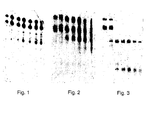
- Fig. 1 shows the gel electrophoretic separation of the BCL20 dsRNA
- Fig. 1 shows that the BCL20 dsRNA during the incubation period is hardly broken down.
- dsRNA B133 is somewhat faster is broken down as the dsRNA BCL20. That's because here the last complementary pair of nucleotides at both ends the dsRNA is not, as is ideally the case, C-G is.
- a conventional dsRNA such as the dsRNA P3 shown in FIG. 3, is broken down into serum almost immediately.
- the dsRNA P3 has complementary GC nucleotide pairs only at one end of the double-stranded structure.
Landscapes
- Health & Medical Sciences (AREA)
- Life Sciences & Earth Sciences (AREA)
- Engineering & Computer Science (AREA)
- Genetics & Genomics (AREA)
- Biomedical Technology (AREA)
- General Engineering & Computer Science (AREA)
- Wood Science & Technology (AREA)
- Organic Chemistry (AREA)
- Molecular Biology (AREA)
- Biotechnology (AREA)
- Chemical & Material Sciences (AREA)
- Zoology (AREA)
- Bioinformatics & Cheminformatics (AREA)
- General Health & Medical Sciences (AREA)
- Microbiology (AREA)
- Plant Pathology (AREA)
- Biochemistry (AREA)
- Biophysics (AREA)
- Physics & Mathematics (AREA)
- Oncology (AREA)
- Virology (AREA)
- Pharmaceuticals Containing Other Organic And Inorganic Compounds (AREA)
Priority Applications (14)
| Application Number | Priority Date | Filing Date | Title |
|---|---|---|---|
| EP03013296A EP1486564A1 (fr) | 2003-06-13 | 2003-06-13 | SiRNA à stabilité élevée dans le sérum |
| US10/560,336 US7786290B2 (en) | 2003-06-13 | 2004-06-14 | Double-stranded ribonucleic acid with increased effectiveness in an organism |
| DK19196267.9T DK3604537T3 (da) | 2003-06-13 | 2004-06-14 | Dobbeltstrenget ribonukleinsyre med forøget effektivitet i en organisme |
| AU2004263830A AU2004263830B2 (en) | 2003-06-13 | 2004-06-14 | Double-stranded ribonucleic acid with increased effectiveness in an organism |
| EP10011218.4A EP2336317B1 (fr) | 2003-06-13 | 2004-06-14 | Acide ribonucléique à double brin avec une meilleure efficacité dans un organisme |
| PCT/US2004/018848 WO2005014782A2 (fr) | 2003-06-13 | 2004-06-14 | Acide ribonucleique double brin presentant une efficacite accrue dans un organisme |
| EP20040776539 EP1633770B1 (fr) | 2003-06-13 | 2004-06-14 | Acide ribonucleique double brin presentant une efficacite accrue dans un organisme |
| GB0525640A GB2417727B (en) | 2003-06-13 | 2004-06-14 | Double-stranded ribonucleic acid with increased effectiveness in an organism |
| EP19196267.9A EP3604537B1 (fr) | 2003-06-13 | 2004-06-14 | Acide ribonucléique double brin présentant une efficacité accrue dans un organisme |
| ES19196267T ES2905724T3 (es) | 2003-06-13 | 2004-06-14 | Acido ribonucleico bicatenario con elevada eficacia en un organismo |
| DK10011218.4T DK2336317T3 (da) | 2003-06-13 | 2004-06-14 | Dobbeltstrenget ribonukleinsyre med forøget effektivitet i en organisme |
| ES10011218T ES2761262T3 (es) | 2003-06-13 | 2004-06-14 | Acido ribonucleico bicatenario con elevada eficacia en un organismo |
| AU2009201091A AU2009201091B8 (en) | 2003-06-13 | 2009-03-18 | Double-stranded ribonucleic acid with increased effectiveness in an organism |
| US12/816,994 US20100280102A1 (en) | 2003-06-13 | 2010-06-16 | Double-stranded ribonucleic acid with increased effectiveness in an organism |
Applications Claiming Priority (1)
| Application Number | Priority Date | Filing Date | Title |
|---|---|---|---|
| EP03013296A EP1486564A1 (fr) | 2003-06-13 | 2003-06-13 | SiRNA à stabilité élevée dans le sérum |
Publications (1)
| Publication Number | Publication Date |
|---|---|
| EP1486564A1 true EP1486564A1 (fr) | 2004-12-15 |
Family
ID=33185889
Family Applications (1)
| Application Number | Title | Priority Date | Filing Date |
|---|---|---|---|
| EP03013296A Withdrawn EP1486564A1 (fr) | 2003-06-13 | 2003-06-13 | SiRNA à stabilité élevée dans le sérum |
Country Status (1)
| Country | Link |
|---|---|
| EP (1) | EP1486564A1 (fr) |
Cited By (2)
| Publication number | Priority date | Publication date | Assignee | Title |
|---|---|---|---|---|
| US7772200B2 (en) | 2005-07-21 | 2010-08-10 | Alnylam Pharmaceuticals, Inc. | iRNA agents targeted to the Rho-A gene |
| WO2010097414A1 (fr) | 2009-02-24 | 2010-09-02 | Riboxx Gmbh | Conception améliorée de petits arn interférants |
Citations (5)
| Publication number | Priority date | Publication date | Assignee | Title |
|---|---|---|---|---|
| WO2002044321A2 (fr) * | 2000-12-01 | 2002-06-06 | MAX-PLANCK-Gesellschaft zur Förderung der Wissenschaften e.V. | Petites molecules d'arn mediant l'interference arn |
| WO2002055693A2 (fr) * | 2001-01-09 | 2002-07-18 | Ribopharma Ag | Procede pour inhiber l'expression d'un gene cible |
| WO2002055692A2 (fr) * | 2001-01-09 | 2002-07-18 | Ribopharma Ag | Procede d'inhibition de l'expression d'un gene cible et medicament destine a la therapie d'une maladie tumorale |
| WO2003035868A1 (fr) * | 2001-10-26 | 2003-05-01 | Ribopharma Ag | Medicament qui augmente l'efficacite d'un remede declenchant l'apoptose mediee par recepteur dans des cellules tumorales |
| WO2003062423A2 (fr) * | 2002-01-22 | 2003-07-31 | Ribopharma Ag | Procede d'inhibition de l'expression d'un gene cible issu d'une aberration chromosomique |
-
2003
- 2003-06-13 EP EP03013296A patent/EP1486564A1/fr not_active Withdrawn
Patent Citations (5)
| Publication number | Priority date | Publication date | Assignee | Title |
|---|---|---|---|---|
| WO2002044321A2 (fr) * | 2000-12-01 | 2002-06-06 | MAX-PLANCK-Gesellschaft zur Förderung der Wissenschaften e.V. | Petites molecules d'arn mediant l'interference arn |
| WO2002055693A2 (fr) * | 2001-01-09 | 2002-07-18 | Ribopharma Ag | Procede pour inhiber l'expression d'un gene cible |
| WO2002055692A2 (fr) * | 2001-01-09 | 2002-07-18 | Ribopharma Ag | Procede d'inhibition de l'expression d'un gene cible et medicament destine a la therapie d'une maladie tumorale |
| WO2003035868A1 (fr) * | 2001-10-26 | 2003-05-01 | Ribopharma Ag | Medicament qui augmente l'efficacite d'un remede declenchant l'apoptose mediee par recepteur dans des cellules tumorales |
| WO2003062423A2 (fr) * | 2002-01-22 | 2003-07-31 | Ribopharma Ag | Procede d'inhibition de l'expression d'un gene cible issu d'une aberration chromosomique |
Non-Patent Citations (2)
| Title |
|---|
| DATABASE EMBL, HEIDELBERG, BRD [online] 19 September 1987 (1987-09-19), TSUJIMOTO, Y. & CROCE, C.M.: "Human B-cell leukemia/lymphoma 2 (bcl-2) proto-oncogene mRNA encoding bcl-2-alpha protein, complete cds", XP002277007, Database accession no. M13994 * |
| FUTAMI, T. ET AL.: "Induction of apoptosis in HeLa cells with siRNA expression vector targeted against bcl-2", NUCLEIC ACIDS RESEARCH SUPPL., no. 2, 2002, pages 251 - 252, XP002968175 * |
Cited By (2)
| Publication number | Priority date | Publication date | Assignee | Title |
|---|---|---|---|---|
| US7772200B2 (en) | 2005-07-21 | 2010-08-10 | Alnylam Pharmaceuticals, Inc. | iRNA agents targeted to the Rho-A gene |
| WO2010097414A1 (fr) | 2009-02-24 | 2010-09-02 | Riboxx Gmbh | Conception améliorée de petits arn interférants |
Similar Documents
| Publication | Publication Date | Title |
|---|---|---|
| EP1798285B1 (fr) | Méthode et médicament destinés à inhiber l'expression d'une gène donnée | |
| DE69316205T2 (de) | Verfahren und reagens zur spaltung und entschützen von oligonukleotide | |
| DE69331946T2 (de) | Nukleozyme | |
| DE69123979T2 (de) | Abgeänderte ribozyme | |
| DE69329755T2 (de) | Phosphorothioat-hybrid-oligonucleotide | |
| EP0845476B1 (fr) | Oligonucléotides synthétiques catalytiques | |
| EP0669395A2 (fr) | 3'-RNA-marquage avec une transférase terminale | |
| DE69232699T2 (de) | Über chirale phosphoratome gebundene oligonukleotide | |
| DE69233599T2 (de) | Unterbrochene 2'-modifizierte Oligonukleotide | |
| EP0765335B1 (fr) | Procede universel d'isolement et de purification d'acides nucleiques a partir de quantites extremement reduites de differents materiaux de depart fortement contamines | |
| DE69718600T2 (de) | Polyether-Nukleinsäuren | |
| EP0653439A2 (fr) | Oligonucléotides stabilisés et leur utilisation | |
| DE19502912A1 (de) | G-Cap Stabilisierte Oligonucleotide | |
| EP1121460A1 (fr) | Procedes et moyens pour l'isolement et la purification d'acides nucleiques sur des surfaces | |
| EP1960522B1 (fr) | Procede pour realiser un enrichissement en acides nucleiques a chaine courte | |
| DE69931928T2 (de) | Reversibel inhibierende sonden | |
| DE69632904T2 (de) | Kopräzipitat und methode zur extraktion von nukleinsäuren | |
| DE69404856T2 (de) | Verfahren zum nachweis geladener oligonukleotide in biologischen flüssigkeiten | |
| EP1486564A1 (fr) | SiRNA à stabilité élevée dans le sérum | |
| DE10242319A1 (de) | Funkionelle Korrektur der-786C/T-Varianz des humanen eNOS-Gens | |
| WO2002004620A2 (fr) | Procede pour isoler des acides nucleiques | |
| WO1999032616A2 (fr) | Procede d'isolement d'acides nucleiques a chaine courte et a chaine longue | |
| EP1707623A1 (fr) | Transcription renversée et amplification de l'ARN avec la dégradation simultanée de l'ADN | |
| DE60117572T2 (de) | Inhibitoren der Reversen Transkriptase von HIV aus tRNA | |
| WO2011151427A1 (fr) | Stabilisation d'acides nucléiques dans des échantillons biologiques contenant de la matière cellulaire |
Legal Events
| Date | Code | Title | Description |
|---|---|---|---|
| PUAI | Public reference made under article 153(3) epc to a published international application that has entered the european phase |
Free format text: ORIGINAL CODE: 0009012 |
|
| 17P | Request for examination filed |
Effective date: 20030614 |
|
| AK | Designated contracting states |
Kind code of ref document: A1 Designated state(s): AT BE BG CH CY CZ DE DK EE ES FI FR GB GR HU IE IT LI LU MC NL PT RO SE SI SK TR |
|
| AX | Request for extension of the european patent |
Extension state: AL LT LV MK |
|
| STAA | Information on the status of an ep patent application or granted ep patent |
Free format text: STATUS: THE APPLICATION HAS BEEN WITHDRAWN |
|
| 18W | Application withdrawn |
Effective date: 20050114 |