EP1486828A2 - Lithographischer Apparat und Verfahren zur Herstellung einer Vorrichtung - Google Patents
Lithographischer Apparat und Verfahren zur Herstellung einer Vorrichtung Download PDFInfo
- Publication number
- EP1486828A2 EP1486828A2 EP04253354A EP04253354A EP1486828A2 EP 1486828 A2 EP1486828 A2 EP 1486828A2 EP 04253354 A EP04253354 A EP 04253354A EP 04253354 A EP04253354 A EP 04253354A EP 1486828 A2 EP1486828 A2 EP 1486828A2
- Authority
- EP
- European Patent Office
- Prior art keywords
- sensor
- substrate
- radiation
- seal member
- liquid
- Prior art date
- Legal status (The legal status is an assumption and is not a legal conclusion. Google has not performed a legal analysis and makes no representation as to the accuracy of the status listed.)
- Granted
Links
- 238000004519 manufacturing process Methods 0.000 title claims description 8
- 239000007788 liquid Substances 0.000 claims abstract description 97
- 239000000758 substrate Substances 0.000 claims description 172
- 230000005855 radiation Effects 0.000 claims description 64
- 239000000463 material Substances 0.000 claims description 18
- 230000005540 biological transmission Effects 0.000 claims description 16
- 238000007654 immersion Methods 0.000 claims description 16
- 238000000059 patterning Methods 0.000 claims description 13
- 238000005286 illumination Methods 0.000 claims description 3
- 238000005259 measurement Methods 0.000 claims description 3
- 239000010410 layer Substances 0.000 description 18
- 239000007789 gas Substances 0.000 description 10
- 239000003292 glue Substances 0.000 description 8
- 238000000034 method Methods 0.000 description 8
- VYPSYNLAJGMNEJ-UHFFFAOYSA-N silicon dioxide Inorganic materials O=[Si]=O VYPSYNLAJGMNEJ-UHFFFAOYSA-N 0.000 description 7
- 230000003287 optical effect Effects 0.000 description 6
- 238000004020 luminiscence type Methods 0.000 description 5
- 230000007246 mechanism Effects 0.000 description 5
- 239000010453 quartz Substances 0.000 description 5
- 206010000496 acne Diseases 0.000 description 4
- 239000011324 bead Substances 0.000 description 4
- 229910019990 cerium-doped yttrium aluminum garnet Inorganic materials 0.000 description 4
- 230000000694 effects Effects 0.000 description 4
- 239000012530 fluid Substances 0.000 description 4
- 239000011521 glass Substances 0.000 description 4
- 238000003384 imaging method Methods 0.000 description 4
- XLYOFNOQVPJJNP-UHFFFAOYSA-N water Substances O XLYOFNOQVPJJNP-UHFFFAOYSA-N 0.000 description 4
- XUIMIQQOPSSXEZ-UHFFFAOYSA-N Silicon Chemical compound [Si] XUIMIQQOPSSXEZ-UHFFFAOYSA-N 0.000 description 3
- 238000006243 chemical reaction Methods 0.000 description 3
- 238000013461 design Methods 0.000 description 3
- 229910052710 silicon Inorganic materials 0.000 description 3
- 239000010703 silicon Substances 0.000 description 3
- OAICVXFJPJFONN-UHFFFAOYSA-N Phosphorus Chemical compound [P] OAICVXFJPJFONN-UHFFFAOYSA-N 0.000 description 2
- 238000003491 array Methods 0.000 description 2
- 238000001514 detection method Methods 0.000 description 2
- 238000009826 distribution Methods 0.000 description 2
- 239000000945 filler Substances 0.000 description 2
- -1 for example Substances 0.000 description 2
- 230000006870 function Effects 0.000 description 2
- 230000005484 gravity Effects 0.000 description 2
- 239000011159 matrix material Substances 0.000 description 2
- 230000010363 phase shift Effects 0.000 description 2
- 230000008569 process Effects 0.000 description 2
- 238000012545 processing Methods 0.000 description 2
- OKTJSMMVPCPJKN-UHFFFAOYSA-N Carbon Chemical compound [C] OKTJSMMVPCPJKN-UHFFFAOYSA-N 0.000 description 1
- 229910052684 Cerium Inorganic materials 0.000 description 1
- 239000004593 Epoxy Substances 0.000 description 1
- 229910000831 Steel Inorganic materials 0.000 description 1
- 239000004809 Teflon Substances 0.000 description 1
- 229920006362 Teflon® Polymers 0.000 description 1
- 239000006094 Zerodur Substances 0.000 description 1
- 238000010521 absorption reaction Methods 0.000 description 1
- PNEYBMLMFCGWSK-UHFFFAOYSA-N aluminium oxide Inorganic materials [O-2].[O-2].[O-2].[Al+3].[Al+3] PNEYBMLMFCGWSK-UHFFFAOYSA-N 0.000 description 1
- QVGXLLKOCUKJST-UHFFFAOYSA-N atomic oxygen Chemical compound [O] QVGXLLKOCUKJST-UHFFFAOYSA-N 0.000 description 1
- 230000002238 attenuated effect Effects 0.000 description 1
- 230000008901 benefit Effects 0.000 description 1
- 229910052799 carbon Inorganic materials 0.000 description 1
- 229910010293 ceramic material Inorganic materials 0.000 description 1
- GWXLDORMOJMVQZ-UHFFFAOYSA-N cerium Chemical compound [Ce] GWXLDORMOJMVQZ-UHFFFAOYSA-N 0.000 description 1
- 239000011248 coating agent Substances 0.000 description 1
- 238000000576 coating method Methods 0.000 description 1
- 238000004891 communication Methods 0.000 description 1
- 230000003750 conditioning effect Effects 0.000 description 1
- 238000010276 construction Methods 0.000 description 1
- 229910052593 corundum Inorganic materials 0.000 description 1
- 239000002178 crystalline material Substances 0.000 description 1
- 230000007423 decrease Effects 0.000 description 1
- 238000011161 development Methods 0.000 description 1
- 238000005553 drilling Methods 0.000 description 1
- 238000001312 dry etching Methods 0.000 description 1
- 230000009977 dual effect Effects 0.000 description 1
- 230000005684 electric field Effects 0.000 description 1
- 230000005670 electromagnetic radiation Effects 0.000 description 1
- 238000000609 electron-beam lithography Methods 0.000 description 1
- 238000005530 etching Methods 0.000 description 1
- 239000000835 fiber Substances 0.000 description 1
- 239000005350 fused silica glass Substances 0.000 description 1
- 239000002223 garnet Substances 0.000 description 1
- 238000007689 inspection Methods 0.000 description 1
- 238000005468 ion implantation Methods 0.000 description 1
- 239000002346 layers by function Substances 0.000 description 1
- 239000004973 liquid crystal related substance Substances 0.000 description 1
- 238000001459 lithography Methods 0.000 description 1
- 230000005381 magnetic domain Effects 0.000 description 1
- 230000015654 memory Effects 0.000 description 1
- QSHDDOUJBYECFT-UHFFFAOYSA-N mercury Chemical compound [Hg] QSHDDOUJBYECFT-UHFFFAOYSA-N 0.000 description 1
- 229910052753 mercury Inorganic materials 0.000 description 1
- 229910052751 metal Inorganic materials 0.000 description 1
- 239000002184 metal Substances 0.000 description 1
- 238000001465 metallisation Methods 0.000 description 1
- 230000003647 oxidation Effects 0.000 description 1
- 238000007254 oxidation reaction Methods 0.000 description 1
- 229910052760 oxygen Inorganic materials 0.000 description 1
- 239000001301 oxygen Substances 0.000 description 1
- 239000002245 particle Substances 0.000 description 1
- 238000005498 polishing Methods 0.000 description 1
- 229920001343 polytetrafluoroethylene Polymers 0.000 description 1
- 239000004810 polytetrafluoroethylene Substances 0.000 description 1
- 230000036316 preload Effects 0.000 description 1
- 230000037452 priming Effects 0.000 description 1
- 229910052761 rare earth metal Inorganic materials 0.000 description 1
- 238000007789 sealing Methods 0.000 description 1
- 239000004065 semiconductor Substances 0.000 description 1
- 238000007493 shaping process Methods 0.000 description 1
- 238000010008 shearing Methods 0.000 description 1
- 125000006850 spacer group Chemical group 0.000 description 1
- 238000004544 sputter deposition Methods 0.000 description 1
- 239000010959 steel Substances 0.000 description 1
- 230000003746 surface roughness Effects 0.000 description 1
- 239000000725 suspension Substances 0.000 description 1
- 239000010409 thin film Substances 0.000 description 1
- 230000007704 transition Effects 0.000 description 1
- 229910001845 yogo sapphire Inorganic materials 0.000 description 1
Images



Classifications
-
- G—PHYSICS
- G03—PHOTOGRAPHY; CINEMATOGRAPHY; ANALOGOUS TECHNIQUES USING WAVES OTHER THAN OPTICAL WAVES; ELECTROGRAPHY; HOLOGRAPHY
- G03F—PHOTOMECHANICAL PRODUCTION OF TEXTURED OR PATTERNED SURFACES, e.g. FOR PRINTING, FOR PROCESSING OF SEMICONDUCTOR DEVICES; MATERIALS THEREFOR; ORIGINALS THEREFOR; APPARATUS SPECIALLY ADAPTED THEREFOR
- G03F9/00—Registration or positioning of originals, masks, frames, photographic sheets or textured or patterned surfaces, e.g. automatically
- G03F9/70—Registration or positioning of originals, masks, frames, photographic sheets or textured or patterned surfaces, e.g. automatically for microlithography
- G03F9/7088—Alignment mark detection, e.g. TTR, TTL, off-axis detection, array detector, video detection
-
- G—PHYSICS
- G03—PHOTOGRAPHY; CINEMATOGRAPHY; ANALOGOUS TECHNIQUES USING WAVES OTHER THAN OPTICAL WAVES; ELECTROGRAPHY; HOLOGRAPHY
- G03F—PHOTOMECHANICAL PRODUCTION OF TEXTURED OR PATTERNED SURFACES, e.g. FOR PRINTING, FOR PROCESSING OF SEMICONDUCTOR DEVICES; MATERIALS THEREFOR; ORIGINALS THEREFOR; APPARATUS SPECIALLY ADAPTED THEREFOR
- G03F7/00—Photomechanical, e.g. photolithographic, production of textured or patterned surfaces, e.g. printing surfaces; Materials therefor, e.g. comprising photoresists; Apparatus specially adapted therefor
- G03F7/70—Microphotolithographic exposure; Apparatus therefor
- G03F7/70216—Mask projection systems
- G03F7/70341—Details of immersion lithography aspects, e.g. exposure media or control of immersion liquid supply
-
- G—PHYSICS
- G03—PHOTOGRAPHY; CINEMATOGRAPHY; ANALOGOUS TECHNIQUES USING WAVES OTHER THAN OPTICAL WAVES; ELECTROGRAPHY; HOLOGRAPHY
- G03F—PHOTOMECHANICAL PRODUCTION OF TEXTURED OR PATTERNED SURFACES, e.g. FOR PRINTING, FOR PROCESSING OF SEMICONDUCTOR DEVICES; MATERIALS THEREFOR; ORIGINALS THEREFOR; APPARATUS SPECIALLY ADAPTED THEREFOR
- G03F7/00—Photomechanical, e.g. photolithographic, production of textured or patterned surfaces, e.g. printing surfaces; Materials therefor, e.g. comprising photoresists; Apparatus specially adapted therefor
- G03F7/70—Microphotolithographic exposure; Apparatus therefor
- G03F7/70691—Handling of masks or workpieces
- G03F7/707—Chucks, e.g. chucking or un-chucking operations or structural details
-
- G—PHYSICS
- G03—PHOTOGRAPHY; CINEMATOGRAPHY; ANALOGOUS TECHNIQUES USING WAVES OTHER THAN OPTICAL WAVES; ELECTROGRAPHY; HOLOGRAPHY
- G03F—PHOTOMECHANICAL PRODUCTION OF TEXTURED OR PATTERNED SURFACES, e.g. FOR PRINTING, FOR PROCESSING OF SEMICONDUCTOR DEVICES; MATERIALS THEREFOR; ORIGINALS THEREFOR; APPARATUS SPECIALLY ADAPTED THEREFOR
- G03F7/00—Photomechanical, e.g. photolithographic, production of textured or patterned surfaces, e.g. printing surfaces; Materials therefor, e.g. comprising photoresists; Apparatus specially adapted therefor
- G03F7/70—Microphotolithographic exposure; Apparatus therefor
- G03F7/708—Construction of apparatus, e.g. environment aspects, hygiene aspects or materials
- G03F7/7085—Detection arrangement, e.g. detectors of apparatus alignment possibly mounted on wafers, exposure dose, photo-cleaning flux, stray light, thermal load
Definitions
- the present invention relates to a lithographic projection apparatus comprising:
- patterning means as here employed should be broadly interpreted as referring to means that can be used to endow an incoming radiation beam with a patterned cross-section, corresponding to a pattern that is to be created in a target portion of the substrate; the term “light valve” can also be used in this context.
- the said pattern will correspond to a particular functional layer in a device being created in the target portion, such as an integrated circuit or other device (see below). Examples of such patterning means include:
- Lithographic projection apparatus can be used, for example, in the manufacture of integrated circuits (ICs).
- the patterning means may generate a circuit pattern corresponding to an individual layer of the IC, and this pattern can be imaged onto a target portion (e.g. comprising one or more dies) on a substrate (silicon wafer) that has been coated with a layer of radiation-sensitive material (resist).
- a target portion e.g. comprising one or more dies
- a substrate silicon wafer
- a layer of radiation-sensitive material resist
- a single wafer will contain a whole network of adjacent target portions that are successively irradiated via the projection system, one at a time.
- employing patterning by a mask on a mask table a distinction can be made between two different types of machine.
- each target portion is irradiated by exposing the entire mask pattern onto the target portion in one go; such an apparatus is commonly referred to as a wafer stepper.
- a wafer stepper In an alternative apparatus ⁇ commonly referred to as a step-and-scan apparatus ⁇ each target portion is irradiated by progressively scanning the mask pattern under the projection beam in a given reference direction (the "scanning" direction) while synchronously scanning the substrate table parallel or anti-parallel to this direction; since, in general, the projection system will have a magnification factor M (generally ⁇ 1), the speed V at which the substrate table is scanned will be a factor M times that at which the mask table is scanned. More information with regard to lithographic devices as here described can be gleaned, for example, from US 6,046,792, incorporated herein by reference.
- a pattern (e.g. in a mask) is imaged onto a substrate that is at least partially covered by a layer of radiation-sensitive material (resist).
- the substrate Prior to this imaging step, the substrate may undergo various procedures, such as priming, resist coating and a soft bake. After exposure, the substrate may be subjected to other procedures, such as a post-exposure bake (PEB), development, a hard bake and measurement/inspection of the imaged features.
- PEB post-exposure bake
- This array of procedures is used as a basis to pattern an individual layer of a device, e.g. an IC.
- Such a patterned layer may then undergo various processes such as etching, ion-implantation (doping), metallization, oxidation, chemo-mechanical polishing, etc., all intended to finish off an individual layer. If several layers are required, then the whole procedure, or a variant thereof, will have to be repeated for each new layer. Eventually, an array of devices will be present on the substrate (wafer). These devices are then separated from one another by a technique such as dicing or sawing, whence the individual devices can be mounted on a carrier, connected to pins, etc.
- the projection system may hereinafter be referred to as the "lens"; however, this term should be broadly interpreted as encompassing various types of projection system, including refractive optics, reflective optics, and catadioptric systems, for example.
- the radiation system may also include components operating according to any of these design types for directing, shaping or controlling the projection beam of radiation, and such components may also be referred to below, collectively or singularly, as a "lens".
- the lithographic apparatus may be of a type having two or more substrate tables (and/or two or more mask tables). In such "multiple stage” devices the additional tables may be used in parallel, or preparatory steps may be carried out on one or more tables while one or more other tables are being used for exposures. Dual stage lithographic apparatus are described, for example, in US 5,969,441 and WO 98/40791, incorporated herein by reference.
- liquid supply system to provide liquid on only a localized area of the substrate and inbetween the final element of the projection system and the substrate (the substrate generally has a larger surface area than the final element of the projection system).
- the substrate generally has a larger surface area than the final element of the projection system.
- liquid is supplied by at least one inlet IN onto the substrate, preferably along the direction of movement of the substrate relative to the final element, and is removed by at least one outlet OUT after having passed under the projection system. That is, as the substrate is scanned beneath the element in a-X direction, liquid is supplied at the +X side of the element and taken up at the -X side.
- Figure 15 shows the arrangement schematically in which liquid is supplied via inlet IN and is taken up on the other side of the element by outlet OUT which is connected to a low pressure source.
- the liquid is supplied along the direction of movement of the substrate relative to the final element, though this does not need to be the case.
- Figure 23 shows the arrangement schematically in which liquid is supplied via inlet IN and is taken up on the other side of the element by outlet OUT which is connected to a low pressure source.
- the liquid is supplied along the direction of movement of the substrate relative to the final element, though this does not need to be the case.
- Figure 23 shows four sets of an inlet with an outlet on either side in a regular pattern around the final element.
- a lithographic apparatus as specified in the opening paragraph, characterized by at least one sensor being positioned for illumination by said projection beam of radiation which has passed through said immersion liquid.
- at least one sensor being positioned for illumination by said projection beam of radiation which has passed through said immersion liquid.
- no elaborate measures need to be taken to compensate the signals from the sensors to take account of the parameters measured by the sensors being measured through a different medium to that which the substrate is imaged through.
- the design of the sensors is such that they are compatible for use when immersed with liquid.
- Sensors which can take advantage of the present invention include alignment sensors used for aligning the substrate table relative to the projection system, transmission image sensors, focus sensors, spot or dose sensors, an integrated lens interferometer and scanner and even alignment marks.
- the measurement gratings of the sensor can have a pitch than less than 500 nm which improves the resolution of the alignment sensor.
- radiation and “beam” are used to encompass all types of electromagnetic radiation, including ultraviolet radiation (e.g. with a wavelength of 365, 248, 193, 157 or 126 nm).
- Figure 1 schematically depicts a lithographic projection apparatus according to a particular embodiment of the invention.
- the apparatus comprises:
- the source LA e.g. an excimer laser
- This beam is fed into an illumination system (illuminator) IL, either directly or after having traversed conditioning means, such as a beam expander Ex, for example.
- the illuminator IL may comprise adjusting means AM for setting the outer and/or inner radial extent (commonly referred to as ⁇ -outer and ⁇ -inner, respectively) of the intensity distribution in the beam.
- ⁇ -outer and ⁇ -inner commonly referred to as ⁇ -outer and ⁇ -inner, respectively
- it will generally comprise various other components, such as an integrator IN and a condenser CO.
- the beam PB impinging on the mask MA has a desired uniformity and intensity distribution in its cross-section.
- the source LA may be within the housing of the lithographic projection apparatus (as is often the case when the source LA is a mercury lamp, for example), but that it may also be remote from the lithographic projection apparatus, the radiation beam which it produces being led into the apparatus ( e.g. with the aid of suitable directing mirrors); this latter scenario is often the case when the source LA is an excimer laser.
- the current invention and Claims encompass both of these scenarios.
- the beam PB subsequently intercepts the mask MA, which is held on a mask table MT. Having traversed the mask MA, the beam PB passes through the lens PL, which focuses the beam PB onto a target portion C of the substrate W. With the aid of the second positioning means (and interferometric measuring means IF), the substrate table WT can be moved accurately, e.g. so as to position different target portions C in the path of the beam PB. Similarly, the first positioning means can be used to accurately position the mask MA with respect to the path of the beam PB, e.g. after mechanical retrieval of the mask MA from a mask library, or during a scan.
- the mask table MT may just be connected to a short stroke actuator, or may be fixed.
- the depicted apparatus can be used in two different modes:
- Figure 2 shows a liquid reservoir 10 between the projection system PL and the substrate W which is positioned on the substrate stage WT.
- the liquid reservoir 10 is filled with a liquid 11 having a relatively high refractive index, e.g. water or a suspension of particles in water, provided via inlet/outlet ducts 13.
- the liquid has the effect that the radiation of the projection beam is a shorter wavelength in the liquid than in air or in a vacuum, allowing smaller features to be resolved.
- the resolution limit of a projection system is determined, inter alia, by the wavelength of the projection beam and the numerical aperture of the system.
- the presence of the liquid may also be regarded as increasing the effective numerical aperture.
- the liquid is effective to increase the depth of field.
- the reservoir 10 forms a preferably contactless seal to the substrate W around the image field of the projection lens PL so that the liquid is confined to fill the space between the substrate's primary surface, which faces the projection system PL, and the final optical element of the projection system PL.
- the reservoir is formed by a seal member 12 positioned below and surrounding the final element of the projection lens PL.
- the liquid supply system provides liquid on only a localised area of the substrate.
- the seal member 12 forms part of the liquid supply system for filling the space between the final element of the projection system and the substrate with a liquid. This liquid is brought into the space below the projection lens and within the seal member 12.
- the seal member 12 preferably extends a little above the bottom element of the projection lens and the liquid rises above the final element so that a buffer of liquid is provided.
- the seal member 12 has an inner periphery that at the upper end closely conforms to the shape of the projection system or the final elements thereof and may, e.g. be round. At the bottom the inner periphery closely conforms to the shape of the image field, e.g. rectangular, though this is not necessarily so.
- the seal member is substantially stationary in the XY plane relative to the projection system though there may be some relative movement in the Z direction (in the direction of the optical axis).
- a seal is formed between the seal member and the surface of the substrate. This seal is preferably a contactless seal and may be a gas seal.
- the seal device is a contactless seal i.e. a gas seal.
- the gas seal is formed by gas, e.g. air or synthetic air, provided under pressure via inlet 15 to the gap between seal member 12 and substrate W and extracted by first outlet 14.
- the over pressure on the gas inlet 15, vacuum level or under pressure on the first outlet 14 and the geometry of the gap are arranged so that there is a high-velocity air flow inwards towards the optical axis of the apparatus that confines the liquid 11.
- some liquid is likely to escape, for example up the first outlet 14.
- Figures 14 and 15 also depict a liquid reservoir defined by inlet(s) IN, outlet(s) OUT, the substrate W and the final element of projection lens PL.
- the liquid supply system can comprise that as described in relation to Figure 2 and Figures 14 and 15.
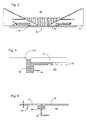
- the second embodiment is illustrated in Figures 3 to 5 and is the same or similar as the first embodiment except as described below.
- an edge liquid supply system provides liquid to a reservoir 30 via a port 40.
- the liquid in the reservoir 30 is optionally the same as the immersion liquid in the liquid supply system.
- the reservoir 30 is positioned on the opposite side of the substrate W to the projection lens and adjacent the edge of the substrate W and the edge of the edge seal member 17, 117.
- the edge seal member 17 is comprised of an element which is separate to the substrate table WT whereas in Figure 3 the edge seal member 117 is provided by an integral portion of the substrate table WT.
- the substrate W is supported on the substrate table WT by a so-called pimple table 20.
- the pimple table 20 comprises a plurality of projections on which the substrate W rests.
- the substrate W is held in place by, e.g., a vacuum source sucking the substrate onto the top surface of the substrate table WT.
- a vacuum source sucking the substrate onto the top surface of the substrate table WT.
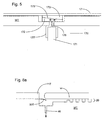
- the mechanism 170 shown in Figure 4 for moving the edge seal member 17 relative to the remainder of the substrate table WT is illustrated in detail in Figure 5.
- the reason for moving the edge seal member 17 in this way is so that its primary surface can be made to be substantially co-planar with the primary surface of the substrate W. This allows a smooth movement of the liquid supply system over edge portions of the substrate W so that the bottom inner periphery of the liquid supply system can be moved to positions partly on the primary surface of substrate W and partly on the primary surface of the edge seal member 17.
- a level sensor (not illustrated) is used to detect the relative heights of the primary surfaces of the substrate W and the edge seal member 17. Based on the results of the level sensor, control signals are sent to the actuator 171 in order to adjust the height of the primary surface of the edge seal member 17.
- a closed loop actuator could also be used for this purpose.
- the actuator 171 is a rotating motor which rotates a shaft 176.
- the shaft 176 is connected to a circular disc at the end distal to the motor 171.
- the shaft 176 is connected away from the centre of the disc.
- the disc is located in a circular recess in a wedge portion 172.
- Ball bearings may be used to reduce the amount of friction between the circular disc and the sides of the recess in the wedge portion 172.
- the motor 171 is held in place by leaf springs 177. On actuation of the motor the wedge portion is driven to the left and right as illustrated (i.e. in the direction of the slope of the wedge portion) because of the excentre position of the shaft 176 in the disc.
- the motor is prevented from moving in the same direction as the direction of movement of the wedge portion 172 by the springs 177.
- the wedge portion 172 moves left and right as illustrated in Figure 6, its top surface 175 (which is the surface of the wedge which is sloped in relation to the primary surface of the edge seal member 17) contacts the bottom sloped surface of a further wedge member 173 which is fixed to the bottom of the edge seal member 17.
- the edge seal member 17 is prevented from moving in the direction of movement of the wedge member 172 so that when the wedge member 172 moves left and right the edge seal member 17 is lowered and raised respectively. Some biasing of the edge seal member 17 towards the substrate table WT may be necessary.
- the further wedge member 173 could be replaced by an alternative shape, for example a rod positioned perpendicularly to the direction of movement of the wedge 172. If the coefficient of friction between the wedge member 172 and the further wedge member 173 is greater than the tangent of the wedge angle then the actuator 170 is self-braking meaning that no force is required on the wedge member 172 to hold it in place. This is advantageous as the system will then be stable when the actuator 171 is not actuated. The accuracy of the mechanism 170 is of the order of a few ⁇ m.
- a mechanism may be provided to adjust the height of the substrate W or the member supporting the substrate W so that the primary surfaces of the edge seal member 17, 117 and the substrate can be made substantially co-planar.
- the third embodiment is illustrated in Figures 6 and 7 and is the same or similar as the first embodiment except as described below.
- This embodiment is described in relation to an edge seal member 117 which is an integral part of the substrate table WT. However, this embodiment is equally applicable to an edge seal member 17 which is movable relative to the substrate table WT.
- a further edge seal member 500 is used to bridge the gap between the edge seal member 117 and the substrate W.
- the further edge seal member is affixed to the edge seal member 117.
- the further edge seal member 500 is removably attachable against the surface of the substrate W opposite the primary surface.
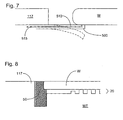
- the further edge seal member 500 can be a flexible edge seal member which is actuatable to contact the under surface of the substrate W. When the flexible edge seal member 500 is deactivated it falls away from the substrate under gravity. The way this is achieved is illustrated in Figure 7 and is described below.
- a port 46 connected to a low pressure source may be provided under the substrate W adjacent edges of the edge seal member 117 and the substrate W in some or all of the versions of this embodiment.
- the design of the area under the substrate could be the same as that of the third embodiment.
- the same system can be used for sensors such as a transmission image sensor (TIS) on the substrate table as opposed for the substrate W.
- TIS transmission image sensor
- the edge seal member 500 can be permanently attached to the sensor, for example using glue.
- edge seal member 500 can be arranged to engage with the top surface of the object (that surface closest to the projection system) rather than the bottom surface. Also, the further edge seal member 500 may be provided attached to or near the top surface of the edge seal member 117 as opposed to under the edge seal member 117 as is illustrated in Figure 8a.
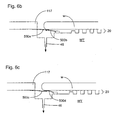
- FIG. 6b A second version of this embodiment is illustrated in Figure 6b.
- Two further edge seal members 500a, 500b are used.
- the first of these edge seal members 500a is the same as in the first version.
- the second of these edge seal members 500b is affixed to the substrate table 20 i.e. underneath the substrate W and extends with its free end radially outwardly from its attachment point.
- the second further edge seal member 500b clamps the first further edge seal member 500a against the substrate W. Compressed gas can be used to deform or move the second further edge seal member 500b.
- a third version of this embodiment is shown in Figure 6c.
- the third version is the same as the second version except the first further edge seal member 500c clamps the second further edge seal member 500d to the substrate W. This avoids, for example, the need for the compressed gas of the second version.
- a channel 510 is formed in the elongate direction of a flexible further edge seal member 500 (which preferably is an annular ring) and (a) discreet port(s) are provided in an upper surface of the flexible further edge seal member which faces the projection system and the underside of the substrate W.
- a vacuum source 515 By connecting a vacuum source 515 to the duct 510 the flexible further edge seal member can be made to abut the substrate W by suction.
- the vacuum source 515 is disconnected or switched off, the flexible further edge seal member 500 drops under gravity and/or pressure from port 46 to assume the position shown in dotted lines in Figure 9.
- a flexible further edge seal member 500 is formed with a mechanical pre-load such that it contacts the substrate W when the substrate is placed on the pimple table 20 and the flexible further edge seal member 500 deforms elastically so that it applies a force upwards on the substrate W to thereby make a seal.
- a flexible further edge seal member 500 may be forced against the substrate W by an overpressure generated by pressurised gas on port 46.
- a flexible further edge seal member 500 may be fashioned from any flexible, radiation and immersion liquid resistant, non-contaminating material, for example, steel, glass e.g. Al 2 O 3 , ceramic material e.g. SiC, Silicon, Teflon, low expansion glasses (e.g. Zerodur (TM) or ULE (TM)), carbon fibre epoxy or quartz and is typically between 10 and 500 ⁇ m thick, preferably between 30 and 200 ⁇ m or 50 to 150 ⁇ m in the case of glass. With a flexible further edge seal member 500 of this material and these dimensions, the typical pressure which is required to be applied to the duct 510 is approximately 0.1 to 0.6 bar.
- the fourth embodiment is illustrated in Figure 8 and is the same or similar as the first embodiment except as described below.
- This embodiment is described in relation to an edge seal member 117 which is an integral part of the substrate table WT. However, this embodiment is equally applicable to an edge seal member 17 which is movable relative to the substrate table WT.
- the gap between the edge seal member 117 and the substrate W is filled with a further edge seal member 50.
- the further edge seal member is a flexible further edge seal member 50 which has a top surface which is substantially co-planar with the primary surfaces of the substrate W and the edge seal member 117.
- the flexible further edge seal member 50 is made of a compliant material so that minor variations in the diameter of substrate W and in the thickness of the substrate W can be accommodated by deflections of the flexible further edge seal member 50.
- the liquid supply system operation is not upset when it passes over the edge of the substrate W so that disturbance forces are not generated in the liquid supply system.
- the flexible further edge seal member 50 is in contact with a surface of the substrate W opposite the primary surface of the substrate W, at an edge portion. This contact has two functions. First the fluid seal between the flexible further edge seal member 50 and the substrate W is improved. Second, the flexible further edge seal member 50 applies a force on the substrate W in a direction away from the pimple table 20. When the substrate W is held on the substrate table WT by, e.g. vacuum suction, the substrate can be held securely on the substrate table. However, when the vacuum source is switched off or disconnected, the force produced by the flexible further edge seal member 50 on the substrate W is effective to push the substrate W off the substrate table WT thereby aiding loading and unloading of substrates W.
- the flexible further edge seal member 50 is made of a radiation and immersion liquid resistant material such as PTFE.
- Figure 9 illustrates a fifth embodiment of the present invention which is the same or similar as the first embodiment except as described below.
- This embodiment is described in relation to an edge seal member 117 which is an integral part of the substrate table WT. However, this embodiment is equally applicable to an edge seal member 17 which is movable relative to the substrate table WT.
- the eighth embodiment includes a further edge seal member 100 for bridging the gap between the edge seal member 117 and the substrate W.
- the further edge seal member 100 is a gap seal member which is positioned on the primary surfaces of the substrate W and the edge seal member 117 to span the gap between the substrate W and edge seal member 117.
- the gap seal member 100 will also be circular (annular).
- the gap seal member 100 may be held in place by the application of a vacuum 105 to its underside (that is a vacuum source exposed through a vacuum port on the primary surface of the edge seal member 117).
- the liquid supply system can pass over the edge of the substrate W without the loss of liquid because the gap between the substrate W and the edge seal member 117 is covered over by the gap seal means 100.
- the gap seal member 100 can be put in place and removed by the substrate handler so that standard substrates and substrate handling can be used. Alternatively the gap seal member 100 can be kept at the projection system PL and put in place and removed by appropriate mechanisms (e.g. a substrate handling robot).
- the gap seal member 100 should be stiff enough to avoid deformation by the vacuum source.
- the gap seal member 100 is less than 50, preferably 30 or 20 or even 10 ⁇ m thick to avoid contact with the liquid supply system, but should be made as thin as possible
- the gap seal member 100 is advantageously provided with tapered edges 110 in which the thickness of the gap seal member 100 decreases towards the edges. This gradual transition to the full thickness of the gap seal member ensures that disturbance of the liquid supply system is reduced when it passes on top of the gap seal member 100.
- the gap seal means 100 can be glued in place (at either end) with a glue which does not dissolve in the immersion liquid.
- the glue can alternatively be positioned at the junction of the edge seal member 117, the object and the gap seal means 100.
- the gap seal means 100 can be positioned underneath the object and an overhang of the edge seal member 117.
- the object may be shaped with an overhang also, if necessary.
- the gap seal means 100 can have a passage provided through it, from one opening in a surface in contact with the edge seal means 117 to another opening in a surface in contact with the object. By positioning one opening in fluid communication with vacuum 105, the gap seal means 100 can then be kept tightly in place.
- the sixth embodiment will be described with reference to Figure 10.
- the solution shown in Figure 10 bypasses some of the problems associated with imaging edge portions of the substrate W as well as allows a transmission image sensor (TIS) 220 to be illuminated by the projection lens PL under the same conditions as the substrate W.
- TIS transmission image sensor
- the sixth embodiment uses the liquid supply system described with respect to the first embodiment. However, rather than confining the immersion liquid in the liquid supply system under the projection lens on its lower side with the substrate W, the liquid is confined by an intermediary plate 210 which is positioned between the liquid supply system and the substrate W. The spaces 222, 215 between the intermediary plate 210 and the TIS 220 and the substrate W are also filled with liquid 111. This may either be done by two separate space liquid supply systems via respective ports 230, 240 as illustrated or by the same space liquid supply system via ports 230, 240.
- the space 215 between the substrate W and the intermediary plate 210 and the space 220 between the transmission image sensor 220 and the intermediary plate 210 are both filled with liquid and both the substrate W and the transmission image sensor can be illuminated under the same conditions.
- Portions 200 provide a support surface or surfaces for the intermediary plate 210 which may be held in place by vacuum sources.
- the intermediary plate 210 is made of such a size that it covers all of the substrate W as well as the transmission image sensor 220. Therefore, no edges need to be traversed by the liquid supply system even when the edge of the substrate W is imaged or when the transmission image sensor is positioned under the projection lens PL.
- the top surface of the transmission image sensor 220 and the substrate W are substantially co-planar.
- the intermediate plate 210 can be removable. It can, for example, be put in place and removed by a substrate handling robot or other appropriate mechanism.
- All of the above described embodiments may be used to seal around the edge of the substrate W.
- Other objects on the substrate table WT may also need to be sealed in a similar way, such as sensors including sensors and/or marks which are illuminated with the projection beam through the liquid such as the transmission image sensors, integrated lens interferometer and scanner (wavefront sensor) and spot sensor plates.
- Such objects may also include sensors and/or marks which are illuminated with non-projection radiation beams such as levelling and alignment sensors and/or marks.
- the liquid supply system may supply liquid to cover all of the object in such a case. Any of the above embodiments may be used for this purpose.
- the object will not need to be removed from the substrate table WT as, in contrast to the substrate W, the sensors do not need to be removed from the substrate table WT.
- the above embodiments may be modified as appropriate (e.g. the seals may not need to be moveable).
- each of the embodiments may be combined with one or more of the other embodiments as appropriate. Further, each of the embodiments (and any appropriate combination of embodiments) can be applied simply to the liquid supply system of Figure 2 and Figures 11 and 12 without the edge seal member 17, 117 as feasible and/or appropriate.
- edge seal member 117 and the top outer most edge of the sensor 220 can be varied. For example, it may be advantageous to provide an overhanging edge seal member 117 or indeed an outer edge of the sensor 220 which is overhanging. Alternatively, an outer upper corner of the sensor 220 may be useful.
- Figure 11 shows a seventh embodiment which is the same as the first embodiment except as described below.
- the object on the substrate table WT is a sensor 220 such as a transmission image sensor (TIS).
- a bead of glue 700 which is undissolvable and unreactable with the immersion fluid is positioned between the edge seal member 117 and the sensor 220.
- the glue is covered by immersion fluid in use.
- the eighth embodiment is described with reference to Figures 12 and 13.
- it is a sensor 220 which is being sealed to the substrate table WT.
- a vacuum 46 is provided adjacent the gap with an opening passage 47 and a chamber 44 for taking away any immersion liquid which should find its way through the gap between the edge seal member 117 and the edge of the substrate 220.
- the vacuum 46 is provided in the substrate table WT under an overhang portion of the object 220.
- the passage 47 is provided in an overhanging inwardly protruding portion of the substrate table WT.
- a bead of glue 700 is positioned at the inner most edge of the protruding portion between the substrate table WT and the object 220. If no bead of glue 700 is provided, a flow of gas from underneath the object 220 helps seal the gap between the sensor 220 and the substrate table WT.
- the vacuum 46, compartment 44 and passage 47 are provided in the object 220 itself under an inwardly protruding edge seal member 117. Again there is the option of providing a bead of glue between the object 220 and the substrate table WT radially outwardly of the passage 47.
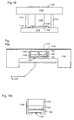
- Substrate-level sensors comprise a radiation-receiving element (1102, 1118) and a radiation-detecting element (1108, 1124, 1140) as shown in Figure 16.
- Exposure radiation is directed from the final element of the projection system PL through an immersion liquid 11 at least partly filling a space between the final element of the projection system PL and the substrate W.
- the detailed configuration of each of these elements depends on the properties of the radiation to be detected.
- the sensor at substrate level may comprise a photocell only, for use in cases where it is desirable for the photocell to receive the radiation directly.
- the sensor at substrate level may comprise a luminescence layer in combination with a photocell. In this arrangement, radiation at a first wavelength is absorbed by the luminescence layer and reradiated a short time later at a second (longer) wavelength. This arrangement is useful, for example, where the photocell is designed to work more efficiently at the second wavelength.
- the radiation-receiving element (1112, 1118), which may be a layer with a pinhole, a grating or another diffractive element fulfilling a similar function, may be supported on top of a quartz sensor body 1120, i.e. on the same side of the body as the projection system.
- the radiation-detecting element (1108, 1124, 1140), in contrast, may be arranged within the sensor body 1120, or within a concave region formed on the side of the sensor body 1120 facing away from the projection system.
- the present invention provides arrangements whereby air is excluded from the region between the radiation-receiving (1102, 1118) and radiation-detecting (1108, 1124, 1140) elements in order to avoid interfaces between media of high refractive index and air.
- absorption may also seriously reduce the intensity of radiation intensity reaching the photocell, as may scattering from interfaces that are not optically smooth.
- FIG 16 shows an ILIAS sensor module according to the prior art.
- This module has a shearing grating structure 1102 as radiation-receiving element, supported by a transmissive plate 1104, which may be made of glass or quartz.
- a quantum conversion layer 1106 is positioned immediately above a camera chip 1108 (the radiation-detecting element), which is in turn mounted on a substrate 1110.
- the substrate 1110 is connected to the transmissive plate 1104 via spacers 1112 and bonding wires 1114 connect the radiation-detecting element to external instrumentation.
- An air gap is located between the quantum conversion layer 1106 and the transmissive plate 1104.
- the air gap within the sensor cannot easily be purged so that it will contain significant proportions of oxygen and water, which absorb radiation. Signal is therefore lost and the effect becomes worse for larger angles as these have a longer path length through air. Thus, the dynamic range requirements for the sensor become more severe.
- Figures 17 and 18 show improved ILIAS sensor modules according to embodiments of the present invention.
- the air gap has been removed by changing the shape of the transmissive plate 1104 to fit directly to the camera 1108. This arrangement is made more difficult by the need to provide access for the bonding wires 1114 and necessitates an elongated form. From an engineering point of view, the alternative arrangement shown in Figure 18 is easier to realize.
- a filler sheet 1116 of the same material as the transmissive plate 1104, or of similar optical properties, is inserted between the transmissive plate 1104 and the quantum conversion layer 1106.
- the removal of the air gap reduces transmission losses and relaxes dynamic range requirements (or, alternatively speaking, improves the effective dynamic range). Both arrangements improve refractive index matching and reduce the extent of spurious internal reflections at the interface with the transmissive plate 1104.
- Figure 19a shows a DUV transmission image sensor according to the prior art.
- Figure 19b shows a magnified view of the processing element for clarity.
- the pattern of transmissive grooves 1118, constituting the radiation-receiving element in this case, is realized by means of e-beam lithography and dry etching techniques in a thin metal layer deposited on a substrate by means of sputtering. Any DUV light that is projected towards the grooves 1118 is transmitted by the transmissive plate 1104 (which may be quartz or fused silica) and hits the underlying luminescent material 1122, or "phosphor".
- the luminescent material 1122 may consist of a slab of crystalline material that is doped with rare-earth ions, e.g.
- the main purpose of the luminescent material 1122 is to convert the DUV radiation into more easily detectable visible radiation, which is then detected by the photodiode 1124. DUV radiation that has not been absorbed and converted into visible radiation by the phosphor 1122 may be filtered out before it reaches the photodiode 1124 (e.g. by a BG-39 or UG filter 26).
- air may be present in the gaps between components mounted in the sensor housing 1125, yielding a number of air/material/air interfaces that interrupt the propagation of radiation.
- the first region of interest is the rear-side 1128 of the transmissive plate 1104, reached by DUV radiation after it has passed through the grooves 1118 and transmissive plate 1104.
- the surface has been formed by mechanical means, such as by drilling, and is inevitably rough on the scale of the wavelength of the radiation. Radiation may therefore be lost due to scattering, either back into the transmissive plate 1104 or out past the luminescent material 1122.
- the DUV light encounters the optically smooth air/YAG:Ce interface, where a substantial amount of reflection may occur due to the refractive index mismatch, particularly in systems of high NA.
- the luminescent material 1122 emits radiation in random directions. Due to its relatively high refractive index, the critical angle for total internal reflection at the YAG:Ce/air boundary is around 33° (there is air in the gap between the YAG:Ce and the filter) from the normal, meaning that a large proportion of radiation incident on the boundary is reflected out of the system and lost through the side walls of the luminescent material 1122.
- the part of the luminescence that is directed towards the photodiode has to overcome the air/quartz interface on the diode surface where surface roughness may again account for loss of detected signal.
- the invention may be practiced otherwise than as described.
- the invention is also applicable to other types of liquid supply systems, especially localised liquid area systems.
- the seal member solution it may be one in which a seal other than a gas seal is used. The description is not intended to limit the invention.
Landscapes
- Physics & Mathematics (AREA)
- General Physics & Mathematics (AREA)
- Engineering & Computer Science (AREA)
- Multimedia (AREA)
- Health & Medical Sciences (AREA)
- Environmental & Geological Engineering (AREA)
- Epidemiology (AREA)
- Public Health (AREA)
- Exposure And Positioning Against Photoresist Photosensitive Materials (AREA)
- Exposure Of Semiconductors, Excluding Electron Or Ion Beam Exposure (AREA)
Priority Applications (1)
| Application Number | Priority Date | Filing Date | Title |
|---|---|---|---|
| EP04253354.7A EP1486828B1 (de) | 2003-06-09 | 2004-06-04 | Lithographischer Apparat und Verfahren zur Herstellung einer Vorrichtung |
Applications Claiming Priority (7)
| Application Number | Priority Date | Filing Date | Title |
|---|---|---|---|
| EP03253636 | 2003-06-09 | ||
| EP03253636 | 2003-06-09 | ||
| EP03255395 | 2003-08-29 | ||
| EP03255395 | 2003-08-29 | ||
| EP03257068.1A EP1429188B1 (de) | 2002-11-12 | 2003-11-10 | Lithographischer Projektionsapparat |
| EP03257068 | 2003-11-10 | ||
| EP04253354.7A EP1486828B1 (de) | 2003-06-09 | 2004-06-04 | Lithographischer Apparat und Verfahren zur Herstellung einer Vorrichtung |
Publications (3)
| Publication Number | Publication Date |
|---|---|
| EP1486828A2 true EP1486828A2 (de) | 2004-12-15 |
| EP1486828A3 EP1486828A3 (de) | 2005-08-10 |
| EP1486828B1 EP1486828B1 (de) | 2013-10-09 |
Family
ID=33303965
Family Applications (1)
| Application Number | Title | Priority Date | Filing Date |
|---|---|---|---|
| EP04253354.7A Expired - Lifetime EP1486828B1 (de) | 2003-06-09 | 2004-06-04 | Lithographischer Apparat und Verfahren zur Herstellung einer Vorrichtung |
Country Status (1)
| Country | Link |
|---|---|
| EP (1) | EP1486828B1 (de) |
Cited By (17)
| Publication number | Priority date | Publication date | Assignee | Title |
|---|---|---|---|---|
| WO2005022616A1 (ja) | 2003-08-29 | 2005-03-10 | Nikon Corporation | 露光装置及びデバイス製造方法 |
| WO2005122219A1 (ja) * | 2004-06-09 | 2005-12-22 | Nikon Corporation | 基板保持装置及びそれを備える露光装置、露光方法、デバイス製造方法、並びに撥液プレート |
| EP1696272A3 (de) * | 2005-02-28 | 2006-09-27 | ASML Netherlands BV | Sensor zur Verwendung in einer lithografischen Vorrichtung |
| EP1562079A3 (de) * | 2004-02-09 | 2006-10-04 | Canon Kabushiki Kaisha | Projektionsbelichtungsapparat und Sensoreinheit |
| EP1736830A1 (de) * | 2005-06-24 | 2006-12-27 | ASML Netherlands B.V. | Lithografische Vorrichtung und Herstellungsverfahren dafür |
| EP1775636A1 (de) * | 2005-10-11 | 2007-04-18 | ASML Netherlands BV | Lithografischer Apparat |
| NL1030443C2 (nl) * | 2005-11-16 | 2007-05-22 | Taiwan Semiconductor Mfg | Verbeterd immersielithografie systeem met wafer-afdichtingsmechanismen. |
| EP1788446A2 (de) | 2005-11-16 | 2007-05-23 | Canon Kabushiki Kaisha | Belichtungsgerät und Verfahren zur Herstellung einer Vorrichtung |
| EP1783555A3 (de) * | 2005-11-08 | 2007-05-30 | ASML Netherlands B.V. | Lithografischer Apparat und Verfahren zur Herstellung einer Vorrichtung |
| EP1739489A3 (de) * | 2005-06-29 | 2007-06-06 | ASML Netherlands BV | Immersionsschadenkontrolle für eine lithografische Vorrichtung |
| EP1652003A4 (de) * | 2003-07-08 | 2007-10-10 | Nikon Corp | Wafer-tisch für die immersions-lithographie |
| NL1032989C2 (nl) * | 2005-12-05 | 2008-06-02 | Taiwan Semiconductor Mfg | Opstellingen met een afdichtingsring voor immersielithografiesystemen. |
| EP1970763A2 (de) | 2004-12-08 | 2008-09-17 | ASML Netherlands BV | Lithografische Vorrichtung und Verfahren zur Herstellung eines Artikels |
| EP1715380A3 (de) * | 2005-04-20 | 2009-01-21 | Canon Kabushiki Kaisha | Belichtungsgerät, Anwendungsverfahren dafür und Verfahren zur Herstellung einer Vorrichtung |
| US7768625B2 (en) | 2005-06-02 | 2010-08-03 | Canon Kabushiki Kaisha | Photo detector unit and exposure apparatus having the same |
| US8943870B2 (en) | 2008-11-11 | 2015-02-03 | Wila B.V. | Device for clamping a tool |
| JP2018041107A (ja) * | 2004-03-25 | 2018-03-15 | 株式会社ニコン | 露光装置及びデバイス製造方法 |
Citations (13)
| Publication number | Priority date | Publication date | Assignee | Title |
|---|---|---|---|---|
| US4509852A (en) | 1980-10-06 | 1985-04-09 | Werner Tabarelli | Apparatus for the photolithographic manufacture of integrated circuit elements |
| US5229872A (en) | 1992-01-21 | 1993-07-20 | Hughes Aircraft Company | Exposure device including an electrically aligned electronic mask for micropatterning |
| US5296891A (en) | 1990-05-02 | 1994-03-22 | Fraunhofer-Gesellschaft Zur Forderung Der Angewandten Forschung E.V. | Illumination device |
| US5523193A (en) | 1988-05-31 | 1996-06-04 | Texas Instruments Incorporated | Method and apparatus for patterning and imaging member |
| EP0834773A2 (de) | 1996-10-07 | 1998-04-08 | Nikon Corporation | System zur Einstellung von Fokuslage und Verkantung für ein lithographisches Reproduktionsgerät mit Ausrichtvorrichtung, ein Herstellungsgerät oder ein Inspektionsgerät |
| WO1998033096A1 (en) | 1997-01-29 | 1998-07-30 | Micronic Laser Systems Ab | Method and apparatus for the production of a structure by focused laser radiation on a photosensitively coated substrate |
| WO1998038597A2 (en) | 1997-02-28 | 1998-09-03 | Micronic Laser Systems Ab | Data-conversion method for a multibeam laser writer for very complex microlithographic patterns |
| WO1998040791A1 (en) | 1997-03-10 | 1998-09-17 | Koninklijke Philips Electronics N.V. | Positioning device having two object holders |
| WO1999049504A1 (fr) | 1998-03-26 | 1999-09-30 | Nikon Corporation | Procede et systeme d'exposition par projection |
| US5969441A (en) | 1996-12-24 | 1999-10-19 | Asm Lithography Bv | Two-dimensionally balanced positioning device with two object holders, and lithographic device provided with such a positioning device |
| US6046792A (en) | 1996-03-06 | 2000-04-04 | U.S. Philips Corporation | Differential interferometer system and lithographic step-and-scan apparatus provided with such a system |
| EP1571701A1 (de) | 2002-12-10 | 2005-09-07 | Nikon Corporation | Belichtungsvorrichtungund verfahren zur bauelementeherstellung |
| EP1628330A1 (de) | 2003-05-28 | 2006-02-22 | Nikon Corporation | Belichtungsverfahren, belichtungseinrichtung und bauelementeherstellungsverfahren |
Family Cites Families (1)
| Publication number | Priority date | Publication date | Assignee | Title |
|---|---|---|---|---|
| JPH11176727A (ja) * | 1997-12-11 | 1999-07-02 | Nikon Corp | 投影露光装置 |
-
2004
- 2004-06-04 EP EP04253354.7A patent/EP1486828B1/de not_active Expired - Lifetime
Patent Citations (13)
| Publication number | Priority date | Publication date | Assignee | Title |
|---|---|---|---|---|
| US4509852A (en) | 1980-10-06 | 1985-04-09 | Werner Tabarelli | Apparatus for the photolithographic manufacture of integrated circuit elements |
| US5523193A (en) | 1988-05-31 | 1996-06-04 | Texas Instruments Incorporated | Method and apparatus for patterning and imaging member |
| US5296891A (en) | 1990-05-02 | 1994-03-22 | Fraunhofer-Gesellschaft Zur Forderung Der Angewandten Forschung E.V. | Illumination device |
| US5229872A (en) | 1992-01-21 | 1993-07-20 | Hughes Aircraft Company | Exposure device including an electrically aligned electronic mask for micropatterning |
| US6046792A (en) | 1996-03-06 | 2000-04-04 | U.S. Philips Corporation | Differential interferometer system and lithographic step-and-scan apparatus provided with such a system |
| EP0834773A2 (de) | 1996-10-07 | 1998-04-08 | Nikon Corporation | System zur Einstellung von Fokuslage und Verkantung für ein lithographisches Reproduktionsgerät mit Ausrichtvorrichtung, ein Herstellungsgerät oder ein Inspektionsgerät |
| US5969441A (en) | 1996-12-24 | 1999-10-19 | Asm Lithography Bv | Two-dimensionally balanced positioning device with two object holders, and lithographic device provided with such a positioning device |
| WO1998033096A1 (en) | 1997-01-29 | 1998-07-30 | Micronic Laser Systems Ab | Method and apparatus for the production of a structure by focused laser radiation on a photosensitively coated substrate |
| WO1998038597A2 (en) | 1997-02-28 | 1998-09-03 | Micronic Laser Systems Ab | Data-conversion method for a multibeam laser writer for very complex microlithographic patterns |
| WO1998040791A1 (en) | 1997-03-10 | 1998-09-17 | Koninklijke Philips Electronics N.V. | Positioning device having two object holders |
| WO1999049504A1 (fr) | 1998-03-26 | 1999-09-30 | Nikon Corporation | Procede et systeme d'exposition par projection |
| EP1571701A1 (de) | 2002-12-10 | 2005-09-07 | Nikon Corporation | Belichtungsvorrichtungund verfahren zur bauelementeherstellung |
| EP1628330A1 (de) | 2003-05-28 | 2006-02-22 | Nikon Corporation | Belichtungsverfahren, belichtungseinrichtung und bauelementeherstellungsverfahren |
Non-Patent Citations (1)
| Title |
|---|
| PETER VAN ZANT: "Microchip Fabrication: A Practical Guide to Semiconductor Processing", 1997, MCGRAW HILL PUBLISHING CO. |
Cited By (37)
| Publication number | Priority date | Publication date | Assignee | Title |
|---|---|---|---|---|
| US8508718B2 (en) | 2003-07-08 | 2013-08-13 | Nikon Corporation | Wafer table having sensor for immersion lithography |
| EP1652003A4 (de) * | 2003-07-08 | 2007-10-10 | Nikon Corp | Wafer-tisch für die immersions-lithographie |
| WO2005022616A1 (ja) | 2003-08-29 | 2005-03-10 | Nikon Corporation | 露光装置及びデバイス製造方法 |
| US9223224B2 (en) | 2003-08-29 | 2015-12-29 | Nikon Corporation | Exposure apparatus with component from which liquid is protected and/or removed and device fabricating method |
| EP2804048A1 (de) * | 2003-08-29 | 2014-11-19 | Nikon Corporation | Belichtungsapparat und Verfahren zur Herstellung einer Vorrichtung |
| EP1670039B1 (de) * | 2003-08-29 | 2014-06-04 | Nikon Corporation | Belichtungsvorrichtung und bauelemente-herstellungsverfahren |
| US7256868B2 (en) | 2004-02-09 | 2007-08-14 | Canon Kabushiki Kaisha | Projection exposure apparatus, device manufacturing method, and sensor unit |
| EP1562079A3 (de) * | 2004-02-09 | 2006-10-04 | Canon Kabushiki Kaisha | Projektionsbelichtungsapparat und Sensoreinheit |
| US7522264B2 (en) | 2004-02-09 | 2009-04-21 | Canon Kabushiki Kaisha | Projection exposure apparatus, device manufacturing method, and sensor unit |
| JP2018041107A (ja) * | 2004-03-25 | 2018-03-15 | 株式会社ニコン | 露光装置及びデバイス製造方法 |
| US8705008B2 (en) | 2004-06-09 | 2014-04-22 | Nikon Corporation | Substrate holding unit, exposure apparatus having same, exposure method, method for producing device, and liquid repellant plate |
| WO2005122219A1 (ja) * | 2004-06-09 | 2005-12-22 | Nikon Corporation | 基板保持装置及びそれを備える露光装置、露光方法、デバイス製造方法、並びに撥液プレート |
| US8860926B2 (en) | 2004-12-08 | 2014-10-14 | Asml Netherlands B.V. | Lithographic apparatus and device manufacturing method |
| EP1970763A3 (de) * | 2004-12-08 | 2013-10-09 | ASML Netherlands BV | Lithografische Vorrichtung und Verfahren zur Herstellung eines Artikels |
| EP1970763A2 (de) | 2004-12-08 | 2008-09-17 | ASML Netherlands BV | Lithografische Vorrichtung und Verfahren zur Herstellung eines Artikels |
| US7282701B2 (en) | 2005-02-28 | 2007-10-16 | Asml Netherlands B.V. | Sensor for use in a lithographic apparatus |
| US8629418B2 (en) | 2005-02-28 | 2014-01-14 | Asml Netherlands B.V. | Lithographic apparatus and sensor therefor |
| EP1696272A3 (de) * | 2005-02-28 | 2006-09-27 | ASML Netherlands BV | Sensor zur Verwendung in einer lithografischen Vorrichtung |
| US7453078B2 (en) | 2005-02-28 | 2008-11-18 | Asml Netherlands B.V. | Sensor for use in a lithographic apparatus |
| EP1715380A3 (de) * | 2005-04-20 | 2009-01-21 | Canon Kabushiki Kaisha | Belichtungsgerät, Anwendungsverfahren dafür und Verfahren zur Herstellung einer Vorrichtung |
| US7768625B2 (en) | 2005-06-02 | 2010-08-03 | Canon Kabushiki Kaisha | Photo detector unit and exposure apparatus having the same |
| EP1736830A1 (de) * | 2005-06-24 | 2006-12-27 | ASML Netherlands B.V. | Lithografische Vorrichtung und Herstellungsverfahren dafür |
| CN1885169B (zh) * | 2005-06-24 | 2010-07-07 | Asml荷兰有限公司 | 光刻装置和器件制造方法 |
| US7372549B2 (en) | 2005-06-24 | 2008-05-13 | Asml Netherlands B.V. | Lithographic apparatus and device manufacturing method |
| EP1962140A3 (de) * | 2005-06-29 | 2010-07-28 | ASML Netherlands BV | Immersionsschadenkontrolle für eine lithografische Vorrichtung |
| EP1739489A3 (de) * | 2005-06-29 | 2007-06-06 | ASML Netherlands BV | Immersionsschadenkontrolle für eine lithografische Vorrichtung |
| CN1892435B (zh) * | 2005-06-29 | 2010-06-09 | Asml荷兰有限公司 | 光刻装置的浸没损坏控制 |
| US7755742B2 (en) | 2005-10-11 | 2010-07-13 | Asml Netherlands B.V. | Lithographic apparatus with mounted sensor |
| EP1775636A1 (de) * | 2005-10-11 | 2007-04-18 | ASML Netherlands BV | Lithografischer Apparat |
| US7564536B2 (en) | 2005-11-08 | 2009-07-21 | Asml Netherlands B.V. | Lithographic apparatus and device manufacturing method |
| EP1783555A3 (de) * | 2005-11-08 | 2007-05-30 | ASML Netherlands B.V. | Lithografischer Apparat und Verfahren zur Herstellung einer Vorrichtung |
| US7916273B2 (en) | 2005-11-16 | 2011-03-29 | Canon Kabushiki Kaisha | Exposure apparatus and device manufacturing method |
| EP1788446A3 (de) * | 2005-11-16 | 2007-11-28 | Canon Kabushiki Kaisha | Belichtungsgerät und Verfahren zur Herstellung einer Vorrichtung |
| EP1788446A2 (de) | 2005-11-16 | 2007-05-23 | Canon Kabushiki Kaisha | Belichtungsgerät und Verfahren zur Herstellung einer Vorrichtung |
| NL1030443C2 (nl) * | 2005-11-16 | 2007-05-22 | Taiwan Semiconductor Mfg | Verbeterd immersielithografie systeem met wafer-afdichtingsmechanismen. |
| NL1032989C2 (nl) * | 2005-12-05 | 2008-06-02 | Taiwan Semiconductor Mfg | Opstellingen met een afdichtingsring voor immersielithografiesystemen. |
| US8943870B2 (en) | 2008-11-11 | 2015-02-03 | Wila B.V. | Device for clamping a tool |
Also Published As
| Publication number | Publication date |
|---|---|
| EP1486828A3 (de) | 2005-08-10 |
| EP1486828B1 (de) | 2013-10-09 |
Similar Documents
| Publication | Publication Date | Title |
|---|---|---|
| US10678139B2 (en) | Lithographic apparatus and device manufacturing method | |
| EP1429188B1 (de) | Lithographischer Projektionsapparat | |
| US9740107B2 (en) | Lithographic apparatus and device manufacturing method | |
| US7795603B2 (en) | Lithographic apparatus and device manufacturing method | |
| EP1486828B1 (de) | Lithographischer Apparat und Verfahren zur Herstellung einer Vorrichtung | |
| EP1788617A1 (de) | Substrathalteeinrichtung, belichtungsvorrichtung damit, belichtungsverfahren, verfahren zur bauelementeherstellung und flüssigkeitsabweisende platte |
Legal Events
| Date | Code | Title | Description |
|---|---|---|---|
| PUAI | Public reference made under article 153(3) epc to a published international application that has entered the european phase |
Free format text: ORIGINAL CODE: 0009012 |
|
| AK | Designated contracting states |
Kind code of ref document: A2 Designated state(s): AT BE BG CH CY CZ DE DK EE ES FI FR GB GR HU IE IT LI LU MC NL PL PT RO SE SI SK TR |
|
| AX | Request for extension of the european patent |
Extension state: AL HR LT LV MK |
|
| PUAL | Search report despatched |
Free format text: ORIGINAL CODE: 0009013 |
|
| AK | Designated contracting states |
Kind code of ref document: A3 Designated state(s): AT BE BG CH CY CZ DE DK EE ES FI FR GB GR HU IE IT LI LU MC NL PL PT RO SE SI SK TR |
|
| AX | Request for extension of the european patent |
Extension state: AL HR LT LV MK |
|
| 17P | Request for examination filed |
Effective date: 20050922 |
|
| AKX | Designation fees paid |
Designated state(s): DE FR GB IT NL |
|
| 17Q | First examination report despatched |
Effective date: 20120103 |
|
| GRAP | Despatch of communication of intention to grant a patent |
Free format text: ORIGINAL CODE: EPIDOSNIGR1 |
|
| GRAS | Grant fee paid |
Free format text: ORIGINAL CODE: EPIDOSNIGR3 |
|
| GRAA | (expected) grant |
Free format text: ORIGINAL CODE: 0009210 |
|
| AK | Designated contracting states |
Kind code of ref document: B1 Designated state(s): DE FR GB IT NL |
|
| REG | Reference to a national code |
Ref country code: GB Ref legal event code: FG4D |
|
| REG | Reference to a national code |
Ref country code: DE Ref legal event code: R096 Ref document number: 602004043516 Country of ref document: DE Effective date: 20131205 |
|
| REG | Reference to a national code |
Ref country code: NL Ref legal event code: VDEP Effective date: 20131009 |
|
| PG25 | Lapsed in a contracting state [announced via postgrant information from national office to epo] |
Ref country code: NL Free format text: LAPSE BECAUSE OF FAILURE TO SUBMIT A TRANSLATION OF THE DESCRIPTION OR TO PAY THE FEE WITHIN THE PRESCRIBED TIME-LIMIT Effective date: 20131009 |
|
| REG | Reference to a national code |
Ref country code: DE Ref legal event code: R097 Ref document number: 602004043516 Country of ref document: DE |
|
| PLBE | No opposition filed within time limit |
Free format text: ORIGINAL CODE: 0009261 |
|
| STAA | Information on the status of an ep patent application or granted ep patent |
Free format text: STATUS: NO OPPOSITION FILED WITHIN TIME LIMIT |
|
| PG25 | Lapsed in a contracting state [announced via postgrant information from national office to epo] |
Ref country code: IT Free format text: LAPSE BECAUSE OF FAILURE TO SUBMIT A TRANSLATION OF THE DESCRIPTION OR TO PAY THE FEE WITHIN THE PRESCRIBED TIME-LIMIT Effective date: 20131009 |
|
| 26N | No opposition filed |
Effective date: 20140710 |
|
| REG | Reference to a national code |
Ref country code: DE Ref legal event code: R097 Ref document number: 602004043516 Country of ref document: DE Effective date: 20140710 |
|
| GBPC | Gb: european patent ceased through non-payment of renewal fee |
Effective date: 20140604 |
|
| PG25 | Lapsed in a contracting state [announced via postgrant information from national office to epo] |
Ref country code: GB Free format text: LAPSE BECAUSE OF NON-PAYMENT OF DUE FEES Effective date: 20140604 |
|
| REG | Reference to a national code |
Ref country code: FR Ref legal event code: PLFP Year of fee payment: 13 |
|
| REG | Reference to a national code |
Ref country code: FR Ref legal event code: PLFP Year of fee payment: 14 |
|
| REG | Reference to a national code |
Ref country code: FR Ref legal event code: PLFP Year of fee payment: 15 |
|
| PGFP | Annual fee paid to national office [announced via postgrant information from national office to epo] |
Ref country code: DE Payment date: 20180625 Year of fee payment: 15 |
|
| PGFP | Annual fee paid to national office [announced via postgrant information from national office to epo] |
Ref country code: FR Payment date: 20180620 Year of fee payment: 15 |
|
| REG | Reference to a national code |
Ref country code: DE Ref legal event code: R119 Ref document number: 602004043516 Country of ref document: DE |
|
| PG25 | Lapsed in a contracting state [announced via postgrant information from national office to epo] |
Ref country code: DE Free format text: LAPSE BECAUSE OF NON-PAYMENT OF DUE FEES Effective date: 20200101 |
|
| PG25 | Lapsed in a contracting state [announced via postgrant information from national office to epo] |
Ref country code: FR Free format text: LAPSE BECAUSE OF NON-PAYMENT OF DUE FEES Effective date: 20190630 |