EP1486849A1 - Gestion de licenses dans des systèmes d'ordinateurs avec une distribution de services à des serveurs dynamique - Google Patents
Gestion de licenses dans des systèmes d'ordinateurs avec une distribution de services à des serveurs dynamique Download PDFInfo
- Publication number
- EP1486849A1 EP1486849A1 EP03012292A EP03012292A EP1486849A1 EP 1486849 A1 EP1486849 A1 EP 1486849A1 EP 03012292 A EP03012292 A EP 03012292A EP 03012292 A EP03012292 A EP 03012292A EP 1486849 A1 EP1486849 A1 EP 1486849A1
- Authority
- EP
- European Patent Office
- Prior art keywords
- license
- service
- computer
- server
- rule set
- Prior art date
- Legal status (The legal status is an assumption and is not a legal conclusion. Google has not performed a legal analysis and makes no representation as to the accuracy of the status listed.)
- Ceased
Links
Images


Classifications
-
- G—PHYSICS
- G06—COMPUTING OR CALCULATING; COUNTING
- G06F—ELECTRIC DIGITAL DATA PROCESSING
- G06F21/00—Security arrangements for protecting computers, components thereof, programs or data against unauthorised activity
- G06F21/10—Protecting distributed programs or content, e.g. vending or licensing of copyrighted material ; Digital rights management [DRM]
- G06F21/105—Arrangements for software license management or administration, e.g. for managing licenses at corporate level
-
- G—PHYSICS
- G06—COMPUTING OR CALCULATING; COUNTING
- G06F—ELECTRIC DIGITAL DATA PROCESSING
- G06F21/00—Security arrangements for protecting computers, components thereof, programs or data against unauthorised activity
- G06F21/10—Protecting distributed programs or content, e.g. vending or licensing of copyrighted material ; Digital rights management [DRM]
Definitions
- the present invention generally relates to data processing and, more particularly, relates to computer systems, programs and methods for managing software licenses.
- a computer service - that is selected from a set of services - is operated on a computer server - that is selected from a set of computer servers.
- the execution of the service by a first partner depends on a license agreement between the first partner and a second partner (referred to as "vendor").
- a license rule set is installed exclusively on a license management computer under supervision of the second partner. The rule set is provided for determining the availability state (i.e. first availability state being presence, second availability state being absence) of a license for any service-to-server selection.
- the rule set is applied for a particular service-to-server selection to determine the availability state; and for a first availability state (i.e. presence), the execution of the computer service according to the particular service-to-server selection is enabled.
- a service vendor provides a license manager and license rules to the service customer; the license management computer server applies the rules for particular service/server selections to either executing the service on the particular server (license present) or not (license absent). For any selection of N services and M servers, this approach potentially allows keeping track of N*M licenses.
- the present invention is implemented by computers (i.e. processors with memory), within a computer network system.
- computers i.e. processors with memory
- a general description of such a system appears at the end of the specification.
- “Installing” stands for writing the service into memory so that the processor of the computer has access to it.
- the memory can be temporary memory (e.g., RAM) or permanent memory (e.g., ROM, disk drive) or any combination thereof.
- Memory and processor communicate according to their physical location, for example, via bus or via computer network.
- the memory is allocated to the processor (e.g., in case of network communication).
- Executing stands for performing the functions of the service by the processor.
- Service stands for software that is part of a business application, for example, a database node, an application component, a J2EE engine, an Internet portal etc.
- “Set of services” stands for at least one service. Conveniently, a set makes up an Enterprise Service Architecture (ESA).
- ESA Enterprise Service Architecture
- “Service vendor” (SV, or “manufacturer”) stands for an organization that provides the service.
- “Service customer” (SC) stands for an organization that uses the service.
- “Server” stands for a computer (i.e. a processor with memory) that executes the service.
- “Set of servers” stand for at least one computer server (with processor and memory).
- “Service and server selection” or “service/server” stands collectively for any assignment of a particular service to a particular server or vice versa. The exemplary selections herein are all service to server assignments.
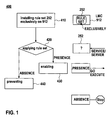
- FIG. 1 illustrates a simplified flow chart diagram of method 400 of the present invention for operating a computer service (e.g. 213 in FIG. 2) - selected from a set of services - on a computer server (e.g., server 913 in FIG. 2) - selected from a set of computer servers.
- the figure shows the flow chart on the left side and symbols for hardware, software and availability states on the right side.
- the method comprises:
- concentrating license management to technically a single computer alleviates the license number problem caused by diversification, see above.
- applying the rule set is the technical approach to obtain the answer to the agreement-related question "Is there a license for the particular service and server selection?".
- the provider of the rule set i.e. the vendor
- the provider of the rule set does not need to know the particular servers (i.e. of the customer) in terms of overall number, service manufacturer or even identification of each server.
- a license manager e.g., 212
- installing 410 comprises to install the license manager and the rule set at different time points. Installation in consecutive order (e.g. manager prior to rules, or vice versa) eases exchange between vendor and customer.
- the license manager can be a standard tool that the vendor gives away free of charge and that is not related to any particular license agreement. If implemented as standard tool, the manager can be part of a software package with services that the vendor ships to the customer. In other words, exclusivity is not needed for the manager alone without rules.
- the rule set is the technical representation of the agreement. It is also convenient that the vendor can ship the rule set through the department that arranges license agreements with the customers.
- license manager and rule set are installed substantially simultaneously (e.g., in a package).
- the license manager is installed on a license management computer that has processor and memory redundancy. Using redundancy (e.g., by doubling processor or memory) increases the reliability of using the invention.
- step installing 410 comprises to use license key technology (LKT, details explained in FIG. 2).
- LKT ensure exclusivity and prevents unauthorized copying of rule sets. Since the rule sets are operable only on the management computer, there is no need to protect the rule set by encrypting the transmission from vendor to management computer.
- step installing 410 comprises to install the rule set in form of a table. Tables are common for computer services.
- step applying 420 the rule set is performed upon receiving a request from the server of the particular service-to-server selection. This allows to identify the particular server automatically.
- step applying 420 the rule set is performed upon receiving a request from a service wrapper.
- the service wrapper participates in step enabling 430 by using LKT.
- LKT allows to use the present invention in computer systems with services that are not specially adapted for use with the present invention compatibility.
- step applying 420 the rule set comprises to record the particular service and server selection for that presence has been established.
- step applying 420 the rule set comprises to record the particular service-to-server selection in combination with a derived rule.
- the license can then be determined as being absence. Recording selections (e.g., in tables) to indicate ABSENCE/PRESENCE in convenient to keep track of the licenses.
- the rule set determines presence or absence of licenses with types such as: (i) license to use a particular service on a particular server; (ii) license to use a particular service exclusively on a particular server; (iii) license to use a particular service simultaneously in a predetermined number on any servers; and (iv) license to use a particular service for a predetermined time period.
- types such as: (i) license to use a particular service on a particular server; (ii) license to use a particular service exclusively on a particular server; (iii) license to use a particular service simultaneously in a predetermined number on any servers; and (iv) license to use a particular service for a predetermined time period.
- the license types can be combined, for example (iii) and (iv) license to use a particular service for a predetermined time period (e.g., hours, days, months, years) in a predetermined number on any servers.
- Type (iii) does not require the vendor to have knowledge about the particular
- the steps are performed as: step installing 410 by a license organization (LO) according to a license agreement between a service vendor (SV) and a service customer (SC); step applying 420 by the license organization. That allows the customer to select and use selections independently from the vendor (at any time).
- LO license organization
- SC service customer
- FIG. 2 illustrates an overview of the present invention in the exemplary implementation with one service and one server. From left to right, the figure shows:
- service vendor 201 provides license manager 212 to license organization 202, and license organization 202 installs license manager 212 on its license management computer (LMC) 912.
- LMC license management computer
- service wrapper 223 continues to checks the presence of the license. If the license key validity is running out, the service wrapper gets back to the license manager and requests a new license key (point 06-09).
- FIG. 3 in combination with TABLE 2 illustrates details for a further implementation with multiple services (213-n, set A, B, and C) and multiple servers (913-m, set 1, 2, 3 and 4).
- the exemplary license type is (ii) "particular service on particular server”. Symbols of FIG. 2 like rectangles with sharp or round corners, black circles, arrows and the like are used likewise. For fully using the advantages of the present invention, the number of services and the number of servers is increased. While points 01 to 05, are substantially similar as in FIG. 2; the last actions (e.g., 06' to 08') are enhanced by 3 preparation steps:
- the service-and-server selection is made by customer 203 without negotiation with vendor 203, fitting into the "computing on demand" approach.
- the servers are provided in blade server technology (processor/memory located on a single circuit board; multiple servers in racks). Servers can be added (or removed) at any time.
- the enhanced scenario of FIG. 2 can be modified by re-arranging the in order, for example to:
- FIG. 4 illustrates a simplified block diagram of exemplary computer system 999 having a plurality of computers 900, 901, 902 (or even more).
- Computer 900 can communicate with computers 901 and 902 over network 990.
- Computer 900 has processor 910, memory 920, bus 930, and, optionally, input device 940 and output device 950 (I/O devices, user interface 960).
- the invention is implemented by computer program product 100 (CPP), carrier 970 and signal 980.
- computer 901/902 is sometimes referred to as "remote computer", computer 901/902 is, for example, a server, a peer device or other common network node, and typically has many or all of the elements described relative to computer 900.
- Computer 900 is, for example, a conventional personal computer (PC), a desktop device or a hand-held device, a multiprocessor computer, a pen computer, a microprocessor-based or programmable consumer electronics device, a minicomputer, a mainframe computer, a personal mobile computing device, a mobile phone, a portable or stationary personal computer, a palmtop computer or the like.
- Processor 910 is, for example, a central processing unit (CPU), a microcontroller unit (MCU), digital signal processor (DSP), or the like.
- Memory 920 is elements that temporarily or permanently store data and instructions. Although memory 920 is illustrated as part of computer 900, memory can also be implemented in network 990, in computers 901/902 and in processor 910 itself (e.g., cache, register), or elsewhere. Memory 920 can be a read only memory (ROM), a random access memory (RAM), or a memory with other access options.
- Memory 920 is physically implemented by computer-readable media, for example: (a) magnetic media, like a hard disk, a floppy disk, or other magnetic disk, a tape, a cassette tape; (b) optical media, like optical disk (CD-ROM, digital versatile disk - DVD); (c) semiconductor media, like DRAM, SRAM, EPROM, EEPROM, memory stick.
- memory 920 is distributed. Portions of memory 920 can be removable or non-removable.
- computer 900 uses well-known devices, for example, disk drives, or tape drives.
- Memory 920 stores modules such as, for example, a basic input output system (BIOS), an operating system (OS), a program library, a compiler, an interpreter, and a text- processing tool. Modules are commercially available and can be installed on computer 900. For simplicity, these modules are not illustrated.
- CPP 100 has program instructions and - optionally - data that cause processor 910 to execute method steps of the present invention. In other words, CPP 100 can control the operation of computer 900 and its interaction in network system 999 so that is operates to perform in accordance with the invention.
- CPP 100 can be available as source code in any programming language, and as object code (“binary code”) in a compiled form.
- CPP 100 is illustrated as being stored in memory 920, CPP 100 can be located elsewhere.
- CPP 100 can also be embodied in carrier 970.
- Carrier 970 is illustrated outside computer 900. For communicating CPP 100 to computer 900, carrier 970 is conveniently inserted into input device 940.
- Carrier 970 is implemented as any computer readable medium, such as a medium largely explained above (cf. memory 920).
- carrier 970 is an article of manufacture having a computer readable medium with computer readable program code to cause the computer to perform methods of the present invention.
- signal 980 can also embody computer program product 100. Having described CPP 100, carrier 970, and signal 980 in connection with computer 900 is convenient.
- Input device 940 provides data and instructions for processing by computer 900.
- Device 940 can be a keyboard, a pointing device (e.g., mouse, trackball, cursor direction keys), microphone, joystick, game pad, scanner, or disc drive.
- a wireless receiver e.g., with satellite dish or terrestrial antenna
- a sensor e.g., a thermometer
- a counter e.g., a goods counter in a factory.
- Input device 940 can serve to read carrier 970.
- Output device 950 presents instructions and data that have been processed.
- this can be a monitor or a display, (cathode ray tube (CRT), flat panel display, liquid crystal display (LCD), speaker, printer, plotter, vibration alert device.
- Output device 950 can communicate with the user, but it can also communicate with further computers. Input device 940 and output device 950 can be combined to a single device. Any device 940 and 950 can be provided optional.
- Bus 930 and network 990 provide logical and physical connections by conveying instruction and data signals. While connections inside computer 900 are conveniently referred to as "bus 930", connections between computers 900-902 are referred to as "network 990".
- network 990 includes gateways which are computers that specialize in data transmission and protocol conversion.
- Devices 940 and 950 are coupled to computer 900 by bus 930 (as illustrated) or by network 990 (optional). While the signals inside computer 900 are mostly electrical signals, the signals in network are electrical, electromagnetic, optical or wireless (radio) signals. Networks are commonplace in offices, enterprise-wide computer networks, intranets and the Intemet (e.g., world wide web). Network 990 can be a wired or a wireless network.
- network 990 can be, for example, a local area network (LAN), a wide area network (WAN), a public switched telephone network (PSTN); a Integrated Services Digital Network (ISDN), an infra-red (IR) link, a radio link, like Universal Mobile Telecommunications System (UMTS), Global System for Mobile Communication (GSM), Code Division Multiple Access (CDMA), or satellite link.
- LAN local area network
- WAN wide area network
- PSTN public switched telephone network
- ISDN Integrated Services Digital Network
- IR infra-red
- radio link like Universal Mobile Telecommunications System (UMTS), Global System for Mobile Communication (GSM), Code Division Multiple Access (CDMA), or satellite link.
- UMTS Universal Mobile Telecommunications System
- GSM Global System for Mobile Communication
- CDMA Code Division Multiple Access
- TCP/IP transmission control protocol/internet protocol
- HTTP hypertext transfer protocol
- WAP wireless application protocol
- URL unique resource locator
- URL unique resource identifier
- HTML hypertext markup language
- XML extensible markup language
- XHTML extensible hypertext markup language
- WML wireless markup language
- SGML Standard Generalized Markup Language
- Interfaces coupled between the elements are also well known in the art. For simplicity, interfaces are not illustrated.
- An interface can be, for example, a serial port interface, a parallel port interface, a game port, a universal serial bus (USB) interface, an internal or external modem, a video adapter, or a sound card.
- Computer and program are closely related. As used hereinafter, phrases, such as "the computer provides” and “the program provides”, are convenient abbreviation to express actions by a computer that is controlled by a program.
Landscapes
- Engineering & Computer Science (AREA)
- Software Systems (AREA)
- Theoretical Computer Science (AREA)
- Multimedia (AREA)
- Technology Law (AREA)
- Computer Hardware Design (AREA)
- Computer Security & Cryptography (AREA)
- Physics & Mathematics (AREA)
- General Engineering & Computer Science (AREA)
- General Physics & Mathematics (AREA)
- Management, Administration, Business Operations System, And Electronic Commerce (AREA)
Priority Applications (2)
| Application Number | Priority Date | Filing Date | Title |
|---|---|---|---|
| EP03012292A EP1486849A1 (fr) | 2003-06-12 | 2003-06-12 | Gestion de licenses dans des systèmes d'ordinateurs avec une distribution de services à des serveurs dynamique |
| PCT/EP2004/051100 WO2004111805A1 (fr) | 2003-06-12 | 2004-06-14 | Gestion de licence dans des systemes informatiques a distribution dynamique service-serveur |
Applications Claiming Priority (1)
| Application Number | Priority Date | Filing Date | Title |
|---|---|---|---|
| EP03012292A EP1486849A1 (fr) | 2003-06-12 | 2003-06-12 | Gestion de licenses dans des systèmes d'ordinateurs avec une distribution de services à des serveurs dynamique |
Publications (1)
| Publication Number | Publication Date |
|---|---|
| EP1486849A1 true EP1486849A1 (fr) | 2004-12-15 |
Family
ID=33185853
Family Applications (1)
| Application Number | Title | Priority Date | Filing Date |
|---|---|---|---|
| EP03012292A Ceased EP1486849A1 (fr) | 2003-06-12 | 2003-06-12 | Gestion de licenses dans des systèmes d'ordinateurs avec une distribution de services à des serveurs dynamique |
Country Status (2)
| Country | Link |
|---|---|
| EP (1) | EP1486849A1 (fr) |
| WO (1) | WO2004111805A1 (fr) |
Cited By (5)
| Publication number | Priority date | Publication date | Assignee | Title |
|---|---|---|---|---|
| EP2184705A1 (fr) * | 2008-11-10 | 2010-05-12 | Siemens Aktiengesellschaft | Procédé, système et appareil destinés au traitement de droits |
| US20120246474A1 (en) * | 2011-03-22 | 2012-09-27 | International Business Machines Corporation | System, method and computer program product for product license management |
| US20140033167A1 (en) * | 2009-08-28 | 2014-01-30 | Adobe Systems Incorporated | Method and system for generating a manifestation of a model in actionscript |
| EP1861815A4 (fr) * | 2005-03-24 | 2014-04-09 | Microsoft Corp | Systemes et methodes pour utiliser des attributs de machine pour empecher une piraterie logicielle dans un environnement d'entreprise |
| FR3068801A1 (fr) * | 2017-07-05 | 2019-01-11 | Airbus | Procede et systeme de gestion de licences de logiciel d'une entreprise fournissant des services a une entreprise cliente |
Citations (3)
| Publication number | Priority date | Publication date | Assignee | Title |
|---|---|---|---|---|
| EP0971281A1 (fr) * | 1998-07-09 | 2000-01-12 | Bull S.A. | Procédé et système de gestion de licences dans un contexte client/serveur |
| US6021438A (en) * | 1997-06-18 | 2000-02-01 | Wyatt River Software, Inc. | License management system using daemons and aliasing |
| US6324578B1 (en) * | 1998-12-14 | 2001-11-27 | International Business Machines Corporation | Methods, systems and computer program products for management of configurable application programs on a network |
-
2003
- 2003-06-12 EP EP03012292A patent/EP1486849A1/fr not_active Ceased
-
2004
- 2004-06-14 WO PCT/EP2004/051100 patent/WO2004111805A1/fr not_active Ceased
Patent Citations (3)
| Publication number | Priority date | Publication date | Assignee | Title |
|---|---|---|---|---|
| US6021438A (en) * | 1997-06-18 | 2000-02-01 | Wyatt River Software, Inc. | License management system using daemons and aliasing |
| EP0971281A1 (fr) * | 1998-07-09 | 2000-01-12 | Bull S.A. | Procédé et système de gestion de licences dans un contexte client/serveur |
| US6324578B1 (en) * | 1998-12-14 | 2001-11-27 | International Business Machines Corporation | Methods, systems and computer program products for management of configurable application programs on a network |
Cited By (7)
| Publication number | Priority date | Publication date | Assignee | Title |
|---|---|---|---|---|
| EP1861815A4 (fr) * | 2005-03-24 | 2014-04-09 | Microsoft Corp | Systemes et methodes pour utiliser des attributs de machine pour empecher une piraterie logicielle dans un environnement d'entreprise |
| EP2184705A1 (fr) * | 2008-11-10 | 2010-05-12 | Siemens Aktiengesellschaft | Procédé, système et appareil destinés au traitement de droits |
| US8312550B2 (en) | 2008-11-10 | 2012-11-13 | Siemens Ag | Method, system and apparatus for processing rights |
| US20140033167A1 (en) * | 2009-08-28 | 2014-01-30 | Adobe Systems Incorporated | Method and system for generating a manifestation of a model in actionscript |
| US20120246474A1 (en) * | 2011-03-22 | 2012-09-27 | International Business Machines Corporation | System, method and computer program product for product license management |
| US8904174B2 (en) * | 2011-03-22 | 2014-12-02 | International Business Machines Corporation | System, method and computer program product for product license management |
| FR3068801A1 (fr) * | 2017-07-05 | 2019-01-11 | Airbus | Procede et systeme de gestion de licences de logiciel d'une entreprise fournissant des services a une entreprise cliente |
Also Published As
| Publication number | Publication date |
|---|---|
| WO2004111805A1 (fr) | 2004-12-23 |
Similar Documents
| Publication | Publication Date | Title |
|---|---|---|
| RU2586866C2 (ru) | Дифференцирование набора признаков участником арендуемой среды и пользователем | |
| US9323519B2 (en) | Packaging an application | |
| US7349929B2 (en) | Accessing data based on user identity | |
| US7412690B2 (en) | Method, apparatus, and program for code reusability and maintainability in XML-driven projects | |
| US6850893B2 (en) | Method and apparatus for an improved security system mechanism in a business applications management system platform | |
| US7089583B2 (en) | Method and apparatus for a business applications server | |
| US20030014656A1 (en) | User registry adapter framework | |
| US20020073080A1 (en) | Method and apparatus for an information server | |
| US20130124695A1 (en) | Mobility Device Method | |
| EP1623558B1 (fr) | Procede permettant de consulter des donnees dans un reseau informatique | |
| US20090063175A1 (en) | Methods and systems for providing multiple support options | |
| US7707072B2 (en) | Method, system, and apparatus configured to manage entitlements relative to new purchases | |
| US7103606B2 (en) | Method and apparatus for removing information from a server | |
| EP2538352A2 (fr) | Système et procédé pour fournir une sécurité de page de serveur java | |
| US7054923B2 (en) | Access control repository for providing access control of service profiles for web based solutions | |
| US7016897B2 (en) | Authentication referral search for LDAP | |
| US20060190480A1 (en) | Generation of names related to organization actions | |
| US20050076325A1 (en) | Automatic software update of nodes in a network data processing system | |
| US7197635B2 (en) | Method and apparatus for providing updated time at a data processing system | |
| US7748026B1 (en) | Transparent interceptors for privacy policy implementation | |
| US20020116648A1 (en) | Method and apparatus for centralized storing and retrieving user password using LDAP | |
| US20090216548A1 (en) | License Management in a Networked Software Application Solution | |
| US20080271011A1 (en) | Method and Apparatus for a Client Call Service | |
| WO2004111805A1 (fr) | Gestion de licence dans des systemes informatiques a distribution dynamique service-serveur | |
| US20050120352A1 (en) | Meta directory server providing users the ability to customize work-flows |
Legal Events
| Date | Code | Title | Description |
|---|---|---|---|
| PUAI | Public reference made under article 153(3) epc to a published international application that has entered the european phase |
Free format text: ORIGINAL CODE: 0009012 |
|
| 17P | Request for examination filed |
Effective date: 20040205 |
|
| AK | Designated contracting states |
Kind code of ref document: A1 Designated state(s): AT BE BG CH CY CZ DE DK EE ES FI FR GB GR HU IE IT LI LU MC NL PT RO SE SI SK TR |
|
| AX | Request for extension of the european patent |
Extension state: AL LT LV MK |
|
| 17Q | First examination report despatched |
Effective date: 20041229 |
|
| AKX | Designation fees paid |
Designated state(s): DE GB |
|
| APBN | Date of receipt of notice of appeal recorded |
Free format text: ORIGINAL CODE: EPIDOSNNOA2E |
|
| RAP1 | Party data changed (applicant data changed or rights of an application transferred) |
Owner name: SAP AG |
|
| APAF | Appeal reference modified |
Free format text: ORIGINAL CODE: EPIDOSCREFNE |
|
| APBT | Appeal procedure closed |
Free format text: ORIGINAL CODE: EPIDOSNNOA9E |
|
| STAA | Information on the status of an ep patent application or granted ep patent |
Free format text: STATUS: THE APPLICATION HAS BEEN REFUSED |
|
| 18R | Application refused |
Effective date: 20050903 |