EP1486906A1 - Procédé pour modifier le comportement d'une carte à puce - Google Patents
Procédé pour modifier le comportement d'une carte à puce Download PDFInfo
- Publication number
- EP1486906A1 EP1486906A1 EP03291404A EP03291404A EP1486906A1 EP 1486906 A1 EP1486906 A1 EP 1486906A1 EP 03291404 A EP03291404 A EP 03291404A EP 03291404 A EP03291404 A EP 03291404A EP 1486906 A1 EP1486906 A1 EP 1486906A1
- Authority
- EP
- European Patent Office
- Prior art keywords
- portable object
- card
- smart card
- behavior
- portable
- Prior art date
- Legal status (The legal status is an assumption and is not a legal conclusion. Google has not performed a legal analysis and makes no representation as to the accuracy of the status listed.)
- Withdrawn
Links
Images

Classifications
-
- G—PHYSICS
- G07—CHECKING-DEVICES
- G07F—COIN-FREED OR LIKE APPARATUS
- G07F7/00—Mechanisms actuated by objects other than coins to free or to actuate vending, hiring, coin or paper currency dispensing or refunding apparatus
- G07F7/08—Mechanisms actuated by objects other than coins to free or to actuate vending, hiring, coin or paper currency dispensing or refunding apparatus by coded identity card or credit card or other personal identification means
- G07F7/10—Mechanisms actuated by objects other than coins to free or to actuate vending, hiring, coin or paper currency dispensing or refunding apparatus by coded identity card or credit card or other personal identification means together with a coded signal, e.g. in the form of personal identification information, like personal identification number [PIN] or biometric data
- G07F7/1008—Active credit-cards provided with means to personalise their use, e.g. with PIN-introduction/comparison system
-
- G—PHYSICS
- G06—COMPUTING OR CALCULATING; COUNTING
- G06K—GRAPHICAL DATA READING; PRESENTATION OF DATA; RECORD CARRIERS; HANDLING RECORD CARRIERS
- G06K19/00—Record carriers for use with machines and with at least a part designed to carry digital markings
- G06K19/06—Record carriers for use with machines and with at least a part designed to carry digital markings characterised by the kind of the digital marking, e.g. shape, nature, code
- G06K19/067—Record carriers with conductive marks, printed circuits or semiconductor circuit elements, e.g. credit or identity cards also with resonating or responding marks without active components
- G06K19/07—Record carriers with conductive marks, printed circuits or semiconductor circuit elements, e.g. credit or identity cards also with resonating or responding marks without active components with integrated circuit chips
-
- G—PHYSICS
- G06—COMPUTING OR CALCULATING; COUNTING
- G06K—GRAPHICAL DATA READING; PRESENTATION OF DATA; RECORD CARRIERS; HANDLING RECORD CARRIERS
- G06K19/00—Record carriers for use with machines and with at least a part designed to carry digital markings
- G06K19/06—Record carriers for use with machines and with at least a part designed to carry digital markings characterised by the kind of the digital marking, e.g. shape, nature, code
- G06K19/067—Record carriers with conductive marks, printed circuits or semiconductor circuit elements, e.g. credit or identity cards also with resonating or responding marks without active components
- G06K19/07—Record carriers with conductive marks, printed circuits or semiconductor circuit elements, e.g. credit or identity cards also with resonating or responding marks without active components with integrated circuit chips
- G06K19/0719—Record carriers with conductive marks, printed circuits or semiconductor circuit elements, e.g. credit or identity cards also with resonating or responding marks without active components with integrated circuit chips at least one of the integrated circuit chips comprising an arrangement for application selection, e.g. an acceleration sensor or a set of radio buttons
-
- G—PHYSICS
- G06—COMPUTING OR CALCULATING; COUNTING
- G06Q—INFORMATION AND COMMUNICATION TECHNOLOGY [ICT] SPECIALLY ADAPTED FOR ADMINISTRATIVE, COMMERCIAL, FINANCIAL, MANAGERIAL OR SUPERVISORY PURPOSES; SYSTEMS OR METHODS SPECIALLY ADAPTED FOR ADMINISTRATIVE, COMMERCIAL, FINANCIAL, MANAGERIAL OR SUPERVISORY PURPOSES, NOT OTHERWISE PROVIDED FOR
- G06Q20/00—Payment architectures, schemes or protocols
- G06Q20/30—Payment architectures, schemes or protocols characterised by the use of specific devices or networks
- G06Q20/34—Payment architectures, schemes or protocols characterised by the use of specific devices or networks using cards, e.g. integrated circuit [IC] cards or magnetic cards
- G06Q20/341—Active cards, i.e. cards including their own processing means, e.g. including an IC or chip
-
- G—PHYSICS
- G06—COMPUTING OR CALCULATING; COUNTING
- G06Q—INFORMATION AND COMMUNICATION TECHNOLOGY [ICT] SPECIALLY ADAPTED FOR ADMINISTRATIVE, COMMERCIAL, FINANCIAL, MANAGERIAL OR SUPERVISORY PURPOSES; SYSTEMS OR METHODS SPECIALLY ADAPTED FOR ADMINISTRATIVE, COMMERCIAL, FINANCIAL, MANAGERIAL OR SUPERVISORY PURPOSES, NOT OTHERWISE PROVIDED FOR
- G06Q20/00—Payment architectures, schemes or protocols
- G06Q20/30—Payment architectures, schemes or protocols characterised by the use of specific devices or networks
- G06Q20/34—Payment architectures, schemes or protocols characterised by the use of specific devices or networks using cards, e.g. integrated circuit [IC] cards or magnetic cards
- G06Q20/357—Cards having a plurality of specified features
Definitions
- the present invention concerns a method for changing the behavior of a portable object such as a smart card according to the role it has to play in a determined system and the portable object itself.
- This invention is applicable to applications involving a smart card embedding several input/output channels (e.g. I/O1 + I/O2) (I/O is an input/output) as described in a patent application filed by the present applicant the same day as the present application and whose title is "Smart and secure gateway for performing secure operations", hereafter called the Patent.
- I/O1 + I/O2 input/output channels
- I/O is an input/output
- Cards with integrated circuit also called smart cards are small plastic devices which contain one or more embedded integrated circuits.
- a card with integrated circuit can be for example a memory card or a microprocessor card also called microprocessor chip card.
- a smart card is accessed with a card reader that has an aperture or slot or else into which the smart card is inserted.
- the smart card reader covers every device used to receive or to be connected with a smart card and work with it (read, write, delete, and/or every possible operation).
- the smart card reader can be part or linked with a computer, a pinpad or else...
- the present invention covers smart cards but also every portable object provided with integrated circuit allowing to work or dialog with at least one portable object accepting device and in embodiments described hereafter, portable object with at least one integrated circuit designed to offer security functions such as authentication, validation, encryption/decryption, secure storage, .
- the portable object accepting device may have the form of a housing provided with an aperture or slot to receive the portable object but also any form allowing the portable object to be connected to the portable object accepting device.
- a same smart card may face several scenarios:
- I/O1 and I/O2 are two I/Os at the same time: I/O1 and I/O2:
- the smart card applications have to work differently with a number of independent devices ; the smart card applications have to change according to the role they have to play.
- a solution to change the behavior of the smart card according to the scenario is that the POS sends data to the smart card indicating the application required.
- Another solution consists for the user to input manually said data.
- a goal of the solution described hereafter is to offer a solution which does not require any intervention of the user or which does not require information on the application needed from the smart card accepting device.
- This invention belongs to the field of portable object provided with at least memory means and connectors able to connect said portable object to at least an object-accepting device with which the portable object is able to work or dialog.
- the method according to the present invention is aimed at changing the behavior of a portable object according to the role the portable object has to play in a particular system.
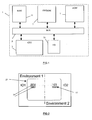
- the portable object is a smart card with an integrated electronic unit 1: the electronic unit 1 comprises at least a microprocessor CPU 3 with two-way connection via an internal bus 5 to a non volatile memory 7 of type ROM, EEPROM, Flash, FeRam or else storing at least a program to be executed, a volatile memory 11 of type RAM and input/output means 13 to communicate with the exterior.
- the unit 1 may comprise additional components not shown, connected to the internal bus.
- This type of unit is generally manufactured as a monolithic integrated electronic circuit, or chip, which once physically protected by any known means can be assembled on the integrated circuit card or similar for use in various fields, such as the bank and/or electronic payment cards, mobile radio telephony, pay television, health and transport.
- the smart card 15 is constituted of said chip in the thickness of the card connected to a module 17.
- the module 17 comprises a set of flat connectors 19 on the surface of the card allowing said chip to be connected and work with a card-accepting device.
- the memory space of the electronic unit 1 consists of the memory RAM 11, the memory ROM and the memory EEPROM 7. This space stores various types of software often represented as software layers. From the hardware layer consisting of the electronic unit 1, we can identify the "core” software layer interfacing directly with the hardware and concerning amongst other things the microprocessor reset, input/output management, interrupt management, the operating system layer OS concerning in particular the system configuration, organization of system operation regarding applications, organization of memory space and addressing, management of peripherals, and the "application” layer with various resident applications for example a program interpreter written in SUN MICROSYSTEMS JAVA language and "user” applications corresponding to precise features (example: bank card, health card, identity card).
- the smart card design assigns a specific role to each existing I/O.
- one I/O(or I/Os) is(are) dedicated to support the exchanges with an insecure or uncontrolled environment (i.e. an environment on which the user cannot rely without restriction such as a PC).
- the other I/O(s) is(are) connected to environment(s) on which the user can be confident (e.g. a personal PIN pad or a POS payment terminal).
- the principle of the present invention is the following:
- the smart card takes into account the channel through which the data comes, ie the connector(s) 19 of the smart card which is(are) used, how many connectors are used and/or the type and/or the version of smart card accepting device(s) to which the smart card is connected.
- the smart card automatically knows how to behave, which means more precisely which application from the application layer is required in the smart card and/or in a device with which the smart card communicates (the smart card accepting device (card reader), a server with which the smart card works, or else).
- the smart card behavior is defined by the comportment of any applicative piece of software embedded in the applicative layer of the card and/or of at least one device with which the smart card communicates.
- the smart card behavior varies upon the presence, the absence, the type, the version, of the devices(s) connected to the card.
- the method of the present invention consists in choosing the behavior of the portable object (here the smart card) and/or of at least one device with which the portable object communicates according to the physical and/or logical environment of said portable object., i.e. :
- the PC is an insecure environment because a virus could perform unwanted actions that the user does not see, including addressing a connected smart card.
- the card owner pays at the merchant shop, he introduces his card the ISO side first, he checks the amount of the transaction on the merchant payment terminal display, and enters his PIN to validate the transaction.
- the merchant payment terminal controls the entire payment scheme.
- the terminal retrieves the PIN from its keyboard, and presents it to the smart card. All exchanges between the card and the terminal flow through IO1. Since it detects IO1 is the unique communication channel (and particularly for the PIN presentation), and because the card was reset in an ISO compliant scheme (reset sequence, timing, external clock...), the smart card applies the corresponding payment scheme , the first payment scheme.
- the user checks out the Internet site for payment. Having verified the list of its purchases, the user is invited to introduce his payment card on his reader. The user introduces his card the USB side first. A communication channel is established between the card and the PC through the card I/O2. The Internet site verifies the card as it can access it transparently. The reading of a data in the card (e.g. application reference) allows detecting the card and it is then required a personal PIN pad to complete a payment over the Internet. A message asking the user to connect the personal PIN pad is displayed. The user connects the card to his personal PIN pad. This second communication channel flows through the card I/O1.
- a data in the card e.g. application reference
- the PC powers the personal PIN pad through the card that relays VCC and GND connectors to the PIN pad side (wires are coated in the card plastic body).
- the I/O2 is dedicated for USB communication.
- the I/O1 is compatible with both ISO standards and the PIN pads specific protocols. According to its startup, the card knows if it is inserted in an ISO device or if it should search for one of the personal PIN pads it knows.
- the card When started the I/O2 connected to a USB host, the card detects the presence of the personal PIN pad by regularly polling I/O1 or because it receives a signal from the personal PIN pad through I/O1, (depending if the PIN pad is pro active or passive).
- the portable object detects the presence of a specific device with which it is connected by regularly polling the input(s)/output(s) or by receiving a signal from it through a specific input/output.
- the card When it receives the essential transaction data (price, goods/services list%) from the Internet site (through I/O2), the card displays the goods/services list on the personal PIN pad display by sending the information through I/O1. The user confirms or cancels the transaction by pressing a key on the PIN pad keyboard. Hence, the card requires the user to enter its PIN by displaying a dedicated message on the personal PIN pad. When the PIN is entered and verified, the card calculates the cryptogram authenticating the payment transaction, based on the data that were displayed on the personal PIN pad display. The smart card applied a corresponding payment scheme, the second payment scheme.
- the personal PIN pad may be of different types. It embeds a micro controller and supports a communication protocol. There are different personal PIN pad types embedding different communication protocols, having a small or a large display, more or less keys...
- the smart card embeds several pieces of software is order to adapt its behavior to the PIN pad to which it is connected (type, version).
- the card When the card starts, it checks for the PIN pad presence and type by sending a specific detection string. If the PIN pad recognizes it, it returns an answer that contains its version and describes its characteristics (display, keyboard; buzzer, ). If the PIN pad did not answer to the first detection string, the card sends another different detection string to search for another type of personal PIN pad. It continues until it finds the personal PIN pad type. If no compatible PIN pad is found, the transaction is aborted upon the smart card decision.
- the card knows the application interface (API) it accepts. Knowing its characteristics, the smart card behavior is adapted according to the user interfaces (message to display, key sequences, ).
- API application interface
- the smart card differentiates the payment schemes according to the number of I/Os used during the transaction, and by detecting the type of the card-accepting device in which it starts (i.e. ISO or USB). In the ISO case, all the data transit through IO1. In the USB case, most of the data flows through I/O2 (card ⁇ PC), while the I/O1 is used to establish the link with the personal PIN pad. The behavior of the smart card changes according to the number of I/O, and so on the number of connectors which are used in the payment system.
- ISO the type of the card-accepting device in which it starts
- the card In order to support several type of card accepting device through I/O1 (i.e. ISO POS device and personal PIN pad), the card shall be able to multiplex the use of the C7 connector (referenced as the I/O connector in ISO standard). This is described in another patent filed by the present applicant on the same day as the present application and whose title is “Method and system for multiplexing smart card electric connections”.
Landscapes
- Engineering & Computer Science (AREA)
- Microelectronics & Electronic Packaging (AREA)
- Physics & Mathematics (AREA)
- General Physics & Mathematics (AREA)
- Theoretical Computer Science (AREA)
- Business, Economics & Management (AREA)
- Computer Hardware Design (AREA)
- Computer Networks & Wireless Communication (AREA)
- Accounting & Taxation (AREA)
- Strategic Management (AREA)
- General Business, Economics & Management (AREA)
- Cash Registers Or Receiving Machines (AREA)
Priority Applications (1)
| Application Number | Priority Date | Filing Date | Title |
|---|---|---|---|
| EP03291404A EP1486906A1 (fr) | 2003-06-12 | 2003-06-12 | Procédé pour modifier le comportement d'une carte à puce |
Applications Claiming Priority (1)
| Application Number | Priority Date | Filing Date | Title |
|---|---|---|---|
| EP03291404A EP1486906A1 (fr) | 2003-06-12 | 2003-06-12 | Procédé pour modifier le comportement d'une carte à puce |
Publications (1)
| Publication Number | Publication Date |
|---|---|
| EP1486906A1 true EP1486906A1 (fr) | 2004-12-15 |
Family
ID=33185992
Family Applications (1)
| Application Number | Title | Priority Date | Filing Date |
|---|---|---|---|
| EP03291404A Withdrawn EP1486906A1 (fr) | 2003-06-12 | 2003-06-12 | Procédé pour modifier le comportement d'une carte à puce |
Country Status (1)
| Country | Link |
|---|---|
| EP (1) | EP1486906A1 (fr) |
Citations (4)
| Publication number | Priority date | Publication date | Assignee | Title |
|---|---|---|---|---|
| WO1995024019A1 (fr) * | 1994-03-02 | 1995-09-08 | Angewandte Digital Elektronik Gmbh | Carte a puce a plusieurs microcontroleurs |
| WO1999049415A2 (fr) * | 1998-03-26 | 1999-09-30 | Gemplus | Carte a puce a interface polyvalente |
| WO2000023936A1 (fr) * | 1998-10-21 | 2000-04-27 | Litronic, Inc. | Appareil et procede permettant de fournir des cartes et des lecteurs bi-mode |
| WO2002031762A1 (fr) * | 2000-10-11 | 2002-04-18 | Stmicroelectronics, Inc. | Carte intelligente multi-mode, systeme et procedes associes |
-
2003
- 2003-06-12 EP EP03291404A patent/EP1486906A1/fr not_active Withdrawn
Patent Citations (4)
| Publication number | Priority date | Publication date | Assignee | Title |
|---|---|---|---|---|
| WO1995024019A1 (fr) * | 1994-03-02 | 1995-09-08 | Angewandte Digital Elektronik Gmbh | Carte a puce a plusieurs microcontroleurs |
| WO1999049415A2 (fr) * | 1998-03-26 | 1999-09-30 | Gemplus | Carte a puce a interface polyvalente |
| WO2000023936A1 (fr) * | 1998-10-21 | 2000-04-27 | Litronic, Inc. | Appareil et procede permettant de fournir des cartes et des lecteurs bi-mode |
| WO2002031762A1 (fr) * | 2000-10-11 | 2002-04-18 | Stmicroelectronics, Inc. | Carte intelligente multi-mode, systeme et procedes associes |
Similar Documents
| Publication | Publication Date | Title |
|---|---|---|
| US12456028B2 (en) | System and apparatus for encrypted data collection using RFID cards | |
| EP2559012B1 (fr) | Système de paiement sécurisé sur un réseau de communication sans fil | |
| JP3776401B2 (ja) | マルチモード・スマートカード・システム及びこれに関連する方法 | |
| US20200005273A1 (en) | Authentication Device & Related Methods | |
| US20100325052A1 (en) | Wireless transaction payment service application selection | |
| CN102460520A (zh) | 使用移动通信装置的支付终端,例如移动电话;直接借记支付交易的方法 | |
| US20040267672A1 (en) | System and method for conducting secure electronic transactions | |
| CN103562972A (zh) | 手持自置备pin ped通信器 | |
| CN101120354B (zh) | 用于操作装置的装置和方法 | |
| KR20000054496A (ko) | 다기능 마우스 및 그를 이용한 전화, 시스템보안 및전자상거래 방법 | |
| CN102542697B (zh) | 基于具有网络访问功能的电子设备的pos终端 | |
| JP5124288B2 (ja) | デバイスを動作させることのデバイスおよび方法 | |
| Husemann | The smart card: don't leave home without it | |
| JP2003044765A (ja) | クレジットカード取引依頼装置、加盟店端末、クレジットカード取引依頼方法、コンピュータプログラム、及びicチップ | |
| EP1486906A1 (fr) | Procédé pour modifier le comportement d'une carte à puce | |
| EP1486908A1 (fr) | Carte à puce avec deux ports d'entrée/sortie pour la connexion des environnements sécurisés et non sécurisés | |
| EP1486907A1 (fr) | Procédé et système pour le multiplexage de contacts d'une carte à puce | |
| WO2004111926A1 (fr) | Separation dielectrique entre les entrees et les sorties d'une carte a puce | |
| EP1486911A1 (fr) | Séparation diélectrique entre des entrées/sorties d'une carte à puce | |
| HK40052414A (en) | System and apparatus for encrypted data collection using rfid cards |
Legal Events
| Date | Code | Title | Description |
|---|---|---|---|
| PUAI | Public reference made under article 153(3) epc to a published international application that has entered the european phase |
Free format text: ORIGINAL CODE: 0009012 |
|
| AK | Designated contracting states |
Kind code of ref document: A1 Designated state(s): AT BE BG CH CY CZ DE DK EE ES FI FR GB GR HU IE IT LI LU MC NL PT RO SE SI SK TR |
|
| AX | Request for extension of the european patent |
Extension state: AL LT LV MK |
|
| AKX | Designation fees paid | ||
| REG | Reference to a national code |
Ref country code: DE Ref legal event code: 8566 |
|
| STAA | Information on the status of an ep patent application or granted ep patent |
Free format text: STATUS: THE APPLICATION IS DEEMED TO BE WITHDRAWN |
|
| 18D | Application deemed to be withdrawn |
Effective date: 20050616 |