EP1486943A2 - Vorrichtung und Verfahren zur Ansteuerung eines Licht emittierenden Anzeige-Paneels - Google Patents
Vorrichtung und Verfahren zur Ansteuerung eines Licht emittierenden Anzeige-Paneels Download PDFInfo
- Publication number
- EP1486943A2 EP1486943A2 EP04011877A EP04011877A EP1486943A2 EP 1486943 A2 EP1486943 A2 EP 1486943A2 EP 04011877 A EP04011877 A EP 04011877A EP 04011877 A EP04011877 A EP 04011877A EP 1486943 A2 EP1486943 A2 EP 1486943A2
- Authority
- EP
- European Patent Office
- Prior art keywords
- scan
- light emitting
- display panel
- lines
- emitting display
- Prior art date
- Legal status (The legal status is an assumption and is not a legal conclusion. Google has not performed a legal analysis and makes no representation as to the accuracy of the status listed.)
- Withdrawn
Links
- 238000000034 method Methods 0.000 title claims abstract description 26
- 230000003071 parasitic effect Effects 0.000 claims abstract description 34
- 239000003990 capacitor Substances 0.000 claims description 11
- 238000007599 discharging Methods 0.000 abstract 1
- 230000007613 environmental effect Effects 0.000 description 10
- 238000010586 diagram Methods 0.000 description 6
- 239000011159 matrix material Substances 0.000 description 6
- 239000000470 constituent Substances 0.000 description 3
- 239000010410 layer Substances 0.000 description 3
- 230000003247 decreasing effect Effects 0.000 description 2
- 230000003068 static effect Effects 0.000 description 2
- 230000008021 deposition Effects 0.000 description 1
- 238000006073 displacement reaction Methods 0.000 description 1
- 230000000694 effects Effects 0.000 description 1
- 150000002894 organic compounds Chemical class 0.000 description 1
- 239000012044 organic layer Substances 0.000 description 1
- 239000011368 organic material Substances 0.000 description 1
- 239000004065 semiconductor Substances 0.000 description 1
Images



Classifications
-
- G—PHYSICS
- G09—EDUCATION; CRYPTOGRAPHY; DISPLAY; ADVERTISING; SEALS
- G09G—ARRANGEMENTS OR CIRCUITS FOR CONTROL OF INDICATING DEVICES USING STATIC MEANS TO PRESENT VARIABLE INFORMATION
- G09G3/00—Control arrangements or circuits, of interest only in connection with visual indicators other than cathode-ray tubes
- G09G3/20—Control arrangements or circuits, of interest only in connection with visual indicators other than cathode-ray tubes for presentation of an assembly of a number of characters, e.g. a page, by composing the assembly by combination of individual elements arranged in a matrix no fixed position being assigned to or needed to be assigned to the individual characters or partial characters
- G09G3/22—Control arrangements or circuits, of interest only in connection with visual indicators other than cathode-ray tubes for presentation of an assembly of a number of characters, e.g. a page, by composing the assembly by combination of individual elements arranged in a matrix no fixed position being assigned to or needed to be assigned to the individual characters or partial characters using controlled light sources
- G09G3/30—Control arrangements or circuits, of interest only in connection with visual indicators other than cathode-ray tubes for presentation of an assembly of a number of characters, e.g. a page, by composing the assembly by combination of individual elements arranged in a matrix no fixed position being assigned to or needed to be assigned to the individual characters or partial characters using controlled light sources using electroluminescent panels
- G09G3/32—Control arrangements or circuits, of interest only in connection with visual indicators other than cathode-ray tubes for presentation of an assembly of a number of characters, e.g. a page, by composing the assembly by combination of individual elements arranged in a matrix no fixed position being assigned to or needed to be assigned to the individual characters or partial characters using controlled light sources using electroluminescent panels semiconductive, e.g. using light-emitting diodes [LED]
- G09G3/3208—Control arrangements or circuits, of interest only in connection with visual indicators other than cathode-ray tubes for presentation of an assembly of a number of characters, e.g. a page, by composing the assembly by combination of individual elements arranged in a matrix no fixed position being assigned to or needed to be assigned to the individual characters or partial characters using controlled light sources using electroluminescent panels semiconductive, e.g. using light-emitting diodes [LED] organic, e.g. using organic light-emitting diodes [OLED]
- G09G3/3216—Control arrangements or circuits, of interest only in connection with visual indicators other than cathode-ray tubes for presentation of an assembly of a number of characters, e.g. a page, by composing the assembly by combination of individual elements arranged in a matrix no fixed position being assigned to or needed to be assigned to the individual characters or partial characters using controlled light sources using electroluminescent panels semiconductive, e.g. using light-emitting diodes [LED] organic, e.g. using organic light-emitting diodes [OLED] using a passive matrix
-
- G—PHYSICS
- G09—EDUCATION; CRYPTOGRAPHY; DISPLAY; ADVERTISING; SEALS
- G09G—ARRANGEMENTS OR CIRCUITS FOR CONTROL OF INDICATING DEVICES USING STATIC MEANS TO PRESENT VARIABLE INFORMATION
- G09G2310/00—Command of the display device
- G09G2310/02—Addressing, scanning or driving the display screen or processing steps related thereto
- G09G2310/0243—Details of the generation of driving signals
- G09G2310/0248—Precharge or discharge of column electrodes before or after applying exact column voltages
-
- G—PHYSICS
- G09—EDUCATION; CRYPTOGRAPHY; DISPLAY; ADVERTISING; SEALS
- G09G—ARRANGEMENTS OR CIRCUITS FOR CONTROL OF INDICATING DEVICES USING STATIC MEANS TO PRESENT VARIABLE INFORMATION
- G09G2320/00—Control of display operating conditions
- G09G2320/02—Improving the quality of display appearance
- G09G2320/0223—Compensation for problems related to R-C delay and attenuation in electrodes of matrix panels, e.g. in gate electrodes or on-substrate video signal electrodes
-
- G—PHYSICS
- G09—EDUCATION; CRYPTOGRAPHY; DISPLAY; ADVERTISING; SEALS
- G09G—ARRANGEMENTS OR CIRCUITS FOR CONTROL OF INDICATING DEVICES USING STATIC MEANS TO PRESENT VARIABLE INFORMATION
- G09G2320/00—Control of display operating conditions
- G09G2320/04—Maintaining the quality of display appearance
- G09G2320/041—Temperature compensation
-
- G—PHYSICS
- G09—EDUCATION; CRYPTOGRAPHY; DISPLAY; ADVERTISING; SEALS
- G09G—ARRANGEMENTS OR CIRCUITS FOR CONTROL OF INDICATING DEVICES USING STATIC MEANS TO PRESENT VARIABLE INFORMATION
- G09G2330/00—Aspects of power supply; Aspects of display protection and defect management
- G09G2330/02—Details of power systems and of start or stop of display operation
- G09G2330/028—Generation of voltages supplied to electrode drivers in a matrix display other than LCD
-
- G—PHYSICS
- G09—EDUCATION; CRYPTOGRAPHY; DISPLAY; ADVERTISING; SEALS
- G09G—ARRANGEMENTS OR CIRCUITS FOR CONTROL OF INDICATING DEVICES USING STATIC MEANS TO PRESENT VARIABLE INFORMATION
- G09G3/00—Control arrangements or circuits, of interest only in connection with visual indicators other than cathode-ray tubes
- G09G3/20—Control arrangements or circuits, of interest only in connection with visual indicators other than cathode-ray tubes for presentation of an assembly of a number of characters, e.g. a page, by composing the assembly by combination of individual elements arranged in a matrix no fixed position being assigned to or needed to be assigned to the individual characters or partial characters
- G09G3/22—Control arrangements or circuits, of interest only in connection with visual indicators other than cathode-ray tubes for presentation of an assembly of a number of characters, e.g. a page, by composing the assembly by combination of individual elements arranged in a matrix no fixed position being assigned to or needed to be assigned to the individual characters or partial characters using controlled light sources
- G09G3/30—Control arrangements or circuits, of interest only in connection with visual indicators other than cathode-ray tubes for presentation of an assembly of a number of characters, e.g. a page, by composing the assembly by combination of individual elements arranged in a matrix no fixed position being assigned to or needed to be assigned to the individual characters or partial characters using controlled light sources using electroluminescent panels
- G09G3/32—Control arrangements or circuits, of interest only in connection with visual indicators other than cathode-ray tubes for presentation of an assembly of a number of characters, e.g. a page, by composing the assembly by combination of individual elements arranged in a matrix no fixed position being assigned to or needed to be assigned to the individual characters or partial characters using controlled light sources using electroluminescent panels semiconductive, e.g. using light-emitting diodes [LED]
- G09G3/3208—Control arrangements or circuits, of interest only in connection with visual indicators other than cathode-ray tubes for presentation of an assembly of a number of characters, e.g. a page, by composing the assembly by combination of individual elements arranged in a matrix no fixed position being assigned to or needed to be assigned to the individual characters or partial characters using controlled light sources using electroluminescent panels semiconductive, e.g. using light-emitting diodes [LED] organic, e.g. using organic light-emitting diodes [OLED]
- G09G3/3275—Details of drivers for data electrodes
- G09G3/3283—Details of drivers for data electrodes in which the data driver supplies a variable data current for setting the current through, or the voltage across, the light-emitting elements
Definitions
- the present invention relates to a drive device and a drive method for a light emitting display panel in which for example an organic EL (electroluminescent) element is employed as a light emitting element, and particularly to a passive drive type drive device and a drive method in which a constant current source which drives lighting of light emitting elements is not needed and in which the utilization efficiency of a power source can be improved.
- organic EL electroluminescent
- a display panel which is constructed by arranging light emitting elements in a matrix pattern has been developed widely, and as the light emitting element employed in such a display panel, an organic EL element in which an organic material is employed in a light emitting layer has attracted attention. This is because of backgrounds one of which is that by employing, in the light emitting layer of the element, an organic compound which enables an excellent light emitting characteristic to be expected, a high efficiency and a long life which make an EL element satisfactorily practicable have been achieved.
- the organic EL element can be electrically shown by an equivalent circuit as shown in FIG. 1. That is, the organic EL element can be replaced by a structure composed of a diode element E and a parasitic capacitance element Cp which is coupled in parallel to this diode element, and the organic EL element has been considered as a capacitive light emitting element.
- a light emission drive voltage is applied to this organic EL element, at first, electrical charges corresponding to the electric capacity of this element flow into an electrode as a displacement current and are accumulated.
- FIG. 2 shows light emission static characteristics of such an organic EL element.
- the organic EL element emits light at an intensity L approximately proportional to a drive current I as shown in FIG. 2(a) and emits light while the current I flows drastically when the drive voltage V is the light emission threshold voltage Vth or higher as shown in FIG. 2(b).
- the EL element has an intensity characteristic that in a light emission possible region in which the voltage is higher than the threshold voltage Vth, the greater the value of the voltage V applied to the EL element becomes, the higher the light emission intensity L of the EL element becomes as shown by the solid line in FIG. 2(c).
- the intensity property of the organic EL element changes due to environmental temperature changes approximately as shown by dotted lines in FIG. 2(c). That is, while the EL element has a characteristic that the greater the value of the voltage V applied thereto, the higher the light emission intensity L thereof in the light emission possible region in which the voltage is higher than the light emission threshold voltage as described above, the EL element also has a characteristic that the higher the temperature becomes, the lower the light emission threshold voltage becomes.
- the EL element becomes in a state where light emission of the EL element is possible by a lower applied voltage as the temperature becomes higher, and thus the EL element has a temperature dependency of the intensity that the EL element is brighter at a high temperature time and is darker at a lower temperature time though the same light emission possible voltage is applied.
- a constant current drive is performed for the organic EL element due to the reason that the voltage vs. intensity characteristic is unstable with respect to temperature changes as described above while the current vs. intensity characteristic is stable with respect to temperature changes, the reason that the organic EL element is drastically deteriorated in a case where the organic EL element receives an excess current, and the like.
- a display panel employing such organic EL elements a passive drive type display panel in which the elements are arranged in a matrix pattern has already been put into practical use partly.
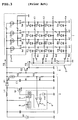
- FIG. 3 a conventional passive matrix type display panel and an example of its drive circuit are shown.
- anode lines A1 to An as n data lines are arranged in a vertical direction
- cathode lines K1 to Km as m scan lines are arranged in a horizontal direction
- organic EL elements E11 to Enm which are denoted by symbols/marks of diodes are arranged at portions at which respective lines intersect one another (in total, n ⁇ m portions) to constitute a display panel 1.
- One ends (anode terminals in equivalent diodes of the EL elements) and other ends (cathode terminals in the equivalent diodes of the EL elements) of the respective EL elements E11 to Enm constituting pixels are connected to the anode lines and cathode lines, respectively, corresponding to respective crossing positions between the anode lines A1 to An extending along the vertical direction and the cathode lines K1 to Km extending along the horizontal direction.
- the respective anode lines A1 to An are connected to an anode line drive circuit 2 provided as a data driver
- the respective cathode liens K1 to Km are connected to a cathode line scan circuit 3 provided as a scan driver, so as to be driven, respectively.
- the anode line drive circuit 2 is provided with constant current sources I1 to In which are operated utilizing a drive voltage VH supplied from a voltage boosting circuit 4 in a later-described DC/DC converter and drive switches Sa1 to San, and the drive switches Sa1 to San are connected to the constant current sources I1 to In sides so that current from the constant current sources I1 to In is supplied to the respective EL elements E11 to Enm arranged corresponding to the cathode lines.
- the drive switches Sa1 to San are constructed in such a way that the anode lines can be connected to the ground side provided as a reference potential point when current from the constant current sources I1 to In is not supplied to the respective EL elements.
- the cathode line scan circuit 3 is provided with scan switches Sk1 to Skm corresponding to the respective cathode lines K1 to Km and operates so as to allow either one of a reverse bias voltage VM supplied from a later-described reverse bias voltage generation circuit 5 which is for preventing cross talk light emission or the ground potential as the reference potential point to be connected to corresponding cathode scan lines.
- a reverse bias voltage VM supplied from a later-described reverse bias voltage generation circuit 5 which is for preventing cross talk light emission or the ground potential as the reference potential point to be connected to corresponding cathode scan lines.
- the above-mentioned DC/DC converter is constructed so as to generate the drive voltage VH of a direct current while utilizing PWM (pulse width modulation) control as the voltage boosting circuit 4 in the example shown in FIG. 3.
- PWM pulse width modulation
- PFM pulse frequency modulation
- PSM pulse skip modulation
- This DC/DC converter is constructed in such a way that a PWM wave outputted from a switching regulator 6 constituting a part of the voltage boosting circuit 4 controls so that a MOS type power FET Q1 as a switching element is turned ON at a predetermined duty cycle. That is, by the ON operation of the power FET Q1, electrical energy from a DC voltage source B1 of a primary side is accumulated in an inductor L1, and the electrical energy accumulated in the inductor L1 is accumulated in a capacitor C1 via a diode D1 as an OFF operation of the power FET Q1. By repeating of the ON/OFF operation of the power FET Q1, a DC output whose voltage is boosted can be obtained as a terminal voltage of the capacitor C1.
- the DC output voltage is divided by a thermistor TH1 performing temperature compensation and resistors R11 and R12, is supplied to an error amplifier 7 in the switching regulator 6, and is compared with a reference voltage Vref in this error amplifier 7.
- This comparison output (error output) is supplied to a PWM circuit 8, and by controlling the duty cycle of a signal wave produced from an oscillator 9, feedback control is performed so that the output voltage is maintained at a predetermined drive voltageVH. Therefore, the output voltage by the DC/DC converter, that is, the drive voltage VH, can be expressed as follows.
- VH Vref ⁇ [(TH1+R11+R12)/R12]
- a control bus extended from a light emission control circuit including an unillustrated CPU is connected to the anode line drive circuit 2 and the cathode line scan circuit 3, and the scan switches Sk1 to Skm and the drive switches Sa1 to San are operated based on a video signal to be displayed.
- the cathode scan lines are set at the ground potential at predetermined cycles based on the video signal
- the constant current sources I1 to In are connected to a desired anode line. Accordingly, the light emitting elements selectively emit light, and thus an image based on the video signal is displayed on the display panel 1.
- the state shown in FIG. 3 shows that the first cathode line K1 is set at the ground potential to be in a scan state and that at this time the reverse bias voltage VM from the reverse bias voltage generation circuit 5 is applied to the cathode lines K2 to Km in a non-scan state. This works so that respective light emitting elements connected to the intersection points between the driven anode lines and the cathode lines which haven not been selected for scan are prevented from emitting cross talk light.
- the constant current sources I1 to In for driving light emission of EL elements are provided. Even when these constant current sources are made into an IC chip, it is difficult for the chip size thereof to be miniaturized, and it cannot be avoided that the cost thereof also increases. Further, in order to allow the constant current sources to have a constant current characteristic, it is necessary to anticipate a certain degree of voltage drop in the constant current source, and this becomes a primary factor to incur a power loss.
- the present invention is to solve the above-described technical problems which occur by the provision of constant current sources in a drive circuit, and it is an object of the present invention to provide a drive device and a drive method for a self light emitting display panel by which any intensity change with respect to the environmental temperature can be easily restrained or deliberately controlled and by which ideal multi-gradation expression can be realized at low cost.
- a drive device of a light emitting display panel in the present invention which has been developed in order to achieve the object described above is, according to a first aspect, a drive device of a light emitting display panel provided with a plurality of data lines and a plurality of scan lines which intersect one another and capacitive light emitting elements having a diode characteristic which are respectively connected, between the data lines and respective scan lines, at intersecting positions between the respective data lines and the respective scan lines, characterized in that scan is implemented one after another by connecting the respective scan lines to a scan potential point and that a scan driver which connects a scan line of a non-scan state which is not connected to the scan potential point to a driving voltage source and a data driver which controls lighting or non-lighting of the respective light emitting elements of a scan state in synchronization with a scan of the scan driver are provided, and characterized by being constructed in such a way that the scan driver and the data driver set all scan lines and all data lines at a same electrical potential when a scan is switched so that electrical charges
- a drive method of a light emitting display panel in the present invention which has been developed in order to achieve the object described above is, according to a ninth aspect, a drive method of a light emitting display panel provided with a plurality of data lines and a plurality of scan lines which intersect one another and capacitive light emitting elements having a diode characteristic which are respectively connected, between the data lines and respective scan lines, at intersecting positions between the respective data lines and respective scan lines, characterized by performing a reset process in which while the scan lines of the display panel are scanned at predetermined cycles, lighting or non-lighting of the respective light emitting elements of a scan state is controlled in synchronization with the scan and in which all scan lines and all data lines are set at a same electrical potential when the scan is switched so that electrical charges accumulated in parasitic capacitances of the respective light emitting elements are discharged and a process which follows this reset process and in which parasitic capacitances of light emitting elements in a non-scan state are charged, utilizing a drive voltage of a
- FIG. 4 shows a first embodiment thereof.
- FIG. 4 similarly to FIG. 3 which has already been described, a plurality of anode lines A1 to An as data lines are arranged in a vertical direction, and a plurality of cathode lines K1 toKmas scan lines are arranged in a horizontal direction.
- Organic EL elements E11 to Enm are arranged in a matrix pattern at respective crossing points between respective anode lines and cathode lines. That is, the structure of FIG. 4 is composed of a plurality of data lines and a plurality of scan lines intersecting one another and capacitive light-emitting elements (organic EL elements) having a diode characteristic which are respectively connected, between the data lines and respective scan lines, at intersecting positions between the respective data lines and respective scan lines.
- the constant current sources I1 to In for driving lighting of the EL elements E11 to Enm as light emitting elements are omitted, and an output voltage Vout of a voltage boosting circuit 4 by a DC/DC converter is utilized as a voltage source for driving a display panel 1. That is, the output voltage Vout from a driving voltage source is supplied to a scan driver 3 that is a cathode line scan circuit and is applied to the EL elements E11 to Enm as a reverse bias.
- Scan switches Sk1 to Skm are provided in the scan driver 3, corresponding to the respective scan lines K1 to Km, and a light emission control circuit 12 implements control for connecting the scan switches Sk1 to Skm of the scan driver 3 selectively to a scan potential point, that is, a ground potential, whereby scan is performed sequentially. At this time the output voltage Vout from the driving voltage source as the voltage boosting circuit 4 is applied to the respective scan lines of a non-scan state.
- the respective data lines A1 to An arranged on the display panel 1 are constructed so as to be controlled by a data driver 10. That is, drive switches Sa1 to San are arranged in the data driver 10, corresponding to the respective drive lines A1 to An, and the respective switches Sa1 to San are turned on so that the data lines A1 to An are connected to the ground provided as a reference potential point of the circuit. The respective switches Sa1 to San are turned off so that the data lines A1 to An are set in an open state.
- a control bus is connected to the scan driver 3 and the data driver 10 from the light emission control circuit 12 including a CPU, and the scan driver 3 receives a command from the light emission control circuit 12 to repeat the above-described scan operation sequentially.
- the data driver 10 controls the drive switches Sa1 to San so that the switches Sa1 to San are turned ON/OFF based on a video signal which is supplied to the light emission control circuit 12 in synchronization with the scan of the scan driver 3 to control the lighting or non-lighting of respective light emitting elements in a scan state.
- the respective EL elements arranged on the display panel 1 are allowed to selectively emit light, and an image based on the video signal is displayed on the display panel 1.
- a gradation control means 13 is connected to the light emission control circuit 12, and by a gradation control signal supplied from this gradation control means 13, the circuit 12 is constructed to control the gradation of an image drawn on the display panel.
- a gradation control method in this embodiment will be described later in detail.
- the current charged in the parasitic capacitances of the light emitting elements which are not scan objects is supplied as rush current to the light emitting elements which are scanned and lit via the respective data lines. Accordingly, the light emitting elements which are scanned and lit are driven to emit light by the rush current.
- FIG. 5 explains the above-described reset operation and the operation in which the light emitting elements, which are scanned and lit, are driven to emit light by the rush current generated by the reset operation.
- FIG. 5 shows from a state in which the EL element E11 connected to the first data line A1 is driven to emit light to a state in which the EL element E12 connected to the same first data line A1 is driven to emit light in the next scan.
- the EL elements which are driven to emit light are denoted by symbols/marks of diodes and other EL elements are denoted by symbols/marks of capacitors as parasitic capacitances.
- FIG. 5(a) shows a prior state of the reset operation and shows a state in which the first scan line K1 is scanned and the EL element E11 emits light.
- the drive switch Sa1 in the data driver 10 is in the open state.
- the output voltage Vout from the driving voltage source is applied to the respective cathode terminals of the EL elements E13 to E1m in the non-scan state via the scan switches Sk2 to Skm.
- the cathode terminal of the EL element E11 in the scan state is the scan reference potential (ground potential).
- a reset operation in which all scan lines and all data lines are set at the same electrical potential is executed. That is, in this embodiment, the respective drive switches Sa1 to San in the data driver 10 are all turned on to be connected to the ground, and the respective scan switches Sk1 to Skm in the scan driver 3 are all connected also to the ground side. Thus, electrical charges accumulated in the parasitic capacitances of the respective light emitting elements are momentarily discharged.
- the second scan line K2 is scanned in order to allow the EL element E12 to emit light. That is, the second scan line K2 is connected to the ground, and the output voltage Vout from the driving voltage source is given to the other scan lines.
- the drive switch Sa1 is in the open state.
- current for charging the respective parasitic capacitances in the EL elements E11, E13 to E1m in the non-scan state flows, and this current gathers in the first data line A1 to be supplied as the rush current to the EL element E12 in the scan state in the forward direction. Accordingly, the EL element E12 is driven to emit light by this rush current.
- Light emission energy given to EL elements which are driven to emit light by the above-described operations is defined by the number of respective EL elements which are not objects of scan, the parasitic capacitances thereof and the drive voltage Vout from the driving voltage source.
- This light emission energy determines momentary intensity of an EL element, which is driven to emit light by one scan. Therefore, the more the number of repeating times of the scan during a unit time (this may be expressed as a duty cycle) , the higher the entire intensity level becomes, and the less the number of repeating times of the scan the lower the entire intensity level becomes.
- gradation control which may be suitably adopted in this embodiment, all scan lines arranged on the display panel are scanned repeatedly a plural number of times so that one screen is displayed, and by controlling the number of lightings of the respective light emitting elements for each scan time, gradation expression is realized.
- all scan lines arranged on the display panel are scanned repeatedly 16 times so that one screen is displayed.
- an image of a display screen can be controlled of brightness of 16 gradations.
- whether EL elements being scan objects should be lit or not is determined by control as to whether the respective drive switches Sa1 to San in the data driver 10 are brought to the open state or are connected to the reference potential as already described.
- the drive switches Sa1 to San are controlled to be switched from the open state to a state in which all switches are connected to the reference potential in the middle of a scan lighting state of EL elements, and by independently changing the switching time from the open state to the state of all switches connected to the reference potential, brightness different for each dot can be expressed.
- the forward voltage Vf of the respective EL elements arranged on the display panel 1 changes in accordance with the environmental temperature as already described, and light emission intensity increases in accordance with the increase of the environmental temperature.
- a temperature characteristic of the thermistor TH1 in the driving voltage source shown in FIG. 4 is utilized. That is, the output voltage Vout of the driving voltage source is gradually decreased in accordance with the increase of the environmental temperature.
- the EL elements E11 to Emn are driven to be lit approximately at a constant intensity regardless of fluctuations of the environmental temperature.
- the light emission intensity can be controlled approximately linearly with respect to the output voltage Vout of the driving voltage source, and by performing temperature correction for the output voltage Vout, a relatively correct temperature correction characteristic can be obtained.
- FIG. 6 shows a second embodiment of a drive device of a display panel according to the present invention.
- the structure of the driving voltage source which supplies the output voltage Vout that has already been described, is omitted.
- Parts corresponding to respective constituent elements shown in FIG. 4 which has already been described are denoted by the like numerals, and therefore detailed explanation thereof will be omitted appropriately.
- two scan drivers are employed, and these scan drivers are constructed so as to be respectively connected to both end portions of respective scan lines K1 to Km in the light emitting display panel 1. That is, a first scan driver 3A is arranged in a left side of the light emitting display panel 1 shown in FIG. 6, a second scan driver 3B is arranged in a right side of the light emitting display panel 1, and these drivers are controlled so that the respective scan lines K1 to Km are connected to a scan potential point in synchronization with a command from the light emission control circuit 12.
- the first scan driver 3A is provided with scan switches Sk1L to SkmL, corresponding to the respective cathode lines K1 to Km, and constructed to be applied with either the ground potential as the reference potential point or the output voltage Vout of the driving voltage.
- the second scan driver 3B is similarly provided scan switches Sk1R to SkmR, corresponding to the respective cathode lines K1 to Km, and constructed to be applied with either the ground potential as the reference potential point or the output voltage Vout of the driving voltage source.
- both end portions of the cathode line K1 are allowed to be in the scan state by the first scan driver 3A and the second scan driver 3B, respectively, and the output voltage Vout of the driving voltage source is applied to the other cathode lines K2 to Km by the first scan driver 3A and the second scan driver 3B.
- the first scan driver 3A and the second scan driver 3B are in synchronism so as to perform operations to connect the respective scan lines to the scan potential point (ground) and to connect scan lines of the non-scan state which are not connected to the scan potential point to the driving voltage source, whereby it can be prevented effectively that intensity slope in the horizontal direction along the scan lines occurs due to a voltage drop generated in the respective cathode lines K1 to Km.
- FIG. 7 shows a third embodiment of a drive device of a display panel according to the present invention.
- parts corresponding to respective constituent elements shown in FIG. 4 which has already been described are denoted by the like numerals, and therefore detailed explanation thereof will be omitted appropriately.
- the embodiment shown in this FIG. 7 shows an example in which adopted is the revival means for generating electromotive force, utilizing discharge current of the case where electrical charges accumulated in the parasitic capacitances of the respective EL elements are discharged as described above.
- This revival means 11 lies between the driving voltage source supplying the output voltage Vout as the voltage boosting circuit 4 and the scan driver 3. That is, the revival means 11 is composed of a first switch S1 lying between the driving voltage source and the scan driver 3, a diode D2 whose cathode terminal is connected to the driving voltage source, a third switch S3 connected between the anode terminal of the diode D2 and the reference potential point, a diode D3 whose anode terminal is connected to the reference potential point, a second switch S2 connected between the cathode terminal of the diode D3 and the scan driver 3, and an inductor L2 connected between the cathode terminal of the diode D3 and the anode terminal of the diode D2.
- the revival means 11 operates so that the inductor L2 collects the discharge current as electromagnetic energy and at the next moment the capacitor C1 arranged in the driving voltage source is charged by the electromotive force generated in the inductor L2.
- FIG. 8 is to explain in due order a revival operation performed by the revival means 11 with the above-described structure.
- Respective reference numerals shown in the left column shown in this FIG. 8 represent operation order (sequence) in order from the top to the bottom, and respective reference numerals shown in the top row represent the first switch to the third switch in the revival means 11, the respective scan switches in the scan driver 3, and the respective drive switches in the data driver 10 in order from the left to the right, respectively.
- the first switch to the third switch S1 to S3 in the revival means 11 show a state of ON or OFF, and the respective scan switches Sk1 to Skm in the scan driver 3 show a switching state to the output voltage side (Vout) supplied from the driving voltage source or to the reference voltage point (GND). Further, the respective drive switches Sa1 to San in the data driver 10 show the OPEN state or the ON state, that is, a connection state to the reference potential point (GND).
- the explanation below exemplifies a case where EL elements connected to the scan lines are all lit.
- sequence 1-1 shown in FIG. 8 the respective EL elements E11, E21, E31, ... En1 connected to the first scan line K1 are all brought to a lighting state. Thereafter, in sequence 1-2, current by electrical charges accumulated in the parasitic capacitances in the respective EL elements E11 to Enm arranged on the display panel 1 flows in the inductor L2 in the arrow direction so that the reset operation is implemented. Thus, the electrical charges accumulated in the parasitic capacitances of the respective EL elements are discharged. At the same time as this operation, the inductor L2 collects discharge current flowing in the inductor L2 as electromagnetic energy.
- a resonance frequency is defined by all parasitic capacitances of the respective EL elements and the inductance of the inductor L2, and the time until reaching a maximum value of the current flowing in the inductor L2 in the arrow direction is determined. Therefore, an optimum continuation time of this sequence 1-2 is always constant and the continuation time can be set by timing control utilizing a clock.
- Sequence 1-3 is operated in such a way that collection energy by the inductor L2, that is, the electromotive force generated in the inductor L2, charges the capacitor C1 arranged in the driving voltage source via the diodes D2 and D3. At this time, by the operations of the diodes D2 and D3, current is prevented from flowing from the capacitor C1 side to the ground side.
- sequence 2-1 shown in FIG. 8 the respective EL elements E12, E22, E32, ... En2 connected to the second scan line K2 are all brought to the lighting state.
- sequence 2-2 by an operation similar to the above-described sequence 1-2, the reset operation and an operation of collecting energy as electromagnetic energy by the inductor L2 are performed.
- sequence 2-3 operates so as to charge the capacitor C1 by the electromotive force generated in the inductor L2.
- the drive switches Sa1 to San in the data driver 10 are constructed so as to select the ground potential or the open state, similar operations and effects can be obtained even in a structure in which the drive switches Sa1 to San are selectively connected to a low voltage source whose voltage is close to the ground potential and a voltage source whose voltage is close to the output voltage Vout supplied from the driving voltage source.
- the drive device and drive method of the display panel according to the present invention can also be adopted in the display device of an anode line scan/cathode line drive form.
Landscapes
- Engineering & Computer Science (AREA)
- Physics & Mathematics (AREA)
- Computer Hardware Design (AREA)
- General Physics & Mathematics (AREA)
- Theoretical Computer Science (AREA)
- Control Of Indicators Other Than Cathode Ray Tubes (AREA)
- Control Of El Displays (AREA)
- Electroluminescent Light Sources (AREA)
Applications Claiming Priority (2)
| Application Number | Priority Date | Filing Date | Title |
|---|---|---|---|
| JP2003165928A JP2005003836A (ja) | 2003-06-11 | 2003-06-11 | 発光表示パネルの駆動装置および駆動方法 |
| JP2003165928 | 2003-06-11 |
Publications (1)
| Publication Number | Publication Date |
|---|---|
| EP1486943A2 true EP1486943A2 (de) | 2004-12-15 |
Family
ID=33296830
Family Applications (1)
| Application Number | Title | Priority Date | Filing Date |
|---|---|---|---|
| EP04011877A Withdrawn EP1486943A2 (de) | 2003-06-11 | 2004-05-19 | Vorrichtung und Verfahren zur Ansteuerung eines Licht emittierenden Anzeige-Paneels |
Country Status (4)
| Country | Link |
|---|---|
| US (1) | US20040252087A1 (de) |
| EP (1) | EP1486943A2 (de) |
| JP (1) | JP2005003836A (de) |
| CN (1) | CN1573880A (de) |
Families Citing this family (28)
| Publication number | Priority date | Publication date | Assignee | Title |
|---|---|---|---|---|
| JP4803629B2 (ja) * | 2004-04-27 | 2011-10-26 | 東北パイオニア株式会社 | 発光ディスプレイ装置およびその駆動制御方法 |
| US20070103412A1 (en) * | 2005-11-09 | 2007-05-10 | Pao-Yun Tang | Liquid crystal display having a voltage divider with a thermistor |
| JP2007148071A (ja) * | 2005-11-29 | 2007-06-14 | Tohoku Pioneer Corp | 発光表示パネルの駆動装置および駆動方法 |
| US20070120777A1 (en) * | 2005-11-30 | 2007-05-31 | Lg Electronics Inc. | Light emitting device and method of driving the same |
| JP5064696B2 (ja) * | 2006-02-16 | 2012-10-31 | ラピスセミコンダクタ株式会社 | 表示パネルの駆動装置 |
| KR100756275B1 (ko) * | 2006-04-28 | 2007-09-06 | 엘지전자 주식회사 | 발광 소자 및 이를 구동하는 방법 |
| EP2145513A1 (de) * | 2007-03-09 | 2010-01-20 | Osram Gesellschaft mit Beschränkter Haftung | Schaltungsanordnung und verfahren zum stufenweisen dimmen eines oder mehrerer leuchtmittel |
| TWI439998B (zh) | 2007-09-17 | 2014-06-01 | Chunghwa Picture Tubes Ltd | 訊號控制電路及方法及液晶顯示器 |
| CN101399018B (zh) * | 2007-09-26 | 2011-09-14 | 中华映管股份有限公司 | 信号控制电路及方法、液晶显示器及其时序控制器 |
| JP5080213B2 (ja) * | 2007-11-14 | 2012-11-21 | ローム株式会社 | 表示パネルの駆動装置およびそれを利用したディスプレイ装置 |
| JP2009238524A (ja) * | 2008-03-26 | 2009-10-15 | Sanken Electric Co Ltd | 有機el素子駆動装置 |
| TWI400990B (zh) * | 2008-12-08 | 2013-07-01 | Green Solution Tech Co Ltd | 具溫度補償之發光二極體驅動電路及其控制器 |
| KR101598071B1 (ko) * | 2008-12-29 | 2016-02-26 | 주식회사 동부하이텍 | Amoled를 위한 전원 공급 장치 및 방법 |
| US20110273426A1 (en) * | 2010-05-06 | 2011-11-10 | Samsung Electro-Mechanics Co., Ltd. | Apparatus and method for driving e-paper panel |
| EP2390870A1 (de) * | 2010-05-31 | 2011-11-30 | Samsung Electro-Mechanics Co., Ltd. | Vorrichtung und Verfahren zur Ansteuerung eines E-Paper-Felds |
| CN105374317A (zh) * | 2015-12-11 | 2016-03-02 | 深圳市绿源半导体技术有限公司 | 一种led显示屏驱动控制方法及驱动控制电路 |
| CN113450723B (zh) | 2020-03-26 | 2024-05-28 | 聚积科技股份有限公司 | 扫描式显示器及其驱动装置与驱动方法 |
| CN113450719A (zh) | 2020-03-26 | 2021-09-28 | 聚积科技股份有限公司 | 扫描式显示器的驱动方法及其驱动装置 |
| US11568793B2 (en) | 2020-03-26 | 2023-01-31 | Macroblock, Inc. | Scan-type display apparatus, and driving device and driving method thereof |
| TWI769616B (zh) * | 2020-03-26 | 2022-07-01 | 聚積科技股份有限公司 | 掃描式顯示器的驅動方法及其驅動裝置 |
| CN113450721B (zh) | 2020-03-26 | 2024-05-28 | 聚积科技股份有限公司 | 扫描式显示器及其驱动装置与驱动方法 |
| CN113450725B (zh) | 2020-03-26 | 2024-09-27 | 聚积科技股份有限公司 | 扫描式显示器及其驱动装置与驱动方法 |
| CN113450724B (zh) | 2020-03-26 | 2024-10-01 | 聚积科技股份有限公司 | 扫描式显示器及其驱动装置 |
| CN112951151B (zh) * | 2021-02-10 | 2022-12-02 | 华源智信半导体(深圳)有限公司 | Mled驱动器、mled显示驱动系统及其驱动方法 |
| CN112992051B (zh) * | 2021-02-25 | 2022-06-03 | 厦门寒烁微电子有限公司 | Led显示器的恒流源校正装置及其方法 |
| CN113628588B (zh) * | 2021-08-17 | 2022-07-12 | 深圳市华星光电半导体显示技术有限公司 | 显示驱动模组、显示装置及显示方法 |
| CN113920928B (zh) * | 2021-10-29 | 2022-07-12 | 重庆惠科金渝光电科技有限公司 | 显示面板驱动器及显示装置 |
| CN115132129B (zh) * | 2022-07-07 | 2023-08-08 | 惠科股份有限公司 | 驱动电路、显示模组及显示装置 |
Family Cites Families (3)
| Publication number | Priority date | Publication date | Assignee | Title |
|---|---|---|---|---|
| US5559402A (en) * | 1994-08-24 | 1996-09-24 | Hewlett-Packard Company | Power circuit with energy recovery for driving an electroluminescent device |
| JP2003091259A (ja) * | 2001-09-18 | 2003-03-28 | Tohoku Pioneer Corp | 発光表示パネルの駆動装置 |
| US6952193B2 (en) * | 2001-12-12 | 2005-10-04 | Canon Kabushiki Kaisha | Image display apparatus and image display methods |
-
2003
- 2003-06-11 JP JP2003165928A patent/JP2005003836A/ja not_active Withdrawn
-
2004
- 2004-05-19 EP EP04011877A patent/EP1486943A2/de not_active Withdrawn
- 2004-05-20 US US10/849,370 patent/US20040252087A1/en not_active Abandoned
- 2004-06-11 CN CN200410048979.6A patent/CN1573880A/zh active Pending
Also Published As
| Publication number | Publication date |
|---|---|
| US20040252087A1 (en) | 2004-12-16 |
| JP2005003836A (ja) | 2005-01-06 |
| CN1573880A (zh) | 2005-02-02 |
Similar Documents
| Publication | Publication Date | Title |
|---|---|---|
| EP1486943A2 (de) | Vorrichtung und Verfahren zur Ansteuerung eines Licht emittierenden Anzeige-Paneels | |
| US6894436B2 (en) | Drive method of light-emitting display panel and organic EL display device | |
| US8125479B2 (en) | Self light emitting type display device | |
| US7119768B2 (en) | Apparatus and method for driving luminescent display panel | |
| US7088319B2 (en) | Drive method of light-emitting display panel and organic EL display device | |
| KR101965892B1 (ko) | 전원 생성부 및 이를 이용한 유기전계발광 표시장치 | |
| US8077118B2 (en) | Display apparatus and driving method thereof | |
| EP1501070A2 (de) | Verfahren und Einrichtung zum Steuern einer lichtemittierenden Anzeigetafel | |
| US7236148B2 (en) | Drive method of light-emitting display panel and organic EL display device | |
| US7471288B2 (en) | Light emitting display device and driving control method therefor | |
| US20050052448A1 (en) | Drive device and drive method of light emitting display panel | |
| KR101633426B1 (ko) | 유기 전계발광 표시장치용 전원공급장치 | |
| US20040189558A1 (en) | Drive method and drive device for light emitting display panel | |
| US20060261744A1 (en) | Drive apparatus and drive method for light emitting display panel | |
| JP2009237004A (ja) | 表示装置 | |
| JP4878414B2 (ja) | 容量性発光表示パネルの駆動装置 | |
| JP4662010B2 (ja) | 発光表示パネルの駆動装置および駆動方法 | |
| KR20010087004A (ko) | 저전력 스캔 구동 회로를 가지는 표시(display) 소자 | |
| JP2005003837A (ja) | 発光表示パネルの駆動装置および駆動方法 |
Legal Events
| Date | Code | Title | Description |
|---|---|---|---|
| PUAI | Public reference made under article 153(3) epc to a published international application that has entered the european phase |
Free format text: ORIGINAL CODE: 0009012 |
|
| AK | Designated contracting states |
Kind code of ref document: A2 Designated state(s): AT BE BG CH CY CZ DE DK EE ES FI FR GB GR HU IE IT LI LU MC NL PL PT RO SE SI SK TR |
|
| AX | Request for extension of the european patent |
Extension state: AL HR LT LV MK |
|
| STAA | Information on the status of an ep patent application or granted ep patent |
Free format text: STATUS: THE APPLICATION HAS BEEN WITHDRAWN |
|
| 18W | Application withdrawn |
Effective date: 20070921 |