EP1487630B1 - Verfahren zur herstellung duroplastischer halbzeuge - Google Patents
Verfahren zur herstellung duroplastischer halbzeuge Download PDFInfo
- Publication number
- EP1487630B1 EP1487630B1 EP03722344A EP03722344A EP1487630B1 EP 1487630 B1 EP1487630 B1 EP 1487630B1 EP 03722344 A EP03722344 A EP 03722344A EP 03722344 A EP03722344 A EP 03722344A EP 1487630 B1 EP1487630 B1 EP 1487630B1
- Authority
- EP
- European Patent Office
- Prior art keywords
- semi
- effected
- extruder
- production
- finished products
- Prior art date
- Legal status (The legal status is an assumption and is not a legal conclusion. Google has not performed a legal analysis and makes no representation as to the accuracy of the status listed.)
- Expired - Lifetime
Links
Images


Classifications
-
- B—PERFORMING OPERATIONS; TRANSPORTING
- B29—WORKING OF PLASTICS; WORKING OF SUBSTANCES IN A PLASTIC STATE IN GENERAL
- B29C—SHAPING OR JOINING OF PLASTICS; SHAPING OF MATERIAL IN A PLASTIC STATE, NOT OTHERWISE PROVIDED FOR; AFTER-TREATMENT OF THE SHAPED PRODUCTS, e.g. REPAIRING
- B29C35/00—Heating, cooling or curing, e.g. crosslinking or vulcanising; Apparatus therefor
- B29C35/02—Heating or curing, e.g. crosslinking or vulcanizing during moulding, e.g. in a mould
- B29C35/08—Heating or curing, e.g. crosslinking or vulcanizing during moulding, e.g. in a mould by wave energy or particle radiation
-
- B—PERFORMING OPERATIONS; TRANSPORTING
- B29—WORKING OF PLASTICS; WORKING OF SUBSTANCES IN A PLASTIC STATE IN GENERAL
- B29B—PREPARATION OR PRETREATMENT OF THE MATERIAL TO BE SHAPED; MAKING GRANULES OR PREFORMS; RECOVERY OF PLASTICS OR OTHER CONSTITUENTS OF WASTE MATERIAL CONTAINING PLASTICS
- B29B11/00—Making preforms
- B29B11/06—Making preforms by moulding the material
- B29B11/10—Extrusion moulding
-
- B—PERFORMING OPERATIONS; TRANSPORTING
- B29—WORKING OF PLASTICS; WORKING OF SUBSTANCES IN A PLASTIC STATE IN GENERAL
- B29B—PREPARATION OR PRETREATMENT OF THE MATERIAL TO BE SHAPED; MAKING GRANULES OR PREFORMS; RECOVERY OF PLASTICS OR OTHER CONSTITUENTS OF WASTE MATERIAL CONTAINING PLASTICS
- B29B7/00—Mixing; Kneading
- B29B7/30—Mixing; Kneading continuous, with mechanical mixing or kneading devices
- B29B7/34—Mixing; Kneading continuous, with mechanical mixing or kneading devices with movable mixing or kneading devices
- B29B7/38—Mixing; Kneading continuous, with mechanical mixing or kneading devices with movable mixing or kneading devices rotary
- B29B7/46—Mixing; Kneading continuous, with mechanical mixing or kneading devices with movable mixing or kneading devices rotary with more than one shaft
- B29B7/48—Mixing; Kneading continuous, with mechanical mixing or kneading devices with movable mixing or kneading devices rotary with more than one shaft with intermeshing devices, e.g. screws
- B29B7/484—Mixing; Kneading continuous, with mechanical mixing or kneading devices with movable mixing or kneading devices rotary with more than one shaft with intermeshing devices, e.g. screws with two shafts provided with screws, e.g. one screw being shorter than the other
-
- B—PERFORMING OPERATIONS; TRANSPORTING
- B29—WORKING OF PLASTICS; WORKING OF SUBSTANCES IN A PLASTIC STATE IN GENERAL
- B29C—SHAPING OR JOINING OF PLASTICS; SHAPING OF MATERIAL IN A PLASTIC STATE, NOT OTHERWISE PROVIDED FOR; AFTER-TREATMENT OF THE SHAPED PRODUCTS, e.g. REPAIRING
- B29C48/00—Extrusion moulding, i.e. expressing the moulding material through a die or nozzle which imparts the desired form; Apparatus therefor
- B29C48/022—Extrusion moulding, i.e. expressing the moulding material through a die or nozzle which imparts the desired form; Apparatus therefor characterised by the choice of material
-
- B—PERFORMING OPERATIONS; TRANSPORTING
- B29—WORKING OF PLASTICS; WORKING OF SUBSTANCES IN A PLASTIC STATE IN GENERAL
- B29C—SHAPING OR JOINING OF PLASTICS; SHAPING OF MATERIAL IN A PLASTIC STATE, NOT OTHERWISE PROVIDED FOR; AFTER-TREATMENT OF THE SHAPED PRODUCTS, e.g. REPAIRING
- B29C48/00—Extrusion moulding, i.e. expressing the moulding material through a die or nozzle which imparts the desired form; Apparatus therefor
- B29C48/03—Extrusion moulding, i.e. expressing the moulding material through a die or nozzle which imparts the desired form; Apparatus therefor characterised by the shape of the extruded material at extrusion
- B29C48/07—Flat, e.g. panels
- B29C48/08—Flat, e.g. panels flexible, e.g. films
-
- B—PERFORMING OPERATIONS; TRANSPORTING
- B29—WORKING OF PLASTICS; WORKING OF SUBSTANCES IN A PLASTIC STATE IN GENERAL
- B29C—SHAPING OR JOINING OF PLASTICS; SHAPING OF MATERIAL IN A PLASTIC STATE, NOT OTHERWISE PROVIDED FOR; AFTER-TREATMENT OF THE SHAPED PRODUCTS, e.g. REPAIRING
- B29C48/00—Extrusion moulding, i.e. expressing the moulding material through a die or nozzle which imparts the desired form; Apparatus therefor
- B29C48/25—Component parts, details or accessories; Auxiliary operations
- B29C48/36—Means for plasticising or homogenising the moulding material or forcing it through the nozzle or die
- B29C48/375—Plasticisers, homogenisers or feeders comprising two or more stages
- B29C48/385—Plasticisers, homogenisers or feeders comprising two or more stages using two or more serially arranged screws in separate barrels
-
- B—PERFORMING OPERATIONS; TRANSPORTING
- B29—WORKING OF PLASTICS; WORKING OF SUBSTANCES IN A PLASTIC STATE IN GENERAL
- B29C—SHAPING OR JOINING OF PLASTICS; SHAPING OF MATERIAL IN A PLASTIC STATE, NOT OTHERWISE PROVIDED FOR; AFTER-TREATMENT OF THE SHAPED PRODUCTS, e.g. REPAIRING
- B29C48/00—Extrusion moulding, i.e. expressing the moulding material through a die or nozzle which imparts the desired form; Apparatus therefor
- B29C48/25—Component parts, details or accessories; Auxiliary operations
- B29C48/78—Thermal treatment of the extrusion moulding material or of preformed parts or layers, e.g. by heating or cooling
- B29C48/80—Thermal treatment of the extrusion moulding material or of preformed parts or layers, e.g. by heating or cooling at the plasticising zone, e.g. by heating cylinders
- B29C48/83—Heating or cooling the cylinders
- B29C48/832—Heating
-
- B—PERFORMING OPERATIONS; TRANSPORTING
- B29—WORKING OF PLASTICS; WORKING OF SUBSTANCES IN A PLASTIC STATE IN GENERAL
- B29C—SHAPING OR JOINING OF PLASTICS; SHAPING OF MATERIAL IN A PLASTIC STATE, NOT OTHERWISE PROVIDED FOR; AFTER-TREATMENT OF THE SHAPED PRODUCTS, e.g. REPAIRING
- B29C70/00—Shaping composites, i.e. plastics material comprising reinforcements, fillers or preformed parts, e.g. inserts
- B29C70/04—Shaping composites, i.e. plastics material comprising reinforcements, fillers or preformed parts, e.g. inserts comprising reinforcements only, e.g. self-reinforcing plastics
- B29C70/28—Shaping operations therefor
- B29C70/40—Shaping or impregnating by compression not applied
- B29C70/50—Shaping or impregnating by compression not applied for producing articles of indefinite length, e.g. prepregs, sheet moulding compounds [SMC] or cross moulding compounds [XMC]
-
- B—PERFORMING OPERATIONS; TRANSPORTING
- B29—WORKING OF PLASTICS; WORKING OF SUBSTANCES IN A PLASTIC STATE IN GENERAL
- B29C—SHAPING OR JOINING OF PLASTICS; SHAPING OF MATERIAL IN A PLASTIC STATE, NOT OTHERWISE PROVIDED FOR; AFTER-TREATMENT OF THE SHAPED PRODUCTS, e.g. REPAIRING
- B29C35/00—Heating, cooling or curing, e.g. crosslinking or vulcanising; Apparatus therefor
- B29C35/02—Heating or curing, e.g. crosslinking or vulcanizing during moulding, e.g. in a mould
- B29C35/08—Heating or curing, e.g. crosslinking or vulcanizing during moulding, e.g. in a mould by wave energy or particle radiation
- B29C35/0805—Heating or curing, e.g. crosslinking or vulcanizing during moulding, e.g. in a mould by wave energy or particle radiation using electromagnetic radiation
- B29C2035/0827—Heating or curing, e.g. crosslinking or vulcanizing during moulding, e.g. in a mould by wave energy or particle radiation using electromagnetic radiation using UV radiation
-
- B—PERFORMING OPERATIONS; TRANSPORTING
- B29—WORKING OF PLASTICS; WORKING OF SUBSTANCES IN A PLASTIC STATE IN GENERAL
- B29C—SHAPING OR JOINING OF PLASTICS; SHAPING OF MATERIAL IN A PLASTIC STATE, NOT OTHERWISE PROVIDED FOR; AFTER-TREATMENT OF THE SHAPED PRODUCTS, e.g. REPAIRING
- B29C35/00—Heating, cooling or curing, e.g. crosslinking or vulcanising; Apparatus therefor
- B29C35/02—Heating or curing, e.g. crosslinking or vulcanizing during moulding, e.g. in a mould
- B29C35/08—Heating or curing, e.g. crosslinking or vulcanizing during moulding, e.g. in a mould by wave energy or particle radiation
- B29C35/0805—Heating or curing, e.g. crosslinking or vulcanizing during moulding, e.g. in a mould by wave energy or particle radiation using electromagnetic radiation
- B29C2035/0855—Heating or curing, e.g. crosslinking or vulcanizing during moulding, e.g. in a mould by wave energy or particle radiation using electromagnetic radiation using microwave
-
- B—PERFORMING OPERATIONS; TRANSPORTING
- B29—WORKING OF PLASTICS; WORKING OF SUBSTANCES IN A PLASTIC STATE IN GENERAL
- B29C—SHAPING OR JOINING OF PLASTICS; SHAPING OF MATERIAL IN A PLASTIC STATE, NOT OTHERWISE PROVIDED FOR; AFTER-TREATMENT OF THE SHAPED PRODUCTS, e.g. REPAIRING
- B29C35/00—Heating, cooling or curing, e.g. crosslinking or vulcanising; Apparatus therefor
- B29C35/02—Heating or curing, e.g. crosslinking or vulcanizing during moulding, e.g. in a mould
- B29C35/08—Heating or curing, e.g. crosslinking or vulcanizing during moulding, e.g. in a mould by wave energy or particle radiation
- B29C35/0866—Heating or curing, e.g. crosslinking or vulcanizing during moulding, e.g. in a mould by wave energy or particle radiation using particle radiation
- B29C2035/0872—Heating or curing, e.g. crosslinking or vulcanizing during moulding, e.g. in a mould by wave energy or particle radiation using particle radiation using ion-radiation, e.g. alpha-rays
-
- B—PERFORMING OPERATIONS; TRANSPORTING
- B29—WORKING OF PLASTICS; WORKING OF SUBSTANCES IN A PLASTIC STATE IN GENERAL
- B29C—SHAPING OR JOINING OF PLASTICS; SHAPING OF MATERIAL IN A PLASTIC STATE, NOT OTHERWISE PROVIDED FOR; AFTER-TREATMENT OF THE SHAPED PRODUCTS, e.g. REPAIRING
- B29C35/00—Heating, cooling or curing, e.g. crosslinking or vulcanising; Apparatus therefor
- B29C35/02—Heating or curing, e.g. crosslinking or vulcanizing during moulding, e.g. in a mould
- B29C35/08—Heating or curing, e.g. crosslinking or vulcanizing during moulding, e.g. in a mould by wave energy or particle radiation
- B29C35/0866—Heating or curing, e.g. crosslinking or vulcanizing during moulding, e.g. in a mould by wave energy or particle radiation using particle radiation
- B29C2035/0877—Heating or curing, e.g. crosslinking or vulcanizing during moulding, e.g. in a mould by wave energy or particle radiation using particle radiation using electron radiation, e.g. beta-rays
-
- B—PERFORMING OPERATIONS; TRANSPORTING
- B29—WORKING OF PLASTICS; WORKING OF SUBSTANCES IN A PLASTIC STATE IN GENERAL
- B29C—SHAPING OR JOINING OF PLASTICS; SHAPING OF MATERIAL IN A PLASTIC STATE, NOT OTHERWISE PROVIDED FOR; AFTER-TREATMENT OF THE SHAPED PRODUCTS, e.g. REPAIRING
- B29C35/00—Heating, cooling or curing, e.g. crosslinking or vulcanising; Apparatus therefor
- B29C35/02—Heating or curing, e.g. crosslinking or vulcanizing during moulding, e.g. in a mould
- B29C35/08—Heating or curing, e.g. crosslinking or vulcanizing during moulding, e.g. in a mould by wave energy or particle radiation
- B29C35/0805—Heating or curing, e.g. crosslinking or vulcanizing during moulding, e.g. in a mould by wave energy or particle radiation using electromagnetic radiation
-
- B—PERFORMING OPERATIONS; TRANSPORTING
- B29—WORKING OF PLASTICS; WORKING OF SUBSTANCES IN A PLASTIC STATE IN GENERAL
- B29C—SHAPING OR JOINING OF PLASTICS; SHAPING OF MATERIAL IN A PLASTIC STATE, NOT OTHERWISE PROVIDED FOR; AFTER-TREATMENT OF THE SHAPED PRODUCTS, e.g. REPAIRING
- B29C35/00—Heating, cooling or curing, e.g. crosslinking or vulcanising; Apparatus therefor
- B29C35/02—Heating or curing, e.g. crosslinking or vulcanizing during moulding, e.g. in a mould
- B29C35/08—Heating or curing, e.g. crosslinking or vulcanizing during moulding, e.g. in a mould by wave energy or particle radiation
- B29C35/0888—Heating or curing, e.g. crosslinking or vulcanizing during moulding, e.g. in a mould by wave energy or particle radiation using transparant moulds
-
- B—PERFORMING OPERATIONS; TRANSPORTING
- B29—WORKING OF PLASTICS; WORKING OF SUBSTANCES IN A PLASTIC STATE IN GENERAL
- B29C—SHAPING OR JOINING OF PLASTICS; SHAPING OF MATERIAL IN A PLASTIC STATE, NOT OTHERWISE PROVIDED FOR; AFTER-TREATMENT OF THE SHAPED PRODUCTS, e.g. REPAIRING
- B29C43/00—Compression moulding, i.e. applying external pressure to flow the moulding material; Apparatus therefor
-
- B—PERFORMING OPERATIONS; TRANSPORTING
- B29—WORKING OF PLASTICS; WORKING OF SUBSTANCES IN A PLASTIC STATE IN GENERAL
- B29C—SHAPING OR JOINING OF PLASTICS; SHAPING OF MATERIAL IN A PLASTIC STATE, NOT OTHERWISE PROVIDED FOR; AFTER-TREATMENT OF THE SHAPED PRODUCTS, e.g. REPAIRING
- B29C45/00—Injection moulding, i.e. forcing the required volume of moulding material through a nozzle into a closed mould; Apparatus therefor
-
- B—PERFORMING OPERATIONS; TRANSPORTING
- B29—WORKING OF PLASTICS; WORKING OF SUBSTANCES IN A PLASTIC STATE IN GENERAL
- B29C—SHAPING OR JOINING OF PLASTICS; SHAPING OF MATERIAL IN A PLASTIC STATE, NOT OTHERWISE PROVIDED FOR; AFTER-TREATMENT OF THE SHAPED PRODUCTS, e.g. REPAIRING
- B29C48/00—Extrusion moulding, i.e. expressing the moulding material through a die or nozzle which imparts the desired form; Apparatus therefor
- B29C48/25—Component parts, details or accessories; Auxiliary operations
- B29C48/285—Feeding the extrusion material to the extruder
- B29C48/288—Feeding the extrusion material to the extruder in solid form, e.g. powder or granules
- B29C48/2886—Feeding the extrusion material to the extruder in solid form, e.g. powder or granules of fillers or of fibrous materials, e.g. short-fibre reinforcements
-
- B—PERFORMING OPERATIONS; TRANSPORTING
- B29—WORKING OF PLASTICS; WORKING OF SUBSTANCES IN A PLASTIC STATE IN GENERAL
- B29C—SHAPING OR JOINING OF PLASTICS; SHAPING OF MATERIAL IN A PLASTIC STATE, NOT OTHERWISE PROVIDED FOR; AFTER-TREATMENT OF THE SHAPED PRODUCTS, e.g. REPAIRING
- B29C48/00—Extrusion moulding, i.e. expressing the moulding material through a die or nozzle which imparts the desired form; Apparatus therefor
- B29C48/25—Component parts, details or accessories; Auxiliary operations
- B29C48/285—Feeding the extrusion material to the extruder
- B29C48/29—Feeding the extrusion material to the extruder in liquid form
-
- B—PERFORMING OPERATIONS; TRANSPORTING
- B29—WORKING OF PLASTICS; WORKING OF SUBSTANCES IN A PLASTIC STATE IN GENERAL
- B29C—SHAPING OR JOINING OF PLASTICS; SHAPING OF MATERIAL IN A PLASTIC STATE, NOT OTHERWISE PROVIDED FOR; AFTER-TREATMENT OF THE SHAPED PRODUCTS, e.g. REPAIRING
- B29C48/00—Extrusion moulding, i.e. expressing the moulding material through a die or nozzle which imparts the desired form; Apparatus therefor
- B29C48/25—Component parts, details or accessories; Auxiliary operations
- B29C48/285—Feeding the extrusion material to the extruder
- B29C48/297—Feeding the extrusion material to the extruder at several locations, e.g. using several hoppers or using a separate additive feeding
-
- B—PERFORMING OPERATIONS; TRANSPORTING
- B29—WORKING OF PLASTICS; WORKING OF SUBSTANCES IN A PLASTIC STATE IN GENERAL
- B29C—SHAPING OR JOINING OF PLASTICS; SHAPING OF MATERIAL IN A PLASTIC STATE, NOT OTHERWISE PROVIDED FOR; AFTER-TREATMENT OF THE SHAPED PRODUCTS, e.g. REPAIRING
- B29C48/00—Extrusion moulding, i.e. expressing the moulding material through a die or nozzle which imparts the desired form; Apparatus therefor
- B29C48/25—Component parts, details or accessories; Auxiliary operations
- B29C48/36—Means for plasticising or homogenising the moulding material or forcing it through the nozzle or die
- B29C48/375—Plasticisers, homogenisers or feeders comprising two or more stages
- B29C48/38—Plasticisers, homogenisers or feeders comprising two or more stages using two or more serially arranged screws in the same barrel
-
- B—PERFORMING OPERATIONS; TRANSPORTING
- B29—WORKING OF PLASTICS; WORKING OF SUBSTANCES IN A PLASTIC STATE IN GENERAL
- B29K—INDEXING SCHEME ASSOCIATED WITH SUBCLASSES B29B, B29C OR B29D, RELATING TO MOULDING MATERIALS OR TO MATERIALS FOR MOULDS, REINFORCEMENTS, FILLERS OR PREFORMED PARTS, e.g. INSERTS
- B29K2101/00—Use of unspecified macromolecular compounds as moulding material
- B29K2101/10—Thermosetting resins
-
- B—PERFORMING OPERATIONS; TRANSPORTING
- B29—WORKING OF PLASTICS; WORKING OF SUBSTANCES IN A PLASTIC STATE IN GENERAL
- B29K—INDEXING SCHEME ASSOCIATED WITH SUBCLASSES B29B, B29C OR B29D, RELATING TO MOULDING MATERIALS OR TO MATERIALS FOR MOULDS, REINFORCEMENTS, FILLERS OR PREFORMED PARTS, e.g. INSERTS
- B29K2105/00—Condition, form or state of moulded material or of the material to be shaped
- B29K2105/0005—Condition, form or state of moulded material or of the material to be shaped containing compounding ingredients
-
- B—PERFORMING OPERATIONS; TRANSPORTING
- B29—WORKING OF PLASTICS; WORKING OF SUBSTANCES IN A PLASTIC STATE IN GENERAL
- B29K—INDEXING SCHEME ASSOCIATED WITH SUBCLASSES B29B, B29C OR B29D, RELATING TO MOULDING MATERIALS OR TO MATERIALS FOR MOULDS, REINFORCEMENTS, FILLERS OR PREFORMED PARTS, e.g. INSERTS
- B29K2105/00—Condition, form or state of moulded material or of the material to be shaped
- B29K2105/06—Condition, form or state of moulded material or of the material to be shaped containing reinforcements, fillers or inserts
-
- B—PERFORMING OPERATIONS; TRANSPORTING
- B29—WORKING OF PLASTICS; WORKING OF SUBSTANCES IN A PLASTIC STATE IN GENERAL
- B29K—INDEXING SCHEME ASSOCIATED WITH SUBCLASSES B29B, B29C OR B29D, RELATING TO MOULDING MATERIALS OR TO MATERIALS FOR MOULDS, REINFORCEMENTS, FILLERS OR PREFORMED PARTS, e.g. INSERTS
- B29K2105/00—Condition, form or state of moulded material or of the material to be shaped
- B29K2105/06—Condition, form or state of moulded material or of the material to be shaped containing reinforcements, fillers or inserts
- B29K2105/12—Condition, form or state of moulded material or of the material to be shaped containing reinforcements, fillers or inserts of short lengths, e.g. chopped filaments, staple fibres or bristles
-
- B—PERFORMING OPERATIONS; TRANSPORTING
- B29—WORKING OF PLASTICS; WORKING OF SUBSTANCES IN A PLASTIC STATE IN GENERAL
- B29K—INDEXING SCHEME ASSOCIATED WITH SUBCLASSES B29B, B29C OR B29D, RELATING TO MOULDING MATERIALS OR TO MATERIALS FOR MOULDS, REINFORCEMENTS, FILLERS OR PREFORMED PARTS, e.g. INSERTS
- B29K2105/00—Condition, form or state of moulded material or of the material to be shaped
- B29K2105/06—Condition, form or state of moulded material or of the material to be shaped containing reinforcements, fillers or inserts
- B29K2105/16—Fillers
-
- B—PERFORMING OPERATIONS; TRANSPORTING
- B29—WORKING OF PLASTICS; WORKING OF SUBSTANCES IN A PLASTIC STATE IN GENERAL
- B29K—INDEXING SCHEME ASSOCIATED WITH SUBCLASSES B29B, B29C OR B29D, RELATING TO MOULDING MATERIALS OR TO MATERIALS FOR MOULDS, REINFORCEMENTS, FILLERS OR PREFORMED PARTS, e.g. INSERTS
- B29K2105/00—Condition, form or state of moulded material or of the material to be shaped
- B29K2105/24—Condition, form or state of moulded material or of the material to be shaped crosslinked or vulcanised
- B29K2105/243—Partially cured
-
- B—PERFORMING OPERATIONS; TRANSPORTING
- B29—WORKING OF PLASTICS; WORKING OF SUBSTANCES IN A PLASTIC STATE IN GENERAL
- B29K—INDEXING SCHEME ASSOCIATED WITH SUBCLASSES B29B, B29C OR B29D, RELATING TO MOULDING MATERIALS OR TO MATERIALS FOR MOULDS, REINFORCEMENTS, FILLERS OR PREFORMED PARTS, e.g. INSERTS
- B29K2105/00—Condition, form or state of moulded material or of the material to be shaped
- B29K2105/25—Solid
- B29K2105/253—Preform
- B29K2105/256—Sheets, plates, blanks or films
-
- B—PERFORMING OPERATIONS; TRANSPORTING
- B29—WORKING OF PLASTICS; WORKING OF SUBSTANCES IN A PLASTIC STATE IN GENERAL
- B29K—INDEXING SCHEME ASSOCIATED WITH SUBCLASSES B29B, B29C OR B29D, RELATING TO MOULDING MATERIALS OR TO MATERIALS FOR MOULDS, REINFORCEMENTS, FILLERS OR PREFORMED PARTS, e.g. INSERTS
- B29K2301/00—Use of unspecified macromolecular compounds as reinforcement
- B29K2301/10—Thermosetting resins
-
- B—PERFORMING OPERATIONS; TRANSPORTING
- B29—WORKING OF PLASTICS; WORKING OF SUBSTANCES IN A PLASTIC STATE IN GENERAL
- B29L—INDEXING SCHEME ASSOCIATED WITH SUBCLASS B29C, RELATING TO PARTICULAR ARTICLES
- B29L2031/00—Other particular articles
- B29L2031/30—Vehicles, e.g. ships or aircraft, or body parts thereof
-
- B—PERFORMING OPERATIONS; TRANSPORTING
- B29—WORKING OF PLASTICS; WORKING OF SUBSTANCES IN A PLASTIC STATE IN GENERAL
- B29L—INDEXING SCHEME ASSOCIATED WITH SUBCLASS B29C, RELATING TO PARTICULAR ARTICLES
- B29L2031/00—Other particular articles
- B29L2031/30—Vehicles, e.g. ships or aircraft, or body parts thereof
- B29L2031/3005—Body finishings
-
- B—PERFORMING OPERATIONS; TRANSPORTING
- B29—WORKING OF PLASTICS; WORKING OF SUBSTANCES IN A PLASTIC STATE IN GENERAL
- B29L—INDEXING SCHEME ASSOCIATED WITH SUBCLASS B29C, RELATING TO PARTICULAR ARTICLES
- B29L2031/00—Other particular articles
- B29L2031/30—Vehicles, e.g. ships or aircraft, or body parts thereof
- B29L2031/3005—Body finishings
- B29L2031/3008—Instrument panels
-
- B—PERFORMING OPERATIONS; TRANSPORTING
- B29—WORKING OF PLASTICS; WORKING OF SUBSTANCES IN A PLASTIC STATE IN GENERAL
- B29L—INDEXING SCHEME ASSOCIATED WITH SUBCLASS B29C, RELATING TO PARTICULAR ARTICLES
- B29L2031/00—Other particular articles
- B29L2031/30—Vehicles, e.g. ships or aircraft, or body parts thereof
- B29L2031/3044—Bumpers
-
- B—PERFORMING OPERATIONS; TRANSPORTING
- B29—WORKING OF PLASTICS; WORKING OF SUBSTANCES IN A PLASTIC STATE IN GENERAL
- B29L—INDEXING SCHEME ASSOCIATED WITH SUBCLASS B29C, RELATING TO PARTICULAR ARTICLES
- B29L2031/00—Other particular articles
- B29L2031/30—Vehicles, e.g. ships or aircraft, or body parts thereof
- B29L2031/3055—Cars
- B29L2031/3061—Number plates
-
- B—PERFORMING OPERATIONS; TRANSPORTING
- B29—WORKING OF PLASTICS; WORKING OF SUBSTANCES IN A PLASTIC STATE IN GENERAL
- B29L—INDEXING SCHEME ASSOCIATED WITH SUBCLASS B29C, RELATING TO PARTICULAR ARTICLES
- B29L2031/00—Other particular articles
- B29L2031/762—Household appliances
- B29L2031/7622—Refrigerators
Definitions
- the invention relates to a process for the uninterrupted production of fiber-reinforced thermoset semi-finished products and the use of this method are using this thermosets as components u.a. in the automotive sector as well as in the electrical industry.
- Direct injection molding processes in particular the LFT-D-ILC, have already become established for components made of thermoplastic fiber composites, since they meet the above-mentioned requirements and changed general conditions to a special degree.
- thermoset Faserverbundbaumaschinener produced in the flow molding process, such direct processes are not yet in use, since the complex chemical processes and their process control and the complex system technology was previously considered unrealisable.
- thermoplastic competing materials today the most economically important semifinished product groups are the SMC (English: Sheet Molding Compound) or BMC (English: Bulk Molding Compound) molding compounds with a global production of about 1.1 million t / a (as of 1996) , These can be e.g. Process in the so-called flow molding process.
- SMC Sheet Molding Compound
- BMC Bulk Molding Compound
- BMC molding compounds are processed as "stuffing compounds" via screw injection molding machines with high efficiency. However, because of fiber damage in the extruder and in the narrow feed channels, the mechanical properties are lower than those of conventional SMC parts.
- the mixture of the Harz spallstoffgemisches usually takes place in large containers, so that the respective SMC recipes must be applied batchwise and then go through the mixing and maturation process.
- the reactivity of the resins limits the shelf life of the semi-finished products such that after e.g. a disturbance-related production interruption, the resin systems have different processing qualities, detectable by examination of the pressing work, tool filling and plasticity.
- thermoset semi-finished products which should ensure a high reproducibility in terms of the final product, ie the component.
- the method should minimize the hitherto known from the prior art logistical effort and thus enable a more cost-effective production.
- thermoset semifinished products with the features of claim 1 is provided.
- semi-finished products are also to be understood as molding compounds.
- thermosets While in the prior art discontinuous processes have hitherto been known for the production of thermosets, i. the processes for the preparation of the resin filler mixture and for the conversion of the reactive resin filler mixture into the semifinished product are spatially and temporally separated from one another, it was now possible for the first time to provide a process for the thermosets which permits the uninterrupted, i.e. ensuring temporally and spatially coherent production of thermoset semi-finished products.
- the starting components are preferably introduced and premixed via at least one metering device, the so-called metering station, into the extruder, which serves as a premixing unit.
- the components are preferably prepared and metered separately according to solids and liquid components.
- Suitable starting components are, in particular, polymers and / or resins as well as optionally fillers, additives and / or solvents.
- additives are preferably internal release agents, hardeners, thermoplastic additives, stabilizers, LPA's (Low Profile Additive), LSA's (Low Shrink Additive), and / or dispersing aids used.
- the starting components are introduced into a mixing device.
- a mixing device for example, stirrers or kneaders are suitable, but preferably extruders and in particular twin-screw extruder, which allow a very high degree of homogenization.
- the addition of the reinforcing fiber preferably takes place during the homogenization, but can also take place in a separate step via a separate device.
- the reinforcing fibers are particularly preferably introduced during the homogenization in the twin-screw extruder in these or continuously discharged or cut into fiber sections. It is possible by the use of the twin-screw extruder in a simple manner that the reinforcing fibers are drawn in and thereby comminuted into fiber sections.
- the reinforcing fibers used are preferably inorganic, organic and / or natural fibers. Particularly preferred are carbon or glass fibers.
- the pre-crosslinking c) takes place by irradiation, by ⁇ or ⁇ radiation and / or electromagnetic waves.
- Particularly preferred is the use of UV radiation or microwaves.
- the viscosity required for handling and for further processing is set in a targeted manner.
- Apparative can the Vorvernetzungszone example, as a ceramic cylinder, which is radiation transparent to microwaves or UV radiation, be configured.
- the irradiation leads to a reduction in viscosity by heating, which accelerates the swelling of the mineral fillers.
- the advantage of the use of microwaves is the targeted control of the duration, the intensity and the homogeneity of the E-nergieeintrages, whereby the degree of crosslinking can be set exactly.
- the thus pre-crosslinked semifinished product can now be subjected directly to shaping, but alternatively it is also possible to precede a portioning step in order to divide the semifinished product into easier-to-process batches.
- a portioning step in order to divide the semifinished product into easier-to-process batches.
- cutting devices or conveyor belts can be used.
- the desired component can be produced.
- the molding processes used are preferably the pressing processes and / or the injection molding. Alternatively, however, all other known from the prior art molding processes can be used.
- Thermoplastic semi-finished products can be produced with this method.
- thermosetting glass fiber-reinforced molding compounds are characterized by very good mechanical properties - even at elevated operating temperatures.
- the process according to the invention is preferably used in the automotive, electrical, construction and food industries as well as in transport and traffic. In these areas, any components can be produced by the method according to the invention. Only examples of this are called fittings, hoods, tailgates and bumpers.
- glass fiber rovings 1 are deducted from coils and cut with a cutter 2 to lengths of about 10 to 50 mm. These cut fibers 3 then fall randomly onto a carrier foil 4, on which half of the required amount of resin filler mixture 5 has been applied as a thin film. After covering with a second carrier sheet 6, the remaining amount of Carries resin mixture, this package passes through a roller track with opposite compressor rollers 7 on both sides of the film, in which the impregnation and compression of the semifinished product is achieved. The several millimeters thick sheet-like semi-finished product is then either wound or assembled into blanks of any length. This is followed by storage of the semifinished product for "maturation" over several days to weeks. The maturation time can be adjusted according to the desired processing window according to the reactivity of the resin.
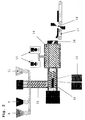
- Fig. 2 an embodiment of the method according to the invention is shown schematically.
- the output components are fed into a compounding extruder 10 via two metering devices 8, 9.
- a filler or other additives can be added via a further metering device 11.
- a premixing of the starting components takes place.
- the premixed resin filler mixture is transported by the compounding extruder 10 into the feed chute of a twin-screw extruder 12, into which the glass fiber rovings 13 are drawn.
- twin-screw extruder 12 the glass fibers are deliberately broken and homogenized with the resin filler mixture coming from the compounding extruder 10.
- the discharge takes place in a pre-crosslinking section, in which the viscosity required for handling and further processing is set.
- the pre-crosslinking here consists of a ceramic cylinder 14, which is permeable to the radiation source 15 depending on the selected type of irradiation for microwaves or UV radiation. Due to the irradiation Induced heating leads to a reduction in viscosity, which accelerates the swelling of the mineral fillers.
- the pre-crosslinking line also called pre-gelling station, the viscous molding compound is conveyed via a flat nozzle 16 to a discharge belt 17. With the cutting unit 18 arranged here, the molding compound can be portioned.
- the transport then takes place, for example, in a pressing tool, in which the shaping takes place.
Landscapes
- Engineering & Computer Science (AREA)
- Mechanical Engineering (AREA)
- Physics & Mathematics (AREA)
- Health & Medical Sciences (AREA)
- Thermal Sciences (AREA)
- Oral & Maxillofacial Surgery (AREA)
- Toxicology (AREA)
- Chemical & Material Sciences (AREA)
- Composite Materials (AREA)
- Processing And Handling Of Plastics And Other Materials For Molding In General (AREA)
- Transition And Organic Metals Composition Catalysts For Addition Polymerization (AREA)
- Macromolecular Compounds Obtained By Forming Nitrogen-Containing Linkages In General (AREA)
- Treatments Of Macromolecular Shaped Articles (AREA)
- Manufacture Of Macromolecular Shaped Articles (AREA)
Description
- Die Erfindung betrifft ein Verfahren zur unterbrechunglosen Herstellung faserverstärkte duroplastischer Halbzeugel sowie die verwendung dieses Verfahrens Verwendung finden diese Duroplaste als Bauteile u.a. im Automobilbereich sowie in der Elektroindustrie.
- Bei der Herstellung von Faserverbundwerkstoffen und deren Einsatz in industriellen Anwendungen ist ein steigender Kostendruck auf den Verarbeiter zu verzeichnen. Zusätzlich nehmen die Anforderungen an flexible, prozesssichere Produktionstechnologien auf gleichbleibend hohem Qualitätsniveau ("Null-Fehler-Produktion") ständig zu. Der Verarbeiter muss dieser Situation durch Reduzierung der Kosten im Herstellungsprozess sowie der Materialkosten und durch Steigerung der Prozessflexibilität begegnen.
- Für im Fliesspressverfahren hergestellte Bauteile aus thermoplastischen Faserverbunden haben sich Direktverfahren, hier speziell das LFT-D-ILC, bereits durchgesetzt, da sie den oben genannten Anforderungen und geänderten Rahmenbedingungen in besonderem Maße gerecht werden. Im Falle der im Fliesspressverfahren hergestellten duroplastischen Fäserverbundbauteile befinden sich derartige Direktverfahren bisher nicht im Einsatz, da die komplexen chemischen Vorgänge und deren prozesssichere Beherrschung sowie die aufwendige Anlagentechnik bisher als nicht realisierbar eingeschätzt wurde.
- Neben den thermoplastischen Konkurrenzmaterialien sind die heute wirtschaftlich bedeutendsten Halbzeuggruppen die SMC- (engl. Sheet Molding Compound) bzw. BMC- (engl. Bulk Molding Compound) Formmassen mit einer weltweiten Produktion von etwa 1,1 Mio. t/a (Stand 1996). Diese lassen sich z.B. im sogenannten Fliesspressverfahren verarbeiten.
- BMC-Pressmassen werden als "Stopfmassen" über Schneckenspritzgießmaschinen mit hoher Wirtschaftlichkeit verarbeitet. Die mechanischen Eigenschaften liegen jedoch wegen der Faserschädigung im Extruder und in den engen Zuführkanälen unter denen von herkömmlichen SMC-Teilen.
- Die Mischung des Harzfüllstoffgemisches erfolgt üblicherweise in großen Behältern, so dass die jeweiligen SMC-Rezepturen chargenweise angesetzt werden müssen und im Anschluß den Misch- und Reifungsprozess durchlaufen.
- Die Bereitstellung von Halbzeugen gleichbleibender Qualität ist z.B. aufgrund der Temperaturempfindlichkeit der reaktiven Harze schwer zu gewährleisten. Die Umgebungstemperatur und somit die Lagerungsbedingungen, die den Jahreszeiten entsprechende Vorkehrungen bedürfen, sind selten reproduzierbar, Einflüsse wie Transportdauer, Temperaturschwankungen sowie Luftfeuchtigkeit beeinträchtigen die Materialqualität, wodurch es zu hohen Ausschussquoten bzw. erhöhter Nacharbeit kommen kann. Um den hohen Qualitätsstandards speziell der Automobilindustrie gerecht zu werden, findet bei sicherheitsrelevanten bzw. hochwertigen Sichtbauteilen der Transport und die Lagerung des Halbzeugs unter Kühlung statt.
- Die Reaktivität der Harze begrenzt die Lagerfähigkeit der Halbzeuge, so dass nach z.B. einer störungsbedingten Produktionsunterbrechung die Harzsysteme unterschiedliche Verarbeitungsqualitäten, nachweisbar mittels Untersuchung der Pressarbeit, Werkzeugfüllung und Plastizität, aufweisen.
- Aus der
WO 02/102577 A1 US 5,338,169 ,US 6,093,354 ,US 5,401,154 ,US 5,202,071 sowie derUS 5,382,148 beschrieben. - Ausgehend hiervon war es Aufgabe der vorliegenden Erfindung ein Verfahren zur Herstellung duroplastischer Halbzeuge bereitzustellen, das eine hohe Reproduzierbarkeit hinsichtlich des Endproduktes, also des Bauteils, gewährleisten soll. Gleichzeitig soll das Verfahren den bisher aus dem Stand der Technik bekannten logistischen Aufwand minimieren und somit eine kostengünstigere Herstellung ermöglichen.
- Diese Aufgabe wird mittels des Verfahrens mit den Merkmalen des Anspruchs 1 gelöst. Die weiteren abhängigen Ansprüche zeigen vorteilhafte Weiterbildungen auf. In den Ansprüchen 12 und 13 wird die Verwendung des erfindungsgemäßen Verfahrens beschrieben.
- Erfindungsgemäß wird ein Verfahren zur unterbrechungslosen Herstellung duroplastischer Halbzeuge mit den Merkmalen des Patentanspruches 1 bereitgestellt.
- Als Halbzeuge sind im Rahmen dieser Anmeldung ebenso Formmassen zu verstehen.
- Während aus dem Stand der Technik bislang für die Herstellung von Duroplasten diskontinuierliche Verfahren bekannt sind, d.h. die Verfahren zur Herstellung des Harzfüllstoffgemisches sowie zur Umwandlung des reaktiven Harzfüllstoffgemisches in das Halbzeug räumlich und zeitlich voneinander getrennt sind, konnte nun zum ersten Mal für die Duroplasten ein Verfahren bereitgestellt werden, das die unterbrechungslose, d.h. zeitlich und räumlich zusammenhängende Herstellung duroplastischer Halbzeuge sicherstellt.
- Hieraus ergibt sich eine Vielfalt von Vorteilen gegenüber den aus dem Stand der Technik bekannten Verfahren. So können aufgrund der Verwendung von Rohstoffen und der Integration mehrerer Verfahrensschritte in einem einzigen zusammenhängenden Verfahrensablauf die Bauteilkosten deutlich reduziert werden. Es führt gleichzeitig zu einer erhöhten Effizienz des Herstellungsverfahrens, da zum einen der Energieverbrauch bei der Bauteilherstellung gesenkt, zum anderen aufgrund des nun nicht mehr nötigen Transports auf die gekühlte Lagerung der Halbzeuge verzichtet werden kann.
- Gleichzeitig werden durch das erfindungsgemäße Verfahren anwendungsoptimierte Werkstoffkombinationen ermöglicht, die eine hohe Prozeß- bzw. Anlageflexibilität gewährleisten, z.B. durch individuelle Farbgebung der Halbzeuge während des Herstellungsverfahrens. Aufgrund der direkten Herstellung des Halbzeugs ohne Zwischenlagerung des reaktiven Harzfüllstoffgemisches wird es so möglich durch die Lagerung bedingte Veränderungen des Harzfüllstoffgemisches zu vermeiden, wodurch die Qualität der Halbzeuge und damit auch der Bauteile deutlich reproduzierbarer wird.
- Vorzugsweise werden beim Herstellungsverfahren die Ausgangskompönenten über mindestens eine Dosiervorrichtung, der sogenannten Dosierstation, in den Extruder, der als eine Vormischeinheit dient, eingetragen und vorvermischt. Dabei werden die Komponenten bevorzugt getrennt nach Festkörper und flüssigen Komponenten bereitgestellt und zudosiert. Der Vorteil des Extruders gegenüber einem Chargenmischer liegt in der kontinuierlichen Zuführung der einzelnen Komponenten, wodurch eine hohe Prozessstabilität und die Reproduzierbarkeit der Rezepturen bei gleichzeitig geringen Materialmengen im Prozess erreicht werden kann.
- Als Ausgangskomponenten kommen vor allem Polymere und/oder Harze sowie gegebenenfalls Füllstoffe, Additive und/oder Lösungsmittel in Betracht. Als Additive werden dabei vorzugsweise interne Trennmittel, Härter, thermoplastische Additive, Stabilisatoren, LPA's (Low Profile Additive), LSA's (Low Shrink Additive), und/oder Dispergierhilfen eingesetzt.
- Nach der Vorvermischung werden die Ausgangskomponenten in eine Mischvorrichtung eingetragen. Hier erfolgt die Homogenisierung der Ausgangskomponenten, wobei gleichzeitig Verstärkungsfasern zugegeben werden. Als Mischvorrichtung kommen beispielsweise Rührer oder Kneter in Frage, bevorzugt aber Extruder und hier insbesondere Doppelschneckenextruder, die einen sehr hohen Homogenisierungsgrad ermöglichen.
- Die Zugabe der Verstärkungsfaser erfolgt bevorzugt während der Homogenisierung, kann aber auch in einem separaten Schritt über eine eigene Vorrichtung erfolgen.
- Die Verstärkungsfasern werden besonders bevorzugt während der Homogenisierung im Doppel-SchneckenExtruder in diesen eingetragen oder kontinuierlich ausgetragen oder zu Faserabschnitten zerschnitten. Dabei ist es durch die Verwendung des DoppelSchnecken-Extruders auf einfache Weise möglich, daß die Verstärkungsfasern eingezogen werden und dabei zu Faserabschnitten zerkleinert werden.
- Als Verstärkungsfasern werden bevorzugt anorganische, organische und/oder Naturfasern eingesetzt. Besonders bevorzugt sind dabei Kohlenstoff oder Glasfasern.
- Nach der Homogenisierung erfolgt die Vorvernetzung c) durch Bestrahlung, durch α oder β-Strahlung und/oder elektromagnetische Wellen. Besonders bevorzugt ist dabei die Verwendung von UV-Strahlung oder Mikrowellen. Während der Vorvernetzung wird dabei die für die Handhabung sowie für die Weiterverarbeitung erforderliche Viskosität gezielt eingestellt. Apparativ kann die Vorvernetzungszone beispielsweise als Keramikzylinder, der strahlungsdurchlässig gegenüber Mikrowellen oder UV-Strahlung ist, ausgestaltet sein. Die Bestrahlung führt durch Erwärmung zu einer Visoksitätsverminderung, welche die Quellung der mineralischen Füllstoffe beschleunigt. Der Vorteil des Einsatzes von Mikrowellen besteht in der gezielten Steuerung der Dauer, der Intensität und der Homogenität des E-nergieeintrages, wodurch der Vernetzungsgrad exakt eingestellt werden kann.
- Das derart vorvernetzte Halbzeug kann nun direkt der Formgebung unterzogen werden, alternativ ist es aber auch möglich, einen Portionierungsschritt vorzuschalten, um das Halbzeug in leichter zu verarbeitende Chargen zu unterteilen. Hierfür können beispielsweise Schneidvorrichtungen oder Förderbänder eingesetzt werden.
- Im abschließenden Schritt der Formgebung, der sich sowohl zeitlich als auch räumlich direkt an die Halbzeugherstellung anschließen kann, kann dann das gewünschte Bauteil hergestellt werden. Als Formgebungsprozesse werden dabei bevorzugt die Pressprozesse und/oder das Spritzgießen eingesetzt. Alternativ sind aber auch alle anderen aus dem Stand der Technik bekannten Formgebungsprozesse einsetzbar.
- Mit diesem Verfahren können duroplastische Halbzeuge hergestellt werden.
- Bauteile aus duroplastischen glasfaserverstärkten Formmassen zeichnen sich durch sehr gute mechanische Eigenschaften aus - auch bei erhöhten Einsatztemperaturen.
- Verwendung findet das erfindungsgemäße Verfahren vorzugsweise in der Automobil-, Elektro-, Bau- und Lebensmittelindustrie sowie in Transport und Verkehr. In diesen Bereichen können mit dem erfindungsgemäßen Verfahren beliebige Bauteile hergestellt werden. Nur beispielhaft seien hierfür Armaturen, Motorhauben, Heckklappen und Stoßfänger genannt.
- Anhand der folgenden Figuren soll der erfindungsgemäße Gegenstand näher erläutert werden, ohne diesen auf die hier dargestellten Sachverhalte einzuschränken.
- Fig. 1
- zeigt eine schematische Darstellung des aus dem Stand der Technik bekannten Fließpress- verfahrens zur Herstellung von SMC (diskon- tinuierlich),
- Fig. 2
- zeigt eine schematische Darstellung des er- findungsgemäßen Verfahrens zur Herstellung von duroplastischen glasfaserverstärkten Formmassen,
- Fig. 3
- zeigt in einem Flussdiagramm eine verglei- chende Gegenüberstellung von Fließpressver- fahren (SMC) und erfindungsgemäßem Verfah- ren (DMC-D).
- Bei dem in
Fig. 1 dargestellten und aus dem Stand der Technik bekannten Fließpressverfahren werden Glasfaserrovings 1 von Spulen abgezogen und mit einem Schneidwerk 2 auf Längen von etwa 10 bis 50 mm zugeschnitten. Diese Schnittfasern 3 fallen dann regellos auf eine Trägerfolie 4, auf der die Hälfte der erforderlichen Menge an Harzfüllstoffgemisch 5 als dünner Film aufgetragen wurde. Nach dem Abdecken mit einer zweiten Trägerfolie 6, die die restliche Menge des Harzfüllstoffgemischs trägt, durchläuft dieses Paket eine Walzenstrecke mit gegenüberliegenden Verdichterrollen 7 auf beiden Seiten der Folie, in der die Imprägnierung und Verdichtung des Halbzeugs erreicht wird. Das mehrere Millimeter dicke flächenförmige Halbzeug wird anschließend entweder aufgewickelt oder zu Zuschnitten beliebiger Länge konfektioniert. Im Anschluss erfolgt eine Lagerung des Halbzeugs zur "Reifung" über mehrere Tage bis Wochen. Die Reifezeit kann dem gewünschten Verarbeitungsfenster entsprechend über die Reaktivität des Harzes eingestellt werden. - In
Fig. 2 ist ein Ausführungsbeispiel des erfindungsgemäßen Verfahrens schematisch dargestellt. Zunächst werden über zwei Dosiervorrichtungen 8;9 die Ausgangskomponenten in einen Compoundierextruder 10 eingespeist. In gleicher Weise können über eine weitere Dosiervorrichtung 11 ein Füllstoff oder andere Additive zugesetzt werden. In dem Compoundierextruder 10 erfolgt so eine Vorvermischung der Ausgangskomponenten. Das vorgemischte Harzfüllstoffgemisch wird vom Compoundierextruder 10 in den Zuführschacht eines Doppelschneckenextruders 12 transportiert, in den auch die Glasfaserrovings 13 eingezogen werden. Im Doppelschneckenextruder 12 werden die Glasfasern gezielt gebrochen und mit dem aus dem Compoundierextruder 10 kommenden Harzfüllstoffgemisch homogenisiert. Nach der Homogenisierung erfolgt der Austrag in eine Vorvernetzungsstrecke, in welcher die für die Handhabung sowie die Weiterverarbeitung erforderliche Viskosität eingestellt wird. Die Vorvernetzung besteht hier aus einem keramischen Zylinder 14, der in Abhängigkeit von der gewählten Bestrahlungsart für Mikrowellen oder UV-Strahlung, aus der Strahlungsquelle 15 durchlässig ist. Aufgrund der durch die Bestrahlung herbeigeführte Erwärmung kommt es zu einer Viskositätsverminderung, welche die Quellung der mineralischen Füllstoffe beschleunigt. Von der Vorvernetzungsstrecke, auch Vorgelierstation genannt, wird die zähviskose Formmasse über eine Flachdüse 16 auf ein Abzugsband 17 befördert. Mit der hier angeordneten Schneideeinheit 18 lässt sich die Formmasse portionieren. Abschließend erfolgt dann der Transport z.B. in ein Presswerkzeug, in dem die Formgebung erfolgt. - In
Fig. 3 sind die beiden Verfahren, das aus dem Stand der Technik bekannte SMC und das erfindungsgemäße DMC-D nochmals anhand eines Flussdiagramms gegenübergestellt. Während erfindungsgemäß ein zusammenhängender Verfahrensablauf realisiert wird, erfolgt beim SMC-Verfahren die Herstellung der Formmassen über drei zeitlich und räumlich getrennte Verfahrensblöcke. Hier stellt gerade der Transport bzw. die Lagerung des Halbzeugs die Problemstelle des Verfahrens dar, die nun erfindungsgemäß beseitigt werden konnte.
Claims (13)
- Verfahren zur unterbrechungslosen Herstellung faserverstärkter duroplastischer Halbzeuge mit folgenden Schritten:a) Vorvermischung der Ausgangskomponenten in einem Extruder,b) Homogenisierung der Ausgangskomponenten in einer Mischvorrichtung,c) Vorvernetzung zum Halbzeug durch kontrollierte Energiezufuhr mittels α- oder β-Strahlung und/oder elektromagnetischer Wellem, wobeid) während oder nach der Homogenisierung Verstärkungsfasern zugegeben werden.
- Verfahren nach Anspruch 1,
dadurch gekennzeichnet, dass die Ausgangskomponenten über mindestens eine Dosiervorrichtung in den Extruder eingetragen und vorvermischt werden. - Verfahren nach mindestens einem der Ansprüche 1 oder 2,
dadurch gekennzeichnet, dass als Ausgangskomponenten Polymere oder Harze sowie gegebenenfalls Füllstoffe, Additive und/oder Lösungsmittel eingesetzt werden. - Verfahren nach Anspruch 3,
dadurch gekennzeichnet, dass die Additive ausgewählt sind aus der Gruppe interne Trennmittel, Härter, thermoplastische Additive, Stabilisatoren, LPA, LSA und/oder Dispergierhilfen. - Verfahren nach.mindestens einem der vorhergehenden Ansprüche,
dadurch gekennzeichnet, dass die Homogenisierung b) in einem Extruder, Rührer oder Kneter erfolgt. - Verfahren nach mindestens einem der vorhergehenden Ansprüche,
dadurch gekennzeichnet, dass die Verstärkungsfasern im Homogenisierungsschritt b) in einen Doppel-Schnecken-Extruder eingetragen, kontinuierlich ausgetragen werden oder zu Faserabschnitten zerschnitten werden. - Verfahren nach mindestens einem der vorhergehenden Ansprüche,
dadurch gekennzeichnet, dass als Verstärkungsfasern anorganische, organische und/oder Naturfasern, insbesondere Glasfasern oder Kohlenstofffasern, eingesetzt werden. - Verfahren nach mindestens einem der vorhergehenden Ansprüche,
dadurch gekennzeichnet, dass die kontrollierte Energiezufuhr durch UV-Strahlung oder Mikrowellen erfolgt. - Verfahren nach mindestens einem der vorhergehenden Ansprüche,
dadurch gekennzeichnet, dass eine Portionierung des Halbzeugs, insbesondere mittels Schneidvorrichtungen und/oder Förderbändern, erfolgt. - Verfahren nach mindestens einem der vorhergehenden Ansprüche,
dadurch gekennzeichnet, dass im direkten Anschluss die Formgebung des Halbzeugs zum Bauteil erfolgt. - Verfahren nach Anspruch 10,
dadurch gekennzeichnet, dass die Formgebung durch Pressprozesse und/oder Spritzgießen erfolgt. - Verwendung des Verfahrens nach mindestens einem der Ansprüche 1 bis 11 zur Herstellung von Bauteilen in der Automobil-, Elektro-, Bau-, Lebensmittelindustrie sowie in Transport und Verkehr.
- Verwendung nach Anspruch 12 für die Herstellung von Armaturen, Motorhauben, Heckklappen oder Stoßfängern.
Applications Claiming Priority (3)
| Application Number | Priority Date | Filing Date | Title |
|---|---|---|---|
| DE10211920 | 2002-03-18 | ||
| DE10211920A DE10211920A1 (de) | 2002-03-18 | 2002-03-18 | Verfahren zur Herstellung duroplastischer Halbzeuge |
| PCT/EP2003/002784 WO2003078143A1 (de) | 2002-03-18 | 2003-03-18 | Verfahren zur herstellung duroplastischer halbzeuge |
Publications (3)
| Publication Number | Publication Date |
|---|---|
| EP1487630A1 EP1487630A1 (de) | 2004-12-22 |
| EP1487630B1 true EP1487630B1 (de) | 2008-12-31 |
| EP1487630B8 EP1487630B8 (de) | 2009-06-10 |
Family
ID=27815734
Family Applications (1)
| Application Number | Title | Priority Date | Filing Date |
|---|---|---|---|
| EP03722344A Expired - Lifetime EP1487630B8 (de) | 2002-03-18 | 2003-03-18 | Verfahren zur herstellung duroplastischer halbzeuge |
Country Status (4)
| Country | Link |
|---|---|
| EP (1) | EP1487630B8 (de) |
| AT (1) | ATE419108T1 (de) |
| DE (2) | DE10211920A1 (de) |
| WO (1) | WO2003078143A1 (de) |
Cited By (1)
| Publication number | Priority date | Publication date | Assignee | Title |
|---|---|---|---|---|
| US11685079B2 (en) | 2017-07-03 | 2023-06-27 | Rampf Holding Gmbh & Co. Kg | Apparatus and method for dispensing and curing of liquid media |
Families Citing this family (5)
| Publication number | Priority date | Publication date | Assignee | Title |
|---|---|---|---|---|
| DE102005036643A1 (de) * | 2005-08-04 | 2007-02-08 | Fraunhofer-Gesellschaft zur Förderung der angewandten Forschung e.V. | Verfahren und Vorrichtung zur Ermittlung des Reifezustandes von Duroplast-Zusammensetzungen |
| DE102013222426A1 (de) | 2013-11-05 | 2015-05-07 | Bayerische Motoren Werke Aktiengesellschaft | Verfahren zur Herstellung eines Halbzeugs zur Verarbeitung zu einem CFK-Bauteil aus Kohlefaserabfällen |
| ES2723399T3 (es) | 2015-09-28 | 2019-08-27 | Coltene/Whaledent Ag | Procedimiento para producir bloques odontológicos de material compuesto |
| US10807277B2 (en) * | 2016-11-07 | 2020-10-20 | The Boeing Company | Resin-infused short fiber composite materials |
| DE102023200183A1 (de) * | 2023-01-11 | 2024-07-11 | Volkswagen Aktiengesellschaft | Verfahren zur Herstellung eines faserverstärkten Kunststoffbauteils |
Family Cites Families (8)
| Publication number | Priority date | Publication date | Assignee | Title |
|---|---|---|---|---|
| DE3812323A1 (de) * | 1988-04-14 | 1989-10-26 | Basf Ag | Faserverbundwerkstoffe |
| JPH0452106A (ja) * | 1990-06-20 | 1992-02-20 | Japan Steel Works Ltd:The | 繊維強化プラスチック成形品の製造方法 |
| US5192387A (en) * | 1990-11-05 | 1993-03-09 | The C.A. Lawton Company | Method of making preforms |
| US5217654A (en) * | 1992-01-30 | 1993-06-08 | The C. A. Lawton Company | Two-stage mat forming preforming and molding process |
| US5401154A (en) * | 1993-05-26 | 1995-03-28 | Continental Structural Plastics, Inc. | Apparatus for compounding a fiber reinforced thermoplastic material and forming parts therefrom |
| US6093354A (en) * | 1998-12-01 | 2000-07-25 | Omnova Solutions Inc. | Method of continuously curing a sheet formed of EPDM material |
| DE10010414A1 (de) * | 2000-03-03 | 2001-09-06 | Trespa Int Bv | Verfahren zur Herstellung eines mattenförmigen Vorprodukts, Vorprodukt und Verwendung eines Vorprodukts |
| DE10129224C1 (de) * | 2001-06-19 | 2003-01-16 | Daimler Chrysler Ag | Verfahren zur Herstellung eines Halbzeugs und Vorrichtung |
-
2002
- 2002-03-18 DE DE10211920A patent/DE10211920A1/de not_active Ceased
-
2003
- 2003-03-18 DE DE50311001T patent/DE50311001D1/de not_active Expired - Lifetime
- 2003-03-18 WO PCT/EP2003/002784 patent/WO2003078143A1/de not_active Ceased
- 2003-03-18 EP EP03722344A patent/EP1487630B8/de not_active Expired - Lifetime
- 2003-03-18 AT AT03722344T patent/ATE419108T1/de not_active IP Right Cessation
Cited By (1)
| Publication number | Priority date | Publication date | Assignee | Title |
|---|---|---|---|---|
| US11685079B2 (en) | 2017-07-03 | 2023-06-27 | Rampf Holding Gmbh & Co. Kg | Apparatus and method for dispensing and curing of liquid media |
Also Published As
| Publication number | Publication date |
|---|---|
| DE10211920A1 (de) | 2003-10-09 |
| ATE419108T1 (de) | 2009-01-15 |
| WO2003078143A8 (de) | 2009-06-11 |
| DE50311001D1 (de) | 2009-02-12 |
| EP1487630B8 (de) | 2009-06-10 |
| WO2003078143A1 (de) | 2003-09-25 |
| EP1487630A1 (de) | 2004-12-22 |
Similar Documents
| Publication | Publication Date | Title |
|---|---|---|
| EP0490056A1 (de) | Verfahren und Vorrichtung zur einstufigen, kontinuierlichen Herstellung einer Kautschukgrund- und -fertigmischung für Fahrzeugreifen, Antriebsriemen, Transportbänder sowie für technische Gummiartikel in nur einer Mischung | |
| EP3065936B1 (de) | Verfahren zur herstellung eines halbzeugs zur verarbeitung zu einem cfk-bauteil aus kohlefaserabfällen | |
| EP1397239B1 (de) | Verfahren zur herstellung eines bauteils | |
| EP1487630B1 (de) | Verfahren zur herstellung duroplastischer halbzeuge | |
| EP0664197A2 (de) | Rückgewinnung von Wasserstoff mittls Adsorptionsmembranen | |
| DE102017104997A1 (de) | Verfahren und Vorrichtung zum Herstellen faserverstärkten Harzmaterials | |
| DE102007031467A1 (de) | Verfahren zur Herstellung eines faserverstärkten Verbundstoffs und Verbundstoff | |
| EP2015914B1 (de) | Verfahren zur herstellung eines beschichteten thermoplastmaterials | |
| DE102013106135A1 (de) | Vorrichtung und Verfahren zum Beschicken von Duroplast-Spritzgieß- und Extrudereinheiten | |
| EP1719600B1 (de) | Verfahren zur Erzeugung einer Schaumkunststoff-Folie | |
| EP2033758B1 (de) | Verfahren und Vorrichtung zur Herstellung von faserverstärkten Kunststoffformteilen | |
| DE3307160C2 (de) | Verfahren zur Herstellung einer innenverstärkten Polymerplatte | |
| DE102012109502A1 (de) | Verfahren zur Herstellung einer anorganischen oder organischen pastösen schmelzeförmigen Masse | |
| CH536655A (de) | Verfahren und Vorrichtung zur kontinuierlichen Herstellung von Gummi-, gummiähnlichen oder Kunststoffmischungen | |
| WO2000027925A1 (de) | Verfahren zur herstellung eines faserverstärkten kunststoff-werkstoffs | |
| EP3569384A1 (de) | Vorrichtung zum extrudieren von faserverstärkten kunststoffen | |
| DE2204673A1 (de) | Verfahren und Vorrichtung zur Herstellung von mit Glimmerplättchen verstärkten Kunststoffgegenständen | |
| DE102013219960A1 (de) | Co-Extrusion, Pultrusion von Profilen mit Carbonabfällen | |
| AT526635B1 (de) | Formgebungsverfahren zum Herstellen eines Formteils | |
| WO2020057762A1 (de) | Vorrichtung zum formen eines kunststoffbauteils | |
| EP1750128A2 (de) | Verfahren und Vorrichtung zur Ermittlung des Reifezustandes von Duroplast-Zusammensetzungen | |
| DE102015204430B4 (de) | Verfahren zum Imprägnieren von Faserrovings mit hochreaktiven Harzen im Wickelprozess | |
| DE2543618A1 (de) | Verfahren und vorrichtung zur herstellung von zusammengesetzten plastikmaterialien | |
| DE102006062622B4 (de) | Verfahren und Vorrichtung zur Herstellung einer Harzmischung im Zuge der Produktion von Kunststoff-Formteilen | |
| DE10038553A1 (de) | Verfahren und Vorrichtung zum Herstellen eines verstärkten Kunststoffbauteils sowie danach hergestelltes Bauteil |
Legal Events
| Date | Code | Title | Description |
|---|---|---|---|
| PUAI | Public reference made under article 153(3) epc to a published international application that has entered the european phase |
Free format text: ORIGINAL CODE: 0009012 |
|
| 17P | Request for examination filed |
Effective date: 20041015 |
|
| AK | Designated contracting states |
Kind code of ref document: A1 Designated state(s): AT BE BG CH CY CZ DE DK EE ES FI FR GB GR HU IE IT LI LU MC NL PT RO SE SI SK TR |
|
| RIN1 | Information on inventor provided before grant (corrected) |
Inventor name: HENNING, FRANK Inventor name: RADTKE, ANDREAS Inventor name: KRAUSE, WENZEL Inventor name: TROESTE, STEFAN Inventor name: BRAEUNING, RUEDIGER Inventor name: GEIGER, OLIVER |
|
| RIN1 | Information on inventor provided before grant (corrected) |
Inventor name: BRAEUNING, RUEDIGER Inventor name: TROESTE, STEFAN Inventor name: GEIGER, OLIVER Inventor name: KRAUSE, WENZEL Inventor name: HENNING, FRANK Inventor name: RADTKE, ANDREAS |
|
| 17Q | First examination report despatched |
Effective date: 20071219 |
|
| GRAP | Despatch of communication of intention to grant a patent |
Free format text: ORIGINAL CODE: EPIDOSNIGR1 |
|
| GRAS | Grant fee paid |
Free format text: ORIGINAL CODE: EPIDOSNIGR3 |
|
| GRAA | (expected) grant |
Free format text: ORIGINAL CODE: 0009210 |
|
| AK | Designated contracting states |
Kind code of ref document: B1 Designated state(s): AT BE BG CH CY CZ DE DK EE ES FI FR GB GR HU IE IT LI LU MC NL PT RO SE SI SK TR |
|
| REG | Reference to a national code |
Ref country code: GB Ref legal event code: FG4D Free format text: NOT ENGLISH Ref country code: CH Ref legal event code: EP |
|
| REF | Corresponds to: |
Ref document number: 50311001 Country of ref document: DE Date of ref document: 20090212 Kind code of ref document: P |
|
| REG | Reference to a national code |
Ref country code: IE Ref legal event code: FG4D Free format text: LANGUAGE OF EP DOCUMENT: GERMAN |
|
| RIN2 | Information on inventor provided after grant (corrected) |
Inventor name: HENNING, FRANK Inventor name: RADTKE, ANDREAS Inventor name: KRAUSE, WENZEL Inventor name: BRAEUNING, RUEDIGER Inventor name: GEIGER, OLIVER Inventor name: TROESTER, STEFAN |
|
| PG25 | Lapsed in a contracting state [announced via postgrant information from national office to epo] |
Ref country code: FI Free format text: LAPSE BECAUSE OF FAILURE TO SUBMIT A TRANSLATION OF THE DESCRIPTION OR TO PAY THE FEE WITHIN THE PRESCRIBED TIME-LIMIT Effective date: 20081231 Ref country code: SI Free format text: LAPSE BECAUSE OF FAILURE TO SUBMIT A TRANSLATION OF THE DESCRIPTION OR TO PAY THE FEE WITHIN THE PRESCRIBED TIME-LIMIT Effective date: 20081231 |
|
| PG25 | Lapsed in a contracting state [announced via postgrant information from national office to epo] |
Ref country code: RO Free format text: LAPSE BECAUSE OF FAILURE TO SUBMIT A TRANSLATION OF THE DESCRIPTION OR TO PAY THE FEE WITHIN THE PRESCRIBED TIME-LIMIT Effective date: 20081231 Ref country code: ES Free format text: LAPSE BECAUSE OF FAILURE TO SUBMIT A TRANSLATION OF THE DESCRIPTION OR TO PAY THE FEE WITHIN THE PRESCRIBED TIME-LIMIT Effective date: 20090411 Ref country code: EE Free format text: LAPSE BECAUSE OF FAILURE TO SUBMIT A TRANSLATION OF THE DESCRIPTION OR TO PAY THE FEE WITHIN THE PRESCRIBED TIME-LIMIT Effective date: 20081231 |
|
| REG | Reference to a national code |
Ref country code: IE Ref legal event code: FD4D |
|
| PG25 | Lapsed in a contracting state [announced via postgrant information from national office to epo] |
Ref country code: PT Free format text: LAPSE BECAUSE OF FAILURE TO SUBMIT A TRANSLATION OF THE DESCRIPTION OR TO PAY THE FEE WITHIN THE PRESCRIBED TIME-LIMIT Effective date: 20090601 Ref country code: CZ Free format text: LAPSE BECAUSE OF FAILURE TO SUBMIT A TRANSLATION OF THE DESCRIPTION OR TO PAY THE FEE WITHIN THE PRESCRIBED TIME-LIMIT Effective date: 20081231 Ref country code: SE Free format text: LAPSE BECAUSE OF FAILURE TO SUBMIT A TRANSLATION OF THE DESCRIPTION OR TO PAY THE FEE WITHIN THE PRESCRIBED TIME-LIMIT Effective date: 20090331 |
|
| BERE | Be: lapsed |
Owner name: FRAUNHOFER-GESELLSCHAFT ZUR FORDERUNG DER ANGEWAN Effective date: 20090331 |
|
| PG25 | Lapsed in a contracting state [announced via postgrant information from national office to epo] |
Ref country code: SK Free format text: LAPSE BECAUSE OF FAILURE TO SUBMIT A TRANSLATION OF THE DESCRIPTION OR TO PAY THE FEE WITHIN THE PRESCRIBED TIME-LIMIT Effective date: 20081231 |
|
| PG25 | Lapsed in a contracting state [announced via postgrant information from national office to epo] |
Ref country code: IE Free format text: LAPSE BECAUSE OF FAILURE TO SUBMIT A TRANSLATION OF THE DESCRIPTION OR TO PAY THE FEE WITHIN THE PRESCRIBED TIME-LIMIT Effective date: 20081231 Ref country code: DK Free format text: LAPSE BECAUSE OF FAILURE TO SUBMIT A TRANSLATION OF THE DESCRIPTION OR TO PAY THE FEE WITHIN THE PRESCRIBED TIME-LIMIT Effective date: 20081231 Ref country code: MC Free format text: LAPSE BECAUSE OF NON-PAYMENT OF DUE FEES Effective date: 20090331 |
|
| REG | Reference to a national code |
Ref country code: CH Ref legal event code: PL |
|
| PLBE | No opposition filed within time limit |
Free format text: ORIGINAL CODE: 0009261 |
|
| STAA | Information on the status of an ep patent application or granted ep patent |
Free format text: STATUS: NO OPPOSITION FILED WITHIN TIME LIMIT |
|
| 26N | No opposition filed |
Effective date: 20091001 |
|
| PG25 | Lapsed in a contracting state [announced via postgrant information from national office to epo] |
Ref country code: LI Free format text: LAPSE BECAUSE OF NON-PAYMENT OF DUE FEES Effective date: 20090331 Ref country code: CH Free format text: LAPSE BECAUSE OF NON-PAYMENT OF DUE FEES Effective date: 20090331 Ref country code: BG Free format text: LAPSE BECAUSE OF FAILURE TO SUBMIT A TRANSLATION OF THE DESCRIPTION OR TO PAY THE FEE WITHIN THE PRESCRIBED TIME-LIMIT Effective date: 20090331 |
|
| PG25 | Lapsed in a contracting state [announced via postgrant information from national office to epo] |
Ref country code: BE Free format text: LAPSE BECAUSE OF NON-PAYMENT OF DUE FEES Effective date: 20090331 |
|
| PG25 | Lapsed in a contracting state [announced via postgrant information from national office to epo] |
Ref country code: AT Free format text: LAPSE BECAUSE OF NON-PAYMENT OF DUE FEES Effective date: 20090318 |
|
| PG25 | Lapsed in a contracting state [announced via postgrant information from national office to epo] |
Ref country code: GR Free format text: LAPSE BECAUSE OF FAILURE TO SUBMIT A TRANSLATION OF THE DESCRIPTION OR TO PAY THE FEE WITHIN THE PRESCRIBED TIME-LIMIT Effective date: 20090401 |
|
| PG25 | Lapsed in a contracting state [announced via postgrant information from national office to epo] |
Ref country code: LU Free format text: LAPSE BECAUSE OF NON-PAYMENT OF DUE FEES Effective date: 20090318 |
|
| PG25 | Lapsed in a contracting state [announced via postgrant information from national office to epo] |
Ref country code: HU Free format text: LAPSE BECAUSE OF FAILURE TO SUBMIT A TRANSLATION OF THE DESCRIPTION OR TO PAY THE FEE WITHIN THE PRESCRIBED TIME-LIMIT Effective date: 20090701 |
|
| PG25 | Lapsed in a contracting state [announced via postgrant information from national office to epo] |
Ref country code: CY Free format text: LAPSE BECAUSE OF FAILURE TO SUBMIT A TRANSLATION OF THE DESCRIPTION OR TO PAY THE FEE WITHIN THE PRESCRIBED TIME-LIMIT Effective date: 20081231 |
|
| REG | Reference to a national code |
Ref country code: FR Ref legal event code: PLFP Year of fee payment: 14 |
|
| REG | Reference to a national code |
Ref country code: FR Ref legal event code: PLFP Year of fee payment: 15 |
|
| REG | Reference to a national code |
Ref country code: FR Ref legal event code: PLFP Year of fee payment: 16 |
|
| PGFP | Annual fee paid to national office [announced via postgrant information from national office to epo] |
Ref country code: NL Payment date: 20180322 Year of fee payment: 16 |
|
| PGFP | Annual fee paid to national office [announced via postgrant information from national office to epo] |
Ref country code: TR Payment date: 20180315 Year of fee payment: 16 |
|
| PGFP | Annual fee paid to national office [announced via postgrant information from national office to epo] |
Ref country code: IT Payment date: 20190321 Year of fee payment: 17 Ref country code: GB Payment date: 20190325 Year of fee payment: 17 Ref country code: FR Payment date: 20190326 Year of fee payment: 17 Ref country code: DE Payment date: 20190325 Year of fee payment: 17 |
|
| REG | Reference to a national code |
Ref country code: NL Ref legal event code: MM Effective date: 20190401 |
|
| PG25 | Lapsed in a contracting state [announced via postgrant information from national office to epo] |
Ref country code: NL Free format text: LAPSE BECAUSE OF NON-PAYMENT OF DUE FEES Effective date: 20190401 |
|
| REG | Reference to a national code |
Ref country code: DE Ref legal event code: R119 Ref document number: 50311001 Country of ref document: DE |
|
| PG25 | Lapsed in a contracting state [announced via postgrant information from national office to epo] |
Ref country code: FR Free format text: LAPSE BECAUSE OF NON-PAYMENT OF DUE FEES Effective date: 20200331 Ref country code: DE Free format text: LAPSE BECAUSE OF NON-PAYMENT OF DUE FEES Effective date: 20201001 |
|
| GBPC | Gb: european patent ceased through non-payment of renewal fee |
Effective date: 20200318 |
|
| PG25 | Lapsed in a contracting state [announced via postgrant information from national office to epo] |
Ref country code: GB Free format text: LAPSE BECAUSE OF NON-PAYMENT OF DUE FEES Effective date: 20200318 |
|
| PG25 | Lapsed in a contracting state [announced via postgrant information from national office to epo] |
Ref country code: IT Free format text: LAPSE BECAUSE OF NON-PAYMENT OF DUE FEES Effective date: 20200318 |
|
| PG25 | Lapsed in a contracting state [announced via postgrant information from national office to epo] |
Ref country code: TR Free format text: LAPSE BECAUSE OF NON-PAYMENT OF DUE FEES Effective date: 20190318 |