EP1488976A2 - Perfectionnements aux engins amphibies - Google Patents
Perfectionnements aux engins amphibies Download PDFInfo
- Publication number
- EP1488976A2 EP1488976A2 EP04253534A EP04253534A EP1488976A2 EP 1488976 A2 EP1488976 A2 EP 1488976A2 EP 04253534 A EP04253534 A EP 04253534A EP 04253534 A EP04253534 A EP 04253534A EP 1488976 A2 EP1488976 A2 EP 1488976A2
- Authority
- EP
- European Patent Office
- Prior art keywords
- craft
- vehicle according
- vehicle
- hull
- air
- Prior art date
- Legal status (The legal status is an assumption and is not a legal conclusion. Google has not performed a legal analysis and makes no representation as to the accuracy of the status listed.)
- Withdrawn
Links
Images

Classifications
-
- B—PERFORMING OPERATIONS; TRANSPORTING
- B60—VEHICLES IN GENERAL
- B60F—VEHICLES FOR USE BOTH ON RAIL AND ON ROAD; VEHICLES CAPABLE OF TRAVELLING IN OR ON DIFFERENT MEDIA, e.g. AMPHIBIOUS VEHICLES
- B60F3/00—Amphibious vehicles, i.e. vehicles capable of travelling both on land and on water; Land vehicles capable of travelling under water
-
- B—PERFORMING OPERATIONS; TRANSPORTING
- B60—VEHICLES IN GENERAL
- B60V—AIR-CUSHION VEHICLES
- B60V1/00—Air-cushion
- B60V1/04—Air-cushion wherein the cushion is contained at least in part by walls
- B60V1/043—Air-cushion wherein the cushion is contained at least in part by walls the walls being flexible
-
- B—PERFORMING OPERATIONS; TRANSPORTING
- B60—VEHICLES IN GENERAL
- B60V—AIR-CUSHION VEHICLES
- B60V1/00—Air-cushion
- B60V1/11—Stability or attitude control
-
- B—PERFORMING OPERATIONS; TRANSPORTING
- B60—VEHICLES IN GENERAL
- B60V—AIR-CUSHION VEHICLES
- B60V1/00—Air-cushion
- B60V1/14—Propulsion; Control thereof
-
- B—PERFORMING OPERATIONS; TRANSPORTING
- B60—VEHICLES IN GENERAL
- B60V—AIR-CUSHION VEHICLES
- B60V1/00—Air-cushion
- B60V1/16—Flexible skirts
-
- B—PERFORMING OPERATIONS; TRANSPORTING
- B60—VEHICLES IN GENERAL
- B60V—AIR-CUSHION VEHICLES
- B60V1/00—Air-cushion
- B60V1/18—Body structure
-
- B—PERFORMING OPERATIONS; TRANSPORTING
- B60—VEHICLES IN GENERAL
- B60V—AIR-CUSHION VEHICLES
- B60V3/00—Land vehicles, waterborne vessels, or aircraft, adapted or modified to travel on air cushions
- B60V3/06—Waterborne vessels
-
- B—PERFORMING OPERATIONS; TRANSPORTING
- B63—SHIPS OR OTHER WATERBORNE VESSELS; RELATED EQUIPMENT
- B63B—SHIPS OR OTHER WATERBORNE VESSELS; EQUIPMENT FOR SHIPPING
- B63B1/00—Hydrodynamic or hydrostatic features of hulls or of hydrofoils
- B63B1/32—Other means for varying the inherent hydrodynamic characteristics of hulls
- B63B1/34—Other means for varying the inherent hydrodynamic characteristics of hulls by reducing surface friction
- B63B1/38—Other means for varying the inherent hydrodynamic characteristics of hulls by reducing surface friction using air bubbles or air layers gas filled volumes
-
- B—PERFORMING OPERATIONS; TRANSPORTING
- B63—SHIPS OR OTHER WATERBORNE VESSELS; RELATED EQUIPMENT
- B63B—SHIPS OR OTHER WATERBORNE VESSELS; EQUIPMENT FOR SHIPPING
- B63B1/00—Hydrodynamic or hydrostatic features of hulls or of hydrofoils
- B63B1/16—Hydrodynamic or hydrostatic features of hulls or of hydrofoils deriving additional lift from hydrodynamic forces
- B63B1/18—Hydrodynamic or hydrostatic features of hulls or of hydrofoils deriving additional lift from hydrodynamic forces of hydroplane type
Definitions
- Planing boats with rigid "deep V” hulls and inflatable collars provide a robust and potentially fast craft.
- a "deep V” hull is able to plane at speed, while slicing through waves, minimising slamming at the bow.
- a slipway or hard surface is required for launching such a craft.
- Such craft are unable to cross exposed sand or mud banks, may be impeded in fouled water, or may strike submerged objects in flood water.
- conventional marine engines rely on water cooling. The water intakes of such conventional marine engines commonly become blocked in fouled or flood water, reducing engine reliability and compromising speed of response and safety of the craft to which they are fitted.
- Known small hovercraft can be fully amphibious and are be able to cross exposed sand or mud banks. They are immune to the problems in fouled water,or flood water noted above.
- Conventional hovercraft engines rely on air cooling (for example, engines may be direct air cooled, or liquid-cooled with an air radiator) and are not compromised in fouled or flood water.
- Small hovercraft have hulls designed to ride over a surface on an air cushion. However, if the height of waves or obstructions is similar or greater than the height of the air cushion, such hovercraft cease to operate correctly and instead become displacement craft.
- a displacement craft is one having a hull that plows through the water, displacing a weight of water equal to its own weight even when more power is added. As a displacement craft moves through water, the water is parted at the bow and closes in again at the stern.
- hovercraft that are small enough to be transported by road without dismantling either have small rigid hulls, which limit their load-carrying capacity, or have a "loop and segment” skirt system which extends the lift cushion to a greater width around the hull.
- conventional "loop and segment” skirt systems have a large bag (loop) that collapses when lift air is turned off. The collapsed bag then impedes rapid loading on to a trailer.
- Some hovercraft have thrust reversers which provide a braking force. However, it can be extremely difficult to steer the craft while operating the reverse thrust.
- US 4 535 712 shows a vessel having a variable geometry hull capable also of operating on the air cushion principle. This presents the problem that the geometry of the hull must be altered before the vehicle can change its mode of operation.
- an amphibious vehicle is characterised in that it comprises a fixed geometry planing hull and a skirt system.
- the skirt system is retractable.
- the skirt system comprises a plurality of side wings each pivotally connected at a first end to the hull of the craft, at least one collar connected to a second end of each of the side wings, a plurality of skirt segments supported from the at least one collar and a lift duct.
- the vehicle comprises at least one fan duct adapted to contain a rudder or thrust reverser.
- the vehicle comprises at least one rudder adapted to operate as a thrust reverser.
- the or each fan duct comprises a propelling nozzle at an outlet and further comprises a plurality of apertures in side walls of the or each fan duct and vertical turning vanes associated with the plurality of apertures.
- the or each rudder comprises a plurality of vertical control surfaces located between fan means and the or an outlet of a fan duct.
- each rudder may be used to block the apertures and associated vanes to provide steering at the same time as reverse thrust.
- a single throttle lever controls a or the thrust reverser, an engine throttle and a gear box.
- an amphibious craft in accordance with the present invention is provided with a fixed geometry planing hull 2 and a skirt system 4.
- the fixed geometry planing hull 2 allows the craft to operate in high waves, strong winds, or other conditions too severe for a conventional hovercraft of a similar size.
- the skirt system 4 contains a cushion of air, providing the craft with a full amphibious capability, so that the craft can operate as a conventional hovercraft in good conditions, or to enter and leave the water in any conditions. No manual conversion is required for the craft to alter its mode of operation.
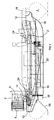
- Thrust may be provided by any air or water propulsion system, or systems. These include air propellers, fans, air jets, water propellers and water jets. In the illustrated embodiment, thrust is provided by one or more fan ducts 5 each having at an exit a nozzle 6 formed by a reduction in cross-sectional area (to accelerate the expelled air), the nozzle 6 being fed with air by one or more air fans 8. Thrust may additionally be supplied by one or more water propellers or water jets 10. Only one fan duct 5 is shown in Figure 4 for clarity. In practice, the craft has a pair of fan ducts arranged side by side at the rear of the craft.
- Lift may be provided by any means of supplying air or another gas to a containment device.
- lift is provided by drawing a proportion of the air flow from ducted fans into a lift duct 12, from where the air flow is fed through the hull 2 to the skirt system 4.
- Splitter plates 14 are controlled to provide adequate lift air and may close to divert all of the air through the fan duct 5 to the thrust nozzle 6, while the craft is supported by the fixed geometry planing hull 2.
- the skirt system 4 may be rigid or flexible.
- the skirt system consists of segments comprising openended flexible bags with a pocket sewn into each bag.
- the skirt segments may be formed from any suitable material.
- the planing hull may be a "deep V” design.
- the hull is a "deep V” design, with a bow 16 designed to slice through waves and push floating debris or ice to each side.
- the hull geometry is suitable to support the lower edges of the skirt segments and at least one inflatable collar 18, so that the upper edges of the skirt segments are supported from the inflatable collar(s) 18.
- a “tunnel” 20 in the hull bottom is formed behind the bow 16.
- a water propeller 10 is shown housed in the tunnel 20, so that the propeller 10 is above the bottom of the keel, or keels.
- the bow 16 deflects floating debris or ice, so that clear water is fed to the propeller 10 in the tunnel 20, while the tunnel 20 protects the propeller 10 from damage when the craft dries out or is used over solid surfaces or submerged debris or obstructions.
- the hull width is suitable for transport on a road trailer, or in a shipping container. Adequate width for the cushion of air is provided by side "wings" 22.
- the side skirt segments are attached to the inflatable collar(s) 18 on the side wings 22.
- the inflatable collar(s) 18 may be separate or a single entity. In the illustrated embodiment, separate inflatable collars 18 are attached to the wings 22 and to the rigid part of the hull 2 around the bow 16, joined by envelopes 24 having sufficient flexibility for the side wings 22 to move through their full travel.
- a wing 22 may be seen in a folded up position A and also a folded down position B. The connection between the wing 22 and the hull 2 is articulated. The wings 22 may be folded down to give maximum width for the cushion.
- the wings 22 may be folded up to give minimum width for transport out of the water.
- the skirt segments may be pulled up out of the water by the action of the folding wings 22.
- hydrodynamic drag from the skirt segments dragging in the water may be reduced, by lifting the skirt segments clear of the water while the craft operates in its planing mode.
- Folding the wings up also raises the inflatable collars at the sides of the craft to their maximum height, which increases the freeboard and improves safety in poor weather conditions.
- operation of the folding wings 22 is by an automatic control, allowing a rapid transition from planing to cushion operation without manual conversion. This allows the craft to enter high waves from a beach, mud flat or any other surface and then enter the planing mode of operation to proceed away safely. Similarly, the craft may leave disturbed water or high waves by driving at speed on to a beach, mud flat or any other surface and then enter the cushion mode of operation to proceed away safely.
- each segment When lift air flows into the skirt segments, the side walls 28 of the skirt segments seal against each other to prevent loss of air. There is no difference in air pressure between adjacent skirt segments, so there is no flow of air out of the slits in the side walls 28.
- the top of each segment is attached to the hull 2 or the inflatable collar 18 by a lip provided with a hook and loop fastening system. This allows damaged segments to be changed rapidly.
- a set of drag flaps 38 at the stern of the craft are long enough to drag underneath the aft skirt segments.
- the drag flaps 38 are bouyant, so that when the craft is floating or planing the drag flaps 38 lift the aft skirt segments clear of the water, to provide minimum drag.
- the craft may conveniently be provided with one or more thrust reversers.
- the thrust reversers may be formed integral with the air rudders or separately.
- a thrust reverser comprises a compound air rudder mounted in between the air fan 8 and the nozzle 6 of the fan duct 5.
- the compound rudder consists of two vertical control surfaces 30 mounted on a jockey bar.
- the control surfaces 30 are normally fixed parallel to each other and the jockey bar is rotated about a vertical axis to provide a turning moment at the rear of the craft.
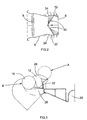
- a separate control moves the control surfaces 30 relative to each other about vertical axes from the jockey bar, until their leading edges meet on a vertical line, so that the control surfaces 30 form a V in plan view ( Figure 2).
- Reverse thrust may be used to slow and stop the craft, or to reverse it. Effective steering while reversing allows the craft to be maneuvered easily. There is nothing to block the reverse flow apertures or vanes 34, either when the control surfaces 30 are locked parallel, or in a V. When the control surfaces 30 are locked parallel and steering is neutral, little or no air escapes out of the apertures because the air has sufficient momentum to get past the apertures. At forward speed, air from outside the fan duct 5 provides an additional sealing pressure. When the steering is moved away from neutral, some air is deflected by a vertical control surface 30 and out of one side of the fan duct 5. The reaction to this flow provides a powerful turning moment at the rear of the craft which, added to the reaction on the compound rudder, improves the maneuverability while the craft is stationary or traveling forwards, compared with conventional craft.
- the craft is also fitted with a pair of water rudders 36, which operate in a conventional manner.
- Conventional boats may have a throttle box with a foward/ reverse movement. Forward engages the gearbox forward gear before advancing the throttle cable. Reverse engages the gearbox reverse gear before advancing the throttle cable and the propeller turns in the opposite direction to pull the boat back or slow it down. This makes maneuvering the boat simple and quick.
- Conventional hovercraft may have separate controls for throttle and thrust reverser(s), vectored thrust, elevons or skirt shifting mechanisms. These are effective but require a trained operator.
- the amphibious craft of the present invention may have a single throttle lever that controls the thrust reverser, engine throttle and a gearbox.
- the vertical control surfaces 30 may be rotated until they are parallel to one another, forming a rudder assembly.
- the same movement of the lever advances the engine throttle once the vertical control surfaces 30 have moved.
- the vertical control surfaces 30 may be rotated until they form a thrust reverser.
- the same movement of the lever advances the engine throttle once the control surfaces 30 have moved.
- the effect is that the craft can be moved forward, backward or slowed using the same control movement as a conventional boat throttle box. Operators of craft constructed in accordance with this aspect of the present invention will accordingly require little further training to use the system.
- the amphibious craft of the present invention may have a water thrust system. This may be engaged or disengaged using the same control box.
- the box may have a separate lever, button or other control to do this, or it may have a separate movement of the single control lever.
- the control box may allow the lever to move in an H pattern in plan view. From the neutral position, the lever can be moved sideways to change from one side of the H to the other. The sideways movement may engage or disengage the water thrust system, so that forward/ reverse movement on one side of the H has the water system engaged and on the other has the water system disengaged.
- the stops on the travel of the lever may be at different positions around the H, allowing the maximum engine power to be limited for different configurations. This system allows the operator to control the craft rapidly and easily, without using different controls for the various systems on the craft.
- the steering system controls the compound air rudders and the water rudders simultaneously, so that steering is provided by a single control however the craft is operating.
Landscapes
- Engineering & Computer Science (AREA)
- Mechanical Engineering (AREA)
- Transportation (AREA)
- Aviation & Aerospace Engineering (AREA)
- Chemical & Material Sciences (AREA)
- Combustion & Propulsion (AREA)
- Physics & Mathematics (AREA)
- Fluid Mechanics (AREA)
- Ocean & Marine Engineering (AREA)
- Toys (AREA)
- Motorcycle And Bicycle Frame (AREA)
- Emergency Lowering Means (AREA)
Applications Claiming Priority (2)
| Application Number | Priority Date | Filing Date | Title |
|---|---|---|---|
| GBGB0313979.7A GB0313979D0 (en) | 2003-06-17 | 2003-06-17 | Improvements in and relating to an amphibious craft |
| GB0313979 | 2003-06-17 |
Publications (2)
| Publication Number | Publication Date |
|---|---|
| EP1488976A2 true EP1488976A2 (fr) | 2004-12-22 |
| EP1488976A3 EP1488976A3 (fr) | 2005-07-20 |
Family
ID=27636680
Family Applications (1)
| Application Number | Title | Priority Date | Filing Date |
|---|---|---|---|
| EP04253534A Withdrawn EP1488976A3 (fr) | 2003-06-17 | 2004-06-14 | Perfectionnements aux engins amphibies |
Country Status (4)
| Country | Link |
|---|---|
| US (1) | US7347154B2 (fr) |
| EP (1) | EP1488976A3 (fr) |
| CA (1) | CA2471052A1 (fr) |
| GB (2) | GB0313979D0 (fr) |
Cited By (2)
| Publication number | Priority date | Publication date | Assignee | Title |
|---|---|---|---|---|
| ITGE20130049A1 (it) * | 2013-05-20 | 2014-11-21 | Hovertech Ltd | Sistema di governo di un hovercraft |
| CN105539420A (zh) * | 2013-06-28 | 2016-05-04 | 苏州汇诚智造工业设计有限公司 | 一种叶轮增压气垫船的制造方法 |
Families Citing this family (15)
| Publication number | Priority date | Publication date | Assignee | Title |
|---|---|---|---|---|
| US7464657B2 (en) * | 2005-12-30 | 2008-12-16 | Textron Inc. | Catamaran air cushion ship with folding, retractable seals |
| US20090101426A1 (en) * | 2007-10-17 | 2009-04-23 | Umoe Mandal As | Vehicle |
| CA3038385C (fr) * | 2009-04-16 | 2021-03-02 | Wabash National, L.P. | Systeme de jupe laterale et de cable de barre anti-encastrement laterale pour une remorque |
| ES2554453T3 (es) | 2011-04-15 | 2015-12-21 | Lta Corporation | Sistema de transportación que incluye un vehículo flotante |
| US8783758B2 (en) | 2012-03-21 | 2014-07-22 | Wabash National, L.P. | Folding side skirt system for a trailer |
| US9919750B2 (en) | 2013-08-15 | 2018-03-20 | Wabash National, L.P. | Side skirt system for reducing drag |
| CA2884510C (fr) | 2014-03-11 | 2022-01-04 | Wabash National, L.P. | Dispositif de jupe laterale pour une remorque |
| FR3024698B1 (fr) * | 2014-08-06 | 2016-09-02 | Pascal Guitton | Vehicule amphibie |
| US9688320B2 (en) | 2014-10-29 | 2017-06-27 | Wabash National, L.P. | Side skirt system for a trailer |
| CN105882340B (zh) * | 2016-06-12 | 2018-03-20 | 中国船舶重工集团公司第七○二研究所 | 空气推进两栖滩涂船 |
| US10343731B2 (en) | 2016-09-30 | 2019-07-09 | Wabash National, L.P. | Skirt system mount bracket assembly |
| US10549797B2 (en) | 2017-04-20 | 2020-02-04 | Wabash National, L.P. | Side underride guard |
| MX2022012587A (es) | 2017-09-13 | 2022-11-09 | Wabash National Lp | Proteccion antiempotramiento lateral. |
| US10940817B2 (en) | 2018-02-21 | 2021-03-09 | Wabash National, L.P. | Side underride guard |
| CN115593653B (zh) * | 2022-10-28 | 2024-04-16 | 中国工程物理研究院总体工程研究所 | 高速空-水介质跨越测试回收试验装置及试验方法 |
Citations (4)
| Publication number | Priority date | Publication date | Assignee | Title |
|---|---|---|---|---|
| US3389672A (en) | 1965-09-24 | 1968-06-25 | Westland Aircraft Ltd | Vehicles |
| US4535712A (en) | 1981-04-16 | 1985-08-20 | Matthews Leslie N | Variable air cushion mode vehicle |
| US5228407A (en) * | 1991-02-01 | 1993-07-20 | Barry Douglas Enterprises Ltd. | Rigid inflatable boat |
| EP0743239A1 (fr) * | 1995-05-19 | 1996-11-20 | Zodiac International | Embarcation pneumatique |
Family Cites Families (20)
| Publication number | Priority date | Publication date | Assignee | Title |
|---|---|---|---|---|
| GB1056037A (en) * | 1964-10-15 | 1967-01-25 | Westland Aircraft Ltd | Improvements in or relating to vehicles capable of operation as a displacement craft or as a gaseous cushion supported craft |
| GB1106753A (en) | 1965-09-24 | 1968-03-20 | British Hovercraft Corp Ltd | Improvements in or relating to gaseous fluid cushion supported vehicles capable of operating as displacement vessels |
| US3476069A (en) * | 1967-01-24 | 1969-11-04 | Gen Dynamics Corp | Multiple hull vehicle with air cushion support |
| US3399655A (en) | 1967-04-24 | 1968-09-03 | Clayton Manufacturing Co | Forced circulation steam generator with thermal-mechanical pre-removal of corrosive gases from the liquid supplied to the heating coil |
| US3481297A (en) * | 1967-11-13 | 1969-12-02 | Gen Dynamics Corp | Multi-mode variable geometry surface effect ship |
| US3515236A (en) * | 1968-03-04 | 1970-06-02 | Carl W Weiland | Apparatus for providing an air cushion for a ground effect vehicle |
| US3677213A (en) * | 1970-09-17 | 1972-07-18 | Allen G Ford | Skirted air cushioned planing hull |
| GB1494733A (en) | 1974-12-16 | 1977-12-14 | British Hovercraft Corp Ltd | Air cushion vehicles |
| GB1529952A (en) | 1975-06-20 | 1978-10-25 | British Hovercraft Corp Ltd | Air cushion vehicles |
| SE426043B (sv) | 1978-04-13 | 1982-12-06 | Beckerbat Ab | Farkost avsedd for gang i vatten och pa is |
| US4397367A (en) * | 1981-05-20 | 1983-08-09 | Ivanov Sergei K | Lift and propulsion unit of air-cushion transport vehicle |
| GB2134857B (en) | 1983-02-11 | 1986-07-16 | Stanley Gordon Rex Simpson | Improvements in or relating to watercraft |
| JPH01215692A (ja) * | 1988-02-25 | 1989-08-29 | Soretsukusu Kk | 空気圧力によって推進する乗物の操縦装置 |
| JPH0420697Y2 (fr) * | 1988-10-14 | 1992-05-12 | ||
| JPH0421748Y2 (fr) * | 1988-11-16 | 1992-05-18 | ||
| JPH04191163A (ja) | 1990-11-26 | 1992-07-09 | Takumi Moriwake | インフレイタブル艇体のホバークラフト |
| BE1008483A3 (nl) | 1994-04-07 | 1996-05-07 | Bekaert Sa Nv | Metaalvezelmembraan voor gasverbranding. |
| CA2164010A1 (fr) | 1995-11-28 | 1997-05-29 | Leszek Balas | Bateau a effet de surface |
| US5746146A (en) * | 1996-10-18 | 1998-05-05 | Bixel, Jr.; Charles Gilbert | Surface effect planing pontoon seaplane (SEPPS) |
| WO2000001565A1 (fr) | 1998-07-01 | 2000-01-13 | Pacific Hovercraft New Zealand Limited | Vehicule sur coussin d'air |
-
2003
- 2003-06-17 GB GBGB0313979.7A patent/GB0313979D0/en not_active Ceased
-
2004
- 2004-06-14 US US10/868,162 patent/US7347154B2/en not_active Expired - Fee Related
- 2004-06-14 EP EP04253534A patent/EP1488976A3/fr not_active Withdrawn
- 2004-06-15 CA CA002471052A patent/CA2471052A1/fr not_active Abandoned
- 2004-06-16 GB GB0413385A patent/GB2402911B/en not_active Expired - Fee Related
Patent Citations (4)
| Publication number | Priority date | Publication date | Assignee | Title |
|---|---|---|---|---|
| US3389672A (en) | 1965-09-24 | 1968-06-25 | Westland Aircraft Ltd | Vehicles |
| US4535712A (en) | 1981-04-16 | 1985-08-20 | Matthews Leslie N | Variable air cushion mode vehicle |
| US5228407A (en) * | 1991-02-01 | 1993-07-20 | Barry Douglas Enterprises Ltd. | Rigid inflatable boat |
| EP0743239A1 (fr) * | 1995-05-19 | 1996-11-20 | Zodiac International | Embarcation pneumatique |
Cited By (3)
| Publication number | Priority date | Publication date | Assignee | Title |
|---|---|---|---|---|
| ITGE20130049A1 (it) * | 2013-05-20 | 2014-11-21 | Hovertech Ltd | Sistema di governo di un hovercraft |
| CN105539420A (zh) * | 2013-06-28 | 2016-05-04 | 苏州汇诚智造工业设计有限公司 | 一种叶轮增压气垫船的制造方法 |
| CN105539420B (zh) * | 2013-06-28 | 2018-08-31 | 宿迁峰驰安防有限公司 | 一种叶轮增压气垫船的制造方法 |
Also Published As
| Publication number | Publication date |
|---|---|
| CA2471052A1 (fr) | 2004-12-17 |
| GB2402911B (en) | 2006-07-19 |
| US7347154B2 (en) | 2008-03-25 |
| GB0313979D0 (en) | 2003-07-23 |
| GB2402911A (en) | 2004-12-22 |
| GB0413385D0 (en) | 2004-07-21 |
| US20050016436A1 (en) | 2005-01-27 |
| EP1488976A3 (fr) | 2005-07-20 |
Similar Documents
| Publication | Publication Date | Title |
|---|---|---|
| US7347154B2 (en) | Amphibious craft | |
| EP0429643B1 (fr) | Systemes porteurs et propulseurs pour engins aquatiques | |
| US3208543A (en) | Air cushion vehicle | |
| US3321923A (en) | Steerable self-powered floating structures | |
| EP0429605B1 (fr) | Vehicule amphibie a ailerons porteurs | |
| JP4937454B2 (ja) | 接岸装備のなされていない海岸線での陸揚げ/船積み用船舶 | |
| US3207116A (en) | Attachment of jet propulsion units to water-borne craft and means for steering the unit | |
| CN113291444A (zh) | 一种水航体新型倒航结构装置 | |
| US7464657B2 (en) | Catamaran air cushion ship with folding, retractable seals | |
| US20260015073A1 (en) | Integrated thruster apparatus for a marine vessel | |
| US3390655A (en) | Patrol craft | |
| US5850801A (en) | Pushing unit | |
| US20080203216A1 (en) | Multi-Environment Engine | |
| KR20180106706A (ko) | 에어제트 선박 | |
| US6619220B1 (en) | Hybrid SES/hovercraft with retractable skirt system | |
| US8915762B2 (en) | Catamaran vessel with hybrid propulsion for embarking and disembarking loads | |
| US5941331A (en) | Air cushion vehicle control system | |
| US7428939B1 (en) | Waterjet drive hovercraft with adjustable trim system | |
| US3189115A (en) | Aqua-track g.e.m. | |
| JPH10100987A (ja) | 入渠案内船 | |
| US7063291B2 (en) | Amphibian delta wing jet aircraft | |
| US4681054A (en) | Marine vessel and method for transporting a vehicle | |
| KR101785226B1 (ko) | 호버크래프트 기능을 겸비한 에어제트 추진방식의 선박 | |
| US3263643A (en) | Vehicles operable over water | |
| US20220105761A1 (en) | Boat with Foot Pedal Operated Braking System |
Legal Events
| Date | Code | Title | Description |
|---|---|---|---|
| PUAI | Public reference made under article 153(3) epc to a published international application that has entered the european phase |
Free format text: ORIGINAL CODE: 0009012 |
|
| AK | Designated contracting states |
Kind code of ref document: A2 Designated state(s): AT BE BG CH CY CZ DE DK EE ES FI FR GB GR HU IE IT LI LU MC NL PL PT RO SE SI SK TR |
|
| AX | Request for extension of the european patent |
Extension state: AL HR LT LV MK |
|
| PUAL | Search report despatched |
Free format text: ORIGINAL CODE: 0009013 |
|
| AK | Designated contracting states |
Kind code of ref document: A3 Designated state(s): AT BE BG CH CY CZ DE DK EE ES FI FR GB GR HU IE IT LI LU MC NL PL PT RO SE SI SK TR |
|
| AX | Request for extension of the european patent |
Extension state: AL HR LT LV MK |
|
| 17P | Request for examination filed |
Effective date: 20060116 |
|
| AKX | Designation fees paid |
Designated state(s): AT BE BG CH CY CZ DE DK EE ES FI FR GB GR HU IE IT LI LU MC NL PL PT RO SE SI SK TR |
|
| 17Q | First examination report despatched |
Effective date: 20060306 |
|
| STAA | Information on the status of an ep patent application or granted ep patent |
Free format text: STATUS: THE APPLICATION IS DEEMED TO BE WITHDRAWN |
|
| 18D | Application deemed to be withdrawn |
Effective date: 20090106 |