EP1490118B1 - Narbenreduktionspflaster - Google Patents
Narbenreduktionspflaster Download PDFInfo
- Publication number
- EP1490118B1 EP1490118B1 EP03717221A EP03717221A EP1490118B1 EP 1490118 B1 EP1490118 B1 EP 1490118B1 EP 03717221 A EP03717221 A EP 03717221A EP 03717221 A EP03717221 A EP 03717221A EP 1490118 B1 EP1490118 B1 EP 1490118B1
- Authority
- EP
- European Patent Office
- Prior art keywords
- scar
- plaster
- layer
- polyurethane
- edge
- Prior art date
- Legal status (The legal status is an assumption and is not a legal conclusion. Google has not performed a legal analysis and makes no representation as to the accuracy of the status listed.)
- Expired - Lifetime
Links
- 239000011505 plaster Substances 0.000 title claims abstract description 32
- 231100000241 scar Toxicity 0.000 claims abstract description 66
- 239000004814 polyurethane Substances 0.000 claims abstract description 65
- 229920002635 polyurethane Polymers 0.000 claims abstract description 65
- 239000011159 matrix material Substances 0.000 claims abstract description 32
- 238000000034 method Methods 0.000 claims abstract description 22
- 239000000853 adhesive Substances 0.000 claims abstract description 18
- 230000001070 adhesive effect Effects 0.000 claims abstract description 16
- XLYOFNOQVPJJNP-UHFFFAOYSA-N water Substances O XLYOFNOQVPJJNP-UHFFFAOYSA-N 0.000 claims abstract description 14
- 229920000642 polymer Polymers 0.000 claims abstract description 8
- 230000008569 process Effects 0.000 claims description 19
- 239000000463 material Substances 0.000 claims description 12
- 238000004519 manufacturing process Methods 0.000 claims description 11
- -1 polyethylene Polymers 0.000 claims description 9
- 208000032544 Cicatrix Diseases 0.000 claims description 8
- 230000037387 scars Effects 0.000 claims description 8
- 239000004952 Polyamide Substances 0.000 claims description 3
- 238000003475 lamination Methods 0.000 claims description 3
- 229920002647 polyamide Polymers 0.000 claims description 3
- 229920000728 polyester Polymers 0.000 claims description 3
- 229920000247 superabsorbent polymer Polymers 0.000 claims description 3
- 230000007704 transition Effects 0.000 claims description 3
- 239000004698 Polyethylene Substances 0.000 claims description 2
- 239000004743 Polypropylene Substances 0.000 claims description 2
- 230000000729 hypotrophic effect Effects 0.000 claims description 2
- 238000004049 embossing Methods 0.000 claims 1
- 229920000573 polyethylene Polymers 0.000 claims 1
- 229920001155 polypropylene Polymers 0.000 claims 1
- 230000007423 decrease Effects 0.000 abstract description 2
- 239000010410 layer Substances 0.000 description 30
- 206010052428 Wound Diseases 0.000 description 28
- 208000027418 Wounds and injury Diseases 0.000 description 26
- 229920005862 polyol Polymers 0.000 description 21
- 150000003077 polyols Chemical class 0.000 description 21
- 230000009467 reduction Effects 0.000 description 20
- 239000000499 gel Substances 0.000 description 17
- 239000000835 fiber Substances 0.000 description 14
- 102000008186 Collagen Human genes 0.000 description 12
- 108010035532 Collagen Proteins 0.000 description 12
- 229920001436 collagen Polymers 0.000 description 12
- 239000012948 isocyanate Substances 0.000 description 12
- 239000004721 Polyphenylene oxide Substances 0.000 description 11
- 150000002513 isocyanates Chemical class 0.000 description 11
- 229920000570 polyether Polymers 0.000 description 11
- 210000001519 tissue Anatomy 0.000 description 11
- RRAMGCGOFNQTLD-UHFFFAOYSA-N hexamethylene diisocyanate Chemical compound O=C=NCCCCCCN=C=O RRAMGCGOFNQTLD-UHFFFAOYSA-N 0.000 description 9
- IAYPIBMASNFSPL-UHFFFAOYSA-N Ethylene oxide Chemical compound C1CO1 IAYPIBMASNFSPL-UHFFFAOYSA-N 0.000 description 8
- 230000029663 wound healing Effects 0.000 description 8
- 230000015572 biosynthetic process Effects 0.000 description 7
- 239000000416 hydrocolloid Substances 0.000 description 6
- 230000001969 hypertrophic effect Effects 0.000 description 6
- 239000005056 polyisocyanate Substances 0.000 description 6
- 229920001228 polyisocyanate Polymers 0.000 description 6
- XEEYBQQBJWHFJM-UHFFFAOYSA-N Iron Chemical compound [Fe] XEEYBQQBJWHFJM-UHFFFAOYSA-N 0.000 description 5
- 239000003054 catalyst Substances 0.000 description 5
- 238000006243 chemical reaction Methods 0.000 description 5
- 150000001875 compounds Chemical class 0.000 description 5
- 230000000694 effects Effects 0.000 description 5
- 125000002887 hydroxy group Chemical group [H]O* 0.000 description 5
- 239000000203 mixture Substances 0.000 description 5
- 206010063560 Excessive granulation tissue Diseases 0.000 description 4
- 239000005057 Hexamethylene diisocyanate Substances 0.000 description 4
- GWEVSGVZZGPLCZ-UHFFFAOYSA-N Titan oxide Chemical compound O=[Ti]=O GWEVSGVZZGPLCZ-UHFFFAOYSA-N 0.000 description 4
- 239000000654 additive Substances 0.000 description 4
- 239000012790 adhesive layer Substances 0.000 description 4
- 239000003963 antioxidant agent Substances 0.000 description 4
- 235000006708 antioxidants Nutrition 0.000 description 4
- 230000008901 benefit Effects 0.000 description 4
- 150000001735 carboxylic acids Chemical class 0.000 description 4
- 210000002808 connective tissue Anatomy 0.000 description 4
- 239000000945 filler Substances 0.000 description 4
- 239000000049 pigment Substances 0.000 description 4
- 229920000058 polyacrylate Polymers 0.000 description 4
- 238000002360 preparation method Methods 0.000 description 4
- 238000007634 remodeling Methods 0.000 description 4
- 150000003839 salts Chemical class 0.000 description 4
- 230000008961 swelling Effects 0.000 description 4
- 238000005406 washing Methods 0.000 description 4
- UPMLOUAZCHDJJD-UHFFFAOYSA-N 4,4'-Diphenylmethane Diisocyanate Chemical compound C1=CC(N=C=O)=CC=C1CC1=CC=C(N=C=O)C=C1 UPMLOUAZCHDJJD-UHFFFAOYSA-N 0.000 description 3
- CIWBSHSKHKDKBQ-JLAZNSOCSA-N Ascorbic acid Natural products OC[C@H](O)[C@H]1OC(=O)C(O)=C1O CIWBSHSKHKDKBQ-JLAZNSOCSA-N 0.000 description 3
- 102000029816 Collagenase Human genes 0.000 description 3
- 108060005980 Collagenase Proteins 0.000 description 3
- RYGMFSIKBFXOCR-UHFFFAOYSA-N Copper Chemical compound [Cu] RYGMFSIKBFXOCR-UHFFFAOYSA-N 0.000 description 3
- LYCAIKOWRPUZTN-UHFFFAOYSA-N Ethylene glycol Chemical compound OCCO LYCAIKOWRPUZTN-UHFFFAOYSA-N 0.000 description 3
- PEDCQBHIVMGVHV-UHFFFAOYSA-N Glycerine Chemical compound OCC(O)CO PEDCQBHIVMGVHV-UHFFFAOYSA-N 0.000 description 3
- DNIAPMSPPWPWGF-UHFFFAOYSA-N Propylene glycol Chemical compound CC(O)CO DNIAPMSPPWPWGF-UHFFFAOYSA-N 0.000 description 3
- GOOHAUXETOMSMM-UHFFFAOYSA-N Propylene oxide Chemical compound CC1CO1 GOOHAUXETOMSMM-UHFFFAOYSA-N 0.000 description 3
- WYURNTSHIVDZCO-UHFFFAOYSA-N Tetrahydrofuran Chemical compound C1CCOC1 WYURNTSHIVDZCO-UHFFFAOYSA-N 0.000 description 3
- 239000002253 acid Substances 0.000 description 3
- 210000004204 blood vessel Anatomy 0.000 description 3
- GVJHHUAWPYXKBD-UHFFFAOYSA-N d-alpha-tocopherol Natural products OC1=C(C)C(C)=C2OC(CCCC(C)CCCC(C)CCCC(C)C)(C)CCC2=C1C GVJHHUAWPYXKBD-UHFFFAOYSA-N 0.000 description 3
- MTHSVFCYNBDYFN-UHFFFAOYSA-N diethylene glycol Chemical compound OCCOCCO MTHSVFCYNBDYFN-UHFFFAOYSA-N 0.000 description 3
- 210000001126 granulation tissue Anatomy 0.000 description 3
- 208000014674 injury Diseases 0.000 description 3
- 239000007788 liquid Substances 0.000 description 3
- 150000002924 oxiranes Chemical class 0.000 description 3
- 239000000843 powder Substances 0.000 description 3
- 239000007787 solid Substances 0.000 description 3
- 239000007858 starting material Substances 0.000 description 3
- 238000003860 storage Methods 0.000 description 3
- 230000002792 vascular Effects 0.000 description 3
- GVJHHUAWPYXKBD-IEOSBIPESA-N α-tocopherol Chemical compound OC1=C(C)C(C)=C2O[C@@](CCC[C@H](C)CCC[C@H](C)CCCC(C)C)(C)CCC2=C1C GVJHHUAWPYXKBD-IEOSBIPESA-N 0.000 description 3
- IKNDGHRNXGEHTO-UHFFFAOYSA-N 2,2-dimethyloctanoic acid Chemical compound CCCCCCC(C)(C)C(O)=O IKNDGHRNXGEHTO-UHFFFAOYSA-N 0.000 description 2
- NLZUEZXRPGMBCV-UHFFFAOYSA-N Butylhydroxytoluene Chemical compound CC1=CC(C(C)(C)C)=C(O)C(C(C)(C)C)=C1 NLZUEZXRPGMBCV-UHFFFAOYSA-N 0.000 description 2
- OKTJSMMVPCPJKN-UHFFFAOYSA-N Carbon Chemical compound [C] OKTJSMMVPCPJKN-UHFFFAOYSA-N 0.000 description 2
- 206010053567 Coagulopathies Diseases 0.000 description 2
- BWGVNKXGVNDBDI-UHFFFAOYSA-N Fibrin monomer Chemical group CNC(=O)CNC(=O)CN BWGVNKXGVNDBDI-UHFFFAOYSA-N 0.000 description 2
- UQSXHKLRYXJYBZ-UHFFFAOYSA-N Iron oxide Chemical compound [Fe]=O UQSXHKLRYXJYBZ-UHFFFAOYSA-N 0.000 description 2
- 229920005830 Polyurethane Foam Polymers 0.000 description 2
- 206010039580 Scar Diseases 0.000 description 2
- 206010047139 Vasoconstriction Diseases 0.000 description 2
- XLOMVQKBTHCTTD-UHFFFAOYSA-N Zinc monoxide Chemical compound [Zn]=O XLOMVQKBTHCTTD-UHFFFAOYSA-N 0.000 description 2
- 239000002250 absorbent Substances 0.000 description 2
- 239000011358 absorbing material Substances 0.000 description 2
- 230000009471 action Effects 0.000 description 2
- 239000013543 active substance Substances 0.000 description 2
- 125000001931 aliphatic group Chemical group 0.000 description 2
- 125000003118 aryl group Chemical group 0.000 description 2
- 230000000740 bleeding effect Effects 0.000 description 2
- 230000023555 blood coagulation Effects 0.000 description 2
- 235000010354 butylated hydroxytoluene Nutrition 0.000 description 2
- 125000004432 carbon atom Chemical group C* 0.000 description 2
- 229960002424 collagenase Drugs 0.000 description 2
- 229920001577 copolymer Polymers 0.000 description 2
- 229920006037 cross link polymer Polymers 0.000 description 2
- 230000006378 damage Effects 0.000 description 2
- 230000000593 degrading effect Effects 0.000 description 2
- 238000011161 development Methods 0.000 description 2
- 230000018109 developmental process Effects 0.000 description 2
- 150000002009 diols Chemical class 0.000 description 2
- 239000002270 dispersing agent Substances 0.000 description 2
- 239000000975 dye Substances 0.000 description 2
- 229920001971 elastomer Polymers 0.000 description 2
- 238000005516 engineering process Methods 0.000 description 2
- 210000002950 fibroblast Anatomy 0.000 description 2
- 239000012530 fluid Substances 0.000 description 2
- 125000004435 hydrogen atom Chemical group [H]* 0.000 description 2
- 229910052738 indium Inorganic materials 0.000 description 2
- 229910052742 iron Inorganic materials 0.000 description 2
- 230000002045 lasting effect Effects 0.000 description 2
- 230000005923 long-lasting effect Effects 0.000 description 2
- 229910052751 metal Inorganic materials 0.000 description 2
- 239000002184 metal Substances 0.000 description 2
- SSDSCDGVMJFTEQ-UHFFFAOYSA-N octadecyl 3-(3,5-ditert-butyl-4-hydroxyphenyl)propanoate Chemical compound CCCCCCCCCCCCCCCCCCOC(=O)CCC1=CC(C(C)(C)C)=C(O)C(C(C)(C)C)=C1 SSDSCDGVMJFTEQ-UHFFFAOYSA-N 0.000 description 2
- 239000012766 organic filler Substances 0.000 description 2
- 239000011496 polyurethane foam Substances 0.000 description 2
- 229920006395 saturated elastomer Polymers 0.000 description 2
- 239000000126 substance Substances 0.000 description 2
- 239000002344 surface layer Substances 0.000 description 2
- 238000012360 testing method Methods 0.000 description 2
- 230000017423 tissue regeneration Effects 0.000 description 2
- 239000004408 titanium dioxide Substances 0.000 description 2
- PCHXZXKMYCGVFA-UHFFFAOYSA-N 1,3-diazetidine-2,4-dione Chemical compound O=C1NC(=O)N1 PCHXZXKMYCGVFA-UHFFFAOYSA-N 0.000 description 1
- 229940008841 1,6-hexamethylene diisocyanate Drugs 0.000 description 1
- PQUXFUBNSYCQAL-UHFFFAOYSA-N 1-(2,3-difluorophenyl)ethanone Chemical compound CC(=O)C1=CC=CC(F)=C1F PQUXFUBNSYCQAL-UHFFFAOYSA-N 0.000 description 1
- KGRVJHAUYBGFFP-UHFFFAOYSA-N 2,2'-Methylenebis(4-methyl-6-tert-butylphenol) Chemical compound CC(C)(C)C1=CC(C)=CC(CC=2C(=C(C=C(C)C=2)C(C)(C)C)O)=C1O KGRVJHAUYBGFFP-UHFFFAOYSA-N 0.000 description 1
- SMZOUWXMTYCWNB-UHFFFAOYSA-N 2-(2-methoxy-5-methylphenyl)ethanamine Chemical compound COC1=CC=C(C)C=C1CCN SMZOUWXMTYCWNB-UHFFFAOYSA-N 0.000 description 1
- NIXOWILDQLNWCW-UHFFFAOYSA-N 2-Propenoic acid Natural products OC(=O)C=C NIXOWILDQLNWCW-UHFFFAOYSA-N 0.000 description 1
- WPMYUUITDBHVQZ-UHFFFAOYSA-M 3-(3,5-ditert-butyl-4-hydroxyphenyl)propanoate Chemical compound CC(C)(C)C1=CC(CCC([O-])=O)=CC(C(C)(C)C)=C1O WPMYUUITDBHVQZ-UHFFFAOYSA-M 0.000 description 1
- HOSGXJWQVBHGLT-UHFFFAOYSA-N 6-hydroxy-3,4-dihydro-1h-quinolin-2-one Chemical group N1C(=O)CCC2=CC(O)=CC=C21 HOSGXJWQVBHGLT-UHFFFAOYSA-N 0.000 description 1
- 239000005995 Aluminium silicate Substances 0.000 description 1
- 229920002134 Carboxymethyl cellulose Polymers 0.000 description 1
- FBPFZTCFMRRESA-FSIIMWSLSA-N D-Glucitol Natural products OC[C@H](O)[C@H](O)[C@@H](O)[C@H](O)CO FBPFZTCFMRRESA-FSIIMWSLSA-N 0.000 description 1
- FBPFZTCFMRRESA-JGWLITMVSA-N D-glucitol Chemical compound OC[C@H](O)[C@@H](O)[C@H](O)[C@H](O)CO FBPFZTCFMRRESA-JGWLITMVSA-N 0.000 description 1
- 241000196324 Embryophyta Species 0.000 description 1
- 239000004606 Fillers/Extenders Substances 0.000 description 1
- UFHFLCQGNIYNRP-UHFFFAOYSA-N Hydrogen Chemical compound [H][H] UFHFLCQGNIYNRP-UHFFFAOYSA-N 0.000 description 1
- 206010020751 Hypersensitivity Diseases 0.000 description 1
- DGAQECJNVWCQMB-PUAWFVPOSA-M Ilexoside XXIX Chemical compound C[C@@H]1CC[C@@]2(CC[C@@]3(C(=CC[C@H]4[C@]3(CC[C@@H]5[C@@]4(CC[C@@H](C5(C)C)OS(=O)(=O)[O-])C)C)[C@@H]2[C@]1(C)O)C)C(=O)O[C@H]6[C@@H]([C@H]([C@@H]([C@H](O6)CO)O)O)O.[Na+] DGAQECJNVWCQMB-PUAWFVPOSA-M 0.000 description 1
- 206010061218 Inflammation Diseases 0.000 description 1
- CSNNHWWHGAXBCP-UHFFFAOYSA-L Magnesium sulfate Chemical compound [Mg+2].[O-][S+2]([O-])([O-])[O-] CSNNHWWHGAXBCP-UHFFFAOYSA-L 0.000 description 1
- 229920002367 Polyisobutene Polymers 0.000 description 1
- 239000004793 Polystyrene Substances 0.000 description 1
- 102000016611 Proteoglycans Human genes 0.000 description 1
- 108010067787 Proteoglycans Proteins 0.000 description 1
- 239000006004 Quartz sand Substances 0.000 description 1
- VYPSYNLAJGMNEJ-UHFFFAOYSA-N Silicium dioxide Chemical compound O=[Si]=O VYPSYNLAJGMNEJ-UHFFFAOYSA-N 0.000 description 1
- XUIMIQQOPSSXEZ-UHFFFAOYSA-N Silicon Chemical compound [Si] XUIMIQQOPSSXEZ-UHFFFAOYSA-N 0.000 description 1
- 206010072170 Skin wound Diseases 0.000 description 1
- CDBYLPFSWZWCQE-UHFFFAOYSA-L Sodium Carbonate Chemical compound [Na+].[Na+].[O-]C([O-])=O CDBYLPFSWZWCQE-UHFFFAOYSA-L 0.000 description 1
- 235000015125 Sterculia urens Nutrition 0.000 description 1
- 240000001058 Sterculia urens Species 0.000 description 1
- CZMRCDWAGMRECN-UGDNZRGBSA-N Sucrose Chemical compound O[C@H]1[C@H](O)[C@@H](CO)O[C@@]1(CO)O[C@@H]1[C@H](O)[C@@H](O)[C@H](O)[C@@H](CO)O1 CZMRCDWAGMRECN-UGDNZRGBSA-N 0.000 description 1
- 229930006000 Sucrose Natural products 0.000 description 1
- ZJCCRDAZUWHFQH-UHFFFAOYSA-N Trimethylolpropane Chemical compound CCC(CO)(CO)CO ZJCCRDAZUWHFQH-UHFFFAOYSA-N 0.000 description 1
- WGLPBDUCMAPZCE-UHFFFAOYSA-N Trioxochromium Chemical compound O=[Cr](=O)=O WGLPBDUCMAPZCE-UHFFFAOYSA-N 0.000 description 1
- 229920001807 Urea-formaldehyde Polymers 0.000 description 1
- 229930003427 Vitamin E Natural products 0.000 description 1
- BGYHLZZASRKEJE-UHFFFAOYSA-N [3-[3-(3,5-ditert-butyl-4-hydroxyphenyl)propanoyloxy]-2,2-bis[3-(3,5-ditert-butyl-4-hydroxyphenyl)propanoyloxymethyl]propyl] 3-(3,5-ditert-butyl-4-hydroxyphenyl)propanoate Chemical compound CC(C)(C)C1=C(O)C(C(C)(C)C)=CC(CCC(=O)OCC(COC(=O)CCC=2C=C(C(O)=C(C=2)C(C)(C)C)C(C)(C)C)(COC(=O)CCC=2C=C(C(O)=C(C=2)C(C)(C)C)C(C)(C)C)COC(=O)CCC=2C=C(C(O)=C(C=2)C(C)(C)C)C(C)(C)C)=C1 BGYHLZZASRKEJE-UHFFFAOYSA-N 0.000 description 1
- 230000002745 absorbent Effects 0.000 description 1
- 239000006096 absorbing agent Substances 0.000 description 1
- 238000010521 absorption reaction Methods 0.000 description 1
- 150000007513 acids Chemical class 0.000 description 1
- 239000004480 active ingredient Substances 0.000 description 1
- 208000026935 allergic disease Diseases 0.000 description 1
- 230000007815 allergy Effects 0.000 description 1
- 229940087168 alpha tocopherol Drugs 0.000 description 1
- 235000012211 aluminium silicate Nutrition 0.000 description 1
- 150000001412 amines Chemical class 0.000 description 1
- 230000001195 anabolic effect Effects 0.000 description 1
- 238000004873 anchoring Methods 0.000 description 1
- 230000033115 angiogenesis Effects 0.000 description 1
- 230000006907 apoptotic process Effects 0.000 description 1
- 235000010323 ascorbic acid Nutrition 0.000 description 1
- 229960005070 ascorbic acid Drugs 0.000 description 1
- 239000011668 ascorbic acid Substances 0.000 description 1
- TZCXTZWJZNENPQ-UHFFFAOYSA-L barium sulfate Chemical compound [Ba+2].[O-]S([O-])(=O)=O TZCXTZWJZNENPQ-UHFFFAOYSA-L 0.000 description 1
- 229910052601 baryte Inorganic materials 0.000 description 1
- 239000010428 baryte Substances 0.000 description 1
- HIFVAOIJYDXIJG-UHFFFAOYSA-N benzylbenzene;isocyanic acid Chemical class N=C=O.N=C=O.C=1C=CC=CC=1CC1=CC=CC=C1 HIFVAOIJYDXIJG-UHFFFAOYSA-N 0.000 description 1
- 239000011230 binding agent Substances 0.000 description 1
- OHJMTUPIZMNBFR-UHFFFAOYSA-N biuret Chemical compound NC(=O)NC(N)=O OHJMTUPIZMNBFR-UHFFFAOYSA-N 0.000 description 1
- 210000004369 blood Anatomy 0.000 description 1
- 239000008280 blood Substances 0.000 description 1
- 230000017531 blood circulation Effects 0.000 description 1
- 238000009835 boiling Methods 0.000 description 1
- 125000003178 carboxy group Chemical group [H]OC(*)=O 0.000 description 1
- 239000001768 carboxy methyl cellulose Substances 0.000 description 1
- 235000010948 carboxy methyl cellulose Nutrition 0.000 description 1
- 239000008112 carboxymethyl-cellulose Substances 0.000 description 1
- 239000012876 carrier material Substances 0.000 description 1
- 230000001925 catabolic effect Effects 0.000 description 1
- 230000004663 cell proliferation Effects 0.000 description 1
- 229910000420 cerium oxide Inorganic materials 0.000 description 1
- 239000003795 chemical substances by application Substances 0.000 description 1
- 229910000423 chromium oxide Inorganic materials 0.000 description 1
- 230000001684 chronic effect Effects 0.000 description 1
- 239000005515 coenzyme Substances 0.000 description 1
- 239000000470 constituent Substances 0.000 description 1
- 238000010924 continuous production Methods 0.000 description 1
- 238000007796 conventional method Methods 0.000 description 1
- 229910052802 copper Inorganic materials 0.000 description 1
- 239000010949 copper Substances 0.000 description 1
- 210000000736 corneocyte Anatomy 0.000 description 1
- 230000007547 defect Effects 0.000 description 1
- 230000007812 deficiency Effects 0.000 description 1
- 230000001419 dependent effect Effects 0.000 description 1
- 238000013461 design Methods 0.000 description 1
- 238000004512 die casting Methods 0.000 description 1
- 125000005442 diisocyanate group Chemical group 0.000 description 1
- SZXQTJUDPRGNJN-UHFFFAOYSA-N dipropylene glycol Chemical compound OCCCOCCCO SZXQTJUDPRGNJN-UHFFFAOYSA-N 0.000 description 1
- 238000004821 distillation Methods 0.000 description 1
- 238000004043 dyeing Methods 0.000 description 1
- 238000001704 evaporation Methods 0.000 description 1
- 230000008020 evaporation Effects 0.000 description 1
- 239000004744 fabric Substances 0.000 description 1
- 230000020764 fibrinolysis Effects 0.000 description 1
- 210000000630 fibrocyte Anatomy 0.000 description 1
- 239000006260 foam Substances 0.000 description 1
- 239000004088 foaming agent Substances 0.000 description 1
- ZZUFCTLCJUWOSV-UHFFFAOYSA-N furosemide Chemical compound C1=C(Cl)C(S(=O)(=O)N)=CC(C(O)=O)=C1NCC1=CC=CO1 ZZUFCTLCJUWOSV-UHFFFAOYSA-N 0.000 description 1
- WIGCFUFOHFEKBI-UHFFFAOYSA-N gamma-tocopherol Natural products CC(C)CCCC(C)CCCC(C)CCCC1CCC2C(C)C(O)C(C)C(C)C2O1 WIGCFUFOHFEKBI-UHFFFAOYSA-N 0.000 description 1
- 239000003365 glass fiber Substances 0.000 description 1
- 210000003714 granulocyte Anatomy 0.000 description 1
- 230000003370 grooming effect Effects 0.000 description 1
- 229910052602 gypsum Inorganic materials 0.000 description 1
- 239000010440 gypsum Substances 0.000 description 1
- 239000000017 hydrogel Substances 0.000 description 1
- 229920001477 hydrophilic polymer Polymers 0.000 description 1
- 238000007373 indentation Methods 0.000 description 1
- 230000002757 inflammatory effect Effects 0.000 description 1
- 230000004054 inflammatory process Effects 0.000 description 1
- 238000009413 insulation Methods 0.000 description 1
- 230000009545 invasion Effects 0.000 description 1
- NLYAJNPCOHFWQQ-UHFFFAOYSA-N kaolin Chemical compound O.O.O=[Al]O[Si](=O)O[Si](=O)O[Al]=O NLYAJNPCOHFWQQ-UHFFFAOYSA-N 0.000 description 1
- 229910052928 kieserite Inorganic materials 0.000 description 1
- 230000033001 locomotion Effects 0.000 description 1
- 210000004698 lymphocyte Anatomy 0.000 description 1
- 230000002879 macerating effect Effects 0.000 description 1
- 238000002803 maceration Methods 0.000 description 1
- 210000002540 macrophage Anatomy 0.000 description 1
- 230000007246 mechanism Effects 0.000 description 1
- NYGZLYXAPMMJTE-UHFFFAOYSA-M metanil yellow Chemical group [Na+].[O-]S(=O)(=O)C1=CC=CC(N=NC=2C=CC(NC=3C=CC=CC=3)=CC=2)=C1 NYGZLYXAPMMJTE-UHFFFAOYSA-M 0.000 description 1
- 239000004005 microsphere Substances 0.000 description 1
- 230000000394 mitotic effect Effects 0.000 description 1
- 238000012986 modification Methods 0.000 description 1
- 230000004048 modification Effects 0.000 description 1
- 210000000651 myofibroblast Anatomy 0.000 description 1
- RGOVYLWUIBMPGK-UHFFFAOYSA-N nonivamide Chemical compound CCCCCCCCC(=O)NCC1=CC=C(O)C(OC)=C1 RGOVYLWUIBMPGK-UHFFFAOYSA-N 0.000 description 1
- BMMGVYCKOGBVEV-UHFFFAOYSA-N oxo(oxoceriooxy)cerium Chemical compound [Ce]=O.O=[Ce]=O BMMGVYCKOGBVEV-UHFFFAOYSA-N 0.000 description 1
- NFHFRUOZVGFOOS-UHFFFAOYSA-N palladium;triphenylphosphane Chemical compound [Pd].C1=CC=CC=C1P(C=1C=CC=CC=1)C1=CC=CC=C1.C1=CC=CC=C1P(C=1C=CC=CC=1)C1=CC=CC=C1.C1=CC=CC=C1P(C=1C=CC=CC=1)C1=CC=CC=C1.C1=CC=CC=C1P(C=1C=CC=CC=1)C1=CC=CC=C1 NFHFRUOZVGFOOS-UHFFFAOYSA-N 0.000 description 1
- 244000052769 pathogen Species 0.000 description 1
- 230000035515 penetration Effects 0.000 description 1
- WXZMFSXDPGVJKK-UHFFFAOYSA-N pentaerythritol Chemical compound OCC(CO)(CO)CO WXZMFSXDPGVJKK-UHFFFAOYSA-N 0.000 description 1
- 230000002093 peripheral effect Effects 0.000 description 1
- 230000035699 permeability Effects 0.000 description 1
- ISWSIDIOOBJBQZ-UHFFFAOYSA-N phenol group Chemical group C1(=CC=CC=C1)O ISWSIDIOOBJBQZ-UHFFFAOYSA-N 0.000 description 1
- IEQIEDJGQAUEQZ-UHFFFAOYSA-N phthalocyanine Chemical compound N1C(N=C2C3=CC=CC=C3C(N=C3C4=CC=CC=C4C(=N4)N3)=N2)=C(C=CC=C2)C2=C1N=C1C2=CC=CC=C2C4=N1 IEQIEDJGQAUEQZ-UHFFFAOYSA-N 0.000 description 1
- 229920003023 plastic Polymers 0.000 description 1
- 239000004033 plastic Substances 0.000 description 1
- 239000004014 plasticizer Substances 0.000 description 1
- 229920001495 poly(sodium acrylate) polymer Polymers 0.000 description 1
- 229920006149 polyester-amide block copolymer Polymers 0.000 description 1
- 238000006116 polymerization reaction Methods 0.000 description 1
- ODGAOXROABLFNM-UHFFFAOYSA-N polynoxylin Chemical compound O=C.NC(N)=O ODGAOXROABLFNM-UHFFFAOYSA-N 0.000 description 1
- 229920001296 polysiloxane Polymers 0.000 description 1
- 229920002223 polystyrene Polymers 0.000 description 1
- 229920003225 polyurethane elastomer Polymers 0.000 description 1
- 229920006264 polyurethane film Polymers 0.000 description 1
- 239000004800 polyvinyl chloride Substances 0.000 description 1
- 229920000915 polyvinyl chloride Polymers 0.000 description 1
- 159000000001 potassium salts Chemical class 0.000 description 1
- 230000002035 prolonged effect Effects 0.000 description 1
- 230000001681 protective effect Effects 0.000 description 1
- 239000011241 protective layer Substances 0.000 description 1
- 238000004080 punching Methods 0.000 description 1
- 230000008929 regeneration Effects 0.000 description 1
- 238000011069 regeneration method Methods 0.000 description 1
- 230000037390 scarring Effects 0.000 description 1
- 238000007789 sealing Methods 0.000 description 1
- 238000007493 shaping process Methods 0.000 description 1
- RMAQACBXLXPBSY-UHFFFAOYSA-N silicic acid Chemical compound O[Si](O)(O)O RMAQACBXLXPBSY-UHFFFAOYSA-N 0.000 description 1
- 229910052710 silicon Inorganic materials 0.000 description 1
- 239000010703 silicon Substances 0.000 description 1
- 235000012239 silicon dioxide Nutrition 0.000 description 1
- 229920002379 silicone rubber Polymers 0.000 description 1
- 229910052708 sodium Inorganic materials 0.000 description 1
- 239000011734 sodium Substances 0.000 description 1
- 229940047670 sodium acrylate Drugs 0.000 description 1
- 239000004071 soot Substances 0.000 description 1
- 239000000600 sorbitol Substances 0.000 description 1
- 239000003381 stabilizer Substances 0.000 description 1
- 239000000758 substrate Substances 0.000 description 1
- 239000005720 sucrose Substances 0.000 description 1
- 238000003786 synthesis reaction Methods 0.000 description 1
- 230000002123 temporal effect Effects 0.000 description 1
- YLQBMQCUIZJEEH-UHFFFAOYSA-N tetrahydrofuran Natural products C=1C=COC=1 YLQBMQCUIZJEEH-UHFFFAOYSA-N 0.000 description 1
- 230000009772 tissue formation Effects 0.000 description 1
- 229960000984 tocofersolan Drugs 0.000 description 1
- 229930003799 tocopherol Natural products 0.000 description 1
- 235000010384 tocopherol Nutrition 0.000 description 1
- 239000011732 tocopherol Substances 0.000 description 1
- 229960001295 tocopherol Drugs 0.000 description 1
- DVKJHBMWWAPEIU-UHFFFAOYSA-N toluene 2,4-diisocyanate Chemical compound CC1=CC=C(N=C=O)C=C1N=C=O DVKJHBMWWAPEIU-UHFFFAOYSA-N 0.000 description 1
- 239000013638 trimer Substances 0.000 description 1
- AVWRKZWQTYIKIY-UHFFFAOYSA-N urea-1-carboxylic acid Chemical group NC(=O)NC(O)=O AVWRKZWQTYIKIY-UHFFFAOYSA-N 0.000 description 1
- 230000025033 vasoconstriction Effects 0.000 description 1
- 125000000391 vinyl group Chemical group [H]C([*])=C([H])[H] 0.000 description 1
- 239000011709 vitamin E Substances 0.000 description 1
- 235000019165 vitamin E Nutrition 0.000 description 1
- 229940046009 vitamin E Drugs 0.000 description 1
- 239000011787 zinc oxide Substances 0.000 description 1
- 235000004835 α-tocopherol Nutrition 0.000 description 1
- 239000002076 α-tocopherol Substances 0.000 description 1
Images

Classifications
-
- A—HUMAN NECESSITIES
- A61—MEDICAL OR VETERINARY SCIENCE; HYGIENE
- A61L—METHODS OR APPARATUS FOR STERILISING MATERIALS OR OBJECTS IN GENERAL; DISINFECTION, STERILISATION OR DEODORISATION OF AIR; CHEMICAL ASPECTS OF BANDAGES, DRESSINGS, ABSORBENT PADS OR SURGICAL ARTICLES; MATERIALS FOR BANDAGES, DRESSINGS, ABSORBENT PADS OR SURGICAL ARTICLES
- A61L15/00—Chemical aspects of, or use of materials for, bandages, dressings or absorbent pads
- A61L15/16—Bandages, dressings or absorbent pads for physiological fluids such as urine or blood, e.g. sanitary towels, tampons
- A61L15/42—Use of materials characterised by their function or physical properties
- A61L15/60—Liquid-swellable gel-forming materials, e.g. super-absorbents
-
- A—HUMAN NECESSITIES
- A61—MEDICAL OR VETERINARY SCIENCE; HYGIENE
- A61L—METHODS OR APPARATUS FOR STERILISING MATERIALS OR OBJECTS IN GENERAL; DISINFECTION, STERILISATION OR DEODORISATION OF AIR; CHEMICAL ASPECTS OF BANDAGES, DRESSINGS, ABSORBENT PADS OR SURGICAL ARTICLES; MATERIALS FOR BANDAGES, DRESSINGS, ABSORBENT PADS OR SURGICAL ARTICLES
- A61L15/00—Chemical aspects of, or use of materials for, bandages, dressings or absorbent pads
- A61L15/16—Bandages, dressings or absorbent pads for physiological fluids such as urine or blood, e.g. sanitary towels, tampons
- A61L15/22—Bandages, dressings or absorbent pads for physiological fluids such as urine or blood, e.g. sanitary towels, tampons containing macromolecular materials
- A61L15/26—Macromolecular compounds obtained otherwise than by reactions only involving carbon-to-carbon unsaturated bonds; Derivatives thereof
-
- A—HUMAN NECESSITIES
- A61—MEDICAL OR VETERINARY SCIENCE; HYGIENE
- A61L—METHODS OR APPARATUS FOR STERILISING MATERIALS OR OBJECTS IN GENERAL; DISINFECTION, STERILISATION OR DEODORISATION OF AIR; CHEMICAL ASPECTS OF BANDAGES, DRESSINGS, ABSORBENT PADS OR SURGICAL ARTICLES; MATERIALS FOR BANDAGES, DRESSINGS, ABSORBENT PADS OR SURGICAL ARTICLES
- A61L15/00—Chemical aspects of, or use of materials for, bandages, dressings or absorbent pads
- A61L15/16—Bandages, dressings or absorbent pads for physiological fluids such as urine or blood, e.g. sanitary towels, tampons
- A61L15/42—Use of materials characterised by their function or physical properties
-
- A—HUMAN NECESSITIES
- A61—MEDICAL OR VETERINARY SCIENCE; HYGIENE
- A61L—METHODS OR APPARATUS FOR STERILISING MATERIALS OR OBJECTS IN GENERAL; DISINFECTION, STERILISATION OR DEODORISATION OF AIR; CHEMICAL ASPECTS OF BANDAGES, DRESSINGS, ABSORBENT PADS OR SURGICAL ARTICLES; MATERIALS FOR BANDAGES, DRESSINGS, ABSORBENT PADS OR SURGICAL ARTICLES
- A61L15/00—Chemical aspects of, or use of materials for, bandages, dressings or absorbent pads
- A61L15/16—Bandages, dressings or absorbent pads for physiological fluids such as urine or blood, e.g. sanitary towels, tampons
- A61L15/42—Use of materials characterised by their function or physical properties
- A61L15/425—Porous materials, e.g. foams or sponges
Definitions
- the invention relates to scar reduction patches, the processes for their preparation and their use.
- the scar reduction patches comprise a carrier film of air and water vapor permeable and water-impermeable polymer layer, a scar pad made of a breathable and adhesive polyurethane xerogel matrix, wherein the carrier film is coated over its entire surface with the polyurethane matrix.
- an edge layer of the same polyurethane xerogel matrix is formed, which slopes to the edge to a maximum thickness of 5 to 150 microns.
- Wound healing requires a balanced balance of opposing actions such as cell proliferation and cell apoptosis, blood vessel assembly and disassembly, and collagen assembly and disassembly. If this balance is disturbed in any way, especially during the assembly and disassembly of the collagen fibers, it can lead to a hypotrophic, atrophic or hypertrophic scar.
- the events that differentiate normal wound healing from, for example, hypertrophic wound healing begin during the development of the granulation tissue. The most visible difference of the tissue lies in the amount and orientation of the collagen fibers. With hypertrophic scarring, an excess of collagen is produced and the granulation tissue shows a tendency to build up the collagen fibers in a random and disordered manner.
- Hypertrophic scars are sublime to the surrounding skin and show a variety of variations in size, shape, color and texture. These marks depend on the one hand on the place and the size of the injury and on the other hand on the temporal development and the personal vulnerability. The ends are usually prominent and end abruptly, sometimes with finger-shaped extensions. The reddish color and the swelling of fresh scars comes from the increased vascular density. Over time, the connective tissue tightens during the remodeling phase and the blood vessel density recovers. Therefore, the scar sinks slightly and fades.
- the process of remodeling involves remodeling the scar tissue and is the longest lasting phase of wound healing, lasting up to 20 years after wounding. Essentially, this involves a restructuring of the collagen fibers, wherein they are partially degraded by collagenases contained in the tissue or re-crosslinked.
- a dressing which consists of a water-absorbent sealing pad, which in turn is formed by one or more hydrocolloids.
- the hydrocolloid (s) are dissolved in or mixed with a binder.
- the cushion is tightly covered by a watertight covering layer.
- the pad is chamfered at least about the outer periphery in such a manner that the thickness at the edge does not exceed about one quarter of its maximum thickness.
- the production takes place via a die casting process at high pressures and high temperatures. This method is not suitable for crosslinked polymer gels, for example polyurethane gels.
- Contoured wound dressings with an adhesive layer consisting of swellable hydrocolloids and water-insoluble, viscous constituents, for example polyisobutylene, rubber, silicone or polyurethane elastomers, are the subject of WO 92/05755 .
- the adhesive layer in the edge region which is of the same type as the adhesive in the central region, has a thickness of less than 0.5 mm (preferably less than 0.3 mm) and a width of at least 5 mm (preferably at least 10 mm).
- the adhesive based on hydrocolloid shows a tack even on damp ground.
- Foam wound pads such as those available from S & N under the name Cutinova® thin and Cutinova® hydro, are described inter alia in US Pat DE 42 33 289 A1 , in DE 196 18 825 A1 and WO 97/43328 ,
- the flat polyurethane foam with a thickness of 1 to 6 mm is covered on one side by a polyurethane film. Plasters of appropriate size are punched out of the bale.
- the wound dressing thus produced surprisingly completely detackifies upon absorption of wound fluid and does not show the tendency of hydrocolloids to disintegrate with strong swelling, which may result in residues of the hydrocolloid remaining in the wound.
- the punched, large-area wound dressings are ideal for the treatment of chronic or difficult-to-heal wounds of patients who need to be hospitalized. A positive or negative effect on the scar treatment is not discussed.
- the product rolls up easily due to its punching edges under mechanical stress.
- the open punched edges prove to be a disadvantage, as this water can reach the absorbent layer and leads to swelling and detackification of the polyurethane foam due to lateral penetration of moisture.
- the significant product height (up to 4 mm) and the same self-adhesive properties at the edge favors the adhesion of dirt and a roll by adhering, for example, garments.
- a method for producing a dressing with thin edges consisting of at least two adhesive layers is in EP 0 680 299 A1 described.
- the adhesive layers which may be the same or different in nature, correspond to an array of interconnected different areas which decrease in size towards the tip.
- the individual layers have a step profile, which in order to achieve a continuous outward course, must be covered with another layer.
- Another disadvantage is the gradual flattening of the dressing on the side facing the skin, so that at some points in the wound and wound edge area of the contact is uneven.
- Silicon gel-based scar covers such as those found in EP 782457 A1 have the disadvantage that they are less breathable and tend to macerating effects. The maceration effects are only one disadvantage, which is evident in many known adhesive dressings. On the one hand there is the problem of skin-sparing and long-lasting adhesion on the skin and on the other hand a painless, residue-free detachment from the skin. None of the mentioned disclosures provides for this an acceptable solution for the manufacturer as well as for the user. In the WO 9629035 and US 5844013 only wound patches based on polyurethane gels are disclosed.
- An object of the present invention is therefore to eliminate the disadvantages of the prior art.
- it is the object of the present invention to provide a scar reduction plaster that allows regression of hypertrophic scars, ensures skin-friendly, long-lasting adhesion, painless and residue-free detachable and has a greatly reduced Aufrollne Trent to the adhesive edges around a long wearing time without affecting the To achieve scar reduction.
- a simple and cost-saving to be produced scar plaster that enriched the state of the art to be provided.
- the invention includes the method for producing scar reduction patches. It was surprising and unforeseeable for the person skilled in the art that the use of a carrier film made of a polymer layer which is permeable to air and water vapor and impermeable to water and a scar dressing made of a breathable and adhesive polyurethane xerogel matrix, wherein the carrier film is coated over its entire area with the polyurethane matrix, an edge layer of polyurethane xerogel matrix is formed, the scar support and the edge layer consist of the same polyurethane xerogel matrix, the edge layer flattens to the edge to a maximum thickness of 5 to 150 microns and the scar support centrally located steplessly into the surface layer to provide a scar reduction patch for the treatment of hypothetical scars, remedying the drawbacks of the prior art.
- the scar dressing of the plaster of the invention may have a
- the carrier film as known from the prior art, consists of an air and water vapor permeable but water-impermeable polymer layer having a thickness of about 10 to 100 microns.
- the possibly flexible carrier film preferably consists of polymers of polyurethane, PE, PP, polyamide, polyester or polyether-ester.
- Xerogels are gels that have lost their fluid through various forms of treatment, evaporation, aspiration, etc., and characterize a limit state to the solids.
- the polyurethane xerogels used are therefore to be regarded as water-free in particular.
- ethylene oxide content is in the polyether polyols used in the invention preferably ⁇ 20 wt .-%.
- the polyether polyols are known per se and are, for example, by polymerization of epoxides such as ethylene oxide, propylene oxide, butylene oxide or tetrahydrofuran, with itself or by addition of these epoxides, preferably of ethylene oxide and propylene oxide - optionally in admixture with each other or separately Starter components having at least two reactive hydrogen atoms, such as water, ethylene glycol, propylene glycol, diethylene glycol, dipropylene glycol, glycerol, trimethylolpropane, pentaerythritol, sorbitol or sucrose.
- epoxides such as ethylene oxide, propylene oxide, butylene oxide or tetrahydrofuran
- the isocyanate component is monomeric or trimerized hexamethylene diisocyanate or by biuret, uretdione, allophanate groups or by prepolymerization with polyether polyols or mixtures of polyether polyols based on the known starter components with 2 or> 2 reactive H atoms and epoxides such as ethylene oxide or propylene oxide of an OH number of ⁇ 850, preferably 100 to 600, modified hexamethylene diisocyanate used.
- Preference is given to the use of modified hexamethylene diisocyanate, in particular by prepolymerization with polyether diols of OH number 200 to 600 modified hexamethylene diisocyanate.
- Very particular preference is given to modifications of the hexamethylene diisocyanate with polyether diols of the OH number 200-600, whose residual content of monomeric hexamethylene diisocyanate is below 0.5% by weight.
- Suitable catalysts for the polyurethane gels of the invention in the anhydrous polyether polyols a) soluble bismuth (III) carboxylates based on linear, branched, saturated or unsaturated carboxylic acids having 2 to 18, preferably 6 to 18 carbon atoms in question.
- 2,2-dimethyl-octanoic acid for example Versatic acids, Shell
- Well suited preparations of these Bi (III) salts in excess amounts of these carboxylic acids.
- a solution of 1 mol of the Bi (III) salt of Versatic 10-acid (2,2-dimethyloctanoic acid) in an excess of 3 mol of this acid with a Bi content of about 17% has proven to be outstanding.
- the catalysts are preferably used in amounts of 0.03 to 0.1 wt .-%, based on the polyol a).
- antioxidants for the polyurethane xerogels according to the invention are sterically hindered phenolic stabilizers, such as BHT (2,6-di-tert-butyl-4-methylphenol), Vulkanox BKF (2,2-methyl-bis (6-tert.
- Irganox 1010 penentaerythrityl tetrakis [3- (3,5-di-tert-butyl-4-hydroxyphenyl) -propionate]
- Irganox 1076 octadecyl-3 ( 3,5-di-tert-butyl-4-hydroxyphenyl) -propionate) (Ciba-Geigy) or tocopherol (vitamin E). Preference is given to using those of the ⁇ -tocopherol type.
- the antioxidants are preferably used in amounts of 0.15 to 0.5 wt .-%, based on the polyol a).
- the isocyanate index (ratio of the free NCO groups used in the reaction to the free OH groups) of the polyurethane xerogel compositions according to the invention is, depending on the functionality of the isocyanate and polyol components used in the range of 0.30 to 0.70, preferably in the range from 0.45 to 0.60.
- the isocyanate index required for gel formation can be estimated very simply by the following formula: f polyol • f isocyanate - 1 • identification number ⁇ 2 identification number ⁇ 2 f polyol • f isocyanate - 1 f: functionality of the isocyanate or polyol component
- the actual isocyanate index to be used may differ by up to + 20% from the calculated value.
- the polyurethane Xerogelmassen invention are prepared by conventional methods, as described for example in Becker / Braun, Kunststoff-Handbuch, Vol. 7, Polyurethane, p. 121 ff, Carl-Hauser, 1983 ,
- the polyurethane xerogels can be prepared from the starting compounds known per se from polyurethane chemistry by processes known per se, as described, for example, in US Pat DE 31 03 499 A1 . DE 31 03 500 A1 and EP 0 147 588 A1 to be discribed. It is essential, however, that in the selection of the yellow-forming components, the conditions defined above are met, since otherwise, instead of self-adhesive gels, tack-free, elastic gels are obtained.
- Preferred polyhydroxyl compounds are polyether polyols, as mentioned in detail in the abovementioned publications.
- Suitable polyisocyanate components are both (cyclo) aliphatic and aromatic isocyanates.
- Preferred (cyclo) aliphatic polyisocyanates are 1,6-hexamethylene diisocyanate and its biurets and trimers or hydrogenated diphenylmethane diisocyanate ("MDI") types.
- Preferred aromatic polyisocyanates are those obtained by distillation, such as MDI mixtures of 4,4'- and 2,4'-isomers or 4,4'-MDI, and toluene diisocyanate (“TDI”) types.
- the diisocyanates may in particular be selected, for example, from the group of unmodified aromatic or aliphatic diisocyanates or else from modified products formed by prepolymerization with amines, polyols or polyether polyols.
- the polyurethane-xerogel matrix can be partially or fully foamed and / or unfoamed, unfilled or used with additional fillers, such as superabsorbers, titanium dioxide, zinc oxide, plasticizers, dyes, etc.
- additional fillers such as superabsorbers, titanium dioxide, zinc oxide, plasticizers, dyes, etc.
- additional hydrogels in semi-solid to solid form with active ingredients for the central zone may also be used.
- the polyurethane xerogels may optionally contain additives known per se from polyurethane chemistry, such as inorganic and organic based fillers and short fibers, metal pigments, surface-active substances or liquid extenders such as substances having a boiling point above 150 ° C.
- additives known per se from polyurethane chemistry such as inorganic and organic based fillers and short fibers, metal pigments, surface-active substances or liquid extenders such as substances having a boiling point above 150 ° C.
- organic fillers are baryte, chalk, gypsum, kieserite, soda, titanium dioxide, cerium oxide, quartz sand, kaolin, soot and hollow microspheres.
- powders based on polystyrene, polyvinyl chloride, urea-formaldehyde and polyhydrazodicarbonamide can be used.
- Metal powders such as iron or copper powder, may also be included in gel formation.
- the dyes known per se in the dyeing of polyurethanes or Color pigments may be used on an organic or inorganic basis, such as iron oxide or chromium oxide pigments, phthalocyanine or monoazo based pigments.
- surface-active substances for example, cellulose powder, activated carbon and silicic acid preparations may be mentioned.
- additives of polymeric vinyl compounds, polyacrylates and other copolymers customary in the adhesive technology or natural-based adhesives may optionally be added up to a content of 10% by weight, based on the weight of the gel mass.
- the polyurethane xerogel layer is in particular transparent, permeable to water vapor and adhesive. This represents a significant advantageous difference to the silicone gel-based scar pads.
- the transparency also increases the user's acceptance, since a scar reduction patch is usually worn over a longer period of time on the skin.
- a superabsorbent polymer may preferably be incorporated as a powder.
- Preferred water-absorbing materials are water-absorbing salts of polyacrylates and their copolymers known as superabsorbents, especially the sodium or potassium salts. They can be uncrosslinked or crosslinked and are also available as commercial products. In particular, such products are suitable, as in the DE 37 13 601 A1 and superabsorbers of the new generation with only small amounts of dehydrated water and high swelling capacity under pressure.
- Preferred products are weakly crosslinked polymers based on acrylic acid / sodium acrylate. Such sodium polyacrylates are available as Favor 22-SK (Stockhausen & Co. KG., Germany).
- Other absorbers for example carboxymethylcellulose and karaya, are also suitable.
- the scar dressing superabsorbent or superabsorbent polymer in an amount of 0.01 to 30 wt.%, In particular from 0.5 to 25 wt.%, In particular 10 wt.%, Based on the total mass of the polyurethane xerogel Matrix, to incorporate.
- Polyurethanes prove to be extremely advantageous over other adhesive materials, such as polyacrylates, rubber, etc., because they contain no known allergy potential and in particular, unlike polyacrylates, do not have hyper-allergenic effects.
- the scar reduction patch of the present invention may comprise a polyurethane xerogel matrix skin as disclosed in U.S. Pat Figure 2 is shown, wherein the scar support and the edge layer consist of the same polyurethane xerogel matrix and the edge layer to the edge to a maximum thickness of 5 to 150 .mu.m, in particular 30 to 90 microns, beveled.
- This has the advantage that the patch greatly reduces the tendency to tumble, as they have conventional patches, caused by clothing, bedding, skin contact or washing. This, in turn, makes possible the long period of scar plastering, which is required for scar treatment, without additional fixation.
- the scar reduction patch may have an elongated, rollable and any cut off shape. This has the advantage that the user can cut from the roll a one-piece patch adapted to the individual scar length.
- the patch may be provided with a protective cover on the adhesive side for better, more sterile transport and storage, which is removed prior to application of the patch to the skin.
- a protective cover on the adhesive side for better, more sterile transport and storage, which is removed prior to application of the patch to the skin.
- This may be, for example, siliconized paper or a particular siliconized film, so that the adhesive side is protected during storage.
- the plaster of the invention is to be used as a scar reduction plaster.
- Another advantage of the plaster of the invention is the production of the scar dressing with / without a peripheral layer of a cast. There are stepless transitions, which allow a variable shape and size of the patches in the production. This is improves the anchoring of the polyurethane xerogel layer on the carrier as well as the adhesion to the skin.
- the contour roller has recesses, which ensure a production of curved, to the edge continuously thinner plaster forms.
- the production process enables the production according to the invention of single-layered or multi-layered, naturally three-dimensionally contoured products.
- the scar support area may correspond to a conventional form (a raised, for example rectangular, wound dressing applied to the substrate material (see illustration 1 ) or, for example, lenticularly curved, with outwardly convex shape, or of combined convex and concave elements, wherein the scar-facing surface is flat.
- recesses may be present to achieve a shaping of the polyurethane layer.
- they may be in the form of a semi-concave lens. This leads in the polyurethane layer to elevated centers, which slope to the edge.
- contouring curve from the center to the edge is determined by the selected shape, that is, the contour roller determines the design of the contour.
- the geometries of the producible contoured shaped bodies are varied (round, elliptical, square, triangular, etc.).
- a pressure of 1 bar to 10 bar, in particular 5 bar can be produced in the nip.
- the nip should be dimensioned so that the polyurethane xerogel layer has a thickness of 0.2 to 2 mm, in particular from 0.5 to 1.5 mm.
- the method allows a continuous production process. This also generates potential savings in process energy and plant investment.
Landscapes
- Health & Medical Sciences (AREA)
- Chemical & Material Sciences (AREA)
- Life Sciences & Earth Sciences (AREA)
- Engineering & Computer Science (AREA)
- Materials Engineering (AREA)
- Epidemiology (AREA)
- Hematology (AREA)
- Animal Behavior & Ethology (AREA)
- General Health & Medical Sciences (AREA)
- Public Health (AREA)
- Veterinary Medicine (AREA)
- Dispersion Chemistry (AREA)
- Chemical Kinetics & Catalysis (AREA)
- Materials For Medical Uses (AREA)
- Medicinal Preparation (AREA)
Description
- Die Erfindung betrifft Narbenreduktionspflaster, die Verfahren zu ihrer Herstellung und deren Verwendung. Die Narbenreduktionspflaster umfassen eine Trägerfolie aus luft- und wasserdampfdurch- und wasserundurchlässiger Polymerschicht, eine Narbenauflage aus einer atmungsaktiven und klebenden Polyurethan-Xerogel-Matrix, wobei die Trägerfolie vollflächig mit der Polyurethan-Matrix beschichtet ist. In einer besonderen Ausführungsform ist eine Randschicht aus der gleichen Polyurethan-Xerogel-Matrix ausgebildet, die sich zum Rand auf eine Dicke von maximal 5 bis 150 µm abschrägt. Damit wird die Aufrollneigung üblicher Narbenauflagen, verursacht durch Kleidung, Bettwäsche, Hautkontakt oder beim Waschen, stark reduziert. Das wiederum ermöglicht erst die für die Narbenbehandlung lange Tragedauer des Narbenpflasters ohne zusätzliche Fixierabschnitte.
- Der Körper reagiert auf eine blutende Hautwunde, indem die Invasion von Krankheitserregern gestoppt und die Blutung gestillt wird. Ist das geschehen, müssen Fremdkörper und Gewebetrümmer entfernt und neues Gewebe aufgebaut werden. Der normale Wundheilungsprozess lässt sich vereinfacht in 4 Phasen unterteilen. Die dabei ablaufenden Prozesse der
- 1. Gefäßreaktion und Blutgerinnung,
- 2. Entzündung,
- 3. Gewebeneubildung (Bildung von Granulationsgewebe und Reepithelisierung) und
- 4. Remodellierung
- Die Wundheilung erfordert ein ausbalanciertes Gleichgewicht von gegenläufigen Aktionen wie Zellproliferation und Zellapaptose, Auf- und Abbau von Blutgefäßen sowie dem Auf- und Abbau von Kollagen. Wird dieses Gleichgewicht - besonders beim Auf- und Abbau der Kollagenfasern - in irgendeiner Weise gestört, so kann es zu einer hypotrophen, atrophen oder hypertrophen Narbe führen. Die Ereignisse, die die normale Wundheilung von z.B. hypertropher Wundheilung unterscheiden, beginnen schon während der Entwicklung des Granulationsgewebes. Der sichtbarste Unterschied des Gewebes liegt in der Menge und Orientierung der Kollagenfasern. Bei hypertropher Narbenbildung wird ein Überschuß an Kollagen erzeugt und das Granulationsgewebe zeigt eine Tendenz, die Kollagenfasern in zufälliger und ungeordneter Weise aufzubauen.
Hypertrophe Narben sind gegenüber der umliegenden Haut erhaben und zeigen eine Vielzahl an Variationen in Größe, Form, Farbe und Konsistenz. Diese Kennzeichen hängen zum einen von dem Ort und der Größe der Verletzung und zum anderen von der zeitlichen Entwicklung und der persönlichen Anfälligkeit ab. Die Enden sind normalerweise markant und enden abrupt, manchmal mit fingerförmigen Verlängerungen. Die rötliche Farbe und die Schwellung von frischen Narben stammt von der erhöhten Gefäßdichte. Mit der Zeit strafft sich das Bindegewebe während der Remodelierungsphase und die Blutgefäßdichte bildet sich zurück. Daher sinkt die Narbe etwas ein und verblasst. Der Prozess des Remodelings umfasst den Umbau des Narbengewebes und stellt die am längsten dauernde Phase der Wundheilung dar, er kann sich bis zu 20 Jahre nach der Verwundung hinziehen. Im wesentlichen erfolgt dabei eine Umstrukturierung der Kollagenfasern, wobei sie teilweise durch im Gewebe enthaltene Kollagenasen abgebaut oder aber neu vernetzt werden. - Der allgemeiner Stand der Technik über Verbände und Wundpflaster äußerst sich nicht zu den spezifischen Problemen, die sich bei Behandlung von Narben ergeben. So ist aus der
EP 0 264 299 B1 ein Verband bekannt, der aus einem wasserabsorbierenden Abdichtungskissen besteht, das seinerseits von einem oder mehreren Hydrokolloiden gebildet wird. Das oder die Hydrokolloide sind in einem Bindemittel aufgelöst oder mit demselben gemischt.
Das Kissen ist fest von einer wasserdichten Deckungsschicht vollständig umfaßt. Erfindungsgemäß ist das Kissen mindestens um die äußere Peripherie auf eine solche Weise abgeschrägt, dass die Dicke am Rand etwa ein Viertel ihrer maximalen Dicke nicht überschreitet.
Die Herstellung erfolgt über ein Druckgussverfahren bei hohen Drücken und hohen Temperaturen. Dieses Verfahren ist für vernetzte Polymergele, beispielsweise Polyurethangele, nicht geeignet. - Konturierte Wundauflagen mit einer Klebmasseschicht bestehend aus quellbaren Hydrokolloiden und wasserunlöslichen, viskosen Bestandteilen, beispielsweise Polyisobutylen, Kautschuk, Silicon oder Polyurethanelastomeren, sind Gegenstand der
WO 92/05755 DE 42 33 289 A1 , inDE 196 18 825 A1 undWO 97/43328
Der flächige Polyurethanschaum mit einer Dicke von 1 bis 6 mm wird einseitig von einer Polyurethanfolie abgedeckt. Pflaster entsprechender Größe werden aus der Ballenware ausgestanzt. Die so hergestellte Wundauflage entklebt überraschenderweise vollständig bei Aufnahme von Wundflüssigkeit und zeigt dabei nicht die von Hydrokolloiden bekannte Neigung zur Desintegration bei starker Quellung, die dazu führen kann, dass Rückstände des Hydrokolloids in der Wunde verbleiben.
Die ausgestanzten, großflächigen Wundauflagen eignen sich hervorragend zur Versorgung von chronischen oder schwerheilenden Wunden von Patienten, die stationär versorgt werden müssen. Eine positive oder negative Wirkung auf die Narbenbehandlung wird nicht diskutiert. Insbesondere rollt sich das Produkt aufgrund seiner Stanzränder bei mechanischer Belastung leicht auf. Bei Kontakt mit Feuchtigkeit erweisen sich die offenen Stanzränder als Nachteil, da dadurch Wasser an die saugende Schicht gelangen kann und zur Aufquellung und Entklebung des Polyurethanschaums durch seitliches Eindringen von Feuchtigkeit führt. - Weiterhin wird durch die signifikante Produkthöhe (bis zu 4 mm) und den gleichen selbstklebenden Eigenschaften am Rand das Anhaften von Schmutz und ein Aufrollen durch Anhaften von zum Beispiel Kleidungsstücken begünstigt.
- Ein Verfahren zur Herstellung eines Verbandes mit dünnen Rändern bestehend aus mindestens zwei Klebmasseschichten wird in
EP 0 680 299 A1 beschrieben. Die Klebstoffschichten, die von derselben oder von unterschiedlicher Art sein können, entsprechen einer Anordnung von miteinander verbundenen unterschiedlichen Flächen, die in ihrer Größe zur Spitze abnehmen. Dabei weisen die einzelnen Schichten ein Stufenprofil auf, welches, um einen nach außen kontinuierlichen Verlauf zu erzielen, mit einer weiteren Schicht abgedeckt werden muss. Weiterhin nachteilhaft ist die stufenweise Abflachung des Verbandes auf der hautzugewandten Seite, so dass dadurch an einigen Stellen im Wund- und Wundrandbereich der Kontakt ungleichmäßig erfolgt. - In
EP 0 919 211 A2 wird die Herstellung von Wundverbänden mit abgeschrägten Rändern aus thermogeformten Kunststoffträgerfilmen, die trennbeschichtet sind und eine Kavität aufweisen, in die ein selbstklebendes, hydrophiles Polymergel gebracht wird, genannt. Die Verbände weisen eine klebende Deckschicht auf, die wiederum mit einer Schutzschicht abgedeckt ist. Das Verfahren ist aufwendig und für Wundverbände aus "einem Guss" nicht geeignet. Auch hier sind die Verbände auf der wundzugewandten Seite abgeschrägt. - Schließlich seien noch herkömmliche Pflaster zur Versorgung von Wunden genannt (zum Beispiel das Gewebepflaster Hansaplast ® classic der Firma Beiersdorf), die sich nur bedingt für die Anwendung als Narbenpflaster eignen. Nachteilig erweisen sich die geringe Elastizität und die Neigung zum Aufrollen des Trägermaterials an den Kanten des Pflasters bei mechanischer Belastung bei längerer Tragedauer. Zusätzlich wird das Pflaster bei täglicher Körperpflege oder beim Händewaschen stark durchfeuchtet und verliert an Haftvermögen. Herkömmliche Pflaster fallen optisch stark auf, behindern Bewegungen beziehungsweise beeinträchtigen beispielsweise das Tragegefühl im Schuh.
- Im Unterschied zu bekannten Wundversorgungsverbänden und Pflastern werden Narbenverbände über einen längeren Zeitraum auf der Haut belassen um einen gewünschten Reduktionseffekt zu gewährleisten. Die übliche Dicke von Wundpflastern von ca. 1 mm und mehr führt bei dieser langen Tragedauer zu einer Ablösung durch Reibung an Kleidung, Bettwäsche, Hautkontakten oder beim täglichen Waschen. Aus diesem Grund sind bekannte Verbände oder Pflaster für den aufgezeigten Zweck nicht einsetzbar. Des weiteren sind an die Narbenauflage ganz andere Anforderungen zu stellen als an Wundauflagen.
- Auf Silikongel basierende Narbenabdeckungen, wie sie beispielsweise in
EP 782457 A1
Die Mazerationseffekte sind dabei nur ein Nachteil, der sich bei vielen bekannten klebenden Verbänden zeigt. Es besteht bei den Narbenreduktionspflastern einerseits das Problem einer hautschonenden und langanhaltenden Haftung auf der Haut und andererseits einer schmerzfreien, rückstandslosen Ablösung von der Haut. Keine der genannten Offenbarungen liefert dazu einen für den Hersteller als auch für den Anwender akzeptablen Lösungsvorschlag.
In derWO 9629035 US 5844013 werden lediglich Wundpflaster auf Basis von Polyurethangelen offenbart. - Eine Aufgabe der vorliegenden Erfindung ist es daher die Nachteile des Standes der Technik zu beseitigen. Insbesondere ist es die Aufgabe der vorliegenden Erfindung ein Narbenreduktionspflaster bereit zu stellen, dass eine Rückbildung hyperthroper Narben ermöglicht, eine hautschonende, langanhaltende Klebung gewährleistet, schmerzfrei und rückstandslos ablösbar ist und eine stark verringerte Aufrollneigung an den Kleberändern aufweist um damit eine lange Tragedauer ohne Beeinträchtigung der Narbenreduktion zu erzielen. Darüber hinaus soll ein einfach und kostensparend herzustellendes Narbenpflaster, dass den Stand der Technik bereichert, zur Verfügung gestellt werden.
- Gelöst werden die Aufgaben durch die Verwendung eines Pflasters als Narbenreduktionspflaster entsprechend den Hauptansprüchen. Gegenstand der Unteransprüche sind vorteilhafte Ausführungsformen des erfindungsgemäßen Pflasters. Des Weiteren umfasst die Erfindung das Verfahren zu Herstellung von Narbenreduktionspflastern.
Es war überraschend und für den Fachmann nicht vorauszusehen, dass die Verwendung einer Trägerfolie aus luft- und wasserdampfdurch- und wasserundurchlässiger Polymerschicht und einer Narbenauflage aus einer atmungsaktiven und klebenden Polyurethan-Xerogel-Matrix, wobei die Trägerfolie vollflächig mit der Polyurethan-Matrix beschichtet ist, eine Randschicht aus Polyurethan-Xerogel-Matrix ausgebildet ist, die Narbenauflage und die Randschicht aus der gleichen Polyurethan-Xerogel-Matrix bestehen, die Randschicht sich zum Rand auf eine Dicke von maximal 5 bis 150 µm abflacht und die Narbenauflage mittig gelegen stufenlos in die Randschicht übergeht, zur Verfügungstellung eines Narbenreduktionspflasters zur Behandlung hypothroper Narben, den Nachteilen des Standes der Technik abhelfen.
Die Narbenauflage des erfindungsgemäßen Pflasters kann eine Dicke von 0,2 bis 2 mm, insbesondere von 0,5 bis 1,5 mm, aufweisen. - Die Trägerfolie, wie sie aus dem Stand der Technik bekannt ist, besteht aus einer luft- und wasserdampfdurchlässigen aber wasserundurchlässigen Polymerschicht mit einer Dicke von ca. 10 bis 100 µm. Die u.U. flexible Trägerfolie besteht vorzugsweise aus Polymeren von Polyurethan, PE, PP, Polyamid, Polyester oder Polyether-ester.
- Xerogele sind Gele, die ihre Flüssigkeit durch verschiedene Behandlungsformen, Verdampfen, Absaugen etc, verloren haben und einen Grenzzustand zu den Festkörpern charakterisieren. Die verwendeten Polyurethan-Xerogele sind daher insbesondere als wasserfrei anzusehen.
- Geeignete Polyurethan-Xerogele als Matrix sind Gegenstand der
DE 196 18 825 , in der hydrophile, selbstklebende Polyurethan-Gele offenbart werden, die bestehen aus - a) 2 bis 6 Hydroxylgruppen aufweisenden Polyetherpolyolen mit OH-Zahlen von 20 bis 112 und einem Ethylenoxid (EO)-Gehalt von ≥ 10 Gew.-%,
- b) Antioxidantien,
- c) in den Polyolen a) löslichen Wismut-(III)-Carboxylaten auf Basis von Carbonsäuren mit 2 bis 18 C-Atomen als Katalysatoren sowie
- d) Hexamethylendiisocyanat,
- Es werden bevorzugt 3 bis 4, ganz besonders bevorzugt 4-Hydroxylgruppen aufweisende Polyetherpolyole eingesetzt mit einer OH-Zahl im Bereich von 20 bis 112, bevorzugt 30 bis 56. Der Ethylenoxidgehalt liegt bei den erfindungsgemäß eingesetzten Polyetherpolyolen bei vorzugsweise ≥ 20 Gew.-%.
- Die Polyetherpolyole sind als solche an sich bekannt und werden zum Beispiel durch Polymerisation von Epoxiden, wie Ethylenoxid, Propylenoxid, Butylenoxid oder Tetrahydrofuran, mit sich selbst oder durch Anlagerung dieser Epoxide, vorzugsweise von Ethylenoxid und Propylenoxid - gegebenenfalls im Gemisch untereinander oder separat nacheinander - an Starterkomponenten mit mindestens zwei reaktionsfähigen Wasserstoffatomen, wie Wasser, Ethylenglykol, Propylenglykol, Diethylenglykol, Dipropylenglykol, Glyzerin, Trimethylolpropan, Pentaerythrit, Sorbit oder Succrose, hergestellt. Vertreter der genannten, zu verwendenden höhermolekularen Polyhydroxylverbindungen sind zum Beispiel in High Polymers, Vol. XVI, "Polyurethanes, Chemistry and Technology" (Saunders-Frisch, Interscience Publishers, New York, Bd 1, 1962, S. 32-42) aufgeführt.
- Als Isocyanatkomponente wird monomeres oder trimerisiertes Hexamethylendiisocyanat oder durch Biuret-, Uretdion-, Allophanatgruppen oder durch Prepolymerisierung mit Polyetherpolyolen oder Mischungen von Polyetherpolyolen auf Basis der bekannten Starterkomponenten mit 2 oder > 2 reaktionsfähigen H-Atomen und Epoxiden, wie Ethylenoxid oder Propylenoxid einer OH-Zahl von ≤ 850, bevorzugt 100 bis 600, modifiziertes Hexamethylendiisocyanat eingesetzt. Bevorzugt ist der Einsatz von modifiziertem Hexamethylendiisocyanat, insbesondere durch Prepolymerisierung mit Polyetherdiolen der OH-Zahl 200 bis 600 modifiziertes Hexamethylendiisocyanat. Ganz besonders bevorzugt sind Modifizierungen des Hexamethylendiisocyanats mit Polyetherdiolen der OH-Zahl 200-600, deren Restgehalt an monomeren Hexamethylendiisocyanat unter 0,5 Gew.-% liegt.
- Als Katalysatoren kommen für die erfindungsgemäßen Polyurethangele in den wasserfreien Polyetherpolyolen a) lösliche Wismut(III)-Carboxylate auf Basis linearer, verzweigter, gesättigter oder ungesättigter Carbonsäuren mit 2 bis 18, vorzugsweise 6 bis 18 C-Atomen in Frage. Bevorzugt sind Bi(III)salze verzweigter gesättigter Carbonsäuren mit tertiären Carboxylgruppen, wie der 2,2-Dimethyl- Octansäure (zum Beispiel Versatic-Säuren, Shell). Gut geeignet sind Zubereitungen dieser Bi(III)Salze in überschüssigen Anteilen dieser Carbonsäuren. Hervorragend bewährt hat sich eine Lösung von 1 mol des Bi(III)Salzes der Versatic 10-Säure (2,2-Dimethyloctansäure) in einem Überschuss von 3 mol dieser Säure mit einem Bi-Gehalt von ca. 17%.
- Es werden die Katalysatoren bevorzugt in Mengen von 0,03 bis 0,1 Gew.-%, bezogen auf das Polyol a), eingesetzt.
- Als Antioxidantien kommen für die erfindungsgemäßen Polyurethan-Xerogele insbesondere sterisch gehinderte phenolische Stabilisatoren, wie BHT (2,6-Di-tert.butyl-4-methylphenol), Vulkanox BKF (2,2 min -Methylen-bis-(6-tert.-butyl-4-methyl phenol) (Bayer AG), Irganox 1010 (Pentaerythrityl-tetrakis-[3-(3,5-ditert.-butyl-4- hydroxyphenyl)-propionat]), Irganox 1076 (Octadecyl-3-(3,5-ditert.-butyl-4- hydroxyphenyl)-propionat) (Ciba-Geigy) oder Tocopherol (Vitamin E) in Betracht. Bevorzugt werden solche vom Typ des α-Tocopherol eingesetzt.
- Die Antioxidantien werden bevorzugt in Mengen von 0,15 bis 0,5 Gew.-%, bezogen auf das Polyol a), eingesetzt.
Die Isocyanatkennzahl (Verhältnis der bei der Reaktion eingesetzten freien NCO-Gruppen zu den freien OH-Gruppen) der erfindungsgemäßen Polyurethan-Xerogelmassen liegt je nach der Funktionalität der eingesetzten Isocyanat- und Polyolkomponenten im Bereich von 0,30 bis 0,70, bevorzugt im Bereich von 0,45 bis 0,60. Die für eine Gelbildung erforderliche Isocyanatkennzahl kann sehr einfach nach der folgenden Formel abgeschätzt werden:

f: Funktionalität der Isocyanat- oder Polyolkomponente - Je nach angestrebter Klebrigkeit oder Elastizität des Gels kann die tatsächlich zu verwendende Isocyanatkennzahl um bis zu + 20% von dem berechneten Wert abweichen. Die erfindungsgemäßen Polyurethan-Xerogelmassen werden hergestellt nach üblichen Verfahren, wie sie beispielsweise beschrieben sind in Becker/Braun, Kunststoff- Handbuch, Bd. 7, Polyurethane, S. 121 ff, Carl-Hauser, 1983.
- Weiter vorzugsweise kommen Polyurethan-Xerogele zum Einsatz, wie sie in der
EP 0 665 856 B1 offenbart sind.
Die hydrophilen Polyurethane sind demnach erhältlich aus - 1. einem Polyurethan-Xerogel, welches
- (A) 25-62 Gew.-%, vorzugsweise 30-60 Gew.-%, besonders bevorzugt 40-57 Gew.-%, bezogen auf die Summe aus (A) und (B), eines kovalent vernetzten Polyurethans als hochmolekulare Matrix und
- (B) 75-38 Gew.-%, vorzugsweise 70-40 Gew.-%, besonders bevorzugt 60-43 Gew.-%, bezogen auf die Summe aus (A) und (B) einer oder mehrerer in der Matrix durch Nebenvalenzkräfte fest gebundenen Polyhydroxylverbindungen mit einem mittleren Molekulargewicht zwischen 1000 und 12000, vorzugsweise zwischen 1500 und 8000, besonders bevorzugt zwischen 2000 und 6000, und einer mittleren OH-Zahl zwischen 20 und 112, vorzugsweise zwischen 25 und 84, besonders bevorzugt zwischen 28 und 56, als flüssigem Dispersionsmittel, wobei das Dispersionsmittel im wesentlichen frei ist an Hydroxylverbindungen mit einem Molekulargewicht unter 800, vorzugsweise unter 1000, besonders bevorzugt unter 1500, sowie gegebenenfalls
- (C) 0 bis 100 Gew.-%, bezogen auf die Summe aus (A) und (B), an Füll- und/oder Zusatzstoffen enthält,
- a) einem oder mehreren Polyisocyanaten,
- b) einer oder mehreren Polyhydroxylverbindungen mit einem mittleren Molekulargewicht zwischen 1000 und 12000, und einer mittleren OH-Zahl zwischen 20 und 112,
- c) gegebenenfalls Katalysatoren oder Beschleunigern für die Reaktion zwischen Isocyanat- und Hydroxylgruppen sowie gegebenenfalls
- d) aus der Polyurethanchemie an sich bekannten Füll- und Zusatzstoffen,

gehorcht, in welcher X ≤ 120, vorzugsweise X ≤ 100, besonders bevorzugt X ≤ 90 ist und die Kennzahl K bei Werten zwischen 15 und 70 liegt, wobei die angegebenen Mittelwerte von Molekulargewicht und OH-Zahl als Zahlenmittel zu verstehen sind, - 2. einem Wasser absorbierenden Material und/oder
- 3. einem nichtwässrigen Schäumungsmittel.
- Die Polyurethan-Xerogele können aus den an sich aus der Polyurethanchemie bekannten Ausgangsverbindungen nach an sich bekannten Verfahren hergestellt werden, wie sie zum Beispiel in
DE 31 03 499 A1 ,DE 31 03 500 A1 undEP 0 147 588 A1 beschrieben werden. Wesentlich ist jedoch, dass bei der Auswahl der gelbbildenden Komponenten die oben definierten Bedingungen eingehalten werden, da sonst anstelle von selbsthaftenden Gelen klebfreie, elastische Gele erhalten werden. - Bevorzugte Polyhydroxylverbindungen sind Polyetherpolyole, wie sie in den oben genannten Offenlegungsschriften ausführlich genannt sind.
- Als Polyisocyanatkomponenten sind sowohl (cyclo)aliphatische als auch aromatische Isocyanate geeignet. Bevorzugte (cyclo)aliphatische Polyisocyanate sind 1,6-Hexamethylen-diisocyanat sowie dessen Biurete und Trimerisate bzw. hydrierte Diphenylmethandiisocyanat ("MDI")-Typen. Bevorzugte aromatischen Polyisocyanate sind solche, die durch Destillation erhalten werden, wie MDI-Gemische aus 4,4'- und 2,4'-Isomeren oder 4,4'-MDI, sowie Toluylendiisocyanat ("TDI")-Typen.
- Die Diisocyanate können insbesondere zum Beispiel aus der Gruppe der unmodifizierten aromatischen oder aliphatischen Diisocyanate oder aber aus durch Prepolymerisierung mit Aminen, Polyolen oder Polyetherpolyolen gebildeten modifizierten Produkten gewählt werden.
- Die Polyurethan-Xerogel-Matrix kann partiell oder vollflächig geschäumt und/oder ungeschäumt, ungefüllt oder mit zusätzlichen Füllstoffen, wie beispielsweise Superabsorbern, Titandioxid, Zinkoxid, Weichmachern, Farbstoffen etc. eingesetzt werden. Für Anwendungen im Bereich der Narbenreduktion können auch zusätzliche Hydrogele in halbfester bis fester Form mit aktiven Bestandteilen für die zentrale Zone verwendet werden.
- Die Polyurethan-Xerogele können gegebenenfalls aus der Polyurethan-Chemie an sich bekannte Zusatzstoffe enthalten, wie zum Beispiel Füllstoffe und Kurzfasern auf anorganischer oder organischer Basis, Metallpigmente, oberflächenaktive Substanzen oder flüssige Streckmittel wie Substanzen mit einem Siedepunkt von über 150 °C.
Als organische Füllstoffe seien beispielsweise Schwerspat, Kreide, Gips, Kieserit, Soda, Titandioxid, Ceroxid, Quarzsand, Kaolin, Russ und Mikrohohlkugeln genannt. An organischen Füllstoffen können zum Beispiel Pulver auf Basis von Polystyrol, Polyvinylchlorid, Harnstoff-Formaldehyd und Polyhydrazodicarbonamid eingesetzt werden. Als Kurzfasern kommen zum Beispiel Glasfasern von 0,1 - 1 mm Länge oder Fasern organischer Herkunft, wie zum Beispiel Polyester- oder Polyamidfasern, in Frage. Metallpulver, wie zum Beispiel Eisen oder Kupferpulver, können ebenfalls bei der Gelbildung mitverwendet werden. Um den Gelen die gewünschte Färbung zu verleihen, können die bei der Einfärbung von Polyurethanen an sich bekannten Farbstoffe oder Farbpigmente auf organischer oder anorganischer Basis verwendet werden, wie zum Beispiel Eisenoxid- oder Chromoxidpigmente, Pigmente auf Phthalocyanin- oder Monoazo-Basis. Als oberflächenaktive Substanzen seien zum Beispiel Cellulosepulver, Aktivkohle und Kieselsäurepräparate genannt. - Zur Modifizierung der Hafteigenschaften der Gele können gegebenenfalls Zusätze von polymeren Vinylverbindungen, Polyacrylaten und sonstigen in der Klebstoff-Technik üblichen Copolymeren bzw. auch Klebemittel auf Naturstoffbasis bis zu einem Gehalt von 10 Gew.-%, bezogen auf das Gewicht der Gelmasse, zugegeben werden.
- Die Polyurethan-Xerogelschicht ist insbesondere transparent, wasserdampfdurchlässig und klebend. Dies stellt einen signifikanten vorteilhaften Unterschied zu den Silikongel basierenden Narbenauflagen dar. Die Transparenz erhöht zudem die Akzeptanz beim Anwender, da ein Narbenreduktionspflaster üblicherweise über einen längeren Zeitraum auf der Haut getragen wird.
- Zur Speicherung von Flüssigkeit kann vorzugsweise ein Superabsorber-Polymer als Pulver eingearbeitet werden.
- Bevorzugte Wasser absorbierende Materialien sind als Superabsorber bekannte Wasser absorbierende Salze von Polyacrylaten und deren Copolymeren, insbesondere die Natrium- oder Kaliumsalze. Sie können unvernetzt oder vernetzt sein und sind auch als Handelsprodukte erhältlich. Insbesondere sind solche Produkte geeignet, wie sie in der
DE 37 13 601 A1 offenbart werden und auch Superabsorber der neuen Generation mit nur noch geringen Anteilen an austrockenbarem Wasser und hohem Quellvermögen unter Druck.
Bevorzugte Produkte sind schwach vernetzte Polymerisate auf der Basis Acrylsäure/Natriumacrylat. Solche Natrium-polyacrylate sind als Favor 22-SK (Stockhausen & Co. KG., Deutschland) erhältlich.
Weitere Absorber, zum Beispiel Carboxymethylcellulose und Karaya, sind ebenfalls geeignet.
Es ist daher von Vorteil in die Narbenauflage Superabsorber oder superabsorbierendes Polymer in einer Menge von 0,01 bis 30 Gew.%, insbesondere von 0,5 bis 25 Gew.%, insbesondere 10 Gew.%, bezogen auf die Gesamtmasse der Polyurethan-Xerogel-Matrix, einzuarbeiten. - Polyurethane erweisen sich gegenüber anderen Klebematerialen, wie Polyacrylaten, Kautschuk etc., als äußerst vorteilhaft, da sie kein bekanntes Allergiepotential beinhalten und insbesondere im Gegensatz zu Polyacrylaten nicht hyperallergen wirken.
- Die wesentlichen Vorteile der erfindungsgemäßen Verwendung des Narbenreduktionspflasters liegen jedoch in den nachfolgend näher erläuterten unterschiedlichen Wirkmechanismen.
- a. Es ist bekannt, dass eine Temperaturerhöhung die Kollagenaseaktivität und damit die Gewebeneubildung fördert. Es ist in verschiedenen Tests nachgewiesen worden, dass bei Aufbringung des erfindungsgemäßen Narbenpflasters eine Temperaturisolierung der Narbe stattfindet. Damit erfolgt eine sensitive Temperaturerhöhung und die Kollagenase wird vorteilhaft stimuliert.
- b. Aufgrund des Druckes des Narbenreduktionspflasters auf die Narbenoberfläche wird eine gerichtete Kollagenfaserbildung unterstützt, wodurch die Bildung hyperthroper Narben vermindert bzw. ganz vermieden wird. Das Pflaster wirkt wie die eigene Haut.
- c. Aufgrund der hohen Wasserdampfdurchlässigkeit des erfindungsgemäßen Pflasters wird die von der haut abgegebene Feuchtigkeit abgeführt und die darunter liegende Hautschicht nicht aufgeweicht. Es ergibt sich ein hoher Tragekomfort für das erfindungsgemäße Narbenreduktionspflaster, da insbesondere die Tragedauer sich über einen längeren Zeitraum von einigen Tagen bis mehreren Wochen hinziehen kann.
- d. Die Klebkraft der eingesetzten Polyurethan-Xerogelmatrix kann derart variiert werden, dass bei Wasserkontakt die Klebkraft verringert bzw. ganz aufgehoben wird. Damit ist einerseits eine hohe Klebkraft während der Tragezeit einstellbar und gleichzeitig eine schmerzfreie und rückstandslose Ablösung nach dem Tragen möglich. Der Anwender braucht beim Entfernen des Pflaster dieses nur unter dem Wasserhahn abzuziehen. Damit ist das erfindungsgemäße Pflaster noch hautschonender, da beim Ablösen die Haut nicht gestresst wird, d.h. die obersten Hautschichten, Corneozyten werden weniger abgezogen.
- In den Abbildungen 1 bis 3 sind zur besseren Erläuterung die erfindungsgemäßen Narbenreduktionspflaster skizziert.
-
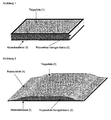
Abbildung 1 zeigt die einfachste Ausführungsform, umfassend ein Abdeckmaterial (3) und eine Trägerfolie (1), die vollflächig mit der Polyurethan-Xerogel-Matrix (2) beschichtet ist. -
Abbildung 2 zeigt ein Narbenreduktionspflaster, das sich zum Rand (4) hin abschrägt. -
Abbildung 3 zeigt ein Narbenreduktionspflaster, das über die gesamte Peripherie eine abgeschrägte Randschicht (4) aufweist. - Das erfindungsgemäße Narbenreduktionspflaster kann eine Randschicht aus Polyurethan-Xerogel-Matrix umfassen, wie es in
Abbildung 2 dargestellt ist, wobei die Narbenauflage und die Randschicht aus der gleichen Polyurethan-Xerogel-Matrix bestehen und die Randschicht sich zum Rand auf eine Dicke von maximal 5 bis 150 µm, insbesondere 30 bis 90 µm, abschrägt.
Dies hat den Vorteil, dass das Pflaster die Aufrollneigung, wie sie übliche Pflaster besitzen, verursacht durch Kleidung, Bettwäsche, Hautkontakt oder beim Waschen, stark reduziert. Das wiederum ermöglicht erst die für die Narbenbehandlung lange Tragedauer des Narbenpflasters ohne zusätzliche Fixierungen. - Das Narbenreduktionspflaster kann eine längliche, aufrollbare und beliebig ablängbare Form besitzen. Das hat den Vorteil, dass der Anwender von der Rolle ein entsprechend der individuellen Narbenlänge angepasstes, einstückiges Pflaster zurecht schneiden kann.
- Das Pflaster kann zum besseren, sterileren Transport und Lagerung mit einer Schutzabdeckung auf der klebenden Seite ausgestattet sein, die vor dem Anlegen des Pflasters auf die Haut entfernt wird. Diese kann beispielsweise silikonisiertes Papier oder eine insbesondere silikonisierte Folie sein, so dass die klebende Seite während der Lagerung geschützt ist.
- Das erfindungsgemäße Pflaster ist als Narbenreduktionspflaster zu verwenden.
- Weiterer Vorteil der erfindungsgemäßen Pflaster ist die Herstellung der Narbenauflage mit/ohne Randschicht aus einem Guss. Es ergeben sich stufenlose Übergänge, die eine variable Form und Größe der Pflaster bei der Herstellung erlauben. Damit ist sowohl die Verankerung der Polyurethan-Xerogelschicht auf dem Träger als auch die Haftung auf der Haut verbessert.
- So ist die Narbenauflage mittig gelegen und geht stufenlos in die Randschicht über.
Das Verfahren zur Herstellung von Narbenreduktionspflaster verläuft über folgende Stufen, wobei - a.) eine Schicht einer Polyurethan-Xerogel-Matrix auf einen Zwischenträger aufgebracht wird,
- b.) das nicht ausgehärtete Polyurethan-Xerogel auf einem Zwischenträger mit einer Trägerfolie insbesondere von einem Rakel zusammenkaschiert wird und
- c.) das Laminat anschließend in einen Walzenspalt geführt wird, wo das Polyurethan-Xerogel auf die endgültige Schichtdicke ausgewalzt wird,
- d.) die Polyurethan-Xerogelschicht im Randbereich eine Dicke von 5 µm bis 150 µm aufweist und
- e.) die Narbenauflage aus Polyurethan-Xerogelschicht mittig gelegen stufenlos in die Randschicht übergeht.
- Die Konturenwalze weist Aussparungen auf, die eine Herstellung von gewölbten, zum Rand stufenlos dünner werdenden Pflasterformen gewährleisten.
- Durch das Herstellverfahren wird die erfindungsgemäße Herstellung von ein- oder mehrschichtigen, naturgemäß dreidimensional konturierten Produkten ermöglicht. Der Narbenauflagenbereich kann dabei einer herkömmlichen Form entsprechen (eine auf das Trägermaterial aufgebrachte erhabene zum Beispiel rechteckige Wundauflage (siehe
Abbildung 1 ) oder beispielsweise linsenförmig gekrümmt sein, mit nach außen konvexer Form, oder aus kombinierten konvexen und konkaven Elementen, wobei die narbenzugewandte Fläche plan ist.
In der Konturenwalze können verschiedene Einprägungen, Aussparungen vorhanden sein, um eine Formung der Polyurethanschicht zu erzielen. Beispielsweise können diese die Form einer halbkonkaven Linse aufweisen. Dies führt in der Polyurethanschicht zu erhöhten Zentren, die sich zum Rand hin abschrägen. Möglich sind auch Ellipsoide, Quader, Würfel oder andere geometrische Formen, um spezielle Formen in der Polyurethanschicht zu erzeugen.
Der Konturierungsverlauf vom Zentrum zum Rand wird durch die gewählte Form festgelegt, das heißt, die Konturenwalze bestimmt das Design der Kontur. - Die Geometrien der herstellbaren konturierten Formkörper sind vielfältig (rund, elliptisch, quadratisch, dreieckig etc.).
- Zur Behandlung, Laminierung der Polyurethan-Xerogelschicht kann im Walzenspalt ein Druck von 1 bar bis 10 bar, insbesondere 5 bar erzeugt werden. Weiterhin sollte der Walzenspalt so dimensioniert sein, dass die Polyurethan-Xerogelschicht eine Dicke von 0,2 bis 2 mm, insbesondere von 0,5 bis 1,5 mm, aufweist.
- Erfindungsgemäß erlaubt das Verfahren einen kontinuierlichen Herstellprozess. Damit sind auch Einsparpotentiale bei der Prozessenergie und den Anlageninvestitionen zu generieren.
- Die dargestellten Ausführungsformen, illustriert durch die Abbildungen 1 bis 3 verdeutlichen die vorliegende Erfindung, ohne sie einzuschränken. Die angegebenen Zahlenwerte bedeuten Gewichtsprozente, bezogen auf das Gesamtgewicht der jeweiligen Zubereitungen sofern nichts anderes angegeben ist.
Die Phase der Gefäßreaktion hat die Funktion größere Blutverluste zu verhindern, dabei kommt es zur Vasokonstriktion, die solange anhält, bis die Blutgerinnung die Wunde provisorisch verschließt. In der Entzündungsphase finden vorwiegend katabole, d.h. abbauende Prozesse statt. In dieser Phase der Wundheilung reinigen Granulozyten, Makrophagen und Lymphozyten die Wunde, indem sie körperfremdes Material und Gewebetrümmer aufnehmen und enzymatisch abbauen.
Die Phase der Gewebeneubildung umfasst dagegen reparative, d.h. anabole Reaktionen. Voraussetzung für eine gut heilende Wunde ist eine ausreichende Durchblutung, so dass schon ab dem dritten Tag nach der Verletzung neue Blutgefäße gebildet werden (Angiogenese). Parallel zur Vaskularisierung erfolgt die Bindegewebsneubildung. Entlang des Fibringerüsts wandern Fibroblasten in die Wunde. Diese produzieren die Bindegewebegrundsubstanz, bestehend aus Proteoglykanen und Kollagenfasern, die für die Gewebefestigkeit ausschlaggebend sind.
Im gesunden Gewebe sind die Kollagenfasern nach bestimmten, den Hauptzugrichtungen folgenden Mustern ausgerichtet. Entscheidend für die Kollagensynthese ist das Vorhandensein von Coenzymen und Cofaktoren wie z.B. Ascorbinsäure, Eisen und Kupfer. Besteht ein Mangel an diesen Stoffen, kann die Wundheilung gestört werden. Dabei entsteht Narbengewebe, das durch eine unorganisierte Struktur der Kollagenfasern charakterisiert ist.
Im gleichen Maß, wie das Bindegewebe auswächst, wird das provisorische Fibringerüst abgebaut (Fibrinolyse) und die verschlossenen Gefäße werden wieder rekanalisiert. Mit der Faserneubildung endet die mitotische Aktivität der Fibroblasten. Sie wandeln sich zum einen in Fibrozyten um, zum anderen in Myofibroblasten. Diese enthalten kontraktile Elemente und können sich zusammenziehen. Dabei werden die Kollagenfasern gestrafft und - soweit möglich - gemäß der Hauptzugrichtung des Gewebes ausgerichtet. Als Folge davon zieht sich das funktionstüchtige Hautgewebe am Wundrand zusammen, so daß nur noch ein kleiner Defekt verbleibt.
Claims (18)
- Verwendung einer Trägerfolie aus luft- und wasserdampfdurch- und wasserundurchlässiger Polymerschicht und einer Narbenauflage aus einer atmungsaktiven und klebenden Polyurethan-Xerogel-Matrix, wobei die Trägerfolie vollflächig mit der Polyurethan-Matrix beschichtet ist, eine Randschicht aus Polyurethan-Xerogel-Matrix ausgebildet ist, die Narbenauflage und die Randschicht aus der gleichen Polyurethan-Xerogel-Matrix bestehen, die Randschicht sich zum Rand auf eine Dicke von maximal 5 bis 150 µm abflacht und die Narbenauflage mittig gelegen stufenlos in die Randschicht übergeht, zur Verfügungstellung eines Narbenreduktionspflasters zur Behandlung hypothroper Narben.
- Verwendung eines Pflasters nach Anspruch 1, dadurch gekennzeichnet, dass die Randschicht sich zum Rand auf eine Dicke von 30 bis 90 µm abflacht.
- Verwendung eines Pflasters nach Anspruch 1 oder 2, dadurch gekennzeichnet, dass das Pflaster eine längliche, aufrollbare und beliebig ablängbare Form besitzt.
- Verwendung eines Pflasters nach Anspruch 1, 2 oder 3, dadurch gekennzeichnet, dass die Randschicht um die gesamte Peripherie des Pflasters angeordnet ist,
- Verwendung eines Pflasters nach einem der vorstehenden Ansprüche, dadurch gekennzeichnet, dass die Trägerfolie aus Polyurethan-, Polyethylen-, Polypropylen-, Polyamid-, Polyester- oder Polyether-ester-Polymeren besteht.
- Verwendung eines Pflasters nach einem der vorstehenden Ansprüche, dadurch gekennzeichnet, dass das gesamte Pflaster transparent ist.
- Verwendung eines Pflasters nach einem der vorstehenden Ansprüche, dadurch gekennzeichnet, dass die Polyurethan-Xerogel-Matrix bei Wasserkontakt entklebt.
- Verwendung eines Pflasters nach einem der vorstehenden Ansprüche, dadurch gekennzeichnet, dass die Narbenauflage eine Dicke von 0,2 bis 2 mm, insbesondere von 0,5 bis 1,5 mm, aufweist
- Verwendung eines Pflasters nach einem der vorstehenden Ansprüche, dadurch gekennzeichnet, dass in der Narbenauflage superabsorbierendes Polymer in einer Menge von 0.01 bis 30 Gew.%, insbesondere von 0,5 bis 25 Gew.%, insbesondere 10 Gew.%, bezogen auf die Gesamtmasse der Polyurethan-Xerogel-Matrix enthalten ist.
- Verwendung eines Pflasters nach einem der vorstehenden Ansprüche, dadurch gekennzeichnet, dass die Polyurethan-Xerogel-Matrix partiell oder vollflächig geschäumt und/oder ungeschäumt vorliegt.
- Verfahren zur Herstellung von Narbenreduktionspflaster, wobeia.) eine Schicht einer Polyurethan-Xerogel-Matrix auf einen Zwischenträger aufgebracht wird,b.) das nicht ausgehärtete Polyurethan-Xerogel auf einem Zwischenträger mit einer Trägerfolie insbesondere von einem Rakel zusammenkaschiert wird undc.) das Laminat anschließend in einen Walzenspalt geführt wird, wo das Polyurethan-Xerogel auf die endgültige Schichtdicke ausgewalzt wird,d.) die Polyurethan-Xerogelschicht im Randbereich eine Dicke von 5 µm bis 150 µm aufweist unde.) die Narbenauflage aus Polyurethan-Xerogelschicht mittig gelegen stufenlos in die Randschicht übergeht.
- Verfahren nach Anspruch 11, dadurch gekennzeichnet, dass der Walzenspalt durch eine Glattwalze und eine Konturenwalze gebildet wird.
- Verfahren nach Anspruch 11, dadurch gekennzeichnet, dass nach der Laminierung c.) eine Prägung mittels einer Konturenwalze stattfindet.
- Verfahren nach Anspruch 12 oder 13, dadurch gekennzeichnet, dass die Konturenwalze Aussparrungen aufweist, die eine Herstellung von gewölbten, zum Rand stufenlos abflachenden Pflasterformen gewährleisten.
- Verfahren nach Anspruch 12 oder 13, dadurch gekennzeichnet, dass die Konturenwalze Aussparrungen aufweist, die eine Herstellung beliebiger geometrischer Pflasterformen gewährleisten.
- Verfahren nach zumindest einem der vorherigen Ansprüche 11 bis 15, dadurch gekennzeichnet, dass im Walzenspalt ein Druck von 1 bar bis 10 bar, insbesondere 5 bar erzeugt wird.
- Verfahren nach zumindest einem der vorherigen Ansprüche 11 bis 16, dadurch gekennzeichnet, dass die Polyurethan-Xerogelschicht nach dem Walzenspalt eine Dicke von 0,2 bis 2 mm, insbesondere von 0,5 bis 1.5 mm, aufweist.
- Verfahren nach einem der Ansprüche 11 bis 17, dadurch gekennzeichnet, dass die Polyurethan-Xerogelschicht im Randbereich eine Dicke von 30 bis 90 µm aufweist.
Applications Claiming Priority (3)
| Application Number | Priority Date | Filing Date | Title |
|---|---|---|---|
| DE10212866 | 2002-03-22 | ||
| DE10212866A DE10212866A1 (de) | 2002-03-22 | 2002-03-22 | Narbenreduktionspflaster |
| PCT/EP2003/002951 WO2003080133A1 (de) | 2002-03-22 | 2003-03-21 | Narbenreduktionspflaster |
Publications (2)
| Publication Number | Publication Date |
|---|---|
| EP1490118A1 EP1490118A1 (de) | 2004-12-29 |
| EP1490118B1 true EP1490118B1 (de) | 2010-09-01 |
Family
ID=27815871
Family Applications (1)
| Application Number | Title | Priority Date | Filing Date |
|---|---|---|---|
| EP03717221A Expired - Lifetime EP1490118B1 (de) | 2002-03-22 | 2003-03-21 | Narbenreduktionspflaster |
Country Status (7)
| Country | Link |
|---|---|
| US (1) | US7115792B2 (de) |
| EP (1) | EP1490118B1 (de) |
| AT (1) | ATE479450T1 (de) |
| AU (1) | AU2003221511A1 (de) |
| DE (2) | DE10212866A1 (de) |
| ES (1) | ES2349245T3 (de) |
| WO (1) | WO2003080133A1 (de) |
Cited By (1)
| Publication number | Priority date | Publication date | Assignee | Title |
|---|---|---|---|---|
| WO2018060958A1 (en) | 2016-09-30 | 2018-04-05 | Adrian Giger | Scar reduction bandage |
Families Citing this family (28)
| Publication number | Priority date | Publication date | Assignee | Title |
|---|---|---|---|---|
| CA2536357A1 (en) | 2003-05-29 | 2004-12-23 | The Scripps Research Institute | Targeted delivery to legumain-expressing cells |
| US9278155B2 (en) | 2003-06-05 | 2016-03-08 | 3M Innovative Properties Company | Adhesive compositions, articles incorporating same and methods of manufacture |
| US20040247654A1 (en) * | 2003-06-05 | 2004-12-09 | 3M Innovative Properties Company | Hydrophilic adhesives for delivery of herbal medicines |
| CN101010187A (zh) * | 2004-06-29 | 2007-08-01 | 思攀气凝胶公司 | 节能和保温的建筑物外层 |
| JP4836228B2 (ja) * | 2005-05-11 | 2011-12-14 | 武彦 大浦 | ジェル状の皮膚保護用シート |
| EP3536350B1 (de) * | 2006-08-03 | 2024-12-18 | The Board of Trustees of the Leland Stanford Junior University | Bandagen zur behandlungen bzw. prävention von narben und/oder keloiden sowie verfahren und kits dafür |
| US8098485B2 (en) | 2007-07-03 | 2012-01-17 | 3M Innovative Properties Company | Wireless network sensors for detecting events occurring proximate the sensors |
| US8035511B2 (en) | 2007-07-03 | 2011-10-11 | 3M Innovative Properties Company | Methods for providing services and information based upon data collected via wireless network sensors |
| US8026808B2 (en) | 2007-07-03 | 2011-09-27 | 3M Innovative Properties Company | Display of information related to data collected via wireless network sensors |
| US8013731B2 (en) | 2007-07-03 | 2011-09-06 | 3M Innovative Properties Company | Apparatus and method for processing data collected via wireless network sensors |
| US20120226306A1 (en) | 2011-03-03 | 2012-09-06 | Jasper Jackson | Controlled strain skin treatment devices and methods |
| US9358009B2 (en) | 2007-08-03 | 2016-06-07 | Neodyne Biosciences, Inc. | Skin straining devices and methods |
| US9248048B2 (en) | 2007-08-03 | 2016-02-02 | Neodyne Biosciences, Inc. | Wound or skin treatment devices and methods |
| JP5438027B2 (ja) | 2008-01-18 | 2014-03-12 | スリーエム イノベイティブ プロパティズ カンパニー | テーパー状縁部を備えるヒドロゲル |
| WO2010036682A2 (en) | 2008-09-24 | 2010-04-01 | 3M Innovative Properties Company | Hydrogels with release element |
| DE102009005143A1 (de) | 2009-01-15 | 2010-07-22 | Beiersdorf Ag | Narbenabdeckung mit UV-Schutz |
| BR122020025483B1 (pt) | 2009-08-11 | 2021-11-23 | Neodyne Biosciences, Inc | Dispositivo de tratamento |
| GB0919411D0 (en) * | 2009-11-05 | 2009-12-23 | Ocutec Ltd | Polymer for contact lenses |
| US10561359B2 (en) | 2011-12-02 | 2020-02-18 | Neodyne Biosciences, Inc. | Elastic devices, methods, systems and kits for selecting skin treatment devices |
| US10213350B2 (en) | 2012-02-08 | 2019-02-26 | Neodyne Biosciences, Inc. | Radially tensioned wound or skin treatment devices and methods |
| US9517163B2 (en) | 2013-07-03 | 2016-12-13 | 3K Anesthesia Innovations, Llp | Pre-stressed pressure device |
| ES2921990T3 (es) | 2014-09-10 | 2022-09-05 | Bard Inc C R | Apósito protector para un dispositivo médico colocado en la piel |
| EP3240582B1 (de) | 2014-12-30 | 2021-08-25 | Heymans, Michel | Mehrschichtiges klebeband zum komprimieren und zusammenziehen einer narbe |
| DE102017131013A1 (de) * | 2017-12-21 | 2019-06-27 | Paul Hartmann Ag | Verfahren zur Herstellung einer Wundauflage |
| CN109125913A (zh) * | 2018-11-05 | 2019-01-04 | 王云鹏 | 一种含药物的医用疤痕贴及其制备方法 |
| US20220379018A1 (en) | 2019-12-10 | 2022-12-01 | Neodyne Biosciences, Inc. | Tensioned infusion systems with removable hubs |
| EP4072439A4 (de) | 2019-12-10 | 2023-12-13 | Neodyne Biosciences, Inc. | Vorrichtungen und verfahren zur behandlung von injektions- und infusionsstellen |
| BR202022010723U2 (pt) * | 2022-06-01 | 2023-12-12 | Gustavo Braz Thá | Disposição construtiva aplicada em curativo compressivo |
Family Cites Families (16)
| Publication number | Priority date | Publication date | Assignee | Title |
|---|---|---|---|---|
| DE3103499A1 (de) | 1981-02-03 | 1982-08-26 | Bayer Ag, 5090 Leverkusen | Wirkstoffhaltige gelmassen mit depotwirkung auf basis einer polyurethanmatrix und hoehermolekularen polyolen, sowie ein verfahren zu ihrer herstellung |
| DE3103500A1 (de) | 1981-02-03 | 1982-08-12 | Bayer Ag, 5090 Leverkusen | Polyolgele und deren verwendung in abformverfahren |
| DE3341555A1 (de) | 1983-11-17 | 1985-05-30 | Bayer Ag, 5090 Leverkusen | Selbsthaftende flaechengebilde, verfahren zu deren herstellung und deren verwendung |
| DK154747C (da) | 1986-10-17 | 1989-05-08 | Coloplast As | Bandage med en hudvenlig, vandabsorberende klaebeskive der paa den ene flade er fast forbundet med en ikke-klaebende daekfilm og paa den anden med et aftageligt beskyttelsesdaekke |
| DE3713601A1 (de) | 1987-04-23 | 1988-11-10 | Stockhausen Chem Fab Gmbh | Verfahren zur herstellung eines stark wasserabsorbierenden polymerisats |
| ES2097217T3 (es) | 1990-10-01 | 1997-04-01 | Hollister Inc | Aposito de herida que tiene una capa de adhesivo contorneada. |
| FR2686505A1 (fr) | 1992-01-29 | 1993-07-30 | Lhd Lab Hygiene Dietetique | Procede de fabrication d'un pansement a bords amincis. |
| DE4233289A1 (de) | 1992-10-02 | 1994-04-07 | Beiersdorf Ag | Hydrophile Polyurethanschaumgele und Verfahren zu deren Herstellung |
| US5844013A (en) * | 1992-10-02 | 1998-12-01 | Beiersdorf Ag | Hydrophilic polyurethane gel foams, particularly for treating deep wounds, wound dressing based on hydrophilic polyurethane gel foams and method of manufacture |
| SE503384C2 (sv) | 1994-09-20 | 1996-06-03 | Moelnlycke Ab | Förband innefattande en silikongel i vilken ett bärarmaterial är inneslutet |
| GB9505424D0 (en) * | 1995-03-17 | 1995-05-03 | Smith & Nephew | Hydrogels |
| DE19618825A1 (de) * | 1996-05-10 | 1997-11-13 | Bayer Ag | Hydrophile, selbstklebende Polyurethan-Gelmassen |
| GB9725169D0 (en) * | 1997-11-27 | 1998-01-28 | The Technology Partnership Plc | Wound dressing |
| US6878385B2 (en) * | 1999-01-12 | 2005-04-12 | Jentec, Inc. | Wrinkle-resistant dressing and gently adhesive composition thereof |
| DE10047884A1 (de) | 2000-09-22 | 2002-04-11 | Beiersdorf Ag | Selbsthaftende Wundverbände mit haftfähigem Wundversorgungsbereich |
| DE10047700A1 (de) * | 2000-09-22 | 2002-04-11 | Beiersdorf Ag | Verfahren zur Herstellung von mehrschichtigen dünnen Pflastern mit einem Trägermaterial auf Polyurethanbasis |
-
2002
- 2002-03-22 DE DE10212866A patent/DE10212866A1/de not_active Ceased
-
2003
- 2003-03-21 AT AT03717221T patent/ATE479450T1/de active
- 2003-03-21 ES ES03717221T patent/ES2349245T3/es not_active Expired - Lifetime
- 2003-03-21 DE DE50313037T patent/DE50313037D1/de not_active Expired - Lifetime
- 2003-03-21 WO PCT/EP2003/002951 patent/WO2003080133A1/de not_active Ceased
- 2003-03-21 EP EP03717221A patent/EP1490118B1/de not_active Expired - Lifetime
- 2003-03-21 AU AU2003221511A patent/AU2003221511A1/en not_active Abandoned
-
2004
- 2004-09-22 US US10/948,622 patent/US7115792B2/en not_active Expired - Fee Related
Cited By (2)
| Publication number | Priority date | Publication date | Assignee | Title |
|---|---|---|---|---|
| WO2018060958A1 (en) | 2016-09-30 | 2018-04-05 | Adrian Giger | Scar reduction bandage |
| US11510821B2 (en) | 2016-09-30 | 2022-11-29 | Adrian Giger | Scar reduction bandage |
Also Published As
| Publication number | Publication date |
|---|---|
| ES2349245T3 (es) | 2010-12-29 |
| DE10212866A1 (de) | 2003-10-09 |
| AU2003221511A1 (en) | 2003-10-08 |
| US20050095276A1 (en) | 2005-05-05 |
| US7115792B2 (en) | 2006-10-03 |
| ATE479450T1 (de) | 2010-09-15 |
| DE50313037D1 (de) | 2010-10-14 |
| WO2003080133A1 (de) | 2003-10-02 |
| EP1490118A1 (de) | 2004-12-29 |
Similar Documents
| Publication | Publication Date | Title |
|---|---|---|
| DE10212866A1 (de) | Narbenreduktionspflaster | |
| EP1190723B1 (de) | Selbsthaftende Wundverbände mit haftfähigem Wundversorgungsbereich | |
| EP1190722B1 (de) | Verband | |
| EP0665856B1 (de) | Hydrophile polyurethangelschäume, insbesondere zur behandlung von tiefen wunden, wundverbände auf basis hydrophiler polyurethangelschäume und verfahren zur herstellung | |
| DE10330971B4 (de) | Verfahren zur Herstellung von Haut- oder Wundauflagen mit verkapselten, wundheilungsfördernden und/oder hautpflegenden Substanzen | |
| EP2338529B1 (de) | Hydrogelmatrix mit verbesserten Klebeeigenschaften | |
| EP3558400B1 (de) | Wasserhaltige hydrogele zur wundversorgung | |
| DE102004061406A1 (de) | Infektionsresistente Polyurethanschäume, Verfahren zu ihrer Herstellung und Verwendung in antiseptisch ausgestatteten Wundauflagen | |
| CH639678A5 (de) | Haftkleber-mischung und deren verwendung. | |
| DE3786345T2 (de) | Heftpflaster in form eines dünnen films, herstellung und verwendung. | |
| EP2338528B1 (de) | Hydrogelmatrix mit erhöhter Absorptionskapazität für Flüssigkeiten | |
| EP1438943B1 (de) | Verfahren zur Herstellung von Pflastern | |
| DE10301835A1 (de) | Pflaster mit bedruckter Wundauflage und transparenter Fixierfolie | |
| EP1203572B1 (de) | Verfahren zur Herstellung von merhschichtigen dünnen Pflastern mit einem Trägermaterial auf Polyurethanbasis | |
| EP2453933A2 (de) | Wasserdampfdurchlässiges hautpflaster | |
| EP4134107A1 (de) | Wundauflage mit einer hydrogelschicht und einer wundkontaktschicht umfassend hyaluronsäure | |
| WO1995005857A1 (de) | Wundversorgungsartikel mit selektivem absorptionsvermögen | |
| DE10231701A1 (de) | Pflaster mit wiederverschließbarer Öffnung |
Legal Events
| Date | Code | Title | Description |
|---|---|---|---|
| PUAI | Public reference made under article 153(3) epc to a published international application that has entered the european phase |
Free format text: ORIGINAL CODE: 0009012 |
|
| 17P | Request for examination filed |
Effective date: 20041022 |
|
| AK | Designated contracting states |
Kind code of ref document: A1 Designated state(s): AT BE BG CH CY CZ DE DK EE ES FI FR GB GR HU IE IT LI LU MC NL PT RO SE SI SK TR |
|
| 17Q | First examination report despatched |
Effective date: 20071004 |
|
| GRAP | Despatch of communication of intention to grant a patent |
Free format text: ORIGINAL CODE: EPIDOSNIGR1 |
|
| GRAS | Grant fee paid |
Free format text: ORIGINAL CODE: EPIDOSNIGR3 |
|
| GRAA | (expected) grant |
Free format text: ORIGINAL CODE: 0009210 |
|
| AK | Designated contracting states |
Kind code of ref document: B1 Designated state(s): AT BE BG CH CY CZ DE DK EE ES FI FR GB GR HU IE IT LI LU MC NL PT RO SE SI SK TR |
|
| REG | Reference to a national code |
Ref country code: GB Ref legal event code: FG4D Free format text: NOT ENGLISH |
|
| REG | Reference to a national code |
Ref country code: CH Ref legal event code: EP |
|
| REG | Reference to a national code |
Ref country code: IE Ref legal event code: FG4D Free format text: LANGUAGE OF EP DOCUMENT: GERMAN |
|
| REF | Corresponds to: |
Ref document number: 50313037 Country of ref document: DE Date of ref document: 20101014 Kind code of ref document: P |
|
| REG | Reference to a national code |
Ref country code: CH Ref legal event code: NV Representative=s name: E. BLUM & CO. AG PATENT- UND MARKENANWAELTE VSP |
|
| REG | Reference to a national code |
Ref country code: NL Ref legal event code: VDEP Effective date: 20100901 Ref country code: ES Ref legal event code: FG2A Effective date: 20101216 |
|
| PG25 | Lapsed in a contracting state [announced via postgrant information from national office to epo] |
Ref country code: FI Free format text: LAPSE BECAUSE OF FAILURE TO SUBMIT A TRANSLATION OF THE DESCRIPTION OR TO PAY THE FEE WITHIN THE PRESCRIBED TIME-LIMIT Effective date: 20100901 |
|
| PG25 | Lapsed in a contracting state [announced via postgrant information from national office to epo] |
Ref country code: CY Free format text: LAPSE BECAUSE OF FAILURE TO SUBMIT A TRANSLATION OF THE DESCRIPTION OR TO PAY THE FEE WITHIN THE PRESCRIBED TIME-LIMIT Effective date: 20100901 Ref country code: SI Free format text: LAPSE BECAUSE OF FAILURE TO SUBMIT A TRANSLATION OF THE DESCRIPTION OR TO PAY THE FEE WITHIN THE PRESCRIBED TIME-LIMIT Effective date: 20100901 |
|
| REG | Reference to a national code |
Ref country code: IE Ref legal event code: FD4D |
|
| PG25 | Lapsed in a contracting state [announced via postgrant information from national office to epo] |
Ref country code: GR Free format text: LAPSE BECAUSE OF FAILURE TO SUBMIT A TRANSLATION OF THE DESCRIPTION OR TO PAY THE FEE WITHIN THE PRESCRIBED TIME-LIMIT Effective date: 20101202 Ref country code: NL Free format text: LAPSE BECAUSE OF FAILURE TO SUBMIT A TRANSLATION OF THE DESCRIPTION OR TO PAY THE FEE WITHIN THE PRESCRIBED TIME-LIMIT Effective date: 20100901 Ref country code: SE Free format text: LAPSE BECAUSE OF FAILURE TO SUBMIT A TRANSLATION OF THE DESCRIPTION OR TO PAY THE FEE WITHIN THE PRESCRIBED TIME-LIMIT Effective date: 20100901 |
|
| PG25 | Lapsed in a contracting state [announced via postgrant information from national office to epo] |
Ref country code: IE Free format text: LAPSE BECAUSE OF FAILURE TO SUBMIT A TRANSLATION OF THE DESCRIPTION OR TO PAY THE FEE WITHIN THE PRESCRIBED TIME-LIMIT Effective date: 20100901 |
|
| PG25 | Lapsed in a contracting state [announced via postgrant information from national office to epo] |
Ref country code: IT Free format text: LAPSE BECAUSE OF FAILURE TO SUBMIT A TRANSLATION OF THE DESCRIPTION OR TO PAY THE FEE WITHIN THE PRESCRIBED TIME-LIMIT Effective date: 20100901 Ref country code: SK Free format text: LAPSE BECAUSE OF FAILURE TO SUBMIT A TRANSLATION OF THE DESCRIPTION OR TO PAY THE FEE WITHIN THE PRESCRIBED TIME-LIMIT Effective date: 20100901 Ref country code: RO Free format text: LAPSE BECAUSE OF FAILURE TO SUBMIT A TRANSLATION OF THE DESCRIPTION OR TO PAY THE FEE WITHIN THE PRESCRIBED TIME-LIMIT Effective date: 20100901 Ref country code: PT Free format text: LAPSE BECAUSE OF FAILURE TO SUBMIT A TRANSLATION OF THE DESCRIPTION OR TO PAY THE FEE WITHIN THE PRESCRIBED TIME-LIMIT Effective date: 20110103 Ref country code: EE Free format text: LAPSE BECAUSE OF FAILURE TO SUBMIT A TRANSLATION OF THE DESCRIPTION OR TO PAY THE FEE WITHIN THE PRESCRIBED TIME-LIMIT Effective date: 20100901 Ref country code: CZ Free format text: LAPSE BECAUSE OF FAILURE TO SUBMIT A TRANSLATION OF THE DESCRIPTION OR TO PAY THE FEE WITHIN THE PRESCRIBED TIME-LIMIT Effective date: 20100901 |
|
| PLBE | No opposition filed within time limit |
Free format text: ORIGINAL CODE: 0009261 |
|
| STAA | Information on the status of an ep patent application or granted ep patent |
Free format text: STATUS: NO OPPOSITION FILED WITHIN TIME LIMIT |
|
| 26N | No opposition filed |
Effective date: 20110606 |
|
| PG25 | Lapsed in a contracting state [announced via postgrant information from national office to epo] |
Ref country code: DK Free format text: LAPSE BECAUSE OF FAILURE TO SUBMIT A TRANSLATION OF THE DESCRIPTION OR TO PAY THE FEE WITHIN THE PRESCRIBED TIME-LIMIT Effective date: 20100901 |
|
| BERE | Be: lapsed |
Owner name: BEIERSDORF A.G. Effective date: 20110331 |
|
| REG | Reference to a national code |
Ref country code: DE Ref legal event code: R097 Ref document number: 50313037 Country of ref document: DE Effective date: 20110606 |
|
| PG25 | Lapsed in a contracting state [announced via postgrant information from national office to epo] |
Ref country code: MC Free format text: LAPSE BECAUSE OF NON-PAYMENT OF DUE FEES Effective date: 20110331 |
|
| PG25 | Lapsed in a contracting state [announced via postgrant information from national office to epo] |
Ref country code: BE Free format text: LAPSE BECAUSE OF NON-PAYMENT OF DUE FEES Effective date: 20110331 |
|
| REG | Reference to a national code |
Ref country code: AT Ref legal event code: MM01 Ref document number: 479450 Country of ref document: AT Kind code of ref document: T Effective date: 20110321 |
|
| PG25 | Lapsed in a contracting state [announced via postgrant information from national office to epo] |
Ref country code: AT Free format text: LAPSE BECAUSE OF NON-PAYMENT OF DUE FEES Effective date: 20110321 |
|
| PG25 | Lapsed in a contracting state [announced via postgrant information from national office to epo] |
Ref country code: LU Free format text: LAPSE BECAUSE OF NON-PAYMENT OF DUE FEES Effective date: 20110321 |
|
| PG25 | Lapsed in a contracting state [announced via postgrant information from national office to epo] |
Ref country code: BG Free format text: LAPSE BECAUSE OF FAILURE TO SUBMIT A TRANSLATION OF THE DESCRIPTION OR TO PAY THE FEE WITHIN THE PRESCRIBED TIME-LIMIT Effective date: 20101201 Ref country code: TR Free format text: LAPSE BECAUSE OF FAILURE TO SUBMIT A TRANSLATION OF THE DESCRIPTION OR TO PAY THE FEE WITHIN THE PRESCRIBED TIME-LIMIT Effective date: 20100901 |
|
| PG25 | Lapsed in a contracting state [announced via postgrant information from national office to epo] |
Ref country code: HU Free format text: LAPSE BECAUSE OF FAILURE TO SUBMIT A TRANSLATION OF THE DESCRIPTION OR TO PAY THE FEE WITHIN THE PRESCRIBED TIME-LIMIT Effective date: 20100901 |
|
| PGFP | Annual fee paid to national office [announced via postgrant information from national office to epo] |
Ref country code: CH Payment date: 20140319 Year of fee payment: 12 |
|
| PGFP | Annual fee paid to national office [announced via postgrant information from national office to epo] |
Ref country code: GB Payment date: 20140319 Year of fee payment: 12 |
|
| REG | Reference to a national code |
Ref country code: CH Ref legal event code: PL |
|
| GBPC | Gb: european patent ceased through non-payment of renewal fee |
Effective date: 20150321 |
|
| PG25 | Lapsed in a contracting state [announced via postgrant information from national office to epo] |
Ref country code: CH Free format text: LAPSE BECAUSE OF NON-PAYMENT OF DUE FEES Effective date: 20150331 Ref country code: LI Free format text: LAPSE BECAUSE OF NON-PAYMENT OF DUE FEES Effective date: 20150331 Ref country code: GB Free format text: LAPSE BECAUSE OF NON-PAYMENT OF DUE FEES Effective date: 20150321 |
|
| REG | Reference to a national code |
Ref country code: FR Ref legal event code: PLFP Year of fee payment: 14 |
|
| REG | Reference to a national code |
Ref country code: FR Ref legal event code: PLFP Year of fee payment: 15 |
|
| REG | Reference to a national code |
Ref country code: FR Ref legal event code: PLFP Year of fee payment: 16 |
|
| PGFP | Annual fee paid to national office [announced via postgrant information from national office to epo] |
Ref country code: FR Payment date: 20210323 Year of fee payment: 19 |
|
| PGFP | Annual fee paid to national office [announced via postgrant information from national office to epo] |
Ref country code: DE Payment date: 20210331 Year of fee payment: 19 |
|
| PGFP | Annual fee paid to national office [announced via postgrant information from national office to epo] |
Ref country code: ES Payment date: 20210521 Year of fee payment: 19 |
|
| REG | Reference to a national code |
Ref country code: DE Ref legal event code: R119 Ref document number: 50313037 Country of ref document: DE |
|
| PG25 | Lapsed in a contracting state [announced via postgrant information from national office to epo] |
Ref country code: FR Free format text: LAPSE BECAUSE OF NON-PAYMENT OF DUE FEES Effective date: 20220331 Ref country code: DE Free format text: LAPSE BECAUSE OF NON-PAYMENT OF DUE FEES Effective date: 20221001 |
|
| REG | Reference to a national code |
Ref country code: ES Ref legal event code: FD2A Effective date: 20230503 |
|
| PG25 | Lapsed in a contracting state [announced via postgrant information from national office to epo] |
Ref country code: ES Free format text: LAPSE BECAUSE OF NON-PAYMENT OF DUE FEES Effective date: 20220322 |