EP1490762B1 - Procede, produit logiciel et systeme de traitement universel de l'information assiste par ordinateur - Google Patents
Procede, produit logiciel et systeme de traitement universel de l'information assiste par ordinateur Download PDFInfo
- Publication number
- EP1490762B1 EP1490762B1 EP03743396A EP03743396A EP1490762B1 EP 1490762 B1 EP1490762 B1 EP 1490762B1 EP 03743396 A EP03743396 A EP 03743396A EP 03743396 A EP03743396 A EP 03743396A EP 1490762 B1 EP1490762 B1 EP 1490762B1
- Authority
- EP
- European Patent Office
- Prior art keywords
- expression
- class
- information
- elements
- hierarchy
- Prior art date
- Legal status (The legal status is an assumption and is not a legal conclusion. Google has not performed a legal analysis and makes no representation as to the accuracy of the status listed.)
- Expired - Lifetime
Links
Images

Classifications
-
- G—PHYSICS
- G06—COMPUTING OR CALCULATING; COUNTING
- G06F—ELECTRIC DIGITAL DATA PROCESSING
- G06F8/00—Arrangements for software engineering
- G06F8/20—Software design
- G06F8/24—Object-oriented
-
- G—PHYSICS
- G06—COMPUTING OR CALCULATING; COUNTING
- G06F—ELECTRIC DIGITAL DATA PROCESSING
- G06F40/00—Handling natural language data
- G06F40/10—Text processing
- G06F40/12—Use of codes for handling textual entities
- G06F40/137—Hierarchical processing, e.g. outlines
Definitions
- the invention relates to a programming-free method for automatically generating structured information systems on the basis of hierarchical, especially object-oriented, modeling.
- Creating complex information systems such as those used for administrative tasks (such as order processing, purchasing, customer service), requires a development process today. This includes a sequence of phases, starting with formulating a task, through specification, modeling, high-level language programming, machine language (or interpretation) translation, through to programmable hardware execution.
- the development phases from task formulation to programming are carried out manually (if necessary with computer-assisted substeps). They require a high personnel expenditure and are error-prone.
- spreadsheets Since about 1979, spreadsheets have known software tools that allow the user to represent information in tabular form and generate information derived by interpreting expressions (formulas). By suitable configuration (table structure and specification of expressions) these tools can be used to create solutions for a wide range of tasks without the need for complex programming. However, for complex information systems (e.g., order processing, purchasing, customer care), spreadsheet programs do not provide adequate structuring capabilities. They are therefore used only for tasks of low complexity.
- the invention has for its object to provide a more efficient and less error prone method of generating information systems.
- the method is intended to generate information systems of as large a complexity as possible can be highly automated and easy to handle.
- the method is preferably composed of steps for modeling a hierarchical data structure, manipulating content in elements of the hierarchy, generating content for elements of the hierarchy by evaluating expressions, and for representing hierarchy and element contents.
- the Software Product is the materialization of software, particularly on storage media, that can control hardware so that it can perform the aforementioned operations.
- system is meant a combination of hardware and software that can perform the aforementioned operations.
- the invention in its preferred embodiment as a data structure, utilizes a hierarchical representation and a method component for dynamically modeling it. Compared with fixed tables, this means a much higher procedural effort. However, it is the resulting functionality that allows the user to complex through mere modeling To create information systems that previously could only be developed with extensive manual programming.
- modeling in the sense of this description particularly includes the actual effect on the structure of the hierarchical structure, e.g. by adding and deleting elements, including entire sub-hierarchies, rather than merely fading them out.
- a preferred embodiment of the method makes the modeling object-oriented.
- Object-oriented here is any kind of modeling that can represent the structure or properties of similar structures separately from their concrete form (content).
- the usual term for a specific expression is object.
- a specification of similar objects is a class.
- Design alternatives may differ in scope of the properties specifiable in a class. They may both explicitly provide appearing classes, e.g. be named, as well as implicit classes. Alternative alternatives may or may not provide generalization / specialization relationships between classes.
- the modeling component of the method ensures that the hierarchical representation can be adapted by input means to any requirements, e.g. by inserting and deleting elements within the hierarchy.
- the associated content manipulation processing component uses input means to address elements of the modeled hierarchy and to assign or change content (e.g., text, numbers).
- the evaluation component of this embodiment generates contents of elements by evaluating user-specified expressions and thus enables the required formation of derived information.
- the presentation component allows access to the hierarchical structure and its contents through input and output means.
- the aforementioned input and output means can be configured as desired.
- Interactive / visual means e.g. a mouse control graphical user interface are provided as well as machine means, e.g. Communication protocols for communication with third-party systems.
- the invention reduces the complexity of creating complex information systems by eliminating the time-consuming traditional programming phase through automation. As a result, it also increases efficiency in the remaining phases of development, because, according to the modeling, each of them has an immediately operational realization that can be tested for practicability. As a result, the number and duration of the phase iterations are reduced.
- an information system generated by this invention is already in productive operation, it can be adapted to changing requirements at any time with little effort by simply modifying the model.
- the invention enables short reaction times and thus higher operational agility for this scenario, which is common in business practice.
- Another advantage of using the invention is the increase in the level of abstraction by running the model directly. Individuals with sufficient modeling skills can use them to produce functional information systems without having to program themselves. In addition, an information system produced in this way is highly self-documenting. The higher level of abstraction frees it from non-task-related, technical details and allows for a quick understanding of a wide circle of users, including non-technical users.
- the invention can be used in addition to independent use with interactive users for the integration of information from third-party systems, far their structure can be adapted to the needs of third-party systems. Differences in semantics and incompatibilities between different foreign systems can be compensated by using the means of expression evaluation to convert the information accordingly.
- This integration functionality can also be used for purely mechanical coupling of otherwise incompatible third-party systems.
- An implementation not only allows multi-user and multi-system operation, but through distributed processing allows for automatic scaling across multiple processors and / or systems without the need for complex programming traditionally required.
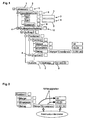
- FIG. 1 shows an exemplary hierarchy as it may be represented in an embodiment by means of a graphical user interface.
- the hierarchy consists of elements that each contain the attributes "Name” (1) and “Expression” (2). Both attributes can be manipulated via edit fields.
- Operating elements (4) are used to expand and collapse individual hierarchy levels.
- the simple elements "text” (7) and “number” (8) have a content attribute (3), which can be manipulated via an editing field. If an expression (2) is specified, the method determines its result and sets it in the content attribute (3). Its edit field is then used only for display.
- Alternative embodiments may provide further simple elements, such as e.g. Logic value, calendar date, time, time span, image.
- An element for holding the file content of any third-party application is also provided. For its editing and presentation, which could be done both visually integrated and in a separate window, the associated application software would be called.
- the content of the container element (9) consists of a list of subordinate elements.
- the list may be empty, such as Case of "Container” (9), or any number of child elements, here two in “universe” (5) and three in “primitives” (6).
- the method involves mouse-driven interaction, in particular a drag-and-drop mechanism.
- To add a child element an element is selected elsewhere and copied or moved to the desired insertion position as a copy.
- To delete an element select it and select the deletion command via the menu. If an expression is specified for a container element, the method determines its result in the form of a new list of subordinate elements and assigns it to the container element.
- the list of children can not be interactively modified in this case.
- Alternative embodiments may provide for further aggregating elements, in particular list, quantity and multi-quantity. Their children have no name attribute, unlike the container.
- the content of an element can also be a reference to another element (the reference target).
- the referring element is then treated as having an always up-to-date copy of the reference target content.
- a drag-and-drop mechanism is used to create a reference.
- the user can completely model the substructure shown in FIG. 1 under the element "order processing" (10).
- the items Quantity, Unit Price, Amount, and Sum are copies of the pre-made item Number (8). All other elements of the subtree are of the container type (9).
- interpreter For processing expressions, an interpreter is used.
- interpreters For techniques for constructing interpreters, particularly parser generators, reference is generally made to the book "Compilers: Principles, Techniques, and Tools” by Alfred V. Aho, Ravi Sethi, Jeffrey D. Ullman, Addison-Wesley, 1985 A newer, more powerful parser generator is also described on the website http://www.antlr.org.
- An element dependency is a tuple (AE, RE) where AE is a dependent element and RE is an element referenced by AE. It is assumed that the elements for this purpose can be addressed directly (via a pointer construct).
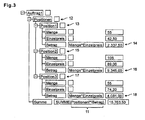
- FIG. 2 A simple example is shown in FIG. 2. In the case of a simple path reference, an element dependency (AE, PE I ) is entered for each path element PE I. For the simple path reference "Avemtrag_A! Morrisangschrift! Postleitrahl”, 3 element dependencies, namely "Avemtrag_A”, “Lieferangschrift” and "Postleitiere” would be transferred.
- Each component dependency has to be registered for the wildcard "*" to take into account the case that a new element is inserted below the start element from which the wildcard search originates.
- Each component dependency is a tuple (AE, SE) where AE is a dependent element and SE is the start element of the wildcard in the expression belonging to AE.
- a validity indicator is stored together with the content.
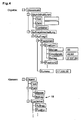
- FIG. 4 shows a configuration of object and class hierarchy analogous to the previous embodiment.
- all container classes have been omitted which have no special function in addition to the aggregation of elements (these are containers of the elements "universe”).
- Basic structures "," order processing ",” positions ").
- the object hierarchy corresponds to the previous hierarchy with the difference that for each element the expression attribute is omitted and a pointer to a class element is added.
- Classes are arranged in a separate hierarchy that describes the generalization / specialization relationships between classes. Classes summarize the properties of similar objects and thus reduce the redundancy that otherwise occurs in the object hierarchy. For example, if the object hierarchy contains 2000 objects of the class "Position” and if the expression for calculating the element "Amount" is to be changed, the previous version would require changes to 2000 places. With the class hierarchy, a single change in the corresponding class element is sufficient.
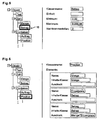
- ⁇ Components of attribute classes (classes of simple elements, such as text, number) are details of the representation (eg length, decimal places) and possibly integrity conditions (eg minimum value, maximum value). All information can be manipulated via edit fields. The appropriate screen form will appear next to the class hierarchy when a corresponding attribute class is selected.
- Fig. 5 shows an example of the number class "Amount" (18) shown in Fig. 4.
- Aggregate classes (classes of aggregating elements, such as containers, lists) contain class elements.
- a container class contains an interactively (drag & drop) manipulable list of class elements; one for each child of the associated container object.
- List and set classes contain only one class element at a time, because the children of list and set objects are uniform.
- a class element determines the behavior of an object element; In particular, it includes the associated expression and the class accepted as the content of the object element.
- Class elements of container classes also contain the name. The information can be manipulated via edit fields. An example of class members of a container class is illustrated in FIG. 6.
- a (class) specialization is bound to the specifications of its generalization (s-class). For the specialization of a number class, e.g. Minimum and maximum value accepted only within the limits of their generalization. In a specialized container class, the deletion of an element originating from the generalization is denied. Changing the details of a generalization automatically adjusts all specializations of the same.
- a class can have several generalizations (it will appear at several places in the class hierarchy).
- the class hierarchy is processed with interaction mechanisms analogous to the object hierarchy, in particular drag & drop.
- interaction mechanisms analogous to the object hierarchy, in particular drag & drop.
- a container class A would gain all elements of B that did not already have A and B (via a common generalization).
- there is a menu-driven operation which creates a specialization to a previously selected class.
- a multi-generalization class is deleted at a location within the class hierarchy, it initially clears only the generalization / specialization relationship at that location. The class itself is not deleted until there are no more generalizations.
- a change in the specifications of a class automatically effects an adaptation of all objects of this class. For example, deleting the element of a container class causes the deletion of all associated object elements.
- certain structural changes can also be made at the object level, in particular the addition and deletion of elements of a container object.
- an order item can be added or deleted.
- Such a manipulation function is realized in that the object-level manipulation of a container object C on the class level implicitly generates a specialization of the container class belonging to C and this specialization now applies as a new class of the changed container object C. This prevents the change from unintentionally affecting other objects of the original class.
- the formation of a class specialization need not be repeated for subsequent changes of the object as long as the object remains the only one of its class.
- the class-based execution variant includes additional forms of expression evaluation.
- the evaluation of the expression “COMPONENTS (class)” returns all child elements whose content class corresponds to the specified class (including its specializations).
- "COMPONENT (position)” starting from the current object, would supply the set of all child objects having the class "position” (or a specialization).
- a variant of this function also contains a conditional expression: "COMPONENTS (class IF condition)".
- the conditional expression is evaluated in each case relative to the examined object of the search class.
- the function restricts the delivered elements to those for which the condition is fulfilled compared to the output variant. For example, "COMPONENTS (Item IF Amount> 5000)" would supply all items whose amount exceeds 5000.
- the expression evaluation may be performed using the concept of polymorphism known from object orientation.
- each object element would be able to accept content not only in the class K specified for the element, but also in the form of a specialization SK i .
- a content of class SK i would each be converted to the form of class K.
- a mode parameter set per element includes the following manipulable by input means (in particular drop-down menus):
- An authorization parameter with the alternatives “no display”, “read only”, “read and write” controls whether an element is displayed at all and whether it can be changed by the user.
- a gestalt parameter with the alternatives "individual” or “uniform” controls whether the content is presented in the form of its specific class (a specialization of the class specified in the class member), or transformed into the class specified in the class member for presentation becomes (polymorphism, only applicable in the class-based variant).
- An arrangement parameter with the alternatives “hierarchical”, “tabular”, “one-line” controls the arrangement of subordinate elements, so that in addition to the hierarchical arrangement also an (automatically generated) table or the sequential arrangement in a row (expedient eg for "quantity followed by "unit of measure”) is possible.
- a Vennreisziel parameter with the alternatives "integrated” and "in a separate window area” controls whether the content of the reference target is displayed as an original content (integrated), or only a shaft surface that can be clicked on and then in a separate window area Represents reference content.
- mode parameters e.g., the reference target parameter
- Some mode parameters only affect interaction with users. Others also work during machine usage of the system.
- a further embodiment variant comprises a list for each object or class element whose elements each consist of a conditional expression and a mode parameter set. To determine the mode parameter set valid for an element, the conditional expression which must supply a logic value is evaluated in the list order. If it returns TRUE, the corresponding mode parameter set applies. Otherwise, the determination continues with the next list item. A missing expression is always considered TRUE.
- the mode parameters for presentation and editing forms are conveniently located in the class elements.
- the information processed by the procedure is usually stored on data carriers.
- object-oriented or relational database systems are used.
- Multi-user operation uses common class-level and object-level locking mechanisms (read and write locks) that exclude change conflicts during parallel processing by different users.
- a central service communicates with user and / or machine clients, which can run on the same or a different networked hardware. Communication takes place at lower levels via any transport protocols (eg TCP, HTTP), at the highest level via a suitable content protocol (eg based on XML, which can directly map the object and class hierarchies).
- the content protocol is used bidirectionally, both for client requests and for object service responses. It maps all operations that are interactive, including the retrieval and manipulation of meta-information (classes).
- the required data structures can be derived directly from the already described visualizations.
- the object service will either prompt the evaluation immediately and let the client maintain it, or inform the client later by asynchronous notifications of changes that have occurred ,
- the object service will also inform a client of changes made by other clients to shared objects.
- the object service uses a directory that contains every object currently used by any client.
- the expression evaluation can be delegated by the object service as a central coordination instance to separate evaluation processes. Requiring content that requires expression evaluation comes first from the clients. Such requests can be collected in a queue and delegated in turn to the next free evaluation process. He is then considered busy until he submits a ready message to the object service.
- the expression evaluation it will happen that an evaluation process has to wait for a content that another evaluation process determines.
- the object service maintains a directory about contents that are currently being determined and the associated evaluation process. Deadlock detection must detect cycles in which two evaluation processes - directly or indirectly - wait for each other. If this is the case, the evaluation is withdrawn from one of the two evaluation processes and transmitted to the other.
- the object service as a central entity also coordinates access conflicts between evaluation processes with each other and with clients.
- design alternatives may employ appropriate partitioning techniques to decompose the set of expressions to be evaluated prior to assignment to evaluation processes so as to minimize the number of interdependencies of expressions to be evaluated by separate processes.
- a further variant of the expression extends the expression evaluation by an interface for calling external functions, which are added via a dynamic library (DLL, shared library).
- DLL dynamic library
- an external function can receive any number of parameters (including a variable parameter number) and provides a result value.
- the external function When the external function is called, it must request the required parameters via a programming interface.
- the expression evaluation is in use of a parameter evaluate it as a subexpression and register required dependencies. Checking the correct number of parameters and parameter types would be the task of the external function, which can report error states via corresponding protocol functions.
- Another embodiment extends the protocol for communication between object service and clients by a function via which a client specifies an object element and the events of interest (content change, invalidation). Upon the occurrence of a corresponding event, the interested client receives a notification. He can then retrieve content as needed via the mechanisms already described (and possibly cause required expression evaluations) and send them e.g. transferred to external systems.
Landscapes
- Engineering & Computer Science (AREA)
- Theoretical Computer Science (AREA)
- General Engineering & Computer Science (AREA)
- Software Systems (AREA)
- Physics & Mathematics (AREA)
- General Physics & Mathematics (AREA)
- Health & Medical Sciences (AREA)
- Artificial Intelligence (AREA)
- Audiology, Speech & Language Pathology (AREA)
- Computational Linguistics (AREA)
- General Health & Medical Sciences (AREA)
- Stored Programmes (AREA)
Claims (12)
- Procédé pour le traitement de l'information exécutable par la machine, représentant des informations dans une structure de données hiérarchique avec au moins deux niveaux hiérarchiques, dans lequel
la configuration structurelle est modelable par des moyens d'entrée, notamment en permettant d'insérer de nouveaux niveaux hiérarchiques et d'ajouter de nouveaux éléments à des niveaux hiérarchiques existants,
les niveaux hiérarchiques sont adaptés pour contenir des éléments dont chacun est susceptible au moins de recevoir un contenu qui consiste :a) soit en une structure élémentaire dont la configuration n'est pas modelable au sens dudit procédé,b) soit en une structure agrégative formant un niveau hiérarchique subordonné à l'élément correspondant,une hiérarchie partielle subordonnée peut être ajoutée à un niveau hiérarchique existant, et
le contenu d'un élément est :a) soit manipulable par des moyens d'entrée,b) soit déterminé à l'aide d'une évaluation par la machine d'une expression manipulable par des moyens d'entrée qui peut contenir une référence à au moins un autre élément. - Procédé selon la revendication 1,
caractérisé en ce que la modélisation est effectuée de manière orientée objet, en représentant la configuration et les caractéristiques d'un nombre de structures agrégatives identiques séparément de leurs contenus individuels par une structure de classe. - Procédé selon l'une des revendications 1 ou 2,
caractérisé en ce que l'expression qui est à évaluer par la machine peut fournir un contenu sous forme d'une structure agrégative. - Procédé selon l'une des revendications 1 à 3,
caractérisé en ce que des paramètres pour les modes de représentation et de traitement des éléments sont manipulables par des moyens d'entrée. - Procédé selon la revendication 4,
caractérisé en ce qu'il peut y avoir plusieurs jeux de paramètres par élément dont l'un devient respectivement valide en fonction du résultat d'expressions manipulables. - Procédé selon l'une des revendications 1 à 5,
caractérisé en ce que toutes les informations, y compris les méta-données, sont mémorisées de manière permanente, notamment dans une base de données orientée objet ou relationnelle. - Procédé selon l'une des revendications 1 à 6,
caractérisé en ce que l'évaluation d'expression est effectuée de manière optimisée, par le fait quea) le résultat d'une expression est qualifié d'invalide si et seulement si l'expression a été modifiée ou si le contenu d'un élément référencé par l'expression a été modifié ou est devenu invalide, etb) le résultat d'une expression ne sera mis à jour que lorsqu'il sera indispensable à la représentation ou à la détermination d'un autre résultat. - Procédé selon l'une des revendications 1 à 7,
caractérisé en ce que l'architecture du système permet une répartition des fonctions avec la possibilité d'un traitement séparé poura) la visualisation et le traitement d'informations et de méta-données,b) la mise à disposition d'informations et de méta-données, notamment visant à la visualisation et le traitement ou à l'entrée et la sortie dirigées à des systèmes externes,c) l'évaluation parallèle d'expressions à l'aide d'un nombre quelconque de processeurs. - Procédé selon l'une des revendications 1 à 8,
caractérisé en ce que l'évaluation d'expression peut être élargie par des fonctions externes (définies par l'utilisateur). - Procédé selon l'une des revendications 1 à 9,
caractérisé en ce qu'un processus externe est informé sur demande de la modification ou l'invalidité de composants de structure à sélectionner. - Produit logiciel contenant des composants qui exécutent, en combinaison avec du matériel, un procédé selon l'une des revendications 1 à 10.
- Système, configuré de manière à être adapté pour exécuter un procédé selon l'une des revendications 1 à 10.
Priority Applications (1)
| Application Number | Priority Date | Filing Date | Title |
|---|---|---|---|
| EP03743396A EP1490762B1 (fr) | 2002-03-07 | 2003-02-21 | Procede, produit logiciel et systeme de traitement universel de l'information assiste par ordinateur |
Applications Claiming Priority (6)
| Application Number | Priority Date | Filing Date | Title |
|---|---|---|---|
| DE10211436 | 2002-03-07 | ||
| DE10211436 | 2002-03-07 | ||
| EP02400029A EP1343079A1 (fr) | 2002-03-07 | 2002-05-17 | Procédure, produit de logiciel et système pour le traitement universel de l'information assisté par ordinateur |
| EP02400029 | 2002-05-17 | ||
| PCT/EP2003/050030 WO2003075157A2 (fr) | 2002-03-07 | 2003-02-21 | Procede, produit logiciel et systeme de traitement universel de l'information assiste par ordinateur |
| EP03743396A EP1490762B1 (fr) | 2002-03-07 | 2003-02-21 | Procede, produit logiciel et systeme de traitement universel de l'information assiste par ordinateur |
Publications (2)
| Publication Number | Publication Date |
|---|---|
| EP1490762A2 EP1490762A2 (fr) | 2004-12-29 |
| EP1490762B1 true EP1490762B1 (fr) | 2006-05-10 |
Family
ID=27740736
Family Applications (2)
| Application Number | Title | Priority Date | Filing Date |
|---|---|---|---|
| EP02400029A Withdrawn EP1343079A1 (fr) | 2002-03-07 | 2002-05-17 | Procédure, produit de logiciel et système pour le traitement universel de l'information assisté par ordinateur |
| EP03743396A Expired - Lifetime EP1490762B1 (fr) | 2002-03-07 | 2003-02-21 | Procede, produit logiciel et systeme de traitement universel de l'information assiste par ordinateur |
Family Applications Before (1)
| Application Number | Title | Priority Date | Filing Date |
|---|---|---|---|
| EP02400029A Withdrawn EP1343079A1 (fr) | 2002-03-07 | 2002-05-17 | Procédure, produit de logiciel et système pour le traitement universel de l'information assisté par ordinateur |
Country Status (4)
| Country | Link |
|---|---|
| US (1) | US7500231B2 (fr) |
| EP (2) | EP1343079A1 (fr) |
| AU (1) | AU2003226830A1 (fr) |
| WO (1) | WO2003075157A2 (fr) |
Families Citing this family (4)
| Publication number | Priority date | Publication date | Assignee | Title |
|---|---|---|---|---|
| DE102004021975A1 (de) * | 2004-05-04 | 2005-12-01 | Carl v. Ossietzky Universität Oldenburg, vertreten durch den Kanzler | Verfahren zur Bestimmung von Verklemmungen in nebenläufigen Prozessen |
| CN101322102A (zh) * | 2005-10-13 | 2008-12-10 | 泽格·布里耶 | 对软件类建模和命名的方法和系统 |
| US20070136366A1 (en) * | 2005-10-13 | 2007-06-14 | Serge Brie | Method and system for structured object modeling |
| EP2511833B1 (fr) * | 2006-02-17 | 2020-02-05 | Google LLC | Accès extensible, adaptatif et de codage à des modèles de traduction distribués |
Family Cites Families (8)
| Publication number | Priority date | Publication date | Assignee | Title |
|---|---|---|---|---|
| CA2134059C (fr) * | 1993-10-29 | 2009-01-13 | Charles Simonyi | Methode et systeme de generation de programmes informatiques |
| US5838980A (en) * | 1994-01-18 | 1998-11-17 | Sybase, Inc. | Compilation and virtual machine arrangement and process for source code including pre-runtime executable language structure constructs |
| US5537630A (en) * | 1994-12-05 | 1996-07-16 | International Business Machines Corporation | Method and system for specifying method parameters in a visual programming system |
| US5987246A (en) * | 1997-02-14 | 1999-11-16 | National Instruments Corp. | Graphical programming system and method including three-dimensional nodes with pre-defined input and output capabilities |
| US6314562B1 (en) * | 1997-09-12 | 2001-11-06 | Microsoft Corporation | Method and system for anticipatory optimization of computer programs |
| US6973639B2 (en) * | 2000-01-25 | 2005-12-06 | Fujitsu Limited | Automatic program generation technology using data structure resolution unit |
| AUPQ836500A0 (en) * | 2000-06-26 | 2000-07-20 | Dstc Pty Ltd | Parallel execution mechanism for spreadsheets |
| US6671869B2 (en) * | 2001-12-12 | 2003-12-30 | Scott A. Davidson | Method and apparatus for graphically programming a programmable circuit |
-
2002
- 2002-05-17 EP EP02400029A patent/EP1343079A1/fr not_active Withdrawn
-
2003
- 2003-02-21 US US10/506,500 patent/US7500231B2/en not_active Expired - Fee Related
- 2003-02-21 EP EP03743396A patent/EP1490762B1/fr not_active Expired - Lifetime
- 2003-02-21 AU AU2003226830A patent/AU2003226830A1/en not_active Abandoned
- 2003-02-21 WO PCT/EP2003/050030 patent/WO2003075157A2/fr not_active Ceased
Also Published As
| Publication number | Publication date |
|---|---|
| AU2003226830A1 (en) | 2003-09-16 |
| US7500231B2 (en) | 2009-03-03 |
| WO2003075157A2 (fr) | 2003-09-12 |
| US20050149906A1 (en) | 2005-07-07 |
| AU2003226830A8 (en) | 2003-09-16 |
| WO2003075157A3 (fr) | 2004-05-06 |
| EP1490762A2 (fr) | 2004-12-29 |
| EP1343079A1 (fr) | 2003-09-10 |
Similar Documents
| Publication | Publication Date | Title |
|---|---|---|
| DE69503065T2 (de) | Objektorientierte vorrichtung für konfigurationsverlaufsverwaltung | |
| DE69432503T2 (de) | Informationsarchivierungssystem mit objektabhängiger Funktionalität | |
| DE69838139T2 (de) | Verfahren und system zur schaffung von datenbankanwendungssoftware,die minimales programmieren benötigen | |
| DE69616449T2 (de) | Vorrichtung zum Hinzufügen von Attributen zu einem Objekt während der Laufzeit in einer objektorientierten Rechnerumgebung | |
| DE69303289T2 (de) | Steuersystem für anzeigemenüzustand | |
| DE10121790B4 (de) | Softwarekonfigurationsverfahren zur Verwendung in einem Computersystem | |
| DE10051645B4 (de) | Prozesssteuersystem und Verfahren zum Kontrollieren eines Prozesses | |
| DE69428279T2 (de) | Produktstrukturverwaltung | |
| DE69400204T2 (de) | Ladesystem | |
| DE69402523T2 (de) | Objektorientiertes systembestimmungssystem | |
| DE69311359T2 (de) | Befehlssystem | |
| DE69406296T2 (de) | Objekorientiertes anzeigesystem | |
| DE69130028T2 (de) | Hierarchische Prozessablaufsteuerung zwischen Fenstern | |
| DE69510823T2 (de) | Verfahren zur binär orientierten gruppenanreihung | |
| DE69031758T2 (de) | Verfahren zur Organisation von und zum Zugriff auf Produkt beschreibenden Daten in Zusammenhang mit einem technischen Prozess | |
| DE69310187T2 (de) | Objektorientiertes fachwerksystem | |
| EP1088280B1 (fr) | Procede et systeme pour effectuer un traitement rapide, residant en memoire, de donnees de transaction | |
| DE69400436T2 (de) | Run-time lader | |
| DE60133343T2 (de) | Verfahren und System in einem elektronischen Kalkulationsblatt für die Handhabung von benutzerdefinierten Optionen in einer Ausschneiden-Kopieren-Einfügen-Funktion | |
| DE69310201T2 (de) | Objektorientierte applikationsschnittstelle. | |
| DE69803657T2 (de) | Wiederverwendbares datenbanksystem | |
| DE69304928T2 (de) | Atomares befehlsystem | |
| DE69413956T2 (de) | Ein computerisiertes handbuch von prozessen | |
| DE102004022481A1 (de) | Datenverwaltungssystem, das einen Datenthesaurus zur Abbildung zwischen mehreren Datenschemata oder zwischen mehreren Domänen innerhalb eines Datenschemas bereitstellt | |
| DE19712946A1 (de) | Methode zum Generieren einer Implementierung wiederverwendbarer Teile von Containern eines Workflow-Prozessmodells |
Legal Events
| Date | Code | Title | Description |
|---|---|---|---|
| PUAI | Public reference made under article 153(3) epc to a published international application that has entered the european phase |
Free format text: ORIGINAL CODE: 0009012 |
|
| 17P | Request for examination filed |
Effective date: 20041008 |
|
| AK | Designated contracting states |
Kind code of ref document: A2 Designated state(s): AT BE BG CH CY CZ DE DK EE ES FI FR GB GR HU IE IT LI LU MC NL PT SE SI SK TR |
|
| AX | Request for extension of the european patent |
Extension state: AL LT LV MK RO |
|
| GRAP | Despatch of communication of intention to grant a patent |
Free format text: ORIGINAL CODE: EPIDOSNIGR1 |
|
| GRAS | Grant fee paid |
Free format text: ORIGINAL CODE: EPIDOSNIGR3 |
|
| GRAA | (expected) grant |
Free format text: ORIGINAL CODE: 0009210 |
|
| RIN1 | Information on inventor provided before grant (corrected) |
Inventor name: OKRONGLI, OLIVER |
|
| AK | Designated contracting states |
Kind code of ref document: B1 Designated state(s): DE FR GB |
|
| REG | Reference to a national code |
Ref country code: GB Ref legal event code: FG4D Free format text: NOT ENGLISH |
|
| REF | Corresponds to: |
Ref document number: 50303292 Country of ref document: DE Date of ref document: 20060614 Kind code of ref document: P |
|
| GBT | Gb: translation of ep patent filed (gb section 77(6)(a)/1977) |
Effective date: 20060830 |
|
| ET | Fr: translation filed | ||
| PLBE | No opposition filed within time limit |
Free format text: ORIGINAL CODE: 0009261 |
|
| STAA | Information on the status of an ep patent application or granted ep patent |
Free format text: STATUS: NO OPPOSITION FILED WITHIN TIME LIMIT |
|
| 26N | No opposition filed |
Effective date: 20070213 |
|
| REG | Reference to a national code |
Ref country code: FR Ref legal event code: PLFP Year of fee payment: 14 |
|
| REG | Reference to a national code |
Ref country code: FR Ref legal event code: PLFP Year of fee payment: 15 |
|
| REG | Reference to a national code |
Ref country code: FR Ref legal event code: PLFP Year of fee payment: 16 |
|
| PGFP | Annual fee paid to national office [announced via postgrant information from national office to epo] |
Ref country code: DE Payment date: 20200224 Year of fee payment: 18 Ref country code: GB Payment date: 20200221 Year of fee payment: 18 |
|
| PGFP | Annual fee paid to national office [announced via postgrant information from national office to epo] |
Ref country code: FR Payment date: 20200221 Year of fee payment: 18 |
|
| REG | Reference to a national code |
Ref country code: DE Ref legal event code: R119 Ref document number: 50303292 Country of ref document: DE |
|
| GBPC | Gb: european patent ceased through non-payment of renewal fee |
Effective date: 20210221 |
|
| PG25 | Lapsed in a contracting state [announced via postgrant information from national office to epo] |
Ref country code: GB Free format text: LAPSE BECAUSE OF NON-PAYMENT OF DUE FEES Effective date: 20210221 Ref country code: FR Free format text: LAPSE BECAUSE OF NON-PAYMENT OF DUE FEES Effective date: 20210228 Ref country code: DE Free format text: LAPSE BECAUSE OF NON-PAYMENT OF DUE FEES Effective date: 20210901 |