EP1491066B1 - Reseau clos a etages multiples dans lequel une matrice a etage unique comprend un etage du reseau clos - Google Patents
Reseau clos a etages multiples dans lequel une matrice a etage unique comprend un etage du reseau clos Download PDFInfo
- Publication number
- EP1491066B1 EP1491066B1 EP03710167A EP03710167A EP1491066B1 EP 1491066 B1 EP1491066 B1 EP 1491066B1 EP 03710167 A EP03710167 A EP 03710167A EP 03710167 A EP03710167 A EP 03710167A EP 1491066 B1 EP1491066 B1 EP 1491066B1
- Authority
- EP
- European Patent Office
- Prior art keywords
- group
- traffic
- switching
- matrices
- inputs
- Prior art date
- Legal status (The legal status is an assumption and is not a legal conclusion. Google has not performed a legal analysis and makes no representation as to the accuracy of the status listed.)
- Expired - Lifetime
Links
Images


Classifications
-
- H—ELECTRICITY
- H04—ELECTRIC COMMUNICATION TECHNIQUE
- H04Q—SELECTING
- H04Q11/00—Selecting arrangements for multiplex systems
- H04Q11/0001—Selecting arrangements for multiplex systems using optical switching
- H04Q11/0005—Switch and router aspects
-
- H—ELECTRICITY
- H04—ELECTRIC COMMUNICATION TECHNIQUE
- H04Q—SELECTING
- H04Q11/00—Selecting arrangements for multiplex systems
- H04Q11/0001—Selecting arrangements for multiplex systems using optical switching
- H04Q11/0005—Switch and router aspects
- H04Q2011/0007—Construction
- H04Q2011/0011—Construction using wavelength conversion
-
- H—ELECTRICITY
- H04—ELECTRIC COMMUNICATION TECHNIQUE
- H04Q—SELECTING
- H04Q11/00—Selecting arrangements for multiplex systems
- H04Q11/0001—Selecting arrangements for multiplex systems using optical switching
- H04Q11/0005—Switch and router aspects
- H04Q2011/0007—Construction
- H04Q2011/0016—Construction using wavelength multiplexing or demultiplexing
-
- H—ELECTRICITY
- H04—ELECTRIC COMMUNICATION TECHNIQUE
- H04Q—SELECTING
- H04Q11/00—Selecting arrangements for multiplex systems
- H04Q11/0001—Selecting arrangements for multiplex systems using optical switching
- H04Q11/0005—Switch and router aspects
- H04Q2011/0007—Construction
- H04Q2011/002—Construction using optical delay lines or optical buffers or optical recirculation
-
- H—ELECTRICITY
- H04—ELECTRIC COMMUNICATION TECHNIQUE
- H04Q—SELECTING
- H04Q11/00—Selecting arrangements for multiplex systems
- H04Q11/0001—Selecting arrangements for multiplex systems using optical switching
- H04Q11/0005—Switch and router aspects
- H04Q2011/0007—Construction
- H04Q2011/0024—Construction using space switching
-
- H—ELECTRICITY
- H04—ELECTRIC COMMUNICATION TECHNIQUE
- H04Q—SELECTING
- H04Q11/00—Selecting arrangements for multiplex systems
- H04Q11/0001—Selecting arrangements for multiplex systems using optical switching
- H04Q11/0005—Switch and router aspects
- H04Q2011/0052—Interconnection of switches
Definitions
- the present invention relates to wavelength division multiplex (WDM) optical communication, and more especially to an optical cross-connect (OXC) for use in a WDM optical communication network.
- WDM wavelength division multiplex
- OXC optical cross-connect
- WDM optical communication network comprise a plurality of spatially disposed nodes which are interconnected by optical fibre waveguides in a network configuration.
- Networks are commonly configured as rings in which the nodes are interconnected in serial manner to form a closed loop or ring.
- Communication traffic is communicated between the nodes by optical radiation modulated by the communication traffic which is conveyed by the optical fibres.
- Optical radiation in the context of the present patent application is defined as electromagnetic radiation having a free-space wavelength of 500nm to 3000nm, although a free-space of 1530nm to 1570nm is a preferred part of this range.
- the optical radiation is partitioned into a plurality of discrete non-overlapping wavebands, termed wavelength channels, or optical channels, and each wavelength channel is modulated by a respective communication traffic channel.
- the network nodes often include an optical add drop multiplexer (OADM) for adding/dropping selected wavelength channels to the network to thereby establish routing of communication traffic channels between nodes in dependence upon the carrier wavelength of the wavelength channel.
- OADM optical add drop multiplexer
- the node at the interconnection of such network parts requires the node at the interconnection of such network parts to include an optical switching capability.
- optical cross-connects Such optical switching arrangements are termed optical cross-connects (OXCs) and can be broadly classified as those which are (i) non-wavelength selective and capable only of switching all WDM wavelength channels appearing at a given input fibre to a selected output fibre and consequently referred to as fibre cross-connects (FXCs), and (ii) those capable of wavelength cross-connection (interchange) which are able to cross-connect selected wavelength channels from one a given input to a selected optical output.
- FXCs fibre cross-connects
- the OXC it is often desirable for the OXC to be capable of additionally adding one or more selected wavelength channel/s to the network via a selected output/s and dropping (terminating) one or more selected wavelength channel/s from the network via a selected input/s.
- optical cross-connect is defined as an optical switching arrangement in which all switching takes place in the optical domain. This is to be contrasted to switching arrangements, sometimes also referred to as being optical on account of them having optical inputs and outputs, in which the optical input radiation is converted to an electrical signal for switching before being converted back to optical radiation.
- an optical switching arrangement can be regarded as an optical switching matrix in which the inputs form rows of the matrix and the outputs form columns of the matrix. At each crossing point between an input and an output, there is an optical switching element which can be selectively closed in order to connect an input to selected output.
- a switching matrix which is always capable of connecting any given input to a desired output, regardless of existing connections in the matrix, is termed non-blocking.
- the size of a non-blocking switching matrix is determined by the product of the numbers of input and outputs, i.e. it increases quadratically with the number of connections which are required to be simultaneously established.
- a non-blocking OXC having M optical inputs and M optical outputs each capable of supporting N wavelength channels requires an optical switching matrix of size (M x N) x (M x N) which for an 8 input/output, 80 wavelength channel OXC requires an optical switching matrix which is of size at least 640 x 640.
- OXCs' which utilise a single optical switching matrix of this size are, with current technology, expensive and hard to develop. Furthermore, if the connection capacity of such a switching matrix no longer meets current demands, it has to be replaced, further increasing the cost of the communication system.
- An advantage of an OXC having a single switching matrix is that it is non-blocking and has a low insertion loss since there is only a single switching stage in the through path between any optical input and any optical output as well as only a single switching stage on the add/drop path.
- the optical cross-connect shown in Figure 1 has been proposed which includes a respective smaller sized switching matrix for each wavelength channel.
- this OXC architecture is still single stage in that all through connections and adding/dropping of wavelength channels involves traversing a single one of the switching matrices.
- the OXC comprises a plurality M of optical inputs and a plurality M of optical outputs, denoted Il to IM and O1 to OM respectively (typically the inputs and outputs comprise an optical fibre).
- Each of the inputs is able to receive WDM radiation comprising a plurality N of wavelength channels of carrier wavelengths ⁇ 1 to ⁇ N.
- the OXC has the capability for cross-connecting M x N communication channels.
- Each optical input I1 to IM is connected to an input of a respective wavelength demultiplexer D1 to DM.
- Each de-multiplexer which has N outputs, spatially separates the WDM radiation appearing at its input such that a respective one of the wavelength channels appears at a respective output of the de-multiplexer.
- the OXC further comprises a plurality N (one for each wavelength carrier) of switching matrices S1 to SN.
- Each switching matrix has at least M inputs and M outputs. (In the example illustrated in Figure 1 the switching matrices each have M+2 inputs and outputs enabling the OXC to additionally add/drop up to two of each wavelength carrier.)
- a switching matrix is assigned to a respective carrier wavelength ⁇ 1 to ⁇ N.
- the switching matrix S1 is assigned for switching only communication channels having a carrier wavelength ⁇ 1
- S2 is for switching only communication channels having a carrier wavelength ⁇ 2, ...
- SN is for switching only communication channels having a carrier wavelength ⁇ N. Assignment of the switching matrices in this way is achieved by connecting the output of each of the M de-multiplexers corresponding to a given wavelength carrier, to a respective one of the inputs of the switching matrix assigned to that wavelength carrier.
- Each output of each switching matrix is connected to a corresponding input of one of M multiplexers M1 to MM, which receives wavelengths ⁇ 1 to ⁇ N from the various switching matrices S1 to SN at its N inputs and multiplexes these to the output O1 to OM, respectively.
- M multiplexers M1 to MM receives wavelengths ⁇ 1 to ⁇ N from the various switching matrices S1 to SN at its N inputs and multiplexes these to the output O1 to OM, respectively.
- the input of this multiplexer at which the communication channel arrives is defined by its carrier wavelength.
- the OXC of Figure 1 in common with the OXC having a single switching matrix, has the benefit of a low insertion loss and has the further benefit that it can be upgraded when additional wavelength channels are subsequently added to the communication system. Upgrading is achieved by adding a further switching matrix for each additional wavelength channel and by increasing the number of outputs of the de-multiplexers and inputs of the multiplexers. Existing switching matrices can continue to be used without modification. Thus it is possible to build up a telecommunication network with little initial investment corresponding to the required capacity and to upgrade it according to demand.
- each switching matrix S1 to SN must additionally include A inputs and outputs. If the demand for dropping wavelength channels increases, this can only be satisfied by either re-assigning inputs and outputs of the switching matrices at the expense of the through-traffic (whereby the number of wavelength channels useable on the input and output is decreased), or by replacing each of the switching matrices by ones having a higher number of inputs and outputs. In the latter case, existing switching matrices can no longer be used when upgrading the OXC and the cost for an upgrade is considerably increased.
- optical routing device for wavelength division multiplexed optical signals that includes an optical switch matrix having a first optical switch array and a second optical switch array.
- the first optical switch array is adapted to couple optical signals to the second optical switch array on the basis of the wavelength of respective optical signals.
- the second optical switch array includes a number of optical switch devices, each of which is dedicated to route traffic on a respective wavelength.
- the device includes a drop traffic path and a through traffic path, in which the drop traffic path includes a transponder unit that is selectively reconfigurable to couple signals to a through traffic path and thereby provide a signal regeneration path.
- the present invention arose in an endeavour to provide an OXC which is capable of adding/dropping selected wavelength channels and whose structure is capable of being adapted to increase the number of wavelength channels that can be added/dropped whilst continuing to use existing components.
- an optical cross-connect for use in a wavelength division multiplex (WDM) comprising: a plurality of optical inputs for receiving respective WDM communication bearing radiation; a plurality of optical outputs for outputting respective WDM communication bearing radiation switched by the OXC; a single stage optical switching matrix for switching WDM radiation between the optical inputs and outputs, wherein the optical switching matrix comprises a respective switching matrix for each wavelength channel of the WDM radiation; and a further plurality of optical inputs and outputs for respectively adding and dropping selected wavelength channels, the OXC being characterised by a respective multi-stage optical switching matrix for selectively connecting the further plurality of optical inputs and outputs to inputs and outputs of the single stage switching matrix.
- the multi-stage switching matrix comprises a multi-stage Clos network in which the single stage switching matrix comprises one stage of the Clos network.
- an optical cross-connect comprises:
- the OXC further comprises a plurality of de-multiplexers, each of which has an input for connection to an optical input which carries WDM radiation comprising a plurality of wavelength channels and a plurality of outputs for outputting one of these wavelength channels to one of the through traffic input channels.
- each demultiplexer is connected to each switching matrix of the first group by one input channel.
- the de-multiplexers are wavelength de-multiplexers outputting a wavelength channels to an output defined according to the carrier wavelength of the wavelength channel, and the outputs of various de-multiplexers for outputting wavelength channels of a same carrier wavelength are connected to a same switching matrix of the first group.
- each switching matrix of the second group has a number M of inputs for adding traffic and a number of at least 2M-1, preferably exactly 2M-1, outputs connected to inputs of switching matrices of the third group where M corresponds to the number of de-multiplexers/optical inputs.
- each optical switching matrix of the first group has a number M of outputs for through traffic and a number of at least 2M-1, preferably exactly 2M-1, inputs connected to outputs of switching matrices of the third group.
- optical cross-connect comprises:
- the OXC further comprises a plurality of multiplexers, each of which has an output for connecting to an optical output which carries WDM radiation comprising a plurality of wavelength channels, and a plurality of inputs for inputting one of these wavelength channels from one of the through traffic output channels.
- each multiplexer is connected to each switching matrix of the first group by one output channel
- each optical switching matrix of the fifth group has a number M of outputs for dropping traffic and a number of at least 2M-1, preferably exactly 2M-1, inputs connected to outputs of switching matrices of the fourth group where M corresponds to the number of multiplexers/optical outputs.
- each optical switching matrix of the first group preferably has a number M of inputs for through traffic and a number of at least 2M-1, preferably exactly 2M-1, outputs connected to inputs of switching matrices of the fourth group.
- the second group of optical switching matrices and the fifth group of optical switching matrices of the OXC in accordance with first and second aspects of the invention are identical.
- optical cross-connect in accordance with the invention.
- the OXC is non-blocking and capable of cross-connecting selected wavelength channels arising on an input to a selected output. Such switching is termed through traffic switching. Additionally the OXC is capable of selectively dropping selected wavelength channels from a selected input line and selectively adding selected wavelength channels to a selected output line.
- the switching arrangement of the present invention thus provides a combined OXC/OADM function.
- the OXC comprises a plurality M of optical fibre inputs I1 to IM and a plurality M of optical fibre outputs O1 to OM.
- Each optical input/output line is capable of supporting wavelength division multiplex radiation comprising a plurality N of wavelength channels having carrier wavelengths ⁇ 1 to ⁇ N .
- the OXC further comprises a respective de-multiplexer D1 to DM for each optical input I1 to IM; a respective multiplexer O1 to OM for each optical output O1 to OM; and five groups of optical switching matrices denoted S1 - 1 to S1 - N, S2 - 1 to S2 - AD, S3 - 1 to S3 - (2M - 1), S4 - 1 to S4 (2M -1) and S5 - 1 to S5 - AD.
- the first group of N of optical switching matrices S1 - 1 to S1 - N has a function analogous to that of switching matrices S1 to SN of the OXC of Figure 1 as described earlier with a respective switching matrix being assigned to each of the N wavelength carriers.
- Each of the optical switching matrices S1-1 to S1-N is a square matrix having 3M-1 inputs (i1 to 13M-1) and 3M-1 outputs (o1 to o3M-1), i.e. they are (3M -1) x (3M -1) switching matrices.
- the first M inputs i1 to iM of the switching matrix are connected to the corresponding output (in terms of carrier wavelength) of the de-multiplexers D1 to DM.
- the first M outputs ol to oM of each switching matrix is connected to an input of one of the multiplexers M1 to MM, from the output of which originates the optical output O1 to OM. Since each multiplexer M1 to MM has only one connection to each of the switching matrices of the first group, ensures that no two switching matrices can supply to a multiplexer radiation having the same carrier wavelength.
- the switching arrangement has a number P of inputs a1 to aP for adding add/drop traffic.
- This second group of switching matrices comprises a first stage of a three-stage Clos network, the second stage of which is formed by the third group of 2M-1 switching matrices S3-1 to S3-(2M-1) having AD used inputs and N outputs each.
- the third stage of the Clos network is constituted by the inputs iM+1 to i3M-1 of the switching matrices S1-1 to S1-N of the first group which are connected with the outputs of the matrices of the third group.
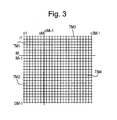
- each matrix of the first group may be regarded as a combination of several switching sub-matrices, namely: a first square sub-matrix TM1 comprising the through traffic inputs i1 to iM and through traffic outputs o1 to oM and which is provided for routing the through traffic; a second sub-matrix TM2 having the inputs iM+1 to 13M-1 and outputs o1 to oM and which provides routing of add traffic added by switching matrices S2-1 to S2-AD, S3-1 to S3-(2M-1) to the through traffic, and two further sub-matrices TM3 and TM4 which will be discussed later on.
- a first square sub-matrix TM1 comprising the through traffic inputs i1 to iM and through traffic outputs o1 to oM and which is provided for routing the through traffic
- a second sub-matrix TM2 having the inputs iM+1 to 13M-1 and outputs o1 to oM and which provides
- the OXC If it is required to upgrade the OXC to increase the number P of inputs for adding traffic, this can be achieved by adding further switching matrices to the second group. If the number of inputs of the switching matrices of the third group, which are physically present (but which have not yet been used before the upgrade) is not less than the number of switching matrices of the second group, those of the third group can continue to be used without modification; otherwise, they must be replaced by switching matrices having a larger number of inputs. Regarding the switching matrices of the first group, no modification is necessary.
- the OXC according to the invention also supports the dropping of traffic arriving on one of the optical input I1 to IM but which are not to be routed further to one of output fibres O1 to OM.
- This purpose is served by the sub-matrix TM3 of each switching matrix of the first group, which is capable of selectively connecting each of the through traffic input channels i1 to iM to one of 2M-1 outputs oM+1 to o3M-1.
- the sub-matrices TM3 of the switching matrices of the first group thus constitute a first stage of a second Clos network, the second and third stage of which are formed by the fourth group of 2M-1 switching matrices S4-1 to S4-(2M-1) having N used inputs and AD used outputs, and the fifth group of AD switching matrices S5-1 to S5-AD having 2M-1 used inputs and M used outputs, respectively.
- the outputs of the switching matrices of the fifth group comprise the drop outputs d1 to dP of the OXC.
- the sub-matrices TM4 of the switching matrices of the first group may remain unused; in case of future need, they can also be used to drop traffic arriving on the add inputs a1 to aP to a selected drop output d1 to dP.
- the third group of switching matrices S3-1 to S3-(2M-1) comprises 2M-1 switching matrices ensures that a communication traffic applied to any add input a1 to aP can routed to any multiplexer M1 to MM and hence be routed to any output 01 to OM, provided of course that the desired output does not already carry communication traffic (wavelength channel) having the same carrier wavelength.
- the switching matrix S1-i of the first group is assigned.
- the add input channel aj is able to connect to the switching matrix S1-i.
- up to M-1 of its inputs, iM+1 to i3(M-1) may be occupied. If the number of occupied inputs were larger, none of the switching matrices outputs o1 to oM would be free, and the add traffic could not be routed, because the wavelength I ⁇ i of the desired output is already occupied. This contradicts the initial assumption, so that it cannot be correct.
- the third group In such a situation, among the switching matrices of the third group S3-1 to S3-(2M-1), up to M-1 matrices are unable to connect to the switching matrix S1-i. Of the remaining M matrices of the third group, however, the output leading to S1-i is free. This corresponds to a total number of M x AD inputs of switching matrices of the third group, by which the add traffic can be routed. Since only up to M x AD add traffic input channels a1 to aP are present, one of these inputs must necessarily be free. i.e. the third group must comprise at least 2M-1 switching matrices in order to ensure that add traffic input at an arbitrary add input aj can reach an output for which it is intended, provided that there is transmission capacity left on that output.
- the same number 2M-1 of matrices of the fourth group is necessary in order to ensure that any wavelength channel arriving at any input I1 to IM, which is to be processed locally (dropped), can be supplied to any drop output d1 to dP.
- a further important advantage of the OXC architecture shown in Figure 2 is that through traffic never need traverse more than one switching matrix when being routed through the OXC.
- the insertion loss of the OXC is thus very low and through traffic can be cross-connected by several OXC, without re-amplification or pulse shaping.
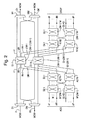
- FIG. 4 A preferred further development of the OXC of the invention is shown in Figure 4 .
- the input and outputs, de-multiplexers and multiplexers and the switching matrices of the first, third and fourth groups are identical with those of the OXC of Figure 2 and are therefore not described again.
- the switching matrices of the second and fifth groups are merged pair wise to switching matrices S2'-1 to S2'-AD.
- the group of switching matrices S2'-1 to S2'-AD will also be referred to as the second group of switching matrices.
- the second group are square matrices each having 3M-1 inputs and 3M - 1 outputs. Preferably they are identical to the matrices of the first group.
- sub-matrices TM1 to TM4 may be regarded as subdivided into sub-matrices TM1 to TM4, wherein the sub-matrices TM3, having M inputs and 2M-1 outputs, correspond to the switching matrices of the second group from Figure 2 and the sub-matrices TM2, having 2M-1 inputs and M outputs, correspond to the switching matrices of the fifth group from Figure 2 .
- the sub-matrices TM1 which directly connects add/drop-traffic input and output channels can be used for routing between these channels; the sub-matrices TM4 remain unused.
- the sub-matrix TM4 is a large unused region in each switching matrix S2'-1 to S2'-AD, this solution is quite efficient and economical because conventional switching matrices which are manufactured in large volumes, and are accordingly competitively priced, are in general quadratic, so that the overall cost of the components for the OXC according to Figure 4 is no higher than for the arrangement of Figure 2 . Since the number of components is less in the embodiment of Figure 4 , the OXC can be more compact.
Landscapes
- Engineering & Computer Science (AREA)
- Computer Networks & Wireless Communication (AREA)
- Use Of Switch Circuits For Exchanges And Methods Of Control Of Multiplex Exchanges (AREA)
- Optical Communication System (AREA)
- Mechanical Coupling Of Light Guides (AREA)
Claims (12)
- Brasseur optique (OXC) comprenant :une pluralité (NxM) de canaux d'entrée (il à iM) pour le trafic de transit ;une pluralité (NxM) de canaux de sortie (ol à oM) pour le trafic de transit ;un premier groupe de matrices de commutation optique (S1-1 à S1-N) pour connecter chaque canal d'entrée de trafic de transit (il à iM) à n'importe lequel des canaux de sortie de trafic de transit (ol à oM), dans lequel chaque canal d'entrée de trafic de transit (il à iM) est connecté à une entrée d'une matrice de commutation (S1-1 à S1-N) du premier groupe et chaque canal de sortie de trafic de transit (ol à oM) est connecté à une sortie de la matrice de commutation (S1-1 à S1-N) du premier groupe ;une troisième pluralité (P) de canaux d'entrée (a1 à aP) pour ajouter du trafic,caractérisé chaque canal d'entrée de trafic ajouté (al à aP) étant connecté à une entrée d'un second groupe de matrices de commutation (S2-1 à S2-AD ; S2'-1 à S2'-AD), dans lequel les sorties du second groupe de matrices de commutation sont connectées aux entrées d'un troisième groupe de matrices de commutation (S3-1 à S3-2M-1) et les sorties du troisième groupe de matrices de commutation sont connectées aux entrées du premier groupe de matrices de commutation de sorte que les matrices de commutation du second, troisième et premier groupe forment un réseau Clos.
- OXC selon la revendication 1, et comprenant en outre une pluralité de démultiplexeurs (D1 à DM), dont chacun possède une entrée à des fins de connexion à une entrée optique (II à IM) qui transporte un rayonnement WDM comprenant une pluralité (N) de canaux de longueur d'onde et une pluralité (N) de sorties pour délivrer un de ces canaux de longueur d'onde à un des canaux d'entrée de trafic de transit (il à iM).
- OXC selon la revendication 2, dans lequel chaque démultiplexeur (Dl à DM) est connecté à chaque matrice de commutation (S1-1 à S1-N) du premier groupe par un canal d'entrée (il à iM).
- OXC selon la revendication 2 ou 3, dans lequel les démultiplexeurs (D1 à DM) sont des démultiplexeurs de longueur d'onde délivrant des canaux de longueur d'onde à une sortie définie selon la longueur d'onde porteuse (λl à λN) du canal de longueur d'onde, et les sorties de divers démultiplexeurs (D1 à DM) pour délivrer des canaux de longueur d'onde d'une même longueur d'onde porteuse sont connectés à une même matrice de commutation (S1-1 à S1-N) du premier groupe.
- OXC selon une quelconque des revendications 1 à 4, dans lequel chaque matrice de commutation (S2-1 à S2-AD ; S2'-1 à S2'-AD) du second groupe possède un nombre M d'entrées pour ajouter du trafic et un nombre d'au moins 2M-1, de préférence exactement 2M-1, sorties connectées aux entrées de matrices de commutation du troisième groupe (S3-1 à S3-(2M-1)).
- OXC selon une quelconque des revendications 1 à 5, dans lequel chaque matrice de commutation optique (S-1 à S1-N) du premier groupe possède un nombre M de sorties pour le trafic de transit et un nombre d'au moins 2M-1, de préférence exactement 2M-1, entrées connectées aux sorties des matrices de commutation du troisième groupe.
- Brasseur optique (OXC) comprenant :une pluralité (NxM) de canaux d'entrée (il à iM) pour le trafic de transit ;une pluralité (NxM) de canaux de sortie (ol à oM) pour le trafic de transit ;un premier groupe de matrices de commutation optique (S1-1 à S1-N) pour connecter chaque canal d'entrée de trafic de transit (il à iM) avec n'importe lequel des canaux de sortie de trafic de transit (ol à oM), dans lequel chaque canal d'entrée de trafic de transit (il à iM) est connecté à une entrée d'une matrice de commutation (S1-1 à S1-N) du premier groupe, et chaque canal de sortie de trafic de transit (ol à oM) est connecté à une sortie d'une matrice de commutation (S1-1 à Si-N) du premier groupe ;une pluralité (P) de canaux de sortie pour supprimer du trafic,caractérisé en ce que chaque canal de sortie de trafic supprimé est connecté à une sortie d'un cinquième groupe de matrices de commutation (S5-1 à S5-AD ; S2'-1 à S2'-AD), dans lequel les entrées du cinquième groupe de matrices de commutation (S5-1 à S5-AD ; S2'-1 à S2'-AD) sont connectées aux sorties d'un quatrième groupe de matrices de commutation (S4-1 à S4-2M-1) et les entrées du quatrième groupe de matrices de commutation sont connectées aux sorties du premier groupe de matrices de commutation de sorte que les matrices de commutation du premier, quatrième et cinquième groupes forment un réseau Clos.
- OXC selon la revendication 7, et comprenant en outre une pluralité (M) de multiplexeurs (M1 à MM), dont chacun possède une sortie à des fins de connexion à une sortie optique (Ol à OM) qui transporte un rayonnement WDM comprenant une pluralité (N) de canaux de longueur d'onde, et une pluralité d'entrées pour entrer un de ces canaux de longueur d'onde à partir d'un des canaux de sortie de trafic de transit (ol à oM).
- OXC selon la revendication 8, dans lequel chaque multiplexeur (Ml à MM) est connecté à chaque matrice de commutation (Si-1 à S1-N) du premier groupe par un canal de sortie (ol à oM).
- OXC selon une quelconque des revendications 7 à 9, dans lequel chaque matrice de commutation optique (S5-1 à S5-Ad ; S2'-1 à S2'-AD) du cinquième groupe possède un nombre M de sorties pour supprimer du trafic et un nombre d'au moins 2M-1, de préférence exactement 2M-1, d'entrées connectées aux sorties des matrices de commutation du quatrième groupe (S4-1 à S4-(2M-1)).
- OXC selon une quelconque des revendications 7 à 10, dans lequel chaque matrice de commutation optique (S1-1 à S1-N) du premier groupe possède un nombre M d'entrées pour le trafic de transit et un nombre d'au moins 2M-1, de préférence exactement 2M-1, de sorties (oM+1 à o3M-1) connectées aux entrées des matrices de commutation du quatrième groupe (S4-1 à S4-(2M-1)).
- OXC selon une quelconque des revendications 1 à 6 et une quelconque des revendications 7 à 11, dans lequel le second groupe de matrices de commutation optique et le cinquième groupe de matrices de commutation optique (S2'-1 à S2'-Ad) sont identiques.
Applications Claiming Priority (3)
| Application Number | Priority Date | Filing Date | Title |
|---|---|---|---|
| DE10213133A DE10213133A1 (de) | 2002-03-23 | 2002-03-23 | Optische Schaltstation |
| DE10213133 | 2002-03-23 | ||
| PCT/IB2003/001469 WO2003081944A1 (fr) | 2002-03-23 | 2003-03-18 | Reseau clos a etages multiples dans lequel une matrice a etage unique comprend un etage du reseau clos |
Publications (2)
| Publication Number | Publication Date |
|---|---|
| EP1491066A1 EP1491066A1 (fr) | 2004-12-29 |
| EP1491066B1 true EP1491066B1 (fr) | 2010-07-21 |
Family
ID=27798145
Family Applications (1)
| Application Number | Title | Priority Date | Filing Date |
|---|---|---|---|
| EP03710167A Expired - Lifetime EP1491066B1 (fr) | 2002-03-23 | 2003-03-18 | Reseau clos a etages multiples dans lequel une matrice a etage unique comprend un etage du reseau clos |
Country Status (10)
| Country | Link |
|---|---|
| US (1) | US7787768B2 (fr) |
| EP (1) | EP1491066B1 (fr) |
| JP (1) | JP4294493B2 (fr) |
| CN (1) | CN100539736C (fr) |
| AT (1) | ATE475270T1 (fr) |
| AU (1) | AU2003214587A1 (fr) |
| CA (1) | CA2478869C (fr) |
| DE (2) | DE10213133A1 (fr) |
| ES (1) | ES2348442T3 (fr) |
| WO (1) | WO2003081944A1 (fr) |
Families Citing this family (14)
| Publication number | Priority date | Publication date | Assignee | Title |
|---|---|---|---|---|
| JP4382635B2 (ja) * | 2004-11-10 | 2009-12-16 | 富士通株式会社 | 光伝送装置 |
| US7715711B2 (en) * | 2006-05-25 | 2010-05-11 | Fujitsu Limited | Wavelength selective switch design configurations for mesh light-trails |
| JP4882712B2 (ja) * | 2006-12-07 | 2012-02-22 | 富士通株式会社 | 光クロスコネクト装置 |
| US8150019B2 (en) * | 2007-08-10 | 2012-04-03 | Smith Robert B | Path redundant hardware efficient communications interconnect system |
| JP4916489B2 (ja) * | 2008-07-29 | 2012-04-11 | 日本電信電話株式会社 | 光回路 |
| US8676057B2 (en) * | 2009-03-18 | 2014-03-18 | Nec Corporation | Optical transmission device, operational wavelength number restricting method, and program |
| US8995456B2 (en) | 2009-04-08 | 2015-03-31 | Empire Technology Development Llc | Space-space-memory (SSM) Clos-network packet switch |
| US8675673B2 (en) * | 2009-07-29 | 2014-03-18 | New Jersey Institute Of Technology | Forwarding cells of partitioned data through a three-stage Clos-network packet switch with memory at each stage |
| US8274988B2 (en) * | 2009-07-29 | 2012-09-25 | New Jersey Institute Of Technology | Forwarding data through a three-stage Clos-network packet switch with memory at each stage |
| JP5610350B2 (ja) * | 2011-06-16 | 2014-10-22 | 日本電信電話株式会社 | 光ノード用光回路 |
| DE102013019643A1 (de) * | 2013-11-22 | 2015-05-28 | Siemens Aktiengesellschaft | Zweistufiger Kreuzschienenverteiler und Verfahren zum Betrieb |
| WO2016122527A1 (fr) | 2015-01-29 | 2016-08-04 | Hewlett Packard Enterprise Development Lp | Interconnexion photonique à réseau de guides d'ondes cyclique |
| CN105337883B (zh) * | 2015-08-20 | 2018-12-18 | 电子科技大学 | 一种支持多业务的网络交换装置及其实现方法 |
| US12621076B2 (en) * | 2022-06-30 | 2026-05-05 | Solutions and Networks Oy | Add/drop capability for spatial division multiplexed optical systems |
Family Cites Families (24)
| Publication number | Priority date | Publication date | Assignee | Title |
|---|---|---|---|---|
| FR2720883B1 (fr) * | 1994-06-07 | 1997-01-10 | Cit Alcatel | Multiplexeur spectral optique à insertion-extraction. |
| US6005698A (en) * | 1995-06-08 | 1999-12-21 | Siemens Aktiengesellschaft | Non-blocking multi-cast WDM coupling arrangement |
| US6208443B1 (en) * | 1996-10-03 | 2001-03-27 | International Business Machines Corporation | Dynamic optical add-drop multiplexers and wavelength-routing networks with improved survivability and minimized spectral filtering |
| JP3114801B2 (ja) * | 1997-07-07 | 2000-12-04 | 日本電気株式会社 | 光通信ネットワーク装置 |
| US5903686A (en) * | 1997-08-21 | 1999-05-11 | Macdonald; Robert I. | Optical switch module |
| US6044185A (en) * | 1997-08-21 | 2000-03-28 | Macdonald; Robert I. | Optical switch module |
| JP3425861B2 (ja) * | 1998-02-20 | 2003-07-14 | 富士通株式会社 | 光交換機 |
| US6366713B1 (en) | 1998-09-04 | 2002-04-02 | Tellabs Operations, Inc. | Strictly non-blocking optical switch core having optimized switching architecture based on reciprocity conditions |
| AU6314900A (en) | 1999-07-26 | 2001-02-13 | Banyu Pharmaceutical Co., Ltd. | Biarylurea derivatives |
| US6567858B1 (en) * | 1999-09-20 | 2003-05-20 | Verizon Laboratories Inc. | Optimal all-to-all personalized exchange in optical multistage networks |
| US6335992B1 (en) * | 2000-02-15 | 2002-01-01 | Tellium, Inc. | Scalable optical cross-connect system and method transmitter/receiver protection |
| GB0007552D0 (en) * | 2000-03-28 | 2000-05-17 | Iltron Limited | A fully reconfigurable regenerative optical add-drop multiplexer |
| WO2001074111A1 (fr) | 2000-03-28 | 2001-10-04 | Ditech Communications Corporation | Dispositif d'acheminement pour tous reseaux optiques |
| FR2811837A1 (fr) * | 2000-07-13 | 2002-01-18 | Cit Alcatel | Cellule elementaire de commutation optique et dispositifs comportant une telle cellule |
| US6696917B1 (en) * | 2000-09-21 | 2004-02-24 | Nortel Networks Limited | Folded Clos architecture switching |
| CN1168349C (zh) * | 2000-12-05 | 2004-09-22 | 北京邮电大学 | 具备光纤链路级和波长信道级的光交叉连接节点结构 |
| US6450829B1 (en) * | 2000-12-15 | 2002-09-17 | Tyco Electronics Canada, Ltd. | Snap-on plug coaxial connector |
| JP2002208895A (ja) * | 2001-01-10 | 2002-07-26 | Fujitsu Ltd | 光アッド/ドロップ装置 |
| JP2003009195A (ja) * | 2001-06-27 | 2003-01-10 | Nec Corp | クロスコネクトスイッチ |
| JP2003021795A (ja) * | 2001-07-09 | 2003-01-24 | Nec Corp | 光スイッチシステム |
| JP4676657B2 (ja) * | 2001-08-30 | 2011-04-27 | 富士通株式会社 | 光アド・ドロップ多重化装置 |
| US7340175B2 (en) * | 2002-01-18 | 2008-03-04 | Nec Corporation | Non-uniform optical waveband aggregator and deaggregator and hierarchical hybrid optical cross-connect system |
| US7088919B2 (en) * | 2002-11-04 | 2006-08-08 | Nortel Networks Limited | Modular photonic switch with wavelength conversion |
| US6714341B1 (en) * | 2003-05-20 | 2004-03-30 | Samsung Electronics Co., Ltd. | Wavelength converter and optical cross-connect system using the same |
-
2002
- 2002-03-23 DE DE10213133A patent/DE10213133A1/de not_active Withdrawn
-
2003
- 2003-03-18 DE DE60333445T patent/DE60333445D1/de not_active Expired - Lifetime
- 2003-03-18 EP EP03710167A patent/EP1491066B1/fr not_active Expired - Lifetime
- 2003-03-18 CN CNB038067730A patent/CN100539736C/zh not_active Expired - Fee Related
- 2003-03-18 AT AT03710167T patent/ATE475270T1/de not_active IP Right Cessation
- 2003-03-18 JP JP2003579502A patent/JP4294493B2/ja not_active Expired - Fee Related
- 2003-03-18 US US10/508,751 patent/US7787768B2/en not_active Expired - Fee Related
- 2003-03-18 ES ES03710167T patent/ES2348442T3/es not_active Expired - Lifetime
- 2003-03-18 CA CA2478869A patent/CA2478869C/fr not_active Expired - Fee Related
- 2003-03-18 WO PCT/IB2003/001469 patent/WO2003081944A1/fr not_active Ceased
- 2003-03-18 AU AU2003214587A patent/AU2003214587A1/en not_active Abandoned
Also Published As
| Publication number | Publication date |
|---|---|
| JP4294493B2 (ja) | 2009-07-15 |
| DE10213133A1 (de) | 2003-10-02 |
| ES2348442T3 (es) | 2010-12-07 |
| AU2003214587A1 (en) | 2003-10-08 |
| CA2478869C (fr) | 2013-01-08 |
| ATE475270T1 (de) | 2010-08-15 |
| JP2005521352A (ja) | 2005-07-14 |
| CN100539736C (zh) | 2009-09-09 |
| WO2003081944A1 (fr) | 2003-10-02 |
| US20050226551A1 (en) | 2005-10-13 |
| DE60333445D1 (de) | 2010-09-02 |
| EP1491066A1 (fr) | 2004-12-29 |
| CN1643972A (zh) | 2005-07-20 |
| CA2478869A1 (fr) | 2003-10-02 |
| US7787768B2 (en) | 2010-08-31 |
Similar Documents
| Publication | Publication Date | Title |
|---|---|---|
| US5878177A (en) | Layered switch architectures for high-capacity optical transport networks | |
| US8457496B2 (en) | Optical signal switching device | |
| EP2002573B1 (fr) | Architectures de commutation optique pour noeuds dans des réseaux maillé et en anneau de multiplexage par répartition en longueur d'onde | |
| US6333799B1 (en) | Hybrid wavelength-interchanging cross-connect | |
| US7751714B2 (en) | Centralized resource management in wavelength selective switch based wavelength cross connect systems | |
| US6738540B2 (en) | Optical cross-connect switch using programmable multiplexers/demultiplexers | |
| CA2478869C (fr) | Reseau clos a etages multiples dans lequel une matrice a etage unique comprend un etage du reseau clos | |
| EP1013110A1 (fr) | Systeme d'interconnexion pour reseaux optiques | |
| EP2982066B1 (fr) | Commutateur optique | |
| US20020131678A1 (en) | Wavelength-modular optical cross-connect switch | |
| WO2004025330A2 (fr) | Brasseur optique et procede associe | |
| US20030152072A1 (en) | Routing device for all optical networks | |
| US6937822B2 (en) | Switch for an optical transmission network using wavelength division multiplexing | |
| NZ521127A (en) | A communications network architecture | |
| EP1267589B1 (fr) | Unité de noeud optique, système de transmission optique à multiplexage en longueurs d'ondes, et méthode de séparation de longueurs d'ondes | |
| KR100431204B1 (ko) | 광스위치 패브릭 모듈을 이용한 대용량 광교차연결 스위칭시스템 | |
| WO2001074111A1 (fr) | Dispositif d'acheminement pour tous reseaux optiques | |
| US6714341B1 (en) | Wavelength converter and optical cross-connect system using the same | |
| AU2001240347B2 (en) | A communications network architecture | |
| Yang | Understanding wavelength cross-connects and their benefits throughout the network | |
| Zong et al. | Centralized Resource Management in WSS-Based Wavelength Cross-Connect Nodes | |
| JP2001285904A (ja) | 光クロスコネクト装置 | |
| CA2246799A1 (fr) | Transmultiplexeur |
Legal Events
| Date | Code | Title | Description |
|---|---|---|---|
| PUAI | Public reference made under article 153(3) epc to a published international application that has entered the european phase |
Free format text: ORIGINAL CODE: 0009012 |
|
| 17P | Request for examination filed |
Effective date: 20041012 |
|
| AK | Designated contracting states |
Kind code of ref document: A1 Designated state(s): AT BE BG CH CY CZ DE DK EE ES FI FR GB GR HU IE IT LI LU MC NL PT RO SE SI SK TR |
|
| AX | Request for extension of the european patent |
Extension state: AL LT LV MK |
|
| RAP1 | Party data changed (applicant data changed or rights of an application transferred) |
Owner name: ERICSSON AB |
|
| 17Q | First examination report despatched |
Effective date: 20090804 |
|
| GRAP | Despatch of communication of intention to grant a patent |
Free format text: ORIGINAL CODE: EPIDOSNIGR1 |
|
| RAP1 | Party data changed (applicant data changed or rights of an application transferred) |
Owner name: ERICSSON AB |
|
| GRAS | Grant fee paid |
Free format text: ORIGINAL CODE: EPIDOSNIGR3 |
|
| GRAA | (expected) grant |
Free format text: ORIGINAL CODE: 0009210 |
|
| AK | Designated contracting states |
Kind code of ref document: B1 Designated state(s): AT BE BG CH CY CZ DE DK EE ES FI FR GB GR HU IE IT LI LU MC NL PT RO SE SI SK TR |
|
| REG | Reference to a national code |
Ref country code: GB Ref legal event code: FG4D |
|
| REG | Reference to a national code |
Ref country code: CH Ref legal event code: EP |
|
| REG | Reference to a national code |
Ref country code: IE Ref legal event code: FG4D |
|
| REF | Corresponds to: |
Ref document number: 60333445 Country of ref document: DE Date of ref document: 20100902 Kind code of ref document: P |
|
| REG | Reference to a national code |
Ref country code: ES Ref legal event code: FG2A Effective date: 20101124 Ref country code: NL Ref legal event code: VDEP Effective date: 20100721 |
|
| PG25 | Lapsed in a contracting state [announced via postgrant information from national office to epo] |
Ref country code: NL Free format text: LAPSE BECAUSE OF FAILURE TO SUBMIT A TRANSLATION OF THE DESCRIPTION OR TO PAY THE FEE WITHIN THE PRESCRIBED TIME-LIMIT Effective date: 20100721 Ref country code: FI Free format text: LAPSE BECAUSE OF FAILURE TO SUBMIT A TRANSLATION OF THE DESCRIPTION OR TO PAY THE FEE WITHIN THE PRESCRIBED TIME-LIMIT Effective date: 20100721 Ref country code: AT Free format text: LAPSE BECAUSE OF FAILURE TO SUBMIT A TRANSLATION OF THE DESCRIPTION OR TO PAY THE FEE WITHIN THE PRESCRIBED TIME-LIMIT Effective date: 20100721 |
|
| PG25 | Lapsed in a contracting state [announced via postgrant information from national office to epo] |
Ref country code: CY Free format text: LAPSE BECAUSE OF FAILURE TO SUBMIT A TRANSLATION OF THE DESCRIPTION OR TO PAY THE FEE WITHIN THE PRESCRIBED TIME-LIMIT Effective date: 20100721 Ref country code: PT Free format text: LAPSE BECAUSE OF FAILURE TO SUBMIT A TRANSLATION OF THE DESCRIPTION OR TO PAY THE FEE WITHIN THE PRESCRIBED TIME-LIMIT Effective date: 20101122 Ref country code: SI Free format text: LAPSE BECAUSE OF FAILURE TO SUBMIT A TRANSLATION OF THE DESCRIPTION OR TO PAY THE FEE WITHIN THE PRESCRIBED TIME-LIMIT Effective date: 20100721 Ref country code: BG Free format text: LAPSE BECAUSE OF FAILURE TO SUBMIT A TRANSLATION OF THE DESCRIPTION OR TO PAY THE FEE WITHIN THE PRESCRIBED TIME-LIMIT Effective date: 20101021 |
|
| PG25 | Lapsed in a contracting state [announced via postgrant information from national office to epo] |
Ref country code: SE Free format text: LAPSE BECAUSE OF FAILURE TO SUBMIT A TRANSLATION OF THE DESCRIPTION OR TO PAY THE FEE WITHIN THE PRESCRIBED TIME-LIMIT Effective date: 20100721 Ref country code: BE Free format text: LAPSE BECAUSE OF FAILURE TO SUBMIT A TRANSLATION OF THE DESCRIPTION OR TO PAY THE FEE WITHIN THE PRESCRIBED TIME-LIMIT Effective date: 20100721 Ref country code: GR Free format text: LAPSE BECAUSE OF FAILURE TO SUBMIT A TRANSLATION OF THE DESCRIPTION OR TO PAY THE FEE WITHIN THE PRESCRIBED TIME-LIMIT Effective date: 20101022 |
|
| PG25 | Lapsed in a contracting state [announced via postgrant information from national office to epo] |
Ref country code: DK Free format text: LAPSE BECAUSE OF FAILURE TO SUBMIT A TRANSLATION OF THE DESCRIPTION OR TO PAY THE FEE WITHIN THE PRESCRIBED TIME-LIMIT Effective date: 20100721 |
|
| PLBE | No opposition filed within time limit |
Free format text: ORIGINAL CODE: 0009261 |
|
| STAA | Information on the status of an ep patent application or granted ep patent |
Free format text: STATUS: NO OPPOSITION FILED WITHIN TIME LIMIT |
|
| PG25 | Lapsed in a contracting state [announced via postgrant information from national office to epo] |
Ref country code: IT Free format text: LAPSE BECAUSE OF FAILURE TO SUBMIT A TRANSLATION OF THE DESCRIPTION OR TO PAY THE FEE WITHIN THE PRESCRIBED TIME-LIMIT Effective date: 20100721 Ref country code: CZ Free format text: LAPSE BECAUSE OF FAILURE TO SUBMIT A TRANSLATION OF THE DESCRIPTION OR TO PAY THE FEE WITHIN THE PRESCRIBED TIME-LIMIT Effective date: 20100721 Ref country code: SK Free format text: LAPSE BECAUSE OF FAILURE TO SUBMIT A TRANSLATION OF THE DESCRIPTION OR TO PAY THE FEE WITHIN THE PRESCRIBED TIME-LIMIT Effective date: 20100721 Ref country code: EE Free format text: LAPSE BECAUSE OF FAILURE TO SUBMIT A TRANSLATION OF THE DESCRIPTION OR TO PAY THE FEE WITHIN THE PRESCRIBED TIME-LIMIT Effective date: 20100721 Ref country code: RO Free format text: LAPSE BECAUSE OF FAILURE TO SUBMIT A TRANSLATION OF THE DESCRIPTION OR TO PAY THE FEE WITHIN THE PRESCRIBED TIME-LIMIT Effective date: 20100721 |
|
| 26N | No opposition filed |
Effective date: 20110426 |
|
| REG | Reference to a national code |
Ref country code: DE Ref legal event code: R097 Ref document number: 60333445 Country of ref document: DE Effective date: 20110426 |
|
| PG25 | Lapsed in a contracting state [announced via postgrant information from national office to epo] |
Ref country code: MC Free format text: LAPSE BECAUSE OF NON-PAYMENT OF DUE FEES Effective date: 20110331 |
|
| REG | Reference to a national code |
Ref country code: CH Ref legal event code: PL |
|
| REG | Reference to a national code |
Ref country code: FR Ref legal event code: ST Effective date: 20111130 |
|
| REG | Reference to a national code |
Ref country code: IE Ref legal event code: MM4A |
|
| PG25 | Lapsed in a contracting state [announced via postgrant information from national office to epo] |
Ref country code: CH Free format text: LAPSE BECAUSE OF NON-PAYMENT OF DUE FEES Effective date: 20110331 Ref country code: LI Free format text: LAPSE BECAUSE OF NON-PAYMENT OF DUE FEES Effective date: 20110331 Ref country code: IE Free format text: LAPSE BECAUSE OF NON-PAYMENT OF DUE FEES Effective date: 20110318 Ref country code: FR Free format text: LAPSE BECAUSE OF NON-PAYMENT OF DUE FEES Effective date: 20110331 |
|
| PG25 | Lapsed in a contracting state [announced via postgrant information from national office to epo] |
Ref country code: LU Free format text: LAPSE BECAUSE OF NON-PAYMENT OF DUE FEES Effective date: 20110318 |
|
| PG25 | Lapsed in a contracting state [announced via postgrant information from national office to epo] |
Ref country code: TR Free format text: LAPSE BECAUSE OF FAILURE TO SUBMIT A TRANSLATION OF THE DESCRIPTION OR TO PAY THE FEE WITHIN THE PRESCRIBED TIME-LIMIT Effective date: 20100721 |
|
| PG25 | Lapsed in a contracting state [announced via postgrant information from national office to epo] |
Ref country code: HU Free format text: LAPSE BECAUSE OF FAILURE TO SUBMIT A TRANSLATION OF THE DESCRIPTION OR TO PAY THE FEE WITHIN THE PRESCRIBED TIME-LIMIT Effective date: 20100721 |
|
| PGFP | Annual fee paid to national office [announced via postgrant information from national office to epo] |
Ref country code: ES Payment date: 20150326 Year of fee payment: 13 Ref country code: DE Payment date: 20150327 Year of fee payment: 13 |
|
| PGFP | Annual fee paid to national office [announced via postgrant information from national office to epo] |
Ref country code: GB Payment date: 20150327 Year of fee payment: 13 |
|
| REG | Reference to a national code |
Ref country code: DE Ref legal event code: R119 Ref document number: 60333445 Country of ref document: DE |
|
| GBPC | Gb: european patent ceased through non-payment of renewal fee |
Effective date: 20160318 |
|
| PG25 | Lapsed in a contracting state [announced via postgrant information from national office to epo] |
Ref country code: DE Free format text: LAPSE BECAUSE OF NON-PAYMENT OF DUE FEES Effective date: 20161001 Ref country code: GB Free format text: LAPSE BECAUSE OF NON-PAYMENT OF DUE FEES Effective date: 20160318 |
|
| REG | Reference to a national code |
Ref country code: ES Ref legal event code: FD2A Effective date: 20170427 |
|
| PG25 | Lapsed in a contracting state [announced via postgrant information from national office to epo] |
Ref country code: ES Free format text: LAPSE BECAUSE OF NON-PAYMENT OF DUE FEES Effective date: 20160319 |