EP1491113A2 - BROSSE à CHEVEUX AUTONETTOYANT - Google Patents
BROSSE à CHEVEUX AUTONETTOYANT Download PDFInfo
- Publication number
- EP1491113A2 EP1491113A2 EP04014946A EP04014946A EP1491113A2 EP 1491113 A2 EP1491113 A2 EP 1491113A2 EP 04014946 A EP04014946 A EP 04014946A EP 04014946 A EP04014946 A EP 04014946A EP 1491113 A2 EP1491113 A2 EP 1491113A2
- Authority
- EP
- European Patent Office
- Prior art keywords
- hair
- bristles
- brush
- type
- hair brush
- Prior art date
- Legal status (The legal status is an assumption and is not a legal conclusion. Google has not performed a legal analysis and makes no representation as to the accuracy of the status listed.)
- Granted
Links
- 238000004140 cleaning Methods 0.000 title claims abstract description 47
- 239000000463 material Substances 0.000 claims description 17
- 230000004913 activation Effects 0.000 claims description 16
- 238000000034 method Methods 0.000 claims description 16
- 210000003128 head Anatomy 0.000 description 15
- 210000004761 scalp Anatomy 0.000 description 15
- 230000013011 mating Effects 0.000 description 8
- 238000010276 construction Methods 0.000 description 5
- 239000012528 membrane Substances 0.000 description 5
- 230000000881 depressing effect Effects 0.000 description 4
- 238000004519 manufacturing process Methods 0.000 description 4
- 230000007246 mechanism Effects 0.000 description 4
- 239000004033 plastic Substances 0.000 description 4
- 229920003023 plastic Polymers 0.000 description 4
- 239000005060 rubber Substances 0.000 description 4
- 239000000853 adhesive Substances 0.000 description 3
- 230000001070 adhesive effect Effects 0.000 description 3
- 230000000994 depressogenic effect Effects 0.000 description 3
- 239000004744 fabric Substances 0.000 description 3
- -1 polyethylene Polymers 0.000 description 3
- 239000000126 substance Substances 0.000 description 3
- XEEYBQQBJWHFJM-UHFFFAOYSA-N Iron Chemical compound [Fe] XEEYBQQBJWHFJM-UHFFFAOYSA-N 0.000 description 2
- 230000008901 benefit Effects 0.000 description 2
- 239000003292 glue Substances 0.000 description 2
- 238000001746 injection moulding Methods 0.000 description 2
- 230000001788 irregular Effects 0.000 description 2
- 239000002184 metal Substances 0.000 description 2
- 229910052751 metal Inorganic materials 0.000 description 2
- 238000012986 modification Methods 0.000 description 2
- 230000004048 modification Effects 0.000 description 2
- 238000000465 moulding Methods 0.000 description 2
- 230000008569 process Effects 0.000 description 2
- QTBSBXVTEAMEQO-UHFFFAOYSA-M Acetate Chemical compound CC([O-])=O QTBSBXVTEAMEQO-UHFFFAOYSA-M 0.000 description 1
- 229920002799 BoPET Polymers 0.000 description 1
- 241000549893 Carphochaete Species 0.000 description 1
- 241000282994 Cervidae Species 0.000 description 1
- 239000005041 Mylar™ Substances 0.000 description 1
- 239000004698 Polyethylene Substances 0.000 description 1
- 239000004743 Polypropylene Substances 0.000 description 1
- 239000004793 Polystyrene Substances 0.000 description 1
- 230000009471 action Effects 0.000 description 1
- 238000007792 addition Methods 0.000 description 1
- 230000001680 brushing effect Effects 0.000 description 1
- 230000008859 change Effects 0.000 description 1
- 239000002131 composite material Substances 0.000 description 1
- 238000012217 deletion Methods 0.000 description 1
- 230000037430 deletion Effects 0.000 description 1
- 239000000428 dust Substances 0.000 description 1
- 230000000694 effects Effects 0.000 description 1
- 238000002347 injection Methods 0.000 description 1
- 239000007924 injection Substances 0.000 description 1
- 229910052742 iron Inorganic materials 0.000 description 1
- 230000007257 malfunction Effects 0.000 description 1
- 239000004579 marble Substances 0.000 description 1
- 229920000573 polyethylene Polymers 0.000 description 1
- 229920001155 polypropylene Polymers 0.000 description 1
- 229920002223 polystyrene Polymers 0.000 description 1
- 230000001105 regulatory effect Effects 0.000 description 1
- 239000004576 sand Substances 0.000 description 1
- 238000000926 separation method Methods 0.000 description 1
- XLYOFNOQVPJJNP-UHFFFAOYSA-N water Substances O XLYOFNOQVPJJNP-UHFFFAOYSA-N 0.000 description 1
- 239000002023 wood Substances 0.000 description 1
Images





Classifications
-
- A—HUMAN NECESSITIES
- A46—BRUSHWARE
- A46B—BRUSHES
- A46B17/00—Accessories for brushes
- A46B17/06—Devices for cleaning brushes after use
-
- A—HUMAN NECESSITIES
- A46—BRUSHWARE
- A46B—BRUSHES
- A46B2200/00—Brushes characterized by their functions, uses or applications
- A46B2200/10—For human or animal care
- A46B2200/104—Hair brush
-
- A—HUMAN NECESSITIES
- A46—BRUSHWARE
- A46B—BRUSHES
- A46B3/00—Brushes characterised by the way in which the bristles are fixed or joined in or on the brush body or carrier
- A46B3/20—Brushes characterised by the way in which the bristles are fixed or joined in or on the brush body or carrier the bristles being fixed or joined in rubber bodies, e.g. in soft rubber
Definitions
- the disclosure relates generally to hair brushes, hair rollers, and a system of hair brushes for use with various types of hair and, more particularly, to hair brushes having comfort features and self-cleaning retractable bristles, and to a system for selecting a hair brush from a plurality of hair brushes according to types and styles of hair.
- hair brushes in general are known in the art.
- hair brushes having retractable bristles or self-cleaning features, and features for added comfort are also know in the art.
- one type of a self-cleaning hair brush is disclosed in U.S. Patent No. 6,021,542, and includes a plurality of cleaning sheets disposed between bristles of the brush. After strands of hair have accumulated between the bristles, the user can pull a sheet away from the plurality of sheets, thereby removing with the sheet the accumulated strands of hair.
- This type of self-cleaning hair brush requires the plurality of sheets to be replaced, making it a costly brush cleaning feature.
- Another type of self-cleaning hair brush includes retractable bristles that enable the user to remove strands of hair from a top of the brush once the bristles have been retracted.
- One such brush is disclosed in U.S. Patent No. 4,574,416 and utilizes a brush head, a spring, and a lever to retract the bristles relative to the head of the brush. More specifically, the brush head is disposed at an end of the lever which pivots about a pivot point in the body of the brush. The spring biases the lever and hence the bristle head to a position such that the bristles of the brush are in a retracted position. The user extends the bristles for use by depressing the lever against the bias of the spring and forcing the bristles out from the head of the brush.
- U.S. Patent No. 5,815,877 includes a base, an actuation member, and a plurality of bristles.
- the bristles are attached to the actuation member which is slidably attached to the base.
- the bristles are retracted by pulling the actuation member toward the user relative to the base.
- the bristles which are positioned perpendicular to the actuation member in the extended position, are forced to a parallel position relative to the actuation member and hence are retracted into the base/actuation member.
- the bristles are extended by pushing the actuation member into the base, thereby positioning the bristles perpendicular to the actuation member.
- U.S. Patent No. 5,862,563 includes body, a backing member, springs, a base, an actuating element, and a plurality of bristles.
- the bristles are attached to the backing member, which is operatively attached to the actuating element.
- the springs are located underneath and bias the backing member against the body of the brush such that the bristles extend from the body.
- the bristles are retracted into the body by depressing the actuating element against the bias of the springs. To extend the bristles from the body, the user releases the depressed actuating element such that the bias of the springs returns the backing member against the body of the brush, and hence extends the bristles.
- U.S. Patent No. 5,862,563 Another brush having retractable bristles is disclosed in U.S. Patent No. 5,862,563 and includes an outer tubular member having apertures and an inner tubular member. A plurality of bristles are rotatably mounted on the inner tubular member and extend through the apertures. By rotation of the outer tubular member relative to the inner tubular member, the bristles, depending on the direction of rotation, either extend from or retract into the outer tubular member.
- retractable bristle/self-cleaning hair brushes each have one or more problematic aspects or features.
- these brushes all require a complicated and multi-piece mechanism to effectuate retraction and extension of the bristles, making the brushes costly to manufacture and more susceptible to breakage and malfunction.
- these brushes are not designed for the comfort of the user and, therefore, have features not optimal for user comfort.
- a comfort hair brush in U.S. Patent No. 6,006,395 and includes a flexible membrane that is pivotally attached along opposite ends to a rigid support. A plurality of bristles are attached to and extend downwardly from the flexible membrane. During use of the brush, the flexible membrane will reconfigure to match a profile of the user's head and will provide a certain amount of forgiveness toward the center portion of the flexible membrane.
- This comfort hair brush does not include any self-cleaning features, and may be hard on the head of the user at areas toward the ends of the flexible membrane.
- a hair brush having a body, a cushion pad, and a plurality of bristles.
- the body includes a first end at which at least a partial cavity is disposed.
- the cavity includes a front portion, a rear portion, and a plurality of apertures.
- the cushion pad includes a first surface that is disposed near the front portion of the cavity when the hair brush is in a user position, and a second surface that is disposed near the rear portion of the cavity when the hair brush is in a cleaning position.
- the plurality of bristles are disposed on the cushion pad such that a first end of the bristles extends substantially perpendicular from the first surface of the cushion pad through the apertures in the front portion of the cavity.
- a hair brush having a body, a central elongate portion and a plurality of bristles.
- the body includes a generally cylindrical portion having an outer surface and a plurality of apertures, wherein the generally cylindrical portion is disposed near the first end of the body.
- the central elongate portion includes a first end and a second end, and is disposed at least partially inside the cylindrical portion.
- Each of the plurality of bristles has a first end that extends from the central elongate portion through a corresponding one of the apertures in the cylindrical portion of the body.
- a second end of each of the plurality of bristles is disposed near the outer surface of the cylindrical portion in a cleaning position, and is disposed away from the outer surface of the cylindrical portion in a user position.
- a hair brush having a body, a head, and a plurality of bristles.
- the head is disposed near a first end of the body, and the plurality of bristles are disposed on the head of the body.
- a bristle density and bristle length are based on at least one of a length, texture, amount, and thickness a hair type.
- a hair brush system having a plurality of brushes.
- the plurality of hair brushes each have different types of bristles and include a first of the plurality of hair brushes having a first type of bristles adapted to be used with a first type of hair, and a second of the plurality of hair brushes having a second type of bristles adapted to be used with a second type of hair.
- the first type of bristles and the second type of bristles differ in at least one of a bristle density and a bristle length.
- a method of providing hair brushes for various types of hair includes providing a first hair brush having a first type of bristle adapted to be used with a first type of hair, and a second hair brush having a second type of bristle adapted to be used with a second type of hair.
- the first type of bristles and the second type of bristles differ in at least one of a bristle density and a bristle length.
- a method of determining hair brushes for various types of hair includes categorizing hair types based on at least one of a length, texture, amount, and thickness of hair, and providing a plurality of hair brushes having a different bristle type.
- the method further includes correlating a first hair type to a first of the plurality of hair brushes having a first bristle type, and correlating a second hair type to a second of the plurality of hair brushes having a second bristle type.
- the first bristle type and the second bristle type differ in at least one of a bristle density and a bristle length.
- a hair roller in accordance with another aspect of the disclosure, includes a generally cylindrical body, a central elongate portion, and a plurality of bristles.
- the generally cylindrical body includes an outer surface and a plurality of apertures, and the central elongate portion has a first end and a second end and is disposed at least partially inside the cylindrical portion.
- the plurality of bristles have a first end that extend from the central elongate portion through the apertures in the body, and a second end that are disposed near the outer surface of the body in a cleaning position, and are disposed away from the outer surface of the body in a user position.
- a vented hair brush in accordance with another aspect of the disclosure, includes a body having a head and a handle, at least a partial cavity disposed in the head of the brush, a cushion pad, and a plurality of bristles.
- the cavity has a front portion, a rear portion, and at least a first plurality of apertures.
- the cushion pad includes a first surface disposed near the front portion of the cavity when the hair brush is in a user position, a second surface disposed near the rear portion of the cavity when the hair brush is in a cleaning position, and a second plurality of apertures aligned with the first plurality of apertures when the hair brush is in a user position.
- the plurality of bristles are disposed on the cushion pad and have first ends that extend substantially perpendicular from the first surface of the cushion pad through a third plurality of apertures disposed in the head of the brush.
- a self-cleaning comfort hair brush 20 includes a body 22, a cushion pad 24, and a plurality of bristles 26.
- the hair brush 20, as depicted in Fig. 1 is only one exemplary type of hair brush 20 and, more particularly, one exemplary type of hair brush head that may be used in conjunction with the present disclosure.
- the hair brush 20 is, therefore, not limited to an oval-shaped brush head as depicted in Fig. 1, but may include any of the brush heads disclosed herein and others.
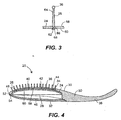
- the hair brush 20 is intended to provide a comfortable brush that is self-cleaning and/or has a self-cleaning mechanism. More specifically, the bristles 26 are attached to and extend substantially or generally perpendicularly from the cushion pad 24 located in a cavity 28, as illustrated in Figs. 2 and 4.
- the cushion pad 24 is constructed from a flexible material, and can be moved such that it is disposed near a front portion 30 of the body 22 with bristles extending outwardly through aperture 34 when the hair brush 20 is in an user position, or is disposed near a rear portion 32 of the body 22 when the hair brush 20 is in a cleaning position.
- the bristles 26 extend through apertures 34 located on the front portion 30 of the body 22, such that tips 36 of the bristles 26 are disposed away from the front portion 34 in a user position, and are disposed near the front portion 30 or at least partially retracted within the cavity 28 in a cleaning position.
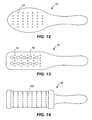
- a hair brush system incorporating various features of the hair brush 20 is intended to provide a hair brush 20 selectable from an array of brushes and adapted for a person's specific type and/or style of hair. More specifically, the user's hair type may be categorized in many ways including, but not limited to, amount or density, shape, width or diameter, and length of the hair. Similarly, the person's hair style may vary. A brush with the length and density of the bristles 26, as illustrated in Figs. 8-17 may, therefore, be appropriately chosen to accommodate the various type and style of hair.
- the body 22 includes a head 31 defining the cavity 28 therein, and a handle 38.
- the handle 38 extends from the front portion 30, and the cavity 28 is disposed between the front portion 30 and the rear portion 32 at the body 22.
- the hair brush 20 may, however, be constructed without the handle 38, such that the user would grasp, for example, the head 31 of the brush 20 during use.
- the hair brush 20 may include several additional elements or pieces.
- the handle 38 may be constructed from a plurality of pieces; similarly, the front and rear portions 30, 32 may be constructed of additional pieces and/or be connected at other locations.
- the front portion 30 of the body 22 has an outside surface 40 and an inside surface 42, wherein the apertures 34 are located between the inside surface 42 and the outside surface 40.
- the inside surface 42 of the front portion 30 may also define an upper surface or front wall 44 of the cavity 28.
- a rear wall 46 of the cavity 28 defined by an inner surface of rear portion 32 is disposed opposite the front wall 44.
- the body 22 may be constructed from one or more pieces and, as in this example, may be constructed from two portions, the front portion 30 and the rear portion 32.
- the front portion 30 may include the handle 38, and may in part create the front wall 44 of the cavity 28.
- the rear portion 32 of the body 22 may be disposed to the rear of the front portion 30, such that the rear portion 32 may in part create the rear wall 46 of the cavity 28.
- the front portion 30 includes a first end 48 and a second end 50.
- the first end 48 of the front portion 30 includes the apertures 34 and a first mating surface 52
- the second end 50 includes the handle 38.
- the first mating surface 52 is located around the perimeter of a first section 28a of the cavity 28 and may be adapted to receive a second mating surface 54 located on the rear portion 32 of the body 22.
- the rear portion 32 may create a second section 28b of the cavity 28 and may include the second mating surface 54.
- the second mating surface 54 is located around the perimeter of the rear portion 32 of the body 22, and may be adapted to engage with the first mating surface 52, such that upon connection of the mating surfaces 52, 54, the cavity 28 is formed.
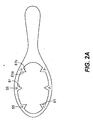
- the body 22 may also include one or more positioning members 55, located along the perimeter of the cavity 28, as seen in Fig. 2a.
- the positioning members 55 may depend from the perimeter of the cavity 28 and extend radially inward.
- the body 22 and the cavity 28 may, however, be formed in many other ways with many additional and/or alternate features.
- the front portion 30 and the rear portion 32 may be attached or engaged via a ledge and corresponding recess.
- the mating surfaces 52, 54 may include a complimentary ledge and recess, such that the rcar portion 32 may snap onto the front portion 30 via the ledge and recess, without adhesive.
- the hair brush 20 may be constructed from a single piece and may not include the rear portion 32.
- the cavity 28 in such an example, may only be partially enclosed.
- Other methods of forming the body 22 and cavity 28 may include connecting the front portion 30 and the cushion pad 24 together without a rear portion 32 where the cushion pad 24 is attached to the front portion 30.
- the cushion pad 24 may be constructed by other materials listed below.
- the cushion pad 24 can also be constructed in pieces with mobile joints that allows movement, with the movement being enhanced or regulated by additional material such as gel-like substance, water, plasmic type of material that is behind the cushion pad 24, and granular substance such as sand, marble, or dust. These materials may require glue or adhesives to retain its position relative to the cushion pad 24, and may or may not require a rear cavity 32 to contain itself.
- the rear portion 32 can be eliminated or constructed together with the front portion 30 as a whole part.
- the substances behind the cushion pad 24 may be functional in nature or aesthetic.
- the front portion 30 is not required to have a dome-like curvature.
- the front portion 30 can also be of a flat surface, textured surface, ribbed with undulating wall thicknesses, or include additional material that creates a textured feel.
- the front wall 44 of the front portion 30 may include a molded rubber for texture, or an oil absorbing fabric, and may be decorative and ornamental as well.
- the body 22 may include additional apertures 56 both on the front and rear portions 30, 32, as seen in Figs. 10, 13, and 16, such that air (i.e., from a hairdryer) may penetrate the head of the hair brush 20.
- the cushion pad 24 may include additional apertures 53 corresponding to the apertures 56, as seen in Fig. 10, such that air may penetrate the cushion pad 24.
- the apertures 53 as seen in Fig. 10, may be slots or cu-outs from the cushion pad 24, thereby allowing air may penetrate the cushion pad 24.
- the apertures 53 may in fact create separations in the cushion pad 24, such that the cushion pad 24 is constructed from a plurality of strips or pieces that contain the bristles 26.
- the body 22 can be fabricated from relatively light weight, durable, and sturdy plastic materials such as polyethylene, polypropylene, polystyrene, or other suitable plastic materials, including but no limited to wood, metal, and composites.
- the body 22 can be injection molded, blow molded, continuously molded, extruded, vacuum formed, or the like.
- the manufacturing process or processes and materials can be selected based on feasibility, cost, tooling concerns, as well as other factors for a given application.
- the optimal method of manufacturing is to use injection molding to form the front and rear portions 30, 32.
- the bristles 26 and cushion pad 24 can be simultaneously molded through injection molding with the bristles 26 being contained within the cushion pad 24.
- the bristles 26 may be molded separately and assembled in a molded cushion pad 24 and reinforced with glue or fabric to further stabilize the bristles 26 to prevent bristles 26 from depressing through the cushion pad 24.
- the cushion pad 24, as illustrated in Figs. 2, 4, and 5, is disposed within the cavity 28 and includes a front surface 58 and a rear surface 60 that, in this example, are substantially parallel to each other.
- the cushion pad 24, when in use, may have a generally convex shape, which may be the result of placement of the cushion pad 24 into the cavity 28 and/or the body 22. More specifically, the cushion pad 24 may be constructed or formed such that the cushion pad 24 has a generally convex shape independent of the cavity 28 and the body 22.
- the cushion pad 24 may alternatively be constructed or formed such that the cushion pad 24 has a generally planar shape and only obtains its convex shape once inserted into the cavity 28 and/or the body 22.
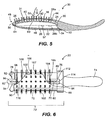
- At least a portion of a perimeter of the cushion pad 24, as seen in the left portion of the head 31 in Fig. 5, may rest on the front or rear portion 30, 32 of the hair brush 20, thereby providing the cushion pad 24 and, more specifically, the perimeter of the cushion pad 24 a stop or the like, to enable the cushion pad 24 to retain the convex shape.
- at least a portion of the perimeter of the cushion pad 24 may rest on a ledge or protrusion 57 extending inwardly from the front or rear portion 30, 32 toward the cavity 28.
- the cushion pad 24, in this example, is biased to remain in the convex shape, due to the construction or placement of the cushion pad 24 in the cavity 28 and/or body 22.
- the rear surface 60 of the cushion pad 24 may be disposed along the rear wall 46 of the cavity 28 when the hair brush 20 is.in the cleaning position, such that the cushion pad 24 may have a substantially similar contour to the rear wall 46 of the rear portion 32.
- the cushion pad 24 may be fabricated from relatively resilient and flexible materials such as rubber, fabric, plastic with high pliability, or plastic connected by joints to enable movement, paper-like material such as vellum, mylar, acetate, metal with high pliability in sheets or connected by joints, wooden pieces connected by joints to enable movement, or other suitable flexible material, or any material joined or designed to create flexible movement.
- relatively resilient and flexible materials such as rubber, fabric, plastic with high pliability, or plastic connected by joints to enable movement, paper-like material such as vellum, mylar, acetate, metal with high pliability in sheets or connected by joints, wooden pieces connected by joints to enable movement, or other suitable flexible material, or any material joined or designed to create flexible movement.
- the cushion pad 24 may include holes, ribs, slots, and/or other features to locally effect the flexibility of the cushion pad 24.
- the cushion pad may include one or more relieves, such as angled cut-outs 61 as in this embodiment.
- the angled cut-outs 61 are located at the perimeter of the cushion pad 24, and extend inwardly.
- the angled cut-outs 61 may allow the cushion pad 24 to conform to the front portion 30 without overlapping parts. More specifically, the angled-cuts may allow the cushion pad 24 to conform to a convex and/or concave shape as defined by the cavity 28.
- the first end 62 of the bristles 26 are adapted to fixedly or removably attach to the cushion pad 24, and the second end 64 of the bristles 26 are adapted to contact the user's scalp.
- the first end 62 of the bristles 26 may include an annular groove 66 and a flange 68, which are arranged such that to one side of the groove 66 is the flange 68 and to the other side of the groove 66 is the remainder of the bristle 26. As seen in Fig.
- the annular groove 66 engages the cushion pad 24 and is secured by the flange 68 at the rear surface 60 of the cushion pad 24, and by the remainder of the bristle 26 on the front surface 58 of the cushion pad 24.
- the bristle 26, may however, be attached to the cushion 24 in other manners, including, but not limited to, adhesive, press-fit, interference-fit, or the like, or can be removably attached and be replaceable. Additionally, the bristles 26 may be integrally molded with the cushion pad 24, in a one step or two step molding process.
- the second end 64 of the bristles 26 includes the tip 36 which may include a feature adapted to make the hair brush 20 more comfortable on the user's scalp.
- the tip 36 is rounded or spherically shaped, which makes engagement with the user's scalp less harsh and more comfortable than without.
- the length of the bristles 26 may be constant throughout the hair brush 20, but may also vary according to need and design, such that the tips 36 of the bristled 26 are staggered and not equidistant to the outside surface 40 of the front portion 30.
- the hair brush 20 has several positions, including a user position and a cleaning position.
- the user position as illustrated in Fig. 4, i.e. as the user is brushing hair
- the front surface 58 of the cushion pad 24 is disposed substantially along the inside surface 42 of the front portion 30 of the body 22, such that the bristles 26 extend outwardly from the front surface 58 of the cushion pad 24 through the apertures 34.
- the tips 36 of the bristles 26 are disposed away from the outside surface 40 front portion 30 of the body 22.
- the front surface 58 of the cushion pad 24 may be forced away from the inside surface 42 of the portion 30 of the body 22, such that cushion pad 24 is forced from the initial convex shape to a less convex shape, a planar shape or even a concave shape, as illustrated in Fig. 5.
- the cushion pad 24 may be designed to absorb a force and/or distance that is in excess of the force and/or distance required to make contact between the bristles 26 and the user's scalp.
- the cushion pad 24, having a generally convex shape may, therefore, temporarily deform to accommodate the extra force and/or distance that is in excess of the force and/or distance required to make contact between the bristles 26 and the user's scalp.
- the rear surface 60 of the cushion pad 24 is disposed substantially along the rear surface 86 of the cavity 28, such that the tips 36 of the bristles 26 are disposed near the outside surface 40 of the front portion 30 of the body 22. More specifically, to make cleaning accumulated strands of hair from the bristles 26 easier, the cushion pad 28 is deformed or moved to cause the bristle 26 to at least partially retract into the front portion 30 and/or the body 22. As illustrated in Fig. 5, the user may depress the bristles 26 into the front portion 30 and/or the body 22, thereby causing the bristles 26 to retract, causing the cushion pad 24 to deform. Upon retraction, the hair is accumulated at a top of the apertures 34 as the hair is prevented from moving with the bristles 26 by the stationary front portion 30.
- the cushion pad 24 may move within the cavity 28 by many methods. In one method, the cushion pad 24 may be suspended between the two cavities 28a, 28b. Due to the nature of rubber material, the cushion pad 24 conforms to the first cavity 28a of the hair brush 20. When the rubber is depressed, due to the nature of the material, the cushion pad 24 has a natural tendency to flex, depress and remit to its original shape.
- the position members 55 and/or the angled cut-outs 61 may aid in the flexing and/or aligning of the cushion pad 24.
- the perimeter of the cushion pad 24 may have a tendency to compress and/or bunch.
- the angled cut-outs 61 may allow the cushion pad 24 variable flexibility depending of the size of the angled cut-outs 61 and/or the positioning members 55.
- the positioning members 55 and the angled cut-outs 61 may align the cushion pad 24 in the cavity 28, and hence relative to the front portion 30 having the apertures 34. More specifically, as illustrated in Fig.
- the positioning members 55 and the angled cut-outs 61 may engage, such that the sides 61 a and 61 b of the angled cut-outs 61 are disposed on either side of the positioning members 55.
- the cushion pad 24 will be aligned in the cavity 28, and hence the front portion 30 and apertures 34.
- the hair brush 20 may not include a cushion pad 24, but may include an elongate central axis rod 70.
- a body 72 may include a handle 74, a first end cap 76, a second end cap 78, a central annular portion 80 located between the first end cap 76 and the second end cap 78, an activation button 82, and a receiving portion 84.
- the handle 74 depends from a first side 86 of the first end cap 76.
- a second side 88 of the first end cap 76 includes a circular recess portion that receives the central annular portion 80.
- the first end cap 76 and the handle 74 may, however, be an integral unit (Fig.
- the second end cap 78 may be constructed such an exterior surface of the second end cap 78 and an exterior surface of the central annular portion 80 are substantially planar or flat (Fig. 7), such that no observable step between the second end cap 76 and the central annular portion 80 exists.
- the activation button 82 is located along the central longitudinal axis of the central annular portion 80 within the second end cap 78. More specifically, the activation button 82 includes a first end 94 and a second end 96, wherein the first end 94 is adapted to be engaged by a user, and the second end 96 includes a cup portion 98 adapted to receive the elongate central axis rod 70.
- the central annular portion 80 may be generally cylindrical and, more specifically, may have a generally circular cylindrical shape.
- a plurality of apertures 100 located around the central annular portion 80 receive bristles 102 that are disposed from the elongate central axis rod 70 through the apertures 100.
- the elongate central axis rod 70 may have a semi-rigid to rigid construction from which the bristles 102 extend. More specifically, as in this example, the elongate central axis rod 70 is constructed from a plurality of rods or wires 104 that are twisted together to form the elongate central axis rod 70.
- the elongate central axis rod 70 may, however, be molded using various types of molding techniques, including being integrally molded with the bristles 26.
- the bristles 102 extend radially outward from the elongate central axis rod 70 and are fixedly attached thereto.
- the bristles 102 are attached to the elongate central axis rod 70 by being wedged between the rods 104 as the rods 104 are twisted together. More specifically, prior to the rods 104 being twisted together, the bristles 102 may be placed between the rods 104, such that the bristles 102 are oriented generally perpendicular to the rods 104 and such that the bristles 102 abut the rods 104 near an inner section 106 of the bristles 102.
- outer sections 108 of the bristles 102 will extend in substantially equal length from opposite sides of the elongate central axis rod 70.
- the bristles 102 may, however, have varying length such that the outer sections 108 of the bristles 102 are staggered and not equidistant to the elongate central axis rod 70.
- the hair brush 20 may be in one or more positions, including the cleaning position and the user position.
- the activation button 80 is located in an outward position, such that the activation button 82 extends from a second side 92 of the second end cap 78, and the bristles 102 are oriented substantially perpendicular to the elongate central axis rod 70.
- the outer portions 108 of the bristles 102 extend through the apertures 100 and outwardly from the central annular portion 80.
- the bristles 102 are in their natural state at this point, because the rigidity of the bristles 102 and their attachment to the elongate central axis rod 70 cause the bristles 102 to have a tendency or bias to be substantially perpendicular to the elongate central axis rod 70, and hence in the user position.
- the hair brush 20 may be changed from the user position to the cleaning position by depressing the activation button 82. More specifically, the activation button 82 may be depressed, thereby causing the cup portion 98 located on the bottom of the activation button 82 to abut a second end 110 of the elongate central axis rod 70.
- the elongate central axis rod 70 will move axially along the central axis of the central annular portion 80, until a first end 112 of the elongate central axis rod 70 abuts a bottom 114 of the receiving portion 84.
- the elongate central axis rod 70 will move axially along the central axis of the central annular portion 80, until a stop (not show) on the activation button 82 prevents further depression of the activation button 82 into the second end cap 78.
- a stop not show
- walls of the activation button 82 and/or the receiving portion 84 may guide the elongate central axis rod 70 along the longitudinal central axis of the central annular portion 80.
- the outer portions 108 of the bristles 102 remain in the stationary apertures 100 and the inner portion 100 of the bristles 102 travel with the elongate central axis rod 70. This action thereby causes the bristles 102 to change from a substantially perpendicular orientation relative the elongate central axis rod 70, to an angled orientation. As best illustrated in Fig.
- the cleaning mechanism as described above may be altered or varied.
- the bristles 102 may be retracted or caused to be retracted in several other ways.
- the first endcap 76, the handle 74, and/or the receiving portion 84 may have axial movement relative to the central annular portion 80.
- the elongate central axis rod 70 may be fixedly attached to the first endcap 76, the handle 74, and/or the receiving portion 84, thereby also allowing the bristles 102 attached to the elongate central axis rod 70 to move relative to the central annular portion 80.
- the handle 74 may be fixedly attached to the receiving portion 84 and the elongate central axis rod 70, which may all slidably engage the first endcap 76 that may be fixedly attached to the central annular portion 80.
- the handle 74 may be pushed or pulled relative to the first endcap 76 and the central annular portion 80, thereby causing the bristles 102 to retract and/or extend from the central annular portion 80.
- receiving portion 84 may be fixedly attached to the elongate central axis rod 70, and the receiving portion 84 may be located in an aperture 115. More specifically, as the elongate central axis rod 70 moves axially within the central annular portion 80, the receiving portion 84 and hence the elongate central axis rod 70 may be guided and aligned by the aperture 115, which may be a tapered hole adapted to slidingly receive the receiving portion 84.
- the hair roller 20' may include a first end cap 76', a second end cap 78', a generally cylindrical body 80' located between the first end cap 76' and the second end cap 78', an activation button 82', and a receiving portion 84'.
- a second side 88' of the first end cap 76' includes a circular recess portion that receives the generally cylindrical body 80'.
- a first side 90' of the second end cap 78' receives the other end of the generally cylindrical body 80' and, more specifically, receives the generally cylindrical body 80' within a circular recess.
- the activation button 82' is located along the central longitudinal axis of the generally cylindrical body 80' within the second end cap 78'. More specifically, the activation button 82' includes a first end 94' and a second end 96', wherein the first end 94' is adapted to be engaged by a user, and the second end 96' includes a cup portion 98' adapted to receive a elongate central axis rod 70'. A plurality of apertures 100' located around the generally cylindrical body 80' receive bristles 102' that are disposed from the elongate central axis rod 70' through the apertures 100'.
- the elongate central axis rod 70' may have a semi-rigid to rigid construction from which the bristles 102' extend. More specifically, as in this example, the elongate central axis rod 70' is constructed from a plurality of rods or wires 104' that are twisted together to form the elongate central axis rod 70'. The bristles 102' extend radially outward from the elongate central axis rod 70' and are fixedly attached thereto.
- the hair brush system includes a plurality of hair brushes 20, wherein each hair brush 20 may have a self-cleaning feature and may be optimized for comfort, as described above.
- the plurality of brushes are customized for different types and/or styles of hair.
- the user's type of hair may be described in many ways including, but not limited to, the length of the hair, the amount or density of hair, the shape of the hair, and the thickness or shape of the diameter of the hair strands.
- the length of the user's hair as measured from the scalp of the user to the ends of the strands of hair, may be separated into two or more categories and, as in this example, may be categorized as being, short, medium, or long.
- Short hair merely for example, may be defined as having a length of 0-4 inches
- medium length hair may be defined as having a length of 4-9 inches
- long hair may be defined as having a length of 9 inches and longer.
- the amount or density of the user's hair may also be separated into two or more categories and, as in this example, may be categorized as being, fine, medium, or thick.
- the texture of the user's hair or the amount of curliness or lack thereof may be separated into two or more categories, and as in this example, may be categorized as being straight, wavy, curly, and kinky.
- Straight hair for example, may be defined as strands of hair having an arc of less than 15 degrees per inch, and the cross-sectional shape of the hair strand's diameter is circular
- wavy hair may be defined as strands of hair having an arc of 15-45 degrees per inch and the cross-sectional shape of the hair strand's diameter is oval
- curly hair may be defined as having strands of hair having an arc of 45 degrees or greater per inch and the cross-sectional shape of the hair strand's diameter is irregular with consistency
- kinky hair may be defined as strands of hair having an arc of 45 degrees or greater per inch and the cross-sectional shape of the hair strand's diameter is irregular shaped without consistency.
- the thickness of the user's strands of hair may also be separated into two or more categories and, as in this example, may be categorized as being fine, regular, or thick. Due to the complexity of measuring the actual thickness of the user's strands of hair, however, the thickness of the user's strands of hair may be quantified or categorized in other ways. For example, it may be said that a relationship exists between the actual diameter of the uscr's strands of hair and the manner, or volume, in which the strands of hair lay on the user's scalp. More specially, the user's strands of hair will fall and rest in an overlapping manner on the user's scalp. The thicker the strands of hair, the more volume and more depth the hair will have.
- the thickness of the strands of hair may be categorized. Fine strands of hair, for example, may be apparent in individuals whose depth of hair measures less than .5 inches measured from scalp to the last layer of hair, regular strands of hair may be apparent in individuals whose depth of hair measures .51" to .60" inches measured from scalp to the last layer of hair, and thick strands of hair may be apparent in individuals whose depth of hair measures .60" inches or greater from scalp to the last layer of hair.
- the user's type of hair may be largely influenced and effected by the hair style, such that the type of hair is made less of a factor or even irrelevant in customizing the hair brush 20.
- a user's style of hair may include, but is not limited to, altering the user's hair such as with a permanent treatment or hair extensions, adding hair care products such as conditioner, gel or moose, and/or utilizing styling tools, such as a hair dryer, curling iron, hair rollers, hair straightener, etc. Therefore, in determining the type of hair brush 20 to be used with the user's hair, the style of hair may also be considered.
- the hair brush 20 may be altered to obtain the hair brush 20 best suited for the user's hair type. These can include, but need not be limited to, a density of the bristles 26, 102 and/or a length of the bristles 26, 102. For example, other features of the hair brush 20 may be altered, such as the shape of the bristles 26, 102 and a diameter of the bristles 26, 102.
- the length of the bristles 26, 102 of the hair brush 20 may be one of several lengths. More specifically, as in the examples disclosed, the bristles 26, 102 may be short, medium or long, as measured from the top of the outside surface 40 of the front part 30 of the body 22 to the tip 36 of the bristles 26 or from the central annular portion 80 to the outer section 108 of the bristles 102, as illustrated in Fig. 8. Short bristles may be approximately .876 inches in length or shorter, medium bristles may approximately .97-.877 inches in length, and long bristles 30 may be .98 inches or longer.
- the density of the bristles 26, 102 of the hair brush 20 may vary depending on the type and/or texture of the user's hair.
- the density may be directly related to the stiffness of the bristle, such that the various stages or categories of densities may correlate to the various stages of stiffness of the bristles.
- the hair brush 20 may have a heavy, medium or light density of bristles 26, 102.
- a hair brush having a heavy density of bristles 30, as illustrated in Fig. 15-17 may have approximately .125 to 45" spacing between each bristle or less, a hair brush 20 having a medium density of bristles 26, 102, as illustrated in Fig.
- a hair brush having a light density of bristles 26, 102 may have approximately .56" to .75" spacing between each bristle or more.
- the diameter and/or shape of the bristles 26, 102 of the hair brush 20 may vary depending on the type and/or texture of the user's hair.
- the diameter and/or shape may be directly related to the stiffness of the bristle, such that the various stages or categories of diameter and/or shape may correlate to the various stages of stiffness of the bristles.
- the hair brush 20 may have a fine, medium or thick diameter and/or shape of bristles 26, 102.
- a combination of the density of the bristles 26, 102 and the length of the bristles 26, 102, best suited for the user's type and texture of hair may be used.
- a hair brush having a heavy density of short bristles 26, 102 may be best suited for a person with straight and fine hair.
- a hair brush 20 having a light density of long bristles 26, 102 may be best suited for a person with curly and thick hair.
- the bristles 26, 102 may only vary in length according to the thickness of the user's strands of hair.
- the density of the bristles 26, 102 may only vary according to the texture of the user's hair. Therefore, the length and/or the density of the bristles 26, 102 may be varied according to the user's length, amount, texture, and/or thickness of hair.
- the below Chart A provides examples of combinations of length and/or the density of the bristles 26, 102 that may be used with various types of hair.
Landscapes
- Brushes (AREA)
- Cosmetics (AREA)
Applications Claiming Priority (2)
| Application Number | Priority Date | Filing Date | Title |
|---|---|---|---|
| US48240703P | 2003-06-25 | 2003-06-25 | |
| US482407P | 2003-06-25 |
Publications (3)
| Publication Number | Publication Date |
|---|---|
| EP1491113A2 true EP1491113A2 (fr) | 2004-12-29 |
| EP1491113A3 EP1491113A3 (fr) | 2005-03-02 |
| EP1491113B1 EP1491113B1 (fr) | 2010-09-01 |
Family
ID=33418490
Family Applications (1)
| Application Number | Title | Priority Date | Filing Date |
|---|---|---|---|
| EP04014946A Expired - Lifetime EP1491113B1 (fr) | 2003-06-25 | 2004-06-25 | Brosse à cheveux autonettoyant |
Country Status (6)
| Country | Link |
|---|---|
| US (2) | US7526829B2 (fr) |
| EP (1) | EP1491113B1 (fr) |
| AT (1) | ATE479356T1 (fr) |
| CA (1) | CA2472269A1 (fr) |
| DE (1) | DE602004028896D1 (fr) |
| ES (1) | ES2350928T3 (fr) |
Cited By (3)
| Publication number | Priority date | Publication date | Assignee | Title |
|---|---|---|---|---|
| GB2422535A (en) * | 2005-01-31 | 2006-08-02 | Janalyn Flora Masse Cunningham | Hair brush |
| WO2009071224A1 (fr) * | 2007-12-06 | 2009-06-11 | Braun Gmbh | Brosse à cheveux, soies et leur procédé de fabrication |
| CN102302272A (zh) * | 2007-12-29 | 2012-01-04 | 博朗有限公司 | 刷毛 |
Families Citing this family (33)
| Publication number | Priority date | Publication date | Assignee | Title |
|---|---|---|---|---|
| US7364380B2 (en) * | 2003-09-26 | 2008-04-29 | The Hartz Mountain Corporation | Grooming/cleaning apparatus |
| EP1491113B1 (fr) | 2003-06-25 | 2010-09-01 | Goody Products, Inc. | Brosse à cheveux autonettoyant |
| US20060042648A1 (en) * | 2004-09-02 | 2006-03-02 | Adrienne Teller | Ambidextrous two-handled hair brush implement |
| US8960129B2 (en) | 2007-11-19 | 2015-02-24 | United Pet Group, Inc. | Toothed pet grooming tool with fur ejecting mechanism |
| JP4872013B2 (ja) * | 2009-07-29 | 2012-02-08 | 花王株式会社 | 頭皮洗浄具 |
| GB2474364B (en) | 2009-10-09 | 2011-09-14 | Michel Mercier Ltd | Hairbrush, methods of use, and methods of manufacturing the same |
| USD637818S1 (en) | 2010-01-24 | 2011-05-17 | Michel Mercier | Hairbrush |
| USD677061S1 (en) | 2012-08-30 | 2013-03-05 | Jean M. Barry | Ergonomic brush handle |
| USD809305S1 (en) | 2014-11-11 | 2018-02-06 | Goody Products, Inc. | Brush |
| GB201421635D0 (en) * | 2014-12-04 | 2015-01-21 | Tung Hing Plastic Manufactory Ltd | Improved hair brush |
| USD803574S1 (en) | 2015-03-19 | 2017-11-28 | Kampalook Ltd. | Hairbrush |
| USD813471S1 (en) | 2015-03-24 | 2018-03-20 | Kampalook Ltd. | Pet grooming apparatus |
| USD766588S1 (en) | 2015-05-12 | 2016-09-20 | Jean Rennette | Hair styling brush |
| US10028574B2 (en) | 2015-06-03 | 2018-07-24 | Olivia Garden International Inc. | Hair styling brush systems |
| USD783293S1 (en) * | 2015-08-05 | 2017-04-11 | J & D Brush Co., Llc | Brush |
| USD766589S1 (en) * | 2015-08-19 | 2016-09-20 | Maggie Cheung | Hair brush |
| USD803577S1 (en) | 2016-02-04 | 2017-11-28 | Goody Products, Inc. | Brush |
| USD805786S1 (en) | 2016-02-04 | 2017-12-26 | Goody Products, Inc. | Brush |
| USD794339S1 (en) | 2016-02-04 | 2017-08-15 | Goody Products, Inc. | Brush |
| USD803578S1 (en) * | 2016-02-04 | 2017-11-28 | Goody Product, Inc. | Brush |
| USD803576S1 (en) | 2016-02-04 | 2017-11-28 | Goody Products, Inc. | Brush handle |
| USD793092S1 (en) | 2016-02-04 | 2017-08-01 | Goody Products, Inc. | Brush handle |
| US10390605B1 (en) * | 2016-02-29 | 2019-08-27 | Anipure Pet Products Inc. | Grooming brush |
| USD824173S1 (en) * | 2017-01-20 | 2018-07-31 | Trade Box, Llc | Hair styler |
| US11771197B2 (en) * | 2018-01-25 | 2023-10-03 | Hair4Good | Hair-smoothing tool |
| USD879476S1 (en) * | 2018-10-15 | 2020-03-31 | Olivia Garden International, Inc. | Hair brush |
| US12419403B2 (en) * | 2019-11-20 | 2025-09-23 | Conair Llc | Hair tools with additives |
| GB2595285B (en) | 2020-05-21 | 2024-10-23 | Dyson Technology Ltd | Brush |
| GB2595286B (en) * | 2020-05-21 | 2024-12-25 | Dyson Technology Ltd | Brush |
| USD941591S1 (en) * | 2020-08-04 | 2022-01-25 | J & D Brush Co., Llc | Brush |
| US11871839B2 (en) | 2020-11-16 | 2024-01-16 | Humanity Brush LLC | Retractable hair brush |
| US20220331221A1 (en) * | 2021-04-20 | 2022-10-20 | Adegen LLC | Hair loss treatment |
| US12520822B2 (en) | 2023-02-22 | 2026-01-13 | Spectrum Brands, Inc. | Combination pet grooming tool and methods |
Citations (6)
| Publication number | Priority date | Publication date | Assignee | Title |
|---|---|---|---|---|
| US4574416A (en) | 1983-08-02 | 1986-03-11 | Stewart John W | Retractable brushes |
| US5815877A (en) | 1996-12-06 | 1998-10-06 | Heneveld; William R. | Brush with retractable bristles |
| US5862563A (en) | 1997-10-02 | 1999-01-26 | Hartmann; Eric | Self-cleaning brush |
| US6006395A (en) | 1996-01-12 | 1999-12-28 | 500 Group, Inc. | Cushion brush |
| US6021542A (en) | 1998-05-28 | 2000-02-08 | Norman; Scott A. | Self-cleaning hair brush |
| US20050055788A1 (en) | 2003-06-25 | 2005-03-17 | Tianyi Chang | Self-cleaning comfort hair brush and roller and system for selecting a brush from a plurality of brushes according to hair type |
Family Cites Families (46)
| Publication number | Priority date | Publication date | Assignee | Title |
|---|---|---|---|---|
| GB191228155A (en) * | 1912-12-06 | 1913-01-16 | Richard Wheatley | A New or Improved Brush Set. |
| GB191408334A (en) * | 1914-04-02 | 1914-06-11 | William Lord Ballin Hinde | Improvements in Hair-brushes and the like. |
| US2482928A (en) * | 1948-03-26 | 1949-09-27 | Neff Augusta | Needle hairbrush |
| GB794594A (en) * | 1954-08-25 | 1958-05-07 | Jacques Baudouin | Improvements in or relating to a hair or other brushes |
| US2963729A (en) * | 1958-04-21 | 1960-12-13 | Gubin As | Separable brushes |
| US3739419A (en) * | 1970-12-07 | 1973-06-19 | Stance Ind Inc | Non-snagging hairbrush |
| DE2550265C3 (de) * | 1975-11-08 | 1978-09-28 | Vladislaus 7800 Freiburg Serediuk | Haarbürste |
| US4118823A (en) * | 1977-03-18 | 1978-10-10 | Jerome Alexander Cosmetics, Inc. | Hair brush |
| DE2923740A1 (de) | 1979-06-12 | 1980-12-18 | Adil Daaud | Buerste mit einziehbaren borsten, insbesondere haar- oder kleiderbuerste |
| CH646315A5 (en) | 1980-05-20 | 1984-11-30 | Stengel Heinz | Hair-brush and curler set |
| US4479501A (en) * | 1982-04-16 | 1984-10-30 | Chern Horng Y | Cassette type hygienic comb and brush |
| US4475563A (en) * | 1982-11-08 | 1984-10-09 | Martin Donald S | Hair brush with movable bristle rows |
| US4567905A (en) * | 1983-07-07 | 1986-02-04 | Conair Corporation | Actuator control for retractable bristle brushes |
| DE8319974U1 (de) * | 1983-07-12 | 1983-10-20 | Schütz, Erwin, 4800 Bielefeld | Fönbürste |
| US4596261A (en) * | 1984-05-24 | 1986-06-24 | Frank J. Renda | Hair dressing comb |
| LU85452A1 (fr) * | 1984-07-06 | 1986-02-12 | Faco Sa | Brosse soufflante pour l'ondulation des cheveux |
| DE3446813A1 (de) | 1984-12-21 | 1986-06-26 | Georg 5000 Köln Kiefner | Haarbuerste |
| DE3602052A1 (de) | 1986-01-24 | 1987-07-30 | Trisa Buerstenfabrik Ag | Rundbuerste |
| HUH3102A (en) * | 1986-04-02 | 1987-01-28 | Laszlo Anda | Brush expediently for animal tending purposes |
| US5095892A (en) * | 1988-02-22 | 1992-03-17 | Takashi Tsumura | Brush for hair and body |
| US4932425A (en) * | 1988-08-11 | 1990-06-12 | Chen Horng Yuan | Comb or brush |
| US4987633A (en) * | 1989-10-23 | 1991-01-29 | Heneveld William R | Bristle hair brush retractable by collapsing handle |
| JPH0755163B2 (ja) * | 1990-01-18 | 1995-06-14 | ウエツトマスター株式会社 | 吸水乾燥ヘアブラシ |
| US5483719A (en) * | 1991-04-23 | 1996-01-16 | Ikemoto Brush Industries Co., Ltd. | Hair brush with porous polytetrafluoroethylene body |
| US5261426A (en) * | 1991-05-30 | 1993-11-16 | Creative Products Resource Associates, Ltd. | Hydrophilic foam pad for hair styling |
| DE4127758A1 (de) * | 1991-08-22 | 1993-02-25 | Limmer Kuenzel Ingeborg | Buerste, insbesondere selbstreinigende haarbuerste |
| US5327611A (en) * | 1993-04-02 | 1994-07-12 | Mebco Industries, Inc. | Hair brush |
| US5755242A (en) * | 1994-12-23 | 1998-05-26 | Denebeim; Sabrina R. | Spherical hair styling device |
| US5519912A (en) * | 1995-04-10 | 1996-05-28 | Kawamura; Shigemasa | Hairbrush having means to collect trapped strands of hair for removal from the bristles |
| IT237540Y1 (it) * | 1997-06-02 | 2000-09-13 | Giorgio Janeke S R L | Spazzola per capelli o simili con membrana elastica portante i dentio setole interposta tra una coppia di conchiglie una delle quali e' |
| CA2212920A1 (fr) * | 1997-09-25 | 1999-03-25 | Eric Hartman | Brosse auto-nettoyante |
| US6029307A (en) * | 1997-11-14 | 2000-02-29 | Baudoin; Thomas | Quick connect brush handle and multi-brush kit |
| US5887600A (en) * | 1997-12-23 | 1999-03-30 | Wilk; Sue | Hair curling brush and method of using same |
| US6070594A (en) * | 1998-02-25 | 2000-06-06 | Arich, Inc. | Brush with retractable bristles |
| US20010001887A1 (en) | 1998-07-12 | 2001-05-31 | Bigio Alberto Lee | Hair brush |
| US5975089A (en) * | 1998-11-19 | 1999-11-02 | Simon; Joseph T | Hair brush applicator |
| US5954064A (en) * | 1999-01-15 | 1999-09-21 | M Head, Llc | Hair styling pieces with reattachable handle |
| US6438785B1 (en) * | 1999-04-06 | 2002-08-27 | Jodie L. Smith | Styling brush |
| JP2001211937A (ja) * | 1999-08-27 | 2001-08-07 | Tetsuji Nakamura | ヘアーブラシ |
| US6408475B1 (en) * | 2000-09-13 | 2002-06-25 | Mark D. Morrison | Self cleaning brush |
| US6595219B2 (en) * | 2000-09-30 | 2003-07-22 | Mitchell E. Anderson | Hairbrush with retractable bristles |
| US6382216B1 (en) * | 2001-06-22 | 2002-05-07 | Wayne Clark | Hangable hair brush with pick |
| US20030000900A1 (en) * | 2001-07-02 | 2003-01-02 | Jackie Yu | Magnetic brush |
| US6631831B1 (en) * | 2001-10-02 | 2003-10-14 | David J. Loiselle | Self-cleaning hairbrush system |
| KR200310098Y1 (ko) * | 2002-10-14 | 2003-04-08 | 김연철 | 두피마사지용 브러시 |
| US6968848B2 (en) * | 2002-12-13 | 2005-11-29 | Grant George L | Retractable bristle brush |
-
2004
- 2004-06-25 EP EP04014946A patent/EP1491113B1/fr not_active Expired - Lifetime
- 2004-06-25 DE DE602004028896T patent/DE602004028896D1/de not_active Expired - Lifetime
- 2004-06-25 CA CA002472269A patent/CA2472269A1/fr not_active Abandoned
- 2004-06-25 AT AT04014946T patent/ATE479356T1/de not_active IP Right Cessation
- 2004-06-25 ES ES04014946T patent/ES2350928T3/es not_active Expired - Lifetime
- 2004-06-25 US US10/876,407 patent/US7526829B2/en not_active Expired - Lifetime
-
2007
- 2007-09-11 US US11/853,569 patent/US20080052858A1/en not_active Abandoned
Patent Citations (6)
| Publication number | Priority date | Publication date | Assignee | Title |
|---|---|---|---|---|
| US4574416A (en) | 1983-08-02 | 1986-03-11 | Stewart John W | Retractable brushes |
| US6006395A (en) | 1996-01-12 | 1999-12-28 | 500 Group, Inc. | Cushion brush |
| US5815877A (en) | 1996-12-06 | 1998-10-06 | Heneveld; William R. | Brush with retractable bristles |
| US5862563A (en) | 1997-10-02 | 1999-01-26 | Hartmann; Eric | Self-cleaning brush |
| US6021542A (en) | 1998-05-28 | 2000-02-08 | Norman; Scott A. | Self-cleaning hair brush |
| US20050055788A1 (en) | 2003-06-25 | 2005-03-17 | Tianyi Chang | Self-cleaning comfort hair brush and roller and system for selecting a brush from a plurality of brushes according to hair type |
Cited By (10)
| Publication number | Priority date | Publication date | Assignee | Title |
|---|---|---|---|---|
| GB2422535A (en) * | 2005-01-31 | 2006-08-02 | Janalyn Flora Masse Cunningham | Hair brush |
| GB2422535B (en) * | 2005-01-31 | 2009-08-12 | Cunningham Janalyn Flora Masse | Hair Brush |
| WO2009071224A1 (fr) * | 2007-12-06 | 2009-06-11 | Braun Gmbh | Brosse à cheveux, soies et leur procédé de fabrication |
| CN101888796B (zh) * | 2007-12-06 | 2012-09-05 | 博朗有限公司 | 毛发刷、刷毛以及它们的制造方法 |
| RU2466670C2 (ru) * | 2007-12-06 | 2012-11-20 | БРАУН ГмбХ | Щетка для волос, щетинки и способ их производства |
| US8414817B2 (en) | 2007-12-06 | 2013-04-09 | Braun Gmbh | Process for manufacturing a hairbrush bristle |
| CN102302272A (zh) * | 2007-12-29 | 2012-01-04 | 博朗有限公司 | 刷毛 |
| CN101909485B (zh) * | 2007-12-29 | 2012-11-07 | 博朗有限公司 | 毛发刷 |
| US8414818B2 (en) | 2007-12-29 | 2013-04-09 | Braun Gmbh | Method for making bristles for a hairbrush |
| CN102302272B (zh) * | 2007-12-29 | 2016-05-11 | 博朗有限公司 | 刷毛 |
Also Published As
| Publication number | Publication date |
|---|---|
| EP1491113A3 (fr) | 2005-03-02 |
| CA2472269A1 (fr) | 2004-12-25 |
| EP1491113B1 (fr) | 2010-09-01 |
| US20080052858A1 (en) | 2008-03-06 |
| US20050055788A1 (en) | 2005-03-17 |
| ES2350928T3 (es) | 2011-01-28 |
| US7526829B2 (en) | 2009-05-05 |
| DE602004028896D1 (de) | 2010-10-14 |
| ATE479356T1 (de) | 2010-09-15 |
Similar Documents
| Publication | Publication Date | Title |
|---|---|---|
| US7526829B2 (en) | Self-cleaning comfort hair brush and roller and system for selecting a brush from a plurality of brushes according to hair type | |
| US8302246B2 (en) | Hair brush with retractable bristles | |
| US6308717B1 (en) | Hair brush with movable bristles | |
| CN109219417B (zh) | 齿间清洁器 | |
| RU2488329C2 (ru) | Зубная щетка | |
| AU708874B2 (en) | Bi-directional wire-wrapped blade cartridge | |
| US12053083B2 (en) | Oral care implement | |
| JP2003523781A (ja) | 応力除去ゲルハンドルを備えるブラシ | |
| CN114711537A (zh) | 倒梳发刷 | |
| US20220361655A1 (en) | Personal Care Implement | |
| AU2022274825B2 (en) | Personal care implement | |
| NL8102435A (nl) | Haarborstel. | |
| CA2261717A1 (fr) | Brosse a dents | |
| US20230292911A1 (en) | Applicator for a cosmetic product including a movable portion comprising a longitudinal axis | |
| KR200387709Y1 (ko) | 브러쉬 케이스 | |
| CN1778223A (zh) | 发刷和卷发筒以及用于根据头发类型来选择发刷的系统 | |
| JPS5835076Y2 (ja) | ブラシ | |
| CN220001089U (zh) | 一种新型指甲油刷 | |
| CN215125127U (zh) | 一种防形变的双面卷发海绵 | |
| JP2023014992A (ja) | 木製ヘアブラシ | |
| AU2006201323B2 (en) | Hair brush | |
| JPS636975Y2 (fr) | ||
| JPS6310092Y2 (fr) | ||
| JPS6348196Y2 (fr) |
Legal Events
| Date | Code | Title | Description |
|---|---|---|---|
| PUAI | Public reference made under article 153(3) epc to a published international application that has entered the european phase |
Free format text: ORIGINAL CODE: 0009012 |
|
| AK | Designated contracting states |
Kind code of ref document: A2 Designated state(s): AT BE BG CH CY CZ DE DK EE ES FI FR GB GR HU IE IT LI LU MC NL PL PT RO SE SI SK TR |
|
| AX | Request for extension of the european patent |
Extension state: AL HR LT LV MK |
|
| PUAL | Search report despatched |
Free format text: ORIGINAL CODE: 0009013 |
|
| RIC1 | Information provided on ipc code assigned before grant |
Ipc: 7A 46B 17/06 A Ipc: 7A 46B 9/02 B Ipc: 7A 46B 7/02 B |
|
| AK | Designated contracting states |
Kind code of ref document: A3 Designated state(s): AT BE BG CH CY CZ DE DK EE ES FI FR GB GR HU IE IT LI LU MC NL PL PT RO SE SI SK TR |
|
| AX | Request for extension of the european patent |
Extension state: AL HR LT LV MK |
|
| 17P | Request for examination filed |
Effective date: 20050727 |
|
| AKX | Designation fees paid |
Designated state(s): AT BE BG CH CY CZ DE DK EE ES FI FR GB GR HU IE IT LI LU MC NL PL PT RO SE SI SK TR |
|
| GRAP | Despatch of communication of intention to grant a patent |
Free format text: ORIGINAL CODE: EPIDOSNIGR1 |
|
| GRAS | Grant fee paid |
Free format text: ORIGINAL CODE: EPIDOSNIGR3 |
|
| GRAA | (expected) grant |
Free format text: ORIGINAL CODE: 0009210 |
|
| AK | Designated contracting states |
Kind code of ref document: B1 Designated state(s): AT BE BG CH CY CZ DE DK EE ES FI FR GB GR HU IE IT LI LU MC NL PL PT RO SE SI SK TR |
|
| REG | Reference to a national code |
Ref country code: GB Ref legal event code: FG4D |
|
| REG | Reference to a national code |
Ref country code: CH Ref legal event code: EP |
|
| REG | Reference to a national code |
Ref country code: IE Ref legal event code: FG4D |
|
| REF | Corresponds to: |
Ref document number: 602004028896 Country of ref document: DE Date of ref document: 20101014 Kind code of ref document: P |
|
| REG | Reference to a national code |
Ref country code: NL Ref legal event code: VDEP Effective date: 20100901 |
|
| REG | Reference to a national code |
Ref country code: ES Ref legal event code: FG2A Effective date: 20110118 |
|
| PG25 | Lapsed in a contracting state [announced via postgrant information from national office to epo] |
Ref country code: FI Free format text: LAPSE BECAUSE OF FAILURE TO SUBMIT A TRANSLATION OF THE DESCRIPTION OR TO PAY THE FEE WITHIN THE PRESCRIBED TIME-LIMIT Effective date: 20100901 Ref country code: AT Free format text: LAPSE BECAUSE OF FAILURE TO SUBMIT A TRANSLATION OF THE DESCRIPTION OR TO PAY THE FEE WITHIN THE PRESCRIBED TIME-LIMIT Effective date: 20100901 |
|
| PG25 | Lapsed in a contracting state [announced via postgrant information from national office to epo] |
Ref country code: PL Free format text: LAPSE BECAUSE OF FAILURE TO SUBMIT A TRANSLATION OF THE DESCRIPTION OR TO PAY THE FEE WITHIN THE PRESCRIBED TIME-LIMIT Effective date: 20100901 Ref country code: SI Free format text: LAPSE BECAUSE OF FAILURE TO SUBMIT A TRANSLATION OF THE DESCRIPTION OR TO PAY THE FEE WITHIN THE PRESCRIBED TIME-LIMIT Effective date: 20100901 Ref country code: CY Free format text: LAPSE BECAUSE OF FAILURE TO SUBMIT A TRANSLATION OF THE DESCRIPTION OR TO PAY THE FEE WITHIN THE PRESCRIBED TIME-LIMIT Effective date: 20100901 |
|
| PG25 | Lapsed in a contracting state [announced via postgrant information from national office to epo] |
Ref country code: GR Free format text: LAPSE BECAUSE OF FAILURE TO SUBMIT A TRANSLATION OF THE DESCRIPTION OR TO PAY THE FEE WITHIN THE PRESCRIBED TIME-LIMIT Effective date: 20101202 Ref country code: SE Free format text: LAPSE BECAUSE OF FAILURE TO SUBMIT A TRANSLATION OF THE DESCRIPTION OR TO PAY THE FEE WITHIN THE PRESCRIBED TIME-LIMIT Effective date: 20100901 Ref country code: NL Free format text: LAPSE BECAUSE OF FAILURE TO SUBMIT A TRANSLATION OF THE DESCRIPTION OR TO PAY THE FEE WITHIN THE PRESCRIBED TIME-LIMIT Effective date: 20100901 |
|
| PG25 | Lapsed in a contracting state [announced via postgrant information from national office to epo] |
Ref country code: RO Free format text: LAPSE BECAUSE OF FAILURE TO SUBMIT A TRANSLATION OF THE DESCRIPTION OR TO PAY THE FEE WITHIN THE PRESCRIBED TIME-LIMIT Effective date: 20100901 Ref country code: PT Free format text: LAPSE BECAUSE OF FAILURE TO SUBMIT A TRANSLATION OF THE DESCRIPTION OR TO PAY THE FEE WITHIN THE PRESCRIBED TIME-LIMIT Effective date: 20110103 Ref country code: CZ Free format text: LAPSE BECAUSE OF FAILURE TO SUBMIT A TRANSLATION OF THE DESCRIPTION OR TO PAY THE FEE WITHIN THE PRESCRIBED TIME-LIMIT Effective date: 20100901 Ref country code: EE Free format text: LAPSE BECAUSE OF FAILURE TO SUBMIT A TRANSLATION OF THE DESCRIPTION OR TO PAY THE FEE WITHIN THE PRESCRIBED TIME-LIMIT Effective date: 20100901 Ref country code: IT Free format text: LAPSE BECAUSE OF FAILURE TO SUBMIT A TRANSLATION OF THE DESCRIPTION OR TO PAY THE FEE WITHIN THE PRESCRIBED TIME-LIMIT Effective date: 20100901 Ref country code: SK Free format text: LAPSE BECAUSE OF FAILURE TO SUBMIT A TRANSLATION OF THE DESCRIPTION OR TO PAY THE FEE WITHIN THE PRESCRIBED TIME-LIMIT Effective date: 20100901 |
|
| PG25 | Lapsed in a contracting state [announced via postgrant information from national office to epo] |
Ref country code: BE Free format text: LAPSE BECAUSE OF FAILURE TO SUBMIT A TRANSLATION OF THE DESCRIPTION OR TO PAY THE FEE WITHIN THE PRESCRIBED TIME-LIMIT Effective date: 20100901 |
|
| PLBE | No opposition filed within time limit |
Free format text: ORIGINAL CODE: 0009261 |
|
| STAA | Information on the status of an ep patent application or granted ep patent |
Free format text: STATUS: NO OPPOSITION FILED WITHIN TIME LIMIT |
|
| 26N | No opposition filed |
Effective date: 20110606 |
|
| PG25 | Lapsed in a contracting state [announced via postgrant information from national office to epo] |
Ref country code: DK Free format text: LAPSE BECAUSE OF FAILURE TO SUBMIT A TRANSLATION OF THE DESCRIPTION OR TO PAY THE FEE WITHIN THE PRESCRIBED TIME-LIMIT Effective date: 20100901 |
|
| REG | Reference to a national code |
Ref country code: DE Ref legal event code: R097 Ref document number: 602004028896 Country of ref document: DE Effective date: 20110606 |
|
| REG | Reference to a national code |
Ref country code: CH Ref legal event code: PL |
|
| GBPC | Gb: european patent ceased through non-payment of renewal fee |
Effective date: 20110625 |
|
| REG | Reference to a national code |
Ref country code: FR Ref legal event code: ST Effective date: 20120229 |
|
| REG | Reference to a national code |
Ref country code: IE Ref legal event code: MM4A |
|
| REG | Reference to a national code |
Ref country code: DE Ref legal event code: R119 Ref document number: 602004028896 Country of ref document: DE Effective date: 20120103 |
|
| PG25 | Lapsed in a contracting state [announced via postgrant information from national office to epo] |
Ref country code: CH Free format text: LAPSE BECAUSE OF NON-PAYMENT OF DUE FEES Effective date: 20110630 Ref country code: FR Free format text: LAPSE BECAUSE OF NON-PAYMENT OF DUE FEES Effective date: 20110630 Ref country code: DE Free format text: LAPSE BECAUSE OF NON-PAYMENT OF DUE FEES Effective date: 20120103 Ref country code: IE Free format text: LAPSE BECAUSE OF NON-PAYMENT OF DUE FEES Effective date: 20110625 Ref country code: LI Free format text: LAPSE BECAUSE OF NON-PAYMENT OF DUE FEES Effective date: 20110630 |
|
| PG25 | Lapsed in a contracting state [announced via postgrant information from national office to epo] |
Ref country code: GB Free format text: LAPSE BECAUSE OF NON-PAYMENT OF DUE FEES Effective date: 20110625 |
|
| PG25 | Lapsed in a contracting state [announced via postgrant information from national office to epo] |
Ref country code: MC Free format text: LAPSE BECAUSE OF NON-PAYMENT OF DUE FEES Effective date: 20110630 |
|
| PG25 | Lapsed in a contracting state [announced via postgrant information from national office to epo] |
Ref country code: LU Free format text: LAPSE BECAUSE OF NON-PAYMENT OF DUE FEES Effective date: 20110625 |
|
| PG25 | Lapsed in a contracting state [announced via postgrant information from national office to epo] |
Ref country code: TR Free format text: LAPSE BECAUSE OF FAILURE TO SUBMIT A TRANSLATION OF THE DESCRIPTION OR TO PAY THE FEE WITHIN THE PRESCRIBED TIME-LIMIT Effective date: 20100901 Ref country code: BG Free format text: LAPSE BECAUSE OF FAILURE TO SUBMIT A TRANSLATION OF THE DESCRIPTION OR TO PAY THE FEE WITHIN THE PRESCRIBED TIME-LIMIT Effective date: 20101201 |
|
| REG | Reference to a national code |
Ref country code: ES Ref legal event code: FD2A Effective date: 20131029 |
|
| PG25 | Lapsed in a contracting state [announced via postgrant information from national office to epo] |
Ref country code: ES Free format text: LAPSE BECAUSE OF NON-PAYMENT OF DUE FEES Effective date: 20110626 Ref country code: HU Free format text: LAPSE BECAUSE OF FAILURE TO SUBMIT A TRANSLATION OF THE DESCRIPTION OR TO PAY THE FEE WITHIN THE PRESCRIBED TIME-LIMIT Effective date: 20100901 |