EP1491268A2 - Procédé de laminage à froid de bandes métalliques - Google Patents
Procédé de laminage à froid de bandes métalliques Download PDFInfo
- Publication number
- EP1491268A2 EP1491268A2 EP04013220A EP04013220A EP1491268A2 EP 1491268 A2 EP1491268 A2 EP 1491268A2 EP 04013220 A EP04013220 A EP 04013220A EP 04013220 A EP04013220 A EP 04013220A EP 1491268 A2 EP1491268 A2 EP 1491268A2
- Authority
- EP
- European Patent Office
- Prior art keywords
- strip
- fluctuations
- reel
- hardness
- inlet
- Prior art date
- Legal status (The legal status is an assumption and is not a legal conclusion. Google has not performed a legal analysis and makes no representation as to the accuracy of the status listed.)
- Granted
Links
Images

Classifications
-
- B—PERFORMING OPERATIONS; TRANSPORTING
- B21—MECHANICAL METAL-WORKING WITHOUT ESSENTIALLY REMOVING MATERIAL; PUNCHING METAL
- B21B—ROLLING OF METAL
- B21B38/00—Methods or devices for measuring, detecting or monitoring specially adapted for metal-rolling mills, e.g. position detection, inspection of the product
-
- B—PERFORMING OPERATIONS; TRANSPORTING
- B21—MECHANICAL METAL-WORKING WITHOUT ESSENTIALLY REMOVING MATERIAL; PUNCHING METAL
- B21B—ROLLING OF METAL
- B21B37/00—Control devices or methods specially adapted for metal-rolling mills or the work produced thereby
- B21B37/48—Tension control; Compression control
- B21B37/52—Tension control; Compression control by drive motor control
- B21B37/54—Tension control; Compression control by drive motor control including coiler drive control, e.g. reversing mills
-
- B—PERFORMING OPERATIONS; TRANSPORTING
- B21—MECHANICAL METAL-WORKING WITHOUT ESSENTIALLY REMOVING MATERIAL; PUNCHING METAL
- B21B—ROLLING OF METAL
- B21B37/00—Control devices or methods specially adapted for metal-rolling mills or the work produced thereby
- B21B37/58—Roll-force control; Roll-gap control
- B21B37/62—Roll-force control; Roll-gap control by control of a hydraulic adjusting device
-
- B—PERFORMING OPERATIONS; TRANSPORTING
- B21—MECHANICAL METAL-WORKING WITHOUT ESSENTIALLY REMOVING MATERIAL; PUNCHING METAL
- B21B—ROLLING OF METAL
- B21B1/00—Metal-rolling methods or mills for making semi-finished products of solid or profiled cross-section; Sequence of operations in milling trains; Layout of rolling-mill plant, e.g. grouping of stands; Succession of passes or of sectional pass alternations
- B21B1/22—Metal-rolling methods or mills for making semi-finished products of solid or profiled cross-section; Sequence of operations in milling trains; Layout of rolling-mill plant, e.g. grouping of stands; Succession of passes or of sectional pass alternations for rolling plates, strips, bands or sheets of indefinite length
- B21B1/24—Metal-rolling methods or mills for making semi-finished products of solid or profiled cross-section; Sequence of operations in milling trains; Layout of rolling-mill plant, e.g. grouping of stands; Succession of passes or of sectional pass alternations for rolling plates, strips, bands or sheets of indefinite length in a continuous or semi-continuous process
- B21B1/28—Metal-rolling methods or mills for making semi-finished products of solid or profiled cross-section; Sequence of operations in milling trains; Layout of rolling-mill plant, e.g. grouping of stands; Succession of passes or of sectional pass alternations for rolling plates, strips, bands or sheets of indefinite length in a continuous or semi-continuous process by cold-rolling, e.g. Steckel cold mill
-
- B—PERFORMING OPERATIONS; TRANSPORTING
- B21—MECHANICAL METAL-WORKING WITHOUT ESSENTIALLY REMOVING MATERIAL; PUNCHING METAL
- B21B—ROLLING OF METAL
- B21B1/00—Metal-rolling methods or mills for making semi-finished products of solid or profiled cross-section; Sequence of operations in milling trains; Layout of rolling-mill plant, e.g. grouping of stands; Succession of passes or of sectional pass alternations
- B21B1/22—Metal-rolling methods or mills for making semi-finished products of solid or profiled cross-section; Sequence of operations in milling trains; Layout of rolling-mill plant, e.g. grouping of stands; Succession of passes or of sectional pass alternations for rolling plates, strips, bands or sheets of indefinite length
- B21B1/30—Metal-rolling methods or mills for making semi-finished products of solid or profiled cross-section; Sequence of operations in milling trains; Layout of rolling-mill plant, e.g. grouping of stands; Succession of passes or of sectional pass alternations for rolling plates, strips, bands or sheets of indefinite length in a non-continuous process
- B21B1/32—Metal-rolling methods or mills for making semi-finished products of solid or profiled cross-section; Sequence of operations in milling trains; Layout of rolling-mill plant, e.g. grouping of stands; Succession of passes or of sectional pass alternations for rolling plates, strips, bands or sheets of indefinite length in a non-continuous process in reversing single stand mills, e.g. with intermediate storage reels for accumulating work
- B21B1/36—Metal-rolling methods or mills for making semi-finished products of solid or profiled cross-section; Sequence of operations in milling trains; Layout of rolling-mill plant, e.g. grouping of stands; Succession of passes or of sectional pass alternations for rolling plates, strips, bands or sheets of indefinite length in a non-continuous process in reversing single stand mills, e.g. with intermediate storage reels for accumulating work by cold-rolling
-
- B—PERFORMING OPERATIONS; TRANSPORTING
- B21—MECHANICAL METAL-WORKING WITHOUT ESSENTIALLY REMOVING MATERIAL; PUNCHING METAL
- B21B—ROLLING OF METAL
- B21B37/00—Control devices or methods specially adapted for metal-rolling mills or the work produced thereby
- B21B37/28—Control of flatness or profile during rolling of strip, sheets or plates
- B21B37/38—Control of flatness or profile during rolling of strip, sheets or plates using roll bending
Definitions
- the invention relates to a method for cold rolling metallic strip according to the preamble of claim 1.
- the invention can be used for example for the production of strips from iron and non-iron alloys.
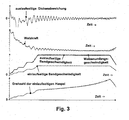
- FIG. 3 shows the time profiles of variables of interest - such as the deviation on the outlet side, the rolling force, the inlet and outlet side belt speeds, the circumferential roller speed and the speed of the inlet-side reel - on the belt header.
- variables of interest - such as the deviation on the outlet side, the rolling force, the inlet and outlet side belt speeds, the circumferential roller speed and the speed of the inlet-side reel - on the belt header.
- the very strong thickness deviations on the outlet side can be clearly recognized during the initial phase of cold rolling.
- Both Figures 3, 4 show a much higher rolling force level in the area of the disturbances (fluctuations), which cannot be explained by better lubrication in the roll gap at a higher speed.
- the frequency of the adverse fluctuations that occur corresponds to the speed of the reel on the inlet side.
- the amplitudes drop - depending on the case under consideration - band head piece or band end piece - or rise sharply.
- the wavelength of the thickness deviations depends on the circumference of the reel on the inlet side, extended by the ratio between the strip thickness on the inlet side and the outlet side.
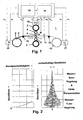
- Fig. 5 shows a sketch to explain the physical causes of the "Christmas tree effect occurring at the band head.
- the explanation for the" Christmas tree effect "occurring at the band head is that the coil in a storage device with the hot-rolled band is not uniform across the entire volume, but cools asymmetrically. Heat is removed from the coil more quickly and more intensely than through the outer jacket surfaces of the coil, which are only “flushed with air", via the contact surfaces of the coil with the bearing device. In this way, zones of different temperature are formed after hot rolling across the cross section of the coil, as the left section of FIG. 5 shows.
- the temperature of the strip falls below the recrystallization temperature in sections, which leads to strong fluctuations (variations, deviations from the desired value) in the hardness as a function of the strip length in the strip, that is to say in the strip head piece before cold rolling, such as the right one Section of Fig. 5 shows.
- the exact profile of these fluctuations in hardness depends heavily on the exact conditions and the resulting asymmetrical temperature conditions during storage of the coil.
- non-uniform recrystallization due to asymmetrical temperature conditions during stress-free annealing can cause similar problems with fluctuating hardness during cold rolling after annealing.
- the sensitivity of the ratio of strip thickness to hardness fluctuation can vary within a wide range - for example 5 ⁇ m / MPa ... 50 ⁇ m / MPa.
- the fluctuations in the mass flow and the strip tension are mainly caused by the fluctuations in the strip thickness at the outlet end resulting from the fluctuating hardness.
- rolling mills with their strip thickness detection devices measure the fluctuations indirectly in terms of hardness with a higher sensitivity than tensile strength tests of selected strip pieces carried out offline, for example.
- Usual strip thickness detection devices achieve a measuring accuracy in the range of +/- 0.3 ⁇ m.
- the invention has for its object to provide an improved method for cold rolling metallic strip, with which a fluctuation in hardness is effectively recognized and in particular can be prevented that strip head pieces and strip end pieces with fluctuating strip thickness on the outlet side arise.
- the advantages that can be achieved with the invention are, in particular, that in order to ensure high quality with regard to the cold-rolled strip, it is of great importance to identify variations (fluctuations) in the hardness of the (for example hot-rolled) entry-side strip as quickly as possible, because this is helpful, in order to be able to master the problems occurring during the cold rolling due to fluctuating hardness and consequently to achieve the high product quality with regard to the strip thickness on the outlet side which is desirable by means of the cold rolling.
- the hot rolling or annealing and storage conditions of the same strips can also be improved.
- FIG. 1 shows an arrangement for the identification, detection and compensation of a "Christmas tree effect occurring in a strip due to fluctuating hardness.
- the figure shows a roll stand suitable for cold rolling with strip winding devices and detection devices (sensors) for important measured values (process signals, variables,
- a generally known roll stand 1 with upper support roll 2, lower support roll 3, upper intermediate roll 4, lower intermediate roll 5, upper work roll 6 and lower work roll 7.
- a belt 8 runs through the roll gap formed between the work rolls 6, 7
- the direction of movement of the strip 8 is indicated by an arrow
- This strip 8 is unwound from an inlet-side reel (unwinder, decoiler) 9.
- the strip 8 reaches the roll stand 1 via an inlet-side deflection roller 10 (measuring roller for detecting the strip tension of the inlet-side strip) ,
- the strip 8 leaves the roll stand 1 and arrives at an exit-side reel (reel, rewinder) 13 via an exit-side strip thickness detection device 11 for detecting fluctuations in the exit-side strip thickness ⁇ h 1 and a return-side deflection roller 12 (measuring roller for detecting the strip tension of the exit-side strip) for winding up the cold-rolled strip.
- a measuring device 14 serves to record the belt speed v 1 on the exit side.
- the belt speed v 1 on the exit side can also be estimated with the aid of other measured variables.
- the fluctuations (variations) in the hardness of the incoming strip cause relatively large disc-side thickness deviations, strip tension fluctuations and rolling force fluctuations with a frequency that corresponds to the speed (or a multiple of the speed) of the input-side reel 9, while at the same time there are typically no significant thickness deviations in the infeed band at such a frequency.
- the principle of the "Christmas tree effect" detection carried out by means of the identification and detection device 18 now consists in fluctuations (deviations) in the exit-side strip thickness ⁇ h 1 , fluctuations (deviations) in the rolling force F r , fluctuations (deviations) in the strip tension F t0 des incoming strip and fluctuations (deviations) of the strip tension F t1 of the outgoing strip, the frequency of which is equal to the frequency of the speed of the inlet-side reel 9 or the frequency of which is a multiple of the speed of the inlet-side reel 9.
- This identification and detection can be carried out with the aid of Cross-correlation or Fast Fourier transformation or with the help of a disturbance observer.
- the profile of the strip tension fluctuations shows impulsive excitations with subsequent vibrations and is in no way purely sinusoidal.
- the strip tension fluctuations due to local elevations and out-of-roundness of the coil also cause fluctuations in the strip thickness on the outlet side, these thickness deviations are relatively small compared to the thickness deviations due to the "Christmas tree effect".
- the uncoilings of the harmonics of strip thickness, rolling force and strip tension are determined.
- a roll force and strip thickness harmonic is calculated using the strip tension harmonic and an online roll gap model. If the measured rolling force and thickness amplitude is greater than the calculated values by a predetermined threshold value and there is no coiling speed dependency, the hardness fluctuation is recognized.
- the fluctuations (variations) in hardness or the amplitude ratio of the fluctuations in hardness are estimated using an online roll gap model.
- roller circumferential speeds of the stands are corrected in addition to the support roller position and reel speeds.
- Compensation monitoring automatically switches the compensation "reel speed correction ⁇ v 0 + reel speed correction ⁇ v 1 + correction signal ⁇ s" to the strip tension controls 16 + 17 and the hydraulic roll gap control 15. If the remaining rolling force fluctuations harmonic flatness fluctuations when cause belt on the outlet side, these effects are compensated for by regulation with feedforward control of the roll bending. In other words, the disadvantageous effect of the rolling force fluctuation on the strip flatness is compensated for by bending pre-control.
Landscapes
- Engineering & Computer Science (AREA)
- Mechanical Engineering (AREA)
- Control Of Metal Rolling (AREA)
- Metal Rolling (AREA)
Applications Claiming Priority (2)
| Application Number | Priority Date | Filing Date | Title |
|---|---|---|---|
| DE10328472A DE10328472A1 (de) | 2003-06-25 | 2003-06-25 | Verfahren zum Kaltwalzen metallischen Bandes |
| DE10328472 | 2003-06-25 |
Publications (3)
| Publication Number | Publication Date |
|---|---|
| EP1491268A2 true EP1491268A2 (fr) | 2004-12-29 |
| EP1491268A3 EP1491268A3 (fr) | 2006-02-15 |
| EP1491268B1 EP1491268B1 (fr) | 2008-11-26 |
Family
ID=33394969
Family Applications (1)
| Application Number | Title | Priority Date | Filing Date |
|---|---|---|---|
| EP04013220A Expired - Lifetime EP1491268B1 (fr) | 2003-06-25 | 2004-06-04 | Procédé de laminage à froid de bandes métalliques |
Country Status (3)
| Country | Link |
|---|---|
| EP (1) | EP1491268B1 (fr) |
| AT (1) | ATE415213T1 (fr) |
| DE (2) | DE10328472A1 (fr) |
Cited By (4)
| Publication number | Priority date | Publication date | Assignee | Title |
|---|---|---|---|---|
| CN102699026A (zh) * | 2012-06-04 | 2012-10-03 | 苏州先端稀有金属有限公司 | 一种钼板卷冷轧设备 |
| CN103252356A (zh) * | 2013-04-25 | 2013-08-21 | 中冶赛迪电气技术有限公司 | 一种单机架可逆轧机初始辊缝差分设定方法及装置 |
| CN107983772A (zh) * | 2017-11-27 | 2018-05-04 | 河北工业大学 | 一种板材冷轧过程中可靠性有限元模型的建立方法 |
| CN117000759A (zh) * | 2023-10-07 | 2023-11-07 | 福建紫金英菲迅应用材料有限公司 | 一种金锡合金制品生产设备及其使用方法 |
Families Citing this family (2)
| Publication number | Priority date | Publication date | Assignee | Title |
|---|---|---|---|---|
| DE102006036054B9 (de) * | 2006-08-02 | 2013-08-14 | Thyssenkrupp Steel Europe Ag | Walzenbiegung bei Mehrwalzengerüsten |
| JP6308928B2 (ja) | 2014-11-14 | 2018-04-11 | 株式会社日立製作所 | 圧延制御装置、圧延制御方法および圧延制御プログラム |
Family Cites Families (13)
| Publication number | Priority date | Publication date | Assignee | Title |
|---|---|---|---|---|
| JPS5944127B2 (ja) * | 1976-05-28 | 1984-10-26 | 新日本製鐵株式会社 | 金属ストリツプ圧延における板厚および形状制御方法 |
| JPS5722812A (en) * | 1980-07-15 | 1982-02-05 | Toshiba Corp | Method for automatic control of plate thickness of multistand rolling mill |
| JPH0659483B2 (ja) * | 1985-09-17 | 1994-08-10 | 石川島播磨重工業株式会社 | 圧延板変形抵抗の計測方法 |
| US4905491A (en) * | 1988-04-11 | 1990-03-06 | Aluminum Company Of America | Unwind/rewind eccentricity control for rolling mills |
| US5054302A (en) * | 1989-04-07 | 1991-10-08 | Kawasaki Steel Corporation | Hardness compensated thickness control method for wet skin-pass rolled sheet |
| JP2513866B2 (ja) * | 1989-11-10 | 1996-07-03 | 川崎製鉄株式会社 | 形状制御方法 |
| JPH03285719A (ja) * | 1990-04-02 | 1991-12-16 | Sumitomo Metal Ind Ltd | 圧延機の摩擦係数および変形抵抗の計測方法 |
| JPH0615317A (ja) * | 1992-07-01 | 1994-01-25 | Toshiba Corp | 熱間仕上圧延機の制御方法 |
| JP3201301B2 (ja) * | 1997-01-28 | 2001-08-20 | 住友金属工業株式会社 | 被圧延材の厚さ制御方法及びその装置 |
| JPH11156413A (ja) * | 1997-11-21 | 1999-06-15 | Daido Steel Co Ltd | 金属材料の塑性加工に関する変形抵抗を予測する方法 |
| JP3384330B2 (ja) * | 1998-07-15 | 2003-03-10 | 住友金属工業株式会社 | リバース圧延機における板厚制御方法 |
| US6263714B1 (en) * | 1999-12-27 | 2001-07-24 | Telepro, Inc. | Periodic gauge deviation compensation system |
| DE10234047B4 (de) * | 2002-07-25 | 2014-07-17 | Abb Ag | Verfahren zur Erkennung und Fehlerursachenzuordnung von periodischen Fehlern in qualitätsrelevanten Prozessgrößen in Walzwerken und Bandbehandlungsanlagen |
-
2003
- 2003-06-25 DE DE10328472A patent/DE10328472A1/de not_active Withdrawn
-
2004
- 2004-06-04 EP EP04013220A patent/EP1491268B1/fr not_active Expired - Lifetime
- 2004-06-04 AT AT04013220T patent/ATE415213T1/de active
- 2004-06-04 DE DE502004008511T patent/DE502004008511D1/de not_active Expired - Lifetime
Cited By (8)
| Publication number | Priority date | Publication date | Assignee | Title |
|---|---|---|---|---|
| CN102699026A (zh) * | 2012-06-04 | 2012-10-03 | 苏州先端稀有金属有限公司 | 一种钼板卷冷轧设备 |
| CN102699026B (zh) * | 2012-06-04 | 2015-05-13 | 苏州先端稀有金属有限公司 | 一种钼板卷冷轧设备 |
| CN103252356A (zh) * | 2013-04-25 | 2013-08-21 | 中冶赛迪电气技术有限公司 | 一种单机架可逆轧机初始辊缝差分设定方法及装置 |
| CN103252356B (zh) * | 2013-04-25 | 2015-02-25 | 中冶赛迪电气技术有限公司 | 一种单机架可逆轧机初始辊缝差分设定方法及装置 |
| CN107983772A (zh) * | 2017-11-27 | 2018-05-04 | 河北工业大学 | 一种板材冷轧过程中可靠性有限元模型的建立方法 |
| CN107983772B (zh) * | 2017-11-27 | 2019-06-04 | 河北工业大学 | 一种板材冷轧过程中可靠性有限元模型的建立方法 |
| CN117000759A (zh) * | 2023-10-07 | 2023-11-07 | 福建紫金英菲迅应用材料有限公司 | 一种金锡合金制品生产设备及其使用方法 |
| CN117000759B (zh) * | 2023-10-07 | 2023-12-08 | 福建紫金英菲迅应用材料有限公司 | 一种金锡合金制品生产设备及其使用方法 |
Also Published As
| Publication number | Publication date |
|---|---|
| EP1491268B1 (fr) | 2008-11-26 |
| DE10328472A1 (de) | 2005-01-27 |
| DE502004008511D1 (de) | 2009-01-08 |
| ATE415213T1 (de) | 2008-12-15 |
| EP1491268A3 (fr) | 2006-02-15 |
Similar Documents
| Publication | Publication Date | Title |
|---|---|---|
| DE69002745T2 (de) | Dickenkontrollsystem für ein Walzwerk. | |
| EP1986795B2 (fr) | Procédé pour diminuer l'influence des excentricités de cylindres | |
| EP1074317B1 (fr) | Procédé pour le laminage flexible d'une bande métallique | |
| DE3036997A1 (de) | Verfahren zur steuerung und regelung der temperatur eines werkstueckes waehrend des walzens in einem warmbandwalzwerk | |
| EP2315636B1 (fr) | Procédé pour le réglage d'un effort de traction d'une bande, dispositif de commande et/ou de régulation, support de mémoire, code de programme pour l'exécution du procédé et installation industrielle pour l'usinage de bandes | |
| EP1491268B1 (fr) | Procédé de laminage à froid de bandes métalliques | |
| EP1908534A1 (fr) | Laminoir et procédé de laminage flexible à froid ou à chaud à voie unique ou inverse d'une bande de métal | |
| EP3590619B1 (fr) | Procédé et dispositif d'enroulement d'une bande métallique ainsi qu'utilisation d'un cylindre contacteur | |
| EP2741870B1 (fr) | Installation de laminage et procédé de laminage | |
| EP1121990A2 (fr) | Dispositif pour le laminage de bandes d'épaisseur variable périodiquement | |
| EP1161313B1 (fr) | Reglage de planeite permettant d'obtenir une bande a froid plane | |
| DE2808014C2 (de) | Verfahren zum Aufhaspeln von warmgewalztem Titanband | |
| EP4061552A1 (fr) | Réglage d'une température de sortie d'une bande métallique quittant un train de laminage | |
| EP2949408B1 (fr) | Procédé et appareil d'étirement de matière plastique d'un fil métallique | |
| CN115803127B (zh) | 用于计算稳定的轧制进程的道次计划的方法和计算机程序产品 | |
| DE102020210970A1 (de) | Planheitsmessvorrichtung, Warmwalzanlage und Verfahren zum Betreiben einer Planheitsmessvorrichtung | |
| EP2305393A1 (fr) | Procédé et dispositif destinés au réglage d'un entraînement | |
| WO2010003723A1 (fr) | Procédé de refroidissement d'un feuillard à chaud enroulé en bobine de feuillard à chaud, dispositif de refroidissement d'une bobine de feuillard à chaud, dispositif de commande et/ou de régulation et feuillard métallique | |
| EP0972580B1 (fr) | Procédé pour préréglage d'installations de formage à froid | |
| DE2628100B2 (de) | Vorrichtung zur Dickenregelung in einem Walzgerüst | |
| DE10254178B4 (de) | Verfahren zur Ermittlung von Zustandsgrößen eines Walzprozesses | |
| JPH1034215A (ja) | 冷間圧延におけるエッジドロップ制御方法 | |
| EP0936002B1 (fr) | Procédé de laminage pour une bande, en particulier une bande métallique | |
| DE10234047B4 (de) | Verfahren zur Erkennung und Fehlerursachenzuordnung von periodischen Fehlern in qualitätsrelevanten Prozessgrößen in Walzwerken und Bandbehandlungsanlagen | |
| RU2668108C1 (ru) | Способ управления прокаткой полосы в непрерывной группе клетей широкополосного стана |
Legal Events
| Date | Code | Title | Description |
|---|---|---|---|
| PUAI | Public reference made under article 153(3) epc to a published international application that has entered the european phase |
Free format text: ORIGINAL CODE: 0009012 |
|
| AK | Designated contracting states |
Kind code of ref document: A2 Designated state(s): AT BE BG CH CY CZ DE DK EE ES FI FR GB GR HU IE IT LI LU MC NL PL PT RO SE SI SK TR |
|
| AX | Request for extension of the european patent |
Extension state: AL HR LT LV MK |
|
| PUAL | Search report despatched |
Free format text: ORIGINAL CODE: 0009013 |
|
| RIC1 | Information provided on ipc code assigned before grant |
Ipc: B21B 37/62 20060101AFI20041004BHEP Ipc: B21B 37/54 20060101ALI20051221BHEP Ipc: B21B 38/00 20060101ALI20051221BHEP |
|
| AK | Designated contracting states |
Kind code of ref document: A3 Designated state(s): AT BE BG CH CY CZ DE DK EE ES FI FR GB GR HU IE IT LI LU MC NL PL PT RO SE SI SK TR |
|
| AX | Request for extension of the european patent |
Extension state: AL HR LT LV MK |
|
| 17P | Request for examination filed |
Effective date: 20060321 |
|
| AKX | Designation fees paid |
Designated state(s): AT DE ES FR IT |
|
| 17Q | First examination report despatched |
Effective date: 20070215 |
|
| GRAP | Despatch of communication of intention to grant a patent |
Free format text: ORIGINAL CODE: EPIDOSNIGR1 |
|
| GRAS | Grant fee paid |
Free format text: ORIGINAL CODE: EPIDOSNIGR3 |
|
| GRAA | (expected) grant |
Free format text: ORIGINAL CODE: 0009210 |
|
| RAP1 | Party data changed (applicant data changed or rights of an application transferred) |
Owner name: ABB AG |
|
| AK | Designated contracting states |
Kind code of ref document: B1 Designated state(s): AT DE ES FR IT |
|
| REF | Corresponds to: |
Ref document number: 502004008511 Country of ref document: DE Date of ref document: 20090108 Kind code of ref document: P |
|
| PG25 | Lapsed in a contracting state [announced via postgrant information from national office to epo] |
Ref country code: ES Free format text: LAPSE BECAUSE OF FAILURE TO SUBMIT A TRANSLATION OF THE DESCRIPTION OR TO PAY THE FEE WITHIN THE PRESCRIBED TIME-LIMIT Effective date: 20090308 |
|
| PLBE | No opposition filed within time limit |
Free format text: ORIGINAL CODE: 0009261 |
|
| STAA | Information on the status of an ep patent application or granted ep patent |
Free format text: STATUS: NO OPPOSITION FILED WITHIN TIME LIMIT |
|
| 26N | No opposition filed |
Effective date: 20090827 |
|
| PGFP | Annual fee paid to national office [announced via postgrant information from national office to epo] |
Ref country code: AT Payment date: 20120613 Year of fee payment: 9 |
|
| PGFP | Annual fee paid to national office [announced via postgrant information from national office to epo] |
Ref country code: FR Payment date: 20130703 Year of fee payment: 10 |
|
| PGFP | Annual fee paid to national office [announced via postgrant information from national office to epo] |
Ref country code: IT Payment date: 20140626 Year of fee payment: 11 |
|
| REG | Reference to a national code |
Ref country code: AT Ref legal event code: MM01 Ref document number: 415213 Country of ref document: AT Kind code of ref document: T Effective date: 20140604 |
|
| REG | Reference to a national code |
Ref country code: FR Ref legal event code: ST Effective date: 20150227 |
|
| PG25 | Lapsed in a contracting state [announced via postgrant information from national office to epo] |
Ref country code: AT Free format text: LAPSE BECAUSE OF NON-PAYMENT OF DUE FEES Effective date: 20140604 Ref country code: FR Free format text: LAPSE BECAUSE OF NON-PAYMENT OF DUE FEES Effective date: 20140630 |
|
| PG25 | Lapsed in a contracting state [announced via postgrant information from national office to epo] |
Ref country code: IT Free format text: LAPSE BECAUSE OF NON-PAYMENT OF DUE FEES Effective date: 20150604 |
|
| PGFP | Annual fee paid to national office [announced via postgrant information from national office to epo] |
Ref country code: DE Payment date: 20230620 Year of fee payment: 20 |
|
| REG | Reference to a national code |
Ref country code: DE Ref legal event code: R071 Ref document number: 502004008511 Country of ref document: DE |