EP1491635A2 - Biocapteur sans réactif pour la détection de nitriles et de cyanides - Google Patents
Biocapteur sans réactif pour la détection de nitriles et de cyanides Download PDFInfo
- Publication number
- EP1491635A2 EP1491635A2 EP04003837A EP04003837A EP1491635A2 EP 1491635 A2 EP1491635 A2 EP 1491635A2 EP 04003837 A EP04003837 A EP 04003837A EP 04003837 A EP04003837 A EP 04003837A EP 1491635 A2 EP1491635 A2 EP 1491635A2
- Authority
- EP
- European Patent Office
- Prior art keywords
- biosensor
- nitrilase
- sensitive
- marked
- insulator
- Prior art date
- Legal status (The legal status is an assumption and is not a legal conclusion. Google has not performed a legal analysis and makes no representation as to the accuracy of the status listed.)
- Withdrawn
Links
Images

Classifications
-
- C—CHEMISTRY; METALLURGY
- C12—BIOCHEMISTRY; BEER; SPIRITS; WINE; VINEGAR; MICROBIOLOGY; ENZYMOLOGY; MUTATION OR GENETIC ENGINEERING
- C12Q—MEASURING OR TESTING PROCESSES INVOLVING ENZYMES, NUCLEIC ACIDS OR MICROORGANISMS; COMPOSITIONS OR TEST PAPERS THEREFOR; PROCESSES OF PREPARING SUCH COMPOSITIONS; CONDITION-RESPONSIVE CONTROL IN MICROBIOLOGICAL OR ENZYMOLOGICAL PROCESSES
- C12Q1/00—Measuring or testing processes involving enzymes, nucleic acids or microorganisms; Compositions therefor; Processes of preparing such compositions
- C12Q1/001—Enzyme electrodes
-
- G—PHYSICS
- G01—MEASURING; TESTING
- G01N—INVESTIGATING OR ANALYSING MATERIALS BY DETERMINING THEIR CHEMICAL OR PHYSICAL PROPERTIES
- G01N2333/00—Assays involving biological materials from specific organisms or of a specific nature
- G01N2333/90—Enzymes; Proenzymes
- G01N2333/914—Hydrolases (3)
- G01N2333/978—Hydrolases (3) acting on carbon to nitrogen bonds other than peptide bonds (3.5)
-
- G—PHYSICS
- G01—MEASURING; TESTING
- G01N—INVESTIGATING OR ANALYSING MATERIALS BY DETERMINING THEIR CHEMICAL OR PHYSICAL PROPERTIES
- G01N27/00—Investigating or analysing materials by the use of electric, electrochemical, or magnetic means
- G01N27/26—Investigating or analysing materials by the use of electric, electrochemical, or magnetic means by investigating electrochemical variables; by using electrolysis or electrophoresis
- G01N27/403—Cells and electrode assemblies
- G01N27/414—Ion-sensitive or chemical field-effect transistors, i.e. ISFETS or CHEMFETS
Definitions
- the invention relates to a biosensor for the detection of nitriles and cyanides.
- the alkyl derivatives of hydrocyanic acid are regarded as nitriles.
- the salts of hydrocyanic acid are regarded as cyanides.
- Cyanide sensors based on ion-sensitive electrodes are commercially available from various manufacturers.
- the sensors comprise a sensitive layer made of a silver halide compound together with an Ag 2 S compound.
- these sensors can only be used in a pH range of 9-11 and, due to their design, show strong interference with sulfide (S 2- ), halides (Cl - , Br - , F - , etc.) and silver (Ag + ). Due to complex formation processes, the electrode wears out during the measuring time and can no longer be used reliably after just a few uses. Miniaturization of such ISEs has so far been possible only to a limited extent.
- Cyanide biosensors are also known from the prior art.
- DE 44 36 001 C2 discloses a biosensor with an enzyme fixed on a Si 3 N 4 surface, in which the enzyme is covalently bound to this surface with the aid of a heterobifunctional crosslinker.
- a disadvantage of such a biosensor can only be produced by using an expensive surface chemical treatment. It is also possible to produce only monolayers of the enzyme using the stated process. The production process is unsuitable when using enzymes which have a low activity.
- Keusgen et al. (Michael Keusgen, Peter Milka and Ingo Krest, 2001. Development of a cyanide biosensor: cyanidase from bacterial sources. Second biosensor symposium Tübingen, 2001; http://barolo.ipc.unituebingen.de/biosensor2001) is a flow measurement device for detection of cyanide (hydrocyanic acid) based on immobilized cyanidase using an ammonia electrode. The electrode and the enzyme are not directly connected to each other. cyanidases belong to the group of nitrilases, EC 3.5.5.1. During the detection process, cyanide is enzymatically converted to ammonia and formic acid in a sample. Ammonia is then recorded with an ammonia electrode. Miniaturization is also not possible with this sensor because of the ammonia measuring electrode.
- the object of the invention is to provide a miniaturized biosensor for the sensitive detection of nitriles, and in particular cyanides.
- the task is solved by a biosensor according to the main claim.
- the biosensor comprises a doped semiconductor layer, in particular made of p- or n-doped silicon, at least one pH-sensitive insulator applied to the semiconductor layer and a nitrilase from substance class EC 3.5.5.1 immobilized on the insulator.
- the nitrilase enzyme class includes cyanidases. A cyanidase can also be immobilized as a nitrilase.
- Such a biosensor detects nitriles, i.e. the alkyl derivatives of hydrocyanic acid, e.g.
- cyanides such as hydrocyanic acid and its salts
- auxiliary reagents without auxiliary reagents.
- the sensor is advantageously miniaturized due to the semiconductor layer structure. Cross-sensitivities to other ions, e.g. B. with the cyanide ISE are excluded.
- all enzymes of the enzyme class EC 3.5.5.1 are suitable as nitrilases. These enzymes differ in their substrate specificity.
- a cyanidase which specifically converts cyanides, ie the salts of hydrocyanic acid, can also be immobilized as nitrilase. Accordingly, cyanides such as hydrocyanic acid can also be hydrolyzed and quantitatively detected. The reaction depends largely on the substrate specificity of the enzyme used. Suitable enzymes can be obtained from bacterial, fungal, vegetable and animal sources.
- a particular cyanidase particularly advantageously comes from Pseudomonas stuzeri (AK 61).
- This cyanidase can be immobilized on a pH-sensitive isolator.
- This cyanidase advantageously also has the property of being able to be immobilized on the pH-sensitive isolator by various methods.
- the biosensor can have means that mechanically immobilize the nitrilase on the pH-sensitive isolator.
- a dialysis membrane with an exclusion size of 10 kDa is particularly suitable. In this case, low molecular weight analytes (cyanide, nitriles) pass through the membrane unhindered. However, the enzyme cannot escape into the test solution.
- the dialysis membrane can e.g. B. sealed against the pH-sensitive isolator via an O-ring.
- the enzyme can chemically z. Before immobilization on the pH-sensitive isolator to a gel or to a solid. B. connected by covalent bond or by absorptive bond. Then the gel or the solid together with enzyme z. B. can be immobilized by means of mechanically immobilizing agents on the pH-sensitive isolator.
- the nitrilase can be fixed to a gel or a solid comprising a poly sugar before immobilization.
- Poly sugars such as agarose, cellulose, dextran and their derivatives are particularly suitable for this.
- the nitrilase can also be dissolved in a solution on the pH-sensitive isolator and immobilized on the pH-sensitive isolator by means of mechanical means, such as a dialysis membrane.
- the nitrilase can also be immobilized chemically directly on the pH-sensitive isolator via amino, hydroxy, thio or carboxy functions of the cyanidase.
- the nitrilase can also be immobilized absorptively on the pH-sensitive isolator.
- a further insulator layer in particular made of SiO 2, can be arranged between the pH-sensitive insulator and the semiconductor layer.
- the biosensor comprises Si 3 N 4 as a material for the pH-sensitive insulator.
- other pH-sensitive thin-layer materials such as Ta 2 O 5 , Al 2 O 3 or ZrO 2 or SiO 2 can be used just as well.
- the biosensor can be configured both as a closed measuring chamber and as a flow measuring chamber.
- the biosensor is designed on the basis of a field effect sensor.
- the biosensor is designed in particular as a capacitive electrolyte insulator semiconductor structure (EIS sensor). This means that to measure the analyte, a reference electrode is immersed in the solution to be examined. This is in contact with the immobilized enzyme. Only a further EIS sensor without enzyme coating is required for complete pH and temperature compensation.
- An EIS sensor has an enzyme layer, here the cyanidase or nitrilase, and measures the change in pH as the end product of the enzymatic reaction.
- Another EIS sensor has a corresponding structure without enzyme.
- This further EIS sensor does not measure any changes in the pH value due to the enzymatic reaction but any changes in the pH value that may occur in the measurement solution. This enables calibration of the sensor.
- the signal caused by the enzymatic reaction is detected by difference formation. The temperature dependency can also be eliminated in the same way.
- the senor can also be designed as a field effect structure, that is to say as an ISFET (ion-sensitive field effect transistor) or as a LAPS (light-addressable potentiometric sensor).
- ISFET on-sensitive field effect transistor
- LAPS light-addressable potentiometric sensor
- FIG. 1 shows schematically the structure of a biosensor 1 for the detection of cyanide (hydrocyanic acid).
- the sensor 1 is designed as an EIS structure. It comprises a doped semiconductor 3, e.g. B. p- or n-doped silicon, which has a metal layer 2 made of z. B. has aluminum and an external contact 2a from z. B. Gold is connected to a measuring device.
- p-silicon 3 On the top of p-silicon 3 is a layer of silicon dioxide (SiO 2 ) 4, on which in turn a pH-sensitive layer of silicon nitride (Si 3 N 4 ) 5 is arranged.
- a cyanidase 6 from Pseudomonas stuzeri (AK 61) with a Dialysis membrane 7 with an exclusion size of 10 kDa is mechanically immobilized. Sealing takes place via an O-ring 8.
- the cyanidase 6 is covalently fixed to a gel or a solid.
- An agarose derivative as a poly sugar is particularly suitable for this.
- the fixation to the agarose derivative was thus carried out chemically via the amino functions of the enzyme 6 to a functionalized poly sugar via an acid amide bond.
- the functionalized groups, e.g. B. carboxy functions enable covalent bonding.
- Immobilization on the Si 3 N 4 layer 5 was carried out mechanically by means of a dialysis membrane 7 and O-ring 8.
- the biosensor 1 is installed in a flow measuring chamber 13 made of a non-conductive polymer material.
- An inflow 9 and an outflow 10 represent the entry and exit of a solution to be examined with the analyte.
- the biosensor 1 can also be operated in a closed measuring chamber.
- the reference electrode 11 required for the measurements e.g. B. a silver / silver chloride electrode, but can also simply be immersed in a test solution 12.
- One is very flexible with such a biosensor 1 with regard to the measurement.
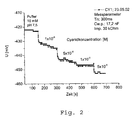
- FIG. 2 shows an example of a sensogram of the EIS biosensor at different cyanide concentrations (sensor designation: CY1, capacitance 17.2 nF, impedance 30 kOhm, time constant for the measurements 300 ms).
- the measurement was carried out in the so-called CONCAP mode, i.e. with a constant capacity of the EIS structure (17.2 nF).
- the potential (U, mV) was plotted against time (s) during the measurements.
- the flow measuring cell shown in FIG. 1 was used, a flow rate of 0.25 ml / min at a pH of 7.5 (phosphate buffer, molarity 10 mM) being used.
- the cyanidase of the bacterium Pseudomonas stuzeri (6 units) was used, which was covalently bound to 20 mg of an agarose derivative.
- the measurement signal is recorded here by means of C / V (capacitance / voltage) measurement or concap measurement with constant capacitance.
Landscapes
- Chemical & Material Sciences (AREA)
- Organic Chemistry (AREA)
- Life Sciences & Earth Sciences (AREA)
- Zoology (AREA)
- Wood Science & Technology (AREA)
- Proteomics, Peptides & Aminoacids (AREA)
- Health & Medical Sciences (AREA)
- Engineering & Computer Science (AREA)
- Microbiology (AREA)
- Biochemistry (AREA)
- Physics & Mathematics (AREA)
- Molecular Biology (AREA)
- Biotechnology (AREA)
- Biophysics (AREA)
- Analytical Chemistry (AREA)
- Immunology (AREA)
- Bioinformatics & Cheminformatics (AREA)
- General Engineering & Computer Science (AREA)
- General Health & Medical Sciences (AREA)
- Genetics & Genomics (AREA)
- Measuring Or Testing Involving Enzymes Or Micro-Organisms (AREA)
- Apparatus Associated With Microorganisms And Enzymes (AREA)
Applications Claiming Priority (2)
| Application Number | Priority Date | Filing Date | Title |
|---|---|---|---|
| DE2003112296 DE10312296B4 (de) | 2003-03-20 | 2003-03-20 | Reagenzloser Biosensor zum Nachweis von Nitrilen und Cyaniden |
| DE10312296 | 2003-03-20 |
Publications (2)
| Publication Number | Publication Date |
|---|---|
| EP1491635A2 true EP1491635A2 (fr) | 2004-12-29 |
| EP1491635A3 EP1491635A3 (fr) | 2005-02-09 |
Family
ID=32945994
Family Applications (1)
| Application Number | Title | Priority Date | Filing Date |
|---|---|---|---|
| EP04003837A Withdrawn EP1491635A3 (fr) | 2003-03-20 | 2004-02-20 | Biocapteur sans réactif pour la détection de nitriles et de cyanides |
Country Status (2)
| Country | Link |
|---|---|
| EP (1) | EP1491635A3 (fr) |
| DE (1) | DE10312296B4 (fr) |
Cited By (1)
| Publication number | Priority date | Publication date | Assignee | Title |
|---|---|---|---|---|
| CN110260905A (zh) * | 2019-05-29 | 2019-09-20 | 西安邮电大学 | 一种阵列检测光寻址电位传感器的恒相位差闭环测量方法 |
Family Cites Families (4)
| Publication number | Priority date | Publication date | Assignee | Title |
|---|---|---|---|---|
| DE69217461T2 (de) * | 1991-11-08 | 1997-10-23 | Nippon Electric Co | Immobilisierte Enzym-Membran, immobilisierte Protein-Membran und Verfahren zu ihrer Herstellung |
| DE4436001C2 (de) * | 1994-10-08 | 1996-07-25 | Forschungszentrum Juelich Gmbh | Biosensor mit auf einer Si¶3¶N¶4¶-Oberfläche fixiertem Enzym |
| GB9525372D0 (en) * | 1995-12-12 | 1996-02-14 | Allied Colloids Ltd | Enzymes, their preparation and their use in the production of ammonium acrylate |
| DE19749216C1 (de) * | 1997-11-06 | 1999-04-15 | Forschungszentrum Juelich Gmbh | Meßvorrichtung mit Probenzelle zum Nachweis von kleinen Probenmengen in Flüssigkeiten |
-
2003
- 2003-03-20 DE DE2003112296 patent/DE10312296B4/de not_active Expired - Fee Related
-
2004
- 2004-02-20 EP EP04003837A patent/EP1491635A3/fr not_active Withdrawn
Cited By (1)
| Publication number | Priority date | Publication date | Assignee | Title |
|---|---|---|---|---|
| CN110260905A (zh) * | 2019-05-29 | 2019-09-20 | 西安邮电大学 | 一种阵列检测光寻址电位传感器的恒相位差闭环测量方法 |
Also Published As
| Publication number | Publication date |
|---|---|
| EP1491635A3 (fr) | 2005-02-09 |
| DE10312296B4 (de) | 2007-02-15 |
| DE10312296A1 (de) | 2004-10-07 |
Similar Documents
| Publication | Publication Date | Title |
|---|---|---|
| Brown et al. | A direct and selective electrochemical hydrogen sulfide sensor | |
| Norouzi et al. | Fast Fourier continuous cyclic voltammetry at gold ultramicroelectrode in flowing solution for determination of ultra trace amounts of penicillin G | |
| Zhou et al. | Selective determination of dopamine and uric acid using electrochemical sensor based on poly (alizarin yellow R) film-modified electrode | |
| MX2011003952A (es) | Metodo electroquimico no enzimatico para la determinacion simultanea de hemoglobina total y hemoglobina glucosilada. | |
| Kianipour et al. | Room temperature ionic liquid/multiwalled carbon nanotube/chitosan-modified glassy carbon electrode as a sensor for simultaneous determination of ascorbic acid, uric acid, acetaminophen, and mefenamic acid | |
| DD301250A7 (de) | Meßvorrichtung und Verfahren zur automatischen Bestimmung derKonzentration von Biokatalysatorsubstraten | |
| Pedrosa et al. | Acetylcholinesterase Immobilization on 3‐Mercaptopropionic Acid Self Assembled Monolayer for Determination of Pesticides | |
| Pal et al. | The detection of mercury, cadium, and arsenic by the deactivation of urease on rhodinized carbon | |
| Saurina et al. | Potentiometric biosensor for lysine analysis based on a chemically immobilized lysine oxidase membrane | |
| Jahani | Electrocatalytic determination of levodopa in presence of cabergoline using carbon paste electrode modified with graphene quantum dots/2-chlorobenzoyl ferrocene/ionic liquid | |
| Wang et al. | Electrochemical detection of nitrite based on difference of surface charge of self-assembled monolayers | |
| US20070000778A1 (en) | Multi-parameter sensor with readout circuit | |
| Barbaro et al. | CHEMFET devices for biomedical and environmental applications | |
| DE10312296B4 (de) | Reagenzloser Biosensor zum Nachweis von Nitrilen und Cyaniden | |
| Martínez‐Paredes et al. | Lead Sensor Using Gold Nanostructured Screen‐Printed Carbon Electrodes as Transducers | |
| Zhao et al. | Simple and sensitive electrochemical sensor for tyramine determination based on overoxidized poly (o-aminophenol) film modified electrode | |
| Sato et al. | Development of a copper-electrodeposited gold electrode for an amperometric creatinine sensor to detect creatinine in urine without pretreatment | |
| DE10212570B4 (de) | Amperometrischer Dickschicht-Biosensor zur Bestimmung der Wasserstoffperoxid-Konzentration in einer Lösung und Verfahren zur Herstellung des Sensors | |
| DE19749216C1 (de) | Meßvorrichtung mit Probenzelle zum Nachweis von kleinen Probenmengen in Flüssigkeiten | |
| Zhang et al. | In vivo determination of tetrahydrobiop-terin and monoamine neurotransmitters in rat brain by liquid chromatography with a nano crystalline Mn-doped lead dioxide film modified electrode | |
| Paulraj et al. | Myoglobin biofunctionalized electrochemical biosensor platform for the dual determination of nitrite and H2O2 as oxidative stress markers | |
| Pang et al. | A novel urea amperometric biosensor based on secretion of carnation petal cells modified on a graphite-epoxy composite electrode | |
| Pundir et al. | Determination of β-ODAP by various methods with special emphasis on biosensors: A mini-review | |
| EP3191825B1 (fr) | Bio-capteur de créatinine | |
| Pijanowska et al. | Simple method of enzyme immobilization for pH-ISFET-based urea biosensors |
Legal Events
| Date | Code | Title | Description |
|---|---|---|---|
| PUAI | Public reference made under article 153(3) epc to a published international application that has entered the european phase |
Free format text: ORIGINAL CODE: 0009012 |
|
| PUAL | Search report despatched |
Free format text: ORIGINAL CODE: 0009013 |
|
| AK | Designated contracting states |
Kind code of ref document: A2 Designated state(s): AT BE BG CH CY CZ DE DK EE ES FI FR GB GR HU IE IT LI LU MC NL PT RO SE SI SK TR |
|
| AX | Request for extension of the european patent |
Extension state: AL LT LV MK |
|
| AK | Designated contracting states |
Kind code of ref document: A3 Designated state(s): AT BE BG CH CY CZ DE DK EE ES FI FR GB GR HU IE IT LI LU MC NL PT RO SE SI SK TR |
|
| AX | Request for extension of the european patent |
Extension state: AL LT LV MK |
|
| 17P | Request for examination filed |
Effective date: 20050629 |
|
| AKX | Designation fees paid |
Designated state(s): AT BE BG CH CY CZ DE DK EE ES FI FR GB GR HU IE IT LI LU MC NL PT RO SE SI SK TR |
|
| 17Q | First examination report despatched |
Effective date: 20060823 |
|
| STAA | Information on the status of an ep patent application or granted ep patent |
Free format text: STATUS: THE APPLICATION HAS BEEN WITHDRAWN |
|
| 18W | Application withdrawn |
Effective date: 20101028 |