EP1491730A1 - Méthode et appareil pour contrôler une soupape électrohydraulique d'un moteur à combustion interne - Google Patents
Méthode et appareil pour contrôler une soupape électrohydraulique d'un moteur à combustion interne Download PDFInfo
- Publication number
- EP1491730A1 EP1491730A1 EP20040102847 EP04102847A EP1491730A1 EP 1491730 A1 EP1491730 A1 EP 1491730A1 EP 20040102847 EP20040102847 EP 20040102847 EP 04102847 A EP04102847 A EP 04102847A EP 1491730 A1 EP1491730 A1 EP 1491730A1
- Authority
- EP
- European Patent Office
- Prior art keywords
- valve
- predetermined time
- time
- spo
- hydraulic actuator
- Prior art date
- Legal status (The legal status is an assumption and is not a legal conclusion. Google has not performed a legal analysis and makes no representation as to the accuracy of the status listed.)
- Granted
Links
- 238000000034 method Methods 0.000 title claims abstract description 27
- 238000002485 combustion reaction Methods 0.000 title 1
- 239000007788 liquid Substances 0.000 claims abstract description 29
- 230000003042 antagnostic effect Effects 0.000 claims abstract description 5
- 230000001276 controlling effect Effects 0.000 claims description 18
- 230000010355 oscillation Effects 0.000 claims description 12
- 238000001514 detection method Methods 0.000 claims description 4
- 238000005086 pumping Methods 0.000 claims description 4
- 230000002596 correlated effect Effects 0.000 claims description 3
- 230000000875 corresponding effect Effects 0.000 claims 6
- 101150025935 Tspo gene Proteins 0.000 abstract 1
- 238000006073 displacement reaction Methods 0.000 description 11
- 238000011084 recovery Methods 0.000 description 7
- 238000010586 diagram Methods 0.000 description 5
- 230000000694 effects Effects 0.000 description 4
- 238000011835 investigation Methods 0.000 description 3
- 238000004891 communication Methods 0.000 description 2
- 230000021715 photosynthesis, light harvesting Effects 0.000 description 2
- 230000001105 regulatory effect Effects 0.000 description 2
- 238000005474 detonation Methods 0.000 description 1
- 238000005516 engineering process Methods 0.000 description 1
- 230000000750 progressive effect Effects 0.000 description 1
Images


Classifications
-
- F—MECHANICAL ENGINEERING; LIGHTING; HEATING; WEAPONS; BLASTING
- F01—MACHINES OR ENGINES IN GENERAL; ENGINE PLANTS IN GENERAL; STEAM ENGINES
- F01L—CYCLICALLY OPERATING VALVES FOR MACHINES OR ENGINES
- F01L9/00—Valve-gear or valve arrangements actuated non-mechanically
- F01L9/10—Valve-gear or valve arrangements actuated non-mechanically by fluid means, e.g. hydraulic
-
- F—MECHANICAL ENGINEERING; LIGHTING; HEATING; WEAPONS; BLASTING
- F01—MACHINES OR ENGINES IN GENERAL; ENGINE PLANTS IN GENERAL; STEAM ENGINES
- F01L—CYCLICALLY OPERATING VALVES FOR MACHINES OR ENGINES
- F01L2800/00—Methods of operation using a variable valve timing mechanism
Definitions
- the present invention relates to a method for controlling an electrohydraulic unit for actuating the valves of a spark-ignition engine.
- valves of a spark-ignition engine are moved mechanically by means of a camshaft.
- alternative systems are currently in the experimental phase.
- the applicant is investigating an electrohydraulic unit for actuating the valves of an endothermic engine of the type described in patent application EP-1,233,152 in the name of the present applicant.
- the above-mentioned electrohydraulic unit is controlled by an electronic unit and makes it possible to vary the opening and closing times of each valve according to a cycle assigned as a function of the angular velocity of the crankshaft and other operating parameters of the engine, substantially increasing the efficiency of the engine.
- the electrohydraulic unit currently under investigation provides, for each of the engine's intake or exhaust valves, an electrohydraulic actuating device which comprises a linear hydraulic actuator capable of displacing the valve axially from the closed position to the maximally open position, overcoming the action of a resilient element capable of holding the valve in the closed position, and a hydraulic distributor capable of controlling the flow of pressurised oil away from and towards the hydraulic actuator in such a manner as to control the displacement of the valve between the closed position and the maximally open position.
- an electrohydraulic actuating device which comprises a linear hydraulic actuator capable of displacing the valve axially from the closed position to the maximally open position, overcoming the action of a resilient element capable of holding the valve in the closed position, and a hydraulic distributor capable of controlling the flow of pressurised oil away from and towards the hydraulic actuator in such a manner as to control the displacement of the valve between the closed position and the maximally open position.
- the electrohydraulic unit under investigation is provided with a hydraulic circuit that comprises an oil-holding tank, within which the oil to be delivered to the actuators is stored at ambient pressure, and a pumping unit capable of delivering the pressurised oil to the various distributors by taking it directly from the holding tank.
- the electrohydraulic unit described in patent application EP 1,233,152 comprises a slide valve distributor, which is capable of assuming a first operating position in which it places the hydraulic actuator in direct communication with a pressurised oil discharge tank, a second operating position in which it isolates the hydraulic actuator so as to prevent the oil from flowing away from and towards said actuator and a third operating position in which it places the linear hydraulic actuator in direct communication with a branch containing pressurised liquid for specific connection time.
- the unit described has the considerable merit of having a particularly simple structure that ensures high levels of reliability over time, allowing its use in automotive applications.
- the aim of the present invention is to provide a method for controlling an electrohydraulic unit for actuating the valves of an endothermic engine so as to optimise the operation of the electrohydraulic unit and the engine.
- the present invention provides a method for controlling an electrohydraulic unit for actuating the valves of an endothermic engine, in which the electrohydraulic unit comprises a hydraulic actuator for opening a respective valve with a pressurised liquid, and a spring which is antagonistic to the hydraulic actuator in order to close the valve; the method being characterised in that the connection time between the hydraulic actuator and a first branch containing said pressurised liquid is controlled as a function of a predetermined time characteristic of the electrohydraulic unit.
- connection time for example, by requiring that the connection time be equal to the predetermined time characteristic of the electrohydraulic unit, considerable energy recovery is obtained whereas, when the connection time differs from the predetermined time, which is for example desired when the engine is running cold in order to adjust the liquid to temperature quickly, energy dissipation is obtained.
- the present invention furthermore relates to a device for controlling an electrohydraulic unit for actuating the valves of an endothermic engine.
- the present invention provides a device for controlling an electrohydraulic unit for actuating the valves of an endothermic engine, in which the electrohydraulic unit comprises a hydraulic actuator for opening a respective valve with a pressurised liquid, and a spring that is antagonistic to the hydraulic actuator in order to close the valve; the device being characterised in that it comprises control means for controlling the connection time between the hydraulic actuator and a first branch containing said pressurised liquid as a function of a predetermined time characteristic of the electrohydraulic unit.
- 1 denotes the overall electrohydraulic unit for actuating the valves 2 of an endothermic engine M.
- Figure 1 shows just one valve 2 coupled with a respective seat 2A, although the electrohydraulic unit 1 is capable of controlling all the intake and exhaust valves of the engine M.
- opening of the valve 2 is taken to mean the phase of changing from the closed position of the valve 2 to the maximally open position;
- closure of the valve 2 is taken mean the phase of changing between the maximally open position of the valve 2 and the closed position;
- holding is taken to mean the phase during which the valve 2 remains in the maximally open position. Consequently, in relation to the valve 2, the terms open, close and hold have an analogous meaning.
- the unit 1 comprises a hydraulic circuit 3 and a control device 4.
- the hydraulic circuit 3 comprises a circuit 5, common to all the valves 2, and a plurality of actuating devices 6, each of which is associated with a respective valve 2.
- Figure 1 shows just one device 6 associated with the respective valve 2.
- the circuit 5 comprises an oil holding tank 7, a pumping unit 8 and two branches 9 and 10, which are supplied with pressurised oil and along which are successively arranged respective pressure regulators 11 and 12 and respective pressure accumulators 13 and 14.
- the two branches 9 and 10 of the ci rcuit 5, downstream from the respective accumulators 13 and 14, are connected to the actuating devices 6, each of which comprises a control selector 15, a slide valve distributor 16 and a hydraulic actuator 17 rigidly coupled to the valve 2.
- the selector 15 is connected to the branch 10, to the tank 7 and to a branch 18 that connects the selector 15 to the distributor 16 in order to control the distributor 16 itself.
- the distributor 16 is connected to the branch 9, to the tank 7, to a delivery branch 19 to the actuator 17 and a discharge branch 20 from the actuator 17.
- the branch 19 and the branch 20 are connected by a discharge branch 21, along which an orifice 22 is provided.
- the discharge branch 21 and orifice 22 have the function of slowing the valve 2 in the closing phase and maintaining a constant velocity for closing the valve 2. In particular, slowing of the valve 2 takes effect during the final part of the closing stroke of the valve 2, as will be described below in greater detail in the present description.
- the selector 15 is a three-way valve controlled by an electromagnet 23 and by a spring 24 and is capable of assuming two positions: when the electromagnet 23 is not excited, the spring 24 holds the selector in the first position, in which the branch 10 is closed, while the branch 18 is connected to the tank 7 ( Figure 1); when excited, the electromagnet 23 overcomes the force of the spring 24 and places the selector 15 in the second position, in which the branch 10 is connected to the branch 18.
- the distributor 16 is a four-way valve controlled by a piston 25 and by a spring 26 and is capable of assuming substantially four operating positions shown diagrammatically as P1, P2, P3 and P4 in Figure 1. While the selector 16 has four operating positions P1, P2, P3 and P4, it actually has only two stable positions, namely the end positions indicated as P1 and P4 in Figure 1.
- the operating positions P2 and P3 are transitional positions between the opposing the operating positions P1 and P4.
- the branch 20 In the operating position P1, the branch 20 is connected to the tank 7, while the branch 9 and the branch 19 are disconnected; in the operating position P2, all the connections are broken; in the operating position P3, the branch 9 is connected to the branch 19, while the discharge branch 20 is shut off: for this reason, the operating position P3 is defined as the actuating position; the operating position P4 again exhibits the same features as the operating position P2.
- the linear hydraulic actuator 17 comprises a cylinder 27, a piston 28 connected to the valve 2 and a spring 29 capable of holding the valve 2 in the closed position.
- the cylinder 27 has a head 27a and a jacket 27b, along which a side discharge opening 30 is arranged.
- the piston 28 comprises a crown 28a and a side face 28b, which, in specific positions of the piston 28, closes the opening 30.
- the distributor 16 comprises a sleeve 31 and a slide valve 32 that slides inside the sleeve 31 along an axis 33.
- the branch 19, the branch 9 and the branch 20 communicate with respective series of radial holes 34, 35 and 36 provided in the sleeve 31.
- the radial holes 34, 35 and 36 of each series are distributed around the axis 33, while the series of radial holes 34, 35 and 36 are distributed along the axis 33 with a spacing determined as a function of the geometric characteristics of the slide valve 32, which comprises two faces 37 and 38, which substantially slide against the sleeve 31 and are separated by a recess 39.
- the slide valve 32 which comprises two faces 37 and 38, which substantially slide against the sleeve 31 and are separated by a recess 39.
- there is a geometric relationship between the axial extent of the faces 37 and 38 and of the recess 39 and the axial position of the axial holes 34, 35 and 36 such as to define all the operating positions P1, P2, P3 and P4 of the slide valve 32.
- the dimensions of the slide valve 32 and the sleeve 31 make it possible to align the recess 39 simultaneously with both series of holes 34 and 35 and to align the face 38 with the series of holes 36, so as to shut off the return branch 20 and to supply pressurised oil from the branch 9 to the branch 19.
- the position described corresponds to the operating position P3 of Figure 1 and is not actually a stable position of the slide valve 32: the open cross-section or port available to the oil for passage from the branch 9 to the branch 19 varies as a function of the position of the slide valve 32.
- the control device 4 comprises an electronic control unit 40, which, on the basis of data captured from the engine M, such as for example rotational speed RPM and other operating parameters, determines the opening time and closing time for each valve 2.
- the unit 40 thus controls the electromagnet 23 in order to actuate in cascade the selector 15 of the distributor 16 and the linear actuator 17.
- the control device 4 furthermore comprises a sensor 41 for the temperature T of the oil; a sensor 42 for the position of the distributor 16 and a sensor 43 for the impact velocity of the valve 2.
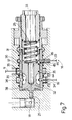
- the position sensor 42 comprises two permanent magnets 44 and 45, which are embedded in the sliding component 32 and are arranged at a distance from one another along the axis 33 that is equal to the difference between the strokes of the slide valve 32 required respectively to open and close the holes 35 and 34.
- the sensor 42 comprises a detector 46 arranged along the sleeve 31 in order to detect the opening of the hole 35 and the closure of the hole 34 in the stroke moving from left to right in Figure 7 and vice versa in the stroke moving from right to left.
- the geometry of the distributor 16 ensures that the connection between the branch 9 and the branch 19 begins after the slide valve 32 has been displaced by a first amount and is brought to an end after the slide valve 32 has been displaced by a second amount.
- the detector 46 detects the passage of the magnet 45 (first amount of displacement), which corresponds to the opening of the open cross-section, and the passage of the magnet 44, which corresponds to the closure of the open cross-section during displacement from P1 to P4.
- the order of detection is reversed on a return displacement from P4 to P1.
- the sensor 43 takes the form of an accelerometer which detects the impact that occurs when the valve 2 comes back into contact with the respective seat 2A.
- the sensor 43 can also be a detonation sensor, the signal from which, when detected and filtered, is correlated with the impact velocity V I for each valve 2.
- V I the impact velocity
- the unit 40 besides controlling the electromagnet 23, also controls the pressure regulators 11 and 12 and the open cross-section of the variable cross-section orifice 22.
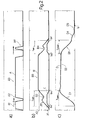
- Parts a), b) and c) are aligned in such a manner that their respective time scales are in phase throughout parts a), b) and c). In this manner, it is possible to compare the relationships between the positions of the selector 15, the distributor 16, the effect of the position of the distributor 16 on the open cross-section, and the position of the valve 2.
- the valve 2 has a predetermined time t open that is necessary to open the valve 2 and a predetermined time t close that is necessary to close the valve 2, at least in part, which times are substantially constant and are determined by the equivalent mass and rigidity of the system, the system being taken to comprise the assembly formed by the piston 28, the valve 2, the spring 29 and the oil contained in the cylinder 27.
- the times t open and t close are influenced by the characteristics of the oil and are obtained experimentally.
- the opening time of the open cross-section must correspond to t open during the opening phase of the valve 2 and to the time t close during the closing phase of the valve 2.
- the times t open and t close are substantially equal to half the first oscillation period of a system defined by the valve 2, the piston 28, the spring 29 and the oil.
- the operating position P3 of the distributor 16 is not a stable position and, therefore, without detecting the position of the slide valve 32, it is not possible to detect the opening time of the open cross-section.
- the sensor 42 detects two points X1 and X2 of the curve B in order to determine the curve C of the open cross-section.
- the unit 40 detects the times t X1 and t X2 and calculates the time t spo , which is equal to the difference between t X2' and t X1' and represents the time that elapses between the detection of the two points X1 and X2: the time t spo accordingly corresponds to the opening time of the open cross-section during the opening phase of the valve 2 and can be defined as the actuation time of the actuator 17 during the opening phase of the valve 2.
- the unit 40 calculates the time t spc which elapses between the detection of the two points X2 and X1: the time t spc is equal to the difference between the times t X1 and t X2 , and corresponds to the opening time of the open cross-section during the closing phase of the valve 2, which can be defined as the actuation time of the actuator 17 during the closing phase of the valve 2.
- the unit 40 subsequently calculates the respective differences between the values for t spo and t spc and the values for t open and t close and outputs respective error signals E o and E c when the calculated differences exceed defined threshold values H and K.
- the selector 15 operates according to a cycle in which change from the position shown in Figure 1 to the position in which the branches 10 and 18 are connected defines the opening of the valve 2, holding of the connection between the branches 10 and 18 defines the valve 2 being held in the open position and breaking of the connection between the branches 10 and 18 defines the closure of the valve 2.
- the unit 40 displaces the selector 15 (portion A1 of the curve A), in order to open the valve (portion B1 of the curve B of the distributor 16 and portions D1 of the curve D of the valve 2). Subsequently, in the presence of an error signal E o , the unit 40 displaces the selector 15 (portion A2 of the curve A) in order to break the connection between the branches 10 and 18 temporarily during the opening phase of the valve 2 after the point X1 has been detected and before the point X2 has been detected in order to delay the closure of the open port and to synchronise the time t spo with the time t open .
- the distributor 16 oscillates (portion B2 of the curve B) in the connection position between the branches 9 and 19.
- valve 2 portion D2 of the curve D, Figure 2 c)
- selector 15 remains in the connection position between the branches 10 and 18 (portion A3 of the curve A of the curve 2a)), such that the distributor 16 is arranged in the operating position P4 (portion B3 of the curve B, Figure 2 b)).
- the unit 40 In the presence of error signal E c , the unit 40 temporarily connects the branch 10 to the branch 18 (portion A4 of the curve A, Figure 2 a) during the closing phase of the valve 2 after the point X2 has been detected and before the point X1 has been detected in order to delay the closure of the open port.
- the distributor 16 oscillates during the closing phase in a position of connection between the branches 9 and 19.
- the selector 15 is actuated after t X1 has been detected in order to cut off the branches 10 and 18 temporarily and to vary the connection time t spo during the opening phase.
- a temporary cut-off can be performed before the moment t X1 in order to achieve the same aim.
- the unit 40 calculates the error signals E o and E c and optionally controls the times T spo and T spc in the above-described manner in the subsequent cycle, adjusting the displacement of the distributor 16 as a function of the times t open and t close .
- the system is also capable of operating in open-loop mode according to a predetermined cycle that provides for the position of the selector 15 to be varied in order to control the connection times t spo and t spc .
- the branch 19 performs not only the function of a delivery branch, but also that of a return branch.
- the distributor 16 reaches the operating position P1, in which the oil contained in the cylinder 27 is initially discharged through the opening 30 and the branch 20 (portion D4 of the curve D, Figure 2 c)). Displacement of the piston 28 during discharge of the oil to the tank 7 brings about progressive closure of the opening 30 and thus the residual oil contained in the cylinder 27 is discharged through the discharge branch 21 and the orifice 22 (portion D5 of the curve D, Figure 2 b)).
- the orifice 22 has the function of slowing the closure of the valve 2 and maintaining a substantially constant closing velocity.
- the unit 40 is capable of varying the open cross-section of the orifice 22 so as to control the closing velocity.
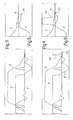
- the curve F is shown relating to the velocity of the valve 2.
- the final portion F1 of the curve F comprises a substantially horizontal portion indicating the constant velocity (approx. 0.35 m/s) and a substantially vertical portion that indicates the impact (abrupt deceleration).
- the selector 15 is activated for a moment during the approach phase of the valve 2 in such a manner as to modify the final portion F2 of the curve F. This has the effect of reducing the velocity to approx. 0.05 m/s in order to reduce the impact.
- the sensor 43 detects the impact velocity V I and the moment t c at which the valve 2 is closed in its respective seat 2A.
- the unit 40 captures the value of the impact velocity V I and calculates the nominal impact velocity V N , which is a function of the rotational speed RPM of the engine M: at low rotational speeds RPM, low impact velocities V I are preferable, while at high rotational speeds, higher impact velocities V I can be tolerated.
- the control unit 40 calculates the difference between the impact velocity V I and the nominal velocity V N .
- the unit 40 calculates and outputs an error signal E V and actuates the electromagnet 23 for a short moment during the final closure phase of the valve 2 in order to displace the distributor 16 from the operating position P1 and to cut off discharge from the cylinder 27. In some cases, it could be necessary not only to cut off discharge, but even to deliver pressurised oil into the actuator 17 during the discharge phase in order to achieve more consistent deceleration.
- the pulse is delivered immediately before the moment t c detected in the preceding cycle.
- control of the electromagnet 23 permits two main adjustments: synchronisation of the motion of the slide valve 32 with the motion of the valve 2: namely synchronisation of the connection times t spo and t spc between the branches 9 and 19 with the times t open and t close characteristic of the opening and closure of the valve 2 in order to effect efficient opening and closure of the valve 2 and energy recovery and deceleration of the closing velocity of the valve 2 in order to minimise the impact velocity V I of the valve 2.
- synchronisation of the motion of the slide valve 32 with the motion of the valve 2 namely synchronisation of the connection times t spo and t spc between the branches 9 and 19 with the times t open and t close characteristic of the opening and closure of the valve 2 in order to effect efficient opening and closure of the valve 2 and energy recovery and deceleration of the closing velocity of the valve 2 in order to minimise the impact velocity V I of the valve 2.
- synchronisation of the motion of the slide valve 32 with the motion of the valve 2 namely synchronisation of the connection times
- connection times t spo and t spc substantially correspond to the predetermined times t open and t close .
- dissipative operation is implemented by requiring that the connection times t spo and t spc differ substantially from the predetermined times t open and t close .
- the sensor 41 detects the oil temperature T and the unit 40 calculates the threshold values K and H as a function of the temperature T: the values of K and H will be closer to zero, the higher is the oil temperature T. In this manner, operation with energy recovery and operation with energy dissipation as a function of oil temperature T are implemented using the same control cycle.
- an operating mode is shown in which the distributor 16 occupies only the operating positions P1 and P2 during a cycle of the valve 2. Essentially, by controlling the selector 15, it is possible to achieve limited displacement of the distributor 16 so as to keep the distributor 16 in the position P2. In practice, the control unit 40 captures the moment t X1 and subsequently controls the selector 15 so as to avoid exceeding the point X2 and, subsequently, detects the moment t X1' which corresponds to the closing time of the connection between the branch 9 and the hydraulic actuator 17.
- the unit 40 calculates the connection time t spoc as the difference between the times tx1' and tx1 and compares the time t spoc with a predetermined time t oc characteristic of the system as defined above: in this case, t oc takes account of the opening and partial closure phase of the valve 2 and is substantially equal to the previously defined oscillation period of the system.
- t oc takes account of the opening and partial closure phase of the valve 2 and is substantially equal to the previously defined oscillation period of the system.
- the unit 40 outputs an error signal E oc , which is used in the subsequent cycle to control the selector 15 and to correct the time t spoc .
- the threshold value J is also a function of the oil temperature T, as described above in relation to the threshold values H and K so as to achieve operation with energy recovery and dissipative operation. Moreover, in this case too, it is possible to operate in both closed-loop and open-loop mode.
- control unit 40 includes regulating the pressure in the branch 9 by means of the pressure regulator 11 and so varying the maximum opening of the valve 2, and regulating the pressure in the branch 10 by means of the pressure regulator 12 and varying the control pressure of the distributor 16 and obtaining different dynamic behaviour of the distributor 16.
Landscapes
- Engineering & Computer Science (AREA)
- Mechanical Engineering (AREA)
- General Engineering & Computer Science (AREA)
- Valve Device For Special Equipments (AREA)
- Fluid-Pressure Circuits (AREA)
- Lifting Devices For Agricultural Implements (AREA)
Priority Applications (1)
| Application Number | Priority Date | Filing Date | Title |
|---|---|---|---|
| PL04102847T PL1491730T3 (pl) | 2003-06-23 | 2004-06-21 | Sposób i urządzenie do sterowania elektrohydraulicznym urządzeniem uruchamiającym zawór w silniku spalinowym |
Applications Claiming Priority (2)
| Application Number | Priority Date | Filing Date | Title |
|---|---|---|---|
| ITBO20030388 | 2003-06-23 | ||
| IT000388A ITBO20030388A1 (it) | 2003-06-23 | 2003-06-23 | Metodo e dispositivo di controllo di un gruppo elettroidraulico |
Publications (2)
| Publication Number | Publication Date |
|---|---|
| EP1491730A1 true EP1491730A1 (fr) | 2004-12-29 |
| EP1491730B1 EP1491730B1 (fr) | 2008-12-03 |
Family
ID=33398039
Family Applications (1)
| Application Number | Title | Priority Date | Filing Date |
|---|---|---|---|
| EP04102847A Expired - Lifetime EP1491730B1 (fr) | 2003-06-23 | 2004-06-21 | Méthode et appareil pour contrôler une soupape électrohydraulique d'un moteur à combustion interne |
Country Status (10)
| Country | Link |
|---|---|
| US (1) | US7044092B2 (fr) |
| EP (1) | EP1491730B1 (fr) |
| CN (1) | CN100540855C (fr) |
| AT (1) | ATE416302T1 (fr) |
| BR (1) | BRPI0404869B1 (fr) |
| DE (1) | DE602004018064D1 (fr) |
| ES (1) | ES2316924T3 (fr) |
| IT (1) | ITBO20030388A1 (fr) |
| PL (1) | PL1491730T3 (fr) |
| PT (1) | PT1491730E (fr) |
Families Citing this family (5)
| Publication number | Priority date | Publication date | Assignee | Title |
|---|---|---|---|---|
| US7261070B2 (en) * | 2005-03-01 | 2007-08-28 | Jones James W | Linear fluid engine |
| DE102007025619B4 (de) * | 2007-06-01 | 2012-11-15 | Robert Bosch Gmbh | Verfahren und Vorrichtung zur Steuerung eines hydraulischen Stellers |
| US9863293B2 (en) * | 2012-08-01 | 2018-01-09 | GM Global Technology Operations LLC | Variable valve actuation system including an accumulator and a method for controlling the variable valve actuation system |
| DE102013207863A1 (de) * | 2013-04-30 | 2014-10-30 | Mahle International Gmbh | Vorrichtung zur Steuerung eines Gaswechselventils einer Brennkraftmaschine |
| DE102014002309B4 (de) * | 2014-02-19 | 2016-01-07 | Hydac Electronic Gmbh | Steuervorrichtung |
Citations (6)
| Publication number | Priority date | Publication date | Assignee | Title |
|---|---|---|---|---|
| DE3741214A1 (de) * | 1987-12-05 | 1989-06-15 | Martin Roth | Regelbare hydraulische ventilsteuerung fuer hubkolbenkraft- oder arbeitsmaschinen |
| EP0647770A2 (fr) * | 1991-06-24 | 1995-04-12 | Ford Motor Company Limited | Dispositif de commande hydraulique de soupapes pour un moteur à combustion interne |
| EP1233152A1 (fr) | 2001-02-20 | 2002-08-21 | MAGNETI MARELLI POWERTRAIN S.p.A. | Dispositif électro-hydraulique de commande de soupapes de moteur à combustion interne |
| US20020157650A1 (en) * | 2000-02-16 | 2002-10-31 | Herman Gaessler | Method and circuit system for operating a solenoid valve |
| WO2003008794A2 (fr) | 2000-12-20 | 2003-01-30 | Siemens Vdo Automotive Corporation | Module air-carburant |
| US6581557B1 (en) * | 1999-12-30 | 2003-06-24 | Robert Bosch Gmbh | Valve control for an internal combustion engine |
Family Cites Families (3)
| Publication number | Priority date | Publication date | Assignee | Title |
|---|---|---|---|---|
| US6739293B2 (en) * | 2000-12-04 | 2004-05-25 | Sturman Industries, Inc. | Hydraulic valve actuation systems and methods |
| US6827050B2 (en) * | 2001-12-21 | 2004-12-07 | Caterpillar Inc | Fluid control valve actuating system |
| US6886510B2 (en) * | 2003-04-02 | 2005-05-03 | General Motors Corporation | Engine valve actuator assembly with dual hydraulic feedback |
-
2003
- 2003-06-23 IT IT000388A patent/ITBO20030388A1/it unknown
-
2004
- 2004-06-21 AT AT04102847T patent/ATE416302T1/de not_active IP Right Cessation
- 2004-06-21 EP EP04102847A patent/EP1491730B1/fr not_active Expired - Lifetime
- 2004-06-21 DE DE602004018064T patent/DE602004018064D1/de not_active Expired - Lifetime
- 2004-06-21 PL PL04102847T patent/PL1491730T3/pl unknown
- 2004-06-21 ES ES04102847T patent/ES2316924T3/es not_active Expired - Lifetime
- 2004-06-21 PT PT04102847T patent/PT1491730E/pt unknown
- 2004-06-22 US US10/873,728 patent/US7044092B2/en not_active Expired - Lifetime
- 2004-06-23 BR BRPI0404869-5A patent/BRPI0404869B1/pt not_active IP Right Cessation
- 2004-06-23 CN CNB200410061619XA patent/CN100540855C/zh not_active Expired - Fee Related
Patent Citations (6)
| Publication number | Priority date | Publication date | Assignee | Title |
|---|---|---|---|---|
| DE3741214A1 (de) * | 1987-12-05 | 1989-06-15 | Martin Roth | Regelbare hydraulische ventilsteuerung fuer hubkolbenkraft- oder arbeitsmaschinen |
| EP0647770A2 (fr) * | 1991-06-24 | 1995-04-12 | Ford Motor Company Limited | Dispositif de commande hydraulique de soupapes pour un moteur à combustion interne |
| US6581557B1 (en) * | 1999-12-30 | 2003-06-24 | Robert Bosch Gmbh | Valve control for an internal combustion engine |
| US20020157650A1 (en) * | 2000-02-16 | 2002-10-31 | Herman Gaessler | Method and circuit system for operating a solenoid valve |
| WO2003008794A2 (fr) | 2000-12-20 | 2003-01-30 | Siemens Vdo Automotive Corporation | Module air-carburant |
| EP1233152A1 (fr) | 2001-02-20 | 2002-08-21 | MAGNETI MARELLI POWERTRAIN S.p.A. | Dispositif électro-hydraulique de commande de soupapes de moteur à combustion interne |
Also Published As
| Publication number | Publication date |
|---|---|
| CN1573031A (zh) | 2005-02-02 |
| EP1491730B1 (fr) | 2008-12-03 |
| US20050022759A1 (en) | 2005-02-03 |
| PL1491730T3 (pl) | 2009-04-30 |
| PT1491730E (pt) | 2009-02-02 |
| BRPI0404869B1 (pt) | 2012-10-02 |
| DE602004018064D1 (de) | 2009-01-15 |
| BRPI0404869A (pt) | 2005-02-22 |
| CN100540855C (zh) | 2009-09-16 |
| ITBO20030388A1 (it) | 2004-12-24 |
| US7044092B2 (en) | 2006-05-16 |
| ES2316924T3 (es) | 2009-04-16 |
| ATE416302T1 (de) | 2008-12-15 |
Similar Documents
| Publication | Publication Date | Title |
|---|---|---|
| US6584885B2 (en) | Variable lift actuator | |
| EP1491732B1 (fr) | Méthode et dispositif pour contrôler la vitesse des soupapes dans un moteur à combustion | |
| EP0925439A2 (fr) | Systeme de soupapes sans came a commande hydraulique, destine a un moteur a combustion interne | |
| WO2009022210A2 (fr) | Dispositif de commande pour moteur à combustion interne équipé d'un turbocompresseur | |
| US6510037B1 (en) | Method for monitoring an electromagnetic actuator | |
| EP1491730B1 (fr) | Méthode et appareil pour contrôler une soupape électrohydraulique d'un moteur à combustion interne | |
| EP3283738B1 (fr) | Actionneur pour déplacement axial d'un objet | |
| EP1617061A1 (fr) | Regulateur du regime de ralenti d'un moteur a combustion interne, regulateur de moteur a combustion et moteur a combustion interne | |
| EP1491731B1 (fr) | Actionneur électrohydraulique de soupape d'un moteur à combustion interne | |
| EP1918573B1 (fr) | Appareil d'injection de carburant pour moteurs | |
| US20220042428A1 (en) | Hydraulic Drive for Accelerating and Braking Dynamically Moving Components | |
| EP3283737B1 (fr) | Actionneur pneumatique destiné à une soupape de moteur | |
| EP1607593B1 (fr) | Méthode et dispositif de commande d'une soupape d'échappement | |
| US6675751B1 (en) | Two-mass bi-directional hydraulic damper | |
| CN100432378C (zh) | 产生压力脉冲的方法、压力脉冲发生器和设置有所述发生器的活塞式发动机 | |
| EP1491733B1 (fr) | Méthode et dispositif de commande pour moteur à combustion interne | |
| US20150369093A1 (en) | Variable electrohydraulic valve control system | |
| EP2206940A1 (fr) | Actionneur de soupape | |
| SE526975C2 (sv) | Metod för generering av tryckpulser, tryckpulsgenerator och en med en sådan försedd kolvmotor | |
| EP3901426B1 (fr) | Dispositif de commande des soupapes et moteur | |
| US20040101420A1 (en) | Solenoid regulated pump assembly | |
| WO2015155407A1 (fr) | Vanne de commande d'écoulement et procédé pour actionner une vanne de commande d'écoulement | |
| JP3796793B2 (ja) | 燃料噴射ポンプのタイマ装置 |
Legal Events
| Date | Code | Title | Description |
|---|---|---|---|
| PUAI | Public reference made under article 153(3) epc to a published international application that has entered the european phase |
Free format text: ORIGINAL CODE: 0009012 |
|
| AK | Designated contracting states |
Kind code of ref document: A1 Designated state(s): AT BE BG CH CY CZ DE DK EE ES FI FR GB GR HU IE IT LI LU MC NL PL PT RO SE SI SK TR |
|
| AX | Request for extension of the european patent |
Extension state: AL HR LT LV MK |
|
| 17P | Request for examination filed |
Effective date: 20050624 |
|
| AKX | Designation fees paid |
Designated state(s): AT BE BG CH CY CZ DE DK EE ES FI FR GB GR HU IE IT LI LU MC NL PL PT RO SE SI SK TR |
|
| GRAP | Despatch of communication of intention to grant a patent |
Free format text: ORIGINAL CODE: EPIDOSNIGR1 |
|
| GRAS | Grant fee paid |
Free format text: ORIGINAL CODE: EPIDOSNIGR3 |
|
| GRAA | (expected) grant |
Free format text: ORIGINAL CODE: 0009210 |
|
| AK | Designated contracting states |
Kind code of ref document: B1 Designated state(s): AT BE BG CH CY CZ DE DK EE ES FI FR GB GR HU IE IT LI LU MC NL PL PT RO SE SI SK TR |
|
| REG | Reference to a national code |
Ref country code: GB Ref legal event code: FG4D |
|
| REG | Reference to a national code |
Ref country code: CH Ref legal event code: EP |
|
| REG | Reference to a national code |
Ref country code: IE Ref legal event code: FG4D |
|
| REF | Corresponds to: |
Ref document number: 602004018064 Country of ref document: DE Date of ref document: 20090115 Kind code of ref document: P |
|
| REG | Reference to a national code |
Ref country code: PT Ref legal event code: SC4A Free format text: AVAILABILITY OF NATIONAL TRANSLATION Effective date: 20090120 |
|
| REG | Reference to a national code |
Ref country code: SE Ref legal event code: TRGR |
|
| REG | Reference to a national code |
Ref country code: ES Ref legal event code: FG2A Ref document number: 2316924 Country of ref document: ES Kind code of ref document: T3 |
|
| REG | Reference to a national code |
Ref country code: PL Ref legal event code: T3 |
|
| NLV1 | Nl: lapsed or annulled due to failure to fulfill the requirements of art. 29p and 29m of the patents act | ||
| PG25 | Lapsed in a contracting state [announced via postgrant information from national office to epo] |
Ref country code: SI Free format text: LAPSE BECAUSE OF FAILURE TO SUBMIT A TRANSLATION OF THE DESCRIPTION OR TO PAY THE FEE WITHIN THE PRESCRIBED TIME-LIMIT Effective date: 20081203 Ref country code: NL Free format text: LAPSE BECAUSE OF FAILURE TO SUBMIT A TRANSLATION OF THE DESCRIPTION OR TO PAY THE FEE WITHIN THE PRESCRIBED TIME-LIMIT Effective date: 20081203 Ref country code: FI Free format text: LAPSE BECAUSE OF FAILURE TO SUBMIT A TRANSLATION OF THE DESCRIPTION OR TO PAY THE FEE WITHIN THE PRESCRIBED TIME-LIMIT Effective date: 20081203 |
|
| PG25 | Lapsed in a contracting state [announced via postgrant information from national office to epo] |
Ref country code: RO Free format text: LAPSE BECAUSE OF FAILURE TO SUBMIT A TRANSLATION OF THE DESCRIPTION OR TO PAY THE FEE WITHIN THE PRESCRIBED TIME-LIMIT Effective date: 20081203 Ref country code: BG Free format text: LAPSE BECAUSE OF FAILURE TO SUBMIT A TRANSLATION OF THE DESCRIPTION OR TO PAY THE FEE WITHIN THE PRESCRIBED TIME-LIMIT Effective date: 20090303 Ref country code: EE Free format text: LAPSE BECAUSE OF FAILURE TO SUBMIT A TRANSLATION OF THE DESCRIPTION OR TO PAY THE FEE WITHIN THE PRESCRIBED TIME-LIMIT Effective date: 20081203 Ref country code: BE Free format text: LAPSE BECAUSE OF FAILURE TO SUBMIT A TRANSLATION OF THE DESCRIPTION OR TO PAY THE FEE WITHIN THE PRESCRIBED TIME-LIMIT Effective date: 20081203 |
|
| PG25 | Lapsed in a contracting state [announced via postgrant information from national office to epo] |
Ref country code: AT Free format text: LAPSE BECAUSE OF FAILURE TO SUBMIT A TRANSLATION OF THE DESCRIPTION OR TO PAY THE FEE WITHIN THE PRESCRIBED TIME-LIMIT Effective date: 20081203 Ref country code: CZ Free format text: LAPSE BECAUSE OF FAILURE TO SUBMIT A TRANSLATION OF THE DESCRIPTION OR TO PAY THE FEE WITHIN THE PRESCRIBED TIME-LIMIT Effective date: 20081203 |
|
| PGFP | Annual fee paid to national office [announced via postgrant information from national office to epo] |
Ref country code: PL Payment date: 20090605 Year of fee payment: 6 Ref country code: PT Payment date: 20090604 Year of fee payment: 6 Ref country code: SE Payment date: 20090623 Year of fee payment: 6 |
|
| PG25 | Lapsed in a contracting state [announced via postgrant information from national office to epo] |
Ref country code: SK Free format text: LAPSE BECAUSE OF FAILURE TO SUBMIT A TRANSLATION OF THE DESCRIPTION OR TO PAY THE FEE WITHIN THE PRESCRIBED TIME-LIMIT Effective date: 20081203 |
|
| PLBE | No opposition filed within time limit |
Free format text: ORIGINAL CODE: 0009261 |
|
| STAA | Information on the status of an ep patent application or granted ep patent |
Free format text: STATUS: NO OPPOSITION FILED WITHIN TIME LIMIT |
|
| PG25 | Lapsed in a contracting state [announced via postgrant information from national office to epo] |
Ref country code: DK Free format text: LAPSE BECAUSE OF FAILURE TO SUBMIT A TRANSLATION OF THE DESCRIPTION OR TO PAY THE FEE WITHIN THE PRESCRIBED TIME-LIMIT Effective date: 20081203 |
|
| PGFP | Annual fee paid to national office [announced via postgrant information from national office to epo] |
Ref country code: ES Payment date: 20090630 Year of fee payment: 6 |
|
| 26N | No opposition filed |
Effective date: 20090904 |
|
| PGFP | Annual fee paid to national office [announced via postgrant information from national office to epo] |
Ref country code: GB Payment date: 20090618 Year of fee payment: 6 |
|
| PG25 | Lapsed in a contracting state [announced via postgrant information from national office to epo] |
Ref country code: MC Free format text: LAPSE BECAUSE OF NON-PAYMENT OF DUE FEES Effective date: 20090630 |
|
| REG | Reference to a national code |
Ref country code: CH Ref legal event code: PL |
|
| REG | Reference to a national code |
Ref country code: IE Ref legal event code: MM4A |
|
| PG25 | Lapsed in a contracting state [announced via postgrant information from national office to epo] |
Ref country code: LI Free format text: LAPSE BECAUSE OF NON-PAYMENT OF DUE FEES Effective date: 20090630 Ref country code: CH Free format text: LAPSE BECAUSE OF NON-PAYMENT OF DUE FEES Effective date: 20090630 Ref country code: IE Free format text: LAPSE BECAUSE OF NON-PAYMENT OF DUE FEES Effective date: 20090621 |
|
| PG25 | Lapsed in a contracting state [announced via postgrant information from national office to epo] |
Ref country code: GR Free format text: LAPSE BECAUSE OF FAILURE TO SUBMIT A TRANSLATION OF THE DESCRIPTION OR TO PAY THE FEE WITHIN THE PRESCRIBED TIME-LIMIT Effective date: 20090304 |
|
| REG | Reference to a national code |
Ref country code: PT Ref legal event code: MM4A Free format text: LAPSE DUE TO NON-PAYMENT OF FEES Effective date: 20101221 |
|
| EUG | Se: european patent has lapsed | ||
| GBPC | Gb: european patent ceased through non-payment of renewal fee |
Effective date: 20100621 |
|
| PG25 | Lapsed in a contracting state [announced via postgrant information from national office to epo] |
Ref country code: PT Free format text: LAPSE BECAUSE OF NON-PAYMENT OF DUE FEES Effective date: 20101221 |
|
| PG25 | Lapsed in a contracting state [announced via postgrant information from national office to epo] |
Ref country code: IT Free format text: LAPSE BECAUSE OF FAILURE TO SUBMIT A TRANSLATION OF THE DESCRIPTION OR TO PAY THE FEE WITHIN THE PRESCRIBED TIME-LIMIT Effective date: 20081203 |
|
| PG25 | Lapsed in a contracting state [announced via postgrant information from national office to epo] |
Ref country code: LU Free format text: LAPSE BECAUSE OF NON-PAYMENT OF DUE FEES Effective date: 20090621 |
|
| PG25 | Lapsed in a contracting state [announced via postgrant information from national office to epo] |
Ref country code: HU Free format text: LAPSE BECAUSE OF FAILURE TO SUBMIT A TRANSLATION OF THE DESCRIPTION OR TO PAY THE FEE WITHIN THE PRESCRIBED TIME-LIMIT Effective date: 20090604 |
|
| REG | Reference to a national code |
Ref country code: ES Ref legal event code: FD2A Effective date: 20110715 |
|
| PG25 | Lapsed in a contracting state [announced via postgrant information from national office to epo] |
Ref country code: ES Free format text: LAPSE BECAUSE OF NON-PAYMENT OF DUE FEES Effective date: 20110705 Ref country code: GB Free format text: LAPSE BECAUSE OF NON-PAYMENT OF DUE FEES Effective date: 20100621 |
|
| PG25 | Lapsed in a contracting state [announced via postgrant information from national office to epo] |
Ref country code: TR Free format text: LAPSE BECAUSE OF FAILURE TO SUBMIT A TRANSLATION OF THE DESCRIPTION OR TO PAY THE FEE WITHIN THE PRESCRIBED TIME-LIMIT Effective date: 20081203 |
|
| PG25 | Lapsed in a contracting state [announced via postgrant information from national office to epo] |
Ref country code: ES Free format text: LAPSE BECAUSE OF NON-PAYMENT OF DUE FEES Effective date: 20100622 Ref country code: CY Free format text: LAPSE BECAUSE OF FAILURE TO SUBMIT A TRANSLATION OF THE DESCRIPTION OR TO PAY THE FEE WITHIN THE PRESCRIBED TIME-LIMIT Effective date: 20081203 |
|
| REG | Reference to a national code |
Ref country code: PL Ref legal event code: LAPE |
|
| PG25 | Lapsed in a contracting state [announced via postgrant information from national office to epo] |
Ref country code: PL Free format text: LAPSE BECAUSE OF NON-PAYMENT OF DUE FEES Effective date: 20100621 |
|
| PG25 | Lapsed in a contracting state [announced via postgrant information from national office to epo] |
Ref country code: SE Free format text: LAPSE BECAUSE OF NON-PAYMENT OF DUE FEES Effective date: 20100622 |
|
| REG | Reference to a national code |
Ref country code: FR Ref legal event code: PLFP Year of fee payment: 12 |
|
| REG | Reference to a national code |
Ref country code: FR Ref legal event code: PLFP Year of fee payment: 13 |
|
| REG | Reference to a national code |
Ref country code: FR Ref legal event code: PLFP Year of fee payment: 14 |
|
| REG | Reference to a national code |
Ref country code: FR Ref legal event code: PLFP Year of fee payment: 15 |
|
| REG | Reference to a national code |
Ref country code: DE Ref legal event code: R079 Ref document number: 602004018064 Country of ref document: DE Free format text: PREVIOUS MAIN CLASS: F01L0009020000 Ipc: F01L0009100000 |
|
| PGFP | Annual fee paid to national office [announced via postgrant information from national office to epo] |
Ref country code: FR Payment date: 20220519 Year of fee payment: 19 Ref country code: DE Payment date: 20220518 Year of fee payment: 19 |
|
| REG | Reference to a national code |
Ref country code: DE Ref legal event code: R119 Ref document number: 602004018064 Country of ref document: DE |
|
| PG25 | Lapsed in a contracting state [announced via postgrant information from national office to epo] |
Ref country code: DE Free format text: LAPSE BECAUSE OF NON-PAYMENT OF DUE FEES Effective date: 20240103 |
|
| PG25 | Lapsed in a contracting state [announced via postgrant information from national office to epo] |
Ref country code: FR Free format text: LAPSE BECAUSE OF NON-PAYMENT OF DUE FEES Effective date: 20230630 |