EP1491780A2 - Einrichtungskabelspanner für Fensterheber - Google Patents
Einrichtungskabelspanner für Fensterheber Download PDFInfo
- Publication number
- EP1491780A2 EP1491780A2 EP04291570A EP04291570A EP1491780A2 EP 1491780 A2 EP1491780 A2 EP 1491780A2 EP 04291570 A EP04291570 A EP 04291570A EP 04291570 A EP04291570 A EP 04291570A EP 1491780 A2 EP1491780 A2 EP 1491780A2
- Authority
- EP
- European Patent Office
- Prior art keywords
- notch
- tensioner
- cable
- tensioner according
- members
- Prior art date
- Legal status (The legal status is an assumption and is not a legal conclusion. Google has not performed a legal analysis and makes no representation as to the accuracy of the status listed.)
- Withdrawn
Links
- 210000000056 organ Anatomy 0.000 claims abstract description 15
- 230000000903 blocking effect Effects 0.000 claims abstract description 5
- 230000000149 penetrating effect Effects 0.000 claims 1
- 230000002427 irreversible effect Effects 0.000 abstract description 8
- 210000002105 tongue Anatomy 0.000 description 8
- 230000001681 protective effect Effects 0.000 description 6
- 230000000694 effects Effects 0.000 description 2
- 238000000605 extraction Methods 0.000 description 2
- 238000004519 manufacturing process Methods 0.000 description 2
- 230000002441 reversible effect Effects 0.000 description 2
- 230000003247 decreasing effect Effects 0.000 description 1
- 238000006073 displacement reaction Methods 0.000 description 1
- 239000004519 grease Substances 0.000 description 1
- 238000003780 insertion Methods 0.000 description 1
- 230000037431 insertion Effects 0.000 description 1
- 238000007747 plating Methods 0.000 description 1
- 238000010079 rubber tapping Methods 0.000 description 1
- 238000004804 winding Methods 0.000 description 1
Images

Classifications
-
- E—FIXED CONSTRUCTIONS
- E05—LOCKS; KEYS; WINDOW OR DOOR FITTINGS; SAFES
- E05F—DEVICES FOR MOVING WINGS INTO OPEN OR CLOSED POSITION; CHECKS FOR WINGS; WING FITTINGS NOT OTHERWISE PROVIDED FOR, CONCERNED WITH THE FUNCTIONING OF THE WING
- E05F11/00—Man-operated mechanisms for operating wings, including those which also operate the fastening
- E05F11/38—Man-operated mechanisms for operating wings, including those which also operate the fastening for sliding windows, e.g. vehicle windows, to be opened or closed by vertical movement
- E05F11/48—Man-operated mechanisms for operating wings, including those which also operate the fastening for sliding windows, e.g. vehicle windows, to be opened or closed by vertical movement operated by cords or chains or other flexible elongated pulling elements, e.g. tapes
- E05F11/481—Man-operated mechanisms for operating wings, including those which also operate the fastening for sliding windows, e.g. vehicle windows, to be opened or closed by vertical movement operated by cords or chains or other flexible elongated pulling elements, e.g. tapes for vehicle windows
- E05F11/483—Man-operated mechanisms for operating wings, including those which also operate the fastening for sliding windows, e.g. vehicle windows, to be opened or closed by vertical movement operated by cords or chains or other flexible elongated pulling elements, e.g. tapes for vehicle windows by cables
- E05F11/485—Man-operated mechanisms for operating wings, including those which also operate the fastening for sliding windows, e.g. vehicle windows, to be opened or closed by vertical movement operated by cords or chains or other flexible elongated pulling elements, e.g. tapes for vehicle windows by cables with cable tensioners
-
- F—MECHANICAL ENGINEERING; LIGHTING; HEATING; WEAPONS; BLASTING
- F16—ENGINEERING ELEMENTS AND UNITS; GENERAL MEASURES FOR PRODUCING AND MAINTAINING EFFECTIVE FUNCTIONING OF MACHINES OR INSTALLATIONS; THERMAL INSULATION IN GENERAL
- F16C—SHAFTS; FLEXIBLE SHAFTS; ELEMENTS OR CRANKSHAFT MECHANISMS; ROTARY BODIES OTHER THAN GEARING ELEMENTS; BEARINGS
- F16C1/00—Flexible shafts; Mechanical means for transmitting movement in a flexible sheathing
- F16C1/10—Means for transmitting linear movement in a flexible sheathing, e.g. "Bowden-mechanisms"
- F16C1/22—Adjusting; Compensating length
-
- E—FIXED CONSTRUCTIONS
- E05—LOCKS; KEYS; WINDOW OR DOOR FITTINGS; SAFES
- E05Y—INDEXING SCHEME ASSOCIATED WITH SUBCLASSES E05D AND E05F, RELATING TO CONSTRUCTION ELEMENTS, ELECTRIC CONTROL, POWER SUPPLY, POWER SIGNAL OR TRANSMISSION, USER INTERFACES, MOUNTING OR COUPLING, DETAILS, ACCESSORIES, AUXILIARY OPERATIONS NOT OTHERWISE PROVIDED FOR, APPLICATION THEREOF
- E05Y2900/00—Application of doors, windows, wings or fittings thereof
- E05Y2900/50—Application of doors, windows, wings or fittings thereof for vehicles
- E05Y2900/53—Type of wing
- E05Y2900/55—Windows
-
- Y—GENERAL TAGGING OF NEW TECHNOLOGICAL DEVELOPMENTS; GENERAL TAGGING OF CROSS-SECTIONAL TECHNOLOGIES SPANNING OVER SEVERAL SECTIONS OF THE IPC; TECHNICAL SUBJECTS COVERED BY FORMER USPC CROSS-REFERENCE ART COLLECTIONS [XRACs] AND DIGESTS
- Y10—TECHNICAL SUBJECTS COVERED BY FORMER USPC
- Y10T—TECHNICAL SUBJECTS COVERED BY FORMER US CLASSIFICATION
- Y10T74/00—Machine element or mechanism
- Y10T74/20—Control lever and linkage systems
- Y10T74/20396—Hand operated
- Y10T74/20402—Flexible transmitter [e.g., Bowden cable]
- Y10T74/20408—Constant tension sustaining
Definitions
- the present invention relates to a cable tensioner and a window regulator comprising such a tensioner.
- the document EP-A-244 303 describes a screw-nut device subjected to an axial force alternates in both directions, the thread of the screw having determined helix and pressure angles, which are chosen so that in a first said reversible direction, the screw can, under the axial thrust exerted in this direction by a spring effect a translation and a rotation in the nut, and that in a second direction called irreversible, opposite to the first, the screw undergoing an axial thrust in this second direction by the pusher cannot carry out either translation or rotation in the nut.
- This set can be applied to the automatic backlash of systems subjected to alternating longitudinal forces such as shafts of electric motors or cable controls.
- the notch is retractable.
- the notch is retractable in one direction of rotation and is locking in the other direction of rotation.
- the tensioner further comprises a spring for biasing an organ with respect to the other organ.
- the members are a conduit and a tube, the tube being movable in translation along the conduit.
- the notch is retractable in the tube.
- the conduit includes a groove along the cable passage, the notch entering a groove.
- the notch has an inclined face extending tangentially to the tube.
- the notch has a stop extending radially to the tube.
- one of the members comprises two notches, the other member comprising grooves into which the notches penetrate.
- the notches have an angular difference which is not proportional to the angular difference of the grooves.
- the notches have an angular difference proportional to the angular difference of the grooves.
- the notch is carried by the conduit.
- the invention also relates to a window regulator comprising a tensioner according to one of the preceding variants.
- the invention relates to a cable tensioner comprising two members defining a cable passage, the members being movable relative to one another in a helical movement.
- the tensioner also comprises a notch authorizing the relative movement of the members in one direction but blocking the relative movement in another direction. The tensioner is thus irreversible, whatever the operating conditions.
- FIG. 1 shows a cable tensioner 10.
- the tensioner comprises elements such as a first member 12 and a second member 14.
- the members 12 and 14 define a cable passage along the axis 11.
- the two members 12 and 14 are movable relative to each other along the axis 11 in a relative helical movement.
- the relative movement increases the length of the cable passage, thus causing the cable tension.
- the increase in the length of the cable passage in Figure 1 is made by a movement of the second member 14 to the left.
- the tensioner is for example applicable in a cable window regulator.
- the window regulator cable extends in a protective sheath (not shown), one end of the sheath abutting against the member 14 from the left in FIG. 1. The movement of the second member 14 to the left requests the end of the sheath; the cable tray is thus increased, allowing conservation of the cable tension.
- FIG. 1 shows an embodiment according to which the first and second members are respectively a conduit 12 and a tube 14.
- the first member 12, in the form of a conduit, is bored over part of its length.
- the bore 26 extends from one end of the conduit 12 to a bottom 28.
- the bore 26 has a thread at least over part of its length.
- the tensioner 10 also comprises, on the other end of the conduit 12, a tubing 32 of diameter smaller than that of the conduit 12 and which extends along the axis 11.
- the tubing 32 allows better centering of the tensioner 10 around the cable along the axis 11, when the tensioner 10 is assembled on a window regulator.
- the tensioner also comprises a rib 34 along the axis 11 on the tube 32. The rib prevents the tensioner 10 from rotating around the axis 11 when it is assembled on the window regulator, for example on the motor plate.
- the second member 14, in the form of a tube, has a hole 30 opening out on either side of the tube 14.
- the hole 30 is divided into two parts 30a and 30b by an annular shoulder 31 allowing the passage of the cable along the 'axis 11.
- the part 30a allows the reception of the protective sheath which comes to bear against a face of the shoulder 31.
- the part 30a of the hole 30 thus allows immobilization of the sheath transversely to the axis 11.
- the part 30b of the hole is a sleeve allowing the reception of a spring 18 which will be described later.
- the tube 14 penetrates into the bore 26 of the conduit 12 and is movable along the axis 11.
- the helical movement can be obtained by means of a tapping 22, in the conduit 12, cooperating with the thread 24 around of the tube 14.
- the tube 14 is threaded through the opening of the bore 26 then is screwed into the bore 26.
- One face of the tube 14 can abut against the bottom 28 of the bore 26. This position in abutment corresponds to the position in which the cable is least stretched by the tensioner 10 (early life position).
- the tensioner 10 early life position
- the relative helical movement allows precise and continuous adjustment of the relative position of the two members. This avoids applying an overvoltage in the cable.
- the relative helical movement of the organs is composed of a relative movement of rotation and a relative movement of translation.
- Figure 1 also shows a notch 16.
- the notch 16 allows the relative movement of the members 12 and 14 in one direction and blocks the relative movement of the members in another direction.
- the notch 16 has the effect of making the movement of one of the members relative to the other irreversible, regardless of the operating conditions.
- the notch 16 blocks the movement of the second member 14 to the right, avoiding the reduction of the cable tray and the cable tension.
- the notch 16 prevents for example the protective sheath of the cable from causing the movement to the right in FIG. 1 of the second member 14.
- the notch 16 allows the rotation of the second member 14 only in one direction, thus allowing the translation of the second member only in one direction along the cable passage 11.
- the notch 16 is carried by the second member 14.
- the notch 16 penetrates into a groove 20 in the first member 12.
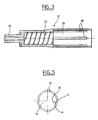
- FIG. 3 shows part of the tensioner 10, in this case the first member 12.
- the member 12 comprises the tubing 32, a first section comprising the internal thread 22 then a second section comprising a plurality of grooves 20.
- the grooves 20 extend along the axis 11.
- FIG. 4 shows a side view of the second member 14.
- the second member 14 carries the notch 16.
- the member 14 can carry several notches 16, two being shown in Figure 4.
- the second member 14 has a section with the thread 24 and a head 25.
- the notch 16 is supported by the head 25.
- the head 25 cooperates with the surface of the bore 26 of the member 12.
- the surfaces in contact with the head 25 and the bore 26 are preferably not threaded or tapped, contact between surfaces as slippery to facilitate the manufacture of these surfaces and to facilitate the cooperation of the notch 16 and a groove 20.
- the notch 16 projects from the side of the member 14, and in particular from the head 25.
- the notch 16 has an inclined face 36 and a stop 37; the inclined face 36 extends tangentially to the circumference of the head 25 and the stop 37 extends along a radius of the head 25.
- the notch 16 enters a groove 20.
- the inclined face 36 cooperates with a side of the groove; the notch 16 then authorizes the relative movement of the members 12, 14.
- the inclined surface 36 of the notch 16 slides against a side of the groove 20. The inclined surface 36 facilitates the extraction of the notch 16 out of the groove 20.
- the notch allows the rotation of the second member 14 relative to the first member 12 in one direction of rotation, but blocks the rotation in the other direction.
- the notch thus prevents rotation of the helical movement, thus blocking the translation of the helical movement.
- the notch 16 is an obstacle to the rotation of the second member 14 in a direction of rotation.
- the notch 16 makes the cable tensioner irreversible.
- the size of the notch 16 is chosen so as to be easily extracted from the groove 20 in a direction of rotation but also so as to immobilize the notch 16 in the groove 20, whatever the operating conditions.
- the engagement of the notch 16 in a groove 20 is carried out gradually; the engagement is then made without noise.
- the tensioner 10 therefore makes it possible to reduce the noise during its operation.
- the stiffness of the notch can be chosen to avoid clicking.
- the shape of the notch can be such that there is no contact with between the inclined surface 36 and the bore 26.
- the notch 16 can be retractable.
- the notch 16 is capable of being erased thus allowing the relative movement of the members in one direction, in this case that allowing the increase in the tension applied to the cable.
- the retraction of the notch 16 makes it possible to reduce the force applicable to the members 12, 14 to cause their relative displacement.
- the notch 16 is retractable in a direction of rotation allowing the relative movement of the members in one direction. In Figure 1, when the second member 14 undergoes a rotational movement causing a translation of the member to the left, the notch 16 is retracted.
- Figure 4 shows the second member 14 with the notch 16 which can be retractable.
- the notch 16 is produced in the form of an articulated tongue.
- the notch 16 can be produced at the free end of the head 25 to facilitate manufacture.
- Two slots 38, 39 are made, one 39 radially, the other 38 along the axis 11.
- the notch 16 is then articulated to the head 25 thus forming an articulated tongue.
- the slot 38 produced along the axis 11 is at the foot of the stop 37.
- Figure 5 shows another embodiment of the notch 16.
- Figure 5 is a section of the first member 12.
- the notch 16 is carried by the first member 12.
- the surface of the bore comprises the notch 16.
- the surface of the the bore 26 is the inclined face 36 and the stop 37 is made radially.
- the notch 16 has the shape of a step in the surface of the bore 26.
- the notch 16 cooperates with an articulated tongue of the second member 14.
- the head 25 of the second member 14 may have the slot 38 which extends along axis 11; the slot 38 then extends over the entire height of the head 25, along the axis 11. In FIG.
- the first member is shown in section, but the notch 16 extends over at least part of the length of the surface of the bore 26 along the axis 11.
- the notch 16 can be extend over the entire length of the bore.
- the groove 20 extends over at least part of the length of the bore 26.
- the groove 20 extends from the end of the bore 26 on the thread side 22 to near the free end of the bore.
- the groove 20 does not extend to the free end so as not to weaken the first member 12.
- the tensioner may include one or more notches 16 and one or more grooves 20.
- the number of notches 16 on the second member 14 and the number of grooves 20 on the first member 12 are chosen according to the precision of the tension to be applied to the cable. Combined with the helical movement, the more the number of notches and grooves increases, the more the precision of the tension in the cable increases. Furthermore, the presence of several notches 16 improves the irreversible nature of the tensioner 10.
- Figure 4 shows the presence of two notches 16.
- Figure 3 shows the presence of at least three grooves. The same angular distance can separate the grooves 20 between them and the notches 16 between them. The notches 16 then engage at the same time each in a groove, each of the notches 16 contributing to the irreversibility of the tensioner.
- the angular difference between the grooves 20 can be different from that present between the notches 16. This makes it possible to increase the precision of the play-up in the tension of the cable without considerably increasing the number of notches and grooves. The same applies to the number of notches 16 in the bore 26 and the number of tongues articulated on the head 25 can be made.
- the two members 12 and 14 are movable relative to each other by means of an elastic means. It is for example a spring 18 for biasing an organ with respect to the other organ.
- the spring 18 extends along the axis 11; it allows movement along the axis 11, and therefore along the cable passage, of a member with respect to the other.
- the spring 18 bears on the one hand against the shoulder 31 of the second member and on the other hand against the bottom 28 of the bore 26.
- the spring 18 is guided along the axis 11 by the part 30b forming a sleeve.
- the spring 18 extends partially in the part 30b which makes it possible to limit the axial size of the tensioner 10.
- the stiffness of the spring 18 is such that the force exerted along the axis 11 by the spring 18 on the shoulder 31 causes the movement of the second member 14 relative to the first member 12.
- the spring 18 causes the relative helical movement of the two members 12, 14.
- the second member 18 rotates around the axis 11 and translates to the left of FIG. 1.
- the notches 16 are extracted from a groove and engage in an angularly adjacent groove.
- the engaged notches 16 prevent the reverse movement of the second member by means of the stop 37.
- the notches 16 prevent the second member 14 from being moved by the cable protection sheath exerting a force along the axis 11 against the force of the spring.
- the notches 16 thus prevent the cable path and the cable tension from decreasing.
- the notch 16 also makes it possible to counter an excessive force of the protective sheath along the axis 11 which would tend to press the second member 14 against the bottom 28 of the bore 26 and reduce the tension applied to the cable. Such a plating being accompanied by a clicking noise, the tensioner 10 and the notch 16 make it possible to avoid such noise.
- Figure 2 shows a bore 40 in the second member 14.
- the bore 40 is for example radial and allows the insertion of a relative immobilization pin of the members 12, 14.
- the pin allows for example to keep the spring compressed 18 between the bottom 28 and the shoulder 31 when transporting the tensioner and assembling the tensioner in the window regulator.
- the pin is for example inserted through a groove 20 and into the bore 40. Once the tensioner is in place in the window regulator and the protective sheath inserted in the part 30a, the pin can be removed.
- the spring 18 relaxes moving the second member 14 and applying a tension in the cable.
- the invention also relates to a window regulator comprising such a tensioner 10.
- the window regulator comprises a cable passing through a protective sheath and traversing a cable tray.
- the sheath is in abutment at one of its ends against the second member 12 and can be at its end in abutment against another tensioner.
- the support is for example a cursor guide rail or a drum for winding the cable.
- the first member 12 is in abutment against the support and the second member 14 is moved relative to the first member 12.
- the movement of the second member arcs the sheath causing the tension of the cable, the notch or notches 16 making the tensioner irreversible.
- a play may be established; the tensioner makes it possible to make up for this play.
Landscapes
- Engineering & Computer Science (AREA)
- General Engineering & Computer Science (AREA)
- Health & Medical Sciences (AREA)
- Oral & Maxillofacial Surgery (AREA)
- Mechanical Engineering (AREA)
- Window Of Vehicle (AREA)
- Blinds (AREA)
- Flexible Shafts (AREA)
- Operating, Guiding And Securing Of Roll- Type Closing Members (AREA)
Applications Claiming Priority (2)
| Application Number | Priority Date | Filing Date | Title |
|---|---|---|---|
| FR0307820A FR2856766B1 (fr) | 2003-06-27 | 2003-06-27 | Tendeur de cable et leve-vitre avec le tendeur |
| FR0307820 | 2003-06-27 |
Publications (2)
| Publication Number | Publication Date |
|---|---|
| EP1491780A2 true EP1491780A2 (de) | 2004-12-29 |
| EP1491780A3 EP1491780A3 (de) | 2007-10-17 |
Family
ID=33396865
Family Applications (1)
| Application Number | Title | Priority Date | Filing Date |
|---|---|---|---|
| EP04291570A Withdrawn EP1491780A3 (de) | 2003-06-27 | 2004-06-22 | Einrichtungskabelspanner für Fensterheber |
Country Status (4)
| Country | Link |
|---|---|
| US (1) | US7325360B2 (de) |
| EP (1) | EP1491780A3 (de) |
| CN (1) | CN1576070B (de) |
| FR (1) | FR2856766B1 (de) |
Cited By (3)
| Publication number | Priority date | Publication date | Assignee | Title |
|---|---|---|---|---|
| EP2228553A1 (de) * | 2009-03-11 | 2010-09-15 | Melchor Daumal Castellon | Vorrichtung zur automatischen Korrektur der Kabellänge in Fensterhebermechanismen |
| US12083870B2 (en) * | 2020-10-28 | 2024-09-10 | Hi-Lex Corporation | Carrier plate and object movement device |
| US20240426157A1 (en) * | 2023-06-23 | 2024-12-26 | Inteva Products, Llc | Tensioner for window regulator |
Families Citing this family (10)
| Publication number | Priority date | Publication date | Assignee | Title |
|---|---|---|---|---|
| FR2857716B1 (fr) * | 2003-07-18 | 2005-09-09 | Arvinmeritor Light Vehicle Sys | Tendeur de cable de leve-vitre |
| FR2873418B1 (fr) * | 2004-07-22 | 2007-10-26 | Faurecia Sieges Automobile | Syteme d'ajustage de la longueur utile d'un cable de commande comportant un tel systeme et siege de vehicule automobile comportant un tel cable |
| DE102004054326B4 (de) * | 2004-11-10 | 2007-01-11 | FICO CABLES S.A. Technological Centre Pujol & Tarragó | Vorrichtung zur Einstellung der Vorspannung eine Zugelements |
| US20070135272A1 (en) * | 2005-12-08 | 2007-06-14 | Stuckey Michael L | Continous tensioning system for fitness apparatus |
| KR101371803B1 (ko) * | 2012-12-11 | 2014-03-07 | 현대자동차주식회사 | 미세 조절이 가능한 와이어 홀더 |
| FR3003510B1 (fr) * | 2013-03-21 | 2015-03-27 | Inteva Products France Sas | Arret de gaine pivotant pour gaine, support, rail de guidage, ensemble, leve-vitre, procede de montage correspondants |
| US9637969B2 (en) | 2014-08-07 | 2017-05-02 | Hi-Lex Controls, Inc. | Integrated window regulator assembly |
| KR102817730B1 (ko) * | 2023-02-07 | 2025-06-11 | 대동하이렉스 주식회사 | 자동차 프레임리스 도어 레귤레이터용 오토 텐셔너 |
| US12607058B2 (en) | 2024-09-16 | 2026-04-21 | Hsin Chong Machinery Works Co. Ltd. | Cable tensioner and window lifting device having the same |
| EP4711572A1 (de) * | 2024-09-17 | 2026-03-18 | Hsin Chong Machinery Works Co., Ltd. | Kabelspanner und fensterhebevorrichtung damit |
Citations (1)
| Publication number | Priority date | Publication date | Assignee | Title |
|---|---|---|---|---|
| EP0244303A1 (de) | 1986-04-30 | 1987-11-04 | Rockwell Automotive Body Systems-France En Abrege:Rockwell Abs-France | Schraubvorrichtung zur Spielbeseitigung |
Family Cites Families (20)
| Publication number | Priority date | Publication date | Assignee | Title |
|---|---|---|---|---|
| US742332A (en) * | 1903-04-11 | 1903-10-27 | John Kunny | Ratchet-clutch for drilling-swivels. |
| US1703947A (en) * | 1926-12-27 | 1929-03-05 | Nation Daniel Lathorn | Nut lock |
| US1722231A (en) * | 1927-06-18 | 1929-07-23 | Early R Penney | Locking device |
| US2220288A (en) * | 1940-06-24 | 1940-11-05 | Blaw Knox Co | Steamboat ratchet |
| US2730154A (en) * | 1951-07-23 | 1956-01-10 | Northrop Aircraft Inc | Self-locking fastener having longitudinal spring key detent means |
| US2930659A (en) * | 1958-03-03 | 1960-03-29 | George A Barber | Combined dust and grease seal and key retainer |
| US3157062A (en) * | 1962-02-08 | 1964-11-17 | Mite Corp | Compensator for chain wear |
| US3587341A (en) * | 1970-01-26 | 1971-06-28 | Theodore E Fiddler | Actuator cable adjustment device |
| US3759352A (en) * | 1971-05-12 | 1973-09-18 | Raleigh Industries Ltd | Cycle brake having brake adjusting mechanism |
| US4334438A (en) * | 1979-03-09 | 1982-06-15 | Nissan Motor Company, Limited | Clearance adjusting mechanism |
| US4274300A (en) * | 1979-09-24 | 1981-06-23 | Conchemco, Incorporated | Apparatus for automatically maintaining the tautness of a mechanical coupling between an actuatable device and an associated actuating mechanism |
| AU531159B2 (en) * | 1980-11-08 | 1983-08-11 | Honda Giken Kogyo Kabushiki Kaisha | Adjusting play in brake control wire |
| US4628759A (en) * | 1984-02-21 | 1986-12-16 | Nippon Cable System Inc. | Driving device employed in a window regulator |
| US4833937A (en) * | 1985-04-22 | 1989-05-30 | Shimano Industrial Company Limited | Adjusting device for a control cable for a bicycle |
| US4798100A (en) * | 1987-09-18 | 1989-01-17 | Babcock Industries Inc. | Automatic adjustment device for cable control systems |
| CN2120722U (zh) * | 1992-05-16 | 1992-11-04 | 孙伟 | 汽车门窗玻璃自动升降器 |
| ES2066681B1 (es) * | 1992-10-26 | 1997-05-01 | Fico Cables Sa | Dispositivo autoajustador de la longitud de cables de mando. |
| CA2187805C (en) * | 1995-02-13 | 2002-01-22 | Thomas Medebach | Device for automatically compensating the length of flexible cable control means, especially cable adjusters |
| DE19603893C1 (de) * | 1996-02-03 | 1996-11-28 | Brose Fahrzeugteile | Vorrichtung zum automatischen Seillängenausgleich eines Bowdenrohr-Fensterhebers |
| US6093892A (en) * | 1998-08-03 | 2000-07-25 | Hi-Lex Corporation | Conduit end fitting with automatic length adjustment |
-
2003
- 2003-06-27 FR FR0307820A patent/FR2856766B1/fr not_active Expired - Fee Related
-
2004
- 2004-06-22 EP EP04291570A patent/EP1491780A3/de not_active Withdrawn
- 2004-06-28 US US10/878,978 patent/US7325360B2/en not_active Expired - Fee Related
- 2004-06-28 CN CN2004100594909A patent/CN1576070B/zh not_active Expired - Fee Related
Patent Citations (1)
| Publication number | Priority date | Publication date | Assignee | Title |
|---|---|---|---|---|
| EP0244303A1 (de) | 1986-04-30 | 1987-11-04 | Rockwell Automotive Body Systems-France En Abrege:Rockwell Abs-France | Schraubvorrichtung zur Spielbeseitigung |
Cited By (5)
| Publication number | Priority date | Publication date | Assignee | Title |
|---|---|---|---|---|
| EP2228553A1 (de) * | 2009-03-11 | 2010-09-15 | Melchor Daumal Castellon | Vorrichtung zur automatischen Korrektur der Kabellänge in Fensterhebermechanismen |
| ES2387369A1 (es) * | 2009-03-11 | 2012-09-20 | Melchor Daumal Castellón | "dispositivo para la correcion automatica de la longitud de un cable en mecanismos elevalunas" |
| US12083870B2 (en) * | 2020-10-28 | 2024-09-10 | Hi-Lex Corporation | Carrier plate and object movement device |
| US20240426157A1 (en) * | 2023-06-23 | 2024-12-26 | Inteva Products, Llc | Tensioner for window regulator |
| US12571246B2 (en) * | 2023-06-23 | 2026-03-10 | Inteva Products, Llc | Tensioner for window regulator |
Also Published As
| Publication number | Publication date |
|---|---|
| US7325360B2 (en) | 2008-02-05 |
| CN1576070B (zh) | 2010-06-16 |
| FR2856766A1 (fr) | 2004-12-31 |
| US20040262442A1 (en) | 2004-12-30 |
| EP1491780A3 (de) | 2007-10-17 |
| CN1576070A (zh) | 2005-02-09 |
| FR2856766B1 (fr) | 2006-09-08 |
Similar Documents
| Publication | Publication Date | Title |
|---|---|---|
| FR2733292A1 (fr) | Dispositif tendeur de cable | |
| FR2753503A1 (fr) | Embrayage a friction a dispositif de rattrapage d'usure, notamment pour vehicule automobile | |
| FR2644542A1 (fr) | Dispositif tendeur a reglage par ressort | |
| WO2014146890A1 (fr) | Arret de gaine pivotant pour gaine, support, rail de guidage, ensemble, leve-vitre, procede de montage correspondants | |
| WO2003036116A2 (fr) | Embrayage a friction, pour vehicule automobile, equipe d'un dispositif de rattrapage de jeu pilote | |
| FR2600603A1 (fr) | Tendeur sur un enrouleur de ceinture de securite | |
| EP3816093A1 (de) | Selbstblockierende riemenscheibe | |
| EP0244303A1 (de) | Schraubvorrichtung zur Spielbeseitigung | |
| FR2950665A1 (fr) | Transmission entre un arbre primaire moteur et un arbre de sortie d'un engin automoteur | |
| WO2001088400A1 (fr) | Embrayage a friction a dispositif de rattrapage de jeu pilote pour vehicule automobile | |
| EP0022411A1 (de) | Verbesserungen in Schaltgetrieben, insbesondere zum Einlegen des Rückwärtsganges | |
| EP0926396B1 (de) | Spannvorrichtung, Motor mit einer derartigen Vorrichtung und Verfahren zum Einbau einer solchen Vorrichtung | |
| FR2864184A1 (fr) | Tendeur de cable | |
| FR3072433A1 (fr) | Boitier de transmission et engin roulant equipe d'un tel boitier | |
| JP3962817B2 (ja) | テンショナー | |
| FR2533985A1 (fr) | Outil portatif a transmission mecanique souple | |
| WO2010135847A1 (fr) | Dispositif d'enroulement d'un lien souple | |
| FR2658892A1 (fr) | Poulie menee d'une transmission a vitesse variable. | |
| EP2168867A1 (de) | Teleskopischer Stellantrieb mit Haupt- und Hilstriebstange | |
| EP0890307A1 (de) | Angelwinde mit hinten angebrachte Bremse und auswechselbare Reservespule | |
| EP0412918B1 (de) | Angelwinde mit entkoppelbarer Schnurrolle | |
| EP0451895B1 (de) | Rollenantriebsvorrichtung an einer Webmaschine | |
| WO2018015632A1 (fr) | Boitier de transmission et engin roulant equipe d'un tel boitier | |
| EP1310693A1 (de) | Synchronisiervorrichtung für ein Schaltgetriebe | |
| FR2750467A1 (fr) | Embrayage a friction a dispositif de rattrapage de jeu pour vehicule automobile |
Legal Events
| Date | Code | Title | Description |
|---|---|---|---|
| PUAI | Public reference made under article 153(3) epc to a published international application that has entered the european phase |
Free format text: ORIGINAL CODE: 0009012 |
|
| AK | Designated contracting states |
Kind code of ref document: A2 Designated state(s): AT BE BG CH CY CZ DE DK EE ES FI FR GB GR HU IE IT LI LU MC NL PL PT RO SE SI SK TR |
|
| AX | Request for extension of the european patent |
Extension state: AL HR LT LV MK |
|
| PUAL | Search report despatched |
Free format text: ORIGINAL CODE: 0009013 |
|
| AK | Designated contracting states |
Kind code of ref document: A3 Designated state(s): AT BE BG CH CY CZ DE DK EE ES FI FR GB GR HU IE IT LI LU MC NL PL PT RO SE SI SK TR |
|
| AX | Request for extension of the european patent |
Extension state: AL HR LT LV MK |
|
| AKX | Designation fees paid | ||
| REG | Reference to a national code |
Ref country code: DE Ref legal event code: 8566 |
|
| STAA | Information on the status of an ep patent application or granted ep patent |
Free format text: STATUS: THE APPLICATION IS DEEMED TO BE WITHDRAWN |
|
| 18D | Application deemed to be withdrawn |
Effective date: 20080418 |