EP1492449B1 - Neuronensignal-analysesystem - Google Patents
Neuronensignal-analysesystem Download PDFInfo
- Publication number
- EP1492449B1 EP1492449B1 EP03721388A EP03721388A EP1492449B1 EP 1492449 B1 EP1492449 B1 EP 1492449B1 EP 03721388 A EP03721388 A EP 03721388A EP 03721388 A EP03721388 A EP 03721388A EP 1492449 B1 EP1492449 B1 EP 1492449B1
- Authority
- EP
- European Patent Office
- Prior art keywords
- signal data
- logic
- microelectrode
- statistical distribution
- neuronal
- Prior art date
- Legal status (The legal status is an assumption and is not a legal conclusion. Google has not performed a legal analysis and makes no representation as to the accuracy of the status listed.)
- Expired - Lifetime
Links
Images




Classifications
-
- A—HUMAN NECESSITIES
- A61—MEDICAL OR VETERINARY SCIENCE; HYGIENE
- A61B—DIAGNOSIS; SURGERY; IDENTIFICATION
- A61B5/00—Measuring for diagnostic purposes; Identification of persons
- A61B5/68—Arrangements of detecting, measuring or recording means, e.g. sensors, in relation to patient
- A61B5/6846—Arrangements of detecting, measuring or recording means, e.g. sensors, in relation to patient specially adapted to be brought in contact with an internal body part, i.e. invasive
- A61B5/6847—Arrangements of detecting, measuring or recording means, e.g. sensors, in relation to patient specially adapted to be brought in contact with an internal body part, i.e. invasive mounted on an invasive device
- A61B5/685—Microneedles
-
- A—HUMAN NECESSITIES
- A61—MEDICAL OR VETERINARY SCIENCE; HYGIENE
- A61B—DIAGNOSIS; SURGERY; IDENTIFICATION
- A61B5/00—Measuring for diagnostic purposes; Identification of persons
- A61B5/24—Detecting, measuring or recording bioelectric or biomagnetic signals of the body or parts thereof
Definitions
- the present invention relates to the neuron signal analysis arts. It finds particular application to a system and method for analyzing signal data.
- Deep brain stimulation employs high-frequency stimulation to stimulate a targeted region of the brain. It includes a surgical procedure where one or more electrodes are positioned and placed into one of several possible targets in the brain. The electrode is then connected to an impulse generator that is implanted subcutaneously, in a manner similar to that used for a pacemaker. Stimulation parameters are adjusted to maximize therapeutic effects. Deep brain stimulation is, for example, a surgical treatment for Parkinson's disease.
- the stimulation electrode works effectively only if positioned near neurons that are targeted for stimulation.
- a recording microelectrode is used to record electrical signals from within the brain or other tissue. From these signals, a surgeon or other expert must identify and isolate extracellular action potentials of individual neurons. If the action potentials are properly identified, the location of the targeted neurons is more than likely determined.
- the present invention provides a new and useful system and method of analyzing electrical signals that addresses one or more of the above problems.
- US-A-5 143 067 discloses a microelectrode and a manual position tool.
- a system of positioning a microelectrode within a tissue comprises a microelectrode for collecting electrical signals, and a distribution logic that generates a statistical distribution of the electrical signals.
- An identification logic identifies whether the statistical distribution resembles a noise distribution, and a position controller controls the position of microelectrode. The position controller moves or does not move the electrode based on the identification of the statistical distribution.
- logic includes but is not limited to hardware, firmware, software and/or combinations of each to perform a function(s) or an action(s). For example, based on a desired application or needs, logic may include a software controlled microprocessor, discrete logic such as an application specific integrated circuit (ASIC), or other programmed logic device. Logic may also be fully embodied as software.
- ASIC application specific integrated circuit
- Signal includes but is not limited to one or more electrical signals, analog or digital signals, one or more computer instructions, a bit or bit stream, or the like.
- Software includes but is not limited to one or more computer executable instructions, routines, algorithms, modules or programs including separate applications or code from dynamically linked libraries for performing functions and actions as described herein.
- Software may also be implemented in various forms such as a stand-alone program, a servlet, an applet, instructions stored in a memory, part of an operating system or other type of executable instructions. It will be appreciated by one of ordinary skill in the art that the form of software is dependent on, for example, requirements of a desired application, the environment it runs on, and/or the desires of a designer/programmer or the like.
- Articles of manufacture may embody software such as computer readable media including magnetic, digital or optical storage devices, and electronic memory devices and circuits.
- the various embodiments of the invention provide for automatically advancing microelectrodes and determining when a neuronal action potential has been encountered as distinct from background electrical noise. Decisions as to whether a neuronal action potential is present does not depend on an operator's subjective judgment based on visual or auditory inspection. Rather, the system can objectively determine the presence of neuron activity within a collected set of signal data based on analyzing statistical characteristics of the signal data. For exemplary purposes, the discussion is based on recording signal data from brain tissue; however, it will readily apply to other types of tissues and signals.
- FIG. 1 Illustrated in Figure 1 is one embodiment of a system 100 for positioning a microelectrode and analyzing electrical signal data.
- the system 100 is controlled by a computer 105 that may be a dedicated system, a general purpose computer, multiple computers, a computer connected to a network or other structural configuration as may be desired.
- Information from the computer 105 is displayed on a display 110 .
- An operator may input data and/or instructions to the computer 105 using an input device 115 such as a keyboard, mouse, pointer, touch screen, microphone and/or any other known input device.
- a microelectrode 120 once implanted into a subject, records electrical activity therein.
- the microelectrode 120 is implanted near a target position within the brain and records electrical signals for a predetermined time period, for example, 1/10 of a second or any other desired time period.
- An analog-to-digital converter 125 converts the recorded signals into digital signal data.
- Optional signal processing 130 may be performed such as filtering, amplification and other desired effects.
- the recorded data signals are collected and stored by a data collector 135 that stores the signal data in one or more data arrays, data bases, files, or other data structures for further processing by the computer 105 .
- the electrical signal data is then analyzed by a signal data analyzer 140 that determines whether the signal data is noise or whether it contains neuron discharge signals.
- the analyzer 140 is embodied as software. The analysis is based on the observation that electrical noise in the signal data is over-represented compared to the relatively infrequent occurrence of a neuronal action potential. In other words, noise signals dominate the signal data whether or not a neuron discharge is present. So in this embodiment, the analysis focuses on examining the noise characteristics 145 of the signal data, and logic of the signal analyzer 140 determines the extent to which the signal data resembles exemplary noise data characteristics 150.
- the analyzer 140 sets a flag, generates an instruction or other type of signal which causes a position controller 155 to move the microelectrode 120 to a new selected location.
- the position controller 155 controls the position of the microelectrode 120 based on the analyzed characteristics of the signal data.
- the position controller 155 may be a hydrolytic drive that advances or retracts the microelectrode. Of course, other types of drive mechanisms can be used.
- the microelectrode 120 then records a new set of signal data and the process repeats until a location that contains neuron discharge signals is found or the process is stopped by an operator.
- the signal data is judged to contain one or more neuron discharge signals. That is because the presence of neuron discharge signals will cause the departure. How much of a departure is needed before triggering an indication of neuron activity can be set by a threshold. When the departure is great enough to pass the threshold, it is determined that neural activity is present. In this manner, an objective analysis is made rather than a subjective determination from an operator.
- Illustrated in Figure 2 is an exemplary methodology 200 of the system shown in Figure 1 for collecting signal data and determining whether neuronal activity is present.
- the rectangular elements denote “processing blocks” and represent computer software instructions or groups of instructions.
- the diamond shaped elements denote “decision blocks” and represent computer software instructions or groups of instructions which affect the execution of the computer software instructions represented by the processing blocks.
- the processing and decision blocks represent steps, functions, and/or actions performed by functionally equivalent circuits such as a digital signal processor circuit, an application specific integrated circuit (ASIC) or microprocessor.
- ASIC application specific integrated circuit
- the diagram does not depict syntax of any particular programming language. Rather, the diagram illustrates the functional information one skilled in the art requires to fabricate circuits or to generate computer software to perform the processing of the system.
- the process begins by collecting signal data (block 205) after a recording device, such as a microelectrode, is inserted at a target location within the brain or other tissue. Signals are recorded for a selected time period to obtain a set of electrical signal data. Characteristics of the signal data are then analyzed to determine whether it resembles noise data (block 210 ). For example, a statistical analysis of one or more characteristics of the signal data are performed and compared to noise data characteristics. A decision is made as to whether the signal data represents noise (block 215 .) If it does, meaning that a neuron action potential has not been found, the microelectrode position is automatically moved to a new position (block 220 ) and the process repeats. If it does not resemble noise data to a predetermined level, neuronal activity is indicated to be contained in the signal data (block 225 ). In this manner, the position of microelectrode can be automatically controlled based on the analyzed signal characteristics.
- a recording device such as a microelectrode
- a statistical characteristic of the signal data reflects a departure from what is expected from the same statistical characteristic of typical noise data
- neuron discharges are present.
- One possible statistical characteristic includes comparing a range of voltages from the signals.
- Other statistical characteristics may include a shape of a signal distribution curve, the size of tails from the distribution curve, a kurtosis value from the distribution curve, other desired characteristics, or a combination of these.
- an amount of neuron discharges can be determined based on the amount of departure determined (block 230 ). As the departure from noise data increases, then the amount of neuron discharges present in the signal data is indicated to be greater. The statistical analysis and/or the results found can be displayed to an operator (block 235 ) for additional verification if desired.
- Illustrated in Figure 3 is another embodiment of the signal data analyzer 140 shown as analyzer 300.
- the analyzer 300 is programmed to analyze signal characteristics of the signal data using statistical analysis. It should be noted that although the elements of the analyzer 300 are shown as separate elements, one or more of them may be embodied together as part of the same software program. The elements can also be embodied such that they are called by the analyzer 300 when desired. Of course, software can be structured in many ways depending on the preferences of the designer/programmer,
- a statistical distribution logic 305 generates a statistical distribution curve 310 from the signal data based on one or more selected characteristics.
- voltage amplitude values of each recorded signal are used.
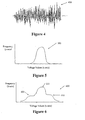
- Figure 4 illustrates an exemplary signal data 400 that may be seen on an oscilloscope tracing of electrical activity.
- Figure 5 illustrates an exemplary noise distribution curve 500 of voltage amplitude values, for example, as a histogram showing frequency of occurrences (y-axis) of each voltage amplitude value (x-axis). Since electrical noise is over-represented in signal data, the statistical distribution of signal amplitudes will be normally and narrowly distributed.
- distribution curve 500 of noise data is a normal distribution curve generally characterized as bell-shaped with a lesser degree of variance from the mean, in other words with shorter tails.
- the distribution curve 310 of the current signal data resembles the noise distribution curve 500, then the signal data is determined to be noise without a neuron action potential.
- the distribution curve 310 may appear normal or bell-shaped because neuron action potentials are relatively rare. But, the variance from the mean will be greater and the tails of the curve will be longer than that of a typical noise distribution curve 500, and these characteristics can be used to identify if a neuron action potential is present.
- further processing of the distribution curve 310 may be performed to exaggerate the distribution values from the mean. For example, logic can be included to determine the 4th order moment about the mean (4MOM) for the signal data. Of course, other orders such as 3rd, 5th, or other order can be used.
- a distribution curve that represents noise with neuron discharge signals present may look like distribution curve 600 shown in Figure 6.
- the curve 600 is shown with exaggerated values in its tail regions which may be obtained, for example, by applying a 4th order moment about the mean.
- the curve 600 shows a greater number of voltage occurrences 605, 610 in the tail regions beyond a central curve 615 as compared to the noise distribution curve 500.
- the central curve 615 represents the greatest concentration of values (e.g. noise signals).
- the tails are lengthened as compared to the exemplary noise distribution curve 500 indicating a greater range of voltages in the signal data.
- the signal analyzer 300 will consider curve 600 as a departure from the generally bell-shaped noise curve 500 at least in part due to the longer tails.
- the signal analyzer 300 can determine if a neuron action potential is present by determining if the distribution curve resembles noise data (e.g., noise distribution curve 500 ) or if it is a departure from noise data (e.g. , distribution curve 600 ), the latter meaning neuron discharge signals are present.
- noise data e.g., noise distribution curve 500
- distribution curve 600 a distribution curve generated from signal data containing both noise and neuron discharge signals, like curve 600, will also resemble a bell-shaped curve. They differ from the "generally bell-shaped" noise curve 500 in their degree of kurtosis or width of distribution as will be described in greater detail below.
- an identification logic 315 analyzes the distribution curve 310 generated from the current signal data.
- the logic 315 performs a curve analysis 320 to determines what type of curve it most likely is. In particular, it determines whether the curve 310 resembles a generally bell-shaped curve of noise data (e.g. Figure 5).
- the shape of the curve can be compared to the shape of a noise distribution curve.
- a central tendency value can be computed and then dispersions from the central tendency are measured. If a pre-selected amount of dispersions exists, then it is determined that neuron discharges are present.
- a kurtosis value is determined for the distribution curve.
- Kurtosis provides information about a curve's shape and, in particular, is based on the size of a distribution's tails. The larger the tails, the lower the kurtosis value. Thus, a generally normal distribution curve (representing only noise) will have smaller tails and a larger kurtosis value than a distribution curve with neuron discharges which will have larger tails.
- a threshold kurtosis value can be set such that if the kurtosis value of a distribution curve falls below the threshold, the analysis determines that one or more neuron discharges are present.
- Equation (1) An exemplary equation for determining kurtosis is shown in Equation (1) below.
- x is a current value from the signal data
- ⁇ is the mean of the data
- N is the number of values in the data
- ⁇ is the standard deviation.
- the kurtosis can be determined differently and/or with different variations of Equation (1).
- the subtraction of "3" can be optional.
- Kurtosis ⁇ x - ⁇ 4 N ⁇ ⁇ 4 - 3
- a count logic 325 can be included to determine a relative amount of neuron discharge signals once it is determined that they are present.
- the count logic 325 includes a tail analysis logic 330 that analyzes the tails of the distribution curve. Generally, as mentioned previously, larger tails indicate greater neuron activity. A number of occurrences beyond a selected threshold ( e.g , beyond the 4th order moment about the mean) can indicate a quantity of neuron activity. Also, the kurtosis value can be used for this analysis. Again, the lower the kurtosis value, the larger the tails are, meaning, a greater amount of neuron discharges are present.
- the amount of neuron signal firings can also be found by Equation 2.
- the number of voltage values recorded is represented by n , ( x - ⁇ ) is the difference between each voltage point ( x ) and the average voltage ( ⁇ ) found in the signal data. This value is raised to the 4th power to exaggerate its distance from the mean.
- an exemplary methodology 700 is shown for the signal data analyzer 300.
- the illustrated blocks may also represent an embodiment of the "analyze signal characteristics" block 210 from Figure 2.
- a characteristic is selected, such as voltage amplitude values for each signal, and a distribution is generated using the selected values (block 710 ).
- Characteristics from the curve are then analyzed (block 715 ). For example, the curve's shape is determined and compared to a normal noise distribution curve (block 720 ). A kurtosis value can be determined which indicates the size of the distribution's tails.
- the distribution resembles a noise distribution (e.g ., by shape or by kurtosis value or by both), then it is judged to be noise data. If the distribution departs from a noise distribution, then it is judged to contain a neuron action potential. The results of the distribution or comparison, or both can be displayed for additional verification from a physician or other expert if desired.
- a noise distribution e.g ., by shape or by kurtosis value or by both
- Illustrated in Figure 8 is another exemplary methodology 800 used by the above systems for the identification of sensor-motor regions within an anatomical target.
- a sensori-motor region is identified by correlating neuronal activity changes (increases or decreases) temporally correlated with sensory stimulation or movement.
- the system automatically determines whether such a correlation exists and if so, whether the microelectrode is in the sensori-motor regions.
- the signal data analyzer 140 and/or 300 includes or calls a correlation logic to perform the correlation as described below.
- the microelectrode When the microelectrode is at a target position in the brain and neuronal activity is determined by the present system, a physician may wish to determine if that target position corresponds to a particular part of the patient such as the left hand.
- the system By stimulating or moving the left hand, or both, the system can record electrical activity at the target position and determine whether the stimulation triggers neuronal activity.
- the system generates a distribution curve for the recorded signal data as described above and, by analyzing changes in the distribution curve as a stimulus is applied, it can determine if there is a correlation.
- microelectrode signals are recorded for a brief epoch, for example 20 msec or other selected time period (block 805 ).
- the signals are statistically analyzed in a manner described above (block 810 ).
- a distribution is generated and the analysis determines whether it resembles noise data or whether a departure exists indicating the presence of neuronal activity (block 815 ).
- the 4th order moment about the mean (4MOM) is determined of the signal data. If it resembles noise, the electrode position is moved (block 820 ) and the process repeats until a location is found that contains neuronal activity.
- the physician can attempt to correlate the location with an area of the patient.
- a stimulus is applied and removed to an area, such as an arm or leg, and a plurality of signal data is recorded for a number of epochs. Between each epoch, data from sensory stimulation or movement is obtained.
- a buffer of these data (sensory, movement and the 4MOM) are recorded, for example, for 100 epochs or other selected quantity.
- This buffer contains the time course of neuronal activity (time course of the 4MOM) and sensory and/or movement. The time course of the 4MOM is correlated with the sensory and/or movement data.
- results of the correlation are displayed so that the physician or electrophysiologist can see the correlation found that determines whether the neuronal activity is correlated with sensory and/or motor function and therefore, the microelectrode tip is within the sensori-motor region of the anatomical target.
- a variety of sensory stimulations can be used. These include (but are not limited to) light touch, proprioception (joint capsule receptors) and muscle spindles. Correlation of neuronal activity to specific types of sensory stimulation have implications for localization. For example, neurons of the central portion of the ventro-caudal nucleus of the thalamus are responsive to light touch while neurons of the ventro-intermediate nucleus of the thalamus are responsive to muscle spindle activation.
- a hand held device can have a contact switch that indicates when the device touches the skin (light touch).
- the hand held device can also have a vibrator to stimulate muscle spindles.
- the contact switch indicates the time that the vibration stimuli are applied.
- the contact switch signal then translates to a waveform in the signal analysis logic that is then correlated with the simultaneously accumulated 4MOM indicating neuronal activity.
- Joint capsule stimulation is accomplished by active and passive movement about the joint.
- an accelerometer can be attached to the physician or electrophysiologist's hand, which moves a limb about a joint as an indirect indicator of joint capsule stimulation. Such movements will be identified by small accelerometers attached to the patient's limb about the joints.
- the accelerometer data can be acquired and correlated with neuronal activity as described above.
- a switch foot or hand held can be used to manually indicate stimulation or movement which cannot be directly instrumented such as a mouth opening, tongue protrusion, etc.
- the system simultaneously records signal data as a stimulus is applied and removed.
- An analysis of a distribution curve's tails for each recorded epoch can be graphed as shown in Figure 9 as graph 900.
- the graph shows the size of the curve's tails, where points 905 represent larger tails (indicating greater neuronal activity) and points 910 represent smaller tails (indicating little or no neuronal activity).
- Figure 10 illustrates a graph 1000 of applied movement or stimulus corresponding in time to graph 900.
- Points 1005 represent when a stimulus is applied to a target and points 1010 represent no stimulus applied.
- the system determines if changes occur in neuronal activity (increase or decrease) based on the corresponding stimulus (block 830 ).
- the two graphs are then correlated to determine if an increase in neuronal activity corresponds to the application of stimulus (block 835 ). If they correlate to a sufficient degree (block 840 ), then it is reasonable to conclude that the microelectrode recording tip is within the sensory and/or motor region of the target.
- the microelectrode can be moved to a new position and the process repeats until a match is found (block 820 ) .
- the microelectrode can be maintained at its position and a new area of stimulation can be selected to determine if it correlates. It will be noted that movement of the electrode may not be tied to the identification of sensory and/or motor related units, rather it may be tied to the presence or absence of an extracellular action potential being within the signal recorded.
- correlation can be determined using Pearson Product Moment Correlation (also called Pearson's correlation for short). Pearson's correlation reflects a degree of linear relationship between two variables. It ranges from +1 to -1. A correlation of +1 means that there is a perfect positive linear relationship between variables while a correlation of -1 means that there is a perfect negative linear relationship between variables.
- a correlation graph is generated shown in Figure 11.
- the system can determine the extent of a correlation by taking the absolute value of the correlation value. By using the above system, a physician can objectively determine if the microelectrode is located in a desired location based on neuronal activity.
- the microelectrode can be incrementally advanced to determine the dimension of the neuronal area. Signal data is collected at each incremental location and a statistical analysis is performed to determine if it is noise or further contains neuronal activity as described above. Knowing the dimension of the neuron can help better position an implanted electrode in that location.
- Data obtained and/or results found by the system can be processed for communication via the Internet or other network.
- Intra-operative data can be transmitted via the Internet to a central facility for processing which can assist in problem solving and data analysis and interpretation.
Landscapes
- Life Sciences & Earth Sciences (AREA)
- Health & Medical Sciences (AREA)
- Surgery (AREA)
- Public Health (AREA)
- Pathology (AREA)
- Engineering & Computer Science (AREA)
- Biomedical Technology (AREA)
- Heart & Thoracic Surgery (AREA)
- Medical Informatics (AREA)
- Molecular Biology (AREA)
- Physics & Mathematics (AREA)
- Animal Behavior & Ethology (AREA)
- General Health & Medical Sciences (AREA)
- Biophysics (AREA)
- Veterinary Medicine (AREA)
- Measurement And Recording Of Electrical Phenomena And Electrical Characteristics Of The Living Body (AREA)
- Medicines Containing Antibodies Or Antigens For Use As Internal Diagnostic Agents (AREA)
- Investigating Or Analysing Materials By Optical Means (AREA)
- Measuring Pulse, Heart Rate, Blood Pressure Or Blood Flow (AREA)
- Investigating Or Analyzing Materials By The Use Of Ultrasonic Waves (AREA)
- Radar Systems Or Details Thereof (AREA)
- Monitoring And Testing Of Transmission In General (AREA)
- Testing Or Calibration Of Command Recording Devices (AREA)
Claims (9)
- System zur Positionierung einer Mikroelektrode in einem Gewebe, umfassend:eine Mikroelektrode zum Sammeln einer Vielzahl von elektrischen Signalen im Gewebe, wobei die elektrischen Signale ein oder mehrere Rauschsignale und ein neuronales Aktivitätssignal umfassen;wobei das System Folgendes umfasst:eine Verteilungslogik zur elektronischen Erstellung einer statistischen Verteilung der Vielzahl von elektrischen Signalen in Echtzeit, wobei die statistische Verteilung die Unterscheidung eines Rauschsignals von einem neuronalen Aktivitätssignal erleichtert;eine Identifikationslogik zur programmtechnischen Identifizierung eines Werts neuronaler Entladungsaktivität in einem durch die Elektrode erfassten Satz an elektrischen Signalen in Echtzeit, wobei der Wert der neuronalen Entladungsaktivität durch elektronisches Analysieren der statistischen Verteilung ermittelt wird; undeine Mikroelektroden-Positioniervorrichtung, welche die Mikroelektrode im Gewebe basierend auf der Identifizierung des Werts der neuronalen Entladungsaktivität durch die Identifikationslogik programmtechnisch steuerbar bewegt.
- System nach Anspruch 1, worin die statistische Verteilung auf der Spannungsamplitude der elektrischen Signale basiert.
- System nach Anspruch 1, worin die Identifikationslogik auch eine oder mehrere programmtechnische Bestimmungen eines Kurtosiswerts aus der statistischen Verteilung und das Analysieren einer oder mehrerer Ränder der statistischen Verteilung durchführt.
- System nach Anspruch 1, das ferner dadurch gekennzeichnet ist, dass das System auch eine Korrelationslogik umfasst, die einen angelegten Stimulus mit einer oder mehreren der statischen Verteilung und dem identifizierten Wert der neuronalen Entladungsaktivität korreliert.
- System nach Anspruch 1, 2 oder 3, worin die Verteilungslogik eine Logik umfasst, um die elektrischen Signaldaten zu überhöhen, um die Werte, die von einem Mittelwert abweichen zu vergrößern.
- System nach Anspruch 5, worin die Logik zur Überhöhung der elektrischen Signaldaten Anweisungen umfasst, die an den Mittelwert der elektrischen Signaldaten ein Moment vierter Ordnung anlegen.
- System nach Anspruch 1, worin die statistische Verteilung eine aus einer ersten Form, welche Rauschsignaldaten repräsentiert, und einer zweiten Form, welche Rauschsignaldaten mit neuronaler Aktivität repräsentiert, ausgewählte Form aufweist.
- System nach Anspruch 7, worin die erste Form im Allgemeinen eine glockenförmige Kurve ist und die zweite Form eine Kurve ist, die von der glockenförmigen Kurve abweicht.
- System nach Anspruch 1, worin die Identifikationslogik eine Logik zur Bestimmung umfasst, ob zumindest ein neuronales Entladungssignal im durch die Elektrode erfassten Satz an elektrischen Signalen beinhaltet ist, während ein zweites Gewebe einer Stimulierung unterzogen wird, wobei das zweite Gewebe und jenes Gewebe, in welchem die Elektrode positioniert ist, Teil des gleichen Körpers sind.
Applications Claiming Priority (5)
| Application Number | Priority Date | Filing Date | Title |
|---|---|---|---|
| US138987 | 1987-12-29 | ||
| US37012302P | 2002-04-05 | 2002-04-05 | |
| US370123P | 2002-04-05 | ||
| US10/138,987 US7136696B2 (en) | 2002-04-05 | 2002-05-03 | Neuron signal analysis system and method |
| PCT/US2003/008283 WO2003086185A1 (en) | 2002-04-05 | 2003-03-17 | Neuron signal analysis system and method |
Publications (2)
| Publication Number | Publication Date |
|---|---|
| EP1492449A1 EP1492449A1 (de) | 2005-01-05 |
| EP1492449B1 true EP1492449B1 (de) | 2007-05-09 |
Family
ID=28677894
Family Applications (1)
| Application Number | Title | Priority Date | Filing Date |
|---|---|---|---|
| EP03721388A Expired - Lifetime EP1492449B1 (de) | 2002-04-05 | 2003-03-17 | Neuronensignal-analysesystem |
Country Status (8)
| Country | Link |
|---|---|
| US (1) | US7136696B2 (de) |
| EP (1) | EP1492449B1 (de) |
| AT (1) | ATE361700T1 (de) |
| AU (1) | AU2003224705A1 (de) |
| CA (1) | CA2459271A1 (de) |
| DE (1) | DE60313760T2 (de) |
| DK (1) | DK1492449T3 (de) |
| WO (1) | WO2003086185A1 (de) |
Families Citing this family (56)
| Publication number | Priority date | Publication date | Assignee | Title |
|---|---|---|---|---|
| WO2004021245A2 (de) * | 2002-08-09 | 2004-03-11 | Siemens Aktiengesellschaft | Verfahren und anordnung sowie computerprogramm mit programmcode-mitteln und computerprogramm-produkt zur analyse von neuronalen aktivitäten in neuronalen arealen |
| US20050256541A1 (en) * | 2004-04-30 | 2005-11-17 | Medtronic, Inc. | Catheter with temporary stimulation electrode |
| US8180601B2 (en) | 2006-03-09 | 2012-05-15 | The Cleveland Clinic Foundation | Systems and methods for determining volume of activation for deep brain stimulation |
| US7346382B2 (en) | 2004-07-07 | 2008-03-18 | The Cleveland Clinic Foundation | Brain stimulation models, systems, devices, and methods |
| US8209027B2 (en) | 2004-07-07 | 2012-06-26 | The Cleveland Clinic Foundation | System and method to design structure for delivering electrical energy to tissue |
| US8112292B2 (en) | 2006-04-21 | 2012-02-07 | Medtronic Navigation, Inc. | Method and apparatus for optimizing a therapy |
| US7848797B2 (en) * | 2006-08-17 | 2010-12-07 | Neurometrix, Inc. | Motor unit number estimation (MUNE) for the assessment of neuromuscular function |
| US8660635B2 (en) | 2006-09-29 | 2014-02-25 | Medtronic, Inc. | Method and apparatus for optimizing a computer assisted surgical procedure |
| US20090048530A1 (en) * | 2007-08-15 | 2009-02-19 | The General Electric Company | Monitoring of epileptiform activity |
| US9220889B2 (en) | 2008-02-11 | 2015-12-29 | Intelect Medical, Inc. | Directional electrode devices with locating features |
| US8019440B2 (en) | 2008-02-12 | 2011-09-13 | Intelect Medical, Inc. | Directional lead assembly |
| US9272153B2 (en) | 2008-05-15 | 2016-03-01 | Boston Scientific Neuromodulation Corporation | VOA generation system and method using a fiber specific analysis |
| US8165658B2 (en) * | 2008-09-26 | 2012-04-24 | Medtronic, Inc. | Method and apparatus for positioning a guide relative to a base |
| JP2012510877A (ja) | 2008-12-04 | 2012-05-17 | ザ クリーブランド クリニック ファウンデーション | 脳内刺激のための標的体積を規定するシステムおよび方法 |
| JP5734295B2 (ja) | 2009-08-27 | 2015-06-17 | ザ クリーブランド クリニック ファウンデーション | 組織活性の部位を推定するためのシステムおよび方法 |
| WO2011068997A1 (en) | 2009-12-02 | 2011-06-09 | The Cleveland Clinic Foundation | Reversing cognitive-motor impairments in patients having a neuro-degenerative disease using a computational modeling approach to deep brain stimulation programming |
| WO2011159688A2 (en) | 2010-06-14 | 2011-12-22 | Boston Scientific Neuromodulation Corporation | Programming interface for spinal cord neuromodulation |
| CN101908099B (zh) * | 2010-07-22 | 2012-05-30 | 中国人民解放军第三军医大学第三附属医院 | 神经元信息单位放电分析方法及分析系统 |
| JP2014518516A (ja) | 2011-03-29 | 2014-07-31 | ボストン サイエンティフィック ニューロモデュレイション コーポレイション | アトラス位置合わせのためのシステムおよび方法 |
| WO2012145244A1 (en) * | 2011-04-20 | 2012-10-26 | Medtronic, Inc. | Method and apparatus for assessing neural activation |
| US9592389B2 (en) | 2011-05-27 | 2017-03-14 | Boston Scientific Neuromodulation Corporation | Visualization of relevant stimulation leadwire electrodes relative to selected stimulation information |
| AU2012294364A1 (en) | 2011-08-09 | 2014-03-20 | Boston Scientific Neuromodulation Corporation | Remote control for blind clinical trials of electrical stimulation |
| WO2014025624A1 (en) | 2012-08-04 | 2014-02-13 | Boston Scientific Neuromodulation Corporation | Techniques and methods for storing and transferring registration, atlas, and lead information between medical devices |
| WO2014036079A2 (en) | 2012-08-28 | 2014-03-06 | Boston Scientific Neuromodulation Corporation | Parameter visualization, selection, and annotation interface |
| US9792412B2 (en) | 2012-11-01 | 2017-10-17 | Boston Scientific Neuromodulation Corporation | Systems and methods for VOA model generation and use |
| US9959388B2 (en) | 2014-07-24 | 2018-05-01 | Boston Scientific Neuromodulation Corporation | Systems, devices, and methods for providing electrical stimulation therapy feedback |
| US10272247B2 (en) | 2014-07-30 | 2019-04-30 | Boston Scientific Neuromodulation Corporation | Systems and methods for stimulation-related volume analysis, creation, and sharing with integrated surgical planning and stimulation programming |
| US10265528B2 (en) | 2014-07-30 | 2019-04-23 | Boston Scientific Neuromodulation Corporation | Systems and methods for electrical stimulation-related patient population volume analysis and use |
| US10478616B2 (en) | 2014-08-20 | 2019-11-19 | Greenville Neuromodulation Center | Method and system for physiological target localization from macroelectrode recordings and monitoring spinal cord function |
| EP3204112A1 (de) | 2014-10-07 | 2017-08-16 | Boston Scientific Neuromodulation Corporation | Systeme, vorrichtungen und verfahren zur elektrischen stimulation mittels rückkopplung zur einstellung von stimulationsparametern |
| US10780283B2 (en) | 2015-05-26 | 2020-09-22 | Boston Scientific Neuromodulation Corporation | Systems and methods for analyzing electrical stimulation and selecting or manipulating volumes of activation |
| EP3268082B1 (de) | 2015-05-26 | 2019-04-17 | Boston Scientific Neuromodulation Corporation | Systeme und verfahren zur analyse von elektrischer stimulation und auswahl oder manipulation von aktivierungsvolumina |
| WO2017003947A1 (en) | 2015-06-29 | 2017-01-05 | Boston Scientific Neuromodulation Corporation | Systems and methods for selecting stimulation parameters by targeting and steering |
| WO2017003946A1 (en) | 2015-06-29 | 2017-01-05 | Boston Scientific Neuromodulation Corporation | Systems and methods for selecting stimulation parameters based on stimulation target region, effects, or side effects |
| US10071249B2 (en) | 2015-10-09 | 2018-09-11 | Boston Scientific Neuromodulation Corporation | System and methods for clinical effects mapping for directional stimulation leads |
| US10716942B2 (en) | 2016-04-25 | 2020-07-21 | Boston Scientific Neuromodulation Corporation | System and methods for directional steering of electrical stimulation |
| US11471092B2 (en) | 2016-06-20 | 2022-10-18 | Greenville Neuromodulation Center | Microelectrode with hemoglobin or iron sensor and methods of guiding same |
| CN109416937A (zh) | 2016-06-24 | 2019-03-01 | 波士顿科学神经调制公司 | 用于临床效果的视觉分析的系统和方法 |
| WO2018044881A1 (en) | 2016-09-02 | 2018-03-08 | Boston Scientific Neuromodulation Corporation | Systems and methods for visualizing and directing stimulation of neural elements |
| US10780282B2 (en) | 2016-09-20 | 2020-09-22 | Boston Scientific Neuromodulation Corporation | Systems and methods for steering electrical stimulation of patient tissue and determining stimulation parameters |
| CN109803719B (zh) | 2016-10-14 | 2023-05-26 | 波士顿科学神经调制公司 | 用于闭环确定电模拟系统的刺激参数设置的系统和方法 |
| ES2871008T3 (es) | 2017-01-03 | 2021-10-28 | Boston Scient Neuromodulation Corp | Sistemas y procedimientos para seleccionar parámetros de estimulación compatibles con IRM |
| EP3519043B1 (de) | 2017-01-10 | 2020-08-12 | Boston Scientific Neuromodulation Corporation | Systeme und verfahren zum erstellen von stimulationsprogrammen basierend auf benutzerdefinierten bereichen oder volumen |
| US10625082B2 (en) | 2017-03-15 | 2020-04-21 | Boston Scientific Neuromodulation Corporation | Visualization of deep brain stimulation efficacy |
| WO2018187090A1 (en) | 2017-04-03 | 2018-10-11 | Boston Scientific Neuromodulation Corporation | Systems and methods for estimating a volume of activation using a compressed database of threshold values |
| WO2018191725A1 (en) | 2017-04-14 | 2018-10-18 | Paradromics, Inc. | Low-area, low-power neural recording circuit, and method of training the same |
| US10716505B2 (en) | 2017-07-14 | 2020-07-21 | Boston Scientific Neuromodulation Corporation | Systems and methods for estimating clinical effects of electrical stimulation |
| WO2019036180A1 (en) | 2017-08-15 | 2019-02-21 | Boston Scientific Neuromodulation Corporation | SYSTEMS AND METHODS FOR CONTROLLING ELECTRICAL STIMULATION USING MULTIPLE STIMULATION FIELDS |
| EP3784332B1 (de) | 2018-04-27 | 2023-04-26 | Boston Scientific Neuromodulation Corporation | Systeme zur visualisierung und programmierung der elektrischen stimulation |
| US11298553B2 (en) | 2018-04-27 | 2022-04-12 | Boston Scientific Neuromodulation Corporation | Multi-mode electrical stimulation systems and methods of making and using |
| WO2022232036A1 (en) | 2021-04-27 | 2022-11-03 | Boston Scientific Neuromodulation Corporation | Systems and methods for automated programming of electrical stimulation |
| EP4313269B1 (de) | 2021-06-15 | 2026-04-15 | Boston Scientific Neuromodulation Corporation | Verfahren und systeme zur schätzung der nervenaktivierung durch stimulation unter verwendung eines stimulationssystems |
| WO2023107457A2 (en) | 2021-12-09 | 2023-06-15 | Boston Scientific Neuromodulation Corparation | Methods and systems for monitoring or assessing movement disorders or other physiological parameters using a stimulation system |
| WO2023107449A2 (en) | 2021-12-10 | 2023-06-15 | Boston Scientific Neuromodulation Corporation | Systems and methods for generating and using response maps for electrical stimulation |
| WO2023167872A1 (en) | 2022-03-02 | 2023-09-07 | Boston Scientific Neuromodulation Corporation | Systems and methods for monitoring stimulation drift in an electrical stimulation system |
| CN119791687B (zh) * | 2024-12-09 | 2025-10-03 | 上海交通大学医学院附属第九人民医院 | 一种基于电极阵列的GnRH神经元分布模式评估方法及系统 |
Family Cites Families (48)
| Publication number | Priority date | Publication date | Assignee | Title |
|---|---|---|---|---|
| US3841310A (en) * | 1973-04-04 | 1974-10-15 | Us Health Education & Welfare | Electrode insertion device for neuroelectrical recordings |
| US3826244A (en) | 1973-07-20 | 1974-07-30 | Us Health Education & Welfare | Thumbtack microelectrode and method of making same |
| CA1065969A (fr) | 1977-09-28 | 1979-11-06 | Gratien Bouillon | Sonde cerebrale auto-bloquante |
| US4461304A (en) | 1979-11-05 | 1984-07-24 | Massachusetts Institute Of Technology | Microelectrode and assembly for parallel recording of neurol groups |
| US5458631A (en) | 1989-01-06 | 1995-10-17 | Xavier; Ravi | Implantable catheter with electrical pulse nerve stimulators and drug delivery system |
| US5119832A (en) | 1989-07-11 | 1992-06-09 | Ravi Xavier | Epidural catheter with nerve stimulators |
| US5165412A (en) * | 1990-03-05 | 1992-11-24 | Kabushiki Kaisha Toshiba | Shock wave medical treatment apparatus with exchangeable imaging ultrasonic wave probe |
| US5081990A (en) | 1990-05-11 | 1992-01-21 | New York University | Catheter for spinal epidural injection of drugs and measurement of evoked potentials |
| US5143067A (en) * | 1990-06-07 | 1992-09-01 | Medtronic, Inc. | Tool for implantable neural electrode |
| US5375594A (en) | 1993-03-29 | 1994-12-27 | Cueva; Roberto A. | Removable medical electrode system |
| US5563067A (en) | 1994-06-13 | 1996-10-08 | Matsushita Electric Industrial Co., Ltd. | Cell potential measurement apparatus having a plurality of microelectrodes |
| US5810742A (en) | 1994-10-24 | 1998-09-22 | Transcan Research & Development Co., Ltd. | Tissue characterization based on impedance images and on impedance measurements |
| NZ287251A (en) | 1994-10-24 | 1998-09-24 | Transscan Res & Dev Co Ltd | Multi electrode probe and method for impedance imaging of living biological tissue |
| US6678552B2 (en) | 1994-10-24 | 2004-01-13 | Transscan Medical Ltd. | Tissue characterization based on impedance images and on impedance measurements |
| US5701909A (en) | 1994-11-01 | 1997-12-30 | Abratech Corporation | Machine and method for the determination of nervous-system-generator parameters using lead fields |
| US5743860A (en) * | 1996-03-20 | 1998-04-28 | Lockheed Martin Energy Systems, Inc. | Apparatus and method for epileptic seizure detection using non-linear techniques |
| CA2249602A1 (en) | 1996-04-04 | 1997-10-16 | Medtronic, Inc. | Living tissue stimulation and recording techniques |
| US6493576B1 (en) | 1996-06-17 | 2002-12-10 | Erich Jaeger Gmbh | Method and apparatus for measuring stimulus-evoked potentials of the brain |
| CA2258008A1 (en) | 1996-06-20 | 1997-12-24 | Advanced Bionics Corporation | Self-adjusting cochlear implant system and method for fitting same |
| DK0980523T3 (da) | 1997-05-01 | 2007-04-30 | Sophion Bioscience As | Indretning til automatisk placering af elektroder |
| US5902236A (en) | 1997-09-03 | 1999-05-11 | Pmt Corporation | Tissue electrode for recording and stimulation |
| US20010027336A1 (en) | 1998-01-20 | 2001-10-04 | Medtronic, Inc. | Combined micro-macro brain stimulation system |
| US6011996A (en) | 1998-01-20 | 2000-01-04 | Medtronic, Inc | Dual electrode lead and method for brain target localization in functional stereotactic brain surgery |
| US6330466B1 (en) * | 1998-02-23 | 2001-12-11 | California Institute Of Technology | Using a multi-electrode probe in creating an electrophysiological profile during stereotactic neurosurgery |
| US6298262B1 (en) | 1998-04-21 | 2001-10-02 | Neutar, Llc | Instrument guidance for stereotactic surgery |
| US6529765B1 (en) | 1998-04-21 | 2003-03-04 | Neutar L.L.C. | Instrumented and actuated guidance fixture for sterotactic surgery |
| US6546277B1 (en) | 1998-04-21 | 2003-04-08 | Neutar L.L.C. | Instrument guidance system for spinal and other surgery |
| US6319241B1 (en) * | 1998-04-30 | 2001-11-20 | Medtronic, Inc. | Techniques for positioning therapy delivery elements within a spinal cord or a brain |
| US6201982B1 (en) | 1998-07-02 | 2001-03-13 | Baltimore Biomedical, Inc. | Quick-placement electroencephalogram (EEG) electrode |
| US6282437B1 (en) | 1998-08-12 | 2001-08-28 | Neutar, Llc | Body-mounted sensing system for stereotactic surgery |
| JP2000262460A (ja) | 1999-03-18 | 2000-09-26 | Inst Of Physical & Chemical Res | 生体試料の特定部位検出方法、生体試料の生理学的測定方法、生体試料の特定部位検出装置、光ファイバ保持装置 |
| US6343226B1 (en) * | 1999-06-25 | 2002-01-29 | Neurokinetic Aps | Multifunction electrode for neural tissue stimulation |
| DK1026973T3 (da) | 1999-06-25 | 2005-05-23 | Neurokinetic Aps | Multifunktionselektrode til stimulation af nervevæv |
| US6175753B1 (en) | 1999-07-02 | 2001-01-16 | Baltimore Biomedical, Inc. | Methods and mechanisms for quick-placement electroencephalogram (EEG) electrodes |
| EP1244400B1 (de) | 2000-01-05 | 2011-03-02 | Rolf-Dieter Battmer | Vorrichtung zur messung des auditiven evozierten potentials |
| FR2803186B1 (fr) | 2000-01-05 | 2002-08-09 | Guy Charvin | Procede et dispositif de recueil de potentiels evoques auditif |
| US6301492B1 (en) * | 2000-01-20 | 2001-10-09 | Electrocore Technologies, Llc | Device for performing microelectrode recordings through the central channel of a deep-brain stimulation electrode |
| US6622035B1 (en) | 2000-01-21 | 2003-09-16 | Instrumentarium Corp. | Electrode for measurement of weak bioelectrical signals |
| DE10010081A1 (de) | 2000-03-02 | 2001-09-13 | Nmi Univ Tuebingen | Vorrichtung und Elektrodenanordnung für elektrophysiologische Untersuchungen |
| DE60113756T2 (de) | 2000-04-12 | 2006-07-20 | AFX, Inc., Fremont | Ablationskatheter mit einem gerichtetem H.F. Strahlungselement |
| US6442421B1 (en) * | 2000-04-27 | 2002-08-27 | Centre National De La Recherche Scientifique | Method for the medical monitoring in real time of a patient from the analysis of electroencephalograms to characterize and differentiate between physiological or pathological conditions, and a method for anticipating epileptic seizures |
| JP3909738B2 (ja) | 2000-07-13 | 2007-04-25 | 松下電器産業株式会社 | 細胞外記録用一体化複合電極 |
| AU2002303295B2 (en) | 2001-04-06 | 2006-11-30 | Univ New York | Diagnosis and treatment of neural disease and injury using microvoltammetry |
| US6671555B2 (en) * | 2001-04-27 | 2003-12-30 | Medtronic, Inc. | Closed loop neuromodulation for suppression of epileptic activity |
| US7041492B2 (en) | 2001-06-20 | 2006-05-09 | Matsushita Electric Industrial Co., Ltd. | Extracellular recording electrode |
| IL145700A0 (en) | 2001-09-30 | 2002-06-30 | Younis Imad | Electrode system for neural applications |
| US7010356B2 (en) | 2001-10-31 | 2006-03-07 | London Health Sciences Centre Research Inc. | Multichannel electrode and methods of using same |
| US6993392B2 (en) | 2002-03-14 | 2006-01-31 | Duke University | Miniaturized high-density multichannel electrode array for long-term neuronal recordings |
-
2002
- 2002-05-03 US US10/138,987 patent/US7136696B2/en not_active Expired - Fee Related
-
2003
- 2003-03-17 WO PCT/US2003/008283 patent/WO2003086185A1/en not_active Ceased
- 2003-03-17 DK DK03721388T patent/DK1492449T3/da active
- 2003-03-17 AU AU2003224705A patent/AU2003224705A1/en not_active Abandoned
- 2003-03-17 DE DE60313760T patent/DE60313760T2/de not_active Expired - Fee Related
- 2003-03-17 CA CA002459271A patent/CA2459271A1/en not_active Abandoned
- 2003-03-17 EP EP03721388A patent/EP1492449B1/de not_active Expired - Lifetime
- 2003-03-17 AT AT03721388T patent/ATE361700T1/de not_active IP Right Cessation
Also Published As
| Publication number | Publication date |
|---|---|
| EP1492449A1 (de) | 2005-01-05 |
| AU2003224705A1 (en) | 2003-10-27 |
| CA2459271A1 (en) | 2003-10-23 |
| DE60313760D1 (de) | 2007-06-21 |
| ATE361700T1 (de) | 2007-06-15 |
| US7136696B2 (en) | 2006-11-14 |
| US20030191408A1 (en) | 2003-10-09 |
| WO2003086185A1 (en) | 2003-10-23 |
| DE60313760T2 (de) | 2008-01-24 |
| DK1492449T3 (da) | 2007-09-10 |
Similar Documents
| Publication | Publication Date | Title |
|---|---|---|
| US7136696B2 (en) | Neuron signal analysis system and method | |
| CN114364318B (zh) | 监测神经记录的质量 | |
| US11045129B2 (en) | Method and apparatus for estimating neural recruitment | |
| US20200289815A1 (en) | Method and System For Physiological Target Localization From Macroelectrode Recordings and Monitoring Spinal Cord Function | |
| JP4926072B2 (ja) | 脳神経活動を非同期化する方法および装置、制御器、ならびに神経疾患および/または精神疾患を治療する方法 | |
| EP3638361B1 (de) | Systeme zur erkennung des schwellenwerts einer nerven-muskelreaktion mittels variabler frequenzstimulation | |
| US20080045853A1 (en) | Methods and Devices for Determining Brain State | |
| EP2139389B1 (de) | Verfahren zum ausfiltern von artefakten bei tiefer gehirnstimulation | |
| US11331494B2 (en) | Brain tissue stimulation method, apparatus and computer program | |
| De la Fuente et al. | Long-range correlations in rabbit brain neural activity | |
| Sanchez et al. | Evolving into epilepsy: multiscale electrophysiological analysis and imaging in an animal model | |
| EP4076194B1 (de) | Verfahren und vorrichtung zur zerlegung von zusammengesetzten muskelwirkungspotenzialen | |
| Davidson et al. | Comparing effects in spike-triggered averages of rectified EMG across different behaviors | |
| van Dijk | On the number of motor units. | |
| Klempíř et al. | Microelectrode neuronal activity biomarker of the internal globus pallidus in dystonia correlates with long-term neuromodulation effects | |
| Lombardi | Valutazione comparativa degli algoritmi che costituiscono lo stato dell’arte nel rilevamento di up state in registrazioni intracorticali in vivo. | |
| US20110184306A1 (en) | Device for treating parkinson's disease and methods of use thereof | |
| Santaniello et al. | Dynamic modeling and statistical characterization of subthalamic nucleus neural activity in Parkinson's disease patients | |
| KR20200055431A (ko) | 섬망이 유도된 동물모델 및 이의 제조 방법 | |
| Cecchetto | Neuronal Population Encoding of Sensory Information in the Rat Barrel Cortex: Local Field Potential Recording and Characterization by an Innovative High-Resolution Brain-Chip Interface | |
| Jones et al. | Evaluation of Three Quantitative Approaches in Electromyography (EMG) | |
| Heiney | Roles Of Inhibitory Interneurons In Cerebellar Cortical Processing For Oculomotor Control | |
| WO2011094262A1 (en) | Device for treating parkinson's disease | |
| Milekovic et al. | Volitional control of single-electrode high gamma local field |
Legal Events
| Date | Code | Title | Description |
|---|---|---|---|
| PUAI | Public reference made under article 153(3) epc to a published international application that has entered the european phase |
Free format text: ORIGINAL CODE: 0009012 |
|
| 17P | Request for examination filed |
Effective date: 20040302 |
|
| AK | Designated contracting states |
Kind code of ref document: A1 Designated state(s): AT BE BG CH CY CZ DE DK EE ES FI FR GB GR HU IE IT LI LU MC NL PT RO SE SI SK TR |
|
| AX | Request for extension of the european patent |
Extension state: AL LT LV MK |
|
| RTI1 | Title (correction) |
Free format text: NEURON SIGNAL ANALYSIS SYSTEM |
|
| GRAP | Despatch of communication of intention to grant a patent |
Free format text: ORIGINAL CODE: EPIDOSNIGR1 |
|
| GRAS | Grant fee paid |
Free format text: ORIGINAL CODE: EPIDOSNIGR3 |
|
| GRAA | (expected) grant |
Free format text: ORIGINAL CODE: 0009210 |
|
| AK | Designated contracting states |
Kind code of ref document: B1 Designated state(s): AT BE BG CH CY CZ DE DK EE ES FI FR GB GR HU IE IT LI LU MC NL PT RO SE SI SK TR |
|
| PG25 | Lapsed in a contracting state [announced via postgrant information from national office to epo] |
Ref country code: LI Free format text: LAPSE BECAUSE OF FAILURE TO SUBMIT A TRANSLATION OF THE DESCRIPTION OR TO PAY THE FEE WITHIN THE PRESCRIBED TIME-LIMIT Effective date: 20070509 Ref country code: FI Free format text: LAPSE BECAUSE OF FAILURE TO SUBMIT A TRANSLATION OF THE DESCRIPTION OR TO PAY THE FEE WITHIN THE PRESCRIBED TIME-LIMIT Effective date: 20070509 Ref country code: CH Free format text: LAPSE BECAUSE OF FAILURE TO SUBMIT A TRANSLATION OF THE DESCRIPTION OR TO PAY THE FEE WITHIN THE PRESCRIBED TIME-LIMIT Effective date: 20070509 |
|
| REG | Reference to a national code |
Ref country code: GB Ref legal event code: FG4D |
|
| REG | Reference to a national code |
Ref country code: CH Ref legal event code: EP |
|
| REG | Reference to a national code |
Ref country code: IE Ref legal event code: FG4D |
|
| REF | Corresponds to: |
Ref document number: 60313760 Country of ref document: DE Date of ref document: 20070621 Kind code of ref document: P |
|
| PG25 | Lapsed in a contracting state [announced via postgrant information from national office to epo] |
Ref country code: SE Free format text: LAPSE BECAUSE OF FAILURE TO SUBMIT A TRANSLATION OF THE DESCRIPTION OR TO PAY THE FEE WITHIN THE PRESCRIBED TIME-LIMIT Effective date: 20070809 |
|
| PG25 | Lapsed in a contracting state [announced via postgrant information from national office to epo] |
Ref country code: ES Free format text: LAPSE BECAUSE OF FAILURE TO SUBMIT A TRANSLATION OF THE DESCRIPTION OR TO PAY THE FEE WITHIN THE PRESCRIBED TIME-LIMIT Effective date: 20070820 |
|
| REG | Reference to a national code |
Ref country code: DK Ref legal event code: T3 |
|
| ET | Fr: translation filed | ||
| REG | Reference to a national code |
Ref country code: CH Ref legal event code: PL |
|
| PG25 | Lapsed in a contracting state [announced via postgrant information from national office to epo] |
Ref country code: AT Free format text: LAPSE BECAUSE OF FAILURE TO SUBMIT A TRANSLATION OF THE DESCRIPTION OR TO PAY THE FEE WITHIN THE PRESCRIBED TIME-LIMIT Effective date: 20070509 |
|
| PG25 | Lapsed in a contracting state [announced via postgrant information from national office to epo] |
Ref country code: BE Free format text: LAPSE BECAUSE OF FAILURE TO SUBMIT A TRANSLATION OF THE DESCRIPTION OR TO PAY THE FEE WITHIN THE PRESCRIBED TIME-LIMIT Effective date: 20070509 |
|
| PG25 | Lapsed in a contracting state [announced via postgrant information from national office to epo] |
Ref country code: BG Free format text: LAPSE BECAUSE OF FAILURE TO SUBMIT A TRANSLATION OF THE DESCRIPTION OR TO PAY THE FEE WITHIN THE PRESCRIBED TIME-LIMIT Effective date: 20070809 Ref country code: CZ Free format text: LAPSE BECAUSE OF FAILURE TO SUBMIT A TRANSLATION OF THE DESCRIPTION OR TO PAY THE FEE WITHIN THE PRESCRIBED TIME-LIMIT Effective date: 20070509 Ref country code: SI Free format text: LAPSE BECAUSE OF FAILURE TO SUBMIT A TRANSLATION OF THE DESCRIPTION OR TO PAY THE FEE WITHIN THE PRESCRIBED TIME-LIMIT Effective date: 20070509 Ref country code: PT Free format text: LAPSE BECAUSE OF FAILURE TO SUBMIT A TRANSLATION OF THE DESCRIPTION OR TO PAY THE FEE WITHIN THE PRESCRIBED TIME-LIMIT Effective date: 20071009 |
|
| PG25 | Lapsed in a contracting state [announced via postgrant information from national office to epo] |
Ref country code: SK Free format text: LAPSE BECAUSE OF FAILURE TO SUBMIT A TRANSLATION OF THE DESCRIPTION OR TO PAY THE FEE WITHIN THE PRESCRIBED TIME-LIMIT Effective date: 20070509 |
|
| PLBE | No opposition filed within time limit |
Free format text: ORIGINAL CODE: 0009261 |
|
| STAA | Information on the status of an ep patent application or granted ep patent |
Free format text: STATUS: NO OPPOSITION FILED WITHIN TIME LIMIT |
|
| 26N | No opposition filed |
Effective date: 20080212 |
|
| PG25 | Lapsed in a contracting state [announced via postgrant information from national office to epo] |
Ref country code: GR Free format text: LAPSE BECAUSE OF FAILURE TO SUBMIT A TRANSLATION OF THE DESCRIPTION OR TO PAY THE FEE WITHIN THE PRESCRIBED TIME-LIMIT Effective date: 20070810 Ref country code: IT Free format text: LAPSE BECAUSE OF FAILURE TO SUBMIT A TRANSLATION OF THE DESCRIPTION OR TO PAY THE FEE WITHIN THE PRESCRIBED TIME-LIMIT Effective date: 20070509 |
|
| PG25 | Lapsed in a contracting state [announced via postgrant information from national office to epo] |
Ref country code: RO Free format text: LAPSE BECAUSE OF FAILURE TO SUBMIT A TRANSLATION OF THE DESCRIPTION OR TO PAY THE FEE WITHIN THE PRESCRIBED TIME-LIMIT Effective date: 20070509 |
|
| PGFP | Annual fee paid to national office [announced via postgrant information from national office to epo] |
Ref country code: IE Payment date: 20080325 Year of fee payment: 6 Ref country code: NL Payment date: 20080324 Year of fee payment: 6 |
|
| PGFP | Annual fee paid to national office [announced via postgrant information from national office to epo] |
Ref country code: DE Payment date: 20080430 Year of fee payment: 6 Ref country code: DK Payment date: 20080331 Year of fee payment: 6 Ref country code: FR Payment date: 20080317 Year of fee payment: 6 |
|
| PG25 | Lapsed in a contracting state [announced via postgrant information from national office to epo] |
Ref country code: MC Free format text: LAPSE BECAUSE OF NON-PAYMENT OF DUE FEES Effective date: 20080331 |
|
| GBPC | Gb: european patent ceased through non-payment of renewal fee |
Effective date: 20080317 |
|
| PG25 | Lapsed in a contracting state [announced via postgrant information from national office to epo] |
Ref country code: EE Free format text: LAPSE BECAUSE OF FAILURE TO SUBMIT A TRANSLATION OF THE DESCRIPTION OR TO PAY THE FEE WITHIN THE PRESCRIBED TIME-LIMIT Effective date: 20070509 |
|
| PG25 | Lapsed in a contracting state [announced via postgrant information from national office to epo] |
Ref country code: GB Free format text: LAPSE BECAUSE OF NON-PAYMENT OF DUE FEES Effective date: 20080317 |
|
| PG25 | Lapsed in a contracting state [announced via postgrant information from national office to epo] |
Ref country code: CY Free format text: LAPSE BECAUSE OF FAILURE TO SUBMIT A TRANSLATION OF THE DESCRIPTION OR TO PAY THE FEE WITHIN THE PRESCRIBED TIME-LIMIT Effective date: 20070509 |
|
| REG | Reference to a national code |
Ref country code: DK Ref legal event code: EBP |
|
| NLV4 | Nl: lapsed or anulled due to non-payment of the annual fee |
Effective date: 20091001 |
|
| REG | Reference to a national code |
Ref country code: FR Ref legal event code: ST Effective date: 20091130 |
|
| PG25 | Lapsed in a contracting state [announced via postgrant information from national office to epo] |
Ref country code: DE Free format text: LAPSE BECAUSE OF NON-PAYMENT OF DUE FEES Effective date: 20091001 Ref country code: IE Free format text: LAPSE BECAUSE OF NON-PAYMENT OF DUE FEES Effective date: 20090317 |
|
| PG25 | Lapsed in a contracting state [announced via postgrant information from national office to epo] |
Ref country code: NL Free format text: LAPSE BECAUSE OF NON-PAYMENT OF DUE FEES Effective date: 20091001 |
|
| PG25 | Lapsed in a contracting state [announced via postgrant information from national office to epo] |
Ref country code: DK Free format text: LAPSE BECAUSE OF NON-PAYMENT OF DUE FEES Effective date: 20090331 Ref country code: FR Free format text: LAPSE BECAUSE OF NON-PAYMENT OF DUE FEES Effective date: 20091123 |
|
| PG25 | Lapsed in a contracting state [announced via postgrant information from national office to epo] |
Ref country code: LU Free format text: LAPSE BECAUSE OF NON-PAYMENT OF DUE FEES Effective date: 20080317 Ref country code: HU Free format text: LAPSE BECAUSE OF FAILURE TO SUBMIT A TRANSLATION OF THE DESCRIPTION OR TO PAY THE FEE WITHIN THE PRESCRIBED TIME-LIMIT Effective date: 20071110 |
|
| PG25 | Lapsed in a contracting state [announced via postgrant information from national office to epo] |
Ref country code: TR Free format text: LAPSE BECAUSE OF FAILURE TO SUBMIT A TRANSLATION OF THE DESCRIPTION OR TO PAY THE FEE WITHIN THE PRESCRIBED TIME-LIMIT Effective date: 20070509 |