EP1492878B1 - Verfahren für die herstellung eines gewünschten profils von erythropoietin glyko-isoformen - Google Patents
Verfahren für die herstellung eines gewünschten profils von erythropoietin glyko-isoformen Download PDFInfo
- Publication number
- EP1492878B1 EP1492878B1 EP02716973A EP02716973A EP1492878B1 EP 1492878 B1 EP1492878 B1 EP 1492878B1 EP 02716973 A EP02716973 A EP 02716973A EP 02716973 A EP02716973 A EP 02716973A EP 1492878 B1 EP1492878 B1 EP 1492878B1
- Authority
- EP
- European Patent Office
- Prior art keywords
- epo
- erythropoietin
- glyco
- process according
- isoforms
- Prior art date
- Legal status (The legal status is an assumption and is not a legal conclusion. Google has not performed a legal analysis and makes no representation as to the accuracy of the status listed.)
- Expired - Lifetime
Links
- OXCMYAYHXIHQOA-UHFFFAOYSA-N potassium;[2-butyl-5-chloro-3-[[4-[2-(1,2,4-triaza-3-azanidacyclopenta-1,4-dien-5-yl)phenyl]phenyl]methyl]imidazol-4-yl]methanol Chemical compound [K+].CCCCC1=NC(Cl)=C(CO)N1CC1=CC=C(C=2C(=CC=CC=2)C2=N[N-]N=N2)C=C1 OXCMYAYHXIHQOA-UHFFFAOYSA-N 0.000 title claims abstract description 263
- 102000003951 Erythropoietin Human genes 0.000 title claims abstract description 262
- 108090000394 Erythropoietin Proteins 0.000 title claims abstract description 262
- 229940105423 erythropoietin Drugs 0.000 title claims abstract description 262
- 238000000034 method Methods 0.000 title claims abstract description 86
- 230000008569 process Effects 0.000 title claims abstract description 72
- 238000002360 preparation method Methods 0.000 title claims description 13
- 239000000203 mixture Substances 0.000 claims abstract description 53
- 238000011210 chromatographic step Methods 0.000 claims abstract description 43
- 238000004587 chromatography analysis Methods 0.000 claims abstract description 34
- 238000005571 anion exchange chromatography Methods 0.000 claims abstract description 22
- 230000002209 hydrophobic effect Effects 0.000 claims abstract description 21
- 238000001042 affinity chromatography Methods 0.000 claims abstract description 10
- 239000000872 buffer Substances 0.000 claims description 89
- 238000001155 isoelectric focusing Methods 0.000 claims description 35
- 239000012528 membrane Substances 0.000 claims description 34
- 239000011159 matrix material Substances 0.000 claims description 29
- 125000005629 sialic acid group Chemical group 0.000 claims description 27
- 102000004169 proteins and genes Human genes 0.000 claims description 20
- 108090000623 proteins and genes Proteins 0.000 claims description 20
- 229920002271 DEAE-Sepharose Polymers 0.000 claims description 11
- 239000012149 elution buffer Substances 0.000 claims description 6
- 238000005227 gel permeation chromatography Methods 0.000 claims description 6
- 239000012505 Superdex™ Substances 0.000 claims description 5
- 238000011026 diafiltration Methods 0.000 claims description 5
- 238000001914 filtration Methods 0.000 claims description 4
- IMHBYKMAHXWHRP-UHFFFAOYSA-N anilazine Chemical compound ClC1=CC=CC=C1NC1=NC(Cl)=NC(Cl)=N1 IMHBYKMAHXWHRP-UHFFFAOYSA-N 0.000 claims description 2
- 238000004519 manufacturing process Methods 0.000 abstract description 14
- 238000001641 gel filtration chromatography Methods 0.000 abstract description 2
- FAPWRFPIFSIZLT-UHFFFAOYSA-M Sodium chloride Chemical compound [Na+].[Cl-] FAPWRFPIFSIZLT-UHFFFAOYSA-M 0.000 description 34
- 239000000523 sample Substances 0.000 description 28
- 238000010828 elution Methods 0.000 description 23
- 238000002955 isolation Methods 0.000 description 23
- 229910019142 PO4 Inorganic materials 0.000 description 21
- 239000010452 phosphate Substances 0.000 description 21
- 235000018102 proteins Nutrition 0.000 description 19
- 238000004458 analytical method Methods 0.000 description 17
- 238000001514 detection method Methods 0.000 description 17
- 238000000746 purification Methods 0.000 description 17
- 239000011780 sodium chloride Substances 0.000 description 17
- 238000004113 cell culture Methods 0.000 description 14
- 239000000020 Nitrocellulose Substances 0.000 description 12
- 102000001708 Protein Isoforms Human genes 0.000 description 12
- 108010029485 Protein Isoforms Proteins 0.000 description 12
- 229920001220 nitrocellulos Polymers 0.000 description 12
- 239000002245 particle Substances 0.000 description 10
- 238000001962 electrophoresis Methods 0.000 description 9
- 238000011068 loading method Methods 0.000 description 9
- 229920002684 Sepharose Polymers 0.000 description 8
- 210000004978 chinese hamster ovary cell Anatomy 0.000 description 8
- 238000004007 reversed phase HPLC Methods 0.000 description 8
- 239000012617 Butyl Sepharose™ 4 Fast Flow Substances 0.000 description 7
- 239000000243 solution Substances 0.000 description 7
- KFZMGEQAYNKOFK-UHFFFAOYSA-N Isopropanol Chemical compound CC(C)O KFZMGEQAYNKOFK-UHFFFAOYSA-N 0.000 description 6
- 230000008859 change Effects 0.000 description 6
- 239000000463 material Substances 0.000 description 6
- 229920002401 polyacrylamide Polymers 0.000 description 6
- 239000000047 product Substances 0.000 description 6
- 239000006228 supernatant Substances 0.000 description 6
- 238000000108 ultra-filtration Methods 0.000 description 6
- 210000004027 cell Anatomy 0.000 description 5
- 238000002523 gelfiltration Methods 0.000 description 5
- 150000003839 salts Chemical class 0.000 description 5
- 238000000926 separation method Methods 0.000 description 5
- 238000005406 washing Methods 0.000 description 5
- BFSVOASYOCHEOV-UHFFFAOYSA-N 2-diethylaminoethanol Chemical compound CCN(CC)CCO BFSVOASYOCHEOV-UHFFFAOYSA-N 0.000 description 4
- 239000012619 Butyl Sepharose® Substances 0.000 description 4
- RTZKZFJDLAIYFH-UHFFFAOYSA-N Diethyl ether Chemical group CCOCC RTZKZFJDLAIYFH-UHFFFAOYSA-N 0.000 description 4
- 238000005349 anion exchange Methods 0.000 description 4
- 239000012228 culture supernatant Substances 0.000 description 4
- 239000003814 drug Substances 0.000 description 4
- 238000012369 In process control Methods 0.000 description 3
- OKKJLVBELUTLKV-UHFFFAOYSA-N Methanol Chemical compound OC OKKJLVBELUTLKV-UHFFFAOYSA-N 0.000 description 3
- BFNBIHQBYMNNAN-UHFFFAOYSA-N ammonium sulfate Chemical compound N.N.OS(O)(=O)=O BFNBIHQBYMNNAN-UHFFFAOYSA-N 0.000 description 3
- 229910052921 ammonium sulfate Inorganic materials 0.000 description 3
- 235000011130 ammonium sulphate Nutrition 0.000 description 3
- 125000000484 butyl group Chemical group [H]C([*])([H])C([H])([H])C([H])([H])C([H])([H])[H] 0.000 description 3
- 239000000706 filtrate Substances 0.000 description 3
- 238000004128 high performance liquid chromatography Methods 0.000 description 3
- 125000001165 hydrophobic group Chemical group 0.000 description 3
- 238000010965 in-process control Methods 0.000 description 3
- 239000008194 pharmaceutical composition Substances 0.000 description 3
- 125000001997 phenyl group Chemical group [H]C1=C([H])C([H])=C(*)C([H])=C1[H] 0.000 description 3
- 239000008363 phosphate buffer Substances 0.000 description 3
- 238000001556 precipitation Methods 0.000 description 3
- 239000000725 suspension Substances 0.000 description 3
- 231100000331 toxic Toxicity 0.000 description 3
- 230000002588 toxic effect Effects 0.000 description 3
- VYZAMTAEIAYCRO-UHFFFAOYSA-N Chromium Chemical compound [Cr] VYZAMTAEIAYCRO-UHFFFAOYSA-N 0.000 description 2
- 108010074604 Epoetin Alfa Proteins 0.000 description 2
- LFQSCWFLJHTTHZ-UHFFFAOYSA-N Ethanol Chemical compound CCO LFQSCWFLJHTTHZ-UHFFFAOYSA-N 0.000 description 2
- DHMQDGOQFOQNFH-UHFFFAOYSA-N Glycine Chemical compound NCC(O)=O DHMQDGOQFOQNFH-UHFFFAOYSA-N 0.000 description 2
- 102000004856 Lectins Human genes 0.000 description 2
- 108090001090 Lectins Proteins 0.000 description 2
- 102000003992 Peroxidases Human genes 0.000 description 2
- XSQUKJJJFZCRTK-UHFFFAOYSA-N Urea Chemical compound NC(N)=O XSQUKJJJFZCRTK-UHFFFAOYSA-N 0.000 description 2
- 241000700605 Viruses Species 0.000 description 2
- 150000001413 amino acids Chemical group 0.000 description 2
- UCMIRNVEIXFBKS-UHFFFAOYSA-N beta-alanine Chemical compound NCCC(O)=O UCMIRNVEIXFBKS-UHFFFAOYSA-N 0.000 description 2
- 230000004071 biological effect Effects 0.000 description 2
- 210000004369 blood Anatomy 0.000 description 2
- 239000008280 blood Substances 0.000 description 2
- 239000004202 carbamide Substances 0.000 description 2
- 125000000837 carbohydrate group Chemical group 0.000 description 2
- 238000004140 cleaning Methods 0.000 description 2
- 238000010924 continuous production Methods 0.000 description 2
- 238000000326 densiometry Methods 0.000 description 2
- 238000009792 diffusion process Methods 0.000 description 2
- 239000003792 electrolyte Substances 0.000 description 2
- 238000001502 gel electrophoresis Methods 0.000 description 2
- 239000001963 growth medium Substances 0.000 description 2
- 238000003306 harvesting Methods 0.000 description 2
- 229910052588 hydroxylapatite Inorganic materials 0.000 description 2
- 208000015181 infectious disease Diseases 0.000 description 2
- 239000002523 lectin Substances 0.000 description 2
- 239000003446 ligand Substances 0.000 description 2
- 210000004962 mammalian cell Anatomy 0.000 description 2
- 239000012454 non-polar solvent Substances 0.000 description 2
- 239000003960 organic solvent Substances 0.000 description 2
- XYJRXVWERLGGKC-UHFFFAOYSA-D pentacalcium;hydroxide;triphosphate Chemical compound [OH-].[Ca+2].[Ca+2].[Ca+2].[Ca+2].[Ca+2].[O-]P([O-])([O-])=O.[O-]P([O-])([O-])=O.[O-]P([O-])([O-])=O XYJRXVWERLGGKC-UHFFFAOYSA-D 0.000 description 2
- 108040007629 peroxidase activity proteins Proteins 0.000 description 2
- 238000011045 prefiltration Methods 0.000 description 2
- 238000005185 salting out Methods 0.000 description 2
- 230000001954 sterilising effect Effects 0.000 description 2
- 238000004114 suspension culture Methods 0.000 description 2
- QKNYBSVHEMOAJP-UHFFFAOYSA-N 2-amino-2-(hydroxymethyl)propane-1,3-diol;hydron;chloride Chemical compound Cl.OCC(N)(CO)CO QKNYBSVHEMOAJP-UHFFFAOYSA-N 0.000 description 1
- 125000000022 2-aminoethyl group Chemical group [H]C([*])([H])C([H])([H])N([H])[H] 0.000 description 1
- HRPVXLWXLXDGHG-UHFFFAOYSA-N Acrylamide Chemical compound NC(=O)C=C HRPVXLWXLXDGHG-UHFFFAOYSA-N 0.000 description 1
- QGZKDVFQNNGYKY-UHFFFAOYSA-O Ammonium Chemical compound [NH4+] QGZKDVFQNNGYKY-UHFFFAOYSA-O 0.000 description 1
- WHUUTDBJXJRKMK-UHFFFAOYSA-N Glutamic acid Natural products OC(=O)C(N)CCC(O)=O WHUUTDBJXJRKMK-UHFFFAOYSA-N 0.000 description 1
- 239000004471 Glycine Substances 0.000 description 1
- 102000003886 Glycoproteins Human genes 0.000 description 1
- 108090000288 Glycoproteins Proteins 0.000 description 1
- 101000987586 Homo sapiens Eosinophil peroxidase Proteins 0.000 description 1
- UEZVMMHDMIWARA-UHFFFAOYSA-N Metaphosphoric acid Chemical compound OP(=O)=O UEZVMMHDMIWARA-UHFFFAOYSA-N 0.000 description 1
- 241001465754 Metazoa Species 0.000 description 1
- 241000283973 Oryctolagus cuniculus Species 0.000 description 1
- 108020004511 Recombinant DNA Proteins 0.000 description 1
- 239000012506 Sephacryl® Substances 0.000 description 1
- 208000036142 Viral infection Diseases 0.000 description 1
- 125000000217 alkyl group Chemical group 0.000 description 1
- 235000001014 amino acid Nutrition 0.000 description 1
- 239000001166 ammonium sulphate Substances 0.000 description 1
- 150000001450 anions Chemical class 0.000 description 1
- 125000003118 aryl group Chemical group 0.000 description 1
- 238000010923 batch production Methods 0.000 description 1
- 230000009286 beneficial effect Effects 0.000 description 1
- 229940000635 beta-alanine Drugs 0.000 description 1
- 230000000903 blocking effect Effects 0.000 description 1
- 210000000601 blood cell Anatomy 0.000 description 1
- 244000309464 bull Species 0.000 description 1
- 238000005341 cation exchange Methods 0.000 description 1
- 238000005277 cation exchange chromatography Methods 0.000 description 1
- 239000006143 cell culture medium Substances 0.000 description 1
- 230000010261 cell growth Effects 0.000 description 1
- 238000006243 chemical reaction Methods 0.000 description 1
- 239000012504 chromatography matrix Substances 0.000 description 1
- 239000012141 concentrate Substances 0.000 description 1
- 239000012468 concentrated sample Substances 0.000 description 1
- 238000011109 contamination Methods 0.000 description 1
- 238000004132 cross linking Methods 0.000 description 1
- 230000001419 dependent effect Effects 0.000 description 1
- 238000011033 desalting Methods 0.000 description 1
- 230000001627 detrimental effect Effects 0.000 description 1
- 238000000502 dialysis Methods 0.000 description 1
- 230000004069 differentiation Effects 0.000 description 1
- 239000003937 drug carrier Substances 0.000 description 1
- 230000008030 elimination Effects 0.000 description 1
- 238000003379 elimination reaction Methods 0.000 description 1
- 238000005516 engineering process Methods 0.000 description 1
- 210000003743 erythrocyte Anatomy 0.000 description 1
- 210000003013 erythroid precursor cell Anatomy 0.000 description 1
- 230000007717 exclusion Effects 0.000 description 1
- 230000002349 favourable effect Effects 0.000 description 1
- 235000013922 glutamic acid Nutrition 0.000 description 1
- 239000004220 glutamic acid Substances 0.000 description 1
- 102000044890 human EPO Human genes 0.000 description 1
- 238000010949 in-process test method Methods 0.000 description 1
- 238000009776 industrial production Methods 0.000 description 1
- 238000004255 ion exchange chromatography Methods 0.000 description 1
- 125000001449 isopropyl group Chemical group [H]C([H])([H])C([H])(*)C([H])([H])[H] 0.000 description 1
- 210000003292 kidney cell Anatomy 0.000 description 1
- 230000010412 perfusion Effects 0.000 description 1
- 239000012071 phase Substances 0.000 description 1
- 239000003495 polar organic solvent Substances 0.000 description 1
- 229920000136 polysorbate Polymers 0.000 description 1
- 229940068965 polysorbates Drugs 0.000 description 1
- 229920003053 polystyrene-divinylbenzene Polymers 0.000 description 1
- 235000008476 powdered milk Nutrition 0.000 description 1
- 230000035755 proliferation Effects 0.000 description 1
- 230000009467 reduction Effects 0.000 description 1
- 239000007790 solid phase Substances 0.000 description 1
- 238000010186 staining Methods 0.000 description 1
- 239000000126 substance Substances 0.000 description 1
- 239000000758 substrate Substances 0.000 description 1
- 235000000346 sugar Nutrition 0.000 description 1
- 150000008163 sugars Chemical class 0.000 description 1
- 238000013060 ultrafiltration and diafiltration Methods 0.000 description 1
- 230000009385 viral infection Effects 0.000 description 1
- 239000011534 wash buffer Substances 0.000 description 1
- 238000001262 western blot Methods 0.000 description 1
Images





Classifications
-
- C—CHEMISTRY; METALLURGY
- C07—ORGANIC CHEMISTRY
- C07K—PEPTIDES
- C07K14/00—Peptides having more than 20 amino acids; Gastrins; Somatostatins; Melanotropins; Derivatives thereof
- C07K14/435—Peptides having more than 20 amino acids; Gastrins; Somatostatins; Melanotropins; Derivatives thereof from animals; from humans
- C07K14/475—Growth factors; Growth regulators
- C07K14/505—Erythropoietin [EPO]
-
- A—HUMAN NECESSITIES
- A61—MEDICAL OR VETERINARY SCIENCE; HYGIENE
- A61K—PREPARATIONS FOR MEDICAL, DENTAL OR TOILETRY PURPOSES
- A61K38/00—Medicinal preparations containing peptides
Definitions
- the invention relates to a new process for isolation of erythropoietin (EPO) by using a specific combination of chromatographic steps. This process enables the production of erythropoietin with high purity and with a desired profile of EPO glyco-isoforms.
- EPO erythropoietin
- EPO is a glycoprotein which plays a major role in the proliferation and differentiation of erythroid progenitor cells to erythrocytes.
- EPO obtained with recombinant DNA technology (recombinant EPO) is used for clinical application.
- EPO exists as a mixture of glyco-isoforms, which differ in the number of charged carbohydrate moieties of the protein.
- the group of different mixtures of EPO glyco-isoforms comprises EPO-alpha, EPO-beta and EPO-omega.
- EPO can be isolated from different sources, which also comprise genetically modified mammalian cells.
- Methods of isolation/purification which are known from the scientific and patent literature comprise different chromatographic steps. The most commonly used are anion exchange chromatography and reverse phase HPLC (RP-HPLC). Other chromatographic methods are also used: hydroxyapatite, hydrophobic, cation exchange, affinity (i.e. immunoaffinity) and size exclusion (gel filtration) chromatographies. Some intermediate steps are also common: salting out, concentration, diafiltration, ultrafiltration, dialysis, precipitation with ethanol and others.
- RP-HPLC require in most cases the use of organic nonpolar solvents.
- the organic nonpolar solvents are toxic, pollute the environment and are difficult to separate from the desired proteins.
- EP358463 a combination of ion exchange chromatography and chromatography with bound lectin for the isolation of EPO is described. This process gives low yield only.
- the EP1127063 describes the isolation of EPO by using precipitation with ammonium sulfate, hydrophobic chromatography, anion and cation exchange chromatographies, gel filtration or different combinations of the described chromatographies. This process provides EPO which can be prepared in large scale with a high purity being suitable for use in human medicine. The use of ammonium sulfate can cause the problems with scalability, additional equipment is required and there is a need of changes of phases.
- the EP984062 describes the isolation of EPO by using: chromatography with the matrix-bound stain, hydrophobic chromatography, hydroxyapatit chromatography and anion exchange chromatography. Neither the isolation of a desired profile of isoforms, nor the possibility of altering the EPO glyco isoforms with a combination of chromatographic step is described.
- the EP428267 describes a process for the isolation of specific EPO glyco-isoforms which includes a preparative isoelectric focussing step, and a process for the isolation of mixtures of EPO glyco-isoforms with 12 or more sialic acids per molecule which includes an anion exchange chromatographic step performed after RP-HPLC purification steps. Furthermore, the process does not allow an aimed control of the desired mixture of isoforms, especially those with less than 12 sialic acids. Neither the isolation of desired profile of isoforms, nor the possibility of altering the EPO glyco isoforms with a combination of chromatographic step is described.
- the present invention provides a. process for producing EPO according to claim 1 and the dependent claims.
- EPO glyco-isoform' refers to EPO preparation having a single pl, and having the same amino acid sequence. Different EPO glyco-isoforms differ predominantly by the content of charged carbohydrate moieties (sialic acids) per EPO molecule.
- the content of sialic acids contributes to the acidity of an EPO glyco-isoform and thus defines the position of each band in the isoelectric focusing (IEF) gel.
- EPO alpha epoietin alfa - Eprex TM
- BRP standard a reference standard of European Pharmacopoeia - Erythropoietin BRP Batch 1
- EPO beta epoietin beta -Neorecormon TM
- BRP standard is an 50:50 blend of the two EPO preparations currently available on the European market (epoietin alfa and epoietin beta).
- EPO alpha is described as a mixture of EPO glyco-isoforms containing 9 to 14 sialic acid groups per EPO molecule and these EPO glyco-isoforms can be correspondingly attributed to the arbitrary numbers 3 to 8 (used for the presentations of the EPO glyco-isoforms of this invention).
- the essential element of the invention is the production of EPO with high purity and with a desired profile of EPO glyco-isoforms by using a combination of specific chromatographic steps in such a manner that the starting EPO glyco-isoform profile is changed or modified.
- the chromatographic steps applied in the process of the invention include at least (a) dye affinity chromatography, and (b) hydrophobic chromatography and (c) anion-exchange chromatography.
- the process of the invention further includes (d) gel filtration chromatography.
- the profile of EPO glyco-isoforms is changed or modified by using each of the above mentioned chromatographic steps.
- the performance of all chromatographic steps (a) to (c), preferably with (d) allows to obtain a more refined, predetermined EPO glyco-isoform profile. It is thus possible to control the profile of EPO glyco-isoforms during the process of isolation and therefore to obtain an exact and desired mixture of EPO glyco-isoforms (EPO alpha, EPO beta and others) with high purity.
- the desired profile of EPO glyco-isoforms is suitably obtained by adjusting particular process factors, especially selecting appropriate matrixes for the above mentioned chromatographic steps, applying appropriate conditions in the washing/elution steps of the respective chromatographic methods and/or collecting appropriate fractions eluted from the chromatography columns.
- the process of the present invention can advatageously be combined with a process for the analysis of the profile of EPO glyco-isoforms by subjecting samples containing EPO, which are obtained at selected intermediate steps during a multistep process of preparing EPO in the form of a glyco-isoform mixture, and optionally also at the beginning and/or the end of the whole process, to IEF with an appropriate gel matrix such as polyacrylamide, and then performing immuno-detection on a solid phase. That is, the analysis is performed as an intermittent in-process step in the course of the isolation and purification process, preferably at least twice.
- the immuno-detection can be performed on the basis of the Western-Blot technique on a suitable membrane such as a nitrocellulose membrane.
- this process By means of this process, an in-process control of samples during the process of purification is enabled. This process is therefore useful for research, optimisation procedures and the industrial application of the processes for the production of EPO with a specific and desired profile of EPO glyco-isoforms.
- this in-process analysis allows an in line control at selected chromatographic steps, optionally before and after each step. It enables a control over the effectiveness of the desired EPO glyco-isoform profile change and the conditions to be adjusted at the purification steps in view of the desired EPO glyco-isoform profile. It therefore enables a targeted development and production of EPO. A profile-directed production of EPO can therefore be performed. A high and uniform product specificity and a high product quality can thereby be maintained.
- the present invention enables large scale preparation (high quantities) of biologically active EPO with high purity and a desired profile of EPO glyco-isoforms. It is therefore suitable for industrial production of EPO.
- the process of the invention provides a desired profile of EPO glyco-isoforms.
- the EPO purity is high by reaching a purity exceeding at least 99 % of total proteins and advantageously exceeding 99.9 % of total proteins, as determined by HPLC and gel electrophoresis.
- the process is suitable for large scale preparation of EPO. Since it is not necessary to carry out a RP-HPLC purification step, toxic non-polar organic solvents can be avoided. Furthermore, neither proteins nor other substances of animal origin are used. Therefore, the risk of contamination by viruses and the like and, hence, the risk of infections of patients is avoided, and the clinical safety is improved.
- the EPO obtained is suitable for use in human medicine.
- the process for preparing erythropoietin (EPO) in the form of a glyco-isoform mixture comprises subjecting an EPO containing composition to chromatographic steps of (a) dye affinity chromatography and (b) hydrophobic chromatography, and (c) anion exchange chromatography, wherein the EPO glyco-isoform profile is changed after the chromatographic steps relative to the starting EPO containing composition.
- EPO glyco-isoform profile means a mixture of defined EPO glyco-isoforms which are present in various proportions in the total mixture.
- the starting EPO containing composition which is subjected to the chromatographic steps and thus for the change of the profile, is suitably a composition which is obtained from the supernatant of a cell culture or growth medium in which recombinant human EPO (rHuEPO) is expressed.
- rHuEPO is expressed from genetically transfected mammalian host cells, for example Chinese Hamster Ovary cells (CHO) or Baby Hamster Kidney cells (BHK)).
- the cells can be cultivated in roller bottles, spinner flasks or bioreactors. Cell growth and cultivation can be carried out by batch process or by continuous process. When a continuous process is performed, it may be carried out as a perfusion culture in a bioreactor and continuous harvesting for an appropriate time period.
- the supernatant may be subjected to a precipitation step, for example using ammonium sulphate.
- a precipitation step for example using ammonium sulphate.
- the supernatant is subjected to filtration.
- the EPO containing solution or filtrate is then applied to the dye affinity column.
- the dye affinity chromatography in step (a) is carried out with a suitable matrix-bound dye, preferably using a triazin dye.
- the particularly preferred matrix-bound dye is Cibachron 3G, and a suitable column material is Blue Sepharose 6 Fast Flow.
- a factor, by which the EPO glyco-isoform profile can be affected, is the pH of the elution buffer.
- the pH of the elution buffer is preferably adjusted to a range of 5.0 to 9.0, more preferably 6.0 to 8.0.
- Different types of elutions can be used, preferably linear (gradient) or step elution, most preferably step elution.
- Different salts can be used for elution, preferably NaCl and KCI, most preferably NaCl.
- the hydrophobic chromatography in step (b) is carried out with a hydrophobic matrix.
- a suitable matrix material is Sepharose which is modified by hydrophobic groups such as alkyl groups, as exemplified by butyl, or aryl groups, as exemplified by phenyl.
- a good reduction or elimination of the proportion of EPO glyco-isoforms having a low number of sialic acid groups per EPO molecule can be obtained by the use of Source matrix (polystyrene divinyl benzene) materials having hydrophobic groups such as isopropyl, phenyl or ether, Toyopearl matrixes having hydrophobic groups such as phenyl, butyl and ether, preferably butyl modified matrix carrier such as Butyl Sepharose 4 Fast Flow.
- Source matrix polystyrene divinyl benzene
- Toyopearl matrixes having hydrophobic groups such as phenyl, butyl and ether
- butyl modified matrix carrier such as Butyl Sepharose 4 Fast Flow.
- Different types of elutions can be used, preferably linear (gradient) or step elution, most preferably step elution
- the desired change of the glyco-isoform profile is further improved by carrying out step (c) of anion exchange chromatography.
- step (c) of anion exchange chromatography By this measure, the profile is significantly changed to provide a more refined and controlled EPO glyco-isoform mixture as desired.
- a preferred anion exchange chromatography material is DEAE Sepharose such as DEAE Sepharose Fast Flow or Source 30Q (quaternary charged aminoethyl ligand) or Source 15Q (quaternary charged ammonium ligand), preferably Source 15Q.
- the process of the invention further comprises the chromatographic step of (d) gel chromatography
- a further selection process with respect to the desired EPO glyco-isoform mixture can be realized.
- the EPO gyco-isoforms differs depending on the fraction pooled from the gel chromatography column.
- a preferred gel chromatography column material is Superdex 200 or Sephacryl S-200.
- the chromatographic steps preferably consist of the following steps in the order as indicated:
- the change of the EPO glyco-isoform profile is directed to prepare a mixture of EPO glyco-isoforms having a defined number of sialic acid groups per EPO molecule.
- the desired EPO glyco-isoform mixture is suitably prepared and precisely controlled (i) by selecting appropriate matrixes, (ii) by adjusting the chromatographic conditions and/or (iii) by collecting the desired fractions eluted from the column in the above chromatographic steps (a) to (c), optionally with (d).
- the chromatographic steps are preferably adjusted in a manner that a specific content of sialic acid groups per EPO molecule that corresponds to the range of 6 to 14 is obtained.
- the prepared EPO glyco-isoform mixture can thus correspond to EPO alpha (number of sialic acid groups of 8 to 13) or EPO beta (6-13) or EPO with a number of sialic acid groups ranging from 7 to 13.
- the proportion of a specific EPO isoform or of all isoforms in a mixture can also be varied.
- the conditions of the respective chromatographic steps described above can be adjusted by using a suitable chromatographic matrix, adjusting the chromatographic conditions and/or selecting the eluted fractions.
- Suitable chromatographic conditions in terms of pH range, salt concentration or gradient and temperature are shown in the following Tables.
- the obtained EPO product having the desired glyco-isoform mixture is suitable for the manufacture of a pharmaceutical composition which comprises a therapeutically effective amount of EPO.
- EPO as obtained by the process of the invention is mixed with a conventional pharmaceutically acceptable carrier.
- a preferred pharmaceutical composition comprises EPO, buffer, polysorbates, different amino acids, optionally sugars and salts.
- the process of the present invention is preferably combined with a process for the determination of erythropoietin (EPO) glyco-isoform profile in an EPO containing composition, the process comprising the steps of:
- a suitable gel matrix used for IEF is polyacrylamide.
- the transfer from the gel to a membrane, which is preferably a nitrocellulose membrane, can be performed by simple diffusion transfer or electro-blotting.
- the immuno-detection is suitably carried out by using EPO specific antibodies and appropriately labeled secondary antibodies.
- the use of IEF combined with the immuno-detection specific for EPO on the membrane enables the reliable analysis of the profile of EPO glyco-isoforms in the samples of mammalian cell cultures and in samples after each chromatographic step of the present invention as described above. This process enables to control the samples during the process of purification, that is an in-process control.
- the profile of EPO glyco-isoforms can be determined in the concentrated samples of purified EPO, in complex mixtures of proteins (cell cultures) and in solutions with low concentration of EPO and after particular chromatographic step and in all samples or solutions, which comprise other proteins.
- the analysis is specific and sensitive to EPO and some EPO analogs.
- the determined EPO glyco-isoform profile enables a direct comparison of EPO glyco-isoform compositions and quantitative proportions in different samples originating either from cell culture or from different eluats of the chromatographic steps.
- the process of determining the EPO glyco-isoform profile is preferably applied as an in-process control during the process of preparing erythropoietin (EPO) of the invention as described above.
- a sample to be prepared for IEF analysis it was subjected to diafiltration by using an ultrafiltration membrane (MwCO (molecular weight cut off) 10000 Da).
- MwCO molecular weight cut off
- the diafiltration step eliminates molecules smaller than 10 kDa and leads to a desalting and concentration of the sample.
- the final concentration of the sample is 0.5-1.5 ⁇ g EPO in 15 - 20 ⁇ l of the sample which is loaded in the gel.
- Preparation of polyacrylamide IEF gel the total concentration of acrylamide was 5 %, the degree of crosslinking was 3%, thickness was 0,5 mm, and final concentrations of urea and total ampholites were 5 M and 2%, respectively.
- the role of ampholites is to get a pH gradient from pH 3 to 6 in the gel (for example: 70% of total ampholites: pH 3-5; 30% of total ampholites pH 3-10).
- Electrode solutions were adapted to the choice of ampholites, for example the electrolyte on anode consisted of 0.1 M glutamic acid and 0.5 M phosphoric acid, the electrolyte on cathode was 0.1 M solution of ⁇ -alanine.
- EPO glyco-isoforms in the samples of supernatants of cell cultures were separated by using IEF.
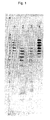
- lanes 1-3 samples of EPO producing cell culture suspension (CHO cells) were taken at the 6 th day (lane 1), at the 10 th day (lane 2) and at the 11 th day (lane 3) from the beginning of cultivation and loaded on the gel.
- EPO BRP Batch 1 was loaded on the gel.
- Diffusion transfer of proteins from the gel to the membrane was performed in the following way: the membrane was placed on the gel and several layers of filter paper were placed on the membrane. Gel, membrane and the filter paper were of the same size. Membrane and filter paper were prewetted in transfer buffer. Transfer buffer: 48 mM Tris-HCl, 39 mM glycine, 0.037% SDS, 20 vol% methanol, pH 8,3. The transfer time is 90 min at 40 °C.
- the nitrocellulose was blocked using a 5% solution of skimmed powder milk blocking solution. Then, the membrane was incubated with mouse monoclonal anti hEPO antibodies (IgG) as primary antibodies. The membrane was washed by using 10 mMTris-HCl, 150 mM NaCl, pH 7.4. Then, the membrane was incubated with rabbit polyclonal antibodies (IgG) conjugated with horse raddish peroxidase as secondary antibodies For the staining reaction, a substrate for peroxidase was used, for example 4-chloro-1-naphtol. Specific EPO glyco-isoforms were identified by comparing with EPO BRP. Intensity of bands was determined by using densitometry. The profile of specific EPO glyco-isoforms was then calculated.
- mouse monoclonal anti hEPO antibodies IgG
- the membrane was washed by using 10 mMTris-HCl, 150 mM NaCl, pH 7.4. Then, the
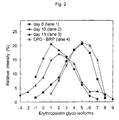
- Fig. 2 shows the profiles of relative proportions of EPO glyco-isoforms in the samples derived from CHO cells suspension culture presented on Fig. 1.
- Intensity of bands on the membrane (Fig. 1) is measured by using densitometry. The intensity of each band is given as a relative part (relative intensity, %) of the sum of intensities of all detected bands for each sample (lane).
- Figs. 1 and 2 show that the IEF analysis combined with immuno-detection according to the invention allows a good and specific control over the EPO glyco-isoform production from crude cell culture where many other proteins are present. By this analysis, an appropriate time point for harvesting can be found which provides a good basis for further isolation and purification in terms of the aimed glyco-isoform profile.
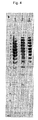
- Figs. 4 and 6 show further electrophoretograms for EPO glyco-isoform analysis during the process of preparing EPO glyco-isoform mixture according to the invention (see Examples 2b and 2d, respectively).
- EPO producing CHO cell culture suspension was prepared in bioreactor, filtered first through a 10 ⁇ m prefilter and than through a 0.2 ⁇ m membrane sterilizing filter to separate the cells.
- the filtrate was loaded on the first chromatographic column by using matrix - bound stain Cibachron Blue 3G.
- the column was equilibrated with 5 CV (column volume) of buffer A. After loading of the sample, the column was first washed with 3 CV of buffer A and then with 5 CV of mixture of buffer A and B (90:10). Most of EPO was eluted with buffer B (5 CV). The same separation was performed by using buffers A and B at pH 6.4 and 8.0.
- the column was equilibrated with buffer A. After loading of the sample, the column was washed with 3 CV of buffer A and then with 8 CV of buffer B. Most of EPO was eluted with buffer C. Profile of EPO glyco-isoforms, which was obtained by washing the column with buffer C, was analysed with IEF in polyacrylamide gel and immuno-detection of EPO on nitrocellulose membrane, as shown in Fig. 4.
- the pooled fractions were concentrated by using the system for ultrafiltration MINITAN (Millipore).
- the dialfiltration was performed by using 10 mM Na-phosphate, pH 7.0 as buffer.
- EPO glyco-isoforms with lower pl are eluted in earlier fractions than those with higher pl. This feature indicates that this method enables to collect the fraction(s) with desired profile of EPO glyco-isoforms.
- the column was equilibrated with buffer A. After loading of the sample, the column was washed with 3 CV buffer A and then with 5 CV of buffer B. Most of EPO was eluted with buffer C (8 CV). Remaining proteins were eluted with buffer D. The column was regenerated with 2 M NaCl.
- the described conditions enabled obtaining a profile which was essentially similar to the profile of EPO BRP standard.
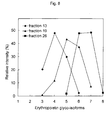
- Fractions 11, 14, pooled fractions 21 and 22 (21 +22) and 24 were analysed by using IEF. Proteins were transferred to nitrocellulose membrane, and EPO was immuno-detected and the intensity of bands was measured densitometrically as described in Example 1.
- EPO glyco-isoforms with higher pl are eluted faster from the column. Therefore the method can be used for isolation of desired profile of EPO glyco-isoforms.
- EPO was eluted from the column in fractions 59 through 68.
- Fig. 9 shows the profiles of EPO glyco-isoforms after elution from the Superdex 200 column. Fractions 61, 63, 65 and 67 were analysed with IEF, proteins were then transferred to nitrocellulose membrane, the EPO was immuno-detected and the intensity of bands was measured densitometrically as described in Example 1.
- EPO glyco-isoforms differed between particular fractions. EPO glyco-isoforms with lower pl (with higher content of sialic acids) are eluted faster from the column. Therefore this method enables the isolation of a desired profile of EPO glyco-isoform by choosing the appropriate fraction after elution from the column.
- Example 2 h Preparation of a desired EPO glyco-isoform mixture
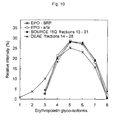
- FIG 10 shows profiles of EPO glyco-isoforms after gradient elution from columns DEAE Sepharose Fast Flow of Example 2e and Source 15 Q of Example 2f.
- EPO BRP Batch 1 was loaded on the columns. Pooled fractions 13 through 31 from Source Q and pooled fractions from 14 to 28 from DEAE Sepharose Fast Flow were analysed by using IEF. For comparison EPO BRP and EPO alpha (Eprex) were also analysed. Proteins were then transferred to the nitrocellulose membrane, EPO was immunodetected and the intensity of bands was measured densitometrically .as described in Example 1. A good correspondence with the desired EPO alpha isoform profile is obtained with both anion exchange chromatography columns.
- the column was equilibrated with 5 CV of buffer A. After loading the sample the column was washed with 5 CV of buffer A and then with 12 CV of mixture of buffers A and B (1:1). The eluate in which EPO was eluted with buffer B (15 CV) was used for the subsequent chromatographic steps.
- the eluate from the second chromatographic step was concentrated and the buffer B was replaced with 10 mM Na-phosphate buffer, pH 7.0 by using the system for ultrafiltration Centricon YM-10 (Millipore).
- the concentrate was loaded to the column of the third chromatographic step (anion exchange chromatography).
Landscapes
- Chemical & Material Sciences (AREA)
- Health & Medical Sciences (AREA)
- Life Sciences & Earth Sciences (AREA)
- Organic Chemistry (AREA)
- General Health & Medical Sciences (AREA)
- Molecular Biology (AREA)
- Biochemistry (AREA)
- Biophysics (AREA)
- Zoology (AREA)
- Genetics & Genomics (AREA)
- Medicinal Chemistry (AREA)
- Gastroenterology & Hepatology (AREA)
- Proteomics, Peptides & Aminoacids (AREA)
- Toxicology (AREA)
- Peptides Or Proteins (AREA)
- Medicines That Contain Protein Lipid Enzymes And Other Medicines (AREA)
- Investigating Or Analysing Biological Materials (AREA)
- Preparation Of Compounds By Using Micro-Organisms (AREA)
Claims (18)
- Verfahren zur Herstellung von Erythropoetin, wobei das Verfahren die Unterziehung einer Erythropoetin-haltigen Zusammensetzung den folgenden chromatographischen Schritten umfasst:(a) Farbstoffaffinitätschromatographie(b) Hydrophobe Chromatographie und(c) Anionenaustauschchromatographie,
dadurch gekennzeichnet, dass die chromatographischen Schritte nur aus den folgenden Schritten in der angegebenen Reihenfolge bestehen (a), (b), (c) oder (a), (c), (b), jeweils optional mit(d) Gelchromatographie. - Verfahren nach Anspruch 1, das zusätzlich zumindest einen Zwischenschritt des Pufferaustausches, der Filtration, der Ultrafiltration und/oder der Diafiltration umfasst.
- Verfahren nach einem der Ansprüche 1 oder 2, worin das Erythropoetin in Form eines Glycoisoformengemisches hergestellt wird.
- Verfahren nach Anspruch 3, worin das Glycoisoformenprofil des hergestellten Erythropoetins nach den chromatographischen Schritten relativ zur Erythropoetin-enthaltenden Ausgangszusammensetzung verändert ist.
- Verfahren nach einem der vorangehenden Ansprüche, worin die Farbstoffaffinitätschromatographie mit einem Matrix-gebundenen Triazinfarbstoff ausgeführt wird.
- Verfahren nach einem der vorangehenden Ansprüche, worin im Farbstoffaffinitätschromatographieschritt der pH des Elutionspuffers auf einen Bereich von 5,0 bis 9,0 eingestellt wird.
- Verfahren nach einem der vorangehenden Ansprüche, worin im Farbstoffaffinitätschromatographieschritt der pH des Elutionspuffers auf einen Bereich von 6,0 bis 8,0 eingestellt wird.
- Verfahren nach einem der vorangehenden Ansprüche, worin die hydrophobe Chromatographie mit einem butylierten Matrixträger ausgeführt wird.
- Verfahren nach einem der vorangehenden Ansprüche, worin die Anionenaustauschchromatographie an einer DEAE Sepharosematrix ausgeführt wird.
- Verfahren nach einem der vorangehenden Ansprüche, worin die Gelchromatographie auf einer Superdex 200 oder einer Sephacryl S-200 Säule ausgeführt wird.
- Verfahren nach einem der Ansprüche 3 bis 10, worin das Glycoisoformenprofil des Erythropoetingemisches vor und/oder nach zumindest einem ausgewählten Chromatographieschritt bestimmt wird, wobei die Erythropoetin-enthaltende Zusammensetzung einer isoelektrischen Fokussierung in einer Gelmatrix unterzogen wird, die Proteine vom Gel auf eine Membran übertragen werden und das Erythropoetin auf der Membran immundetektiert wird.
- Verfahren nach Anspruch 11, worin die gewünschten Fraktionen, die von der Säule eluieren, vereinigt werden.
- Verfahren nach einem der vorangehenden Ansprüche, worin in der hergestellten Erythropoetin-enthaltenden Zusammensetzung der Anteil an Erythropoetin enthaltenden Glycoisoformen mit bis zu 3 Sialinsäuregruppen pro Erythropoetinmolekül relativ zur Erythropoetin-enthaltenden Ausgangszusammensetzung verringert ist.
- Verfahren nach einem der vorangehenden Ansprüche, worin in der hergestellten Erythropoetin-enthaltenden Zusammensetzung der Anteil an Erythropoetin enthaltenden Glycoisoformen mit bis zu 4 Sialinsäuregruppen pro Erythropoetinmolekül relativ zur Erythropoetin-enthaltenden Ausgangszusammensetzung verringert ist.
- Verfahren nach einem der vorangehenden Ansprüche, worin in der hergestellten Erythropoetin-enthaltenden Zusammensetzung der Anteil an Erythropoetin enthaltenden Glycoisoformen mit bis zu 5 Sialinsäuregruppen pro Erythropoetinmolekül relativ zur Erythropoetin-enthaltenden Ausgangszusammensetzung verringert ist.
- Verfahren nach einem der vorangehenden Ansprüche, worin ein Erythropoetinglycoisoformengemisch mit einem spezifischen Gehalt an Molekülen mit einer Anzahl an Sialinsäuregruppen, die von 6 bis 14 pro Erythropoetinmolekül reicht, hergestellt wird.
- Verfahren nach einem der vorangehenden Ansprüche, worin ein Erythropoetinglycoisoformengemisch mit einem spezifischen Gehalt an Molekülen mit einer Anzahl an Sialinsäuregruppen, die von 7 bis 13 pro Erythropoetinmolekül reicht, hergestellt wird.
- Verfahren nach einem der vorangehenden Ansprüche, worin ein Erythropoetinglycoisoformengemisch mit einem spezifischen Gehalt an Molekülen mit einer Anzahl an Sialinsäuregruppen, die von 8 bis 13 pro Erythropoetinmolekül reicht, hergestellt wird.
Priority Applications (1)
| Application Number | Priority Date | Filing Date | Title |
|---|---|---|---|
| SI200230595T SI1492878T1 (sl) | 2002-03-26 | 2002-03-26 | Postopek za pripravo Ĺľelenega profila gliko-izoform eritropoietina |
Applications Claiming Priority (1)
| Application Number | Priority Date | Filing Date | Title |
|---|---|---|---|
| PCT/IB2002/000971 WO2003080852A1 (en) | 2002-03-26 | 2002-03-26 | Process for the preparation of a desired erythropoietin glyco-isoform profile |
Publications (2)
| Publication Number | Publication Date |
|---|---|
| EP1492878A1 EP1492878A1 (de) | 2005-01-05 |
| EP1492878B1 true EP1492878B1 (de) | 2007-05-30 |
Family
ID=28053152
Family Applications (1)
| Application Number | Title | Priority Date | Filing Date |
|---|---|---|---|
| EP02716973A Expired - Lifetime EP1492878B1 (de) | 2002-03-26 | 2002-03-26 | Verfahren für die herstellung eines gewünschten profils von erythropoietin glyko-isoformen |
Country Status (8)
| Country | Link |
|---|---|
| US (1) | US20050153879A1 (de) |
| EP (1) | EP1492878B1 (de) |
| JP (1) | JP4109204B2 (de) |
| AT (1) | ATE363541T1 (de) |
| AU (1) | AU2002247896A1 (de) |
| DE (1) | DE60220451T2 (de) |
| SI (1) | SI1492878T1 (de) |
| WO (1) | WO2003080852A1 (de) |
Families Citing this family (99)
| Publication number | Priority date | Publication date | Assignee | Title |
|---|---|---|---|---|
| DE102004027816A1 (de) | 2004-06-08 | 2006-01-05 | Bioceuticals Arzneimittel Ag | Verfahren zur Reinigung von Erythropoietin |
| US7566401B2 (en) * | 2005-10-03 | 2009-07-28 | Kelm Mark A | Process for separating and isolating xanthines, individual polar protic monomers, and polar protic oligomers |
| AR053416A1 (es) | 2005-11-10 | 2007-05-09 | Protech Pharma S A | Combinacion de glicoisoformas para el tratamiento o prevencion de la septicemia, linea celular transgenica productora de glicoformas de eritropoyetina, composicion farmaceutica que comprende a dicha combinacion, procedimientos para obtener la linea celular, procedimiento para producir dicha combinac |
| AR058568A1 (es) | 2005-12-20 | 2008-02-13 | Bristol Myers Squibb Co | Metodos para producir una composicion con moleculas ctla4-ig a partir de un medio de cultivo |
| PL2253644T3 (pl) | 2005-12-20 | 2014-04-30 | Bristol Myers Squibb Co | Kompozycje i sposoby wytwarzania kompozycji |
| AR065083A1 (es) * | 2007-02-02 | 2009-05-13 | Amgen Inc | Hepcidina, antagonistas de la hepcidina y metodos de uso |
| AU2008304111B2 (en) * | 2007-09-27 | 2014-04-24 | Amgen Inc. | Pharmaceutical formulations |
| EP3381445B1 (de) | 2007-11-15 | 2023-10-25 | Amgen Inc. | Wässrige antikörperformulierung mit stabilisierung durch antioxidantien zur parenteralen verabreichung |
| AU2009206306B2 (en) | 2008-01-25 | 2013-06-06 | Amgen Inc. | Ferroportin antibodies and methods of use |
| JP2011519279A (ja) | 2008-05-01 | 2011-07-07 | アムジエン・インコーポレーテツド | 抗ヘプシジン抗体及び使用の方法 |
| EP2334699B1 (de) | 2008-09-23 | 2013-09-11 | F. Hoffmann-La Roche AG | Aufreinigung von erythropoietin |
| EP2349332B1 (de) | 2008-11-13 | 2019-10-23 | The General Hospital Corporation | Verfahren und zusammensetzungen zur regulierung der eisenhomöostase durch modulierung der bmp6-aktivität |
| DE102008054716A1 (de) * | 2008-12-16 | 2010-06-17 | Evonik Degussa Gmbh | Inprozesskontrolle in einem Verfahren zur Herstellung von EPO |
| EA022396B1 (ru) * | 2009-09-23 | 2015-12-30 | Ратиофарм Гмбх | Способ очистки рекомбинантного эритропоэтина человека (epo), эритропоэтин, очищенный данным способом, и фармацевтические композиции, содержащие такой эритропоэтин |
| MX344382B (es) | 2009-10-23 | 2016-12-14 | Amgen Inc * | Adaptador de vial y sistema. |
| ES2545411T5 (es) | 2010-06-07 | 2024-04-05 | Amgen Inc | Dispositivo de administración de fármaco |
| AU2011329053A1 (en) * | 2010-11-15 | 2013-06-06 | Biogen Inc. | Enrichment and concentration of select product isoforms by overloaded bind and elute chromatography |
| CA2831100C (en) | 2011-03-31 | 2020-02-18 | Mark Dominis Holt | Vial adapter and system |
| CA3021845C (en) | 2011-04-20 | 2022-03-29 | Amgen Inc. | Autoinjector apparatus |
| LT3045187T (lt) | 2011-10-14 | 2019-07-10 | Amgen Inc. | Injekcijų įrenginys ir surinkimo būdas |
| SI3081249T1 (sl) | 2012-11-21 | 2021-03-31 | Amgen Inc. | Naprava za dajanje zdravila |
| CN105142695B (zh) | 2013-03-15 | 2020-06-02 | 安进公司 | 身体轮廓可调适的自动注射器装置 |
| EP2968503B1 (de) | 2013-03-15 | 2018-08-15 | Intrinsic LifeSciences LLC | Anti-hepcidin-antikörper und verwendungen davon |
| EP2968775B1 (de) | 2013-03-15 | 2019-12-18 | Amgen Inc. | Medikamentenkassette, autoinjektor und autoinjektorsystem |
| TWI580451B (zh) | 2013-03-15 | 2017-05-01 | 安美基公司 | 用於注射器之匣盒及使用具有自動注射器及匣盒之自動注射器設備之方法 |
| SG11201507878SA (en) | 2013-03-22 | 2015-10-29 | Amgen Inc | Injector and method of assembly |
| EP3060281B1 (de) | 2013-10-24 | 2019-01-30 | Amgen Inc. | Arzneimittelabgabesystem mit temperaturempfindlicher steuerung |
| EP3421066B1 (de) | 2013-10-24 | 2021-03-03 | Amgen Inc. | Injektor und verfahren zur montage |
| WO2015119906A1 (en) | 2014-02-05 | 2015-08-13 | Amgen Inc. | Drug delivery system with electromagnetic field generator |
| JP6640113B2 (ja) | 2014-05-07 | 2020-02-05 | アムジエン・インコーポレーテツド | 衝撃低減要素を有する自動注入器 |
| CN112237662B (zh) | 2014-06-03 | 2022-10-21 | 安姆根有限公司 | 药物递送系统和使用方法 |
| WO2016049036A1 (en) | 2014-09-22 | 2016-03-31 | Intrinsic Lifesciences Llc | Humanized anti-hepcidin antibodies and uses thereof |
| WO2016061220A2 (en) | 2014-10-14 | 2016-04-21 | Amgen Inc. | Drug injection device with visual and audio indicators |
| US9908932B2 (en) | 2014-10-15 | 2018-03-06 | Alexion Pharmaceuticals, Inc. | Methods of shifting an isoelectric profile of a protein product and uses thereof |
| US11357916B2 (en) | 2014-12-19 | 2022-06-14 | Amgen Inc. | Drug delivery device with live button or user interface field |
| EP3848072A1 (de) | 2014-12-19 | 2021-07-14 | Amgen Inc. | Medikamentenabgabevorrichtung mit näherungssensor |
| CA2976935C (en) | 2015-02-17 | 2020-03-10 | Amgen Inc. | Drug delivery device with vacuum assisted securement and/or feedback |
| WO2016138434A1 (en) | 2015-02-27 | 2016-09-01 | Amgen Inc. | Drug delivery device having a needle guard mechanism with a tunable threshold of resistance to needle guard movement |
| WO2017039786A1 (en) | 2015-09-02 | 2017-03-09 | Amgen Inc. | Syringe assembly adapter for a syringe |
| ES2755717T3 (es) | 2015-12-09 | 2020-04-23 | Amgen Inc | Autoinyector con tapa de señalización |
| US11154661B2 (en) | 2016-01-06 | 2021-10-26 | Amgen Inc. | Auto-injector with signaling electronics |
| US11200298B2 (en) | 2016-03-15 | 2021-12-14 | Amgen Inc. | Reducing probability of glass breakage in drug delivery devices |
| US11541168B2 (en) | 2016-04-29 | 2023-01-03 | Amgen Inc. | Drug delivery device with messaging label |
| WO2017192287A1 (en) | 2016-05-02 | 2017-11-09 | Amgen Inc. | Syringe adapter and guide for filling an on-body injector |
| EP3455142B1 (de) | 2016-05-13 | 2023-08-09 | Amgen Inc. | Ampullenhülsenanordnung |
| US11238150B2 (en) | 2016-05-16 | 2022-02-01 | Amgen Inc. | Data encryption in medical devices with limited computational capability |
| US11541176B2 (en) | 2016-06-03 | 2023-01-03 | Amgen Inc. | Impact testing apparatuses and methods for drug delivery devices |
| WO2018004842A1 (en) | 2016-07-01 | 2018-01-04 | Amgen Inc. | Drug delivery device having minimized risk of component fracture upon impact events |
| WO2018034784A1 (en) | 2016-08-17 | 2018-02-22 | Amgen Inc. | Drug delivery device with placement detection |
| US20200261643A1 (en) | 2016-10-25 | 2020-08-20 | Amgen Inc. | On-body injector |
| WO2018136398A1 (en) | 2017-01-17 | 2018-07-26 | Amgen Inc. | Injection devices and related methods of use and assembly |
| US11752258B2 (en) | 2017-02-17 | 2023-09-12 | Amgen Inc. | Drug delivery device with sterile fluid flowpath and related method of assembly |
| US11369736B2 (en) | 2017-02-17 | 2022-06-28 | Amgen Inc. | Cannula insertion and retraction mechanisms |
| CA3050927A1 (en) | 2017-03-06 | 2018-09-13 | Brian Stonecipher | Drug delivery device with activation prevention feature |
| KR102627069B1 (ko) | 2017-03-07 | 2024-01-18 | 암겐 인코포레이티드 | 과압에 의한 바늘 삽입 |
| EP3592404A1 (de) | 2017-03-09 | 2020-01-15 | Amgen Inc. | Einführmechanismus für eine arzneimittelabgabevorrichtung |
| EP3570871B1 (de) | 2017-03-20 | 2020-11-18 | H. Hoffnabb-La Roche Ag | Verfahren für in-vitro-glyco-engineering eines erythropoiesestimulierenden proteins |
| KR102651078B1 (ko) | 2017-03-28 | 2024-03-22 | 암겐 인코포레이티드 | 플런저 로드 및 주사기 조립 시스템 및 방법 |
| US11590294B2 (en) | 2017-06-08 | 2023-02-28 | Amgen Inc. | Syringe assembly for a drug delivery device and method of assembly |
| JP7200134B2 (ja) | 2017-06-08 | 2023-01-06 | アムジエン・インコーポレーテツド | トルク駆動式薬物送達デバイス |
| JP7195276B2 (ja) | 2017-06-22 | 2022-12-23 | アムジエン・インコーポレーテツド | デバイス起動による衝突/衝撃の低減 |
| MA49461A (fr) | 2017-06-23 | 2020-04-29 | Amgen Inc | Dispositif électronique d'administration de médicament comprenant un bouchon activé par un ensemble commutateur |
| MA49562A (fr) | 2017-07-14 | 2020-05-20 | Amgen Inc | Système d'insertion-rétractation d'aiguille présentant un système à ressort en double torsion |
| EP3655063A1 (de) | 2017-07-21 | 2020-05-27 | Amgen Inc. | Gasdurchlässiges dichtelement für arzneimittelbehälter und verfahren zur montage |
| US11484648B2 (en) | 2017-07-25 | 2022-11-01 | Amgen Inc. | Drug delivery device with container access system and related method of assembly |
| MA49677A (fr) | 2017-07-25 | 2021-04-21 | Amgen Inc | Dispositif d'administration de médicament avec module d'engrenage et procédé d'assemblage associé |
| MA49838A (fr) | 2017-08-09 | 2020-06-17 | Amgen Inc | Systèm de administration de médicaments avec pression hydraulique-pneumatique de chambre |
| WO2019036181A1 (en) | 2017-08-18 | 2019-02-21 | Amgen Inc. | BODY INJECTOR WITH STERILE ADHESIVE PATCH |
| US11103636B2 (en) | 2017-08-22 | 2021-08-31 | Amgen Inc. | Needle insertion mechanism for drug delivery device |
| WO2019070472A1 (en) | 2017-10-04 | 2019-04-11 | Amgen Inc. | FLOW ADAPTER FOR MEDICATION DELIVERY DEVICE |
| CN111132711B (zh) | 2017-10-06 | 2022-07-01 | 安进公司 | 带有联锁组件的药物递送装置及相关组装方法 |
| MA50348A (fr) | 2017-10-09 | 2020-08-19 | Amgen Inc | Dispositif d'administration de médicament comprenant un ensemble d'entraînement et procédé d'assemblage associé |
| WO2019090086A1 (en) | 2017-11-03 | 2019-05-09 | Amgen Inc. | Systems and approaches for sterilizing a drug delivery device |
| IL273664B1 (en) | 2017-11-06 | 2026-02-01 | Amgen Inc | Full-fledged assemblies and related methods |
| US20200261648A1 (en) | 2017-11-06 | 2020-08-20 | Amgen Inc. | Drug delivery device with placement and flow sensing |
| IL319987A (en) | 2017-11-10 | 2025-06-01 | Amgen Inc | Plungers for drug delivery devices |
| SG11202003004RA (en) | 2017-11-16 | 2020-04-29 | Amgen Inc | Door latch mechanism for drug delivery device |
| AU2018368338B2 (en) | 2017-11-16 | 2024-07-25 | Amgen Inc. | Autoinjector with stall and end point detection |
| US10835685B2 (en) | 2018-05-30 | 2020-11-17 | Amgen Inc. | Thermal spring release mechanism for a drug delivery device |
| US11083840B2 (en) | 2018-06-01 | 2021-08-10 | Amgen Inc. | Modular fluid path assemblies for drug delivery devices |
| WO2020023220A1 (en) | 2018-07-24 | 2020-01-30 | Amgen Inc. | Hybrid drug delivery devices with tacky skin attachment portion and related method of preparation |
| CA3103681A1 (en) | 2018-07-24 | 2020-01-30 | Amgen Inc. | Delivery devices for administering drugs |
| WO2020023451A1 (en) | 2018-07-24 | 2020-01-30 | Amgen Inc. | Delivery devices for administering drugs |
| WO2020023336A1 (en) | 2018-07-24 | 2020-01-30 | Amgen Inc. | Hybrid drug delivery devices with grip portion |
| EP3829692A1 (de) | 2018-07-31 | 2021-06-09 | Amgen Inc. | Flüssigkeitsweganordnungen für wirkstofffreisetzungsvorrichtung |
| EP3856284A1 (de) | 2018-09-24 | 2021-08-04 | Amgen Inc. | Interventionelle dosiersysteme und verfahren |
| MA53718A (fr) | 2018-09-28 | 2022-01-05 | Amgen Inc | Ensemble d'activation d'échappement de fil de muscle pour un dispositif d'administration de médicament |
| MX2021003492A (es) | 2018-10-02 | 2021-06-18 | Amgen Inc | Sistemas de inyeccion para la administracion de farmacos con transmision de fuerza interna. |
| JP7547325B2 (ja) | 2018-10-05 | 2024-09-09 | アムジエン・インコーポレーテツド | 投薬量インジケータを有する薬物送達デバイス |
| AU2019359801B2 (en) | 2018-10-15 | 2025-01-02 | Amgen Inc. | Platform assembly process for drug delivery device |
| SG11202103800RA (en) | 2018-10-15 | 2021-05-28 | Amgen Inc | Drug delivery device having damping mechanism |
| MA54057A (fr) | 2018-11-01 | 2022-02-09 | Amgen Inc | Dispositifs d'administration de médicament à rétraction partielle d'élément d'administration de médicament |
| ES3010833T3 (en) | 2018-11-01 | 2025-04-04 | Amgen Inc | Drug delivery devices with partial drug delivery member retraction |
| TWI831847B (zh) | 2018-11-01 | 2024-02-11 | 美商安進公司 | 部分針頭縮回之藥物遞送裝置及其操作方法 |
| AU2020263289B2 (en) | 2019-04-24 | 2025-05-22 | Amgen Inc. | Syringe sterilization verification assemblies and methods |
| MX2022002149A (es) | 2019-08-23 | 2022-03-17 | Amgen Inc | Dispositivo de suministro de farmacos con componentes de acoplamiento de capuchon de aguja configurable y metodos relacionados. |
| MX2023013640A (es) * | 2021-05-21 | 2023-11-30 | Amgen Inc | Metodo de optimizacion de una receta de llenado para un contenedor de medicamento. |
| KR20250099137A (ko) | 2022-11-02 | 2025-07-01 | 에프. 호프만-라 로슈 아게 | 당단백질 조성물의 생산 방법 |
| WO2026030152A1 (en) | 2024-07-29 | 2026-02-05 | Amgen Inc. | System and method for assessing transferability of a fill recipe |
Family Cites Families (4)
| Publication number | Priority date | Publication date | Assignee | Title |
|---|---|---|---|---|
| IL118201A (en) * | 1995-05-11 | 2004-12-15 | Roche Diagnostics Gmbh | Preparation comprising a protein with human erythropoietin activity which is free of serum and non-recombinant mammalian protein and process for the preparation thereof |
| TR200001580T2 (tr) * | 1997-12-03 | 2000-12-21 | Roche Diagnostics Gmbh | Spesifik etkinliği yüksek eritropoyetin |
| EP0984062A1 (de) * | 1998-09-04 | 2000-03-08 | Cytos Biotechnology AG | Herstellung von menschlichem Erythropoietin |
| CN1596268A (zh) * | 2001-11-28 | 2005-03-16 | 桑多斯有限公司 | 重组人红细胞生成素的层析纯化 |
-
2002
- 2002-03-26 AT AT02716973T patent/ATE363541T1/de active
- 2002-03-26 US US10/508,598 patent/US20050153879A1/en not_active Abandoned
- 2002-03-26 JP JP2003578576A patent/JP4109204B2/ja not_active Expired - Lifetime
- 2002-03-26 EP EP02716973A patent/EP1492878B1/de not_active Expired - Lifetime
- 2002-03-26 AU AU2002247896A patent/AU2002247896A1/en not_active Abandoned
- 2002-03-26 DE DE60220451T patent/DE60220451T2/de not_active Expired - Lifetime
- 2002-03-26 SI SI200230595T patent/SI1492878T1/sl unknown
- 2002-03-26 WO PCT/IB2002/000971 patent/WO2003080852A1/en not_active Ceased
Non-Patent Citations (1)
| Title |
|---|
| None * |
Also Published As
| Publication number | Publication date |
|---|---|
| SI1492878T1 (sl) | 2007-12-31 |
| AU2002247896A1 (en) | 2003-10-08 |
| DE60220451D1 (de) | 2007-07-12 |
| JP2005520550A (ja) | 2005-07-14 |
| WO2003080852A1 (en) | 2003-10-02 |
| ATE363541T1 (de) | 2007-06-15 |
| DE60220451T2 (de) | 2008-01-24 |
| US20050153879A1 (en) | 2005-07-14 |
| JP4109204B2 (ja) | 2008-07-02 |
| EP1492878A1 (de) | 2005-01-05 |
Similar Documents
| Publication | Publication Date | Title |
|---|---|---|
| US20050153879A1 (en) | Process for the preparation of a desired erythropoietin glyco-isoform profile | |
| EP1127063B1 (de) | Methoden zur aufreinigung von rekombinatem humanem erythropoietin aus zellkulturüberständen | |
| Gozes et al. | Multiple tubulin forms are expressed by a single neurone | |
| JP3673261B2 (ja) | 高い比活性を有するエリスロポエチン | |
| US20020146771A1 (en) | Process for producing erythropoietin containing no animal proteins | |
| US20210070822A1 (en) | Method for the Purification of G-CSF | |
| US20110098452A1 (en) | Purification of modified cytokines | |
| US20030036629A1 (en) | Novel tgf-beta protein purification methods | |
| KR100234497B1 (ko) | Tgf-베타 2 및 tgf-베타3의 대형 잠복 복합체 | |
| US7619073B2 (en) | Method for purifying erythropoietin | |
| US20110152506A1 (en) | Method for Purifying Erythropoietin | |
| EP3075740A1 (de) | Verfahren zur reinigung von darbepoetin-alpha | |
| WO2011063195A2 (en) | Purification of modified cytokines | |
| Choppin et al. | Characterization of erythropoietin produced by IW32 murine erythroleukemia cells | |
| KR100442076B1 (ko) | 에리트로포이에틴과같은당단백질의정제방법 | |
| KR100297927B1 (ko) | 인간에리스로포이에틴의정제방법 | |
| Somerville et al. | Discrimination of granulocyte colony-stimulating factor isoforms by high-performance capillary electrophoresis | |
| EP0575311A1 (de) | Kontrolle von milchsekretion | |
| KR0184776B1 (ko) | 재조합 인 과립구 콜로니 자극인자의 정제방법 |
Legal Events
| Date | Code | Title | Description |
|---|---|---|---|
| PUAI | Public reference made under article 153(3) epc to a published international application that has entered the european phase |
Free format text: ORIGINAL CODE: 0009012 |
|
| 17P | Request for examination filed |
Effective date: 20041021 |
|
| AK | Designated contracting states |
Kind code of ref document: A1 Designated state(s): AT BE CH CY DE DK ES FI FR GB GR IE IT LI LU MC NL PT SE TR |
|
| AX | Request for extension of the european patent |
Extension state: AL LT LV MK RO SI |
|
| 17Q | First examination report despatched |
Effective date: 20050330 |
|
| GRAP | Despatch of communication of intention to grant a patent |
Free format text: ORIGINAL CODE: EPIDOSNIGR1 |
|
| GRAS | Grant fee paid |
Free format text: ORIGINAL CODE: EPIDOSNIGR3 |
|
| GRAA | (expected) grant |
Free format text: ORIGINAL CODE: 0009210 |
|
| AK | Designated contracting states |
Kind code of ref document: B1 Designated state(s): AT BE CH CY DE DK ES FI FR GB GR IE IT LI LU MC NL PT SE TR |
|
| AX | Request for extension of the european patent |
Extension state: SI |
|
| PG25 | Lapsed in a contracting state [announced via postgrant information from national office to epo] |
Ref country code: FI Free format text: LAPSE BECAUSE OF FAILURE TO SUBMIT A TRANSLATION OF THE DESCRIPTION OR TO PAY THE FEE WITHIN THE PRESCRIBED TIME-LIMIT Effective date: 20070530 Ref country code: LI Free format text: LAPSE BECAUSE OF FAILURE TO SUBMIT A TRANSLATION OF THE DESCRIPTION OR TO PAY THE FEE WITHIN THE PRESCRIBED TIME-LIMIT Effective date: 20070530 Ref country code: CH Free format text: LAPSE BECAUSE OF FAILURE TO SUBMIT A TRANSLATION OF THE DESCRIPTION OR TO PAY THE FEE WITHIN THE PRESCRIBED TIME-LIMIT Effective date: 20070530 |
|
| REG | Reference to a national code |
Ref country code: GB Ref legal event code: FG4D |
|
| REG | Reference to a national code |
Ref country code: CH Ref legal event code: EP |
|
| REG | Reference to a national code |
Ref country code: IE Ref legal event code: FG4D |
|
| REF | Corresponds to: |
Ref document number: 60220451 Country of ref document: DE Date of ref document: 20070712 Kind code of ref document: P |
|
| PG25 | Lapsed in a contracting state [announced via postgrant information from national office to epo] |
Ref country code: SE Free format text: LAPSE BECAUSE OF FAILURE TO SUBMIT A TRANSLATION OF THE DESCRIPTION OR TO PAY THE FEE WITHIN THE PRESCRIBED TIME-LIMIT Effective date: 20070830 |
|
| PG25 | Lapsed in a contracting state [announced via postgrant information from national office to epo] |
Ref country code: ES Free format text: LAPSE BECAUSE OF FAILURE TO SUBMIT A TRANSLATION OF THE DESCRIPTION OR TO PAY THE FEE WITHIN THE PRESCRIBED TIME-LIMIT Effective date: 20070910 |
|
| NLV1 | Nl: lapsed or annulled due to failure to fulfill the requirements of art. 29p and 29m of the patents act | ||
| REG | Reference to a national code |
Ref country code: CH Ref legal event code: PL |
|
| PG25 | Lapsed in a contracting state [announced via postgrant information from national office to epo] |
Ref country code: BE Free format text: LAPSE BECAUSE OF FAILURE TO SUBMIT A TRANSLATION OF THE DESCRIPTION OR TO PAY THE FEE WITHIN THE PRESCRIBED TIME-LIMIT Effective date: 20070530 |
|
| PG25 | Lapsed in a contracting state [announced via postgrant information from national office to epo] |
Ref country code: NL Free format text: LAPSE BECAUSE OF FAILURE TO SUBMIT A TRANSLATION OF THE DESCRIPTION OR TO PAY THE FEE WITHIN THE PRESCRIBED TIME-LIMIT Effective date: 20070530 Ref country code: PT Free format text: LAPSE BECAUSE OF FAILURE TO SUBMIT A TRANSLATION OF THE DESCRIPTION OR TO PAY THE FEE WITHIN THE PRESCRIBED TIME-LIMIT Effective date: 20071030 Ref country code: DK Free format text: LAPSE BECAUSE OF FAILURE TO SUBMIT A TRANSLATION OF THE DESCRIPTION OR TO PAY THE FEE WITHIN THE PRESCRIBED TIME-LIMIT Effective date: 20070530 |
|
| PLBE | No opposition filed within time limit |
Free format text: ORIGINAL CODE: 0009261 |
|
| STAA | Information on the status of an ep patent application or granted ep patent |
Free format text: STATUS: NO OPPOSITION FILED WITHIN TIME LIMIT |
|
| PG25 | Lapsed in a contracting state [announced via postgrant information from national office to epo] |
Ref country code: IT Free format text: LAPSE BECAUSE OF FAILURE TO SUBMIT A TRANSLATION OF THE DESCRIPTION OR TO PAY THE FEE WITHIN THE PRESCRIBED TIME-LIMIT Effective date: 20070530 Ref country code: GR Free format text: LAPSE BECAUSE OF FAILURE TO SUBMIT A TRANSLATION OF THE DESCRIPTION OR TO PAY THE FEE WITHIN THE PRESCRIBED TIME-LIMIT Effective date: 20070831 |
|
| 26N | No opposition filed |
Effective date: 20080303 |
|
| PG25 | Lapsed in a contracting state [announced via postgrant information from national office to epo] |
Ref country code: FR Free format text: LAPSE BECAUSE OF FAILURE TO SUBMIT A TRANSLATION OF THE DESCRIPTION OR TO PAY THE FEE WITHIN THE PRESCRIBED TIME-LIMIT Effective date: 20080125 |
|
| PG25 | Lapsed in a contracting state [announced via postgrant information from national office to epo] |
Ref country code: MC Free format text: LAPSE BECAUSE OF NON-PAYMENT OF DUE FEES Effective date: 20080331 |
|
| PG25 | Lapsed in a contracting state [announced via postgrant information from national office to epo] |
Ref country code: IE Free format text: LAPSE BECAUSE OF NON-PAYMENT OF DUE FEES Effective date: 20080326 |
|
| PG25 | Lapsed in a contracting state [announced via postgrant information from national office to epo] |
Ref country code: CY Free format text: LAPSE BECAUSE OF FAILURE TO SUBMIT A TRANSLATION OF THE DESCRIPTION OR TO PAY THE FEE WITHIN THE PRESCRIBED TIME-LIMIT Effective date: 20070530 |
|
| PG25 | Lapsed in a contracting state [announced via postgrant information from national office to epo] |
Ref country code: LU Free format text: LAPSE BECAUSE OF NON-PAYMENT OF DUE FEES Effective date: 20080326 |
|
| PG25 | Lapsed in a contracting state [announced via postgrant information from national office to epo] |
Ref country code: TR Free format text: LAPSE BECAUSE OF FAILURE TO SUBMIT A TRANSLATION OF THE DESCRIPTION OR TO PAY THE FEE WITHIN THE PRESCRIBED TIME-LIMIT Effective date: 20070530 |
|
| REG | Reference to a national code |
Ref country code: DE Ref legal event code: R082 Ref document number: 60220451 Country of ref document: DE |
|
| PGFP | Annual fee paid to national office [announced via postgrant information from national office to epo] |
Ref country code: GB Payment date: 20210317 Year of fee payment: 20 Ref country code: AT Payment date: 20210225 Year of fee payment: 20 Ref country code: DE Payment date: 20210316 Year of fee payment: 20 |
|
| REG | Reference to a national code |
Ref country code: DE Ref legal event code: R071 Ref document number: 60220451 Country of ref document: DE |
|
| REG | Reference to a national code |
Ref country code: GB Ref legal event code: PE20 Expiry date: 20220325 |
|
| PG25 | Lapsed in a contracting state [announced via postgrant information from national office to epo] |
Ref country code: GB Free format text: LAPSE BECAUSE OF EXPIRATION OF PROTECTION Effective date: 20220325 |
|
| REG | Reference to a national code |
Ref country code: AT Ref legal event code: MK07 Ref document number: 363541 Country of ref document: AT Kind code of ref document: T Effective date: 20220326 |