EP1492896B1 - Knetprodukte aus einer mit hohen mechanischen eigenschaften al-zn-mg-cu-legierung und strukturbauteile für ein luftfahrzeug - Google Patents
Knetprodukte aus einer mit hohen mechanischen eigenschaften al-zn-mg-cu-legierung und strukturbauteile für ein luftfahrzeug Download PDFInfo
- Publication number
- EP1492896B1 EP1492896B1 EP03740569A EP03740569A EP1492896B1 EP 1492896 B1 EP1492896 B1 EP 1492896B1 EP 03740569 A EP03740569 A EP 03740569A EP 03740569 A EP03740569 A EP 03740569A EP 1492896 B1 EP1492896 B1 EP 1492896B1
- Authority
- EP
- European Patent Office
- Prior art keywords
- stiffeners
- product according
- mpa
- alloy
- profile
- Prior art date
- Legal status (The legal status is an assumption and is not a legal conclusion. Google has not performed a legal analysis and makes no representation as to the accuracy of the status listed.)
- Revoked
Links
Images





Classifications
-
- C—CHEMISTRY; METALLURGY
- C22—METALLURGY; FERROUS OR NON-FERROUS ALLOYS; TREATMENT OF ALLOYS OR NON-FERROUS METALS
- C22F—CHANGING THE PHYSICAL STRUCTURE OF NON-FERROUS METALS AND NON-FERROUS ALLOYS
- C22F1/00—Changing the physical structure of non-ferrous metals or alloys by heat treatment or by hot or cold working
- C22F1/04—Changing the physical structure of non-ferrous metals or alloys by heat treatment or by hot or cold working of aluminium or alloys based thereon
- C22F1/053—Changing the physical structure of non-ferrous metals or alloys by heat treatment or by hot or cold working of aluminium or alloys based thereon of alloys with zinc as the next major constituent
-
- C—CHEMISTRY; METALLURGY
- C22—METALLURGY; FERROUS OR NON-FERROUS ALLOYS; TREATMENT OF ALLOYS OR NON-FERROUS METALS
- C22C—ALLOYS
- C22C21/00—Alloys based on aluminium
- C22C21/10—Alloys based on aluminium with zinc as the next major constituent
Definitions
- the present invention relates to wrought products of al-Zn-Mg-Cu type alloys with very high mechanical properties, with a Zn content greater than 8.3%, as well as aircraft structural elements incorporating such products.
- Al-Zn-Mg-Cu alloys (belonging to the family of 7xxx alloys) are commonly used in aircraft construction, and in particular in the construction of civil aircraft wings.
- a skin made of alloy plates 7150, 7055, 7449, and possibly stiffeners profiles of alloys 7150, 7055, 7349 or 7449.
- the alloys 7150, 7050 and 7349 are also used for the manufacture of fuselage stiffeners.
- alloys 7075 and 7175 (zinc content between 5.1 and 6.1% by weight), 7050 (zinc content between 5.7 and 6.7%). , 7150 (zinc content between 5.9 and 6.9%) and 7049 (zinc content between 7.2 and 8.2%). They have a high yield strength, good toughness and good resistance to stress corrosion and exfoliating corrosion. More recently, it has been found that for certain applications, the use of an alloy with a higher zinc content may have advantages because it makes it possible to further increase the yield strength. Alloys 7349 and 7449 contain between 7.5 and 8.7% zinc. Wrought alloys richer in zinc have been described in the literature, but do not seem to be used in aeronautical construction.
- the patent US 4,063,936 discloses an aluminum alloy comprising in weight percent: 5-15% Zn, 0.3-1.5% Mg, 0.1-1.0% Zr, 0.1-1.0% of an element of group consisting of Cu and Ag, the remainder being Al and unavoidable impurities.
- the problem addressed by the present invention is to propose new wrought products of Al-Zn-Mg-Cu type alloy with a high zinc content, greater than 8.3%, and especially spun products, which are characterized by a very high limit of rupture, a very high limit of elasticity, a sufficient resistance to corrosion, a good aptitude for shaping, and which can be manufactured industrially under conditions of reliability compatible with the high requirements of the aviation industry.
- the Applicant has found that the problem can be solved by adjusting the concentration of the Zn, Cu and Mg addition elements and certain impurities (especially Fe and Si) in a fine way, and possibly adding other elements.
- a first object of the present invention is constituted by a rolled, spun or forged product made of Al-Zn-Mg-Cu alloy, characterized in that it contains (in percent by mass): a) Zn 8.3 - 14.0 Cu> 0.6 - 2.0 Mg 0.5 - 4.5 and preferably 0.5 - 3.6 Zr 0.03 - 0.15 Fe + Si ⁇ 0.25 b) at least one element selected from the group consisting of Sc, Hf, La, Ti, Ce, Nd, Eu, Gd, Tb, Dy, Ho, Er, Y, Yb, the content of each of said elements, if is selected, being between 0.02 and 0.7%, (c) the remaining aluminum and unavoidable impurities, and that he satisfies the conditions d) Mg / Cu> 2.4 and e) (7.9 - 0.4 Zn)> (Cu + Mg)> (6.4 - 0.4 Zn).
- a third object of the present invention is an aircraft structural element which incorporates at least one of said products, and in particular a structural element used in the construction of the fuselage of civil aircraft, such as a fuselage stiffener.
- the figure 7 shows schematically the place on the T1 profile where the sample is taken for the 3-point folding test.
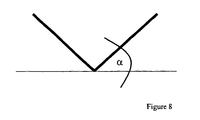
- the figure 8 schematically shows the definition of the folding angle.
- the figure 9 schematically shows the geometric parameters important for the three-point bending test.
- the figure 10 schematically shows a crack with a length of two stiffeners with broken central stiffener.
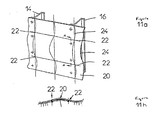
- the figure 11 schematically shows the buckling test.
- Figure (b) corresponds to a rotation AA of 90 °.
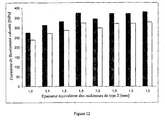
- the figure 12 compares the buckling stresses for different types of Z-shaped stiffeners according to the invention (gray bars) and according to the prior art (white bars), for the same geometry.
- the Applicant has found a very particular composition area that allows the development of wrought products, including spun products, which have both very high static mechanical characteristics, corrosion resistance acceptable, and good fitness skills.
- the applicant has thus been able to develop spun products that can be used very advantageously as stiffeners of the fuselage of civil aircraft.
- the damage tolerance is not a limiting factor, and we can therefore afford to optimize the elastic limit and the rupture limit to the detriment of the damage tolerance, while taking care not to degrade corrosion resistance.
- the fact of pushing the elastic limit as much as possible and the limit of rupture, making it possible to lighten the structure of the airplane usually leads to a deterioration of the aptitude for shaping.
- fuselage stiffeners are subjected to complex operations and very particular shaping. In order to develop a stronger alloy for fuselage stiffeners, it must therefore be ensured that the formability is not degraded with respect to known alloys, or preferentially better than that of known alloys. .
- the problem is solved by finely adjusting the contents of the alloying elements and certain impurities, and by adding a controlled concentration of certain other elements to the composition of the alloy.
- the present invention applies to Al-Zn-Mg-Cu alloys containing: Zn 8.3 - 14.0 Cu> 0.6 - 2.0 Mg 0.5 - 4.5 as well as some other elements specified below, and the rest being aluminum with its inevitable impurities.
- the alloys according to the invention must contain at least 0.5% magnesium, since it is not possible to obtain satisfactory static mechanical characteristics with a lower magnesium content. According to the findings of the applicant, with a zinc content of less than 8.3%, one does not obtain a result that is better than those obtained with known alloys.
- the zinc content is greater than 9.0%, and even more preferably greater than 9.5%. However, it is necessary to respect certain relationships between certain elements, as explained later.
- the zinc content is between 9.0 and 11.0%. In any case, we do not want to exceed a zinc content of about 14%, because beyond this value, regardless of the magnesium and copper content, the results are not satisfactory.
- the addition of at least 0.6% copper improves corrosion resistance. But to ensure a satisfactory dissolution, the Cu content should not exceed about 2%, and the Mg content should not exceed about 4.5%; a maximum content of 3.6% is preferred for magnesium.
- the copper content is between 0.6% and 1.2 while the magnesium content is between 2.5% and 3.4%.
- the copper content is between 0.8% and 1.5 while the magnesium content is between 2.2% and 3.0%.
- the ratio between the magnesium and copper contents must meet certain criteria.
- the alloy must be sufficiently loaded with addition elements capable of precipitating during a maturation or a treatment of income, in order to be able to present interesting static mechanical characteristics.
- addition elements capable of precipitating during a maturation or a treatment of income, in order to be able to present interesting static mechanical characteristics.
- the content of these additive elements must fulfill the condition Mg + Cu> 6.4 0.4 Zn.
- anti-recrystallizing elements More specifically, for alloys with more than 9.5% zinc, at least one element selected from the group comprising the elements Zr, Sc, Hf, La, Ti, Y, Ce, Nd, Eu, Gd, must be added. Tb, Dy, Ho, Er, Yb, Cr, Mn with, for each element present, a concentration of between 0.02 and 0.7%. It is preferable that the concentration of all the elements of said group does not exceed 1.5%.
- anti-recrystallizing elements in the form of fine precipitates formed during thermal or thermomechanical treatments, block the recrystallization.
- the Applicant has found that it will be necessary to avoid a too abundant precipitation during the quenching of the wrought product, and especially when the alloy is heavily loaded with zinc (Zn> 9.5%). A compromise must therefore be found as to the content of anti-recrystallizing elements.
- zirconium with a content of between 0.03% and 0.15%, and in addition at least an element selected from the group comprising the elements Sc, Hf, La, Ti, Y, Ce, Nd, Eu, Gd, Tb, Dy, Ho, Er, Yb, with, for each element present, a concentration of between 0, 02 and 0.7%.
- titanium is chosen, alone or associated with one or more other elements of said group.
- the Applicant has found that for said anti-recrystallizing elements, it is advantageous, irrespective of the zinc content, not to exceed the following maximum levels: Cr 0.40; Mn 0.60; Sc 0.50; Zr 0.15; Hf 0.60; Ti, 0.15; This 0.35 and preferably 0.30; Nd 0, 35 and preferably 0.30; Eu 0.35 and preferably 0.30; Gd 0.35; Tb 0.35; Ho, 0.40; Dy 0.40; Er 0.40; Yb 0.40; Y, 0.20; 0.35 and preferably 0.30.
- the total of these elements does not exceed 1.5%.
- the Applicant has found that in order to improve the rupture limit and the yield strength, it is preferable to respect an Mg / Cu ratio> 2.4, and preferably at least 2.8, even more preferentially 3.5 or even 4. , 0.
- Another technical characteristic is related to the need to be able to industrially produce wrought products under conditions of reliability compatible with the high requirements of the aeronautical industry, as well as under satisfactory economic conditions. It is therefore necessary to choose a chemical composition which minimizes the occurrence of cracks or slits during the solidification of the plates or billets, said cracks or slots being prohibitive defects leading to the scrapping of said plates or billets.
- the Applicant has found in numerous tests that this occurrence of cracks or splits was much more likely when the 7000 alloys complete their solidification below 470 ° C.
- This criterion is called in the context of the present invention the "flowability criterion".
- the alloys produced according to this variant of the invention complete their solidification at a temperature of between 473 ° C. and 478 ° C., and make it possible to achieve an industrial reliability of the processes for producing the metal (that is to say a consistency of the quality of cast plates or billets) compatible with the high requirements of the aerospace industry.
- Another technical feature of the invention is related to the need to minimize as much as possible the amount of insoluble precipitates (which are typically ternary or quaternary Al-Zn-Mg-Cu S, M or T) after homogenization and dissolution treatments, as this reduces the tenacity, the elongation at break and especially the aptitude for shaping; for this, we choose a content of Mg, Cu and Zn such that Mg + Cu ⁇ 7.9 - 0.4 Zn.
- Mg + Cu ⁇ 7.9 - 0.4 Zn Mg + Cu ⁇ 7.9 - 0.4 Zn.
- a content of between 0.05 and 0.10% is preferred.
- money is the preferred element.
- the addition of one or more anti-recrystallizing elements, such as scandium is particularly advantageous; such an effect is also observed in the case of heavy plates.
- the profiles also benefit from an increase in their mechanical strength, which is even greater than the width or thickness of the profile is low; this effect called "press effect" is well known to those skilled in the art.
- the Applicant has found that when the added anti-recrystallizing element is scandium, a content between 0.02 and 0.50% is advantageous.
- the products according to the invention are especially spun products. They can be used advantageously for the manufacture of structural elements in aeronautical construction.
- a preferred application of the products according to the invention is the application as a structural element in the fuselage of a civil aircraft.
- These elements, in particular the stiffeners, are first dimensioned in mechanical strength.
- the damage tolerance is usually not a property that fits into the dimensioning, to the extent that it is of a reasonable level: one can, in case of need and up to a certain point, optimize the mechanical resistance to the detriment of damage tolerance, and without fear of reducing the usefulness of the product. Corrosion resistance must always remain at an acceptable level.
- fuselage stiffeners makes it possible, at the choice of the manufacturer, to reduce their weight, or to have, at equal weight, a more rigid fuselage structure. This can, by increasing the spacing between two adjacent stiffeners (within the limit of the resistance to the folding of the fuselage sheets), to reduce the number of stiffeners, which leads to a decrease in the number of fasteners or assembly points between stiffener and sail skin. This can be very advantageous because fasteners or points of assembly, such as rivets or bolts, are important in the cost of manufacturing such structures.
- a Particularly advantageous use of the product according to the invention is therefore the application as a structural element in the field of aeronautical construction, and more specifically in the construction of aircraft comprising a fuselage assembled from a plurality of stiffeners and a plurality of sheets, at least a portion of said stiffeners being structural elements according to the invention.
- Such an aircraft is characterized by a lighter structure, but at least as rigid, or by a more rigid structure, but not heavier than existing aircraft.
- stiffeners according to the invention can improve the shear and compression stability of the fuselage panels, because these stiffeners exhibit a higher buckling stability.
- This effect can be used either to increase the margin of safety in constructions where stiffeners are replaced by stiffeners according to the invention, or to reduce the weight of the construction by using stiffeners with reduced sections and fuselage sheets more thin, and / or larger stiffener spacings.
- An increase in rivet spacing can also be achieved, which reduces the cost of assembling the structure.
- Table 17 shows parameters of different stiffener geometries used for the calculations. The figure 12 compares the predicted buckling stresses for these different geometries from Z1 to Z8 (from left to right).
- a shaping mode used in the industrial manufacturing of the fuselage stiffeners from profiles is the soyage. It is an introduction of a step located over an area of a few millimeters (cf. figure 6 ). This can be done, in the case of profiles according to the invention, either hot (preferably at 130 ° C) or cold. In the case of cold milling, it will advantageously carry out a solution in solution of the profile delivered in state W (unstable), followed by quenching. Then the shaping is done by shredding. Cold trimming does not allow shaping as deep as hot trimming, but when it is applicable, it is often more practical.
- Jarring as an industrial shaping process is not suitable for use in the study of materials under development.
- the failure of the material during the process is directly related to maximum plane deformations that can be supported by the material. This makes it possible to evaluate the suitability of a material for shaping by means of the 3-point bending test.
- DIN 50111 September 1987, in particular section 3.1
- the sample must be sufficiently wide in relation to its thickness to be in plane deformation conditions in the center of the specimen.
- the flat specimen in order to evaluate the formability at 130 ° C. (warm formability of the product in the final state), the flat specimen is deformed in an oven at 130 ° C. until the beginning of the fall.
- the applied force (which means crack initiation), always ensuring that the sample temperature is at 130 ° C. Since the deformation is done hot, the deformation rate is a parameter that influences the result. It was fixed by a traverse speed of 50 mm / min. The more the angle of folding (see definition in figure 8 ) is high, the greater the ability to form by sinking is high.
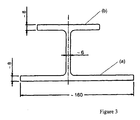
- it is important that the samples to be compared have the same thicknesses. If two samples of different thickness are to be compared, the face is compressed to the required thickness. In the case of a profile, the sampling of the sample from which the flat specimen is prepared is done at a representative place as indicated on the figure 7 for the T1 profile.
- the 3-point bending tests at 130 ° C are carried out on the T6x state or on the T7x state of the product. Nevertheless, it is possible to characterize the quenched formability W with this test, provided that the time between the tensile stress relieving after the quenching and the execution of the three-point bend test is controlled.
- the bending angle at 130 ° C is expressed as the average value calculated from individual measurements made on samples taken at different locations along the length of the profile.
- a particularly preferred product according to the present invention is a spun product which has in the T6511 state, measured on specimens taken from a flat area, a bending angle, measured at 130 ° C by a 3-point bend test according to DIN 50. 111 (section 3.1) on a sample of thickness 1.6 mm, of at least 34 °, and an elastic limit R p0.2 of at least 720 MPa, and preferably a folding angle of at least 35 ° and an elastic limit of at least 750 MPa.
- the static mechanical characteristics (R p0.2 , R m and A) depend little on the thickness of the section for thicknesses up to about 60 mm.
- Another particularly advantageous product according to the invention is a spun product which has, in the T76511 state, measured on specimens taken from a flat zone, a bending angle, measured at 130 ° C. by a 3-point bending test according to DIN 50 111 (section 3.1) on a sample of thickness 1.6 mm, of at least 36 °, and an elastic limit R p0.2 of at least 660 MPa, and preferably at least 670 MPa.
- This product may be used in cases where the corrosion resistance must be at least EB level in an EXCO test (ASTM G34) performed on unmachined samples.
- the Applicant has surprisingly found that compared to known products, including those with a comparable zinc content, the products according to the invention show good hot forming ability.
- the cold forming ability in the unstable state W after redissolution and quenching is slightly less good.
- the Applicant therefore prefers the hot forming process, if said shaping is deep.
- the products according to the invention can also be used as structural elements for floors, and in particular as floor profiles, aircraft, and, in the form of profiles, as seat rails.
- the seat rails are generally of great length, generally arranged parallel to the length of the cabin, on which are fixed rows of seats in a commercial aircraft.
- T76511 seat rails can be obtained with a breaking strength of the seat attachment area (ie the heel of an "I" type profile) whose breaking strength reaches 670 MPa and even 680 MPa, and whose elasticity limit reaches 640 MPa and even 660 MPa.
- the commercial aircraft seat rails must withstand corrosion by corrosive food liquids under heavy mechanical stresses, and the seat rails according to the invention effectively exhibit good corrosion resistance under stress determined according to ASTM G47.
- sheet C has a good compromise between mechanical strength and elongation. Compared to sheet D, outside the invention, its mechanical strength is significantly better. Compared to the sheet A, alloy 7449 according to the state of the art, the alloy C has a very improved mechanical strength. The fact that the toughness of the sheet C is less good than that of the sheet B limits its application to certain uses for which the toughness is not dimensioning, but which require both excellent mechanical strength and good suitability. formatting. With respect to the sheet B, outside the invention, the elongation at break of the sheet C is significantly better. Moreover, in order for Sheet B to achieve the results indicated in Table 2, it must be subjected to a rather long dissolution in solution which does not lend itself to the requirements of an industrial production. And even, it is found that there are too many coarse phases in the product which have a detrimental effect on the homogeneity of the mechanical properties, both within the same batch and within the same product (sheet or shaped); this could prohibit the use of product B as an aircraft structural element.
- Alloys G1, G2, G3 and G4 and B are outside the present invention.
- the composition of alloys B 1 and D, outside the invention, is indicated in Example 1, as well as that of Example C (according to the invention). All of these alloys showed satisfactory flowability during the tests, i.e. splits or cracks were not observed in the casting tests on an industrial scale.
- the alloys G5, G6, G7, G8 are outside the present invention, and the alloy G9 is a 7060 alloy according to the state of the art; these alloys showed slits during casting tests.
- alloys of the series 7xxx having a very pronounced propensity for the formation of cracks or cracks in the casting have a magnesium content lower than the critical magnesium content; this critical value was obtained by calculating the limit value in Mg defined by the flowability criterion.
- Spinning billets with alloys whose composition is summarized in Table 4 were prepared.
- the alloys were homogenized as follows: Samples Q1 and Q2: 4 h at 465 ° C + 20 h at 476 ° C Q3 and Q4 samples: 4 h at 465 ° C + 20 h at 471 ° C Samples P1 to P3: 20 h at 471 ° C.
- Billet diameters were 200 mm for P3 and Q1 to Q4 billets, and 155 mm for P1 and P2 billets.
- Table 4 ⁇ / u> billet Zn mg Cu Cr mn Yes Fe Zr Ti Mg / Cu P1 8.10 2.48 1.65 0.14 0.17 0.01 0.08 0.15 0.03 1.50 P2 8.45 2.60 1.76 0.18 0.18 0.05 0.14 0.12 0.02 1.48 P3 8.39 2.55 1.71 0.18 0.16 0.04 0.15 0.11 0.02 1.49 Q1 10,20 3.10 0.68 0.17 0.17 0.07 0.08 0.13 0.04 4.56 Q2 10,20 2.84 0.95 0.18 0.17 0.06 0.11 0.13 0.03 2.99 Q3 9.98 2.10 1.24 0.18 0.17 0.06 0.14 0.12 0.03 1.69 Q4 10.00 2.15 1.25 0.18 0.17 0.07 0.14 0.12 0.03 1.72 R1 10.18 2.97 0.66 0.17 0.16 0.07 0.13 0.11 0.02 4.5 R2 10.16 3.12 0.70 0.17 0.16 0.16
- the maximum spinning pressures are summarized in Table 5. It is surprisingly found that for the alloys according to the invention, the spinning pressure does not increase, and, surprisingly, even decreases, for certain types of profiles, when the magnesium content increases. ⁇ u> Table 5 ⁇ / u> Pressure [bar] for billet P1 Pressure [bars] for billet Q1 Pressure [bar] for billet Q2 Pressure [bar] for billet Q3 Pressure [bars] for billet Q4 Spinning ratio T1 profile 179 175 170 164 164 58 T2 profile 151 145 142 137 139 24 T3 profile 203 208 200 193 195 13
- the profiles Q1 to Q4 were dissolved at 471 ° C., the profiles P1 to P3 at 472 ° C. (T1, T2 and T3 sections). R1 and R2 profiles were treated under comparable conditions. All profiles were water quenched and stripped with a permanent elongation of between 1.5 and 2%. Products are obtained in the T6511 or T76511 state.
- alloys Q1 and Q2 have a significantly higher mechanical strength.
- the corrosion resistance was characterized according to the EXCO test (ASTM G34) of products Q1 and Q2 in the T6511 state (samples not machined at the beginning of spinning) was at level EA or EB and generally at least as good or better than samples P1 to P3 and Q3 and Q4.
- the forming ability of the T1-type profiles of Example 3 was investigated using the 3-point bending test according to DIN 50 111 of September 1987 (section 3.1).
- the important parameters of the 3-point bending device are indicated on the figure 9 .
- the test was carried out at 130 ° C. T6511 and T76511 states were tested.
- the values of the folding angle ⁇ (defined on the figure 8 ) are presented in Table 9. These are average values calculated from half a dozen individual measurements taken on samples taken at different locations along the length of the profiles.
- the profiles according to the invention (Q1 and Q2) have a formability comparable to that of the profiles according to the state of the art (Q3 and P1).
- Rolling plates were developed by a method similar to that described in Example 1.
- the chemical composition is given in Table 11.
- plates having a thickness of 25 mm were prepared by hot rolling. They were dissolved for 2 hours at a temperature of between 472 and 480 ° C., quenched and triturated with a permanent elongation of between 1.5 and 2%. Then the sheets were subjected to a tempering treatment at a temperature of 135 ° C.
- the sheet N with a high Mg / Cu ratio shows better values of R p0.2 (L) and R m (L) than the sheet K.
- Table 13 summarizes the results obtained: ⁇ u> Table 13 ⁇ / u> Sample State Constraint [MPa] Duration of the test Q1 alloy, T1 profile, L-direction T76511 530 > 30 days Q1 alloy, T1 profile, L-direction T6511 350 > 30 days P1 alloy, T4 profile, L-direction T76511 430 > 30 days P1 alloy, T4 profile, LT direction T76511 400 > 30 days P1 alloy, T4 profile, LT direction T6511 280 > 30 days R1 alloy, T4 profile, LT direction T 76511 R1 alloy, T4 profile, LT direction T 76511
- Table 14 shows the chemical compositions
- Table 15 shows the mechanical characteristics obtained.
- Billet of chemical composition R1 and Q1 according to the preceding examples were manufactured from aircraft seat rails. These profiles are type "I" and comprise a sole, a central zone (core) and a heel (which are seated seats).
- the thickness of the central zone was of the order of 2 mm, the height of the profile of the order of 65 mm.
- Table 16 collects the static mechanical characteristics in the state T76511. ⁇ u> Table 16 ⁇ / u> Alloy Sample R m [MPa] R p0.2 [MPa] R1 Sole 688 669 R1 Heel 686 667 Q1 Sole 672 643 Q1 Heel 683 660
- This effect can be used either to increase the margin of safety in constructions where stiffeners are replaced by stiffeners according to the invention, or to reduce the weight of the construction by using stiffeners with reduced sections and fuselage sheets more thin, and / or larger stiffener spacings.
- Skin rupture is governed by the stress intensity factor at the tip of the crack.
- the stress intensity factor for a crack of a length of two stiffeners with the stiffener Central broken in a panel assembled with stiffeners according to the invention will be reduced by 5% in comparison with a panel with stiffeners made with the alloy 2024 T3 widely used.
- the stiffener in 2024 will be solicited more and more in the plastic field in comparison with new stiffeners that have not even reached the limit of elasticity.
- the difference in the stress intensity factor can go up to 15%.
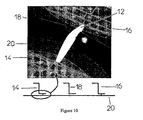
- the buckling test leads to a deformation of the panel which manifests itself as a gap (24) between the stiffener (14, 16) and the skin (22). It has been noted by the applicant that the shear and compression stability of the fuselage panels working in compression and / or shear can benefit from the high strength of the stiffeners according to the invention.
- the use of the stiffeners according to the invention as a structural element in a fuselage panel of an aircraft can improve the shear and compression stability of the fuselage panels, because these stiffeners exhibit a higher buckling stability.
- This effect can be used either to increase the margin of safety in constructions where stiffeners are replaced by stiffeners according to the invention, or to reduce the weight of the construction by using stiffeners with reduced sections and thinner fuselage sheets, and / or larger stiffener spacings.
- An increase in rivet spacing can also be achieved, which reduces the cost of assembling the structure.
- a gain estimate in buckling stability can be obtained by applying a general method given in [Michael CY Niu, Airframe Stress Analysis and Sizing, 2 nd edition, chapter 10].
- the Applicant noted, using this method, that the increase in the stiffness of the stiffener according to the invention (with 700 MPa yield strength in compression and a Young's modulus in compression of 73 GPa) compared with a stiffener in 7150 T77511 (with 538 MPa typical yield strength in compression and a Young's modulus in compression of 73 GPa), which is widely used in aircraft according to the state of the art, is greater than or equal to 15% for typical use stiffeners in the form of "Z".
- Table 17 shows parameters of different stiffener geometries used for the calculations.
- the figure 12 compares the predicted buckling stresses for these different geometries from Z1 to Z8 (from left to right).
- Table 17 ⁇ / u> Concept small stiffener in "Z”: Z1 Z2 Z3 Z4 Z5 Z6 Z7 Z8 Free foot width [mm] 12.7 12.7 12.7 12.7 12.7 12.7 12.7 12.7 12.7 Width of riveted sole [mm] 25.4 25.4 25.4 25.4 25.4 25.4 25.4 25.4 Height [mm] 38.1 38.1 38.1 38.1 38.1 38.1 38.1 38.1 Thickness of free sole [mm] 1.0 1.5 1.5 2.0 1.0 1.5 1.5 1.5 1.5 Thickness of riveted sole [mm] 1.0 1.0 1.5 1.5 1.0 1.0 1.0 1.5 Thickness of the soul [mm] 1.0 1.0 1.0 1.5 1.5 1.5 1.0 1.0 1.5 Thickness of the soul [mm] 1.0 1.0 1.0 1.5 1.5 1.5 1.5 Section [mm 2 ] 76 83
Landscapes
- Chemical & Material Sciences (AREA)
- Organic Chemistry (AREA)
- Mechanical Engineering (AREA)
- Metallurgy (AREA)
- Engineering & Computer Science (AREA)
- Materials Engineering (AREA)
- Physics & Mathematics (AREA)
- Thermal Sciences (AREA)
- Crystallography & Structural Chemistry (AREA)
- Heat Treatment Of Steel (AREA)
- Extrusion Of Metal (AREA)
- Preparation Of Clay, And Manufacture Of Mixtures Containing Clay Or Cement (AREA)
- Crushing And Pulverization Processes (AREA)
- Metal Rolling (AREA)
- Physical Vapour Deposition (AREA)
- Conductive Materials (AREA)
Claims (27)
- Walz-, Strangpress- oder Schmiedeerzeugnis aus AIZnMgCu-Legierung, dadurch gekennzeichnet, dass es enthält (in Masseprozent):a) Zn 8,3 -14,0 Cu > 0.6 - 2,0 Mg 0,5 - 4,5
Zr 0,03 - 0,15 Fe + Si < 0,25b) mindestens ein aus der Gruppe bestehend aus Sc, Hf, La, Ti, Ce, Nd, Eu, Gd, Tb, Dy, Ho, Er, Y, Yb gewähltes Element, wobei der Gehalt eines jeden dieser Elemente, falls es gewählt wird, 0,02 bis 0,7 % beträgt,c) Rest Aluminium und unvermeidbare Verunreinigungen,
und dass es folgende Bedingungen erfüllt:d) Mg / Cu > 2,4 unde) (7,9 - 0,4 Zn) > (Cu + Mg) > (6,4 - 0,4 Zn). - Erzeugnis nach Anspruch 1, dadurch gekennzeichnet, dass Mg / Cu > 2,8, bevorzugt > 3,5 und besonders bevorzugt > 4,0.
- Erzeugnis nach Anspruch 1 oder 2, dadurch gekennzeichnet, dass die Massekonzentration der Elemente Sc, Hf, La, Ti, Ce, Nd, Eu, Gd, Tb, Dy, Ho, Er, Y, Yb insgesamt 1,5 % nicht überschreitet.
- Erzeugnis nach irgendeinem der Ansprüche 1 bis 3, dadurch gekennzeichnet, dass aus der Gruppe bestehend aus Sc, Hf, La, Ti, Ce, Nd, Eu, Gd, Tb, Dy, Ho, Er, Y, Yb nur Titan gewählt wird.
- Walz-, Strangpress- oder Schmiedeerzeugnis aus AIZnMgCu-Legierung, dadurch gekennzeichnet, dass es enthält (in Masseprozent):a) Zn 9,5 -14,0 Cu > 0,6 - 2, 0
Mg 0,5 - 4,5 Fe + Si < 0,25b) mindestens ein aus der Gruppe bestehend aus Zr, Sc, Hf, La, Ti, Ce, Nd, Eu, Gd, Tb, Dy, Ho, Er, Y, Yb, Cr, Mn gewähltes Element, wobei der Gehalt eines jeden dieser Elemente, falls es gewählt wird, 0,02 bis 0,7 % beträgt,c) Rest Aluminium und unvermeidbare Verunreinigungen,
und dass es folgende Bedingungen erfüllt:d) Mg / Cu > 2,4 unde) (7,9 - 0,4 Zn) > (Cu + Mg) > (6,4 - 0,4 Zn). - Erzeugnis nach Anspruch 5, dadurch gekennzeichnet, dass die Massekonzentration der Elemente Zr, Sc, Hf, La, Ti, Ce, Nd, Eu, Gd, Tb, Dy, Ho, Er, Y, Yb insgesamt 1,5 % nicht überschreitet.
- Erzeugnis nach einem der Ansprüche 1 bis 4, wobei Zn > 9,0 %.
- Erzeugnis nach Anspruch 7, wobei Zn > 9,5 %.
- Erzeugnis nach Anspruch 7, wobei der Zinkgehalt 9,0 % bis 11 % beträgt.
- Erzeugnis nach irgendeinem der Ansprüche 1 bis 9, wobei Cu > 0,6 -1,2 % und Mg 2,5 - 3,4 % beträgt.
- Erzeugnis nach irgendeinem der Ansprüche 1 bis 9, wobei Cu 0,8 - 1,5 % und Mg 2,2 - 3,0 % beträgt.
- Erzeugnis nach irgendeinem der Ansprüche 1 bis 11, wobei Mg 0,5% 3,6 % beträgt.
- Erzeugnis nach irgendeinem der Ansprüche 1 bis 12, wobei Mg > 1.95 + 0,5 (Cu - 2,3) + 0,16 (Zn - 6) + 1,9 (Si - 0,04).
- Erzeugnis nach irgendeinem der Ansprüche 1 bis 13 wobei folgende Höchstkonzentrationen nicht überschritten werden:Cr 0,40 Mn 0,60 Sc 0,50 Zr 0,15 Hf 0,60 Ti 0,15Ce, Nd und Eu jeweils 0,35 und bevorzugt jeweils 0,30Gd 0,35 Tb 0,35 Ho 0,40 Dy 0,40 Er 0,40 Yb 0,40 Y 0,20.
- Erzeugnis nach irgendeinem der Ansprüche 1 bis 14 dadurch gekennzeichnet, dass es zusätzlich ein aus der Gruppe bestehend aus Ag, Sn, Cd, Ge, In gewähltes Element enthält, wobei der Gehalt eines jeden dieser Elemente, falls es gewählt wird, 0,02 % bis 0,15 % und bevorzugt 0,05 % bis 0,10 % beträgt.
- Strangpresserzeugnis nach irgendeinem der Ansprüche 1 bis 15 dadurch gekennzeichnet, dass es im Zustand T6511, gemessen an aus einem flachen Abschnitt entnommenen Proben,a) einen Biegewinkel, gemessen bei 130°C mit einem 3-Punkt-Biegetest nach DIN 50 111 (Abschnitt 3.1) an einer Probe von 1,6 mm Dicke und ausgedrückt als Mittelwert berechnet aus an verschiedenen, über die Länge des Profils verteilten Stellen entnommenen Proben durchgeführten Einzelberechnungen, von mindestens 34° undb) eine Dehngrenze Rp0,2 von mindestens 720 MPa,
und bevorzugt einen Biegewinkel von mindestens 35° und eine Dehngrenze von mindestens 750 MPa aufweist. - Strangpresserzeugnis nach irgendeinem der Ansprüche 1 bis 15 dadurch gekennzeichnet, dass es im Zustand T76511, gemessen an aus einem flachen Abschnitt entnommenen Proben,a) einen Biegewinkel, gemessen bei 130°C mit einem 3-Punkt-Biegetest nach DIN 50 111 (Abschnitt 3.1) an einer Probe von 1,6 mm Dicke und ausgedrückt als Mittelwert berechnet aus an verschiedenen, über die Länge des Profils verteilten Stellen entnommenen Proben durchgeführten Einzelberechnungen, von mindestens 37° und bevorzugt mindestens 40° undb) eine Dehngrenze Rp0,2 von mindestens 670 MPa aufweist.
- Strangpresserzeugnis nach Anspruch 17 dadurch gekennzeichnet, dass die Korrosionsfestigkeit, bestimmt nach dem EXCO-Test (Norm ASTM G34) im Zustand T6511 an unbearbeiteten Proben mindestens dem Niveau EB entspricht.
- Strukturelement für Luftfahrzeuge, hergestellt aus einem Erzeugnis nach irgendeinem der Ansprüche 1 bis 18.
- Strukturelement nach Anspruch 19 dadurch gekennzeichnet, dass das Element eine Rumpfverstärkung ist.
- Strukturelement nach Anspruch 19 dadurch gekennzeichnet, dass das Element eine Sitzschiene ist.
- Sitzschiene nach Anspruch 21 dadurch gekennzeichnet, dass ihre Bruchfestigkeit im Zustand T76511 im Befestigungsbereich der Sitze mindestens 670 MPa und bevorzugt mindestens 680 MPa beträgt.
- Sitzschiene nach Anspruch 21 oder 22 dadurch gekennzeichnet, dass ihre Dehngrenze im Zustand T76511 im Befestigungsbereich der Sitze mindestens 640 MPa und bevorzugt mindestens 660 MPa beträgt.
- Strukturelement nach Anspruch 19 dadurch gekennzeichnet, dass das Element ein Fußbodenprofil ist.
- Luftfahrzeug mit einem aus einer Vielzahl von Versteifungen und einer Vielzahl von Blechen zusammengesetzten Rumpf, dadurch gekennzeichnet, dass mindestens ein Teil der Versteifungen Strukturelemente nach Anspruch 19.
- Rumpfstruktur zusammengesetzt aus einer Vielzahl von Verstärkungen nach Anspruch 20 und einer Vielzahl von Blechen, dadurch gekennzeichnet, dass bei einem Abstand der Versteifungen von 200 mm und einem Versteifungsfaktor (Querschnitt der Versteifung/Gesamtquerschnitt) von 0,25 der Spannungsintensitätsfaktor für einen Riss mit einer Länge von zwei Versteifungen mit gebrochener Mittelversteifung um mindestens 5 % im Vergleich zu Versteifungen aus einer Legierung 2024 T3 reduziert ist.
- Rumpfstruktur zusammengesetzt aus einer Vielzahl von Verstärkungen nach Anspruch 20 und einer Vielzahl von Blechen, dadurch gekennzeichnet, dass die Knickfestigkeit der Versteifungen um mindestens 15 % im Vergleich zu derselben Struktur mit Z-förmigen Versteifungen gleicher Geometrie aus einer Legierung 7150 T77511 verbessert ist.
Applications Claiming Priority (3)
| Application Number | Priority Date | Filing Date | Title |
|---|---|---|---|
| FR0204250A FR2838135B1 (fr) | 2002-04-05 | 2002-04-05 | PRODUITS CORROYES EN ALLIAGES A1-Zn-Mg-Cu A TRES HAUTES CARACTERISTIQUES MECANIQUES, ET ELEMENTS DE STRUCTURE D'AERONEF |
| FR0204250 | 2002-04-05 | ||
| PCT/FR2003/001063 WO2003085146A1 (fr) | 2002-04-05 | 2003-04-04 | Produits corroyes en alliages al-zn-mg-cu a tres hautes caracteristiques mecaniques, et elements de structure d'aeronef |
Publications (2)
| Publication Number | Publication Date |
|---|---|
| EP1492896A1 EP1492896A1 (de) | 2005-01-05 |
| EP1492896B1 true EP1492896B1 (de) | 2008-11-26 |
Family
ID=28052134
Family Applications (1)
| Application Number | Title | Priority Date | Filing Date |
|---|---|---|---|
| EP03740569A Revoked EP1492896B1 (de) | 2002-04-05 | 2003-04-04 | Knetprodukte aus einer mit hohen mechanischen eigenschaften al-zn-mg-cu-legierung und strukturbauteile für ein luftfahrzeug |
Country Status (9)
| Country | Link |
|---|---|
| US (2) | US20050072497A1 (de) |
| EP (1) | EP1492896B1 (de) |
| JP (1) | JP2005530032A (de) |
| AT (1) | ATE415498T1 (de) |
| AU (1) | AU2003260003A1 (de) |
| DE (2) | DE03740569T1 (de) |
| ES (1) | ES2316779T3 (de) |
| FR (1) | FR2838135B1 (de) |
| WO (1) | WO2003085146A1 (de) |
Families Citing this family (65)
| Publication number | Priority date | Publication date | Assignee | Title |
|---|---|---|---|---|
| JP4932473B2 (ja) * | 2003-03-17 | 2012-05-16 | アレリス、アルミナム、コブレンツ、ゲゼルシャフト、ミット、ベシュレンクテル、ハフツング | 一体化されたモノリシックアルミニウム構造の製造方法およびその構造から機械加工されたアルミニウム製品 |
| JP5128124B2 (ja) * | 2003-04-10 | 2013-01-23 | アレリス、アルミナム、コブレンツ、ゲゼルシャフト、ミット、ベシュレンクテル、ハフツング | Al−Zn−Mg−Cu合金 |
| US20050034794A1 (en) * | 2003-04-10 | 2005-02-17 | Rinze Benedictus | High strength Al-Zn alloy and method for producing such an alloy product |
| US20060032560A1 (en) * | 2003-10-29 | 2006-02-16 | Corus Aluminium Walzprodukte Gmbh | Method for producing a high damage tolerant aluminium alloy |
| US7883591B2 (en) * | 2004-10-05 | 2011-02-08 | Aleris Aluminum Koblenz Gmbh | High-strength, high toughness Al-Zn alloy product and method for producing such product |
| DE502005001724D1 (de) * | 2005-01-19 | 2007-11-29 | Fuchs Kg Otto | Abschreckunempfindliche Aluminiumlegierung sowie Verfahren zum Herstellen eines Halbzeuges aus dieser Legierung |
| EP1848835A2 (de) * | 2005-02-01 | 2007-10-31 | Timothy Langan | Aluminium-zink-magnesium-scandium-legierungen und herstellungsverfahren dafür |
| US8157932B2 (en) * | 2005-05-25 | 2012-04-17 | Alcoa Inc. | Al-Zn-Mg-Cu-Sc high strength alloy for aerospace and automotive castings |
| US20060289093A1 (en) * | 2005-05-25 | 2006-12-28 | Howmet Corporation | Al-Zn-Mg-Ag high-strength alloy for aerospace and automotive castings |
| US20070151636A1 (en) * | 2005-07-21 | 2007-07-05 | Corus Aluminium Walzprodukte Gmbh | Wrought aluminium AA7000-series alloy product and method of producing said product |
| US20070204937A1 (en) * | 2005-07-21 | 2007-09-06 | Aleris Koblenz Aluminum Gmbh | Wrought aluminium aa7000-series alloy product and method of producing said product |
| US8083871B2 (en) | 2005-10-28 | 2011-12-27 | Automotive Casting Technology, Inc. | High crashworthiness Al-Si-Mg alloy and methods for producing automotive casting |
| JP5345056B2 (ja) * | 2006-06-30 | 2013-11-20 | コンステリウム ロールド プロダクツ−レイヴンズウッド,エルエルシー | 熱処理可能な高強度アルミニウム合金 |
| EP2038447B1 (de) * | 2006-07-07 | 2017-07-19 | Aleris Aluminum Koblenz GmbH | Verfahren zur herstellung von produkten aus aluminium-legierungen vom 2000-typ |
| US8608876B2 (en) * | 2006-07-07 | 2013-12-17 | Aleris Aluminum Koblenz Gmbh | AA7000-series aluminum alloy products and a method of manufacturing thereof |
| FR2910874B1 (fr) * | 2007-01-02 | 2009-02-13 | Airbus France Sas | Lisses assemblees au niveau d'une jonction circonferentielle d'un fuselage d'avion. |
| WO2008120237A1 (en) | 2007-03-30 | 2008-10-09 | Director General, Defence Research & Development Organisation | Alloy composition and preparation thereof |
| US8673209B2 (en) * | 2007-05-14 | 2014-03-18 | Alcoa Inc. | Aluminum alloy products having improved property combinations and method for artificially aging same |
| US8840737B2 (en) * | 2007-05-14 | 2014-09-23 | Alcoa Inc. | Aluminum alloy products having improved property combinations and method for artificially aging same |
| US7879162B2 (en) * | 2008-04-18 | 2011-02-01 | United Technologies Corporation | High strength aluminum alloys with L12 precipitates |
| US7811395B2 (en) | 2008-04-18 | 2010-10-12 | United Technologies Corporation | High strength L12 aluminum alloys |
| US8409373B2 (en) | 2008-04-18 | 2013-04-02 | United Technologies Corporation | L12 aluminum alloys with bimodal and trimodal distribution |
| US8017072B2 (en) | 2008-04-18 | 2011-09-13 | United Technologies Corporation | Dispersion strengthened L12 aluminum alloys |
| US7875133B2 (en) | 2008-04-18 | 2011-01-25 | United Technologies Corporation | Heat treatable L12 aluminum alloys |
| US7875131B2 (en) | 2008-04-18 | 2011-01-25 | United Technologies Corporation | L12 strengthened amorphous aluminum alloys |
| US20090263273A1 (en) | 2008-04-18 | 2009-10-22 | United Technologies Corporation | High strength L12 aluminum alloys |
| US8002912B2 (en) | 2008-04-18 | 2011-08-23 | United Technologies Corporation | High strength L12 aluminum alloys |
| US7871477B2 (en) | 2008-04-18 | 2011-01-18 | United Technologies Corporation | High strength L12 aluminum alloys |
| US8778099B2 (en) | 2008-12-09 | 2014-07-15 | United Technologies Corporation | Conversion process for heat treatable L12 aluminum alloys |
| US8778098B2 (en) | 2008-12-09 | 2014-07-15 | United Technologies Corporation | Method for producing high strength aluminum alloy powder containing L12 intermetallic dispersoids |
| US8206517B1 (en) | 2009-01-20 | 2012-06-26 | Alcoa Inc. | Aluminum alloys having improved ballistics and armor protection performance |
| US9611522B2 (en) | 2009-05-06 | 2017-04-04 | United Technologies Corporation | Spray deposition of L12 aluminum alloys |
| US9127334B2 (en) | 2009-05-07 | 2015-09-08 | United Technologies Corporation | Direct forging and rolling of L12 aluminum alloys for armor applications |
| US8728389B2 (en) | 2009-09-01 | 2014-05-20 | United Technologies Corporation | Fabrication of L12 aluminum alloy tanks and other vessels by roll forming, spin forming, and friction stir welding |
| US8409496B2 (en) | 2009-09-14 | 2013-04-02 | United Technologies Corporation | Superplastic forming high strength L12 aluminum alloys |
| US9194027B2 (en) | 2009-10-14 | 2015-11-24 | United Technologies Corporation | Method of forming high strength aluminum alloy parts containing L12 intermetallic dispersoids by ring rolling |
| US8409497B2 (en) | 2009-10-16 | 2013-04-02 | United Technologies Corporation | Hot and cold rolling high strength L12 aluminum alloys |
| CN102108463B (zh) * | 2010-01-29 | 2012-09-05 | 北京有色金属研究总院 | 一种适合于结构件制造的铝合金制品及制备方法 |
| US9163304B2 (en) | 2010-04-20 | 2015-10-20 | Alcoa Inc. | High strength forged aluminum alloy products |
| JP5535957B2 (ja) * | 2011-02-21 | 2014-07-02 | 三菱航空機株式会社 | 翼パネルの形成方法 |
| US9551050B2 (en) * | 2012-02-29 | 2017-01-24 | The Boeing Company | Aluminum alloy with additions of scandium, zirconium and erbium |
| KR101526660B1 (ko) | 2013-05-07 | 2015-06-05 | 현대자동차주식회사 | 복합 미세조직을 갖는 내마모성 합금 |
| KR101526661B1 (ko) | 2013-05-07 | 2015-06-05 | 현대자동차주식회사 | 복합 미세조직을 갖는 내마모성 합금 |
| KR101526656B1 (ko) | 2013-05-07 | 2015-06-05 | 현대자동차주식회사 | 복합 미세조직을 갖는 내마모성 합금 |
| WO2015003253A1 (en) * | 2013-07-12 | 2015-01-15 | Magna International Inc. | Process for forming aluminum alloy parts with tailored mechanical properties |
| DE102013012259B3 (de) | 2013-07-24 | 2014-10-09 | Airbus Defence and Space GmbH | Aluminium-Werkstoff mit verbesserter Ausscheidungshärtung, Verfahren zu dessen Herstellung und Verwendung des Aluminium-Werkstoffes |
| CN103572106B (zh) * | 2013-11-22 | 2016-08-17 | 湖南稀土金属材料研究院 | 铝合金材料 |
| WO2015132932A1 (ja) * | 2014-03-06 | 2015-09-11 | 株式会社Uacj | 構造用アルミニウム合金及びその製造方法 |
| CN104109784B (zh) * | 2014-04-30 | 2016-09-14 | 广西南南铝加工有限公司 | 一种超高强度Al-Zn-Mg-Cu系铝合金大规格扁铸锭及其制造方法 |
| JP6638192B2 (ja) * | 2015-02-20 | 2020-01-29 | 日本軽金属株式会社 | アルミニウム合金加工材及びその製造方法 |
| JP6638193B2 (ja) * | 2015-02-20 | 2020-01-29 | 日本軽金属株式会社 | アルミニウム合金加工材及びその製造方法 |
| CN106367644B (zh) * | 2016-09-23 | 2018-03-13 | 北京工业大学 | 一种超高强、高硬度TiB2颗粒增强Al‑Zn‑Mg‑Cu复合材料及其制备方法 |
| CN106399776B (zh) * | 2016-11-11 | 2018-05-01 | 佛山科学技术学院 | 一种800MPa级超高强铝合金及其制备方法 |
| BR112021004434B1 (pt) | 2018-11-12 | 2024-01-02 | Novelis Koblenz Gmbh | Produto de liga de alumínio da série 7xxx |
| CN109977457B (zh) * | 2019-02-02 | 2020-11-24 | 浙江大学 | 一种考虑温卷影响的加钒钢制筒节极限载荷预测方法 |
| US11958140B2 (en) | 2019-05-10 | 2024-04-16 | General Cable Technologies Corporation | Aluminum welding alloys with improved performance |
| CN110331319B (zh) * | 2019-05-27 | 2020-06-30 | 中国航发北京航空材料研究院 | 一种含钪和铒的高强、高塑性耐蚀铝合金及其制备方法 |
| JP2022532347A (ja) * | 2019-06-03 | 2022-07-14 | ノベリス・インコーポレイテッド | 超高強度アルミニウム合金製品及びその作製方法 |
| CN112226636A (zh) * | 2020-09-08 | 2021-01-15 | 烟台南山学院 | 一种高强耐蚀Al-Zn-Mg-Cu-Zr-Ce合金板材的制备方法 |
| CN112981196B (zh) * | 2021-02-10 | 2022-04-22 | 北京科技大学 | 一种超高强度、高韧性Al-Zn-Mg-Cu铝合金及其制备方法 |
| CN115216674B (zh) * | 2022-07-11 | 2023-02-24 | 上海交通大学 | 一种汽车用7000系铝合金薄板及其制备方法 |
| FR3138122A1 (fr) * | 2022-07-25 | 2024-01-26 | Airbus Operations | Système de transport de grille de plancher de cabine d’aéronef en vue d’un assemblage d’un corps de fuselage d’aéronef et procédé de calibration dudit système de transport. |
| CN115287511A (zh) * | 2022-09-06 | 2022-11-04 | 安徽辉隆集团辉铝新材料科技有限公司 | 一种7020超硬铝合金型材及制备方法 |
| CN115537615A (zh) * | 2022-10-26 | 2022-12-30 | 山东南山铝业股份有限公司 | 一种用于汽车门窗饰条高光亮铝合金及制备方法 |
| CN121250200A (zh) * | 2025-03-14 | 2026-01-02 | 广东辉煌金属制品有限公司 | 高强度Al-Zn系压铸铝合金及其制备方法、结构件 |
Family Cites Families (12)
| Publication number | Priority date | Publication date | Assignee | Title |
|---|---|---|---|---|
| US4863528A (en) * | 1973-10-26 | 1989-09-05 | Aluminum Company Of America | Aluminum alloy product having improved combinations of strength and corrosion resistance properties and method for producing the same |
| US4063936A (en) * | 1974-01-14 | 1977-12-20 | Alloy Trading Co., Ltd. | Aluminum alloy having high mechanical strength and elongation and resistant to stress corrosion crack |
| FR2457908A1 (fr) * | 1979-06-01 | 1980-12-26 | Gerzat Metallurg | Procede de fabrication de corps creux en alliage d'aluminium et produits ainsi obtenus |
| FR2517702B1 (de) * | 1981-12-03 | 1985-11-15 | Gerzat Metallurg | |
| JPH0635624B2 (ja) * | 1985-05-10 | 1994-05-11 | 昭和アルミニウム株式会社 | 高強度アルミニウム合金押出材の製造法 |
| FR2601967B1 (fr) | 1986-07-24 | 1992-04-03 | Cerzat Ste Metallurg | Alliage a base d'al pour corps creux sous pression. |
| US5221377A (en) | 1987-09-21 | 1993-06-22 | Aluminum Company Of America | Aluminum alloy product having improved combinations of properties |
| FR2640644B1 (fr) * | 1988-12-19 | 1991-02-01 | Pechiney Recherche | Procede d'obtention par " pulverisation-depot " d'alliages d'al de la serie 7000 et de materiaux composites a renforts discontinus ayant pour matrice ces alliages a haute resistance mecanique et bonne ductilite |
| FR2716896B1 (fr) * | 1994-03-02 | 1996-04-26 | Pechiney Recherche | Alliage 7000 à haute résistance mécanique et procédé d'obtention. |
| US6562154B1 (en) * | 2000-06-12 | 2003-05-13 | Aloca Inc. | Aluminum sheet products having improved fatigue crack growth resistance and methods of making same |
| FR2838136B1 (fr) * | 2002-04-05 | 2005-01-28 | Pechiney Rhenalu | PRODUITS EN ALLIAGE A1-Zn-Mg-Cu A COMPROMIS CARACTERISTIQUES STATISTIQUES/TOLERANCE AUX DOMMAGES AMELIORE |
| US7060139B2 (en) * | 2002-11-08 | 2006-06-13 | Ues, Inc. | High strength aluminum alloy composition |
-
2002
- 2002-04-05 FR FR0204250A patent/FR2838135B1/fr not_active Expired - Fee Related
-
2003
- 2003-04-04 ES ES03740569T patent/ES2316779T3/es not_active Expired - Lifetime
- 2003-04-04 JP JP2003582321A patent/JP2005530032A/ja active Pending
- 2003-04-04 DE DE03740569T patent/DE03740569T1/de active Pending
- 2003-04-04 AT AT03740569T patent/ATE415498T1/de not_active IP Right Cessation
- 2003-04-04 WO PCT/FR2003/001063 patent/WO2003085146A1/fr not_active Ceased
- 2003-04-04 DE DE60324903T patent/DE60324903D1/de not_active Expired - Lifetime
- 2003-04-04 US US10/406,610 patent/US20050072497A1/en not_active Abandoned
- 2003-04-04 EP EP03740569A patent/EP1492896B1/de not_active Revoked
- 2003-04-04 AU AU2003260003A patent/AU2003260003A1/en not_active Abandoned
-
2006
- 2006-04-06 US US11/398,664 patent/US20060182650A1/en not_active Abandoned
Also Published As
| Publication number | Publication date |
|---|---|
| US20060182650A1 (en) | 2006-08-17 |
| DE03740569T1 (de) | 2005-06-23 |
| FR2838135B1 (fr) | 2005-01-28 |
| AU2003260003A1 (en) | 2003-10-20 |
| ATE415498T1 (de) | 2008-12-15 |
| EP1492896A1 (de) | 2005-01-05 |
| DE60324903D1 (de) | 2009-01-08 |
| FR2838135A1 (fr) | 2003-10-10 |
| US20050072497A1 (en) | 2005-04-07 |
| WO2003085146A1 (fr) | 2003-10-16 |
| ES2316779T3 (es) | 2009-04-16 |
| JP2005530032A (ja) | 2005-10-06 |
Similar Documents
| Publication | Publication Date | Title |
|---|---|---|
| EP1492896B1 (de) | Knetprodukte aus einer mit hohen mechanischen eigenschaften al-zn-mg-cu-legierung und strukturbauteile für ein luftfahrzeug | |
| EP2449142B1 (de) | Aluminium-kupfer-lithium-legierung mit verbesserten mechanische beständigkeit und zähigkeit | |
| EP1492895B1 (de) | Produkte aus al-zn-mg-cu-legierung | |
| EP2766503B1 (de) | Verbessertes verfahren zum bearbeiten von metallblechen aus einer al-cu-li-legierung | |
| EP2364378B1 (de) | Produkte aus aluminium-kupfer-lithium-legierung | |
| EP2710163B1 (de) | Aluminium-magnesium-lithiumlegierung mit erhöhter zähigkeit | |
| EP2655680B1 (de) | Aluminium-kupfer-lithium-legierung mit verbesserter druckfestigkeit und beständigkeit | |
| EP3384061B1 (de) | Aluminium-kupfer-lithium-legierung mit verbesserter mechanischer festigkeit und erhöhter zähigkeit | |
| EP1966402B1 (de) | Blech aus einer hochfesten aluminiumlegierung mit kupfer und lithium für einen flugzeugrumpf | |
| EP2569456B1 (de) | Aluminium-kupfer-lithium-legierung für niedrigeres oberflächenelement | |
| EP3201371B1 (de) | Verfahren zur herstellung eines knetproduktes aus einer aluminium-magnesium-lithium legierung, knetprodukt und vervendung des knetproduktes | |
| EP2981631B1 (de) | Bleche aus aluminium-kupfer-lithium-legierung zur herstellung von flugzeugrümpfen | |
| EP3201372B1 (de) | Isotropische bleche aus aluminium-lithium-kupfer legierung für die herstellung von flugzeugrümpfen und herstellungsverfahren davon | |
| EP1809779B1 (de) | Produkte aus hochfester aluminiumlegierung und herstellungsverfahren dafür | |
| CA2528614C (fr) | Produits en alliages al-zn-mg-cu a compromis caracteristiques mecaniques statiques/tolerance aux dommages ameliore | |
| EP3635146B2 (de) | Aluminiumlegierung mit lithium mit verbesserten ermüdungseigenschaften | |
| EP3788178B1 (de) | Aluminium-kupfer-lithium-legierung mit verbesserter kompressionsfestigkeit und erhöhter beständigkeit | |
| EP3788179A1 (de) | Verfahren zur herstellung einer aluminium-kupfer-lithium-legierung mit verbesserter druckfestigkeit und verbesserter zähigkeit | |
| EP1544316B1 (de) | Dickes Bech aus Al-Zn-Cu-Mg Zirkonarmen rekristallisierten Legierung | |
| EP3610047B1 (de) | Aluminium-kupfer-lithium-legierungsprodukte | |
| EP3362584B1 (de) | Dünne bleche aus aluminium-magnesium-zirkonium-legierungen für luft- und raumfahrtanwendungen | |
| FR3026411A1 (fr) | Procede de fabrication de produits en alliage aluminium magnesium lithium |
Legal Events
| Date | Code | Title | Description |
|---|---|---|---|
| PUAI | Public reference made under article 153(3) epc to a published international application that has entered the european phase |
Free format text: ORIGINAL CODE: 0009012 |
|
| 17P | Request for examination filed |
Effective date: 20040921 |
|
| AK | Designated contracting states |
Kind code of ref document: A1 Designated state(s): AT BE BG CH CY CZ DE DK EE ES FI FR GB GR HU IE IT LI LU MC NL PT RO SE SI SK TR |
|
| AX | Request for extension of the european patent |
Extension state: AL LT LV MK |
|
| GBC | Gb: translation of claims filed (gb section 78(7)/1977) | ||
| DET | De: translation of patent claims | ||
| 17Q | First examination report despatched |
Effective date: 20071107 |
|
| R17C | First examination report despatched (corrected) |
Effective date: 20071115 |
|
| RAP1 | Party data changed (applicant data changed or rights of an application transferred) |
Owner name: ALCAN RHENALU |
|
| GRAP | Despatch of communication of intention to grant a patent |
Free format text: ORIGINAL CODE: EPIDOSNIGR1 |
|
| GRAS | Grant fee paid |
Free format text: ORIGINAL CODE: EPIDOSNIGR3 |
|
| GRAA | (expected) grant |
Free format text: ORIGINAL CODE: 0009210 |
|
| AK | Designated contracting states |
Kind code of ref document: B1 Designated state(s): AT BE BG CH CY CZ DE DK EE ES FI FR GB GR HU IE IT LI LU MC NL PT RO SE SI SK TR |
|
| REG | Reference to a national code |
Ref country code: GB Ref legal event code: FG4D Free format text: NOT ENGLISH |
|
| REG | Reference to a national code |
Ref country code: CH Ref legal event code: EP |
|
| REG | Reference to a national code |
Ref country code: IE Ref legal event code: FG4D Free format text: LANGUAGE OF EP DOCUMENT: FRENCH |
|
| REG | Reference to a national code |
Ref country code: CH Ref legal event code: NV Representative=s name: WILLIAM BLANC & CIE CONSEILS EN PROPRIETE INDUSTRI |
|
| REF | Corresponds to: |
Ref document number: 60324903 Country of ref document: DE Date of ref document: 20090108 Kind code of ref document: P |
|
| REG | Reference to a national code |
Ref country code: ES Ref legal event code: FG2A Ref document number: 2316779 Country of ref document: ES Kind code of ref document: T3 |
|
| PG25 | Lapsed in a contracting state [announced via postgrant information from national office to epo] |
Ref country code: AT Free format text: LAPSE BECAUSE OF FAILURE TO SUBMIT A TRANSLATION OF THE DESCRIPTION OR TO PAY THE FEE WITHIN THE PRESCRIBED TIME-LIMIT Effective date: 20081126 |
|
| NLV1 | Nl: lapsed or annulled due to failure to fulfill the requirements of art. 29p and 29m of the patents act | ||
| PG25 | Lapsed in a contracting state [announced via postgrant information from national office to epo] |
Ref country code: NL Free format text: LAPSE BECAUSE OF FAILURE TO SUBMIT A TRANSLATION OF THE DESCRIPTION OR TO PAY THE FEE WITHIN THE PRESCRIBED TIME-LIMIT Effective date: 20081126 Ref country code: FI Free format text: LAPSE BECAUSE OF FAILURE TO SUBMIT A TRANSLATION OF THE DESCRIPTION OR TO PAY THE FEE WITHIN THE PRESCRIBED TIME-LIMIT Effective date: 20081126 Ref country code: SI Free format text: LAPSE BECAUSE OF FAILURE TO SUBMIT A TRANSLATION OF THE DESCRIPTION OR TO PAY THE FEE WITHIN THE PRESCRIBED TIME-LIMIT Effective date: 20081126 |
|
| REG | Reference to a national code |
Ref country code: IE Ref legal event code: FD4D |
|
| PG25 | Lapsed in a contracting state [announced via postgrant information from national office to epo] |
Ref country code: DK Free format text: LAPSE BECAUSE OF FAILURE TO SUBMIT A TRANSLATION OF THE DESCRIPTION OR TO PAY THE FEE WITHIN THE PRESCRIBED TIME-LIMIT Effective date: 20081126 Ref country code: BG Free format text: LAPSE BECAUSE OF FAILURE TO SUBMIT A TRANSLATION OF THE DESCRIPTION OR TO PAY THE FEE WITHIN THE PRESCRIBED TIME-LIMIT Effective date: 20090226 Ref country code: EE Free format text: LAPSE BECAUSE OF FAILURE TO SUBMIT A TRANSLATION OF THE DESCRIPTION OR TO PAY THE FEE WITHIN THE PRESCRIBED TIME-LIMIT Effective date: 20081126 Ref country code: IE Free format text: LAPSE BECAUSE OF FAILURE TO SUBMIT A TRANSLATION OF THE DESCRIPTION OR TO PAY THE FEE WITHIN THE PRESCRIBED TIME-LIMIT Effective date: 20081126 Ref country code: RO Free format text: LAPSE BECAUSE OF FAILURE TO SUBMIT A TRANSLATION OF THE DESCRIPTION OR TO PAY THE FEE WITHIN THE PRESCRIBED TIME-LIMIT Effective date: 20081126 |
|
| PLBI | Opposition filed |
Free format text: ORIGINAL CODE: 0009260 |
|
| PG25 | Lapsed in a contracting state [announced via postgrant information from national office to epo] |
Ref country code: CZ Free format text: LAPSE BECAUSE OF FAILURE TO SUBMIT A TRANSLATION OF THE DESCRIPTION OR TO PAY THE FEE WITHIN THE PRESCRIBED TIME-LIMIT Effective date: 20081126 Ref country code: SE Free format text: LAPSE BECAUSE OF FAILURE TO SUBMIT A TRANSLATION OF THE DESCRIPTION OR TO PAY THE FEE WITHIN THE PRESCRIBED TIME-LIMIT Effective date: 20090226 Ref country code: PT Free format text: LAPSE BECAUSE OF FAILURE TO SUBMIT A TRANSLATION OF THE DESCRIPTION OR TO PAY THE FEE WITHIN THE PRESCRIBED TIME-LIMIT Effective date: 20090427 |
|
| PLAX | Notice of opposition and request to file observation + time limit sent |
Free format text: ORIGINAL CODE: EPIDOSNOBS2 |
|
| 26 | Opposition filed |
Opponent name: ALERIS ALUMINUM KOBLENZ GMBH Effective date: 20090824 |
|
| PG25 | Lapsed in a contracting state [announced via postgrant information from national office to epo] |
Ref country code: SK Free format text: LAPSE BECAUSE OF FAILURE TO SUBMIT A TRANSLATION OF THE DESCRIPTION OR TO PAY THE FEE WITHIN THE PRESCRIBED TIME-LIMIT Effective date: 20081126 |
|
| BERE | Be: lapsed |
Owner name: ALCAN RHENALU Effective date: 20090430 |
|
| PLAF | Information modified related to communication of a notice of opposition and request to file observations + time limit |
Free format text: ORIGINAL CODE: EPIDOSCOBS2 |
|
| PLBB | Reply of patent proprietor to notice(s) of opposition received |
Free format text: ORIGINAL CODE: EPIDOSNOBS3 |
|
| PG25 | Lapsed in a contracting state [announced via postgrant information from national office to epo] |
Ref country code: MC Free format text: LAPSE BECAUSE OF NON-PAYMENT OF DUE FEES Effective date: 20090430 |
|
| PG25 | Lapsed in a contracting state [announced via postgrant information from national office to epo] |
Ref country code: BE Free format text: LAPSE BECAUSE OF NON-PAYMENT OF DUE FEES Effective date: 20090430 |
|
| REG | Reference to a national code |
Ref country code: CH Ref legal event code: PFA Owner name: ALCAN RHENALU Free format text: ALCAN RHENALU#17, PLACE DES REFLETS LA DEFENSE 2#92400 COURBEVOIE (FR) -TRANSFER TO- ALCAN RHENALU#17, PLACE DES REFLETS LA DEFENSE 2#92400 COURBEVOIE (FR) |
|
| PG25 | Lapsed in a contracting state [announced via postgrant information from national office to epo] |
Ref country code: GR Free format text: LAPSE BECAUSE OF FAILURE TO SUBMIT A TRANSLATION OF THE DESCRIPTION OR TO PAY THE FEE WITHIN THE PRESCRIBED TIME-LIMIT Effective date: 20090227 |
|
| PG25 | Lapsed in a contracting state [announced via postgrant information from national office to epo] |
Ref country code: LU Free format text: LAPSE BECAUSE OF NON-PAYMENT OF DUE FEES Effective date: 20090404 |
|
| PG25 | Lapsed in a contracting state [announced via postgrant information from national office to epo] |
Ref country code: HU Free format text: LAPSE BECAUSE OF FAILURE TO SUBMIT A TRANSLATION OF THE DESCRIPTION OR TO PAY THE FEE WITHIN THE PRESCRIBED TIME-LIMIT Effective date: 20090527 |
|
| REG | Reference to a national code |
Ref country code: CH Ref legal event code: PCAR Free format text: NOVAGRAAF SWITZERLAND SA;CHEMIN DE L'ECHO 3;1213 ONEX (CH) |
|
| PG25 | Lapsed in a contracting state [announced via postgrant information from national office to epo] |
Ref country code: TR Free format text: LAPSE BECAUSE OF FAILURE TO SUBMIT A TRANSLATION OF THE DESCRIPTION OR TO PAY THE FEE WITHIN THE PRESCRIBED TIME-LIMIT Effective date: 20081126 |
|
| PG25 | Lapsed in a contracting state [announced via postgrant information from national office to epo] |
Ref country code: CY Free format text: LAPSE BECAUSE OF FAILURE TO SUBMIT A TRANSLATION OF THE DESCRIPTION OR TO PAY THE FEE WITHIN THE PRESCRIBED TIME-LIMIT Effective date: 20081126 |
|
| REG | Reference to a national code |
Ref country code: FR Ref legal event code: CD Owner name: CONSTELLIUM FRANCE, FR Effective date: 20111123 |
|
| RAP2 | Party data changed (patent owner data changed or rights of a patent transferred) |
Owner name: CONSTELLIUM FRANCE |
|
| RAP2 | Party data changed (patent owner data changed or rights of a patent transferred) |
Owner name: CONSTELLIUM FRANCE |
|
| REG | Reference to a national code |
Ref country code: CH Ref legal event code: PUE Owner name: CONSTELLIUM FRANCE SAS Free format text: ALCAN RHENALU#17, PLACE DES REFLETS LA DEFENSE 2#92400 COURBEVOIE (FR) -TRANSFER TO- CONSTELLIUM FRANCE SAS#40-44, RUE WASHINGTON#75008 PARIS (FR) Ref country code: CH Ref legal event code: NV Representative=s name: NOVAGRAAF INTERNATIONAL SA |
|
| APBM | Appeal reference recorded |
Free format text: ORIGINAL CODE: EPIDOSNREFNO |
|
| APBP | Date of receipt of notice of appeal recorded |
Free format text: ORIGINAL CODE: EPIDOSNNOA2O |
|
| APAH | Appeal reference modified |
Free format text: ORIGINAL CODE: EPIDOSCREFNO |
|
| REG | Reference to a national code |
Ref country code: DE Ref legal event code: R082 Ref document number: 60324903 Country of ref document: DE Representative=s name: BEETZ & PARTNER PATENT- UND RECHTSANWAELTE, DE |
|
| APBQ | Date of receipt of statement of grounds of appeal recorded |
Free format text: ORIGINAL CODE: EPIDOSNNOA3O |
|
| REG | Reference to a national code |
Ref country code: DE Ref legal event code: R081 Ref document number: 60324903 Country of ref document: DE Owner name: CONSTELLIUM FRANCE, FR Free format text: FORMER OWNER: ALCAN RHENALU, COURBEVOIE, FR Effective date: 20120622 Ref country code: DE Ref legal event code: R082 Ref document number: 60324903 Country of ref document: DE Representative=s name: BEETZ & PARTNER PATENT- UND RECHTSANWAELTE, DE Effective date: 20120622 Ref country code: DE Ref legal event code: R082 Ref document number: 60324903 Country of ref document: DE Representative=s name: BEETZ & PARTNER MBB, DE Effective date: 20120622 Ref country code: DE Ref legal event code: R082 Ref document number: 60324903 Country of ref document: DE Representative=s name: BEETZ & PARTNER MBB PATENTANWAELTE, DE Effective date: 20120622 Ref country code: DE Ref legal event code: R082 Ref document number: 60324903 Country of ref document: DE Representative=s name: BEETZ & PARTNER MBB PATENT- UND RECHTSANWAELTE, DE Effective date: 20120622 |
|
| PGFP | Annual fee paid to national office [announced via postgrant information from national office to epo] |
Ref country code: ES Payment date: 20120426 Year of fee payment: 10 |
|
| PGFP | Annual fee paid to national office [announced via postgrant information from national office to epo] |
Ref country code: CH Payment date: 20130429 Year of fee payment: 11 Ref country code: DE Payment date: 20130429 Year of fee payment: 11 Ref country code: GB Payment date: 20130429 Year of fee payment: 11 |
|
| PGFP | Annual fee paid to national office [announced via postgrant information from national office to epo] |
Ref country code: FR Payment date: 20130506 Year of fee payment: 11 Ref country code: IT Payment date: 20130422 Year of fee payment: 11 |
|
| APBU | Appeal procedure closed |
Free format text: ORIGINAL CODE: EPIDOSNNOA9O |
|
| RDAE | Information deleted related to despatch of communication that patent is revoked |
Free format text: ORIGINAL CODE: EPIDOSDREV1 |
|
| RDAF | Communication despatched that patent is revoked |
Free format text: ORIGINAL CODE: EPIDOSNREV1 |
|
| REG | Reference to a national code |
Ref country code: DE Ref legal event code: R103 Ref document number: 60324903 Country of ref document: DE Ref country code: DE Ref legal event code: R064 Ref document number: 60324903 Country of ref document: DE |
|
| RDAF | Communication despatched that patent is revoked |
Free format text: ORIGINAL CODE: EPIDOSNREV1 |
|
| RDAG | Patent revoked |
Free format text: ORIGINAL CODE: 0009271 |
|
| STAA | Information on the status of an ep patent application or granted ep patent |
Free format text: STATUS: PATENT REVOKED |
|
| REG | Reference to a national code |
Ref country code: CH Ref legal event code: PL |
|
| 27W | Patent revoked |
Effective date: 20140327 |
|
| GBPR | Gb: patent revoked under art. 102 of the ep convention designating the uk as contracting state |
Effective date: 20140327 |
|
| REG | Reference to a national code |
Ref country code: DE Ref legal event code: R107 Ref document number: 60324903 Country of ref document: DE Effective date: 20140605 |
|
| PG25 | Lapsed in a contracting state [announced via postgrant information from national office to epo] |
Ref country code: LI Free format text: LAPSE BECAUSE OF THE APPLICANT RENOUNCES Effective date: 20081126 Ref country code: CH Free format text: LAPSE BECAUSE OF THE APPLICANT RENOUNCES Effective date: 20081126 |