EP1493078B1 - Gegen seitenkanalangriffe geschütztes kryptographisches verfahren - Google Patents
Gegen seitenkanalangriffe geschütztes kryptographisches verfahren Download PDFInfo
- Publication number
- EP1493078B1 EP1493078B1 EP03740566A EP03740566A EP1493078B1 EP 1493078 B1 EP1493078 B1 EP 1493078B1 EP 03740566 A EP03740566 A EP 03740566A EP 03740566 A EP03740566 A EP 03740566A EP 1493078 B1 EP1493078 B1 EP 1493078B1
- Authority
- EP
- European Patent Office
- Prior art keywords
- block
- instructions
- value
- pointer
- input variable
- Prior art date
- Legal status (The legal status is an assumption and is not a legal conclusion. Google has not performed a legal analysis and makes no representation as to the accuracy of the status listed.)
- Expired - Lifetime
Links
Images

Classifications
-
- G—PHYSICS
- G06—COMPUTING OR CALCULATING; COUNTING
- G06F—ELECTRIC DIGITAL DATA PROCESSING
- G06F7/00—Methods or arrangements for processing data by operating upon the order or content of the data handled
- G06F7/60—Methods or arrangements for performing computations using a digital non-denominational number representation, i.e. number representation without radix; Computing devices using combinations of denominational and non-denominational quantity representations, e.g. using difunction pulse trains, STEELE computers, phase computers
- G06F7/72—Methods or arrangements for performing computations using a digital non-denominational number representation, i.e. number representation without radix; Computing devices using combinations of denominational and non-denominational quantity representations, e.g. using difunction pulse trains, STEELE computers, phase computers using residue arithmetic
- G06F7/724—Finite field arithmetic
- G06F7/725—Finite field arithmetic over elliptic curves
-
- G—PHYSICS
- G06—COMPUTING OR CALCULATING; COUNTING
- G06F—ELECTRIC DIGITAL DATA PROCESSING
- G06F21/00—Security arrangements for protecting computers, components thereof, programs or data against unauthorised activity
- G06F21/70—Protecting specific internal or peripheral components, in which the protection of a component leads to protection of the entire computer
- G06F21/71—Protecting specific internal or peripheral components, in which the protection of a component leads to protection of the entire computer to assure secure computing or processing of information
- G06F21/75—Protecting specific internal or peripheral components, in which the protection of a component leads to protection of the entire computer to assure secure computing or processing of information by inhibiting the analysis of circuitry or operation
- G06F21/755—Protecting specific internal or peripheral components, in which the protection of a component leads to protection of the entire computer to assure secure computing or processing of information by inhibiting the analysis of circuitry or operation with measures against power attack
-
- G—PHYSICS
- G06—COMPUTING OR CALCULATING; COUNTING
- G06F—ELECTRIC DIGITAL DATA PROCESSING
- G06F7/00—Methods or arrangements for processing data by operating upon the order or content of the data handled
- G06F7/60—Methods or arrangements for performing computations using a digital non-denominational number representation, i.e. number representation without radix; Computing devices using combinations of denominational and non-denominational quantity representations, e.g. using difunction pulse trains, STEELE computers, phase computers
- G06F7/72—Methods or arrangements for performing computations using a digital non-denominational number representation, i.e. number representation without radix; Computing devices using combinations of denominational and non-denominational quantity representations, e.g. using difunction pulse trains, STEELE computers, phase computers using residue arithmetic
- G06F7/723—Modular exponentiation
-
- G—PHYSICS
- G06—COMPUTING OR CALCULATING; COUNTING
- G06F—ELECTRIC DIGITAL DATA PROCESSING
- G06F2207/00—Indexing scheme relating to methods or arrangements for processing data by operating upon the order or content of the data handled
- G06F2207/72—Indexing scheme relating to groups G06F7/72 - G06F7/729
- G06F2207/7219—Countermeasures against side channel or fault attacks
- G06F2207/7261—Uniform execution, e.g. avoiding jumps, or using formulae with the same power profile
Definitions
- the invention relates to a cryptographic method protected against concealed channel type attacks.
- the invention is particularly interesting for protecting algorithms in which one executes an instruction block among several different blocks of instructions according to an input variable.
- Such an algorithm is for example implemented in electronic devices such as smart cards.
- I1 comprises a first step of testing the value of an input data. Depending on the result of the test, a block of instructions ⁇ 0 or a block of instructions ⁇ 1 is then produced . The algorithm can then be terminated, or else a new test step is performed on another input variable.
- the input variable is a bit D i of D and the diagram of the figure 1 is repeated successively for each bit of D.
- the instruction blocks ⁇ 0 , ⁇ 1 each comprise a set of instructions to be executed, for example operations of addition, multiplication, update of variable, etc.
- the number and / or type of the instructions may be different from one instruction block ⁇ 0 , ⁇ 1 to the other.
- the numbers A, B may correspond, for example, to an encrypted or encrypted text, signed or signed data, verified or verified data, etc.
- the number D may correspond to private or public key elements used for encrypting or decrypting the numbers A, B.
- a malicious user may possibly engage in attacks, in particular to discover confidential information (such as the key D or data derived from this key) manipulated in processing performed by the computing device executing an exponentiation operation.
- confidential information such as the key D or data derived from this key
- Timing attack against the algorithm of the figure 1 is to measure the time required for the device to execute a block of instructions between two test steps. If the execution times of the instruction blocks ⁇ 0 , ⁇ 1 are different, then it is easy to identify a block of instructions ⁇ 0 or ⁇ 1 and to deduce the value of the associated input variable .
- fictitious instructions It is known to guard against hidden channel attacks by adding fictitious instructions to the algorithm. It will be assumed in the following that a fictitious instruction is equivalent to a similar real instruction. For example, the instruction i ⁇ -i-0 is assumed to be equivalent to the instruction i ⁇ -i-1.
- a first object of the invention is to propose a new secure cryptographic algorithm against hidden channel attacks.
- a second object of the invention is a protected and faster cryptographic method than the existing protected algorithms.
- a cryptographic calculation method characterized in that, to execute a chosen instruction block ( ⁇ j ) as a function of an input variable (D i ) among N blocks of predefined instructions ( ⁇ 1 , ..., ⁇ N ), a predefined number (L j ) of times a common block ( ⁇ (k, s)) is executed at the N predefined instruction blocks ( ⁇ 1 , ... , ⁇ N ), the predefined number (L j ) being associated with the chosen instruction block ( ⁇ j ).
- a single elementary block is produced, the common elementary block, whatever the input variable.
- the common elementary block is executed a predefined number of times, depending on the input variable.
- different instruction blocks are not executed according to the input variable.
- the predefined number (L j ) is variable from one predefined instruction block ( ⁇ 1 , ..., ⁇ N ) to the other.
- the common block ( ⁇ (k, s)) preferably comprises at least one computation instruction ( ⁇ (k, s)) equivalent with respect to a concealed channel attack to a calculation instruction of each predefined block ( ⁇ 1 , ..., ⁇ N ).
- the common block ( ⁇ (k, s)) may also include an update instruction of a loop pointer (k) indicating a number of executions already executed of the common block ( ⁇ (k, s)).
- the common block ( ⁇ (k, s)) may additionally comprise an instruction for updating a status pointer (s) indicating whether the predefined number (L j ) has been reached.
- the value of the loop pointer (k) and / or the value of the state pointer (s) are a function of the value the input variable (Di) and / or the number of instructions of the instruction block ( ⁇ j ) associated with the value of the input variable.
- the common block is chosen minimum, in that it comprises a minimum number of instructions and / or that it is carried out in a minimum time.
- each selected instruction block being selected according to an input variable. (D i ) associated with an input index (i),
- one or more mathematical relationships are used to update the loop pointer and / or the state pointer and / or register indices used for the implementation of the cryptographic method and / or the input variable (s).
- the update is done using a multi-entry table.
- the invention also relates to a method for obtaining a common block ( ⁇ (k, s)) with N predefined instruction blocks ( ⁇ 1 , ..., ⁇ N ). Said method is capable of being used for the implementation of a secure cryptographic calculation method according to the invention and such as that described above.
- one or more fictitious instructions may be added to the series of instructions of one or more blocks of instructions. This can facilitate the decomposition of each instruction block into elementary blocks all equivalent to a hidden channel attack.
- L j is the number of elementary blocks necessary to completely decompose the predefined block of instructions ⁇ j .
- step E2 a common elementary block ⁇ is sought such that each instruction block ⁇ j (1 ⁇ j ⁇ N) can be expressed as a repetition L j times of the common elementary block ⁇ .
- the common block is chosen minimal. In other words, it includes a minimum number of instructions and / or it runs in a minimal time.
- D i is the input variable for selecting a block of instructions to execute
- s is the state pointer
- f is a logical function of the input variable D i associated with a predefined instruction block ⁇ j to execute
- / s is the complement of the pointer s (logical NO function).
- the blocks of instructions ⁇ 0 , ⁇ 1 are made according to the value of a bit D i of the exponent D, and the index of the loop i is decremented at the end of each block of instructions ⁇ 0 , ⁇ 1 so as to process successively all the bits D i of D.
- the instruction blocks ⁇ 0 , ⁇ 1 are not equivalent to a hidden channel attack, in particular because the number of instructions of ⁇ 0 is different from the number of instructions instructions 1 .
- a common elementary block ⁇ which can be used for the execution of the blocks ⁇ 0 , ⁇ 1 is sought.
- each instruction block ⁇ 0 , ⁇ 1 is first broken down into a series of elementary blocks, all equivalent to each other with respect to a given attack.
- the block of instructions ⁇ 0 can be written: R 0 ⁇ - R 0 ⁇ R 0 i ⁇ - i - 0 R 0 ⁇ - R 0 ⁇ R 1 i ⁇ - i - 1
- the instruction i ⁇ - i-0 is fictitious: it does not modify any variable, no data manipulated by the algorithm 1.
- ⁇ 1 ⁇ 2 with ⁇ ⁇ 2 : R 0 ⁇ - R 0 ⁇ R 0 i ⁇ - i - 1
- Each instruction block ⁇ 0 , ⁇ 1 has thus been decomposed into a variable number (from one block of instructions to another) of elementary blocks, all equivalent to one another.
- k can be obtained by the following relation: k ⁇ - / s ⁇ k + 1 + s ⁇ f D i / s is the complementary value of s (logical NO function), and f is a logical function of D i , which depends on the algorithm to be protected (see also figure 3 ).
- Equation 3 k ⁇ - / s ⁇ k + 1 + s ⁇ 2 ⁇ D i , we find the different values of k as a function of s and of D i (see Table 1).
- the associated block ⁇ (k, s) is equivalent, with respect to a hidden channel attack, to the block ⁇ (k , s) previously executed and block ⁇ (k, s) executed next. Consequently, it is not possible to distinguish them from each other, and it is not possible to know which block of instructions ⁇ j corresponds to the common block ⁇ (k, s) being executed.
- the algorithm 1 protected according to the invention uses the same number of calculation instructions (such as multiplication instructions for example) to achieve the same final result.
- the protected algorithm 1 according to the invention simply comprises additional steps for updating pointers: such steps are much faster and much less resource consuming than a calculation instruction such as a multiplication.
- ⁇ 0 ⁇ ' ⁇ 0
- R 0 , R 1 , R 2 are registers of the device used for the implementation of the algorithm.
- Table 4 makes it possible to calculate quite easily the value of the pointer k as a function of s and of D i , and also the value of the pointer s as a function of k, as previously.
- the blocks ⁇ 0 to ⁇ 5 are all equivalent to a hidden channel attack, and can for example choose the following common elementary block ⁇ (k, s): ⁇ k ⁇ s : R 0 ⁇ - R 0 ⁇ R s ⁇ k div 2 i ⁇ - i + s ⁇ k mod 2 + 1
- Table 5 makes it possible to calculate, as previously, the value of the pointer k as a function of s and of D i , the value of the pointer s as a function of k, and the value from which the index i must be decremented. Moreover, one can for example choose the following common elementary block ⁇ (k, s): ⁇ k ⁇ s : R 0 ⁇ - R 0 ⁇ R k ⁇ s i ⁇ - i + k ⁇ s - / di
- Algorithm 5 protected algorithm (M, M 3 ), 2nd version
- the links between the values of the loop pointer k, the state pointer s, the index of the registers used, the index i of the variable D, indexe j blocks ⁇ j , etc. are expressed as a multi-entry table U as will be seen in the examples below.
- said table U may for example be stored in a memory, erasable or not, of the device used.
- the update of the pointers will then be done by a reading in the memory of one or more values in the matrix U.
- each line of Table 6 corresponds to a value different from k.
- ⁇ k R U k ⁇ 0 ⁇ - R U k ⁇ 1 ⁇ R U k ⁇ 2 ; i ⁇ - i - U k ⁇ 3
- the matrix U is constructed in the following manner. Each row of the matrix corresponds to an elementary block ⁇ k of index k. Each column is associated with an index capable of varying from one elementary block ⁇ k to the other.
- the column 0 is associated with the index of the register in which is stored the result of the instruction R ⁇ ⁇ - R ⁇ ⁇ R ⁇ ( ⁇ , ⁇ are equal to 0 or 1 here).
- Column 1 and Column 2 are associated with the indices of the registers whose product is produced by the instruction R ⁇ ⁇ - R ⁇ ⁇ R ⁇ .
- column 3 is associated with changes in index i.
- the matrix U is thus obtained very simply from the table summarizing the decomposition of the blocks ⁇ j into elementary blocks ⁇ k.
- the basic operations of a cryptographic algorithm on elliptic curves are the operations of doubling of points and the operations of addition of two distinct points.
- the matrix comprises only two lines since only two different elementary blocks are used.
- the matrix comprises 8 columns, each associated with a register index varying from one line to another.
- the column 0 is thus associated with the index of the register (R1 or R6) in which the result of the 1 esis is stored.
- operation (R1 + R3) the column 1 is associated with the index of the register (R2 or R6) in which the result of the 2 nd operation (R 2 + R 4 or R 6 + R 3 ) is stored, the columns 1 and 2 are associated with the registers which are added the content during the 2 nd step (R 2 + R 4 or R 6 + R 3), etc.
Landscapes
- Engineering & Computer Science (AREA)
- Physics & Mathematics (AREA)
- General Physics & Mathematics (AREA)
- Theoretical Computer Science (AREA)
- Computational Mathematics (AREA)
- Mathematical Analysis (AREA)
- Mathematical Optimization (AREA)
- Pure & Applied Mathematics (AREA)
- Mathematical Physics (AREA)
- General Engineering & Computer Science (AREA)
- Computing Systems (AREA)
- Computer Hardware Design (AREA)
- Computer Security & Cryptography (AREA)
- Software Systems (AREA)
- Executing Machine-Instructions (AREA)
- Mobile Radio Communication Systems (AREA)
- Storage Device Security (AREA)
- Complex Calculations (AREA)
- Nonmetallic Welding Materials (AREA)
- Paper (AREA)
- Percussion Or Vibration Massage (AREA)
- Circuits Of Receivers In General (AREA)
- Bidet-Like Cleaning Device And Other Flush Toilet Accessories (AREA)
- Facsimile Transmission Control (AREA)
Claims (14)
- Verschlüsselungsverfahren, umgesetzt in einer elektronischen Komponente, bei dem man eine vordefinierte Anzahl (Lj) mal einen Anweisungsblock (Γ (k, s)) an einer Eingangsvariablen (A)ausführt, wobei die Gesamtanzahl (Lj) einer Summe von vordefinierten Anzahlen entspricht, wobei jede vordefinierte Anzahl abhängig ist vom Wert eines Bits (Di) mit dem Eingangsindex i einer geheimen Eingangsvariablen (D), wobei das Verfahren die Initialisierung des Eingangsindex (i), die Wiederholung des Anweisungsblocks (Γ (k, s)) bis der Eingangsindex (i) einen vordefinierten Wert (0 oder M-1) erreicht hat, und die Rückkehr des Inhalts des Rechenregisters umfasst, wobei der Anweisungsblock (Γ (k, s)) die folgenden Anweisungen enthält:eine Aktualisierungsanweisung eines Schleifenanzeigers (k) entsprechend dem Wert der geheimen Eingangsvariablen (D), wobei der Schleifenanzeiger (k) eine Anzahl von bereits ausgeführten Ausführungen des Anweisungsblocks (Γ (k, s)) anzeigt,mindestens eine Rechenanweisung an einem Register, dessen Index abhängig ist vom genannten Schleifenanzeiger (k), undeine Aktualisierungsanweisung des Eingangsindex (i) durch Addition oder Subtraktion zum bzw. vom Eingangsindex (i) einer Funktion des Schleifenanzeigers (k).
- Verfahren gemäß Anspruch 1, bei dem mehrere vordefinierte Anzahlen, die jeweils einem Bit (Di) der geheimen Eingangsvariablen (D) zugeordnet sind, einen gleichen Wert (Lj) haben.
- Verfahren gemäß einem der Ansprüche 1 bis 2, bei dem der elementare Anweisungsblock (Γ (k, s)) ebenfalls eine Aktualisierungsanweisung eines Zustandsanzeigers (s) umfasst, der anzeigt, ob die vordefinierte Anzahl (Lj) erreicht ist.
- Verfahren gemäß Anspruch 3, bei dem der Wert des Zustandsanzeigers (s) abhängig ist vom Wert der geheimen Eingangsvariablen (Di).
- Verfahren gemäß einem der Ansprüche 1 bis 4, bei dem:- die Aktualisierung des Schleifenanzeigers die Berechnung des Werts des Schleifenanzeigers entsprechend dem Wert des Zustandsanzeigers, dem Wert des Schleifenanzeigers und / oder dem Wert der geheimen Eingangsvariablen (Di) umfasst,- die Aktualisierung des Zustandsanzeigers den Berechnung des Werts des Zustandsanzeigers entsprechend dem Wert des Zustandsanzeigers, dem Wert des Schleifenanzeigers und / oder dem Wert der geheimen Eingangsvariablen (Di) umfasst.
- Verfahren gemäß einem der Ansprüche 1 bis 4, das für die Umsetzung einer Exponentialrechnung vom Typ B = AD verwendet wird, wobei A die Eingangsgröße und D die geheime Eingangsvariable von M Bits ist, wobei das Verfahren die folgenden Schritte umfasst:Initialisierung:
 So lange i ≥ 0, den elementaren Anweisungsblock Γ(k, s) wiederholen:


Zurück R0. - Verfahren gemäß einem der Ansprüche 1 bis 5, das für die Umsetzung einer Exponentialrechnung vom Typ B = AD verwendet wird, wobei A die Eingangsgröße und D eine geheime Eingangsvariable von M Bits ist, wobei das Verfahren die folgenden Schritte umfasst:Initialisierung:

 So lange i ≥ 0, den elementaren Anweisungsblock Γ(k, s) wiederholen:Zurück R0.


- Verfahren gemäß einem der Ansprüche 1 bis 5, das für die Umsetzung einer Exponentialrechnung vom Typ B = AD verwendet wird, wobei A die Eingangsgröße und D eine geheime Eingangsvariable von M Bits ist, wobei das Verfahren die folgenden Schritte umfasst:Initialisierung:

 So lange i ≥ 0, wiederholen:Zurück R0.
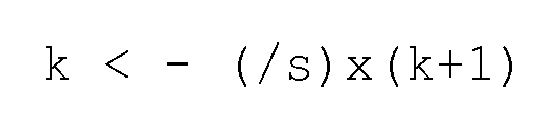


- Verfahren gemäß einem der Ansprüche 1 bis 2, das für die Umsetzung einer Exponentialrechnung vom Typ B = AD verwendet wird, wobei A die Eingangsgröße und D die geheime Eingangsvariable von M Bits, ist, wobei das Verfahren die folgenden Schritte umfasst:Initialisierung:
 So lange i ≥ 0, den elementaren Anweisungsblock Γ'(k, s) wiederholen:R0 umdrehen.


- Verfahren gemäß einem der Ansprüche 1 bis 2, das für die Umsetzung einer Exponentialrechnung vom Typ B = AD verwendet wird, wobei A die Eingangsgröße und D die geheime Eingangsvariable von M Bits, ist, wobei das Verfahren die folgenden Schritte umfasst:Initialisierung:
 So lange i ≤ M-1, den elementaren Anweisungsblock Γ(k,s) wiederholen:

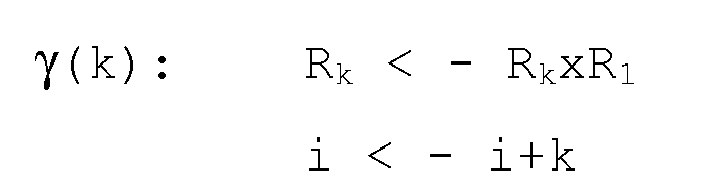
Zurück R0. - Verfahren gemäß einem der Ansprüche 1 bis 4, bei dem die Verbindungen zwischen dem Wert des Schleifenanzeigers (k) und / oder dem Wert des Zustandsanzeigers (s) und / oder dem Wert der geheimen Eingangsvariablen (Di) durch eine Tabelle mit mehreren Eingängen definiert werden.
- Verfahren gemäß Anspruch 11, das für die Umsetzung einer Exponentialrechnung vom Typ B = AD verwendet wird, wobei A die Einganggröße und D die geheime Eingangsvariable von M Bits, ist, wobei das Verfahren den folgenden Schritt umfasst:So lange i ≥ 0, den elementaren Anweisungsblock Γ(k, s) wiederholen:


wobei (U(k, l) die folgende Matrix ist:
- Verfahren gemäß Anspruch 11, das für die Umsetzung einer Exponentialrechnung vom Typ B = AD gemäß dem Algorithmus (M, M3) verwendet wird, wobei A die Eingangsgröße und D die geheime Eingangsvariable von M Bits, ist, wobei das Verfahren den folgenden Schritt umfasst:So lange i ≥ 0, den elementaren Anweisungsblock Γ(k, s) wiederholen:


wobei (U(k, 1) die folgende Matrix ist: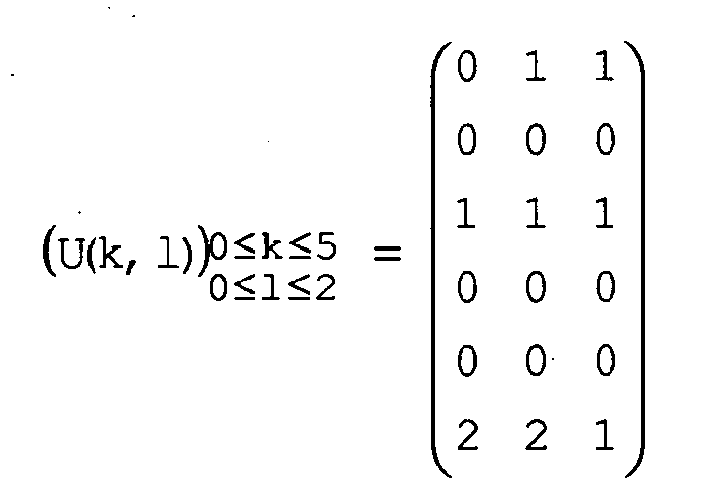
- Verfahren gemäß Anspruch 11, das für die Umsetzung einer Rechnung an einer elliptischen Kurve mit verfeinerten Koordinaten verwendet wird, Rechnung, die Operationen vom Typ Addition oder Punkteverdoppelung verwendet, und bei der man den folgenden Schritt durchführt:So lange i ≥ 0, den elementaren Anweisungsblock Γ(k, s) wiederholen:wobei (U(k, 1) die folgende Matrix ist:


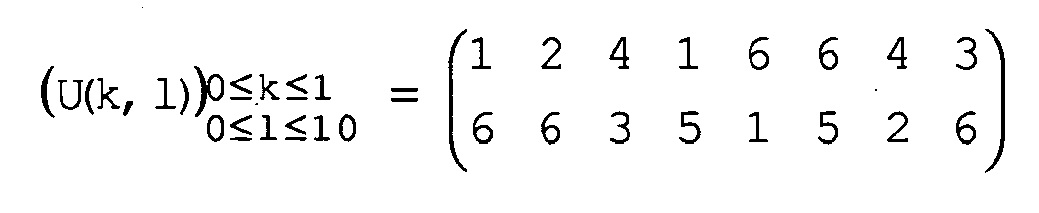
Applications Claiming Priority (3)
| Application Number | Priority Date | Filing Date | Title |
|---|---|---|---|
| FR0204117 | 2002-04-03 | ||
| FR0204117A FR2838210B1 (fr) | 2002-04-03 | 2002-04-03 | Procede cryptographique protege contre les attaques de type a canal cache |
| PCT/FR2003/001058 WO2003083645A2 (fr) | 2002-04-03 | 2003-04-03 | Procede cryptographique protege contre les attaques de type a canal cache |
Publications (3)
| Publication Number | Publication Date |
|---|---|
| EP1493078A2 EP1493078A2 (de) | 2005-01-05 |
| EP1493078B1 true EP1493078B1 (de) | 2009-03-18 |
| EP1493078B8 EP1493078B8 (de) | 2009-07-01 |
Family
ID=28052059
Family Applications (1)
| Application Number | Title | Priority Date | Filing Date |
|---|---|---|---|
| EP03740566A Expired - Lifetime EP1493078B8 (de) | 2002-04-03 | 2003-04-03 | Gegen seitenkanalangriffe geschütztes kryptographisches verfahren |
Country Status (7)
| Country | Link |
|---|---|
| US (1) | US7742595B2 (de) |
| EP (1) | EP1493078B8 (de) |
| AT (1) | ATE426202T1 (de) |
| AU (1) | AU2003258856A1 (de) |
| DE (1) | DE60326707D1 (de) |
| FR (1) | FR2838210B1 (de) |
| WO (1) | WO2003083645A2 (de) |
Families Citing this family (12)
| Publication number | Priority date | Publication date | Assignee | Title |
|---|---|---|---|---|
| US8913739B2 (en) | 2005-10-18 | 2014-12-16 | Telecom Italia S.P.A. | Method for scalar multiplication in elliptic curve groups over prime fields for side-channel attack resistant cryptosystems |
| ATE466329T1 (de) * | 2005-10-28 | 2010-05-15 | Telecom Italia Spa | Verfahren zur skalarmultiplikation in gruppen elliptischer kurven über binäre polynomische körper für nebenkanalattacken-beständige kryptosysteme |
| JP2009515449A (ja) * | 2005-11-04 | 2009-04-09 | ジェムプリュス | 組み込みシステム上での暗号アルゴリズム実行中にデータを安全に処理するための方法 |
| JP2009532973A (ja) * | 2006-04-06 | 2009-09-10 | エヌエックスピー ビー ヴィ | 安全な復号方法 |
| EP2015171A1 (de) * | 2007-06-29 | 2009-01-14 | Gemplus | Kryptographieverfahren, das eine gesicherte modulare Potenzierung gegen Angriffe mit verborgenen Kanälen ohne Kenntnis des öffentlichen Exponenten umfasst, Kryptoprozessor zur Umsetzung des Verfahrens und dazugehörige Chipkarte |
| CN101689233B (zh) * | 2007-07-05 | 2013-01-02 | Nxp股份有限公司 | 安全敏感系统中的微处理器 |
| FR2947647B1 (fr) | 2009-07-06 | 2011-08-26 | Oberthur Technologies | Procede de traitement de donnees et dispositif associe |
| FR2972064B1 (fr) | 2011-02-25 | 2013-03-15 | Inside Secure | Procede de cryptographie comprenant une operation d'exponentiation |
| EP2535804A1 (de) * | 2011-06-17 | 2012-12-19 | Thomson Licensing | Fehlerbeständiger Potenzierungsalgorithmus |
| FR2997780B1 (fr) | 2012-11-07 | 2016-01-22 | Inside Secure | Procede de cryptographie comprenant une operation d'exponentiation modulaire |
| EP2793123A1 (de) | 2013-04-16 | 2014-10-22 | Gemalto SA | Verfahren zur sicheren Ausführung einer modularen Exponentiation |
| CN104778408B (zh) * | 2015-04-15 | 2017-12-29 | 华中科技大学 | 一种基于Android的隐蔽通道攻击审计与侦测方法 |
Family Cites Families (18)
| Publication number | Priority date | Publication date | Assignee | Title |
|---|---|---|---|---|
| US6965673B1 (en) * | 1997-09-19 | 2005-11-15 | Telcordia Technologies, Inc. | Method of using transient faults to verify the security of a cryptosystem |
| JP2002519722A (ja) * | 1998-06-03 | 2002-07-02 | クリプターグラフィー リサーチ インコーポレイテッド | スマートカードおよび他の暗号システム用の、漏洩を最小に抑える、改良desおよび他の暗号プロセス |
| CA2243761C (en) * | 1998-07-21 | 2009-10-06 | Certicom Corp. | Timing attack resistant cryptographic system |
| JP3600454B2 (ja) * | 1998-08-20 | 2004-12-15 | 株式会社東芝 | 暗号化・復号装置、暗号化・復号方法、およびそのプログラム記憶媒体 |
| CA2252078C (en) * | 1998-10-28 | 2009-02-17 | Certicom Corp. | Power signature attack resistant cryptographic system |
| US6724894B1 (en) * | 1999-11-05 | 2004-04-20 | Pitney Bowes Inc. | Cryptographic device having reduced vulnerability to side-channel attack and method of operating same |
| TW536672B (en) * | 2000-01-12 | 2003-06-11 | Hitachi Ltd | IC card and microcomputer |
| DE50014462D1 (de) * | 2000-05-22 | 2007-08-16 | Infineon Technologies Ag | Sicherheits-Datenverarbeitungseinheit sowie dazugehöriges Verfahren |
| JP4199937B2 (ja) * | 2001-03-06 | 2008-12-24 | 株式会社日立製作所 | 耐タンパー暗号処理方法 |
| FR2825863B1 (fr) * | 2001-06-07 | 2003-09-19 | Gemplus Card Int | Procede de securisation d'un calcul d'exponentiation dans un dispositif electronique |
| US7142670B2 (en) * | 2001-08-14 | 2006-11-28 | International Business Machines Corporation | Space-efficient, side-channel attack resistant table lookups |
| JP4086503B2 (ja) * | 2002-01-15 | 2008-05-14 | 富士通株式会社 | 暗号演算装置及び方法並びにプログラム |
| FR2847402B1 (fr) * | 2002-11-15 | 2005-02-18 | Gemplus Card Int | Procede de division entiere securise contre les attaques a canaux caches |
| US20040201647A1 (en) * | 2002-12-02 | 2004-10-14 | Mark Jackson Pulver | Stitching of integrated circuit components |
| FR2848753B1 (fr) * | 2002-12-11 | 2005-02-18 | Gemplus Card Int | Procede de division entiere ou de reduction modulaire securise contre les attaques a canaux caches |
| US20050152539A1 (en) * | 2004-01-12 | 2005-07-14 | Brickell Ernie F. | Method of protecting cryptographic operations from side channel attacks |
| JP4701166B2 (ja) * | 2004-04-26 | 2011-06-15 | パナソニック株式会社 | 暗号又は復号を行うコンピュータシステム及びコンピュータプログラム |
| US7404089B1 (en) * | 2005-06-03 | 2008-07-22 | Pitney Bowes Inc. | Method and system for protecting against side channel attacks when performing cryptographic operations |
-
2002
- 2002-04-03 FR FR0204117A patent/FR2838210B1/fr not_active Expired - Fee Related
-
2003
- 2003-04-03 US US10/509,876 patent/US7742595B2/en not_active Expired - Fee Related
- 2003-04-03 WO PCT/FR2003/001058 patent/WO2003083645A2/fr not_active Ceased
- 2003-04-03 AU AU2003258856A patent/AU2003258856A1/en not_active Abandoned
- 2003-04-03 EP EP03740566A patent/EP1493078B8/de not_active Expired - Lifetime
- 2003-04-03 AT AT03740566T patent/ATE426202T1/de not_active IP Right Cessation
- 2003-04-03 DE DE60326707T patent/DE60326707D1/de not_active Expired - Lifetime
Non-Patent Citations (1)
| Title |
|---|
| LIARDET P.-Y. ET AL: "PREVENTING SPA/DPA IN ECC SYSTEMS USING THE JACOBI FORM", CRYPTOGRAPHIC HARDWARE AND EMBEDDED SYSTEMS. 3RD INTERNATIONAL WORKSHOP, CHES 2001, PARIS, FRANCE; PROCEEDINGS,LECTURE NOTES IN COMPUTER SCIENCE, vol. 2162, 14 May 2001 (2001-05-14) - 16 May 2001 (2001-05-16), SPRINGER, BERLIN, ALLEMAGNE, pages 391 - 401, ISBN: 3-540-42521-7 * |
Also Published As
| Publication number | Publication date |
|---|---|
| ATE426202T1 (de) | 2009-04-15 |
| US7742595B2 (en) | 2010-06-22 |
| FR2838210B1 (fr) | 2005-11-04 |
| DE60326707D1 (de) | 2009-04-30 |
| US20050163312A1 (en) | 2005-07-28 |
| WO2003083645A2 (fr) | 2003-10-09 |
| AU2003258856A1 (en) | 2003-10-13 |
| FR2838210A1 (fr) | 2003-10-10 |
| WO2003083645A3 (fr) | 2004-04-01 |
| EP1493078A2 (de) | 2005-01-05 |
| EP1493078B8 (de) | 2009-07-01 |
Similar Documents
| Publication | Publication Date | Title |
|---|---|---|
| EP2946284B1 (de) | Kryptografisches verfahren mit einem betrieb durch multiplikation mittels eines skalars oder einer exponentiation | |
| EP1414182B1 (de) | Verstecken von in einem Restklassensystem dargestellten Daten | |
| EP1358732B2 (de) | Verfahren zur gesicherten verschlüsselung und baustein zur ausführung eines solchen verschlüsselungsverfahrens | |
| FR2829331A1 (fr) | Procede de securisation d'une quantite secrete | |
| FR2971600A1 (fr) | Dispositif et procede de calcul d'un resultat d'une multiplication scalaire | |
| FR2977953A1 (fr) | Protection d'un calcul d'exponentiation modulaire par addition d'une quantite aleatoire | |
| FR2977952A1 (fr) | Protection d'un calcul d'exponentiation modulaire par multiplication par une quantite aleatoire | |
| EP3287891B1 (de) | Schutz einer modularen berechnung | |
| CA2712178A1 (fr) | Procede et dispositifs de contre-mesure pour cryptographie asymetrique | |
| FR3017476A1 (fr) | Procede de contremesure pour un composant electronique mettant en œuvre un algorithme de cryptographie sur une courbe elliptique | |
| EP1493078B8 (de) | Gegen seitenkanalangriffe geschütztes kryptographisches verfahren | |
| EP1291763A1 (de) | Verfahren zum Verwürflen einer Berechnung mit einer Geheimzahl | |
| EP2284690A2 (de) | Maskierung einer gemäß eines RSA-CRT-Algorithmus durchgeführten Berechnung | |
| EP3136226B1 (de) | Schutz einer berechnung von modularer potenzierung | |
| EP3136227B1 (de) | Überprüfung der sensibilität eines elektronischen schaltkreises, der eine berechnung einer modularen potenzierung ausführt | |
| FR3056322A1 (fr) | Procede de chiffrement ou de dechiffrement protege contre des attaques par canaux caches | |
| EP2983083A1 (de) | Kryptografie-verfahren auf einer elliptischen kurve, das eine fehlererfassung umfasst | |
| EP1804161B1 (de) | Störungsdetektion in einer kryptographischen Berechnung | |
| EP3435585B1 (de) | Schutz einer iterativen berechnung gegen horizontale angriffe | |
| EP1715410B1 (de) | Schutz einer von einem integrierten Schaltkreis durchgeführten Berechnung | |
| EP3579491A1 (de) | Bestimmungsverfahren des modularen kehrwerts und entsprechende kryptographische verarbeitungsvorrichtung | |
| WO2004111831A2 (fr) | Procede de contre-mesure par masquage de l'accumulateur | |
| FR2977954A1 (fr) | Protection d'un calcul sur courbe elliptique | |
| FR2942560A1 (fr) | Procede de traitement de donnees impliquant une exponentiation et un dispositif associe. | |
| EP4617853A1 (de) | Verfahren zur bestimmung einer modularen inverse, elektronische vorrichtung und computerprogramme dafür |
Legal Events
| Date | Code | Title | Description |
|---|---|---|---|
| PUAI | Public reference made under article 153(3) epc to a published international application that has entered the european phase |
Free format text: ORIGINAL CODE: 0009012 |
|
| 17P | Request for examination filed |
Effective date: 20041103 |
|
| AK | Designated contracting states |
Kind code of ref document: A2 Designated state(s): AT BE BG CH CY CZ DE DK EE ES FI FR GB GR HU IE IT LI LU MC NL PT RO SE SI SK TR |
|
| AX | Request for extension of the european patent |
Extension state: AL LT LV MK |
|
| RIN1 | Information on inventor provided before grant (corrected) |
Inventor name: JOYE, MARC Inventor name: CHEVALLIER-MAMES, BENOIT |
|
| 17Q | First examination report despatched |
Effective date: 20051104 |
|
| RTI1 | Title (correction) |
Free format text: CRYPTOGRAPHIC METHOD PROTECTED AGAINST SIDE CHANNEL ATTACKS |
|
| GRAP | Despatch of communication of intention to grant a patent |
Free format text: ORIGINAL CODE: EPIDOSNIGR1 |
|
| GRAS | Grant fee paid |
Free format text: ORIGINAL CODE: EPIDOSNIGR3 |
|
| GRAA | (expected) grant |
Free format text: ORIGINAL CODE: 0009210 |
|
| RAP1 | Party data changed (applicant data changed or rights of an application transferred) |
Owner name: GEMALTO SA |
|
| AK | Designated contracting states |
Kind code of ref document: B1 Designated state(s): AT BE BG CH CY CZ DE DK EE ES FI FR GB GR HU IE IT LI LU MC NL PT RO SE SI SK TR |
|
| REG | Reference to a national code |
Ref country code: GB Ref legal event code: FG4D Free format text: NOT ENGLISH |
|
| REG | Reference to a national code |
Ref country code: CH Ref legal event code: EP |
|
| REG | Reference to a national code |
Ref country code: IE Ref legal event code: FG4D Free format text: LANGUAGE OF EP DOCUMENT: FRENCH |
|
| REF | Corresponds to: |
Ref document number: 60326707 Country of ref document: DE Date of ref document: 20090430 Kind code of ref document: P |
|
| RAP2 | Party data changed (patent owner data changed or rights of a patent transferred) |
Owner name: GEMALTO SA |
|
| NLT2 | Nl: modifications (of names), taken from the european patent patent bulletin |
Owner name: GEMALTO SA Effective date: 20090422 |
|
| PG25 | Lapsed in a contracting state [announced via postgrant information from national office to epo] |
Ref country code: FI Free format text: LAPSE BECAUSE OF FAILURE TO SUBMIT A TRANSLATION OF THE DESCRIPTION OR TO PAY THE FEE WITHIN THE PRESCRIBED TIME-LIMIT Effective date: 20090318 Ref country code: SI Free format text: LAPSE BECAUSE OF FAILURE TO SUBMIT A TRANSLATION OF THE DESCRIPTION OR TO PAY THE FEE WITHIN THE PRESCRIBED TIME-LIMIT Effective date: 20090318 |
|
| PG25 | Lapsed in a contracting state [announced via postgrant information from national office to epo] |
Ref country code: SE Free format text: LAPSE BECAUSE OF FAILURE TO SUBMIT A TRANSLATION OF THE DESCRIPTION OR TO PAY THE FEE WITHIN THE PRESCRIBED TIME-LIMIT Effective date: 20090618 Ref country code: AT Free format text: LAPSE BECAUSE OF FAILURE TO SUBMIT A TRANSLATION OF THE DESCRIPTION OR TO PAY THE FEE WITHIN THE PRESCRIBED TIME-LIMIT Effective date: 20090318 |
|
| REG | Reference to a national code |
Ref country code: IE Ref legal event code: FD4D |
|
| PG25 | Lapsed in a contracting state [announced via postgrant information from national office to epo] |
Ref country code: EE Free format text: LAPSE BECAUSE OF FAILURE TO SUBMIT A TRANSLATION OF THE DESCRIPTION OR TO PAY THE FEE WITHIN THE PRESCRIBED TIME-LIMIT Effective date: 20090318 Ref country code: CZ Free format text: LAPSE BECAUSE OF FAILURE TO SUBMIT A TRANSLATION OF THE DESCRIPTION OR TO PAY THE FEE WITHIN THE PRESCRIBED TIME-LIMIT Effective date: 20090318 Ref country code: ES Free format text: LAPSE BECAUSE OF FAILURE TO SUBMIT A TRANSLATION OF THE DESCRIPTION OR TO PAY THE FEE WITHIN THE PRESCRIBED TIME-LIMIT Effective date: 20090629 Ref country code: IE Free format text: LAPSE BECAUSE OF FAILURE TO SUBMIT A TRANSLATION OF THE DESCRIPTION OR TO PAY THE FEE WITHIN THE PRESCRIBED TIME-LIMIT Effective date: 20090318 Ref country code: PT Free format text: LAPSE BECAUSE OF FAILURE TO SUBMIT A TRANSLATION OF THE DESCRIPTION OR TO PAY THE FEE WITHIN THE PRESCRIBED TIME-LIMIT Effective date: 20090826 |
|
| BERE | Be: lapsed |
Owner name: GEMALTO SA Effective date: 20090430 |
|
| PG25 | Lapsed in a contracting state [announced via postgrant information from national office to epo] |
Ref country code: SK Free format text: LAPSE BECAUSE OF FAILURE TO SUBMIT A TRANSLATION OF THE DESCRIPTION OR TO PAY THE FEE WITHIN THE PRESCRIBED TIME-LIMIT Effective date: 20090318 Ref country code: RO Free format text: LAPSE BECAUSE OF FAILURE TO SUBMIT A TRANSLATION OF THE DESCRIPTION OR TO PAY THE FEE WITHIN THE PRESCRIBED TIME-LIMIT Effective date: 20090318 |
|
| REG | Reference to a national code |
Ref country code: CH Ref legal event code: PL |
|
| PLBE | No opposition filed within time limit |
Free format text: ORIGINAL CODE: 0009261 |
|
| STAA | Information on the status of an ep patent application or granted ep patent |
Free format text: STATUS: NO OPPOSITION FILED WITHIN TIME LIMIT |
|
| PG25 | Lapsed in a contracting state [announced via postgrant information from national office to epo] |
Ref country code: DK Free format text: LAPSE BECAUSE OF FAILURE TO SUBMIT A TRANSLATION OF THE DESCRIPTION OR TO PAY THE FEE WITHIN THE PRESCRIBED TIME-LIMIT Effective date: 20090318 Ref country code: BG Free format text: LAPSE BECAUSE OF FAILURE TO SUBMIT A TRANSLATION OF THE DESCRIPTION OR TO PAY THE FEE WITHIN THE PRESCRIBED TIME-LIMIT Effective date: 20090618 Ref country code: LI Free format text: LAPSE BECAUSE OF NON-PAYMENT OF DUE FEES Effective date: 20090430 Ref country code: CH Free format text: LAPSE BECAUSE OF NON-PAYMENT OF DUE FEES Effective date: 20090430 |
|
| 26N | No opposition filed |
Effective date: 20091221 |
|
| PG25 | Lapsed in a contracting state [announced via postgrant information from national office to epo] |
Ref country code: MC Free format text: LAPSE BECAUSE OF NON-PAYMENT OF DUE FEES Effective date: 20090430 |
|
| PG25 | Lapsed in a contracting state [announced via postgrant information from national office to epo] |
Ref country code: BE Free format text: LAPSE BECAUSE OF NON-PAYMENT OF DUE FEES Effective date: 20090430 |
|
| PG25 | Lapsed in a contracting state [announced via postgrant information from national office to epo] |
Ref country code: GR Free format text: LAPSE BECAUSE OF FAILURE TO SUBMIT A TRANSLATION OF THE DESCRIPTION OR TO PAY THE FEE WITHIN THE PRESCRIBED TIME-LIMIT Effective date: 20090619 |
|
| PG25 | Lapsed in a contracting state [announced via postgrant information from national office to epo] |
Ref country code: LU Free format text: LAPSE BECAUSE OF NON-PAYMENT OF DUE FEES Effective date: 20090403 |
|
| PG25 | Lapsed in a contracting state [announced via postgrant information from national office to epo] |
Ref country code: HU Free format text: LAPSE BECAUSE OF FAILURE TO SUBMIT A TRANSLATION OF THE DESCRIPTION OR TO PAY THE FEE WITHIN THE PRESCRIBED TIME-LIMIT Effective date: 20090919 |
|
| PG25 | Lapsed in a contracting state [announced via postgrant information from national office to epo] |
Ref country code: TR Free format text: LAPSE BECAUSE OF FAILURE TO SUBMIT A TRANSLATION OF THE DESCRIPTION OR TO PAY THE FEE WITHIN THE PRESCRIBED TIME-LIMIT Effective date: 20090318 |
|
| PG25 | Lapsed in a contracting state [announced via postgrant information from national office to epo] |
Ref country code: CY Free format text: LAPSE BECAUSE OF FAILURE TO SUBMIT A TRANSLATION OF THE DESCRIPTION OR TO PAY THE FEE WITHIN THE PRESCRIBED TIME-LIMIT Effective date: 20090318 |
|
| REG | Reference to a national code |
Ref country code: FR Ref legal event code: PLFP Year of fee payment: 14 |
|
| REG | Reference to a national code |
Ref country code: FR Ref legal event code: PLFP Year of fee payment: 15 |
|
| REG | Reference to a national code |
Ref country code: FR Ref legal event code: PLFP Year of fee payment: 16 |
|
| PGFP | Annual fee paid to national office [announced via postgrant information from national office to epo] |
Ref country code: GB Payment date: 20190325 Year of fee payment: 17 Ref country code: FR Payment date: 20190325 Year of fee payment: 17 Ref country code: IT Payment date: 20190321 Year of fee payment: 17 |
|
| PGFP | Annual fee paid to national office [announced via postgrant information from national office to epo] |
Ref country code: NL Payment date: 20190327 Year of fee payment: 17 |
|
| PGFP | Annual fee paid to national office [announced via postgrant information from national office to epo] |
Ref country code: DE Payment date: 20190220 Year of fee payment: 17 |
|
| REG | Reference to a national code |
Ref country code: DE Ref legal event code: R119 Ref document number: 60326707 Country of ref document: DE |
|
| REG | Reference to a national code |
Ref country code: NL Ref legal event code: MM Effective date: 20200501 |
|
| PG25 | Lapsed in a contracting state [announced via postgrant information from national office to epo] |
Ref country code: DE Free format text: LAPSE BECAUSE OF NON-PAYMENT OF DUE FEES Effective date: 20201103 Ref country code: FR Free format text: LAPSE BECAUSE OF NON-PAYMENT OF DUE FEES Effective date: 20200430 |
|
| GBPC | Gb: european patent ceased through non-payment of renewal fee |
Effective date: 20200403 |
|
| PG25 | Lapsed in a contracting state [announced via postgrant information from national office to epo] |
Ref country code: NL Free format text: LAPSE BECAUSE OF NON-PAYMENT OF DUE FEES Effective date: 20200501 |
|
| PG25 | Lapsed in a contracting state [announced via postgrant information from national office to epo] |
Ref country code: GB Free format text: LAPSE BECAUSE OF NON-PAYMENT OF DUE FEES Effective date: 20200403 |
|
| PG25 | Lapsed in a contracting state [announced via postgrant information from national office to epo] |
Ref country code: IT Free format text: LAPSE BECAUSE OF NON-PAYMENT OF DUE FEES Effective date: 20200403 |