EP1493083B1 - Umkonfigurierbares steuersystem auf der basis einer hardwareimplementierung von petri-graphen - Google Patents
Umkonfigurierbares steuersystem auf der basis einer hardwareimplementierung von petri-graphen Download PDFInfo
- Publication number
- EP1493083B1 EP1493083B1 EP03740574A EP03740574A EP1493083B1 EP 1493083 B1 EP1493083 B1 EP 1493083B1 EP 03740574 A EP03740574 A EP 03740574A EP 03740574 A EP03740574 A EP 03740574A EP 1493083 B1 EP1493083 B1 EP 1493083B1
- Authority
- EP
- European Patent Office
- Prior art keywords
- cell
- token
- state
- cells
- connection
- Prior art date
- Legal status (The legal status is an assumption and is not a legal conclusion. Google has not performed a legal analysis and makes no representation as to the accuracy of the status listed.)
- Expired - Lifetime
Links
Images








Classifications
-
- G—PHYSICS
- G06—COMPUTING OR CALCULATING; COUNTING
- G06F—ELECTRIC DIGITAL DATA PROCESSING
- G06F9/00—Arrangements for program control, e.g. control units
- G06F9/06—Arrangements for program control, e.g. control units using stored programs, i.e. using an internal store of processing equipment to receive or retain programs
- G06F9/44—Arrangements for executing specific programs
-
- G—PHYSICS
- G06—COMPUTING OR CALCULATING; COUNTING
- G06F—ELECTRIC DIGITAL DATA PROCESSING
- G06F30/00—Computer-aided design [CAD]
- G06F30/20—Design optimisation, verification or simulation
- G06F30/22—Design optimisation, verification or simulation using Petri net models
Definitions
- the present invention relates to a reconfigurable system based on the implementation of Petri graphs.
- the invention consists in proposing a system for implementing the control part of an application.
- This system is compatible with different paradigms of parallelism (parallelism of data, instructions or tasks), and can be used with different types of existing computers whether they are synchronous or asynchronous.
- the invention is based on the use of Petri graphs which make it possible to model the control part of the applications.
- this type of modeling is used in the software domain because it makes it possible to carry out the formal verification on the applications as described in the referenced document [1] at the end of the description.
- Petri nets are also the basis for programming PLCs and especially PLCs ("Programmable Logic Control "or” programmable logic controller "), as described in the referenced document [2]
- PLCs Programmable Logic Control "or" programmable logic controller "
- the reference document [3] describes an asynchronous logical network capable of directly implementing a specification of a digital system by a graph of Petri.
- the invention relates to a system for the direct transposition of Petri graphs on a material support.
- the present invention describes a reconfigurable system defined in the present claim 1.
- Preferred embodiments of the invention are defined in the dependent claims.
- the system of the invention is designed using the concept of reconfigurability that allows to change dynamically, that is to say during operation, the control graph of an application.
- Reconfigurability makes it possible to envisage a hardware solution for the management of these graphs. Indeed, it is possible with such a system to load Petri graphs per portion, which does not limit the size of the applications that can be processed.
- An application can be modeled by these graphs of Petri. Indeed, each place of the Petri graph can be linked to an action and the transition between two places is validated by control events. These control events are used to advance the chips in the graphs of Petri implemented in the system of the invention. They can come from different modules depending on the application to be modeled. For example, it can be the outputs of a sensor or event flags of an ALU (arithmetic and logic unit).
- ALU arithmetic and logic unit
- the invention therefore consists of a reconfigurable system for modeling Petri graphs: one or more chips will circulate in the system of the invention as a function of events. Places, which receive the chips, determine the actions to be performed.
- Each state cell has three entries, token entry, destruction entry, and validation input, and a token output, as shown on the figure 1 .
- the token enters the cell state where it is stored. If validation is enabled then the token is transferred to the exit. If the destruction command is enabled, the token is removed from the status cell and the validation has no effect.
- the reconfiguration here consists in linking the state cells together so as to model the Petri graphs associated with the application.
- the control part of an application is used to make the connections between the state cells.
- the invention proposes to use a technology reconfigurable to translate the control part of an application into interconnects.
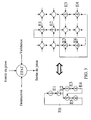
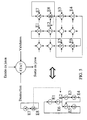
- the first example ( figure 3 ) illustrates a simple transposition between a Petri graph and its implementation using the state cell.
- the transposition consists of realizing the transfer paths of the token by connecting the state cells together (transmission connections).
- the token can not be simultaneously in cell number 5 and in cell number 3. To implement this Petri graph, it is necessary to use the destruction connections. As soon as one of the two events (E2 or E3) takes place, the token waiting for the other event is destroyed. Thus cells number 5 and 3 can not be validated at the same time.
- the cells In order to be able to make any Petri graph, the cells must be fully interconnectable: one cell must be able to connect with all the others. If the structure has N states cells, then N 2 connectors 2 as shown on the figure 6a .
- each cell 1 can only connect to a limited number of cells, but each cell can serve as a connector to increase network connectivity as shown in FIG. Figure 6c .
- figure 7 shows a functional implementation of a state cell supporting indirect connections.
- All these primitives can be performed by each of the state cells.
- the sending of the primitives is however managed by an external control device.
- This controller is responsible for managing state cells. It must notably manage the sending of the primitives towards the cells in order to allow the construction of the graphs of Petri. It is also responsible for the release of resources for the use of the structure of the system of the invention as a memory cache (use described later).
- All state cells can be instructed to know which primitive to perform. If a state cell is not used, it is marked as free if not used.
- the first primitive consists of transmitting to a state cell the type of connection that it must carry out.
- each cell must be able to contain information relating to the connection that it must make.
- the cell must memorize the type of connection that it will have to establish (connection of transmission, validation or destruction).
- the second primitive is to connect to a new state cell.
- the state cell having to make this connection looks for among the free state cells of its neighborhood, that is to say those to which it can directly access. If a free cell is found, the connection is made. This requires that the cell be able to send a connection request to each of these neighbors and check their state of freedom. Thus, a connection request signal must be sent to the neighboring cells and each of them must provide a signal characteristic of its state (free or used).
- the fourth primitive is a security that avoids the blockage of the system due to the lack of free cells. It allows forcing the release of a state cell for reuse.
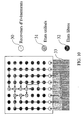
- a mechanism for collecting and distributing events is set up. Some cells are not connectable by other system states cells. These cells receive their chips directly from an event bus 33 and are called "event receivers".
- the event bus consists of all the signals that are associated with a transition in the Petri graphs. Validation connections can be established from these cells to feed the event structure.
- the references 30, 31 and 32 respectively represent: an event receiver, the used state cells and the free state cells.
- each place of the Petri graph corresponds an action to be performed. It is therefore necessary to set up a device for linking an action to a state cell. Each cell must therefore be able to signal to the structure integrating the system of the invention the presence of the token. In the same way, each cell must also indicate when it is used to model a place of the Petri graph, to allow the system to map to the appropriate action.
- a possible implementation of such a mechanism may be based on the use of a memory, as illustrated on the figure 11 .
- each cell of the system of the invention is associated with a memory box 40.
- each time a token moves to a new cell it activates the reading of the memory box associated with this cell.
- This memory has a reconfigurable data bus 41. Indeed, each memory slot can choose the portion of the data bus on which the data will pass through a configuration information 42.
- This configuration associated with each memory box is a binary code which allows you to specify the part of the data bus used for transfers. Thus, it is possible that several memory boxes are active at the same time without conflict.
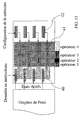
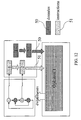
- two streams are generated by the propagation of tokens in the graph: a data stream and a flow of instructions. These two streams are sent to an operator who performs the processing by generating the events necessary for the associated Petri graph.
- a flow of instructions is generated and sent to each of the operators, the Petri graph being "parallelized” so as to generate several streams of data that will be used to supply the various operators of the targeted SIMD structure.
- different Petri graphs manage each of the operators, each of these graphs making it possible to generate the flow of instructions and data associated with each operator.
- the graphs can be synchronized with each other in order to coordinate the operators.
- Petri graphs avoids the implementation of a controller for the synchronization of operations during a SIMD or MIMD treatment.
- the MIMD mode is obtained by the ability to describe and browse several graphs in parallel. It is then possible by using the previously described configurable memory to generate parallel streams of data and instructions compatible with the targeted MIMD structure.
- the loading of the Petri graphs on the reconfigurable structure can be dynamic. Indeed, the progression of the tokens in the graphs is not incompatible with the loading of graphs. For example, for complex applications the whole graph can not fit on the structure.
- the system then functions like a cache: it keeps in memory the actions to be performed in the rest of the application. The operation of the covers as well as examples of conventional implementations are described below.
- the figure 15 discloses a four-level memory hierarchy that proceeds from processor 56 to central memory 52 through three cache levels L1 55, L2 54 and L3 53.
- the presence of the data or instruction is first verified. in the memory closest to the processor. If the data requested is not present we go down in the memory hierarchy until we find it.
- the mechanism of loading the data in the caches makes it possible to favor the use of the memory closest to the processor (cache L1).
- cache L1 Currently some processor architectures integrate L1 and L2.
- the system of the invention can be used in the implementation of caches. Since the petriery graph associated with an application may be too large to be integrated on the system, it must be cut into parts. The portion of the Petri graph stored on the system must therefore be dynamically updated according to the progress of the application. Some state cells may not be reachable during the execution of the application, which means that these state cells can no longer receive tokens. Each state cell constantly knows whether it is achievable or not. A device capable of deleting the non-reachable states cells is set up so as to release certain state cells to enable the loading of the sequence of the graph. This device must make it possible to balance the loading and unloading of the state cells. This mechanism is to be integrated in the external controller introduced during the definition of the primitives of the state cell.
- the unloading of the state cells is performed using the release primitive presented previously.
- the controller decides on the release of a state cell based on its reachability and a criterion reflecting the balance between loading and unloading state cells.
- the release of the state cell is achieved by the use of the release primitive. It can for example be implemented so as to maintain constant the relationship between the free state cells and the used state cells, in order to maintain sufficient routing resources.
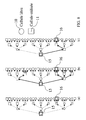
- Each token transmission connection is coupled with a connection which makes it possible to know whether a state cell is accessible or not. Indeed the information that circulates on these connections reflects the presence or absence of a token upstream of the state cell considered. If there is a token upstream of the cell state it is reachable, otherwise the cell state will be considered unreachable.
- the figure 17 illustrates such a mechanism. On this FIG. 6 shows the reachability signal 60, the transmission connections 61, the non-attainable states 62, and the token 63.
Landscapes
- Engineering & Computer Science (AREA)
- Theoretical Computer Science (AREA)
- Software Systems (AREA)
- Physics & Mathematics (AREA)
- General Physics & Mathematics (AREA)
- General Engineering & Computer Science (AREA)
- Geometry (AREA)
- Evolutionary Computation (AREA)
- Computer Hardware Design (AREA)
- Logic Circuits (AREA)
- Multi Processors (AREA)
- Medicines Containing Material From Animals Or Micro-Organisms (AREA)
- Data Exchanges In Wide-Area Networks (AREA)
- Pharmaceuticals Containing Other Organic And Inorganic Compounds (AREA)
- Medicines That Contain Protein Lipid Enzymes And Other Medicines (AREA)
- Image Generation (AREA)
- Management, Administration, Business Operations System, And Electronic Commerce (AREA)
Claims (6)
- Rekonfigurierbares System für die materialisierte Verwendung des Steuerteils einer Anwendung, die einen Steuerteil und einen operativen Teil umfaßt, wobei der Steuerteil die Anweisung für Operationen gibt, die vom operativen Teil auszuführen sind, dadurch gekennzeichnet, dass es umfaßt:- eine Gruppe von N materialisierten Zustandszellen, die untereinander vollständig verbindbar sind, wobei N eine ganze Zahl größer als 1 ist,wobei jede Zelle einem Platz des Petrigraphen entspricht, der der Anwendung zugeordnet ist, sich mit allen anderen Zellen verbinden und wohl oder nicht ein Token enthalten kann, wobei jede Zelle ferner einen Tokeneingang, einen Tokenlöschungseingang, einen Tokenausgang und einen Validierungseingang besitzt, wobei jede Zelle dazu ausgelegt ist, jedes an ihrem Tokeneingang empfangene Token zu speichern, ihr Token infolge einer Aktivierung ihres Tokenlöschungseingangs zu löschen, ohne es zu übertragen, und ihr Token infolge einer Aktivierung ihres Validierungseingangs zu jeder anderen Zelle hin zu übertragen, die mit dem Tokenausgang verbunden ist;- ein rekonfigurierbares Netz von Verbindern, die es ermöglichen, die Zellen miteinander zu verbinden, wobei der Tokenausgang einer Zelle mit dem Tokeneingang einer anderen Zelle mittels eines ersten Anschlusses verbunden werden kann, genannt Übertragungsanschluß, mit dem Validierungseingang dieser anderen Zelle mittels eines zweiten Anschlusses, genannt Validierungsanschluß, und mit dem Löschungseingang dieser anderen Zelle mittels eines dritten Anschlusses, genannt Löschungsanschluß.
- System nach Anspruch 1, bei dem ein Multiplexer (5) einen Anschluß zwischen dem Tokeneingang und dem Tokenausgang in jeder Zustandszelle realisiert, was die Verwendung der Zustandszelle als Verbinder erlaubt.
- System nach Anspruch 1, bei dem jede Zustandszelle dazu ausgelegt ist, alle nachfolgenden Konstruktionsgrundlagen des Petrigraphen zu verwenden:- Wahl des zu realisierenden Anschlusses,- Realisierung eines Anschlusses an eine freie Zustandszelle,- Realisierung eines Anschlusses an eine verwendete Zustandszelle,- Trennen der Anschlüsse der Zustandszelle,wobei die Realisierung der Anschlüsse zwischen den Zustandszellen automatisiert ist.
- System nach Anspruch 1, umfassend Ereignisempfängerzellen (30), die so angeschlossen sind, dass sie ihre Tokens direkt von einem Ereignisbus (33) empfangen, wobei diese Ereignisempfängerzellen (30) nicht mittels der anderen Zustandszellen des Systems anschließbar sind.
- System nach Anspruch 1, bei dem jede Zustandszelle einem Speicherplatz (40) eines Speichers zugeordnet ist, der einen rekonfigurierbaren Datenbus besitzt.
- System nach einem der vorhergehenden Ansprüche, bei dem jede Zustandszelle dazu ausgelegt ist, ständig zu wissen, ob sie erreichbar ist oder nicht.
Applications Claiming Priority (3)
| Application Number | Priority Date | Filing Date | Title |
|---|---|---|---|
| FR0204396 | 2002-04-09 | ||
| FR0204396A FR2838222B1 (fr) | 2002-04-09 | 2002-04-09 | Systeme reconfigurable de controle base sur la mise en oeuvre materielle de graphes de petri |
| PCT/FR2003/001086 WO2003085522A2 (fr) | 2002-04-09 | 2003-04-07 | Systeme reconfigurable de controle base sur la mise en oeuvre materielle de graphes de petri |
Publications (2)
| Publication Number | Publication Date |
|---|---|
| EP1493083A2 EP1493083A2 (de) | 2005-01-05 |
| EP1493083B1 true EP1493083B1 (de) | 2009-09-30 |
Family
ID=28052226
Family Applications (1)
| Application Number | Title | Priority Date | Filing Date |
|---|---|---|---|
| EP03740574A Expired - Lifetime EP1493083B1 (de) | 2002-04-09 | 2003-04-07 | Umkonfigurierbares steuersystem auf der basis einer hardwareimplementierung von petri-graphen |
Country Status (7)
| Country | Link |
|---|---|
| US (1) | US7499843B2 (de) |
| EP (1) | EP1493083B1 (de) |
| JP (1) | JP4349914B2 (de) |
| AT (1) | ATE444521T1 (de) |
| DE (1) | DE60329479D1 (de) |
| FR (1) | FR2838222B1 (de) |
| WO (1) | WO2003085522A2 (de) |
Family Cites Families (7)
| Publication number | Priority date | Publication date | Assignee | Title |
|---|---|---|---|---|
| USRE31287E (en) * | 1976-02-03 | 1983-06-21 | Massachusetts Institute Of Technology | Asynchronous logic array |
| US4068214A (en) * | 1976-02-03 | 1978-01-10 | Massachusetts Institute Of Technology | Asynchronous logic array |
| US4866605A (en) * | 1984-11-05 | 1989-09-12 | Hitachi, Ltd. | System function simulation method and apparatus therefor using Petri net symbols |
| US4845633A (en) * | 1985-12-02 | 1989-07-04 | Apple Computer Inc. | System for programming graphically a programmable, asynchronous logic cell and array |
| US4700187A (en) * | 1985-12-02 | 1987-10-13 | Concurrent Logic, Inc. | Programmable, asynchronous logic cell and array |
| US6476814B1 (en) * | 1998-06-25 | 2002-11-05 | Wordgraph, Inc. | Display structure for representation of complex systems |
| US6789054B1 (en) * | 1999-04-25 | 2004-09-07 | Mahmoud A. Makhlouf | Geometric display tools and methods for the visual specification, design automation, and control of adaptive real systems |
-
2002
- 2002-04-09 FR FR0204396A patent/FR2838222B1/fr not_active Expired - Fee Related
-
2003
- 2003-04-07 AT AT03740574T patent/ATE444521T1/de not_active IP Right Cessation
- 2003-04-07 DE DE60329479T patent/DE60329479D1/de not_active Expired - Lifetime
- 2003-04-07 JP JP2003582641A patent/JP4349914B2/ja not_active Expired - Fee Related
- 2003-04-07 US US10/508,709 patent/US7499843B2/en not_active Expired - Fee Related
- 2003-04-07 EP EP03740574A patent/EP1493083B1/de not_active Expired - Lifetime
- 2003-04-07 WO PCT/FR2003/001086 patent/WO2003085522A2/fr not_active Ceased
Also Published As
| Publication number | Publication date |
|---|---|
| JP4349914B2 (ja) | 2009-10-21 |
| FR2838222B1 (fr) | 2005-02-18 |
| US20050149308A1 (en) | 2005-07-07 |
| WO2003085522A2 (fr) | 2003-10-16 |
| DE60329479D1 (de) | 2009-11-12 |
| ATE444521T1 (de) | 2009-10-15 |
| EP1493083A2 (de) | 2005-01-05 |
| JP2005527897A (ja) | 2005-09-15 |
| FR2838222A1 (fr) | 2003-10-10 |
| US7499843B2 (en) | 2009-03-03 |
| WO2003085522A3 (fr) | 2004-04-01 |
Similar Documents
| Publication | Publication Date | Title |
|---|---|---|
| EP0597028B1 (de) | Vorrichtung mit paralleler prozessor matrix | |
| EP0020202B1 (de) | Datenverarbeitungssystem zur simultanen Verarbeitung mehrerer Programme | |
| FR2612313A1 (fr) | Selecteur programmable d'options | |
| EP0160028B1 (de) | Vorrichtung und verfahren zur schnellen und beständigen informationsspeicherung | |
| EP0755013A1 (de) | Verfahren zur Übertragung von Nachrichten in einem Vielfachknoten-Datenverarbeitungssystem | |
| FR2810423A1 (fr) | Systeme informatique modulaire et procede associe | |
| EP3217290A1 (de) | Chipsystem und verfahren zum datenaustausch zwischen rechenknoten eines solchen chipsystems | |
| FR2992446A1 (fr) | Systeme et procede de traitement de donnees a gestion d'une coherence de caches dans un reseau de processeurs munis de memoires caches. | |
| EP0646875B1 (de) | Verfahren und System von Zwischenverbindungen zur Verwaltung von Meldungen in einem Prozessorennetzwerk mit paralleler Struktur | |
| EP2254066A1 (de) | Verfahren zur Unterstützung der Realisierung und Validierung einer Flugzeugcomputingplatform | |
| EP0524089B1 (de) | Programmstruktur für ein Datenverarbeitungssystem, insbesondere für ein Telekommunikationssystem | |
| FR2948206A1 (fr) | Dispositif et procede pour l'execution distribuee de traitements de donnees numeriques | |
| FR2986346A1 (fr) | Procede d'utilisation d'une memoire partagee | |
| EP2507712A1 (de) | System für direkte datenübertragungen zwischen speichern von einer vielzahl von elementen des besagten systems | |
| FR2759178A1 (fr) | Circuit de gestion de memoire dans un environnement multi-utilisateurs avec requete et priorite d'acces | |
| EP1493083A2 (de) | Umkonfigurierbares steuersystem auf der basis einer hardwareimplementierung von petri-graphen | |
| EP0333537A1 (de) | Digitale Signalverarbeitungsanordnung | |
| EP2208143B1 (de) | Struktur und verfahren für speicherung und abruf von daten | |
| EP0634725A1 (de) | Netzwerkprozessor | |
| EP1269377B1 (de) | System zur selektiven kommunikation zwischen mobilen endgeräten, die sich in der nähe befinden, und die mit globalen netzwerken verbunden sind | |
| EP0634724A1 (de) | Verarbeitungssystem mit gemeinschaftlichem Speicher | |
| EP0113272B1 (de) | Modulares Kommunikationsknotenkoppelfeld | |
| FR2742894A1 (fr) | Systeme d'echange d'informations entre plusieurs operateurs | |
| FR2902211A1 (fr) | Procede de simulation d'un systeme complexe avec construction d'au moins un modele comprenant au moins un routeur modelise, produit programme d'ordinateur et moyen de stockage correspondants | |
| FR3154820A1 (fr) | Optimisation des transferts de données entre un processeur de traitement parallèle et une mémoire |
Legal Events
| Date | Code | Title | Description |
|---|---|---|---|
| PUAI | Public reference made under article 153(3) epc to a published international application that has entered the european phase |
Free format text: ORIGINAL CODE: 0009012 |
|
| 17P | Request for examination filed |
Effective date: 20040920 |
|
| AK | Designated contracting states |
Kind code of ref document: A2 Designated state(s): AT BE BG CH CY CZ DE DK EE ES FI FR GB GR HU IE IT LI LU MC NL PT RO SE SI SK TR |
|
| RAP1 | Party data changed (applicant data changed or rights of an application transferred) |
Owner name: COMMISSARIAT A L'ENERGIE ATOMIQUE |
|
| 17Q | First examination report despatched |
Effective date: 20070214 |
|
| GRAP | Despatch of communication of intention to grant a patent |
Free format text: ORIGINAL CODE: EPIDOSNIGR1 |
|
| RIC1 | Information provided on ipc code assigned before grant |
Ipc: G06F 15/80 20060101ALI20090417BHEP Ipc: G06F 9/44 20060101AFI20090417BHEP Ipc: G06F 17/50 20060101ALI20090417BHEP |
|
| GRAS | Grant fee paid |
Free format text: ORIGINAL CODE: EPIDOSNIGR3 |
|
| GRAA | (expected) grant |
Free format text: ORIGINAL CODE: 0009210 |
|
| AK | Designated contracting states |
Kind code of ref document: B1 Designated state(s): AT BE BG CH CY CZ DE DK EE ES FI FR GB GR HU IE IT LI LU MC NL PT RO SE SI SK TR |
|
| REG | Reference to a national code |
Ref country code: CH Ref legal event code: EP Ref country code: GB Ref legal event code: FG4D Free format text: NOT ENGLISH |
|
| REG | Reference to a national code |
Ref country code: IE Ref legal event code: FG4D |
|
| REF | Corresponds to: |
Ref document number: 60329479 Country of ref document: DE Date of ref document: 20091112 Kind code of ref document: P |
|
| PG25 | Lapsed in a contracting state [announced via postgrant information from national office to epo] |
Ref country code: SE Free format text: LAPSE BECAUSE OF FAILURE TO SUBMIT A TRANSLATION OF THE DESCRIPTION OR TO PAY THE FEE WITHIN THE PRESCRIBED TIME-LIMIT Effective date: 20090930 |
|
| PG25 | Lapsed in a contracting state [announced via postgrant information from national office to epo] |
Ref country code: SI Free format text: LAPSE BECAUSE OF FAILURE TO SUBMIT A TRANSLATION OF THE DESCRIPTION OR TO PAY THE FEE WITHIN THE PRESCRIBED TIME-LIMIT Effective date: 20090930 |
|
| PG25 | Lapsed in a contracting state [announced via postgrant information from national office to epo] |
Ref country code: RO Free format text: LAPSE BECAUSE OF FAILURE TO SUBMIT A TRANSLATION OF THE DESCRIPTION OR TO PAY THE FEE WITHIN THE PRESCRIBED TIME-LIMIT Effective date: 20090930 Ref country code: CZ Free format text: LAPSE BECAUSE OF FAILURE TO SUBMIT A TRANSLATION OF THE DESCRIPTION OR TO PAY THE FEE WITHIN THE PRESCRIBED TIME-LIMIT Effective date: 20090930 Ref country code: EE Free format text: LAPSE BECAUSE OF FAILURE TO SUBMIT A TRANSLATION OF THE DESCRIPTION OR TO PAY THE FEE WITHIN THE PRESCRIBED TIME-LIMIT Effective date: 20090930 Ref country code: ES Free format text: LAPSE BECAUSE OF FAILURE TO SUBMIT A TRANSLATION OF THE DESCRIPTION OR TO PAY THE FEE WITHIN THE PRESCRIBED TIME-LIMIT Effective date: 20100110 Ref country code: PT Free format text: LAPSE BECAUSE OF FAILURE TO SUBMIT A TRANSLATION OF THE DESCRIPTION OR TO PAY THE FEE WITHIN THE PRESCRIBED TIME-LIMIT Effective date: 20100201 |
|
| REG | Reference to a national code |
Ref country code: IE Ref legal event code: FD4D |
|
| PG25 | Lapsed in a contracting state [announced via postgrant information from national office to epo] |
Ref country code: CY Free format text: LAPSE BECAUSE OF FAILURE TO SUBMIT A TRANSLATION OF THE DESCRIPTION OR TO PAY THE FEE WITHIN THE PRESCRIBED TIME-LIMIT Effective date: 20090930 Ref country code: SK Free format text: LAPSE BECAUSE OF FAILURE TO SUBMIT A TRANSLATION OF THE DESCRIPTION OR TO PAY THE FEE WITHIN THE PRESCRIBED TIME-LIMIT Effective date: 20090930 |
|
| PG25 | Lapsed in a contracting state [announced via postgrant information from national office to epo] |
Ref country code: AT Free format text: LAPSE BECAUSE OF FAILURE TO SUBMIT A TRANSLATION OF THE DESCRIPTION OR TO PAY THE FEE WITHIN THE PRESCRIBED TIME-LIMIT Effective date: 20090930 |
|
| PG25 | Lapsed in a contracting state [announced via postgrant information from national office to epo] |
Ref country code: DK Free format text: LAPSE BECAUSE OF FAILURE TO SUBMIT A TRANSLATION OF THE DESCRIPTION OR TO PAY THE FEE WITHIN THE PRESCRIBED TIME-LIMIT Effective date: 20090930 Ref country code: IE Free format text: LAPSE BECAUSE OF FAILURE TO SUBMIT A TRANSLATION OF THE DESCRIPTION OR TO PAY THE FEE WITHIN THE PRESCRIBED TIME-LIMIT Effective date: 20090930 |
|
| PLBE | No opposition filed within time limit |
Free format text: ORIGINAL CODE: 0009261 |
|
| STAA | Information on the status of an ep patent application or granted ep patent |
Free format text: STATUS: NO OPPOSITION FILED WITHIN TIME LIMIT |
|
| 26N | No opposition filed |
Effective date: 20100701 |
|
| PG25 | Lapsed in a contracting state [announced via postgrant information from national office to epo] |
Ref country code: GR Free format text: LAPSE BECAUSE OF FAILURE TO SUBMIT A TRANSLATION OF THE DESCRIPTION OR TO PAY THE FEE WITHIN THE PRESCRIBED TIME-LIMIT Effective date: 20091231 |
|
| BERE | Be: lapsed |
Owner name: COMMISSARIAT A L'ENERGIE ATOMIQUE Effective date: 20100430 |
|
| PG25 | Lapsed in a contracting state [announced via postgrant information from national office to epo] |
Ref country code: MC Free format text: LAPSE BECAUSE OF NON-PAYMENT OF DUE FEES Effective date: 20100430 |
|
| REG | Reference to a national code |
Ref country code: CH Ref legal event code: PL |
|
| PG25 | Lapsed in a contracting state [announced via postgrant information from national office to epo] |
Ref country code: CH Free format text: LAPSE BECAUSE OF NON-PAYMENT OF DUE FEES Effective date: 20100430 Ref country code: LI Free format text: LAPSE BECAUSE OF NON-PAYMENT OF DUE FEES Effective date: 20100430 |
|
| PG25 | Lapsed in a contracting state [announced via postgrant information from national office to epo] |
Ref country code: BE Free format text: LAPSE BECAUSE OF NON-PAYMENT OF DUE FEES Effective date: 20100430 |
|
| PG25 | Lapsed in a contracting state [announced via postgrant information from national office to epo] |
Ref country code: LU Free format text: LAPSE BECAUSE OF NON-PAYMENT OF DUE FEES Effective date: 20100407 Ref country code: BG Free format text: LAPSE BECAUSE OF FAILURE TO SUBMIT A TRANSLATION OF THE DESCRIPTION OR TO PAY THE FEE WITHIN THE PRESCRIBED TIME-LIMIT Effective date: 20090930 Ref country code: HU Free format text: LAPSE BECAUSE OF FAILURE TO SUBMIT A TRANSLATION OF THE DESCRIPTION OR TO PAY THE FEE WITHIN THE PRESCRIBED TIME-LIMIT Effective date: 20100401 |
|
| PG25 | Lapsed in a contracting state [announced via postgrant information from national office to epo] |
Ref country code: TR Free format text: LAPSE BECAUSE OF FAILURE TO SUBMIT A TRANSLATION OF THE DESCRIPTION OR TO PAY THE FEE WITHIN THE PRESCRIBED TIME-LIMIT Effective date: 20090930 |
|
| PGFP | Annual fee paid to national office [announced via postgrant information from national office to epo] |
Ref country code: FI Payment date: 20150318 Year of fee payment: 13 Ref country code: NL Payment date: 20150313 Year of fee payment: 13 |
|
| REG | Reference to a national code |
Ref country code: FR Ref legal event code: PLFP Year of fee payment: 13 |
|
| PGFP | Annual fee paid to national office [announced via postgrant information from national office to epo] |
Ref country code: DE Payment date: 20150409 Year of fee payment: 13 Ref country code: GB Payment date: 20150414 Year of fee payment: 13 |
|
| PGFP | Annual fee paid to national office [announced via postgrant information from national office to epo] |
Ref country code: IT Payment date: 20150424 Year of fee payment: 13 Ref country code: FR Payment date: 20150430 Year of fee payment: 13 |
|
| REG | Reference to a national code |
Ref country code: DE Ref legal event code: R119 Ref document number: 60329479 Country of ref document: DE |
|
| REG | Reference to a national code |
Ref country code: NL Ref legal event code: MM Effective date: 20160501 |
|
| GBPC | Gb: european patent ceased through non-payment of renewal fee |
Effective date: 20160407 |
|
| REG | Reference to a national code |
Ref country code: FR Ref legal event code: ST Effective date: 20161230 |
|
| PG25 | Lapsed in a contracting state [announced via postgrant information from national office to epo] |
Ref country code: GB Free format text: LAPSE BECAUSE OF NON-PAYMENT OF DUE FEES Effective date: 20160407 Ref country code: NL Free format text: LAPSE BECAUSE OF NON-PAYMENT OF DUE FEES Effective date: 20160501 Ref country code: FI Free format text: LAPSE BECAUSE OF NON-PAYMENT OF DUE FEES Effective date: 20160407 Ref country code: DE Free format text: LAPSE BECAUSE OF NON-PAYMENT OF DUE FEES Effective date: 20161101 Ref country code: FR Free format text: LAPSE BECAUSE OF NON-PAYMENT OF DUE FEES Effective date: 20160502 |
|
| PG25 | Lapsed in a contracting state [announced via postgrant information from national office to epo] |
Ref country code: IT Free format text: LAPSE BECAUSE OF NON-PAYMENT OF DUE FEES Effective date: 20160407 |