EP1493330A2 - Landwirtschaftliches Gebäude - Google Patents
Landwirtschaftliches Gebäude Download PDFInfo
- Publication number
- EP1493330A2 EP1493330A2 EP03254151A EP03254151A EP1493330A2 EP 1493330 A2 EP1493330 A2 EP 1493330A2 EP 03254151 A EP03254151 A EP 03254151A EP 03254151 A EP03254151 A EP 03254151A EP 1493330 A2 EP1493330 A2 EP 1493330A2
- Authority
- EP
- European Patent Office
- Prior art keywords
- building
- roof
- stanchions
- beams
- building according
- Prior art date
- Legal status (The legal status is an assumption and is not a legal conclusion. Google has not performed a legal analysis and makes no representation as to the accuracy of the status listed.)
- Granted
Links
- 239000000463 material Substances 0.000 claims abstract description 31
- 244000144972 livestock Species 0.000 claims abstract description 13
- 238000003860 storage Methods 0.000 claims abstract description 6
- 230000002093 peripheral effect Effects 0.000 claims description 2
- 239000004464 cereal grain Substances 0.000 claims 1
- 238000000926 separation method Methods 0.000 claims 1
- XLYOFNOQVPJJNP-UHFFFAOYSA-N water Substances O XLYOFNOQVPJJNP-UHFFFAOYSA-N 0.000 claims 1
- 241001465754 Metazoa Species 0.000 description 19
- 241000283690 Bos taurus Species 0.000 description 18
- 238000010276 construction Methods 0.000 description 13
- 238000005253 cladding Methods 0.000 description 7
- 238000009423 ventilation Methods 0.000 description 6
- 238000000034 method Methods 0.000 description 4
- 229910000831 Steel Inorganic materials 0.000 description 3
- 239000010959 steel Substances 0.000 description 3
- 241001494479 Pecora Species 0.000 description 2
- 239000011449 brick Substances 0.000 description 2
- 230000000694 effects Effects 0.000 description 2
- 239000004744 fabric Substances 0.000 description 2
- 238000009309 intensive farming Methods 0.000 description 2
- 210000003739 neck Anatomy 0.000 description 2
- 241000282887 Suidae Species 0.000 description 1
- 208000027418 Wounds and injury Diseases 0.000 description 1
- 239000004411 aluminium Substances 0.000 description 1
- 229910052782 aluminium Inorganic materials 0.000 description 1
- XAGFODPZIPBFFR-UHFFFAOYSA-N aluminium Chemical compound [Al] XAGFODPZIPBFFR-UHFFFAOYSA-N 0.000 description 1
- 230000004888 barrier function Effects 0.000 description 1
- 238000009414 blockwork Methods 0.000 description 1
- 238000009435 building construction Methods 0.000 description 1
- 235000013339 cereals Nutrition 0.000 description 1
- 230000006378 damage Effects 0.000 description 1
- 239000011518 fibre cement Substances 0.000 description 1
- 239000008187 granular material Substances 0.000 description 1
- 231100001261 hazardous Toxicity 0.000 description 1
- 208000014674 injury Diseases 0.000 description 1
- 229910052751 metal Inorganic materials 0.000 description 1
- 239000002184 metal Substances 0.000 description 1
- 239000004033 plastic Substances 0.000 description 1
- 229920003023 plastic Polymers 0.000 description 1
- 238000012216 screening Methods 0.000 description 1
- 238000000638 solvent extraction Methods 0.000 description 1
- 239000000126 substance Substances 0.000 description 1
- 230000036642 wellbeing Effects 0.000 description 1
- 239000002023 wood Substances 0.000 description 1
Images




Classifications
-
- A—HUMAN NECESSITIES
- A01—AGRICULTURE; FORESTRY; ANIMAL HUSBANDRY; HUNTING; TRAPPING; FISHING
- A01K—ANIMAL HUSBANDRY; AVICULTURE; APICULTURE; PISCICULTURE; FISHING; REARING OR BREEDING ANIMALS, NOT OTHERWISE PROVIDED FOR; NEW BREEDS OF ANIMALS
- A01K1/00—Housing animals; Equipment therefor
- A01K1/0041—Rotary, round or circular animal barns
Definitions
- This invention relates to a building such as an agricultural building, and more particularly to agricultural buildings adapted to house livestock, in particular cattle and other commercially farmed animals, and/or for use as bulk storage for loose materials such as cereal crops and the like.
- the spacing of the stanchions may be determined by engineering constraints, the nature of the wall cladding, roof cladding and other structural considerations, but in general pairs of stanchions are provided on either side of the intended rectangular floor of the building, and there may be two or more pairs equidistantly spaced apart along the longer sides of the said rectangular floor.
- Pairs of rafters are securely bolted in known manner to the free upper ends of the stanchions in upwardly inclined fashion so as to ultimately define the pitch of the roof of the building, and each of the rafters in a particular pair is then bolted together at the ends remote from the stanchion upper ends to define the vertex of the roof of the building.
- a series of purlins are secured to the rafters, said purlins being parallel to the longer edges of the rectangular floor and perpendicular to the rafters so that panels of roof cladding material may be secured between or atop the purlins and also to the rafters themselves, if necessary.
- the panels of roof cladding material may be simple corrugated sheet steel, fibre cement or aluminium, or alternatively some of the roof panels may be of a translucent plastics material to allow some light into the interior of the constructed building during daylight.
- the walls of the building may either consist of panels of wall cladding material, such as wood, corrugated sheet steel or the like which are secured between the stanchions on either of the longer sides of the building, or alternatively the walls may be of conventional brick construction if the building is required to be of enhanced structural rigidity and substance. In certain instances, the walls constructions may be a combination of both cladding material panels and of brick or block work.
- the building is usually completed by providing end structures which may be constructed in a variety of different ways.
- end structures which may be constructed in a variety of different ways.
- unitary end sections including swing or slide doors to permit access through said end structures, or alternatively, further stanchions of differing lengths depending on the distance from the floor of the building to the end pair of rafters vertically above, may be erected in foundations along the shorter sides of the building, and in such cases the ends may be completed in similar fashion to the walls of the building as described above.
- the construction will provide some means of access to the building, typically in the ends of the building.
- a level, flat concrete floor is commonly laid, and it is common in agricultural buildings of the type with which this invention is concerned to construct a number of metal or masonry divisions which segregate areas of the interior floor space into pens in which a predetermined number of cattle are intended to be held. It is also conventional in such buildings to provide one or more central aisles between the pens defined on either side of said aisles, and the configuration of the pens is such that the heads and necks of cattle are permitted to pass through the sides of the pen adjacent said aisles for the purpose of permitting the cattle to feed.
- the floor of the central aisles adjacent the pen edges may be covered with a predetermined amount of animal feed which is sufficient for all the animals held in a particular pen.
- the nature of the pen layout and the central aisles which separate the pens arranged along either of the longer sides of the building is such that a farmer can travel in a straight line down the building continuously dropping feed adjacent the pen edges very conveniently, and this is common in intensive farming practices.
- a further disadvantage of such buildings is their inconsistent ventilation characteristics, which results in stagnant and odorous atmospheres within the building.
- the ventilation of agricultural buildings has a direct effect on the wellbeing and ability of the animals housed within the building, and in cases where the ventilation within a building is good, animals tend to grow more expediently and also tend to digest their feed more efficiently, thus resulting in quicker fattening process.
- DE20021101U1 in the name of Langhoff describes an agricultural building for housing animals, particularly horses, in which the stalls for the horses, the access areas for each of the stalls, and storage space associated with each of the stalls are arranged concentrically within a polygonally shaped structure. More specifically, the building described has a polygonal structure which in plan is divided into at least three concentric areas. The outer area adjacent the walls of the building is used as storage space, e.g. for animal feed, the intermediate area includes at least one animal stall, and the inner area contains access for the stalls.
- an agricultural building said building having a circular or polygonal shape in plan and having a number of perimeter stanchions vertically orientated and passing between the roof and ground at spaced intervals at or adjacent to the periphery of the roof of the building said roof is of a substantially conical or frustoconical form supported by beams depending radially from the centre of the roof, and characterised in that at least part of the side walls of the building are open or openable to allow the passage of air into the building, through the building and the roof includes at least one opening to allow the passage of air therethrough.
- the panels are arranged so that in plan the roof shape is either of circular or polygonal shape and the floor can be the same or the other of circular or polygonal.
- the building can further comprise a plurality of wall structures arranged and secured between the adjacent stanchions.
- the building includes one or a series of central stanchions or king posts at the centre of the building.
- one or more of the wall structures is provided with selectively openable means.
- the roof structure includes at least one opening at or proximate the vertex thereof in order that ventilating air can enter the building through the opening in said one or more of the wall structures and flow to exit through the opening in the vertex of the roof.
- the roof is comprised of a plurality of rafters or beams secured to the free end of the perimeter stanchions and upwardly inclined to provide said roof with a predetermined degree of pitch, said rafters being orientated to approach one another and be joined together and to the central stanchions in the region of the vertex of said roof.
- the roof is constructed primarily of canvas or like fabric material and of unitary or sectional construction, preferably of sectional construction, enabling each portion to be attached into position between the adjacent roof beams and the peripheral edge.
- the building is completed by attaching the roof material to the structure at or proximate ground level and subsequently raising both the roof and building structure attached thereto.
- the lifting motion is achieved by powered movement of the ends of the roof beams mounted on a frame adjacent the kingpost or central stanchions upwardly with respect to the kingpost.
- the stanchions Prior to the movement the stanchions are attached at or near the opposing ends of some or all of the roof beams and lie flat, substantially in line with the roof beams.
- the frame at the kingpost moves upwardly and is guided by the kingpost and the stanchions move from the plane substantially in line with said beams to a position substantially perpendicular to the beams in the erected position.
- various locking procedures can be performed to lock the stanchions in position with the beams.
- each of the wall structures is provided with selectively openable means, and it is further preferable that the opening in the roof is provided so as to substantially coincide with the vertex thereof.
- the interior space of the building is provided with a plurality of divisions to define a series of substantially triangular or trapezoidal penning or stall areas which are adapted to receive a predetermined number of livestock.
- the divisions are arranged so as to enter into a central common area within the building. From that area the cattle can pass into a race extending from said central area to the perimeter of the building, or alternatively, into a handling area within the building.
- Trough feeding means can be provided at locations to suit the requirements for the livestock kept in the building.
- trough feeding means are provided adjacent the outer perimeter of the stall areas, either on the inside of the building or to the outside, said troughs configured around said perimeter to permit the head and optionally the neck of the livestock to pass therethrough and approach said trough means for the purposes of feeding.
- the trough means are disposed to the outside of the building, there may be additionally provided feed bars disposed above the trough means over which cattle may feed.
- the trough feeding means can be located radially, positioned between the centre of the building and the perimeter of the building.
- the building when erected is provided with a canopy or an overhang at the eaves thereof, and preferably this overhang is approximately 1.5m wide.
- the shape and configuration of the building allows an airflow inside the building and thus the ventilation characteristics of the building are improved significantly over the conventional structures.
- the degree to which the building is ventilated can be chosen by the farmer, depending on ambient conditions, by the selective opening and closing of parts of the wall structure. This is a feature which is heretofore unprecedented in buildings of this type.
- a further advantage of the invention is the excellent use of internal space which is achieved by nature of the trapezoidally shaped pens or stalls defined by the divisions, typically fitted to the floor of the building after erection.
- the materials When used for storing granular materials the materials are prefereably introduced into the interior of the building and onto the floor of the building at the centre of the building. This can be via an opening in the roof of the building or the material can be conveyed to the centre of the building within the same.
- the introduction into the interior of the building then allows the material to spread out around 360 degrees of the building in a substantially even manner, thereby ensuring that when there is a need to remove the material, access can be made to the material via the side walls of the building. If required constructions such as partitioning or the like can be included in the building to aid the flow of the material.
- an agricultural building polygonal; or circular in plan, said building having a roof, and a wall structure around the periphery of the roof, said wall structure comprising a series of spaced stanchions which serve to support the roof, said roof further supported by a king post or series of kingposts located at the centre of the building, said roof being conical or frustoconical in shape and formed by a series of beams depending radially from the said at least one kingpost towards the said stanchions, and characterised in that the building is movable to an erected condition from a substantially flattened condition by erecting the at least one kingpost, connecting first ends of the beams to the kingpost, connecting the second ends of at least some of the beams to a stanchion in a pivotable manner and said beams and stanchions positioned substantially in line adjacent the ground and then moving the first ends of the beams upwardly with respect to the at least one kingpost to the required height, where
- the roofing sheet material is attached in portions, each portion connected to adjacent roof beams, prior to erection.
- an agricultural building 2 which has a round roof and a generally round floor.
- the building consists of a plurality of perimeter stanchions 4 spaced around the periphery of the building and between which there are provided a plurality of wall panels 6 which are secured to the stanchion on either side of said panels 6 and supported thereby.
- the building has a roof generally indicated 8 which consists of a plurality of substantially triangularly shaped panels 10 joined to adjacent roof beams 16 edges and being arranged consecutively one next to the other so as to define a circular shape. It is to be noticed that the triangular panels 10 have truncated vertices 12 which define an opening 14 into the interior of the building and through which air within the building can exit in the manner of a chimney-type effect.
- the walls 6 are provided as gate sections but can be provided with selectively openable means which may be in the form of a sliding shutter, or rotating door or the like, and it is the intention of the invention that these selectively openable means may be open as required by the farmer either to allow for increased ventilation and air movement within the building, or alternatively and/or additionally to permit animals housed in stalls within the building to feed around the perimeter edge of the building through said selectively openable means.
- the wall panels 6 may be selectively openable and provided with a component in the form of a grille or barrier which in itself may be selectively openable or removable and through which the animals may feed.
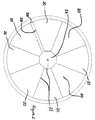
- FIG. 2 a possible interior floor plan of the building 2 is demonstrated, and it can be seen that the floor is divided into a plurality of trapezoidally shaped stalls 20 which are arranged adjacent one another and defined within stall sections 22 which are bolted or otherwise secured to the floor of the building.
- the stall sections 22 are further arranged so as to define a central space 24 within the centre of the building, and this central area 24 may be seen as a distribution, or collection, area for cattle entering the building from the perimeter 26, passing along a cattle race 28 and emerging at the interior end of said cattle race into said central area 24, whereupon said cattle may be distributed into the various surrounding stalls 20.
- the central area 24 can be used as a collecting area for cattle leaving the stall areas when opened.
- the cattle can either leave the building via a race or pass into a further handling area 20' in the building or into the stalls.
- the stall sections 22, at least where they define the central region 24, may be provided with a gate or door or the like which can be opened to allow the entry and exit of cattle to the stall 20, and closed to prevent the escape of cattle from said stalls.
- Cattle screening and the like may also be incorporated into the stall dividers 22.
- the broken line 38 indicates the periphery of the roof and indicates that the same overhangs the floor.
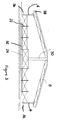
- FIG. 3 there is shown a schematic sectional view of the building, and it can be seen from this figure that a central king post 30 may be employed to act as a support for the roof structure 8, which in this drawing is shown as a lightweight steel frame, which nevertheless may be hoisted vertically along the kingpost as a unitary structure during the construction of the building and secured atop the king post 30, and the perimeter stanchions 4 move to the vertical position shown. It can also be seen from this figure that the central area 24 of the building is defined peripherally of the king post 30 and around its perimeter by the stall sections 22 which are bolted to the floor 32 as required.
- trough means 36 into which a farmer may deposit feed or other like comestibles for consumption by the animals housed within the stalls 20 when the selectively openable means 16 in the wall panel 6 is open adjacent one or more of the particular stalls. When this occurs, animals housed within the stall can lean outwardly of the building and reach into the trough in which the feed is deposited.
- FIG 4 there is shown a proposed roof structure construction wherein the roof 8 consists of a plurality of triangular panels of canvas material which may be hoisted into place atop the king post 30.
- the fabric from which such a roof construction may be manufactured may be a canvas type material mounted in rails provided on the beams, and that the supporting structure underneath (or above, in the case where the roof is suspended) may comprise a series of lightweight beams 16 secured between the perimeter stanchions and the king post 30 as hereinbefore described.
- a series of support struts are provided as required between the adjacent beams. To erect the same the first ends of the beams are mounted on a support on the king post and movable in relation thereto. The support can then be hydraulically powered up the king post to the raised position shown in Figure 5.
- Figure 5 illustrates a perspective view of the structure 2 in accordance with the invention and illustrates the components as herein described and how they interact when under the roof material (not shown). If the building is to be used for storage of materials rather than animals some, or all, of the divisions 22 can be removed, and the wall structure made more substantial.
- handling gates can be mounted in the central area 24 to allow the livestock to be moved into and out of the central area 24 with minimal risk of injuring the handlers.
- the gates can be mounted to rotate around the kingpin.
Landscapes
- Life Sciences & Earth Sciences (AREA)
- Environmental Sciences (AREA)
- Zoology (AREA)
- Animal Husbandry (AREA)
- Biodiversity & Conservation Biology (AREA)
- Building Environments (AREA)
- Housing For Livestock And Birds (AREA)
- Pretreatment Of Seeds And Plants (AREA)
- Agricultural Chemicals And Associated Chemicals (AREA)
- Catching Or Destruction (AREA)
- Buildings Adapted To Withstand Abnormal External Influences (AREA)
Applications Claiming Priority (2)
| Application Number | Priority Date | Filing Date | Title |
|---|---|---|---|
| GBGB0215121.5A GB0215121D0 (en) | 2002-06-29 | 2002-06-29 | Agricultural building |
| GB2151215 | 2003-06-29 |
Publications (3)
| Publication Number | Publication Date |
|---|---|
| EP1493330A2 true EP1493330A2 (de) | 2005-01-05 |
| EP1493330A3 EP1493330A3 (de) | 2005-05-25 |
| EP1493330B1 EP1493330B1 (de) | 2009-12-23 |
Family
ID=9939573
Family Applications (1)
| Application Number | Title | Priority Date | Filing Date |
|---|---|---|---|
| EP03254151A Expired - Lifetime EP1493330B1 (de) | 2002-06-29 | 2003-06-30 | Landwirtschaftliches Gebäude |
Country Status (5)
| Country | Link |
|---|---|
| EP (1) | EP1493330B1 (de) |
| AT (1) | ATE452533T1 (de) |
| DE (1) | DE60330654D1 (de) |
| DK (1) | DK1493330T3 (de) |
| GB (1) | GB0215121D0 (de) |
Cited By (1)
| Publication number | Priority date | Publication date | Assignee | Title |
|---|---|---|---|---|
| CN110720396A (zh) * | 2019-09-18 | 2020-01-24 | 河南牧业经济学院 | 一种环形牛舍 |
Citations (1)
| Publication number | Priority date | Publication date | Assignee | Title |
|---|---|---|---|---|
| DE20021109U1 (de) | 2000-12-13 | 2001-04-19 | Langhoff, Wiebke, 45134 Essen | Landwirtschaftliches Gebäude |
Family Cites Families (6)
| Publication number | Priority date | Publication date | Assignee | Title |
|---|---|---|---|---|
| GB401964A (en) * | 1933-04-10 | 1933-11-23 | Donald Gunn Munro | A shed or shelter for cattle |
| US2704995A (en) * | 1954-01-22 | 1955-03-29 | Smith Corp A O | Self-feeding storage structure |
| US3919976A (en) * | 1974-07-10 | 1975-11-18 | Clarence J Meyer | Livestock enclosure |
| AU556275B2 (en) * | 1984-11-29 | 1986-10-30 | High Accolade Limited | Post-tensioned steel frames and erection of such |
| JPH10262479A (ja) * | 1997-03-21 | 1998-10-06 | Norihisa Matsuoka | 有機廃棄物を利用した複合農産施設 |
| US6532701B2 (en) * | 2000-09-25 | 2003-03-18 | Robert Edward Williams | Shelter system of clustered modular enclosures |
-
2002
- 2002-06-29 GB GBGB0215121.5A patent/GB0215121D0/en not_active Ceased
-
2003
- 2003-06-30 DK DK03254151.8T patent/DK1493330T3/da active
- 2003-06-30 AT AT03254151T patent/ATE452533T1/de not_active IP Right Cessation
- 2003-06-30 EP EP03254151A patent/EP1493330B1/de not_active Expired - Lifetime
- 2003-06-30 DE DE60330654T patent/DE60330654D1/de not_active Expired - Lifetime
Patent Citations (1)
| Publication number | Priority date | Publication date | Assignee | Title |
|---|---|---|---|---|
| DE20021109U1 (de) | 2000-12-13 | 2001-04-19 | Langhoff, Wiebke, 45134 Essen | Landwirtschaftliches Gebäude |
Cited By (1)
| Publication number | Priority date | Publication date | Assignee | Title |
|---|---|---|---|---|
| CN110720396A (zh) * | 2019-09-18 | 2020-01-24 | 河南牧业经济学院 | 一种环形牛舍 |
Also Published As
| Publication number | Publication date |
|---|---|
| DE60330654D1 (de) | 2010-02-04 |
| DK1493330T3 (da) | 2010-04-26 |
| EP1493330B1 (de) | 2009-12-23 |
| GB0215121D0 (en) | 2002-08-07 |
| EP1493330A3 (de) | 2005-05-25 |
| ATE452533T1 (de) | 2010-01-15 |
Similar Documents
| Publication | Publication Date | Title |
|---|---|---|
| US8065976B1 (en) | Cattle feeding system and shelter to create a controlled environment within the thermal neutral zone | |
| US7074124B2 (en) | Ventilation system | |
| US3545407A (en) | Animal pen | |
| EP2959772A2 (de) | Voliere | |
| US7036455B2 (en) | Animal feeding device and facility for housing the same | |
| CA3042051A1 (en) | Apparatus for climate controlled housing for hydroponic grow rooms | |
| US20070068094A1 (en) | Movable outdoor shelters | |
| DE102011101089A1 (de) | Schweinestall | |
| US6014948A (en) | Protective structure for shading and cooling dairy cows | |
| EP1493330B1 (de) | Landwirtschaftliches Gebäude | |
| RU2053657C1 (ru) | Загон для скота | |
| US4222347A (en) | Animal shelter for large-scale feedlot operations | |
| US6571739B2 (en) | Aviary | |
| US6637369B1 (en) | Covered livestock feeder for field use | |
| US7536976B1 (en) | Cattle feeding system and shelter to create a controlled environment | |
| US20030009955A1 (en) | Clear span building structure | |
| US11771052B2 (en) | Portable pop-up pet pen | |
| WO1990007872A1 (en) | A pigpen unit | |
| US4077359A (en) | Stable structure for cattle self-feeding and open air pen cattle breeding | |
| GB2179232A (en) | Housing structure | |
| US3815548A (en) | Structural support apparatus | |
| Soehnlen | Analysis of Modern Barn Design | |
| DE3131017A1 (de) | Universale kaefigbatterie | |
| CZ2019741A3 (cs) | Zastřešení stájového objektu | |
| AU2006220442A1 (en) | Covered Structure |
Legal Events
| Date | Code | Title | Description |
|---|---|---|---|
| PUAI | Public reference made under article 153(3) epc to a published international application that has entered the european phase |
Free format text: ORIGINAL CODE: 0009012 |
|
| AK | Designated contracting states |
Kind code of ref document: A2 Designated state(s): AT BE BG CH CY CZ DE DK EE ES FI FR GB GR HU IE IT LI LU MC NL PT RO SE SI SK TR |
|
| AX | Request for extension of the european patent |
Extension state: AL LT LV MK |
|
| PUAL | Search report despatched |
Free format text: ORIGINAL CODE: 0009013 |
|
| RIC1 | Information provided on ipc code assigned before grant |
Ipc: 7A 01K 1/00 A Ipc: 7E 04B 1/35 B |
|
| AK | Designated contracting states |
Kind code of ref document: A3 Designated state(s): AT BE BG CH CY CZ DE DK EE ES FI FR GB GR HU IE IT LI LU MC NL PT RO SE SI SK TR |
|
| AX | Request for extension of the european patent |
Extension state: AL LT LV MK |
|
| 17P | Request for examination filed |
Effective date: 20051121 |
|
| AKX | Designation fees paid |
Designated state(s): AT BE BG CH CY CZ DE DK EE ES FI FR GB GR HU IE IT LI LU MC NL PT RO SE SI SK TR |
|
| GRAP | Despatch of communication of intention to grant a patent |
Free format text: ORIGINAL CODE: EPIDOSNIGR1 |
|
| GRAS | Grant fee paid |
Free format text: ORIGINAL CODE: EPIDOSNIGR3 |
|
| GRAA | (expected) grant |
Free format text: ORIGINAL CODE: 0009210 |
|
| AK | Designated contracting states |
Kind code of ref document: B1 Designated state(s): AT BE BG CH CY CZ DE DK EE ES FI FR GB GR HU IE IT LI LU MC NL PT RO SE SI SK TR |
|
| REG | Reference to a national code |
Ref country code: GB Ref legal event code: FG4D |
|
| REG | Reference to a national code |
Ref country code: CH Ref legal event code: EP |
|
| REG | Reference to a national code |
Ref country code: IE Ref legal event code: FG4D |
|
| REF | Corresponds to: |
Ref document number: 60330654 Country of ref document: DE Date of ref document: 20100204 Kind code of ref document: P |
|
| REG | Reference to a national code |
Ref country code: DK Ref legal event code: T3 |
|
| PG25 | Lapsed in a contracting state [announced via postgrant information from national office to epo] |
Ref country code: SE Free format text: LAPSE BECAUSE OF FAILURE TO SUBMIT A TRANSLATION OF THE DESCRIPTION OR TO PAY THE FEE WITHIN THE PRESCRIBED TIME-LIMIT Effective date: 20091223 Ref country code: FI Free format text: LAPSE BECAUSE OF FAILURE TO SUBMIT A TRANSLATION OF THE DESCRIPTION OR TO PAY THE FEE WITHIN THE PRESCRIBED TIME-LIMIT Effective date: 20091223 |
|
| PG25 | Lapsed in a contracting state [announced via postgrant information from national office to epo] |
Ref country code: SI Free format text: LAPSE BECAUSE OF FAILURE TO SUBMIT A TRANSLATION OF THE DESCRIPTION OR TO PAY THE FEE WITHIN THE PRESCRIBED TIME-LIMIT Effective date: 20091223 |
|
| PG25 | Lapsed in a contracting state [announced via postgrant information from national office to epo] |
Ref country code: AT Free format text: LAPSE BECAUSE OF FAILURE TO SUBMIT A TRANSLATION OF THE DESCRIPTION OR TO PAY THE FEE WITHIN THE PRESCRIBED TIME-LIMIT Effective date: 20091223 |
|
| PG25 | Lapsed in a contracting state [announced via postgrant information from national office to epo] |
Ref country code: BG Free format text: LAPSE BECAUSE OF FAILURE TO SUBMIT A TRANSLATION OF THE DESCRIPTION OR TO PAY THE FEE WITHIN THE PRESCRIBED TIME-LIMIT Effective date: 20100323 Ref country code: ES Free format text: LAPSE BECAUSE OF FAILURE TO SUBMIT A TRANSLATION OF THE DESCRIPTION OR TO PAY THE FEE WITHIN THE PRESCRIBED TIME-LIMIT Effective date: 20100403 Ref country code: EE Free format text: LAPSE BECAUSE OF FAILURE TO SUBMIT A TRANSLATION OF THE DESCRIPTION OR TO PAY THE FEE WITHIN THE PRESCRIBED TIME-LIMIT Effective date: 20091223 Ref country code: RO Free format text: LAPSE BECAUSE OF FAILURE TO SUBMIT A TRANSLATION OF THE DESCRIPTION OR TO PAY THE FEE WITHIN THE PRESCRIBED TIME-LIMIT Effective date: 20091223 Ref country code: PT Free format text: LAPSE BECAUSE OF FAILURE TO SUBMIT A TRANSLATION OF THE DESCRIPTION OR TO PAY THE FEE WITHIN THE PRESCRIBED TIME-LIMIT Effective date: 20100423 |
|
| PG25 | Lapsed in a contracting state [announced via postgrant information from national office to epo] |
Ref country code: CZ Free format text: LAPSE BECAUSE OF FAILURE TO SUBMIT A TRANSLATION OF THE DESCRIPTION OR TO PAY THE FEE WITHIN THE PRESCRIBED TIME-LIMIT Effective date: 20091223 Ref country code: SK Free format text: LAPSE BECAUSE OF FAILURE TO SUBMIT A TRANSLATION OF THE DESCRIPTION OR TO PAY THE FEE WITHIN THE PRESCRIBED TIME-LIMIT Effective date: 20091223 |
|
| PG25 | Lapsed in a contracting state [announced via postgrant information from national office to epo] |
Ref country code: CY Free format text: LAPSE BECAUSE OF FAILURE TO SUBMIT A TRANSLATION OF THE DESCRIPTION OR TO PAY THE FEE WITHIN THE PRESCRIBED TIME-LIMIT Effective date: 20091223 Ref country code: GR Free format text: LAPSE BECAUSE OF FAILURE TO SUBMIT A TRANSLATION OF THE DESCRIPTION OR TO PAY THE FEE WITHIN THE PRESCRIBED TIME-LIMIT Effective date: 20100324 |
|
| PLBE | No opposition filed within time limit |
Free format text: ORIGINAL CODE: 0009261 |
|
| STAA | Information on the status of an ep patent application or granted ep patent |
Free format text: STATUS: NO OPPOSITION FILED WITHIN TIME LIMIT |
|
| 26N | No opposition filed |
Effective date: 20100924 |
|
| PG25 | Lapsed in a contracting state [announced via postgrant information from national office to epo] |
Ref country code: MC Free format text: LAPSE BECAUSE OF NON-PAYMENT OF DUE FEES Effective date: 20100630 |
|
| REG | Reference to a national code |
Ref country code: CH Ref legal event code: PL |
|
| PG25 | Lapsed in a contracting state [announced via postgrant information from national office to epo] |
Ref country code: IT Free format text: LAPSE BECAUSE OF FAILURE TO SUBMIT A TRANSLATION OF THE DESCRIPTION OR TO PAY THE FEE WITHIN THE PRESCRIBED TIME-LIMIT Effective date: 20091223 |
|
| PG25 | Lapsed in a contracting state [announced via postgrant information from national office to epo] |
Ref country code: CH Free format text: LAPSE BECAUSE OF NON-PAYMENT OF DUE FEES Effective date: 20100630 Ref country code: LI Free format text: LAPSE BECAUSE OF NON-PAYMENT OF DUE FEES Effective date: 20100630 |
|
| PG25 | Lapsed in a contracting state [announced via postgrant information from national office to epo] |
Ref country code: LU Free format text: LAPSE BECAUSE OF NON-PAYMENT OF DUE FEES Effective date: 20100630 Ref country code: HU Free format text: LAPSE BECAUSE OF FAILURE TO SUBMIT A TRANSLATION OF THE DESCRIPTION OR TO PAY THE FEE WITHIN THE PRESCRIBED TIME-LIMIT Effective date: 20100624 |
|
| PG25 | Lapsed in a contracting state [announced via postgrant information from national office to epo] |
Ref country code: TR Free format text: LAPSE BECAUSE OF FAILURE TO SUBMIT A TRANSLATION OF THE DESCRIPTION OR TO PAY THE FEE WITHIN THE PRESCRIBED TIME-LIMIT Effective date: 20091223 |
|
| REG | Reference to a national code |
Ref country code: FR Ref legal event code: PLFP Year of fee payment: 14 |
|
| REG | Reference to a national code |
Ref country code: DE Ref legal event code: R081 Ref document number: 60330654 Country of ref document: DE Owner name: ID VENTURE B. V., NL Free format text: FORMER OWNER: SIMPSON & ALLINSON LTD., BARNARD CASTLE, DURHAM, GB |
|
| REG | Reference to a national code |
Ref country code: FR Ref legal event code: TP Owner name: ID VENTURE B.V., NL Effective date: 20160721 |
|
| REG | Reference to a national code |
Ref country code: NL Ref legal event code: PD Owner name: ID VENTURE B.V.; NL Free format text: DETAILS ASSIGNMENT: VERANDERING VAN EIGENAAR(S), OVERDRACHT; FORMER OWNER NAME: SIMPSON & ALLINSON LIMITED Effective date: 20160720 |
|
| REG | Reference to a national code |
Ref country code: GB Ref legal event code: 732E Free format text: REGISTERED BETWEEN 20161020 AND 20161026 |
|
| REG | Reference to a national code |
Ref country code: FR Ref legal event code: PLFP Year of fee payment: 15 |
|
| REG | Reference to a national code |
Ref country code: FR Ref legal event code: PLFP Year of fee payment: 16 |
|
| PGFP | Annual fee paid to national office [announced via postgrant information from national office to epo] |
Ref country code: NL Payment date: 20220401 Year of fee payment: 20 |
|
| PGFP | Annual fee paid to national office [announced via postgrant information from national office to epo] |
Ref country code: IE Payment date: 20220406 Year of fee payment: 20 Ref country code: GB Payment date: 20220401 Year of fee payment: 20 Ref country code: FR Payment date: 20220406 Year of fee payment: 20 Ref country code: DK Payment date: 20220408 Year of fee payment: 20 Ref country code: DE Payment date: 20220401 Year of fee payment: 20 |
|
| PGFP | Annual fee paid to national office [announced via postgrant information from national office to epo] |
Ref country code: BE Payment date: 20220401 Year of fee payment: 20 |
|
| REG | Reference to a national code |
Ref country code: DE Ref legal event code: R071 Ref document number: 60330654 Country of ref document: DE |
|
| REG | Reference to a national code |
Ref country code: DK Ref legal event code: EUP Expiry date: 20230630 |
|
| REG | Reference to a national code |
Ref country code: NL Ref legal event code: MK Effective date: 20230629 |
|
| REG | Reference to a national code |
Ref country code: BE Ref legal event code: MK Effective date: 20230630 |
|
| REG | Reference to a national code |
Ref country code: GB Ref legal event code: PE20 Expiry date: 20230629 |
|
| REG | Reference to a national code |
Ref country code: IE Ref legal event code: MK9A |
|
| PG25 | Lapsed in a contracting state [announced via postgrant information from national office to epo] |
Ref country code: IE Free format text: LAPSE BECAUSE OF EXPIRATION OF PROTECTION Effective date: 20230630 Ref country code: GB Free format text: LAPSE BECAUSE OF EXPIRATION OF PROTECTION Effective date: 20230629 |