EP1493399A1 - Enossales Implantat - Google Patents
Enossales Implantat Download PDFInfo
- Publication number
- EP1493399A1 EP1493399A1 EP03077039A EP03077039A EP1493399A1 EP 1493399 A1 EP1493399 A1 EP 1493399A1 EP 03077039 A EP03077039 A EP 03077039A EP 03077039 A EP03077039 A EP 03077039A EP 1493399 A1 EP1493399 A1 EP 1493399A1
- Authority
- EP
- European Patent Office
- Prior art keywords
- intra
- osseous
- implant
- implant according
- screw thread
- Prior art date
- Legal status (The legal status is an assumption and is not a legal conclusion. Google has not performed a legal analysis and makes no representation as to the accuracy of the status listed.)
- Withdrawn
Links
- 239000007943 implant Substances 0.000 title claims abstract description 169
- 210000000988 bone and bone Anatomy 0.000 claims abstract description 36
- 239000000463 material Substances 0.000 claims abstract description 5
- 241001465754 Metazoa Species 0.000 claims abstract description 3
- 239000004053 dental implant Substances 0.000 claims description 14
- 230000014759 maintenance of location Effects 0.000 description 19
- 238000001356 surgical procedure Methods 0.000 description 11
- 238000003780 insertion Methods 0.000 description 9
- 230000037431 insertion Effects 0.000 description 9
- 238000002360 preparation method Methods 0.000 description 7
- 241000251730 Chondrichthyes Species 0.000 description 4
- 210000001519 tissue Anatomy 0.000 description 4
- 230000007704 transition Effects 0.000 description 4
- 230000001055 chewing effect Effects 0.000 description 3
- 238000000034 method Methods 0.000 description 3
- 238000003801 milling Methods 0.000 description 3
- 206010065687 Bone loss Diseases 0.000 description 2
- 230000009471 action Effects 0.000 description 2
- 230000008901 benefit Effects 0.000 description 2
- 210000001145 finger joint Anatomy 0.000 description 2
- 238000003754 machining Methods 0.000 description 2
- 238000010079 rubber tapping Methods 0.000 description 2
- 210000001226 toe joint Anatomy 0.000 description 2
- 238000004804 winding Methods 0.000 description 2
- 229910001069 Ti alloy Inorganic materials 0.000 description 1
- RTAQQCXQSZGOHL-UHFFFAOYSA-N Titanium Chemical compound [Ti] RTAQQCXQSZGOHL-UHFFFAOYSA-N 0.000 description 1
- 238000009412 basement excavation Methods 0.000 description 1
- 210000003679 cervix uteri Anatomy 0.000 description 1
- 238000010276 construction Methods 0.000 description 1
- 230000002349 favourable effect Effects 0.000 description 1
- 230000036541 health Effects 0.000 description 1
- 230000010354 integration Effects 0.000 description 1
- 229910052751 metal Inorganic materials 0.000 description 1
- 239000002184 metal Substances 0.000 description 1
- 239000010936 titanium Substances 0.000 description 1
- 229910052719 titanium Inorganic materials 0.000 description 1
- 210000003371 toe Anatomy 0.000 description 1
Images





Classifications
-
- A—HUMAN NECESSITIES
- A61—MEDICAL OR VETERINARY SCIENCE; HYGIENE
- A61C—DENTISTRY; APPARATUS OR METHODS FOR ORAL OR DENTAL HYGIENE
- A61C8/00—Means to be fixed to the jaw-bone for consolidating natural teeth or for fixing dental prostheses thereon; Dental implants; Implanting tools
- A61C8/0018—Means to be fixed to the jaw-bone for consolidating natural teeth or for fixing dental prostheses thereon; Dental implants; Implanting tools characterised by the shape
- A61C8/0022—Self-screwing
- A61C8/0025—Self-screwing with multiple threads
-
- A—HUMAN NECESSITIES
- A61—MEDICAL OR VETERINARY SCIENCE; HYGIENE
- A61B—DIAGNOSIS; SURGERY; IDENTIFICATION
- A61B17/00—Surgical instruments, devices or methods
- A61B17/56—Surgical instruments or methods for treatment of bones or joints; Devices specially adapted therefor
- A61B17/58—Surgical instruments or methods for treatment of bones or joints; Devices specially adapted therefor for osteosynthesis, e.g. bone plates, screws or setting implements
- A61B17/68—Internal fixation devices, including fasteners and spinal fixators, even if a part thereof projects from the skin
- A61B17/84—Fasteners therefor or fasteners being internal fixation devices
- A61B17/86—Pins or screws or threaded wires; nuts therefor
- A61B17/8625—Shanks, i.e. parts contacting bone tissue
-
- A—HUMAN NECESSITIES
- A61—MEDICAL OR VETERINARY SCIENCE; HYGIENE
- A61B—DIAGNOSIS; SURGERY; IDENTIFICATION
- A61B17/00—Surgical instruments, devices or methods
- A61B17/56—Surgical instruments or methods for treatment of bones or joints; Devices specially adapted therefor
- A61B17/58—Surgical instruments or methods for treatment of bones or joints; Devices specially adapted therefor for osteosynthesis, e.g. bone plates, screws or setting implements
- A61B17/68—Internal fixation devices, including fasteners and spinal fixators, even if a part thereof projects from the skin
- A61B17/84—Fasteners therefor or fasteners being internal fixation devices
- A61B17/86—Pins or screws or threaded wires; nuts therefor
- A61B17/8625—Shanks, i.e. parts contacting bone tissue
- A61B17/863—Shanks, i.e. parts contacting bone tissue with thread interrupted or changing its form along shank, other than constant taper
-
- A—HUMAN NECESSITIES
- A61—MEDICAL OR VETERINARY SCIENCE; HYGIENE
- A61C—DENTISTRY; APPARATUS OR METHODS FOR ORAL OR DENTAL HYGIENE
- A61C8/00—Means to be fixed to the jaw-bone for consolidating natural teeth or for fixing dental prostheses thereon; Dental implants; Implanting tools
- A61C8/0018—Means to be fixed to the jaw-bone for consolidating natural teeth or for fixing dental prostheses thereon; Dental implants; Implanting tools characterised by the shape
- A61C8/0022—Self-screwing
-
- A—HUMAN NECESSITIES
- A61—MEDICAL OR VETERINARY SCIENCE; HYGIENE
- A61C—DENTISTRY; APPARATUS OR METHODS FOR ORAL OR DENTAL HYGIENE
- A61C8/00—Means to be fixed to the jaw-bone for consolidating natural teeth or for fixing dental prostheses thereon; Dental implants; Implanting tools
- A61C8/0018—Means to be fixed to the jaw-bone for consolidating natural teeth or for fixing dental prostheses thereon; Dental implants; Implanting tools characterised by the shape
- A61C8/0037—Details of the shape
Definitions
- the invention relates to an intra-osseous implant for placement in bone of a human or animal body comprising at least one intra-osseous part intended for placement in said bone tissue having an apical side and a (head or connection or mounting) cervical side and composed of a body friendly material, which part is provided on its circumferential surface with a thread running in the direction of the apical end; and a support part present at said cervical or head side of said at least one intra-osseous part intended for supporting a prosthetic element.
- intra-osseous implants are frequently used for medical purposes, such as (hip-, knee- and finger-) joint prostheses and bone screws for traumatology. Also these intra-osseous implants are used as dental implants in dentistry and oral and maxillofacial surgery.
- Dental implants can be placed in the bone after implant bed preparation with one or more drills. After a certain integration period they can be loaded, for example by chewing.
- the prosthetic parts will provide the patients with essential functions like chewing ability, speech, appearance and self-esteem.
- the threaded dental implants excludes an asymmetric implant design (e.g. angled or bevelled or scalloped), since the critical position of the implant clashes with the intended implant placement depth.
- an asymmetric implant design e.g. angled or bevelled or scalloped
- the screw thread provides the implant of a good retention, it limits on the other hand the depth accuracy of the placed implant.
- the pitch of the screw thread defines the depth positioning of an implant.
- a large pitch allows a quick insertion procedure, but the depth positioning towards the surrounding bone and the next structures is less accurate.
- a screw thread having a small pitch allows an accurate implant position, but offers less primary implant stability and a time consuming surgical procedure.
- Rotation asymmetric implants benefit in this respect from a cylinder design, since the implant is tapped or pushed into its desired position, after the implant bed is prepared the appropriate drills. This is a very fast surgical procedure. However the retention of the implant towards the surrounding bone is limited, especially if the bone is of a non-dense (weak) structure.
- cylindrical implants have a better position ability than screw implants, but the primary stability is lower. This observation is not only applicable for implant dentistry, but also for medical indications.
- the invention aims to provide a medical intra-osseous implant and especially a dental intra-osseous implant, which allows an accurate implant position at a desired depth into bone tissue, without losing a high degree of primary implant stability. Also the proposed implant design will allow a short surgical procedure with an improved suture of bone tissue to the implant as well as providing an intra-osseous implant having a strong anti-rotation characteristic.
- the intra-osseous implant is characterized in that the intra-osseous part is provided with one or more grooves extending in longitudinal direction and interrupting the screw thread.
- the presence of one or more groove-like interruptions of the screw thread allows a quick and accurate placement of the implant into the bone, without the necessity to screw the implant into its proper position.
- the implant can merely be tapped or pushed into its proper position significantly reducing the time of the surgical procedure.
- the remaining thread parts on the intra-osseous implant surface function as retention elements (like shark teeth) exerting vertical and rotational retention forces on the surrounding bone tissue. This ensures a proper primary implant stability of the intra-osseous implant according to the invention.
- the remaining thread parts still form a (though interrupted) screw thread, so that the implant can also be (re)positioned by means of screw (rotation) action.
- the interrupted screw thread also allows removal of an implant that has just been inserted, but intra-operatively regarded as not properly positioned.
- the implant invention combines the advantages of a fast surgical procedure and an accurate placement and positioning of the intra-osseous implant. Also it provides the implant of a good primary stability and a high retention against vertical and rotational forces.
- the groove extends over the entire length of the intra-osseous part of the implant, wherein the depth of the groove can be smaller, equal or greater than the height of the screw thread.
- the width of the groove varies in the direction of the apical side of said intra-osseous part and more in particular widens.
- the depth of the groove may vary in the direction of the apical side of said intra-osseous part and more in particular becomes larger, or the height of the screw thread may vary in the direction of the apical side of said intra-osseous part and more in particular becomes smaller.
- the intra-osseous part comprises multiple grooves.
- a better stability of the implant according to the invention is acquired due to the longitudinal grooves, which are present in an equidistant manner in the surface of the intra-osseous part of the implant.
- the intra-osseous part has a cylindrical cross section.
- the intra-osseous part may have a near cylindrical cross section, for example a conical, elipsonal, oval cross section.
- the intra-osseous part may exhibit a polygonal cross section, for example a pentagon or hexagonal or heptagon or octagonal cross section.
- a further improved insertion of the implant according to the invention is obtained as the intra-osseous part becomes smaller in the apical direction.
- the intra-osseous part of the implant may have a conical shape or be narrower towards the apex of the implant.
- the support part is positioned under an angle on said intra-osseous part with respect to the direction of implant.
- the intra-osseous implant is intended as a dental implant, where the shape is adapted to the shape of the alveolar crest.
- the shoulder of the implant that is the circumferential edge of the support (or connection) part will not be rotation symmetric. It may be scalloped, bevelled or angled to accommodate the bony contours of the jawbone. In this manner the implant shape will allow proper aesthetics in the regions of aesthetic relevance (mainly the frontal teeth in the upper jaw).
- the shape of the natural tooth is such that the crown on the buccal (lip- or cheek- or out-) side (and palatal or oral side), extends further to the apex (towards the end of the implant) than on the interproximal sides.
- the rotation symmetric design of the implant does not allow a crown margin that follows these contours.
- the result is that the crown is buccally not deep enough and interproximally too deep in to the tissues.
- the first aspect is negative for the aesthetic appearance (it is less beautiful, sometimes showing implant metal).
- the second may impair the hygienic possibilities and may lead to peri-implant bone loss.
- the present dental implants are usually of a straight design.
- the shape of a natural tooth shows a small angle between the root and the crown of the tooth, in a specific embodiment the support part is positioned under an angle on said intra-osseous part with respect to the direction of implant.
- the implant invention allows the implant to be of an angled design, thus dealing with anatomical requirements of the jaws and teeth.
- intra-osseous implant designs which are meant to be used as dental implants.
- the invention is, depending on the indication and medical application as well as the surgical treatment, not limited to only dental implant, but also applicable to other bone implants or bone screws or bone nails.
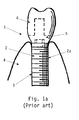
- Figures 1a-1c disclose conventional dental implants 1 according to the state of the art having an elongated shape and manufactured of a tissue friendly material, such as titanium or a titanium alloy.
- the implant 1 has a root part also called an intra-osseous part 2, which is meant to be placed in an implant bed preparation 3 in the jaw bone 4.
- the intra-osseous implant 1 also has a support connection or mounting part 5, which usually is utilised to insert the implant with.
- the support part 5 is also used to support and mount or connect the prosthetic device 6 (supra-structure, e.g. crown, bridge or over denture) at a later stage.
- An essential factor in implant dentistry is the accurate depth of the intra-osseous implant 1 into the bone 4 during placement.
- An accurate depth in implant placement has a significant aesthetic relevance, but is also of importance for a good oral hygiene and peri-implant health. Disregarding the rules of the biologic width (in the event an implant is placed too deeply) will lead to bone loss. On the other hand, if the implant is not placed deeply enough, the aesthetic result will be disappointing (visible crown margin or implant shoulder).
- FIG. 1a and 1b An accurate placement of implants can be achieved by using cylindrical implants as shown in Figures 1a and 1b.
- Such cylindrical implants 1 allow a quick and accurate placement of the implant into the bone 4, but the cylindrically shaped intra-osseous part 2 provides a less primary stability in the implant bed preparation 3 than with a screw implant.
- a well-known intra-osseous implant 1b has an intra-osseous part 2 with a hollow cylinder design provided with lateral perforations 7 to increase ingrowth of bone tissue.
- FIG. 1c Another well known implant design 1c shows an intra-osseous part 2 with a screw thread 8 provided in its circumferential surface 2a.
- the screw thread 8 provides the implant 1 with a high primary stability at implant placement. It also guarantees an increased implant-bone contact surface and allows the implant to be loaded (e.g. by chewing) at an earlier stage after the implant procedure.
- a disadvantage of a screw thread 8 present in the circumferential surface 2a of the intra-osseous part 2 of the implant 1 is that the limited accuracy in depth positioning is limited even if the implant is not rotation symmetric (scalloped or bevelled or angled).
- a screw thread 8 with a large pitch will permit a quick implant placement, but involves minor accuracy as to the depth positioning of the implant with respect to the surrounding bone tissue.
- a screw thread 8 with a smaller pitch allows a more accurate depth positioning, however such design requires in turn a more time consuming surgery procedure and in extreme cases less primary stability of the implant due to the smaller thread.
- the invention aims to avoid above mentioned drawbacks and design an implant that allows a swift and accurate implant placement, providing a high degree of (primary) implant stability.
- the intra-osseous implant 10 as shown in Figure 2 consists of an elongated intra-osseous part 12 of a tissue friendly material and a support or connection part 15 intended for implant insertion and acting as a support or mounting area for a prosthetic device 6 (a supra-structure, e.g. crown, bridge or over denture) at a later stage.
- a prosthetic device 6 a supra-structure, e.g. crown, bridge or over denture
- the intra-osseous part 12 of the implant 10 carries on its surface 12a a screw thread 18 with a certain pitch.
- the intra-osseous part 12as shown in Figure 2 has on its circumferential surface 12a a screw thread 18, which thread 18 is interrupted by one or more longitudinal extending grooves 19a-19c.
- the presence of one or more grooves 19a-19c results in a screw thread 18, which is composed of several sections 18a-18d depending on the number of grooves 19a-19c.
- these grooves 19a-19c etc. are present in an equidistant manner in the surface 12a of the intra-osseous part 12 of the implant 10.
- the intra-osseous part 12 of the implant may preferably have a cylindrical cross-section.
- near cylindrical cross-sections like an elliptical, oval or conical cross-section are possible.
- intra-osseous implant according to the invention may have a polygonal cross-section, for example a squar or pentagonal or hexagonal or heptagonal or octagonal cross-section.
- the intra-osseous implant 10 is not only a screw implant, but can also be used as a cylinder implant.
- the cylindrical ground form allows a swift surgical procedure, since the screw action is not necessary.
- the screw parts 18a-18c etc. present on the circumferential surface 12a of the intra-osseous part 12 act as retention elements positioned side-by-side in a longitudinal manner.
- These retention elements function like shark teeth hooking on to the bone tissue 13 surrounding the implanted intra-osseous part 12. With these retention elements the implant 10 will have a good primary stability and a high retention against vertical and rotational forces.
- a symmetric or non-symmetric implant 10 can be properly (re)positioned in height (or depth) by turning the implant 10 in a screw motion.
- the interrupted screw thread parts 18a-18c etc. still function as a complete thread with a certain pitch, thus allowing to alter the desired insertion depth and to maintain primary stability.
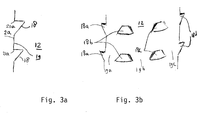
- Figures 3a and 3b show detailed views of the embodiment shown in Figure 2.
- the grooves 19a-19c etc. extend in longitudinal direction along the circumferential surface 12a of the intra-osseous part 12, in such a manner that the grooves 19a-19c more or less flatten the extending edge 21a-21c etc. of the thread 18a-18c etc.
- Each extended edge 21a-21c etc. of the thread 18 functions as a retention element towards the bone tissue 14 surrounding the intra-osseous part 12.
- a possibly wrongly inserted implant 10 can be removed using the interrupted screw thread 18a-18c etc., by simply unscrewing the implant using a proper and known tool after a certain initial resistance has been surpassed.
- each longitudinally extending groove 19a-19c etc is applied with a certain depth in the circumferential surface 12a of the intra-osseous part 12, whereby the thread 18 is locally completely removed.
- the remains of the interrupted thread 18 in this design form several rows 18a-18d etc. of thread parts, which encounter the surrounding bone as retention elements.
- This function guarantees a good stability of the implant in the (jaw-)bone, but also allows adjusting or removing a wrongly placed implant.
- the retention elements 18a-18d etc exhibit a sloping edge in the apical direction of the intra-osseous part 12 allowing an uninterrupted insertion, but preventing the removal of the implant by simply pulling. Removal is only possible by unscrewing the implant out of the implant preparation bed 13 in bone 14.
- the intra-osseous part 12 exhibits an apical end side 12b, which enters the implant preparation bed 13 first and a cervical end side 12c, which carries the support or connection part 15 intended for implant insertion and acting as a support or mounting area for a prosthetic device 6 (a supra-structure, e.g. crown, bridge or over denture).
- the surface 12a shows a thread 18, which according to the invention shows several longitudinal interruptions 19a-19c etc.
- the interrupted thread parts 18a-18c etc. act like retention elements placed on rows extending in longitudinal direction along the circumferential surface 12a of the intra-osseous part 12. Due to their configuration these retention elements function like shark teeth to hook into the surrounding bone tissue 14 as the profile of the thread exhibits a shallow slope towards the apical side 12b and a steep or even rectangular slope on the cervical side 12c. See also Figure 3a and 3b.
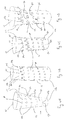
- FIG 4a an intra-osseous implant is shown having a conical or tapered form seen in the direction of the apex 12b, while Figure 4b shows a cross section of a cylindrical form.
- Figure 4c shows an embodiment with several grooves 19a-19c etc. extending over the entire longitudinal length of the intra-osseous part 12 having a constant width B between the interrupted rows of screw thread parts (retention elements) 18a-18c etc., whilst the width B' of grooves 19a-19c etc. increase towards the apex in the embodiment shown in Figure 4d.
- the intra-osseous part 12 exhibit smaller retention elements at the apex 12b than towards the cervix 12c.
- Figure 5a-5c show further different embodiments of an intra-osseous implant according to the invention, wherein the support or connection part (cervical part) 15 of the implant is positioned under an inclined angle ⁇ with respect to the implant axis x of the intra-osseous part 12.
- the angle ⁇ between the axis of the support part 15 and the implant axis x of the intra-osseous part 12 may be in the range e.g. of 10°-20° and approximately 15°.
- FIG. 5b and 5c disclose at least one bevel 23 on the circumferential edge or shoulder 22 of the cervical (support) part 15 of the implant 10.
- the bevel 23 shows a fluent or smooth transition 24 from the shoulder 22 of the implant towards the apical side 12b, whilst in Figure 5c the bevel 23 shows a clear and sharp transition angle 24.
- transition 24 of the bevel 23 exhibits a convex shape in Figure 5b, it will be apparent that also a concave transition 24 of the bevel 23 is applicable.
- the implant according to this invention is placed in such a manner that the bevel of the implant will be situated on the buccal side, so that good aesthetics can be achieved.
- Figures 6a-b show combinations of embodiments of intra-osseous implants already described above and show two different combinations of a conical implant according to Figure 4a and a cylindrical implant according to Figure 4b.
- other combinations are possible e.g. a squar, pentagonal, hexagonal, heptagonal or octagonal design combined with a cylindrical design.
- FIG. 7 shows another embodiment of the intra-osseous implant according to the invention to be used in finger or toe joint surgery.
- the implant 30 consists of two intra-osseous parts 31a and 31b and a joint 32.
- the intra-osseous parts 31a and 31b are placed in the digits of the fingers or toes.
- Each intra-osseous part 31a-31b is provided with a screw thread 18 resp. 18'.
- the screw threads 18-18' are interrupted by several grooves 19-19'. As was described above these interrupted thread parts 18-18' act like shark teeth, hooking into the surrounding bone.
- Both intra-osseous parts 31a-31b can be introduced into the finger- or toe-bone by simply using pressure or by tapping. Both intra-osseous parts 31a-31b are connected with a ball- or hinge-joint 32, in order to restore the normal finger- or toe-joint function.
- the invention may also be applicable to another type of intra-osseous implant: the "screw nail", which in fact exhibits an interrupted screw thread as well. It can be used as a screw but also as a cylinder.
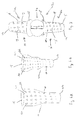
- Figures 8a-8e show several different types of cross sections of the intra-osseous part 12 of the proposed implant 10 according to the invention provided with grooves 19 interrupting the screw thread 18.
- Figure 8a the grooves 19 show a round shape leaving sharp and pointing thread edges 18", whilst Figure 8b shows flattened thread surfaces 18.
- Figure 8c shows a combination of narrow 19 and wider 19' grooves.
- the wide groove 19' can be used to mark the position of the bevel 23 on the support part 15. This construction makes orientation during implant placement more accurate and easy.
- Figure 8d shows flat grooves 19 with sharp thread edges 18, whereas Figure 8e shows trapezoid shaped thread profiles 18 due to a specific milling operation.
- the embodiment shown in Figure 9 exhibits an intra-osseous part 12 with a polygonal ground form, for example a hexagonal cross-section. However also an octagonal or other polygonal shapes can be used as ground form.
- a groove 40 is applied in the circumferential surface of the intra-osseous part 12, said groove extending in one or more (helical) windings 40a-40f along the circumferential surface.
- a screw thread 18 is created due to this milling or machining operation having flattened parts 19a-19b etc. and extending retention elements 18a-18b etc.
- the surface of the flattened parts 19a-19b coincide with the surface of the groove windings 40a-40f.
Landscapes
- Health & Medical Sciences (AREA)
- Orthopedic Medicine & Surgery (AREA)
- Life Sciences & Earth Sciences (AREA)
- Animal Behavior & Ethology (AREA)
- Veterinary Medicine (AREA)
- Public Health (AREA)
- General Health & Medical Sciences (AREA)
- Surgery (AREA)
- Oral & Maxillofacial Surgery (AREA)
- Dentistry (AREA)
- Epidemiology (AREA)
- Neurology (AREA)
- Biomedical Technology (AREA)
- Engineering & Computer Science (AREA)
- Nuclear Medicine, Radiotherapy & Molecular Imaging (AREA)
- Medical Informatics (AREA)
- Heart & Thoracic Surgery (AREA)
- Molecular Biology (AREA)
- Prostheses (AREA)
- Dental Prosthetics (AREA)
- Materials For Medical Uses (AREA)
- Dental Preparations (AREA)
Priority Applications (13)
| Application Number | Priority Date | Filing Date | Title |
|---|---|---|---|
| EP03077039A EP1493399A1 (de) | 2003-06-30 | 2003-06-30 | Enossales Implantat |
| US10/562,387 US8496478B2 (en) | 2003-06-30 | 2004-06-28 | Intra-osseous implant |
| JP2006518058A JP4417957B2 (ja) | 2003-06-30 | 2004-06-28 | 骨内インプラント |
| DK04740442T DK1638477T3 (da) | 2003-06-30 | 2004-06-28 | Intraossöst implantat |
| PT04740442T PT1638477E (pt) | 2003-06-30 | 2004-06-28 | Implante intra-ósseo |
| DE602004013315T DE602004013315T2 (de) | 2003-06-30 | 2004-06-28 | Enossales implantat |
| AT04740442T ATE392862T1 (de) | 2003-06-30 | 2004-06-28 | Enossales implantat |
| CN200480021720A CN100588377C (zh) | 2003-06-30 | 2004-06-28 | 骨内植入体 |
| ES04740442T ES2304160T3 (es) | 2003-06-30 | 2004-06-28 | Implante intraoseo. |
| HK07104913.9A HK1098333B (en) | 2003-06-30 | 2004-06-28 | Intra-osseous implant |
| PCT/EP2004/007058 WO2005002462A1 (en) | 2003-06-30 | 2004-06-28 | Intra-osseous implant |
| EP04740442A EP1638477B1 (de) | 2003-06-30 | 2004-06-28 | Enossales implantat |
| US13/928,710 US9572639B2 (en) | 2003-06-30 | 2013-06-27 | Intra-osseous implant |
Applications Claiming Priority (1)
| Application Number | Priority Date | Filing Date | Title |
|---|---|---|---|
| EP03077039A EP1493399A1 (de) | 2003-06-30 | 2003-06-30 | Enossales Implantat |
Publications (1)
| Publication Number | Publication Date |
|---|---|
| EP1493399A1 true EP1493399A1 (de) | 2005-01-05 |
Family
ID=33427148
Family Applications (2)
| Application Number | Title | Priority Date | Filing Date |
|---|---|---|---|
| EP03077039A Withdrawn EP1493399A1 (de) | 2003-06-30 | 2003-06-30 | Enossales Implantat |
| EP04740442A Expired - Lifetime EP1638477B1 (de) | 2003-06-30 | 2004-06-28 | Enossales implantat |
Family Applications After (1)
| Application Number | Title | Priority Date | Filing Date |
|---|---|---|---|
| EP04740442A Expired - Lifetime EP1638477B1 (de) | 2003-06-30 | 2004-06-28 | Enossales implantat |
Country Status (10)
| Country | Link |
|---|---|
| US (2) | US8496478B2 (de) |
| EP (2) | EP1493399A1 (de) |
| JP (1) | JP4417957B2 (de) |
| CN (1) | CN100588377C (de) |
| AT (1) | ATE392862T1 (de) |
| DE (1) | DE602004013315T2 (de) |
| DK (1) | DK1638477T3 (de) |
| ES (1) | ES2304160T3 (de) |
| PT (1) | PT1638477E (de) |
| WO (1) | WO2005002462A1 (de) |
Cited By (7)
| Publication number | Priority date | Publication date | Assignee | Title |
|---|---|---|---|---|
| WO2007060005A1 (de) * | 2005-11-27 | 2007-05-31 | Holger Zipprich | Kieferorthopädische verankerungsschraube |
| WO2011078877A1 (en) | 2009-12-11 | 2011-06-30 | Cortex Dental Implants Industries Ltd. | Winged implant |
| EP2219812A4 (de) * | 2007-11-19 | 2013-12-25 | Medical Facets Llc | Knochenschraube und herstellungsverfahren dafür |
| WO2014111432A1 (de) * | 2013-01-15 | 2014-07-24 | Zimmer Gmbh | Chirurgische knochenschraube sowie implantationssystem |
| US8828065B2 (en) | 2007-11-19 | 2014-09-09 | Medical Facets, Llc | Bone screw and method for manufacturing the same |
| EP3421007A1 (de) * | 2007-08-30 | 2019-01-02 | Zimmer Dental Inc. | Dentalimplantatsystem |
| US11963880B2 (en) | 2020-05-11 | 2024-04-23 | Gensano Llc | Cannulated bone implant |
Families Citing this family (20)
| Publication number | Priority date | Publication date | Assignee | Title |
|---|---|---|---|---|
| KR100919416B1 (ko) * | 2007-12-06 | 2009-09-29 | 오스템임플란트 주식회사 | 픽스츄어 |
| EP2224870B1 (de) | 2007-12-28 | 2013-05-22 | Synthes GmbH | Heft- oder antrriebsschraube zur fixierung einer prothese an einem knochen sowie entsprechendes instrument |
| DE102008054138B4 (de) * | 2008-10-31 | 2018-01-11 | Holger Zipprich | Dentalimplantat |
| WO2010090482A2 (ko) * | 2009-02-09 | 2010-08-12 | Lee Do Sang | 개량된 매식구성을 갖는 임플란트 픽스쳐 |
| ES2365090B1 (es) * | 2009-06-12 | 2012-06-15 | Carlos Fernando Cardona Labarga | Sistema de expansión interna/compresión externa para retención de pilares transepiteliales entre sí y a implantes o prótesis. |
| CN102648371A (zh) * | 2009-11-02 | 2012-08-22 | 德尼培股份有限公司 | 带中断螺纹的联接构件及制造方法 |
| EP2566413B1 (de) | 2010-05-05 | 2016-11-09 | Holger Zipprich | Dentalimplantat |
| DE102010021601A1 (de) * | 2010-05-26 | 2011-12-01 | Straumann Holding Ag | Analogimplantat |
| US11273015B2 (en) * | 2010-09-09 | 2022-03-15 | Hankookin, Inc. | Fabrication and installation of a dental implant |
| US10299895B2 (en) | 2010-09-09 | 2019-05-28 | Hankookin, LLC | Fabrication and installation of a dental implant |
| DE102010051176A1 (de) | 2010-11-15 | 2012-05-16 | Urs Brodbeck | Dental-Implantatsystem und Verfahren zur Herstellung eines Dental-Implantatsystems |
| DE102011009906A1 (de) | 2011-01-31 | 2012-08-02 | Holger Zipprich | Dental- Implantatsystem |
| EP2502600A1 (de) | 2011-03-21 | 2012-09-26 | Biodenta Swiss AG | Dental-Implantatsystem |
| CN102755197B (zh) * | 2011-04-29 | 2015-01-28 | 高雄应用科技大学 | 人工牙根植体、制法及其坯体的射出模具 |
| WO2014153487A2 (en) * | 2013-03-21 | 2014-09-25 | Poovey John P | Dental implant system comprising means for preventing rotation of the superstructures and methods of forming and installing |
| US20140342314A1 (en) * | 2013-04-23 | 2014-11-20 | Erick Chamblee | Implant Tack and Methods of Use Thereof |
| EP3079628B1 (de) * | 2013-10-15 | 2019-09-04 | Marvin Cota | Einteilige massgeschneiderte dentale vorrichtung zum halten mehrerer zähne |
| US9572631B2 (en) * | 2014-03-05 | 2017-02-21 | Form And Function Dental Services, P.C. | Asymmetrical dental tool with cooling channels |
| US10660681B2 (en) * | 2014-06-01 | 2020-05-26 | Raycont Ltd. | Universal implant-to-bone fixation system |
| WO2019012540A1 (en) | 2017-07-12 | 2019-01-17 | Raycont Ltd. | BONE ANCHOR, KIT AND METHOD OF USE |
Citations (8)
| Publication number | Priority date | Publication date | Assignee | Title |
|---|---|---|---|---|
| US5302126A (en) * | 1992-03-19 | 1994-04-12 | Park Dental Research Corp. | Dental implant with adjustable post |
| EP0922439A2 (de) * | 1997-12-12 | 1999-06-16 | Francesco Faraci | Verbesserte Schraube für Knochenimplantat |
| DE19753577A1 (de) * | 1997-12-03 | 1999-06-17 | Ralf Dr Schroeder | Atraumatisches, geschlossenes Kieferschraubenimplantat |
| EP0974311A1 (de) * | 1998-07-08 | 2000-01-26 | Manuel Perona Alvaro | Zahnimplantat |
| US6039568A (en) * | 1998-06-02 | 2000-03-21 | Hinds; Kenneth F. | Tooth shaped dental implants |
| US20020055783A1 (en) * | 2000-05-01 | 2002-05-09 | Tallarida Steven J. | System and method for joint resurface repair |
| US20020102518A1 (en) * | 2000-12-22 | 2002-08-01 | Mena Raul R. | Implant fixation device |
| DE10204324A1 (de) * | 2001-02-02 | 2002-08-22 | Friadent Gmbh | Implantatsystem |
Family Cites Families (17)
| Publication number | Priority date | Publication date | Assignee | Title |
|---|---|---|---|---|
| FR2508307A1 (fr) * | 1981-09-16 | 1982-12-31 | Lonca Philippe | Nouveaux implants dentaires et materiel ancillaire pour leur mise en place |
| DE3241963C1 (de) * | 1982-11-12 | 1984-04-26 | Feldmühle AG, 4000 Düsseldorf | Schraubenfoermig ausgebildetes Kieferimplantat |
| US4653486A (en) * | 1984-04-12 | 1987-03-31 | Coker Tom P | Fastener, particularly suited for orthopedic use |
| US4932868A (en) * | 1986-09-04 | 1990-06-12 | Vent-Plant Corporation | Submergible screw-type dental implant and method of utilization |
| US4826434A (en) * | 1986-10-20 | 1989-05-02 | Steri-Oss, Inc. | Dental implant |
| US4854873A (en) * | 1987-10-13 | 1989-08-08 | Hall Surgical Division Of Zimmer, Inc. | Oral implant |
| US5205746A (en) * | 1990-01-11 | 1993-04-27 | Societe De Fabrication De Materiel Orthopedique - Sofamor | Surgical implant for oral and maxillofacial implantology |
| US5427527A (en) * | 1993-05-25 | 1995-06-27 | Vent Plant Corporation | Dental implant method of installation |
| US5376004A (en) * | 1993-11-18 | 1994-12-27 | Mena; Raul | Dental implant device |
| US5547323A (en) * | 1994-05-31 | 1996-08-20 | Fang; Steven | Threaded bush |
| US5921774A (en) * | 1996-08-08 | 1999-07-13 | Sankin Kogyo Kabushiki Kaisha | Supporting body for use in orthodontic appliance and method |
| US5759034A (en) * | 1996-11-29 | 1998-06-02 | Daftary; Fereidoun | Anatomical restoration dental implant system for posterior and anterior teeth |
| DE59700035D1 (de) * | 1997-03-21 | 1998-12-17 | Wolfgang Dinkelacker | Zahnimplantat |
| US5954504A (en) * | 1997-03-31 | 1999-09-21 | Biohorizons Implants Systems | Design process for skeletal implants to optimize cellular response |
| EP1252866A1 (de) * | 2001-04-27 | 2002-10-30 | Straumann Holding AG | Anordnung für das Handling eines Implantats |
| US6689137B2 (en) * | 2001-10-15 | 2004-02-10 | Gary Jack Reed | Orthopedic fastener and method |
| KR101145415B1 (ko) * | 2005-07-08 | 2012-05-15 | 비이더만 모테크 게엠베하 & 코. 카게 | 뼈 고정 요소 |
-
2003
- 2003-06-30 EP EP03077039A patent/EP1493399A1/de not_active Withdrawn
-
2004
- 2004-06-28 WO PCT/EP2004/007058 patent/WO2005002462A1/en not_active Ceased
- 2004-06-28 DK DK04740442T patent/DK1638477T3/da active
- 2004-06-28 CN CN200480021720A patent/CN100588377C/zh not_active Expired - Fee Related
- 2004-06-28 US US10/562,387 patent/US8496478B2/en active Active
- 2004-06-28 EP EP04740442A patent/EP1638477B1/de not_active Expired - Lifetime
- 2004-06-28 PT PT04740442T patent/PT1638477E/pt unknown
- 2004-06-28 ES ES04740442T patent/ES2304160T3/es not_active Expired - Lifetime
- 2004-06-28 DE DE602004013315T patent/DE602004013315T2/de not_active Expired - Lifetime
- 2004-06-28 AT AT04740442T patent/ATE392862T1/de active
- 2004-06-28 JP JP2006518058A patent/JP4417957B2/ja not_active Expired - Fee Related
-
2013
- 2013-06-27 US US13/928,710 patent/US9572639B2/en not_active Expired - Fee Related
Patent Citations (8)
| Publication number | Priority date | Publication date | Assignee | Title |
|---|---|---|---|---|
| US5302126A (en) * | 1992-03-19 | 1994-04-12 | Park Dental Research Corp. | Dental implant with adjustable post |
| DE19753577A1 (de) * | 1997-12-03 | 1999-06-17 | Ralf Dr Schroeder | Atraumatisches, geschlossenes Kieferschraubenimplantat |
| EP0922439A2 (de) * | 1997-12-12 | 1999-06-16 | Francesco Faraci | Verbesserte Schraube für Knochenimplantat |
| US6039568A (en) * | 1998-06-02 | 2000-03-21 | Hinds; Kenneth F. | Tooth shaped dental implants |
| EP0974311A1 (de) * | 1998-07-08 | 2000-01-26 | Manuel Perona Alvaro | Zahnimplantat |
| US20020055783A1 (en) * | 2000-05-01 | 2002-05-09 | Tallarida Steven J. | System and method for joint resurface repair |
| US20020102518A1 (en) * | 2000-12-22 | 2002-08-01 | Mena Raul R. | Implant fixation device |
| DE10204324A1 (de) * | 2001-02-02 | 2002-08-22 | Friadent Gmbh | Implantatsystem |
Cited By (18)
| Publication number | Priority date | Publication date | Assignee | Title |
|---|---|---|---|---|
| WO2007060005A1 (de) * | 2005-11-27 | 2007-05-31 | Holger Zipprich | Kieferorthopädische verankerungsschraube |
| US20090240289A1 (en) * | 2005-11-27 | 2009-09-24 | Holger Zipprich | Orthodontic Anchoring Screw |
| EP3421007A1 (de) * | 2007-08-30 | 2019-01-02 | Zimmer Dental Inc. | Dentalimplantatsystem |
| US8828065B2 (en) | 2007-11-19 | 2014-09-09 | Medical Facets, Llc | Bone screw and method for manufacturing the same |
| US8920480B2 (en) | 2007-11-19 | 2014-12-30 | Orthopedic Medical Channels, Llc | Bone screw and method for manufacturing the same |
| US8685070B2 (en) | 2007-11-19 | 2014-04-01 | Medical Facets, Llc | Faceted bone screw |
| US10052144B2 (en) | 2007-11-19 | 2018-08-21 | Orthopedic Medical Channels, Llc | Bone screw and method for manufacturing the same |
| US8801762B2 (en) | 2007-11-19 | 2014-08-12 | Medical Facets Llc | Bone screw and method for manufacturing the same |
| US9713487B2 (en) | 2007-11-19 | 2017-07-25 | Orthopedic Medical Channels, Llc | Bone screw and method for manufacturing the same |
| US8858346B2 (en) | 2007-11-19 | 2014-10-14 | Medical Facets Llc | Bone screw and method for manufacturing the same |
| EP2219812A4 (de) * | 2007-11-19 | 2013-12-25 | Medical Facets Llc | Knochenschraube und herstellungsverfahren dafür |
| US9237915B2 (en) | 2007-11-19 | 2016-01-19 | Orthpedic Medical Channels, Llc | Bone screw and method for manufacturing the same |
| EP2509533A4 (de) * | 2009-12-11 | 2013-05-22 | Cortex Dental Implants Ind Ltd | Geflügeltes implantat |
| WO2011078877A1 (en) | 2009-12-11 | 2011-06-30 | Cortex Dental Implants Industries Ltd. | Winged implant |
| WO2014111432A1 (de) * | 2013-01-15 | 2014-07-24 | Zimmer Gmbh | Chirurgische knochenschraube sowie implantationssystem |
| US10426531B2 (en) | 2013-01-15 | 2019-10-01 | Zimmer Gmbh | Surgical bone screw and implant system |
| US11197702B2 (en) | 2013-01-15 | 2021-12-14 | Zimmer Gmbh | Surgical bone screw and implant system |
| US11963880B2 (en) | 2020-05-11 | 2024-04-23 | Gensano Llc | Cannulated bone implant |
Also Published As
| Publication number | Publication date |
|---|---|
| DE602004013315T2 (de) | 2009-06-25 |
| US9572639B2 (en) | 2017-02-21 |
| WO2005002462A1 (en) | 2005-01-13 |
| US20080064010A1 (en) | 2008-03-13 |
| JP4417957B2 (ja) | 2010-02-17 |
| PT1638477E (pt) | 2008-06-26 |
| JP2009513168A (ja) | 2009-04-02 |
| CN100588377C (zh) | 2010-02-10 |
| EP1638477B1 (de) | 2008-04-23 |
| US8496478B2 (en) | 2013-07-30 |
| HK1098333A1 (zh) | 2007-07-20 |
| DK1638477T3 (da) | 2008-07-28 |
| ATE392862T1 (de) | 2008-05-15 |
| US20130337410A1 (en) | 2013-12-19 |
| EP1638477A1 (de) | 2006-03-29 |
| ES2304160T3 (es) | 2008-09-16 |
| DE602004013315D1 (de) | 2008-06-05 |
| CN1870947A (zh) | 2006-11-29 |
Similar Documents
| Publication | Publication Date | Title |
|---|---|---|
| US9572639B2 (en) | Intra-osseous implant | |
| JP4740139B2 (ja) | 容易に挿入可能な骨圧縮インプラント | |
| EP2496169B1 (de) | Verbessertes zahnimplantat | |
| AU2011203341B2 (en) | Condensing Skeletal Implant that Facilitate Insertions | |
| HK1098333B (en) | Intra-osseous implant | |
| US20230372067A1 (en) | Dental implant for preserving bone and improving osseointegration | |
| AU2012200657B2 (en) | Condensing Skeletal Implant that Facilitate Insertions | |
| IL254999B2 (en) | Dental implant |
Legal Events
| Date | Code | Title | Description |
|---|---|---|---|
| PUAI | Public reference made under article 153(3) epc to a published international application that has entered the european phase |
Free format text: ORIGINAL CODE: 0009012 |
|
| AK | Designated contracting states |
Kind code of ref document: A1 Designated state(s): AT BE BG CH CY CZ DE DK EE ES FI FR GB GR HU IE IT LI LU MC NL PT RO SE SI SK TR |
|
| AX | Request for extension of the european patent |
Extension state: AL LT LV MK |
|
| AKX | Designation fees paid | ||
| REG | Reference to a national code |
Ref country code: DE Ref legal event code: 8566 |
|
| STAA | Information on the status of an ep patent application or granted ep patent |
Free format text: STATUS: THE APPLICATION IS DEEMED TO BE WITHDRAWN |
|
| 18D | Application deemed to be withdrawn |
Effective date: 20050706 |