EP1493593B1 - Thermisches Übertragungsaufzeichnungsverfahren mit einer amorphen Farbstoffphase - Google Patents
Thermisches Übertragungsaufzeichnungsverfahren mit einer amorphen Farbstoffphase Download PDFInfo
- Publication number
- EP1493593B1 EP1493593B1 EP04020513A EP04020513A EP1493593B1 EP 1493593 B1 EP1493593 B1 EP 1493593B1 EP 04020513 A EP04020513 A EP 04020513A EP 04020513 A EP04020513 A EP 04020513A EP 1493593 B1 EP1493593 B1 EP 1493593B1
- Authority
- EP
- European Patent Office
- Prior art keywords
- dye
- thermal
- solvent
- transfer
- phase
- Prior art date
- Legal status (The legal status is an assumption and is not a legal conclusion. Google has not performed a legal analysis and makes no representation as to the accuracy of the status listed.)
- Expired - Lifetime
Links
- 238000012546 transfer Methods 0.000 title claims description 171
- 239000002904 solvent Substances 0.000 claims description 150
- 239000000463 material Substances 0.000 claims description 120
- 238000003384 imaging method Methods 0.000 claims description 56
- 239000007787 solid Substances 0.000 claims description 53
- 238000000034 method Methods 0.000 claims description 41
- 238000002844 melting Methods 0.000 claims description 28
- 230000008018 melting Effects 0.000 claims description 28
- 238000010438 heat treatment Methods 0.000 claims description 18
- 239000000758 substrate Substances 0.000 claims description 9
- 238000001931 thermography Methods 0.000 claims description 7
- 229910052799 carbon Inorganic materials 0.000 claims description 2
- 239000000975 dye Substances 0.000 description 222
- YMWUJEATGCHHMB-UHFFFAOYSA-N Dichloromethane Chemical compound ClCCl YMWUJEATGCHHMB-UHFFFAOYSA-N 0.000 description 148
- 239000010410 layer Substances 0.000 description 132
- 239000012071 phase Substances 0.000 description 82
- 239000000203 mixture Substances 0.000 description 68
- 239000000243 solution Substances 0.000 description 64
- XLYOFNOQVPJJNP-UHFFFAOYSA-N water Substances O XLYOFNOQVPJJNP-UHFFFAOYSA-N 0.000 description 61
- OKKJLVBELUTLKV-UHFFFAOYSA-N Methanol Chemical compound OC OKKJLVBELUTLKV-UHFFFAOYSA-N 0.000 description 51
- VEXZGXHMUGYJMC-UHFFFAOYSA-N Hydrochloric acid Chemical compound Cl VEXZGXHMUGYJMC-UHFFFAOYSA-N 0.000 description 45
- 238000000576 coating method Methods 0.000 description 33
- -1 nitrogen-containing compound Chemical class 0.000 description 33
- ZMANZCXQSJIPKH-UHFFFAOYSA-N Triethylamine Chemical compound CCN(CC)CC ZMANZCXQSJIPKH-UHFFFAOYSA-N 0.000 description 30
- 238000006243 chemical reaction Methods 0.000 description 30
- XEKOWRVHYACXOJ-UHFFFAOYSA-N Ethyl acetate Chemical compound CCOC(C)=O XEKOWRVHYACXOJ-UHFFFAOYSA-N 0.000 description 28
- 239000011248 coating agent Substances 0.000 description 28
- LRHPLDYGYMQRHN-UHFFFAOYSA-N N-Butanol Chemical compound CCCCO LRHPLDYGYMQRHN-UHFFFAOYSA-N 0.000 description 27
- YXFVVABEGXRONW-UHFFFAOYSA-N Toluene Chemical compound CC1=CC=CC=C1 YXFVVABEGXRONW-UHFFFAOYSA-N 0.000 description 27
- 239000010408 film Substances 0.000 description 27
- 239000011148 porous material Substances 0.000 description 25
- IJGRMHOSHXDMSA-UHFFFAOYSA-N Atomic nitrogen Chemical compound N#N IJGRMHOSHXDMSA-UHFFFAOYSA-N 0.000 description 22
- LFQSCWFLJHTTHZ-UHFFFAOYSA-N Ethanol Chemical compound CCO LFQSCWFLJHTTHZ-UHFFFAOYSA-N 0.000 description 21
- 239000000047 product Substances 0.000 description 20
- 239000011541 reaction mixture Substances 0.000 description 20
- SECXISVLQFMRJM-UHFFFAOYSA-N N-Methylpyrrolidone Chemical compound CN1CCCC1=O SECXISVLQFMRJM-UHFFFAOYSA-N 0.000 description 19
- 238000007639 printing Methods 0.000 description 19
- WEVYAHXRMPXWCK-UHFFFAOYSA-N Acetonitrile Chemical compound CC#N WEVYAHXRMPXWCK-UHFFFAOYSA-N 0.000 description 15
- ZMXDDKWLCZADIW-UHFFFAOYSA-N N,N-Dimethylformamide Chemical compound CN(C)C=O ZMXDDKWLCZADIW-UHFFFAOYSA-N 0.000 description 15
- VYPSYNLAJGMNEJ-UHFFFAOYSA-N Silicium dioxide Chemical compound O=[Si]=O VYPSYNLAJGMNEJ-UHFFFAOYSA-N 0.000 description 15
- WYURNTSHIVDZCO-UHFFFAOYSA-N Tetrahydrofuran Chemical compound C1CCOC1 WYURNTSHIVDZCO-UHFFFAOYSA-N 0.000 description 14
- 238000001914 filtration Methods 0.000 description 14
- 238000002360 preparation method Methods 0.000 description 14
- 238000010992 reflux Methods 0.000 description 14
- CSNNHWWHGAXBCP-UHFFFAOYSA-L Magnesium sulfate Chemical compound [Mg+2].[O-][S+2]([O-])([O-])[O-] CSNNHWWHGAXBCP-UHFFFAOYSA-L 0.000 description 13
- 238000001644 13C nuclear magnetic resonance spectroscopy Methods 0.000 description 12
- QPQKUYVSJWQSDY-UHFFFAOYSA-N 4-phenyldiazenylaniline Chemical compound C1=CC(N)=CC=C1N=NC1=CC=CC=C1 QPQKUYVSJWQSDY-UHFFFAOYSA-N 0.000 description 12
- 230000035515 penetration Effects 0.000 description 12
- 239000011521 glass Substances 0.000 description 11
- 238000004949 mass spectrometry Methods 0.000 description 11
- 239000000155 melt Substances 0.000 description 11
- AJDUTMFFZHIJEM-UHFFFAOYSA-N n-(9,10-dioxoanthracen-1-yl)-4-[4-[[4-[4-[(9,10-dioxoanthracen-1-yl)carbamoyl]phenyl]phenyl]diazenyl]phenyl]benzamide Chemical compound O=C1C2=CC=CC=C2C(=O)C2=C1C=CC=C2NC(=O)C(C=C1)=CC=C1C(C=C1)=CC=C1N=NC(C=C1)=CC=C1C(C=C1)=CC=C1C(=O)NC1=CC=CC2=C1C(=O)C1=CC=CC=C1C2=O AJDUTMFFZHIJEM-UHFFFAOYSA-N 0.000 description 11
- 229910052757 nitrogen Inorganic materials 0.000 description 11
- 239000012044 organic layer Substances 0.000 description 10
- CTSLXHKWHWQRSH-UHFFFAOYSA-N oxalyl chloride Chemical compound ClC(=O)C(Cl)=O CTSLXHKWHWQRSH-UHFFFAOYSA-N 0.000 description 10
- 239000000049 pigment Substances 0.000 description 10
- 239000002244 precipitate Substances 0.000 description 10
- 239000000523 sample Substances 0.000 description 10
- 239000000741 silica gel Substances 0.000 description 10
- 229910002027 silica gel Inorganic materials 0.000 description 10
- 238000003756 stirring Methods 0.000 description 10
- FYSNRJHAOHDILO-UHFFFAOYSA-N thionyl chloride Chemical compound ClS(Cl)=O FYSNRJHAOHDILO-UHFFFAOYSA-N 0.000 description 10
- 239000001043 yellow dye Substances 0.000 description 10
- QTBSBXVTEAMEQO-UHFFFAOYSA-N Acetic acid Chemical compound CC(O)=O QTBSBXVTEAMEQO-UHFFFAOYSA-N 0.000 description 9
- RTZKZFJDLAIYFH-UHFFFAOYSA-N Diethyl ether Chemical compound CCOCC RTZKZFJDLAIYFH-UHFFFAOYSA-N 0.000 description 9
- KWYUFKZDYYNOTN-UHFFFAOYSA-M Potassium hydroxide Chemical compound [OH-].[K+] KWYUFKZDYYNOTN-UHFFFAOYSA-M 0.000 description 9
- HEMHJVSKTPXQMS-UHFFFAOYSA-M Sodium hydroxide Chemical compound [OH-].[Na+] HEMHJVSKTPXQMS-UHFFFAOYSA-M 0.000 description 9
- 239000002245 particle Substances 0.000 description 9
- 239000000654 additive Substances 0.000 description 8
- 230000015572 biosynthetic process Effects 0.000 description 8
- 230000008859 change Effects 0.000 description 8
- 150000001875 compounds Chemical class 0.000 description 8
- 238000000113 differential scanning calorimetry Methods 0.000 description 8
- 229910052739 hydrogen Inorganic materials 0.000 description 8
- 239000001257 hydrogen Substances 0.000 description 8
- 239000007788 liquid Substances 0.000 description 8
- 239000000843 powder Substances 0.000 description 8
- 230000008569 process Effects 0.000 description 8
- 230000002441 reversible effect Effects 0.000 description 8
- 239000007864 aqueous solution Substances 0.000 description 7
- 230000015556 catabolic process Effects 0.000 description 7
- 150000001793 charged compounds Chemical class 0.000 description 7
- 238000006731 degradation reaction Methods 0.000 description 7
- 238000010265 fast atom bombardment Methods 0.000 description 7
- 239000003921 oil Substances 0.000 description 7
- 235000019198 oils Nutrition 0.000 description 7
- 238000010898 silica gel chromatography Methods 0.000 description 7
- ZWEHNKRNPOVVGH-UHFFFAOYSA-N 2-Butanone Chemical compound CCC(C)=O ZWEHNKRNPOVVGH-UHFFFAOYSA-N 0.000 description 6
- ROSDSFDQCJNGOL-UHFFFAOYSA-N Dimethylamine Chemical compound CNC ROSDSFDQCJNGOL-UHFFFAOYSA-N 0.000 description 6
- IAZDPXIOMUYVGZ-UHFFFAOYSA-N Dimethylsulphoxide Chemical compound CS(C)=O IAZDPXIOMUYVGZ-UHFFFAOYSA-N 0.000 description 6
- 238000002835 absorbance Methods 0.000 description 6
- 239000011230 binding agent Substances 0.000 description 6
- 238000001816 cooling Methods 0.000 description 6
- 239000012043 crude product Substances 0.000 description 6
- QQHJDPROMQRDLA-UHFFFAOYSA-N hexadecanedioic acid Chemical compound OC(=O)CCCCCCCCCCCCCCC(O)=O QQHJDPROMQRDLA-UHFFFAOYSA-N 0.000 description 6
- 125000002496 methyl group Chemical group [H]C([H])([H])* 0.000 description 6
- VLKZOEOYAKHREP-UHFFFAOYSA-N n-Hexane Chemical class CCCCCC VLKZOEOYAKHREP-UHFFFAOYSA-N 0.000 description 6
- XHXFXVLFKHQFAL-UHFFFAOYSA-N phosphoryl trichloride Chemical compound ClP(Cl)(Cl)=O XHXFXVLFKHQFAL-UHFFFAOYSA-N 0.000 description 6
- 230000002829 reductive effect Effects 0.000 description 6
- 230000003595 spectral effect Effects 0.000 description 6
- 239000000725 suspension Substances 0.000 description 6
- 102100023927 Asparagine synthetase [glutamine-hydrolyzing] Human genes 0.000 description 5
- 101100380329 Homo sapiens ASNS gene Proteins 0.000 description 5
- 239000002253 acid Substances 0.000 description 5
- 230000008901 benefit Effects 0.000 description 5
- 239000012267 brine Substances 0.000 description 5
- 239000003086 colorant Substances 0.000 description 5
- 239000013078 crystal Substances 0.000 description 5
- FOTKYAAJKYLFFN-UHFFFAOYSA-N decane-1,10-diol Chemical compound OCCCCCCCCCCO FOTKYAAJKYLFFN-UHFFFAOYSA-N 0.000 description 5
- 230000000694 effects Effects 0.000 description 5
- 230000009477 glass transition Effects 0.000 description 5
- 229910052943 magnesium sulfate Inorganic materials 0.000 description 5
- 235000019341 magnesium sulphate Nutrition 0.000 description 5
- 239000012299 nitrogen atmosphere Substances 0.000 description 5
- 229920000642 polymer Polymers 0.000 description 5
- 230000005855 radiation Effects 0.000 description 5
- HPALAKNZSZLMCH-UHFFFAOYSA-M sodium;chloride;hydrate Chemical compound O.[Na+].[Cl-] HPALAKNZSZLMCH-UHFFFAOYSA-M 0.000 description 5
- 238000003860 storage Methods 0.000 description 5
- AIQCTYVNRWYDIF-UHFFFAOYSA-N 1-phenyl-9h-xanthene Chemical compound C=12CC3=CC=CC=C3OC2=CC=CC=1C1=CC=CC=C1 AIQCTYVNRWYDIF-UHFFFAOYSA-N 0.000 description 4
- OGNCVVRIKNGJHQ-UHFFFAOYSA-N 4-(3-pyridin-4-ylpropyl)pyridine Chemical compound C=1C=NC=CC=1CCCC1=CC=NC=C1 OGNCVVRIKNGJHQ-UHFFFAOYSA-N 0.000 description 4
- CSCPPACGZOOCGX-UHFFFAOYSA-N Acetone Chemical compound CC(C)=O CSCPPACGZOOCGX-UHFFFAOYSA-N 0.000 description 4
- LCGLNKUTAGEVQW-UHFFFAOYSA-N Dimethyl ether Chemical compound COC LCGLNKUTAGEVQW-UHFFFAOYSA-N 0.000 description 4
- IMNFDUFMRHMDMM-UHFFFAOYSA-N N-Heptane Chemical compound CCCCCCC IMNFDUFMRHMDMM-UHFFFAOYSA-N 0.000 description 4
- JUJWROOIHBZHMG-UHFFFAOYSA-N Pyridine Chemical compound C1=CC=NC=C1 JUJWROOIHBZHMG-UHFFFAOYSA-N 0.000 description 4
- FAPWRFPIFSIZLT-UHFFFAOYSA-M Sodium chloride Chemical compound [Na+].[Cl-] FAPWRFPIFSIZLT-UHFFFAOYSA-M 0.000 description 4
- HEDRZPFGACZZDS-MICDWDOJSA-N Trichloro(2H)methane Chemical compound [2H]C(Cl)(Cl)Cl HEDRZPFGACZZDS-MICDWDOJSA-N 0.000 description 4
- 238000005299 abrasion Methods 0.000 description 4
- 238000004821 distillation Methods 0.000 description 4
- 239000003480 eluent Substances 0.000 description 4
- 238000001704 evaporation Methods 0.000 description 4
- 230000008020 evaporation Effects 0.000 description 4
- 239000000706 filtrate Substances 0.000 description 4
- BXWNKGSJHAJOGX-UHFFFAOYSA-N hexadecan-1-ol Chemical compound CCCCCCCCCCCCCCCCO BXWNKGSJHAJOGX-UHFFFAOYSA-N 0.000 description 4
- 239000005457 ice water Substances 0.000 description 4
- 238000005259 measurement Methods 0.000 description 4
- 230000003287 optical effect Effects 0.000 description 4
- LPNYRYFBWFDTMA-UHFFFAOYSA-N potassium tert-butoxide Chemical compound [K+].CC(C)(C)[O-] LPNYRYFBWFDTMA-UHFFFAOYSA-N 0.000 description 4
- 238000000634 powder X-ray diffraction Methods 0.000 description 4
- 238000010791 quenching Methods 0.000 description 4
- 239000006100 radiation absorber Substances 0.000 description 4
- 239000002002 slurry Substances 0.000 description 4
- LPXPTNMVRIOKMN-UHFFFAOYSA-M sodium nitrite Chemical compound [Na+].[O-]N=O LPXPTNMVRIOKMN-UHFFFAOYSA-M 0.000 description 4
- 238000003786 synthesis reaction Methods 0.000 description 4
- 238000012360 testing method Methods 0.000 description 4
- HQHCYKULIHKCEB-UHFFFAOYSA-N tetradecanedioic acid Natural products OC(=O)CCCCCCCCCCCCC(O)=O HQHCYKULIHKCEB-UHFFFAOYSA-N 0.000 description 4
- YLQBMQCUIZJEEH-UHFFFAOYSA-N tetrahydrofuran Natural products C=1C=COC=1 YLQBMQCUIZJEEH-UHFFFAOYSA-N 0.000 description 4
- 238000005303 weighing Methods 0.000 description 4
- PBKONEOXTCPAFI-UHFFFAOYSA-N 1,2,4-trichlorobenzene Chemical compound ClC1=CC=C(Cl)C(Cl)=C1 PBKONEOXTCPAFI-UHFFFAOYSA-N 0.000 description 3
- WSLDOOZREJYCGB-UHFFFAOYSA-N 1,2-Dichloroethane Chemical compound ClCCCl WSLDOOZREJYCGB-UHFFFAOYSA-N 0.000 description 3
- OISVCGZHLKNMSJ-UHFFFAOYSA-N 2,6-dimethylpyridine Chemical compound CC1=CC=CC(C)=N1 OISVCGZHLKNMSJ-UHFFFAOYSA-N 0.000 description 3
- MHOFGBJTSNWTDT-UHFFFAOYSA-M 2-[n-ethyl-4-[(6-methoxy-3-methyl-1,3-benzothiazol-3-ium-2-yl)diazenyl]anilino]ethanol;methyl sulfate Chemical compound COS([O-])(=O)=O.C1=CC(N(CCO)CC)=CC=C1N=NC1=[N+](C)C2=CC=C(OC)C=C2S1 MHOFGBJTSNWTDT-UHFFFAOYSA-M 0.000 description 3
- MHZGKXUYDGKKIU-UHFFFAOYSA-N Decylamine Chemical compound CCCCCCCCCCN MHZGKXUYDGKKIU-UHFFFAOYSA-N 0.000 description 3
- 230000002411 adverse Effects 0.000 description 3
- 239000000987 azo dye Substances 0.000 description 3
- 230000008033 biological extinction Effects 0.000 description 3
- 125000004432 carbon atom Chemical group C* 0.000 description 3
- 238000002425 crystallisation Methods 0.000 description 3
- 230000008025 crystallization Effects 0.000 description 3
- 238000009792 diffusion process Methods 0.000 description 3
- QKIUAMUSENSFQQ-UHFFFAOYSA-N dimethylazanide Chemical compound C[N-]C QKIUAMUSENSFQQ-UHFFFAOYSA-N 0.000 description 3
- JRBPAEWTRLWTQC-UHFFFAOYSA-N dodecylamine Chemical compound CCCCCCCCCCCCN JRBPAEWTRLWTQC-UHFFFAOYSA-N 0.000 description 3
- 238000001035 drying Methods 0.000 description 3
- 238000002474 experimental method Methods 0.000 description 3
- GNBHRKFJIUUOQI-UHFFFAOYSA-N fluorescein Chemical compound O1C(=O)C2=CC=CC=C2C21C1=CC=C(O)C=C1OC1=CC(O)=CC=C21 GNBHRKFJIUUOQI-UHFFFAOYSA-N 0.000 description 3
- 230000004927 fusion Effects 0.000 description 3
- WTIFIAZWCCBCGE-UUOKFMHZSA-N guanosine 2'-monophosphate Chemical compound C1=2NC(N)=NC(=O)C=2N=CN1[C@@H]1O[C@H](CO)[C@@H](O)[C@H]1OP(O)(O)=O WTIFIAZWCCBCGE-UUOKFMHZSA-N 0.000 description 3
- 125000004435 hydrogen atom Chemical group [H]* 0.000 description 3
- 238000010348 incorporation Methods 0.000 description 3
- GLDOVTGHNKAZLK-UHFFFAOYSA-N octadecan-1-ol Chemical compound CCCCCCCCCCCCCCCCCCO GLDOVTGHNKAZLK-UHFFFAOYSA-N 0.000 description 3
- BNJOQKFENDDGSC-UHFFFAOYSA-N octadecanedioic acid Natural products OC(=O)CCCCCCCCCCCCCCCCC(O)=O BNJOQKFENDDGSC-UHFFFAOYSA-N 0.000 description 3
- 229920000139 polyethylene terephthalate Polymers 0.000 description 3
- 239000005020 polyethylene terephthalate Substances 0.000 description 3
- 230000001681 protective effect Effects 0.000 description 3
- 229920005989 resin Polymers 0.000 description 3
- 239000011347 resin Substances 0.000 description 3
- 239000011369 resultant mixture Substances 0.000 description 3
- 238000000926 separation method Methods 0.000 description 3
- 239000000126 substance Substances 0.000 description 3
- 238000007651 thermal printing Methods 0.000 description 3
- 238000009736 wetting Methods 0.000 description 3
- OCQDPIXQTSYZJL-UHFFFAOYSA-N 1,4-bis(butylamino)anthracene-9,10-dione Chemical compound O=C1C2=CC=CC=C2C(=O)C2=C1C(NCCCC)=CC=C2NCCCC OCQDPIXQTSYZJL-UHFFFAOYSA-N 0.000 description 2
- IUNJCFABHJZSKB-UHFFFAOYSA-N 2,4-dihydroxybenzaldehyde Chemical compound OC1=CC=C(C=O)C(O)=C1 IUNJCFABHJZSKB-UHFFFAOYSA-N 0.000 description 2
- CZZZABOKJQXEBO-UHFFFAOYSA-N 2,4-dimethylaniline Chemical compound CC1=CC=C(N)C(C)=C1 CZZZABOKJQXEBO-UHFFFAOYSA-N 0.000 description 2
- VOWZNBNDMFLQGM-UHFFFAOYSA-N 2,5-dimethylaniline Chemical compound CC1=CC=C(C)C(N)=C1 VOWZNBNDMFLQGM-UHFFFAOYSA-N 0.000 description 2
- MXZDMUOYQBHOCH-UHFFFAOYSA-N 2-amino-n-butylbenzamide Chemical compound CCCCNC(=O)C1=CC=CC=C1N MXZDMUOYQBHOCH-UHFFFAOYSA-N 0.000 description 2
- MLPVBIWIRCKMJV-UHFFFAOYSA-N 2-ethylaniline Chemical compound CCC1=CC=CC=C1N MLPVBIWIRCKMJV-UHFFFAOYSA-N 0.000 description 2
- LTHNHFOGQMKPOV-UHFFFAOYSA-N 2-ethylhexan-1-amine Chemical compound CCCCC(CC)CN LTHNHFOGQMKPOV-UHFFFAOYSA-N 0.000 description 2
- DZNJMLVCIZGWSC-UHFFFAOYSA-N 3',6'-bis(diethylamino)spiro[2-benzofuran-3,9'-xanthene]-1-one Chemical compound O1C(=O)C2=CC=CC=C2C21C1=CC=C(N(CC)CC)C=C1OC1=CC(N(CC)CC)=CC=C21 DZNJMLVCIZGWSC-UHFFFAOYSA-N 0.000 description 2
- MAZRKDBLFYSUFV-UHFFFAOYSA-N 3-[(1-anilino-1,3-dioxobutan-2-yl)diazenyl]-2-hydroxy-5-nitrobenzenesulfonic acid chromium Chemical compound CC(=O)C(C(=O)NC1=CC=CC=C1)N=NC2=C(C(=CC(=C2)[N+](=O)[O-])S(=O)(=O)O)O.[Cr] MAZRKDBLFYSUFV-UHFFFAOYSA-N 0.000 description 2
- WTKWFNIIIXNTDO-UHFFFAOYSA-N 3-isocyanato-5-methyl-2-(trifluoromethyl)furan Chemical compound CC1=CC(N=C=O)=C(C(F)(F)F)O1 WTKWFNIIIXNTDO-UHFFFAOYSA-N 0.000 description 2
- ZEYHEAKUIGZSGI-UHFFFAOYSA-N 4-methoxybenzoic acid Chemical compound COC1=CC=C(C(O)=O)C=C1 ZEYHEAKUIGZSGI-UHFFFAOYSA-N 0.000 description 2
- VJUKWPOWHJITTP-UHFFFAOYSA-N 81-39-0 Chemical compound C1=CC(C)=CC=C1NC1=CC=C2C3=C1C(=O)C1=CC=CC=C1C3=CC(=O)N2C VJUKWPOWHJITTP-UHFFFAOYSA-N 0.000 description 2
- 241001480079 Corymbia calophylla Species 0.000 description 2
- 235000006552 Liquidambar styraciflua Nutrition 0.000 description 2
- LUWJPTVQOMUZLW-UHFFFAOYSA-N Luxol fast blue MBS Chemical compound [Cu++].Cc1ccccc1N\C(N)=N\c1ccccc1C.Cc1ccccc1N\C(N)=N\c1ccccc1C.OS(=O)(=O)c1cccc2c3nc(nc4nc([n-]c5[n-]c(nc6nc(n3)c3ccccc63)c3c(cccc53)S(O)(=O)=O)c3ccccc43)c12 LUWJPTVQOMUZLW-UHFFFAOYSA-N 0.000 description 2
- WTKZEGDFNFYCGP-UHFFFAOYSA-N Pyrazole Chemical compound C=1C=NNC=1 WTKZEGDFNFYCGP-UHFFFAOYSA-N 0.000 description 2
- SMWDFEZZVXVKRB-UHFFFAOYSA-N Quinoline Chemical compound N1=CC=CC2=CC=CC=C21 SMWDFEZZVXVKRB-UHFFFAOYSA-N 0.000 description 2
- VMHLLURERBWHNL-UHFFFAOYSA-M Sodium acetate Chemical compound [Na+].CC([O-])=O VMHLLURERBWHNL-UHFFFAOYSA-M 0.000 description 2
- UIIMBOGNXHQVGW-UHFFFAOYSA-M Sodium bicarbonate Chemical compound [Na+].OC([O-])=O UIIMBOGNXHQVGW-UHFFFAOYSA-M 0.000 description 2
- OKJPEAGHQZHRQV-UHFFFAOYSA-N Triiodomethane Natural products IC(I)I OKJPEAGHQZHRQV-UHFFFAOYSA-N 0.000 description 2
- 238000002441 X-ray diffraction Methods 0.000 description 2
- GRPFBMKYXAYEJM-UHFFFAOYSA-M [4-[(2-chlorophenyl)-[4-(dimethylamino)phenyl]methylidene]cyclohexa-2,5-dien-1-ylidene]-dimethylazanium;chloride Chemical compound [Cl-].C1=CC(N(C)C)=CC=C1C(C=1C(=CC=CC=1)Cl)=C1C=CC(=[N+](C)C)C=C1 GRPFBMKYXAYEJM-UHFFFAOYSA-M 0.000 description 2
- 238000010521 absorption reaction Methods 0.000 description 2
- WETWJCDKMRHUPV-UHFFFAOYSA-N acetyl chloride Chemical compound CC(Cl)=O WETWJCDKMRHUPV-UHFFFAOYSA-N 0.000 description 2
- 239000012346 acetyl chloride Substances 0.000 description 2
- 230000000996 additive effect Effects 0.000 description 2
- MXMOTZIXVICDSD-UHFFFAOYSA-N anisoyl chloride Chemical compound COC1=CC=C(C(Cl)=O)C=C1 MXMOTZIXVICDSD-UHFFFAOYSA-N 0.000 description 2
- 239000001000 anthraquinone dye Chemical group 0.000 description 2
- 229920006187 aquazol Polymers 0.000 description 2
- 239000012861 aquazol Substances 0.000 description 2
- 125000003118 aryl group Chemical group 0.000 description 2
- ZDMVLXPCERUWIR-UHFFFAOYSA-N bis[4-(diethylamino)phenyl]-[4-(ethylamino)naphthalen-1-yl]methanol Chemical compound C12=CC=CC=C2C(NCC)=CC=C1C(O)(C=1C=CC(=CC=1)N(CC)CC)C1=CC=C(N(CC)CC)C=C1 ZDMVLXPCERUWIR-UHFFFAOYSA-N 0.000 description 2
- IWWWBRIIGAXLCJ-BGABXYSRSA-N chembl1185241 Chemical compound C1=2C=C(C)C(NCC)=CC=2OC2=C\C(=N/CC)C(C)=CC2=C1C1=CC=CC=C1C(=O)OCC IWWWBRIIGAXLCJ-BGABXYSRSA-N 0.000 description 2
- 239000002178 crystalline material Substances 0.000 description 2
- 230000001419 dependent effect Effects 0.000 description 2
- 230000005595 deprotonation Effects 0.000 description 2
- 238000010537 deprotonation reaction Methods 0.000 description 2
- 150000005690 diesters Chemical class 0.000 description 2
- HPNMFZURTQLUMO-UHFFFAOYSA-N diethylamine Chemical compound CCNCC HPNMFZURTQLUMO-UHFFFAOYSA-N 0.000 description 2
- DEKPYXUDJRABNK-UHFFFAOYSA-N dimethyl 5-aminobenzene-1,3-dicarboxylate Chemical compound COC(=O)C1=CC(N)=CC(C(=O)OC)=C1 DEKPYXUDJRABNK-UHFFFAOYSA-N 0.000 description 2
- VAYGXNSJCAHWJZ-UHFFFAOYSA-N dimethyl sulfate Chemical compound COS(=O)(=O)OC VAYGXNSJCAHWJZ-UHFFFAOYSA-N 0.000 description 2
- GHLKSLMMWAKNBM-UHFFFAOYSA-N dodecane-1,12-diol Chemical compound OCCCCCCCCCCCCO GHLKSLMMWAKNBM-UHFFFAOYSA-N 0.000 description 2
- 230000007613 environmental effect Effects 0.000 description 2
- PQJJJMRNHATNKG-UHFFFAOYSA-N ethyl bromoacetate Chemical compound CCOC(=O)CBr PQJJJMRNHATNKG-UHFFFAOYSA-N 0.000 description 2
- RIFGWPKJUGCATF-UHFFFAOYSA-N ethyl chloroformate Chemical compound CCOC(Cl)=O RIFGWPKJUGCATF-UHFFFAOYSA-N 0.000 description 2
- IPCSVZSSVZVIGE-UHFFFAOYSA-N hexadecanoic acid Chemical compound CCCCCCCCCCCCCCCC(O)=O IPCSVZSSVZVIGE-UHFFFAOYSA-N 0.000 description 2
- 125000004051 hexyl group Chemical group [H]C([H])([H])C([H])([H])C([H])([H])C([H])([H])C([H])([H])C([H])([H])* 0.000 description 2
- 230000007062 hydrolysis Effects 0.000 description 2
- 238000006460 hydrolysis reaction Methods 0.000 description 2
- 238000007641 inkjet printing Methods 0.000 description 2
- 230000003993 interaction Effects 0.000 description 2
- INQOMBQAUSQDDS-UHFFFAOYSA-N iodomethane Chemical compound IC INQOMBQAUSQDDS-UHFFFAOYSA-N 0.000 description 2
- 239000004611 light stabiliser Substances 0.000 description 2
- RNVFYQUEEMZKLR-UHFFFAOYSA-N methyl 3,5-dihydroxybenzoate Chemical compound COC(=O)C1=CC(O)=CC(O)=C1 RNVFYQUEEMZKLR-UHFFFAOYSA-N 0.000 description 2
- QSQLTHHMFHEFIY-UHFFFAOYSA-N methyl behenate Chemical compound CCCCCCCCCCCCCCCCCCCCCC(=O)OC QSQLTHHMFHEFIY-UHFFFAOYSA-N 0.000 description 2
- ZYVJWTSIMMFWAO-UHFFFAOYSA-N n-(2-ethylhexyl)-3-oxo-2-phenyl-1h-pyrazole-5-carboxamide Chemical compound N1C(C(=O)NCC(CC)CCCC)=CC(=O)N1C1=CC=CC=C1 ZYVJWTSIMMFWAO-UHFFFAOYSA-N 0.000 description 2
- TVIDDXQYHWJXFK-UHFFFAOYSA-N n-Dodecanedioic acid Natural products OC(=O)CCCCCCCCCCC(O)=O TVIDDXQYHWJXFK-UHFFFAOYSA-N 0.000 description 2
- 125000004108 n-butyl group Chemical group [H]C([H])([H])C([H])([H])C([H])([H])C([H])([H])* 0.000 description 2
- YBRZHBAXGAPFMN-UHFFFAOYSA-N n-chloro-n-hexylhexan-1-amine Chemical group CCCCCCN(Cl)CCCCCC YBRZHBAXGAPFMN-UHFFFAOYSA-N 0.000 description 2
- PXSXRABJBXYMFT-UHFFFAOYSA-N n-hexylhexan-1-amine Chemical compound CCCCCCNCCCCCC PXSXRABJBXYMFT-UHFFFAOYSA-N 0.000 description 2
- 239000012074 organic phase Substances 0.000 description 2
- 229920000620 organic polymer Polymers 0.000 description 2
- XNLICIUVMPYHGG-UHFFFAOYSA-N pentan-2-one Chemical compound CCCC(C)=O XNLICIUVMPYHGG-UHFFFAOYSA-N 0.000 description 2
- 238000001907 polarising light microscopy Methods 0.000 description 2
- BWHMMNNQKKPAPP-UHFFFAOYSA-L potassium carbonate Chemical compound [K+].[K+].[O-]C([O-])=O BWHMMNNQKKPAPP-UHFFFAOYSA-L 0.000 description 2
- 238000000746 purification Methods 0.000 description 2
- KIDHWZJUCRJVML-UHFFFAOYSA-N putrescine Chemical compound NCCCCN KIDHWZJUCRJVML-UHFFFAOYSA-N 0.000 description 2
- UMJSCPRVCHMLSP-UHFFFAOYSA-N pyridine Natural products COC1=CC=CN=C1 UMJSCPRVCHMLSP-UHFFFAOYSA-N 0.000 description 2
- 230000009467 reduction Effects 0.000 description 2
- 230000008521 reorganization Effects 0.000 description 2
- 230000000717 retained effect Effects 0.000 description 2
- PYWVYCXTNDRMGF-UHFFFAOYSA-N rhodamine B Chemical compound [Cl-].C=12C=CC(=[N+](CC)CC)C=C2OC2=CC(N(CC)CC)=CC=C2C=1C1=CC=CC=C1C(O)=O PYWVYCXTNDRMGF-UHFFFAOYSA-N 0.000 description 2
- 229920006395 saturated elastomer Polymers 0.000 description 2
- 239000000377 silicon dioxide Substances 0.000 description 2
- 239000011780 sodium chloride Substances 0.000 description 2
- 235000010288 sodium nitrite Nutrition 0.000 description 2
- 239000000992 solvent dye Substances 0.000 description 2
- YBBRCQOCSYXUOC-UHFFFAOYSA-N sulfuryl dichloride Chemical compound ClS(Cl)(=O)=O YBBRCQOCSYXUOC-UHFFFAOYSA-N 0.000 description 2
- VDZOOKBUILJEDG-UHFFFAOYSA-M tetrabutylammonium hydroxide Chemical compound [OH-].CCCC[N+](CCCC)(CCCC)CCCC VDZOOKBUILJEDG-UHFFFAOYSA-M 0.000 description 2
- 230000007704 transition Effects 0.000 description 2
- 230000004580 weight loss Effects 0.000 description 2
- 238000004736 wide-angle X-ray diffraction Methods 0.000 description 2
- CMOYCZQBKLDPNH-UHFFFAOYSA-N (3-acetyloxy-4-formylphenyl) acetate Chemical compound CC(=O)OC1=CC=C(C=O)C(OC(C)=O)=C1 CMOYCZQBKLDPNH-UHFFFAOYSA-N 0.000 description 1
- IPJPTPFIJLFWLP-UHFFFAOYSA-M (4-nitrophenyl)methyl-triphenylphosphanium;bromide Chemical compound [Br-].C1=CC([N+](=O)[O-])=CC=C1C[P+](C=1C=CC=CC=1)(C=1C=CC=CC=1)C1=CC=CC=C1 IPJPTPFIJLFWLP-UHFFFAOYSA-M 0.000 description 1
- 0 *N(*)c1cc(Oc2c(C3c4ccccc4S(*)(=O)=O)ccc(N(*)*)c2)c3cc1 Chemical compound *N(*)c1cc(Oc2c(C3c4ccccc4S(*)(=O)=O)ccc(N(*)*)c2)c3cc1 0.000 description 1
- OIAQMFOKAXHPNH-UHFFFAOYSA-N 1,2-diphenylbenzene Chemical group C1=CC=CC=C1C1=CC=CC=C1C1=CC=CC=C1 OIAQMFOKAXHPNH-UHFFFAOYSA-N 0.000 description 1
- BMVXCPBXGZKUPN-UHFFFAOYSA-N 1-hexanamine Chemical compound CCCCCCN BMVXCPBXGZKUPN-UHFFFAOYSA-N 0.000 description 1
- RYJATPLJVSILLB-UHFFFAOYSA-N 1-nitro-2-(2-phenylethenyl)benzene Chemical compound [O-][N+](=O)C1=CC=CC=C1C=CC1=CC=CC=C1 RYJATPLJVSILLB-UHFFFAOYSA-N 0.000 description 1
- 238000005160 1H NMR spectroscopy Methods 0.000 description 1
- IVWSGOOPQGMALJ-UHFFFAOYSA-N 2,3,3-trimethyl-1,2-dihydroindole Chemical compound C1=CC=C2C(C)(C)C(C)NC2=C1 IVWSGOOPQGMALJ-UHFFFAOYSA-N 0.000 description 1
- VVAKEQGKZNKUSU-UHFFFAOYSA-N 2,3-dimethylaniline Chemical compound CC1=CC=CC(N)=C1C VVAKEQGKZNKUSU-UHFFFAOYSA-N 0.000 description 1
- LITYSJYILYFCMJ-UHFFFAOYSA-M 2-(3-hydroxyquinolin-2-yl)-1,3-dioxoindene-5-carboxylate;tetrabutylazanium Chemical compound CCCC[N+](CCCC)(CCCC)CCCC.O=C1C2=CC=C(C([O-])=O)C=C2C(=O)C1C1=NC2=CC=CC=C2C=C1O LITYSJYILYFCMJ-UHFFFAOYSA-M 0.000 description 1
- ZFEWVGNTHIIVBH-UHFFFAOYSA-N 2-(3-hydroxyquinolin-2-yl)-1,3-dioxoindene-5-carboxylic acid Chemical compound C1=CC=C2C=C(O)C(C3C(=O)C4=CC=C(C=C4C3=O)C(=O)O)=NC2=C1 ZFEWVGNTHIIVBH-UHFFFAOYSA-N 0.000 description 1
- GRTZRJNOTNOPLL-UHFFFAOYSA-N 2-chloro-5-[[4-hydroxy-8-(methanesulfonamido)-3-(morpholin-4-ylsulfamoyl)naphthalen-1-yl]diazenyl]benzenesulfonyl chloride Chemical compound CS(=O)(=O)Nc1cccc2c(O)c(cc(N=Nc3ccc(Cl)c(c3)S(Cl)(=O)=O)c12)S(=O)(=O)NN1CCOCC1 GRTZRJNOTNOPLL-UHFFFAOYSA-N 0.000 description 1
- 125000004182 2-chlorophenyl group Chemical group [H]C1=C([H])C(Cl)=C(*)C([H])=C1[H] 0.000 description 1
- KTZPLZXGGKFPHD-UHFFFAOYSA-N 2-dodecylpyridine-3-carboxamide Chemical compound CCCCCCCCCCCCC1=NC=CC=C1C(N)=O KTZPLZXGGKFPHD-UHFFFAOYSA-N 0.000 description 1
- XWKFPIODWVPXLX-UHFFFAOYSA-N 2-methyl-5-methylpyridine Natural products CC1=CC=C(C)N=C1 XWKFPIODWVPXLX-UHFFFAOYSA-N 0.000 description 1
- DCUHJBLMLMFFNG-UHFFFAOYSA-N 3-[(3-cyano-5-oxo-1-phenyl-4H-pyrazol-4-yl)diazenyl]benzenesulfonyl chloride Chemical compound C(#N)C1=NN(C(C1N=NC1=CC(=CC=C1)S(=O)(=O)Cl)=O)C1=CC=CC=C1 DCUHJBLMLMFFNG-UHFFFAOYSA-N 0.000 description 1
- WNQWONOWCGKVPO-UHFFFAOYSA-N 3-amino-4-chloro-n-(2-ethylhexyl)benzamide Chemical compound CCCCC(CC)CNC(=O)C1=CC=C(Cl)C(N)=C1 WNQWONOWCGKVPO-UHFFFAOYSA-N 0.000 description 1
- XKFIFYROMAAUDL-UHFFFAOYSA-N 3-amino-4-methylbenzoic acid Chemical compound CC1=CC=C(C(O)=O)C=C1N XKFIFYROMAAUDL-UHFFFAOYSA-N 0.000 description 1
- RVGATDHHYVSTQG-UHFFFAOYSA-N 3-hydroxy-2-methylquinoline-4-carboxylic acid Chemical compound C1=CC=C2C(C(O)=O)=C(O)C(C)=NC2=C1 RVGATDHHYVSTQG-UHFFFAOYSA-N 0.000 description 1
- MCSXGCZMEPXKIW-UHFFFAOYSA-N 3-hydroxy-4-[(4-methyl-2-nitrophenyl)diazenyl]-N-(3-nitrophenyl)naphthalene-2-carboxamide Chemical compound Cc1ccc(N=Nc2c(O)c(cc3ccccc23)C(=O)Nc2cccc(c2)[N+]([O-])=O)c(c1)[N+]([O-])=O MCSXGCZMEPXKIW-UHFFFAOYSA-N 0.000 description 1
- JPYNZOOSSSFHQU-MRLUILNMSA-N 4-[(4z)-4-[(e,4z)-4-(4-oxo-3-propyl-2-sulfanylidene-1,3-thiazolidin-5-ylidene)but-2-enylidene]quinolin-1-yl]butane-1-sulfonic acid Chemical compound O=C1N(CCC)C(=S)S\C1=C/C=C/C=C/1C2=CC=CC=C2N(CCCCS(O)(=O)=O)C=C\1 JPYNZOOSSSFHQU-MRLUILNMSA-N 0.000 description 1
- NVVVQTNTLIAISI-UHFFFAOYSA-N 4-butan-2-ylaniline Chemical compound CCC(C)C1=CC=C(N)C=C1 NVVVQTNTLIAISI-UHFFFAOYSA-N 0.000 description 1
- XIKSLBWFYKVMRK-UHFFFAOYSA-N 4-chloro-n-decylbenzamide Chemical compound CCCCCCCCCCNC(=O)C1=CC=C(Cl)C=C1 XIKSLBWFYKVMRK-UHFFFAOYSA-N 0.000 description 1
- KLPPPIIIEMUEGP-UHFFFAOYSA-N 4-dodecylaniline Chemical compound CCCCCCCCCCCCC1=CC=C(N)C=C1 KLPPPIIIEMUEGP-UHFFFAOYSA-N 0.000 description 1
- SKDHHIUENRGTHK-UHFFFAOYSA-N 4-nitrobenzoyl chloride Chemical compound [O-][N+](=O)C1=CC=C(C(Cl)=O)C=C1 SKDHHIUENRGTHK-UHFFFAOYSA-N 0.000 description 1
- 241001120493 Arene Species 0.000 description 1
- JHZIPELOLLVQSW-UHFFFAOYSA-N C(CCCCCCCCCCC)(C(=O)O)C(=O)O.C(CCCCCCCCCCCCC(=O)O)(=O)O Chemical compound C(CCCCCCCCCCC)(C(=O)O)C(=O)O.C(CCCCCCCCCCCCC(=O)O)(=O)O JHZIPELOLLVQSW-UHFFFAOYSA-N 0.000 description 1
- CURLTUGMZLYLDI-UHFFFAOYSA-N Carbon dioxide Chemical compound O=C=O CURLTUGMZLYLDI-UHFFFAOYSA-N 0.000 description 1
- 229920000742 Cotton Polymers 0.000 description 1
- SNRUBQQJIBEYMU-UHFFFAOYSA-N Dodecane Natural products CCCCCCCCCCCC SNRUBQQJIBEYMU-UHFFFAOYSA-N 0.000 description 1
- 238000005481 NMR spectroscopy Methods 0.000 description 1
- 235000019502 Orange oil Nutrition 0.000 description 1
- 229910019213 POCl3 Inorganic materials 0.000 description 1
- KDLHZDBZIXYQEI-UHFFFAOYSA-N Palladium on carbon Substances [Pd] KDLHZDBZIXYQEI-UHFFFAOYSA-N 0.000 description 1
- 235000021314 Palmitic acid Nutrition 0.000 description 1
- 239000005700 Putrescine Substances 0.000 description 1
- PMZURENOXWZQFD-UHFFFAOYSA-L Sodium Sulfate Chemical compound [Na+].[Na+].[O-]S([O-])(=O)=O PMZURENOXWZQFD-UHFFFAOYSA-L 0.000 description 1
- 235000021355 Stearic acid Nutrition 0.000 description 1
- 239000005702 Tetradecan-1-ol Substances 0.000 description 1
- DZGWFCGJZKJUFP-UHFFFAOYSA-N Tyramine Natural products NCCC1=CC=C(O)C=C1 DZGWFCGJZKJUFP-UHFFFAOYSA-N 0.000 description 1
- QNFVRDVJOMKTBD-UHFFFAOYSA-N [3-acetyloxy-4-[2-(4-aminophenyl)ethyl]phenyl] acetate Chemical compound CC(=O)OC1=CC(OC(=O)C)=CC=C1CCC1=CC=C(N)C=C1 QNFVRDVJOMKTBD-UHFFFAOYSA-N 0.000 description 1
- LKYBABCDVWXYAC-UHFFFAOYSA-N [3-acetyloxy-4-[2-(4-nitrophenyl)ethenyl]phenyl] acetate Chemical compound CC(=O)OC1=CC(OC(=O)C)=CC=C1C=CC1=CC=C([N+]([O-])=O)C=C1 LKYBABCDVWXYAC-UHFFFAOYSA-N 0.000 description 1
- BWVAOONFBYYRHY-UHFFFAOYSA-N [4-(hydroxymethyl)phenyl]methanol Chemical compound OCC1=CC=C(CO)C=C1 BWVAOONFBYYRHY-UHFFFAOYSA-N 0.000 description 1
- 239000006096 absorbing agent Substances 0.000 description 1
- 238000000862 absorption spectrum Methods 0.000 description 1
- 150000007513 acids Chemical group 0.000 description 1
- 239000000853 adhesive Substances 0.000 description 1
- 230000001070 adhesive effect Effects 0.000 description 1
- 239000002390 adhesive tape Substances 0.000 description 1
- 238000007605 air drying Methods 0.000 description 1
- 150000001408 amides Chemical class 0.000 description 1
- 238000004458 analytical method Methods 0.000 description 1
- 229940040526 anhydrous sodium acetate Drugs 0.000 description 1
- 239000003963 antioxidant agent Substances 0.000 description 1
- 150000004945 aromatic hydrocarbons Chemical class 0.000 description 1
- 238000003491 array Methods 0.000 description 1
- 125000006213 aryl hydroxyalkyl group Chemical group 0.000 description 1
- 125000004421 aryl sulphonamide group Chemical group 0.000 description 1
- 230000005540 biological transmission Effects 0.000 description 1
- 230000000903 blocking effect Effects 0.000 description 1
- HQABUPZFAYXKJW-UHFFFAOYSA-N butan-1-amine Chemical compound CCCCN HQABUPZFAYXKJW-UHFFFAOYSA-N 0.000 description 1
- 235000011089 carbon dioxide Nutrition 0.000 description 1
- KXDHJXZQYSOELW-UHFFFAOYSA-N carbonic acid monoamide Natural products NC(O)=O KXDHJXZQYSOELW-UHFFFAOYSA-N 0.000 description 1
- 125000003178 carboxy group Chemical group [H]OC(*)=O 0.000 description 1
- 150000001732 carboxylic acid derivatives Chemical group 0.000 description 1
- 239000003054 catalyst Substances 0.000 description 1
- YCIMNLLNPGFGHC-UHFFFAOYSA-N catechol Chemical group OC1=CC=CC=C1O YCIMNLLNPGFGHC-UHFFFAOYSA-N 0.000 description 1
- 229960000541 cetyl alcohol Drugs 0.000 description 1
- 238000004587 chromatography analysis Methods 0.000 description 1
- 230000001427 coherent effect Effects 0.000 description 1
- 239000000084 colloidal system Substances 0.000 description 1
- 230000000052 comparative effect Effects 0.000 description 1
- 239000013068 control sample Substances 0.000 description 1
- 238000007796 conventional method Methods 0.000 description 1
- 229910052802 copper Inorganic materials 0.000 description 1
- 239000010949 copper Substances 0.000 description 1
- 239000013058 crude material Substances 0.000 description 1
- 238000013461 design Methods 0.000 description 1
- 239000003085 diluting agent Substances 0.000 description 1
- 238000010790 dilution Methods 0.000 description 1
- 239000012895 dilution Substances 0.000 description 1
- MKRTXPORKIRPDG-UHFFFAOYSA-N diphenylphosphoryl azide Chemical compound C=1C=CC=CC=1P(=O)(N=[N+]=[N-])C1=CC=CC=C1 MKRTXPORKIRPDG-UHFFFAOYSA-N 0.000 description 1
- 239000006185 dispersion Substances 0.000 description 1
- 238000009826 distribution Methods 0.000 description 1
- ZITKDVFRMRXIJQ-UHFFFAOYSA-N dodecane-1,2-diol Chemical compound CCCCCCCCCCC(O)CO ZITKDVFRMRXIJQ-UHFFFAOYSA-N 0.000 description 1
- 125000003438 dodecyl group Chemical group [H]C([H])([H])C([H])([H])C([H])([H])C([H])([H])C([H])([H])C([H])([H])C([H])([H])C([H])([H])C([H])([H])C([H])([H])C([H])([H])C([H])([H])* 0.000 description 1
- 230000005670 electromagnetic radiation Effects 0.000 description 1
- 238000002003 electron diffraction Methods 0.000 description 1
- 239000000839 emulsion Substances 0.000 description 1
- 238000005265 energy consumption Methods 0.000 description 1
- 150000002148 esters Chemical class 0.000 description 1
- LJDNMOCAQVXVKY-UHFFFAOYSA-N ethyl 2-[(2-ethoxy-2-oxoethyl)amino]acetate Chemical compound CCOC(=O)CNCC(=O)OCC LJDNMOCAQVXVKY-UHFFFAOYSA-N 0.000 description 1
- ILNOSUPSMMAKNS-UHFFFAOYSA-N ethyl 5-oxopyrazole-3-carboxylate Chemical compound CCOC(=O)C1=CC(=O)N=N1 ILNOSUPSMMAKNS-UHFFFAOYSA-N 0.000 description 1
- 125000004494 ethyl ester group Chemical class 0.000 description 1
- 239000000284 extract Substances 0.000 description 1
- 238000005562 fading Methods 0.000 description 1
- 239000012065 filter cake Substances 0.000 description 1
- 230000009969 flowable effect Effects 0.000 description 1
- 239000012530 fluid Substances 0.000 description 1
- 238000005187 foaming Methods 0.000 description 1
- 238000009472 formulation Methods 0.000 description 1
- 239000007789 gas Substances 0.000 description 1
- 238000004817 gas chromatography Methods 0.000 description 1
- 239000000499 gel Substances 0.000 description 1
- 238000007496 glass forming Methods 0.000 description 1
- 230000005484 gravity Effects 0.000 description 1
- GJBXIPOYHVMPQJ-UHFFFAOYSA-N hexadecane-1,16-diol Chemical compound OCCCCCCCCCCCCCCCCO GJBXIPOYHVMPQJ-UHFFFAOYSA-N 0.000 description 1
- 239000013628 high molecular weight specie Substances 0.000 description 1
- 238000004128 high performance liquid chromatography Methods 0.000 description 1
- MSYBLBLAMDYKKZ-UHFFFAOYSA-N hydron;pyridine-3-carbonyl chloride;chloride Chemical compound Cl.ClC(=O)C1=CC=CN=C1 MSYBLBLAMDYKKZ-UHFFFAOYSA-N 0.000 description 1
- 125000002887 hydroxy group Chemical group [H]O* 0.000 description 1
- 230000006872 improvement Effects 0.000 description 1
- 239000012535 impurity Substances 0.000 description 1
- 239000004615 ingredient Substances 0.000 description 1
- 238000007689 inspection Methods 0.000 description 1
- 150000008040 ionic compounds Chemical group 0.000 description 1
- 150000002500 ions Chemical class 0.000 description 1
- 125000000959 isobutyl group Chemical group [H]C([H])([H])C([H])(C([H])([H])[H])C([H])([H])* 0.000 description 1
- 125000001449 isopropyl group Chemical group [H]C([H])([H])C([H])(*)C([H])([H])[H] 0.000 description 1
- 238000003475 lamination Methods 0.000 description 1
- 239000004973 liquid crystal related substance Substances 0.000 description 1
- 239000011344 liquid material Substances 0.000 description 1
- 239000000395 magnesium oxide Substances 0.000 description 1
- CPLXHLVBOLITMK-UHFFFAOYSA-N magnesium oxide Inorganic materials [Mg]=O CPLXHLVBOLITMK-UHFFFAOYSA-N 0.000 description 1
- AXZKOIWUVFPNLO-UHFFFAOYSA-N magnesium;oxygen(2-) Chemical compound [O-2].[Mg+2] AXZKOIWUVFPNLO-UHFFFAOYSA-N 0.000 description 1
- 238000001819 mass spectrum Methods 0.000 description 1
- 239000011159 matrix material Substances 0.000 description 1
- 238000010907 mechanical stirring Methods 0.000 description 1
- 230000007246 mechanism Effects 0.000 description 1
- 229910052751 metal Inorganic materials 0.000 description 1
- 239000002184 metal Substances 0.000 description 1
- 150000002763 monocarboxylic acids Chemical class 0.000 description 1
- XMWFMEYDRNJSOO-UHFFFAOYSA-N morpholine-4-carbonyl chloride Chemical compound ClC(=O)N1CCOCC1 XMWFMEYDRNJSOO-UHFFFAOYSA-N 0.000 description 1
- WQEPLUUGTLDZJY-UHFFFAOYSA-N n-Pentadecanoic acid Natural products CCCCCCCCCCCCCCC(O)=O WQEPLUUGTLDZJY-UHFFFAOYSA-N 0.000 description 1
- FTQWRYSLUYAIRQ-UHFFFAOYSA-N n-[(octadecanoylamino)methyl]octadecanamide Chemical compound CCCCCCCCCCCCCCCCCC(=O)NCNC(=O)CCCCCCCCCCCCCCCCC FTQWRYSLUYAIRQ-UHFFFAOYSA-N 0.000 description 1
- KYAMBGJPQZGQKA-UHFFFAOYSA-N n-decyl-4-methoxybenzamide Chemical compound CCCCCCCCCCNC(=O)C1=CC=C(OC)C=C1 KYAMBGJPQZGQKA-UHFFFAOYSA-N 0.000 description 1
- ZHJCYIYHOOGPQR-UHFFFAOYSA-N n-decyl-4-nitrobenzamide Chemical compound CCCCCCCCCCNC(=O)C1=CC=C([N+]([O-])=O)C=C1 ZHJCYIYHOOGPQR-UHFFFAOYSA-N 0.000 description 1
- KVEZPQNBMSQMQU-UHFFFAOYSA-N n-dodecyl-4-methoxybenzamide Chemical compound CCCCCCCCCCCCNC(=O)C1=CC=C(OC)C=C1 KVEZPQNBMSQMQU-UHFFFAOYSA-N 0.000 description 1
- IULTVCIFEQUZKK-UHFFFAOYSA-N n-dodecylmorpholine-4-carboxamide Chemical compound CCCCCCCCCCCCNC(=O)N1CCOCC1 IULTVCIFEQUZKK-UHFFFAOYSA-N 0.000 description 1
- 125000003136 n-heptyl group Chemical group [H]C([H])([H])C([H])([H])C([H])([H])C([H])([H])C([H])([H])C([H])([H])C([H])([H])* 0.000 description 1
- WZGQRPGQTOSEMN-UHFFFAOYSA-N n-hexadecylacetamide Chemical compound CCCCCCCCCCCCCCCCNC(C)=O WZGQRPGQTOSEMN-UHFFFAOYSA-N 0.000 description 1
- IPSIPYMEZZPCPY-UHFFFAOYSA-N new fuchsin Chemical compound [Cl-].C1=CC(=[NH2+])C(C)=CC1=C(C=1C=C(C)C(N)=CC=1)C1=CC=C(N)C(C)=C1 IPSIPYMEZZPCPY-UHFFFAOYSA-N 0.000 description 1
- QIQXTHQIDYTFRH-UHFFFAOYSA-N octadecanoic acid Chemical compound CCCCCCCCCCCCCCCCCC(O)=O QIQXTHQIDYTFRH-UHFFFAOYSA-N 0.000 description 1
- OQCDKBAXFALNLD-UHFFFAOYSA-N octadecanoic acid Natural products CCCCCCCC(C)CCCCCCCCC(O)=O OQCDKBAXFALNLD-UHFFFAOYSA-N 0.000 description 1
- 238000005457 optimization Methods 0.000 description 1
- 239000010502 orange oil Substances 0.000 description 1
- 150000002894 organic compounds Chemical class 0.000 description 1
- 239000003960 organic solvent Substances 0.000 description 1
- 239000003208 petroleum Substances 0.000 description 1
- 229960003742 phenol Drugs 0.000 description 1
- LTEKQAPRXFBRNN-UHFFFAOYSA-N piperidin-4-ylmethanamine Chemical compound NCC1CCNCC1 LTEKQAPRXFBRNN-UHFFFAOYSA-N 0.000 description 1
- 150000003053 piperidines Chemical class 0.000 description 1
- 239000004033 plastic Substances 0.000 description 1
- 229920006122 polyamide resin Polymers 0.000 description 1
- 229920005668 polycarbonate resin Polymers 0.000 description 1
- 239000004431 polycarbonate resin Substances 0.000 description 1
- 229920001225 polyester resin Polymers 0.000 description 1
- 239000004645 polyester resin Substances 0.000 description 1
- 239000013047 polymeric layer Substances 0.000 description 1
- 229910000027 potassium carbonate Inorganic materials 0.000 description 1
- 238000007790 scraping Methods 0.000 description 1
- 239000001632 sodium acetate Substances 0.000 description 1
- 235000017281 sodium acetate Nutrition 0.000 description 1
- 235000017557 sodium bicarbonate Nutrition 0.000 description 1
- 229910000030 sodium bicarbonate Inorganic materials 0.000 description 1
- 229910052938 sodium sulfate Inorganic materials 0.000 description 1
- 235000011152 sodium sulphate Nutrition 0.000 description 1
- 238000007711 solidification Methods 0.000 description 1
- 230000008023 solidification Effects 0.000 description 1
- 241000894007 species Species 0.000 description 1
- 230000006641 stabilisation Effects 0.000 description 1
- 238000011105 stabilization Methods 0.000 description 1
- 239000007858 starting material Substances 0.000 description 1
- 239000008117 stearic acid Substances 0.000 description 1
- 239000012258 stirred mixture Substances 0.000 description 1
- 238000000859 sublimation Methods 0.000 description 1
- 230000008022 sublimation Effects 0.000 description 1
- 239000004094 surface-active agent Substances 0.000 description 1
- 239000000979 synthetic dye Substances 0.000 description 1
- 229920001059 synthetic polymer Polymers 0.000 description 1
- DZLFLBLQUQXARW-UHFFFAOYSA-N tetrabutylammonium Chemical class CCCC[N+](CCCC)(CCCC)CCCC DZLFLBLQUQXARW-UHFFFAOYSA-N 0.000 description 1
- HLZKNKRTKFSKGZ-UHFFFAOYSA-N tetradecan-1-ol Chemical compound CCCCCCCCCCCCCCO HLZKNKRTKFSKGZ-UHFFFAOYSA-N 0.000 description 1
- TUNFSRHWOTWDNC-HKGQFRNVSA-N tetradecanoic acid Chemical compound CCCCCCCCCCCCC[14C](O)=O TUNFSRHWOTWDNC-HKGQFRNVSA-N 0.000 description 1
- NQRYJNQNLNOLGT-UHFFFAOYSA-N tetrahydropyridine hydrochloride Natural products C1CCNCC1 NQRYJNQNLNOLGT-UHFFFAOYSA-N 0.000 description 1
- IRLDWAZULVYZGZ-UHFFFAOYSA-N tetramethyl tetradecane-1,1,14,14-tetracarboxylate Chemical compound COC(=O)C(C(=O)OC)CCCCCCCCCCCCC(C(=O)OC)C(=O)OC IRLDWAZULVYZGZ-UHFFFAOYSA-N 0.000 description 1
- 230000010512 thermal transition Effects 0.000 description 1
- 239000010409 thin film Substances 0.000 description 1
- KJAMZCVTJDTESW-UHFFFAOYSA-N tiracizine Chemical compound C1CC2=CC=CC=C2N(C(=O)CN(C)C)C2=CC(NC(=O)OCC)=CC=C21 KJAMZCVTJDTESW-UHFFFAOYSA-N 0.000 description 1
- LMYRWZFENFIFIT-UHFFFAOYSA-N toluene-4-sulfonamide Chemical compound CC1=CC=C(S(N)(=O)=O)C=C1 LMYRWZFENFIFIT-UHFFFAOYSA-N 0.000 description 1
- 239000001003 triarylmethane dye Substances 0.000 description 1
- IMFACGCPASFAPR-UHFFFAOYSA-N tributylamine Chemical compound CCCCN(CCCC)CCCC IMFACGCPASFAPR-UHFFFAOYSA-N 0.000 description 1
- SRPWOOOHEPICQU-UHFFFAOYSA-N trimellitic anhydride Chemical compound OC(=O)C1=CC=C2C(=O)OC(=O)C2=C1 SRPWOOOHEPICQU-UHFFFAOYSA-N 0.000 description 1
- 229960003732 tyramine Drugs 0.000 description 1
- DZGWFCGJZKJUFP-UHFFFAOYSA-O tyraminium Chemical compound [NH3+]CCC1=CC=C(O)C=C1 DZGWFCGJZKJUFP-UHFFFAOYSA-O 0.000 description 1
- 238000000870 ultraviolet spectroscopy Methods 0.000 description 1
- 238000007738 vacuum evaporation Methods 0.000 description 1
- 238000013022 venting Methods 0.000 description 1
- RHBVMOPMEXFYAE-UHFFFAOYSA-N victoria blue 4R(1+) Chemical compound C1=CC(N(C)C)=CC=C1C(C=1C=CC(=CC=1)N(C)C)=C(C=C1)C2=CC=CC=C2C1=[N+](C)C1=CC=CC=C1 RHBVMOPMEXFYAE-UHFFFAOYSA-N 0.000 description 1
- 239000003039 volatile agent Substances 0.000 description 1
- 238000010792 warming Methods 0.000 description 1
- 238000005406 washing Methods 0.000 description 1
- 239000001018 xanthene dye Substances 0.000 description 1
- 150000003732 xanthenes Chemical class 0.000 description 1
Images



Classifications
-
- B—PERFORMING OPERATIONS; TRANSPORTING
- B41—PRINTING; LINING MACHINES; TYPEWRITERS; STAMPS
- B41M—PRINTING, DUPLICATING, MARKING, OR COPYING PROCESSES; COLOUR PRINTING
- B41M5/00—Duplicating or marking methods; Sheet materials for use therein
- B41M5/26—Thermography ; Marking by high energetic means, e.g. laser otherwise than by burning, and characterised by the material used
- B41M5/382—Contact thermal transfer or sublimation processes
- B41M5/385—Contact thermal transfer or sublimation processes characterised by the transferable dyes or pigments
-
- C—CHEMISTRY; METALLURGY
- C09—DYES; PAINTS; POLISHES; NATURAL RESINS; ADHESIVES; COMPOSITIONS NOT OTHERWISE PROVIDED FOR; APPLICATIONS OF MATERIALS NOT OTHERWISE PROVIDED FOR
- C09D—COATING COMPOSITIONS, e.g. PAINTS, VARNISHES OR LACQUERS; FILLING PASTES; CHEMICAL PAINT OR INK REMOVERS; INKS; CORRECTING FLUIDS; WOODSTAINS; PASTES OR SOLIDS FOR COLOURING OR PRINTING; USE OF MATERIALS THEREFOR
- C09D11/00—Inks
- C09D11/02—Printing inks
-
- B—PERFORMING OPERATIONS; TRANSPORTING
- B41—PRINTING; LINING MACHINES; TYPEWRITERS; STAMPS
- B41M—PRINTING, DUPLICATING, MARKING, OR COPYING PROCESSES; COLOUR PRINTING
- B41M5/00—Duplicating or marking methods; Sheet materials for use therein
- B41M5/26—Thermography ; Marking by high energetic means, e.g. laser otherwise than by burning, and characterised by the material used
- B41M5/382—Contact thermal transfer or sublimation processes
- B41M5/392—Additives, other than colour forming substances, dyes or pigments, e.g. sensitisers, transfer promoting agents
Definitions
- This invention relates to a thermal transfer recording system. More specifically, this invention relates to a thermal transfer recording system which utilizes a donor sheet in which the transfer layer contains an amorphous, or non-crystalline, dye phase.
- a number of different printing systems utilize thermal transfer of a dye from a donor sheet to a receiving sheet.
- a wide variety of specific mechanisms for thermal transfer have been used, but as described in "A New Thermal Transfer Ink Sheet for Continuous-Tone Full Color Printer", by M. Kutami et al., J . Imaging Sci., 1990, 16 , 70-74, all fall into two broad categories.
- dyes thermally diffuse from a polymeric binder on the donor sheet into a second polymeric layer on the receiving sheet, in a process called “dye diffusion thermal transfer” (or D2T2; this process is also sometimes called “dye sublimation transfer”).
- D2T2 this process is also sometimes called “dye sublimation transfer”
- TMT thermal mass transfer
- Thermal mass transfer methods may be further subdivided into those involving differential adhesion, in which a heated plug of material from the donor sheet adheres to the surface of the receiving sheet, and those involving flow penetration, in which the colorant layer on the donor sheet melts and is transferred into pores on the receiving sheet.
- Thermal mass transfer generally requires significantly less energy than dye diffusion thermal transfer, and, among the various thermal mass transfer processes, flow penetration may require somewhat less energy than differential adhesion.
- thermal mass transfer with flow penetration is the typically preferred technique for use in situations in which energy consumption must be kept low, for example, in battery-powered printing devices.
- Prior art methods for thermal mass transfer with flow penetration have a number of disadvantages. Because the layers transferred tend to be relatively thick (typically in the range of 1.5-2.5 ⁇ m), the pore diameter in the receiving sheet is typically required to be in the range of about 1 to 10 ⁇ m, as described for example in U.S. Patents Nos. 5,521,626 and 5,897,254. Consequently, the receiving sheet tends to scatter visible light and have a matte appearance. If it is desired to use such a method to produce a glossy image (for example, for reproduction of a photograph, where most consumers expect a glossy image), a fourth clear panel (in addition to the three primary color images) typically must be thermally transferred over the entire area of the image. Transfer of the fourth panel increases both the energy required and the time required to make a print, since four passes rather than three are required to form a full color image. Further, if a microporous receiving sheet is not used, the durability of the image can be poor.
- thermal transfer recording system which can utilize relatively thin donor layers and which can utilize receiver sheets which have a relatively smooth, glossy surface. It is therefore an object of this invention to provide a novel thermal transfer recording system. It is another object of the invention to provide a thermal transfer donor material which has a relatively thin layer of transfer material. A further obj ect of the invention is to provide a thermal transfer recording method which can utilize a relatively smooth, glossy receiver material. Still another object of the invention is to provide a donor sheet transfer material coating capable of being transferred into pores having average diameters less than about 0.2 ⁇ m.
- EP 0 696 518 A1 discloses a heat sensitive ink sheet and an image forming method.
- the heat sensitive ink sheet comprises a support sheet and a heat sensitive ink layer having a thickness of 0.2 to 1.0 ⁇ m which is formed of a heat sensitive ink material comprising 30 to 70 wt.-% of coloured pigments, 25 to 65 wt.-% of amorphous organic polymer having a softening point of 40 to 150°C and 0.1 to 20 wt.-% of a nitrogen-containing compound.
- the coloured pigment to be incorporated into the heat sensitive ink layer can be optionally selected from known pigments.
- the pigment preferably has such particle distribution that at least 70 % of the pigment particles have a particle size of not less than 1.0 ⁇ m.
- a dye can be employed in combination with the pigment for controlling hue of the colour image.
- the ink layer shows a viscosity of higher than 10 4 cps at 150°C. Accordingly, when the ink layer is heated, the ink layer per se is easily pealed from the support and transferred into an image receiving layer keeping the predetermined reflection density.
- EP 0 649 754 A1 is directed to a method for thermal transfer recording of multicolour image.
- the method utilizes a heat sensitive ink sheet having a support sheet and a transparent heat sensitive ink layer having a thickness of 0.2 to 1.0 ⁇ m which is formed of a heat sensitive ink material comprising 30 to 70 weight parts of a coloured pigment at least 70 wt.-% of which has a particle size of not more than 1.0 ⁇ m, and 25 to 60 weight parts of an amorphous organic polymer having a softening point of 40 to 150°C.
- the ink layer shows a viscosity of higher and 10 4 cps at 150°C. Accordingly, when the ink layer of the invention is heated, the ink layer per se is easily peeled from the support and transferred onto an image receiving layer keeping the predetermined reflection density.
- JP 3/126589 discloses a thermal transfer dye providing material.
- This material is having a dye providing layer including at least a substantially amorphous thermo-mobile dye and a binder on a support.
- the binder is used in a ratio of 30 to 100 parts by weight per 100 parts by weight of the dyes.
- Any conventional binder resins known can be used in combination with the dyes.
- binder resins which have a high thermal resistance and in addition do not prevent the dyes from transferring during heating are selected.
- the resins are polymers, e.g. a polyamide resin, a polyester resin, a polycarbonate resin besides other polymers.
- the thermal transfer material layer further includes at least one thermal solvent having a melting point above 50 °C, at least a portion of said thermal solvent forming a separate crystalline phase and wherein said crystalline thermal solvent is capable upon melting of causing said dye in said dye-containing phase to transfer to said receiver layer at a temperature lower than that at which said transfer could be effected in the absence of said crystalline thermal solvent.
- the thermal solvent has a melting point in the range of from 60 °C to 120 °C.
- the thermal solvent is present in an amount of from 1:3 to 3:1 by weight of said dye in said dye-containing phase.
- the thermal transfer material layer has a thickness not greater than 2 ⁇ m.
- not more than 2% by weight, particularly preferred not more than 1% by weight, of the material in said thermal transfer material layer has a molecular weight higher than that of the dye of the highest molecular weight in said dye-containing phase.
- a donor element for use in thermal transfer imaging, said donor element comprising a substrate carrying a solid thermal transfer material layer comprising a dye-containing amorphous phase comprising at least one dye, wherein said dye forms a continuous film and wherein not more than 5% by weight of the material in said thermal transfer material layer has a molecular weight higher than that of the dye of the highest molecular weight in said dye-containing phase.
- the thermal transfer material layer further includes at least one thermal solvent having a melting point above 50 °C.
- the thermal solvent preferably has a melting point in the range of from 60 °C to 120 °C.
- the thermal transfer material layer includes two different thermal solvents having different melting points.
- the present invention provides a method for thermal transfer recording, and donor sheets and fusible compositions for use therein, which are based upon thermal transfer material layers comprising an amorphous, or non-crystalline, dye-containing phase.
- the thermal transfer material layer according to the invention is characterized in that it is a solid transparent or translucent film which does not undergo any detectable flow at room temperature and the film is formed by the dye(s) in the amorphous phase.
- the dyes which are utilized in accordance with the invention can be those which form solids which are themselves amorphous, that is to say solids which lack the long-range ordered structure characteristic of crystalline solids.
- amorphous solids do not give the strong powder X-ray diffraction lines exhibited by crystalline solids, and also lack the strong electron diffraction characteristics of crystalline solids.
- Amorphous solids formed from low molecular weight organic compounds have been described in the art. As described, for example, in “Organic Monomeric Glasses: A Novel Class of Materials” by Michel F. Molaire and Roger W. Johnson, J. Polymer Sci. 1989, 2569-2592, "Molecular Design for Nonpolymeric Organic Dye Glasses with Thermal Stability: Relations between Thermodynamic Parameters and Amorphous Properties", by Katsuyki Naito and Akira Miura, J . Phys. Chem . 1993, 97 , 6240-6248, and "Glass Formation from Low Molecular Weight Organic Melts", by Seong-Jin Kim and T. E. Karis, J . Mater . Res.
- Such amorphous solids can form transparent, thermally stable, non-tacky films which have a glassy appearance.
- Such films may be stabilized with respect to the corresponding crystalline phase either thermodynamically (for example, by using in the glass phase a mixture of two or more chemically similar molecules) or kinetically, by means of a network of weak bonds (for example, hydrogen bonds) between the individual molecules.
- the amorphous, dye-containing phase may comprise a dye capable of forming hydrogen bonds with its neighbors.
- the hydrogen bond-forming dye may be an azo or anthraquinone dye bearing at least one di-hydroxybenzene ring (the term "di-hydroxybenzene ring" being used herein to include tri-, tetra- and penta-hydroxy substituted rings).
- Preferred examples of such hydrogen bond-forming dyes include Dyes I-X shown below.
- Certain ionic dyes have sufficient solubility in coating solvents (for example, n-butanol) to be cast as thin films of amorphous solid dyes with sufficient cohesive and adhesive strength that they are not removed from a donor sheet substrate by adhesive tape; these films also have glass transition temperatures substantially above room temperature so that they are not tacky at room temperature.
- coating solvents for example, n-butanol
- these films also have glass transition temperatures substantially above room temperature so that they are not tacky at room temperature.
- Examples of such ionic dyes are Dyes XI-XXV shown below. It is not necessary for the ionic dyes to have two separate ions; such dyes can be zwitterions.
- Examples of other suitable dyes include Solvent Yellow 13, Solvent Yellow 19, Solvent Yellow 36, Solvent Yellow 47, Solvent Yellow 88, Solvent Yellow 143, Basic Yellow 27, Solvent Red 35, Solvent Red 49, Solvent Red 52, Solvent Red 91, Solvent Red 122, Solvent Red 125, Solvent Red 127, Basic Red 1, Basic Violet 10, Solvent Blue 5, Solvent Blue 25. Solvent Blue 35, Solvent Blue 38, Solvent Blue 44, Solvent Blue 45, Solvent Blue 67, Solvent Blue 70, Basic Blue 1, Basic Blue 2, and Basic Blue 33. These dyes are well known and are described in the literature, for example, in the Color Index.
- Dyes I-XXV are:
- an amorphous solid film from a dye according to the invention can be seen by reference to the graphical illustration in Figure 1 which shows the behavior exhibited by a material as a function of temperature (°C).
- the dye used was a yellow azo dye (IV) and the heat flow into the material was measured by differential scanning calorimetry (DSC) using a TA Instruments 2920 DSC unit operated in the Modulated DSC mode [MDSC]. Operation in the MDSC mode enables the total heat flow signal to be separated into reversible and non-reversible heat flow components; permitting the separation of sample phase transitions, such as crystal melting and Tg, from non-reversible phenomena such as volatilization, morphology reorganizations, and chemical reactions.
- samples were run in nitrogen atmosphere at heating rates of either 2 or 4 degrees Centigrade/minute over the temperature range: -10 °C to 120 °C [thermal solvents] or -10 °C to 200 °C [dyes]. Samples were run through 2 heating cycles with quench cooling to compare samples after they have a common thermal history. To determine the effect of cooling rate on the sample morphology, samples were run through 3 consecutive heating cycles separated by a slow cool [4 °C/min] and quench cool steps. Samples weights were in the range: 4-6mg.
- Curve A was obtained with the dye in powder (crystalline) form and exhibits a melting point at just below 100 °C.
- Curve B was obtained with the same dye taken from an amorphous solid layer of the dye formed by coating a solution of the dye in n-butanol onto a glass plate, drying the coating, and scraping off the material so deposited. It can be seen that the dye in the amorphous (non-crystalline) condition exhibited a glass transition temperature (Tg) at approximately 60 °C as shown by the change observed in the heat flow into the amorphous dye.
- Tg glass transition temperature
- Curve C was obtained with 1,10-decanediol (TS1 shown below), a thermal solvent which can be utilized in accordance with the invention as will be described in detail below herein, and Curve D from a 1:1 mixture by weight of the thermal solvent and yellow dye formed by coating on a glass plate.
- TS1 1,10-decanediol
- Curve D from a 1:1 mixture by weight of the thermal solvent and yellow dye formed by coating on a glass plate.
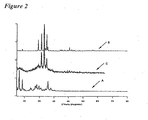
- Fig. 2 The X-ray diffraction lines of the materials used to obtain the data shown in Fig. 1 are illustrated in Fig. 2. These data were obtained from wide angle X-ray diffraction (WAXD) experiments conducted using a Siemens D500 fixed-anode generator (rotating specimen carrier) coupled with a diffractometer. The monochromatized X-ray beam consisting of Cu K ⁇ with a wavelength of 0.154 nm at 40 kV and 30 mA was used for this measurement, in the 2 theta range of 2-80 degrees.
- WAXD wide angle X-ray diffraction
- Curve A the powder (crystalline) form of the dye exhibits the strong diffraction lines characteristic of crystalline solids.
- Curves B and C were obtained with crystalline 1,10-decanediol and the 1:1 mixture of 1,10-decanediol and the dye formed as described by coating on a glass plate. It can be seen that the 1,10-decanediol exhibits the strong diffraction lines characteristic of a crystalline solid whereas the mixture exhibits the strong diffraction lines characteristic of the thermal solvent but not those characteristic of the crystalline dye material thus indicating that the dye is in the amorphous form.
- the transfer layer material contains primarily only a single dye-containing phase, although there may be present small amounts of an additive or additives in separate phases.
- additives may be, for example, light stabilizers, ultra-violet absorbers and antioxidants.
- this dye-containing phase may contain essentially a dye or mixture of dyes with little if any other material.
- any other ingredients in the thermal transfer material layer would not necessarily be film-forming materials since the principal film-forming component of the layer is the dye itself.
- the dye-containing phase can be a single compound (such as those listed above) capable of itself forming the necessary amorphous, non-crystalline phase, or a mixture of such compounds.
- This embodiment has the advantage that it is capable of providing very thin transfer material layers, since there is no, or a minimal amount of, "diluent" present with the dye.
- the single phase transfer material layer embodiments of the invention are particularly well-suited for certain applications such as variable dot thermal transfer.
- the glass transition temperatures of certain dyes, especially the ionic dyes may be relatively high (in some cases substantially in excess of 100 °C), so that substantial energy input per unit area imaged can be required in order to convert the transfer material from its solid condition to a flowable state whereby the material can be transferred imagewise to a receiver sheet.
- High energy input is not desirable in a portable printer or other imaging apparatus where energy usage can be a major concern, and high energy input per unit area can limit printing speed in a thermal head.
- the single phase transfer layers may be preferred for use in thermal transfer applications where energy requirements are not a major concern.
- the transfer layer comprises a mixture of the dye-containing phase and at least one "thermal solvent", which is a crystalline material. At least a portion of the thermal solvent present in the thermal transfer material layer forms a phase separate from the dye-containing phase.
- the thermal solvent is believed to be equilibrated between the amorphous form present in the dye-containing amorphous phase and the crystalline form present in the other phase.
- the amount of thermal solvent which can be present in the dye-containing amorphous phase is thought to be limited by the Tg of the amorphous phase which is preferably at least about 50 °C and particularly preferably about 60 °C.
- the thermal transfer donor sheets can be avoided even under high temperature storage conditions.
- there should be no first order phase change for the entire thermal transfer material layer i.e., there should be no melting of the layer, below about 50 °C.
- the crystalline thermal solvent melts during the heating of the donor sheet and dissolves or liquefies the dye-containing phase, thereby permitting the transfer of portions of the transfer layer to the receiving sheet to occur at a temperature lower than such transfer would occur in the absence of the crystalline thermal solvent.
- the mixture of dye(s) and thermal solvent melts at a temperature which is approximately the same as that of the crystalline thermal solvent itself (and substantially below the melting point of this dye in the powder (crystalline) form).
- the thermal solvent selected for the transfer layer is a good solvent for the dye(s) of the dye-containing phase.
- the dot size of the transferred imaging material may be varied by use of a thermal printing head optimized for variable dot printing.
- transfer of the imaging material can be effected to porous receiver materials.
- receiver materials having relatively low average pore sizes e.g., less than about 1 ⁇ m may be used.
- the two phase embodiment of the invention allows dye transfer to be effected at temperatures substantially lower than those achievable when the transfer layer contains only the same dye-containing phase, and hence with lower energy inputs per unit area imaged.
- the thermal solvent used can be any fusible material which melts above ambient temperature and which dissolves or liquefies the dye-containing phase to form a mixture which transfers at a lower temperature than that of the dye-containing phase alone.
- the imaging material which is transferred from the donor sheet to the receiving sheet during the two phase imaging embodiment need not be in the form of a conventional low viscosity true solution, but may be a slurry or similar material.
- the ratio of thermal solvent to dye may range from about 1:3 by weight to about 3:1. A preferred ratio is about 2:1.
- the two phase embodiment of the invention can provide a major reduction of imaging temperature while maintaining a thin donor layer.
- the thermal solvent may separate into a second phase as the mixture cools after imaging, and preferably the thermal solvent should not form such large crystals that it adversely affects the quality of the resulting image.
- the thermal solvent preferably has a melting point sufficiently above room temperature such that the donor layer is not tacky at room temperature, and does not melt at temperatures likely to be encountered during transportation and storage of the donor sheet prior to imaging.
- the crystalline thermal solvents used in the two-phase embodiments of the invention typically have a melting point in the range of from about 60 °C to about 120 °C and preferably in the range of from about 85 °C to about 100 °C.
- the melting point of the thermal transfer material is high enough that, at the melting point temperature the viscosity of the liquid material is low enough to transfer substantially the entire thickness of the thermal transfer material into the pores of the receiver material in the time allowed for imaging.
- thermo solvent have a melting point of about 90 °C.
- thermal solvent component of the donor layer prior to imaging, will crystallize out from the dye-containing phase and form a second phase separate from the dye-containing phase.
- the amount of thermal solvent in the transfer material layer which is incorporated in the dye-containing phase can be controlled by including additives in the dye-containing phase to make the latter more compatible with the thermal solvent thereby resulting in a higher percentage of the thermal solvent being located in the dye-containing phase.
- additives could be, for example, molecules similar to the thermal solvent which do not crystallize under the conditions of preparation of the donor layer or other additives such as light stabilizers. It is preferred to utilize thermal solvents which form relatively small crystals since these dissolve the dye-containing phase quickly during imaging to provide satisfactory transfer of the dye to the receiver layer.
- the relative amounts of thermal solvent which are in the dye containing and second, crystalline phases of the transfer layer can be determined by measuring the heat of fusion of the transfer layer material and comparing the value with the heat of fusion of the same mass of thermal solvent present in the transfer layer. The ratio of the respective values will indicate the proportions of thermal solvent present in the dye-containing phase and the second, crystalline phase.
- phase change occurs between room temperature and the imaging temperature such that essentially one phase is formed.
- the dye-containing phase transfer layer which is not tacky at room temperature, undergoes a composition change such that it has relatively low viscosity at the imaging temperature to allow the imaging material to be transferred to the receiving layer.
- more than one thermal solvent is incorporated into the transfer layer.
- a transfer layer which comprises two (or more) different thermal solvents having differing melting points and chosen so that the thermal solvent having the lower melting point dissolves or liquefies less of the dye-containing phase than the thermal solvent having the higher melting point, the amount of dye-containing phase transferred per imaged pixel during the imaging method varies according to the temperature to which the transfer layer is heated. It has been found possible, with certain imaging systems, to obtain good continuous-tone performance using only two thermal solvents in addition to the dye-containing phase. Such continuous-tone performance is an important advantage of the present invention as compared with conventional thermal mass transfer processes, in which the mass transfer is strictly binary. Alternatively, the use of two or more dyes which have differing solubilities in a single thermal solvent may be employed.
- thermal solvent used in any specific imaging system of the present invention must be chosen having regard to the dye-containing phase and other components of the proposed system.
- the thermal solvent should also be sufficiently non-volatile that it does not substantially sublime from the thin transfer layer during transportation and storage of the donor sheet prior to imaging.
- Any suitable thermal solvent may be used in accordance with the invention.
- Suitable thermal solvents include, for example, alkanols containing at least about 12 carbon atoms, alkanediols containing at least about 12 carbon atoms, monocarboxylic acids containing at least about 12 carbon atoms, esters and amides of such acids, aryl sulfonamides and hydroxyalkyl-substituted arenes.
- thermal solvents include: tetradecan-1-ol, hexadecan-1-ol, octadecan-1-ol, dodecane-1,2-diol, hexadecane-1,16-diol, myristic acid, palmitic acid, stearic acid, methyl docosanoate, 1,4- bis (hydroxymethyl)benzene, and p-toluenesulfonamide.
- Particularly preferred thermal solvents are TS1 through TS 13, as described below herein.
- thermal solvents for use in accordance with the invention consists of thermal solvents which have a low volatility. See Example 6 below.
- the transfer material layer not more than 5% by weight of the material present in the layer has a molecular weight higher than that of the highest molecular weight dye in the dye-containing phase.
- this feature of the transfer material layer allows the layer to be coated from a solution which has a relatively low viscosity.
- the transfer layer include not more than about 2% by weight, and particularly preferably not more than about 1% by weight, of components having a molecular weight higher than that of the highest molecular weight dye in the dye-containing phase.
- the thermal transfer material layer does not include any such higher molecular weight species.
- equation (3) becomes equivalent to equation (1).
- the Lucas-Washburn equation should be a reasonable approximation. In either case, optimization of the donor formulation for flow penetration mass transfer will require minimization of the thickness and melt viscosity of the transferred layer, while maintaining the maximum surface tension consistent with wetting the receiver.
- d' m ⁇ ⁇
- the thickness of a film composed entirely of a dye having extinction coefficient 25,000 L mole -1 cm -1 , molecular weight 0.5 kg/mole and density 1.0 kg/L would be 0.2 micrometers. Generally, this would be the minimum possible thickness for a donor film for thermal mass transfer for a given dye and is the thickness achievable according to the single phase embodiment of the invention. It is preferred to utilize according to the invention a dye for which the ratio of the extinction coefficient, measured at the peak absorbance (in liters per mole per centimeter) to the molecular weight (in grams per mole) is greater than about 10.
- equation (1) it is possible to estimate the viscosity required for penetration of three layers, each of thickness 0.5 micrometers and surface tension 0.035 N/m, into receiver pores of radius 0.1 micrometers. It may be assumed that the capillary pressure is more significant than the pressure exerted by the thermal printhead. If it is further assumed that the pore volume of the receiver is 50% of its total volume (for example, the interstitial space between porous silica gel particles is about 35% of the total volume, and the silica gel particles themselves are porous), the distance for mass transfer will be about twice the thickness of the donor.
- D which for a wide range of materials spans the range of between about 3 and about 50, is thought to be indicative of the nature of the bonding between the molecules that make up the material.
- a high value of D corresponds to a strong network of bonds (as is found in silica glass, a so-called “strong” liquid, for example) while a low value of D corresponds to weak intermolecular bonding (as exemplified by, say, o-terphenyl, a "fragile” liquid).
- Figure 4 is a plot of log viscosity as a function of Tg/T showing the behavior of single phase liquids with high, low and mid-D values when heated above Tg. For materials with Tg of greater than room temperature the change in viscosity is sufficient for imaging by differential adhesion but less suitable for fast penetration into small pores.
- a phase change occurs between room temperature and the elevated imaging temperature such that viscosities much lower than those attainable in the single phase embodiments may be achieved as shown in Example 7 below.
- ⁇ 4 + b 4 a ⁇ 1 4 b ( b + 8 ) a 2
- the product ⁇ d 2 is proportional to the time taken for penetration into pores, the lower this value the faster it is possible to print. In the current invention values of the product ⁇ d 2 less than about 0.06 Pa s ⁇ m 2 are preferred.
- the viscosity of the amorphous dye-containing phase be about 10 12 Pa s or the Tg of that phase be not less than about 30 °C above room temperature so that this phase is not tacky at temperatures likely to be reached during storage or in practical use.
- the Tg of the dye-containing phase is preferably about 50 °C and more preferably about 60 °C.
- the receiving layer utilized according to the present invention may comprise any suitable receiving layer material. It is preferred to utilize receiver layers having an average pore size less than about 1 ⁇ m and it is particularly preferred to utilize those having average pore sizes less than about 0.3 ⁇ m. Such receiver material layers do not scatter any substantial amounts of light and provide a desirable glossy appearance. Such microporous receiver layers are commercially available. There are also commercially available receiver materials made up of particles which are themselves porous such that thermal transfer material from a donor layer may occupy pores within the particles as well as interstitial space between the particles. An example of such a receiver materials is described in "Novel Sub-Micron Silica Gels for Glossy Ink Receptive Coatings," D. M. Chapman and D. Michos, IS&T NIP 15:1999, pp. 164-168.
- the amount of dye(s) present in the transfer layer can vary over a wide range dependent primarily upon the particular dye(s) utilized, the intended imaging application and the desired results.
- the requisite dye concentration for any specific transfer layer may be determined by routine scoping experiments.
- the transfer material layer used in the present method typically has a thickness not greater than about 1.5 ⁇ m, preferably not greater than about 1 ⁇ m.
- preferred systems of the invention can use transfer material layers having a thickness not greater than about 1.0 ⁇ m or even less; satisfactory imaging characteristics and optical densities have been achieved at transfer layer coating weights as low as 0.5 g m -2 , corresponding to a thickness of about 0.5 ⁇ m.
- preferred thermal transfer material layers also produce liquefied transfer layers having melt viscosities below about 1 Pa s and relatively low surface energy, or surface tension. It is particularly preferred to utilize transfer layers having melt viscosities below about 0.5 Pa s. With such thin layers, low melt viscosities and low surface energies, microporous receiving sheets having the majority of pores less than about 1 ⁇ m, and preferably less than about 0.5 ⁇ m, in diameter can readily be used, and in many cases microporous receiving sheets having the majority of pores less than about 0.2 ⁇ m may be used to produce images having a glossy appearance. According to a preferred embodiment of the invention the melt viscosity of the thermal transfer material is sufficiently low at the melting point of the crystalline thermal solvent to allow substantially all the thermal transfer material to enter the pores of the receiver material.
- the transfer layer comprises a dye or pigment dissolved or dispersed in a vehicle, typically a wax and/or a synthetic polymer. Because of the need to keep the dye or pigment uniformly dissolved or dispersed in the vehicle both during the coating process used to form the transfer layer and during storage and transportation of the donor sheet (during which the donor sheet may be exposed to substantial changes in temperature, humidity and other environmental variables), in practice the dye or pigment typically comprises less than 25 percent by weight of the transfer layer, so that to secure the optical density (around 1.5) needed for high quality full color images, the transfer layer needs to have a minimum thickness of about 1.5 ⁇ m. If one attempts to increase the proportion of dye in the transfer layer, both the melt viscosity and the surface energy of the transfer layer tend to increase, and thus such conventional systems cannot be used with small-pore receiving sheets.
- the thin transfer layers which can be used in the recording method of the present invention, together with the physical characteristics of the amorphous dye solid layers, provide significant advantages as compared with conventional thermal mass transfer processes.
- the present invention is used in a differential adhesion type process; the images produced typically are less susceptible to abrasion than conventional differential adhesion thermal mass transfer images, both because a thinner transfer layer is typically inherently less susceptible to abrasion, and because the amorphous dye solid films used in the present methods, by virtue of their glassy nature, can produce tough, highly coherent layers.
- Two phase transfer layers of the present invention can also substantially reduce the energy per unit area needed for imaging, which is especially advantageous in, for example portable printers, or in printers which use imagewise absorption of radiation to effect imaging, as discussed below.
- a protective overcoat may be placed over the transfer layer on the receiving sheet.
- a protective overcoat could be applied by hot lamination or a similar technique, but is conveniently thermally transferred over the image using the same thermal head or other head source used for the imaging method itself; in a multi-color method, the protective overcoat essentially becomes an extra "color" which is transferred in the same manner as the other colors, except of course that the overcoat will normally be transferred to cover the entire image rather than only selected pixels.
- the heating of the transfer layer may be effected using thermal heads of the linear or traversing types, or hot metal dies.
- the heating of the transfer layer may be effected by imagewise exposure of the transfer layer to radiation absorbed by the transfer layer or a layer in thermal contact therewith.
- the transfer layer itself may not strongly absorb the radiation used for imaging (for example, cost considerations may indicate the use of infra-red lasers which may not be absorbed by visible dyes) and in such cases the transfer layer itself, or a layer in thermal contact therewith, may comprise a radiation absorber which strongly absorbs the radiation used for imaging.
- the substrate itself may contain the radiation absorber, or the radiation absorber could be, for example, in a separate layer disposed between the transfer layer and the substrate; this might be desirable, for example, to prevent the radiation absorber being transferred to the receiving sheet together with the transfer layer.
- the thermal transfer recording system of the invention may most commonly be used to produce visible images to be viewed by the human eye, it is not restricted to such images and may be used to produce non-visible images intended for various forms of machine reading.
- the present invention may be used to form security codes, bar codes and similar indicia, for example on security and identification documents, and such security and other codes may have "colors" in the infra-red or ultra-violet regions so that the security codes are not obvious to casual inspection but can be read by well known techniques.
- the term “dye” is used herein to refer to a material which selectively absorbs certain wavelengths of electromagnetic radiation, and should not be construed as restricted to materials which have colors visible to the human eye.
- the term "color” should be understood in a corresponding manner.
- the present recording method may also be used to form arrays of colored elements which are not typically thought of as "images", for example color filters for use in liquid crystal displays and other optical or electronic systems.
- CMY cyan, magenta and yellow
- CMYK cyan, magenta, yellow and black
- the various colored transfer layers can be coated on separate substrates and each transfer layer imaged with a separate thermal head or other heat source, the printing apparatus needed to do so tends to be bulky and complex and difficulties may arise in accurate registration of the separate colored images. Accordingly, in general it is preferred to form the donor sheet by coating the various transfer layers as a sequential array of color imaging areas or "patches", on a single web of substrate in the manner described, for example in U.S. Patent No.
- One patch of each color is used to image a single receiving sheet, the patches being contacted successively with the receiving sheet and being imaged by a single head. Since only a single web (with, in practice, one feed spool and one take-up spool) and single print head are required, the printing apparatus can be made compact.
- multicolor embodiments it is preferred to transfer the different color thermal transfer materials in increasing order of viscosity, i.e., the least viscous color material first followed by the next least viscous and finally the most viscous (assuming all the thermal transfer materials have substantially the same thickness and surface tension).
- a different thermal solvent in each differently colored thermal transfer material layer.
- a preferred full color embodiment which utilizes three donor elements, each having a differently colored thermal transfer material, e.g., cyan, magenta and yellow
- thermal transfer recording system of the invention will now be described further in detail with respect to specific preferred embodiments by way of examples, it being understood that these are intended to be illustrative only and the invention is not limited to the materials, procedures, amounts, conditions, etc., recited therein. All parts and percentages recited are by weight unless otherwise specified.
- the dyes illustrated in this example are preferred dyes for use according to the invention.
- Yellow Dye XXV whose preparation is described in Example 4 below, was a crystalline solid as determined by X-ray powder diffraction conducted as described above with reference to Figure 2.
- Thermal Solvent Structure TS 1 1,10-Decanediol TS2 1,12-Dodecanediol TS3 1,12-Dodecanedioic acid, bis(dimethyl amide) TS4 1,14-Tetradecanedioic acid, bis(dimethyl amide) TS5 1,16-Hexadecanedioic acid, bis(dimethyl amide) TS6 N-Hexadecan-1-yl acetamide TS7 N-Decan-1-yl-4-methoxybenzamide TS8 N-Decan-1-yl-4-chlorobenzamide TS9 N-(Dodecan-1-yl-aminocarbonyl)morpholine TS10 Dodecan-1-yl-nicotinamide TS11 N-Decan-1-yl-4-nitrobenzamide TS12 Carbamic acid, 1,4-butanediyl-bis-diethyl este
- TS1 and TS2 were obtained from Aldrich Chemical Company and used as received.
- TS6 was prepared as described in Sasin et al ., J. Am. Oil Chem. Soc. 34, 358 (1957).
- Nicotinoyl chloride hydrochloride salt (5g, 28mmol) was added to a flask containing 1-dodecylamine (5.2g, 28mmol), triethylamine (5.6g, 56mmol) and dichloromethane (100mL). The moderately exothermic reaction warmed the solvent to reflux and the reaction was allowed to stir for 30 min. The reaction mixture was poured into water (200mL) and the layers were separated. The organic layer was cooled on ice and a white precipitate formed. The solid was filtered and air dried affording 6.5 g (80%) TS 10, (m.p. 73-76 °C).
- reaction mixture was stirred in the ice bath for 15 minutes, warmed to room temperature, stirred for 1 hour and heated for half an hour at 65 °C.
- the reaction mixture was transferred to a separatory funnel.
- the hot organic layer was separated and quickly filtered through a 2,54 cm (1 inch) bed of anhydrous magnesium sulfate.
- Toluene (63.3 mL) was added to the aqueous layer and the mixture was stirred and heated at 65 °C for 10 minutes. The hot organic layer was separated and quickly filtered through the same 1 inch bed of anhydrous magnesium sulfate.
- Dyes IV, V, VI, VII, and VIII are all described in US Patent No. 3,134,764.
- Dye IX is described in US Patent No. 3,135,606.
- Dye X is described in US Patent No. 3,691,210.
- Non-dye component 1,3-di(4-pyridyl)propane was available from Aldrich Chemical Co. and was used as received. All temperatures recited are in degrees Centigrade.
- the slurry was filtered and the cake washed with water (80 mL) to give red-orange prisms, still slightly water-wet, which were recrystallized from ethanol (450 mL) to provide, after drying in vacuo, 8.58 g (85%) of gold-colored matted plates.
- nitrostilbene prepared as described in c. above
- ethanol 100 mL
- 10% Pd/C 0.5 g
- This mixture was hydrogenated for 14 hours using a Parr shaker at an initial pressure of 3.15 ⁇ 10 5 Pa (45 psi).
- the catalyst was removed by filtration and the solution evaporated to give 2.947 g (87%) of crude product used in the next step.
- Tetrabutylammonium 2-(3-hydroxy-quinolin-2- yl)-1,3-dioxo-indan-5-carboxylate 2-(3-hydroxy-quinolin-2- yl)-1,3-dioxo-indan-5-carboxylate.
- 2 g of the acid was suspended in methanol (100 mL) and tetrabutyl ammonium hydroxide (1.0 M, 6.0 mL) was added slowly. Because the deprotonation of the first proton (carboxylic acid proton) of the yellow dye does not change its absorption spectrum while the deprotonation of the second proton (hydroxy group) shifts its absorption significantly, the addition of base can be followed easily by UV-Vis spectroscopy.
- the dye XIII (400mg) was N-methylated by treatment with potassium t-butoxide (112mg, 1mmol) in NMP for 1 hour, followed by addition of iodomethane (284mg, 2mmol) and further stirring of the mixture for approximately 16 hours.
- the reaction mixture was then poured into aqueous hydrochloric acid 50mL of a 0.5 M solution).
- the solid precipitate was filtered off and purified by silica gel chromatography (eluent: 5% methanol/methylene chloride) to give dye XIV (340 mg).
- the structure was confirmed by 1 H & 13 C NMR, and mass spectrometry.
- This dye was prepared in two steps as described below:
- n-Butylamine (3.0g, 0.041 mole) and water (75 mL) were combined in a 250-ml 3-necked round bottomed flask equipped with an overhead stirrer. The mixture was rapidly stirred and powdered isatoic ahydride (4.08g, 0.025 mole) was added portionwise over 2 minutes time. A slight exotherm occurred and a white solid precipitated from solution. The mixture was stirred for 10 minutes, then a heating mantle and reflux condenser were attached and the mixture was heated at reflux for 10 minutes. The heating mantle was removed and the mixture was stirred overnight at room temperature.
- This dye was prepared in two steps as follows:
- the mixture was refrigerated for 2 hours, after which the precipitated dye was filtered under suction and washed successively with water (75 mL) dilute sodium bicarbonate solution (50 mL) and water (2x75 mL). The dye was dried in air overnight and in vacuum oven at 45° for two hours to give 6.3 g (quantitative yield) of magenta-copper powder.
- Dye XX (3.3g, 5 mmol) was taken with 150 mL of acetonitrile in a 500 mL round bottomed flask under nitrogen. About 2g (excess) of phosphorus oxychloride was added and the mixture was heated at 65-70° for 2 hrs. The flask was then cooled to room temperature and about 20 mL of diethylamine was added. The reaction was stirred at room temperature overnight and at 50° for 2 hrs. The bulk of the solvent was removed under reduced pressure, the residue was dissolved in 200 mL of dichloromethane (200 mL) and washed with 2M hydrochloric acid and brine.
- This dye was prepared in two steps as described below.
- the fluorescein dimethyl ether prepared in a. above (360 mg, 1 mmol) was dissolved in 5 mL of dichloromethane in a 100 mL round bottomed flask under nitrogen and oxalyl chloride (250 mg) was then added. The reaction was stirred for 30 min and then most of the solvent was removed under reduced presssure. The residue was redissolved in dichloromethane (3 mL). A solution of 0.5 mL of absolute ethanol in 2 mL of dichloromethane was added to the reaction flask and the content was stirred for 1 hour. The reaction was quenched into 50 mL of cold water, and then extracted with dichloromethane (2x25 mL).
- Copikem® 16 available from Hilton-Davis Co. (2.80 g, 5 mmol) in methylene chloride (20 mL) was added dropwise oxalyl chloride (1.26 g, 10 mmol) over the course of ten minutes at 20° (some foaming was noted). The dark red solution was stirred at 20° for an additional 25 minutes, whereupon the volatiles were evaporated and the residual red gum dissolved in dichloromethane (25 mL). To this solution was added di-n-hexylamine (2.5 g, 20 mmol), and the resulting mixture stirred at 20° for 14 hours.
- Copikem® 35 (0.616 g, 1.0 mmol, available from Hilton-Davis Co.) in dichloromethane (2.5 mL) was added 0.3 mL of oxalyl chloride. After an immediate gas evolution and coloration the reaction mixture was stirred at 20° for 30 min, then evaporated to dryness. The residue was taken up in 1,2-dichloroethane (3 mL) and evaporated to dryness, then dissolved in dichloromethane (3 mL) and added to a solution of diethylamine (0.6 g) in dichloromethane (3 mL).
- the wet solid diester was suspended in a mixture of ethanol ( ⁇ 200mL) and a 1M aqueous solution of sodium hydroxide (100 mL), and the mixture was heated at reflux for several hours until hydrolysis was complete. The reaction mixture was then acidified with concentrated bydrochloric acid and the product was filtered off and washed with water. The crude dye was recrystallized from hot ethanol, affording 4.8g of pure dye XXVII. The structure was confirmed by 1 H & 13 C NMR, and mass spectrometry.
- Thermal data This example shows the Tg obtained from amorphous solid dye layers formed from some representative dyes. Also illustrated is the melting behavior of the thermal solvent both alone and in the amorphous solid dye matrix. These data confirm that the dye is in a substantially amorphous form, while the thermal solvent is partially dissolved in the dye, and partly in crystalline form.
- Thermal transition behavior of samples was determined by Differential Scanning Calorimetry [DSC] using a TA Instruments 2920 DSC unit operated in the Modulated DSC mode [MDSC]. Operation in the MDSC mode enables the total heat flow signal to be separated into reversible and non-reversible heat flow components; permitting the separation of sample phase transitions, such as crystal melting and Tg, from non-reversible phenomena such as volatilization, morphology reorganizations, and chemical reactions. All samples were run in nitrogen atmosphere at heating rates of either 2 or 4 degrees Centigrade/minute over the temperature range: -10 °C to 120 °C [thermal solvents] or -10 °C to 200 °C [dyes].
- Samples were run through 2 heating cycles with quench cooling to compare samples after they have a common thermal history. To determine the effect of cooling rate on the sample morphology, samples were run through 3 consecutive heating cycles separated by a slow cool [4 °C/min] and quench cool steps. Samples weights were in the range: 4-6mg.
- Thermal solvent candidates were assessed for their relative volatility in a TA Instruments Model 2950 Thermogravometric Analyzer [TGA] by measuring sample weight loss as a function of time while the samples were held @ 90 °C for 3-6 hrs. Sample size was in the range 5-7 mg and all measurements were made in a nitrogen atmosphere. Data were plotted as percent retained of original weight versus time, and the volatility number is reported as the slope of the % weight retained versus time plot when the rate of loss had achieved steady-state. After an initial weight loss (due to the loss of solvent/water as the samples are heated at a rate of 10 °C per minute to the isotherm temperature) a steady state rate of loss was achieved usually within 1-2 hours at the isotherm temperature.
- TGA Thermogravometric Analyzer
- the amount of thermal solvent lost from films stored at elevated temperatures was measured as follows:
- This Example illustrates the significant change in melt viscosity at imaging temperatures which may be achieved by incorporation of a crystalline thermal solvent into an amorphous solid dye.
- the viscosity of the pure amorphous solid dye at imaging temperatures was too high to be reliably measured.
- that of compound Y1 a measurement was possible at low shear rates.
- a reduction in viscosity of as much as four orders of magnitude is achievable by incorporation of the thermal solvent TS 1.
- High temperature viscosity measurements were obtained using an AR1000 control stress rheometer supplied by TA instruments, employing a cone and plate geometry.
- the temperature ramp used was 120 - 150 °C followed by 150 - 80 °C or lower (until solidification of the liquid), at a ramp rate of 10 °C per minute.
- the shear rate used is indicated in Table V.
- Donor sheets for thermal transfer in the following imaging examples were prepared in the following manner:
- a coating solution was prepared containing the dye (2 % w/w) and an appropriate amount of the specified thermal solvent in 1-butanol. This solution was coated onto a poly(ethylene terephthalate) film base of 4.5 ⁇ m thickness with a slip coating for thermal printing on the reverse side (supplied by International Imaging Materials, Inc., Amherst, New York) using a #7 Meyer rod, and the coating was dried using warm air. After standing for one hour, the resulting donor element was placed over a receiver sheet, with the coated side in contact with the microporous receiver coating. Unless otherwise stated, the receiver sheet was Photo IJ Paper QP ink jet paper, available from Konica.
- the resulting assembly was printed using a laboratory test-bed printer equipped with a thermal head supplied by Kyocera Corporation, Kyoto, Japan.
- the following printing parameters were used: Printhead width: 10.16 cm (4 inch) Resistor size: 70 x 70 ⁇ m Resistance: 1124 Ohm Voltage: 11 V Print speed: 4,24 cm/s (1.67 inches/second)(2 msec per line) Pressure: 2.6-3.5 N/linear cm (1.5 - 2 lb/linear inch) Donor peeling: 90 degree angle, 0.1 - 0.2 seconds after printing
- Dot pattern Odd-numbered and even-numbered pixels printed alternately in successive lines; one pixel (70 ⁇ m) spacing between lines in paper transport direction. Ten steps of different energy were printed, the current pulse for a given pixel in each step varying between 0.2 - 2 ms per line.
- Imaging of pure amorphous solid dyes in accordance with the single phase embodiment of the invention shows that in the specified cases, an image was obtained by thermal transfer of a pure amorphous solid dye, without any other additives. In this way, the thinnest possible donor layer for transfer of a given dye may be obtained. It can be seen that some dyes, for example, M2, M3 and C1, do not provide an image in the absence of a thermal solvent.
- Imaging of various dyes with TS 1. This example illustrates the imaging of a wide variety of dyes using an ⁇ , ⁇ -diol thermal solvent.
- TABLE VIII Dye Thermal solvent (mass ratio w.r.t. dye) Approximate donor coating thickness ( ⁇ m) D max E 0.5 (J/cm 2 ) Slope (cm 2 /J) Y1 TS1 (1) 0.5 1.19 0.63 2.71 Y3 TS1 (1) 0.5 1.17 0.65 2.57 M1 TS1 (1) 0.5 1.03 0.55 2.39 M2 TS1 (1) 0.5 1.22 0.63 1.56 M3 TS1 (1) 0.5 1.60 0.85 1.21 C1 TS1 (1) 0.5 0.97 0.71 1.51 C2 TS1 (1) 0.5 1.07 0.54 1.50
- TS12 refers to 1-hexadecanol and TS13 refers to 1-octadecanol.
- the donor coatings were prepared in the same manner as described above, except that a small amount of surfactant was added (FC-431, available from 3M), amounting to 0.3% of the dry weight of the coating for the first two table entries and 0.6% of the dry weight of the coating for the final two table entries.
- FC-431 available from 3M
- the receiver sheet used was Epson Glossy Film paper for ink-jet printing, available from Seiko Epson Corporation.
- the donor/receiver combination was printed using a laboratory test-bed printer equipped with a thermal head supplied by Kyocera Corporation, Kyoto, Japan.
- Printhead width 10.16 cm (4 inch)
- Resistor size 70 x 140 ⁇ m Resistance: 3750 Ohm Voltage: 9.5 V
- Print speed 12.7 cm/s (5 inches/second; 6- msec per line)
- Pressure 2.6-3.5 N/linear cm (1.5 - 2 lb/linear inch)
- Donor peeling 90 degree angle, 0.1- 0.2 seconds after printing
- Dot pattern All pixels were used in each line, such that a rectangular grid was printed. Sixteen steps of different energy per pixel were printed, using a pulse pattern optimized for dye diffusion thermal transfer (continuous tone) printing.
- the reflection density in each of the sixteen printed areas was measured using a spectrophotometer supplied by GretagMacbeth Corporation, and this density was plotted against the energy supplied to the thermal head. From these graphs, the following four parameters were extracted: D min , D max , Energy to reach a density of D max /2 (E 0.5 ) and slope at E 0.5 (Slope).
- the example illustrates a three color printing method according to the invention.
- the resulting donor element was placed over a receiver sheet (Photo IJ Paper QP ink jet paper, available from Konica Corporation) with the coated side of the donor in contact with the microporous receiver coating.
- the resulting assembly was printed using a laboratory test-bed printer equipped with a thermal head supplied by Kyocera Corporation, Kyoto, Japan.
Landscapes
- Chemical & Material Sciences (AREA)
- Physics & Mathematics (AREA)
- Optics & Photonics (AREA)
- Life Sciences & Earth Sciences (AREA)
- Engineering & Computer Science (AREA)
- Materials Engineering (AREA)
- Wood Science & Technology (AREA)
- Organic Chemistry (AREA)
- Thermal Transfer Or Thermal Recording In General (AREA)
Claims (13)
- Verfahren zur Erzeugung von Bildern durch thermischen Transfer von Massen, umfassend- Erhitzen eines Donorelements, umfassend ein Substrat, das eine Schicht eines thermischen Transfermaterials trägt, das eine farbstoffhaltige amorphe Phase mit mindestens einem Farbstoff enthält, wobei der Farbstoff einen kontinuierlichen Film bildet, und wobei nicht mehr als 5 Gew.-% des Materials in der Schicht des thermischen Transfermaterials ein höheres Molekulargewicht aufweisen als das des Farbstoffs mit dem höchsten Molekulargewicht in der farbstoffhaltigen Phase, und- bildmäßiger Transfer von Teilen der Schicht des Transfermaterials auf die Empfangsschicht.
- Thermisches Bilderzeugungsverfahren nach Anspruch 1, wobei die Schicht des thermischen Transfermaterials weiterhin mindestens ein thermisches Lösungsmittel mit einem Schmelzpunkt oberhalb 50°C umfasst, wobei mindestens ein Teil des thermischen Lösungsmittels eine getrennte kristalline Phase bildet und wobei das kristalline thermische Lösungsmittel nach dem Schmelzen einen Transfer des Farbstoffs in der farbstoffhaltigen Phase auf eine Empfangsschicht bei einer niedrigeren Temperatur als diejenige bewirken kann, bei welcher der Transfer in Abwesenheit des kristallinen thermischen Lösungsmittels erfolgen würde.
- Thermisches Bilderzeugungsverfahren nach Anspruch 2, wobei das thermische Lösungsmittel einen Schmelzpunkt im Bereich von 60°C bis 120°C hat.
- Thermisches Bilderzeugungsverfahren nach Anspruch 2, wobei das thermische Lösungsmittel, bezogen auf den Farbstoff, in einer Menge von 1:3 bis 3:1 Gewichtsteilen in der farbstoffhaltigen Phase vorliegt.
- Thermisches Bilderzeugungsverfahren nach Anspruch 1, wobei die Schicht des thermischen Transfermaterials eine Dicke von nicht mehr als 2 µm hat.
- Thermisches Bilderzeugungsverfahren nach Anspruch 1, wobei nicht mehr als 2 Gew.-% des Materials in der thermischen Übertragungsschicht ein Molekulargewicht aufweisen, das höher ist als das des Farbstoffes mit dem höchsten Molekulargewicht in der farbstoffhaltigen Schicht.
- Thermisches Bilderzeugungsverfahren nach Anspruch 1, wobei nicht mehr als 1 Gew.-% des Materials in der thermischen Übertragungsschicht ein Molekulargewicht aufweisen, das höher ist als das des Farbstoffes mit dem höchsten Molekulargewicht in der farbstoffhaltigen Schicht.
- Donorelement zur Verwendung bei der Bilderzeugung durch thermischen Transfer, wobei das Donorelement einen Träger umfasst, der eine Schicht eines festen thermischen Transfermaterials trägt, das eine farbstoffhaltige amorphe Phase mit mindestens einem Farbstoff umfasst, wobei der Farbstoff einen kontinuierlichen Film bildet, und wobei nicht mehr als 5 Gew.-% des Materials in der Schicht des thermischen Transfermaterials ein höheres Molekulargewicht aufweisen als das des Farbstoffes mit dem höchsten Molekulargewicht in der farbstoffhaltigen Phase.
- Donorelement nach Anspruch 8, wobei die Schicht des thermischen Transfermaterials weiterhin mindestens ein thermisches Lösungsmittel mit einem Schmelzpunkt von mehr als 50°C umfasst.
- Donorelement nach Anspruch 9, wobei das thermische Lösungsmittel einen Schmelzpunkt im Bereich von 60°C bis 120°C hat.
- Donorelement nach Anspruch 9, wobei die Schicht des thermischen Transfermaterials zwei unterschiedliche thermische Lösungsmittel mit unterschiedlichen Schmelzpunkten umfasst.
- Donorelement nach Anspruch 9, wobei das thermische Lösungsmittel, bezogen auf den Farbstoff, in einer Menge von 1:3 bis 3:1 Gewichtsteilen in der farbstoffhaltigen Phase vorliegt.
- Donorelement nach Anspruch 9, wobei die Schicht des thermischen Transfermaterials eine Dicke von nicht mehr als 2 µm hat.
Applications Claiming Priority (5)
| Application Number | Priority Date | Filing Date | Title |
|---|---|---|---|
| US17956200P | 2000-02-01 | 2000-02-01 | |
| US179562P | 2000-02-01 | ||
| US09/745,700 US6537410B2 (en) | 2000-02-01 | 2000-12-21 | Thermal transfer recording system |
| EP01905206A EP1263607B1 (de) | 2000-02-01 | 2001-01-30 | Thermisches transferaufzeichnungsverfahren mit einer amorphen farbstoffphase |
| US745700 | 2007-05-08 |
Related Parent Applications (1)
| Application Number | Title | Priority Date | Filing Date |
|---|---|---|---|
| EP01905206A Division EP1263607B1 (de) | 2000-02-01 | 2001-01-30 | Thermisches transferaufzeichnungsverfahren mit einer amorphen farbstoffphase |
Publications (2)
| Publication Number | Publication Date |
|---|---|
| EP1493593A1 EP1493593A1 (de) | 2005-01-05 |
| EP1493593B1 true EP1493593B1 (de) | 2006-05-31 |
Family
ID=33436881
Family Applications (1)
| Application Number | Title | Priority Date | Filing Date |
|---|---|---|---|
| EP04020513A Expired - Lifetime EP1493593B1 (de) | 2000-02-01 | 2001-01-30 | Thermisches Übertragungsaufzeichnungsverfahren mit einer amorphen Farbstoffphase |
Country Status (1)
| Country | Link |
|---|---|
| EP (1) | EP1493593B1 (de) |
Families Citing this family (1)
| Publication number | Priority date | Publication date | Assignee | Title |
|---|---|---|---|---|
| US10647142B2 (en) | 2016-12-20 | 2020-05-12 | Canon Kabushiki Kaisha | Thermal transfer recording sheet |
Family Cites Families (7)
| Publication number | Priority date | Publication date | Assignee | Title |
|---|---|---|---|---|
| CA1198591A (en) | 1982-02-13 | 1985-12-31 | Tadao Seto | Heat-sensitive color transfer recording media |
| JPH03126589A (ja) * | 1989-10-11 | 1991-05-29 | Fuji Photo Film Co Ltd | 熱転写色素供与材料 |
| US5308736A (en) * | 1991-09-10 | 1994-05-03 | Agfa-Gevaert, N.V. | Dye-donor element for use according to thermal dye sublimation transfer |
| JP2850930B2 (ja) | 1992-10-12 | 1999-01-27 | 日本ビクター株式会社 | 溶融型熱転写プリントシステム |
| JP3204820B2 (ja) * | 1993-10-21 | 2001-09-04 | 富士写真フイルム株式会社 | 感熱転写記録材料及び画像形成方法 |
| DE69517881T2 (de) * | 1994-08-11 | 2001-03-01 | Fuji Photo Film Co., Ltd. | Wärmeempfindliche Tintenschicht und Verfahren zur Herstellung von Bildern |
| JPH1076693A (ja) | 1996-07-12 | 1998-03-24 | Victor Co Of Japan Ltd | 溶融型熱転写印刷装置及びその印刷用紙 |
-
2001
- 2001-01-30 EP EP04020513A patent/EP1493593B1/de not_active Expired - Lifetime
Also Published As
| Publication number | Publication date |
|---|---|
| EP1493593A1 (de) | 2005-01-05 |
Similar Documents
| Publication | Publication Date | Title |
|---|---|---|
| EP1263607B1 (de) | Thermisches transferaufzeichnungsverfahren mit einer amorphen farbstoffphase | |
| DE3829918C2 (de) | Wärmeempfindliches Übertragungsmaterial | |
| EP1626072B1 (de) | Phasenaustauschtinten | |
| DE68919744T2 (de) | Wärmeempfindliche Farbübertragungsmaterialien. | |
| JP3997651B2 (ja) | 新規色素及び画像記録材料及び感熱転写材料及びインクジェット記録液 | |
| JPH05237B2 (de) | ||
| EP0319234B1 (de) | Druckverfahren mit Verwendung eines neuen gelben Farbstoffes und Thermotransfermaterial für thermische Übertragung mit diesem Verfahren | |
| JPH0462277B2 (de) | ||
| EP1626071B1 (de) | Anthrapyridonfarbstoffe | |
| EP1493593B1 (de) | Thermisches Übertragungsaufzeichnungsverfahren mit einer amorphen Farbstoffphase | |
| DE3441657A1 (de) | Waermeempfindliches zweifarben-aufzeichnungsmaterial | |
| EP1799780B1 (de) | Bebilderungsmassen, bebilderungsverfahren und bebilderungselemente | |
| JPH0692045A (ja) | 熱染料昇華転写に使用するためのチアゾリルアゾアニリン染料 | |
| US5013712A (en) | Magenta dye-donor element used in thermal transfer and thermal transfer sheet using it | |
| US4940692A (en) | Transfer of dyes | |
| JP4020655B2 (ja) | ピペリジル基含有共重合体の水分散液又は水溶液 | |
| JP5298739B2 (ja) | 感熱転写記録用色素 | |
| JP3321940B2 (ja) | 可逆性感熱記録媒体 | |
| DE19813493C2 (de) | Reversibles, wärmeempfindliches Aufzeichnungsmaterial | |
| JPH051154B2 (de) | ||
| JPH07195837A (ja) | 熱転写ドナーシートおよび熱転写方法 | |
| JP2699534B2 (ja) | 近赤外線を吸収する油性インキ | |
| Hauser et al. | Fine particle pigment concentrates for ink jet printing inks | |
| KR0180885B1 (ko) | 인도아닐린계 염료, 이를 함유한 잉크조성물 및 전사시트 | |
| JPS6157651A (ja) | インドアニリン系化合物、感熱転写記録用色素及び感熱転写記録用シート |
Legal Events
| Date | Code | Title | Description |
|---|---|---|---|
| PUAI | Public reference made under article 153(3) epc to a published international application that has entered the european phase |
Free format text: ORIGINAL CODE: 0009012 |
|
| 17P | Request for examination filed |
Effective date: 20041008 |
|
| AC | Divisional application: reference to earlier application |
Ref document number: 1263607 Country of ref document: EP Kind code of ref document: P |
|
| AK | Designated contracting states |
Kind code of ref document: A1 Designated state(s): AT BE CH CY DE DK ES FI FR GB GR IE IT LI LU MC NL PT SE TR |
|
| 17Q | First examination report despatched |
Effective date: 20050412 |
|
| AKX | Designation fees paid |
Designated state(s): AT BE CH CY DE DK ES FI FR GB GR IE IT LI LU MC NL PT SE TR |
|
| GRAP | Despatch of communication of intention to grant a patent |
Free format text: ORIGINAL CODE: EPIDOSNIGR1 |
|
| RIC1 | Information provided on ipc code assigned before grant |
Ipc: B41M 5/382 00000000AFI20051130BHEP Ipc: C09D 11/00 19680901ALI20051130BHEP |
|
| GRAS | Grant fee paid |
Free format text: ORIGINAL CODE: EPIDOSNIGR3 |
|
| GRAA | (expected) grant |
Free format text: ORIGINAL CODE: 0009210 |
|
| AC | Divisional application: reference to earlier application |
Ref document number: 1263607 Country of ref document: EP Kind code of ref document: P |
|
| AK | Designated contracting states |
Kind code of ref document: B1 Designated state(s): AT BE CH CY DE DK ES FI FR GB GR IE IT LI LU MC NL PT SE TR |
|
| PG25 | Lapsed in a contracting state [announced via postgrant information from national office to epo] |
Ref country code: IT Free format text: LAPSE BECAUSE OF FAILURE TO SUBMIT A TRANSLATION OF THE DESCRIPTION OR TO PAY THE FEE WITHIN THE PRESCRIBED TIME-LIMIT;WARNING: LAPSES OF ITALIAN PATENTS WITH EFFECTIVE DATE BEFORE 2007 MAY HAVE OCCURRED AT ANY TIME BEFORE 2007. THE CORRECT EFFECTIVE DATE MAY BE DIFFERENT FROM THE ONE RECORDED. Effective date: 20060531 Ref country code: LI Free format text: LAPSE BECAUSE OF FAILURE TO SUBMIT A TRANSLATION OF THE DESCRIPTION OR TO PAY THE FEE WITHIN THE PRESCRIBED TIME-LIMIT Effective date: 20060531 Ref country code: AT Free format text: LAPSE BECAUSE OF FAILURE TO SUBMIT A TRANSLATION OF THE DESCRIPTION OR TO PAY THE FEE WITHIN THE PRESCRIBED TIME-LIMIT Effective date: 20060531 Ref country code: NL Free format text: LAPSE BECAUSE OF FAILURE TO SUBMIT A TRANSLATION OF THE DESCRIPTION OR TO PAY THE FEE WITHIN THE PRESCRIBED TIME-LIMIT Effective date: 20060531 Ref country code: FI Free format text: LAPSE BECAUSE OF FAILURE TO SUBMIT A TRANSLATION OF THE DESCRIPTION OR TO PAY THE FEE WITHIN THE PRESCRIBED TIME-LIMIT Effective date: 20060531 Ref country code: BE Free format text: LAPSE BECAUSE OF FAILURE TO SUBMIT A TRANSLATION OF THE DESCRIPTION OR TO PAY THE FEE WITHIN THE PRESCRIBED TIME-LIMIT Effective date: 20060531 Ref country code: CH Free format text: LAPSE BECAUSE OF FAILURE TO SUBMIT A TRANSLATION OF THE DESCRIPTION OR TO PAY THE FEE WITHIN THE PRESCRIBED TIME-LIMIT Effective date: 20060531 |
|
| REG | Reference to a national code |
Ref country code: GB Ref legal event code: FG4D Ref country code: CH Ref legal event code: EP |
|
| REG | Reference to a national code |
Ref country code: IE Ref legal event code: FG4D |
|
| REF | Corresponds to: |
Ref document number: 60120236 Country of ref document: DE Date of ref document: 20060706 Kind code of ref document: P |
|
| PG25 | Lapsed in a contracting state [announced via postgrant information from national office to epo] |
Ref country code: SE Free format text: LAPSE BECAUSE OF FAILURE TO SUBMIT A TRANSLATION OF THE DESCRIPTION OR TO PAY THE FEE WITHIN THE PRESCRIBED TIME-LIMIT Effective date: 20060831 Ref country code: DK Free format text: LAPSE BECAUSE OF FAILURE TO SUBMIT A TRANSLATION OF THE DESCRIPTION OR TO PAY THE FEE WITHIN THE PRESCRIBED TIME-LIMIT Effective date: 20060831 |
|
| PG25 | Lapsed in a contracting state [announced via postgrant information from national office to epo] |
Ref country code: ES Free format text: LAPSE BECAUSE OF FAILURE TO SUBMIT A TRANSLATION OF THE DESCRIPTION OR TO PAY THE FEE WITHIN THE PRESCRIBED TIME-LIMIT Effective date: 20060911 |
|
| PG25 | Lapsed in a contracting state [announced via postgrant information from national office to epo] |
Ref country code: PT Free format text: LAPSE BECAUSE OF FAILURE TO SUBMIT A TRANSLATION OF THE DESCRIPTION OR TO PAY THE FEE WITHIN THE PRESCRIBED TIME-LIMIT Effective date: 20061031 |
|
| NLV1 | Nl: lapsed or annulled due to failure to fulfill the requirements of art. 29p and 29m of the patents act | ||
| ET | Fr: translation filed | ||
| REG | Reference to a national code |
Ref country code: CH Ref legal event code: PL |
|
| PG25 | Lapsed in a contracting state [announced via postgrant information from national office to epo] |
Ref country code: MC Free format text: LAPSE BECAUSE OF NON-PAYMENT OF DUE FEES Effective date: 20070131 |
|
| PLBE | No opposition filed within time limit |
Free format text: ORIGINAL CODE: 0009261 |
|
| STAA | Information on the status of an ep patent application or granted ep patent |
Free format text: STATUS: NO OPPOSITION FILED WITHIN TIME LIMIT |
|
| 26N | No opposition filed |
Effective date: 20070301 |
|
| REG | Reference to a national code |
Ref country code: GB Ref legal event code: 732E |
|
| PG25 | Lapsed in a contracting state [announced via postgrant information from national office to epo] |
Ref country code: IE Free format text: LAPSE BECAUSE OF NON-PAYMENT OF DUE FEES Effective date: 20070130 |
|
| PG25 | Lapsed in a contracting state [announced via postgrant information from national office to epo] |
Ref country code: GR Free format text: LAPSE BECAUSE OF FAILURE TO SUBMIT A TRANSLATION OF THE DESCRIPTION OR TO PAY THE FEE WITHIN THE PRESCRIBED TIME-LIMIT Effective date: 20060901 |
|
| PG25 | Lapsed in a contracting state [announced via postgrant information from national office to epo] |
Ref country code: LU Free format text: LAPSE BECAUSE OF NON-PAYMENT OF DUE FEES Effective date: 20070130 Ref country code: CY Free format text: LAPSE BECAUSE OF FAILURE TO SUBMIT A TRANSLATION OF THE DESCRIPTION OR TO PAY THE FEE WITHIN THE PRESCRIBED TIME-LIMIT Effective date: 20060531 |
|
| PG25 | Lapsed in a contracting state [announced via postgrant information from national office to epo] |
Ref country code: TR Free format text: LAPSE BECAUSE OF FAILURE TO SUBMIT A TRANSLATION OF THE DESCRIPTION OR TO PAY THE FEE WITHIN THE PRESCRIBED TIME-LIMIT Effective date: 20060531 |
|
| PGFP | Annual fee paid to national office [announced via postgrant information from national office to epo] |
Ref country code: GB Payment date: 20141230 Year of fee payment: 15 |
|
| PGFP | Annual fee paid to national office [announced via postgrant information from national office to epo] |
Ref country code: FR Payment date: 20141226 Year of fee payment: 15 |
|
| PGFP | Annual fee paid to national office [announced via postgrant information from national office to epo] |
Ref country code: DE Payment date: 20150126 Year of fee payment: 15 |
|
| REG | Reference to a national code |
Ref country code: DE Ref legal event code: R119 Ref document number: 60120236 Country of ref document: DE |
|
| GBPC | Gb: european patent ceased through non-payment of renewal fee |
Effective date: 20160130 |
|
| REG | Reference to a national code |
Ref country code: FR Ref legal event code: ST Effective date: 20160930 |
|
| PG25 | Lapsed in a contracting state [announced via postgrant information from national office to epo] |
Ref country code: DE Free format text: LAPSE BECAUSE OF NON-PAYMENT OF DUE FEES Effective date: 20160802 Ref country code: GB Free format text: LAPSE BECAUSE OF NON-PAYMENT OF DUE FEES Effective date: 20160130 |
|
| PG25 | Lapsed in a contracting state [announced via postgrant information from national office to epo] |
Ref country code: FR Free format text: LAPSE BECAUSE OF NON-PAYMENT OF DUE FEES Effective date: 20160201 |