EP1493770A2 - Ionenaustauschpolymere - Google Patents
Ionenaustauschpolymere Download PDFInfo
- Publication number
- EP1493770A2 EP1493770A2 EP04077086A EP04077086A EP1493770A2 EP 1493770 A2 EP1493770 A2 EP 1493770A2 EP 04077086 A EP04077086 A EP 04077086A EP 04077086 A EP04077086 A EP 04077086A EP 1493770 A2 EP1493770 A2 EP 1493770A2
- Authority
- EP
- European Patent Office
- Prior art keywords
- unit
- polymer
- copolymer
- represent
- moiety
- Prior art date
- Legal status (The legal status is an assumption and is not a legal conclusion. Google has not performed a legal analysis and makes no representation as to the accuracy of the status listed.)
- Withdrawn
Links
- UHOVQNZJYSORNB-UHFFFAOYSA-N c1ccccc1 Chemical compound c1ccccc1 UHOVQNZJYSORNB-UHFFFAOYSA-N 0.000 description 3
Images
Classifications
-
- C—CHEMISTRY; METALLURGY
- C08—ORGANIC MACROMOLECULAR COMPOUNDS; THEIR PREPARATION OR CHEMICAL WORKING-UP; COMPOSITIONS BASED THEREON
- C08G—MACROMOLECULAR COMPOUNDS OBTAINED OTHERWISE THAN BY REACTIONS ONLY INVOLVING UNSATURATED CARBON-TO-CARBON BONDS
- C08G65/00—Macromolecular compounds obtained by reactions forming an ether link in the main chain of the macromolecule
- C08G65/34—Macromolecular compounds obtained by reactions forming an ether link in the main chain of the macromolecule from hydroxy compounds or their metallic derivatives
- C08G65/38—Macromolecular compounds obtained by reactions forming an ether link in the main chain of the macromolecule from hydroxy compounds or their metallic derivatives derived from phenols
- C08G65/40—Macromolecular compounds obtained by reactions forming an ether link in the main chain of the macromolecule from hydroxy compounds or their metallic derivatives derived from phenols from phenols (I) and other compounds (II), e.g. OH-Ar-OH + X-Ar-X, where X is halogen atom, i.e. leaving group
- C08G65/4012—Other compound (II) containing a ketone group, e.g. X-Ar-C(=O)-Ar-X for polyetherketones
-
- C—CHEMISTRY; METALLURGY
- C08—ORGANIC MACROMOLECULAR COMPOUNDS; THEIR PREPARATION OR CHEMICAL WORKING-UP; COMPOSITIONS BASED THEREON
- C08G—MACROMOLECULAR COMPOUNDS OBTAINED OTHERWISE THAN BY REACTIONS ONLY INVOLVING UNSATURATED CARBON-TO-CARBON BONDS
- C08G75/00—Macromolecular compounds obtained by reactions forming a linkage containing sulfur with or without nitrogen, oxygen, or carbon in the main chain of the macromolecule
- C08G75/20—Polysulfones
- C08G75/23—Polyethersulfones
-
- H—ELECTRICITY
- H01—ELECTRIC ELEMENTS
- H01M—PROCESSES OR MEANS, e.g. BATTERIES, FOR THE DIRECT CONVERSION OF CHEMICAL ENERGY INTO ELECTRICAL ENERGY
- H01M8/00—Fuel cells; Manufacture thereof
- H01M8/10—Fuel cells with solid electrolytes
- H01M8/1016—Fuel cells with solid electrolytes characterised by the electrolyte material
- H01M8/1018—Polymeric electrolyte materials
- H01M8/102—Polymeric electrolyte materials characterised by the chemical structure of the main chain of the ion-conducting polymer
- H01M8/1025—Polymeric electrolyte materials characterised by the chemical structure of the main chain of the ion-conducting polymer having only carbon and oxygen, e.g. polyethers, sulfonated polyetheretherketones [S-PEEK], sulfonated polysaccharides, sulfonated celluloses or sulfonated polyesters
-
- H—ELECTRICITY
- H01—ELECTRIC ELEMENTS
- H01M—PROCESSES OR MEANS, e.g. BATTERIES, FOR THE DIRECT CONVERSION OF CHEMICAL ENERGY INTO ELECTRICAL ENERGY
- H01M8/00—Fuel cells; Manufacture thereof
- H01M8/10—Fuel cells with solid electrolytes
- H01M8/1016—Fuel cells with solid electrolytes characterised by the electrolyte material
- H01M8/1018—Polymeric electrolyte materials
- H01M8/102—Polymeric electrolyte materials characterised by the chemical structure of the main chain of the ion-conducting polymer
- H01M8/1027—Polymeric electrolyte materials characterised by the chemical structure of the main chain of the ion-conducting polymer having carbon, oxygen and other atoms, e.g. sulfonated polyethersulfones [S-PES]
-
- H—ELECTRICITY
- H01—ELECTRIC ELEMENTS
- H01M—PROCESSES OR MEANS, e.g. BATTERIES, FOR THE DIRECT CONVERSION OF CHEMICAL ENERGY INTO ELECTRICAL ENERGY
- H01M8/00—Fuel cells; Manufacture thereof
- H01M8/10—Fuel cells with solid electrolytes
- H01M8/1016—Fuel cells with solid electrolytes characterised by the electrolyte material
- H01M8/1018—Polymeric electrolyte materials
- H01M8/102—Polymeric electrolyte materials characterised by the chemical structure of the main chain of the ion-conducting polymer
- H01M8/1032—Polymeric electrolyte materials characterised by the chemical structure of the main chain of the ion-conducting polymer having sulfur, e.g. sulfonated-polyethersulfones [S-PES]
-
- Y—GENERAL TAGGING OF NEW TECHNOLOGICAL DEVELOPMENTS; GENERAL TAGGING OF CROSS-SECTIONAL TECHNOLOGIES SPANNING OVER SEVERAL SECTIONS OF THE IPC; TECHNICAL SUBJECTS COVERED BY FORMER USPC CROSS-REFERENCE ART COLLECTIONS [XRACs] AND DIGESTS
- Y02—TECHNOLOGIES OR APPLICATIONS FOR MITIGATION OR ADAPTATION AGAINST CLIMATE CHANGE
- Y02E—REDUCTION OF GREENHOUSE GAS [GHG] EMISSIONS, RELATED TO ENERGY GENERATION, TRANSMISSION OR DISTRIBUTION
- Y02E60/00—Enabling technologies; Technologies with a potential or indirect contribution to GHG emissions mitigation
- Y02E60/30—Hydrogen technology
- Y02E60/50—Fuel cells
Definitions
- This invention relates to ion-exchange polymers and particularly, although not exclusively, relates to sulphonated polymers, for example sulphonated polyaryletherketones, polyarylethersulphones and/or copolymers of the aforesaid.
- Preferred embodiments of the invention relate to ion-conductive membranes, for example of polymer electrolyte membrane fuel cells, made using such polymers.
- the invention also relates to novel non-sulphonated polyaryletherketones and/or polyarylethersulphones used for preparing said sulphonated polymers and processes for the preparation of polymers described herein.
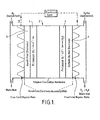
- a polymer electrolyte membrane fuel cell shown schematically in Figure 1 of the accompanying diagrammatic drawings, may comprise a thin sheet 2 of a hydrogen-ion conducting Polymer Electrolyte Membrane (PEM) sandwiched on both sides by a layer 4 of platinum catalyst and an electrode 6.
- the layers 2, 4, 6 make up a Membrane Electrode Assembly (MEA) of less than 1mm thickness.
- MEA Membrane Electrode Assembly
- US Patent No. 5 561 202 discloses the production of PEMs from sulphonated aromatic polyether ketones. At least 5% of the sulphonic groups in the sulphonic acid moieties are converted into sulphonyl chloride groups and then reacted with an amine containing at least one cross-linkable substituent or a further functional group. An aromatic sulphonamide is then isolated, dissolved in an organic solvent, converted into a film and then the cross-linkable substituents in the film are cross-linked.
- the invention is said to provide ion-conductive membranes suitable for use as polymeric solid electrolytes which have adequate chemical stability and can be produced from polymers which are soluble in suitable solvents.
- PEMFCs One problem associated with known PEMFCs is that of providing PEMs which have desirable properties at elevated temperatures and which are cheap to manufacture.
- a polymer electrolyte membrane which includes a polymer having a moiety of formula and/or a moiety of formula and/or a moiety of formula wherein at least some of the units I, II and/or III are sulphonated; wherein the phenyl moieties in units I, II, and III are independently optionally substituted and optionally cross-linked; and wherein m,r,s,t,v,w and z independently represent zero or a positive integer, E and E' independently represent an oxygen or a sulphur atom or a direct link, G represents an oxygen or sulphur atom, a direct link or a -O-Ph-O- moiety where Ph represents a phenyl group and Ar is selected from one of the following moieties (i) to (x) which is bonded via one or more of its phenyl moieties to adjacent moieties
- the invention extends to a polymer electrolyte membrane which includes a polymer having a moiety of formula I and/or a moiety of formula II and/or a moiety of formula III as described according to said first aspect, wherein at least some of units I, II and/or III are functionalised to provide ion exchange sites.
- said polymer is sulphonated, phosphorylated, carboxylated, quaternary-aminoalkylated or chloromethylated, and optionally further modified to yield -CH 2 PO 3 H 2 , -CH 2 NR 3 20+ where R 20 is an alkyl, or -CH 2 NAr 3 x+ where Ar x is an aromatic (arene), to provide a cation or anion exchange membrane.
- the aromatic moiety may contain a hydroxyl group which can be readily elaborated by existing methods to generate -OSO 3 H and -OPO 3 H 2 cationic exchange sites on the polymer. Ion exchange sites of the type stated may be provided as described in WO95/08581.
- references to sulphonation include a reference to substitution with a group -SO 3 M wherein M stands for one or more elements selected with due consideration to ionic valencies from the following group: H, NR 4 y+ , in which R y stands for H, C 1 -C 4 alkyl, or an alkali or alkaline earth metal or a metal of sub-group 8, preferably H, NR 4 + , Na, K, Ca, Mg, Fe, and Pt.
- M represents H.
- Sulphonation of the type stated may be provided as described in WO96/29360.
- a phenyl moiety may have 1,4- or 1,3-, especially 1,4-, linkages to moieties to which it is bonded.
- Said polymer may include more than one different type of repeat unit of formula I; more than one different type of repeat unit of formula II; and more than one different type of repeat unit of formula III.
- Said moieties I, II and III are suitably repeat units.
- units I, II and/or III are suitably bonded to one another - that is, with no other atoms or groups being bonded between units I, II, and III.
- phenyl moieties in units I, II or III are optionally substituted, they may be optionally substituted by one or more halogen, especially fluorine and chlorine, atoms or alkyl, cycloalkyl or phenyl groups.
- Preferred alkyl groups are C 1-10 , especially C 1-4 , alkyl groups.
- Preferred cycloalkyl groups include cyclohexyl and multicyclic groups, for example adamantyl.
- the optional substituents may be used in the cross-linking of the polymer.
- hydrocarbon optional substituents may be functionalised, for example sulphonated, to allow a cross-linking reaction to take place.
- said phenyl moieties are unsubstituted.
- said polymer is cross-linked, it is suitably cross-linked so as to improve its properties as a polymer electrolyte membrane, for example to reduce its swellability in water.
- Any suitable means may be used to effect cross-linking.
- cross-linking between polymer chains may be effected via sulphur atoms on respective chains.
- said polymer may be cross-linked via sulphonamide bridges as described in US 5 561 202.
- a further alternative is to effect cross-linking as described in EP-A-0008895.
- polymers according to the first aspect or second aspect which are crystalline (which some are) there may be no need to effect cross-linking to produce a material which can be used as a polymer electrolyte membrane.
- Such polymers may be easier to prepare than cross-linked polymers.
- said polymer of the first and/or second aspects may be crystalline.
- said polymer is not optionally cross-linked as described.
- the respective phenylene moieties may independently have 1,4-or 1,3-linkages to the other moieties in the repeat units of formulae II and/or III.
- said phenylene moieties have 1,4- linkages.
- the polymeric chain of the polymer does not include a -S- moiety.
- G represents a direct link.
- a represents the mole % of units of formula I in said polymer, suitably wherein each unit I is the same;
- "b” represents the mole % of units of formula II in said polymer, suitably wherein each unit II is the same;
- "c” represents the mole % of units of formula III in said polymer, suitably wherein each unit III is the same.
- a is in the range 45-100, more preferably in the range 45-55, especially in the range 48-52.
- the sum of b and c is in the range 0-55, more preferably in the range 45-55, especially in the range 48-52.
- the ratio of a to the sum of b and c is in the range 0.9 to 1.1 and, more preferably, is about 1.
- the sum of a, b and c is at least 90, preferably at least 95, more preferably at least 99, especially about 100.
- said polymer consists essentially of moieties I, II and/or III.
- Said polymer may be a homopolymer having a repeat unit of general formula or a homopolymer having a repeat unit of general formula or a random or block copolymer of at least two different units of IV and/or V wherein A, B, C and D independently represent 0 or 1 and E,E',G,Ar,m,r,s,t,v,w and z are as described in any statement herein.
- said polymer may be a homopolymer having a repeat unit of general formula
- a homopolymer having a repeat unit of general formula or a random or block copolymer of at least two different units of IV* and/or V* wherein A, B, C, and D independently represent 0 or 1 and E, E', G, Ar, m, r, s, t, v, w and z are as described in any statement herein.
- m is in the range 0-3, more preferably 0-2, especially 0-1.
- r is in the range 0-3, more preferably 0-2, especially 0-1.
- t is in the range 0-3, more preferably 0-2, especially 0-1.
- s is 0 or 1.
- v is 0 or 1.
- w is 0 or 1.
- z is 0 or 1.
- Ar is selected from the following moieties (xi) to (xxi):
- (xv) is selected from a 1,2-, 1,3-, or a 1,5-moiety;
- (xvi) is selected from a 1,6-, 2,3-, 2,6- or a 2,7-moiety;
- (xvii) is selected from a 1,2-, 1,4-, 1,5-, 1,8- or a 2,6- moiety.
- One preferred class of polymers may include at least some ketone moieties in the polymeric chain.
- the polymer preferably does not only include -O- and -SO 2 - moieties between aryl (or other unsaturated) moieties in the polymeric chain.
- a polymer of the first and/or second aspects does not consist only of moieties of formula III, but also includes moieties of formula I and/or II.
- One preferred class of polymers does not include any moieties of formula III, but suitably only includes moieties of formulae I and/or II.
- said polymer is a homopolymer or random or block copolymer as described, said homopolymer or copolymer suitably includes a repeat unit of general formula IV.
- Such a polymer may, in some embodiments, not include any repeat unit of general formula V.
- said polymer is not a polymer wherein: Ar represents moiety (iv), E and E' represent oxygen atoms, m represents zero, w represents 1, s represents zero, and A and B represent 1; Ar represents moiety (i), E and E' represent oxygen atoms, G represents a direct link, m represents zero, w represents 1, r represents 0, s represents 1 and A and B represent 1; Ar represents moiety (iv), E and E' represent oxygen atoms, G represents a direct link, m represents 0, w represents 0, s represents 1, r represents 1 and A and B represent 1.
- Ar represents moiety (iv), E and E' represent oxygen atoms, G represents a direct link, m represents zero, z represents 1, v represents zero and C and D represent 1.
- said polymer is not a sulphonated aromatic polyetherketone of formula - [[Ph-O] p -Ph-[[CO-Ph'] x -O-Ph] h -[CO-Ph'] y -[O-Ph] n -CO-]- where Ph represents a 1,4- or 1,3- phenylene moiety; Ph' represents phenylene, naphthylene, biphenylene or anthrylene; p is 1, 2, 3 or 4; x, h and n are, independently, zero or 1; and y is 1, 2 or 3.
- said polymer is not a copolymer built up from at least two different units of formulae:
- Suitable moieties Ar are moieties (i), (ii), (iv) and (v) and, of these, moieties (i), (ii) and (iv) are preferred.
- Preferred moieties Ar are moieties (xi), (xii), (xiv), (xv) and (xvi) and, of these, moieties (xi), (xii) and (xiv) are especially preferred.
- Another preferred moiety is moiety (v), especially, moiety (xvi).
- preferred Ar moieties are (v) and, especially, (xvi).
- Preferred polymers include an electron-rich, relatively non-deactivated, easily sulphonatable unit, for example a multi-phenylene moiety or a fused-rings aromatic moiety, such as naphthalene. Such an easy to sulphonate unit may be sulphonated under relatively mild conditions to introduce two sulphonate groups per unit. Thus, preferred polymers may have at least 10 ⁇ electrons in a delocalized aromatic moiety. The number of ⁇ electrons may be 12 or less.
- Preferred polymers include a biphenylene moiety. Other preferred polymers include a naphthalene moiety.
- Preferred polymers include said electron rich, non-deactivated, easily sulphonatable unit bonded to two oxygen atoms.
- Especially preferred polymers include a -O-biphenylene-O-moiety.
- Other especially preferred polymers include a -O-naphthalene-O- moiety.
- Preferred polymers include a first type of moiety which is relatively difficult to sulphonate and a second type of moiety which is relatively easy to sulphonate.
- said second moiety may be sulphonatable using the relatively mild method described in Example 13 hereinafter, whereas the first moiety may be substantially non-sulphonatable in such a method.
- the use of the method of Example 13 may be advantageous over currently used methods which use oleum.
- a preferred second said moiety includes a moiety -Ph n - wherein n is an integer of at least 2. Said moiety is preferably bound to at least one ether oxygen. Especially preferred is the case wherein said moiety is -O-Ph n -O- where said ether groups are para to the Ph-Ph bond.
- Preferred polymers are copolymers comprising a first repeat unit which is selected from the following:
- second units which may form copolymers with any of said first repeat units (a) to (e) above include: a unit of formula IV wherein E and E' represent oxygen atoms, G represents a direct link, Ar represents a moiety of structure (v), m represents 0, w represents 1, s represents 0, A and B represent 1; or a unit of formula V wherein E and E' represent oxygen atoms, G represents a direct link, Ar represents a moiety of structure (v), m represents 0, z represents 1, v represents 0, C and D represent 1.
- Preferred polymers for some situations may comprise first units selected from (a), (b), (c) and (e) and second units selected from (f), (g), (h) or (i).
- a polymer comprising units (d) and (h) may also be preferred.
- More preferred polymers are copolymers having a first repeat unit selected from those described above, especially repeat units (b), (d) or (e) in combination with a second repeat unit selected from units (f) or (h).
- Preferred polymers having repeat unit(s) of formulae IV* and V* may include: a unit of formula IV* wherein Ar represents a moiety of structure (v), E represents a direct link, E' represents an oxygen atom, G represents a direct link, w, s and m represent 0, A and B represent 1; and/or a repeat unit of formula V* wherein Ar represents a moiety of structure (v), E represents a direct link, E' represents an oxygen atom, G represents a direct link, z, v and m represent 0, C and D represent 1.
- Said polymers having repeat units IV* and V* may include any of repeat units (a) to (i) described above.
- polymers which include at least one repeat unit of formula IV or formula IV* may be preferred.
- Copolymers may be prepared having one or more first repeat units and one or more of said second repeat units.
- the mole% of co-monomer units may be varied to vary the solubility of the polymer in solvents, for example in organic solvents which may be used in the preparation of films and/or membranes from the polymers and/or in other solvents, especially water.
- Preferred polymers suitably have a solubility of at least 10% w/v, preferably a solubility in the range 10 to 30 %w/v in a polar aprotic solvent, for example NMP, DMSO or DMF. Preferred polymers are substantially insoluble in boiling water.
- First units of the type described above may be relatively difficult to sulphonate, whereas second units of the type described may be easier to sulphonate.
- a phenyl moiety is sulphonated, it may only be mono-sulphonated. However, in some situations it may be possible to effect bi- or multi-sulphonation.
- a said polymer includes a -O-phenyl-O- moiety
- up to 100 mole% of the phenyl moieties may be sulphonated.
- a said polymer includes a -O-biphenylene-O- moiety
- up to 100 mole% of the phenyl moieties may be sulphonated. It is believed to be possible to sulphonate relatively easily -O-(phenyl) n -O- moieties wherein n is an integer, suitably 1-3, at up to 100 mole%.
- Moieties of formula -O-(phenyl) n -CO- or -O-(phenyl) n -SO 2 - may also be sulphonated at up to 100 mole% but more vigorous conditions may be required.
- Moieties of formulae -CO-(phenyl) n -CO- and -SO 2 -(phenyl) n -SO 2 - are more difficult to sulphonate and may be sulphonated to a level less than 100 mole% or not at all under some sulphonation conditions.
- the glass transition temperature (Tg) of said polymer may be at least 144°C, suitably at least 150°C, preferably at least 154°C, more preferably at least 160°C, especially at least 164°C. In some cases, the Tg may be at least 170°C, or at least 190°C or greater than 250°C or even 300°C.
- Said polymer may have an inherent viscosity (IV) of at least 0.1, suitably at least 0.3, preferably at least 0.4, more preferably at least 0.6, especially at least 0.7 (which corresponds to a reduced viscosity (RV) of least 0.8) wherein RV is measured at 25°C on a solution of the polymer in concentrated sulphuric acid of density 1.84gcm -3 , said solution containing 1g of polymer per 100cm -3 of solution. IV is measured at 25°C on a solution of polymer in concentrated sulphuric acid of density 1.84gcm 3 , said solution containing 0.1g of polymer per 100cm 3 of solution.
- IV is measured at 25°C on a solution of polymer in concentrated sulphuric acid of density 1.84gcm 3 , said solution containing 0.1g of polymer per 100cm 3 of solution.
- both RV and IV both suitably employ a viscometer having a solvent flow time of approximately 2 minutes.
- the main peak of the melting endotherm (Tm) for said polymer (if crystalline) may be at least 300°C.
- said polymer is preferably substantially stable when used as a PEM in a fuel cell.
- it suitably has high resistance to oxidation, reduction and hydrolysis and has very low permeability to reactants in the fuel cell.
- it has a high proton conductivity.
- it suitably has high mechanical strength and is capable of being bonded to other components which make up a membrane electrode assembly.
- Said polymer may comprise a film, suitably having a thickness of less than 1mm, preferably less than 0.5mm, more preferably less than 0.1mm, especially less than 0.05 mm.
- the film may have a thickness of at least 5 ⁇ m.
- Said polymer electrolyte membrane may comprise one or more layers wherein, suitably, at least one layer comprises a film of said polymer.
- Said membrane may have a thickness of at least 5 ⁇ m and, suitably, less than 1mm, preferably less than 0.5mm, more preferably less than 0.1mm, especially less than 0.05mm.
- the polymer electrolyte membrane may be a composite membrane which suitably includes a support material for the conductive polymer for importing mechanical strength and dimensional stability to the membrane.
- the polymer may be associated with the support material to form a composite membrane in a variety of ways.
- an unsupported conductive polymer film can be preformed and laminated to the support material.
- the support material may be porous and a solution of the conductive polymer can be impregnated into the support material.
- the support material may comprise, or preferably consist essentially of, polytetrafluoroethylene, suitably provided as a porous film.
- Such a support material may be as described and used in accordance with the teachings of WO97/25369 and WO96/28242, the contents of which are incorporated herein by reference.
- the support material has a porous microstructure of polymeric fibrils and is impregnated with said polymer throughout the material, preferably so as to render an interior volume of the membrane substantially occlusive.
- support material may allow polymers of lower equivalent weights (EW) (for example less than 500 g/mol, less than 450 g/mol or even less than 400 g/mol or 370 g/mol) or relatively inflexible and/or brittle polymers to be used in polymer electrolyte membranes.
- EW equivalent weights
- the polymer electrolyte membrane suitably includes a layer of a catalyst material, which may be a platinum catalyst (i.e. platinum containing) or a mixture of platinum and ruthenium, on both sides of the polymer film. Electrodes may be provided outside the catalyst material.
- a platinum catalyst i.e. platinum containing
- ruthenium a mixture of platinum and ruthenium
- each phenyl group in a sulphonated polymer as described may be deactivated by being bonded directly to an electron withdrawing group, for example a sulphonated group, a sulphone group or a ketone group.
- a polymer electrolyte membrane which includes a polymer which includes: polyaryletherketone and/or polyarylethersulphone units; and units of formula -O-Ph n -O- (XX) wherein Ph represents a phenyl group and n represents an integer of 2 or greater and wherein Ph groups of units (XX) are sulphonated.
- each phenyl group of moiety Ph n is sulphonated, preferably mono-sulphonated. About 100 mole% of such phenyl groups may be sulphonated as described.
- -OPhCO- and/or -OPhSO 2 - moieties of said polymer are sulphonated to a lesser extent than the phenyl groups of moiety Ph n .
- Moieties -OPhCO- and -OPhSO 2 - may be substantially non-sulphonated.
- said polymer may include no ketone linkages and may have an equivalent weight of more than 900. Nonetheless, it has been found, surprisingly, that such polymers are still conducting.
- Said polymer electrolyte membrane may be for a fuel cell or an electrolyser.
- the invention extends to the use of a polymer which includes relatively easy to sulphonate units and relatively difficult to sulphonate units in the preparation of a polymer for a polymer electrolyte membrane.
- the polymer electrolyte membrane described herein may include a blend of polymers, at least one of which is a polymer described according to the invention described herein.
- the polymers described herein are blended with 0-40wt%, preferably 0-20wt%, more preferably 0-10wt%, especially 0-5wt% of other polymeric material.
- a blend of polymers is not provided.
- a fuel cell or an electrolyser (especially a fuel cell) incorporating a polymer electrolyte membrane according to the first or second aspects.
- a process for the preparation of a polymer as described in the first, second, third and/or fourth aspects comprising:
- the polymer prepared more particularly phenyl groups thereof, may be optionally substituted with the groups hereinabove described after polymer formation.
- Y 1 , Y 2 , X 1 and/or X 2 represent a halogen, especially a fluorine, atom, an activating group, especially a carbonyl or sulphone group, is arranged ortho- or para- to the halogen atom.
- halogen atoms are fluorine and chlorine atoms, with fluorine atoms being especially preferred.
- halogen atoms are arranged meta- or para- to activating groups, especially carbonyl groups.
- one of Y 1 and Y 2 represents a fluorine atom and the other represents an hydroxy group. More preferably in this case, Y 1 represents a fluorine atom and Y 2 represents an hydroxy group.
- the process described in paragraph (a) may be used when Ar represents a moiety of structure (i) and m represents 1.
- Y 1 and Y 2 each represent an hydroxy group.
- X 1 and X 2 each represent a halogen atom, suitably the same halogen atom.
- compounds of formulas VI, VII and/or VIII which are not sulphonated may be prepared and such compounds may be sulphonated prior to said polycondensation reaction.
- Sulphonation as described herein may be carried out in concentrated sulphuric acid (suitably at least 96% w/w, preferably at least 97%w/w, more preferably at least 98%w/w; and preferably less than 98.5%w/w) at an elevated temperature.
- concentrated sulphuric acid suitable at least 96% w/w, preferably at least 97%w/w, more preferably at least 98%w/w; and preferably less than 98.5%w/w
- dried polymer may be contacted with sulphuric acid and heated with stirring at a temperature of greater than 40°C, preferably greater than 55°C, for at least one hour, preferably at least two hours, more preferably about three hours.
- the desired product may be caused to precipitate, suitably by contact with cooled water, and isolated by standard techniques.
- Sulphonation may also be effected as described in US5362836 and/or EP0041780.
- a* is in the range 45-55, especially in the range 48-52.
- the sum of b* and c* is in the range 45-55, especially in the range 48-52.
- the sum of a*, b* and c* is 100.
- one of either the total mole % of halogen atoms or groups -EH/-E'H in compounds VI, VII and VIII is greater, for example by up to 10%, especially up to 5%, than the total mole % of the other one of either the total mole % of halogen atoms or groups -EH/-E'H in compounds VI, VII and VIII.
- the polymer may have halogen end groups and be more stable than when the mole % of groups -EH/-E'H is greater in which case the polymer will have -EH/-E'H end groups.
- polymers having -EH/-E'H end groups may be advantageously cross-linked.
- the molecular weight of the polymer can also be controlled by using an excess of halogen or hydroxy reactants.
- the excess may typically be in the range 0.1 to 5.0 mole %.
- the polymerisation reaction may be terminated by addition of one or more monofunctional reactants as end-cappers.
- a novel polymer having a moiety of formula I and/or a moiety of formula II and/or a moiety of formula III wherein E,E',G,m,r,s,t,v,w,z and Ar are as described in any statement herein.
- said polymer includes a moiety of formula II and/or III and Ar is selected from
- each -Ar- is bonded to adjacent moieties as described in any statement herein.
- Sulphonated polymers described herein may be made into films and/or membranes for use as PEMs by conventional techniques, for example as described in Examples 5 to 7 of US 5561202.
- the sulphonated polymers described herein may be used as polymer electrolyte membranes in fuel cells or electrolysers as described. Additionally, they may be used in gas diffusion electrodes.
- figure 1 is a schematic representation of a polymer electrolyte membrane fuel cell.
- the fuel cell includes a thin sheet 2 of a hydrogen-ion conducting Polymer Electrolyte Membrane.
- the preparation of sheet material for such a membrane is described hereinafter.
- a 700ml flanged flask fitted with a ground glass Quickfit lid, stirrer/stirrer guide, nitrogen inlet and outlet was charged with 4,4'-difluorobenzophenone (89.03g, 0.408 mole), 4,4'-dihydroxybenzophenone (34.28g, 0.16 mole), 4,4'-dihydroxybiphenyl (44.69g, 0.24 mole) and diphenysulphone (332g) and purged with nitrogen for at least 1 hour.
- the contents were then heated under a nitrogen blanket to between 140 and 145°C to form an almost colourless solution. While maintaining a nitrogen blanket, dried sodium carbonate (43.24g, 0.408 mole) was added. The temperature was raised gradually to 335°C over 200 minutes then maintained for 1 hour.
- the reaction mixture was allowed to cool, milled and washed with acetone and water.
- the resulting polymer was dried in an air oven at 120°C.
- the polymer had a Tg of 164°C, a melt viscosity at 400°C, 1000sec -1 of 0.48 kNsm -2 and an inherent viscosity (IV) 0.40 (measured at 25°C on a solution of the polymer in concentrated sulphuric acid of density 1.84g.cm -3 , said solution containing 0.1g of polymer/100cm 3 ).
- Example 1 The polymerisation procedure of Example 1 was followed, except that copolymers of different compositions were prepared by varying the mole ratios of 4,4'-dihydroxybenzophenone to 4,4'-dihydroxybiphenyl, with the sum of the number of moles of the aforesaid reactants equalling the number of moles of 4,4'-difluorobenzophenone, as described in Example 1.
- a summary of the mole ratios and the MV are detailed in the table below.
- a 700ml flanged flask fitted with a ground glass Quickfit lid, stirrer/stirrer guide, nitrogen inlet and outlet was charged with 4,4'-difluorobenzophenone (89.03g, 0.408 mole), 4,4'-dihydroxybiphenyl (37.24g, 0.2 mole) 4,4'-dihydroxydiphenylsulphone (50.05g, 0.2 mole), and diphenysulphone (332g) and purged with nitrogen for over 1 hour.
- the contents were then heated under a nitrogen blanket to between 140 and 150°C to form an almost colourless solution. While maintaining a nitrogen blanket, dried sodium carbonate (42.44g, 0.4 mole) and potassium carbonate (1.11g, 0.008 mole) were added. The temperature was raised gradually to 315°C over 3 hours then maintained for 0.5 hours.
- the reaction mixture was allowed to cool, milled and washed with acetone and water.
- the resulting polymer was dried in an air oven at 120°C.
- the polymer had a Tg of 183°C, a melt viscosity at 400°C, 1000sec -1 of 0.78 kNsm -2 and an inherent viscosity (IV) 0.40 (measured at 25°C on a solution of the polymer in concentrated sulphuric acid of density 1.84g.cm -3 , the solution containing 0.1g of polymer/100cm 3 ).
- Example 7a The polymerisation procedure of Example 7a was followed except dried sodium carbonate (42.44g, 0.4 mole) and dried potassium carbonate (1.11g, 0.008 mole) was replaced by dried sodium carbonate only (43.24g, 0.408 mole).
- the polymer had a Tg of 183°C and a melt viscosity at 400°C, 1000sec -1 of 0.43 kNsm -2
- Example 7b The polymerisation procedure of Example 7b was followed, except that copolymers were prepared by varying the mole ratios of the hydroxy-containing reactants, with the sum of the number of moles of the aforesaid equalling the number of moles of 4,4'-difluorobenzophenone.
- a summary of the mole ratios and the MV are detailed in the table below.
- Example No 4,4'-dihydroxybiphenyl 4,4'-dihydroxydiphenyl-sulphone MV (kNsm -2 ) 8 1:2 0.67 9 1:3 0.72 10 1:1.5 0.6
- a 700ml flanged flask fitted with a ground glass Quickfit lid, stirrer/stirrer guide, nitrogen inlet and outlet was charged with 4,4'-dichlorodiphenylsulphone (104.25g, 0.36 mole), 4,4'-dihydroxydiphenylsulphone (6.75g, 0.27 mole), 4,4'-dihydroxybiphenyl (16.74g, 0.09 mole) and diphenysulphone (245g) and purged with nitrogen for at least 1 hour.
- the contents were then heated under a nitrogen blanket to between 140 and 145°C to form an almost colourless solution. While maintaining a nitrogen blanket potassium carbonates (50.76g, 0.37 mole) was added.
- the temperature was raised to 180°C, held for 0.5 hours, raised to 205°C, held for 1 hour, raised to 225°C, held for 2 hours, raised to 265°C, held for 0.5 hours, raised to 280°C and held for 2 hours.
- the reaction mixture was allowed to cool, milled and washed with acetone/methanol (30/70) and water.
- the resulting polymer was dried in an air oven at 120°C.
- Example 11 The polymerisation procedure of Example 11 was followed, except that the ratio of 4,4'-dihydroxybiphenyl to 4,4'-dihydroxydiphenylsulphone was 1:2.
- the polymer has a Tg of 198°C and on RV of 0.52.
- Example 13 Sulphonation of Polymers of Examples 1 to 12
- the polymers of Examples 1 to 12 were sulphonated by stirring each polymer in 98% sulphuric acid (3.84g polymer/100g sulphuric acid) for 21 hours at 50°C. Thereafter, the reaction solution was allowed to drip into stirred deionised water. Sulphonated polymer precipitated as free-flowing beads. Recovery was by filtration, followed by washing with deionised water until the pH was neutral and subsequent drying.
- 1 H nmr in DMSO-d6 confirmed that 100 mole% of the biphenyl units had sulphonated, giving one sulphonic acid group, ortho to the ether linkage, on each of the two aromatic rings comprising the biphenyl unit.
- Membranes were produced from selected polymers of Examples 1 to 12 after sulphonation as described in Example 13 by dissolving respective polymers in N-methylpyrrolidone (NMP). The polymers were dissolved at a concentration of 15% wt/v, except for Examples 3a and 6 which were dissolved to 4% wt/v. The homogeneous solutions were cast onto clean glass plates and then drawn down to give 300 micron films, using a stainless steel Gardner Knife. Evaporation at 100°C under vacuum for 24 hours produced membranes of mean thickness 40 microns except that Examples 3a and 6 produced membranes of about 10 microns.
- NMP N-methylpyrrolidone
- the membranes prepared from sulphonated polymers of Examples 8 to 11 were installed in a Standard PEMFC single cell test module and polarisation date was generated and compared to Nafion 115, a leading commercially-available membrane.
- the current densities obtained at 0.8V were 0.42, 0.35, 0.58 and 0.26Acm -2 for the Example 8 to 11 polymers respectively, compared to 0.12 Acm -2 for Nafion 115.
- S Number Number of unsulphonated phenyls Number of sulphonated phenyls
- anhydrous potassium carbonate 29.02g, 0.21 mole was added and the mixture stirred for 35 minutes. The temperature was raised gradually to 220°C over 2 hours then raised to 280°C over 2 hours and maintained for 2 hours.
- the reaction mixture was allowed to cool, milled and washed with acetone/methanol and water.
- the resulting solid polymer was dried at 140°C under vacuum.
- the polymer had a reduced viscosity of (RV) 2.50 (measured at 25°C on a solution of the polymer in concentrated sulphuric acid of density 1.84g.cm -3 , said solution containing 1g of polymer/100cm 3 ) and a Tg of 186°C.
- the reaction mixture was allowed to cool, milled and washed with acetone/methanol and water.
- the resulting solid polymer was dried at 140°C under vacuum.
- the polymer had an reduced viscosity (RV) of 0.76 (measured at 25°C on a solution of the polymer in concentrated sulphuric acid of density 1.84g.cm -3 , said solution containing 1g of polymer/100cm 3 ) and a Tg of 165°C.
- the reaction mixture was allowed to cool, milled and washed with acetone/methanol and water.
- the resulting solid polymer was dried at 140°C under vacuum.
- the polymer had an inherent viscosity (IV) of 0.50 (measured at 25°C on a solution of the polymer in concentrated sulphuric acid of density 1.84g.cm -3 , said solution containing 0.1g of polymer/100cm 3 ) and a Tg of 264°C.
- the reaction mixture was allowed to cool, milled and washed with acetone/methanol and water.
- the resulting solid polymer was dried at 140°C under vacuum.
- the polymer had an inherent viscosity (RV) of 1.28 (measured at 25°C on a solution of the polymer in concentrated sulphuric acid of density 1.84g.cm -3 , said solution containing 1g of polymer/100cm 3 ) and a Tg 167°C.
- the temperature was raised to 200°C held for 1 hour, raised to 250°C held for 1 hour, raised to 300°C held for 1 hour.
- the reaction mixture was allowed to cool, milled and washed with acetone/methanol and water.
- the resulting solid polymer was dried at 140°C under vacuum.
- the polymer has an inherent viscosity (IV) 0.92 (measured at 25°C on a solution of the polymer in concentrated sulphuric acid of density 1.84 g.cm -3 , said solution containing 0.1 g of polymer/100cm 3 ) and a Tg 156°C.
- the reaction mixture was allowed to cool, milled and washed with acetone/methanol and water.
- the resulting solid polymer was dried at 140°C under vacuum.
- the polymer had an inherent viscosity (RV) 1.48 (measured at 25°C on a solution of the polymer in concentrated sulphuric acid of density 1.84g.cm -3 , said solution containing 1g of polymer/100cm 3 ) and a Tg 163°C.
- the dried polymer was placed in a three-necked round-bottomed flask fitted with a stirrer containing 98% concentrated sulphuric acid (100cm 3 ), heated with stirring to 60°C and maintained at the temperature for 3 hours.
- the reaction product was poured into 5 litres of stirred ice/water mixture. The product precipitated out. It was then filtered-off, washed with iced-water until the pH was neutral, washed with methanol and dried under vacuum at 100°C.
- the degree of sulphonation was determined by elemental analysis, filtration or Nmr.
- Example 25 Sulphonation of polymer of Example 22
- Example 22(10g) The dried polymer from Example 22(10g) was placed in a three-necked round-bottomed flask fitted with a stirrer, containing 98% concentrated sulphuric acid (100cm 3 ), heated with stirring to 60°C and maintained at that temperature for 3 hours.
- the reaction products was poured into 5 litres of stirred ice/water mixture.
- the product precipitated out, was filtered-off, washed with iced-water until the pH was neutral, washed with methanol and dried under vacuum at 100°C. Nmr analysis showed the polymer had readily sulphonated, in which 95-100 mole% of the ether-diphenyl-ether and ether-phenyl-ether units had been sulphonated.
- a 500ml 3-necked round bottomed quickfit flask fitted with stirrer/stirrer guide, nitrogen inlet and outlet was charged with 4,4'-difluorobenzophenone (22.04g, 0.102 mole), 4,4'-dihydroxybenzophenone (10.71g, 0.05 mole), 2,7-dihydroxynaphthalene (8.01g, 0.05 mole) and diphenyl sulphone (76.9g) and purged with nitrogen for at least 1 hour.
- the contents were heated under a nitrogen blanket to about 132°C to form a clear solution. While maintaining a nitrogen blanket, dried sodium carbonate (10.81g, 0.102 mole) was added. The temperature was raised gradually to 290°C over 240 minutes then maintained for 65 minutes.
- the reaction mixture was allowed to cool, milled and washed with acetone and water.
- the resulting polymer had a Tg of 158°C and melt viscosity at 400°C, 1000sec -1 of 0.55 kNsm -2 .
- the polymer was sulphonated using the process described in Example 13.
- the resultant sulphonated polymer has a water-uptake of 69.3% and an equivalent weight of 445.
Landscapes
- Chemical & Material Sciences (AREA)
- Chemical Kinetics & Catalysis (AREA)
- Electrochemistry (AREA)
- General Chemical & Material Sciences (AREA)
- Manufacturing & Machinery (AREA)
- Sustainable Development (AREA)
- Sustainable Energy (AREA)
- Life Sciences & Earth Sciences (AREA)
- Crystallography & Structural Chemistry (AREA)
- Engineering & Computer Science (AREA)
- Health & Medical Sciences (AREA)
- Medicinal Chemistry (AREA)
- Polymers & Plastics (AREA)
- Organic Chemistry (AREA)
- Polyethers (AREA)
- Macromolecular Compounds Obtained By Forming Nitrogen-Containing Linkages In General (AREA)
- Other Resins Obtained By Reactions Not Involving Carbon-To-Carbon Unsaturated Bonds (AREA)
Applications Claiming Priority (7)
| Application Number | Priority Date | Filing Date | Title |
|---|---|---|---|
| GBGB9819706.4A GB9819706D0 (en) | 1998-09-11 | 1998-09-11 | Sulphonated polymers |
| GB9819706 | 1998-09-11 | ||
| GB9820940 | 1998-09-28 | ||
| GBGB9820940.6A GB9820940D0 (en) | 1998-09-11 | 1998-09-28 | Sulphonated polymers |
| GB9913572 | 1999-06-11 | ||
| GBGB9913572.5A GB9913572D0 (en) | 1998-09-11 | 1999-06-11 | Sulphonated polyaryletherketones |
| EP99944684A EP1112301B1 (de) | 1998-09-11 | 1999-09-10 | Ionenaustauschpolymere |
Related Parent Applications (2)
| Application Number | Title | Priority Date | Filing Date |
|---|---|---|---|
| EP99944684.2 Division | 1999-09-10 | ||
| EP99944684A Division EP1112301B1 (de) | 1998-09-11 | 1999-09-10 | Ionenaustauschpolymere |
Publications (2)
| Publication Number | Publication Date |
|---|---|
| EP1493770A2 true EP1493770A2 (de) | 2005-01-05 |
| EP1493770A3 EP1493770A3 (de) | 2010-12-08 |
Family
ID=10838617
Family Applications (1)
| Application Number | Title | Priority Date | Filing Date |
|---|---|---|---|
| EP04077086A Withdrawn EP1493770A3 (de) | 1998-09-11 | 1999-09-10 | Ionenaustauschpolymere |
Country Status (2)
| Country | Link |
|---|---|
| EP (1) | EP1493770A3 (de) |
| GB (2) | GB9819706D0 (de) |
Family Cites Families (7)
| Publication number | Priority date | Publication date | Assignee | Title |
|---|---|---|---|---|
| DE2964904D1 (en) * | 1978-09-05 | 1983-03-31 | Ici Plc | Sulphonated polyarylethersulphone copolymers and process for the manufacture thereof |
| EP0211693A1 (de) * | 1985-08-21 | 1987-02-25 | Amoco Corporation | Herstellung von Polyaryletherketonen |
| GB8902761D0 (en) * | 1989-02-08 | 1989-03-30 | Ici Plc | Cation echange membranes |
| DE59309908D1 (de) * | 1992-06-13 | 2000-01-27 | Aventis Res & Tech Gmbh & Co | Polymerelektrolyt-Membran und Verfahren zu ihrer Herstellung |
| WO1996029360A1 (de) * | 1995-03-20 | 1996-09-26 | Hoechst Aktiengesellschaft | Sulfonierte polyetherketone, verfahren zu ihrer herstellung und verwendung zur herstellung von membranen |
| FR2748485B1 (fr) * | 1996-05-07 | 1998-08-07 | Commissariat Energie Atomique | Polyimides sulfones, membranes preparees avec ceux-ci, et dispositif de pile a combustible comprenant ces membranes |
| JP3724064B2 (ja) * | 1996-06-28 | 2005-12-07 | 住友化学株式会社 | 燃料電池用高分子電解質及び燃料電池 |
-
1998
- 1998-09-11 GB GBGB9819706.4A patent/GB9819706D0/en not_active Ceased
- 1998-09-28 GB GBGB9820940.6A patent/GB9820940D0/en not_active Ceased
-
1999
- 1999-09-10 EP EP04077086A patent/EP1493770A3/de not_active Withdrawn
Also Published As
| Publication number | Publication date |
|---|---|
| EP1493770A3 (de) | 2010-12-08 |
| GB9819706D0 (en) | 1998-11-04 |
| GB9820940D0 (en) | 1998-11-18 |
Similar Documents
| Publication | Publication Date | Title |
|---|---|---|
| EP1112301B1 (de) | Ionenaustauschpolymere | |
| US6902801B2 (en) | Composite ion exchange material | |
| CA2382144C (en) | Composite ion-exchange membranes | |
| CA2402838C (en) | Ion-exchange materials | |
| CA2440964C (en) | Fuel cell powered by direct fuel | |
| AU2002241152A1 (en) | Polymer electrolyte membrane fuel cell | |
| US20040214063A1 (en) | Ion-conducting polymeric materials | |
| CA2520650C (en) | Fuel cell or electrolyser | |
| US7799465B2 (en) | Cells | |
| JP2004528683A (ja) | 燃料電池 | |
| JP4754496B2 (ja) | ニトリル型疎水性ブロックを有するスルホン化ポリマーおよび固体高分子電解質 | |
| AU2002329405A1 (en) | Ion-conductive polymeric material for fuel or electrolytic cells | |
| WO2001071835A2 (en) | Membrane/electrode composite |
Legal Events
| Date | Code | Title | Description |
|---|---|---|---|
| PUAI | Public reference made under article 153(3) epc to a published international application that has entered the european phase |
Free format text: ORIGINAL CODE: 0009012 |
|
| 17P | Request for examination filed |
Effective date: 20040720 |
|
| AC | Divisional application: reference to earlier application |
Ref document number: 1112301 Country of ref document: EP Kind code of ref document: P |
|
| AK | Designated contracting states |
Kind code of ref document: A2 Designated state(s): AT BE CH CY DE DK ES FI FR GB GR IE IT LI LU MC NL PT SE |
|
| PUAL | Search report despatched |
Free format text: ORIGINAL CODE: 0009013 |
|
| AK | Designated contracting states |
Kind code of ref document: A3 Designated state(s): AT BE CH CY DE DK ES FI FR GB GR IE IT LI LU MC NL PT SE |
|
| AKX | Designation fees paid |
Designated state(s): AT BE CH CY DE DK ES FI FR GB GR IE IT LI LU MC NL PT SE |
|
| 17Q | First examination report despatched |
Effective date: 20130605 |
|
| STAA | Information on the status of an ep patent application or granted ep patent |
Free format text: STATUS: THE APPLICATION IS DEEMED TO BE WITHDRAWN |
|
| 18D | Application deemed to be withdrawn |
Effective date: 20150401 |