EP1493790A1 - Etikette mit verbesserten Stanzeigenschaften - Google Patents
Etikette mit verbesserten Stanzeigenschaften Download PDFInfo
- Publication number
- EP1493790A1 EP1493790A1 EP03077043A EP03077043A EP1493790A1 EP 1493790 A1 EP1493790 A1 EP 1493790A1 EP 03077043 A EP03077043 A EP 03077043A EP 03077043 A EP03077043 A EP 03077043A EP 1493790 A1 EP1493790 A1 EP 1493790A1
- Authority
- EP
- European Patent Office
- Prior art keywords
- weight
- block
- component
- mixture
- isoprene
- Prior art date
- Legal status (The legal status is an assumption and is not a legal conclusion. Google has not performed a legal analysis and makes no representation as to the accuracy of the status listed.)
- Withdrawn
Links
Images
Classifications
-
- C—CHEMISTRY; METALLURGY
- C09—DYES; PAINTS; POLISHES; NATURAL RESINS; ADHESIVES; COMPOSITIONS NOT OTHERWISE PROVIDED FOR; APPLICATIONS OF MATERIALS NOT OTHERWISE PROVIDED FOR
- C09J—ADHESIVES; NON-MECHANICAL ASPECTS OF ADHESIVE PROCESSES IN GENERAL; ADHESIVE PROCESSES NOT PROVIDED FOR ELSEWHERE; USE OF MATERIALS AS ADHESIVES
- C09J153/00—Adhesives based on block copolymers containing at least one sequence of a polymer obtained by reactions only involving carbon-to-carbon unsaturated bonds; Adhesives based on derivatives of such polymers
- C09J153/02—Vinyl aromatic monomers and conjugated dienes
-
- C—CHEMISTRY; METALLURGY
- C09—DYES; PAINTS; POLISHES; NATURAL RESINS; ADHESIVES; COMPOSITIONS NOT OTHERWISE PROVIDED FOR; APPLICATIONS OF MATERIALS NOT OTHERWISE PROVIDED FOR
- C09J—ADHESIVES; NON-MECHANICAL ASPECTS OF ADHESIVE PROCESSES IN GENERAL; ADHESIVE PROCESSES NOT PROVIDED FOR ELSEWHERE; USE OF MATERIALS AS ADHESIVES
- C09J7/00—Adhesives in the form of films or foils
- C09J7/30—Adhesives in the form of films or foils characterised by the adhesive composition
- C09J7/38—Pressure-sensitive adhesives [PSA]
- C09J7/381—Pressure-sensitive adhesives [PSA] based on macromolecular compounds obtained by reactions involving only carbon-to-carbon unsaturated bonds
- C09J7/387—Block-copolymers
-
- C—CHEMISTRY; METALLURGY
- C09—DYES; PAINTS; POLISHES; NATURAL RESINS; ADHESIVES; COMPOSITIONS NOT OTHERWISE PROVIDED FOR; APPLICATIONS OF MATERIALS NOT OTHERWISE PROVIDED FOR
- C09J—ADHESIVES; NON-MECHANICAL ASPECTS OF ADHESIVE PROCESSES IN GENERAL; ADHESIVE PROCESSES NOT PROVIDED FOR ELSEWHERE; USE OF MATERIALS AS ADHESIVES
- C09J2203/00—Applications of adhesives in processes or use of adhesives in the form of films or foils
- C09J2203/334—Applications of adhesives in processes or use of adhesives in the form of films or foils as a label
Definitions
- the present invention concerns a label stock with improved die-cutting performance. More in particular, the present invention concerns labels comprising a laminate of face stock, pressure sensitive layer and release liner, wherein the pressure sensitive layer is an adhesive comprising a tackified styrenic block copolymer.
- PSA labels are highly desirable for a wide variety of purposes. For instance, pages of peelable label stock are available which can be fit into standard printers to print address labels, etc. The preaddressed labels are then peeled off and put on envelopes. There are a wide variety of uses for such labels and many varieties, sizes, and types are available commercially. Alternatively labels may also be used in the packaging industry (“permanent labels").
- One method for producing sheets, etc. of PSA labels involves providing a base sheet (or roll) which is generally coated with a release coating. Release coatings are materials from which the label can be peeled away such that the adhesive is not removed from the label and retaining its adhesive properties. Thus, the label then has the capability of being adhered to another substrate.
- the label sheet is then adhered to the release coating sheet by placing the adhesive surface in contact with the release coating surface.
- the adhesive is usually coated on the release material and this construction is then laminated with the paper. This is called “transfer coating”. The printing step happens afterwards.
- the adhesive might be coated on the filmic substrate first (depending on the nature of the substrate).
- a laminate of face stock (either paper or film, either colored or transparent), PSA layer and release liner is passed through an apparatus that converts the laminate to yield commercially useful labels and label stock.
- the process involved in the converting operation includes printing, die cutting and matrix stripping to leave labels on a release liner.
- the cost of converting a laminate into a finished product is a function of the speed at which the various processing operations occur. While the nature of all layers of the laminate can impact cost of convertibility, the adhesive layer is an important limiting factor in ease and cost of convertibility. This is in consequence of its viscoelastic nature, which hampers precise and clean penetration of a die in die-cutting operations and promotes adherence to cutting blades. Stringiness of the adhesive also impacts matrix-stripping operations, which follow die-cutting operations.
- Emulsion acrylic adhesives convert very well and this makes them very successful in the label industry. However they exhibit poorer adhesive performance compared to styrenic block copolymers-based adhesives, in particular SIS based adhesives (for example: water sensitivity, lower aggressive tack or lower adhesion on polyolefins), wherein SIS stands for poly(styrene-isoprene-styrene) block copolymer. Moreover, acrylic polymer emulsions require handling large volumes of liquid and subsequent liquid removal. They also perform poorer at low temperatures.
- Styrenic block copolymers of the formula A-B-A (wherein A stands for polystyrene blocks and B stands for elastomeric blocks typically composed of (co)polymerized conjugated dienes) and variations thereof, are used in a variety of PSA applications because of their formulation flexibility, their excellent adhesive properties on a wide range of substrates and their hot-melt processability. They are particularly suitable for tape applications due to their excellent cohesion.
- the styrenic block copolymers have not yet established a major market position.
- PSAs based on KRATON® D-1163NS or KRATON® D-1113 have been found perfectly suited for label applications, further improvement in respect of die-cutting behavior remains desirable. It is an object of the present invention to provide label stock with improved die cutting behavior, as well as the labels produced there from and the adhesive layer used in its preparation.
- the present invention relates to label stock comprising a laminate of face stock, a PSA layer and a release liner, wherein the PSA layer comprises
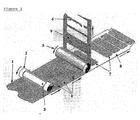
- the basic method for producing labels from roll label stock by label die cutting is shown in Figure 1.
- the roll label stock 1 is fed through a rotary die 2 which has several cutters 3 which produce the desired shape of the cut out 4 in the roll label stock 1.
- the roll label stock 1 then continues on to the stripping roller 5 which removes the matrix flagging 6 from the roll stock 1, leaving behind the die cut labels 7.
- the die-cutting behavior is influenced by the blade angle of rotary die 2 and the speed of the process.
- the narrower the angle the sharper but also the more expensive and fragile the blades. For this reason, it is preferred to use as large an angle as is possible.
- high speeds, even at high blade cutting angles e.g., more than 50 m/min at a blade cutting angle of 110° should be achieved.
- the main block copolymer component used in the adhesive composition is a block copolymer, having a structure represented by the general formulae S- (I/B) -S (1) or (S- (I/B)] n X (2) optionally mixed with minor amounts of one or more block copolymers selected from the group S-B-S, S-I-S, and radial variations thereof wherein S represents a poly(vinyl aromatic compound) block, (I/B) represents a block of a randomly copolymerized mixture of isoprene and butadiene, wherein the weight ratio between isoprene and butadiene is in the range of from 80:20 to 20:80, wherein n is an integer equal to or greater than 2, and wherein X is the residue of a coupling agent.
- Such block copolymers are known to behave as thermoplastic elastomers, given the proper choice of molecular weight, and total content of vinyl aromatic compound.
- aromatic vinyl compound useful in the practice of the present invention, may be mentioned styrene, alpha-methylstyrene, p-methylstyrene, o-methylstyrene, p-tert.butylstyrene, dimethylstyrene, and vinyl naphthalene or mixtures thereof.
- styrene is particularly preferred from the viewpoints of easy availability, reactivity, physical properties of the resulting block copolymers.
- the A polymer block may contain minor amounts of comonomers other than an aromatic vinyl compound, e.g., up to 5 wt% of a copolymerizable monomer such as butadiene and/or isoprene (based on the weight of the total block). Most preferred are A blocks derived from substantially pure styrene. These polymer blocks A preferably have a true molecular weight in the range from 9,500 to 25,000.
- the mixed polymer midblock (I/B) is made of butadiene and isoprene as copolymerizing monomers, although it too may contain minor amounts of other comonomers, e.g. up to 5 wt% of a copolymerizable monomer such as styrene (based on the weight of the total block), but mixtures of substantially pure isoprene and butadiene are preferred.
- the proportion of bound aromatic vinyl compound is in the range of 10-50 wt%, preferably 12-45 wt% based on the total block copolymer, most preferably 15-30 wt%.
- the proportion of bound butadiene is 18-80 wt%, preferably 40-70 wt% in total.
- the proportion of bound isoprene is 15-70 wt%, preferably 30-70 wt%.
- the or each block copolymer (a) to be applied in the adhesive compositions according to the present invention preferably has a weight average molecular weight (Mw, expressed in terms of polystyrene) ranging from 100,000 to 500,000, preferably from 150,000 to 250,000 as determined by gel permeation chromatography (GPC, using the method described by J. R. Runyon et al, J. Polym. Sci., 13, 2359 (1969).
- Mw weight average molecular weight
- the block copolymers to be applied in the adhesive compositions according to the present invention each preferably contain 1,2-vinyl bonds and/or 3,4-vinyl bonds in a proportion in the range of from 5 to 40 wt% based on the weight of the conjugated diene, and preferably from 5 to 20 wt% based on the weight of conjugated diene.
- the block copolymers according to the present invention each have only one peak on loss tangent (tan ⁇ ) attributable to the mixed butadiene/isoprene polymer block at a temperature of -50 °C or below.
- Said block copolymers to be applied as main component (a) in the adhesive composition have a randomly copolymerized block (I/B), which means that the mixed midblock shows no significant single homopolymer block formation. They can be prepared as described in WO 02/057386.
- the block copolymers according to the present invention can be made e.g. by coupling living diblock copolymer prepared by anionic polymerization with a coupling agent.
- tin coupling agents such as tin dichloride, monomethyltin dichloride, dimethyltin dichloride, monoethyltin dichloride, diethyltin dichloride, methyltin trichloride, monobutyltin dichloride, dibutyltin dibromide, monohexyltin dichloride and tin tetrachloride; halogenated silicon coupling agents such as dichlorosilane, monomethyldichlorosilane, dimethyldichlorosilane, monoethyldichlorosilane, diethyldichlorosilane, monobutyldichlorosilane, dibutyldichlorosilane, monohexyldichlorosilane, dihexyldichlorosilane, dibromosilane, monomethyldibromosilane, dimethyldibromosilane, silicon t
- the block copolymers may also be prepared by a a full sequential polymerization process (resulting in a product of general formula (1), with re-introduction of initiator before or during the step 2 polymerization (preparation of the I/B block), resulting in the in-situ formation of a diblock copolymer.
- Component (b) may be the finished, uncoupled diblock copolymer left as a component in component (a) which is synthesized by coupling a living diblock copolymer.
- the polymer blocks of both components will be identical. It may also be the in-situ produced diblock copolymer as the result of re-introduction of the initiator.
- a different diblock copolymer may be used, including poly(styrene-butadiene) and poly(styrene-isoprene) diblock copolymers.
- Component (b) may comprise a mixture of diblock copolymers.
- Component (b) comprises from 25 to 80% by weight of the mixture of components (a) and (b).
- Tackifying resins and plasticizers, as well as other components like antioxidants and the like, for use in PSA compositions based on styrenic block copolymers are known.
- PSAs are, for instance, described in Chapter 13 of the Handbook of Pressure Sensitive Adhesive Technology, 2 nd ed. by Donatas Satas (ISBN 0-442-28026-2).
- various rubber phase associated resins are disclosed, e.g., aliphatic olefin-derived resins, rosin esters, polyterpenes and terpene phenolic resins derived from petroleum or terpentine sources, which provide tack to the styrenic block copolymer.
- Particularly suitable tackifying resins are those having an average aromaticity (in relative percentage of aromatic protons as determined by proton-NMR) in the range of from 3 to 18%.
- a preferred type of resins are the mixed aliphatic/aromatic resins, mentioned in WO 02/057386, herewith incorporated by reference.
- An example of a suitable tackifying resin is WINGTACKTM 86, a modified aliphatic hydrocarbon resin with a softening point of 86°C, and an aromaticity of 9.6.
- the fourth component of the adhesive formulation of the present invention is oil. It preferably is present in an amount from 10 to 60 parts by weight per 100 parts of the mixture of components (a) and (b).
- Rubber compounding oils are well known in the art and include both high saturates content oils and naphthenic oils.
- Preferred plasticizer oils are highly saturated oils, e.g., TUFFLO® 6056 and 6204 oil made by Arco and naphthenic process oils, e.g., SHELLFLEX® 371 and 6371 oil made by Shell Chemical Company.
- the preferred amount of oil is 20 to 50 parts by weight so as to obtain the appropriate glass transition temperature and tack (label formulations typically contain about 40 phr of oil).
- compositions of the present invention may be modified further with the addition of other antioxidants and stabilizers without departing from the scope of this invention.
- the process of preparing a laminate of a face stock, PSA layer and a release liner is also known.
- the PSA layer may be applied without using any solvent (e.g., hot-melt) or in the form of its solution to a base material such as paper or a plastic film by means of a proper coater.
- PICCOTAC® 1094-E resin is an aliphatic hydrocarbon resin and WINGTACK® 96 resin has been defined herein before. The resins were used in an amount of 150 parts by weight on 100 parts by weight of the mixture of components (a) and (b). EDELEXTM N956, a naphthenic mineral oil, was used as plasticizer, in an amount of 40 parts by weight. Finally, the formulation comprised 3 parts by weight of IRGANOXTM 1010 as antioxidant.
- Polymer composition A has a slightly better RBT performance, and a slightly worse LT and HP performance. On balance, these two compositions perform equally well.
- Formulation based on ... KD1113 Polymer comp. A Die cutting behaviour, depending on blade angle 60° ⁇ 50 m/min >77 m/min 75° ⁇ 10 m/min >77 m/min 110° ⁇ 6 m/min >77 m/min
- the die cutting behavior of Polymer composition A (77 is the limit of the equipment) greatly outperforms that of the composition based on KD1113, which illustrates the superior properties of Polymer composition A.
Landscapes
- Chemical & Material Sciences (AREA)
- Chemical Kinetics & Catalysis (AREA)
- Organic Chemistry (AREA)
- Adhesives Or Adhesive Processes (AREA)
Priority Applications (14)
| Application Number | Priority Date | Filing Date | Title |
|---|---|---|---|
| EP03077043A EP1493790A1 (de) | 2003-06-30 | 2003-06-30 | Etikette mit verbesserten Stanzeigenschaften |
| KR1020057015339A KR100642357B1 (ko) | 2003-02-21 | 2004-02-19 | 다이 절단 성능이 개선된 라벨 스톡 |
| DE602004014593T DE602004014593D1 (de) | 2003-02-21 | 2004-02-19 | Etikettenvormaterial mit verbessertem stanzverhalten |
| EP04712572A EP1599556B1 (de) | 2003-02-21 | 2004-02-19 | Etikettenvormaterial mit verbessertem stanzverhalten |
| AT04712572T ATE399196T1 (de) | 2003-02-21 | 2004-02-19 | Etikettenvormaterial mit verbessertem stanzverhalten |
| ES07075651T ES2332019T3 (es) | 2003-02-21 | 2004-02-19 | Lamina de etiquetas con un comportamiento de troquelado mejorado. |
| PCT/EP2004/050169 WO2004074392A1 (en) | 2003-02-21 | 2004-02-19 | Label stock with improved die-cutting performance |
| JP2006500118A JP2006520826A (ja) | 2003-02-21 | 2004-02-19 | 改善されたダイス切断性能を有するラベルストック |
| BRPI0407641-9A BRPI0407641A (pt) | 2003-02-21 | 2004-02-19 | material para etiqueta |
| AT07075651T ATE443115T1 (de) | 2003-02-21 | 2004-02-19 | Etikettenrolle mit verbesserter abschneideleistung |
| US10/546,021 US20060099373A1 (en) | 2003-02-21 | 2004-02-19 | Label stock with improved die-cutting performance |
| EP07075651A EP1873221B1 (de) | 2003-02-21 | 2004-02-19 | Etikettenrolle mit verbesserter Abschneideleistung |
| DE602004023241T DE602004023241D1 (de) | 2003-02-21 | 2004-02-19 | Etikettenrolle mit verbesserter Abschneideleistung |
| TW093104285A TWI320426B (en) | 2003-02-21 | 2004-02-20 | Label stock with improved die-cutting performance |
Applications Claiming Priority (1)
| Application Number | Priority Date | Filing Date | Title |
|---|---|---|---|
| EP03077043A EP1493790A1 (de) | 2003-06-30 | 2003-06-30 | Etikette mit verbesserten Stanzeigenschaften |
Publications (1)
| Publication Number | Publication Date |
|---|---|
| EP1493790A1 true EP1493790A1 (de) | 2005-01-05 |
Family
ID=33427151
Family Applications (1)
| Application Number | Title | Priority Date | Filing Date |
|---|---|---|---|
| EP03077043A Withdrawn EP1493790A1 (de) | 2003-02-21 | 2003-06-30 | Etikette mit verbesserten Stanzeigenschaften |
Country Status (1)
| Country | Link |
|---|---|
| EP (1) | EP1493790A1 (de) |
Cited By (5)
| Publication number | Priority date | Publication date | Assignee | Title |
|---|---|---|---|---|
| US7307124B2 (en) | 2004-02-19 | 2007-12-11 | Kraton Polymers U.S. Llc | Hot-melt adhesive composition for non-wovens |
| US7560512B2 (en) | 2005-03-11 | 2009-07-14 | Kraton Polymers U.S. Llc | Adhesive compositions comprising mixtures of block copolymers |
| US7589152B2 (en) | 2003-12-22 | 2009-09-15 | Kraton Polymers U.S. Llc | Adhesive formulations for novel radial (S-I/B)x polymers |
| US7872065B2 (en) | 2005-03-11 | 2011-01-18 | Kraton Polymers U.S. Llc | Adhesive compositions comprising mixtures of block copolymers |
| US9394466B2 (en) | 2008-04-22 | 2016-07-19 | 3M Innovative Properties Company | Method of making adhesive article |
Citations (4)
| Publication number | Priority date | Publication date | Assignee | Title |
|---|---|---|---|---|
| DE2942128A1 (de) * | 1979-10-18 | 1981-04-30 | Basf Ag, 6700 Ludwigshafen | Schmelzhaftkleber auf basis von nichthydrierten, linearen blockcopolymerisaten a-b-a |
| WO1997030844A1 (en) * | 1996-02-23 | 1997-08-28 | Ato Findley Inc. | Improved pressure sensitive labeling adhesive |
| WO2002000805A2 (en) * | 2000-06-27 | 2002-01-03 | Exxonmobil Chemical Patents Inc. | Adhesives with improved die-cutting performance |
| WO2002057386A2 (en) * | 2001-01-18 | 2002-07-25 | Kraton Polymers Research B.V. | Adhesive composition |
-
2003
- 2003-06-30 EP EP03077043A patent/EP1493790A1/de not_active Withdrawn
Patent Citations (4)
| Publication number | Priority date | Publication date | Assignee | Title |
|---|---|---|---|---|
| DE2942128A1 (de) * | 1979-10-18 | 1981-04-30 | Basf Ag, 6700 Ludwigshafen | Schmelzhaftkleber auf basis von nichthydrierten, linearen blockcopolymerisaten a-b-a |
| WO1997030844A1 (en) * | 1996-02-23 | 1997-08-28 | Ato Findley Inc. | Improved pressure sensitive labeling adhesive |
| WO2002000805A2 (en) * | 2000-06-27 | 2002-01-03 | Exxonmobil Chemical Patents Inc. | Adhesives with improved die-cutting performance |
| WO2002057386A2 (en) * | 2001-01-18 | 2002-07-25 | Kraton Polymers Research B.V. | Adhesive composition |
Cited By (6)
| Publication number | Priority date | Publication date | Assignee | Title |
|---|---|---|---|---|
| US7589152B2 (en) | 2003-12-22 | 2009-09-15 | Kraton Polymers U.S. Llc | Adhesive formulations for novel radial (S-I/B)x polymers |
| US7307124B2 (en) | 2004-02-19 | 2007-12-11 | Kraton Polymers U.S. Llc | Hot-melt adhesive composition for non-wovens |
| US7560512B2 (en) | 2005-03-11 | 2009-07-14 | Kraton Polymers U.S. Llc | Adhesive compositions comprising mixtures of block copolymers |
| KR100984578B1 (ko) * | 2005-03-11 | 2010-09-30 | 크레이튼 폴리머즈 리서치 비.브이. | 블록 공중합체의 혼합물을 함유하는 접착제 조성물 |
| US7872065B2 (en) | 2005-03-11 | 2011-01-18 | Kraton Polymers U.S. Llc | Adhesive compositions comprising mixtures of block copolymers |
| US9394466B2 (en) | 2008-04-22 | 2016-07-19 | 3M Innovative Properties Company | Method of making adhesive article |
Similar Documents
| Publication | Publication Date | Title |
|---|---|---|
| EP1599556B1 (de) | Etikettenvormaterial mit verbessertem stanzverhalten | |
| US7202297B2 (en) | Adhesive composition | |
| CN101180377B (zh) | 抗蠕变胶粘剂及以其制备的胶带 | |
| KR930009214B1 (ko) | 감압성 접착제 조성물 | |
| US7651765B2 (en) | Adhesive composition and tapes and labels derived therefrom | |
| EP1424359B1 (de) | Elastomerzusammensetzung und damit hergestellte haftklebstoffe | |
| RU2367675C2 (ru) | Клеевые композиции, содержащие смеси блоксополимеров | |
| EP3202844B1 (de) | Blockcopolymerzusammensetzung, haftzusammensetzung und haftfolie | |
| CN101198670A (zh) | 压敏胶粘剂 | |
| JPS61278578A (ja) | 感圧性接着剤組成物 | |
| EP1493790A1 (de) | Etikette mit verbesserten Stanzeigenschaften | |
| EP0659861B1 (de) | Entfernbare druckempfindliche Klebstoffzusammensetzung | |
| JP3107491B2 (ja) | 重合体組成物および粘着剤 | |
| US6794441B2 (en) | Die cuttable label adhesive formulation | |
| CN1768120A (zh) | 具有改进模切性能的标签备料 | |
| US12583076B2 (en) | Adhesive sheet and polishing pad with adhesive sheet | |
| US20060070543A1 (en) | Adhesive composition | |
| US20070244252A1 (en) | Adhesive compositions comprising mixtures of block copolymers |
Legal Events
| Date | Code | Title | Description |
|---|---|---|---|
| PUAI | Public reference made under article 153(3) epc to a published international application that has entered the european phase |
Free format text: ORIGINAL CODE: 0009012 |
|
| AK | Designated contracting states |
Kind code of ref document: A1 Designated state(s): AT BE BG CH CY CZ DE DK EE ES FI FR GB GR HU IE IT LI LU MC NL PT RO SE SI SK TR |
|
| AX | Request for extension of the european patent |
Extension state: AL LT LV MK |
|
| 18W | Application withdrawn |
Effective date: 20050117 |
|
| D18W | Application withdrawn (deleted) | ||
| AKX | Designation fees paid | ||
| STAA | Information on the status of an ep patent application or granted ep patent |
Free format text: STATUS: THE APPLICATION IS DEEMED TO BE WITHDRAWN |
|
| 18D | Application deemed to be withdrawn |
Effective date: 20050706 |