EP1493948A2 - Verfahren zur Steuerung einer Parksperre für Kraftfahrzeuge, insbesondere für landwirtschaftliche Nutzfahrzeuge - Google Patents
Verfahren zur Steuerung einer Parksperre für Kraftfahrzeuge, insbesondere für landwirtschaftliche Nutzfahrzeuge Download PDFInfo
- Publication number
- EP1493948A2 EP1493948A2 EP04015073A EP04015073A EP1493948A2 EP 1493948 A2 EP1493948 A2 EP 1493948A2 EP 04015073 A EP04015073 A EP 04015073A EP 04015073 A EP04015073 A EP 04015073A EP 1493948 A2 EP1493948 A2 EP 1493948A2
- Authority
- EP
- European Patent Office
- Prior art keywords
- parking brake
- engagement
- parking
- vehicle
- parking lock
- Prior art date
- Legal status (The legal status is an assumption and is not a legal conclusion. Google has not performed a legal analysis and makes no representation as to the accuracy of the status listed.)
- Granted
Links
- 238000000034 method Methods 0.000 title claims abstract description 65
- 230000008569 process Effects 0.000 claims abstract description 34
- 230000005540 biological transmission Effects 0.000 claims description 42
- 230000007704 transition Effects 0.000 claims description 23
- 230000008878 coupling Effects 0.000 claims description 12
- 238000010168 coupling process Methods 0.000 claims description 12
- 238000005859 coupling reaction Methods 0.000 claims description 12
- 238000005096 rolling process Methods 0.000 claims description 8
- 230000001419 dependent effect Effects 0.000 claims description 6
- 230000008859 change Effects 0.000 claims description 5
- 230000000994 depressogenic effect Effects 0.000 claims description 4
- 238000011156 evaluation Methods 0.000 claims description 3
- 230000010354 integration Effects 0.000 claims description 2
- 230000001360 synchronised effect Effects 0.000 claims description 2
- 230000003287 optical effect Effects 0.000 abstract 1
- 230000007935 neutral effect Effects 0.000 description 20
- 230000002706 hydrostatic effect Effects 0.000 description 5
- 238000003780 insertion Methods 0.000 description 4
- 230000001133 acceleration Effects 0.000 description 3
- 238000001994 activation Methods 0.000 description 3
- 230000037431 insertion Effects 0.000 description 3
- 230000004913 activation Effects 0.000 description 2
- 230000008901 benefit Effects 0.000 description 2
- 238000003825 pressing Methods 0.000 description 2
- 238000012552 review Methods 0.000 description 2
- 241001136792 Alle Species 0.000 description 1
- 230000002950 deficient Effects 0.000 description 1
- 238000013461 design Methods 0.000 description 1
- 238000003745 diagnosis Methods 0.000 description 1
- 238000010586 diagram Methods 0.000 description 1
- 230000000694 effects Effects 0.000 description 1
- 230000002996 emotional effect Effects 0.000 description 1
- 238000007373 indentation Methods 0.000 description 1
- 210000003127 knee Anatomy 0.000 description 1
- 238000004091 panning Methods 0.000 description 1
- 238000012360 testing method Methods 0.000 description 1
- 238000012546 transfer Methods 0.000 description 1
- 230000001960 triggered effect Effects 0.000 description 1
Images
Classifications
-
- F—MECHANICAL ENGINEERING; LIGHTING; HEATING; WEAPONS; BLASTING
- F16—ENGINEERING ELEMENTS AND UNITS; GENERAL MEASURES FOR PRODUCING AND MAINTAINING EFFECTIVE FUNCTIONING OF MACHINES OR INSTALLATIONS; THERMAL INSULATION IN GENERAL
- F16H—GEARING
- F16H61/00—Control functions within control units of change-speed- or reversing-gearings for conveying rotary motion ; Control of exclusively fluid gearing, friction gearing, gearings with endless flexible members or other particular types of gearing
- F16H61/12—Detecting malfunction or potential malfunction, e.g. fail safe ; Circumventing or fixing failures
-
- F—MECHANICAL ENGINEERING; LIGHTING; HEATING; WEAPONS; BLASTING
- F16—ENGINEERING ELEMENTS AND UNITS; GENERAL MEASURES FOR PRODUCING AND MAINTAINING EFFECTIVE FUNCTIONING OF MACHINES OR INSTALLATIONS; THERMAL INSULATION IN GENERAL
- F16H—GEARING
- F16H63/00—Control outputs from the control unit to change-speed- or reversing-gearings for conveying rotary motion or to other devices than the final output mechanism
- F16H63/40—Control outputs from the control unit to change-speed- or reversing-gearings for conveying rotary motion or to other devices than the final output mechanism comprising signals other than signals for actuating the final output mechanisms
- F16H63/48—Signals to a parking brake or parking lock; Control of parking locks or brakes being part of the transmission
-
- F—MECHANICAL ENGINEERING; LIGHTING; HEATING; WEAPONS; BLASTING
- F16—ENGINEERING ELEMENTS AND UNITS; GENERAL MEASURES FOR PRODUCING AND MAINTAINING EFFECTIVE FUNCTIONING OF MACHINES OR INSTALLATIONS; THERMAL INSULATION IN GENERAL
- F16H—GEARING
- F16H59/00—Control inputs to control units of change-speed- or reversing-gearings for conveying rotary motion
- F16H59/36—Inputs being a function of speed
- F16H59/44—Inputs being a function of speed dependent on machine speed, e.g. the vehicle speed
- F16H2059/446—Detecting vehicle stop, i.e. the vehicle is at stand still, e.g. for engaging parking lock
Definitions
- the present invention relates to a method for Control of a parking brake for motor vehicles, in particular for agricultural vehicles, according to the generic term of claim 1.
- hydrostatic-mechanical power split transmissions which consists of a continuously adjustable Hydrostatic transmission with a volume adjustable and a volume constant unit, a summation gear and a range gearbox with several switchable gears exist.
- a parking lock which primarily a security function Has. Since the driver has the opportunity during the standstill control to leave the vehicle, must in case of electrical or hydraulic failure a rolling of the vehicle can be mechanically prevented. Furthermore, by automatically inserting the parking brake after a certain time when the tractor is stopped Hydrostat relieved. In addition, the parking brake can be secured of the vehicle.
- Parking locks are usually equipped with a pawl, as it is e.g. in DE 101 19 268 of the applicant described is, executed; but there are also known solutions where existing parking brakes (frictional Brakes) are used with spring-loaded.
- the parking brake does not check if the parking lock actually was inserted. So it may be disadvantageous In addition, the vehicle will have a parking brake engaged indicates and switches to neutral. On the other hand, it can happen that with unlocked parking lock an indefinite Time is tried to insert the parking brake repeatedly causing the vehicle to travel a considerable distance can.
- the present invention is based on the object a method for controlling a parking brake for motor vehicles, in particular for agricultural vehicles, which is a hydrostatic-mechanical power split transmission include indicating which one is safe Guaranteed engagement and disengagement of the parking brake and for the Case of non-intervention initiates replacement measures. moreover should be a review of the safe indenting the Parking lock be guaranteed.
- the check of the engagement process takes place by turning the output with a defined Load or output torque change in both directions, wherein, when the load is not established, a Threshold exceeded for the distance traveled or if a defined time threshold is exceeded the process is aborted and an error occurs Engaging the parking lock is detected.
- the parking lock control is done by the gearbox controller, which the request to insert or disengage the parking lock of the vehicle engine gearbox governor (FMGR) receives, taking after inserting the parking lock a currently closed directional coupling open and the four-wheel drive regardless of the four-wheel-switch position is switched.
- FMGR vehicle engine gearbox governor
- the insertion of the parking brake is preferably at a closed directional clutch to a load on the output (Ratchet wheel) to adjust. After done Disengagement of the parking brake is the four-wheel drive accordingly set the switch position. When open Directional couplings the speed has a value of about 0.25 km / h or the clutch pedal is pressed is, the engagement process is canceled.
- An actuation of the parking lock button for the parking lock causes an immediate engagement of the parking lock, if the speed of the vehicle below a limit speed lies, with the parking lock button already can be operated when rolling out of the vehicle.
- the procedure can be used both with parking locks with a Pawl as well as parking locks with a frictional Brake be applied.
- the toggle is controlled by a 4-3-way parking lock valve emotional.
- This valve has three positions: “Parking lock a “,” parking lock off “and the middle position as well four ways: “parking lock on”, “parking lock off”, 30-bar circle, and tank.
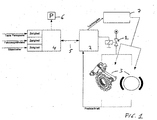
- the parking brake valve is in Fig. 1 with provided with the reference numeral 1.
- the control of the 4-3-way valve via a Pulse width modulated signal (PWM signal) via the PWM outputs PSE ("parking lock on") and PSA ("parking lock off”) on the gearbox controller 2.
- PWM signal Pulse width modulated signal
- PSA parking lock off
- the control logic in the gearbox controller 2 not only switches the valve 1, but must for the engagement and disengagement of the hydrostats and the directional couplings KV (forward clutch) and KR (reverse clutch) of the transmission 7 control accordingly. In addition, will from the transmission controller determined whether the parking brake 3 safe is indented.
- the request to engage or disengage the parking brake 3 receives the transmission controller 2 from the vehicle engine-transmission controller (FMGR) 4. This information and the feedback of the transmission controller 2 are via the CAN bus. 5 transfer.
- FMGR vehicle engine-transmission controller
- the input signals for the control logic in the vehicle engine / transmission controller FMGR 4 are of different Buttons, switches or pedals generated, such. B. from the seat switch, the steering column switch for the positions V, N and R, the parking brake button, the accelerator pedal, the Clutch pedal and the service and handbrake.
- a first variant of the invention may by the transmission controller the parking lock with open directional couplings, that is, in the N position, are taken out, e.g. at Actuation of the clutch pedal.
- a directional clutch KV or KR.
- KV or KR a directional clutch
- the effected disengagement of the parking lock is transmitted from the transmission controller to the FMGR. After the disengagement of the lock is the four-wheel drive adjusted according to the switch position.
- a positive edge at the parking lock button or at one Actuator for the parking lock causes a Immediately inserting the parking lock, provided the speed of the vehicle is below a limit speed.
- a typical value for the limit speed is about 0.25 km / h or nAb ⁇ 25 U / min.
- the button can come here already when rolling out the vehicle (vehicle speed is less than or equal to 3 km / h). It is also possible to insert the parking brake from position "N", but only if the speed of the vehicle is less than about 0.25 km / h. Should in this case the Vehicle speed increase or the clutch pedal be pressed, the engagement process is canceled.
- the parking brake engaged, when the driver rises from the seat.
- the driver can also without seat switch signal to move the vehicle, the maximum speed However, it is limited to approx. 2 km / h. If the seat is loaded again, by releasing the Accelerators canceled the speed limit.
- the N button is pressed for pressed for one second, the vehicle is permanently on Switched "N", causing the parking lock permanently disengaged remains.
- the FMGR calculates the vehicle speed the transmission output speed via the rear axle ratio and the tire rolling circumference, wherein the transmission output speed transmitted via the CAN bus from the gearbox controller becomes.
- a brake actuation Resetting a counter which in standstill control after a certain time has elapsed (a typical value 45 seconds) automatic engagement of the parking brake initiates. If the service brake is applied during a "P" ⁇ "N” ⁇ “P” transition is actuated, then the engagement process only stopped - the vehicle is in standstill control without start-up possibility. When leaving the Brake pedal calls the FMGR immediately an engagement of the Parking lock on.
- the control logic of the parking lock is preferred in the FMGR built as a state machine, with between 8 States (States) is distinguished:
- the transmission controller reports that the parking brake is not is inserted, for. B. as already explained by recognizing an output speed greater than the limit speed corresponding, the corresponding direction of movement is Area code (KV or KR) met and in State 4 (No standstill regulation). This is a Error flag set, the a renewed parking lock engagement process effected at standstill of the vehicle.
- Area code KV or KR
- state 3 standstill control
- state 2 the clutch pedal pressed, it leads to a transition in state 6 (neutral).
- a preselection by the driver causes a transition in State 4 (no standstill control). Will the parking lock button pressed, a transition is made to State 8 (Off Neutral parking lock insert).
- state 6 (neutral) passed over, i. the insertion request (via the parking lock button) is ignored. Otherwise, a transition occurs in state 7 (neutral from "P").
- the display shows P.
- state 7 (neutral from "P") a flag can be set which causes the counter to be set when the flag is set is considered expired. This will lock the parking immediately inserted.
- This flag is in state 1 (parking lock is engaged) or reset by preselection by the driver.
- State 3 standstill control
- 4 no standstill control
- State 7 prevents the service brake restarts the counter, and on the other hand, that it is detected whether the state 7 (neutral from "P") previously active was. Whether the state machine has run over State 7 is also relevant for state 5 (parking lock is engaged).
- the display visually shows the driver according to the invention and acoustically indicate that the parking brake is not is inserted and he must put on the handbrake. Of the After-run of the FMGR and the display is stopped as soon as the Handbrake signal is applied or the parking brake is engaged. If the driver ignores the display warnings, it switches the FMGR 10 seconds after leaving the vehicle (Seat switch) off. When restarting the vehicle becomes independent displayed by the parking lock state "N".
- the control logic for the parking brake in the gearbox controller consists of the initialization part and the four States “indented”, “indented”, “disengaged” and “disengaged”. The distinction in which state the Gearbox controller is located by corresponding flags made; There is no sensor with which the transmission controller communicated directly the position of the parking pawl becomes.
- the transmission controller receives over, as already explained the CAN bus from FMGR meets the requirements for parking brake or -ausush, separating or clutch-insertion, etc., wherein the input and Ausgurzeit the parking brake depends on temperature be calculated.
- the parking lock valve which moves the toggle, has the positions "parking lock on", “parking lock off” and the middle position. Both coils of the valve are at Switch on first with full battery voltage activated, then the pulse width is reduced, so that on average the rated voltage of the valve spool is adjusted.
- the toggle lever is in the position "Park lock off” moves, with the PSA output only at Start of the next engagement process switched off again becomes.
- a faulty energization of the PSE output eg: Power amplifier defective
- the directional clutch must be inserted. When the clutch pedal is pressed According to the invention, no directional clutch is engaged.
- the output is moved. This is done by specifying a Adjustment of the hydrostat by activation (of the stepping motor) with a PWM signal.
- the engagement process is started.
- the indentation time is correspondingly temperature-dependent calculated. During the entire process will be a Counter counted up at the end of each phase for the next Phase is initialized.
- the parking brake is activated (PSE), the range ("V” or “R”), the load, the high pressure, the slope or gradient stored and the error evaluation and initializes the integration of the output speed. If the Einschzeit has expired, then the Panning started. The latch is either engaged or Presses against the tip circle of the ratchet wheel under pressure.
- a check of the engagement process with the pressurized (PSE output of the gear controller) parking lock valve performed.
- aim the review is, by turning the output to back and forth, the pawl the possibility of snapping into to give the ratchet wheel.
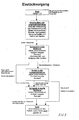
- the engagement process is shown in Fig. 3rd shown.
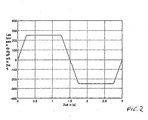
- the output is moved by an output torque change according to Fig. 2, which the load default as a function illustrates the time, is given.
- the sign this specification always depends on the inserted area ("V” or "R”) and from the thrust or train of the vehicle (base load). This ensures that started in that direction becomes “easier”.
- the load and thus the output torque is from the Difference between the swivel angle specification and the measured Gear ratio calculated iV. It turns out that at standstill of the vehicle drive torque and Load torque must balance; the output torque must cover the base load.
- the acceleration process is not a large Last built up, since once the play in the transmission and in the parking brake is used up. Only when the latch in the gap is locked, a load may be corresponding build the default. If the minimum load is not reached or the way for the engagement is too large, the Activation process aborted, the PSA output is energized, the set before loading current load and an error flag (Parking lock not insertable) set.
- the engine idle speed is preferably during engagement increased about 1 000 rpm to stop the engine prevent.
- the valve After the first swing completed in both directions is, the valve is current and thus depressurized switched, the pressure drop time (temperature-dependent) waiting and then the same pan started without printing. It is checked whether the pawl is engaged.
- the same test conditions apply as in first swing.
- the high pressure must have the base load of 200 bar above or below, the maximum way may can not be exceeded, and the maximum time allowed not be exceeded. Will be one of the criteria not satisfied, the swing is canceled, the PSA output energized by the gearbox controller before being engaged current load set and a fault flag (parking lock not insertable).
- valve is connected via the PSE output the gearbox controller again for about 2.5 s energized and controlled the hydrostatic load.
- the release time is (according to the evaluations in the cold chamber) temperature-dependent calculated. After expiration During this time the FMGR will be notified of the successful disengagement.
Landscapes
- Engineering & Computer Science (AREA)
- General Engineering & Computer Science (AREA)
- Mechanical Engineering (AREA)
- Regulating Braking Force (AREA)
- Control Of Transmission Device (AREA)
- Control Of Driving Devices And Active Controlling Of Vehicle (AREA)
- Harvester Elements (AREA)
Abstract
Description
Es zeigen:
- Fig. 1
- eine schematische Ansicht der Komponenten, die für das erfindungsgemäße Verfahren benötigt werden;
- Fig. 2
- eine Darstellung der beim Überprüfen des Zustandes der Parksperre angelegten Last als Funktion der Zeit und
- Fig. 3
- eine Blockdarstellung des Einrückvorgangs einer Parksperre mit Sperrklinke gemäß der vorliegenden Erfindung.
- 1
- Parksperrenventil
- 2
- Getriebe-Regler
- 3
- Parksperre
- 4
- Fahrzeug-Motor-Getriebe-Regler
- 5
- CAN-Bus
- 6
- Display
- 7
- Getriebe
Claims (26)
- Verfahren zur Steuerung einer Parksperre für Kraftfahrzeuge, insbesondere für landwirtschaftliche Nutzfahrzeuge, welche ein hydrostatisch-mechanisches Leistungsverzweigungsgetriebe umfassen, dadurch gekennzeichnet, dass nach dem Einlegen der Parksperre (3) (Position P) überprüft wird, ob die Parksperre (3) tatsächlich eingelegt ist, wobei, wenn die Parksperre nicht eingelegt ist, das Fahrzeug in Stillstandsregelung bleibt und der Fahrer optisch und/oder akustisch informiert wird.
- Verfahren nach Anspruch 1, dadurch gekennzeichnet, dass, wenn trotz eingelegter Parksperre (3) eine Abtriebszahl festgestellt wird, ein erneuter Einrückvorgang gestartet wird.
- Verfahren nach Anspruch 1 oder 2, dadurch gekennzeichnet, dass die Überprüfung des Einrückvorgangs durch Verdrehen des Abtriebs mit einer definierten Last bzw. Abtriebsmomentänderung in beiden Richtungen erfolgt, wobei, wenn die Last nicht aufgebaut wird, ein Schwellenwert für den dabei zurückgelegten Weg überschritten wird oder eine definierte Zeitschwelle überschritten wird, der Vorgang abgebrochen wird und ein Fehler beim Einrücken der Parksperre (3) erkannt wird.
- Verfahren nach einem der vorangehenden Ansprüche, dadurch gekennzeichnet, dass bei notentriegelter Parksperre (3) keine Last aufgebaut wird, wobei, wenn der Drehwinkel am Abtrieb einen Winkel in der Größenordnung von 60° überschreitet, das Fahrzeug in den Zustand Stillstandsregelung übergeht.
- Verfahren nach einem der vorangehenden Ansprüche, dadurch gekennzeichnet, dass die Parksperrenansteuerung durch den Getriebe-Regler (2) erfolgt, welcher die Anforderung zum Einlegen bzw. Ausrücken der Parksperre vom Fahrzeug-Motor-Getriebe-Regler (FMGR) (4) erhält, wobei nach dem Einlegen der Parksperre (3) eine aktuell geschlossene Richtungskupplung geöffnet und der Allradantrieb unabhängig von der Allrad-Schalterstellung geschaltet wird.
- Verfahren nach Anspruch 5, dadurch gekennzeichnet, dass das Einlegen der Parksperre (3) bei geöffneten Richtungskupplungen oder bei einer geschlossenen Richtungskupplung erfolgen kann, wobei nach erfolgtem Ausrücken der Parksperre der Allradantrieb entsprechend der Schalterstellung eingestellt wird und wobei bei geöffneten Richtungskupplungen (Position "N") die Geschwindigkeit des Fahrzeugs einen Wert in der Größenordnung von etwa 0,25 km/h nicht überschreiten darf, wobei wenn bei geöffneten Richtungskupplungen die Geschwindigkeit diesen Wert überschreitet oder das Kupplungspedal betätigt wird, der Einrückvorgang abgebrochen wird.
- Verfahren nach einem der vorangehenden Ansprüche, dadurch gekennzeichnet, dass eine positive Flanke am Parksperrentaster oder an einer entsprechenden Betätigungseinrichtung für die Parksperre (3) ein sofortiges Einlegen der Parksperre (3) bewirkt, sofern die Geschwindigkeit des Fahrzeugs unter einer Grenzgeschwindigkeit liegt, wobei der Parksperrentaster bereits beim Ausrollen des Fahrzeuges betätigt werden kann.
- Verfahren nach Anspruch 7, dadurch gekennzeichnet, dass die Grenzgeschwindigkeit in der Größenordnung von 0,25 km/h liegt.
- Verfahren nach einem der vorangehenden Ansprüche, dadurch gekennzeichnet, dass, wenn sich das Fahrzeug unterhalb der Grenzgeschwindigkeit in der Größenordnung von 0,25 km/h bewegt, nach einer vorbestimmten Zeit, die Parksperre (3) eingelegt wird, wenn sich der Fahrer vom Sitz erhebt.
- Verfahren nach Anspruch 9, dadurch gekennzeichnet, dass die vorbestimmte Zeit etwa 5 Sekunden beträgt.
- Verfahren nach einem der vorangehenden Ansprüche, dadurch gekennzeichnet, dass bei eingelegter Parksperre (3) bei Vorwahl "V" oder Vorwahl "R" die jeweilige Richtungskupplung eingelegt und die Parksperre ausgerückt wird.
- Verfahren nach einem der vorangehenden Ansprüche, dadurch gekennzeichnet, dass, wenn während des Einrückvorgangs der Parksperre (3) aus "V1" oder "R1" das Fahrpedal betätigt wird, der Einrückvorgang unterbrochen, die Parksperre sofort ausgerückt und das Fahrzeug beschleunigt wird.
- Verfahren nach einem der vorangehenden Ansprüche, dadurch gekennzeichnet, dass, wenn das Kupplungspedal bei eingelegter Parksperre oder während des Einrückvorganges über ca. 90 % des Pedalwegs betätigt wird, die Parksperre (3) ausgerückt wird, wobei wenn anschließend der Pedalweg ca. 85 % überschreitet, die Parksperre wieder eingelegt wird, sofern sich das Fahrzeug nicht bewegt oder die Grenzgeschwindigkeit von etwa 0,25 km/h nicht überschreitet.
- Verfahren nach Anspruch 13, dadurch gekennzeichnet, dass, wenn das Fahrzeug wegrollt, die entsprechende Richtungskupplung einsynchronisiert wird, so dass das Fahrzeug über das Fahrpedal in diese Richtung sofort beschleunigbar ist.
- Verfahren nach einem der vorangehenden Ansprüche, dadurch gekennzeichnet, dass, wenn bei eingelegter Parksperre (3) und durchgedrücktem Kupplungspedal der N-Taster für etwa eine Sekunde betätigt wird, das Fahrzeug dauerhaft auf "N" geschaltet wird, wodurch die Parksperre (3) dauerhaft ausgerückt bleibt.
- Verfahren nach einem der vorangehenden Ansprüche, dadurch gekennzeichnet, dass, wenn die Parksperre (3) über den Parksperrenschalter aus "N" heraus eingelegt wird, die Betätigung des Kupplungspedals einen Abbruch des Einrückvorgangs bewirkt.
- Verfahren nach einem der vorangehenden Ansprüche, dadurch gekennzeichnet, dass eine Bremsbetätigung ein Rücksetzen des Zählers bewirkt, welcher bei Stillstandsregelung nach Ablauf einer bestimmten Zeit in der Größenordnung von 45 Sekunden ein automatisches Einrücken der Parksperre einleitet, wobei, wenn die Bremse während eines "P" → "N" → "P"-Überganges betätigt wird, der Einrückvorgang lediglich angehalten wird und beim Verlassen des Bremspedals vom Fahrzeug-Motor-Getriebe-Regler (4) unverzüglich ein Einrücken der Parksperre angefordert wird.
- Verfahren nach einem der vorangehenden Ansprüche, dadurch gekennzeichnet, dass, wenn bei Zündung aus keine Rückmeldung vom Getriebe-Regler (2) über ein gesichertes Einrücken der Parksperre vorliegt, sich der Fahrzeug-Motor-Getriebe-Regler (4) und das Display (6) nicht abschalten, wobei der Fahrer optisch und akustisch darauf hingewiesen wird, dass die Parksperre nicht eingelegt ist, wobei der Nachlauf des Fahrzeug-Motor-Getriebe-Reglers (4) und des Displays (6) beendet wird, sobald ein Handbremssignal über die Betätigung der Handbremse vorliegt oder die Parksperre eingelegt wird.
- Verfahren nach einem der vorangehenden Ansprüche, dadurch gekennzeichnet, dass für den Fall einer eine Sperrklinke umfassenden Parksperre, bei der die Sperrklinke durch eine Rolle über einen Kniehebel in eine Lücke am Klinkenrad gedrückt wird, der Kniehebel durch ein als 4-3-Wege-Ventil ausgebildetes Parksperrenventil (1) bewegt wird, dessen Ansteuerung durch pulsweitenmodulierte Signale über einen ersten Ausgang (PSE, Parksperre Ein) und einen zweiten Ausgang (PSA, Parksperre Aus) am Getriebe-Regler (2) erfolgt.
- Verfahren nach Anspruch 19, dadurch gekennzeichnet, dass beim Einrücken der Parksperre (3) in einer ersten Phase die Parksperre (3) angesteuert (PSE), der Bereich ("V" oder "R"), die Last, der Hochdruck, die Steigung oder das Gefälle abgespeichert und die Fehlerauswertung und die Integration der Abtriebsdrehzahl initialisiert werden, wobei, wenn eine temperaturabhängig berechnete Einrückzeit abläuft der Schwenk der Sperrklinke durchgeführt wird, so dass die Sperrklinke entweder eingerückt oder unter Druck am Kopfkreis des Klinkenrades anliegt.
- Verfahren nach Anspruch 20, dadurch gekennzeichnet, dass in einer zweiten Phase eine Überprüfung des Einrückvorgangs mit dem mit Druck beaufschlagtem (Ausgang PSE des Getriebereglers) Parksperrenventil (1) durchgeführt wird, wobei durch Verdrehen des Abtriebs mit einer definierten Last in beide Richtungen, der Sperrklinke die Möglichkeit zum Einrasten in das Klinkenrad gegeben wird, wenn sie vorher auf einem Zahn des Klinkenrades gelegen ist, wobei, wenn die Parksperre (3) eingerückt ist, diese die Last aufnimmt, so dass der maximale Weg, den das Fahrzeug bei eingerückter Parksperre zurücklegt einen definierten Wert annimmt.
- Verfahren nach Anspruch 21, dadurch gekennzeichnet, dass, wenn eine Mindestlast nicht erreicht wird oder der Weg für das Einrücken den definierten Wert überschreitet, der Einrückvorgang abgebrochen, der PSA-Ausgang des Getriebe-Reglers bestromt, die vor dem Einrücken aktuelle Last eingestellt und ein Fehlerflag (Parksperre nicht einlegbar) gesetzt wird.
- Verfahren nach Anspruch 21, dadurch gekennzeichnet, dass, wenn die Parksperre (3) eingerückt ist, das Parksperrenventil strom- und damit drucklos geschaltet, die Druckabfallzeit (temperaturabhängig) abgewartet und danach durch Verdrehen des Abtriebs mit einer definierten Last in beide Richtungen überprüft wird, ob die Sperrklinke eingerastet ist.
- Verfahren nach Anspruch 23, dadurch gekennzeichnet, dass, wenn eine Mindestlast nicht erreicht wird oder der Weg für das Einrücken den definierten Wert überschreitet oder eine definierte Zeitdauer überschritten wird, der Einrückvorgang abgebrochen, der PSA-Ausgang des Getriebe-Reglers (2) bestromt, die vor dem Einrücken aktuelle Last eingestellt und ein Fehlerflag (Parksperre nicht einlegbar) gesetzt wird.
- Verfahren nach einem der vorangehenden Ansprüche, dadurch gekennzeichnet, dass bei eingerückter Parksperre laufend die Abtriebsdrehzahl überwacht wird, wobei, wenn diese einen vorgegebenen Wert überschreitet, ein Fehler erkannt und gespeichert wird und ein erneuter Einrückvorgang beim nächsten Fahrzeugstillstand durchgeführt wird und wobei der Fehler beim nächsten erfolgreichen Einrücken gelöscht wird.
- Verfahren nach einem der vorangehenden Ansprüche, dadurch gekennzeichnet, dass die Motor-Leerlaufdrehzahl während des Einrückens der Parksperre (3) erhöht wird, um ein Abwürgen des Motors zu verhindern.
Applications Claiming Priority (2)
| Application Number | Priority Date | Filing Date | Title |
|---|---|---|---|
| DE10330007A DE10330007A1 (de) | 2003-07-03 | 2003-07-03 | Verfahren zur Steuerung einer Parksperre für Kraftfahrzeuge, insbesondere für landwirtschaftliche Nutzfahrzeuge |
| DE10330007 | 2003-07-03 |
Publications (3)
| Publication Number | Publication Date |
|---|---|
| EP1493948A2 true EP1493948A2 (de) | 2005-01-05 |
| EP1493948A3 EP1493948A3 (de) | 2010-05-19 |
| EP1493948B1 EP1493948B1 (de) | 2011-11-16 |
Family
ID=33426840
Family Applications (1)
| Application Number | Title | Priority Date | Filing Date |
|---|---|---|---|
| EP04015073A Expired - Lifetime EP1493948B1 (de) | 2003-07-03 | 2004-06-26 | Verfahren zur Steuerung einer Parksperre für Kraftfahrzeuge, insbesondere für landwirtschaftliche Nutzfahrzeuge |
Country Status (3)
| Country | Link |
|---|---|
| EP (1) | EP1493948B1 (de) |
| AT (1) | ATE533979T1 (de) |
| DE (1) | DE10330007A1 (de) |
Cited By (2)
| Publication number | Priority date | Publication date | Assignee | Title |
|---|---|---|---|---|
| DE102007007681A1 (de) * | 2007-02-16 | 2008-08-21 | Audi Ag | Vorrichtung und Verfahren zum Abstellen eines Fahrzeugs mit einem automatischen Getriebe |
| CN110778710A (zh) * | 2018-07-24 | 2020-02-11 | 通用汽车环球科技运作有限责任公司 | 用于辅助换出驻车挡的车辆驻车系统及方法 |
Families Citing this family (8)
| Publication number | Priority date | Publication date | Assignee | Title |
|---|---|---|---|---|
| DE102007001495B4 (de) * | 2007-01-10 | 2016-06-23 | Zf Friedrichshafen Ag | Verfahren zur Steuerung eines Parksperrensystems eines Automatgetriebes eines Fahrzeugs |
| JP4894933B2 (ja) * | 2009-06-04 | 2012-03-14 | 株式会社デンソー | シフトレンジ切換装置、及びパーキングロック装置 |
| DE102013213962A1 (de) * | 2013-07-17 | 2015-01-22 | Zf Friedrichshafen Ag | Verfahren zum Betreiben eines Parksperren-Systems eines Getriebes und Steuerungseinrichtung zur Durchführung des Verfahrens |
| DE102013213964A1 (de) * | 2013-07-17 | 2015-01-22 | Zf Friedrichshafen Ag | Verfahren zum Betreiben eines Parksperren-Systems eines Getriebes und Steuerungseinrichtung zur Durchführung des Verfahrens |
| DE102014202894B4 (de) * | 2014-02-18 | 2020-10-01 | Bayerische Motoren Werke Aktiengesellschaft | Verfahren zum Warnen des Fahrers eines Fahrzeugs |
| DE102014221748B4 (de) | 2014-10-27 | 2024-01-11 | Zf Friedrichshafen Ag | Verfahren zur Überwachung der Betätigung eines hydraulisch oder pneumatisch betätigbaren Bauteils |
| JP6852658B2 (ja) | 2017-11-24 | 2021-03-31 | 株式会社デンソー | 車両用制御装置 |
| DE102022134458A1 (de) * | 2022-12-22 | 2024-06-27 | Bayerische Motoren Werke Aktiengesellschaft | Verfahren zur Stillstandsicherung eines Fahrzeugs am Ende einer Bewegungsphase und Fahrzeug |
Citations (1)
| Publication number | Priority date | Publication date | Assignee | Title |
|---|---|---|---|---|
| DE10119268A1 (de) | 2001-04-20 | 2002-10-24 | Zahnradfabrik Friedrichshafen | Parksperre |
Family Cites Families (4)
| Publication number | Priority date | Publication date | Assignee | Title |
|---|---|---|---|---|
| US5370449A (en) * | 1993-10-12 | 1994-12-06 | Eaton Corporation | Electrically operated parking brake system |
| US5704457A (en) * | 1995-02-20 | 1998-01-06 | Honda Giken Kogyo Kabushiki Kaisha | Parking system for a vehicle |
| US5696679A (en) * | 1995-06-09 | 1997-12-09 | Ford Global Technologies, Inc. | Integrated electronic control of pawl-gear park function of an automatic transmission |
| DE19804640B4 (de) * | 1998-02-06 | 2007-11-22 | Bayerische Motoren Werke Ag | Kraftfahrzeug mit einem elektronisch gesteuerten Automatikgetriebe |
-
2003
- 2003-07-03 DE DE10330007A patent/DE10330007A1/de not_active Withdrawn
-
2004
- 2004-06-26 EP EP04015073A patent/EP1493948B1/de not_active Expired - Lifetime
- 2004-06-26 AT AT04015073T patent/ATE533979T1/de active
Patent Citations (1)
| Publication number | Priority date | Publication date | Assignee | Title |
|---|---|---|---|---|
| DE10119268A1 (de) | 2001-04-20 | 2002-10-24 | Zahnradfabrik Friedrichshafen | Parksperre |
Cited By (3)
| Publication number | Priority date | Publication date | Assignee | Title |
|---|---|---|---|---|
| DE102007007681A1 (de) * | 2007-02-16 | 2008-08-21 | Audi Ag | Vorrichtung und Verfahren zum Abstellen eines Fahrzeugs mit einem automatischen Getriebe |
| CN110778710A (zh) * | 2018-07-24 | 2020-02-11 | 通用汽车环球科技运作有限责任公司 | 用于辅助换出驻车挡的车辆驻车系统及方法 |
| CN110778710B (zh) * | 2018-07-24 | 2021-03-26 | 通用汽车环球科技运作有限责任公司 | 用于辅助换出驻车挡的车辆驻车系统及方法 |
Also Published As
| Publication number | Publication date |
|---|---|
| EP1493948A3 (de) | 2010-05-19 |
| DE10330007A1 (de) | 2005-02-24 |
| ATE533979T1 (de) | 2011-12-15 |
| EP1493948B1 (de) | 2011-11-16 |
Similar Documents
| Publication | Publication Date | Title |
|---|---|---|
| EP2342112B1 (de) | Verfahren zur steuerung eines automatisierten stufenschaltgetriebes | |
| DE10392606B4 (de) | Verfahren und Vorrichtung zum Betrieb insbesondere eines automatischen bzw. automatisierten Getriebes mit Parksperre bzw. Wegrollsicherung | |
| DE19982048B4 (de) | Kraftfahrzeug | |
| DE10229035B4 (de) | Verfahren zur Steuerung der Antriebseinheit eines Fahrzeugs | |
| DE102004017635A1 (de) | Rollsperre | |
| DE102007000557B3 (de) | Verfahren zum automatischen Ansteuern einer Neutralposition und einer Parksperre eines Kraftfahrzeug-Getriebes | |
| DE19881678B4 (de) | Vorrichtung zur automatisierten Betätigung einer Kupplung | |
| DE102015119706B4 (de) | Fahrzeugsteuersystem und Verfahren zum Verwenden desselben | |
| DE19732924B4 (de) | Verfahren zur Steuerung einer automatisierten Kupplung | |
| EP1554503A2 (de) | Verfahren und system zum steuern wenigstens eines aktors im antriebsstrang eines fahrzeuges | |
| DE19829861A1 (de) | Kraftfahrzeug | |
| EP1359336B1 (de) | Kraftfahrzeug mit Kriechfunktion | |
| EP1493948B1 (de) | Verfahren zur Steuerung einer Parksperre für Kraftfahrzeuge, insbesondere für landwirtschaftliche Nutzfahrzeuge | |
| EP2709890B1 (de) | Verfahren für ein fahrzeug mit einer elektrischen maschine | |
| DE102005005669A1 (de) | Verfahren zum Parken und Starten eines Kraftfahrzeugs | |
| DE10220869A1 (de) | Verfahren zur Betätigung einer Kupplung in einem Kraftfahrzeug | |
| EP1863687A1 (de) | Verfahren und vorrichtung zur steuerung der bremsanlage eines kraftfahrzeugs | |
| DE102007040671A1 (de) | Verfahren zur Ansteuerung einer Fahrstufe in einem automatischen oder automatisierten Getriebe eines Kraftfahrzeugs | |
| DE102007036337A1 (de) | Verfahren zur Steuerung eines automatisierten Stufenschaltgetriebes | |
| EP0928380B1 (de) | Automatisch gesteuerte kupplung mit kriechregelung | |
| DE19920803A1 (de) | Anordnung zur Betätigung einer Reibungskupplung | |
| EP0759515A2 (de) | Steuerung einer automatischen Kupplung bei Anfahrsituationen | |
| EP0928379B1 (de) | Automatisch gesteuerte kupplung | |
| WO2021219271A1 (de) | Notbremsen eines kraftfahrzeugs mittels eines doppelkupplungsgetriebes | |
| DE102007035296A1 (de) | Steuerung eines automatisierten Schaltgetriebes in einem Kraftfahrzeug mit Allradantrieb |
Legal Events
| Date | Code | Title | Description |
|---|---|---|---|
| PUAI | Public reference made under article 153(3) epc to a published international application that has entered the european phase |
Free format text: ORIGINAL CODE: 0009012 |
|
| AK | Designated contracting states |
Kind code of ref document: A2 Designated state(s): AT BE BG CH CY CZ DE DK EE ES FI FR GB GR HU IE IT LI LU MC NL PL PT RO SE SI SK TR |
|
| AX | Request for extension of the european patent |
Extension state: AL HR LT LV MK |
|
| PUAL | Search report despatched |
Free format text: ORIGINAL CODE: 0009013 |
|
| AK | Designated contracting states |
Kind code of ref document: A3 Designated state(s): AT BE BG CH CY CZ DE DK EE ES FI FR GB GR HU IE IT LI LU MC NL PL PT RO SE SI SK TR |
|
| AX | Request for extension of the european patent |
Extension state: AL HR LT LV MK |
|
| RIC1 | Information provided on ipc code assigned before grant |
Ipc: F16H 61/12 20100101ALI20100409BHEP Ipc: F16H 63/48 20060101AFI20041006BHEP |
|
| 17P | Request for examination filed |
Effective date: 20100522 |
|
| AKX | Designation fees paid |
Designated state(s): AT DE FR GB IT |
|
| 17Q | First examination report despatched |
Effective date: 20110311 |
|
| RIC1 | Information provided on ipc code assigned before grant |
Ipc: F16H 61/12 20100101ALI20110419BHEP Ipc: F16H 63/48 20060101AFI20110419BHEP |
|
| GRAP | Despatch of communication of intention to grant a patent |
Free format text: ORIGINAL CODE: EPIDOSNIGR1 |
|
| GRAS | Grant fee paid |
Free format text: ORIGINAL CODE: EPIDOSNIGR3 |
|
| GRAA | (expected) grant |
Free format text: ORIGINAL CODE: 0009210 |
|
| AK | Designated contracting states |
Kind code of ref document: B1 Designated state(s): AT DE FR GB IT |
|
| REG | Reference to a national code |
Ref country code: GB Ref legal event code: FG4D Free format text: NOT ENGLISH |
|
| REG | Reference to a national code |
Ref country code: DE Ref legal event code: R096 Ref document number: 502004013058 Country of ref document: DE Effective date: 20120112 |
|
| PG25 | Lapsed in a contracting state [announced via postgrant information from national office to epo] |
Ref country code: IT Free format text: LAPSE BECAUSE OF FAILURE TO SUBMIT A TRANSLATION OF THE DESCRIPTION OR TO PAY THE FEE WITHIN THE PRESCRIBED TIME-LIMIT Effective date: 20111116 |
|
| PLBE | No opposition filed within time limit |
Free format text: ORIGINAL CODE: 0009261 |
|
| STAA | Information on the status of an ep patent application or granted ep patent |
Free format text: STATUS: NO OPPOSITION FILED WITHIN TIME LIMIT |
|
| 26N | No opposition filed |
Effective date: 20120817 |
|
| REG | Reference to a national code |
Ref country code: DE Ref legal event code: R097 Ref document number: 502004013058 Country of ref document: DE Effective date: 20120817 |
|
| GBPC | Gb: european patent ceased through non-payment of renewal fee |
Effective date: 20120626 |
|
| REG | Reference to a national code |
Ref country code: FR Ref legal event code: ST Effective date: 20130228 |
|
| PG25 | Lapsed in a contracting state [announced via postgrant information from national office to epo] |
Ref country code: GB Free format text: LAPSE BECAUSE OF NON-PAYMENT OF DUE FEES Effective date: 20120626 Ref country code: FR Free format text: LAPSE BECAUSE OF NON-PAYMENT OF DUE FEES Effective date: 20120702 |
|
| REG | Reference to a national code |
Ref country code: AT Ref legal event code: MM01 Ref document number: 533979 Country of ref document: AT Kind code of ref document: T Effective date: 20120626 |
|
| PG25 | Lapsed in a contracting state [announced via postgrant information from national office to epo] |
Ref country code: AT Free format text: LAPSE BECAUSE OF NON-PAYMENT OF DUE FEES Effective date: 20120626 |
|
| PGFP | Annual fee paid to national office [announced via postgrant information from national office to epo] |
Ref country code: DE Payment date: 20200617 Year of fee payment: 17 |
|
| REG | Reference to a national code |
Ref country code: DE Ref legal event code: R119 Ref document number: 502004013058 Country of ref document: DE |
|
| PG25 | Lapsed in a contracting state [announced via postgrant information from national office to epo] |
Ref country code: DE Free format text: LAPSE BECAUSE OF NON-PAYMENT OF DUE FEES Effective date: 20220101 |