EP1494110A2 - Verbrauchsprofilierung - Google Patents
Verbrauchsprofilierung Download PDFInfo
- Publication number
- EP1494110A2 EP1494110A2 EP04012763A EP04012763A EP1494110A2 EP 1494110 A2 EP1494110 A2 EP 1494110A2 EP 04012763 A EP04012763 A EP 04012763A EP 04012763 A EP04012763 A EP 04012763A EP 1494110 A2 EP1494110 A2 EP 1494110A2
- Authority
- EP
- European Patent Office
- Prior art keywords
- power
- processor
- power consumption
- recited
- computer
- Prior art date
- Legal status (The legal status is an assumption and is not a legal conclusion. Google has not performed a legal analysis and makes no representation as to the accuracy of the status listed.)
- Withdrawn
Links
Images





Classifications
-
- G—PHYSICS
- G06—COMPUTING OR CALCULATING; COUNTING
- G06F—ELECTRIC DIGITAL DATA PROCESSING
- G06F1/00—Details not covered by groups G06F3/00 - G06F13/00 and G06F21/00
- G06F1/26—Power supply means, e.g. regulation thereof
-
- G—PHYSICS
- G06—COMPUTING OR CALCULATING; COUNTING
- G06F—ELECTRIC DIGITAL DATA PROCESSING
- G06F1/00—Details not covered by groups G06F3/00 - G06F13/00 and G06F21/00
- G06F1/26—Power supply means, e.g. regulation thereof
- G06F1/32—Means for saving power
- G06F1/3203—Power management, i.e. event-based initiation of a power-saving mode
-
- G—PHYSICS
- G06—COMPUTING OR CALCULATING; COUNTING
- G06F—ELECTRIC DIGITAL DATA PROCESSING
- G06F1/00—Details not covered by groups G06F3/00 - G06F13/00 and G06F21/00
- G06F1/26—Power supply means, e.g. regulation thereof
- G06F1/32—Means for saving power
Definitions
- the present disclosure generally relates to prolonging battery life in mobile devices, and more particularly, to profiling the power consumption of instructions executing on such devices.
- Power consumption on portable devices is of significant importance to users.
- portable devices e.g., notebook computers, sub-notebook computers, cell phones, PDA's, etc.
- the extent to which power is available on such devices is the extent to which one might consider them to be portable.
- the occasional exception to this generalization may be notebook computers that are used as desktop-replacement computers. In this scenario, some users simply expect to move such notebook computers from one power outlet to another, thus reducing the need for dependable portable power.
- the majority of users generally expect to use notebook computers and other portable devices in mobile settings where power outlets are not available.
- Components used in such devices can draw significant power. For example, components in a typical notebook can draw 25 watts or more while the notebook runs certain applications. Power consumption is important not only because it determines how long the battery will last, but also because there are limits to how much heat a notebook case can dissipate and still remain comfortable to touch. Heat is less of a problem with PDAs and cell phones, but these devices are expected to have much longer battery life, so power consumption is still a major concern.
- a chipmaker for notebook computers may incorporate power saving features such as an ability to automatically reduce the clock speed and the voltage level of a processor when a notebook computer is in a "sleep" mode or when it is switched from AC power to battery power.
- Other power saving features may include embedding certain software functions in separate hardware chips, shutting down blocks of circuitry when they are not in use (e.g., the radio portion of a chip in a cell phone), turning off hardware components when they have not been used for a certain period of time (e.g., turning off a display screen), and so on.
- While these power saving features provide some advantages, they generally fail to address the problem of how to reduce power consumption in a normal "runtime" environment, and/or they have other disadvantages. For example, reducing the clock speed and the voltage level of a processor when a notebook computer is in a sleep mode or running on battery power may adversely affect the performance of certain applications.
- the use of additional hardware to embed certain software functions requires additional space and cost for the hardware.
- Shutting down blocks of circuitry and other hardware e.g., a display screen
- current methods do not address the problem of reducing the normal runtime power consumption of such portable devices, nor do they offer any useful information about how software executing on such devices consumes power.
- instructions executing on a processor are identified.
- Power consumption data is received from a power measurement circuit and correlated with the identified instructions.
- a power profile is generated.
- the power profile includes a plurality of power consumption values and a plurality of identified instructions. Each value of power consumption is associated in the power profile with an identified instruction.
- a power measurement circuit records power consumption levels of a processor executing various software instructions.
- a profiling tool tracks and identifies the instructions being executed on the processor and generates an association between the instructions and the power consumed during execution of those instructions.
- the association is a profile represented, for example, as a table or a graph that correlates an amount of power consumed for each instruction executed on the processor.
- the power profile enables the precise isolation and identification of instructions relative to amounts of power consumed during the execution of those instructions.
- Advantages of the disclosed systems and methods include providing a way for software developers to isolate sections of code that consume excessive amounts of power while executing. Code sections that consume excessive amounts of power may be amenable to alternate configurations that perform the same function yet reduce the amount of power consumed during execution. Significant power savings can be realized on mobile embedded and other devices through the identification and reconfiguration of such code sections, especially where those code sections execute on a recurrent basis.
- Fig. 1 illustrates an exemplary development environment 100 that is suitable for implementing power profiling.
- a target device 102 is coupled to a host computer 104 and a power measurement circuit 106 via a data communications bus 108.
- the host computer 104 and the power measurement circuit 106 are also coupled via bus 108.
- Bus 108 is intended to represent any of a variety of general purpose data communications buses including, for example, an I2C (Inter-IC) bus, an SPI (Serial Peripheral Interface) bus, a USB (Universal Serial Bus), and the like.
- Bus 108 is not a single bus, but is rather made up of several bus instances illustrated as 108(a), 108(b) and 108(c), that interconnect devices 102, 104 and 106.
- Target device 102 is intended to represent any of a variety of conventional computing devices. Such devices 102 may include, for example, desktop PCs, notebook or other portable/handheld computers, workstations, servers, mainframe computers, Internet appliances, and so on. However, power profiling may be particularly beneficial in the development of mobile/portable computing devices that are capable of functioning on battery power. Thus, target device 102 is generally discussed throughout this disclosure as being a mobile computing device capable of functioning on battery power.
- Such mobile devices 102 typically include embedded, hand-held/mobile devices such as PDA's (e.g., Hewlett-Packard's iPAQ, 3Com's PalmPilot, RIM's Blackberry), cell phones, smartphones, and the like.
- PDA's e.g., Hewlett-Packard's iPAQ, 3Com's PalmPilot, RIM's Blackberry
- Such embedded, hand-held/mobile devices generally provide more limited computing capabilities than a typical personal computer. Such capabilities may include, for example, information storage and retrieval capabilities for personal or business use, including keeping schedule calendars and address book information.
- Such devices usually offer some version of an operating system such as, for example, Windows CE.
- Various applications are available for such devices that provide limited functionality compared to full-fledged versions available for typical personal computers.
- mobile, embedded, target devices 102 may include limited versions of email, phone, SMS (short message service), organizer and Web applications.
- a target device 102 might also include a laptop or notebook computer.
- target device 102 may be implemented as a notebook computer running an open platform operating system, such as the Windows® brand operating systems from Microsoft® and various applications for performing common computing functions, such as email, calendaring, task organization, word processing, Web browsing, and so on.
- An exemplary computing environment for implementing various embodiments of a target device 102 is described in more detail herein below with reference to Fig. 9.
- Power measurement circuit 106 is a custom circuit capable of measuring power consumption on the target device 102. Power measurement circuit 106 enables the measurement of active power consumption in an analog format and the conversion of analog power consumption measurements into a digital format. Power measurement circuit 106 also typically enables the storage of such digitally formatted power consumption information and an ability to communicate this information to a host computer 104 via data communications bus 108(c).
- Host computer 104 can be any of a variety of conventional computing devices, including desktop PCs, notebook or portable computers, workstations, servers, mainframe computers, Internet appliances, and so on. Host computer 104 is generally configured to profile the power consumption on target device 102 with respect to software instructions executing on the device 102. Host computer 104 tracks and identifies which software instructions are executing on target device 102 at any given time and receives power consumption information from power measurement circuit 106. Host computer 104 generates a power profile that correlates power consumption on target device 102 with the execution of specific software instructions on the device 102. An exemplary computing environment for implementing a host computer 104 is described in more detail herein below with reference to Fig. 9.
- Fig. 2 illustrates an exemplary embodiment of a target device 102, host computer 104, and power measurement circuit 106 configured to implement power profiling.
- Target device 102 is implemented as an embedded device 102 and includes a processor 200 and a memory 202.
- the processor 200 includes a program counter 204.
- a program counter 204 is a register in the processor 200 that contains the address of the next instruction 206 from memory 202 to be executed.I
- the program counter 204 is automatically incremented after each instruction 206 is fetched in order to point the processor 200 to a subsequent instruction 206.
- special instructions may be provided that alter the sequence of execution of instructions 206 by writing a new value to the program counter 204.
- Such instructions 206 include, for example, JUMP, CALL, and RTS (return from subroutine) instructions.
- Instructions 206 in memory 202 can include any executable instructions that are part of an operating system, various application programs, device drivers, and so on.
- Power measurement circuit 106 typically includes an analog to digital converter (ADC) 208, a communications interface 210 and a memory 212.
- ADC 208 is preferably a high precision analog to digital converter such as, for example, a National Semiconductor ADC12662.
- ADC 208 is typically configured to measure active power consumption of a processor 200 executing instructions 206 on embedded device 102. Alternatively, ADC 208 may be configured to measure active power consumption of the entire embedded device 102 during execution of instructions 206 on the device 102. Power consumption is typically measured in either milliamps or milliwatts (mA or mW respectively).
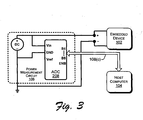
- FIG. 3 illustrates an example of how a typical ADC 208 on circuit 106 might be coupled to an embedded device 102 to measure power consumption. It is noted that while Fig. 3 illustrates an ADC 208 configured to measure the power consumption of the embedded device 102, it may also be configured to measure the power consumption of various components of the embedded device 102, such as processor 200.
- ADC 208 generally converts a continuously variable (i.e., analog) power consumption signal from device 102 into a digital (discrete) form. The analog power consumption signal from device 102 is sampled at a rate that is typically greater than or equal to the rate at which instructions 206 are being executed by processor 200 on embedded device 102.
- This power sample rate might also be the rate at which a profiler 220 on a host computer 104 samples a program counter 204 on a processor 200 of the embedded device 102, as discussed in greater detail below.
- the number of digital output states of the ADC 208 is defined by the precision of the ADC 208. For example, a 1amp/12bit ADC 208 can provide 4096 different discrete output values, each representing 0.2 milliamps (i.e., 1amp/4096) of resolution.
- Each power consumption value converted to digital form by ADC 208 is typically stored as power consumption data 214 in memory 212 on power measurement circuit 106 prior to being transferred to host computer 104.
- Communication interface 210 is configured to respond to queries from host computer 104 requesting power consumption data 214 stored in memory 212. Thus, communication interface 210 receives requests from host computer 104 and returns power consumption data 214 from memory 212 to host computer 104 in response to the requests.
- Communication interface 210 is generally implemented as any one of a variety of serial and/or parallel interfaces capable of communicating over bus 108(c) with host computer 104.
- Host computer 104 includes a processor 216 and memory 218, and in general, can be represented by the exemplary computing environment described in more detail herein below with reference to Fig. 9.
- Memory 218 includes a power profiler 220 module that is configured to execute on processor 216 to track and identify software instructions 206 executing on embedded device 102.
- power profiler 220 generally resembles current available profiler development tools that use statistical methods to determine which software instructions and components (i.e., groups of instructions) are running at any given moment as well as how long software instructions and components execute.
- a profiler e.g.; power profiler 220 interrupts the system (e.g., processor 200 on embedded device 102) at a very high rate and inspects which software instruction 206 is currently executing. This inspection is implemented through sampling the program counter 204 of the processor 200 being interrupted. Using the sampled value of the program counter 204, the profiler 220 scans an instruction lookup table 222 to locate a memory address associated with the program counter 204.
- lookup table 222 is a mapping between memory locations/addresses and compiled code generated when a compiler compiles source code into machine code.
- the profiler 220 identifies the software instruction that was executing when the processor 200 was interrupted. After a period of time, the number of "hits" for each software instruction or component is tabulated and a software developer is able to better understand which software is utilizing the majority of computation time.
- Power profiler 220 is additionally configured to query the power measurement circuit 106 to determine the power consumption level of embedded device 102 at any given moment. Power profiler 220 receives power consumption data 214 from power measurement circuit 106 in response to the queries it sends to power measurement circuit 106. Power profiler 220 is adapted to query the power measurement circuit 106 each time it takes a sample of the program counter 204 as discussed above. Thus, each time the power profiler 220 samples the program counter 204 to identify a software instruction executing on processor 200, it queries the power measurement circuit 106 and receives a value from power consumption data 214 that has been measured during the execution of the software instruction on processor 200.
- power profiler 220 may query the power measurement circuit 106 at intervals and receive groups of values of power consumption data 214 which it then correlates with identified software instructions executed on processor 200.
- power consumption data 214 may be received as one value per query sent in real time from power profiler 220, or it may be received as a group of power consumption values that have been previously stored in memory 212 on power measurement circuit 106.
- Power profiler 220 is also configured to correlate the power consumption data 214 received from power measurement circuit 106 with the software instructions 206 executing on processor 200 of embedded device 102. Power profiler 220 generates a power profile 224 that quantifies the power consumed for the precise software instruction executing on processor 200 of embedded device 102.
- a power profile 224 can be represented in various forms including, for example, a table or a graph that provide pairs of information identifying software instructions with corresponding power consumption values measured during the execution of the identified software instructions.
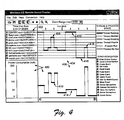
- Fig. 4 illustrates an example of a graphical user interface that might be generated by power profiler 224 to communicate information in a power profile 224 to a developer.
- the power profile 224 illustrated in Fig. 4 is shown in the form of a graph that depicts a correlation between levels of power consumption 400 and various software instructions 402 from various applications executing on an embedded device 102.
- the thick horizontal lines in the top half 404 of the graph are intended to indicate which software instructions 402 are currently executing.
- the thick horizontal lines in the bottom half 406 of the graph are intended to indicate the level of power consumed during the execution of the currently executing software instruction as indicated in the top half of the graph.
- the power consumption is approximately 90 mA 410
- the power consumption is approximately 50 mA 414.
- the power profiling information presented to a developer in a power profile 224 such as that shown in Fig. 4 can help a developer identify "hot spots" in code where there are increases in runtime power consumption on a mobile device 102.
- the power consumption increases dramatically because of a function call into "NK.exe ⁇ 0x0DFFF002>>” 418. Consequently, a developer may find it advantageous to eliminate "NK.exe ⁇ 0x0DFFF002>>" 418 function call if possible in order to save power.
- Fig. 5 illustrates another exemplary embodiment of a target device 102, host computer 104, and power measurement circuit 106 configured to implement power profiling.
- target device 102 is implemented as an embedded device 102.
- the embedded device 102 of Fig. 5 is generally configured to operate as discussed above.
- embedded device 102 includes the power measurement circuit 106.
- Power measurement circuit 106 functions in a manner similar to that discussed above with respect to the Fig. 2 embodiment.
- the power measurement circuit 106 is integrated into embedded device 102, in one implementation it may share various components of the embedded device 102 such as memory 202.
- Fig. 5 illustrates power consumption data 214 as being stored by power measurement circuit 106 in memory 202 on embedded device 102.
- Example methods for implementing power profiling in an environment such as the exemplary development environment 100 of Fig. 1 will now be described with primary reference to the flow diagrams of Figs. 6 - 8.
- the methods apply generally to the exemplary embodiments discussed above with respect to Figs. 2 - 5.
- the elements of the described methods may be performed by any appropriate means including, for example, by hardware logic blocks on an ASIC or by the execution of processor-readable instructions defined on a processor-readable medium.
- a "processor-readable medium,” as used herein, can be any means that can contain, store, communicate, propagate, or transport instructions for use by or execution by a processor.
- a processor-readable medium can be, without limitation, an electronic, magnetic, optical, electromagnetic, infrared, or semiconductor system, apparatus, device, or propagation medium.
- processor-readable medium include, among others, an electrical connection (electronic) having one or more wires, a portable computer diskette (magnetic), a random access memory (RAM) (magnetic), a read-only memory (ROM) (magnetic), an erasable programmable-read-only memory (EPROM or Flash memory), an optical fiber (optical), a rewritable compact disc (CD-RW) (optical), and a portable compact disc read-only memory (CDROM) (optical).
- an electrical connection electronic having one or more wires
- a portable computer diskette magnetic
- RAM random access memory
- ROM read-only memory
- EPROM or Flash memory erasable programmable-read-only memory
- CD-RW rewritable compact disc
- CDROM portable compact disc read-only memory
- Fig. 6 shows an exemplary method 600 for implementing power profiling of software instructions executing on a processor.
- the processor is generally a component of an embedded device 102 that is capable of operating on battery power.
- instructions executing on a processor are identified. The identification process is generally discussed below with respect to method 700, which is an extension of method 600.
- power consumption data is received from a power measurement circuit 106.
- the power measurement circuit 106 is typically part of a software development board or it may be resident on the embedded device 102 itself.
- the power measurement circuit 106 is typically configured to measure the power consumption of the processing circuitry being implemented to execute various software instructions on the embedded device 102, but it can also be configured to measure power consumption of the entire embedded device 102.
- a host computer 104 running a power profiler 220 typically receives the power consumption data upon querying the power measurement circuit. However, the host computer 104 might receive power consumption data from the power measurement circuit automatically at some fixed interval.
- the power consumption data is correlated with the identified instructions.
- the power profiler 220 executing on the host computer 104 associates each instruction that executes on the embedded device 102 with a measured amount of power (i.e., measure by the power measurement circuit 106) being consumed by the processing circuitry of the embedded device 102 during the execution of each identified instruction.
- the power profiler 220 generates a power profile that tracks the power being consumed on the embedded device 102 due to the execution of the software instructions. Therefore, the power profile typically includes numerous power consumption values each associated with an identified software instruction that has executed on the embedded device 102.
- the power profile can be implemented in various forms, including for example, a table having pairs of data that match power consumption values with identified software instructions, or a graph that visually correlates power consumption values with identified software instructions.
- Fig. 7 shows an exemplary method 700 for implementing power profiling of software instructions that is an extension of method 600.
- Method 700 extends from block 602 of method 600, and generally describes the identification of software instructions executing on a processor.
- the processor is generally a component of an embedded device 102 that is capable of operating on battery power.
- the processor is interrupted.
- the processor is executing software instructions in a runtime environment when it is interrupted. The interrupt comes from a host computer 104 executing a power profiler 220.
- the program counter on the processor is sampled.
- the program counter is a register in the processor that contains the address of the next software instruction from memory to be executed. In general, it is the value of the program counter that permits the power profiler 220 executing on the host computer 104 to identify which instruction is executing when the processor is interrupted.
- a lookup table is scanned to determine the address in memory indicated by the program counter.
- the lookup table is a table generated during a previous compilation of the software instructions that are stored on the embedded device.
- the host computer 104 is typically the computer on which the embedded device 102 software is compiled. Therefore, the lookup table is resident on the host computer 104 and permits the identification of the exact instruction executing on the embedded device 102 when the processor on the embedded device 102 is interrupted and its program counter is sampled.
- the software instruction is identified which resides at the memory address determined from the program counter.
- the software instruction might be an instruction from any number of routines or applications running on the embedded device 102.
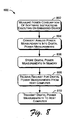
- Fig. 8 shows another exemplary method 800 for implementing power profiling of software instructions executing on a processor of an embedded device.
- the power consumption of software instructions executing on an embedded device is measured.
- a power measurement circuit 106 is typically configured to measure the power consumption of a processor executing the software instructions. However, the power measurement circuit 106 may also be configured to measure power consumption of the entire embedded device 102 during execution of the software instructions by the processor on the embedded device.
- the power measurement circuit may be integrated into the embedded device, or it may be a part of a software development test board.
- analog power consumption measurements from the embedded device 102 are converted into digital measurements.
- the analog to digital conversion is typically implemented by a high precision analog to digital converter (ADC) 208 such as a National Semiconductor ADC12662.
- ADC analog to digital converter
- the digital power measurements are stored in a memory on the power measurement circuit 106.
- the power measurement circuit 106 receives a request from a host computer 104 to transmit power consumption data. Requests may be received as frequently as the execution of each instruction on processor 200 of embedded device 102. Requests may also be received at intervals.
- the power measurement circuit 106 responds to the request(s) by transmitting digital power consumption measurements to the host computer 104.
- the power consumption data transferred may be transmitted one measurement at a time, or in groups of measurements. The transmissions can depend on the nature of the request from host computer 104.
- Fig. 9 illustrates an exemplary computing environment suitable for implementing various embodiments of a target device 102 and a host computer 104. Although one specific configuration is shown, a target device 102 and a host computer 104 may be implemented in other computing configurations. For example, the exemplary computing environment of Fig. 9 is generally a more developed computing environment than might typically be employed for specific implementations of a target device 102.
- the computing environment 900 includes a general-purpose computing system in the form of a computer 902.
- the components of computer 902 can include, but are not limited to, one or more processors or processing units 904, a system memory 906, and a system bus 908 that couples various system components including the processor 904 to the system memory 906.
- the system bus 908 represents one or more of any of several types of bus structures, including a memory bus or memory controller, a peripheral bus, an accelerated graphics port, and a processor or local bus using any of a variety of bus architectures.
- An example of a system bus 908 would be a Peripheral Component Interconnects (PCI) bus, also known as a Mezzanine bus.
- PCI Peripheral Component Interconnects
- Computer 902 typically includes a variety of computer readable media. Such media can be any available media that is accessible by computer 902 and includes both volatile and non-volatile media, removable and non-removable media.
- the system memory 906 includes computer readable media in the form of volatile memory, such as random access memory (RAM) 910, and/or non-volatile memory, such as read only memory (ROM) 912.
- RAM 910 typically contains data and/or program modules that are immediately accessible to and/or presently operated on by the processing unit 904.
- Computer 902 can also include other removable/non-removable, volatile/non-volatile computer storage media.
- Fig. 9 illustrates a hard disk drive 916 for reading from and writing to a non-removable, non-volatile magnetic media (not shown), a magnetic disk drive 918 for reading from and writing to a removable, non-volatile magnetic disk 920 (e.g., a "floppy disk"), and an optical disk drive 922 for reading from and/or writing to a removable, non-volatile optical disk 924 such as a CD-ROM, DVD-ROM, or other optical media.
- a hard disk drive 916 for reading from and writing to a non-removable, non-volatile magnetic media (not shown)
- a magnetic disk drive 918 for reading from and writing to a removable, non-volatile magnetic disk 920 (e.g., a "floppy disk")
- an optical disk drive 922 for reading from and/or writing to a removable, non-volatile optical
- the hard disk drive 916, magnetic disk drive 918, and optical disk drive 922 are each connected to the system bus 908 by one or more data media interfaces 926.
- the hard disk drive 916, magnetic disk drive 918, and optical disk drive 922 can be connected to the system bus 908 by a SCSI interface (not shown).
- the disk drives and their associated computer-readable media provide non-volatile storage of computer readable instructions, data structures, program modules, and other data for computer 902.
- a hard disk 916 a removable magnetic disk 920, and a removable optical disk 924
- other types of computer readable media which can store data that is accessible by a computer, such as magnetic cassettes or other magnetic storage devices, flash memory cards, CD-ROM, digital versatile disks (DVD) or other optical storage, random access memories (RAM), read only memories (ROM), electrically erasable programmable read-only memory (EEPROM), and the like, can also be utilized to implement the exemplary computing system and environment.
- RAM random access memories
- ROM read only memories
- EEPROM electrically erasable programmable read-only memory
- Any number of program modules can be stored on the hard disk 916, magnetic disk 920, optical disk 924, ROM 912, and/or RAM 910, including by way of example, an operating system 926, one or more application programs 928, other program modules 930, and program data 932.
- an operating system 926 may include an embodiment of a caching scheme for user network access information.
- Computer 902 can include a variety of computer/processor readable media identified as communication media.
- Communication media typically embodies computer readable instructions, data structures, program modules, or other data in a modulated data signal such as a carrier wave or other transport mechanism and includes any information delivery media.
- modulated data signal means a signal that has one or more of its characteristics set or changed in such a manner as to encode information in the signal.
- communication media includes wired media such as a wired network or direct-wired connection, and wireless media such as acoustic, RF, infrared, and other wireless media. Combinations of any of the above are also included within the scope of computer readable media.
- a user can enter commands and information into computer system 902 via input devices such as a keyboard 934 and a pointing device 936 (e.g., a "mouse").
- Other input devices 938 may include a microphone, joystick, game pad, satellite dish, serial port, scanner, and/or the like.
- input/output interfaces 940 that are coupled to the system bus 908, but may be connected by other interface and bus structures, such as a parallel port, game port, or a universal serial bus (USB).
- a monitor 942 or other type of display device can also be connected to the system bus 908 via an interface, such as a video adapter 944.
- other output peripheral devices can include components such as speakers (not shown) and a printer 946 which can be connected to computer 902 via the input/output interfaces 940.
- Computer 902 can operate in a networked environment using logical connections to one or more remote computers, such as a remote computing device 948.
- the remote computing device 948 can be a personal computer, portable computer, a server, a router, a network computer, a peer device or other common network node, and the like.
- the remote computing device 948 is illustrated as a portable computer that can include many or all of the elements and features described herein relative to computer system 902.
- Logical connections between computer 902 and the remote computer 948 are depicted as a local area network (LAN) 950 and a general wide area network (WAN) 952.
- LAN local area network
- WAN wide area network
- Such networking environments are commonplace in offices, enterprise-wide computer networks, intranets, and the Internet.
- the computer 902 When implemented in a LAN networking environment, the computer 902 is connected to a local network 950 via a network interface or adapter 954.
- the computer 902 When implemented in a WAN networking environment, the computer 902 typically includes a modem 956 or other means for establishing communications over the wide network 952.
- the modem 956, which can be internal or external to computer 902 can be connected to the system bus 908 via the input/output interfaces 940 or other appropriate mechanisms. It is to be appreciated that the illustrated network connections are exemplary and that other means of establishing communication link(s) between the computers 902 and 948 can be employed.
- remote application programs 958 reside on a memory device of remote computer 948.
- application programs and other executable program components such as the operating system, are illustrated herein as discrete blocks, although it is recognized that such programs and components reside at various times in different storage components of the computer system 902, and are executed by the data processor(s) of the computer.
Landscapes
- Engineering & Computer Science (AREA)
- Theoretical Computer Science (AREA)
- Physics & Mathematics (AREA)
- General Engineering & Computer Science (AREA)
- General Physics & Mathematics (AREA)
- Power Sources (AREA)
- Debugging And Monitoring (AREA)
Applications Claiming Priority (2)
| Application Number | Priority Date | Filing Date | Title |
|---|---|---|---|
| US10/610,496 US20040268159A1 (en) | 2003-06-30 | 2003-06-30 | Power profiling |
| US610496 | 2003-06-30 |
Publications (2)
| Publication Number | Publication Date |
|---|---|
| EP1494110A2 true EP1494110A2 (de) | 2005-01-05 |
| EP1494110A3 EP1494110A3 (de) | 2008-12-31 |
Family
ID=33435410
Family Applications (1)
| Application Number | Title | Priority Date | Filing Date |
|---|---|---|---|
| EP04012763A Withdrawn EP1494110A3 (de) | 2003-06-30 | 2004-05-28 | Verbrauchsprofilierung |
Country Status (5)
| Country | Link |
|---|---|
| US (1) | US20040268159A1 (de) |
| EP (1) | EP1494110A3 (de) |
| JP (1) | JP2005025754A (de) |
| KR (1) | KR20050002667A (de) |
| CN (1) | CN1577219A (de) |
Cited By (34)
| Publication number | Priority date | Publication date | Assignee | Title |
|---|---|---|---|---|
| GB2446754B (en) * | 2005-12-06 | 2011-02-09 | Advanced Risc Mach Ltd | Energy management |
| WO2011143829A1 (en) * | 2010-05-21 | 2011-11-24 | Marlon Galsim | Method and apparatus for controlling distribution of power |
| CN102354971A (zh) * | 2010-05-21 | 2012-02-15 | G·马龙 | 用于控制功率分配的方法和装置 |
| US8200209B2 (en) | 2005-02-16 | 2012-06-12 | Telefonaktiebolaget L M Ericsson (Publ) | Power consumption debugging in mobile terminals |
| WO2012146821A1 (en) * | 2011-04-27 | 2012-11-01 | Nokia Corporation | Method and apparatus for providing consumption information for software applications |
| US8340952B2 (en) | 2009-03-12 | 2012-12-25 | Freescale Semiconductor, Inc. | Power estimation method and device therefor |
| US10459464B2 (en) | 2012-09-03 | 2019-10-29 | Schneider Electric It Corporation | Method and apparatus for controlling distribution of power |
| US11425189B2 (en) * | 2019-02-06 | 2022-08-23 | Magic Leap, Inc. | Target intent-based clock speed determination and adjustment to limit total heat generated by multiple processors |
| US11445232B2 (en) | 2019-05-01 | 2022-09-13 | Magic Leap, Inc. | Content provisioning system and method |
| US11510027B2 (en) | 2018-07-03 | 2022-11-22 | Magic Leap, Inc. | Systems and methods for virtual and augmented reality |
| US11514673B2 (en) | 2019-07-26 | 2022-11-29 | Magic Leap, Inc. | Systems and methods for augmented reality |
| US11521296B2 (en) | 2018-11-16 | 2022-12-06 | Magic Leap, Inc. | Image size triggered clarification to maintain image sharpness |
| US11579441B2 (en) | 2018-07-02 | 2023-02-14 | Magic Leap, Inc. | Pixel intensity modulation using modifying gain values |
| US11598651B2 (en) | 2018-07-24 | 2023-03-07 | Magic Leap, Inc. | Temperature dependent calibration of movement detection devices |
| US11609645B2 (en) | 2018-08-03 | 2023-03-21 | Magic Leap, Inc. | Unfused pose-based drift correction of a fused pose of a totem in a user interaction system |
| US11624929B2 (en) | 2018-07-24 | 2023-04-11 | Magic Leap, Inc. | Viewing device with dust seal integration |
| US11630507B2 (en) | 2018-08-02 | 2023-04-18 | Magic Leap, Inc. | Viewing system with interpupillary distance compensation based on head motion |
| US20230229219A1 (en) * | 2022-01-20 | 2023-07-20 | Vmware, Inc. | Managing power consumption in a software build environment |
| US11737832B2 (en) | 2019-11-15 | 2023-08-29 | Magic Leap, Inc. | Viewing system for use in a surgical environment |
| US11756335B2 (en) | 2015-02-26 | 2023-09-12 | Magic Leap, Inc. | Apparatus for a near-eye display |
| US11762623B2 (en) | 2019-03-12 | 2023-09-19 | Magic Leap, Inc. | Registration of local content between first and second augmented reality viewers |
| US11762222B2 (en) | 2017-12-20 | 2023-09-19 | Magic Leap, Inc. | Insert for augmented reality viewing device |
| US11776509B2 (en) | 2018-03-15 | 2023-10-03 | Magic Leap, Inc. | Image correction due to deformation of components of a viewing device |
| US11790554B2 (en) | 2016-12-29 | 2023-10-17 | Magic Leap, Inc. | Systems and methods for augmented reality |
| US11856479B2 (en) | 2018-07-03 | 2023-12-26 | Magic Leap, Inc. | Systems and methods for virtual and augmented reality along a route with markers |
| US11874468B2 (en) | 2016-12-30 | 2024-01-16 | Magic Leap, Inc. | Polychromatic light out-coupling apparatus, near-eye displays comprising the same, and method of out-coupling polychromatic light |
| US11885871B2 (en) | 2018-05-31 | 2024-01-30 | Magic Leap, Inc. | Radar head pose localization |
| US11927759B2 (en) | 2017-07-26 | 2024-03-12 | Magic Leap, Inc. | Exit pupil expander |
| US11953653B2 (en) | 2017-12-10 | 2024-04-09 | Magic Leap, Inc. | Anti-reflective coatings on optical waveguides |
| US12016719B2 (en) | 2018-08-22 | 2024-06-25 | Magic Leap, Inc. | Patient viewing system |
| US12033081B2 (en) | 2019-11-14 | 2024-07-09 | Magic Leap, Inc. | Systems and methods for virtual and augmented reality |
| US12164978B2 (en) | 2018-07-10 | 2024-12-10 | Magic Leap, Inc. | Thread weave for cross-instruction set architecture procedure calls |
| US12498581B2 (en) | 2018-12-21 | 2025-12-16 | Magic Leap, Inc. | Air pocket structures for promoting total internal reflection in a waveguide |
| US12618952B2 (en) | 2019-10-08 | 2026-05-05 | Magic Leap, Inc. | Staging system to verify accuracy of a motion tracking system |
Families Citing this family (68)
| Publication number | Priority date | Publication date | Assignee | Title |
|---|---|---|---|---|
| US7287173B2 (en) * | 2003-12-19 | 2007-10-23 | Intel Corporation | Method for computing power consumption levels of instruction and recompiling the program to reduce the excess power consumption |
| US7424632B2 (en) | 2004-02-13 | 2008-09-09 | Microsoft Corporation | Systems and methods that facilitate state machine power and wake state management |
| US7181190B2 (en) | 2004-04-30 | 2007-02-20 | Microsoft Corporation | Method for maintaining wireless network response time while saving wireless adapter power |
| JP2006059068A (ja) * | 2004-08-19 | 2006-03-02 | Matsushita Electric Ind Co Ltd | プロセッサ装置 |
| JP2007109085A (ja) * | 2005-10-14 | 2007-04-26 | Sony Computer Entertainment Inc | 発熱制御方法、装置およびシステム |
| US7512513B2 (en) * | 2005-11-29 | 2009-03-31 | International Business Machines Corporation | Thermal throttling control for testing of real-time software |
| US7376532B2 (en) * | 2005-11-29 | 2008-05-20 | International Business Machines Corporation | Maximal temperature logging |
| US20070124618A1 (en) * | 2005-11-29 | 2007-05-31 | Aguilar Maximino Jr | Optimizing power and performance using software and hardware thermal profiles |
| US7681053B2 (en) * | 2005-11-29 | 2010-03-16 | International Business Machines Corporation | Thermal throttle control with minimal impact to interrupt latency |
| US7603576B2 (en) * | 2005-11-29 | 2009-10-13 | International Business Machines Corporation | Hysteresis in thermal throttling |
| US7698089B2 (en) * | 2005-11-29 | 2010-04-13 | International Business Machines Corporation | Generation of software thermal profiles executed on a set of processors using processor activity |
| US7460932B2 (en) * | 2005-11-29 | 2008-12-02 | International Business Machines Corporation | Support of deep power savings mode and partial good in a thermal management system |
| US7721128B2 (en) * | 2005-11-29 | 2010-05-18 | International Business Machines Corporation | Implementation of thermal throttling logic |
| US7848901B2 (en) * | 2005-11-29 | 2010-12-07 | International Business Machines Corporation | Tracing thermal data via performance monitoring |
| US7386414B2 (en) * | 2005-11-29 | 2008-06-10 | International Business Machines Corporation | Generation of hardware thermal profiles for a set of processors |
| US7512530B2 (en) * | 2005-11-29 | 2009-03-31 | International Business Machines Corporation | Generation of software thermal profiles for applications in a simulated environment |
| US20070198864A1 (en) * | 2006-02-21 | 2007-08-23 | Toshiba America Electronic Components | Systems and methods for determining and using power profiles for software programs executing on data processors |
| US20070220293A1 (en) * | 2006-03-16 | 2007-09-20 | Toshiba America Electronic Components | Systems and methods for managing power consumption in data processors using execution mode selection |
| US20070260894A1 (en) * | 2006-05-03 | 2007-11-08 | Aguilar Maximino Jr | Optimizing thermal performance using feed-back directed optimization |
| US7596430B2 (en) * | 2006-05-03 | 2009-09-29 | International Business Machines Corporation | Selection of processor cores for optimal thermal performance |
| US7552346B2 (en) * | 2006-05-03 | 2009-06-23 | International Business Machines Corporation | Dynamically adapting software for reducing a thermal state of a processor core based on its thermal index |
| US8037893B2 (en) * | 2006-05-03 | 2011-10-18 | International Business Machines Corporation | Optimizing thermal performance using thermal flow analysis |
| US7555666B2 (en) * | 2006-05-04 | 2009-06-30 | Dell Products L.P. | Power profiling application for managing power allocation in an information handling system |
| JP5045122B2 (ja) * | 2007-01-29 | 2012-10-10 | 富士通株式会社 | プログラムの評価プログラム、プログラムの評価装置、プログラムの評価方法 |
| KR100869953B1 (ko) * | 2007-05-30 | 2008-11-24 | 경북대학교 산학협력단 | Etm 인터페이스를 이용한 전력 측정 시스템 및 그 방법 |
| US8027798B2 (en) * | 2007-11-08 | 2011-09-27 | International Business Machines Corporation | Digital thermal sensor test implementation without using main core voltage supply |
| JP5439715B2 (ja) * | 2007-11-20 | 2014-03-12 | 日本電気株式会社 | 携帯端末、制御方法、プログラム、及び記録媒体 |
| WO2009114017A1 (en) * | 2008-03-14 | 2009-09-17 | Hewlett-Packard Development Company, L.P. | Exergy-based evaluation of an infrastructure |
| US8086882B2 (en) * | 2008-06-29 | 2011-12-27 | Microsoft Corporation | Energy measurement techniques for computing systems |
| JP5299161B2 (ja) * | 2008-08-22 | 2013-09-25 | 富士通株式会社 | 計算機装置および消費電力のサンプリング方法 |
| US8898049B2 (en) * | 2009-04-20 | 2014-11-25 | International Business Machines Corporation | System level power profiling of embedded applications executing on virtual multicore system-on-chip platforms |
| US8311683B2 (en) * | 2009-04-29 | 2012-11-13 | International Business Machines Corporation | Processor cooling management |
| US8756564B2 (en) * | 2009-05-29 | 2014-06-17 | International Business Machines Corporation | Techniques for providing environmental impact information associated with code |
| US20110016455A1 (en) * | 2009-07-20 | 2011-01-20 | Glenn Perry | Power Profiling for Embedded System Design |
| US8468380B2 (en) | 2009-07-31 | 2013-06-18 | Dell Products, Lp | Power consumption monitor and method therefor |
| NL2003915C2 (en) | 2009-12-07 | 2011-06-09 | Yggdra Solutions | Improved power usage management. |
| US20120016606A1 (en) * | 2010-02-25 | 2012-01-19 | Emmanuel Petit | Power Profiling for Embedded System Design |
| KR20110114910A (ko) | 2010-04-14 | 2011-10-20 | 삼성전자주식회사 | 집적회로 및 그것의 소비전력 측정 방법 |
| JP5510543B2 (ja) * | 2010-06-30 | 2014-06-04 | 富士通株式会社 | 情報処理装置の使用量解析方法、情報処理システム及びそのプログラム |
| KR101243513B1 (ko) * | 2011-02-23 | 2013-03-20 | 성균관대학교산학협력단 | 프로세서 파워 시뮬레이션 수행 방법 및 프로세서 파워 시뮬레이션 시스템 |
| US8971819B2 (en) * | 2011-06-16 | 2015-03-03 | Deutsche Telekom Ag | System for analyzing mobile browser energy consumption |
| US9465427B2 (en) * | 2011-06-30 | 2016-10-11 | International Business Machines Corporation | Software-centric power management by indirectly determining that user is not actively using computer program running on computing device |
| JP5890988B2 (ja) * | 2011-09-15 | 2016-03-22 | 株式会社ダイヘン | 産業用ロボットの消費電力モニタ装置 |
| US8904208B2 (en) * | 2011-11-04 | 2014-12-02 | International Business Machines Corporation | Run-time task-level dynamic energy management |
| US9009517B2 (en) * | 2011-11-16 | 2015-04-14 | Infineon Technologies Ag | Embedded voltage regulator trace |
| JP5790431B2 (ja) * | 2011-11-18 | 2015-10-07 | 富士通株式会社 | 設計支援装置、設計支援方法および設計支援プログラム |
| US9064253B2 (en) * | 2011-12-01 | 2015-06-23 | Broadcom Corporation | Systems and methods for providing NFC secure application support in battery on and battery off modes |
| EP2811407A4 (de) | 2012-01-31 | 2015-09-30 | Nec Corp | Informationsverarbeitungsvorrichtung und stromverbrauch-berechnungsverfahren für die informationsverarbeitungsvorrichtung |
| KR101387769B1 (ko) * | 2012-04-04 | 2014-04-21 | 김광진 | 스마트 디바이스의 전력 소모를 줄이기 위한 스케줄링 방법, 시스템, 및 컴퓨터 판독 가능한 기록 매체 |
| US20140068581A1 (en) * | 2012-08-30 | 2014-03-06 | International Business Machines Corporation | Optimized division of work among processors in a heterogeneous processing system |
| US10133329B2 (en) | 2012-11-19 | 2018-11-20 | Qualcomm Incorporated | Sequential feature computation for power efficient classification |
| US20140229754A1 (en) * | 2013-02-11 | 2014-08-14 | Nvidia Corporation | Power telemetry remote monitoring |
| KR102050076B1 (ko) | 2013-12-26 | 2019-11-28 | 한국전자통신연구원 | 절전형 컴퓨터 시스템 및 컴퓨터 시스템의 절전 제어 방법 |
| KR101497870B1 (ko) * | 2014-02-06 | 2015-03-04 | 계명대학교 산학협력단 | 전력데이터 처리유닛 및 처리방법, 이의 모바일 기기 |
| KR102151135B1 (ko) | 2014-04-28 | 2020-09-02 | 삼성전자주식회사 | 전력 관리 방법 및 그 방법을 처리하는 전자 장치 |
| US9766673B2 (en) * | 2015-02-27 | 2017-09-19 | Intel Corporation | Supercapacitor-based power supply protection for multi-node systems |
| JP6544013B2 (ja) * | 2015-04-16 | 2019-07-17 | 富士通株式会社 | 情報処理装置、消費電力計測プログラムおよび消費電力計測方法 |
| CN108475098A (zh) * | 2015-12-22 | 2018-08-31 | 索尼移动通讯有限公司 | 功耗时间同步 |
| US10078364B2 (en) * | 2016-01-14 | 2018-09-18 | Hcl Technologies Limited | System and method for optimizing power consumption of one or more devices |
| JP6631374B2 (ja) * | 2016-04-13 | 2020-01-15 | 富士通株式会社 | 情報処理装置、動作状況収集プログラム及び動作状況収集方法 |
| US10387285B2 (en) | 2017-04-17 | 2019-08-20 | Microsoft Technology Licensing, Llc | Power evaluator for application developers |
| US10820274B2 (en) * | 2017-06-19 | 2020-10-27 | T-Mobile Usa, Inc. | Systems and methods for testing power consumption of electronic devices |
| CN111026571B (zh) * | 2019-11-11 | 2023-09-08 | 北京字节跳动网络技术有限公司 | 处理器降频处理方法、装置及电子设备 |
| US12189767B2 (en) * | 2020-09-25 | 2025-01-07 | Robert Bosch Gmbh | System and method for intrusion detection on a physical level using an internal analog to digital converter |
| CN112601269B (zh) * | 2020-11-13 | 2023-08-15 | 维沃移动通信有限公司 | 一种通信连接方法、装置、电子设备和可读存储介质 |
| US20230161398A1 (en) * | 2021-11-22 | 2023-05-25 | Rakuten Mobile, Inc. | Data storage system with power consumption efficiency and methods of operating the same |
| CN117675625A (zh) * | 2022-08-25 | 2024-03-08 | 中移物联网有限公司 | 物联网模组的功耗测试装置、方法及相关设备 |
| US12307224B2 (en) | 2023-06-14 | 2025-05-20 | International Business Machines Corporation | Cross-layer power optimization of program code and/or software architecture |
Family Cites Families (10)
| Publication number | Priority date | Publication date | Assignee | Title |
|---|---|---|---|---|
| AU4610496A (en) * | 1994-12-22 | 1996-07-10 | Intel Corporation | System power consumption tracking and reporting |
| JP3693420B2 (ja) * | 1996-06-20 | 2005-09-07 | 株式会社リコー | 集積回路の消費電力見積り装置 |
| US6560773B1 (en) * | 1997-12-12 | 2003-05-06 | International Business Machines Corporation | Method and system for memory leak detection in an object-oriented environment during real-time trace processing |
| US6513155B1 (en) * | 1997-12-12 | 2003-01-28 | International Business Machines Corporation | Method and system for merging event-based data and sampled data into postprocessed trace output |
| JP3285807B2 (ja) * | 1997-12-26 | 2002-05-27 | 富士通株式会社 | 電源及びハードウェア障害の切り分け装置及びその方法 |
| JP4298878B2 (ja) * | 2000-02-17 | 2009-07-22 | インターナショナル・ビジネス・マシーンズ・コーポレーション | 消費電力情報の表示方法および電子機器 |
| EP1182556B1 (de) * | 2000-08-21 | 2009-08-19 | Texas Instruments France | Auf Aufgaben basierte adaptive Profilerstellung und Fehlerbeseitigung |
| US6834353B2 (en) * | 2001-10-22 | 2004-12-21 | International Business Machines Corporation | Method and apparatus for reducing power consumption of a processing integrated circuit |
| US7149636B2 (en) * | 2002-04-04 | 2006-12-12 | Texas Instruments Incorporated | Method and apparatus for non-obtrusive power profiling |
| US7185215B2 (en) * | 2003-02-24 | 2007-02-27 | International Business Machines Corporation | Machine code builder derived power consumption reduction |
-
2003
- 2003-06-30 US US10/610,496 patent/US20040268159A1/en not_active Abandoned
-
2004
- 2004-05-28 EP EP04012763A patent/EP1494110A3/de not_active Withdrawn
- 2004-06-29 JP JP2004192281A patent/JP2005025754A/ja not_active Withdrawn
- 2004-06-30 CN CNA2004100632506A patent/CN1577219A/zh active Pending
- 2004-06-30 KR KR1020040050540A patent/KR20050002667A/ko not_active Withdrawn
Cited By (51)
| Publication number | Priority date | Publication date | Assignee | Title |
|---|---|---|---|---|
| US8200209B2 (en) | 2005-02-16 | 2012-06-12 | Telefonaktiebolaget L M Ericsson (Publ) | Power consumption debugging in mobile terminals |
| GB2446754B (en) * | 2005-12-06 | 2011-02-09 | Advanced Risc Mach Ltd | Energy management |
| US8762744B2 (en) | 2005-12-06 | 2014-06-24 | Arm Limited | Energy management system configured to generate energy management information indicative of an energy state of processing elements |
| US8340952B2 (en) | 2009-03-12 | 2012-12-25 | Freescale Semiconductor, Inc. | Power estimation method and device therefor |
| WO2011143829A1 (en) * | 2010-05-21 | 2011-11-24 | Marlon Galsim | Method and apparatus for controlling distribution of power |
| CN102354971A (zh) * | 2010-05-21 | 2012-02-15 | G·马龙 | 用于控制功率分配的方法和装置 |
| CN102354971B (zh) * | 2010-05-21 | 2014-01-01 | 美国能量变换公司 | 用于控制功率分配的方法和装置 |
| US9047071B2 (en) | 2010-05-21 | 2015-06-02 | Schneider Electric It Corporation | Method and apparatus for controlling distribution of power |
| WO2012146821A1 (en) * | 2011-04-27 | 2012-11-01 | Nokia Corporation | Method and apparatus for providing consumption information for software applications |
| US10459464B2 (en) | 2012-09-03 | 2019-10-29 | Schneider Electric It Corporation | Method and apparatus for controlling distribution of power |
| US12562004B2 (en) | 2015-02-26 | 2026-02-24 | Magic Leap, Inc. | Apparatus for a near-eye display |
| US11756335B2 (en) | 2015-02-26 | 2023-09-12 | Magic Leap, Inc. | Apparatus for a near-eye display |
| US12131500B2 (en) | 2016-12-29 | 2024-10-29 | Magic Leap, Inc. | Systems and methods for augmented reality |
| US11790554B2 (en) | 2016-12-29 | 2023-10-17 | Magic Leap, Inc. | Systems and methods for augmented reality |
| US11874468B2 (en) | 2016-12-30 | 2024-01-16 | Magic Leap, Inc. | Polychromatic light out-coupling apparatus, near-eye displays comprising the same, and method of out-coupling polychromatic light |
| US11927759B2 (en) | 2017-07-26 | 2024-03-12 | Magic Leap, Inc. | Exit pupil expander |
| US12298473B2 (en) | 2017-12-10 | 2025-05-13 | Magic Leap, Inc. | Anti-reflective coatings on optical waveguides |
| US11953653B2 (en) | 2017-12-10 | 2024-04-09 | Magic Leap, Inc. | Anti-reflective coatings on optical waveguides |
| US12366769B2 (en) | 2017-12-20 | 2025-07-22 | Magic Leap, Inc. | Insert for augmented reality viewing device |
| US11762222B2 (en) | 2017-12-20 | 2023-09-19 | Magic Leap, Inc. | Insert for augmented reality viewing device |
| US11908434B2 (en) | 2018-03-15 | 2024-02-20 | Magic Leap, Inc. | Image correction due to deformation of components of a viewing device |
| US11776509B2 (en) | 2018-03-15 | 2023-10-03 | Magic Leap, Inc. | Image correction due to deformation of components of a viewing device |
| US11885871B2 (en) | 2018-05-31 | 2024-01-30 | Magic Leap, Inc. | Radar head pose localization |
| US11579441B2 (en) | 2018-07-02 | 2023-02-14 | Magic Leap, Inc. | Pixel intensity modulation using modifying gain values |
| US12001013B2 (en) | 2018-07-02 | 2024-06-04 | Magic Leap, Inc. | Pixel intensity modulation using modifying gain values |
| US11856479B2 (en) | 2018-07-03 | 2023-12-26 | Magic Leap, Inc. | Systems and methods for virtual and augmented reality along a route with markers |
| US11510027B2 (en) | 2018-07-03 | 2022-11-22 | Magic Leap, Inc. | Systems and methods for virtual and augmented reality |
| US12164978B2 (en) | 2018-07-10 | 2024-12-10 | Magic Leap, Inc. | Thread weave for cross-instruction set architecture procedure calls |
| US12379981B2 (en) | 2018-07-10 | 2025-08-05 | Magic Leap, Inc. | Thread weave for cross-instruction set architectureprocedure calls |
| US12247846B2 (en) | 2018-07-24 | 2025-03-11 | Magic Leap, Inc. | Temperature dependent calibration of movement detection devices |
| US11624929B2 (en) | 2018-07-24 | 2023-04-11 | Magic Leap, Inc. | Viewing device with dust seal integration |
| US11598651B2 (en) | 2018-07-24 | 2023-03-07 | Magic Leap, Inc. | Temperature dependent calibration of movement detection devices |
| US11630507B2 (en) | 2018-08-02 | 2023-04-18 | Magic Leap, Inc. | Viewing system with interpupillary distance compensation based on head motion |
| US12254141B2 (en) | 2018-08-03 | 2025-03-18 | Magic Leap, Inc. | Unfused pose-based drift correction of a fused pose of a totem in a user interaction system |
| US11609645B2 (en) | 2018-08-03 | 2023-03-21 | Magic Leap, Inc. | Unfused pose-based drift correction of a fused pose of a totem in a user interaction system |
| US11960661B2 (en) | 2018-08-03 | 2024-04-16 | Magic Leap, Inc. | Unfused pose-based drift correction of a fused pose of a totem in a user interaction system |
| US12016719B2 (en) | 2018-08-22 | 2024-06-25 | Magic Leap, Inc. | Patient viewing system |
| US11521296B2 (en) | 2018-11-16 | 2022-12-06 | Magic Leap, Inc. | Image size triggered clarification to maintain image sharpness |
| US12498581B2 (en) | 2018-12-21 | 2025-12-16 | Magic Leap, Inc. | Air pocket structures for promoting total internal reflection in a waveguide |
| US11425189B2 (en) * | 2019-02-06 | 2022-08-23 | Magic Leap, Inc. | Target intent-based clock speed determination and adjustment to limit total heat generated by multiple processors |
| US11762623B2 (en) | 2019-03-12 | 2023-09-19 | Magic Leap, Inc. | Registration of local content between first and second augmented reality viewers |
| US11445232B2 (en) | 2019-05-01 | 2022-09-13 | Magic Leap, Inc. | Content provisioning system and method |
| US12267545B2 (en) | 2019-05-01 | 2025-04-01 | Magic Leap, Inc. | Content provisioning system and method |
| US11514673B2 (en) | 2019-07-26 | 2022-11-29 | Magic Leap, Inc. | Systems and methods for augmented reality |
| US12249035B2 (en) | 2019-07-26 | 2025-03-11 | Magic Leap, Inc. | System and method for augmented reality with virtual objects behind a physical surface |
| US12618952B2 (en) | 2019-10-08 | 2026-05-05 | Magic Leap, Inc. | Staging system to verify accuracy of a motion tracking system |
| US12033081B2 (en) | 2019-11-14 | 2024-07-09 | Magic Leap, Inc. | Systems and methods for virtual and augmented reality |
| US11737832B2 (en) | 2019-11-15 | 2023-08-29 | Magic Leap, Inc. | Viewing system for use in a surgical environment |
| US12472007B2 (en) | 2019-11-15 | 2025-11-18 | Magic Leap, Inc. | Viewing system for use in a surgical environment |
| US20230229219A1 (en) * | 2022-01-20 | 2023-07-20 | Vmware, Inc. | Managing power consumption in a software build environment |
| US11899514B2 (en) * | 2022-01-20 | 2024-02-13 | VMware LLC | Managing power consumption in a software build environment |
Also Published As
| Publication number | Publication date |
|---|---|
| JP2005025754A (ja) | 2005-01-27 |
| CN1577219A (zh) | 2005-02-09 |
| KR20050002667A (ko) | 2005-01-10 |
| EP1494110A3 (de) | 2008-12-31 |
| US20040268159A1 (en) | 2004-12-30 |
Similar Documents
| Publication | Publication Date | Title |
|---|---|---|
| EP1494110A2 (de) | Verbrauchsprofilierung | |
| US10416995B2 (en) | Techniques for providing environmental impact information associated with code | |
| US8972957B2 (en) | Thermal-aware source code compilation | |
| US9122526B2 (en) | Dynamic program evaluation for system adaptation | |
| Fu et al. | Llmco2: Advancing accurate carbon footprint prediction for llm inferences | |
| Chen et al. | Fine-grained power management using process-level profiling | |
| US9164899B2 (en) | Administering thermal distribution among memory modules of a computing system | |
| JP2010517142A (ja) | 複数の装置に電力を割り当てるためのデータ構造 | |
| CN104969190B (zh) | 多核心二进制转换任务处理 | |
| WO2022151707A1 (zh) | 内存测试方法及装置、可读存储介质、电子设备 | |
| US20060242611A1 (en) | Integrating programmable logic into personal computer (PC) architecture | |
| US6633937B2 (en) | GPIB system and method which performs autopolling using heuristics | |
| CN103154891B (zh) | 虚拟机阶段检测 | |
| CN103064723B (zh) | 虚拟机器存储器的鉴识方法与计算机系统 | |
| US20070162896A1 (en) | Method and apparatus for generating run time profiles for program compilation | |
| US6775785B1 (en) | Method and apparatus for access to resources not mapped to an autonomous subsystem in a computer based system without involvement of the main operating system | |
| US7707560B2 (en) | Analyzing software performance without requiring hardware | |
| US12307224B2 (en) | Cross-layer power optimization of program code and/or software architecture | |
| US7142995B2 (en) | Method for reading battery status by operation system of portable computer | |
| Xian et al. | Power measurement of software programs on computers with multiple I/O components | |
| Herrlin | Guidance on Identifying Zombie Servers in Data Centers | |
| US20060143598A1 (en) | Method and apparatus for transforming program representations | |
| US11513936B2 (en) | Computing device application performance optimization system | |
| CN100489736C (zh) | 可携式电脑的作业系统读取电池状态的方法 | |
| US20220222009A1 (en) | Method and device for testing memory, and non-transitory readable storage medium |
Legal Events
| Date | Code | Title | Description |
|---|---|---|---|
| PUAI | Public reference made under article 153(3) epc to a published international application that has entered the european phase |
Free format text: ORIGINAL CODE: 0009012 |
|
| AK | Designated contracting states |
Kind code of ref document: A2 Designated state(s): AT BE BG CH CY CZ DE DK EE ES FI FR GB GR HU IE IT LI LU MC NL PL PT RO SE SI SK TR |
|
| AX | Request for extension of the european patent |
Extension state: AL HR LT LV MK |
|
| PUAL | Search report despatched |
Free format text: ORIGINAL CODE: 0009013 |
|
| AK | Designated contracting states |
Kind code of ref document: A3 Designated state(s): AT BE BG CH CY CZ DE DK EE ES FI FR GB GR HU IE IT LI LU MC NL PL PT RO SE SI SK TR |
|
| AX | Request for extension of the european patent |
Extension state: AL HR LT LV MK |
|
| STAA | Information on the status of an ep patent application or granted ep patent |
Free format text: STATUS: THE APPLICATION IS DEEMED TO BE WITHDRAWN |
|
| 18D | Application deemed to be withdrawn |
Effective date: 20081202 |