EP1494170A2 - Signalverarbeitungsapparat, Signalverarbeitungsprogramm und elektronische Kamera - Google Patents
Signalverarbeitungsapparat, Signalverarbeitungsprogramm und elektronische Kamera Download PDFInfo
- Publication number
- EP1494170A2 EP1494170A2 EP04015259A EP04015259A EP1494170A2 EP 1494170 A2 EP1494170 A2 EP 1494170A2 EP 04015259 A EP04015259 A EP 04015259A EP 04015259 A EP04015259 A EP 04015259A EP 1494170 A2 EP1494170 A2 EP 1494170A2
- Authority
- EP
- European Patent Office
- Prior art keywords
- section
- signal processing
- pixel
- coefficient
- coefficient group
- Prior art date
- Legal status (The legal status is an assumption and is not a legal conclusion. Google has not performed a legal analysis and makes no representation as to the accuracy of the status listed.)
- Granted
Links
Images



Classifications
-
- G—PHYSICS
- G06—COMPUTING OR CALCULATING; COUNTING
- G06T—IMAGE DATA PROCESSING OR GENERATION, IN GENERAL
- G06T5/00—Image enhancement or restoration
- G06T5/20—Image enhancement or restoration using local operators
-
- G—PHYSICS
- G06—COMPUTING OR CALCULATING; COUNTING
- G06T—IMAGE DATA PROCESSING OR GENERATION, IN GENERAL
- G06T5/00—Image enhancement or restoration
- G06T5/70—Denoising; Smoothing
-
- G—PHYSICS
- G06—COMPUTING OR CALCULATING; COUNTING
- G06T—IMAGE DATA PROCESSING OR GENERATION, IN GENERAL
- G06T5/00—Image enhancement or restoration
- G06T5/73—Deblurring; Sharpening
-
- H—ELECTRICITY
- H04—ELECTRIC COMMUNICATION TECHNIQUE
- H04N—PICTORIAL COMMUNICATION, e.g. TELEVISION
- H04N1/00—Scanning, transmission or reproduction of documents or the like, e.g. facsimile transmission; Details thereof
- H04N1/40—Picture signal circuits
- H04N1/409—Edge or detail enhancement; Noise or error suppression
-
- H—ELECTRICITY
- H04—ELECTRIC COMMUNICATION TECHNIQUE
- H04N—PICTORIAL COMMUNICATION, e.g. TELEVISION
- H04N1/00—Scanning, transmission or reproduction of documents or the like, e.g. facsimile transmission; Details thereof
- H04N1/46—Colour picture communication systems
- H04N1/56—Processing of colour picture signals
- H04N1/58—Edge or detail enhancement; Noise or error suppression, e.g. colour misregistration correction
-
- G—PHYSICS
- G06—COMPUTING OR CALCULATING; COUNTING
- G06T—IMAGE DATA PROCESSING OR GENERATION, IN GENERAL
- G06T2207/00—Indexing scheme for image analysis or image enhancement
- G06T2207/10—Image acquisition modality
- G06T2207/10024—Color image
-
- G—PHYSICS
- G06—COMPUTING OR CALCULATING; COUNTING
- G06T—IMAGE DATA PROCESSING OR GENERATION, IN GENERAL
- G06T2207/00—Indexing scheme for image analysis or image enhancement
- G06T2207/20—Special algorithmic details
- G06T2207/20172—Image enhancement details
- G06T2207/20192—Edge enhancement; Edge preservation
Definitions
- the present invention relates to a signal processing technology applied to an imaging apparatus such as an electronic camera, a video camera, a scanner and a printer.
- an imaging apparatus has something that applies a spatial frequency filter to a pixel signal in order to perform edge enhancement and noise reduction.
- a spatial frequency filter for noise reduction there is known a method in which a 3 ⁇ 3 pixel block around the pixels of the processing object is cut out, having the pixels of the processing object in the center, the pixel block is multiplied by a coefficient group of 1 1 1 1 2 1 1 1 1 , and a weighted average is taken.
- a spatial frequency filter for edge enhancement there is known a method in which a 3 ⁇ 3 pixel block around the pixels of the processing object is cut out, having the pixels of the processing object in the center, the pixel block is multiplied by a coefficient group of -1 -1 -1 - 1 9 -1 -1 -1 -1 , and addition is done.
- the intensity of the noise reduction and edge enhancement can be adjusted by performing adjustments (including size adjustment of the pixel blocks) of these coefficient groups.
- Japanese Unexamined Patent Publication No. Hei. 5-174142 discloses a technique in which a pixel signal of a processing object is decomposed into signals of lightness, color saturation and hue, and edge enhancement and edge relaxation are performed for the signals of lightness and color saturation.
- edge enhancements and the noise reductions are uniformly performed for all pixels. Thus, it had been necessary to perform edge enhancement and noise reduction moderately so that failures do not occur in processing results of images of various patterns. Thus, sufficient signal processing could not be performed for places where edge enhancement is desired to be actively performed or places where noise reduction is desired to be performed more intensely, and so it had been difficult to obtain optimum processing results.
- a signal processing apparatus of the invention includes a signal processing section for applying a spatial frequency filter to an inputted pixel signal to perform a signal processing of noise reduction and/or edge enhancement, and a coefficient correcting section for setting a coefficient group of the spatial frequency filter to a correct coefficient group.
- the coefficient correcting section includes an analyzing section, a correspondence setting section and a coefficient determining section as set forth below.
- the analyzing section sets a local area so as to include an object pixel of the signal processing, and processes plural pixel signals in the local area to obtain average on color information (hereinafter referred to as "average color information").
- average color information hereinafter referred to as "average color information”.
- a correspondence relation between the "average color information" and the "correct coefficient group” is set previously in the correspondence setting section.
- the coefficient determining section checks the correspondence relation of the correspondence setting section on the basis of the average color information obtained by the analyzing section, and adjusts the correct coefficient group used for the pixel of the processing object.
- the coefficient group of the spatial frequency filter is changed on the basis of the color information of an image.
- noise reduction is selectively strengthened in the hue and color saturation in which noise is noticeable, so that a visual feeling of noise in the image can be improved for the better.
- the edge enhancement is selectively strengthened in the hue and color saturation where a gradation change is noticeable, so that a feeling of sharpness in the image can be effectively increased.
- the spatial frequency filter (that is, the correct coefficient group) is adjusted on the basis of the average color information in the local area, and not on the basis of the color information of one pixel of the processing object.
- the average color information as the average value in the local area is not directly influenced by the noises.
- the coefficient of the spatial frequency filter hardly changes sensitively by the noises of the pixel signals, and a phenomenon in which the noises are noticeable can be improved for the better.
- the spatial frequency filter is not extensively changed between the adjacent pixels, and a phenomenon in which a false signal (noise) is generated by an extensive change of the spatial frequency filter is improved for the better.
- the coefficient correcting section adjusts the correct coefficient group in a direction of strengthening the edge enhancement when the average hue in the local area including the pixel of the processing object is green or cyan.
- the coefficient correcting section adjusts the correct coefficient group in a direction of strengthening the noise reduction when the hue is red or yellow.
- edge enhancement is selectively strengthened in places having a green or a cyan.
- human beings have high visual sensitivity for gradation changes in green or cyan, the feeling of sharpness in the image can be effectively enhanced by selectively strengthening the edge enhancement in these hues.
- noise reduction is selectively strengthened in places with red or yellow.
- red and yellow places uneven color saturation (turbidity of color) due to the noise is apt to become noticeable.
- noise reduction in these places uneven color saturation of the image can be excellently improved for the better.
- Another signal processing apparatus of the invention includes a signal processing section applying a spatial frequency filter to an inputted pixel signal to perform a signal processing of noise reduction and/or edge enhancement, and a coefficient correcting section setting a coefficient group of the spatial frequency filter to a correct coefficient group.
- the coefficient correcting section includes an analyzing section, a correspondence setting section and a coefficient determining section as set forth below.
- the analyzing section sets a local area so as to include an object pixel of the signal processing, and processes plural pixel signals in the local area to obtain average luminance information (hereinafter referred to as "average luminance information").
- average luminance information hereinafter referred to as "average luminance information”.
- a correspondence relation between the "average luminance information" and the "correct coefficient group” is set beforehand in the correspondence setting section.
- the coefficient determining section checks the correspondence relation on the basis of the average luminance information obtained by the analyzing section, and adjusts the correct coefficient group used for the pixel of the processing object.
- the coefficient group of the spatial frequency filter is changed on the basis of the color information of the image.
- a visual feeling of noise in the image can be improved for the better.
- a feeling of sharpness in the image can be effectively improved.
- the spatial frequency filter (that is, the correct coefficient group) is adjusted on the basis of the average luminance information in the local area, not the brightness information of one pixel of the processing object.
- the spatial frequency filter hardly changes sensitively by the noises of the pixel signals, and a phenomenon in which the noises are noticeable can be improved for the better.
- the spatial frequency filter is not extensively changed between the adjacent pixels, and a phenomenon in which a false signal (noise) is generated by an extensive change of the spatial frequency filter is improved for the better.
- the brightness information having a large difference between light and shade is included in the local area.
- the average luminance information in this case does not reflect each piece of brightness information having large variations of light and shade and becomes intermediate brightness information.
- the coefficient correcting section adjusts the correct coefficient group in a direction of strengthening the edge enhancement when the average luminance in the local area including the pixel of the processing object falls in a range of a predetermined intermediate gradation.
- the coefficient correcting section adjusts the correct coefficient group in a direction of strengthening the noise reduction.
- the noise of the place with the processing object is intensely removed. Accordingly, it is possible to adequately prevent such harmful effects that the signal level of the pixel signal is saturated in the bright part by the edge enhancement, and the noise in the dark part becomes noticeable.
- Another signal processing apparatus of the invention includes a signal processing section applying a spatial frequency filter to an inputted pixel signal to perform a signal processing of noise reduction and/or edge enhancement, and a coefficient correcting section setting a coefficient group of the spatial frequency filter to a correct coefficient group.
- the coefficient correcting section includes an analyzing section, a correspondence setting section and a coefficient determining section as set forth below.
- the analyzing section sets a local area so as to include an object pixel of the signal processing, and processes plural pixel signals in the local area to obtain the degree of flatness in a pixel space.
- a correspondence relation between the "degree of flatness” and the "correct coefficient group” is set beforehand in the correspondence setting section.
- the coefficient determining section checks the correspondence relation on the basis of the degree of flatness obtained by the analyzing section, and adjusts the correct coefficient group used for the pixel of the processing object.
- the coefficient group of the spatial frequency filter is changed in accordance with the degree of flatness in the local area.
- the degree of flatness in a place where a noise level is large and the degree of flatness is low, it becomes possible to selectively strengthen the noise reduction.
- the dispersion of brightness information in the local area and the range of ⁇ maximum brightness - minimum brightness> in the local area become large. Then, the place having many brightness noises is judged by detecting the dispersion of the brightness information and range as a degree of flatness in the local area, and in the place having the many brightness noises, the coefficient of the spatial frequency filter may be adjusted in the "direction of strengthening the noise reduction" and/or "direction of weakening the edge enhancement".
- the coefficient correcting section adjusts the correct coefficient group in the direction of strengthening the noise reduction.
- the coefficient correcting section adjusts the correct coefficient group in the direction of strengthening the edge enhancement.
- the noise reduction is strengthened in a flat area
- the edge enhancement is strengthened in a nonflat area (detailed part, edge part, etc.).
- the sharpness of gradation can be enhanced in the nonflat area.
- Another signal processing apparatus of the invention includes a signal processing section applying a spatial frequency filter to an inputted pixel signal to perform a signal processing of noise reduction and/or edge enhancement, and a coefficient correcting section setting a coefficient group of the spatial frequency filter to a correct coefficient group.
- the coefficient correcting section includes an analyzing section, an aberration judging section and a coefficient determining section as set forth below.
- the analyzing section sets a local area so as to include an object pixel of the signal processing, and calculates average color information and degree of flatness on the basis of plural pixel signals in the local area.
- the aberration judging section judges whether conditions of
- the coefficient determining section adjusts the correct coefficient group used for the pixel of the processing object in a "direction of strengthening the noise reduction" and/or “direction of weakening the edge enhancement".
- Another signal processing apparatus of the invention includes a signal processing section applying a spatial frequency filter to an inputted pixel signal to perform a signal processing of noise reduction and/or edge enhancement, and a coefficient correcting section setting a coefficient group of the spatial frequency filter to a correct coefficient group.
- the coefficient correcting section includes an analyzing section, a skin judging section and a coefficient determining section as set forth below.
- the analyzing section sets a local area so as to include an object pixel of the signal processing, and calculates average color information, average luminance information and degree of flatness on the basis of plural pixel signals in the local area.
- the skin judging section judges whether conditions of
- the coefficient determining section adjusts the correct coefficient group used for the pixel of the processing object in a "direction of strengthening the noise reduction” and/or “direction of weakening the edge enhancement".
- Another signal processing apparatus of the invention includes a signal processing section applying a spatial frequency filter to an inputted pixel signal to perform a signal processing of noise reduction and/or edge enhancement, and a coefficient correcting section setting a coefficient group of the spatial frequency filter to a correct coefficient group.
- the coefficient correcting section includes an analyzing section, a blue sky judging section and a coefficient determining section as set forth below.
- the analyzing section sets a local area so as to include an object pixel of the signal processing, and calculates average color information, average luminance information and degree of flatness on the basis of plural pixel signals in the local area.
- the blue sky judging section judges whether conditions of
- the coefficient determining section adjusts the correct coefficient group used for the pixel of the processing object in a "direction of strengthening the noise reduction" and/or “direction of weakening the edge enhancement".
- Another signal processing apparatus of the invention includes a signal processing section applying a spatial frequency filter to an inputted pixel signal to perform a signal processing of noise reduction and/or edge enhancement, and a coefficient correcting section setting a coefficient group of the spatial frequency filter to a correct coefficient group.
- the coefficient correcting section includes an analyzing section, a correspondence setting section and a coefficient determining section as set forth below.
- the analyzing section sets a local area so as to include an object pixel of the signal processing, and calculates feature information (hereinafter referred to as "local feature information") in the local area including at least one of average color information, average luminance information and degree of flatness on the basis of plural pixel signals in the local area.
- local feature information feature information
- a correspondence relation between the "local feature information" and the "correct coefficient group” is set beforehand in the correspondence setting section.
- the coefficient determining section checks the correspondence relation on the basis of the local feature information obtained by the analyzing section, and adjusts the correct coefficient group used for the pixel of the processing object.
- a signal processing program of the invention is characterized by causing a computer to function as the signal processing section and the coefficient correcting section as described above.
- the computer can be made to function as the signal processing apparatus of the invention.
- An electronic camera of the invention includes an image pickup section taking an image of a subject to generate a pixel signal, and a signal processing apparatus applying a spatial frequency filter to the pixel signal generated by the image pickup section.
- the signal processing apparatus is the signal processing apparatus as described above.
- the average color information, the average luminance information and the degree of flatness are obtained, and the correct coefficient group of the spatial frequency filter (noise reduction and/or edge enhancement) is adjusted on the basis of the feature information in the local area as stated above.
- an excellent spatial frequency filter processing can be performed in accordance with the features in the local area.
- the noise of the feature information can be suppressed. As a result, there is little fear that an unexpected spatial frequency filter is applied by the noise of the pixel signal.
- the feature information is not abruptly changed. Accordingly, there is little fear that the coefficient group of the spatial frequency filter is abruptly changed between the adjacent pixels. As a result, it is possible to suitably suppress such harmful effects that a false boundary and a false color are generated by an extensive change of the spatial frequency filter.
- Fig. 1 is a block diagram showing an electronic camera 11 of this embodiment.
- a taking lens 12 is mounted in the electronic camera 11.
- An image pickup plane of an image pickup element 13 is disposed in an image space of the taking lens 12.
- a pixel signal scan-outputted from the image pickup element 13 is processed through an A/D conversion part 14 and a white balance adjustment part 15, and then is stored as image data in a buffer 16.
- the image data in the buffer 16 is processed through a color interpolating section 17, a gradation converting section 18, a color converting section 19, a noise reduction section 20, and an edge enhancing section 21, and then is compressed and recorded in a not-shown recording medium.
- the electronic camera 11 includes an analyzing section 22, a coefficient determining section 23, and a correspondence setting section 24.
- the analyzing section 22 and the coefficient determining section 23 are constructed of a microprocessor or the like.
- the correspondence section 24 is constructed of a memory or the like.
- An aberration judging section, a skin judging section, and a blue sky judging section of the claims are included in the correspondence setting section 24.
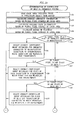
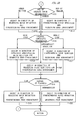
- Fig. 2A and 2B are flowcharts showing an operation in which the electronic camera 11 determines a correct coefficient group for noise reduction and edge enhancement in pixel units.
- Step S1 The analyzing section 22 sets a local area including a pixel as a processing object of a signal processing.
- the analyzing section 22 reads out plural pixel signals positioned in the local area from the buffer 16.
- Figs. 3A to 3D are views showing examples in the local area.
- the local area is set to a range of 9 pixels horizontal by 7 pixels vertical around the pixel (pixel indicated by a thick letter) of the processing object. It is preferable that the size in the local area is expanded or contracted in accordance with the number of pixels in all directions of image data, output resolution, printing size or display size.
- the setting range in the local area protrudes from the image data.
- pixel folding is performed with respect to the end of the screen as a symmetrical axis, and a blank portion in the local area is filled with the folded pixels.
- the blank portion in the local area may be filled by using the pixel signals of the processing object, pixel signals in the neighborhood, median values or the like.
- Step S2 The analyzing section 22 obtains average luminance information on the basis of the plural pixel signals included in the local area and in accordance with a following procedure.
- the analyzing section 22 adds the plural pixel signals in the local area for the respective colors, and obtains added values T ⁇ (R), T ⁇ (B) and T ⁇ (G) for the respective colors.
- the analyzing section 22 calculates the added values T ⁇ (R), T ⁇ (B) and T ⁇ (G) for the respective colors by following expressions.
- a pixel signal at vertical position y and horizontal position x is denoted by Cyx.
- C23 denotes the pixel signal at the center in the local area.
- T ⁇ (R) (C11 + C13 + C15 + C31 + C33 + C35)
- T ⁇ (B) (C00 + C02 + C04 + C06 + C20 + C22 + C24 + C26 + C40 + C42 + C44 + C46)
- T ⁇ (G) (C01 + C03 + C05 + C10 + C12 + C14 + C16 + C21 + C23 + C25 + C30 + C32 + C34 + C36 + C41 + C43 + C45)
- the analyzing section 22 calculates the added values T ⁇ (R), T ⁇ (B) and T ⁇ (G) for the respective colors by following expressions.
- T ⁇ (R) (C00 + C02 + C04 + C06 + C20 + C22 + C24 + C26 + C40 + C42 + C44 + C46)
- T ⁇ (B) (C11 + C13 + C15 + C31 + C33 + C35)
- T ⁇ (G) (C01 + C03 + C05 + C10 + C12 + C14 + C16 + C21 + C23 + C25 + C30 + C32 + C34 + C36 + C41 + C43 + C45)
- the analyzing section 22 calculates the added values T ⁇ (R), T ⁇ (B) and T ⁇ (G) for the respective colors by following expressions.
- T ⁇ (R) (C10 + C12 + C14 + C16 + C30 + C32 + C34 + C36)
- T ⁇ (B) (C01 + C03 + C05 + C21 + C23 + C25 + C41 + C43 + C45)
- T ⁇ (G) (C00 + C02 + C04 + C06 + C11 + C13 + C15 + C20 + C22 + C24 + C26 + C31 + C33 + C35 + C40 + C42 + C44 + C46)
- the analyzing section 22 calculates the added values T ⁇ (R), T ⁇ (B) and T ⁇ (G) for the respective colors by following expressions.
- T ⁇ (R) (C01 + C03 + C05 + C21 + C23 + C25 + C41 + C43 + C45)
- T ⁇ (B) (C10 + C12 + C14 + C16 + C30 + C32 + C34 + C36)
- T ⁇ (G) (C00 + C02 + C04 + C06 + C11 + C13 + C15 + C20 + C22 + C24 + C26 + C31 + C33 + C35 + C40 + C42 + C44 + C46)
- the analyzing section 22 divides the total sum of the added values T ⁇ (R), T ⁇ (B) and T ⁇ (G) for the respective colors by the number of the added pixels and calculates average luminance information.
- Step 3 Subsequently, the analyzing section 22 calculates an average chromaticity coordinate in the local area as average color information by using following expressions.
- (R/G, B/G) (T ⁇ (R)/T ⁇ (G), T ⁇ (B)/T ⁇ (G))
- the added values T ⁇ (R), T ⁇ (B) and T ⁇ (G) for the respective colors are normalized in accordance with the number of the added pixels.
- Step 4 Further, the analyzing section 22 obtains the degree of flatness in the local area by following procedures.
- Step S5 The coefficient determining section 23 acquires the information of the average luminance information, the average color information and the degree of flatness from the analyzing section 22.
- the coefficient determining section 23 consults the correspondence setting section 24 about the information.
- the correspondence setting section 24 checks the information against conditions (1) and (2) set forth below, and judges whether the pixel of the processing object is a place with a chromatic aberration of magnification.
- the threshold here is set to the degree of flatness at which the chromatic aberration of magnification starts to become noticeable.
- the coefficient section 23 judges that the processing part is the place with occurrence of the chromatic aberration of magnification, and causes the operation to proceed to step S6.
- the coefficient determining section 23 causes the operation to proceed to step S7.
- the spatial frequency filter of the noise reducing section 20 is adjusted by this correct coefficient group in the direction of strengthening the noise reduction.
- the spatial frequency filter of the edge enhancement 21 is adjusted in the direction of weakening the edge enhancement.
- Step 7 The coefficient determining section 23 consults the correspondence setting section 24 about the average luminance information, the average color information, and the degree of flatness.
- the correspondence setting section 24 checks the information against conditions (1), (2) and (3) set forth below, and judges whether the pixel of the processing object is a skin portion.
- image data of the skin is collected from various photographing results, and the threshold here is determined from the image data.
- the coefficient determining section 23 judges that the processing object is the skin portion, and causes the operation to proceed to step S8.
- Step S8 At this step, there is a high possibility that the pixel of the processing object is the skin portion. Then, the coefficient determining section 23 selects the correct coefficient group optimized for the skin portion, and transmits it to the noise reducing section 20 and the edge enhancing section 21.
- the correct coefficient group may be suitably determined by subjectively evaluate the picture quality of the skin portion after the signal processing.
- the spatial frequency filter of the noise reducing section 20 is adjusted by the correct coefficient group in the direction of strengthening the noise reduction.
- the spatial frequency filter of the edge enhancing section 21 is adjusted in the direction of weakening the edge enhancement.
- Step S9 The coefficient determining section 23 consults the correspondence setting section 24 about the average luminance information, the color information and the degree of flatness.
- the correspondence setting section 24 checks the information against conditions (1 ), (2) and (3) set forth below, and judges whether the pixel of the processing object is the blue sky portion.
- image data of the blue sky is collected from various photographing results and the threshold here is determined from the image data.
- the coefficient determining section 23 judges that the processing object is the place in the blue sky, and causes the operation to proceed to step S10.
- Step S10 At this step, there is a high possibility that the pixel of the processing object is the blue sky. Then, the coefficient determining section 23 selects the correct coefficient group optimized for the blue sky, and transmits it to the noise reducing section 20 and the edge enhancing section 21.
- the correct coefficient group may be suitably determined by subjectively evaluating the picture quality of the blue sky portion after the signal processing.
- the spatial frequency filter of the noise reducing section 20 is adjusted by this correct coefficient group in the direction of strengthening the noise reduction.
- the spatial frequency filter of the edge enhancing section 21 is adjusted in the direction of weakening the edge enhancement.
- Step 11 The coefficient determining section 23 checks the average color information against the correspondence relation stored in the correspondence setting section 24, and judges the average hue in the local area.
- the coefficient determining section 23 causes the operation to proceed to step S12.
- the coefficient determining section 23 causes the operation to proceed to step S13.
- Step S12 At this step, the average hue in the local area is green or cyan.
- the coefficient determining section 23 adjusts the spatial frequency filter of the edge enhancing section 21 in the direction of strengthening the edge enhancement. Further, the coefficient determining section 23 adjusts the spatial frequency filter of the noise reducing section 20 in the direction of weakening the noise reduction.
- the coefficient determining section 23 causes the operation to proceed to step S14.
- Step 13 At this step, the average hue in the local area is red or yellow.
- the coefficient determining section 23 adjusts the spatial frequency filter of the edge enhancing section 21 in the direction of weakening the edge enhancement. Further, the coefficient determining section 23 adjusts the spatial frequency filter of the noise reducing section 20 in the direction of strengthening the noise reduction.
- Step S 14 The coefficient determining section 23 checks the correspondence relation stored in the correspondence setting section 24, and judges whether the average luminance information falls in a range of intermediate gradation.
- the range of the intermediate gradation is set to the gradation range in which a harmful influence of the edge enhancement is low.
- the coefficient determining section 23 causes the operation to proceed to step S15.
- the coefficient determining section 23 causes the operation to proceed to step S16.
- step S15 In the case where the average luminance information falls in the range of the intermediate gradation, the coefficient determining section 23 adjusts the spatial frequency filter of the edge enhancing section 21 in the direction of strengthening the edge enhancement. Further, the coefficient determining section 23 adjusts the spatial frequency filter of the noise reducing section 20 in the direction of weakening the noise reduction (see Fig. 5).
- Step S16 In the case where the average luminance information is in the dark side, the coefficient determining section 23 adjusts the spatial frequency filter of the edge enhancing section 21 in the direction of weakening the edge enhancement. Further, the coefficient determining section 23 adjusts the spatial frequency filter of the noise reducing section 20 in the direction of especially strengthening the noise reduction (see Fig. 5).
- the noise of the dark part can be made unnoticeable by the adjustment as stated above.
- step S17 In the case where the average luminance information is in the bright side, the coefficient determining section 23 adjusts the spatial frequency filter of the edge enhancing section 21 in the direction of weakening the edge enhancement. Further, the coefficient determining section 23 adjusts the spatial frequency filter of the noise reducing section 20 in the direction of strengthening the noise reduction (see Fig. 5).
- Step S18 The coefficient determining section 23 checks the correspondence relation stored in the correspondence setting section 24, and evaluates and judges the degree of flatness in the local area.
- the coefficient determining section 23 causes the operation to proceed to step S19.
- Step S19 In the case where the degree of flatness is low, the coefficient determining section 23 adjusts the spatial frequency filter of the edge enhancing section 21 in the direction of strengthening the edge enhancement. Further, the coefficient determining section 23 adjusts the spatial frequency filter of the noise reducing section 20 in the direction of weakening the noise reduction (see Fig. 6).
- Step S20 On the contrary, in the case where the degree of flatness is high, the coefficient determining section 23 adjusts the spatial frequency filter of the edge enhancing section 21 in the direction of weakening the edge enhancement. Further, the coefficient determining section 23 adjusts the spatial frequency filter of the noise reducing section 20 in the direction of strengthening the noise reduction (see Fig. 6).
- the signal processing apparatus may be mounted in another color image equipment.
- a signal processing program may be created which causes a computer to function as the signal processing part (the noise reducing section 20 and/or the edge enhancing section 21), and the coefficient correcting section (the analyzing section 22, the coefficient determining section 23, and the correspondence setting section 24).
- the signal processing program it becomes possible to perform a signal processing suitable for image data (especially RAW data) on the computer.
- the "correct coefficient group" can be specified by checking the feature information (for example, average luminance information, average color information, and degree of flatness) in the local area.
- a lookup table may be used in which selected numbers of the correct coefficient group are made to correspond to the feature information in the local areas and are stored.
- arithmetic expressions for calculating the correction amount of the correct coefficient group from the feature information may be used.
- the noise reducing section 20 and the edge enhancement 21 are separately provided, and the respective spatial frequency filters are independently adjusted.
- the invention is not limited to this.
- by adjusting the coefficient group of one spatial frequency filter it is also possible to apply the noise reduction and the edge enhancement selectively or mixedly to the pixel signal.
Landscapes
- Engineering & Computer Science (AREA)
- Physics & Mathematics (AREA)
- General Physics & Mathematics (AREA)
- Theoretical Computer Science (AREA)
- Multimedia (AREA)
- Signal Processing (AREA)
- Facsimile Image Signal Circuits (AREA)
- Image Processing (AREA)
- Processing Of Color Television Signals (AREA)
- Picture Signal Circuits (AREA)
- Color Television Image Signal Generators (AREA)
- Color Image Communication Systems (AREA)
- Image Analysis (AREA)
Applications Claiming Priority (2)
| Application Number | Priority Date | Filing Date | Title |
|---|---|---|---|
| JP2003189521A JP4411879B2 (ja) | 2003-07-01 | 2003-07-01 | 信号処理装置、信号処理プログラム、および電子カメラ |
| JP2003189521 | 2003-07-01 |
Publications (3)
| Publication Number | Publication Date |
|---|---|
| EP1494170A2 true EP1494170A2 (de) | 2005-01-05 |
| EP1494170A3 EP1494170A3 (de) | 2007-01-03 |
| EP1494170B1 EP1494170B1 (de) | 2010-08-18 |
Family
ID=33432309
Family Applications (1)
| Application Number | Title | Priority Date | Filing Date |
|---|---|---|---|
| EP04015259A Expired - Lifetime EP1494170B1 (de) | 2003-07-01 | 2004-06-29 | Signalverarbeitungsapparat, Signalverarbeitungsprogramm und elektronische Kamera |
Country Status (4)
| Country | Link |
|---|---|
| US (1) | US7418132B2 (de) |
| EP (1) | EP1494170B1 (de) |
| JP (1) | JP4411879B2 (de) |
| DE (1) | DE602004028690D1 (de) |
Cited By (1)
| Publication number | Priority date | Publication date | Assignee | Title |
|---|---|---|---|---|
| FR2880453A1 (fr) * | 2005-01-06 | 2006-07-07 | Thomson Licensing Sa | Procede et dispositif de traitement de mosaique d'images |
Families Citing this family (65)
| Publication number | Priority date | Publication date | Assignee | Title |
|---|---|---|---|---|
| WO2005022460A1 (ja) * | 2003-08-29 | 2005-03-10 | Mitsubishi Denki Kabushiki Kaisha | 画像処理装置および画像処理方法 |
| US7519274B2 (en) | 2003-12-08 | 2009-04-14 | Divx, Inc. | File format for multiple track digital data |
| US8472792B2 (en) | 2003-12-08 | 2013-06-25 | Divx, Llc | Multimedia distribution system |
| CN100366045C (zh) * | 2005-01-11 | 2008-01-30 | 北京中星微电子有限公司 | 一种实现缩放的图像转换方法 |
| US20060242143A1 (en) * | 2005-02-17 | 2006-10-26 | Esham Matthew P | System for processing medical image representative data from multiple clinical imaging devices |
| JP4577565B2 (ja) * | 2005-03-03 | 2010-11-10 | ソニー株式会社 | 画像処理方法、画像処理装置、プログラム、および撮影装置 |
| KR100695067B1 (ko) | 2005-06-15 | 2007-03-14 | 삼성전자주식회사 | 블록분류를 이용한 시공간 노이즈 제거 방법 및 이 방법이적용되는 디스플레이장치 |
| JP2007036894A (ja) * | 2005-07-28 | 2007-02-08 | Kyocera Corp | 画像処理装置 |
| US8115833B2 (en) | 2005-09-28 | 2012-02-14 | Olympus Corporation | Image-acquisition apparatus |
| JP2007110576A (ja) * | 2005-10-17 | 2007-04-26 | Fujifilm Corp | 被写体像データの色補正装置およびその制御方法 |
| JP4487903B2 (ja) * | 2005-11-09 | 2010-06-23 | ソニー株式会社 | 画像処理装置および方法、並びにプログラム |
| KR100784162B1 (ko) * | 2005-12-29 | 2007-12-11 | 엠텍비젼 주식회사 | 격자 노이즈 제거를 이용한 컬러 보간 장치 |
| JP5200204B2 (ja) | 2006-03-14 | 2013-06-05 | ディブエックス リミテッド ライアビリティー カンパニー | 高信頼性システムを含む連合型デジタル権限管理機構 |
| JP4395789B2 (ja) | 2006-10-30 | 2010-01-13 | ソニー株式会社 | 画像処理装置、撮像装置、画像処理方法およびプログラム |
| JP4775230B2 (ja) * | 2006-11-06 | 2011-09-21 | 株式会社ニコン | 画像処理装置、撮像装置、及び画像処理プログラム |
| WO2008065089A2 (en) * | 2006-11-27 | 2008-06-05 | Thomson Licensing | Video pre-processing device and method, motion estimation device and method |
| CN103559165B (zh) | 2007-01-05 | 2016-08-17 | 索尼克知识产权股份有限公司 | 包含连续播放的视频分配系统 |
| US8532428B2 (en) * | 2007-02-27 | 2013-09-10 | Nec Corporation | Noise reducing apparatus, noise reducing method, and noise reducing program for improving image quality |
| WO2008149904A1 (ja) * | 2007-06-05 | 2008-12-11 | Olympus Corporation | 画像信号処理装置および画像信号処理プログラム |
| WO2009065137A1 (en) | 2007-11-16 | 2009-05-22 | Divx, Inc. | Hierarchical and reduced index structures for multimedia files |
| US20110128438A1 (en) * | 2008-08-29 | 2011-06-02 | Haruo Yamashita | Color signal converting apparatus, video displaying apparatus, color signal converting method, video displaying method and image data |
| JP5491073B2 (ja) * | 2009-05-22 | 2014-05-14 | キヤノン株式会社 | 画像処理装置、画像処理方法及びプログラム |
| JP5397079B2 (ja) * | 2009-08-11 | 2014-01-22 | ソニー株式会社 | 映像信号処理装置、エンハンスゲイン生成方法およびプログラム |
| US8781122B2 (en) | 2009-12-04 | 2014-07-15 | Sonic Ip, Inc. | Elementary bitstream cryptographic material transport systems and methods |
| JP5367667B2 (ja) * | 2010-09-21 | 2013-12-11 | 株式会社東芝 | 画像処理装置 |
| US8914534B2 (en) | 2011-01-05 | 2014-12-16 | Sonic Ip, Inc. | Systems and methods for adaptive bitrate streaming of media stored in matroska container files using hypertext transfer protocol |
| US9021119B2 (en) | 2011-01-06 | 2015-04-28 | Sonic Ip, Inc. | Systems and methods for performing adaptive bitrate streaming based upon the delay of each stream and the channel rate |
| JP5335017B2 (ja) * | 2011-02-24 | 2013-11-06 | 富士フイルム株式会社 | 内視鏡装置 |
| US8812662B2 (en) | 2011-06-29 | 2014-08-19 | Sonic Ip, Inc. | Systems and methods for estimating available bandwidth and performing initial stream selection when streaming content |
| WO2013014791A1 (ja) * | 2011-07-28 | 2013-01-31 | 株式会社 東芝 | 映像信号処理装置及び映像信号処理方法 |
| US9467708B2 (en) | 2011-08-30 | 2016-10-11 | Sonic Ip, Inc. | Selection of resolutions for seamless resolution switching of multimedia content |
| KR102020764B1 (ko) | 2011-08-30 | 2019-09-11 | 디브이엑스, 엘엘씨 | 복수의 최대 비트레이트 레벨들을 사용하여 인코딩된 비디오를 인코딩하고 스트리밍하기 위한 시스템들 및 방법들 |
| US8799647B2 (en) | 2011-08-31 | 2014-08-05 | Sonic Ip, Inc. | Systems and methods for application identification |
| US8787570B2 (en) | 2011-08-31 | 2014-07-22 | Sonic Ip, Inc. | Systems and methods for automatically genenrating top level index files |
| US8909922B2 (en) | 2011-09-01 | 2014-12-09 | Sonic Ip, Inc. | Systems and methods for playing back alternative streams of protected content protected using common cryptographic information |
| US8964977B2 (en) | 2011-09-01 | 2015-02-24 | Sonic Ip, Inc. | Systems and methods for saving encoded media streamed using adaptive bitrate streaming |
| JP5834728B2 (ja) * | 2011-09-30 | 2015-12-24 | 大日本印刷株式会社 | 雑音除去装置 |
| US8918908B2 (en) | 2012-01-06 | 2014-12-23 | Sonic Ip, Inc. | Systems and methods for accessing digital content using electronic tickets and ticket tokens |
| KR20130122411A (ko) * | 2012-04-30 | 2013-11-07 | 삼성전자주식회사 | 이미지 획득 장치 및 이미지 획득 장치의 동작 방법 |
| JP2014027632A (ja) * | 2012-07-30 | 2014-02-06 | Sharp Corp | 画像処理装置、画像形成装置、画像処理方法、画像処理プログラム、および記録媒体 |
| US9936267B2 (en) | 2012-08-31 | 2018-04-03 | Divx Cf Holdings Llc | System and method for decreasing an initial buffering period of an adaptive streaming system |
| US9313510B2 (en) | 2012-12-31 | 2016-04-12 | Sonic Ip, Inc. | Use of objective quality measures of streamed content to reduce streaming bandwidth |
| US9191457B2 (en) | 2012-12-31 | 2015-11-17 | Sonic Ip, Inc. | Systems, methods, and media for controlling delivery of content |
| US9906785B2 (en) | 2013-03-15 | 2018-02-27 | Sonic Ip, Inc. | Systems, methods, and media for transcoding video data according to encoding parameters indicated by received metadata |
| US10397292B2 (en) | 2013-03-15 | 2019-08-27 | Divx, Llc | Systems, methods, and media for delivery of content |
| US9094737B2 (en) | 2013-05-30 | 2015-07-28 | Sonic Ip, Inc. | Network video streaming with trick play based on separate trick play files |
| US9380099B2 (en) | 2013-05-31 | 2016-06-28 | Sonic Ip, Inc. | Synchronizing multiple over the top streaming clients |
| US9100687B2 (en) | 2013-05-31 | 2015-08-04 | Sonic Ip, Inc. | Playback synchronization across playback devices |
| US9386067B2 (en) | 2013-12-30 | 2016-07-05 | Sonic Ip, Inc. | Systems and methods for playing adaptive bitrate streaming content by multicast |
| JP6415062B2 (ja) * | 2014-02-21 | 2018-10-31 | キヤノン株式会社 | 画像処理装置、画像処理方法、制御プログラム、および記録媒体 |
| US9866878B2 (en) | 2014-04-05 | 2018-01-09 | Sonic Ip, Inc. | Systems and methods for encoding and playing back video at different frame rates using enhancement layers |
| TWI536319B (zh) * | 2014-06-24 | 2016-06-01 | 瑞昱半導體股份有限公司 | 去雜訊方法以及影像系統 |
| KR102548789B1 (ko) | 2014-08-07 | 2023-06-29 | 디빅스, 엘엘씨 | 독립적으로 인코딩된 타일을 포함한 기본 비트스트림을 보호하는 시스템 및 방법 |
| JP6514504B2 (ja) * | 2014-12-26 | 2019-05-15 | キヤノン株式会社 | 画像処理装置およびその制御方法、ならびにプログラム |
| EP4730752A3 (de) | 2015-01-06 | 2026-07-15 | DivX, LLC | Systeme und verfahren zur codierung und gemeinsamen nutzung von inhalten zwischen vorrichtungen |
| WO2016138493A1 (en) | 2015-02-27 | 2016-09-01 | Sonic Ip, Inc. | Systems and methods for frame duplication and frame extension in live video encoding and streaming |
| US10075292B2 (en) | 2016-03-30 | 2018-09-11 | Divx, Llc | Systems and methods for quick start-up of playback |
| US10231001B2 (en) | 2016-05-24 | 2019-03-12 | Divx, Llc | Systems and methods for providing audio content during trick-play playback |
| US10129574B2 (en) | 2016-05-24 | 2018-11-13 | Divx, Llc | Systems and methods for providing variable speeds in a trick-play mode |
| US10148989B2 (en) | 2016-06-15 | 2018-12-04 | Divx, Llc | Systems and methods for encoding video content |
| US12244660B2 (en) | 2016-09-08 | 2025-03-04 | Divx, Llc | Systems and methods for adaptive buffering for digital video streaming |
| US10498795B2 (en) | 2017-02-17 | 2019-12-03 | Divx, Llc | Systems and methods for adaptive switching between multiple content delivery networks during adaptive bitrate streaming |
| US10628921B1 (en) * | 2017-03-21 | 2020-04-21 | Ambarella International Lp | Tone based non-smooth detection |
| ES2974683T3 (es) | 2019-03-21 | 2024-07-01 | Divx Llc | Sistemas y métodos para enjambres multimedia |
| JP2024003974A (ja) * | 2022-06-28 | 2024-01-16 | ブラザー工業株式会社 | 印刷装置、印刷方法および印刷プログラム |
Family Cites Families (11)
| Publication number | Priority date | Publication date | Assignee | Title |
|---|---|---|---|---|
| JPH0537776A (ja) | 1990-12-13 | 1993-02-12 | Ricoh Co Ltd | 画像処理装置 |
| JPH05174142A (ja) | 1991-12-20 | 1993-07-13 | Nippon Telegr & Teleph Corp <Ntt> | カラー画像輪郭強調・弛緩処理方法 |
| US6434266B1 (en) * | 1993-12-17 | 2002-08-13 | Canon Kabushiki Kaisha | Image processing method and apparatus for converting colors in a color image |
| JPH0950531A (ja) | 1995-08-09 | 1997-02-18 | Fuji Xerox Co Ltd | 画像処理装置 |
| JP3618912B2 (ja) * | 1996-07-12 | 2005-02-09 | キヤノン株式会社 | 画像形成装置 |
| US6295382B1 (en) | 1998-05-22 | 2001-09-25 | Ati Technologies, Inc. | Method and apparatus for establishing an adaptive noise reduction filter |
| JP3625160B2 (ja) | 1999-10-14 | 2005-03-02 | シャープ株式会社 | 画像処理装置 |
| US6856704B1 (en) | 2000-09-13 | 2005-02-15 | Eastman Kodak Company | Method for enhancing a digital image based upon pixel color |
| US20030026495A1 (en) | 2001-03-07 | 2003-02-06 | Gondek Jay Stephen | Parameterized sharpening and smoothing method and apparatus |
| US20020172431A1 (en) | 2001-03-07 | 2002-11-21 | Atkins C. Brian | Digital image appearance enhancement and compressibility improvement method and system |
| US7092573B2 (en) | 2001-12-10 | 2006-08-15 | Eastman Kodak Company | Method and system for selectively applying enhancement to an image |
-
2003
- 2003-07-01 JP JP2003189521A patent/JP4411879B2/ja not_active Expired - Lifetime
-
2004
- 2004-06-28 US US10/876,688 patent/US7418132B2/en not_active Expired - Fee Related
- 2004-06-29 EP EP04015259A patent/EP1494170B1/de not_active Expired - Lifetime
- 2004-06-29 DE DE602004028690T patent/DE602004028690D1/de not_active Expired - Lifetime
Cited By (3)
| Publication number | Priority date | Publication date | Assignee | Title |
|---|---|---|---|---|
| FR2880453A1 (fr) * | 2005-01-06 | 2006-07-07 | Thomson Licensing Sa | Procede et dispositif de traitement de mosaique d'images |
| EP1679653A1 (de) * | 2005-01-06 | 2006-07-12 | Thomson Licensing | Verfahren und Vorrichtung zur Verarbeitung eines Bildmosaiks |
| US7769242B2 (en) | 2005-01-06 | 2010-08-03 | Thomson Licensing | Method and device for processing a mosaic of images |
Also Published As
| Publication number | Publication date |
|---|---|
| US7418132B2 (en) | 2008-08-26 |
| JP2005026962A (ja) | 2005-01-27 |
| DE602004028690D1 (de) | 2010-09-30 |
| US20050001913A1 (en) | 2005-01-06 |
| JP4411879B2 (ja) | 2010-02-10 |
| EP1494170A3 (de) | 2007-01-03 |
| EP1494170B1 (de) | 2010-08-18 |
Similar Documents
| Publication | Publication Date | Title |
|---|---|---|
| US7418132B2 (en) | Signal processing apparatus, signal processing program and electronic camera | |
| JP4154847B2 (ja) | 画像処理装置、画像処理方法および画像処理プログラムを記録したコンピュータ読取可能な記録媒体 | |
| JP4677753B2 (ja) | 動画像処理装置及び方法 | |
| US7973850B2 (en) | Image processing apparatus and image processing method | |
| US8274580B2 (en) | Signal processing device, signal processing program and electronic camera | |
| US7812868B2 (en) | Signal processing method and apparatus, and image sensing apparatus | |
| JP2004088149A (ja) | 撮像システムおよび画像処理プログラム | |
| KR20070102399A (ko) | 촬상 장치 | |
| JP2002232906A (ja) | ホワイトバランス制御装置 | |
| US7697044B2 (en) | Image processing apparatus and image processing method | |
| US8270712B2 (en) | Image processing device, image processing program, and image processing method | |
| US11108999B2 (en) | Image processing apparatus, image processing method, and non-transitory computer-readable storage medium | |
| JP7124163B2 (ja) | 画像処理装置及び画像処理方法 | |
| JP7203441B2 (ja) | 画像生成装置及び撮像装置 | |
| JP3334047B2 (ja) | 画像処理装置およびこれを搭載した画像読取装置と画像形成装置、並びに画像処理方法、および画像処理手順を記憶したコンピュータ読み取り可能な記憶媒体 | |
| JP4120928B2 (ja) | 画像処理装置、画像処理方法、およびそのプログラム | |
| JP2000165906A (ja) | 自動ホワイトバランス調整方法及び調整装置 | |
| JP2002232704A (ja) | 画像処理装置及び画像形成装置 | |
| JP4107014B2 (ja) | 画像処理装置、画像処理方法、及びそのプログラム並びにそのプログラムを記録した記録媒体 | |
| JPH08116462A (ja) | 画像処理装置 | |
| JP2009239396A (ja) | 画像処理装置 |
Legal Events
| Date | Code | Title | Description |
|---|---|---|---|
| PUAI | Public reference made under article 153(3) epc to a published international application that has entered the european phase |
Free format text: ORIGINAL CODE: 0009012 |
|
| AK | Designated contracting states |
Kind code of ref document: A2 Designated state(s): AT BE BG CH CY CZ DE DK EE ES FI FR GB GR HU IE IT LI LU MC NL PL PT RO SE SI SK TR |
|
| AX | Request for extension of the european patent |
Extension state: AL HR LT LV MK |
|
| PUAL | Search report despatched |
Free format text: ORIGINAL CODE: 0009013 |
|
| AK | Designated contracting states |
Kind code of ref document: A3 Designated state(s): AT BE BG CH CY CZ DE DK EE ES FI FR GB GR HU IE IT LI LU MC NL PL PT RO SE SI SK TR |
|
| AX | Request for extension of the european patent |
Extension state: AL HR LT LV MK |
|
| 17P | Request for examination filed |
Effective date: 20070628 |
|
| 17Q | First examination report despatched |
Effective date: 20070726 |
|
| AKX | Designation fees paid |
Designated state(s): DE FR GB |
|
| GRAP | Despatch of communication of intention to grant a patent |
Free format text: ORIGINAL CODE: EPIDOSNIGR1 |
|
| GRAS | Grant fee paid |
Free format text: ORIGINAL CODE: EPIDOSNIGR3 |
|
| GRAA | (expected) grant |
Free format text: ORIGINAL CODE: 0009210 |
|
| RAP1 | Party data changed (applicant data changed or rights of an application transferred) |
Owner name: NIKON CORPORATION |
|
| AK | Designated contracting states |
Kind code of ref document: B1 Designated state(s): DE FR GB |
|
| REG | Reference to a national code |
Ref country code: GB Ref legal event code: FG4D |
|
| REF | Corresponds to: |
Ref document number: 602004028690 Country of ref document: DE Date of ref document: 20100930 Kind code of ref document: P |
|
| PLBE | No opposition filed within time limit |
Free format text: ORIGINAL CODE: 0009261 |
|
| STAA | Information on the status of an ep patent application or granted ep patent |
Free format text: STATUS: NO OPPOSITION FILED WITHIN TIME LIMIT |
|
| 26N | No opposition filed |
Effective date: 20110519 |
|
| REG | Reference to a national code |
Ref country code: DE Ref legal event code: R097 Ref document number: 602004028690 Country of ref document: DE Effective date: 20110519 |
|
| REG | Reference to a national code |
Ref country code: FR Ref legal event code: PLFP Year of fee payment: 13 |
|
| REG | Reference to a national code |
Ref country code: FR Ref legal event code: PLFP Year of fee payment: 14 |
|
| REG | Reference to a national code |
Ref country code: FR Ref legal event code: PLFP Year of fee payment: 15 |
|
| PGFP | Annual fee paid to national office [announced via postgrant information from national office to epo] |
Ref country code: DE Payment date: 20190618 Year of fee payment: 16 |
|
| PGFP | Annual fee paid to national office [announced via postgrant information from national office to epo] |
Ref country code: GB Payment date: 20190626 Year of fee payment: 16 |
|
| PGFP | Annual fee paid to national office [announced via postgrant information from national office to epo] |
Ref country code: FR Payment date: 20200512 Year of fee payment: 17 |
|
| REG | Reference to a national code |
Ref country code: DE Ref legal event code: R119 Ref document number: 602004028690 Country of ref document: DE |
|
| GBPC | Gb: european patent ceased through non-payment of renewal fee |
Effective date: 20200629 |
|
| PG25 | Lapsed in a contracting state [announced via postgrant information from national office to epo] |
Ref country code: GB Free format text: LAPSE BECAUSE OF NON-PAYMENT OF DUE FEES Effective date: 20200629 |
|
| PG25 | Lapsed in a contracting state [announced via postgrant information from national office to epo] |
Ref country code: DE Free format text: LAPSE BECAUSE OF NON-PAYMENT OF DUE FEES Effective date: 20210101 |
|
| PG25 | Lapsed in a contracting state [announced via postgrant information from national office to epo] |
Ref country code: FR Free format text: LAPSE BECAUSE OF NON-PAYMENT OF DUE FEES Effective date: 20210630 |