EP1494448A1 - Lichtpunktabtaster - Google Patents
Lichtpunktabtaster Download PDFInfo
- Publication number
- EP1494448A1 EP1494448A1 EP03101957A EP03101957A EP1494448A1 EP 1494448 A1 EP1494448 A1 EP 1494448A1 EP 03101957 A EP03101957 A EP 03101957A EP 03101957 A EP03101957 A EP 03101957A EP 1494448 A1 EP1494448 A1 EP 1494448A1
- Authority
- EP
- European Patent Office
- Prior art keywords
- light
- detector
- guiding means
- image
- recording member
- Prior art date
- Legal status (The legal status is an assumption and is not a legal conclusion. Google has not performed a legal analysis and makes no representation as to the accuracy of the status listed.)
- Withdrawn
Links
Images


Classifications
-
- H—ELECTRICITY
- H04—ELECTRIC COMMUNICATION TECHNIQUE
- H04N—PICTORIAL COMMUNICATION, e.g. TELEVISION
- H04N1/00—Scanning, transmission or reproduction of documents or the like, e.g. facsimile transmission; Details thereof
- H04N1/024—Details of scanning heads ; Means for illuminating the original
- H04N1/028—Details of scanning heads ; Means for illuminating the original for picture information pick-up
-
- H—ELECTRICITY
- H04—ELECTRIC COMMUNICATION TECHNIQUE
- H04N—PICTORIAL COMMUNICATION, e.g. TELEVISION
- H04N1/00—Scanning, transmission or reproduction of documents or the like, e.g. facsimile transmission; Details thereof
- H04N1/04—Scanning arrangements, i.e. arrangements for the displacement of active reading or reproducing elements relative to the original or reproducing medium, or vice versa
- H04N1/10—Scanning arrangements, i.e. arrangements for the displacement of active reading or reproducing elements relative to the original or reproducing medium, or vice versa using flat picture-bearing surfaces
- H04N1/1008—Scanning arrangements, i.e. arrangements for the displacement of active reading or reproducing elements relative to the original or reproducing medium, or vice versa using flat picture-bearing surfaces with sub-scanning by translatory movement of the picture-bearing surface
-
- H—ELECTRICITY
- H04—ELECTRIC COMMUNICATION TECHNIQUE
- H04N—PICTORIAL COMMUNICATION, e.g. TELEVISION
- H04N2201/00—Indexing scheme relating to scanning, transmission or reproduction of documents or the like, and to details thereof
- H04N2201/024—Indexing scheme relating to scanning, transmission or reproduction of documents or the like, and to details thereof deleted
- H04N2201/02493—Additional optical elements not otherwise provided for, e.g. filters, polarising plates, masks or apertures
-
- H—ELECTRICITY
- H04—ELECTRIC COMMUNICATION TECHNIQUE
- H04N—PICTORIAL COMMUNICATION, e.g. TELEVISION
- H04N2201/00—Indexing scheme relating to scanning, transmission or reproduction of documents or the like, and to details thereof
- H04N2201/04—Scanning arrangements
- H04N2201/0402—Arrangements not specific to a particular one of the scanning methods covered by groups H04N1/04 - H04N1/207
- H04N2201/0404—Scanning transparent media, e.g. photographic film
- H04N2201/0412—Scanning X-ray films
Definitions
- the present invention relates to light detection in flying spot scanners, more specifically flying spot scanners used in medical applications.
- a radiation image can be stored in a photo-stimulable phosphor screen.
- a digital signal representation of the stored radiation image is obtained by scanning the screen with stimulating radiation and detecting the image-wise modulated light emitted by the screen upon stimulation.
- the radiation image is read out of the screen in a flying spot scanner.
- a flying spot scanner a recording member such as a photo-stimulable phosphor screen is scanned by deflecting radiation emitted by a source of radiation in a first direction, the so-called fast scan direction and by transporting the image into a second direction, e.g. perpendicular to the first direction, said second direction being referred to as the slow scan direction.
- Image-wise modulated light emitted by the screen upon stimulation is then guided by light guiding means, e.g. a bundle of optical fibers, towards the light sensitive entrance surface of a photo-electrical converter such as a photo-multiplier by means of which the detected light is converted in to an electric signal.
- light guiding means e.g. a bundle of optical fibers
- a photo-electrical converter such as a photo-multiplier
- the light emitted by pixels within a single line on the phosphor screen is guided by a bundle of optical fibers towards a circular entrance surface of the photo-multiplier.
- the number of optical fibers that transport the light emitted by a single pixel towards the anode of the photo-multiplier is limited and the light of one pixel is guided to a dedicated part of the surface of the anode. Light emitted by another pixel is guided to another part of the surface.
- the spectral sensitivity of the anode surface and an optical filter used to avoid stimulating light entering the photo-multiplier may be not completely uniform. This non-uniform spectral sensitivity has a negative influence on the detected signal specially when different phosphors with different emission spectra are used. Calibration becomes more difficult if the plate used to calibrate contains another phosphor as the plate used to make the images. This effect depends on the way in which the light guiding optical fibers are bundled.
- Calibration of this non-sensitive behavior is difficult since the calibration corresponds with the position of the recording member and may hence not be applicable in all circumstances. Calibration might for example become in-applicable when the calibration line is showing parts with high gradients and if the position of the screen in the flying spot scanner is slightly changed, for example slightly displaced.
- the calibration depends on the emission wavelength of the phosphor and a scanner should thus be calibrated for each material having its own emission wavelength.
- an apparatus for reading an image that has been stored in a recording member as set out in claim 1.
- the apparatus has light distributing means in between the output of light guiding means guiding image-wise modulated light towards a detector and the detector so that light leaving the light guiding means is distributed over substantially the whole entrance surface of the detector.
- a diffuser such as an opaline glass is provided in between the output of the light guiding means and the entrance surface of the detector.
- a hollow tube is provided between the light guiding means and the entrance surface of the detector.
- the output of all individual fibers has to enter the tube.
- the output of the tube needs to cover at least the entrance window of the photo-multiplier.
- the tube provides that the distance between the light guide and entrance of the photo-multiplier is increased while the light remains to be guided into the detector.
- the inner surface of the tube is covered with a material that has very good light reflecting properties such as white paint (e.g. Eastman Kodak White Paint (BaSO 4 )) or high-gloss aluminum.
- an integrating sphere is provided in between the light guiding means and the entrance surface of the detector.
- the integrating sphere is a hollow sphere having an entrance window, which is positioned so that the output of the light guiding means is coupled to the entrance window of the integrating sphere while the output window of the integrating sphere is coupled to the entrance window of the detector.
- the inner surface of the sphere is preferably provided with a material that has very good reflecting properties, white lacquer (BaSO 4 ) or high-gloss aluminum.
- the invention has been conceived for a particular application in which a radiation image, more particular an X-ray image of a patient is temporarily stored in a photo-stimulable phosphor screen and wherein the image is read out of the screen by line-wise scanning the screen with laser light having (a) wavelength range(s) in the stimulating wavelength range of the phosphor.
- Image-wise radiation emitted by the screen upon stimulation is guided by a light guiding means, more particular by a bundle of optical fibers towards the anode of a photo-multiplier tube and converted into an electrical signal representation.
- the bundle of optical fibers is arranged to form a line parallel with a scanned line (fast scan direction) at its light input side and is arranged to form a circular area at the output side.
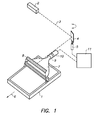
- Figure 1 shows a specific embodiment of a read out apparatus according to the present invention which is adapted for read out of a radiation image such as an X-ray image that has been stored in a photo-stimulable phosphor screen.
- a stimulable phosphor screen has been exposed to radiation such as an X-ray image of a patient is read out in a read out apparatus such as the one shown in figure 1.
- the apparatus comprises the following components: a stimulating light source 2 such as a laser.
- a galvanometric mirror, driven by drive means 5 is controlled and arranged to deflect the light emitted by the light source in the fast scan direction.
- Transport means (not shown) are provided to transport the screen in the direction of arrow 6 to enable the whole screen to be scanned in two dimensions.
- a light guide 7 Positioned close to but behind the scanning line of the laser beam on the phosphor sheet 1 is a light guide 7 which receives image-wise modulated light emitted from the phosphor sheet but is shielded by shielding means 8 from direct exposure to the laser beam 3.
- the light guide comprises individual optical fibers that are bundled at the output end.
- the output end is positioned close to the entrance of a light distributing means 9 according to the present invention.
- the light distributing means consists of a hollow tube of approximately 15-cm and a inner diameter of 8 cm. The inner surface of the tube is covered with high-gloss aluminum.
- the output end of the tube is positioned adjacent to the entrance window of a photo multiplier 10 which produces an electrical signal representative of the light intensity falling on its entrance window.
- An optical filter (not shown) was placed at the output window of the tube in front of the photomultiplier.
- Light originating from a single pixel in the image is transported by at least one of the optical fibers to entrance of the tube and is then further guided by the tube onto the entrance window of the photo-multiplier where the light falling on the entire surface will be integrated and will constitute the input of the light to signal conversion for the generation of the signal presentation of that specific pixel.
- the signal generated by the photo multiplier may be processed in processing means 11, stored, transmitted or applied to another device such as a display monitor.
- the alignment of the phosphor screens in the cassettes conveying the screens was different during either of the exposures. One screen was aligned with the right side of the cassette while the other screen was aligned with the left side.
- Figure 2 shows the profile of both images in the fast scan direction (Scan Average Level (SAL), being the signal detected by photo-multiplier and (amplifying) electronics for a pixel versus distance along a scan line in mm).
- SAL Scan Average Level
- Profile 1 relates to the screen which was aligned with the right side of the cassette
- profile 2 relates to the screen, which was aligned to the left side of the cassette.
- the curve shown in figure 3 represents the comparison (ratio) of both profiles.
- Figure 4 shows the result of the same situations as those for which the profiles were shown in figure 2.
- a hollow tube having a length of about 15 cm and an inner diameter of about 8 cm and having its inner surface covered with high-gloss aluminum was positioned between the output of the light guide and the entrance window of the photo-multiplier. In this way the light leaving a single fiber is spread over the entire entrance surface of the anode of the photo-multiplier and also over the entire surface of the optical filter.
- Figure 5 shows the comparison (ratio of) between both curves shown in figure 4. The fluctuations in the curve have disappeared, this corresponds with reduced banding in the image.
Landscapes
- Engineering & Computer Science (AREA)
- Multimedia (AREA)
- Signal Processing (AREA)
- Facsimile Scanning Arrangements (AREA)
- Radiography Using Non-Light Waves (AREA)
- Conversion Of X-Rays Into Visible Images (AREA)
Priority Applications (1)
| Application Number | Priority Date | Filing Date | Title |
|---|---|---|---|
| EP03101957A EP1494448A1 (de) | 2003-07-01 | 2003-07-01 | Lichtpunktabtaster |
Applications Claiming Priority (1)
| Application Number | Priority Date | Filing Date | Title |
|---|---|---|---|
| EP03101957A EP1494448A1 (de) | 2003-07-01 | 2003-07-01 | Lichtpunktabtaster |
Publications (1)
| Publication Number | Publication Date |
|---|---|
| EP1494448A1 true EP1494448A1 (de) | 2005-01-05 |
Family
ID=33427223
Family Applications (1)
| Application Number | Title | Priority Date | Filing Date |
|---|---|---|---|
| EP03101957A Withdrawn EP1494448A1 (de) | 2003-07-01 | 2003-07-01 | Lichtpunktabtaster |
Country Status (1)
| Country | Link |
|---|---|
| EP (1) | EP1494448A1 (de) |
Citations (5)
| Publication number | Priority date | Publication date | Assignee | Title |
|---|---|---|---|---|
| EP0151932A2 (de) * | 1984-01-13 | 1985-08-21 | Fuji Photo Film Co., Ltd. | Strahlungs-Darstellungsvorrichtung und Verfahren |
| US4818861A (en) * | 1986-06-25 | 1989-04-04 | Hitachi Medical Corp. | Film image reading out device |
| US5037207A (en) * | 1986-02-12 | 1991-08-06 | Ohio State University Research Foundation | Laser imaging system |
| WO1996037761A1 (en) * | 1995-05-26 | 1996-11-28 | Lxr Biotechnology Inc. | Multi-channel acquisition using integrating sphere |
| US5973839A (en) * | 1998-03-05 | 1999-10-26 | Hewlett-Packard Company | Optical homogenizer |
-
2003
- 2003-07-01 EP EP03101957A patent/EP1494448A1/de not_active Withdrawn
Patent Citations (5)
| Publication number | Priority date | Publication date | Assignee | Title |
|---|---|---|---|---|
| EP0151932A2 (de) * | 1984-01-13 | 1985-08-21 | Fuji Photo Film Co., Ltd. | Strahlungs-Darstellungsvorrichtung und Verfahren |
| US5037207A (en) * | 1986-02-12 | 1991-08-06 | Ohio State University Research Foundation | Laser imaging system |
| US4818861A (en) * | 1986-06-25 | 1989-04-04 | Hitachi Medical Corp. | Film image reading out device |
| WO1996037761A1 (en) * | 1995-05-26 | 1996-11-28 | Lxr Biotechnology Inc. | Multi-channel acquisition using integrating sphere |
| US5973839A (en) * | 1998-03-05 | 1999-10-26 | Hewlett-Packard Company | Optical homogenizer |
Similar Documents
| Publication | Publication Date | Title |
|---|---|---|
| US4551626A (en) | Method of correcting radiation image read-out error | |
| US20020011577A1 (en) | Radiation image information read-out method and system | |
| JPH0246931B2 (de) | ||
| US4749861A (en) | Method and apparatus for radiation image read-out | |
| EP0275116A2 (de) | Wiedergabegerät für ein Strahlungsbild | |
| JPS5919939A (ja) | 放射線画像情報読取方法 | |
| US4816688A (en) | Radiation image read-out apparatus for stimulable phosphor sheet | |
| US4816690A (en) | Method and apparatus for radiation image recording and read-out including control of read-out in accordance with irradiation field definition | |
| EP1494448A1 (de) | Lichtpunktabtaster | |
| JP2707363B2 (ja) | 放射線画像読取装置 | |
| JPH0439947B2 (de) | ||
| JPS61189763A (ja) | 放射線画像情報読取方法 | |
| US4816677A (en) | Method and apparatus for radiation image recording and read-out including data processing based on a portion of image data defined by an irradiation field stop | |
| US5081356A (en) | Image read-out apparatus | |
| US4835387A (en) | Radiation image read-out apparatus | |
| JPH03156437A (ja) | 放射線画像読取装置 | |
| JPH03198039A (ja) | 画像読取装置 | |
| JP2561159B2 (ja) | 放射線画像読取装置 | |
| JPS63167345A (ja) | 放射線画像情報読取方法 | |
| JP2761638B2 (ja) | 蓄積性蛍光体シート用カセツテ | |
| JPH01237640A (ja) | 放射線画像情報読取装置 | |
| JP2537599B2 (ja) | 放射線画像情報記録読取システム | |
| JP2004279593A (ja) | 放射線画像情報読取装置 | |
| JPH043149A (ja) | 放射線画像情報読取装置 | |
| JPH03132155A (ja) | 光ビーム走査装置の画像幅調整方法 |
Legal Events
| Date | Code | Title | Description |
|---|---|---|---|
| PUAI | Public reference made under article 153(3) epc to a published international application that has entered the european phase |
Free format text: ORIGINAL CODE: 0009012 |
|
| AK | Designated contracting states |
Kind code of ref document: A1 Designated state(s): AT BE BG CH CY CZ DE DK EE ES FI FR GB GR HU IE IT LI LU MC NL PT RO SE SI SK TR |
|
| AX | Request for extension of the european patent |
Extension state: AL LT LV MK |
|
| 17P | Request for examination filed |
Effective date: 20050705 |
|
| AKX | Designation fees paid |
Designated state(s): DE FR GB |
|
| RAP1 | Party data changed (applicant data changed or rights of an application transferred) |
Owner name: AGFA HEALTHCARE NV |
|
| RAP1 | Party data changed (applicant data changed or rights of an application transferred) |
Owner name: AGFA HEALTHCARE NV |
|
| STAA | Information on the status of an ep patent application or granted ep patent |
Free format text: STATUS: THE APPLICATION IS DEEMED TO BE WITHDRAWN |
|
| 18D | Application deemed to be withdrawn |
Effective date: 20090202 |