EP1494482A1 - Verfahren zur Transkodierung eines JPEG2000 komprimierten Bilds - Google Patents
Verfahren zur Transkodierung eines JPEG2000 komprimierten Bilds Download PDFInfo
- Publication number
- EP1494482A1 EP1494482A1 EP04076779A EP04076779A EP1494482A1 EP 1494482 A1 EP1494482 A1 EP 1494482A1 EP 04076779 A EP04076779 A EP 04076779A EP 04076779 A EP04076779 A EP 04076779A EP 1494482 A1 EP1494482 A1 EP 1494482A1
- Authority
- EP
- European Patent Office
- Prior art keywords
- bit
- codeblock
- compressed
- jpeg2000
- stream
- Prior art date
- Legal status (The legal status is an assumption and is not a legal conclusion. Google has not performed a legal analysis and makes no representation as to the accuracy of the status listed.)
- Granted
Links
Images



Classifications
-
- H—ELECTRICITY
- H04—ELECTRIC COMMUNICATION TECHNIQUE
- H04N—PICTORIAL COMMUNICATION, e.g. TELEVISION
- H04N19/00—Methods or arrangements for coding, decoding, compressing or decompressing digital video signals
- H04N19/50—Methods or arrangements for coding, decoding, compressing or decompressing digital video signals using predictive coding
- H04N19/59—Methods or arrangements for coding, decoding, compressing or decompressing digital video signals using predictive coding involving spatial sub-sampling or interpolation, e.g. alteration of picture size or resolution
-
- H—ELECTRICITY
- H04—ELECTRIC COMMUNICATION TECHNIQUE
- H04N—PICTORIAL COMMUNICATION, e.g. TELEVISION
- H04N19/00—Methods or arrangements for coding, decoding, compressing or decompressing digital video signals
- H04N19/10—Methods or arrangements for coding, decoding, compressing or decompressing digital video signals using adaptive coding
- H04N19/102—Methods or arrangements for coding, decoding, compressing or decompressing digital video signals using adaptive coding characterised by the element, parameter or selection affected or controlled by the adaptive coding
- H04N19/124—Quantisation
- H04N19/126—Details of normalisation or weighting functions, e.g. normalisation matrices or variable uniform quantisers
-
- H—ELECTRICITY
- H04—ELECTRIC COMMUNICATION TECHNIQUE
- H04N—PICTORIAL COMMUNICATION, e.g. TELEVISION
- H04N19/00—Methods or arrangements for coding, decoding, compressing or decompressing digital video signals
- H04N19/10—Methods or arrangements for coding, decoding, compressing or decompressing digital video signals using adaptive coding
- H04N19/102—Methods or arrangements for coding, decoding, compressing or decompressing digital video signals using adaptive coding characterised by the element, parameter or selection affected or controlled by the adaptive coding
- H04N19/132—Sampling, masking or truncation of coding units, e.g. adaptive resampling, frame skipping, frame interpolation or high-frequency transform coefficient masking
-
- H—ELECTRICITY
- H04—ELECTRIC COMMUNICATION TECHNIQUE
- H04N—PICTORIAL COMMUNICATION, e.g. TELEVISION
- H04N19/00—Methods or arrangements for coding, decoding, compressing or decompressing digital video signals
- H04N19/10—Methods or arrangements for coding, decoding, compressing or decompressing digital video signals using adaptive coding
- H04N19/134—Methods or arrangements for coding, decoding, compressing or decompressing digital video signals using adaptive coding characterised by the element, parameter or criterion affecting or controlling the adaptive coding
- H04N19/146—Data rate or code amount at the encoder output
- H04N19/147—Data rate or code amount at the encoder output according to rate distortion criteria
-
- H—ELECTRICITY
- H04—ELECTRIC COMMUNICATION TECHNIQUE
- H04N—PICTORIAL COMMUNICATION, e.g. TELEVISION
- H04N19/00—Methods or arrangements for coding, decoding, compressing or decompressing digital video signals
- H04N19/10—Methods or arrangements for coding, decoding, compressing or decompressing digital video signals using adaptive coding
- H04N19/134—Methods or arrangements for coding, decoding, compressing or decompressing digital video signals using adaptive coding characterised by the element, parameter or criterion affecting or controlling the adaptive coding
- H04N19/146—Data rate or code amount at the encoder output
- H04N19/152—Data rate or code amount at the encoder output by measuring the fullness of the transmission buffer
-
- H—ELECTRICITY
- H04—ELECTRIC COMMUNICATION TECHNIQUE
- H04N—PICTORIAL COMMUNICATION, e.g. TELEVISION
- H04N19/00—Methods or arrangements for coding, decoding, compressing or decompressing digital video signals
- H04N19/10—Methods or arrangements for coding, decoding, compressing or decompressing digital video signals using adaptive coding
- H04N19/134—Methods or arrangements for coding, decoding, compressing or decompressing digital video signals using adaptive coding characterised by the element, parameter or criterion affecting or controlling the adaptive coding
- H04N19/162—User input
-
- H—ELECTRICITY
- H04—ELECTRIC COMMUNICATION TECHNIQUE
- H04N—PICTORIAL COMMUNICATION, e.g. TELEVISION
- H04N19/00—Methods or arrangements for coding, decoding, compressing or decompressing digital video signals
- H04N19/10—Methods or arrangements for coding, decoding, compressing or decompressing digital video signals using adaptive coding
- H04N19/134—Methods or arrangements for coding, decoding, compressing or decompressing digital video signals using adaptive coding characterised by the element, parameter or criterion affecting or controlling the adaptive coding
- H04N19/164—Feedback from the receiver or from the transmission channel
-
- H—ELECTRICITY
- H04—ELECTRIC COMMUNICATION TECHNIQUE
- H04N—PICTORIAL COMMUNICATION, e.g. TELEVISION
- H04N19/00—Methods or arrangements for coding, decoding, compressing or decompressing digital video signals
- H04N19/10—Methods or arrangements for coding, decoding, compressing or decompressing digital video signals using adaptive coding
- H04N19/169—Methods or arrangements for coding, decoding, compressing or decompressing digital video signals using adaptive coding characterised by the coding unit, i.e. the structural portion or semantic portion of the video signal being the object or the subject of the adaptive coding
- H04N19/187—Methods or arrangements for coding, decoding, compressing or decompressing digital video signals using adaptive coding characterised by the coding unit, i.e. the structural portion or semantic portion of the video signal being the object or the subject of the adaptive coding the unit being a scalable video layer
-
- H—ELECTRICITY
- H04—ELECTRIC COMMUNICATION TECHNIQUE
- H04N—PICTORIAL COMMUNICATION, e.g. TELEVISION
- H04N19/00—Methods or arrangements for coding, decoding, compressing or decompressing digital video signals
- H04N19/10—Methods or arrangements for coding, decoding, compressing or decompressing digital video signals using adaptive coding
- H04N19/169—Methods or arrangements for coding, decoding, compressing or decompressing digital video signals using adaptive coding characterised by the coding unit, i.e. the structural portion or semantic portion of the video signal being the object or the subject of the adaptive coding
- H04N19/1883—Methods or arrangements for coding, decoding, compressing or decompressing digital video signals using adaptive coding characterised by the coding unit, i.e. the structural portion or semantic portion of the video signal being the object or the subject of the adaptive coding the unit relating to sub-band structure, e.g. hierarchical level, directional tree, e.g. low-high [LH], high-low [HL], high-high [HH]
-
- H—ELECTRICITY
- H04—ELECTRIC COMMUNICATION TECHNIQUE
- H04N—PICTORIAL COMMUNICATION, e.g. TELEVISION
- H04N19/00—Methods or arrangements for coding, decoding, compressing or decompressing digital video signals
- H04N19/10—Methods or arrangements for coding, decoding, compressing or decompressing digital video signals using adaptive coding
- H04N19/189—Methods or arrangements for coding, decoding, compressing or decompressing digital video signals using adaptive coding characterised by the adaptation method, adaptation tool or adaptation type used for the adaptive coding
- H04N19/192—Methods or arrangements for coding, decoding, compressing or decompressing digital video signals using adaptive coding characterised by the adaptation method, adaptation tool or adaptation type used for the adaptive coding the adaptation method, adaptation tool or adaptation type being iterative or recursive
-
- H—ELECTRICITY
- H04—ELECTRIC COMMUNICATION TECHNIQUE
- H04N—PICTORIAL COMMUNICATION, e.g. TELEVISION
- H04N19/00—Methods or arrangements for coding, decoding, compressing or decompressing digital video signals
- H04N19/40—Methods or arrangements for coding, decoding, compressing or decompressing digital video signals using video transcoding, i.e. partial or full decoding of a coded input stream followed by re-encoding of the decoded output stream
-
- H—ELECTRICITY
- H04—ELECTRIC COMMUNICATION TECHNIQUE
- H04N—PICTORIAL COMMUNICATION, e.g. TELEVISION
- H04N19/00—Methods or arrangements for coding, decoding, compressing or decompressing digital video signals
- H04N19/48—Methods or arrangements for coding, decoding, compressing or decompressing digital video signals using compressed domain processing techniques other than decoding, e.g. modification of transform coefficients, variable length coding [VLC] data or run-length data
-
- H—ELECTRICITY
- H04—ELECTRIC COMMUNICATION TECHNIQUE
- H04N—PICTORIAL COMMUNICATION, e.g. TELEVISION
- H04N19/00—Methods or arrangements for coding, decoding, compressing or decompressing digital video signals
- H04N19/60—Methods or arrangements for coding, decoding, compressing or decompressing digital video signals using transform coding
- H04N19/61—Methods or arrangements for coding, decoding, compressing or decompressing digital video signals using transform coding in combination with predictive coding
-
- H—ELECTRICITY
- H04—ELECTRIC COMMUNICATION TECHNIQUE
- H04N—PICTORIAL COMMUNICATION, e.g. TELEVISION
- H04N19/00—Methods or arrangements for coding, decoding, compressing or decompressing digital video signals
- H04N19/60—Methods or arrangements for coding, decoding, compressing or decompressing digital video signals using transform coding
- H04N19/63—Methods or arrangements for coding, decoding, compressing or decompressing digital video signals using transform coding using sub-band based transform, e.g. wavelets
-
- H—ELECTRICITY
- H04—ELECTRIC COMMUNICATION TECHNIQUE
- H04N—PICTORIAL COMMUNICATION, e.g. TELEVISION
- H04N19/00—Methods or arrangements for coding, decoding, compressing or decompressing digital video signals
- H04N19/10—Methods or arrangements for coding, decoding, compressing or decompressing digital video signals using adaptive coding
-
- H—ELECTRICITY
- H04—ELECTRIC COMMUNICATION TECHNIQUE
- H04N—PICTORIAL COMMUNICATION, e.g. TELEVISION
- H04N19/00—Methods or arrangements for coding, decoding, compressing or decompressing digital video signals
- H04N19/10—Methods or arrangements for coding, decoding, compressing or decompressing digital video signals using adaptive coding
- H04N19/102—Methods or arrangements for coding, decoding, compressing or decompressing digital video signals using adaptive coding characterised by the element, parameter or selection affected or controlled by the adaptive coding
- H04N19/115—Selection of the code volume for a coding unit prior to coding
-
- H—ELECTRICITY
- H04—ELECTRIC COMMUNICATION TECHNIQUE
- H04N—PICTORIAL COMMUNICATION, e.g. TELEVISION
- H04N19/00—Methods or arrangements for coding, decoding, compressing or decompressing digital video signals
- H04N19/10—Methods or arrangements for coding, decoding, compressing or decompressing digital video signals using adaptive coding
- H04N19/134—Methods or arrangements for coding, decoding, compressing or decompressing digital video signals using adaptive coding characterised by the element, parameter or criterion affecting or controlling the adaptive coding
- H04N19/146—Data rate or code amount at the encoder output
Definitions
- This invention pertains to the field of image compression, and in particular to the transcoding of a JPEG2000 compressed image.
- JPEG2000 image compression standard In December 2000, the International Standards Organization (ISO) ratified a new image compression standard known as the JPEG2000 image compression standard, as described in "Information Technology - JPEG2000 Image Coding System, ISO/IEC International Standard 15444-1, ITU Recommendation T.800".
- the JPEG2000 standard is based on the EBCOT algorithm as described by Taubman (David Taubman, "High performance scalable compression with EBCOT," IEEE Transactions on Image Processing, 9(7), pp. 1158-1170, July 2000).
- the JPEG2000 standard represents a paradigm shift from the old JPEG standard.
- JPEG2000 compressed image stored at an image server may be accessed by a variety of clients with differing needs for resolution and image quality.
- One of the key properties of the JPEG2000 standard is that it is possible to parse a JPEG2000 bit-stream to extract a lower resolution and/or quality image without having to perform dequantization and requantization. In some cases, even arithmetic decoding may not be required.
- Transcoding refers to converting a JPEG2000 compressed image to another JPEG2000 compressed image, typically at a lower bit-rate and/or resolution.
- Kakadu software developed by David Taubman ( http://www.kakadusoftware.com )
- the JPEG2000 bit-stream can be configured to have multiple quality layers, where each additional layer improves the quality of the compressed image.
- the performance of the transcoder in Kakadu is very poor if it is used to transcode an existing JPEG2000 bit-stream to a rate that is very far from the nearest bit-rate layer boundary.
- the present invention is directed to overcoming one or more of the problems set forth above.
- the invention resides in a method for transcoding a JPEG2000 compressed image comprised of a collection of sub-bands encoded in one or more coding passes into a compressed bit-stream of quantized sub-band coefficients partitioned into codeblocks of each sub-band and aggregated into layers. More specifically, the method comprises the steps of:
- a rate-control function uses the desired bit-rate from step (c) and the coding pass length tables produced in step (f) to produce coding pass inclusion information, which represents the coding passes that should be included in the transcoded bit-stream, for each codeblock. Then, a transcoded JPEG2000 bit-stream is produced from the compressed codeblock bit-streams produced in step (e), header information extracted in step (a) and the coding pass inclusion information produced above.
- the decision whether to include a coding pass in the transcoded bit-stream is independent of distortion, and therefore it is unnecessary to produce an operational rate-distortion table.
- the present invention provides a method for transcoding a JPEG2000 compressed image to a lower bit-rate or lower resolution or both.
- the advantage of this method is that it is not necessary to decompress the initial JPEG2000 image and then recompress it to a lower bit-rate and/or resolution. It is necessary to perform arithmetic decoding only to the nearest higher bit-rate layer, up to the desired resolution, before performing rate-distortion optimization to produce a transcoded image.
- Another advantage of the present invention is that the quality of the transcoded image is very close to the quality of the image obtained by direct JPEG200 compression to the lower bit-rate and/or resolution.
- the present invention relates to the compression of a digital image. Although there are other techniques well known in the art, the present invention will be described with respect to the technique set forth in the JPEG2000 image compression standard. The present description will be directed in particular to attributes forming part of, or cooperating more directly with, the algorithm in accordance with the present invention. Attributes not specifically shown or described herein may be selected from those described in "Information Technology - JPEG2000 Image Coding System, ISO/IEC International Standard 15444-1, ITU Recommendation T.800", or otherwise known in the art. In the following description, a preferred embodiment of the present invention would ordinarily be implemented as a software program, although those skilled in the art will readily recognize that the equivalent of such software may also be constructed in hardware.
- the program may be stored in conventional computer readable storage medium, which may comprise, for example; magnetic storage media such as a magnetic disk (such as a floppy disk or a hard drive) or magnetic tape; optical storage media such as an optical disc, optical tape, or machine readable bar code; solid state electronic storage devices such as random access memory (RAM), or read only memory (ROM); or any other physical device or medium employed to store a computer program.
- magnetic storage media such as a magnetic disk (such as a floppy disk or a hard drive) or magnetic tape
- optical storage media such as an optical disc, optical tape, or machine readable bar code
- solid state electronic storage devices such as random access memory (RAM), or read only memory (ROM); or any other physical device or medium employed to store a computer program.
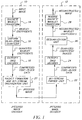
- FIG. 1 shows a simplified block diagram of a JPEG2000 encoder ( 10 ) and decoder ( 12 ).
- the discrete wavelet transform (DWT) unit ( 14 ) decomposes the input image into subbands.
- JPEG2000 also allows tiling of the image into a number of rectangular tiles. If tiling is used, the DWT is applied independently to each image tile. The resulting subband or wavelet coefficients undergo quantization with a uniform dead-zone quantizer ( 16 ).
- the quantized coefficients are grouped into precincts and codeblocks.
- Each codeblock is encoded independently by an entropy coder ( 18 ) to produce a compressed bit-stream corresponding to that codeblock.
- the packet formation and bit-stream organization unit (20) divides the compressed codeblock bit-stream into layers and aggregates the appropriate layer from different codeblocks into packets. It also decides the order in which the packets should appear in the compressed bit-stream.
- the bit-stream parser unit ( 22 ) reads the header information and extracts the packets. It also decodes the packet headers and concatenates all the compressed data corresponding to each codeblock.
- the entropy decoder ( 24 ) decodes the compressed data to obtain quantizer indices corresponding to each wavelet coefficient.
- the dequantization unit ( 26 ) reconstructs wavelet coefficients from the respective quantizer indices.
- the reconstructed wavelet coefficients undergo inverse DWT in the inverse DWT unit ( 28 ) to produce the reconstructed image.
- JPEG2000 uses a two-dimensional (2-D) discrete wavelet transform (DWT) to transform the input image into a collection of subbands.
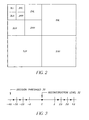
- FIG. 2 shows a 3-level, 2-D DWT and the corresponding labeling for each subband.
- the subband label k HL indicates that a horizontal high-pass (H) filter has been applied to the rows, followed by a vertical low-pass (L) filter applied to the columns during the k th level of the DWT decomposition.
- the subband 0LL refers to the original image (or image tile).
- the DWT decomposition provides a natural multi-resolution representation.
- the lowest resolution at which the image can be reconstructed is referred to as resolution zero.
- the 3LL subband would correspond to resolution zero for a 3-level decomposition.
- the image can be reconstructed at N L +1 resolutions.
- subbands N L - r +1)HL, ( N L -r +1)LH and ( N L - r +1)HH need to be combined with the image at resolution ( r -1). These subbands are referred to as belonging to resolution r .
- Resolution zero consists of only the N L LL band. If the subbands are encoded independently, the image can be reconstructed at any resolution level by simply decoding those portions of the codestream that contain the subbands corresponding to that resolution and all the lower resolutions. For example, referring to FIG. 2, the image can be reconstructed at resolution 2 by combining the resolution 1 image and the three subbands labeled 2HL, 2LH, and 2HH.
- Each wavelet coefficient is quantized with the uniform dead-zone scalar quantizer ( 16 ) to produce a sign-magnitude representation of the indices of quantized coefficients.
- the decision thresholds ( 30 ) and reconstruction levels ( 32 ) for this quantizer are shown in FIG. 3, for a quantizer step-size of ⁇ .
- the JPEG2000 standard mandates the use of a single quantizer step-size for all the coefficients in a given subband. But the step-size can vary from subband to subband. Let the step-size for subband b be ⁇ b .
- the dead-zone refers to the quantizer bin centered around zero, which is bigger than other quantizer bins.
- Part 1 of the JPEG2000 standard has adopted a dead-zone equal to twice the step-size due to its optimal embedded structure. Briefly, this means that if a M b -bit quantizer index resulting from a step-size of ⁇ b is transmitted progressively starting with the most significant bit (MSB) and proceeding to the least significant bit (LSB), the resulting index after decoding only N b bits is identical to that obtained by using a similar quantizer with a step-size of ⁇ b 2 M b -N b.
- MSB most significant bit
- LSB least significant bit
- SNR signal-to-noise ratio
- the quantized subband coefficients are partitioned into codeblocks.
- a codeblock can be considered to be tiling of wavelet coefficients.
- Quantized wavelet coefficients from each codeblock are independently encoded by the entropy coder ( 18 ).
- the MQ arithmetic coder is used as the entropy coder.
- the entropy coder encodes the sign-magnitude representation of the codeblock coefficients as bit-planes.
- the codeblock being processed is from subband b .
- the samples from the codeblock are quantized with a uniform dead-zone scalar quantizer with step-size ⁇ b as described above.
- the magnitude of the indices of quantized coefficients in subband b is represented by a fixed precision of M b bits.
- the bits be indexed as 1,2,..., M b , where index 1 corresponds to the most significant bit (MSB) and M b corresponds to the least significant bit (LSB).
- the k th bit-plane for the codeblock consists of the k th bit from the magnitude representation of all the indices of quantized coefficients from that codeblock.
- a bit-plane for a codeblock is said to be significant if any of the previous bit-planes were significant or the bit-plane has at least one non-zero bit.
- the MQ coder encodes the most significant bit-plane of a codeblock using a single coding pass, known as the cleanup pass.
- the remaining bit-planes are MQ encoded using 3 coding passes, namely, significance pass, refinement pass, and cleanup pass. If the magnitude representation of quantized codeblock coefficients has M b significant bit-planes, the total number of coding passes necessary to encode all the bit-planes is (3*( M b -1) + 1).
- JPEG2000 offers significant flexibility in the organization of the compressed bit-stream. This flexibility is achieved partly through the various structures of components, tiles, subbands, resolution levels, and codeblocks. These structures partition the image data into: 1) color channels (through components); 2) spatial regions (through tiles); 3) frequency regions (through subbands and resolution levels), and 4) space-frequency regions (through codeblocks). JPEG2000 also provides an intermediate space-frequency structure known as a precinct. A precinct is a collection of spatially contiguous codeblocks from all subbands at a particular resolution level.
- JPEG2000 organizes the compressed data from the codeblocks into units known as packets and layers.
- the compressed data for the codeblocks in the precinct is first organized into one or more packets.
- a packet is simply a continuous segment in the compressed codestream that consists of a number of bit-plane coding passes for each codeblock in the precinct. The number of coding passes can vary from codeblock to codeblock (including zero coding passes). Packets from precincts at all resolution levels in a tile are then combined to form layers.
- precinct partition for a 3-level decomposition of a 768 ⁇ 512 image, where codeblock boundaries ( 40 ) identify the code blocks and precinct boundaries ( 42 ) identify the precincts.
- codeblock boundaries ( 40 ) identify the code blocks
- precinct boundaries ( 42 ) identify the precincts.
- the highlighted precincts in resolutions 0-3 correspond roughly to the same 256 ⁇ 256 region in the original image.
- the compressed bit-stream for each codeblock is distributed across one or more layers in the compressed bit-stream. All of the codeblocks from all subbands and components of a tile contribute compressed data to each layer. For each codeblock, a number of consecutive coding passes (including zero) is included in a layer. Each layer represents a quality increment. The number of coding passes included in a specific layer can vary from one codeblock to another, and is typically determined by the encoder as a result of post-compression rate-distortion optimization as explained later on.
- the compressed data belonging to a specific tile, component, resolution, layer and precinct is aggregated into a packet.
- the compressed data in a packet needs to be contiguous in the codestream. If a precinct contains data from more than one subband, it appears in the order HL, LH and HH. Within each subband, the contributions from codeblocks appear in the raster order.
- FIG. 4 shows an example of codeblocks belonging to a precinct.
- the numbering of the codeblocks represents the order in which the coded data from the codeblocks will appear in a packet.
- Each packet starts with a packet header.
- the packet header contains information about the number of coding passes for each codeblock in the packet. It also contains the length of the compressed data for each codeblock.
- the first bit of a packet header indicates whether the packet contains data or is empty. If the packet is non-empty, codeblock inclusion information is signaled for each codeblock in the packet. This information indicates whether any compressed data from a codeblock is included in the packet. If codeblock data is being included for the first time, the number of most significant bit-planes that are entirely zero is also signaled. After this, the number of coding passes for the codeblock and the length of the corresponding compressed data are signaled.
- the arithmetic encoding of the bit-planes is referred to as tier-1 coding, whereas the packetization of the compressed data and encoding of the packet header information is known as tier-2 coding.
- JPEG2000 bit-stream consists of a main header followed by a sequence of tile-streams.
- the main header consists of global information necessary for decompression of the entire bit-stream, such as, the image size, tile size, information about the number of components, decomposition levels, layers, quantizer step-sizes, etc.
- Each tile-stream contains a tile header and packets belonging to that tile. As described above, each packet consists of packet header and compressed codeblock data.
- Rate-control refers to the process of generating an optimal image for a target file size (bit-rate).
- the criterion for optimality can be based on mean squared error (MSE) between the original and the reconstructed image, visual distortion, or any other metric.
- MSE mean squared error
- the embedded block coding scheme of the JPEG2000 and its flexible codestream syntax allow for the generation of a rate-distortion (R-D) optimized codestream for a given file size.
- Taubman (David Taubman, "High performance scalable compression with EBCOT," IEEE Transactions on Image Processing, 9(7), pp. 1158-1170, July 2000) proposed an efficient rate-control method for the EBCOT compression algorithm that achieves a desired rate in a single iteration with minimum distortion. This method can also be used by a JPEG2000 encoder, with several possible variations.
- each subband is first quantized using a very fine step-size, and the bit-planes of the resulting codeblocks are entropy coded. This typically generates more coding passes for each codeblock than will be eventually included in the final bit-stream. If the quantizer step-size is chosen to be small enough, the R-D performance of the algorithm is independent of the initial choice of the step-size.
- a Lagrangian R-D optimization is performed to determine the number of coding passes from each codeblock that should be included in the final compressed bit-stream to achieve the desired bit-rate. If more than a single layer is desired, this process can be repeated at the end of each layer to determine the additional number of coding passes from each codeblock that need to be included in the next layer.
- the Lagrangian R-D optimization works in the following manner.
- the compressed bit-stream from each codeblock contains a large number of potential truncation points that can occur at the end of each coding pass.
- the wavelet coefficients contained in a codeblock of subband b are initially quantized with a step-size of ⁇ b , resulting in an M b -bit quantizer index for each coefficient. If the codeblock bit-stream is truncated so that only N b bits are decoded for a particular wavelet coefficient, the effective quantizer step-size for the coefficients is ⁇ b 2 M b -N b .
- the inclusion of each additional bit-plane in the compressed bit-stream will decrease the effective quantizer step-size by a factor of two.
- the increase in bit-rate and the reduction in distortion resulting from the inclusion of that coding pass in the bit-stream are calculated and stored in a table known as the operational rate-distortion table.
- the distortion measure selected is usually MSE or visually weighted MSE, although any general distortion measure that is additive across codeblocks can be used.
- the associated weighted MSE distortion D t / i is given by: where u and v represent the coefficient row and column indices within the codeblock B i ; x i [ u,v ] is the original wavelet coefficient value; x t / i [ u , v ] is the quantized coefficient value for truncation point t; w i [ u,v ] is a weighting factor for coefficient x i [ u,v ]; and ⁇ b is the L 2 -norm of the synthesis basis functions corresponding to subband b .
- the EBCOT rate-control algorithm finds the truncation point for each codeblock that minimizes the total distortion D . This is equivalent to finding the optimal bit allocation for all of the codeblocks, R * / i , 1 ⁇ i ⁇ P, such that: In the JPEG2000 literature, this rate-control algorithm is also referred to as post-compression R-D optimization. If the weighting factor w i [ u,v ] is set to unity for all subband coefficients, the distortion metric reduces to the mean-squared error.
- our objective is to transcode an existing JPEG2000 image to another JPEG2000 image at a lower bit-rate and/or resolution.
- knowledge of the operational rate-distortion table for each codeblock is necessary. But the distortion information is lost forever because we no longer have access to the original image.
- the rate information is available, but it is necessary to decode the packets and perform MQ decoding of the compressed codeblock coding passes.
- Our invention overcomes these problems.
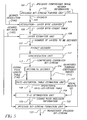
- a flow chart of an image transcoder according to the present invention is shown in FIG. 5.
- a JPEG2000 compressed image ( 101 ) is parsed by a JPEG2000 bit-stream parsing unit ( 102 ).
- the JPEG2000 bit-stream parsing unit ( 102 ) extracts header information ( 103 ) contained in various JPEG2000 marker segments and separates packets ( 104 ) corresponding to different resolutions.
- a resolution-layer byte counter ( 105 ) produces a layer byte-count table ( 108 ) for a user-specified desired resolution ( 106 ).
- the JPEG2000 compressed image consists of L layers denoted by 0, 1, ... , L -1 and that the user-specified resolution is u .
- the layer byte-count table ( 108 ) entry corresponding to layer x signifies the cumulative size of packets belonging to layers 0, 1, ..., x and resolutions 0, 1, ..., u .
- a user-specified desired bit-rate ( 107 ) for the transcoded image is input to a layer estimation unit ( 109 ).
- the desired bit-rate is specified in terms of the size of the transcoded image in bytes.
- the layer estimation unit ( 109 ) determines the number of layers that need to be decoded ( 110 ) up to the user-specified desired resolution to achieve the desired bit-rate ( 107 ) by using the layer byte-count table ( 108 ).
- FIG. 6 shows an illustrative example of a layer byte-count table for each resolution of a JPEG2000 compressed image having 4 resolutions and 3 layers.
- the user-specified desired resolution is 2 and the user-specified desired bit-rate is 16384 bytes, layers 0 and 1 would need to be decoded up to resolution 2.
- a packet decoder decodes the packets corresponding to the layers that are to be decoded as determined by the layer estimation unit, up to the user-specified desired resolution.
- the packet decoder also extracts the compressed codeblock bit-stream corresponding to each codeblock that contributed to the packet.
- a concatenation unit ( 112 ) concatenates the compressed data for each codeblock to produce a compressed codeblock bit-stream ( 113 ) for each codeblock.
- An arithmetic decoder performs arithmetic decoding on each compressed codeblock bit-stream ( 113 ) to produce quantized subband coefficient indices ( 115 ) and a coding pass length table ( 116 ).
- a rate-distortion table estimation unit ( 117 ) produces an operational rate-distortion table ( 118 ) from the quantized coefficient indices ( 115 ) and the coding pass length table ( 116 ), which contains an estimate of the length of the compressed data corresponding to each decoded coding pass.
- An R-D optimization unit ( 119 ) performs post-compression R-D optimization to produce coding pass inclusion information ( 120 ), which represents the coding passes that should be included in the transcoded bit-stream, using the operational rate-distortion table ( 118 ), the desired bit-rate ( 107 ) and user-specified visual weights ( 121 ).
- the post-compression R-D optimization is the same as that performed by a JPEG2000 encoder as described earlier.
- the user-specified visual weights (121) provide the values for w i [ u,v ] in Equation (1) while performing post-compression R-D optimization.
- a JPEG2000 bit-stream formation unit (122) uses the coding passes inclusion information ( 120 ), the compressed codeblock bit-streams ( 113 ) and header information ( 103 ) to produce a transcoded JPEG2000 bit-stream ( 123 ).
- the arithmetic decoder unit ( 114 ) produces quantized subband coefficient indices ( 115 ). It is not necessary to explicitly reconstruct the subband coefficient, and perform inverse DWT for the purpose of determining the operational rate-distortion table ( 118 ). This is because the transcoding process uses the same basic quantizer step-sizes for quantization. Thus, consider a wavelet coefficient for which the quantizer index is 23 (10111 in binary representation), the step-size is ⁇ b and 3 LSBs have been discarded. In that case, for midpoint reconstruction, the reconstructed coefficient is 23.5 ⁇ 80 ⁇ b . Mixing binary and decimal notation, this can be written as (10111100 b ) ⁇ b .
- the R-D optimization step ( 119 ) can be performed multiple times, once for each desired layer bit-rate.
- the above transcoding method works very well when the end-user knows the proper visual weights that should be applied at the time of transcoding or when no visual weights are to be used. But sometimes it may be desirable to preserve the relative visual importance of the different codeblocks as determined by the JPEG2000 encoder.
- JPEG2000 encoder consider two codeblocks that belong to the same subband. As per JPEG2000 standard specification, they both have to be quantized with the same quantizer step-size. But if the encoder decides that the first codeblock is visually more important, it may include more coding passes from the first codeblock in layer 0.
- a JPEG2000 encoder may include 12 coding passes from the first codeblock but only 4 coding passes from the second codeblock in layer 0.
- FIG. 7 shows another embodiment of the invention that achieves this goal.
- a JPEG2000 compressed image (201) is parsed by a JPEG2000 bit-stream parsing unit (202) .
- the JPEG2000 bit-stream parsing unit (202) extracts header information (203) contained in various JPEG2000 marker segments and separates packets (204) corresponding to different resolutions.
- a resolution-layer byte counter ( 205 ) produces a layer byte-count table ( 208 ) for a user-specified desired resolution ( 206 ).
- the information contained in the layer byte-count table ( 208 ) is the same as that in the layer byte-count table ( 108 ) from the preferred embodiment.
- a user-specified desired bit-rate ( 207 ) for the transcoded image is input to a layer estimation unit ( 209 ).
- the layer estimation unit (209) determines the number of layers that need to be decoded (210) up to the user-specified desired resolution to achieve the desired bit-rate ( 207 ) by using the layer byte-count table ( 208 ).
- a packet decoder ( 211 ) decodes the packets corresponding to the layers that are to be decoded as determined by the layer estimation unit, up to the user-specified desired resolution.
- the packet decoder also extracts the compressed codeblock bit-stream corresponding to each codeblock that contributed to the packet.
- a concatenation unit ( 212 ) concatenates the compressed data for each codeblock to produce a compressed codeblock bit-stream ( 213 ) for each codeblock.
- An arithmetic decoder ( 214 ) performs arithmetic decoding on each compressed codeblock bit-stream ( 213 ) to produce a coding pass length table ( 215 ).
- a rate-control unit ( 216 ) produces coding pass inclusion information ( 217 ) based on the coding pass length table ( 215 ) and the desired bit-rate ( 207 ).
- a JPEG2000 bit-stream formation unit ( 218 ) uses the coding passes inclusion information ( 217 ), the compressed codeblock bit-streams ( 213 ) and header information ( 203 ) to produce a transcoded JPEG2000 bit-stream ( 219 ).
- the decision whether to include a coding pass in the transcoded bit-stream is independent of distortion. Hence no operational rate-distortion table is generated. Instead the following principle is used by the rate-control unit. Let the number of layers to be decoded, as determined by the layer estimator unit (209) be w . Then, layers 0,1,...,( w -2) are included in their entirety in the transcoded bit-stream. No coding passes from layers w or higher are included in the transcoded bit-stream, whereas only some coding passes from layer ( w -1) are included in the transcoded bit-stream.
- the rate-control unit tries to equalize the proportion of coding passes from layer ( w -1) that are included in the transcoded bit-stream. Now, the rate-control unit ( 216 ) will be discussed in greater detail.
- FIG. 8 shows a flow diagram of the rate-control unit ( 216 ).
- R( w -2) and R w -1) be denoted by R( w -2) and R ( w -1), respectively.
- desired bit-rate (207) be denoted by R desired .
- R min and R max are set to R ( w -2) and R ( w -1), respectively.
- f min and f max are set to 0 and 1, respectively.
- ( f max - f min ) is compared against a 'threshold'.
- the coding pass inclusion determination step (303) for each codeblock, the number of coding passes from layer ( w -1) to be included in the transcoded bit-stream, n B / w -1, is calculated as ⁇ N B / w -1, ⁇ f min ⁇ . This information is output as the coding pass inclusion information (217). If ( f max - f min ) is greater than threshold, in the update step (304) the value of f is updated to an average of f max and f min .
- the rate determination step (305) determines the overall rate R ( f ), if for each codeblock B, ⁇ N B / w -1 ⁇ f ⁇ coding passes from layer ( w -1) are included in the compressed bit-stream. Then, in another comparison step (306), the overall rate R ( f ) is compared with R desired . If R ( f ) is less than or equal to R desired , R min is set to R ( f ) and f min is set to f in another update step (307). Otherwise, R max is set to R ( f ) and f max is set to f (308) , and the flow control returns to step (302).
- the threshold in step (302) was chosen to be 0.01, but those skilled in the art will realize that any other small value may be chosen.
- the coding pass inclusion information generated in this manner may lead to an overall bit-rate that is less than the user-specified desired bit-rate. In that case, it is possible to start adding one coding pass from each codeblock up to the point where inclusion of another coding pass would result in the desired bit-rate being exceeded.
- the codeblock order for inclusion of additional coding passes is from lower resolution to higher resolution.
- the precincts are traversed in a raster scan.
- the codeblocks are traversed in the order shown in FIG. 4.
Landscapes
- Engineering & Computer Science (AREA)
- Multimedia (AREA)
- Signal Processing (AREA)
- Compression Or Coding Systems Of Tv Signals (AREA)
- Compression Of Band Width Or Redundancy In Fax (AREA)
- Compression, Expansion, Code Conversion, And Decoders (AREA)
- Image Processing (AREA)
Applications Claiming Priority (2)
| Application Number | Priority Date | Filing Date | Title |
|---|---|---|---|
| US611026 | 2003-07-01 | ||
| US10/611,026 US7200277B2 (en) | 2003-07-01 | 2003-07-01 | Method for transcoding a JPEG2000 compressed image |
Publications (2)
| Publication Number | Publication Date |
|---|---|
| EP1494482A1 true EP1494482A1 (de) | 2005-01-05 |
| EP1494482B1 EP1494482B1 (de) | 2006-09-27 |
Family
ID=33435421
Family Applications (1)
| Application Number | Title | Priority Date | Filing Date |
|---|---|---|---|
| EP04076779A Expired - Lifetime EP1494482B1 (de) | 2003-07-01 | 2004-06-17 | Verfahren zur Transkodierung eines JPEG2000 komprimierten Bilds |
Country Status (4)
| Country | Link |
|---|---|
| US (2) | US7200277B2 (de) |
| EP (1) | EP1494482B1 (de) |
| JP (1) | JP2005027309A (de) |
| DE (1) | DE602004002525T2 (de) |
Cited By (5)
| Publication number | Priority date | Publication date | Assignee | Title |
|---|---|---|---|---|
| FR2969892A1 (fr) * | 2010-12-23 | 2012-06-29 | Thales Sa | Procede et dispositif d'adaptation de debit d'un flux video compresse transmis dans un environnement contraint |
| CN103152568A (zh) * | 2013-02-27 | 2013-06-12 | 西安理工大学 | 一种实时截断码流的jpeg2000编码方法及其实施系统 |
| GB2486374B (en) * | 2009-09-17 | 2015-04-22 | Magor Comm Corp | Method and apparatus for communicating an image over a network with spatial scalability |
| EP2824919A4 (de) * | 2012-03-09 | 2015-10-14 | Solution Inc G | Vorrichtung zur partitionierung einer komprimierten satellitenaufnahme und verfahren dafür |
| WO2021028550A1 (fr) * | 2019-08-13 | 2021-02-18 | Qwoo | Procédé de fourniture d'un contenu comportant au moins une image, format de fichier |
Families Citing this family (50)
| Publication number | Priority date | Publication date | Assignee | Title |
|---|---|---|---|---|
| WO2003088142A2 (en) | 2002-04-10 | 2003-10-23 | Instasolv, Inc. | Method and system for managing computer systems |
| JP2004104347A (ja) * | 2002-09-06 | 2004-04-02 | Ricoh Co Ltd | 画像処理装置、画像処理方法、プログラム及び記録媒体 |
| US20050129322A1 (en) * | 2003-10-06 | 2005-06-16 | Mark Olin | Method and system for compressing, storing, and retrieving image data |
| JP4273996B2 (ja) * | 2004-02-23 | 2009-06-03 | ソニー株式会社 | 画像符号化装置及び方法、並びに画像復号装置及び方法 |
| JP4111926B2 (ja) * | 2004-03-09 | 2008-07-02 | 株式会社リコー | 画像処理装置、プログラム、記憶媒体及び画像送信方法 |
| US7801383B2 (en) * | 2004-05-15 | 2010-09-21 | Microsoft Corporation | Embedded scalar quantizers with arbitrary dead-zone ratios |
| US7653255B2 (en) | 2004-06-02 | 2010-01-26 | Adobe Systems Incorporated | Image region of interest encoding |
| KR20060007765A (ko) * | 2004-07-21 | 2006-01-26 | 삼성전자주식회사 | 영상 압축/복원 방법 및 장치 |
| US7639886B1 (en) * | 2004-10-04 | 2009-12-29 | Adobe Systems Incorporated | Determining scalar quantizers for a signal based on a target distortion |
| US20060146967A1 (en) * | 2004-12-31 | 2006-07-06 | Adarsh Panikkar | Keep-out asynchronous clock alignment scheme |
| US7792375B2 (en) * | 2005-01-19 | 2010-09-07 | Megachips Corporation | Rate control system |
| US7583844B2 (en) * | 2005-03-11 | 2009-09-01 | Nokia Corporation | Method, device, and system for processing of still images in the compressed domain |
| JP4737711B2 (ja) * | 2005-03-23 | 2011-08-03 | 富士ゼロックス株式会社 | 復号化装置、逆量子化方法、分布決定方法及びこのプログラム |
| US7778468B2 (en) * | 2005-03-23 | 2010-08-17 | Fuji Xerox Co., Ltd. | Decoding apparatus, dequantizing method, and program thereof |
| US8422546B2 (en) | 2005-05-25 | 2013-04-16 | Microsoft Corporation | Adaptive video encoding using a perceptual model |
| JP4716949B2 (ja) * | 2005-09-02 | 2011-07-06 | 株式会社リコー | 画像処理装置および画像処理方法 |
| US20070237237A1 (en) * | 2006-04-07 | 2007-10-11 | Microsoft Corporation | Gradient slope detection for video compression |
| US7974340B2 (en) * | 2006-04-07 | 2011-07-05 | Microsoft Corporation | Adaptive B-picture quantization control |
| US8130828B2 (en) * | 2006-04-07 | 2012-03-06 | Microsoft Corporation | Adjusting quantization to preserve non-zero AC coefficients |
| US8503536B2 (en) * | 2006-04-07 | 2013-08-06 | Microsoft Corporation | Quantization adjustments for DC shift artifacts |
| US8059721B2 (en) * | 2006-04-07 | 2011-11-15 | Microsoft Corporation | Estimating sample-domain distortion in the transform domain with rounding compensation |
| US7995649B2 (en) | 2006-04-07 | 2011-08-09 | Microsoft Corporation | Quantization adjustment based on texture level |
| US8711925B2 (en) * | 2006-05-05 | 2014-04-29 | Microsoft Corporation | Flexible quantization |
| US7729551B2 (en) * | 2006-09-08 | 2010-06-01 | Eastman Kodak Company | Method for controlling the amount of compressed data |
| US8238424B2 (en) | 2007-02-09 | 2012-08-07 | Microsoft Corporation | Complexity-based adaptive preprocessing for multiple-pass video compression |
| US8498335B2 (en) | 2007-03-26 | 2013-07-30 | Microsoft Corporation | Adaptive deadzone size adjustment in quantization |
| US20080240257A1 (en) * | 2007-03-26 | 2008-10-02 | Microsoft Corporation | Using quantization bias that accounts for relations between transform bins and quantization bins |
| US8243797B2 (en) | 2007-03-30 | 2012-08-14 | Microsoft Corporation | Regions of interest for quality adjustments |
| US7957309B1 (en) * | 2007-04-16 | 2011-06-07 | Hewlett-Packard Development Company, L.P. | Utilizing multiple distortion measures |
| US8442337B2 (en) | 2007-04-18 | 2013-05-14 | Microsoft Corporation | Encoding adjustments for animation content |
| US8331438B2 (en) * | 2007-06-05 | 2012-12-11 | Microsoft Corporation | Adaptive selection of picture-level quantization parameters for predicted video pictures |
| KR101376666B1 (ko) * | 2007-06-27 | 2014-03-21 | 톰슨 라이센싱 | 이미지 품질 강화 |
| KR100898058B1 (ko) * | 2007-07-09 | 2009-05-19 | 중앙대학교 산학협력단 | Dct 계수와 dwt 계수의 상호변환장치 및 방법 |
| US8126047B2 (en) * | 2007-12-19 | 2012-02-28 | Intel Corporation | Video compression and transmission system with transmitter side memory restriction |
| JP5359302B2 (ja) * | 2008-03-18 | 2013-12-04 | ソニー株式会社 | 情報処理装置および方法、並びにプログラム |
| US8189933B2 (en) * | 2008-03-31 | 2012-05-29 | Microsoft Corporation | Classifying and controlling encoding quality for textured, dark smooth and smooth video content |
| US8897359B2 (en) | 2008-06-03 | 2014-11-25 | Microsoft Corporation | Adaptive quantization for enhancement layer video coding |
| JP4656190B2 (ja) * | 2008-06-10 | 2011-03-23 | ソニー株式会社 | 情報処理装置および方法 |
| JP4780172B2 (ja) * | 2008-10-10 | 2011-09-28 | ソニー株式会社 | 情報処理装置および方法 |
| WO2010077325A2 (en) * | 2008-12-29 | 2010-07-08 | Thomson Licensing | Method and apparatus for adaptive quantization of subband/wavelet coefficients |
| US8473558B2 (en) * | 2009-09-22 | 2013-06-25 | Thwapr, Inc. | Progressive registration for mobile media sharing |
| DE102010028189B4 (de) | 2010-04-26 | 2018-09-27 | Solarworld Industries Gmbh | Solarzelle |
| JP5469127B2 (ja) * | 2011-05-30 | 2014-04-09 | 富士フイルム株式会社 | 画像データ符号化装置ならびにその動作制御方法およびそのプログラム |
| US9602841B2 (en) * | 2012-10-30 | 2017-03-21 | Texas Instruments Incorporated | System and method for decoding scalable video coding |
| CN103366385A (zh) * | 2013-07-10 | 2013-10-23 | 郑静晨 | 一种医疗图像中信息的透明标记方法 |
| US8879858B1 (en) * | 2013-10-01 | 2014-11-04 | Gopro, Inc. | Multi-channel bit packing engine |
| JP6722995B2 (ja) * | 2015-10-23 | 2020-07-15 | キヤノン株式会社 | 符号化方法及び符号化装置、撮像装置及びプログラム |
| US10878597B2 (en) * | 2018-09-14 | 2020-12-29 | Sony Corporation | Rate distortion optimization for adaptive subband coding of regional adaptive HAAR transform (RAHT) |
| WO2020258188A1 (zh) * | 2019-06-27 | 2020-12-30 | 深圳市大疆创新科技有限公司 | 解码方法、解码器和解码系统 |
| KR20210067788A (ko) * | 2019-11-29 | 2021-06-08 | 삼성전자주식회사 | 전자 장치, 시스템 및 그 제어 방법 |
Citations (2)
| Publication number | Priority date | Publication date | Assignee | Title |
|---|---|---|---|---|
| EP1274247A2 (de) * | 2001-06-27 | 2003-01-08 | Ricoh Company, Ltd. | JPEG 2000 für eine effektive Bildübertragung in einer Client-Serverumgebung |
| US20030113027A1 (en) * | 2001-07-02 | 2003-06-19 | Woei Chan | Digital image compression |
Family Cites Families (7)
| Publication number | Priority date | Publication date | Assignee | Title |
|---|---|---|---|---|
| US6327392B1 (en) * | 1999-01-28 | 2001-12-04 | Sharp Laboratories Of America, Inc. | Method of visual progressive coding |
| US6492916B1 (en) * | 2001-03-30 | 2002-12-10 | Ricoh Co., Ltd. | Method and apparatus for generating multiple selectable contexts |
| US7228000B2 (en) * | 2002-03-15 | 2007-06-05 | Ricoh Co., Ltd. | Image data generation with reduced amount of processing |
| JP3743384B2 (ja) * | 2002-04-19 | 2006-02-08 | ソニー株式会社 | 画像符号化装置及び方法、並びに画像復号装置及び方法 |
| US8769395B2 (en) * | 2002-12-13 | 2014-07-01 | Ricoh Co., Ltd. | Layout objects as image layers |
| US7260261B2 (en) * | 2003-02-20 | 2007-08-21 | Microsoft Corporation | Systems and methods for enhanced image adaptation |
| US7447369B2 (en) * | 2003-03-07 | 2008-11-04 | Ricoh Co., Ltd. | Communication of compressed digital images |
-
2003
- 2003-07-01 US US10/611,026 patent/US7200277B2/en not_active Expired - Fee Related
-
2004
- 2004-06-17 DE DE602004002525T patent/DE602004002525T2/de not_active Expired - Lifetime
- 2004-06-17 EP EP04076779A patent/EP1494482B1/de not_active Expired - Lifetime
- 2004-06-30 JP JP2004193874A patent/JP2005027309A/ja active Pending
- 2004-06-30 US US10/881,107 patent/US7382926B2/en not_active Expired - Fee Related
Patent Citations (2)
| Publication number | Priority date | Publication date | Assignee | Title |
|---|---|---|---|---|
| EP1274247A2 (de) * | 2001-06-27 | 2003-01-08 | Ricoh Company, Ltd. | JPEG 2000 für eine effektive Bildübertragung in einer Client-Serverumgebung |
| US20030113027A1 (en) * | 2001-07-02 | 2003-06-19 | Woei Chan | Digital image compression |
Non-Patent Citations (4)
| Title |
|---|
| "INFORMATION TECHNOLOGY - JPEG 2000 IMAGE CODING SYSTEM - PART 1: CORE CODING SYSTEM TECHNOLOGIES DE L'INFORMATION - SYSTEME DE CODAGE D'IMAGE JPEG 2000 - PARTIE 1: SYSTEME DE CODAGE DE NOYAU", INTERNATIONAL STANDARD ISO/IEC, vol. 15444-1, 15 December 2000 (2000-12-15), pages I - XII,1, XP008033454 * |
| TAUBMAN D: "HIGH PERFORMANCE SCALABLE IMAGE COMPRESSION WITH EBCOT", IEEE TRANSACTIONS ON IMAGE PROCESSING, IEEE INC. NEW YORK, US, vol. 9, no. 7, July 2000 (2000-07-01), pages 1158 - 1170, XP000951990, ISSN: 1057-7149 * |
| TAUBMAN D: "JPEG 2000 Verification Model VM3A, ISO/IEC JTC1/SC29/WG1 N1143", ISO/IEC JTC1/SC29/WG1 N1143, 1 February 1999 (1999-02-01), pages 1 - 90, XP002146099 * |
| WU G K ET AL: "NEW COMPRESSION PARADIGMS IN JPEG2000", PROCEEDINGS OF THE SPIE, SPIE, BELLINGHAM, VA, US, vol. 4115, 31 July 2000 (2000-07-31), pages 418 - 429, XP008013391, ISSN: 0277-786X * |
Cited By (9)
| Publication number | Priority date | Publication date | Assignee | Title |
|---|---|---|---|---|
| GB2486374B (en) * | 2009-09-17 | 2015-04-22 | Magor Comm Corp | Method and apparatus for communicating an image over a network with spatial scalability |
| FR2969892A1 (fr) * | 2010-12-23 | 2012-06-29 | Thales Sa | Procede et dispositif d'adaptation de debit d'un flux video compresse transmis dans un environnement contraint |
| EP2477402A1 (de) * | 2010-12-23 | 2012-07-18 | Thales | Verfahren und Vorrichtung zur Adaptation des Durchsatzes eines komprimierten Videoflusses in einer eingeschränkten Übertragungsumgebung |
| US8780975B2 (en) | 2010-12-23 | 2014-07-15 | Thales | Method and device for adapting the throughput of a compressed video stream transmitted in a constrained environment |
| EP2824919A4 (de) * | 2012-03-09 | 2015-10-14 | Solution Inc G | Vorrichtung zur partitionierung einer komprimierten satellitenaufnahme und verfahren dafür |
| CN103152568A (zh) * | 2013-02-27 | 2013-06-12 | 西安理工大学 | 一种实时截断码流的jpeg2000编码方法及其实施系统 |
| CN103152568B (zh) * | 2013-02-27 | 2016-02-24 | 西安理工大学 | 一种实时截断码流的jpeg2000编码方法及其实施系统 |
| WO2021028550A1 (fr) * | 2019-08-13 | 2021-02-18 | Qwoo | Procédé de fourniture d'un contenu comportant au moins une image, format de fichier |
| FR3099975A1 (fr) * | 2019-08-13 | 2021-02-19 | Qwoo | Procédé de fourniture d’un contenu comportant au moins une image, format de fichier |
Also Published As
| Publication number | Publication date |
|---|---|
| US20050002575A1 (en) | 2005-01-06 |
| US20050002573A1 (en) | 2005-01-06 |
| EP1494482B1 (de) | 2006-09-27 |
| DE602004002525D1 (de) | 2006-11-09 |
| DE602004002525T2 (de) | 2007-05-16 |
| US7382926B2 (en) | 2008-06-03 |
| US7200277B2 (en) | 2007-04-03 |
| JP2005027309A (ja) | 2005-01-27 |
Similar Documents
| Publication | Publication Date | Title |
|---|---|---|
| EP1494482B1 (de) | Verfahren zur Transkodierung eines JPEG2000 komprimierten Bilds | |
| US10205951B2 (en) | Method of signalling motion information for efficient scalable video compression | |
| US6987890B2 (en) | Producing and encoding rate-distortion information allowing optimal transcoding of compressed digital image | |
| US6728316B2 (en) | Video coding method | |
| EP0928109A2 (de) | Verfahren und Vorrichtung zur Videokodierung und -dekodierung | |
| EP1583368A1 (de) | Richtungadaptiv-Skalierbarbewegungsparameternkodierung für skalierbarevideokodierung | |
| US20050163217A1 (en) | Method and apparatus for coding and decoding video bitstream | |
| US20050244068A1 (en) | Encoding method, decoding method, encoding device, and decoding device | |
| Kulkarni et al. | Compression of earth science data with JPEG2000 | |
| KR101257970B1 (ko) | 스케일러블 코딩 영상의 비율 제어 방법 | |
| Yeung et al. | An efficient optimal rate control scheme for JPEG2000 image coding | |
| KR100323701B1 (ko) | 영상부호화장치 | |
| Xie et al. | ROI coding with separated code block | |
| Yeung et al. | Successive bit-plane rate allocation technique for JPEG2000 image coding | |
| WO2005006765A1 (en) | Method for transcoding a jpeg2000 compressed image | |
| Dubey | A review on wavelet-based image compression techniques | |
| Muller et al. | Embedded Laplacian pyramid image coding using conditional arithmetic coding | |
| Joshi et al. | Efficient transcoding of JPEG2000 images | |
| Skodras | The JPEG2000 image compression standard in mobile health | |
| Yoon et al. | A scalable wavelet video coder for hybrid communication channels | |
| Monro et al. | Improved coding of atoms in matching pursuits | |
| Bojkovic et al. | Advanced image compression techniques: Comparative functionalities and performances | |
| AU2003260192B2 (en) | Method of signalling motion information for efficient scalable video compression | |
| Zandi et al. | Compression with reversible embedded wavelets with an enhanced binary mode. | |
| Christopoulou et al. | JPEG 2000 implementation on different computer platforms |
Legal Events
| Date | Code | Title | Description |
|---|---|---|---|
| PUAI | Public reference made under article 153(3) epc to a published international application that has entered the european phase |
Free format text: ORIGINAL CODE: 0009012 |
|
| AK | Designated contracting states |
Kind code of ref document: A1 Designated state(s): AT BE BG CH CY CZ DE DK EE ES FI FR GB GR HU IE IT LI LU MC NL PL PT RO SE SI SK TR |
|
| AX | Request for extension of the european patent |
Extension state: AL HR LT LV MK |
|
| 17P | Request for examination filed |
Effective date: 20050606 |
|
| AKX | Designation fees paid |
Designated state(s): DE GB |
|
| GRAP | Despatch of communication of intention to grant a patent |
Free format text: ORIGINAL CODE: EPIDOSNIGR1 |
|
| GRAS | Grant fee paid |
Free format text: ORIGINAL CODE: EPIDOSNIGR3 |
|
| GRAA | (expected) grant |
Free format text: ORIGINAL CODE: 0009210 |
|
| AK | Designated contracting states |
Kind code of ref document: B1 Designated state(s): DE GB |
|
| REG | Reference to a national code |
Ref country code: GB Ref legal event code: FG4D |
|
| REF | Corresponds to: |
Ref document number: 602004002525 Country of ref document: DE Date of ref document: 20061109 Kind code of ref document: P |
|
| PLBE | No opposition filed within time limit |
Free format text: ORIGINAL CODE: 0009261 |
|
| STAA | Information on the status of an ep patent application or granted ep patent |
Free format text: STATUS: NO OPPOSITION FILED WITHIN TIME LIMIT |
|
| 26N | No opposition filed |
Effective date: 20070628 |
|
| PGFP | Annual fee paid to national office [announced via postgrant information from national office to epo] |
Ref country code: GB Payment date: 20120525 Year of fee payment: 9 |
|
| PGFP | Annual fee paid to national office [announced via postgrant information from national office to epo] |
Ref country code: DE Payment date: 20120629 Year of fee payment: 9 |
|
| REG | Reference to a national code |
Ref country code: DE Ref legal event code: R082 Ref document number: 602004002525 Country of ref document: DE Representative=s name: MUELLER-BORE & PARTNER PATENTANWAELTE, EUROPEA, DE |
|
| REG | Reference to a national code |
Ref country code: DE Ref legal event code: R081 Ref document number: 602004002525 Country of ref document: DE Owner name: INTELLECTUAL VENTURES FUND 83 LLC (N.D.GES.D.S, US Free format text: FORMER OWNER: EASTMAN KODAK CO., ROCHESTER, US Effective date: 20130430 Ref country code: DE Ref legal event code: R082 Ref document number: 602004002525 Country of ref document: DE Representative=s name: MUELLER-BORE & PARTNER PATENTANWAELTE, EUROPEA, DE Effective date: 20130430 Ref country code: DE Ref legal event code: R082 Ref document number: 602004002525 Country of ref document: DE Representative=s name: MUELLER-BORE & PARTNER PATENTANWAELTE PARTG MB, DE Effective date: 20130430 |
|
| REG | Reference to a national code |
Ref country code: GB Ref legal event code: 732E Free format text: REGISTERED BETWEEN 20130711 AND 20130717 |
|
| GBPC | Gb: european patent ceased through non-payment of renewal fee |
Effective date: 20130617 |
|
| REG | Reference to a national code |
Ref country code: DE Ref legal event code: R119 Ref document number: 602004002525 Country of ref document: DE Effective date: 20140101 |
|
| PG25 | Lapsed in a contracting state [announced via postgrant information from national office to epo] |
Ref country code: DE Free format text: LAPSE BECAUSE OF NON-PAYMENT OF DUE FEES Effective date: 20140101 Ref country code: GB Free format text: LAPSE BECAUSE OF NON-PAYMENT OF DUE FEES Effective date: 20130617 |