EP1494745B1 - Ballonnet de dilatation pour endoscope - Google Patents
Ballonnet de dilatation pour endoscope Download PDFInfo
- Publication number
- EP1494745B1 EP1494745B1 EP03723963A EP03723963A EP1494745B1 EP 1494745 B1 EP1494745 B1 EP 1494745B1 EP 03723963 A EP03723963 A EP 03723963A EP 03723963 A EP03723963 A EP 03723963A EP 1494745 B1 EP1494745 B1 EP 1494745B1
- Authority
- EP
- European Patent Office
- Prior art keywords
- balloon
- endoscope
- balloon catheter
- dilation
- proximal end
- Prior art date
- Legal status (The legal status is an assumption and is not a legal conclusion. Google has not performed a legal analysis and makes no representation as to the accuracy of the status listed.)
- Expired - Lifetime
Links
- 230000010339 dilation Effects 0.000 title claims abstract description 45
- 238000001802 infusion Methods 0.000 claims description 6
- RVTZCBVAJQQJTK-UHFFFAOYSA-N oxygen(2-);zirconium(4+) Chemical group [O-2].[O-2].[Zr+4] RVTZCBVAJQQJTK-UHFFFAOYSA-N 0.000 claims description 5
- 230000037361 pathway Effects 0.000 claims description 5
- 239000012780 transparent material Substances 0.000 claims description 4
- 239000000853 adhesive Substances 0.000 claims description 3
- 230000001070 adhesive effect Effects 0.000 claims description 3
- 230000000295 complement effect Effects 0.000 claims 2
- 208000031481 Pathologic Constriction Diseases 0.000 abstract description 32
- 206010028980 Neoplasm Diseases 0.000 abstract description 5
- 210000003484 anatomy Anatomy 0.000 abstract description 5
- 238000000034 method Methods 0.000 description 16
- 239000000463 material Substances 0.000 description 11
- 238000013461 design Methods 0.000 description 7
- 238000012544 monitoring process Methods 0.000 description 7
- 229920000139 polyethylene terephthalate Polymers 0.000 description 6
- 239000005020 polyethylene terephthalate Substances 0.000 description 6
- 238000012800 visualization Methods 0.000 description 6
- 239000003550 marker Substances 0.000 description 5
- FAPWRFPIFSIZLT-UHFFFAOYSA-M Sodium chloride Chemical compound [Na+].[Cl-] FAPWRFPIFSIZLT-UHFFFAOYSA-M 0.000 description 4
- 230000000112 colonic effect Effects 0.000 description 4
- 238000003780 insertion Methods 0.000 description 4
- 230000037431 insertion Effects 0.000 description 4
- 239000011780 sodium chloride Substances 0.000 description 4
- XLYOFNOQVPJJNP-UHFFFAOYSA-N water Substances O XLYOFNOQVPJJNP-UHFFFAOYSA-N 0.000 description 4
- 208000007217 Esophageal Stenosis Diseases 0.000 description 2
- 206010030194 Oesophageal stenosis Diseases 0.000 description 2
- 239000004696 Poly ether ether ketone Substances 0.000 description 2
- 230000008901 benefit Effects 0.000 description 2
- 238000010276 construction Methods 0.000 description 2
- 238000001839 endoscopy Methods 0.000 description 2
- 238000007373 indentation Methods 0.000 description 2
- 239000007788 liquid Substances 0.000 description 2
- 229920002530 polyetherether ketone Polymers 0.000 description 2
- -1 polyethylene terephthalate Polymers 0.000 description 2
- 239000007787 solid Substances 0.000 description 2
- 239000010935 stainless steel Substances 0.000 description 2
- 229910001220 stainless steel Inorganic materials 0.000 description 2
- 208000005489 Esophageal Perforation Diseases 0.000 description 1
- RYECOJGRJDOGPP-UHFFFAOYSA-N Ethylurea Chemical compound CCNC(N)=O RYECOJGRJDOGPP-UHFFFAOYSA-N 0.000 description 1
- 206010074061 Large intestinal stenosis Diseases 0.000 description 1
- 206010030181 Oesophageal perforation Diseases 0.000 description 1
- 229910045601 alloy Inorganic materials 0.000 description 1
- 239000000956 alloy Substances 0.000 description 1
- 238000013459 approach Methods 0.000 description 1
- 210000003445 biliary tract Anatomy 0.000 description 1
- 230000005540 biological transmission Effects 0.000 description 1
- 238000000071 blow moulding Methods 0.000 description 1
- 239000003086 colorant Substances 0.000 description 1
- 238000001514 detection method Methods 0.000 description 1
- 238000003745 diagnosis Methods 0.000 description 1
- 229920001971 elastomer Polymers 0.000 description 1
- 239000000806 elastomer Substances 0.000 description 1
- 210000003238 esophagus Anatomy 0.000 description 1
- 238000000605 extraction Methods 0.000 description 1
- 239000012530 fluid Substances 0.000 description 1
- 238000002594 fluoroscopy Methods 0.000 description 1
- 230000002496 gastric effect Effects 0.000 description 1
- 238000007689 inspection Methods 0.000 description 1
- 238000005259 measurement Methods 0.000 description 1
- 239000002184 metal Substances 0.000 description 1
- 239000000203 mixture Substances 0.000 description 1
- 238000012986 modification Methods 0.000 description 1
- 230000004048 modification Effects 0.000 description 1
- 238000000465 moulding Methods 0.000 description 1
- 230000001537 neural effect Effects 0.000 description 1
- HLXZNVUGXRDIFK-UHFFFAOYSA-N nickel titanium Chemical compound [Ti].[Ti].[Ti].[Ti].[Ti].[Ti].[Ti].[Ti].[Ti].[Ti].[Ti].[Ni].[Ni].[Ni].[Ni].[Ni].[Ni].[Ni].[Ni].[Ni].[Ni].[Ni].[Ni].[Ni].[Ni] HLXZNVUGXRDIFK-UHFFFAOYSA-N 0.000 description 1
- 229910001000 nickel titanium Inorganic materials 0.000 description 1
- 229920000642 polymer Polymers 0.000 description 1
- 239000002861 polymer material Substances 0.000 description 1
- 238000005476 soldering Methods 0.000 description 1
- 239000003351 stiffener Substances 0.000 description 1
- 238000011277 treatment modality Methods 0.000 description 1
- VLCQZHSMCYCDJL-UHFFFAOYSA-N tribenuron methyl Chemical compound COC(=O)C1=CC=CC=C1S(=O)(=O)NC(=O)N(C)C1=NC(C)=NC(OC)=N1 VLCQZHSMCYCDJL-UHFFFAOYSA-N 0.000 description 1
- 238000002604 ultrasonography Methods 0.000 description 1
- 230000002792 vascular Effects 0.000 description 1
- 230000000007 visual effect Effects 0.000 description 1
Images


Classifications
-
- A—HUMAN NECESSITIES
- A61—MEDICAL OR VETERINARY SCIENCE; HYGIENE
- A61B—DIAGNOSIS; SURGERY; IDENTIFICATION
- A61B1/00—Instruments for performing medical examinations of the interior of cavities or tubes of the body by visual or photographical inspection, e.g. endoscopes; Illuminating arrangements therefor
- A61B1/00064—Constructional details of the endoscope body
- A61B1/00071—Insertion part of the endoscope body
- A61B1/0008—Insertion part of the endoscope body characterised by distal tip features
- A61B1/00082—Balloons
-
- A—HUMAN NECESSITIES
- A61—MEDICAL OR VETERINARY SCIENCE; HYGIENE
- A61B—DIAGNOSIS; SURGERY; IDENTIFICATION
- A61B1/00—Instruments for performing medical examinations of the interior of cavities or tubes of the body by visual or photographical inspection, e.g. endoscopes; Illuminating arrangements therefor
- A61B1/00064—Constructional details of the endoscope body
- A61B1/00071—Insertion part of the endoscope body
- A61B1/0008—Insertion part of the endoscope body characterised by distal tip features
- A61B1/00096—Optical elements
-
- A—HUMAN NECESSITIES
- A61—MEDICAL OR VETERINARY SCIENCE; HYGIENE
- A61B—DIAGNOSIS; SURGERY; IDENTIFICATION
- A61B1/00—Instruments for performing medical examinations of the interior of cavities or tubes of the body by visual or photographical inspection, e.g. endoscopes; Illuminating arrangements therefor
- A61B1/005—Flexible endoscopes
- A61B1/01—Guiding arrangements therefore
-
- A—HUMAN NECESSITIES
- A61—MEDICAL OR VETERINARY SCIENCE; HYGIENE
- A61M—DEVICES FOR INTRODUCING MEDIA INTO, OR ONTO, THE BODY; DEVICES FOR TRANSDUCING BODY MEDIA OR FOR TAKING MEDIA FROM THE BODY; DEVICES FOR PRODUCING OR ENDING SLEEP OR STUPOR
- A61M25/00—Catheters; Hollow probes
- A61M25/10—Balloon catheters
- A61M25/1002—Balloon catheters characterised by balloon shape
Definitions
- This invention relates to medical devices, more particularly to balloons used in endoscopy to dilate strictures.
- An alternative method for accomplishing complete stricture passage with balloon dilation is the "balloon-scope train method".
- the stricture is dilated to a diameter 1 or 2 mm larger than the diameter of the endoscope.
- the endoscope is then pushed up against the proximal end of the inflated dilation balloon to form a balloon-scope "train”.
- the combination of balloon and endoscope is then advanced through the stricture.
- dilation balloons are made of transparent material, their design permits only limited monitoring and inspection of the stricture wall as the maneuver is carried out.
- Figure 1 depicts a currently available esophageal dilation balloon (for example, the QUANTUM TTC ® Balloon Dilator, which is the subject of U.S. Patent No. 5,681,344 to Kelly ) and endoscope in a "balloon-scope train" configuration. Because the instrument accessory channel outlet on the endoscope face is off-center with respect to the endoscope insertion shaft and the balloon support wire is centered with respect to the balloon, the flat face of the endoscope protrudes over one side of the balloon.
- the protruding endoscope face tends to catch tumor shelves and resist passage through tortuous areas resulting in difficult passage and on occasion failure of passage. Also, because the current tapered or domed butt balloon designs prevent the endoscope from being cinched up tight against the rear of the balloon, a significant gap is created, which exacerbates the tendency of the endoscope face to catch on tumor shelves and in tortuous areas of a stricture.
- the dilation balloon of the subject invention is described in claim 1. It comprises a balloon portion mounted about a shaft that, when inflated, produces a configuration comprising a tapered distal end and a proximal end or butt that is substantially flat (truncated) and is adapted to generally conform with the outer contours of the endoscope through which it is introduced when the balloon is pulled back against the endoscope face.
- the close engagement of the subject balloon catheter and endoscope, when forming a balloon-scope train enables the scope to more readily navigate strictures and tortuous body lumen, as well as allows the balloon to act as a lens for viewing anatomical structure within the body lumen, such as tumors, strictures, and the inner luminal wall surface itself.
- engage is used herein to define when the balloon portion and endoscope come into contact in a manner made possible by the configuration of the balloon portion such that the scope and balloon portion generally fit closely against, or couple with one another, to generally form a single functional unit.
- the balloon portion is positioned relative to the shaft such that the central axis of the balloon portion and the central axis of the endoscope are generally in alignment with one another when in engagement, regardless of the position of the instrument channel along the endoscope face.
- the term "endoscope” includes any elongate medical device having a viewing lens, port, camera, etc., located about the distal end thereof that is capable of remote transmission of images from within the body of a patient, through video, ultrasound and other energy waves, direct observation, etc. to a screen, viewing port, etc. where it can be viewed by a clinician, typically in real time.
- the dilation balloon includes a shaft made of a flexible catheter tubing, such as Pellethane; a balloon portion made of non-compliant material, such as transparent polyethylene terephthalate (PTE); a support element, such as a solid, tapered nitinol wire that extends from the distal end of the shaft and longitudinally traverses the balloon; and a flexible tip portion.
- a shaft made of a flexible catheter tubing such as Pellethane
- a balloon portion made of non-compliant material, such as transparent polyethylene terephthalate (PTE)
- PTE transparent polyethylene terephthalate
- a support element such as a solid, tapered nitinol wire that extends from the distal end of the shaft and longitudinally traverses the balloon
- a flexible tip portion Unlike the standard PTE dilation balloon, the cross-sectional center of the present balloon is offset relative to both the balloon shaft, which supplies infustate to fill the balloon, and the support wire.
- This offset results in the balloon having an eccentric shape following inflation, relative to the luminal axis, which comprises the original passageway that extends longitudinally through the balloon portion, intersecting the distal and proximal openings.
- the degree of offset generally corresponds to the distance between the instrument or working channel of the endoscope and the scope's central axis, thus allowing the balloon, when inflated and properly oriented, to become concentrically aligned with the scope and generally eliminating or reducing exposure of the otherwise-protruding edge along the endoscope face.
- This allows the balloon-scope train which generally forms a common cylindrical unit, to be navigated through a complex stricture with greater ease by better protecting the endoscope face from butting against a shelf or other portion of a stricture during advancement.
- a "common cylindrical unit” is defined as endoscope and balloon catheter combination in which the inflated balloon portion, when fully abutted against the endoscope face, generally extends distally therefrom as a continuous unit and without any significant gaps existing between the proximal end of the balloon portion and the distal face of the endoscope.
- the balloon portion is generally concentrically aligned with the body of the scope.
- the balloon portion can be somewhat larger or smaller than the scope, or increase or decrease in diameter somewhat over its length; however, the balloon provides a functional extension that generally follows the contours of the scope for at least a portion of the balloon's length, such as up until the distal taper.
- the definition of "cylindrical” would include a tubular shape that is not generally round.
- the balloon portion may comprise an elongate, but squarish or triangular shape.
- the present invention does not necessarily require that all embodiments of the balloon portion form a common cylindrical unit with the endoscope.
- the balloon portion may be spherical or some other shape, yet comprise a material or configuration that allows it to effectively abut and engage the endoscope face to function in the manner previously described.
- the balloon is formed such that the proximal end is generally truncate in shape, having a substantially flat butt, rather than comprising a standard tapered or domed configuration.
- the truncated end permits all or a substantial portion of the endoscope face to be drawn up against the proximal end of the balloon, thereby significantly reducing or eliminating any gaps that would otherwise exist.
- the liquid-filled balloon acts like a lens to permit improved visualization of the anatomical structures adjacent to the balloon. This is especially significant during a dilation procedure in the esophagus.
- the balloon catheter includes an inner shaft that extends from within the main shaft and through the balloon portion, instead of a support wire, to accommodate optional ancillary instrumentation that may be used in a procedure, such as a standard wire guide.
- the inner shaft terminates about the distal tip portion, which includes a passageway via which the wire guide may enter and exit the balloon catheter to aid in cannulation or perform some other function.
- the infustate for inflation of the balloon is supplied via the outer shaft through the space between the outer and inner shafts.
- the posterior end of the balloon portion is further modified to facilitate positive engagement with the face of the endoscope and/or aid with alignment between the endoscope and balloon when the endoscopist is drawing the balloon back against the scope.
- the positive end of the balloon portion is concave in shape to receive the distal face of the endoscope, which typically has a rounded shape.
- the posterior end of the balloon portion includes a guide element, such as one or more rings, flaps, ridges, etc. affixed around the outer ridge of the posterior end that could guide and/or align the tip of the endoscope against the posterior end of the balloon portion.
- the guide element(s) may also serve to further shield any gap that exists between the scope and balloon to prevent tissue or materials from entering that space, possibly causing an obstruction that hinders further advancement or impairs visibility.
- a different approach to facilitating alignment between the balloon portion and endoscope is found in an embodiment that provides an alignment marking on the portion of the catheter external to the scope, such as the proximal hub. The marking is positioned such that when oriented in a predetermined manner, the larger side of the eccentric balloon is aligned with the corresponding side of the endoscope face, typically having the viewing port or lens, such that the scope and balloon are generally aligned concentrically.
- Fig. 1 depicts a partially-sectioned side view of a prior art dilation balloon being used with a standard endoscope
- Fig. 2 depicts a partially-sectioned side view of the illustrative embodiment of the present invention in engagement with the endoscope of Fig. 1 ;
- Fig. 2a depicts a partially-sectioned detail view of the embodiment of Fig. 2 ;
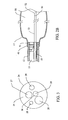
- Fig. 3 depicts an end view of the face of a standard endoscope having an instrument channel offset from the central axis;
- Fig. 4 depicts a cross-sectional view of an embodiment of the present invention configured for use with a standard wire guide
- Fig. 4a is a cross-sectional view taken along line 4a-4a of Fig. 4 ;
- Fig. 5 depicts an embodiment of the present invention, wherein the posterior end of the balloon portion is generally concave;
- Fig. 6 depicts an embodiment of the present invention, wherein the posterior end includes a guide element to facilitate engagement with the endoscope face;
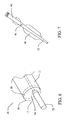
- Fig. 7 depicts an embodiment of the posterior connector of the present invention which includes an alignment marker.
- the present invention includes embodiments of a balloon catheter 10, such as that depicted in Fig. 2 , configured for engagement with an endoscope to facilitate negotiation of the scope through a stricture or other difficult or tortuous pathway within the body, and/or to abut the viewing port 27 or objective lens of the endoscope face such that anatomical structures of interest can be viewed.
- the illustrative balloon catheter 10 comprises a dilation balloon portion 11; typically made of a clear, non-distensible polymer material such as transparent polyethylene terephthalate (PET); a shaft, made of a flexible catheter material 12 attached proximally to the balloon portion and having a passageway 15 that communicates with the balloon portion 11 to supply infusate, such as water, or saline, to expand the balloon; a support element 13 or wire, that extends beyond the distal end 18 of the shaft, through the distal end 16 of the balloon, and terminating within a flexible tip portion 14, made of a suitable medical grade elastomer tubing, such as Pelethane 2363-80AE.
- a suitable medical grade elastomer tubing such as Pelethane 2363-80AE.
- the support element 13 is a kink-resistant material such as nitinol, stainless steel, or other non-superelastic materials and alloys.
- the illustrative balloon portion 11, depicted in Figs. 2-2a comprises a main portion 57 that is generally uniformly cylindrical in shape, and a tapered portion 22 toward the distal end 16 of the balloon portion 11.
- the proximal end 17 of the balloon portion 11 is generally truncate in shape such that the proximal end 17 can be cinched or drawn against the distal face 25 of an endoscope 24 from which it has been advanced, such that there is broad area of contact between the balloon portion 11 and at least a substantial cross section of the endoscope face 25, which is depicted in Fig. 3 .
- the area of contact includes the viewing port 27 or objective lens, and preferably, but not essentially, the light source 28 such that the balloon portion generally serves as an extension of the lens 27, thereby enabling the endoscopist a relatively unobstructed and undistorted view through the balloon interior 58, which permits visualization of the anatomical structures within the body conduit.
- the balloon portion 11 When obstructions from tissues or fluids do occur, they still can be dislodged from the lens or space between the balloon and endoscope using a stream of saline, water, etc. delivered from the flush port 29.
- the resulting balloon-scope train 61 When illustrative balloon portion 11 is inflated and held against the endoscope 24, the resulting balloon-scope train 61 generally forms a common cylindrical unit 63.
- the main portion 57 of the balloon portion 11 includes a central axis 21 that intersects the cross-sectional center point of the main cylindrical portion 57.
- the balloon portion 11 also includes a luminal axis 47 that intersects the proximal and distal openings 48, 49 of the balloon portion.
- the luminal axis 47 of the present invention comprises the original lumen of the tubing used to form the balloon portion 11, but unlike a standard dilation balloon, such as the '344 balloon, is offset relative to the central axis 16 to allow alignment with the endoscope.
- the balloon portion 11 and outer contours of the endoscope 24 be concentrically aligned with one another to maximize the field of view and reduce ledges or surfaces that are prone to catch upon a shelf or stricture during advancement of the balloon-scope train 61.
- the balloon diameter closely match that of the endoscope provides the ideal clinical situation for introduction of the balloon-scope train 61, it is not necessary to the invention that the balloon and scope be of the same diameter.
- multiple sizes of balloons are used with a given endoscope for a single procedure, such as in esophageal dilation procedures, where attempting to fully dilate in a single, rather than multiple stages, increases the risk of rupture.
- the standard sizes of endoscopes used in gastrointestinal procedures are 8.5, 9.5, and 11.5 mm, which are generally compatible with the most preferred range of balloon diameters for the illustrative embodiment (10-16 mm).
- the balloon portion 11 and shaft 12 are attached to one another by inserting the distal end 18 of the shaft 12 into the proximal opening 49 and bonding thereto using a well-known method such as an ultraviolet-curable adhesive.
- the shaft 12, which is aligned with the luminal axis 47, is therefore, offset relative to the central axis 21.
- the support element 13, or stiffener which can be, but is not to be limited to, for example, a 0,686 mm (0.027”) solid flexible nitinol wire, that extends the length of the catheter shaft 12, through the balloon portion 11, then terminating within the tip portion 14.
- the support element 13 includes a tapered portion 52 that begins at a point 50 within the interior 58 of the balloon portion and tapers down about two-thirds the original diameter (in this example, approximately 0.254 mm (0.010")) at the tip 23. As shown in Fig. 2a , the support element 13 is attached to an insert 51 that is embedded into the sheath lumen 15 about the distal tip.
- the insert is preferably, but not essentially, made of a physiologically inert, radiopaque material, such as 303 stainless steel.
- a piece of metal cannula 53 is crimped over the support wire 13 and soldered or otherwise affixed to the insert 51, thereby longitudinally securing the support wire relative to the shaft 12 and balloon portion 11.
- the catheter shaft 12 includes a single lumen 15 that houses the support element 13 and provides an infusion pathway to the balloon portion 11, whereby water or saline is introduced, via the hub, using a commonly-available infusion device appropriate for the balloon volume.
- the balloon is maintained in a deflated state and is folded and inserted into a delivery sheath (not shown). It is then advanced from the delivery sheath into the instrument (accessory) channel of the endoscope, which typically is a minimum of 2.8 mm for the illustrative esophageal dilation balloon, as well as the related pyloric, or colonic embodiments in which the balloon is 18 mm or smaller in diameter when inflated.
- the shaft 12 of the illustrative embodiment and related embodiments has an OD of approximately 2,16 mm (0.085") and an ID of approximately 1.47 mm (0.058").
- the esophageal and colonic embodiments typically have an overall length, including balloon, of approximately 180 cm, although any length that is appropriate for a particular endoscope may be used.
- the colonic dilation balloon catheter 10 is typically longer, e.g., 240 cm.
- the balloon portion 10 of the illustrative embodiment of Fig. 2 is formed by a well-known means, such as blow molding, whereby a length of PTE tubing, sufficient in length to form the final desired length of the balloon, is placed and clamped within a mold conforming to the final shape of the fully distended balloon. Hot air is passed through the tubing, causing the tubing to expand against the contours of the mold.
- the tubing and molding process parameters necessary to achieve the desired balloon are determined by the required burst strength and recommended pressure of the balloon, the material used, and the size of the balloon.
- One source of the balloon portion 10 of the illustrative embodiment is Advanced Polymers, Inc. (Salem, NH).
- the typical range of diameters for an 8 cm long esophageal dilation balloon is generally about 6 to 19 mm, with a more preferred range of 12-18 mm.
- Minimum specified burst pressures typically average 1.21 ⁇ 10 6 Pa (175 psi) for a 12 mm balloon, down to about 122 mm for an 18 mm diameter balloon, with the corresponding recommended pressures being about 6.21 ⁇ 10 5 Pa and 3.45 ⁇ 10 5 Pa (90 and 50 psi), respectively.
- Pyloric and colonic dilation balloons are typically shorter in length (e.g., 5.5 cm); however, the recommended pressures are generally the same as the longer esophageal balloons for corresponding diameters.
- the balloon portion 11 because of its eccentric shape, is divisible into a first longitudinal portion 54 and a second longitudinal portion 55 along the luminal axis 47, with the first longitudinal portion 54 comprising the larger volume of the two. Because the original tubing requires greater expansion within one side of the eccentric-shaped mold than the other to contact the outer mold surface, the thicknesses found along the wall 59 of the first longitudinal portion 54 will generally be thinner than that found along the wall 60 of the second longitudinal portion 55. Generally, the thickness and strength of the first portion wall 59 determines the burst and recommended pressures that are specified for a given balloon catheter 10.
- FIG. 4 A second embodiment of the present invention is depicted in Fig. 4 that is adapted for use with a wire guide 34.
- the illustrative wire-guided dilation balloon 10 includes an inner sheath 62 coaxially disposed within the outer sheath 12 to which the balloon portion 11 is attached.
- the inner sheath 62 serves as the conduit for a wire guide 34, in one embodiment a standard 0,889 mm (0.035") wire guide, that is loaded into, and is extendable from the inner sheath passageway 45.
- both the inner and outer sheaths 12, 62 are made of poly-ether ether ketone (PEEK), with the outer sheath 12 having and OD of 2,16 mm (0.85") and the inner sheath 62 having an OD of 1,27mm (0.50").
- PEEK poly-ether ether ketone
- the inner sheath 62 is sized to allow the flow of infusate through sheath passageway 15 within the annular space between the two sheaths 12, 62 and into the interior 58 of the balloon portion 11 to expand the balloon.
- the inner sheath 62 terminates within the distal tip portion 14 about the distal end 16 of the balloon portion or a few millimeters past.
- the wire guide 34 is typically utilized a support element 13 for adding stiffness or pushability to the balloon catheter 10, or it may be introduced separately into the patient.
- the inner sheath 62 alone may provide sufficient stiffness and pushability to function as the support element 13 for some applications, which can in some embodiments make a separate support element 13, such as a nitinol wire, unnecessary.
- a wire guide 34 that is most suitable as a support element 13, may at some point be replaced with a different wire guide having characteristics more desirable for a particular procedure.
- the outer and inner sheaths 12, 62 are typically fixed relative to one another longitudinally by a standard hub (not shown), which provides access for the wire guide, and a port for the infusion of balloon infusate.
- the proximal end of the balloon is indented.
- Such indentations can permit the endoscopist to lock or otherwise more completely engage the proximal end of the balloon with the distal end of the endoscope, thereby resisting rotational movement and thus minimizing rotational loss of balloon/scope alignment.
- One such exemplary embodiment comprises an indentation which effectively results in a circumferential flange at the proximal end of the balloon that is configured to frictionally engage the distal end of the endoscope.
- Figs. 5-6 depicts embodiments of the balloon portion 11 that include a positive engagement guide 36 that is intended to facilitate or improve engagement and/or alignment with the face 25 of the endoscope 24.
- a positive engagement guide 36 that is intended to facilitate or improve engagement and/or alignment with the face 25 of the endoscope 24.
- engagement results when the proximal end 17 of balloon both tightly abuts the endoscope face 25 and is correctly aligned so that central axis 21 of the balloon is generally aligned with central axis 30 of the endoscope.
- Fig. 5 depicts a positive engagement guide 36 that comprises a receiving area 64 comprising a concave surface 37 at the proximal end 17 of the balloon portion 11 to receive the endoscope face 25, which is typically rounded distally and therefore, naturally conforms to the concave surface 37.
- the concave shape of the proximal end 17 can increase the available area of the endoscope face 25 contacting the balloon portion 11, and possibly assisting with alignment as the balloon pulled back to
- Fig. 6 depicts a balloon portion 11 that includes a guide structure 38 along the outer edge of the truncate proximal end 17 to help facilitate correct alignment and proper engagement between the scope 24 and balloon portion 11.
- the guide structure 38 provides an additional means to help guide the endoscope against the balloon portion 11.
- the illustrative guide structure 38 comprises a flap-like structure that is bonded to or formed with the balloon portion 11 and that defines a receiving area 64. The guide structure 38 acts to properly seat the endoscope face 25 into the receiving area 64 at the proximal end 17 so that the balloon can be rotated and aligned accordingly.
- the guide structure 38 may comprise merely a marker or series of markers on the surface of the balloon portion surface for indicating orientation, rather than a raised structure or structures.
- the flap-like guide structure 38 further serves to provide some protection against tissue or materials migrating into the space between the proximal end 17 of the balloon portion 11 and the endoscope face 25, thus limiting visibility.
- the illustrative guide structure 38 is merely exemplary. In view of the teachings herein, it would be within the ability of one of ordinary skill in the medical arts to conceive and design other annular or discrete structures that would accomplish the objective of providing a guide for proper engagement of the balloon portion 11 and endoscope 24.
- FIG. 7 Another manner in which alignment can be accomplished is depicted in Fig. 7 , in which an alignment marker 41 is placed on the proximal hub 40 of the balloon catheter 10 that the operator can use to tell when a particular side of the balloon is oriented upward, thereby matching the orientation of the endoscope so that they are concentrically aligned.
- the alignment marker can comprise any system of indicia, such as markings, characters, colors, structures, etc. that are printed on, embossed in, molded with, or otherwise affixed or attached to the hub.
- the marker can be included on the strain relief element 42 or the shaft 12 itself in a location for convenient viewing during the procedure.
- the present invention may encompass any balloon, dilation, extraction, etc. that can be designed for endoscopic use and which may be abutted against the scope face to form a common functional unit therewith that is appropriate for a particular clinical application. These would include applications utilizing both compliant and non-compliant balloon materials. Examples of other clinical applications include, but are not limited to, biliary tree, bronchial tree, neural endoscopy, and the vascular system.
Landscapes
- Health & Medical Sciences (AREA)
- Life Sciences & Earth Sciences (AREA)
- Surgery (AREA)
- Heart & Thoracic Surgery (AREA)
- Public Health (AREA)
- General Health & Medical Sciences (AREA)
- Engineering & Computer Science (AREA)
- Veterinary Medicine (AREA)
- Biomedical Technology (AREA)
- Biophysics (AREA)
- Animal Behavior & Ethology (AREA)
- Nuclear Medicine, Radiotherapy & Molecular Imaging (AREA)
- Molecular Biology (AREA)
- Medical Informatics (AREA)
- Physics & Mathematics (AREA)
- Radiology & Medical Imaging (AREA)
- Optics & Photonics (AREA)
- Pathology (AREA)
- Pulmonology (AREA)
- Child & Adolescent Psychology (AREA)
- Anesthesiology (AREA)
- Hematology (AREA)
- Endoscopes (AREA)
- Media Introduction/Drainage Providing Device (AREA)
- Materials For Medical Uses (AREA)
Claims (22)
- Un cathéter à ballonnet (10) à utiliser avec un endoscope (24) comprenant :(a) un ballonnet de dilatation (11) comprenant une extrémité proximale (17) et une extrémité distale (18), selon laquelle ladite extrémité proximale comprend une ouverture proximale (48), ladite ouverture proximale étant déportée par rapport à un axe longitudinal médian (16) ; et(b) un arbre (12) connecté à ladite ouverture proximale, dans laquelle ledit arbre comprend une lumière (15) pour fournir une voie d'infusion dans ledit ballonnet de dilatation ;
caractérisé par le fait que ladite extrémité proximale du ballonnet de dilatation est tronquée de telle sorte que lorsque la partie ballonnet est gonflée et alignée avec l'endoscope, elle forme une unité essentiellement cylindrique unitaire avec l'endoscope ; tandis que le ballonnet de dilatation comprend aussi un axe luminal (47), dans lequel ledit axe luminal est déporté par rapport audit axe longitudinal médian ; et dans lequel ledit arbre est connecté au ballonnet de dilatation le long de l'axe luminal. - Le cathéter à ballonnet (10) selon la revendication 1, dans lequel ladite extrémité proximale (17) est en retrait.
- Le cathéter à ballonnet (10) selon la revendication 1, dans lequel ladite extrémité proximale (17) est concave.
- Le cathéter à ballonnet (10) selon la revendication 2, dans lequel l'extrémité proximale (17) est configurée pour être complémentaire de l'extrémité distale (18) d'un endoscope, de telle sorte qu'en cours d'utilisation, ladite extrémité proximale engage l'extrémité distale de l'endoscope par friction, et de ce fait résiste au mouvement de rotation.
- Le cathéter à ballonnet (10) selon la revendication 3, dans lequel l'extrémité proximale (17) est configurée pour être complémentaire de l'extrémité distale (18) d'un endoscope, de telle sorte qu'en cours d'utilisation, ladite extrémité proximale engage l'extrémité distale de l'endoscope par friction, et de ce fait, résiste au mouvement de rotation.
- Le cathéter à ballonnet (10) selon la revendication 4, dans lequel ladite extrémité proximale dudit ballonnet comprend une bride circonférentielle,
- Le cathéter à ballonnet (10) selon la revendication 5, dans lequel ladite extrémité proximale (17) dudit ballonnet comprend une bride circonférentielle.
- Le cathéter à ballonnet (10) selon la revendication 1, dans lequel ledit ballonnet à dilatation (11) est essentiellement de forme cylindrique.
- Le cathéter à ballonnet (10) selon la revendication 1, dans lequel ladite extrémité distale (18) est conique.
- Le cathéter à ballonnet (10) selon la revendication 1, dans lequel ladite extrémité distale (18), comprend une partie embout, dans laquelle ladite partie embout (46) est déportée par rapport audit axe longitudinal médian (16).
- Le cathéter à ballonnet (10) selon la revendication 10, dans lequel ladite partie embout (46) est flexible.
- Le cathéter à ballonnet (10) selon la revendication 10, dans lequel ladite partie embout (46) est arrondie.
- Le cathéter à ballonnet (10) selon la revendication 10, dans lequel ladite partie embout (46) comprend un alésage central.
- Le cathéter à ballonnet (10) selon la revendication 13, dans lequel ledit alésage central est rempli de colle.
- Le cathéter à ballonnet (10) selon la revendication 10, comprend par ailleurs un élément de support (13) dans lequel ledit élément de support est disposé en connexion entre ledit arbre (12) et ladite partie embout (46), de telle sorte que ladite voie d'infusion est maintenue entre ledit arbre et ledit ballonnet à dilatation (11).
- Le cathéter à ballonnet (10) selon la revendication 15, dans lequel ledit élément de support (13) est un élément filaire.
- Le cathéter à ballonnet (10) selon la revendication 16, dans lequel ledit élément de support est un fil au nitinol.
- Le cathéter à ballonnet (10) selon la revendication 15, dans lequel ledit élément de support est une gaine intérieure, dans lequel ladite gaine intérieure est disposée coaxialement dans ledit arbre (12).
- Le cathéter à ballonnet (10) selon la revendication 18, comprend par ailleurs un guide filaire dans lequel ledit guide filaire est allongé à travers ladite gaine intérieure jusqu'à ladite partie embout (46).
- Le cathéter à ballonnet (10) selon la revendication 19, dans lequel ledit guide filaire est un fil au nitinol.
- Le cathéter à ballonnet (10) selon la revendication 1, dans lequel le ballonnet de dilatation (11) est fabriqué dans une matière transparente.
- Un cathéter à ballonnet (10) selon la revendication 1, à utiliser avec un endoscope (24), comprend par ailleurs :(c) une partie embout (46) connectée à ladite ouverture distale (49) ; et(d) un élément de support (13) dans lequel ledit élément de support est disposé en connexion entre ledit arbre (12) et ladite partie embout, de telle sorte que ladite voie d'infusion est maintenue entre ledit arbre et ledit ballonnet à dilatation (11).
Applications Claiming Priority (3)
| Application Number | Priority Date | Filing Date | Title |
|---|---|---|---|
| US37175402P | 2002-04-11 | 2002-04-11 | |
| US371754P | 2002-04-11 | ||
| PCT/US2003/011036 WO2003086524A1 (fr) | 2002-04-11 | 2003-04-11 | Ballonnet de dilatation pour endoscope |
Publications (2)
| Publication Number | Publication Date |
|---|---|
| EP1494745A1 EP1494745A1 (fr) | 2005-01-12 |
| EP1494745B1 true EP1494745B1 (fr) | 2010-08-18 |
Family
ID=29250736
Family Applications (1)
| Application Number | Title | Priority Date | Filing Date |
|---|---|---|---|
| EP03723963A Expired - Lifetime EP1494745B1 (fr) | 2002-04-11 | 2003-04-11 | Ballonnet de dilatation pour endoscope |
Country Status (8)
| Country | Link |
|---|---|
| US (2) | US6953431B2 (fr) |
| EP (1) | EP1494745B1 (fr) |
| JP (1) | JP2005522278A (fr) |
| AT (1) | ATE477832T1 (fr) |
| AU (1) | AU2003230857A1 (fr) |
| CA (1) | CA2482969C (fr) |
| DE (1) | DE60333827D1 (fr) |
| WO (1) | WO2003086524A1 (fr) |
Families Citing this family (72)
| Publication number | Priority date | Publication date | Assignee | Title |
|---|---|---|---|---|
| US20040236366A1 (en) * | 2002-05-16 | 2004-11-25 | Kennedy Kenneth C. | Non-buckling balloon catheter |
| US20030236495A1 (en) * | 2002-05-16 | 2003-12-25 | Kennedy Kenneth C. | Non-buckling balloon catheter |
| US6979290B2 (en) * | 2002-05-30 | 2005-12-27 | The Board Of Trustees Of The Leland Stanford Junior University | Apparatus and methods for coronary sinus access |
| US7309344B2 (en) * | 2002-12-20 | 2007-12-18 | Ethicon Endo-Surgery, Inc. | Transparent dilator device and method of use |
| US20050159645A1 (en) * | 2003-11-12 | 2005-07-21 | Bertolero Arthur A. | Balloon catheter sheath |
| US7186214B2 (en) * | 2004-02-12 | 2007-03-06 | Medtronic, Inc. | Instruments and methods for accessing an anatomic space |
| JP4505345B2 (ja) * | 2004-03-31 | 2010-07-21 | オリンパス株式会社 | 内視鏡挿入補助用プローブ及びこれを適用する内視鏡装置 |
| US20060063973A1 (en) | 2004-04-21 | 2006-03-23 | Acclarent, Inc. | Methods and apparatus for treating disorders of the ear, nose and throat |
| US8702626B1 (en) | 2004-04-21 | 2014-04-22 | Acclarent, Inc. | Guidewires for performing image guided procedures |
| US7803150B2 (en) | 2004-04-21 | 2010-09-28 | Acclarent, Inc. | Devices, systems and methods useable for treating sinusitis |
| US20190314620A1 (en) | 2004-04-21 | 2019-10-17 | Acclarent, Inc. | Apparatus and methods for dilating and modifying ostia of paranasal sinuses and other intranasal or paranasal structures |
| US10188413B1 (en) | 2004-04-21 | 2019-01-29 | Acclarent, Inc. | Deflectable guide catheters and related methods |
| US9399121B2 (en) | 2004-04-21 | 2016-07-26 | Acclarent, Inc. | Systems and methods for transnasal dilation of passageways in the ear, nose or throat |
| US8894614B2 (en) | 2004-04-21 | 2014-11-25 | Acclarent, Inc. | Devices, systems and methods useable for treating frontal sinusitis |
| US7654997B2 (en) | 2004-04-21 | 2010-02-02 | Acclarent, Inc. | Devices, systems and methods for diagnosing and treating sinusitus and other disorders of the ears, nose and/or throat |
| US20070167682A1 (en) | 2004-04-21 | 2007-07-19 | Acclarent, Inc. | Endoscopic methods and devices for transnasal procedures |
| US20070208252A1 (en) | 2004-04-21 | 2007-09-06 | Acclarent, Inc. | Systems and methods for performing image guided procedures within the ear, nose, throat and paranasal sinuses |
| US8747389B2 (en) | 2004-04-21 | 2014-06-10 | Acclarent, Inc. | Systems for treating disorders of the ear, nose and throat |
| US8460178B2 (en) * | 2004-11-30 | 2013-06-11 | Atul Kumar | Method and system for minimizing leakage of a distending medium during endoscopic procedures |
| US20060135847A1 (en) * | 2004-12-22 | 2006-06-22 | Zoom Medical, L.L.C. | Endoscope guiding device |
| USD597205S1 (en) | 2004-12-22 | 2009-07-28 | Zutron Medical, L.L.C. | Handle for endoscope stiffening device |
| US20060178671A1 (en) * | 2005-02-07 | 2006-08-10 | Jerome Canady | APC dual mode therapeutic balloon dilator |
| US20060224113A1 (en) * | 2005-03-31 | 2006-10-05 | Van Sloten Leonard A | Esophageal balloon catheter with asymmetrical balloon |
| US20070100280A1 (en) * | 2005-03-31 | 2007-05-03 | Van Sloten Leonard A | Catheter with balloon material having visual marker |
| US7195612B2 (en) * | 2005-03-31 | 2007-03-27 | Gordis Corporation | Esophageal balloon catheter with visual marker |
| US8951225B2 (en) | 2005-06-10 | 2015-02-10 | Acclarent, Inc. | Catheters with non-removable guide members useable for treatment of sinusitis |
| US7623899B2 (en) * | 2005-09-16 | 2009-11-24 | Biosense Webster, Inc. | Catheter with flexible pre-shaped tip section |
| JP4772446B2 (ja) * | 2005-09-30 | 2011-09-14 | オリンパスメディカルシステムズ株式会社 | 内視鏡挿入補助具及び内視鏡装置 |
| WO2007098416A2 (fr) * | 2006-02-16 | 2007-08-30 | University Of South Florida | Ballons de dilatation excentrique pour utilisation avec endoscopes |
| US20070198046A1 (en) * | 2006-02-17 | 2007-08-23 | Medicalcv, Inc. | Surgical visualization tool |
| US10238518B2 (en) * | 2007-02-27 | 2019-03-26 | Agt Inc. | Implantable weight control device |
| US20080306441A1 (en) * | 2007-04-10 | 2008-12-11 | Wilson-Cook Medical Inc. | Non-buckling balloon catheter with spring loaded floating flexible tip |
| US8287447B2 (en) * | 2007-08-29 | 2012-10-16 | Minos Medical | Outer tube for natural orifice surgery |
| WO2009073602A2 (fr) * | 2007-11-30 | 2009-06-11 | University Of South Florida | Appareil à ballonnet hydraulique trans-endoscopique |
| AU2009205679B2 (en) | 2008-01-18 | 2013-12-05 | Spinecore, Inc. | Instruments and methods for inserting artificial intervertebral implants |
| US8483831B1 (en) | 2008-02-15 | 2013-07-09 | Holaira, Inc. | System and method for bronchial dilation |
| CA2723806C (fr) | 2008-05-09 | 2022-05-31 | Innovative Pulmonary Solutions, Inc. | Systemes, ensembles et procedes utilisables pour le traitement d'un arbre bronchique |
| US20100042198A1 (en) | 2008-08-18 | 2010-02-18 | Burton David G | Single piece double wall dilation balloon catheter |
| US20100042199A1 (en) * | 2008-08-18 | 2010-02-18 | Burton David G | Dilation balloon catheter and methods of use thereof |
| EP2323724A1 (fr) | 2008-09-18 | 2011-05-25 | Acclarent, Inc. | Procédés et appareil de traitement de troubles d'oto-rhino-laryngologie |
| AT506573B1 (de) * | 2008-09-23 | 2009-10-15 | Furtmueller Franz Dr | Endoskopartige vorrichtung |
| US20100186211A1 (en) * | 2009-01-29 | 2010-07-29 | Nellcor Puritan Bennett Llc | Medical device and technique for using the same |
| US8381730B2 (en) * | 2009-01-29 | 2013-02-26 | Covidien Lp | Medical device and technique for using the same |
| US9596979B2 (en) * | 2009-05-29 | 2017-03-21 | Smart Medical Systems Ltd. | Anchoring assemblies for endoscopes |
| EP2488093A4 (fr) * | 2009-10-15 | 2013-04-03 | Inventio Llc | Endoscope transparent de forme complexe jetable et réutilisable |
| JP5843777B2 (ja) | 2009-10-27 | 2016-01-13 | ホライラ, インコーポレイテッド | 冷却可能なエネルギー放出アセンブリを有する送達デバイス |
| CN102711645B (zh) | 2009-11-11 | 2016-12-28 | 赫莱拉公司 | 用于处理组织和控制狭窄的系统和装置 |
| US10449071B2 (en) | 2010-12-22 | 2019-10-22 | Boston Scientific Scimed, Inc. | Stent deployment system with integrated digital camera and dilation balloon |
| CN103781394B (zh) | 2011-04-05 | 2016-09-28 | 可视化气囊有限责任公司 | 用于内窥镜的气囊状进入设备 |
| US9833126B2 (en) | 2011-04-05 | 2017-12-05 | Visualization Balloons, Llc | Balloon access device with features for engaging an endoscope |
| ITGO20110004A1 (it) * | 2011-05-06 | 2012-11-07 | Romano Guerra | Nuovo dispositivo per la tracheostomia con pallone dilatatore |
| US9451875B2 (en) | 2012-12-07 | 2016-09-27 | Cook Medical Technologies Llc | Flexible lens |
| US20180360586A9 (en) | 2013-03-07 | 2018-12-20 | Merit Medical Systems, Inc. | Embolic filter balloon |
| IN2013CH01041A (fr) * | 2013-03-12 | 2015-08-14 | Atchayam Business Solutions Pvt Ltd | |
| WO2015127265A1 (fr) | 2014-02-24 | 2015-08-27 | Visualization Balloons, Llc | Endoscopie gastro-intestinale à l'aide de structures de plissage de l'intestin pouvant être fixées |
| JP6760557B2 (ja) * | 2014-09-25 | 2020-09-23 | メリット・メディカル・システムズ・インコーポレイテッドMerit Medical Systems,Inc. | コーティングされたバルーン及びコーティングされたバルーン組立品並びに関連する使用方法及び製造方法 |
| US20160367120A1 (en) * | 2015-06-19 | 2016-12-22 | Children's Medical Center Corporation | Optically Guided Surgical Devices |
| US10940299B2 (en) | 2015-08-10 | 2021-03-09 | Gyms Acmi, Inc. | Center marker for dilatation balloon |
| WO2017124014A1 (fr) | 2016-01-13 | 2017-07-20 | Agt Inc. | Dispositif implantable de contrôle du poids permettant de favoriser la satiété précoce et prolongée chez un patient bariatrique |
| BR112018016496A2 (pt) | 2016-02-12 | 2018-12-26 | Childrens Medical Center | porta-instrumento com sistema de formação de imagem integrado |
| WO2018160454A1 (fr) * | 2017-02-28 | 2018-09-07 | University Of Florida Research Foundation, Inc. | Régulation de la température œsophagienne pendant une ablation cardiaque |
| JP2018008088A (ja) * | 2017-08-31 | 2018-01-18 | スマート・メディカル・システムズ・リミテッド | 内視鏡ツール |
| EP3648653B1 (fr) * | 2017-10-25 | 2023-05-10 | Boston Scientific Scimed Inc. | Cathéter de visualisation directe et système associé |
| US11565092B2 (en) | 2018-03-06 | 2023-01-31 | Alpine Medical Devices, Llc | Endoscopic dilator |
| WO2019232537A1 (fr) * | 2018-06-01 | 2019-12-05 | Endo RX, LLC | Dispositif de dilation et procédé d'utilisation |
| CN113613542A (zh) * | 2019-01-24 | 2021-11-05 | 诺亚医疗集团公司 | 具有集成视觉能力的一次性装置 |
| US11931522B2 (en) | 2019-05-09 | 2024-03-19 | Neuravi Limited | Inflation lumen kink protection and balloon profile |
| US11957855B2 (en) | 2019-05-09 | 2024-04-16 | Neuravi Limited | Balloon guide catheter with positive venting of residual air |
| US11571553B2 (en) | 2019-05-09 | 2023-02-07 | Neuravi Limited | Balloon guide catheter with thermally expandable material |
| US11607531B2 (en) | 2019-05-09 | 2023-03-21 | Neuravi Limited | Balloon catheter with venting of residual air in a proximal direction |
| CN110840392B (zh) * | 2019-12-14 | 2025-01-24 | 宁波智光机电科技有限公司 | 内窥镜头部插入保护装置 |
| KR102473095B1 (ko) * | 2020-05-20 | 2022-12-02 | 재단법인 아산사회복지재단 | 직장 확장 풍선 카테터 |
Family Cites Families (46)
| Publication number | Priority date | Publication date | Assignee | Title |
|---|---|---|---|---|
| US508784A (en) * | 1893-11-14 | Lever and locking mechanism therefor | ||
| US312430A (en) * | 1885-02-17 | Attoreets | ||
| US2354471A (en) * | 1943-08-18 | 1944-07-25 | Foregger Company Inc | Laryngoscope |
| US4083369A (en) * | 1976-07-02 | 1978-04-11 | Manfred Sinnreich | Surgical instruments |
| US4295465A (en) * | 1980-04-03 | 1981-10-20 | N.A.D., Inc. | Laryngoscope blade |
| US4705024A (en) * | 1986-06-20 | 1987-11-10 | Bainton Cedric R | Laryngoscope for use with pharyngeal obstructions |
| US5312430A (en) | 1986-12-09 | 1994-05-17 | Rosenbluth Robert F | Balloon dilation catheter |
| US5030227A (en) * | 1988-06-02 | 1991-07-09 | Advanced Surgical Intervention, Inc. | Balloon dilation catheter |
| US5007898A (en) | 1988-06-02 | 1991-04-16 | Advanced Surgical Intervention, Inc. | Balloon dilatation catheter |
| US4958634A (en) * | 1987-05-06 | 1990-09-25 | Jang G David | Limacon geometry balloon angioplasty catheter systems and method of making same |
| DE3719250A1 (de) | 1987-06-10 | 1988-12-22 | Kellner Hans Joerg Dr Med | Endoskop |
| JPS6415063A (en) | 1987-07-10 | 1989-01-19 | Terumo Corp | Catheter tube |
| GB8719814D0 (en) * | 1987-08-21 | 1987-09-30 | Weed Master Western Ltd | Pesticide applicator |
| US5003907A (en) * | 1988-05-20 | 1991-04-02 | Roach John E | Boat hook |
| US4924855A (en) * | 1988-07-25 | 1990-05-15 | Albert Salerno | Laryngoscope blade |
| US4947896A (en) * | 1988-11-04 | 1990-08-14 | Bartlett Robert L | Laryngoscope |
| US5269793A (en) * | 1989-07-20 | 1993-12-14 | Devices For Vascular Intervention, Inc. | Guide wire systems for intravascular catheters |
| US5345927A (en) * | 1990-03-02 | 1994-09-13 | Bonutti Peter M | Arthroscopic retractors |
| US5163949A (en) * | 1990-03-02 | 1992-11-17 | Bonutti Peter M | Fluid operated retractors |
| CA2044867C (fr) * | 1990-06-25 | 1999-10-12 | James J. Rudnick | Catheter a ballonnet permettant une vision directe de la prostate |
| US5103804A (en) * | 1990-07-03 | 1992-04-14 | Boston Scientific Corporation | Expandable tip hemostatic probes and the like |
| JPH04297236A (ja) * | 1991-03-26 | 1992-10-21 | Toshiba Corp | ディジタルフルオログラフィ装置 |
| US5331947A (en) * | 1992-05-01 | 1994-07-26 | Shturman Cardiology Systems, Inc. | Inflatable sheath for introduction of ultrasonic catheter through the lumen of a fiber optic endoscope |
| US5271383A (en) * | 1992-06-05 | 1993-12-21 | Wilk Peter J | Method for reducing intussusception |
| US5315747A (en) | 1992-10-30 | 1994-05-31 | Pameda N.V. | Method of preparing a balloon dilatation catheter |
| US5409483A (en) * | 1993-01-22 | 1995-04-25 | Jeffrey H. Reese | Direct visualization surgical probe |
| US5645529A (en) | 1993-03-11 | 1997-07-08 | C. R. Bard, Inc. | Devices for selectively directing inflation devices |
| US5549553A (en) | 1993-04-29 | 1996-08-27 | Scimed Life Systems, Inc. | Dilation ballon for a single operator exchange intravascular catheter or similar device |
| US5669880A (en) | 1993-08-24 | 1997-09-23 | Cordis Corporation | Stent delivery system |
| AU2359395A (en) | 1994-04-20 | 1995-11-16 | Ronald J. Solar | Active perfusion dilatation catheter |
| US5578009A (en) | 1994-07-20 | 1996-11-26 | Danforth Biomedical Incorporated | Catheter system with push rod for advancement of balloon along guidewire |
| US5899882A (en) | 1994-10-27 | 1999-05-04 | Novoste Corporation | Catheter apparatus for radiation treatment of a desired area in the vascular system of a patient |
| US5667493A (en) * | 1994-12-30 | 1997-09-16 | Janacek; Jaroslav | Dilation catheter |
| US5681344A (en) * | 1995-02-06 | 1997-10-28 | Wilson-Cook Medical Inc. | Esophageal dilation balloon catheter containing flexible nitinol wire |
| US5662608A (en) * | 1995-07-26 | 1997-09-02 | Intelliwire, Inc. | Low profile balloon catheter and method |
| FR2738489A1 (fr) | 1995-09-12 | 1997-03-14 | Balt Extrusion | Catheter a ballonnet d'occlusion et son procede de fabrication |
| US5827175A (en) * | 1996-09-30 | 1998-10-27 | Fuji Photo Optical Co., Ltd. | Endoscopically inserting ultrasound probe |
| ES2216556T3 (es) * | 1998-08-19 | 2004-10-16 | Cook Incorporated | Guia de alambre preformada. |
| US6741884B1 (en) * | 1998-09-03 | 2004-05-25 | Hypermed, Inc. | Infrared endoscopic balloon probes |
| CA2379670A1 (fr) | 1999-08-12 | 2001-02-22 | Wilson-Cook Medical Inc. | Ballonnet de dilatation a diametres multiples |
| WO2001074260A1 (fr) | 2000-03-24 | 2001-10-11 | Johns Hopkins University | Cavite peritoneale, procede et dispositif |
| US6508784B1 (en) | 2000-05-19 | 2003-01-21 | Yan-Ho Shu | Balloon catheter having adjustable centering capabilities and methods thereof |
| DE10192161T1 (de) * | 2000-05-30 | 2002-09-05 | Olympus Optical Co | Medizinischer Führungsdraht |
| US20020072706A1 (en) | 2000-12-11 | 2002-06-13 | Thomas Hiblar | Transluminal drug delivery catheter |
| US20030045859A1 (en) | 2001-06-11 | 2003-03-06 | Larry Dominguez | Delivery system using balloon catheter |
| US6659941B2 (en) | 2001-06-19 | 2003-12-09 | Mallinckrodt, Inc. | Balloon assisted endoscope for viewing a fetus during delivery |
-
2003
- 2003-04-04 US US10/408,831 patent/US6953431B2/en not_active Expired - Lifetime
- 2003-04-11 JP JP2003583533A patent/JP2005522278A/ja active Pending
- 2003-04-11 WO PCT/US2003/011036 patent/WO2003086524A1/fr not_active Ceased
- 2003-04-11 DE DE60333827T patent/DE60333827D1/de not_active Expired - Lifetime
- 2003-04-11 EP EP03723963A patent/EP1494745B1/fr not_active Expired - Lifetime
- 2003-04-11 AT AT03723963T patent/ATE477832T1/de not_active IP Right Cessation
- 2003-04-11 CA CA2482969A patent/CA2482969C/fr not_active Expired - Fee Related
- 2003-04-11 AU AU2003230857A patent/AU2003230857A1/en not_active Abandoned
-
2005
- 2005-08-31 US US11/218,084 patent/US8298134B2/en not_active Expired - Fee Related
Also Published As
| Publication number | Publication date |
|---|---|
| EP1494745A1 (fr) | 2005-01-12 |
| US20050288552A1 (en) | 2005-12-29 |
| ATE477832T1 (de) | 2010-09-15 |
| AU2003230857A1 (en) | 2003-10-27 |
| JP2005522278A (ja) | 2005-07-28 |
| US8298134B2 (en) | 2012-10-30 |
| WO2003086524A1 (fr) | 2003-10-23 |
| US20040015052A1 (en) | 2004-01-22 |
| CA2482969A1 (fr) | 2003-10-23 |
| US6953431B2 (en) | 2005-10-11 |
| DE60333827D1 (de) | 2010-09-30 |
| CA2482969C (fr) | 2011-09-27 |
Similar Documents
| Publication | Publication Date | Title |
|---|---|---|
| US6953431B2 (en) | Eccentric dilation balloons for use with endoscopes | |
| US20090287050A1 (en) | Eccentric Dilation Balloons for Use of Endoscopes | |
| US7309344B2 (en) | Transparent dilator device and method of use | |
| JP4920235B2 (ja) | 透明な拡張器およびその使用方法 | |
| JP5513116B2 (ja) | アクセスポートに応力集中部を備えて破断力を低減した医療用カテーテル | |
| EP0980691B1 (fr) | Catheter a ballonnet pour ponctions et instrument a usage medical pour introduction de tube utilisant ce catheter | |
| EP3482706B1 (fr) | Instrument de traitement destiné à un endoscope | |
| US20120123463A1 (en) | Mechanically-guided transoral bougie | |
| US9440049B2 (en) | Apparatus and method for accessing a sinus cavity | |
| JP2010503476A5 (fr) | ||
| JP2002126089A (ja) | カテーテル装置 | |
| CN107847718A (zh) | 用于扩张球囊的中心标记物 | |
| US20190274887A1 (en) | Methods, devices and systems for treating eustachian tube disorders | |
| JP2007229499A (ja) | 拡張バルーンカテーテル | |
| WO2008089424A2 (fr) | Systèmes et techniques pour dilatation endoscopique | |
| JP4758985B2 (ja) | 遠位側ワイヤ停止装置 | |
| JP2007533400A5 (fr) | ||
| JP4744522B2 (ja) | 壁を割くことのできるシャフトと剥ぎ取り具を備えたカテーテル | |
| EP2967600B1 (fr) | Retire-tube destiné à être utilisé avec un dispositif endoscopique | |
| CN114585293A (zh) | 医疗器械组件及其使用方法 | |
| Ahlawat et al. | Endoscopes, guidewires, and accessories | |
| Barthel | Eccentric dilation balloons for use with endoscopes | |
| JP2019115755A (ja) | 血管内視鏡カテーテルおよびそれを用いた血管内視鏡 | |
| HK1088520A (en) | Transparent dilator device |
Legal Events
| Date | Code | Title | Description |
|---|---|---|---|
| PUAI | Public reference made under article 153(3) epc to a published international application that has entered the european phase |
Free format text: ORIGINAL CODE: 0009012 |
|
| 17P | Request for examination filed |
Effective date: 20041029 |
|
| AK | Designated contracting states |
Kind code of ref document: A1 Designated state(s): AT BE BG CH CY CZ DE DK EE ES FI FR GB GR HU IE IT LI LU MC NL PT RO SE SI SK TR |
|
| AX | Request for extension of the european patent |
Extension state: AL LT LV MK |
|
| 17Q | First examination report despatched |
Effective date: 20071109 |
|
| GRAP | Despatch of communication of intention to grant a patent |
Free format text: ORIGINAL CODE: EPIDOSNIGR1 |
|
| GRAS | Grant fee paid |
Free format text: ORIGINAL CODE: EPIDOSNIGR3 |
|
| GRAA | (expected) grant |
Free format text: ORIGINAL CODE: 0009210 |
|
| AK | Designated contracting states |
Kind code of ref document: B1 Designated state(s): AT BE BG CH CY CZ DE DK EE ES FI FR GB GR HU IE IT LI LU MC NL PT RO SE SI SK TR |
|
| REG | Reference to a national code |
Ref country code: GB Ref legal event code: FG4D |
|
| REG | Reference to a national code |
Ref country code: CH Ref legal event code: EP |
|
| REG | Reference to a national code |
Ref country code: IE Ref legal event code: FG4D |
|
| REF | Corresponds to: |
Ref document number: 60333827 Country of ref document: DE Date of ref document: 20100930 Kind code of ref document: P |
|
| REG | Reference to a national code |
Ref country code: NL Ref legal event code: VDEP Effective date: 20100818 |
|
| PG25 | Lapsed in a contracting state [announced via postgrant information from national office to epo] |
Ref country code: AT Free format text: LAPSE BECAUSE OF FAILURE TO SUBMIT A TRANSLATION OF THE DESCRIPTION OR TO PAY THE FEE WITHIN THE PRESCRIBED TIME-LIMIT Effective date: 20100818 Ref country code: FI Free format text: LAPSE BECAUSE OF FAILURE TO SUBMIT A TRANSLATION OF THE DESCRIPTION OR TO PAY THE FEE WITHIN THE PRESCRIBED TIME-LIMIT Effective date: 20100818 |
|
| PG25 | Lapsed in a contracting state [announced via postgrant information from national office to epo] |
Ref country code: BG Free format text: LAPSE BECAUSE OF FAILURE TO SUBMIT A TRANSLATION OF THE DESCRIPTION OR TO PAY THE FEE WITHIN THE PRESCRIBED TIME-LIMIT Effective date: 20101118 Ref country code: PT Free format text: LAPSE BECAUSE OF FAILURE TO SUBMIT A TRANSLATION OF THE DESCRIPTION OR TO PAY THE FEE WITHIN THE PRESCRIBED TIME-LIMIT Effective date: 20101220 Ref country code: CY Free format text: LAPSE BECAUSE OF FAILURE TO SUBMIT A TRANSLATION OF THE DESCRIPTION OR TO PAY THE FEE WITHIN THE PRESCRIBED TIME-LIMIT Effective date: 20100818 Ref country code: SI Free format text: LAPSE BECAUSE OF FAILURE TO SUBMIT A TRANSLATION OF THE DESCRIPTION OR TO PAY THE FEE WITHIN THE PRESCRIBED TIME-LIMIT Effective date: 20100818 |
|
| PG25 | Lapsed in a contracting state [announced via postgrant information from national office to epo] |
Ref country code: NL Free format text: LAPSE BECAUSE OF FAILURE TO SUBMIT A TRANSLATION OF THE DESCRIPTION OR TO PAY THE FEE WITHIN THE PRESCRIBED TIME-LIMIT Effective date: 20100818 Ref country code: GR Free format text: LAPSE BECAUSE OF FAILURE TO SUBMIT A TRANSLATION OF THE DESCRIPTION OR TO PAY THE FEE WITHIN THE PRESCRIBED TIME-LIMIT Effective date: 20101119 Ref country code: BE Free format text: LAPSE BECAUSE OF FAILURE TO SUBMIT A TRANSLATION OF THE DESCRIPTION OR TO PAY THE FEE WITHIN THE PRESCRIBED TIME-LIMIT Effective date: 20100818 Ref country code: SE Free format text: LAPSE BECAUSE OF FAILURE TO SUBMIT A TRANSLATION OF THE DESCRIPTION OR TO PAY THE FEE WITHIN THE PRESCRIBED TIME-LIMIT Effective date: 20100818 |
|
| PG25 | Lapsed in a contracting state [announced via postgrant information from national office to epo] |
Ref country code: DK Free format text: LAPSE BECAUSE OF FAILURE TO SUBMIT A TRANSLATION OF THE DESCRIPTION OR TO PAY THE FEE WITHIN THE PRESCRIBED TIME-LIMIT Effective date: 20100818 |
|
| PG25 | Lapsed in a contracting state [announced via postgrant information from national office to epo] |
Ref country code: SK Free format text: LAPSE BECAUSE OF FAILURE TO SUBMIT A TRANSLATION OF THE DESCRIPTION OR TO PAY THE FEE WITHIN THE PRESCRIBED TIME-LIMIT Effective date: 20100818 Ref country code: RO Free format text: LAPSE BECAUSE OF FAILURE TO SUBMIT A TRANSLATION OF THE DESCRIPTION OR TO PAY THE FEE WITHIN THE PRESCRIBED TIME-LIMIT Effective date: 20100818 Ref country code: EE Free format text: LAPSE BECAUSE OF FAILURE TO SUBMIT A TRANSLATION OF THE DESCRIPTION OR TO PAY THE FEE WITHIN THE PRESCRIBED TIME-LIMIT Effective date: 20100818 Ref country code: IT Free format text: LAPSE BECAUSE OF FAILURE TO SUBMIT A TRANSLATION OF THE DESCRIPTION OR TO PAY THE FEE WITHIN THE PRESCRIBED TIME-LIMIT Effective date: 20100818 Ref country code: CZ Free format text: LAPSE BECAUSE OF FAILURE TO SUBMIT A TRANSLATION OF THE DESCRIPTION OR TO PAY THE FEE WITHIN THE PRESCRIBED TIME-LIMIT Effective date: 20100818 |
|
| PLBE | No opposition filed within time limit |
Free format text: ORIGINAL CODE: 0009261 |
|
| STAA | Information on the status of an ep patent application or granted ep patent |
Free format text: STATUS: NO OPPOSITION FILED WITHIN TIME LIMIT |
|
| PG25 | Lapsed in a contracting state [announced via postgrant information from national office to epo] |
Ref country code: ES Free format text: LAPSE BECAUSE OF FAILURE TO SUBMIT A TRANSLATION OF THE DESCRIPTION OR TO PAY THE FEE WITHIN THE PRESCRIBED TIME-LIMIT Effective date: 20101129 |
|
| 26N | No opposition filed |
Effective date: 20110519 |
|
| REG | Reference to a national code |
Ref country code: DE Ref legal event code: R097 Ref document number: 60333827 Country of ref document: DE Effective date: 20110519 |
|
| PG25 | Lapsed in a contracting state [announced via postgrant information from national office to epo] |
Ref country code: MC Free format text: LAPSE BECAUSE OF NON-PAYMENT OF DUE FEES Effective date: 20110430 |
|
| REG | Reference to a national code |
Ref country code: CH Ref legal event code: PL |
|
| REG | Reference to a national code |
Ref country code: FR Ref legal event code: ST Effective date: 20111230 |
|
| PG25 | Lapsed in a contracting state [announced via postgrant information from national office to epo] |
Ref country code: FR Free format text: LAPSE BECAUSE OF NON-PAYMENT OF DUE FEES Effective date: 20110502 Ref country code: CH Free format text: LAPSE BECAUSE OF NON-PAYMENT OF DUE FEES Effective date: 20110430 Ref country code: LI Free format text: LAPSE BECAUSE OF NON-PAYMENT OF DUE FEES Effective date: 20110430 |
|
| REG | Reference to a national code |
Ref country code: IE Ref legal event code: MM4A |
|
| PG25 | Lapsed in a contracting state [announced via postgrant information from national office to epo] |
Ref country code: IE Free format text: LAPSE BECAUSE OF NON-PAYMENT OF DUE FEES Effective date: 20110411 |
|
| PGFP | Annual fee paid to national office [announced via postgrant information from national office to epo] |
Ref country code: DE Payment date: 20120427 Year of fee payment: 10 |
|
| PGFP | Annual fee paid to national office [announced via postgrant information from national office to epo] |
Ref country code: GB Payment date: 20120425 Year of fee payment: 10 |
|
| PG25 | Lapsed in a contracting state [announced via postgrant information from national office to epo] |
Ref country code: LU Free format text: LAPSE BECAUSE OF NON-PAYMENT OF DUE FEES Effective date: 20110411 |
|
| PG25 | Lapsed in a contracting state [announced via postgrant information from national office to epo] |
Ref country code: TR Free format text: LAPSE BECAUSE OF FAILURE TO SUBMIT A TRANSLATION OF THE DESCRIPTION OR TO PAY THE FEE WITHIN THE PRESCRIBED TIME-LIMIT Effective date: 20100818 |
|
| PG25 | Lapsed in a contracting state [announced via postgrant information from national office to epo] |
Ref country code: HU Free format text: LAPSE BECAUSE OF FAILURE TO SUBMIT A TRANSLATION OF THE DESCRIPTION OR TO PAY THE FEE WITHIN THE PRESCRIBED TIME-LIMIT Effective date: 20100818 |
|
| GBPC | Gb: european patent ceased through non-payment of renewal fee |
Effective date: 20130411 |
|
| PG25 | Lapsed in a contracting state [announced via postgrant information from national office to epo] |
Ref country code: DE Free format text: LAPSE BECAUSE OF NON-PAYMENT OF DUE FEES Effective date: 20131101 Ref country code: GB Free format text: LAPSE BECAUSE OF NON-PAYMENT OF DUE FEES Effective date: 20130411 |
|
| REG | Reference to a national code |
Ref country code: DE Ref legal event code: R119 Ref document number: 60333827 Country of ref document: DE Effective date: 20131101 |
|
| P01 | Opt-out of the competence of the unified patent court (upc) registered |
Effective date: 20231017 |