EP1495733A2 - Marknagelsystem und Verfahren zur Befestigung eines gebrochenen Knochens - Google Patents
Marknagelsystem und Verfahren zur Befestigung eines gebrochenen Knochens Download PDFInfo
- Publication number
- EP1495733A2 EP1495733A2 EP04102524A EP04102524A EP1495733A2 EP 1495733 A2 EP1495733 A2 EP 1495733A2 EP 04102524 A EP04102524 A EP 04102524A EP 04102524 A EP04102524 A EP 04102524A EP 1495733 A2 EP1495733 A2 EP 1495733A2
- Authority
- EP
- European Patent Office
- Prior art keywords
- nail
- hole
- proximal
- bone
- holes
- Prior art date
- Legal status (The legal status is an assumption and is not a legal conclusion. Google has not performed a legal analysis and makes no representation as to the accuracy of the status listed.)
- Granted
Links
Images




Classifications
-
- A—HUMAN NECESSITIES
- A61—MEDICAL OR VETERINARY SCIENCE; HYGIENE
- A61B—DIAGNOSIS; SURGERY; IDENTIFICATION
- A61B17/00—Surgical instruments, devices or methods
- A61B17/16—Instruments for performing osteoclasis; Drills or chisels for bones; Trepans
- A61B17/17—Guides or aligning means for drills, mills, pins or wires
- A61B17/1717—Guides or aligning means for drills, mills, pins or wires for applying intramedullary nails or pins
-
- A—HUMAN NECESSITIES
- A61—MEDICAL OR VETERINARY SCIENCE; HYGIENE
- A61B—DIAGNOSIS; SURGERY; IDENTIFICATION
- A61B17/00—Surgical instruments, devices or methods
- A61B17/56—Surgical instruments or methods for treatment of bones or joints; Devices specially adapted therefor
- A61B17/58—Surgical instruments or methods for treatment of bones or joints; Devices specially adapted therefor for osteosynthesis, e.g. bone plates, screws or setting implements
- A61B17/68—Internal fixation devices, including fasteners and spinal fixators, even if a part thereof projects from the skin
- A61B17/72—Intramedullary devices, e.g. pins or nails
-
- A—HUMAN NECESSITIES
- A61—MEDICAL OR VETERINARY SCIENCE; HYGIENE
- A61B—DIAGNOSIS; SURGERY; IDENTIFICATION
- A61B17/00—Surgical instruments, devices or methods
- A61B17/56—Surgical instruments or methods for treatment of bones or joints; Devices specially adapted therefor
- A61B17/58—Surgical instruments or methods for treatment of bones or joints; Devices specially adapted therefor for osteosynthesis, e.g. bone plates, screws or setting implements
- A61B17/68—Internal fixation devices, including fasteners and spinal fixators, even if a part thereof projects from the skin
- A61B17/74—Devices for the head or neck or trochanter of the femur
- A61B17/742—Devices for the head or neck or trochanter of the femur having one or more longitudinal elements oriented along or parallel to the axis of the neck
- A61B17/744—Devices for the head or neck or trochanter of the femur having one or more longitudinal elements oriented along or parallel to the axis of the neck the longitudinal elements coupled to an intramedullary nail
-
- A—HUMAN NECESSITIES
- A61—MEDICAL OR VETERINARY SCIENCE; HYGIENE
- A61B—DIAGNOSIS; SURGERY; IDENTIFICATION
- A61B17/00—Surgical instruments, devices or methods
- A61B17/56—Surgical instruments or methods for treatment of bones or joints; Devices specially adapted therefor
- A61B17/58—Surgical instruments or methods for treatment of bones or joints; Devices specially adapted therefor for osteosynthesis, e.g. bone plates, screws or setting implements
- A61B17/68—Internal fixation devices, including fasteners and spinal fixators, even if a part thereof projects from the skin
- A61B17/72—Intramedullary devices, e.g. pins or nails
- A61B17/7233—Intramedullary devices, e.g. pins or nails with special means of locking the nail to the bone
- A61B17/7241—Intramedullary devices, e.g. pins or nails with special means of locking the nail to the bone the nail having separate elements through which screws pass
-
- A—HUMAN NECESSITIES
- A61—MEDICAL OR VETERINARY SCIENCE; HYGIENE
- A61B—DIAGNOSIS; SURGERY; IDENTIFICATION
- A61B17/00—Surgical instruments, devices or methods
- A61B17/56—Surgical instruments or methods for treatment of bones or joints; Devices specially adapted therefor
- A61B17/58—Surgical instruments or methods for treatment of bones or joints; Devices specially adapted therefor for osteosynthesis, e.g. bone plates, screws or setting implements
- A61B17/68—Internal fixation devices, including fasteners and spinal fixators, even if a part thereof projects from the skin
- A61B17/72—Intramedullary devices, e.g. pins or nails
- A61B17/7283—Intramedullary devices, e.g. pins or nails with special cross-section of the nail
Definitions
- the present invention relates generally to implantable devices for treating femoral fractures, and specifically to an intramedullary system for coupling bone portions across a fracture.
- Intramedullary (IM) nails are implantable devices used to stabilize fractures and allow for bone healing.
- IM nails are inserted into the medullary canal of the long bones of the extremities, e.g., the femur or tibia.
- IM nails have a head region that generally includes at least one hole, transverse to the longitudinal axis of the nail, for receiving anchoring means, such as a screw, to secure the nail within the medullary canal of the bone.
- anchoring means include at least one sleeve, which passes through the transverse hole, and through which a screw assembly typically passes freely.
- a proximal end of the head region protrudes from the proximal end of the bone, to facilitate post-implantation access to the IM nail, if desired.
- the proximal end of the head region, which protrudes from the bone, is a continuous extension of the head region, not structurally or visually distinct from the more distal portion of the head region that includes the holes.
- US Patent 4,827,917 to Brumfield which is incorporated herein by reference, describes an IM system including a screw and an intramedullary rod.
- the screw has a threaded portion and a smooth portion
- the rod has a head, stem and a longitudinal bore.
- first anchoring means such as a nail, screw or bolt
- the distal pair of head holes are adapted to slidingly receive the screw so as to permit the threaded portion of the screw, in use, to engage the femoral head and to allow sliding compression of a f
- IM hip screw that includes an IM rod, a lag screw and a sleeve for slidably receiving the lag screw.
- the sleeve is received in a passage in the IM rod having an axis positioned at an angle relative to the longitudinal axis of the IM rod such that the axis of the sleeve is directed toward the head of the femur.
- the IM hip screw is described as permitting sliding compression of selected fractures, particularly intertrochanteric fractures and fractures of the femoral neck.
- US Patent 6,443,954 to Bramlet et al. which is incorporated herein by reference, describes an IM system that includes a lag screw assembly extending through a radial bore in an IM nail.
- the lag screw is inserted into one portion of a bone and deployed to fix the leading end.
- the IM nail is placed in the IM canal of a portion of the bone and the trailing end of the lag screw assembly is adjustably fixed in the radial bore to provide compression between the lag screw assembly and the IM nail.
- the IM nail has a cap screw in the proximal end holding the lag screw assembly and a tang in the distal end.
- the tang has legs extending through the nail to fix the distal end in the IM canal.
- US Patent 6,235,031 to Hodgeman et al. which is incorporated herein by reference, describes an IM system that includes an IM rod, a lag screw, and a lag screw collar.
- the rod has a proximal end with a transverse bore extending therethrough.
- the lag screw has a distal end with coarse bone engaging thread elements and a proximal end with screw threads. When in use, the lag screw is substantially axially aligned with the transverse bore of the rod.
- the lag screw collar has an outer diameter sized to rotatably fit within the transverse bore of the rod.
- the collar also has an inner diameter and internal screw threads adapted to cooperate with the screw threads of the proximal end of the lag screw.
- the lag screw collar may have an increased outer diameter at one end thereof which is at least slightly larger than a diameter of the transverse bore of the rod.
- US Patent Application Publication 2002/0156473 to Bramlet et al. which is incorporated herein by reference, describes an IM system that includes an IM nail for insertion in the femur.
- the nail has an axial bore and an intersecting transverse bore.
- a lag screw is inserted through the transverse bore and turned into the head of the femur.
- a slotted sleeve is inserted over the lag screw and through the transverse bore with the slots aligned with the axial bore.
- a sleeve lock is inserted into the axial bore, and has a locking tab which engages the slots in the sleeve preventing rotational and longitudinal movement between the sleeve and the nail.
- a compression screw is turned into the trailing end of the lag screw and engages the encircling sleeve to provide longitudinal translation between the lag screw and sleeve to apply compressive force across a fracture.
- EP 0 521 600 to Lawes which is incorporated herein by reference, describes an IM system that includes an IM rod having an angulated opening to receive a femoral neck screw having a threaded portion at its distal end, and locking means acting between the neck screw and the wall of the angulated opening to prevent relative rotation between the screw and the rod.
- an intramedullary (IM) system for implantation in a medullary canal of a femur of a subject, comprises an IM nail having a head and a stem.
- the head of the IM nail defines at least one hole, which is oriented in an angled direction toward the femoral head relative to the longitudinal axis of the IM nail.
- the head hole is adapted to receive a sleeve, which is adapted to slidably receive a screw, so as to permit a threaded portion of the screw to engage a femoral head of the subject and to allow sliding compression of a femoral neck or intertrochanteric fracture.
- the sleeve comprises a locking mechanism, which engages the head hole, preventing rotational and longitudinal movement between the sleeve and the head hole.
- the locking mechanism typically comprises a depressible male coupling element, such as a tab, configured so that when the sleeve is inserted into the head hole and properly aligned, the tab engages a female coupling element, such as a notch, located on the inner surface of the head hole, thereby locking the sleeve to the head hole.
- an IM system comprises an IM nail having a head and a stem.
- the head of the IM nail comprises a distal portion, which typically includes at least one head hole, and a proximal portion, having a diameter less than a diameter of the distal portion.
- the diameter of the proximal portion is less than about 50% of the diameter of the distal portion.
- the IM system further comprises the sleeve locking mechanism described hereinabove.
- an IM locating tool for locating an IM nail, a proximal portion of which does not extend to the surface of the femur. Without the use of this IM locating tool, it is sometimes difficult for a surgeon to locate such an IM nail if post-operative access to the implant becomes necessary.
- the surgeon temporarily couples one or more connecting elements of the locating tool to respective head holes of the IM nail. As a result, a proximal end of the locating tool is positioned directly over the site on the surface of the femur at which the surgeon should drill.
- head with respect to the IM nail is intended to distinguish at least a portion of the proximal end of the nail from the stem of the nail.
- the head is separated by a neck region from the stem, while in other embodiments, the head and stem are generally continuous.
- apparatus for treating a fracture of a bone of a subject including:
- the apparatus includes a screw, and the sleeve is adapted to slidably receive the screw.
- the proximal head is shaped so as to define a female coupling element located on a surface of the hole
- the locking mechanism includes a depressible male coupling element, configured to engage the female coupling element so as to prevent the rotational and longitudinal movement.
- the female coupling element is shaped to define a notch.
- the male coupling element includes a tab.
- the depressible male coupling element is adapted to engage the female coupling element when the sleeve is inserted in the hole to a fixed depth and then rotated until the depressible male coupling element engages the female coupling element.
- apparatus for treating a fracture of a bone of a subject including an intramedullary (IM) nail, adapted to be inserted in a medullary canal of the bone of the subject, the IM nail including a proximal head having a distal portion and a proximal portion, the distal portion having a distal diameter, and the proximal portion having a proximal diameter less than or equal to about 80% of the distal diameter.
- IM intramedullary
- the proximal diameter is less than or equal to about 50% of the distal diameter.
- the proximal diameter is equal to between about 5 mm and about 10 mm and the distal diameter is equal to between about 11 mm and about 17 mm.
- a length of the proximal portion is equal to between about 10% and about 50% of a length of the distal portion.
- the distal portion defines at least one hole therethrough, and including a sleeve, which includes a locking mechanism, which locking mechanism is adapted to engage the hole when the sleeve is inserted in the hole, such engagement preventing rotational and longitudinal movement between the sleeve and the hole.
- apparatus for treating a fracture of a bone of a subject including an intramedullary (IM) nail, adapted to be implanted in the bone, such that no portion of the IM nail extends to an external surface of the bone.
- IM intramedullary
- the IM nail includes a proximal head that defines one or more proximal head holes therethrough, and including a locating device, which includes:
- the one or more connecting elements include exactly one connecting element.
- each of the one or more connecting elements includes a locking mechanism, adapted to engage one of the proximal head holes when the connecting element is inserted in the proximal head hole, such engagement preventing rotational and longitudinal movement between the connecting element and the proximal head hole.
- the apparatus includes one or more sleeves, adapted to be coupled to respective ones of the proximal head holes, and the one or more connecting elements are adapted to be coupled to the respective ones of the proximal head holes by being coupled to respective ones of the sleeves when the one or more sleeves are coupled to the respective ones of the proximal head holes.
- each of the one or more sleeves includes a locking mechanism, adapted to engage one of the holes when the sleeve is inserted in the hole, such engagement preventing rotational and longitudinal movement between the sleeve and the hole.
- the IM nail includes a proximal head having a proximal end, the proximal head defining at least one hole therethrough, and defining a longitudinal channel, open to the hole and to the proximal end
- the apparatus includes a bendable, resilient elongated element, which includes a sharp tip, the element adapted to be inserted (a) into the hole, (b) through at least a portion of the channel, (c) through the proximal end of the proximal portion, and (d) through the bone, so as to indicate a location on the external surface of the bone substantially directly over the proximal end of the proximal head.
- the tip includes a screw thread.
- the tip includes a drill bit.
- apparatus for locating an intramedullary (IM) nail implanted in a bone of subject the IM nail having a proximal head that defines one or more holes therethrough, the apparatus including:
- the one or more connecting elements include exactly one connecting element.
- each of the one or more connecting elements includes a locking mechanism, adapted to engage one of the holes when the locking mechanism is inserted in the hole, such engagement preventing rotational and longitudinal movement between the connecting element and the hole.
- the apparatus includes one or more sleeves, adapted to be coupled to respective ones of the holes, and the one or more connecting elements are adapted to be coupled to the respective ones of the holes by being coupled to respective ones of the sleeves when the one or more sleeves are coupled to the respective ones of the holes.
- each of the one or more sleeves includes a locking mechanism, adapted to engage one of the holes when the sleeve is inserted in the hole, such engagement preventing rotational and longitudinal movement between the sleeve and the hole.
- apparatus for treating a fracture of a bone of a subject including an intramedullary (IM) nail, adapted to be inserted in a medullary canal of the bone of the subject, the IM nail including a proximal head having a distal portion and a proximal portion, the proximal portion visually discrete from the distal portion, the proximal portion adapted to aid in locating the IM nail, and the distal portion adapted to be coupled to at least one element.
- IM intramedullary
- the distal portion is adapted to be coupled to the at least one element, the at least one element being selected from the list consisting of: a nail, a screw, a pin, and a sleeve.
- the distal portion defines at least one hole therethrough, and including a sleeve, which includes a locking mechanism, which locking mechanism is adapted to engage the hole when the sleeve is inserted in the hole, such engagement preventing rotational and longitudinal movement between the sleeve and the hole.
- a method for treating a fracture of a bone of a subject including:
- a method for treating a fracture of a bone of a subject including inserting, in a medullary canal of the bone of the subject, an intramedullary (IM) nail having a proximal head having a distal portion and a proximal portion, the distal portion having a distal diameter, and the proximal portion having a proximal diameter less than or equal to about 80% of the distal diameter.
- IM intramedullary
- a method for treating a fracture of a bone of a subject including implanting an intramedullary (IM) nail in the bone, such that no portion of the IM nail extends to an external surface of the bone.
- IM intramedullary
- a method for locating an intramedullary (IM) nail implanted in a bone of subject the IM nail having a proximal head that defines one or more holes therethrough, the method including temporarily coupling one or more connecting elements to respective ones of the holes, in a manner that brings a location indicating element to a position from which the location indicating element indicates a location on an external surface of the bone substantially directly over a location of a proximal end of the proximal head, when no portion of the IM nail extends to the external surface of the bone.
- IM intramedullary
- the method includes coupling the connecting elements to the location indicating element.
- a method for locating an intramedullary (IM) nail implanted in a bone of a subject the IM nail having a proximal head that has a proximal end, the proximal head defining at least one hole therethrough, the method including inserting a bendable, resilient elongated element, having a sharp tip,
- a method for treating a fracture of a bone of a subject including:
- apparatus for use with an intramedullary (IM) nail implanted in a bone of subject including:
- the multi-axial control element includes a biaxial control element, which is adapted to move the pin in a cephalad direction and rotationally, so as to reduce and align the fracture, respectively.
- the biaxial control element includes a first member and a second member, both coupled to the support, the first and second members including a first set screw and a second set screw, respectively, the first and second set screws adapted to:
- the biaxial control element includes a shaped element coupled to at least one of the set screws, such that rotation of the at least one of the set screws in a first direction induces movement of the pin in the cephalad direction, and such that rotation of the at least one of the set screws in a second direction, opposite to the first direction, induces movement of the pin in the caudal direction.
- the holes are typically elongated in parallel with a longitudinal axis of the IM nail.
- apparatus for treating a fracture of a bone of a subject including:
- apparatus for use with an intramedullary (IM) nail implanted in a bone of subject including:
- the means for moving the pin include means for moving the pin in a cephalad direction and rotationally, so as to reduce and align the fracture, respectively.
- a method for treating a fracture of a bone of a subject including:
- Fig. 1 is a schematic illustration of an intramedullary (IM) system 10 in place in a femur 20, in accordance with an embodiment of the present invention.
- the IM system comprises an IM nail 30, having a proximal head 32 and a stem 34; at least one screw 40 for securing the IM nail at the head within a femoral head 23 of femur 20; and at least one sleeve 50.
- another anchoring element such as a nail or bolt is used, instead of screw 40.
- IM system 10 typically further comprises at least one distal anchoring element 60, such as a screw, nail, or bolt, to secure IM nail 30 at stem 34 within a canal 22 of femur 20.
- head 32 and/or stem 34 define a longitudinal bore (not shown).
- Fig. 2A is a schematic illustration of head 32 of IM nail 30, and Fig. 2B is a cross-sectional illustration of head 32 through the line A--A of Fig. 2A, in accordance with an embodiment of the present invention.
- Head 32 defines at least one hole 36, typically two holes, as shown in the figures.
- Holes 36 are typically oriented in an angled direction toward a femoral head 23 (Fig. 1) relative to a longitudinal axis of IM nail 30.
- head holes 36 are adapted to receive respective sleeves 50, which in turn are adapted to slidably receive screws 40, so as to permit a threaded portion of the screws to engage femoral head 23 and to allow sliding compression of a femoral neck 24, an intertrochanteric fracture 25, and/or a subtrochanteric fracture 26.
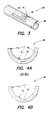
- Fig. 3 is a schematic illustration of sleeve 50, in accordance with an embodiment of the present invention.
- Sleeve 50 comprises a locking mechanism 51, which engages head hole 36, preventing rotational and longitudinal movement between sleeve 50 and head hole 36.
- the locking mechanism typically comprises a male coupling element, such as a tab 52 fixed to the outer surface of a depressible tongue 54, which is adapted to flex inwards toward the center of the sleeve when pressure is applied thereto.
- tab 52 engages female coupling element, such as a notch 72 of hole 36, as described hereinbelow with reference to Fig. 4A.
- sleeve 50 typically is shaped to define at least one cutout 56 to receive a screwdriver used by the surgeon to align the tab with the notch, as described hereinbelow with reference to Figs. 4A and 4B.
- Figs. 4A and 4B are cross-sectional illustrations of one of holes 36 of head 32 through the line B--B of Fig. 2A, in accordance with an embodiment of the present invention.
- An inner grooved surface 70 of hole 36 is shaped to define a notch 72, which tab 52 engages when sleeve 50 is inserted into hole 36 and properly aligned, thereby locking sleeve 50 to hole 36.
- the radius R 1 of grooved inner surface 70 adjacent to notch 72 is less than the maximum radius R 2 of inner surface 70 in a region further away from notch 72.
- the surgeon typically first rotationally orients the sleeve so that tab 52 is aligned with a region of hole 36 having maximum radius R 2 , for example at the upper portion of hole 36. The surgeon then inserts the sleeve in the hole until tab 52 of sleeve 50 meets the upper portion of hole 36, which blocks further insertion of the sleeve. The surgeon then rotates the sleeve so that tab 52 approaches notch 72. As tab 52 approaches notch 72, tab 52 (and tongue 54) is gradually depressed by inner surface 70, until the tab reaches the notch and the tongue springs back into its original position, forcing the tab into the notch, and locking it therein.
- Such a locking mechanism is generally impervious to loosening under cyclical loading, even over the course of many years.
- two pieces which are attached without a locking mechanism e.g., by being screwed together or wedged together
- the radius R 3 of inner surface 70 adjacent to notch 72 is substantially equal to the maximum radius R 2 of inner surface 70.
- Hole 36 in this alternate embodiment is typically flared, such that the tab is depressed during insertion of sleeve 50 into hole 36. Insertion of sleeve 50 into hole 36 in this alternate embodiment does not necessarily include rotation of sleeve 50 (as is described with reference to Fig. 4A).
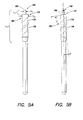
- Fig. 5A is a schematic illustration of a head 132 of IM nail 30, in accordance with an embodiment of the present invention.
- head 132 of IM nail 30 comprises a distal portion 180, which includes one or more head holes 136, and a proximal portion 182.
- Proximal portion 182 is adapted to aid in locating IM nail 30, while distal portion 180 is adapted to be coupled to at least one element, such as a nail, screw, or a sleeve.
- Proximal portion 182 is visually and structurally distinct from distal portion 180.
- proximal portion 182 has a diameter D 1 that is less than a diameter D 2 of distal portion 180 adjacent to proximal portion 182.
- diameter D 1 is between 50% and about 80% of diameter D 2 , or is less than about 50% of diameter D 2 .
- diameter D 1 is between about 25% and about 50% of diameter D 2 .
- diameter D 1 is between about 5 mm and about 10 mm
- diameter D 2 is between about 11 mm and about 17 mm.
- a length L 1 of proximal portion 182 is typically equal to between about 10% and about 50% of a length L 2 of head 132.
- length L 1 may be between about 10 mm and about 35 mm
- length L 2 may be between about 40 mm and about 60 mm, in IM nails intended for use in adults.
- head 132 is shown in the figures as narrowing suddenly, for some applications the diameter of the head decreases gradually from D 2 to D 1 .
- proximal portion 182 is removable, in which case the surgeon typically removes the proximal portion after implanting IM nail 30, or
- head 132 does not comprise proximal portion 182, so that head 132 does not extend to the surface of femur 20.
- Fig. 5B is a schematic illustration of head 132 of IM nail 30, in accordance with an embodiment of the present invention.
- a longitudinal axis of proximal portion 182 is oriented at an angle ⁇ with respect to a longitudinal axis of distal portion 180.
- Angle ⁇ is typically between about 4 and about 40 degrees, in this embodiment.
- a proximal surface 190 of distal portion 180 is oriented at an angle ⁇ with respect to the longitudinal axis of distal portion 180.
- Angle ⁇ is typically between about 4 and about 40.
- IM nail 30 is typically inserted into femur 20 so that a proximal end 184 of proximal portion 182 is generally flush with or slightly protrudes from a surface region 27 of femur 20 in a vicinity of the greater trochanter or the piriformis (Fig. 1).
- a surgeon generally can readily locate the IM nail if post-operative access to the implant becomes necessary.
- such a narrower proximal portion typically allows greater regrowth and healing of the neck of the femur towards the area of the greater trochanter, than generally occurs upon implantation of conventional IM nail heads.
- IM nail 30 comprises both narrower proximal portion 182 and locking mechanism 51, as described hereinabove.
- the IM nail comprises only one of these features, but is generally otherwise conventional.
- Fig. 6 is a schematic illustration of an IM locating tool 200, in accordance with an embodiment of the present invention.
- proximal portion 32 of IM nail 30 does not extend to surface region 27 of femur 20.
- a distal end 220 of the locating tool comprises or is removably coupled to one or more connecting elements 240, which typically comprise a locking mechanism similar to locking mechanism 51, for locking to IM nail 30, as described hereinabove with reference to Fig. 3.
- connecting elements 240 comprise another locking mechanism, such as protrusions, clips, or pegs.
- connecting elements 240 to respective head holes 36 of IM nail 30.
- the surgeon performs this coupling by removing any sleeves or screws present in holes 36, and inserting a sleeve (not shown), which may be similar to sleeve 50 described hereinabove with reference to Fig. 3, into each hole 36.
- the surgeon then couples each connecting element 240 to one of the sleeves.
- connecting elements 240 are directly coupled to head holes 36. In either case, after the connecting elements are in a fixed position with respect to IM nail 30, tool 200 is typically placed or slid onto the connecting elements, so as to assume a known, rigid position with respect thereto.
- connecting elements 240 are an integral part of tool 200, this step is not necessary.
- the use of at least two connecting elements 240 provides for a known, fixed orientation of IM locating tool 200 with respect to IM nail 30.
- means are provided for ensuring a fixed rotational angle between connecting element 240 and hole 36, thereby providing a known, fixed orientation of IM locating tool 200 with respect to IM nail 30.
- such means may include a slot in hole 36.
- proximal end 230 of the locating tool typically positions a proximal end 230 of the locating tool so as to indicate a site 228 of surface region 27 substantially directly over proximal portion 32 of the IM nail.
- the surgeon typically uses knowledge of the location of site 228 in order to determine an appropriate location at which to drill.
- proximal end 230 comprises means for guiding a marking device 250 or drill, such as a hole through which the marking device or drill is inserted.
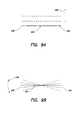
- FIG. 7 is a schematic illustration of an IM locating tool 300, in accordance with an embodiment of the present invention.
- An IM nail 302 comprises a proximal portion 304 which does not extend to a surface region 306 of a femur 308.
- the proximal portion defines one or more head holes 310, and a longitudinal channel 312 open to at least one of the head holes and to a proximal end 314 of proximal portion 304.
- IM locating tool 300 it is sometimes difficult for the surgeon to locate proximal portion 304 of IM nail 302 if post-operative access to the implant becomes necessary.
- IM locating tool 300 comprises an elongated element that is both bendable and resilient, i.e., is able to bend while maintaining longitudinal strength.
- a tip 316 of tool 300 is sufficiently sharp to pass through femur 308.
- the surgeon inserts tool 300, sharp end first, into one of head holes 310. The surgeon guides the tool through channel 312, so that the tool bends to conform with the channel.
- tip 316 is threaded, and the surgeon rotates tool 300 so as to screw tip 316 through femur 308.
- tool 300 comprises a flexible drill bit, and the surgeon drills the tool through femur 308. The surgeon typically uses knowledge of the location of site 318 attained through use of tool 300 in order to determine an appropriate location at which to drill during post-operative access to the IM nail.
- FIG. 8 is a schematic illustration of an introducer 400 applied to a femur 402, in accordance with an embodiment of the present invention.
- Introducer 400 is adapted to actively reduce and align a fracture 404 of femur 402, such as a subtrochanteric fracture, while generally minimizing the required size of an incision in the vicinity of the fracture.
- Introducer 400 comprises a support 406, a coupling element 408, and a multi-axial control element, such as a biaxial control element 410.
- Coupling element 408 is adapted to couple introducer 400 to an IM nail 412, which is inserted into a medullary canal 414 of femur 402.
- coupling element 408 may comprise a male element adapted to be inserted into a hole defined by a proximal end of a proximal head 416 of IM nail 412.
- Other coupling mechanisms used by conventional introducers may also be used.
- One or more neck screws 420 secure the IM nail at the head within a femoral head 422 of femur 402.
- Introducer 400 is typically shaped so as to define one or more holes (not shown) for guiding respective neck screws 420 during their insertion into femoral head 422.
- Introducer 400 is shaped to facilitate use with a pin 424.
- pin 424 is inserted through femur 402 and through an elliptical or otherwise elongated hole 426, defined by a distal region 428 of IM nail 412 in a vicinity of fracture 404, such that the fracture is between the pin and coupling element 408.
- pin 424 is threaded in a vicinity of a bone-penetrating tip 430 thereof and/or in a vicinity of one or both regions 432 thereof that pass through femur 402.
- Pin 424 typically has a diameter of between about 3 and about 6 mm, typically between about 4 and about 5 mm.
- Biaxial control element 410 is adapted to move pin 424 along two axes, as follows:
- a screw (not shown) is typically screwed through a hole 444, defined by distal region 428 of IM nail 412, into fragment 440, in order to fix IM nail 412 to fragment 440.
- Hole 444 is typically circular and positioned distally to elongated hole 426 (as shown), or proximal thereto (configuration not shown).
- Pin 424 is then removed from elongated hole 426.
- a second screw (not shown) is screwed through elongated hole 426 into fragment 440 to further fix the IM nail to the fragment.
- distal region 428 of IM nail 412 defines a secondary elliptical or otherwise elongated hole 446, in a distal vicinity of elongated hole 426.
- the pin is inserted through secondary hole 446.
- Biaxial control element 410 further moves pin 424 in the cephalad direction towards support 406, in order to further reduce fracture 404.
- about 10 mm of reduction is performed using elongated hole 426, and up to about an additional 10 mm of reduction is performed using secondary elongated hole 446, for a total reduction of up to about 20 mm. It has been the inventor's experience that fractures rarely require reduction of more than about 20 mm, after initial reduction with a fracture table.
- biaxial control element 410 comprises a first member such as a first leg 448, and a second member such as a second leg 450, the first and second members comprising set screws 452 and 454, respectively.
- the first and second legs each define one or more elliptical or otherwise elongated holes 456 and 458, respectively.
- pin 424 passes through one of holes 456 and one of holes 458.
- the pin is initially positioned near respective distal ends of the holes. Tightening set screw 452 pushes the pin towards a proximal end of the one of the holes 456, while tightening set screw 454 pushes the pin towards a proximal end of the one of the holes 458. Therefore:
- leg 448 or 450 are removably coupled to support 406 by coupling elements 460 or 462, respectively (e.g., comprising screws or clips).
- leg 450 may be removably coupled to support 406, in which case leg 448 and support 406 are used to insert IM nail 412 into intramedullary canal 414. The absence of leg 450 during this insertion generally makes introducer 400 easier to manipulate. After insertion of the IM nail, leg 450 is coupled to support 406.
- biaxial control element 410 comprises an optional shaped element, such as shaped element 454, coupled within biaxial control element 410 so as to provide means for pulling pin 424 (or otherwise inducing motion of pin 424) in the caudal direction.
- Shaped element 454 is coupled via a joint 456 to the proximal tip of set screw 452. (Alternatively or additionally, a shaped element is coupled to set screw 454.)
- Pin 424 passes through a hole in shaped element 454, such that joint 456 allows set screw 452 to rotate while shaped element 454 substantially does not rotate.
- joint 456 couples shaped element 454 and set screw 452 such that movement of either one along the proximal/distal axis induces movement of the other one in the same direction.
- distal (caudal) motion of set screw 452 causes corresponding caudal motion of pin 424.
- proximal motion of set screw 452 causes cephalad motion of pin 452, while distal motion of set screw 452 does not induce any substantial motion of pin 452.
- shaped element 454 shown in Fig. 8 is by way of illustration and not limitation. A person of ordinary skill in the art of mechanical design, having read the disclosure of the present patent application, would be able to develop other substantially equivalent means for providing cephalad and caudal motion of pin 424.
- introducer 400 is used in conjunction with a surgical plate having one or more elliptical or otherwise elongated holes through which pin 424 is inserted (configuration not shown).
- the plate is secured to the outside of femur 402 in a position suitable for reducing fracture 404 and for aligning fragments 440 and 442.
- techniques described hereinabove with reference to Figs. 8, 9A, and 9B are adapted to for use with the surgical plate, mutatis mutandis.
Landscapes
- Health & Medical Sciences (AREA)
- Orthopedic Medicine & Surgery (AREA)
- Surgery (AREA)
- Life Sciences & Earth Sciences (AREA)
- Biomedical Technology (AREA)
- Public Health (AREA)
- Veterinary Medicine (AREA)
- Engineering & Computer Science (AREA)
- Nuclear Medicine, Radiotherapy & Molecular Imaging (AREA)
- Heart & Thoracic Surgery (AREA)
- Medical Informatics (AREA)
- Molecular Biology (AREA)
- Animal Behavior & Ethology (AREA)
- General Health & Medical Sciences (AREA)
- Neurology (AREA)
- Dentistry (AREA)
- Oral & Maxillofacial Surgery (AREA)
- Surgical Instruments (AREA)
Applications Claiming Priority (2)
| Application Number | Priority Date | Filing Date | Title |
|---|---|---|---|
| US616218 | 2003-07-08 | ||
| US10/616,218 US7455673B2 (en) | 2003-07-08 | 2003-07-08 | Intramedullary nail system and method for fixation of a fractured bone |
Publications (3)
| Publication Number | Publication Date |
|---|---|
| EP1495733A2 true EP1495733A2 (de) | 2005-01-12 |
| EP1495733A3 EP1495733A3 (de) | 2005-04-13 |
| EP1495733B1 EP1495733B1 (de) | 2010-09-22 |
Family
ID=33452675
Family Applications (1)
| Application Number | Title | Priority Date | Filing Date |
|---|---|---|---|
| EP04102524A Expired - Lifetime EP1495733B1 (de) | 2003-07-08 | 2004-06-04 | Marknagelsystem zur Befestigung eines gebrochenen Knochens |
Country Status (7)
| Country | Link |
|---|---|
| US (4) | US7455673B2 (de) |
| EP (1) | EP1495733B1 (de) |
| JP (1) | JP3987511B2 (de) |
| CN (2) | CN100369588C (de) |
| AT (1) | ATE481933T1 (de) |
| DE (1) | DE602004029222D1 (de) |
| IL (1) | IL162394A0 (de) |
Cited By (3)
| Publication number | Priority date | Publication date | Assignee | Title |
|---|---|---|---|---|
| EP1974681A3 (de) * | 2007-03-28 | 2008-11-12 | Aesculap AG | Implantatset |
| US8641740B2 (en) | 2007-09-26 | 2014-02-04 | Zimmer, Gmbh | Bone anchoring device for the operative repair of fractures |
| US11446072B2 (en) | 2017-10-10 | 2022-09-20 | DePuy Synthes Products, Inc. | Self-retaining nail to insertion handle interface |
Families Citing this family (66)
| Publication number | Priority date | Publication date | Assignee | Title |
|---|---|---|---|---|
| US7179260B2 (en) * | 2003-09-29 | 2007-02-20 | Smith & Nephew, Inc. | Bone plates and bone plate assemblies |
| JP4218837B2 (ja) * | 2002-10-29 | 2009-02-04 | ジンテーズ ゲゼルシャフト ミト ベシュレンクテル ハフツング | 大腿骨骨折を治療するための装置 |
| US7455673B2 (en) * | 2003-07-08 | 2008-11-25 | Yechiel Gotfried | Intramedullary nail system and method for fixation of a fractured bone |
| US20050055024A1 (en) * | 2003-09-08 | 2005-03-10 | James Anthony H. | Orthopaedic implant and screw assembly |
| US7799030B2 (en) * | 2003-09-08 | 2010-09-21 | Smith & Nephew, Inc. | Orthopaedic plate and screw assembly |
| US7780667B2 (en) * | 2003-09-08 | 2010-08-24 | Smith & Nephew, Inc. | Orthopaedic plate and screw assembly |
| JP4657104B2 (ja) * | 2003-09-18 | 2011-03-23 | ジンテーズ ゲゼルシャフト ミト ベシュレンクテル ハフツング | 大腿骨の骨折を治療するための装置 |
| US20060036248A1 (en) * | 2004-07-01 | 2006-02-16 | Ferrante Joseph M | Fixation elements |
| US20060015101A1 (en) * | 2004-07-15 | 2006-01-19 | Wright Medical Technology, Inc. | Intramedullary fixation assembly and devices and methods for installing the same |
| US7588577B2 (en) | 2004-07-15 | 2009-09-15 | Wright Medical Technology, Inc. | Guide assembly for intramedullary fixation and method of using the same |
| ITVI20050049A1 (it) * | 2005-02-22 | 2006-08-23 | Tecres Spa | Dispositivo monouso per il trattamento di infezioni di arti del corpo umano, particolarmente di arti con ossa lunghe |
| FR2885513B1 (fr) * | 2005-05-13 | 2007-08-10 | Newdeal S A S Soc Par Actions | Appareillage d'arthrodese pour une articulation, du genre articulation de la cheville, et clou d'athrodese destine a etre utilise dans un tel appareillage |
| AU2006294767A1 (en) * | 2005-09-28 | 2007-04-05 | Smith & Nephew, Inc | Instrumentation for reducing fractures , particularly femoral neck |
| US20070155271A1 (en) * | 2005-12-30 | 2007-07-05 | Touzov Igor V | Heat conductive textile and method producing thereof |
| US8628531B2 (en) * | 2006-01-27 | 2014-01-14 | Smith & Nephew, Inc. | Assemblies for the reduction of a fracture |
| JP4880407B2 (ja) * | 2006-09-15 | 2012-02-22 | 日本メディカルマテリアル株式会社 | 大腿骨近位部骨折用固定器具 |
| US20080119856A1 (en) * | 2006-11-20 | 2008-05-22 | Yechiel Gotfried | Intramedullary nail system and method for fixation of a fractured bone |
| US8579985B2 (en) | 2006-12-07 | 2013-11-12 | Ihip Surgical, Llc | Method and apparatus for hip replacement |
| US8974540B2 (en) | 2006-12-07 | 2015-03-10 | Ihip Surgical, Llc | Method and apparatus for attachment in a modular hip replacement or fracture fixation device |
| WO2008069800A1 (en) * | 2006-12-07 | 2008-06-12 | Anatol Podolsky | Method and apparatus for total hip replacement |
| US9320551B2 (en) | 2007-01-26 | 2016-04-26 | Biomet Manufacturing, Llc | Lockable intramedullary fixation device |
| US8303590B2 (en) * | 2007-01-26 | 2012-11-06 | Ebi, Llc | Lockable intramedullary fixation device |
| US9308031B2 (en) | 2007-01-26 | 2016-04-12 | Biomet Manufacturing, Llc | Lockable intramedullary fixation device |
| US8157802B2 (en) | 2007-01-26 | 2012-04-17 | Ebi, Llc | Intramedullary implant with locking and compression devices |
| US7763023B2 (en) * | 2007-02-09 | 2010-07-27 | Yechiel Gotfried | Intramedullary nail system and method for fixation of a fractured bone |
| US7918853B2 (en) * | 2007-03-20 | 2011-04-05 | Smith & Nephew, Inc. | Orthopaedic plate and screw assembly |
| AU2008228710A1 (en) * | 2007-03-22 | 2008-09-25 | Novalign Orthopaedics, Inc. | Segmented intramedullary structure |
| DE102007051136A1 (de) * | 2007-05-23 | 2009-04-30 | Eichhorn, Stefan, Dipl.-Ing. | Verriegelbarer Marknagel und Vorrichtung zum Fixieren |
| EP2166973B1 (de) * | 2007-05-25 | 2016-03-16 | Zimmer GmbH | Verstärkter marknagel |
| CN101827560A (zh) | 2007-10-16 | 2010-09-08 | Ebi有限责任公司 | 用于矫形固定的方法和装置 |
| US8771283B2 (en) | 2007-12-17 | 2014-07-08 | Wright Medical Technology, Inc. | Guide assembly for intramedullary fixation and method of using the same |
| WO2009136386A2 (en) * | 2008-05-07 | 2009-11-12 | Tornier | Surgical technique and apparatus for proximal humeral fracture repair |
| USD602159S1 (en) * | 2008-06-13 | 2009-10-13 | Yechiel Gotfried | Surgical instrument |
| ES2524076T3 (es) | 2008-10-15 | 2014-12-04 | Zimmer Gmbh | Clavo intramedular |
| USD611145S1 (en) * | 2009-01-02 | 2010-03-02 | Medshape Solutions, Inc. | Intramedullary medical device |
| US8449544B2 (en) | 2009-06-30 | 2013-05-28 | Smith & Nephew, Inc. | Orthopaedic implant and fastener assembly |
| CN105726112B (zh) | 2009-06-30 | 2021-04-27 | 史密夫和内修有限公司 | 整形外科的植入物和紧固组件 |
| JP5760093B2 (ja) | 2010-12-01 | 2015-08-05 | イノヴァチ インク.Innovaci Inc. | 自販変更環境制御デバイス |
| BR112013018525B1 (pt) * | 2011-01-21 | 2021-03-23 | Synthes Gmbh | Dispositivo para fixação de ossos |
| US8709092B2 (en) * | 2011-02-16 | 2014-04-29 | Genesis Medical Devices, LLC | Periprosthetic fracture management enhancements |
| JP5345193B2 (ja) * | 2011-10-13 | 2013-11-20 | 京セラメディカル株式会社 | 大腿骨近位部骨折用固定器具 |
| EP2785283B1 (de) * | 2011-11-30 | 2021-01-13 | Smith&Nephew, Inc. | Orthopädisches implantat mit schlitz für dynamische transfixierung |
| USD680221S1 (en) * | 2012-03-09 | 2013-04-16 | Yechiel Gotfried | Surgical nail |
| US11051864B2 (en) * | 2012-08-30 | 2021-07-06 | DePuy Synthes Products, Inc. | Intramedullary fixation assembly |
| US20140243826A1 (en) * | 2013-02-28 | 2014-08-28 | Yechiel Gotfried | Method for connecting fractured bone |
| USD714938S1 (en) | 2013-08-01 | 2014-10-07 | Yechiel Gotfried | Surgical nail |
| US9433451B2 (en) | 2013-12-09 | 2016-09-06 | Acumed Llc | Hip fixation system with a compliant fixation element |
| WO2015089083A1 (en) | 2013-12-09 | 2015-06-18 | Acumed Llc | Plate-based compliant hip fixation system |
| US10080596B2 (en) | 2013-12-09 | 2018-09-25 | Acumed Llc | Hip fixation with load-controlled dynamization |
| PT3079612T (pt) | 2013-12-09 | 2020-07-16 | Acumed Llc | Sistema de fixação de anca compatível à base de hastes |
| US9526542B2 (en) | 2014-05-07 | 2016-12-27 | Acumed Llc | Hip fixation with load-controlled dynamization |
| US9517094B1 (en) * | 2014-05-09 | 2016-12-13 | Savage Medical Design LLC | Intramedullary fixation apparatus for use in hip and femur fracture surgery |
| US20160184099A1 (en) | 2014-12-29 | 2016-06-30 | Yechiel Gotfried | Orthopedic implants |
| US11083503B2 (en) | 2016-09-22 | 2021-08-10 | Globus Medical, Inc. | Systems and methods for intramedullary nail implantation |
| US10492803B2 (en) | 2016-09-22 | 2019-12-03 | Globus Medical, Inc. | Systems and methods for intramedullary nail implantation |
| EP3648685A4 (de) * | 2017-07-05 | 2021-05-12 | Genesis Medical Devices LLC | Periprothetische schulterbruchreparatur |
| EP3453349A1 (de) | 2017-09-10 | 2019-03-13 | Yechiel Gotfried | Orthopädisches implantat |
| EP3694430A1 (de) | 2017-10-11 | 2020-08-19 | Tornier, Inc. | Führungen für humerusfixationsplatte |
| WO2019217184A1 (en) * | 2018-05-08 | 2019-11-14 | Orthopediatrics Corp. | Intramedullary nail |
| US11633219B2 (en) | 2019-06-26 | 2023-04-25 | Globus Medical, Inc. | Fenestrated pedicle nail |
| US20220338907A1 (en) | 2019-09-03 | 2022-10-27 | Bispebjerg Hospital | Surgical system for osteosynthesis of femoral fractures |
| US11617604B2 (en) * | 2020-04-15 | 2023-04-04 | DePuy Synthes Products, Inc. | Intramedullary nail assembly |
| US11553950B2 (en) * | 2020-10-27 | 2023-01-17 | Spinal Generations, Llc | Lag screw systems and nail systems and methods incorporating the same |
| US11291488B1 (en) | 2021-02-24 | 2022-04-05 | Medshape, Inc. | Dynamic compression devices and processes for making and using same |
| US12527606B1 (en) | 2021-08-26 | 2026-01-20 | Medshape, Inc. | System and method for bone fixation based on bone quality |
| US12004785B2 (en) | 2022-04-21 | 2024-06-11 | DePuy Synthes Products, Inc. | Retrograde femoral intramedullary nail, and related systems and methods |
Family Cites Families (61)
| Publication number | Priority date | Publication date | Assignee | Title |
|---|---|---|---|---|
| US3019789A (en) * | 1958-06-30 | 1962-02-06 | Jules L Whitehill | Anastomosis clamp |
| US3433220A (en) * | 1966-12-30 | 1969-03-18 | Robert E Zickel | Intramedullary rod and cross-nail assembly for treating femur fractures |
| US4176815A (en) * | 1977-09-08 | 1979-12-04 | F & S Manufacturing Corporation | Variable spring hanger assembly |
| CH634742A5 (en) | 1978-12-19 | 1983-02-28 | Synthes Ag | Device for fixing bone fragments |
| AT369637B (de) * | 1981-01-12 | 1983-01-25 | Plansee Metallwerk | Profilierter intramedulaerer unterschenkelnagel |
| US4622959A (en) * | 1985-03-05 | 1986-11-18 | Marcus Randall E | Multi-use femoral intramedullary nail |
| DE8620399U1 (de) | 1986-07-30 | 1986-10-09 | Howmedica GmbH Werk Schönkirchen, 2314 Schönkirchen | Osteosynthesehilfsmittel zur Versorgung subtrochanterer Frakturen |
| US4827917A (en) | 1986-12-30 | 1989-05-09 | Richards Medical Company | Fermoral fracture device |
| DE8701164U1 (de) | 1987-01-24 | 1987-06-04 | Howmedica GmbH, 2314 Schönkirchen | Osteosynthesehilfsmittel |
| US5176681A (en) | 1987-12-14 | 1993-01-05 | Howmedica International Inc. | Intramedullary intertrochanteric fracture fixation appliance and fitting device |
| FR2632514B1 (fr) * | 1988-06-09 | 1990-10-12 | Medinov Sarl | Clou centro-medullaire progressif |
| US5066296A (en) * | 1989-02-02 | 1991-11-19 | Pfizer Hopsital Products Group, Inc. | Apparatus for treating a fracture |
| US5032125A (en) | 1990-02-06 | 1991-07-16 | Smith & Nephew Richards Inc. | Intramedullary hip screw |
| US5122141A (en) * | 1990-08-30 | 1992-06-16 | Zimmer, Inc. | Modular intramedullary nail |
| DE9101037U1 (de) * | 1991-01-30 | 1991-04-18 | Howmedica GmbH, 2314 Schönkirchen | Zielgerät für ein Implantat zur Versorgung trochanterer und subtrochanterer Frakturen |
| GB9113578D0 (en) * | 1991-06-24 | 1991-08-14 | Howmedica | Intramedullary intertrochanteric fracture fixation appliance |
| US5178621A (en) * | 1991-12-10 | 1993-01-12 | Zimmer, Inc. | Two-piece radio-transparent proximal targeting device for a locking intramedullary nail |
| DE4318150C2 (de) * | 1993-06-01 | 1996-08-01 | Endocare Ag | Osteosynthese-Hilfsmittel zur Versorgung subtrochanterer und pertrochanterer Frakturen sowie von Schenkelhalsfrakturen |
| FR2698261B1 (fr) * | 1992-11-24 | 1995-03-17 | Lacaffiniere Jean Yves De | Dispositif de guidage d'une double vis du col du fémur pour clou trochantéro-diaphysaire verrouillé. |
| AU2940092A (en) * | 1992-12-04 | 1994-07-04 | Synthes Ag, Chur | Modular marrow nail |
| US5352228A (en) * | 1993-05-10 | 1994-10-04 | Kummer Frederick J | Apparatus and method to provide compression for a locked intramedullary nail |
| US5403321A (en) * | 1993-12-15 | 1995-04-04 | Smith & Nephew Richards Inc. | Radiolucent drill guide |
| US5662652A (en) * | 1994-04-28 | 1997-09-02 | Schafer Micomed Gmbh | Bone surgery holding apparatus |
| US5489284A (en) * | 1994-07-15 | 1996-02-06 | Smith & Nephew Richards Inc. | Cannulated modular intramedullary nail |
| IT1275300B (it) * | 1995-06-05 | 1997-08-05 | Gruppo Ind Bioimpianti Srl | Chiodo endomidollare bloccato adatto in particolare per le fratture del femore |
| CA2523814C (en) * | 1997-02-11 | 2007-02-06 | Gary Karlin Michelson | Segmentable skeletal plating system |
| US5728128A (en) * | 1997-02-11 | 1998-03-17 | Wright Medical Technology, Inc. | Femoral neck anteversion guide |
| US6228086B1 (en) * | 1997-03-19 | 2001-05-08 | Stryker Trauma-Selzach Ag | Modular intramedullary nail |
| US6270499B1 (en) * | 1997-10-20 | 2001-08-07 | Synthes (U.S.A.) | Bone fixation device |
| US5915482A (en) * | 1998-02-26 | 1999-06-29 | Carruthers; Robert B. | Hand tool with interchangeable attachments |
| DE19829228C1 (de) * | 1998-06-30 | 1999-10-28 | Aesculap Ag & Co Kg | Vorrichtung zur Versorgung von Knochenbrüchen |
| US6183477B1 (en) * | 1998-09-04 | 2001-02-06 | Smith & Nephew, Inc. | Attachment tool for drill guide |
| US7008425B2 (en) * | 1999-05-27 | 2006-03-07 | Jonathan Phillips | Pediatric intramedullary nail and method |
| US6221074B1 (en) * | 1999-06-10 | 2001-04-24 | Orthodyne, Inc. | Femoral intramedullary rod system |
| DE19945612C1 (de) * | 1999-09-23 | 2001-05-10 | Aesculap Ag & Co Kg | Repositionsinstrumentarium |
| US6494636B1 (en) * | 1999-10-12 | 2002-12-17 | Gene Mozena | Retractable pole apparatus |
| US6926719B2 (en) | 1999-10-21 | 2005-08-09 | Gary W. Sohngen | Modular intramedullary nail |
| US7147399B2 (en) * | 1999-11-15 | 2006-12-12 | Swicherz, Llc | Apparatus for securely yet removably installing an ornament onto a substantively planar surface |
| US6331179B1 (en) * | 2000-01-06 | 2001-12-18 | Spinal Concepts, Inc. | System and method for stabilizing the human spine with a bone plate |
| US6562042B2 (en) * | 2000-02-02 | 2003-05-13 | Owen A. Nelson | Orthopedic implant used to repair intertrochanteric fractures and a method for inserting the same |
| US6235031B1 (en) | 2000-02-04 | 2001-05-22 | Encore Medical Corporation | Intramedullary fracture fixation device |
| US6656189B1 (en) * | 2000-05-25 | 2003-12-02 | Synthes (Usa) | Radiolucent aiming guide |
| US6565573B1 (en) | 2001-04-16 | 2003-05-20 | Smith & Nephew, Inc. | Orthopedic screw and method of use |
| US6443954B1 (en) | 2001-04-24 | 2002-09-03 | Dale G. Bramlet | Femoral nail intramedullary system |
| US6648889B2 (en) | 2001-04-24 | 2003-11-18 | Dale G. Bramlet | Intramedullary hip nail with bifurcated lock |
| CN1329878A (zh) * | 2001-08-14 | 2002-01-09 | 苏继承 | 髓内钉联合钢板内固定装置 |
| ITBO20020200A1 (it) * | 2002-04-15 | 2003-10-15 | Hit Medica Srl | Dispositivo per il posizionamento di una vite da associare ed un chiodo endomidollare infisso nel canale midollare del femore |
| US20030231927A1 (en) * | 2002-06-13 | 2003-12-18 | Electronic Eel Manufacturing Company Inc. | Connector for pipe cleaning apparatus |
| US7001386B2 (en) * | 2002-07-23 | 2006-02-21 | Advanced Orthopaedic Solutions, Inc. | Intramedullary nail for long bone fractures |
| AU2002328243A1 (en) * | 2002-10-01 | 2004-04-23 | Synthes Ag Chur | Device for fixing bones |
| US7632272B2 (en) * | 2002-10-03 | 2009-12-15 | Synthes Usa, Llc | Device for bone fixation |
| DE10246386B4 (de) * | 2002-10-04 | 2008-08-07 | Biedermann Motech Gmbh | Knochenschraube, Knochenfixationseinrichtung und Halteelement |
| JP4218837B2 (ja) * | 2002-10-29 | 2009-02-04 | ジンテーズ ゲゼルシャフト ミト ベシュレンクテル ハフツング | 大腿骨骨折を治療するための装置 |
| US20060241606A1 (en) * | 2003-06-12 | 2006-10-26 | Disc-O-Tech, Ltd. | Plate device |
| US7455673B2 (en) * | 2003-07-08 | 2008-11-25 | Yechiel Gotfried | Intramedullary nail system and method for fixation of a fractured bone |
| US7909860B2 (en) * | 2003-09-03 | 2011-03-22 | Synthes Usa, Llc | Bone plate with captive clips |
| US7488328B2 (en) * | 2004-07-20 | 2009-02-10 | Yechiel Gotfried | Targeting apparatus for bone fixation device |
| FR2881340B1 (fr) * | 2005-02-01 | 2008-01-11 | Tornier Sas | Clou humeral |
| US20070049939A1 (en) * | 2005-08-31 | 2007-03-01 | Wallace Matthew S | Intramedullary nail assembly with sleeve and screw for use therewith |
| US20080119856A1 (en) * | 2006-11-20 | 2008-05-22 | Yechiel Gotfried | Intramedullary nail system and method for fixation of a fractured bone |
| US7763023B2 (en) * | 2007-02-09 | 2010-07-27 | Yechiel Gotfried | Intramedullary nail system and method for fixation of a fractured bone |
-
2003
- 2003-07-08 US US10/616,218 patent/US7455673B2/en not_active Expired - Fee Related
-
2004
- 2004-06-04 AT AT04102524T patent/ATE481933T1/de not_active IP Right Cessation
- 2004-06-04 EP EP04102524A patent/EP1495733B1/de not_active Expired - Lifetime
- 2004-06-04 DE DE602004029222T patent/DE602004029222D1/de not_active Expired - Lifetime
- 2004-06-07 IL IL16239404A patent/IL162394A0/xx unknown
- 2004-07-06 JP JP2004199298A patent/JP3987511B2/ja not_active Expired - Fee Related
- 2004-07-07 CN CNB2004100637105A patent/CN100369588C/zh not_active Expired - Fee Related
- 2004-07-07 CN CN2007101096497A patent/CN101066228B/zh not_active Expired - Fee Related
-
2007
- 2007-10-31 US US11/932,719 patent/US8137348B2/en not_active Expired - Fee Related
- 2007-10-31 US US11/932,665 patent/US20080058813A1/en not_active Abandoned
-
2012
- 2012-02-17 US US13/399,512 patent/US20120150187A1/en not_active Abandoned
Cited By (3)
| Publication number | Priority date | Publication date | Assignee | Title |
|---|---|---|---|---|
| EP1974681A3 (de) * | 2007-03-28 | 2008-11-12 | Aesculap AG | Implantatset |
| US8641740B2 (en) | 2007-09-26 | 2014-02-04 | Zimmer, Gmbh | Bone anchoring device for the operative repair of fractures |
| US11446072B2 (en) | 2017-10-10 | 2022-09-20 | DePuy Synthes Products, Inc. | Self-retaining nail to insertion handle interface |
Also Published As
| Publication number | Publication date |
|---|---|
| CN100369588C (zh) | 2008-02-20 |
| JP2005028136A (ja) | 2005-02-03 |
| ATE481933T1 (de) | 2010-10-15 |
| IL162394A0 (en) | 2005-11-20 |
| CN1589749A (zh) | 2005-03-09 |
| EP1495733A3 (de) | 2005-04-13 |
| CN101066228B (zh) | 2010-10-06 |
| CN101066228A (zh) | 2007-11-07 |
| JP3987511B2 (ja) | 2007-10-10 |
| EP1495733B1 (de) | 2010-09-22 |
| DE602004029222D1 (de) | 2010-11-04 |
| US8137348B2 (en) | 2012-03-20 |
| US20050010223A1 (en) | 2005-01-13 |
| US20080058814A1 (en) | 2008-03-06 |
| US7455673B2 (en) | 2008-11-25 |
| US20120150187A1 (en) | 2012-06-14 |
| US20080058813A1 (en) | 2008-03-06 |
Similar Documents
| Publication | Publication Date | Title |
|---|---|---|
| EP1495733B1 (de) | Marknagelsystem zur Befestigung eines gebrochenen Knochens | |
| US7763023B2 (en) | Intramedullary nail system and method for fixation of a fractured bone | |
| US20250235251A1 (en) | Systems and methods for intramedullary nail implantation | |
| US11730524B2 (en) | Systems and methods for intramedullary nail implantation | |
| US6648889B2 (en) | Intramedullary hip nail with bifurcated lock | |
| US8025666B2 (en) | Orthopedic implant insertion instruments | |
| US6221074B1 (en) | Femoral intramedullary rod system | |
| US6524313B1 (en) | Intramedullary nail system | |
| US20080119856A1 (en) | Intramedullary nail system and method for fixation of a fractured bone | |
| US12178489B2 (en) | Systems and methods for intramedullary nail implantation | |
| US7488328B2 (en) | Targeting apparatus for bone fixation device | |
| EP3747375A1 (de) | Systeme zur marknagelimplantation | |
| US12594108B2 (en) | Systems and methods for intramedullary nail implantation | |
| EP3636175A2 (de) | Systeme zur marknagelimplantation | |
| WO2008064059A2 (en) | Sliding hip helical implant | |
| EP4215131A1 (de) | Systeme zur implantation von marknageln | |
| AU2002356834A1 (en) | Intramedullary hip nail with bifurcated lock | |
| EP1435850A1 (de) | Instrument zum einsetzen eines orthopädischen implantates | |
| AU2002340219A1 (en) | Orthopedic implant insertion instruments |
Legal Events
| Date | Code | Title | Description |
|---|---|---|---|
| PUAI | Public reference made under article 153(3) epc to a published international application that has entered the european phase |
Free format text: ORIGINAL CODE: 0009012 |
|
| AK | Designated contracting states |
Kind code of ref document: A2 Designated state(s): AT BE BG CH CY CZ DE DK EE ES FI FR GB GR HU IE IT LI LU MC NL PL PT RO SE SI SK TR |
|
| AX | Request for extension of the european patent |
Extension state: AL HR LT LV MK |
|
| PUAL | Search report despatched |
Free format text: ORIGINAL CODE: 0009013 |
|
| RIC1 | Information provided on ipc code assigned before grant |
Ipc: 7A 61B 17/72 B Ipc: 7A 61B 17/78 A |
|
| AK | Designated contracting states |
Kind code of ref document: A3 Designated state(s): AT BE BG CH CY CZ DE DK EE ES FI FR GB GR HU IE IT LI LU MC NL PL PT RO SE SI SK TR |
|
| AX | Request for extension of the european patent |
Extension state: AL HR LT LV MK |
|
| 17P | Request for examination filed |
Effective date: 20051006 |
|
| AKX | Designation fees paid |
Designated state(s): AT BE BG CH CY CZ DE DK EE ES FI FR GB GR HU IE IT LI LU MC NL PL PT RO SE SI SK TR |
|
| 17Q | First examination report despatched |
Effective date: 20090326 |
|
| GRAP | Despatch of communication of intention to grant a patent |
Free format text: ORIGINAL CODE: EPIDOSNIGR1 |
|
| RTI1 | Title (correction) |
Free format text: INTRAMEDULLARY NAIL SYSTEM FOR FIXATION OF A FRACTURED BONE |
|
| GRAS | Grant fee paid |
Free format text: ORIGINAL CODE: EPIDOSNIGR3 |
|
| GRAA | (expected) grant |
Free format text: ORIGINAL CODE: 0009210 |
|
| AK | Designated contracting states |
Kind code of ref document: B1 Designated state(s): AT BE BG CH CY CZ DE DK EE ES FI FR GB GR HU IE IT LI LU MC NL PL PT RO SE SI SK TR |
|
| REG | Reference to a national code |
Ref country code: GB Ref legal event code: FG4D |
|
| REG | Reference to a national code |
Ref country code: CH Ref legal event code: EP |
|
| REG | Reference to a national code |
Ref country code: IE Ref legal event code: FG4D |
|
| REF | Corresponds to: |
Ref document number: 602004029222 Country of ref document: DE Date of ref document: 20101104 Kind code of ref document: P |
|
| PG25 | Lapsed in a contracting state [announced via postgrant information from national office to epo] |
Ref country code: FI Free format text: LAPSE BECAUSE OF FAILURE TO SUBMIT A TRANSLATION OF THE DESCRIPTION OR TO PAY THE FEE WITHIN THE PRESCRIBED TIME-LIMIT Effective date: 20100922 Ref country code: AT Free format text: LAPSE BECAUSE OF FAILURE TO SUBMIT A TRANSLATION OF THE DESCRIPTION OR TO PAY THE FEE WITHIN THE PRESCRIBED TIME-LIMIT Effective date: 20100922 |
|
| REG | Reference to a national code |
Ref country code: NL Ref legal event code: VDEP Effective date: 20100922 |
|
| PG25 | Lapsed in a contracting state [announced via postgrant information from national office to epo] |
Ref country code: SI Free format text: LAPSE BECAUSE OF FAILURE TO SUBMIT A TRANSLATION OF THE DESCRIPTION OR TO PAY THE FEE WITHIN THE PRESCRIBED TIME-LIMIT Effective date: 20100922 Ref country code: PL Free format text: LAPSE BECAUSE OF FAILURE TO SUBMIT A TRANSLATION OF THE DESCRIPTION OR TO PAY THE FEE WITHIN THE PRESCRIBED TIME-LIMIT Effective date: 20100922 |
|
| PG25 | Lapsed in a contracting state [announced via postgrant information from national office to epo] |
Ref country code: SE Free format text: LAPSE BECAUSE OF FAILURE TO SUBMIT A TRANSLATION OF THE DESCRIPTION OR TO PAY THE FEE WITHIN THE PRESCRIBED TIME-LIMIT Effective date: 20100922 Ref country code: GR Free format text: LAPSE BECAUSE OF FAILURE TO SUBMIT A TRANSLATION OF THE DESCRIPTION OR TO PAY THE FEE WITHIN THE PRESCRIBED TIME-LIMIT Effective date: 20101223 |
|
| PG25 | Lapsed in a contracting state [announced via postgrant information from national office to epo] |
Ref country code: PT Free format text: LAPSE BECAUSE OF FAILURE TO SUBMIT A TRANSLATION OF THE DESCRIPTION OR TO PAY THE FEE WITHIN THE PRESCRIBED TIME-LIMIT Effective date: 20110124 Ref country code: SK Free format text: LAPSE BECAUSE OF FAILURE TO SUBMIT A TRANSLATION OF THE DESCRIPTION OR TO PAY THE FEE WITHIN THE PRESCRIBED TIME-LIMIT Effective date: 20100922 Ref country code: RO Free format text: LAPSE BECAUSE OF FAILURE TO SUBMIT A TRANSLATION OF THE DESCRIPTION OR TO PAY THE FEE WITHIN THE PRESCRIBED TIME-LIMIT Effective date: 20100922 Ref country code: NL Free format text: LAPSE BECAUSE OF FAILURE TO SUBMIT A TRANSLATION OF THE DESCRIPTION OR TO PAY THE FEE WITHIN THE PRESCRIBED TIME-LIMIT Effective date: 20100922 Ref country code: CZ Free format text: LAPSE BECAUSE OF FAILURE TO SUBMIT A TRANSLATION OF THE DESCRIPTION OR TO PAY THE FEE WITHIN THE PRESCRIBED TIME-LIMIT Effective date: 20100922 Ref country code: EE Free format text: LAPSE BECAUSE OF FAILURE TO SUBMIT A TRANSLATION OF THE DESCRIPTION OR TO PAY THE FEE WITHIN THE PRESCRIBED TIME-LIMIT Effective date: 20100922 |
|
| PG25 | Lapsed in a contracting state [announced via postgrant information from national office to epo] |
Ref country code: BE Free format text: LAPSE BECAUSE OF FAILURE TO SUBMIT A TRANSLATION OF THE DESCRIPTION OR TO PAY THE FEE WITHIN THE PRESCRIBED TIME-LIMIT Effective date: 20100922 |
|
| PG25 | Lapsed in a contracting state [announced via postgrant information from national office to epo] |
Ref country code: ES Free format text: LAPSE BECAUSE OF FAILURE TO SUBMIT A TRANSLATION OF THE DESCRIPTION OR TO PAY THE FEE WITHIN THE PRESCRIBED TIME-LIMIT Effective date: 20110102 |
|
| PLBE | No opposition filed within time limit |
Free format text: ORIGINAL CODE: 0009261 |
|
| STAA | Information on the status of an ep patent application or granted ep patent |
Free format text: STATUS: NO OPPOSITION FILED WITHIN TIME LIMIT |
|
| 26N | No opposition filed |
Effective date: 20110623 |
|
| PG25 | Lapsed in a contracting state [announced via postgrant information from national office to epo] |
Ref country code: DK Free format text: LAPSE BECAUSE OF FAILURE TO SUBMIT A TRANSLATION OF THE DESCRIPTION OR TO PAY THE FEE WITHIN THE PRESCRIBED TIME-LIMIT Effective date: 20100922 |
|
| REG | Reference to a national code |
Ref country code: DE Ref legal event code: R097 Ref document number: 602004029222 Country of ref document: DE Effective date: 20110623 |
|
| REG | Reference to a national code |
Ref country code: CH Ref legal event code: PL |
|
| REG | Reference to a national code |
Ref country code: IE Ref legal event code: MM4A |
|
| PG25 | Lapsed in a contracting state [announced via postgrant information from national office to epo] |
Ref country code: IE Free format text: LAPSE BECAUSE OF NON-PAYMENT OF DUE FEES Effective date: 20110604 Ref country code: LI Free format text: LAPSE BECAUSE OF NON-PAYMENT OF DUE FEES Effective date: 20110630 Ref country code: CH Free format text: LAPSE BECAUSE OF NON-PAYMENT OF DUE FEES Effective date: 20110630 |
|
| PG25 | Lapsed in a contracting state [announced via postgrant information from national office to epo] |
Ref country code: MC Free format text: LAPSE BECAUSE OF NON-PAYMENT OF DUE FEES Effective date: 20110630 |
|
| PG25 | Lapsed in a contracting state [announced via postgrant information from national office to epo] |
Ref country code: LU Free format text: LAPSE BECAUSE OF NON-PAYMENT OF DUE FEES Effective date: 20110604 Ref country code: CY Free format text: LAPSE BECAUSE OF FAILURE TO SUBMIT A TRANSLATION OF THE DESCRIPTION OR TO PAY THE FEE WITHIN THE PRESCRIBED TIME-LIMIT Effective date: 20100922 |
|
| PGFP | Annual fee paid to national office [announced via postgrant information from national office to epo] |
Ref country code: GB Payment date: 20130619 Year of fee payment: 10 |
|
| PG25 | Lapsed in a contracting state [announced via postgrant information from national office to epo] |
Ref country code: BG Free format text: LAPSE BECAUSE OF FAILURE TO SUBMIT A TRANSLATION OF THE DESCRIPTION OR TO PAY THE FEE WITHIN THE PRESCRIBED TIME-LIMIT Effective date: 20101222 Ref country code: TR Free format text: LAPSE BECAUSE OF FAILURE TO SUBMIT A TRANSLATION OF THE DESCRIPTION OR TO PAY THE FEE WITHIN THE PRESCRIBED TIME-LIMIT Effective date: 20100922 |
|
| PG25 | Lapsed in a contracting state [announced via postgrant information from national office to epo] |
Ref country code: HU Free format text: LAPSE BECAUSE OF FAILURE TO SUBMIT A TRANSLATION OF THE DESCRIPTION OR TO PAY THE FEE WITHIN THE PRESCRIBED TIME-LIMIT Effective date: 20100922 |
|
| PGFP | Annual fee paid to national office [announced via postgrant information from national office to epo] |
Ref country code: IT Payment date: 20140626 Year of fee payment: 11 Ref country code: DE Payment date: 20140619 Year of fee payment: 11 |
|
| PGFP | Annual fee paid to national office [announced via postgrant information from national office to epo] |
Ref country code: FR Payment date: 20140619 Year of fee payment: 11 |
|
| GBPC | Gb: european patent ceased through non-payment of renewal fee |
Effective date: 20140604 |
|
| PG25 | Lapsed in a contracting state [announced via postgrant information from national office to epo] |
Ref country code: GB Free format text: LAPSE BECAUSE OF NON-PAYMENT OF DUE FEES Effective date: 20140604 |
|
| REG | Reference to a national code |
Ref country code: DE Ref legal event code: R119 Ref document number: 602004029222 Country of ref document: DE |
|
| PG25 | Lapsed in a contracting state [announced via postgrant information from national office to epo] |
Ref country code: IT Free format text: LAPSE BECAUSE OF NON-PAYMENT OF DUE FEES Effective date: 20150604 |
|
| REG | Reference to a national code |
Ref country code: FR Ref legal event code: ST Effective date: 20160229 |
|
| PG25 | Lapsed in a contracting state [announced via postgrant information from national office to epo] |
Ref country code: DE Free format text: LAPSE BECAUSE OF NON-PAYMENT OF DUE FEES Effective date: 20160101 |
|
| PG25 | Lapsed in a contracting state [announced via postgrant information from national office to epo] |
Ref country code: FR Free format text: LAPSE BECAUSE OF NON-PAYMENT OF DUE FEES Effective date: 20150630 |