EP1496099A1 - Verbessertes Isomerisierungsverfahren eines C7-Schnitts mit Öffnung der Naphtenringe - Google Patents
Verbessertes Isomerisierungsverfahren eines C7-Schnitts mit Öffnung der Naphtenringe Download PDFInfo
- Publication number
- EP1496099A1 EP1496099A1 EP04291494A EP04291494A EP1496099A1 EP 1496099 A1 EP1496099 A1 EP 1496099A1 EP 04291494 A EP04291494 A EP 04291494A EP 04291494 A EP04291494 A EP 04291494A EP 1496099 A1 EP1496099 A1 EP 1496099A1
- Authority
- EP
- European Patent Office
- Prior art keywords
- unit
- feeds
- effluent
- isomerization
- paraffins
- Prior art date
- Legal status (The legal status is an assumption and is not a legal conclusion. Google has not performed a legal analysis and makes no representation as to the accuracy of the status listed.)
- Granted
Links
- 238000006317 isomerization reaction Methods 0.000 title claims abstract description 116
- 238000000034 method Methods 0.000 title claims abstract description 50
- YXFVVABEGXRONW-UHFFFAOYSA-N Toluene Chemical compound CC1=CC=CC=C1 YXFVVABEGXRONW-UHFFFAOYSA-N 0.000 claims abstract description 86
- UAEPNZWRGJTJPN-UHFFFAOYSA-N methylcyclohexane Chemical compound CC1CCCCC1 UAEPNZWRGJTJPN-UHFFFAOYSA-N 0.000 claims abstract description 64
- 238000000926 separation method Methods 0.000 claims abstract description 41
- GYNNXHKOJHMOHS-UHFFFAOYSA-N methyl-cycloheptane Natural products CC1CCCCCC1 GYNNXHKOJHMOHS-UHFFFAOYSA-N 0.000 claims abstract description 32
- 229930195733 hydrocarbon Natural products 0.000 claims abstract description 9
- 238000004821 distillation Methods 0.000 claims description 61
- 239000000203 mixture Substances 0.000 claims description 33
- 230000006641 stabilisation Effects 0.000 claims description 33
- 238000011105 stabilization Methods 0.000 claims description 33
- 238000007142 ring opening reaction Methods 0.000 claims description 28
- 125000004432 carbon atom Chemical group C* 0.000 claims description 14
- 150000002430 hydrocarbons Chemical class 0.000 claims description 8
- 238000005984 hydrogenation reaction Methods 0.000 claims description 7
- 239000012188 paraffin wax Substances 0.000 claims description 7
- 238000004519 manufacturing process Methods 0.000 claims description 4
- 229910052799 carbon Inorganic materials 0.000 abstract description 6
- OFBQJSOFQDEBGM-UHFFFAOYSA-N n-pentane Natural products CCCCC OFBQJSOFQDEBGM-UHFFFAOYSA-N 0.000 description 46
- IMNFDUFMRHMDMM-UHFFFAOYSA-N N-Heptane Chemical compound CCCCCCC IMNFDUFMRHMDMM-UHFFFAOYSA-N 0.000 description 20
- 125000000118 dimethyl group Chemical group [H]C([H])([H])* 0.000 description 20
- TVMXDCGIABBOFY-UHFFFAOYSA-N octane Chemical compound CCCCCCCC TVMXDCGIABBOFY-UHFFFAOYSA-N 0.000 description 20
- UHOVQNZJYSORNB-UHFFFAOYSA-N Benzene Chemical compound C1=CC=CC=C1 UHOVQNZJYSORNB-UHFFFAOYSA-N 0.000 description 15
- 150000001875 compounds Chemical class 0.000 description 13
- VLKZOEOYAKHREP-UHFFFAOYSA-N n-Hexane Chemical compound CCCCCC VLKZOEOYAKHREP-UHFFFAOYSA-N 0.000 description 13
- GXDHCNNESPLIKD-UHFFFAOYSA-N 2-methylhexane Chemical compound CCCCC(C)C GXDHCNNESPLIKD-UHFFFAOYSA-N 0.000 description 12
- VLJXXKKOSFGPHI-UHFFFAOYSA-N 3-methylhexane Chemical compound CCCC(C)CC VLJXXKKOSFGPHI-UHFFFAOYSA-N 0.000 description 12
- 238000006243 chemical reaction Methods 0.000 description 11
- QWHNJUXXYKPLQM-UHFFFAOYSA-N 1,1-dimethylcyclopentane Chemical compound CC1(C)CCCC1 QWHNJUXXYKPLQM-UHFFFAOYSA-N 0.000 description 10
- IFTRQJLVEBNKJK-UHFFFAOYSA-N Ethylcyclopentane Chemical compound CCC1CCCC1 IFTRQJLVEBNKJK-UHFFFAOYSA-N 0.000 description 10
- GDOPTJXRTPNYNR-UHFFFAOYSA-N methylcyclopentane Chemical compound CC1CCCC1 GDOPTJXRTPNYNR-UHFFFAOYSA-N 0.000 description 10
- 239000001273 butane Substances 0.000 description 9
- IJDNQMDRQITEOD-UHFFFAOYSA-N n-butane Chemical compound CCCC IJDNQMDRQITEOD-UHFFFAOYSA-N 0.000 description 9
- AFABGHUZZDYHJO-UHFFFAOYSA-N 2-Methylpentane Chemical compound CCCC(C)C AFABGHUZZDYHJO-UHFFFAOYSA-N 0.000 description 8
- 125000004429 atom Chemical group 0.000 description 8
- 239000001257 hydrogen Substances 0.000 description 8
- 229910052739 hydrogen Inorganic materials 0.000 description 8
- UFHFLCQGNIYNRP-UHFFFAOYSA-N Hydrogen Chemical compound [H][H] UFHFLCQGNIYNRP-UHFFFAOYSA-N 0.000 description 7
- 239000003054 catalyst Substances 0.000 description 7
- 230000009466 transformation Effects 0.000 description 7
- 239000000284 extract Substances 0.000 description 6
- XAZKFISIRYLAEE-UHFFFAOYSA-N (+-)-trans-1,3-Dimethyl-cyclopentan Natural products CC1CCC(C)C1 XAZKFISIRYLAEE-UHFFFAOYSA-N 0.000 description 5
- XDTMQSROBMDMFD-UHFFFAOYSA-N Cyclohexane Chemical compound C1CCCCC1 XDTMQSROBMDMFD-UHFFFAOYSA-N 0.000 description 5
- 239000003463 adsorbent Substances 0.000 description 4
- PNEYBMLMFCGWSK-UHFFFAOYSA-N aluminium oxide Inorganic materials [O-2].[O-2].[O-2].[Al+3].[Al+3] PNEYBMLMFCGWSK-UHFFFAOYSA-N 0.000 description 4
- 125000003118 aryl group Chemical group 0.000 description 4
- SFRKSDZMZHIISH-UHFFFAOYSA-N ethyl-3 pentane Natural products CCCC(CC)CC SFRKSDZMZHIISH-UHFFFAOYSA-N 0.000 description 4
- QWTDNUCVQCZILF-UHFFFAOYSA-N isopentane Chemical compound CCC(C)C QWTDNUCVQCZILF-UHFFFAOYSA-N 0.000 description 4
- 238000004064 recycling Methods 0.000 description 4
- BZLVMXJERCGZMT-UHFFFAOYSA-N Methyl tert-butyl ether Chemical compound COC(C)(C)C BZLVMXJERCGZMT-UHFFFAOYSA-N 0.000 description 3
- 240000008042 Zea mays Species 0.000 description 3
- 239000000686 essence Substances 0.000 description 3
- 239000000945 filler Substances 0.000 description 3
- 238000005194 fractionation Methods 0.000 description 3
- 239000004215 Carbon black (E152) Substances 0.000 description 2
- 150000001491 aromatic compounds Chemical class 0.000 description 2
- 238000001833 catalytic reforming Methods 0.000 description 2
- 229910052741 iridium Inorganic materials 0.000 description 2
- GKOZUEZYRPOHIO-UHFFFAOYSA-N iridium atom Chemical compound [Ir] GKOZUEZYRPOHIO-UHFFFAOYSA-N 0.000 description 2
- 239000003208 petroleum Substances 0.000 description 2
- BASFCYQUMIYNBI-UHFFFAOYSA-N platinum Chemical compound [Pt] BASFCYQUMIYNBI-UHFFFAOYSA-N 0.000 description 2
- 230000009897 systematic effect Effects 0.000 description 2
- ZAMOUSCENKQFHK-UHFFFAOYSA-N Chlorine atom Chemical compound [Cl] ZAMOUSCENKQFHK-UHFFFAOYSA-N 0.000 description 1
- 241001080024 Telles Species 0.000 description 1
- 239000000654 additive Substances 0.000 description 1
- 125000000217 alkyl group Chemical group 0.000 description 1
- 230000033228 biological regulation Effects 0.000 description 1
- 230000015572 biosynthetic process Effects 0.000 description 1
- 238000009835 boiling Methods 0.000 description 1
- 238000004523 catalytic cracking Methods 0.000 description 1
- 239000000460 chlorine Substances 0.000 description 1
- 229910052801 chlorine Inorganic materials 0.000 description 1
- 238000005336 cracking Methods 0.000 description 1
- 239000013078 crystal Substances 0.000 description 1
- 238000010586 diagram Methods 0.000 description 1
- 230000008030 elimination Effects 0.000 description 1
- 238000003379 elimination reaction Methods 0.000 description 1
- 230000007613 environmental effect Effects 0.000 description 1
- 239000000446 fuel Substances 0.000 description 1
- 239000007789 gas Substances 0.000 description 1
- 150000002431 hydrogen Chemical class 0.000 description 1
- 239000012528 membrane Substances 0.000 description 1
- 238000002156 mixing Methods 0.000 description 1
- 239000002808 molecular sieve Substances 0.000 description 1
- 229910052697 platinum Inorganic materials 0.000 description 1
- 230000001737 promoting effect Effects 0.000 description 1
- 238000002407 reforming Methods 0.000 description 1
- URGAHOPLAPQHLN-UHFFFAOYSA-N sodium aluminosilicate Chemical compound [Na+].[Al+3].[O-][Si]([O-])=O.[O-][Si]([O-])=O URGAHOPLAPQHLN-UHFFFAOYSA-N 0.000 description 1
- 238000001179 sorption measurement Methods 0.000 description 1
- 241000894007 species Species 0.000 description 1
- 239000000126 substance Substances 0.000 description 1
- 230000002194 synthesizing effect Effects 0.000 description 1
- 125000003944 tolyl group Chemical group 0.000 description 1
- 238000000844 transformation Methods 0.000 description 1
Images
Classifications
-
- C—CHEMISTRY; METALLURGY
- C10—PETROLEUM, GAS OR COKE INDUSTRIES; TECHNICAL GASES CONTAINING CARBON MONOXIDE; FUELS; LUBRICANTS; PEAT
- C10G—CRACKING HYDROCARBON OILS; PRODUCTION OF LIQUID HYDROCARBON MIXTURES, e.g. BY DESTRUCTIVE HYDROGENATION, OLIGOMERISATION, POLYMERISATION; RECOVERY OF HYDROCARBON OILS FROM OIL-SHALE, OIL-SAND, OR GASES; REFINING MIXTURES MAINLY CONSISTING OF HYDROCARBONS; REFORMING OF NAPHTHA; MINERAL WAXES
- C10G45/00—Refining of hydrocarbon oils using hydrogen or hydrogen-generating compounds
- C10G45/58—Refining of hydrocarbon oils using hydrogen or hydrogen-generating compounds to change the structural skeleton of some of the hydrocarbon content without cracking the other hydrocarbons present, e.g. lowering pour point; Selective hydrocracking of normal paraffins
- C10G45/60—Refining of hydrocarbon oils using hydrogen or hydrogen-generating compounds to change the structural skeleton of some of the hydrocarbon content without cracking the other hydrocarbons present, e.g. lowering pour point; Selective hydrocracking of normal paraffins characterised by the catalyst used
- C10G45/62—Refining of hydrocarbon oils using hydrogen or hydrogen-generating compounds to change the structural skeleton of some of the hydrocarbon content without cracking the other hydrocarbons present, e.g. lowering pour point; Selective hydrocracking of normal paraffins characterised by the catalyst used containing platinum group metals or compounds thereof
-
- C—CHEMISTRY; METALLURGY
- C10—PETROLEUM, GAS OR COKE INDUSTRIES; TECHNICAL GASES CONTAINING CARBON MONOXIDE; FUELS; LUBRICANTS; PEAT
- C10G—CRACKING HYDROCARBON OILS; PRODUCTION OF LIQUID HYDROCARBON MIXTURES, e.g. BY DESTRUCTIVE HYDROGENATION, OLIGOMERISATION, POLYMERISATION; RECOVERY OF HYDROCARBON OILS FROM OIL-SHALE, OIL-SAND, OR GASES; REFINING MIXTURES MAINLY CONSISTING OF HYDROCARBONS; REFORMING OF NAPHTHA; MINERAL WAXES
- C10G35/00—Reforming naphtha
- C10G35/04—Catalytic reforming
-
- C—CHEMISTRY; METALLURGY
- C10—PETROLEUM, GAS OR COKE INDUSTRIES; TECHNICAL GASES CONTAINING CARBON MONOXIDE; FUELS; LUBRICANTS; PEAT
- C10G—CRACKING HYDROCARBON OILS; PRODUCTION OF LIQUID HYDROCARBON MIXTURES, e.g. BY DESTRUCTIVE HYDROGENATION, OLIGOMERISATION, POLYMERISATION; RECOVERY OF HYDROCARBON OILS FROM OIL-SHALE, OIL-SAND, OR GASES; REFINING MIXTURES MAINLY CONSISTING OF HYDROCARBONS; REFORMING OF NAPHTHA; MINERAL WAXES
- C10G2400/00—Products obtained by processes covered by groups C10G9/00 - C10G69/14
- C10G2400/02—Gasoline
Definitions
- the process described in the French patent application FR-A-2,828,205 relates to a process for isomerizing a C 5 -C 8 filler, the C 8+ cut of the naphtha being sent to reforming.
- the charge C 5 -C 8 is preliminarily separated into two fractions, a first fraction rich in C 5 -C 6 and a second fraction rich in C 7 -C 8 , these two fractions being treated separately in separate reaction zones.
- the present invention relates more particularly to the isomerization of the second C 7 -C 8 rich fraction which in practice will essentially be a C 7 cut.
- the isomers having only one branch or mono-branched have insufficient octane numbers (42 for 2-methylhexane, 52 for 3-methylhexane) to be mixed with the gasoline pool. These compounds must be the most can be converted into di- and / or tribranched paraffins in the isomerization process.
- 5,382,731 describes a sequence of a reactor with naphthenic ring opening followed by an isomerization reactor in the presence of hydrogen and chlorine, this set of reactions being applied to a charge with 6 carbon atoms comprising 50% weight of normal hexane, 14.5% by weight of methyl-cyclopentane, 32% by weight of cyclohexane and 3.9% by weight of benzene.
- US Pat. Nos. 5,463,155 and 5,770,042 describe a sequence of a reactor with naphthenic ring opening followed by an isomerization reactor supplemented by a normal paraffins / isoparaffins separation in US Pat. No. 5,770,042.
- the filler used is a naphtha defined as a petroleum fraction having from 4 to 7 carbon atoms, with a concentration of C 7 preferably limited to 20% by weight.
- US Pat. No. 2,971,571 describes a sequence of isomerization followed by a distillation column and a ring opening reactor.
- the problem which the present invention seeks to solve is that of the production of gasoline bases from a C 7 fraction which have a search octane number (RON) of at least 80, with a content of aromatic compounds limited to 1% wt, which makes it possible to anticipate the new regulation on the specifications of the gasoline pool.
- RON search octane number
- the solution proposed in the present invention consists of a combination of known units, namely at least one isomerization unit and at least one opening unit of the naphthenic rings, the combination having the characteristic of producing a depletion of methylcyclohexane, and normal and mono branched C 7 paraffins responsible for lowering the octane number.
- exhaustion is meant converting said compounds by systematic recycling into an appropriate unit of the combination of units integrated in the process according to the invention, said compounds having been previously isolated in at least one separation unit.
- the toluene present in the fresh feed is totally hydrogenated, which makes it possible to limit the aromatic content in the isomerate produced.
- the prior art described above shows individually the units that are used in the present invention, but it does not combine them in the manner described by the Applicant, that is to say with normal paraffin depletion recycling. and monobranched, in particular unconverted C 7 normal and mono-branched paraffins, and naphthenes, in particular methylcyclohexane, and aromatics, in particular toluene, on the other hand.
- the invention relates more specifically to the treatment of the 7-carbon cut and makes it possible to convert the said C 7 cut from the naphtha of first distillation into a 7-carbon cut composed of a majority of di and tribranched paraffins. that is to say containing at least 70% by weight, preferably at least 85% by weight of multi-branched paraffins.
- the subject of the present invention is a process for producing an isomerization of RON at least equal to 80 and containing less than 1% by weight of aromatics from a cut predominantly consisting of hydrocarbons containing 7 carbon atoms, and containing paraffins, naphthenes and aromatics, said process comprising at least one isomerisation unit, at least one opening unit of the naphthenic rings and at least one separation unit, characterized in that said units are combined so to recycle until exhaustion methylcyclohexane, toluene and normal and mono-branched paraffins.
- the initial section consisting mainly of hydrocarbons with 7 carbon atoms, paraffins, naphthenes and aromatics are in any proportion.
- exhaustion is meant the conversion of methylcyclohexane, toluene and normal and mono-branched paraffins by systematic recycling into an appropriate unit of the combination of units integrated in the process according to the invention, said compounds having been previously isolated in at least a separation unit.
- the process according to the invention has numerous variants depending on the point of introduction of the fresh feedstock and the various recycling operations to the isomerization unit or the ring opening unit intended to achieve the depletion of linear paraffins. or mono-branched, essentially C7, on the one hand and naphthenic compounds, in particular methylcyclohexane and aromatic, in particular toluene on the other hand.
- At least one of the separation units is a distillation column supplied with a mixture of different streams, at least one of which comes from the fresh feed, and from which a) a head stream which, after further separation, gives the isomer produced, b) a side stream, which feeds alone or in mixture one of the isomerization units, from which the normal and mono-branched paraffins are converted to exhaustion, and c ) a bottom stream from which the toluene and methylcyclohexane contained in the fresh load are recycled to exhaustion.
- nC7 Up to 1% by weight of nC7 can be tolerated in the isomerate constituting the head flow but if possible less than 0.5% by weight.
- a first isomerization unit is fed by the side withdrawal from the distillation column, the isomerization effluent, after stabilization, being returned to the distillation column on a plate located above the lateral withdrawal tray, the fresh feed feeds the distillation column, and the cycle opening unit is fed by the bottom flow of said column, the effluent the ring opening unit being recycled at the inlet of the isomerization unit, in admixture with the lateral withdrawal stream coming from said column.
- an isomerization unit is fed by the lateral withdrawal from the distillation column, the effluent from the isomerization after stabilization being returned to the distillation column on a tray above the side draw-off tray, the fresh feed feeds the distillation column and the unit of opening cycles is fed by the bottom flow of said column, the effluent of the unit opening of cycles being recycled mixed with the fresh load at the entrance of the said column.
- one of the isomerization units is fed by the lateral withdrawal from the distillation column, the effluent of this first isomerization after stabilization being returned to the distillation column on a tray located above the lateral draw plate, the fresh feed feeds a second isomerization unit distinct from the first isomerization unit, the effluent of this second isomerization unit being, after stabilization, sent as feedstock.
- the distillation column and the cycle opening unit being fed with the bottom stream of the distillation column, the effluent of the ring opening unit being recycled in admixture with the fresh feed at the inlet of the second isomerization unit.
- one of the isomerization units is fed by the side withdrawal from the distillation column, the effluent of this first isomerization after stabilization being returned to the distillation column on a tray located above the lateral draw plate, the fresh feed feeds the ring opening unit, the effluent of this cycle opening unit feeds a second isomerization unit distinct from the first isomerization, and the effluent of this second isomerization unit, after stabilization, feeds the distillation column, the bottom flow of the distillation column feeding in mixture with the fresh charge the opening unit of cycles.
- one of the isomerization units is fed by the lateral withdrawal from the column of distillation, the effluent of this first isomerization after stabilization being returned to the distillation column on a tray located above the side withdrawal tray, the fresh feed feeds the distillation column, and the bottom flow of the column of distillation feeds the opening unit of cycles, the effluent of this opening unit of cycles feeds a second isomerization unit distinct from the first isomerization, the effluent of this second isomerization, after stabilization, feeds in mixture with the fresh load the distillation column.
- the top flow of the distillation column is sent to a separation unit from which are extracted on the one hand the normal and mono-paraffins which are recycled either at the entrance to the column, mixed with the fresh load, or entry of the first isomerization unit, in admixture with the side draw stream, and on the other hand, a stream rich in di- and tribranched paraffins which constitutes the isomerate produced.
- the separation unit used may be based on any technique known to those skilled in the art for example a molecular sieve adsorption unit such as that described in US Pat. patent application US2002 / 0045793 A1.
- the adsorbent used in said unit can be any adsorbent known to those skilled in the art to make this separation, for example the adsorbents described in US Pat. No. 6,353,144, patent application FR 02/09841 (adsorbent non-homogeneous consisting of at least one crystal formed of a core and an outer layer continuous having a diffusional selectivity greater than 5) and the patent application US2002 / 0045793 A1.
- the distillation column may optionally be column-wall column type (divided-wall column in the English terminology), which is a technology that applies well in case you have a side racking.
- one of the separation units involved is fed by a mixture of different streams, at least one of which comes from the fresh load, and this separation unit is extracted from the normal and mono-paraffins which are recycled at the inlet of an isomerization unit, and secondly a stream rich in paraffins di and tribranched and naphthenic which feeds a distillation column which is extracted a) a head flow which is the isomerate produced, and b) a bottom flow from which it is recycled to exhaustion toluene and methylcyclohexane contained in the fresh load.
- the fresh feed feeds a isomerization unit, the isomerization effluent, after stabilization, feeds the unit of separation from which one extracts on the one hand the normal and mono paraffins which are recycled at the input of the isomerization unit, mixed with the fresh load, and other a rich flow of di- and tribranched paraffins and naphthenic rings which feeds the distillation column whose head flow constitutes the isomerate, and whose background flow rich in naphthenic is sent in charge of the ring opening unit, whose effluent is recycled at the inlet of the isomerization unit in mixture with the fresh load and the recycle from the separation unit.
- the fresh feed feeds after stabilization, the separation unit from which one extracts on the one hand the normals and mono paraffins which are recycled at the inlet of an isomerization unit, and secondly a stream of rich in di and tribranched paraffins and in naphthenic rings that feeds the column of distillation whose head flow constitutes the isomerate, and whose background flow rich in naphthenic is sent in charge of the ring opening unit, whose effluent is recycled as a mixture with the fresh feedstock and the effluent from the isomerization unit stabilization.
- the fresh feed feeds a unit of opening of cycles
- the effluent of said unit feeds an isomerization unit
- the effluent from the isomerization unit after stabilization, feeds the separation unit of which one extracts on the one hand the normal and mono-paraffins which are recycled in entry of the isomerization unit mixed with the effluent of the ring opening unit, and other a rich flow of di- and tribranched paraffins and naphthenic rings which feeds the distillation column whose head flow constitutes the isomerate, and whose background flow rich in naphthenic is recycled in charge of the cycle opening unit in mixture with the fresh load.
- one of the separation units involved is a distillation column supplied with a mixture of different streams, at least one of which comes from the fresh feed, which is extracted from the feedstock.
- an overhead stream which supplies a second separation unit from which are extracted on the one hand the normal and mono-paraffins which are recycled to the input of one of the isomerization units, and on the other hand a stream rich in di paraffins and tribranched which is the isomerate produced, and b) a bottom stream from which the toluene and methylcyclohexane contained in the fresh feed are exhaustively recycled.
- Up to 1% by weight of nC7 in the isomerate can be tolerated but, if possible, less than 0.5% by weight.
- the fresh load feeds a unit the isomerization effluent
- the isomerization effluent after stabilization, feeds the column of distillation whose head flow feeds the separation unit from which one extracts on the one hand the normal and mono paraffins which are recycled to the input of the isomerisation unit, in mixing with the fresh load, and secondly a rich flow of paraffin di and tribranched which constitutes the isomerate, the bottom flow of the naphthenic rich distillation column is sent in charge of a ring opening unit whose effluent is recycled to the input of the isomerization unit mixed with the fresh load and the recycle from the unit of separation.
- the fresh feed feeds a unit of opening of cycles
- the effluent of said unit feeds an isomerization unit
- the effluent of this isomerization unit after stabilization, feeds the distillation column whose flow of head feeds the separation unit from which one extracts on the one hand the normal and mono-paraffins which are recycled to the input of the isomerisation unit, in mixture with the effluent of the ring opening unit and secondly a flow rich in paraffin di and tribranched which is the isomerate, the bottom flow of the column is recycled in charge of the cycle opening unit mixed with the fresh load.
- the fresh feed feeds a cycle opening unit
- the effluent of said unit after stabilization, feeds the column distillate whose feed flow feeds the separation unit from which the normal and mono paraffins that are sent as input to a first unit isomerization the effluent of which is recycled to the stabilization inlet in admixture with the effluent of the cycle opening unit and secondly a rich flow of paraffin di and tribranched which constitutes the isomerate
- the bottom flow of the column feeds a second unit isomerisation, whose effluent is recycled in charge of the ring-opening unit in mix with the fresh load.
- the hydrogenation of toluene can be carried out in a specific hydrogenation unit.
- This unit can be placed to handle the entire fresh load, or to handle only the load of the opening unit of the cycles or one of the isomerization units.
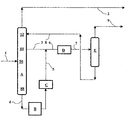
- FIG. 1 presents a process diagram of the invention in one of its preferred variants.
- the detailed description of this variant includes the example that illustrates it. Other variants are possible, but not all will be described in detail.
- the feedstock to be treated (1) is introduced into a distillation column (A) comprising 88 actual trays at the tray 50.
- the fresh feed (1) has in the example considered the following composition (in% weight) and a mass flow rate given below: % weight dimethyl 2-3 butane 0.01 2-methyl pentane 0.10 methyl-3 pentane 0.14 n-hexane 1.41 methyl-cyclopentane 0.79 cyclohexane 1.64 benzene 0.18 trimethyl 2-2-3 butane 0.06 dimethyl 2-2 pentane 0.15 dimethyl 2-3 pentane 3.66 dimethyl 2-4 pentane 0.42 dimethyl 3-3 pentane 0.24 2-methyl hexane 9.39 3-methyl hexane 12.68 ethyl-3 pentane 1.16 n-heptane 31,20 1,1-dimethylcyclopentane 0.89 cis-dimethyl-1,3 cyclopentane 2.40 1,
- a flow (2) which corresponds to the product isomerate and whose weight composition and mass flow rate are as follows: isopentane 4.23 dimethyl 2-2 butane 0.22 dimethyl 2-3 butane 0.18 2-methyl pentane 0.83 methyl-3 pentane 0.53 n-hexane 2.21 methyl-cyclopentane 0.97 cyclohexane 1.93 benzene 0.18 trimethyl 2-2-3 butane 8.12 dimethyl 2-2 pentane 22.04 dimethyl 2-3 pentane 0.88 dimethyl 2-4 pentane 47,23 dimethyl 3-3 pentane 3.07 2-methyl hexane 4.34 3-methyl hexane 1.79 ethyl-3 pentane 0.06 n-heptane 0.50 1,1-dimethylcyclopentane 0.20 cis-dimethyl-1,3 cyclopentane 0.08 1,3-trans-1,3-dimethylcyclopentane 0.07 1,2-trans-1,
- the RON of this isomerate (stream 2) is 84.2 and its aromatic content is 0.18 wt%.
- a stream (3) containing a majority (at least 70%) of normal-heptane and C 7 paraffins mono-branched At the bottom of the column (A) is drawn a stream (4) which is a rich flow of methylcyclohexane, toluene and n-heptane.
- This stream (4) is sent to a toluene-specific hydrogenation unit (B) and then to a ring-opening unit (C) which produces an effluent (5) containing mainly a mixture of paraffins resulting in part from the opening of the rings, as well as the unconverted methylcyclohexane, toluene being completely hydrogenated.
- the catalyst used for the opening unit of cycles may be any catalyst allowing to convert at least 5% of the methylcyclohexane present in the mixture to be treated.
- the opening unit of cycles uses an iridium catalyst deposited on alumina or silica-alumina, such as that described in patent application WO 02/07881.
- the weight composition and the mass flow rate (excluding hydrogen) of the stream (5) corresponding to the effluent of the ring opening unit are as follows: C 5- 1.82 paraffins C 5 3.69 paraffins C 6 1.72 methyl-cyclopentane 0.00 cyclohexane 0.00 benzene 0.00 paraffins C 7 71.13 1,1-dimethylcyclopentane 0.39 cis-dimethyl-1,3 cyclopentane 0.37 1,3-trans-1,3-dimethylcyclopentane 0.40 1,2-trans-1,2-dimethylcyclopentane 0.40 methyl-cyclohexane 19.18 ethyl-cyclopentane 0.39 toluene 0.00 C 8+ 0.51 total flow (kg / h) 10962
- the stream (5) is mixed with the stream (3) to give a stream (6) which is introduced into an isomerization unit (D) using a platinum catalyst on chlorinated alumina as described in the application US2002 / 0002319 A1.
- the weight composition and the mass flow rate (excluding hydrogen) of the stream (7) corresponding to the effluent of the isomerization unit are as follows: C 5- 2.54 isopentane 0.56 dimethyl 2-2 butane 0.03 dimethyl 2-3 butane 0.02 2-methyl pentane 0.10 methyl-3 pentane 0.05 n-hexane 0.12 methyl-cyclopentane 0.04 cyclohexane 0.10 benzene 0.00 trimethyl 2-2-3 butane 1.63 dimethyl 2-2 pentane 3.26 dimethyl 2-3 pentane 4.08 dimethyl 2-4 pentane 8.16 dimethyl 3-3 pentane 4.08 2-methyl hexane 22.04 3-methyl hexane 16.32 ethyl-3 pentane 0.82 n-heptane 21,22 1,1-dimethylcyclopentane 0.33 cis-dimethyl-1,3 cyclopentane 0.32 1,3-trans-1,3-dimethylcyclopentane 0.34 1,
- the effluent (7) of the isomerization unit is sent to a stabilization column (E) from which a flow (9) comprising the light gases resulting from the cracking reactions within the isomerization unit (C 5- cut) and bottom a flow (8) whose composition is very close to that of the flow (7) and which is reintroduced at the top of the column (A) at the plateau 12 .
- the mass flow (excluding hydrogen) of the flow (9) amounts to 1800 kg / h. It can be checked globally that the mass flow rate of the flow (1) is equal to the sum of the mass flow rates of the flows (2) and (9).
Landscapes
- Chemical & Material Sciences (AREA)
- Oil, Petroleum & Natural Gas (AREA)
- Engineering & Computer Science (AREA)
- Chemical Kinetics & Catalysis (AREA)
- General Chemical & Material Sciences (AREA)
- Organic Chemistry (AREA)
- Crystallography & Structural Chemistry (AREA)
- Organic Low-Molecular-Weight Compounds And Preparation Thereof (AREA)
Applications Claiming Priority (2)
| Application Number | Priority Date | Filing Date | Title |
|---|---|---|---|
| FR0308570 | 2003-07-11 | ||
| FR0308570A FR2857371B1 (fr) | 2003-07-11 | 2003-07-11 | Procede ameliore d'isomerisation d'une coupe c7 avec ouverture des cycles naphteniques |
Publications (2)
| Publication Number | Publication Date |
|---|---|
| EP1496099A1 true EP1496099A1 (de) | 2005-01-12 |
| EP1496099B1 EP1496099B1 (de) | 2017-08-09 |
Family
ID=33443279
Family Applications (1)
| Application Number | Title | Priority Date | Filing Date |
|---|---|---|---|
| EP04291494.5A Expired - Lifetime EP1496099B1 (de) | 2003-07-11 | 2004-06-14 | Verbessertes Isomerisierungsverfahren eines C7-Schnitts mit Öffnung der Naphtenringe |
Country Status (3)
| Country | Link |
|---|---|
| US (1) | US7273958B2 (de) |
| EP (1) | EP1496099B1 (de) |
| FR (1) | FR2857371B1 (de) |
Families Citing this family (5)
| Publication number | Priority date | Publication date | Assignee | Title |
|---|---|---|---|---|
| FR2875507B1 (fr) * | 2004-09-22 | 2008-10-31 | Inst Francais Du Petrole | Procede ameliore d'isomerisation d'une coupe c7 avec coproduction d'une coupe riche en molecules cycliques |
| RU2408659C1 (ru) * | 2009-07-20 | 2011-01-10 | Открытое акционерное общество "Научно-производственное предприятие Нефтехим" (ОАО "НПП Нефтехим") | Способ изомеризации легких бензиновых фракций, содержащих c7-c8 парафиновые углеводороды |
| US20150166438A1 (en) * | 2013-12-12 | 2015-06-18 | Uop Llc | Processes and apparatuses for isomerizing hydrocarbons |
| FR3042190B1 (fr) * | 2015-10-09 | 2019-12-27 | IFP Energies Nouvelles | Procede de production de bases essence |
| US11318452B2 (en) | 2019-07-24 | 2022-05-03 | Council Of Scientific & Industrial Research | Single step process for the simultaneous production of aromatics, naphthenics and isoparaffins using transition metal functionalized zeolite based catalyst |
Citations (7)
| Publication number | Priority date | Publication date | Assignee | Title |
|---|---|---|---|---|
| US2915571A (en) * | 1957-11-13 | 1959-12-01 | Universal Oil Prod Co | Isomerization of saturated hydrocarbons |
| EP0473828A1 (de) * | 1988-10-06 | 1992-03-11 | Uop | Adsorptive Trennung von Isopentan und Dimethyl verzweigten Paraffinen von Mono-methyl verzweigten Paraffinen |
| US5334792A (en) * | 1992-10-09 | 1994-08-02 | Mobil Oil Corporation | Combined paraffin isomerization/ring opening process for c5+naphtha |
| US5382731A (en) * | 1993-07-22 | 1995-01-17 | Mobil Oil Corp. | Combined paraffin isomerization/ring opening process |
| US5463155A (en) * | 1993-11-15 | 1995-10-31 | Uop | Upgrading of cyclic naphthas |
| EP0922748A1 (de) * | 1997-11-25 | 1999-06-16 | Institut Français du Pétrole | Verfahren zur Trennung von C5-C8 Einsätzen in drei Produkte, angereicht in lineare, einfach-verzweigte und vielfach-verzweigte Paraffine |
| FR2828205A1 (fr) * | 2001-08-06 | 2003-02-07 | Inst Francais Du Petrole | Procede d'isomerisation d'une coupe c5-c8 mettant en oeuvre deux reacteurs en parallele |
Family Cites Families (2)
| Publication number | Priority date | Publication date | Assignee | Title |
|---|---|---|---|---|
| US5055633A (en) * | 1988-10-06 | 1991-10-08 | Uop | Adsorption and isomerization of normal and mono-methyl paraffins |
| FR2769622B1 (fr) * | 1997-10-14 | 1999-12-24 | Inst Francais Du Petrole | Procede d'isomerisation des composes aromatiques a huit atomes de carbone |
-
2003
- 2003-07-11 FR FR0308570A patent/FR2857371B1/fr not_active Expired - Lifetime
-
2004
- 2004-06-14 EP EP04291494.5A patent/EP1496099B1/de not_active Expired - Lifetime
- 2004-07-09 US US10/887,223 patent/US7273958B2/en not_active Expired - Lifetime
Patent Citations (8)
| Publication number | Priority date | Publication date | Assignee | Title |
|---|---|---|---|---|
| US2915571A (en) * | 1957-11-13 | 1959-12-01 | Universal Oil Prod Co | Isomerization of saturated hydrocarbons |
| EP0473828A1 (de) * | 1988-10-06 | 1992-03-11 | Uop | Adsorptive Trennung von Isopentan und Dimethyl verzweigten Paraffinen von Mono-methyl verzweigten Paraffinen |
| US5334792A (en) * | 1992-10-09 | 1994-08-02 | Mobil Oil Corporation | Combined paraffin isomerization/ring opening process for c5+naphtha |
| US5382731A (en) * | 1993-07-22 | 1995-01-17 | Mobil Oil Corp. | Combined paraffin isomerization/ring opening process |
| US5463155A (en) * | 1993-11-15 | 1995-10-31 | Uop | Upgrading of cyclic naphthas |
| EP0922748A1 (de) * | 1997-11-25 | 1999-06-16 | Institut Français du Pétrole | Verfahren zur Trennung von C5-C8 Einsätzen in drei Produkte, angereicht in lineare, einfach-verzweigte und vielfach-verzweigte Paraffine |
| US6156950A (en) * | 1997-11-25 | 2000-12-05 | Institut Francais Du Petrole | Process for separating a C5-C8 feed or an intermediate feed into three effluents, respectively rich in straight chain, non-branched and multi-branched paraffins |
| FR2828205A1 (fr) * | 2001-08-06 | 2003-02-07 | Inst Francais Du Petrole | Procede d'isomerisation d'une coupe c5-c8 mettant en oeuvre deux reacteurs en parallele |
Also Published As
| Publication number | Publication date |
|---|---|
| EP1496099B1 (de) | 2017-08-09 |
| US20050043576A1 (en) | 2005-02-24 |
| FR2857371A1 (fr) | 2005-01-14 |
| US7273958B2 (en) | 2007-09-25 |
| FR2857371B1 (fr) | 2007-08-24 |
Similar Documents
| Publication | Publication Date | Title |
|---|---|---|
| EP2333031B1 (de) | Verfahren zur Herstellung von Kerosin- und Dieselkraftstoffen sowie zur gleichzeitigen Herstellung von Wasserstoff aus gesättigten leichten Fraktionen | |
| US7485768B1 (en) | Processes for making higher octane motor fuels having a low reid vapor pressure from naphtha boiling range feedstocks | |
| FR2925065A1 (fr) | Nouveau schema permettant d'optimiser la production d'essence a haut indice d'octane et la coproduction de bases aromatiques | |
| EP2321385A1 (de) | Verfahren zur umwandlung einer schweren ladung in benzin und propylen mit einer struktur für variablen ertrag | |
| EP2636661B1 (de) | Umwandlungsverfahren einer schweren Ladung durch Einsatz einer Katkrackeinheit und einer selektiven Hydrierphase des aus dem Katkrackverfahren entstandenen Kraftstoffs | |
| FR3014894A1 (fr) | Procede de reformage catalytique | |
| EP0354826A1 (de) | Kohlenwasserstoff-Fraktionierungs- und Extraktionsverfahren zur Erlangung von Benzin mit verbesserter Oktanzahl und von Kerosin mit verbessertem Rauchpunkt | |
| EP1640436B1 (de) | Verfahren zur Isomerisierung von einer C7-Fraktion mit Koproduktion von einer cyclischen Methylcyclohexan-reichen Fraktion | |
| EP3137583A1 (de) | Benzinherstellungsverfahren mit einem isomerisierungsschritt gefolgt von mindestens zwei trennungsschritten | |
| EP1496099B1 (de) | Verbessertes Isomerisierungsverfahren eines C7-Schnitts mit Öffnung der Naphtenringe | |
| FR2714305A1 (fr) | Catalyseur pour la réduction de la teneur en benzène dans les essences. | |
| EP0552070B1 (de) | Erniedrigung des Benzolgehaltes von Benzinen | |
| EP1417283B1 (de) | Verfahren zur isomerisierung von c5-c8 kohlenwasserstofffreaktionen mit zwei parallelreaktoren | |
| EP1640435B1 (de) | Verfahren zur Isomerisierung von einer C7-Fraktion mit Koproduktion von einer aromatischen Toluenreichen Fraktion | |
| EP0787786B1 (de) | Verfahren zur Isomerisierung von Paraffinen durch reaktive Distillation | |
| EP1110931B1 (de) | Verfahren und Vorrichtung zur Alkylierung von Isobutan mittels leichten Olefinen | |
| FR2686095A1 (fr) | Production de base pour carburant exempt de benzene, presentant un indice d'octane eleve. | |
| EP2426189B1 (de) | Verfahren zur Herstellung von Kerosin- und Dieselkraftstoffen aus leichten ungesättigten und reichen aromatischen BTX-Anteilen | |
| FR2744441A1 (fr) | Procede d'isomerisation de paraffines | |
| WO2023117594A1 (fr) | Unité de production et de séparation des aromatiques avec valorisation d'un extrait et/ou d'un raffinat provenant d'un procédé d'extraction liquide-liquide | |
| WO2024208767A1 (fr) | Procédé de reformage catalytique avec valorisation des effluents non-aromatiques | |
| FR3034764A1 (fr) | Procede d'isomerisation d'une charge d'hydrocarbures en c7 a c11. | |
| FR3042190A1 (fr) | Procede de production de bases essence | |
| FR2730487A1 (fr) | Procede integre comportant l'etherification optimisee d'une coupe d'hydrocarbures contenant des olefines ayant 6 atomes de carbone par molecule | |
| WO2013098523A1 (fr) | Procédé pour maximiser la production de composés aromatiques |
Legal Events
| Date | Code | Title | Description |
|---|---|---|---|
| PUAI | Public reference made under article 153(3) epc to a published international application that has entered the european phase |
Free format text: ORIGINAL CODE: 0009012 |
|
| AK | Designated contracting states |
Kind code of ref document: A1 Designated state(s): AT BE BG CH CY CZ DE DK EE ES FI FR GB GR HU IE IT LI LU MC NL PL PT RO SE SI SK TR |
|
| AX | Request for extension of the european patent |
Extension state: AL HR LT LV MK |
|
| 17P | Request for examination filed |
Effective date: 20050712 |
|
| AKX | Designation fees paid |
Designated state(s): DE ES FR IT NL |
|
| GRAP | Despatch of communication of intention to grant a patent |
Free format text: ORIGINAL CODE: EPIDOSNIGR1 |
|
| RIC1 | Information provided on ipc code assigned before grant |
Ipc: C10G 59/02 20060101ALI20170206BHEP Ipc: C10G 65/04 20060101AFI20170206BHEP Ipc: C10G 45/62 20060101ALI20170206BHEP Ipc: C10G 65/08 20060101ALI20170206BHEP Ipc: C10G 35/04 20060101ALI20170206BHEP |
|
| INTG | Intention to grant announced |
Effective date: 20170223 |
|
| GRAS | Grant fee paid |
Free format text: ORIGINAL CODE: EPIDOSNIGR3 |
|
| GRAA | (expected) grant |
Free format text: ORIGINAL CODE: 0009210 |
|
| AK | Designated contracting states |
Kind code of ref document: B1 Designated state(s): DE ES FR IT NL |
|
| REG | Reference to a national code |
Ref country code: DE Ref legal event code: R096 Ref document number: 602004051636 Country of ref document: DE |
|
| RAP2 | Party data changed (patent owner data changed or rights of a patent transferred) |
Owner name: IFP ENERGIES NOUVELLES |
|
| REG | Reference to a national code |
Ref country code: NL Ref legal event code: MP Effective date: 20170809 |
|
| PG25 | Lapsed in a contracting state [announced via postgrant information from national office to epo] |
Ref country code: NL Free format text: LAPSE BECAUSE OF FAILURE TO SUBMIT A TRANSLATION OF THE DESCRIPTION OR TO PAY THE FEE WITHIN THE PRESCRIBED TIME-LIMIT Effective date: 20170809 |
|
| PG25 | Lapsed in a contracting state [announced via postgrant information from national office to epo] |
Ref country code: ES Free format text: LAPSE BECAUSE OF FAILURE TO SUBMIT A TRANSLATION OF THE DESCRIPTION OR TO PAY THE FEE WITHIN THE PRESCRIBED TIME-LIMIT Effective date: 20170809 |
|
| REG | Reference to a national code |
Ref country code: DE Ref legal event code: R097 Ref document number: 602004051636 Country of ref document: DE |
|
| PG25 | Lapsed in a contracting state [announced via postgrant information from national office to epo] |
Ref country code: IT Free format text: LAPSE BECAUSE OF FAILURE TO SUBMIT A TRANSLATION OF THE DESCRIPTION OR TO PAY THE FEE WITHIN THE PRESCRIBED TIME-LIMIT Effective date: 20170809 |
|
| PLBE | No opposition filed within time limit |
Free format text: ORIGINAL CODE: 0009261 |
|
| STAA | Information on the status of an ep patent application or granted ep patent |
Free format text: STATUS: NO OPPOSITION FILED WITHIN TIME LIMIT |
|
| REG | Reference to a national code |
Ref country code: FR Ref legal event code: PLFP Year of fee payment: 15 |
|
| 26N | No opposition filed |
Effective date: 20180511 |
|
| REG | Reference to a national code |
Ref country code: DE Ref legal event code: R119 Ref document number: 602004051636 Country of ref document: DE |
|
| PG25 | Lapsed in a contracting state [announced via postgrant information from national office to epo] |
Ref country code: DE Free format text: LAPSE BECAUSE OF NON-PAYMENT OF DUE FEES Effective date: 20190101 |
|
| PGFP | Annual fee paid to national office [announced via postgrant information from national office to epo] |
Ref country code: FR Payment date: 20230622 Year of fee payment: 20 |