EP1496499A2 - Méthode et appareil pour la reconnaissance de la parole dans un appareil audio-vidéo - Google Patents
Méthode et appareil pour la reconnaissance de la parole dans un appareil audio-vidéo Download PDFInfo
- Publication number
- EP1496499A2 EP1496499A2 EP04015881A EP04015881A EP1496499A2 EP 1496499 A2 EP1496499 A2 EP 1496499A2 EP 04015881 A EP04015881 A EP 04015881A EP 04015881 A EP04015881 A EP 04015881A EP 1496499 A2 EP1496499 A2 EP 1496499A2
- Authority
- EP
- European Patent Office
- Prior art keywords
- voice
- user
- probability
- model
- patterns
- Prior art date
- Legal status (The legal status is an assumption and is not a legal conclusion. Google has not performed a legal analysis and makes no representation as to the accuracy of the status listed.)
- Ceased
Links
- 238000000034 method Methods 0.000 title claims description 27
- 230000005236 sound signal Effects 0.000 claims abstract description 9
- 230000003044 adaptive effect Effects 0.000 claims description 15
- 238000001914 filtration Methods 0.000 description 5
- 230000008901 benefit Effects 0.000 description 4
- 230000000903 blocking effect Effects 0.000 description 3
- 238000012790 confirmation Methods 0.000 description 3
- 238000010586 diagram Methods 0.000 description 3
- 230000008859 change Effects 0.000 description 2
- 230000007257 malfunction Effects 0.000 description 2
- 238000012986 modification Methods 0.000 description 2
- 230000004048 modification Effects 0.000 description 2
- 238000002474 experimental method Methods 0.000 description 1
- 239000000945 filler Substances 0.000 description 1
- 230000006870 function Effects 0.000 description 1
- 230000014509 gene expression Effects 0.000 description 1
- 230000004044 response Effects 0.000 description 1
- 230000001755 vocal effect Effects 0.000 description 1
Images


Classifications
-
- G—PHYSICS
- G10—MUSICAL INSTRUMENTS; ACOUSTICS
- G10L—SPEECH ANALYSIS TECHNIQUES OR SPEECH SYNTHESIS; SPEECH RECOGNITION; SPEECH OR VOICE PROCESSING TECHNIQUES; SPEECH OR AUDIO CODING OR DECODING
- G10L21/00—Speech or voice signal processing techniques to produce another audible or non-audible signal, e.g. visual or tactile, in order to modify its quality or its intelligibility
- G10L21/02—Speech enhancement, e.g. noise reduction or echo cancellation
- G10L21/0208—Noise filtering
-
- G—PHYSICS
- G10—MUSICAL INSTRUMENTS; ACOUSTICS
- G10L—SPEECH ANALYSIS TECHNIQUES OR SPEECH SYNTHESIS; SPEECH RECOGNITION; SPEECH OR VOICE PROCESSING TECHNIQUES; SPEECH OR AUDIO CODING OR DECODING
- G10L15/00—Speech recognition
- G10L15/20—Speech recognition techniques specially adapted for robustness in adverse environments, e.g. in noise, of stress induced speech
-
- G—PHYSICS
- G10—MUSICAL INSTRUMENTS; ACOUSTICS
- G10L—SPEECH ANALYSIS TECHNIQUES OR SPEECH SYNTHESIS; SPEECH RECOGNITION; SPEECH OR VOICE PROCESSING TECHNIQUES; SPEECH OR AUDIO CODING OR DECODING
- G10L19/00—Speech or audio signals analysis-synthesis techniques for redundancy reduction, e.g. in vocoders; Coding or decoding of speech or audio signals, using source filter models or psychoacoustic analysis
- G10L19/02—Speech or audio signals analysis-synthesis techniques for redundancy reduction, e.g. in vocoders; Coding or decoding of speech or audio signals, using source filter models or psychoacoustic analysis using spectral analysis, e.g. transform vocoders or subband vocoders
- G10L19/0204—Speech or audio signals analysis-synthesis techniques for redundancy reduction, e.g. in vocoders; Coding or decoding of speech or audio signals, using source filter models or psychoacoustic analysis using spectral analysis, e.g. transform vocoders or subband vocoders using subband decomposition
-
- G—PHYSICS
- G10—MUSICAL INSTRUMENTS; ACOUSTICS
- G10L—SPEECH ANALYSIS TECHNIQUES OR SPEECH SYNTHESIS; SPEECH RECOGNITION; SPEECH OR VOICE PROCESSING TECHNIQUES; SPEECH OR AUDIO CODING OR DECODING
- G10L15/00—Speech recognition
- G10L15/08—Speech classification or search
- G10L2015/088—Word spotting
-
- G—PHYSICS
- G10—MUSICAL INSTRUMENTS; ACOUSTICS
- G10L—SPEECH ANALYSIS TECHNIQUES OR SPEECH SYNTHESIS; SPEECH RECOGNITION; SPEECH OR VOICE PROCESSING TECHNIQUES; SPEECH OR AUDIO CODING OR DECODING
- G10L21/00—Speech or voice signal processing techniques to produce another audible or non-audible signal, e.g. visual or tactile, in order to modify its quality or its intelligibility
- G10L21/02—Speech enhancement, e.g. noise reduction or echo cancellation
- G10L21/0208—Noise filtering
- G10L2021/02082—Noise filtering the noise being echo, reverberation of the speech
Definitions
- the present invention relates to perceiving a phonic input, and more particularly, to an apparatus and a method of perceiving a user's phonic input in AV system.
- the voice recognition system makes it possible that people communicate with machinery and computers by only people's phonic expressions. Even though the voice recognition system has been applied to many fields and brought much convenience to the people, it has not been successful in the AV (audio-visual) system. The fact that there are too many noises around as well as from the AV appliances and remote distance from the AV appliances to users makes the voice recognition system less reliable and accurate. Accordingly, there are many problems that need to be solved to implement the voice recognition system in the AV system.
- the present invention is directed to an apparatus and a method of voice recognition system in AV system that substantially obviates one or more problems due to limitations and disadvantages of the related art.
- An object of the present invention is to provide an apparatus and a method of voice recognition system under a situation where reflected sound and noises are present
- a voice recognition system for an audio-visual (AV) system comprises a reflected sound remover having a plurality of filters, the reflected sound remover being configured to receive an input sound signal including a reflected AV system audio, a user's voice, and a noise, and being configured to remove the reflected audio from the input sound according to user's voice information; a voice detector detecting the user's voice from a signal outputted from the reflected sound remover and obtaining the user's voice information based on the detected user's voice; and a voice recognition unit comparing the detected user's voice with voice patterns that belong to at least one model.
- the reflected sound remover includes a first filter bank dividing the original AV system audio into a first plurality of signals having different frequency ranges; a second filter bank dividing the input sound into a second plurality of signals having the different frequency ranges; a plurality of adaptive filters removing the reflected AV system audio from the second plurality of signals using the first plurality of signals; and a third filter bank combining the signals outputted from the plurality of adaptive filters.
- the reflected sound remover further includes at least one of a blocking frequency, a transmitting frequency, and a reflected sound removing rate of the filters, according to the detected property information of the user's voice.
- the voice recognition unit compares the first probability and the second probability with reference values, and recognizes the user's voice depending on an outcome of the comparing the first and the second probabilities with reference values.
- the voice recognition unit calculates a plurality of probabilities that the user's voice matches the predetermined voice patterns in the first model, and selects a highest probability from the plurality of probabilities as the first probability. In addition, the voice recognition unit calculates a plurality of probabilities that the user's voice matches the voice patterns in the second model, and selects a highest probability from the plurality of probabilities as the second probability.
- the first model includes voice patterns which correspond to predetermined words and the second model accumulates voice patterns which do not correspond to the predetermined words.
- a method for recognizing a voice for an audio-visual (AV) system includes receiving an input signal including a reflected AV system audio, a user's voice, and a noise; removing the reflected AV system audio from the input signal according to user's voice information by passing the input signal through a plurality of filters; detecting the user's voice from the first signal and obtaining the user's voice information based on the detected user's voice; and comparing the detected user's voice with voice patterns that belong to at least one model.
- the step of controlling the plurality of filters includes fixing parameters of the plurality of filters during an interval from a starting point to an ending point of the user's voice.
- the parameters include at least one of a blocking frequency, a transmitting frequency, and a reflected sound removing rate of the plurality of filters.
- the step of comparing the detected user's voice with voice patterns from at least one model includes calculating a first probability that the user's voice matches the voice patterns in a first model, and calculating a second probability that the user's voice matches the voice patterns in a second model. It also includes determining the ratio of the first probability and the second probability and comparing the determined ratio with reference values, and recognizing the user's voice depending on the ratio of the first probability and the second probability.
- a voice recognition system for an audio-visual (AV) system includes a voice detector detecting a user's voice from a received sound; and a voice recognition unit calculating a first probability that the user's voice matches one of voice patterns in a first model and a second probability that the user's voice matches one of voice patterns in a second model, and recognizing the user's voice according to a ratio of the first probability and the second probability.
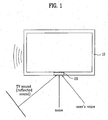
- FIG. 1 is an example of a TV including a voice recognition system in accordance with the present invention
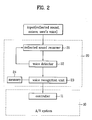
- FIG. 2 is a block diagram illustrating the voice recognition system in AV system in accordance with the present invention
- FIG. 3 is a detailed diagram illustrating a reflected sound remover in accordance with the present invention.
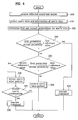
- FIG. 4 is a flowchart illustrating the voice recognition system in the AV system in accordance with the present invention.
- FIG. 5 is an example illustrating a user's decoded audio signal by the voice recognition system in accordance with the present invention.
- FIG. 1 illustrates an example of an audio-visual (AV) system including a voice recognition system according to the present invention.
- the TV 10 includes the voice recognition device 20, which receives reflected sound, noises and a user's voice.
- the reflected sound is TV 10 sound that is reflected by walls or remote objects.
- the best mode to place the voice recognition device 20 is on the front side of the TV 10.
- FIG. 2 is a block diagram illustrating the voice recognition system 20 in AV system according to the present invention.
- the TV 10 includes a microphone (not shown in FIG. 2), which receives the TV reflected sound, the noises, and the user's voice and converts them into frequency signals.
- the voice recognition system 20 includes a reflected sound remover 21 , which receives the frequency signals from the microphone and outputs only vocal signals corresponding to the user's voice. It is relatively easy for a minute noise to be recognized whereas it is very difficult for the reflected sound to be recognized. Therefore, as shown in FIG. 3, the present invention includes a first, a second and a third infinite-impulse response filter banks (IIR filter bank) 211, 212, 213 respectively in order to efficiently separate and remove said reflected sound.
- IIR filter bank infinite-impulse response filter bank
- the first filter bank 211 includes an M number of channel filters (H 0 , H 1 , H 2 , ... H M-1 ) to divide audio signals decoded from broadcast signals into different frequency ranges (sub bands).
- the second filter bank 212 also includes an M number of the channel filters (H 0 , H 1 , H 2 , ... H M-1 ) to divide the audio signals converted from the TV reflected sound, the noises, and the user's voice into the different frequency ranges (sub bands).
- Each channel of the H 0 , H 1 , H 2 , ... H M-1 passes the signals according to the frequency ranges.
- the reflected sound remover 21 further includes an adaptive filter unit 215 containing filters (W 0 , W 1 , W 2 , ... W M-1 ), which receives the divided signals from the first filter bank 211 and the second filter bank 212.
- Each of the W 0 , W 1 , W 2 , ... W M-1 receives respectively the signals at the same frequency range from the first filter bank 211 and the second filter bank 212.
- the filter W 0 receives the signal from the channel filter (H 0 ) of the first filter bank 211 and the signal from the channel filter (H 0 ) of the second filter bank 212.
- W M-1 compare the two outputted signals from the first filter bank 211 and the second filter bank 212 and determine if the frequencies and amplitudes of the two signals are identical or similar.
- the adaptive filters (W 0 , W 1 , W 2 , ... W M-1 ) detect the signal from the second filter band 212 to be nearly identical to the signal from the first filter bank 211. If the signal from the second filter bank 212 is nearly identical to the signal from the first filter bank 211, the signals are considered to be the TV reflected sound signals. Then the adaptive filters (W 0 , W 1 , W 2 , ... W M-1 ) removed the signal from the signals from the first filter bank 212.
- the adaptive filter unit 215 outputs the divided signals except for the reflected TV sound signals.
- the third filter bank 213 receives and combines the divided signals from the adaptive filter unit 215 .
- the combined signals include the user's voice and may include the noises and the residual reflected sound signals. Therefore, the present invention may include a noise remover (not illustrated), which filters the signals from the third filter bank 213 based on a threshold value.
- the voice recognition system 20 further includes a voice detector 22, which receives the signals from the reflected sound remover 21 and detects the user's voice from the received signals.
- the voice detector 22 obtains a user's voice information based on the user's voice. For example, to determine an interval of the user's voice, the voice detector 22 detects a beginning and an end of the voice and detects the frequency range, amplitude, and a wave shape of the user's voice. Now, the voice detector 22 sends the user's voice information to the reflected sound remover 21 and a voice recognition unit 23.
- the voice recognition system 20 also includes a memory 24, which stores voice patterns, probability models having statistical data of the voice patterns.
- the voice recognition unit 23 compares the user's voice with the stored voice patterns in the memory 24. It then determines a probability (similarity level) of each stored voice matching the user's voice. Based on the probability, it determines if the user's voice is a certain voice pattern that corresponds to the stored voice in the memory 24 and what voice pattern it is.
- a controller 11 in the TV 10 manipulates the TV 10 as the user's voice desires.
- FIG. 4 is a flowchart illustrating a voice recognition system in AV system.
- the user says a user's voice such as "volume down”
- the user's voice is received by the microphone and transmitted to the reflected sound remover 21 .
- the reflected TV sound and the noises are transmitted to the reflected sound remover 21 along with the user's voice.
- the transmitted user's voice, TV reflected sound, and noises are divided into the different frequency ranges and the divided reflected TV sound is removed by the adaptive filters (W 0 , W 1 , W 2 , ... W M-1 ) and the noises is removed by the noise remover (S30).
- the reflected sound remover (21) removes the reflected TV sound by using the IIR filter banks 211, 212, 213 according to sub bands filtering method.
- the voice detector 22 receives all the signals but the removed reflected sound and the noises from the reflected sound remover 21 . As show in FIG. 5, the sinusoidal waves of the signals are analyzed into frames in order to detect the user's voice (S31). The voice detector 22 also figures the starting and ending points of the signals and determines the frequency range and the amplitudes, and so on. The voice detector 22 compares energy (i.e. amplitude) of the user's voice with a predetermined reference value. For example, a point, where the energy of the signal inputted to the voice detector 22 is greater than a first threshold value, is the starting point, and another point, where the energy of the signal inputted to the voice detector 22 is greater than a second threshold value, is the ending point.
- energy i.e. amplitude
- the adaptive filter unit 215 stops adapting. But it restarts adapting when the ending point of the user's voice is determined. Adjusting is immediately predicting a route of the TV sound when reflected, altering filtering parameters such as blocking frequencies or passing frequencies of the adaptive filters (W 0 , W 1 , W 2 , ... W M-1 ) according to the reflected sound route being changed. An example of the reflected sound route is change according to the user's moving.
- the filtering parameters of the adaptive filters should be fixed when the reflected sound remover 21 receives both the reflected sound and the user's voice together because it is difficult to know the precise filtering parameters.
- the filtering parameters of the adaptive filters can be changed according to the reflected sound route only when the reflected sound itself is received.
- the voice recognition unit 23 determines a first probability of the user's voice matching at least one of the stored voice patterns corresponding to predetermined words. It also determines a second probability of not matching one of voice patterns corresponding to words which are not predetermined (S32). To determine the first probability, the user's voice is first compared with each of the voice patterns stored in a first model such as "change channel”, "volume up", and "volume down”. The probabilities (i.e. similarities) of the stored voice patterns matching the user's voice are calculated.
- the first model is specifically a hidden markov model (HMM) which includes the voice patterns corresponding to the predetermined words. The voice recognition unit 23 determines considers the highest probability among the calculated probabilities as the first probability.
- HMM hidden markov model
- the voice recognition unit 23 uses a second model, particularly a filler model accumulating the voice patterns corresponding to the words which are not predetermined.
- the user's voice is compared with each of the voice patterns stored in the second model and the probabilities of the stored voice patterns in the second model matching the user's voice are calculated.
- the voice recognition unit 23 considers the highest probability among the calculated probabilities as the second probability. It then determines the ratio of the first and the second probabilities (the former/ the latter) and compares the ratio with a first reference value and a second reference value (S33, S35).
- the first reference value is used for malfunction percent of 0.5% and the second reference value is used for malfunction percent of 5%.
- the first and the second reference values are obtained from the experiments.
- the voice recognition unit 23 recognizes the transmitted user's voice. For example, the voice recognition unit 23 assures the voice pattern that corresponds to the first probability from the first model and sends an instruction corresponding to the voice pattern to the controller 11 . The controller 11 now manipulates the TV 10 based on the user's voice pattern.
- the voice recognition unit 23 does not automatically recognize the transmitted user's voice but displays a word that best corresponds to the user's voice. For example, the voice recognition unit 23 requests the controller 11 that it assures the voice pattern that corresponds to the first probability from the first model (S36). The controller 11 then displays the assured voice pattern (i.e. volume down) and waits to receive the user's confirmation. If the user says, "yes", “OK”, or “select” as a confirmation (S37), the controller 11 volumes down the TV 10 (S38). If the user refuses the confirmation by saying "No” or "cancel", the controller 11 deletes the display voice pattern, "volume down” on the TV 10.
- the voice recognition unit 23 requests the controller 11 that it assures the voice pattern that corresponds to the first probability from the first model (S36). The controller 11 then displays the assured voice pattern (i.e. volume down) and waits to receive the user's confirmation. If the user says, "yes”, “OK”, or “select” as a confirmation (S37), the controller 11
- the voice recognition unit 23 does neither attempt to recognize the user's voice nor sends any signal to the controller 11 (S39). Therefore, the controller 11 does not respond to the user's voice.
- the present invention makes it possible that the voice recognition system functions precisely even with the reflected sound and the noises because it detects the user's voice based on the ratio of the two probabilities of the user's voice being matched and not matched one of the stored voice patterns.
- the present invention is also applicable to not only the electronic home appliances but also translating devices, handsets, toys, and the like.
Landscapes
- Engineering & Computer Science (AREA)
- Acoustics & Sound (AREA)
- Health & Medical Sciences (AREA)
- Audiology, Speech & Language Pathology (AREA)
- Human Computer Interaction (AREA)
- Physics & Mathematics (AREA)
- Computational Linguistics (AREA)
- Multimedia (AREA)
- Quality & Reliability (AREA)
- Signal Processing (AREA)
- Two-Way Televisions, Distribution Of Moving Picture Or The Like (AREA)
- Details Of Television Systems (AREA)
- Selective Calling Equipment (AREA)
- Circuit For Audible Band Transducer (AREA)
Applications Claiming Priority (2)
| Application Number | Priority Date | Filing Date | Title |
|---|---|---|---|
| KR2003045765 | 2003-07-07 | ||
| KR1020030045765A KR100556365B1 (ko) | 2003-07-07 | 2003-07-07 | 음성 인식장치 및 방법 |
Publications (2)
| Publication Number | Publication Date |
|---|---|
| EP1496499A2 true EP1496499A2 (fr) | 2005-01-12 |
| EP1496499A3 EP1496499A3 (fr) | 2005-02-02 |
Family
ID=33448354
Family Applications (1)
| Application Number | Title | Priority Date | Filing Date |
|---|---|---|---|
| EP04015881A Ceased EP1496499A3 (fr) | 2003-07-07 | 2004-07-06 | Méthode et appareil pour la reconnaissance de la parole dans un appareil audio-video |
Country Status (4)
| Country | Link |
|---|---|
| US (1) | US8046223B2 (fr) |
| EP (1) | EP1496499A3 (fr) |
| KR (1) | KR100556365B1 (fr) |
| CN (1) | CN100345184C (fr) |
Cited By (2)
| Publication number | Priority date | Publication date | Assignee | Title |
|---|---|---|---|---|
| WO2017039575A1 (fr) * | 2015-08-28 | 2017-03-09 | Hewlett-Packard Development Company, L.P. | Reconnaissance vocale avec capteur distant |
| WO2022050973A1 (fr) * | 2020-09-03 | 2022-03-10 | Google Llc | Médiation utilisateur pour la détection d'un mot déclencheur/mot-clé |
Families Citing this family (13)
| Publication number | Priority date | Publication date | Assignee | Title |
|---|---|---|---|---|
| KR100556365B1 (ko) | 2003-07-07 | 2006-03-03 | 엘지전자 주식회사 | 음성 인식장치 및 방법 |
| KR20080061901A (ko) * | 2006-12-28 | 2008-07-03 | 주식회사 유진로봇 | 로봇의 입출력 장치에 의한 효율적인 음성인식 방법 및시스템 |
| KR101086304B1 (ko) | 2009-11-30 | 2011-11-23 | 한국과학기술연구원 | 로봇 플랫폼에 의해 발생한 반사파 제거 신호처리 장치 및 방법 |
| RU2642250C2 (ru) | 2012-07-31 | 2018-01-24 | Гайстлих Фарма Аг | Гидрофильный содержащий фосфатную группу дегидратированный частично очищенный материал для замещения кости |
| KR102216048B1 (ko) | 2014-05-20 | 2021-02-15 | 삼성전자주식회사 | 음성 명령 인식 장치 및 방법 |
| US9508343B2 (en) * | 2014-05-27 | 2016-11-29 | International Business Machines Corporation | Voice focus enabled by predetermined triggers |
| CN105988049B (zh) * | 2015-02-28 | 2019-02-19 | 惠州市德赛西威汽车电子股份有限公司 | 一种噪声抑制的调试方法 |
| CN105554609A (zh) * | 2015-12-26 | 2016-05-04 | 北海鸿旺电子科技有限公司 | 通过语音输入进行功能切换的方法及耳机 |
| US10958747B2 (en) * | 2017-08-24 | 2021-03-23 | Google Llc | Digital component transmission |
| KR102918256B1 (ko) | 2018-08-08 | 2026-01-28 | 주식회사 케이티 | 음성을 인식하는 장치, 방법 및 컴퓨터 판독 가능 매체 |
| USD915360S1 (en) * | 2018-08-27 | 2021-04-06 | Lg Electronics Inc. | Voice recognition device for television |
| US11849291B2 (en) * | 2021-05-17 | 2023-12-19 | Apple Inc. | Spatially informed acoustic echo cancelation |
| CN114220445B (zh) * | 2021-11-17 | 2025-07-11 | 南京邮电大学 | 基于非均匀图子带划分的语音图自适应谱减法 |
Citations (1)
| Publication number | Priority date | Publication date | Assignee | Title |
|---|---|---|---|---|
| WO2002007151A2 (fr) * | 2000-07-19 | 2002-01-24 | Aliphcom | Procédé et dispositif de suppression du bruit dans des signaux électroniques |
Family Cites Families (15)
| Publication number | Priority date | Publication date | Assignee | Title |
|---|---|---|---|---|
| US5512939A (en) * | 1994-04-06 | 1996-04-30 | At&T Corp. | Low bit rate audio-visual communication system having integrated perceptual speech and video coding |
| US5956674A (en) * | 1995-12-01 | 1999-09-21 | Digital Theater Systems, Inc. | Multi-channel predictive subband audio coder using psychoacoustic adaptive bit allocation in frequency, time and over the multiple channels |
| US6016473A (en) * | 1998-04-07 | 2000-01-18 | Dolby; Ray M. | Low bit-rate spatial coding method and system |
| US6292778B1 (en) * | 1998-10-30 | 2001-09-18 | Lucent Technologies Inc. | Task-independent utterance verification with subword-based minimum verification error training |
| US6571210B2 (en) * | 1998-11-13 | 2003-05-27 | Microsoft Corporation | Confidence measure system using a near-miss pattern |
| KR100587260B1 (ko) | 1998-11-13 | 2006-09-22 | 엘지전자 주식회사 | 음향 기기의 음성인식장치 |
| EP1110315B1 (fr) * | 1999-06-24 | 2008-03-26 | Koninklijke Philips Electronics N.V. | Suppression d'echo et de bruit acoustiques |
| DE10002321C2 (de) * | 2000-01-20 | 2002-11-14 | Micronas Munich Gmbh | Sprachgesteuerte Vorrichtung und System mit einer derartigen sprachgesteuerten Vorrichtung |
| JP2004506944A (ja) | 2000-08-15 | 2004-03-04 | コーニンクレッカ フィリップス エレクトロニクス エヌ ヴィ | 共通エコー相殺機能を備える複数装置型オーディオ/ビデオ |
| US6968064B1 (en) * | 2000-09-29 | 2005-11-22 | Forgent Networks, Inc. | Adaptive thresholds in acoustic echo canceller for use during double talk |
| EP1356589B1 (fr) * | 2001-01-23 | 2010-07-14 | Koninklijke Philips Electronics N.V. | Filtre asymetrique a canaux multiples |
| KR100368289B1 (ko) * | 2001-02-20 | 2003-01-24 | (주)성우테크노 | 음성인식장치를 위한 음성명령식별기 |
| US6985859B2 (en) * | 2001-03-28 | 2006-01-10 | Matsushita Electric Industrial Co., Ltd. | Robust word-spotting system using an intelligibility criterion for reliable keyword detection under adverse and unknown noisy environments |
| JP2003308091A (ja) * | 2002-04-17 | 2003-10-31 | Pioneer Electronic Corp | 音声認識装置、音声認識方法および音声認識プログラム |
| KR100556365B1 (ko) | 2003-07-07 | 2006-03-03 | 엘지전자 주식회사 | 음성 인식장치 및 방법 |
-
2003
- 2003-07-07 KR KR1020030045765A patent/KR100556365B1/ko not_active Expired - Fee Related
-
2004
- 2004-07-06 US US10/883,775 patent/US8046223B2/en not_active Expired - Fee Related
- 2004-07-06 EP EP04015881A patent/EP1496499A3/fr not_active Ceased
- 2004-07-07 CN CNB2004100637266A patent/CN100345184C/zh not_active Expired - Fee Related
Patent Citations (1)
| Publication number | Priority date | Publication date | Assignee | Title |
|---|---|---|---|---|
| WO2002007151A2 (fr) * | 2000-07-19 | 2002-01-24 | Aliphcom | Procédé et dispositif de suppression du bruit dans des signaux électroniques |
Cited By (8)
| Publication number | Priority date | Publication date | Assignee | Title |
|---|---|---|---|---|
| WO2017039575A1 (fr) * | 2015-08-28 | 2017-03-09 | Hewlett-Packard Development Company, L.P. | Reconnaissance vocale avec capteur distant |
| US10482877B2 (en) | 2015-08-28 | 2019-11-19 | Hewlett-Packard Development Company, L.P. | Remote sensor voice recognition |
| WO2022050973A1 (fr) * | 2020-09-03 | 2022-03-10 | Google Llc | Médiation utilisateur pour la détection d'un mot déclencheur/mot-clé |
| US11521604B2 (en) | 2020-09-03 | 2022-12-06 | Google Llc | User mediation for hotword/keyword detection |
| JP2023530048A (ja) * | 2020-09-03 | 2023-07-13 | グーグル エルエルシー | ホットワード/キーワード検出のためのユーザ仲介 |
| AU2020466345B2 (en) * | 2020-09-03 | 2023-11-02 | Google Llc | User mediation for hotword/keyword detection |
| US12027160B2 (en) | 2020-09-03 | 2024-07-02 | Google Llc | User mediation for hotword/keyword detection |
| EP4730324A1 (fr) * | 2020-09-03 | 2026-04-22 | Google LLC | Médiation d'utilisateur pour la détection de mot-clé/mot-clé |
Also Published As
| Publication number | Publication date |
|---|---|
| EP1496499A3 (fr) | 2005-02-02 |
| KR20050005868A (ko) | 2005-01-15 |
| US20050033572A1 (en) | 2005-02-10 |
| KR100556365B1 (ko) | 2006-03-03 |
| CN100345184C (zh) | 2007-10-24 |
| CN1591566A (zh) | 2005-03-09 |
| US8046223B2 (en) | 2011-10-25 |
Similar Documents
| Publication | Publication Date | Title |
|---|---|---|
| US8046223B2 (en) | Apparatus and method of voice recognition system for AV system | |
| CN101510425B (zh) | 声音识别装置以及用于执行声音识别的方法 | |
| US6351222B1 (en) | Method and apparatus for receiving an input by an entertainment device | |
| US7885818B2 (en) | Controlling an apparatus based on speech | |
| US20010039494A1 (en) | Voice controller and voice-controller system having a voice-controller apparatus | |
| US8462190B2 (en) | Voice communication device, voice communication method, and voice communication program | |
| KR101863097B1 (ko) | 키워드 인식 장치 및 방법 | |
| CN100490314C (zh) | 语音通信的声频信号处理装置和方法 | |
| US8103504B2 (en) | Electronic appliance and voice signal processing method for use in the same | |
| US20060195316A1 (en) | Voice detecting apparatus, automatic image pickup apparatus, and voice detecting method | |
| US8255209B2 (en) | Noise elimination method, apparatus and medium thereof | |
| KR102374054B1 (ko) | 음성 인식 방법 및 이에 사용되는 장치 | |
| JP2019184809A (ja) | 音声認識装置、音声認識方法 | |
| EP4005249A1 (fr) | Estimation de l'emplacement d'un utilisateur dans un système comprenant des dispositifs audio intelligents | |
| CN102640084A (zh) | 用于多用户和系统的通信接口设备和方法 | |
| EP3484183B1 (fr) | Classification d'emplacements pour un assistant personnel intelligent | |
| KR100651940B1 (ko) | 음성 인식 장치 및 방법 | |
| US7177806B2 (en) | Sound signal recognition system and sound signal recognition method, and dialog control system and dialog control method using sound signal recognition system | |
| JP2008519989A (ja) | 音声認識システムと同システムを用いたセキュリティ装置 | |
| CN107543569B (zh) | 基于调频声波的空间扰动检测方法与装置 | |
| KR101859614B1 (ko) | 디스플레이 장치, 전자 장치, 대화형 시스템 및 이들의 제어 방법 | |
| WO2021010056A1 (fr) | Unité de microphone | |
| WO2020230460A1 (fr) | Dispositif de traitement d'informations, système de traitement d'informations, procédé de traitement d'informations, et programme | |
| JP3301775B2 (ja) | 音声認識制御装置 | |
| TW201800774A (zh) | 基於調頻聲波的空間擾動偵測方法與裝置 |
Legal Events
| Date | Code | Title | Description |
|---|---|---|---|
| PUAI | Public reference made under article 153(3) epc to a published international application that has entered the european phase |
Free format text: ORIGINAL CODE: 0009012 |
|
| PUAL | Search report despatched |
Free format text: ORIGINAL CODE: 0009013 |
|
| 17P | Request for examination filed |
Effective date: 20040804 |
|
| AK | Designated contracting states |
Kind code of ref document: A2 Designated state(s): AT BE BG CH CY CZ DE DK EE ES FI FR GB GR HU IE IT LI LU MC NL PL PT RO SE SI SK TR |
|
| AX | Request for extension of the european patent |
Extension state: AL HR LT LV MK |
|
| AK | Designated contracting states |
Kind code of ref document: A3 Designated state(s): AT BE BG CH CY CZ DE DK EE ES FI FR GB GR HU IE IT LI LU MC NL PL PT RO SE SI SK TR |
|
| AX | Request for extension of the european patent |
Extension state: AL HR LT LV MK |
|
| AKX | Designation fees paid |
Designated state(s): DE FR NL |
|
| 17Q | First examination report despatched |
Effective date: 20081120 |
|
| APBK | Appeal reference recorded |
Free format text: ORIGINAL CODE: EPIDOSNREFNE |
|
| APBN | Date of receipt of notice of appeal recorded |
Free format text: ORIGINAL CODE: EPIDOSNNOA2E |
|
| APAF | Appeal reference modified |
Free format text: ORIGINAL CODE: EPIDOSCREFNE |
|
| APBR | Date of receipt of statement of grounds of appeal recorded |
Free format text: ORIGINAL CODE: EPIDOSNNOA3E |
|
| APBT | Appeal procedure closed |
Free format text: ORIGINAL CODE: EPIDOSNNOA9E |
|
| STAA | Information on the status of an ep patent application or granted ep patent |
Free format text: STATUS: THE APPLICATION HAS BEEN REFUSED |
|
| 18R | Application refused |
Effective date: 20150630 |