EP1496579A1 - Stecker - Google Patents
Stecker Download PDFInfo
- Publication number
- EP1496579A1 EP1496579A1 EP03717583A EP03717583A EP1496579A1 EP 1496579 A1 EP1496579 A1 EP 1496579A1 EP 03717583 A EP03717583 A EP 03717583A EP 03717583 A EP03717583 A EP 03717583A EP 1496579 A1 EP1496579 A1 EP 1496579A1
- Authority
- EP
- European Patent Office
- Prior art keywords
- plug
- contacts
- contact
- insertion hole
- tip
- Prior art date
- Legal status (The legal status is an assumption and is not a legal conclusion. Google has not performed a legal analysis and makes no representation as to the accuracy of the status listed.)
- Withdrawn
Links
Images



Classifications
-
- H—ELECTRICITY
- H01—ELECTRIC ELEMENTS
- H01R—ELECTRICALLY-CONDUCTIVE CONNECTIONS; STRUCTURAL ASSOCIATIONS OF A PLURALITY OF MUTUALLY-INSULATED ELECTRICAL CONNECTING ELEMENTS; COUPLING DEVICES; CURRENT COLLECTORS
- H01R24/00—Two-part coupling devices, or either of their cooperating parts, characterised by their overall structure
- H01R24/58—Contacts spaced along longitudinal axis of engagement
-
- H—ELECTRICITY
- H01—ELECTRIC ELEMENTS
- H01R—ELECTRICALLY-CONDUCTIVE CONNECTIONS; STRUCTURAL ASSOCIATIONS OF A PLURALITY OF MUTUALLY-INSULATED ELECTRICAL CONNECTING ELEMENTS; COUPLING DEVICES; CURRENT COLLECTORS
- H01R24/00—Two-part coupling devices, or either of their cooperating parts, characterised by their overall structure
- H01R24/38—Two-part coupling devices, or either of their cooperating parts, characterised by their overall structure having concentrically or coaxially arranged contacts
- H01R24/40—Two-part coupling devices, or either of their cooperating parts, characterised by their overall structure having concentrically or coaxially arranged contacts specially adapted for high frequency
-
- H—ELECTRICITY
- H01—ELECTRIC ELEMENTS
- H01R—ELECTRICALLY-CONDUCTIVE CONNECTIONS; STRUCTURAL ASSOCIATIONS OF A PLURALITY OF MUTUALLY-INSULATED ELECTRICAL CONNECTING ELEMENTS; COUPLING DEVICES; CURRENT COLLECTORS
- H01R12/00—Structural associations of a plurality of mutually-insulated electrical connecting elements, specially adapted for printed circuits, e.g. printed circuit boards [PCB], flat or ribbon cables, or like generally planar structures, e.g. terminal strips, terminal blocks; Coupling devices specially adapted for printed circuits, flat or ribbon cables, or like generally planar structures; Terminals specially adapted for contact with, or insertion into, printed circuits, flat or ribbon cables, or like generally planar structures
- H01R12/50—Fixed connections
- H01R12/51—Fixed connections for rigid printed circuits or like structures
- H01R12/55—Fixed connections for rigid printed circuits or like structures characterised by the terminals
- H01R12/57—Fixed connections for rigid printed circuits or like structures characterised by the terminals surface mounting terminals
-
- H—ELECTRICITY
- H01—ELECTRIC ELEMENTS
- H01R—ELECTRICALLY-CONDUCTIVE CONNECTIONS; STRUCTURAL ASSOCIATIONS OF A PLURALITY OF MUTUALLY-INSULATED ELECTRICAL CONNECTING ELEMENTS; COUPLING DEVICES; CURRENT COLLECTORS
- H01R2103/00—Two poles
-
- H—ELECTRICITY
- H01—ELECTRIC ELEMENTS
- H01R—ELECTRICALLY-CONDUCTIVE CONNECTIONS; STRUCTURAL ASSOCIATIONS OF A PLURALITY OF MUTUALLY-INSULATED ELECTRICAL CONNECTING ELEMENTS; COUPLING DEVICES; CURRENT COLLECTORS
- H01R2107/00—Four or more poles
Definitions
- the present invention relates to jacks that are provided with a plurality of contacts along a plug insertion hole formed in a body, the contacts including tip contacts that contact a tip electrode at a front end of a plug that is inserted onto the plug insertion hole, and intermediate contacts that contact a ring electrode at an intermediate location of the plug.
- the jacks disclosed in Japanese Patent No. 2633258 and Japanese Patent Application Publication No. JP 2001-217053A are known as jacks similar to the one disclosed in the present invention.
- the former is configured such that when a multipolar plug is inserted into a jack unit (corresponding to the body in the present invention), a conductive state is established by bringing a plurality of connection plug contacts (a concept including the tip electrode and the ring electrodes of the present invention) formed on the multipolar plug into contact with a corresponding plurality of contact terminals (corresponding to the contacts in the present invention) inside the jack unit.
- the latter of these pieces of related art is configured such that the inside of a jack unit (corresponding to the body in the present invention) is provided with a ring contact piece and a tip contact piece (corresponding to the tip contact of the present invention) in which a pair of tip electrodes are formed at both ends of a plate-shaped linking member, whereby, when a unipolar plug is inserted into the jack unit, the tip electrodes at the front end of the unipolar plug are contacted in an embracing fashion by the tip contacts, and the ring electrode at an intermediate position of the unipolar plug is contacted by the ring contact piece, thereby achieving a conductive state.
- connection terminal Focusing on the tip contacts that contact the tip electrode at the front end of the plug, in the former of these pieces of related art (Japanese Patent 2633258), one end portion of the connection terminal disclosed in the drawings of this publication is supported by the jack unit, and the other end portion is configured with a relatively long length, so that it is used as a contact for the plug.
- connection terminal When the connection terminal is supported in this manner, it is possible to utilize the elastic deformation of the entire material of the connection terminals, and the contact force does not decrease even when repeatedly inserting and pulling out the plug, so that a favorable performance is attained in which a contact force of substantially predetermined strength is maintained.
- the tip contact piece is arranged at an end location of the jack, so that it is difficult to design a structure in which an elastic spring force is attained when used for long spans of time, thus leaving room for improvement.
- the tip contact piece may be ultimately enter a state of plastic deformation, so that a favorable performance was difficult to realize.
- a contact unit is constituted by a linking portion that is arranged at an inner end of the plug insertion hole in an orientation perpendicular to an axis of the plug insertion hole, intermediate portions that extend from both ends of the linking portion towards an aperture side of the plug insertion hole, and folded portions that are folded over from the aperture side of the intermediate portions to the inner end side of the plug insertion hole, projecting into the plug insertion hole, the contact unit being formed in one piece by bending a conductor, and the tip contacts being formed on a free end side of the folded portions in the contact unit.
- the pair of tip contacts contact the tip electrode at the front end of the plug in an embracing fashion.
- a contact pressure can be attained through a relatively large elastic deformation utilizing the combined regions of an elastic deformation region of the folded pieces and an elastic deformation region of the intermediate portions, and there is no risk of plastic deformation of the contact unit, even when the plug is repeatedly inserted.
- the folded portions are formed at the intermediate portion of the contact unit by folding from the end on the side opposite the linking portion back toward the linking portion, the contact unit can be provided with substantially the same length in the direction along the axis of the plug as the intermediate portions.
- the size of the contact unit is small, and the overall size of the jack can be prevented from becoming bigger, while achieving a jack with which a reliable and favorable conductive state can be realized by bringing the tip at the front end into contact with the tip contacts, even when the plug is inserted repeatedly.
- the contact unit in a jack having the first characteristic configuration, is provided with abutting portions protruding toward the folded portions or toward the tip contacts, the abutting portions being formed in one piece with the intermediate portions, and when the folded portions are elastically deformed more than a predetermined amount, the abutting portions are abutted and deformation of the folded portions is prevented.
- a spacing in a direction along the plug insertion hole between a conduction site of the intermediate contacts and a conduction site of the tip contacts is set to a value that is smaller than a length in a direction along a plug axis of a region of the plug's tip electrode at which conduction to the contacts is possible.
- the intermediate contacts are arranged at an intermediate location and at a base end position that is located closer to an aperture side of the plug insertion hole than the intermediate location, such that the intermediate contacts contact the two ring electrodes formed at intermediate locations of the plug, and the intermediate contacts at the base end location are configured as a pair, arranged in opposition at locations clamping the ring electrode.
- a pair of intermediate contacts are arranged at positions clamping the ring electrode on the base end side of the plug, so that when the plug is inserted into the plug insertion hole, the pair of intermediate contacts clamps the plug, and the plug's orientation is stabilized, while keeping the plug from coming out off the jack.
- a jack is achieved with which an inserted plug can be held reliably.
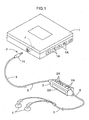
- a jack J in accordance with the present invention can be provided in a mobile phone or, as shown in FIG. 1, in a portable audio device 1, such as an MD player or a CD player.
- the jack J is configured so as to allow use of a single-prong plug P for connecting stereo ear-phones 4 or headphones (not shown in the drawings) via a cable 3 that is provided with a controller 2 at an intermediate portion.
- the plug P having the controller 2 when using the plug P having the controller 2, it is possible to play or stop the audio saved on a medium placed in the audio device 1 or to control the volume or the like by operating a plurality of switches 2A provided on the controller 2. If the controller 2 is provided with a liquid crystal display 2B as shown in FIG. 1, then its control state can be displayed.
- the jack J can also be used for an ordinary plug P that is not provided with a controller 2. When using such a plug P, it is possible to play or stop the audio or to control the volume or the like by operating a plurality of switches 1A provided on the audio device 1.
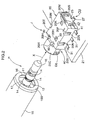
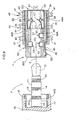
- the plug P is provided with a tip electrode 10 at the front end of the plug, and, in that order from the front end, first and second ring electrodes 11 and 12 for audio signals, and a third ring electrode 13 for control signals, which are separated by three insulation rings 14.
- the plug P is further provided with a cylindrical first sleeve electrode 16 and second sleeve electrode 17 for control purposes.
- the tip electrode 10, the first and second ring electrodes 11 and 12, and the first and second sleeve electrodes 16 and 17 are all made of a good conductor, such as a copper alloy or the like, with excellent abrasion resistance. Although not shown in the drawings, all of these electrodes are connected to conducting wires within the cable 3.
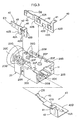
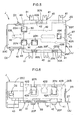
- the jack J has a block-shaped body 20 made of an insulating resin that is provided with a top surface 20T, a bottom surface 20B, and a plurality of side surfaces 20S.
- a plurality of contacts (explained below) are provided along a plug insertion hole H that is in continuation with an aperture of a cylindrical portion 20C formed in one piece with one of the side surfaces 20S.
- the inner surface of the cylindrical portion 20C facing the plug insertion hole H is provided with an inner control contact DB contacting the third ring electrode 13, and the outer surface of the cylindrical portion 20C is provided with first and second control contacts D1 and D2 contacting the first and second sleeve electrodes 16 and 17.
- a pair of positioning protrusions 20P protrude from the lower surface 20B of the body 20.
- these positioning protrusions 20P are engaged with holes 21A in the substrate 21, as shown in FIGs. 10 and 11, so that the jack J can be positioned with high precision with respect to the substrate 21.
- the engagement of the protrusions 20P with the holes 21A in the substrate 21 ensures that there is no relative displacement between the substrate 21 and the jack J when the plug P is inserted into or pulled out of the jack J, even when using a large force to do so.
- the plurality of contacts are made of a contact unit CU having tip contacts CT that establish a conductive state as they contact the tip electrode 10 at the front end of the plug, and first and second intermediate contacts C1 and C2 that establish a conductive state as they contact the first and the second ring electrodes 11 and 12.
- the contact unit CU includes a linking portion 23, intermediate portions 24, folded portions 25, and abutting portions 26, formed in one piece by bending a band-shaped good conductor, such as a copper alloy or the like.
- the linking portion 23 is arranged at the inner end of the plug insertion hole H in an orientation perpendicular to the axis X of the plug insertion hole H (that is, an orientation in which the walls of the linking portion 23 are perpendicular to the axis X).
- the intermediate portions 24 extend from both ends of the linking portion 23 towards the aperture of the plug insertion hole H (along the axis X of the plug insertion hole H).
- the folded portions 25 are folded over from the ends of the intermediate portions 24 to the inner side of the plug insertion hole H, projecting into the plug insertion hole H. And the abutting portions 26 project from the intermediate portions 24 toward the folded portions 25.
- the above-mentioned tip contacts CT are formed on the free end side of the folded portions 27.
- the tip contacts CT are formed by shaping a curvature, such that they protrude towards the axis of the plug insertion hole H, fitting the small diameter portion of the tip electrode 10 of the plug P. If the tip contacts CT are deformed together with the folded portions 25 in the direction away from the axis X of the plug insertion hole H, then the abutting portions 26 abut against the tip contacts CT and prevent excessive deformation.
- this contact unit CU it is not necessary to let the protruding ends of the abutting portions 26 abut against the tip contacts CT as shown in FIG. 9, and it is possible to let the protruding ends of the abutting portions 26 abut against the folded portions 25.
- a terminal 27 is formed in one piece with the linking portion 23 of this contact unit CU, and latch portions 24A are formed unitarily at the edges of the intermediate portion 24.
- the latch portions 24A are brought into a state in which they engage the bottom surface 20B of the body 20 and an engaging hole 20F formed in the top surface 20T of the body 20 and are supported in this latched state.
- the bottom surface of the terminal 27 of the contact unit CU is arranged in an orientation in which it is located on a virtual plane defined by the bottom surface 20B of the body 20.
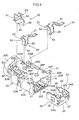
- the first intermediate contact C1 and the second intermediate contacts C2 are both formed on contact members 30 made by press-forming a good conductor, such a copper alloy or the like.
- the contact member 30 for the first intermediate contact is provided with a terminal 31, a support portion 32, a curved portion 33, and the first intermediate contact C1.
- the support portion 32 is linked to the terminal 31 and in vertical orientation in FIG. 4 (that is, oriented in a direction perpendicular to the surface of the substrate 21).
- the curved portion 33 is linked to the support portion 32 and formed such that it can be elastically deformed.
- the first intermediate contact C1 is linked to the curved portion 33, and is formed in an arc along the face on the side of the plug.
- a small protrusion portion 34 is formed on the contact face of this first intermediate contact C1.
- the support portions 32 are brought into press contact with and supported by the inner face of slits formed in continuation with the holes 20G, and at the same time, the curved portion 33 is fitted into an aperture 20H formed in the top surface 20T of the body 20, stabilizing the orientation of the first intermediate contact C1.
- the bottom surface of the terminal 31 is arranged on a virtual plane defined by the bottom surface 20B of the body 20.
- the contact members 30 for the second intermediate contact are provided with a terminal 31, a support portion 32, a curved portion 33, and the second intermediate contact C2.
- the support portion 32 is linked to the terminal 31 and in vertical orientation in FIG. 4 (that is, oriented in a direction perpendicular to the surface of the substrate 21).
- the curved portion 33 is linked to the support portion 32 and formed such that it can be elastically deformed.
- the second intermediate contact C2 is linked to the curved portion 33, and is formed in an arc along the face on the side of the plug.
- members are used that form a symmetrical shape after they have been arranged in opposition at the aperture location of the plug insertion hole H.
- a small protrusion portion 34 is formed on the contact faces of the second intermediate contacts C2.
- control contact DB and the first and second control contacts D1 and D2 are formed on control contact members 40 made by press-forming a good conductor, such as a copper alloy or the like, and the control contact members 40 have basically the same structure.
- control contact members 40 have a terminal 41, a support portion 42, an arm portion 43, and the inner control contact DB or the first or second control contact D1 or D2.
- the support portion 42 is linked to the terminal 41 and in vertical orientation in FIG. 3 (that is, oriented in a direction perpendicular to the surface of the substrate 21).
- the arm portion 43 is linked to the support portion 42 and is elastically deformable.
- the inner control contact DB, and the first and second control contacts D1 and D2 are linked to the arm portion 43.
- the respective support portions 42 are formed in one piece with a protruding piece 42A that prevents the control contact member 40 from coming off, and the edges of the respective support portions 42 are formed in one piece with a plurality of checking pieces 42B that prevent the control contact member 40 from coming off.
- control contact member 40 that is provided with the inner control contact DB into the body 20 from the same direction as the contact unit CU, its support portion 42 is brought into press contact with the inner face of a groove-shaped portion 20M in the body 20, and at the same time, the protrusion piece 42A engages an engaging hole 20K formed in the top surface 20T of the body 20, one of the checking pieces 42B engages an engaging hole 20L in the bottom surface of the body, and the other checking piece 42B engages the inside of the body 20, thereby maintaining the control contact member 40 in its supported state.
- control contact members 40 that are provided with the first and second control contacts D1 and D2 into groove-shaped portions 20M formed in the bottom surface 20B of the body 20.
- their support portions 42 are brought into press contact with the inner face of a groove-shaped portion 20M in the body 20, and at the same time, their protrusion pieces 42A engage engaging holes 20N formed in the side surfaces 20S of the body 20, and their checking pieces 42B engage the inside of the body 20, thereby maintaining the control contact members 40 in their supported state.
- the inner control contact DB is arranged at the inner surface of the cylindrical portion 20C, as mentioned above, whereas the first and the second control contacts D1 and D2 are arranged at the outer surface of the cylindrical portion 20C.
- the bottom surfaces of the terminals 41 of the control contact members 40 are positioned on the virtual plane defined by the bottom surface 20B of the body 20.
- the spacing S in the direction along the plug insertion hole H between the conduction site of the first intermediate contact C1 and the conduction site of the tip contacts CT is set to a value that is smaller than the length L in the direction along the plug axis of the region of the plug's tip electrode 10 at which conduction is possible. It should be noted that this region at which conduction is possible is the region at which conduction becomes possible by contacting the first intermediate contact C1 or the tip contacts CT.
- the tip electrode 10 will not contact the tip contacts CT or the members constituting the contact unit CU in a state in which the first intermediate contact C1 contacts the end on the base end side (side near the insulation ring 14) of the tip electrode 10, as shown in FIG. 13(a). And when a state is reached in which the plug P is further inserted into from the position shown in FIG. 13(a) and the tip contact CT contacts the tip electrode 10 as shown in FIG. 13(b), then the first intermediate contact C1 is separated from the tip electrode 10.
- the first intermediate electrode C1 and the tip contact CT will not simultaneously contact the tip electrode 10, and an unnecessary current due to electrical conduction between the first intermediate electrode C1 and the tip contact CT will not flow, thus avoiding the problem of grating noises being generated in the headphones 4 or the earphones.
- the pair of tip contacts CT contact the tip electrode 10 in an embracing fashion
- the first intermediate contact C1 contacts the first ring electrode 11
- the pair of second intermediate contacts C2 contacts the second ring electrode 12 in a clamping fashion
- the inner control contact DB contacts the third ring electrode 13
- the first control contact D1 contacts the first sleeve electrode 16
- the second control contact D2 contacts the second sleeve electrode 17, thereby enabling the transmission of audio signal and the accessing of control signals.
- the tip electrode 10 at the front end of the plug is embraced by the pair of tip contacts CT formed on the contact unit CU, thus contacting the tip electrode 10 and establishing a conductive state, so that a reliable contact is accomplished regardless of the orientation in which the plug P is inserted.
- the tip contacts CT due to elastic deformation of the tip contacts CT at the combined region of the intermediate portion 24 and the folded portion 25 of the contact unit CU, the tip contacts CT, there is a contact pressure with respect to the tip electrode 10, so that a favorable elastic spring force can be attained without making the contact unit CU bigger, and as a result, a smaller jack J can be realized.
- the combined region of the intermediate portion 24 and the folded portion 25 is elastically deformed as it comes into contact with the tip electrode 10 as explained above, so that, as opposed to configurations with local elastic deformation, even when the plug P is inserted and pulled out repeatedly, a contact state with a favorable contact pressure is maintained without risking plastic deformation of the intermediate portion 24 and the folded portion 25.
- the folded portion 25 abuts against the tip contact CT, thereby setting a limit to the deformation, so that the problem of plastic deformation of one of the intermediate portions 24 or folded portions 25 can be avoided.
- the spacing S in the direction along the plug insertion hole H between the conduction site of the first intermediate contact C1 and the conduction site of the tip contacts CT to a value that is smaller than the length L in the direction along the plug axis of the region of the plug's tip electrode 10 at which conduction is possible, the problem of grating noises being generated in the headphones 4 or the earphones when the plug P is inserted or pulled out can be avoided.
- the plug P is clamped by the pair of second intermediate contacts C2 on the side near the aperture of the plug insertion hole H, so that with this configuration, the orientation of the plug P is maintained and the plug P is prevented from coming off.
- this jack J can be assembled by inserting the contact unit CU, the plurality of contact members 30 and the plurality of control contact members 40 into the body 20, so that extraordinary steps such as gluing or caulking are not necessary. Moreover, if the jack J has been mounted to the substrate 21, it can be positioned with high accuracy with respect to the substrate 21, due to the protrusions 20P protruding from the bottom surface 20B. At the same time, a firm mounting state is maintained without changing the position of the jack J with respect to the substrate 21, even if the plug P is inserted or pulled out under application of a large force.
- the jack according to the present invention can be applied to jacks for audio devices, such as MD players or CD players, or mobile phones, which can be used for single-prong plugs for connecting stereo earphones or headphones via a cable. Furthermore, it can also be applied to jacks adapted for a single tip electrode and a single ring electrode for monaural audio devices, or it can be applied to jacks adapted for plugs not provided with control electrodes.
Landscapes
- Coupling Device And Connection With Printed Circuit (AREA)
- Details Of Connecting Devices For Male And Female Coupling (AREA)
Applications Claiming Priority (3)
| Application Number | Priority Date | Filing Date | Title |
|---|---|---|---|
| JP2002116190 | 2002-04-18 | ||
| JP2002116190A JP2003308933A (ja) | 2002-04-18 | 2002-04-18 | ジャック |
| PCT/JP2003/004756 WO2003088428A1 (en) | 2002-04-18 | 2003-04-14 | Jack |
Publications (2)
| Publication Number | Publication Date |
|---|---|
| EP1496579A1 true EP1496579A1 (de) | 2005-01-12 |
| EP1496579A4 EP1496579A4 (de) | 2006-10-04 |
Family
ID=29243447
Family Applications (1)
| Application Number | Title | Priority Date | Filing Date |
|---|---|---|---|
| EP03717583A Withdrawn EP1496579A4 (de) | 2002-04-18 | 2003-04-14 | Stecker |
Country Status (7)
| Country | Link |
|---|---|
| US (1) | US6869315B2 (de) |
| EP (1) | EP1496579A4 (de) |
| JP (1) | JP2003308933A (de) |
| KR (1) | KR20030082907A (de) |
| CN (1) | CN1257584C (de) |
| TW (1) | TWI255083B (de) |
| WO (1) | WO2003088428A1 (de) |
Cited By (3)
| Publication number | Priority date | Publication date | Assignee | Title |
|---|---|---|---|---|
| EP1939992A3 (de) * | 2006-12-25 | 2009-05-13 | Hosiden Corporation | Buchse |
| EP2557637A1 (de) * | 2011-08-11 | 2013-02-13 | Tyco Electronics Nederland B.V. | Rückhaltefeder und Trägerplatte dafür |
| EP2619793A4 (de) * | 2010-09-25 | 2014-03-12 | Intel Corp | Selbstbezogener bolzen |
Families Citing this family (39)
| Publication number | Priority date | Publication date | Assignee | Title |
|---|---|---|---|---|
| JP2005268067A (ja) * | 2004-03-19 | 2005-09-29 | Smk Corp | 多極ジャック |
| US20060083399A1 (en) * | 2004-10-20 | 2006-04-20 | Johnson Yang | Earphone connector assembly |
| KR100700018B1 (ko) * | 2004-11-22 | 2007-03-27 | 유지컴 주식회사 | 잭 |
| KR100677423B1 (ko) * | 2004-12-31 | 2007-02-02 | 엘지전자 주식회사 | 잭 조립체 및 이를 구비한 휴대용 단말기 |
| USD535622S1 (en) * | 2005-11-23 | 2007-01-23 | Hon Hai Precision Ind. Co. Ltd. | Audio jack connector |
| JP4505424B2 (ja) * | 2006-03-17 | 2010-07-21 | ホシデン株式会社 | ジャック |
| US7285024B1 (en) * | 2006-03-29 | 2007-10-23 | Speed Tech Corp. | Audio jack connector |
| US7238059B1 (en) * | 2006-06-06 | 2007-07-03 | Cheng Uei Precision Industry Co., Ltd. | Audio jack connector |
| TW200803069A (en) * | 2006-06-26 | 2008-01-01 | Delta Electronics Inc | Power adapter with detachable power line connector |
| TWM319560U (en) * | 2007-04-27 | 2007-09-21 | Advanced Connectek Inc | Radio-frequency socket connector |
| JP4134247B1 (ja) * | 2007-06-20 | 2008-08-20 | 株式会社エクセル電子 | 多極ジャック及び多極プラグ |
| JP2009048922A (ja) * | 2007-08-22 | 2009-03-05 | D D K Ltd | ジャック用コネクタ |
| US20090298347A1 (en) * | 2008-05-28 | 2009-12-03 | Yin Lung Wu | Audio jack connector |
| TW200952294A (en) * | 2008-06-06 | 2009-12-16 | Asustek Comp Inc | Connector |
| JP2010049838A (ja) * | 2008-08-19 | 2010-03-04 | Excel Denshi:Kk | 多極単頭プラグ |
| US7789712B1 (en) * | 2009-09-04 | 2010-09-07 | Cheng Uei Precision Industry Co., Ltd. | Audio jack connector |
| US7901251B1 (en) * | 2009-11-13 | 2011-03-08 | Cheng Uei Precision Industry Co., Ltd. | Audio connector |
| CN101784001B (zh) * | 2009-12-18 | 2013-04-17 | 华为终端有限公司 | 一种耳机母座及耳机按键检测方法 |
| KR100967870B1 (ko) | 2010-01-06 | 2010-07-05 | 주식회사 산청 | 잭홀더 |
| US7959472B1 (en) * | 2010-01-15 | 2011-06-14 | Cheng Uei Precision Industry Co., Ltd. | Audio jack connector |
| US20110183536A1 (en) * | 2010-01-26 | 2011-07-28 | Cheng Uei Precision Industry Co., Ltd. | Switch contact and audio jack with the same |
| US8123569B2 (en) * | 2010-02-08 | 2012-02-28 | Hon Hai Precision Ind. Co., Ltd. | Waterproof audio jack connector |
| CN102377056B (zh) * | 2010-08-12 | 2014-01-22 | 鸿富锦精密工业(深圳)有限公司 | 音频连接器及其音频插头 |
| US8771021B2 (en) * | 2010-10-22 | 2014-07-08 | Blackberry Limited | Audio jack with ESD protection |
| KR101113592B1 (ko) * | 2010-12-06 | 2012-02-22 | 암페놀커머셜인터커넥트코리아(주) | 이어폰 잭 |
| US8831267B2 (en) | 2011-07-05 | 2014-09-09 | William R. Annacone | Audio jack system |
| JP5683419B2 (ja) * | 2011-09-14 | 2015-03-11 | ホシデン株式会社 | コネクタ及びこれを備えた電子機器 |
| US8998649B2 (en) * | 2012-03-14 | 2015-04-07 | Sae Magnetics (H.K.) Ltd. | Serial electrical connector |
| US9130289B2 (en) * | 2012-08-02 | 2015-09-08 | Google Inc. | Power connector |
| US8753151B2 (en) * | 2012-09-06 | 2014-06-17 | Htc Corporation | Connector module and handheld electronic device |
| CN104241984A (zh) * | 2013-06-17 | 2014-12-24 | 鸿富锦精密工业(深圳)有限公司 | 连接器支架及连接器组合 |
| US9728914B2 (en) * | 2013-11-22 | 2017-08-08 | Sony Semiconductor Solutions Corporation | Connection device and reception device |
| US9774152B2 (en) | 2014-02-24 | 2017-09-26 | Oleg Los | Forward and backward compatible 5 pole audio plug and jack system |
| CN105337090B (zh) * | 2014-06-09 | 2018-03-06 | 富士康(昆山)电脑接插件有限公司 | 电连接器组件 |
| JP6663754B2 (ja) | 2016-03-09 | 2020-03-13 | 日本航空電子工業株式会社 | コネクタ |
| CN106505358B (zh) * | 2016-10-13 | 2019-07-23 | Oppo广东移动通信有限公司 | 移动终端、耳机座及耳机座的制造方法 |
| PT3309909T (pt) * | 2016-10-13 | 2019-10-15 | Guangdong Oppo Mobile Telecommunications Corp Ltd | Terminal móvel, tomada de auscultador e método para fabrico de tomada de auscultador |
| WO2018068534A1 (en) * | 2016-10-13 | 2018-04-19 | Guangdong Oppo Mobile Telecommunications Corp., Ltd. | Mobile terminal, earphone socket and method for manufacturing earphone socket |
| CN109390725A (zh) * | 2017-08-02 | 2019-02-26 | 连展科技(深圳)有限公司 | 多合一插座电连接器 |
Family Cites Families (10)
| Publication number | Priority date | Publication date | Assignee | Title |
|---|---|---|---|---|
| JPS59141674U (ja) * | 1983-03-10 | 1984-09-21 | 星電器製造株式会社 | ジヤツク |
| DE3427261C2 (de) * | 1983-08-31 | 1986-05-22 | Hosiden Electronics Co., Ltd., Osaka | Elektrische Anschlußbuchse |
| JPS6042286U (ja) * | 1983-08-31 | 1985-03-25 | 星電器製造株式会社 | ジヤツク |
| JP2633258B2 (ja) * | 1987-09-03 | 1997-07-23 | 松下電器産業株式会社 | 接続装置 |
| JP2000340311A (ja) * | 1999-05-31 | 2000-12-08 | Mitsumi Electric Co Ltd | 電気コネクタ |
| US6296525B1 (en) * | 2000-01-07 | 2001-10-02 | J. D'addario & Company, Inc. | Electrical plug and jack connectors |
| JP3683151B2 (ja) * | 2000-02-04 | 2005-08-17 | ホシデン株式会社 | コネクタ用ジャック |
| JP3546162B2 (ja) * | 2000-02-14 | 2004-07-21 | ホシデン株式会社 | 多極コネクタ |
| TW573139B (en) * | 2000-04-14 | 2004-01-21 | Hosiden Corp | Ultra-small single-head optical plug and portable electronic device with the plug |
| US6312274B1 (en) * | 2001-01-12 | 2001-11-06 | Advanced Connectek Inc. | Electrical connector |
-
2002
- 2002-04-18 JP JP2002116190A patent/JP2003308933A/ja active Pending
-
2003
- 2003-03-12 TW TW092105376A patent/TWI255083B/zh not_active IP Right Cessation
- 2003-04-09 KR KR10-2003-0022232A patent/KR20030082907A/ko not_active Ceased
- 2003-04-14 CN CNB038004704A patent/CN1257584C/zh not_active Expired - Fee Related
- 2003-04-14 WO PCT/JP2003/004756 patent/WO2003088428A1/ja not_active Ceased
- 2003-04-14 EP EP03717583A patent/EP1496579A4/de not_active Withdrawn
- 2003-04-14 US US10/471,359 patent/US6869315B2/en not_active Expired - Fee Related
Cited By (6)
| Publication number | Priority date | Publication date | Assignee | Title |
|---|---|---|---|---|
| EP1939992A3 (de) * | 2006-12-25 | 2009-05-13 | Hosiden Corporation | Buchse |
| EP2619793A4 (de) * | 2010-09-25 | 2014-03-12 | Intel Corp | Selbstbezogener bolzen |
| EP2557637A1 (de) * | 2011-08-11 | 2013-02-13 | Tyco Electronics Nederland B.V. | Rückhaltefeder und Trägerplatte dafür |
| WO2013020994A1 (en) * | 2011-08-11 | 2013-02-14 | Tyco Electronics Nederland Bv | Retention spring and substrate therefor |
| CN103947052A (zh) * | 2011-08-11 | 2014-07-23 | 泰科电子连接荷兰公司 | 保持弹簧和用于其的基板 |
| CN103947052B (zh) * | 2011-08-11 | 2017-04-26 | 泰科电子连接荷兰公司 | 保持弹簧和用于其的基板 |
Also Published As
| Publication number | Publication date |
|---|---|
| EP1496579A4 (de) | 2006-10-04 |
| KR20030082907A (ko) | 2003-10-23 |
| TW200306041A (en) | 2003-11-01 |
| CN1518787A (zh) | 2004-08-04 |
| WO2003088428A1 (en) | 2003-10-23 |
| TWI255083B (en) | 2006-05-11 |
| JP2003308933A (ja) | 2003-10-31 |
| US6869315B2 (en) | 2005-03-22 |
| US20040242076A1 (en) | 2004-12-02 |
| CN1257584C (zh) | 2006-05-24 |
Similar Documents
| Publication | Publication Date | Title |
|---|---|---|
| US6869315B2 (en) | Jack | |
| US6761571B2 (en) | Coaxial connector with a switch | |
| JP3337650B2 (ja) | スイッチ付き同軸コネクタ | |
| JP2003217755A (ja) | 同軸ケーブルコネクタ及びその取付方法 | |
| JP2011040262A (ja) | 同軸コネクタ及びその組立方法 | |
| JP2824757B2 (ja) | 電気コネクタ | |
| JP2009231226A (ja) | ライトアングルコネクタ | |
| US6224409B1 (en) | Audio jack | |
| JP6687166B2 (ja) | 同軸コネクタ及び同軸ケーブル付き同軸コネクタ | |
| US20060246776A1 (en) | Connector suitable for connection of a coaxial cable | |
| JP2009037748A (ja) | ケーブルコネクタ及びケーブル接続方法 | |
| JP2019114623A (ja) | 車両用アンテナ装置に用いるケーブル接続構造 | |
| JP2003168520A (ja) | 電気コネクタ組立体 | |
| JP2001307842A (ja) | 同軸コネクタ及びこの同軸コネクタを備えた電子機器 | |
| CN219498260U (zh) | 电连接器 | |
| CN223390825U (zh) | 同轴连接器和同轴连接器组件 | |
| JP3239238B2 (ja) | 同軸ケーブル接続用コンタクト | |
| JP2000021485A (ja) | 接触子及びこの接触子を備えたコネクタ装置 | |
| JP2005158359A (ja) | 接点部材およびそれを備えて成る同軸コネクタ | |
| JP3323141B2 (ja) | 高圧用可変抵抗器 | |
| JP2537567Y2 (ja) | コネクタ | |
| JP2003109712A (ja) | 同軸コネクタ | |
| CN115603113A (zh) | 连接器组 | |
| JPH11111373A (ja) | コネクタ | |
| JP3118281U (ja) | 弾性を有するピン |
Legal Events
| Date | Code | Title | Description |
|---|---|---|---|
| PUAI | Public reference made under article 153(3) epc to a published international application that has entered the european phase |
Free format text: ORIGINAL CODE: 0009012 |
|
| 17P | Request for examination filed |
Effective date: 20031127 |
|
| AK | Designated contracting states |
Kind code of ref document: A1 Designated state(s): AT BE BG CH CY CZ DE DK EE ES FI FR GB GR HU IE IT LI LU MC NL PT RO SE SI SK TR |
|
| A4 | Supplementary search report drawn up and despatched |
Effective date: 20060904 |
|
| 17Q | First examination report despatched |
Effective date: 20110419 |
|
| STAA | Information on the status of an ep patent application or granted ep patent |
Free format text: STATUS: THE APPLICATION IS DEEMED TO BE WITHDRAWN |
|
| 18D | Application deemed to be withdrawn |
Effective date: 20110830 |