EP1496644A2 - Verfahren zur Unterschrift und zur Sitzungsschlüsselerzeugung - Google Patents
Verfahren zur Unterschrift und zur Sitzungsschlüsselerzeugung Download PDFInfo
- Publication number
- EP1496644A2 EP1496644A2 EP04104990A EP04104990A EP1496644A2 EP 1496644 A2 EP1496644 A2 EP 1496644A2 EP 04104990 A EP04104990 A EP 04104990A EP 04104990 A EP04104990 A EP 04104990A EP 1496644 A2 EP1496644 A2 EP 1496644A2
- Authority
- EP
- European Patent Office
- Prior art keywords
- correspondent
- key
- signature
- correspondents
- generator
- Prior art date
- Legal status (The legal status is an assumption and is not a legal conclusion. Google has not performed a legal analysis and makes no representation as to the accuracy of the status listed.)
- Withdrawn
Links
Images
Classifications
-
- H—ELECTRICITY
- H04—ELECTRIC COMMUNICATION TECHNIQUE
- H04L—TRANSMISSION OF DIGITAL INFORMATION, e.g. TELEGRAPHIC COMMUNICATION
- H04L9/00—Cryptographic mechanisms or cryptographic arrangements for secret or secure communications; Network security protocols
- H04L9/08—Key distribution or management, e.g. generation, sharing or updating, of cryptographic keys or passwords
- H04L9/0816—Key establishment, i.e. cryptographic processes or cryptographic protocols whereby a shared secret becomes available to two or more parties, for subsequent use
- H04L9/0838—Key agreement, i.e. key establishment technique in which a shared key is derived by parties as a function of information contributed by, or associated with, each of these
- H04L9/0841—Key agreement, i.e. key establishment technique in which a shared key is derived by parties as a function of information contributed by, or associated with, each of these involving Diffie-Hellman or related key agreement protocols
- H04L9/0844—Key agreement, i.e. key establishment technique in which a shared key is derived by parties as a function of information contributed by, or associated with, each of these involving Diffie-Hellman or related key agreement protocols with user authentication or key authentication, e.g. ElGamal, MTI, MQV-Menezes-Qu-Vanstone protocol or Diffie-Hellman protocols using implicitly-certified keys
-
- H—ELECTRICITY
- H04—ELECTRIC COMMUNICATION TECHNIQUE
- H04L—TRANSMISSION OF DIGITAL INFORMATION, e.g. TELEGRAPHIC COMMUNICATION
- H04L9/00—Cryptographic mechanisms or cryptographic arrangements for secret or secure communications; Network security protocols
- H04L9/32—Cryptographic mechanisms or cryptographic arrangements for secret or secure communications; Network security protocols including means for verifying the identity or authority of a user of the system or for message authentication, e.g. authorization, entity authentication, data integrity or data verification, non-repudiation, key authentication or verification of credentials
- H04L9/3247—Cryptographic mechanisms or cryptographic arrangements for secret or secure communications; Network security protocols including means for verifying the identity or authority of a user of the system or for message authentication, e.g. authorization, entity authentication, data integrity or data verification, non-repudiation, key authentication or verification of credentials involving digital signatures
-
- G—PHYSICS
- G06—COMPUTING OR CALCULATING; COUNTING
- G06F—ELECTRIC DIGITAL DATA PROCESSING
- G06F7/00—Methods or arrangements for processing data by operating upon the order or content of the data handled
- G06F7/60—Methods or arrangements for performing computations using a digital non-denominational number representation, i.e. number representation without radix; Computing devices using combinations of denominational and non-denominational quantity representations, e.g. using difunction pulse trains, STEELE computers, phase computers
- G06F7/72—Methods or arrangements for performing computations using a digital non-denominational number representation, i.e. number representation without radix; Computing devices using combinations of denominational and non-denominational quantity representations, e.g. using difunction pulse trains, STEELE computers, phase computers using residue arithmetic
- G06F7/724—Finite field arithmetic
- G06F7/725—Finite field arithmetic over elliptic curves
-
- Y—GENERAL TAGGING OF NEW TECHNOLOGICAL DEVELOPMENTS; GENERAL TAGGING OF CROSS-SECTIONAL TECHNOLOGIES SPANNING OVER SEVERAL SECTIONS OF THE IPC; TECHNICAL SUBJECTS COVERED BY FORMER USPC CROSS-REFERENCE ART COLLECTIONS [XRACs] AND DIGESTS
- Y04—INFORMATION OR COMMUNICATION TECHNOLOGIES HAVING AN IMPACT ON OTHER TECHNOLOGY AREAS
- Y04S—SYSTEMS INTEGRATING TECHNOLOGIES RELATED TO POWER NETWORK OPERATION, COMMUNICATION OR INFORMATION TECHNOLOGIES FOR IMPROVING THE ELECTRICAL POWER GENERATION, TRANSMISSION, DISTRIBUTION, MANAGEMENT OR USAGE, i.e. SMART GRIDS
- Y04S40/00—Systems for electrical power generation, transmission, distribution or end-user application management characterised by the use of communication or information technologies, or communication or information technology specific aspects supporting them
- Y04S40/20—Information technology specific aspects, e.g. CAD, simulation, modelling, system security
Definitions
- the present invention relates to key agreement protocols for transfer and authentication of encryption keys.
- the correspondents In a secret key cryptographic protocol, the correspondents share a common key that is secret to them. This requires the key to be agreed upon between the correspondents and for provision to be made to maintain the secrecy of the key and provide for change of the key should the underlying security be compromised.
- Public key cryptographic protocols were first proposed in 1976 by Diffie-Hellman and utilized a public key made available to all potential correspondents and a private key known only to the intended recipient.
- the public and private keys are related such that a message encrypted with the public key of a recipient can be readily decrypted with the private key but the private key cannot be derived from the knowledge of the plaintext, ciphertext and public key.
- Key establishment is the process by which two (or more) parties establish a shared secret key, called the session key.
- the session key is subsequently used to achieve some cryptographic goal, such as privacy.
- the number of message exchanges required between the parties is called the number of passes.
- a key establishment protocol is said to provide implicit key authentication (or simply key authentication) if one party is assured that no other party aside from a specially identified second party may learn the value of the session key.
- the property of implicit key authentication does not necessarily mean that the second party actually possesses the session key.
- a key establishment protocol is said to provide key confirmation if one party is assured that a specially identified second party actually has possession of a particular session key. If the authentication is provided to both parties involved in the protocol, then the key authentication is said to be mutual; if provided to only one party, the authentication is said to be unilateral.
- Examples include the Nyberg-Rueppel one-pass protocol and the Matsumoto-Takashima-Imai (MTI) and the Goss and Yacobi two-pass protocols for key agreement.
- Matsumoto-Takashima-Imai Matsumoto-Takashima-Imai
- the prior proposals ensure that transmissions between correspondents to establish a common key are secure and that an interloper cannot retrieve the session key and decrypt the ciphertext. In this way security for sensitive transactions such as transfer of funds is provided.
- the MTI/A0 key agreement protocol establishes a shared secret K, known to the two correspondents, in the following manner:
- A In order to compute the key K, A must use his secret key a and the random integer x, both of which are known only to him. Similarly B must use her secret key b and random integer y to compute the session key K. Provided the secret keys a,b remain uncompromised, an interloper cannot generate a session key identical to the other correspondent. Accordingly, any ciphertext will not be decipherable by both correspondents.
- a practical scenario where such an attack may be launched successfully is the following.
- B is a bank branch and A is an account holder. Certificates are issued by the bank headquarters and within the certificate is the account information of the holder.
- the protocol for electronic deposit of funds is to exchange a key with a bank branch via a mutually authenticated key agreement.
- B has authenticated the transmitting entity, encrypted funds are deposited to the account number in the certificate. If no further authentication is done in the encrypted deposit message (which might be the case to save bandwidth) then the deposit will be made to E's account.
- a method of authenticating a pair of correspondents A,B to permit exchange of information therebetween each of said correspondents having a respective private key a,b and a public key p A ,p B derived from a generator ⁇ and respective ones of said private keys a,b, said method including the steps of
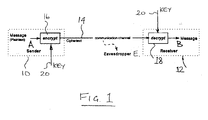
- a pair of correspondents, 10,12 exchange information over a communication channel 14.
- a cryptographic unit 16,18 is interposed between each of the correspondents 10,12 and the channel 14.
- a key 20 is associated with each of the cryptographic units 16,18 to convert plaintext carried between each unit 16,18 and its respective correspondent 10,12 into ciphertext carried on the channel 14.
- a message generated by correspondent A, 10 is encrypted by the unit 16 with the key 20 and transmitted as ciphertext over channel 14 to the unit 18.
- the key 20 operates upon the ciphertext in the unit 18 to generate a plaintext message for the correspondent B, 12. Provided the keys 20 correspond, the message received by the correspondent 12 will be that sent by the correspondent 10.
- the system parameters for these protocols are a prime number p and a generator ⁇ of the multiplicative group Z * / P .
- text A refers to a string of information that identifies party A. If the other correspondent B possesses an authentic copy of correspondent A's public key, then text A will contain A's public-key certificate, issued by a trusted center; correspondent B can use his authentic copy of the trusted center's public key to verify correspondent A's certificate, hence obtaining an authentic copy of correspondent A's public key.
- an interloper E wishes to have messages from A identified as having originated from E herself.
- E does not know the exponent ae, although she knows e.
- the correspondent B will assume that the message originates from E rather than A and use E's public key to generate the session key K.
- E also intercepts the message from B and uses his secret random integer e to modify its contents. A will then use that information to generate the same session key allowing A to communicate with B.
- the purpose of the protocol is for parties A and B to establish a session key K.
- the protocols exemplified are role-symmetric and non-interactive.
- the system parameters for this protocol are a prime number p and a generator ⁇ of the multiplicative group Z * / P .
- Protocol 1 One draw back of the first protocol is that it does not offer perfect forward secrecy. That is, if an adversary learns the long-term private key a of party A, then the adversary can deduce all of A's past session keys.
- the property of perfect forward secrecy can be achieved by modifying Protocol 1 in the following way.
- step 1 A also sends ⁇ x 1 to B, where x 1 is a second random integer generated by A.
- B also sends ⁇ y 1 to A, where y 1 is a random integer.
- the second protocol improves upon the first protocol in the sense that if offers perfect forward secrecy. While it is still the case that disclosure of a private random integer x allows an adversary to learn the private key a, this will not be a problem in practice because A can destroy x as soon as she uses it in step 1 of the protocol.
- the second protocol is a three-pass protocol.
- the quantity s A serves as A's signature on the value ⁇ x .
- This signature has the novel property that it can only be verified by party B. This idea can be generalized to all ElGamal-like signatures schemes.
- a further protocol is available for parties A and B to establish a session key K.
- the system parameters for this protocol are a prime number p and a generator ⁇ for the multiplicative group Z * / P .
- (r A ,s A ) can be thought of as the signature of r x 1 with the property that only A can sign the message r x 1 .
- the protocols described above permit the establishment and authentication of a session key K. It is also desirable to establish a protocol in which permits A to transport a session key K to party B. Such a protocol is exemplified below.
- All one-pass key transport protocols have the following problem of replay.
- a one-pass key transport protocol is used to transmit a session key K from A to B as well as some text encrypted with the session key K.
- E records the transmission from A to B. If E can at a later time gain access to B's decryption machine (but not the internal contents of the machine, such as B's private key), then, by replaying the transmission to the machine, E can recover the original text. (In this scenario, E does not learn the session key K.).
- This replay attack can be foiled by usual methods, such as the use of timestamps.
- B has limited computational resources, in which it is more suitable at the beginning of each session, for B to transmit a random bit string k to A.
- the session key that is used to encrypt the text is then k ⁇ K, i.e. k XOR'd with K.
Landscapes
- Engineering & Computer Science (AREA)
- Computer Security & Cryptography (AREA)
- Computer Networks & Wireless Communication (AREA)
- Signal Processing (AREA)
- Computer And Data Communications (AREA)
- Data Exchanges In Wide-Area Networks (AREA)
- Storage Device Security (AREA)
- Mobile Radio Communication Systems (AREA)
Applications Claiming Priority (3)
| Application Number | Priority Date | Filing Date | Title |
|---|---|---|---|
| US42671295A | 1995-04-21 | 1995-04-21 | |
| US426712 | 1995-04-21 | ||
| EP96105920A EP0739105B1 (de) | 1995-04-21 | 1996-04-16 | Verfahren zur Unterschrift und zur Sitzungsschlüsselerzeugung |
Related Parent Applications (1)
| Application Number | Title | Priority Date | Filing Date |
|---|---|---|---|
| EP96105920A Division EP0739105B1 (de) | 1995-04-21 | 1996-04-16 | Verfahren zur Unterschrift und zur Sitzungsschlüsselerzeugung |
Publications (2)
| Publication Number | Publication Date |
|---|---|
| EP1496644A2 true EP1496644A2 (de) | 2005-01-12 |
| EP1496644A3 EP1496644A3 (de) | 2005-02-09 |
Family
ID=23691906
Family Applications (2)
| Application Number | Title | Priority Date | Filing Date |
|---|---|---|---|
| EP96105920A Expired - Lifetime EP0739105B1 (de) | 1995-04-21 | 1996-04-16 | Verfahren zur Unterschrift und zur Sitzungsschlüsselerzeugung |
| EP04104990A Withdrawn EP1496644A3 (de) | 1995-04-21 | 1996-04-16 | Verfahren zur Unterschrift und zur Sitzungsschlüsselerzeugung |
Family Applications Before (1)
| Application Number | Title | Priority Date | Filing Date |
|---|---|---|---|
| EP96105920A Expired - Lifetime EP0739105B1 (de) | 1995-04-21 | 1996-04-16 | Verfahren zur Unterschrift und zur Sitzungsschlüsselerzeugung |
Country Status (6)
| Country | Link |
|---|---|
| US (1) | US6122736A (de) |
| EP (2) | EP0739105B1 (de) |
| AU (1) | AU5266596A (de) |
| CA (2) | CA2579259C (de) |
| DE (1) | DE69633590T2 (de) |
| WO (1) | WO1996033565A1 (de) |
Families Citing this family (53)
| Publication number | Priority date | Publication date | Assignee | Title |
|---|---|---|---|---|
| US7334127B2 (en) | 1995-04-21 | 2008-02-19 | Certicom Corp. | Key agreement and transport protocol |
| US7243232B2 (en) | 1995-04-21 | 2007-07-10 | Certicom Corp. | Key agreement and transport protocol |
| US6785813B1 (en) | 1997-11-07 | 2004-08-31 | Certicom Corp. | Key agreement and transport protocol with implicit signatures |
| US6487661B2 (en) | 1995-04-21 | 2002-11-26 | Certicom Corp. | Key agreement and transport protocol |
| EP2315390B1 (de) * | 1996-10-18 | 2014-09-17 | Certicom Corp. | Schlüsselvereinbarungs- und Transportprotokoll mit impliziten Signaturen |
| FI974341A7 (fi) | 1997-11-26 | 1999-05-27 | Nokia Telecommunications Oy | Datayhteyksien tietosuoja |
| DE19811833A1 (de) * | 1998-03-18 | 1999-09-30 | Siemens Ag | Schlüsselaustauschprotokoll |
| SE9900472L (sv) * | 1999-02-12 | 2000-08-13 | Ericsson Telefon Ab L M | Förfarande och arrangemang för att möjliggöra krypterad kommunikation |
| US7499551B1 (en) * | 1999-05-14 | 2009-03-03 | Dell Products L.P. | Public key infrastructure utilizing master key encryption |
| US7707420B1 (en) * | 1999-06-23 | 2010-04-27 | Research In Motion Limited | Public key encryption with digital signature scheme |
| TW548940B (en) * | 1999-11-29 | 2003-08-21 | Gen Instrument Corp | Generation of a mathematically constrained key using a one-way function |
| US20020078352A1 (en) * | 2000-12-15 | 2002-06-20 | International Business Machines Corporation | Secure communication by modification of security codes |
| GB2379588A (en) * | 2001-09-11 | 2003-03-12 | Motorola Inc | Encrypting/decrypting information in a wireless communication system |
| CA2369545C (en) * | 2001-12-31 | 2013-01-08 | Blackberry Limited | Method and apparatus for elliptic curve scalar multiplication |
| CA2369540C (en) | 2001-12-31 | 2013-10-01 | Blackberry Limited | Method and apparatus for computing a shared secret key |
| US7142674B2 (en) | 2002-06-18 | 2006-11-28 | Intel Corporation | Method of confirming a secure key exchange |
| US7505585B2 (en) * | 2002-06-25 | 2009-03-17 | The United States Of America As Represented By The Director, The National Security Agency | Method of generating cryptographic key using elliptic curve and expansion in joint sparse form and using same |
| KR100571820B1 (ko) | 2003-10-20 | 2006-04-17 | 삼성전자주식회사 | 신원 정보를 기반으로 하는 암호 시스템에서의 컨퍼런스세션 키 분배 방법 |
| US8467535B2 (en) * | 2005-01-18 | 2013-06-18 | Certicom Corp. | Accelerated verification of digital signatures and public keys |
| CA2935823C (en) | 2005-01-18 | 2019-01-15 | Blackberry Limited | Accelerated verification of digital signatures and public keys |
| US8316416B2 (en) * | 2005-04-04 | 2012-11-20 | Research In Motion Limited | Securely using a display to exchange information |
| US7627760B2 (en) * | 2005-07-21 | 2009-12-01 | Microsoft Corporation | Extended authenticated key exchange |
| US7694141B2 (en) * | 2005-07-26 | 2010-04-06 | Microsoft Corporation | Extended authenticated key exchange with key confirmation |
| US7908482B2 (en) * | 2005-08-18 | 2011-03-15 | Microsoft Corporation | Key confirmed authenticated key exchange with derived ephemeral keys |
| US8190895B2 (en) * | 2005-08-18 | 2012-05-29 | Microsoft Corporation | Authenticated key exchange with derived ephemeral keys |
| US8670566B2 (en) * | 2006-05-12 | 2014-03-11 | Blackberry Limited | System and method for exchanging encryption keys between a mobile device and a peripheral output device |
| US8005223B2 (en) | 2006-05-12 | 2011-08-23 | Research In Motion Limited | System and method for exchanging encryption keys between a mobile device and a peripheral device |
| SG174833A1 (en) | 2006-11-15 | 2011-10-28 | Certicom Corp | Implicit certificate verification |
| JP2009130882A (ja) * | 2007-11-28 | 2009-06-11 | Oki Electric Ind Co Ltd | チェックバリュー確認方法及び装置 |
| CN102648471B (zh) | 2008-11-24 | 2015-05-27 | 塞尔蒂卡姆公司 | 用于基于硬件的安全的系统和方法 |
| CA2746830C (en) * | 2008-12-16 | 2016-06-07 | Blackberry Limited | Acceleration of key agreement protocols |
| EP2363976A1 (de) * | 2010-02-25 | 2011-09-07 | Certicom Corp. | Verbesserte digitale Signatur und Schlüsselvereinbarungsschemen |
| US8745376B2 (en) | 2011-10-14 | 2014-06-03 | Certicom Corp. | Verifying implicit certificates and digital signatures |
| JP6313520B2 (ja) * | 2014-05-08 | 2018-04-18 | スクエア, インコーポレイテッド | カードリーダとモバイルデバイスとの間のセキュアなセッションの確立 |
| US8990121B1 (en) | 2014-05-08 | 2015-03-24 | Square, Inc. | Establishment of a secure session between a card reader and a mobile device |
| KR102871871B1 (ko) | 2016-02-23 | 2025-10-15 | 엔체인 라이센싱 아게 | 분산형 해시 테이블 및 블록체인을 사용하여 컴퓨터 소프트웨어를 보호하기 위한 방법 및 시스템 |
| US11347838B2 (en) | 2016-02-23 | 2022-05-31 | Nchain Holdings Ltd. | Blockchain implemented counting system and method for use in secure voting and distribution |
| JP6799061B2 (ja) | 2016-02-23 | 2020-12-09 | エヌチェーン ホールディングス リミテッドNchain Holdings Limited | ウォレット管理システムと併せたブロックチェーンベースのシステムのための暗号鍵のセキュアなマルチパーティ損失耐性のある記憶及び転送 |
| EP3420674B1 (de) | 2016-02-23 | 2021-03-24 | Nchain Holdings Limited | Blockkettenimplementiertes verfahren zur steuerung und verteilung von digitalem inhalt |
| JP6528008B2 (ja) | 2016-02-23 | 2019-06-12 | エヌチェーン ホールディングス リミテッドNchain Holdings Limited | 秘密共有のための楕円曲線暗号化を利用したパーソナルデバイスセキュリティ |
| JP6869250B2 (ja) | 2016-02-23 | 2021-05-12 | エヌチェーン ホールディングス リミテッドNchain Holdings Limited | ブロックチェーンを使用してピアツーピア分散型台帳におけるエンティティを効率的な移転のための方法およびシステム |
| EP3268914B1 (de) | 2016-02-23 | 2018-06-20 | Nchain Holdings Limited | Bestimmung eines gemeinsamen geheimnisses für den sicheren informationsaustausch und hierarchische, deterministische kryptographische schlüssel |
| CN109314637B (zh) | 2016-02-23 | 2021-09-10 | 区块链控股有限公司 | 区块链上高效转移加密货币的方法和设备 |
| BR112018016782A2 (pt) | 2016-02-23 | 2018-12-26 | Nchain Holdings Ltd | sistema e método implementado por computador configurado para controlar uma transferência feita através de um blockchain |
| GB2571367A (en) | 2016-02-23 | 2019-08-28 | Nchain Holdings Ltd | Tokenisation method and system for implementing exchanges on a blockchain |
| EP3748903A1 (de) | 2016-02-23 | 2020-12-09 | Nchain Holdings Limited | Universelles tokenisierungssystem für blockchain-basierte kryptowährungen |
| KR102777896B1 (ko) | 2016-02-23 | 2025-03-10 | 엔체인 홀딩스 리미티드 | 토큰화를 이용한 블록체인 기반 교환 방법 |
| SG11201806781SA (en) | 2016-02-23 | 2018-09-27 | Nchain Holdings Ltd | Registry and automated management method for blockchain-enforced smart contracts |
| KR102890466B1 (ko) | 2016-02-23 | 2025-11-21 | 엔체인 라이센싱 아게 | 블록체인으로부터 데이터의 안전한 추출을 위한 암호화 방법 및 시스템 |
| KR102753027B1 (ko) | 2016-02-23 | 2025-01-14 | 엔체인 홀딩스 리미티드 | 블록체인상의 개체의 안전한 전송을 위한 방법 및 시스템 |
| EP3794765A1 (de) | 2018-05-14 | 2021-03-24 | Nchain Holdings Limited | Computerimplementierte systeme und verfahren zur verwendung einer blockchain zur durchführung eines atomaren wechsels |
| GB201815396D0 (en) | 2018-09-21 | 2018-11-07 | Nchain Holdings Ltd | Computer implemented system and method |
| GB201909960D0 (en) | 2019-07-11 | 2019-08-28 | Nchain Holdings Ltd | Computer-implemented system and method |
Family Cites Families (7)
| Publication number | Priority date | Publication date | Assignee | Title |
|---|---|---|---|---|
| US4200770A (en) * | 1977-09-06 | 1980-04-29 | Stanford University | Cryptographic apparatus and method |
| DE3915262A1 (de) * | 1988-05-18 | 1989-11-30 | Asea Brown Boveri | Verfahren zur erzeugung von authentifizierten geheimschluesseln |
| US4956863A (en) * | 1989-04-17 | 1990-09-11 | Trw Inc. | Cryptographic method and apparatus for public key exchange with authentication |
| US5299263A (en) * | 1993-03-04 | 1994-03-29 | Bell Communications Research, Inc. | Two-way public key authentication and key agreement for low-cost terminals |
| ATE187588T1 (de) * | 1993-08-17 | 1999-12-15 | R3 Security Engineering Ag | Verfahren zur digitalen unterschrift und verfahren zur schlüsselübereinkunft |
| US5761305A (en) * | 1995-04-21 | 1998-06-02 | Certicom Corporation | Key agreement and transport protocol with implicit signatures |
| CA2176972C (en) * | 1995-05-17 | 2008-11-25 | Scott A. Vanstone | Key agreement and transport protocol with implicit signatures |
-
1996
- 1996-04-15 WO PCT/CA1996/000239 patent/WO1996033565A1/en not_active Ceased
- 1996-04-15 AU AU52665/96A patent/AU5266596A/en not_active Abandoned
- 1996-04-16 DE DE69633590T patent/DE69633590T2/de not_active Expired - Lifetime
- 1996-04-16 CA CA002579259A patent/CA2579259C/en not_active Expired - Lifetime
- 1996-04-16 EP EP96105920A patent/EP0739105B1/de not_active Expired - Lifetime
- 1996-04-16 EP EP04104990A patent/EP1496644A3/de not_active Withdrawn
- 1996-04-16 CA CA002174261A patent/CA2174261C/en not_active Expired - Lifetime
-
1997
- 1997-11-07 US US08/966,766 patent/US6122736A/en not_active Expired - Lifetime
Non-Patent Citations (1)
| Title |
|---|
| None |
Also Published As
| Publication number | Publication date |
|---|---|
| AU5266596A (en) | 1996-11-07 |
| WO1996033565A1 (en) | 1996-10-24 |
| DE69633590T2 (de) | 2006-02-02 |
| EP0739105B1 (de) | 2004-10-13 |
| CA2174261C (en) | 2007-06-12 |
| US6122736A (en) | 2000-09-19 |
| CA2174261A1 (en) | 1996-10-22 |
| CA2579259C (en) | 2010-02-02 |
| EP1496644A3 (de) | 2005-02-09 |
| CA2579259A1 (en) | 1996-10-22 |
| DE69633590D1 (de) | 2004-11-18 |
| EP0739105A1 (de) | 1996-10-23 |
Similar Documents
| Publication | Publication Date | Title |
|---|---|---|
| EP0739105B1 (de) | Verfahren zur Unterschrift und zur Sitzungsschlüsselerzeugung | |
| US5761305A (en) | Key agreement and transport protocol with implicit signatures | |
| US5896455A (en) | Key agreement and transport protocol with implicit signatures | |
| US6785813B1 (en) | Key agreement and transport protocol with implicit signatures | |
| US6487661B2 (en) | Key agreement and transport protocol | |
| US7243232B2 (en) | Key agreement and transport protocol | |
| EP1526676B1 (de) | Verfahren zur Verteilung von Konferenzschlüsseln, gemäss einem Identitätsbasierten Verschlüsselungssystem. | |
| EP2315389B1 (de) | Schlüsselvereinbarungs- und Transportprotokoll mit impliziten Signaturen | |
| HK1101628B (en) | Key agreement and transport protocol with implicit signatures | |
| HK1157529B (en) | Key agreement and transport protocol with implicit signatures | |
| HK1157528B (en) | Key agreement and transport protocol with implicit signatures |
Legal Events
| Date | Code | Title | Description |
|---|---|---|---|
| PUAI | Public reference made under article 153(3) epc to a published international application that has entered the european phase |
Free format text: ORIGINAL CODE: 0009012 |
|
| PUAL | Search report despatched |
Free format text: ORIGINAL CODE: 0009013 |
|
| AC | Divisional application: reference to earlier application |
Ref document number: 0739105 Country of ref document: EP Kind code of ref document: P |
|
| AK | Designated contracting states |
Kind code of ref document: A2 Designated state(s): CH DE ES FR GB IT LI NL SE |
|
| AK | Designated contracting states |
Kind code of ref document: A3 Designated state(s): CH DE ES FR GB IT LI NL SE |
|
| RIC1 | Information provided on ipc code assigned before grant |
Ipc: 7H 04L 9/32 B Ipc: 7H 04L 9/08 A |
|
| RIN1 | Information on inventor provided before grant (corrected) |
Inventor name: VANSTONE, SCOTT A. Inventor name: QU, MINGHUA Inventor name: MENEZES, ALFRED JOHN |
|
| 17P | Request for examination filed |
Effective date: 20050729 |
|
| AKX | Designation fees paid |
Designated state(s): CH DE ES FR GB IT LI NL SE |
|
| 17Q | First examination report despatched |
Effective date: 20090217 |
|
| RAP1 | Party data changed (applicant data changed or rights of an application transferred) |
Owner name: CERTICOM CORP. |
|
| STAA | Information on the status of an ep patent application or granted ep patent |
Free format text: STATUS: THE APPLICATION IS DEEMED TO BE WITHDRAWN |
|
| 18D | Application deemed to be withdrawn |
Effective date: 20130326 |