EP1496892B1 - Derives de 1h-benzo(f)indazol-5-yl utilises en tant que modulateurs selectifs du recepteur glucocorticoide - Google Patents
Derives de 1h-benzo(f)indazol-5-yl utilises en tant que modulateurs selectifs du recepteur glucocorticoide Download PDFInfo
- Publication number
- EP1496892B1 EP1496892B1 EP03718285A EP03718285A EP1496892B1 EP 1496892 B1 EP1496892 B1 EP 1496892B1 EP 03718285 A EP03718285 A EP 03718285A EP 03718285 A EP03718285 A EP 03718285A EP 1496892 B1 EP1496892 B1 EP 1496892B1
- Authority
- EP
- European Patent Office
- Prior art keywords
- etoac
- mmol
- hexanes
- reaction
- added
- Prior art date
- Legal status (The legal status is an assumption and is not a legal conclusion. Google has not performed a legal analysis and makes no representation as to the accuracy of the status listed.)
- Expired - Lifetime
Links
- 0 C[C@@](C1)([C@](*)(CCC2)[C@](c3ccc(C)c(C=C)c3)OC)C2=CC2=C1C=**2c1ccc(C=*)cc1 Chemical compound C[C@@](C1)([C@](*)(CCC2)[C@](c3ccc(C)c(C=C)c3)OC)C2=CC2=C1C=**2c1ccc(C=*)cc1 0.000 description 7
- ZGGKNRUTPLERIK-LDBYWJCYSA-N C/C(/CCC[C@@H](CC1)[C@H](c2cc(CO)ccc2)O)=C\c2c1cn[n]2-c(cc1)ccc1F Chemical compound C/C(/CCC[C@@H](CC1)[C@H](c2cc(CO)ccc2)O)=C\c2c1cn[n]2-c(cc1)ccc1F ZGGKNRUTPLERIK-LDBYWJCYSA-N 0.000 description 1
- LMWKGVHGBOZNCF-FHLAJEGSSA-N CC(C1)([C@H](CCC2)[C@@H](c(cc3)ccc3F)O)C2=Cc2c1cn[n]2-c(cc1)ccc1F Chemical compound CC(C1)([C@H](CCC2)[C@@H](c(cc3)ccc3F)O)C2=Cc2c1cn[n]2-c(cc1)ccc1F LMWKGVHGBOZNCF-FHLAJEGSSA-N 0.000 description 1
- CAFIKTJRLKNMSB-BVAGGSTKSA-N C[C@@](C1)([C@H](CCC2)C(Cc3ccccc3)=O)C2=Cc2c1cn[n]2-c(cc1)ccc1F Chemical compound C[C@@](C1)([C@H](CCC2)C(Cc3ccccc3)=O)C2=Cc2c1cn[n]2-c(cc1)ccc1F CAFIKTJRLKNMSB-BVAGGSTKSA-N 0.000 description 1
- QLFOUNLIOQNADF-ARMFNRFLSA-N C[C@@](C1)([C@H](CCC2)[C@@H](Cc3ccccc3)O)C2=CC(Nc(cc2)ccc2F)=C1C=N Chemical compound C[C@@](C1)([C@H](CCC2)[C@@H](Cc3ccccc3)O)C2=CC(Nc(cc2)ccc2F)=C1C=N QLFOUNLIOQNADF-ARMFNRFLSA-N 0.000 description 1
- SRRJVOMFCQWCTJ-ARMFNRFLSA-N C[C@@](C1)([C@H](CCC2)[C@@H](Cc3ccccc3)O)C2=Cc2c1cn[n]2-c(cc1)ccc1F Chemical compound C[C@@](C1)([C@H](CCC2)[C@@H](Cc3ccccc3)O)C2=Cc2c1cn[n]2-c(cc1)ccc1F SRRJVOMFCQWCTJ-ARMFNRFLSA-N 0.000 description 1
- JXNMFWGSWNZGTH-STXQHDJLSA-N C[C@@](C1)([C@H](CCC2)[C@H](Cc3cc(C)ccc3)O)C2=Cc2c1cn[n]2-c(cc1)ccc1F Chemical compound C[C@@](C1)([C@H](CCC2)[C@H](Cc3cc(C)ccc3)O)C2=Cc2c1cn[n]2-c(cc1)ccc1F JXNMFWGSWNZGTH-STXQHDJLSA-N 0.000 description 1
- CUOWBQJBYPWINR-IGBKUBFESA-N C[C@@](C1)([C@H](CCC2)[C@H](c(cc3)c(cccc4)c4c3F)O)C2=Cc2c1cn[n]2-c(cc1)ccc1F Chemical compound C[C@@](C1)([C@H](CCC2)[C@H](c(cc3)c(cccc4)c4c3F)O)C2=Cc2c1cn[n]2-c(cc1)ccc1F CUOWBQJBYPWINR-IGBKUBFESA-N 0.000 description 1
- HHEFUPFPFKNAGV-ICTDUYRTSA-N C[C@@](C1)([C@H](CCC2)[C@H](c(cc3)cc(N(C)C)c3F)O)C2=Cc2c1cn[n]2-c(cc1)ccc1F Chemical compound C[C@@](C1)([C@H](CCC2)[C@H](c(cc3)cc(N(C)C)c3F)O)C2=Cc2c1cn[n]2-c(cc1)ccc1F HHEFUPFPFKNAGV-ICTDUYRTSA-N 0.000 description 1
- DHWWHGHZBWODEZ-QDSKXPNFSA-N C[C@@](C1)([C@H](CCC2)[C@H](c(cc3)cnc3F)O)C2=Cc2c1cn[n]2-c(cc1)ccc1F Chemical compound C[C@@](C1)([C@H](CCC2)[C@H](c(cc3)cnc3F)O)C2=Cc2c1cn[n]2-c(cc1)ccc1F DHWWHGHZBWODEZ-QDSKXPNFSA-N 0.000 description 1
- JMFAEFMHBLLYHS-NPAAKHOSSA-N C[C@@](C1)([C@H](CCC2)[C@H](c(cc3C)cc(C)c3F)O)C2=Cc2c1cn[n]2-c(cc1)ccc1F Chemical compound C[C@@](C1)([C@H](CCC2)[C@H](c(cc3C)cc(C)c3F)O)C2=Cc2c1cn[n]2-c(cc1)ccc1F JMFAEFMHBLLYHS-NPAAKHOSSA-N 0.000 description 1
- JCJKUOAGKVEXMU-ZCUZBQTDSA-N O[C@@H](CCc1ccccc1)[C@@H](CCC1)CC[C@H](C2)C1=Cc1c2cn[n]1-c(cc1)ccc1F Chemical compound O[C@@H](CCc1ccccc1)[C@@H](CCC1)CC[C@H](C2)C1=Cc1c2cn[n]1-c(cc1)ccc1F JCJKUOAGKVEXMU-ZCUZBQTDSA-N 0.000 description 1
Classifications
-
- C—CHEMISTRY; METALLURGY
- C07—ORGANIC CHEMISTRY
- C07D—HETEROCYCLIC COMPOUNDS
- C07D417/00—Heterocyclic compounds containing two or more hetero rings, at least one ring having nitrogen and sulfur atoms as the only ring hetero atoms, not provided for by group C07D415/00
- C07D417/02—Heterocyclic compounds containing two or more hetero rings, at least one ring having nitrogen and sulfur atoms as the only ring hetero atoms, not provided for by group C07D415/00 containing two hetero rings
- C07D417/06—Heterocyclic compounds containing two or more hetero rings, at least one ring having nitrogen and sulfur atoms as the only ring hetero atoms, not provided for by group C07D415/00 containing two hetero rings linked by a carbon chain containing only aliphatic carbon atoms
-
- A—HUMAN NECESSITIES
- A61—MEDICAL OR VETERINARY SCIENCE; HYGIENE
- A61P—SPECIFIC THERAPEUTIC ACTIVITY OF CHEMICAL COMPOUNDS OR MEDICINAL PREPARATIONS
- A61P1/00—Drugs for disorders of the alimentary tract or the digestive system
- A61P1/04—Drugs for disorders of the alimentary tract or the digestive system for ulcers, gastritis or reflux esophagitis, e.g. antacids, inhibitors of acid secretion, mucosal protectants
-
- A—HUMAN NECESSITIES
- A61—MEDICAL OR VETERINARY SCIENCE; HYGIENE
- A61P—SPECIFIC THERAPEUTIC ACTIVITY OF CHEMICAL COMPOUNDS OR MEDICINAL PREPARATIONS
- A61P1/00—Drugs for disorders of the alimentary tract or the digestive system
- A61P1/16—Drugs for disorders of the alimentary tract or the digestive system for liver or gallbladder disorders, e.g. hepatoprotective agents, cholagogues, litholytics
-
- A—HUMAN NECESSITIES
- A61—MEDICAL OR VETERINARY SCIENCE; HYGIENE
- A61P—SPECIFIC THERAPEUTIC ACTIVITY OF CHEMICAL COMPOUNDS OR MEDICINAL PREPARATIONS
- A61P11/00—Drugs for disorders of the respiratory system
-
- A—HUMAN NECESSITIES
- A61—MEDICAL OR VETERINARY SCIENCE; HYGIENE
- A61P—SPECIFIC THERAPEUTIC ACTIVITY OF CHEMICAL COMPOUNDS OR MEDICINAL PREPARATIONS
- A61P11/00—Drugs for disorders of the respiratory system
- A61P11/06—Antiasthmatics
-
- A—HUMAN NECESSITIES
- A61—MEDICAL OR VETERINARY SCIENCE; HYGIENE
- A61P—SPECIFIC THERAPEUTIC ACTIVITY OF CHEMICAL COMPOUNDS OR MEDICINAL PREPARATIONS
- A61P13/00—Drugs for disorders of the urinary system
- A61P13/12—Drugs for disorders of the urinary system of the kidneys
-
- A—HUMAN NECESSITIES
- A61—MEDICAL OR VETERINARY SCIENCE; HYGIENE
- A61P—SPECIFIC THERAPEUTIC ACTIVITY OF CHEMICAL COMPOUNDS OR MEDICINAL PREPARATIONS
- A61P17/00—Drugs for dermatological disorders
-
- A—HUMAN NECESSITIES
- A61—MEDICAL OR VETERINARY SCIENCE; HYGIENE
- A61P—SPECIFIC THERAPEUTIC ACTIVITY OF CHEMICAL COMPOUNDS OR MEDICINAL PREPARATIONS
- A61P17/00—Drugs for dermatological disorders
- A61P17/14—Drugs for dermatological disorders for baldness or alopecia
-
- A—HUMAN NECESSITIES
- A61—MEDICAL OR VETERINARY SCIENCE; HYGIENE
- A61P—SPECIFIC THERAPEUTIC ACTIVITY OF CHEMICAL COMPOUNDS OR MEDICINAL PREPARATIONS
- A61P19/00—Drugs for skeletal disorders
- A61P19/08—Drugs for skeletal disorders for bone diseases, e.g. rachitism, Paget's disease
-
- A—HUMAN NECESSITIES
- A61—MEDICAL OR VETERINARY SCIENCE; HYGIENE
- A61P—SPECIFIC THERAPEUTIC ACTIVITY OF CHEMICAL COMPOUNDS OR MEDICINAL PREPARATIONS
- A61P21/00—Drugs for disorders of the muscular or neuromuscular system
-
- A—HUMAN NECESSITIES
- A61—MEDICAL OR VETERINARY SCIENCE; HYGIENE
- A61P—SPECIFIC THERAPEUTIC ACTIVITY OF CHEMICAL COMPOUNDS OR MEDICINAL PREPARATIONS
- A61P21/00—Drugs for disorders of the muscular or neuromuscular system
- A61P21/02—Muscle relaxants, e.g. for tetanus or cramps
-
- A—HUMAN NECESSITIES
- A61—MEDICAL OR VETERINARY SCIENCE; HYGIENE
- A61P—SPECIFIC THERAPEUTIC ACTIVITY OF CHEMICAL COMPOUNDS OR MEDICINAL PREPARATIONS
- A61P25/00—Drugs for disorders of the nervous system
- A61P25/18—Antipsychotics, i.e. neuroleptics; Drugs for mania or schizophrenia
-
- A—HUMAN NECESSITIES
- A61—MEDICAL OR VETERINARY SCIENCE; HYGIENE
- A61P—SPECIFIC THERAPEUTIC ACTIVITY OF CHEMICAL COMPOUNDS OR MEDICINAL PREPARATIONS
- A61P25/00—Drugs for disorders of the nervous system
- A61P25/20—Hypnotics; Sedatives
-
- A—HUMAN NECESSITIES
- A61—MEDICAL OR VETERINARY SCIENCE; HYGIENE
- A61P—SPECIFIC THERAPEUTIC ACTIVITY OF CHEMICAL COMPOUNDS OR MEDICINAL PREPARATIONS
- A61P25/00—Drugs for disorders of the nervous system
- A61P25/22—Anxiolytics
-
- A—HUMAN NECESSITIES
- A61—MEDICAL OR VETERINARY SCIENCE; HYGIENE
- A61P—SPECIFIC THERAPEUTIC ACTIVITY OF CHEMICAL COMPOUNDS OR MEDICINAL PREPARATIONS
- A61P25/00—Drugs for disorders of the nervous system
- A61P25/24—Antidepressants
-
- A—HUMAN NECESSITIES
- A61—MEDICAL OR VETERINARY SCIENCE; HYGIENE
- A61P—SPECIFIC THERAPEUTIC ACTIVITY OF CHEMICAL COMPOUNDS OR MEDICINAL PREPARATIONS
- A61P25/00—Drugs for disorders of the nervous system
- A61P25/28—Drugs for disorders of the nervous system for treating neurodegenerative disorders of the central nervous system, e.g. nootropic agents, cognition enhancers, drugs for treating Alzheimer's disease or other forms of dementia
-
- A—HUMAN NECESSITIES
- A61—MEDICAL OR VETERINARY SCIENCE; HYGIENE
- A61P—SPECIFIC THERAPEUTIC ACTIVITY OF CHEMICAL COMPOUNDS OR MEDICINAL PREPARATIONS
- A61P25/00—Drugs for disorders of the nervous system
- A61P25/30—Drugs for disorders of the nervous system for treating abuse or dependence
-
- A—HUMAN NECESSITIES
- A61—MEDICAL OR VETERINARY SCIENCE; HYGIENE
- A61P—SPECIFIC THERAPEUTIC ACTIVITY OF CHEMICAL COMPOUNDS OR MEDICINAL PREPARATIONS
- A61P27/00—Drugs for disorders of the senses
- A61P27/16—Otologicals
-
- A—HUMAN NECESSITIES
- A61—MEDICAL OR VETERINARY SCIENCE; HYGIENE
- A61P—SPECIFIC THERAPEUTIC ACTIVITY OF CHEMICAL COMPOUNDS OR MEDICINAL PREPARATIONS
- A61P29/00—Non-central analgesic, antipyretic or antiinflammatory agents, e.g. antirheumatic agents; Non-steroidal antiinflammatory drugs [NSAID]
-
- A—HUMAN NECESSITIES
- A61—MEDICAL OR VETERINARY SCIENCE; HYGIENE
- A61P—SPECIFIC THERAPEUTIC ACTIVITY OF CHEMICAL COMPOUNDS OR MEDICINAL PREPARATIONS
- A61P3/00—Drugs for disorders of the metabolism
-
- A—HUMAN NECESSITIES
- A61—MEDICAL OR VETERINARY SCIENCE; HYGIENE
- A61P—SPECIFIC THERAPEUTIC ACTIVITY OF CHEMICAL COMPOUNDS OR MEDICINAL PREPARATIONS
- A61P3/00—Drugs for disorders of the metabolism
- A61P3/04—Anorexiants; Antiobesity agents
-
- A—HUMAN NECESSITIES
- A61—MEDICAL OR VETERINARY SCIENCE; HYGIENE
- A61P—SPECIFIC THERAPEUTIC ACTIVITY OF CHEMICAL COMPOUNDS OR MEDICINAL PREPARATIONS
- A61P3/00—Drugs for disorders of the metabolism
- A61P3/08—Drugs for disorders of the metabolism for glucose homeostasis
- A61P3/10—Drugs for disorders of the metabolism for glucose homeostasis for hyperglycaemia, e.g. antidiabetics
-
- A—HUMAN NECESSITIES
- A61—MEDICAL OR VETERINARY SCIENCE; HYGIENE
- A61P—SPECIFIC THERAPEUTIC ACTIVITY OF CHEMICAL COMPOUNDS OR MEDICINAL PREPARATIONS
- A61P3/00—Drugs for disorders of the metabolism
- A61P3/12—Drugs for disorders of the metabolism for electrolyte homeostasis
- A61P3/14—Drugs for disorders of the metabolism for electrolyte homeostasis for calcium homeostasis
-
- A—HUMAN NECESSITIES
- A61—MEDICAL OR VETERINARY SCIENCE; HYGIENE
- A61P—SPECIFIC THERAPEUTIC ACTIVITY OF CHEMICAL COMPOUNDS OR MEDICINAL PREPARATIONS
- A61P31/00—Antiinfectives, i.e. antibiotics, antiseptics, chemotherapeutics
- A61P31/04—Antibacterial agents
-
- A—HUMAN NECESSITIES
- A61—MEDICAL OR VETERINARY SCIENCE; HYGIENE
- A61P—SPECIFIC THERAPEUTIC ACTIVITY OF CHEMICAL COMPOUNDS OR MEDICINAL PREPARATIONS
- A61P31/00—Antiinfectives, i.e. antibiotics, antiseptics, chemotherapeutics
- A61P31/12—Antivirals
- A61P31/14—Antivirals for RNA viruses
- A61P31/18—Antivirals for RNA viruses for HIV
-
- A—HUMAN NECESSITIES
- A61—MEDICAL OR VETERINARY SCIENCE; HYGIENE
- A61P—SPECIFIC THERAPEUTIC ACTIVITY OF CHEMICAL COMPOUNDS OR MEDICINAL PREPARATIONS
- A61P31/00—Antiinfectives, i.e. antibiotics, antiseptics, chemotherapeutics
- A61P31/12—Antivirals
- A61P31/20—Antivirals for DNA viruses
- A61P31/22—Antivirals for DNA viruses for herpes viruses
-
- A—HUMAN NECESSITIES
- A61—MEDICAL OR VETERINARY SCIENCE; HYGIENE
- A61P—SPECIFIC THERAPEUTIC ACTIVITY OF CHEMICAL COMPOUNDS OR MEDICINAL PREPARATIONS
- A61P35/00—Antineoplastic agents
-
- A—HUMAN NECESSITIES
- A61—MEDICAL OR VETERINARY SCIENCE; HYGIENE
- A61P—SPECIFIC THERAPEUTIC ACTIVITY OF CHEMICAL COMPOUNDS OR MEDICINAL PREPARATIONS
- A61P35/00—Antineoplastic agents
- A61P35/02—Antineoplastic agents specific for leukemia
-
- A—HUMAN NECESSITIES
- A61—MEDICAL OR VETERINARY SCIENCE; HYGIENE
- A61P—SPECIFIC THERAPEUTIC ACTIVITY OF CHEMICAL COMPOUNDS OR MEDICINAL PREPARATIONS
- A61P37/00—Drugs for immunological or allergic disorders
-
- A—HUMAN NECESSITIES
- A61—MEDICAL OR VETERINARY SCIENCE; HYGIENE
- A61P—SPECIFIC THERAPEUTIC ACTIVITY OF CHEMICAL COMPOUNDS OR MEDICINAL PREPARATIONS
- A61P37/00—Drugs for immunological or allergic disorders
- A61P37/02—Immunomodulators
- A61P37/04—Immunostimulants
-
- A—HUMAN NECESSITIES
- A61—MEDICAL OR VETERINARY SCIENCE; HYGIENE
- A61P—SPECIFIC THERAPEUTIC ACTIVITY OF CHEMICAL COMPOUNDS OR MEDICINAL PREPARATIONS
- A61P37/00—Drugs for immunological or allergic disorders
- A61P37/02—Immunomodulators
- A61P37/06—Immunosuppressants, e.g. drugs for graft rejection
-
- A—HUMAN NECESSITIES
- A61—MEDICAL OR VETERINARY SCIENCE; HYGIENE
- A61P—SPECIFIC THERAPEUTIC ACTIVITY OF CHEMICAL COMPOUNDS OR MEDICINAL PREPARATIONS
- A61P37/00—Drugs for immunological or allergic disorders
- A61P37/08—Antiallergic agents
-
- A—HUMAN NECESSITIES
- A61—MEDICAL OR VETERINARY SCIENCE; HYGIENE
- A61P—SPECIFIC THERAPEUTIC ACTIVITY OF CHEMICAL COMPOUNDS OR MEDICINAL PREPARATIONS
- A61P43/00—Drugs for specific purposes, not provided for in groups A61P1/00-A61P41/00
-
- A—HUMAN NECESSITIES
- A61—MEDICAL OR VETERINARY SCIENCE; HYGIENE
- A61P—SPECIFIC THERAPEUTIC ACTIVITY OF CHEMICAL COMPOUNDS OR MEDICINAL PREPARATIONS
- A61P7/00—Drugs for disorders of the blood or the extracellular fluid
- A61P7/04—Antihaemorrhagics; Procoagulants; Haemostatic agents; Antifibrinolytic agents
-
- C—CHEMISTRY; METALLURGY
- C07—ORGANIC CHEMISTRY
- C07D—HETEROCYCLIC COMPOUNDS
- C07D231/00—Heterocyclic compounds containing 1,2-diazole or hydrogenated 1,2-diazole rings
- C07D231/54—Heterocyclic compounds containing 1,2-diazole or hydrogenated 1,2-diazole rings condensed with carbocyclic rings or ring systems
-
- C—CHEMISTRY; METALLURGY
- C07—ORGANIC CHEMISTRY
- C07D—HETEROCYCLIC COMPOUNDS
- C07D401/00—Heterocyclic compounds containing two or more hetero rings, having nitrogen atoms as the only ring hetero atoms, at least one ring being a six-membered ring with only one nitrogen atom
- C07D401/02—Heterocyclic compounds containing two or more hetero rings, having nitrogen atoms as the only ring hetero atoms, at least one ring being a six-membered ring with only one nitrogen atom containing two hetero rings
- C07D401/06—Heterocyclic compounds containing two or more hetero rings, having nitrogen atoms as the only ring hetero atoms, at least one ring being a six-membered ring with only one nitrogen atom containing two hetero rings linked by a carbon chain containing only aliphatic carbon atoms
-
- C—CHEMISTRY; METALLURGY
- C07—ORGANIC CHEMISTRY
- C07D—HETEROCYCLIC COMPOUNDS
- C07D403/00—Heterocyclic compounds containing two or more hetero rings, having nitrogen atoms as the only ring hetero atoms, not provided for by group C07D401/00
- C07D403/02—Heterocyclic compounds containing two or more hetero rings, having nitrogen atoms as the only ring hetero atoms, not provided for by group C07D401/00 containing two hetero rings
- C07D403/04—Heterocyclic compounds containing two or more hetero rings, having nitrogen atoms as the only ring hetero atoms, not provided for by group C07D401/00 containing two hetero rings directly linked by a ring-member-to-ring-member bond
-
- C—CHEMISTRY; METALLURGY
- C07—ORGANIC CHEMISTRY
- C07D—HETEROCYCLIC COMPOUNDS
- C07D403/00—Heterocyclic compounds containing two or more hetero rings, having nitrogen atoms as the only ring hetero atoms, not provided for by group C07D401/00
- C07D403/02—Heterocyclic compounds containing two or more hetero rings, having nitrogen atoms as the only ring hetero atoms, not provided for by group C07D401/00 containing two hetero rings
- C07D403/06—Heterocyclic compounds containing two or more hetero rings, having nitrogen atoms as the only ring hetero atoms, not provided for by group C07D401/00 containing two hetero rings linked by a carbon chain containing only aliphatic carbon atoms
-
- C—CHEMISTRY; METALLURGY
- C07—ORGANIC CHEMISTRY
- C07D—HETEROCYCLIC COMPOUNDS
- C07D403/00—Heterocyclic compounds containing two or more hetero rings, having nitrogen atoms as the only ring hetero atoms, not provided for by group C07D401/00
- C07D403/02—Heterocyclic compounds containing two or more hetero rings, having nitrogen atoms as the only ring hetero atoms, not provided for by group C07D401/00 containing two hetero rings
- C07D403/10—Heterocyclic compounds containing two or more hetero rings, having nitrogen atoms as the only ring hetero atoms, not provided for by group C07D401/00 containing two hetero rings linked by a carbon chain containing aromatic rings
-
- C—CHEMISTRY; METALLURGY
- C07—ORGANIC CHEMISTRY
- C07D—HETEROCYCLIC COMPOUNDS
- C07D405/00—Heterocyclic compounds containing both one or more hetero rings having oxygen atoms as the only ring hetero atoms, and one or more rings having nitrogen as the only ring hetero atom
- C07D405/02—Heterocyclic compounds containing both one or more hetero rings having oxygen atoms as the only ring hetero atoms, and one or more rings having nitrogen as the only ring hetero atom containing two hetero rings
- C07D405/06—Heterocyclic compounds containing both one or more hetero rings having oxygen atoms as the only ring hetero atoms, and one or more rings having nitrogen as the only ring hetero atom containing two hetero rings linked by a carbon chain containing only aliphatic carbon atoms
-
- C—CHEMISTRY; METALLURGY
- C07—ORGANIC CHEMISTRY
- C07D—HETEROCYCLIC COMPOUNDS
- C07D405/00—Heterocyclic compounds containing both one or more hetero rings having oxygen atoms as the only ring hetero atoms, and one or more rings having nitrogen as the only ring hetero atom
- C07D405/02—Heterocyclic compounds containing both one or more hetero rings having oxygen atoms as the only ring hetero atoms, and one or more rings having nitrogen as the only ring hetero atom containing two hetero rings
- C07D405/10—Heterocyclic compounds containing both one or more hetero rings having oxygen atoms as the only ring hetero atoms, and one or more rings having nitrogen as the only ring hetero atom containing two hetero rings linked by a carbon chain containing aromatic rings
-
- C—CHEMISTRY; METALLURGY
- C07—ORGANIC CHEMISTRY
- C07D—HETEROCYCLIC COMPOUNDS
- C07D409/00—Heterocyclic compounds containing two or more hetero rings, at least one ring having sulfur atoms as the only ring hetero atoms
- C07D409/02—Heterocyclic compounds containing two or more hetero rings, at least one ring having sulfur atoms as the only ring hetero atoms containing two hetero rings
- C07D409/06—Heterocyclic compounds containing two or more hetero rings, at least one ring having sulfur atoms as the only ring hetero atoms containing two hetero rings linked by a carbon chain containing only aliphatic carbon atoms
Definitions
- Intracellular receptors are a class of structurally related proteins involved in the regulation of gene expression.
- the steroid hormone receptors are a subset of this superfamily whose natural ligands are typically comprised of endogenous steroids such as estradiol, progesterone, and cortisol.
- Man-made ligands to these receptors play an important role in human health and, of these receptors, the glucocorticoid receptor has an essential role in regulating human physiology and immune response.
- Steroids that interact with the glucocorticoid receptor have been shown to be potent antfinflammatory agents cf. EP 0000471 , US 4349559 , US 4412995 , US 4349558 .
- the present invention is directed to a novel class of compounds that are selective glucocorticoid receptor modulators that have potent ani-inflammatory and immunosupresive activity and possess advantages over steroidal glucocorticoid ligands with respect to side effects, efficacy, toxicity and/or metabolism.
- Pharamaceutical compositions and methods of use are also included.
- the present invention encompasses a compound represented by Formula II, Formula III or Formula IV: or a pharmaceutically acceptable salt or hydrate thereof, wherein:
- Each R 11 is independently selected from the group consisting of:
- Another embodiment of the invention encompasses a compound of Formula II wherein R 8 is selected from the group consisting of hydrogen or C 1-4 alkyl.
- Another embodiment of the invention encompasses a pharmaceutical composition comprising a compound of Formula II, III or IV in combination with a pharmaceutically acceptable carrier.
- Another embodiment of the invention encompasses the above compounds for use in treating a glucocorticoid receptor mediated disease or condition in a mammalian patient in need of such treatment.
- the glucocorticoid receptor mediated disease or condition is selected from the group consisting of: tissue rejection, leukemias, lymphomas, Cushing's syndrome, acute adrenal insufficiency, congenital adrenal hyperplasia, rheumatic fever, polyarteritis nodosa, granulomatous polyarteritis, inhibition of myeloid cell lines, immune proliferation/apoptosis, HPA axis suppression and regulation, hypercortisolemia, stroke and spinal cord injury, hypercalcemia, hypergylcemia, acute adrenal insufficiency, chronic primary adrenal insufficiency, secondary adrenal insufficiency, congenital adrenal hyperplasia, cerebral edema, thrombocytopenia, Little's syndrome, obesity, metabolic syndrome, inflammatory bowel disease, systemic lupus erythematosus, polyartitis nodosa, Wegener's granulomatosis, giant cell arteritis,
- the invention is exemplified by the compounds that follow.
- halogen or halo includes F, Cl, Br, and I.
- alkyl means linear or branched structures and combinations thereof, having the indicated number of carbon atoms.
- C 1-6 akyl includes methyl, ethyl, propyl, 2-propyl, s- and t-butyl, butyl, pentyl, hexyl and 1,1-dimethylethyl.
- alkenyl means linear or branched structures and combinations thereof, of the indicated number of carbon atoms, having at least one carbon-to-carbon double bond, wherein hydrogen may be replaced by an additional carbon-to-carbon double bond.
- C 2-6 alkenyl for example, includes ethenyl, propenyl, 1-methylethenyl, butenyl and the like.
- alkynyl means linear or branched structures and combinations thereof, of the indicated number of carbon atoms, having at least one carbon-to-carbon triple bond.
- C 3-6 alkynyl for example, includes, propenyl, 1-methylethenyl, butenyl and the like.
- cycloalkyl means mono-, bi- or tri-cyclic structures, optionally combined with linear or branched structures, the indicated number of carbon atoms.
- Examples of cycloalkyl groups include cyclopropyl, cyclopentyl, cycloheptyl, adamantyl, cyclododecylmethyl, 2-methyl-1- bicyclo[4.4.0]decyl, and the like.
- treating encompasses not only treating a patient to relieve the patient of the signs and symptoms of the disease or condition but also prophylactically treating an asymptomatic patient to prevent the onset of the disease or condition or preventing, slowing or reversing the progression of the disease or condition.
- amount effective for treating is intended to mean that amount of a drug or pharmaceutical agent that will elicit the biological or medical response of a tissue, a system, animal or human that is being sought by a researcher, veterinarian, medical doctor or other clinician.
- the term also encompasses the amount of a pharmaceutical drug that will prevent or reduce the risk of occurrence of the biological or medical event that is sought to be prevented in a tissue, a system, animal or human by a researcher, veterinarian, medical doctor or other clinician.
- Some of the compounds described herein contain one or more asymmetric centers and may thus give rise to diastereomers and optical isomers.
- the present invention is meant to comprehend such possible diastereomers as well as their racemic and resolved, enantiomerically pure forms and pharmaceutically acceptable salts thereof.
- compositions of the present invention comprise a compound of Formula II, III or IV as an active ingredient or a pharmaceutically acceptable salt, thereof, and may also contain a pharmaceutically acceptable carrier and optionally other therapeutic ingredients.
- pharmaceutically acceptable salts refers to salts prepared from pharmaceutically acceptable non-toxic bases including inorganic bases and organic bases. Salts derived from inorganic bases include aluminum, ammonium, calcium, copper, ferric, ferrous, lithium, magnesium, manganic salts, manganous, potassium, sodium, zinc, and the like. Particularly preferred are the ammonium, calcium, magnesium, potassium, and sodium salts.
- Salts derived from pharmaceutically acceptable organic non-toxic bases include salts of primary, secondary, and tertiary amines, substituted amines including naturally occurring substituted amines, cyclic amines, and basic ion exchange resins, such as arginine, betaine, caffeine, choline, N,N'-dibenzylethylenediamine, diethylamine, 2-diethylaminoethanol, 2-dimethylaminoethanol, ethanolamine, ethylenediamine, N-ethylmorpholine, N-ethylpiperidine, glucamine, glucosamine, histidine, hydrabamine, isopropylamine, lysine, methylglucamine, morpholine, piperazine, piperidine, polyamine resins, procaine, purines, theobromine, triethylamine, trimethylamine, tripropylamine, and the like.
- basic ion exchange resins such as arginine, betaine
- salts may be prepared from pharmaceutically acceptable non-toxic acids, including inorganic and organic acids.
- acids include acetic, benzenesulfonic, benzoic, camphorsulfonic, citric, ethanesulfonic, fumaric, gluconic, glutamic, hydrobromic, hydrochloric, isethionic, lactic, maleic, malic, mandelic, methanesulfonic, mucic, nitric, pamoic, pantothenic, phosphoric, succinic, sulfuric, tartaric, p-toluenesulfonic acid, and the like.
- Particularly preferred are citric, hydrobromic, hydrochloric, maleic, phosphoric, sulfuric, and tartaric acids.
- prophylactic or therapeutic dose of a compound of Formula II, III or IV will, of course, vary with the nature and the severity of the condition to be treated and with the particular compound of Formula II, III or IV and its route of administration. It will also vary according to a variety of factors including the age, weight, general health, sex, diet, time of administration, rate of excretion, drug combination and response of the individual patient. In general, the daily dose from about 0.001 mg to about 100 mg per kg body weight of a mammal, preferably 0.01 mg to about 10 mg per kg. On the other hand, it may be necessary to use dosages outside these limits in some cases.
- the amount of active ingredient that may be combined with the carrier materials to produce a single dosage form will vary depending upon the host treated and the particular mode of administration.
- a formulation intended for oral administration to humans may contain from about 0.5 mg to about 5 g of active agent compounded with an appropriate and convenient amount of carrier material which may vary from about 5 to about 95 percent of the total composition.
- Dosage unit forms will generally contain from about 1 mg to about 2 g of an active ingredient, typically 25 mg, 50 mg, 100 mg, 200 mg, 300 mg, 400 mg, 500 mg, 600 mg, 800 mg, or 1000 mg.
- the compound of Formula I may be administered orally, topically, parenterally, by inhalation spray or rectally in dosage unit formulations containing conventional non-toxic pharmaceutically acceptable carriers, adjuvants and vehicles.
- parenteral as used herein includes subcutaneous, intravenous, intramuscular, intrasternal injection or infusion techniques.
- the compound of the invention is effective in the treatment of humans.
- compositions containing the active ingredient may be in a form suitable for oral use, for example, as tablets, troches, lozenges, solutions, aqueous or oily suspensions, dispersible powders or granules, emulsions, hard or soft capsules, syrups or elixirs.
- Compositions intended for oral use may be prepared according to any method known to the art for the manufacture of pharmaceutical compositions and such compositions may contain one or more agents selected from the group consisting of sweetening agents, flavouring agents, colouring agents and preserving agents in order to provide pharmaceutically elegant and palatable preparations. Tablets contain the active ingredient in admixture with non-toxic pharmaceutically acceptable excipients which are suitable for the manufacture of tablets.
- excipients may be for example, inert diluents, such as calcium carbonate, sodium carbonate, lactose, calcium phosphate or sodium phosphate; granulating and disintegrating agents, for example, corn starch, or alginic acid; binding agents, for example starch, gelatin or acacia, and lubricating agents, for example, magnesium stearate, stearic acid or talc.
- the tablets may be uncoated or they may be coated by known techniques to delay disintegration and absorption in the gastrointestinal tract and thereby provide a sustained action over a longer period.
- a time delay material such as glyceryl monostearate or glyceryl distearate may be employed. They may also be coated by the technique described in the U.S. Patent 4,256,108 ; 4,166,452 ; and 4,265,874 to form osmotic therapeutic tablets for control release.
- Formulations for oral use may also be presented as hard gelatin capsules wherein the active ingredient is mixed with an inert solid diluent, for example, calcium carbonate, calcium phosphate or kaolin, or as soft gelatin capsules wherein the active ingredients is mixed with water-miscible solvents such as propylene glycol, PEGs and ethanol, or an oil medium, for example peanut oil, liquid paraffin, or olive oil.
- an inert solid diluent for example, calcium carbonate, calcium phosphate or kaolin
- water-miscible solvents such as propylene glycol, PEGs and ethanol
- an oil medium for example peanut oil, liquid paraffin, or olive oil.
- Aqueous suspensions contain the active material in admixture with excipients suitable for the manufacture of aqueous suspensions.
- excipients are suspending agents, for example sodium carboxymethylcellulose, methylcellulose, hydroxypropyl methylcellulose, sodium alginate, polyvinylpyrrolidone, gum tragacanth and gum acacia; dispersing or wetting agents may be a naturally-occurring phosphatide, for example lecithin, or condensation products of an alkylene oxide with fatty acids, for example polyoxyethylene stearate, or condensation products of ethylene oxide with long chain aliphatic alcohols, for example heptadecaethyleneoxycetanol, or condensation products of ethylene oxide with partial esters derived from fatty acids and a hexitol such as polyoxyethylene sorbitol monooleate, or condensation products of ethylene oxide with partial esters derived from fatty acids and hexitol anhydrides, for example polyethylene sorbitan monoole
- the aqueous suspensions may also contain one or more preservatives, for example ethyl, or n-propyl, p-hydroxybenzoate, one or more colouring agents, one or more flavouring agents, and one or more sweetening agents, such as sucrose, saccharin or aspartame.
- preservatives for example ethyl, or n-propyl, p-hydroxybenzoate
- colouring agents for example ethyl, or n-propyl, p-hydroxybenzoate
- flavouring agents such as sucrose, saccharin or aspartame.
- sweetening agents such as sucrose, saccharin or aspartame.
- Oily suspensions may be formulated by suspending the active ingredient in a vegetable oil, for example arachis oil, olive oil, sesame oil or coconut oil, or in mineral oil such as liquid paraffin.
- the oily suspensions may contain a thickening agent, for example beeswax, hard paraffin or cetyl alcohol. Sweetening agents such as those set forth above, and flavouring agents may be added to provide a palatable oral preparation. These compositions may be preserved by the addition of an anti-oxidant such as ascorbic acid.
- Dispersible powders and granules suitable for preparation of an aqueous suspension by the addition of water provide the active ingredient in admixture with a dispersing or wetting agent, suspending agent and one or more preservatives.
- a dispersing or wetting agent e.g., kaolin, kaolin, kaolin, kaolin, kaolin, kaolin, kaolin, kaolin, kaolin, kaolin, kaolin, kaolin, kaolin, kaolin, kaolin, kaolin, sorbitol, sorbitol, sorbitol, sorbitol, sorbitol, sorbitol, sorbitol, sorbitol, sorbitol, mannitol, mannitol, mannitol, mannitol, mannitol, mannitol, mannitol, mannitol, mannitol, mannitol,
- the pharmaceutical compositions of the invention may also be in the form of an oil-in-water emulsion.
- the oily phase may be a vegetable oil, for example olive oil or arachis oil, or a mineral oil, for example liquid paraffin or mixtures of these.
- Suitable emulsifying agents may be naturally-occurring phosphatides, for example soy bean, lecithin, and esters or partial esters derived from fatty acids and hexitol anhydrides, for example sorbitan monooleate, and condensation products of the said partial esters with ethylene oxide, for example polyoxyethylene sorbitan monooleate.
- the emulsions may also contain sweetening and flavouring agents.
- Syrups and elixirs may be formulated with sweetening agents, for example glycerol, propylene glycol, sorbitol or sucrose. Such formulations may also contain a demulcent, a preservative and flavouring and colouring agents.
- the pharmaceutical compositions may be in the form of a sterile injectable aqueous or oleagenous suspension. This suspension may be formulated according to the known art using those suitable dispersing or wetting agents and suspending agents which have been mentioned above.
- the sterile injectable preparation may also be a sterile injectable solution or suspension in a non-toxic parenterally-acceptable diluent or solvent, for example as a solution in 1,3-butane diol.
- acceptable vehicles and solvents that may be employed are water, Ringer's solution and isotonic sodium chloride solution. Cosolvents such as ethanol, propylene glycol or polyethylene glycols may also be used.
- sterile, fixed oils are conventionally employed as a solvent or suspending medium. For this purpose any bland fixed oil may be employed including synthetic mono- or diglycerides.
- fatty acids such as oleic acid find use in the preparation of injectables.
- the compounds of Formula II, III or IV may also be administered in the form of suppositories for rectal administration of the drug.
- These compositions can be prepared by mixing the drug with a suitable non-irritating excipient which is solid at ambient temperatures but liquid at the rectal temperature and will therefore melt in the rectum to release the drug.
- suitable non-irritating excipient which is solid at ambient temperatures but liquid at the rectal temperature and will therefore melt in the rectum to release the drug.
- Such materials are cocoa butter and polyethylene glycols.
- Topical formulations may generally be comprised of a pharmaceutical carrier, cosolvent, emulsifier, penetration enhancer, preservative system, and emollient.
- the compounds of Formula II, III or IV are useful to treat, prevent or ameliorate the following diseases or conditions: inflammation, tissue rejection, auto-immunity, various malianancies, such as leukemias and lymphomas, Cushing's syndrome, acute adrenal insufficiency, congenital adrenal hyperplasia, rheumatic fever, polyarteritis nodosa, granulomatous polyarteritis, inhibition of myeloid cell lines, immune proliferation/apoptosis, HPA axis suppression and regulation, hypercortisolemia, stroke and spinal cord injury, hypercalcemia, hypergylcemia, acute adrenal insufficiency, chronic primary adrenal insufficiency, secondary adrenal insufficiency, congenital adrenal hyperplasia, cerebral edema, thrombocytopenia
- the compounds of the present invention are also useful for treating, preventing or reversing the progression of disease states involving systemic inflammation such as inflammatory bowel disease, systemic lupus erythematosus, polyartitis nodosa, Wegener's granulomatosis, giant cell arteritis, rheumatoid arthritis, juvenile rheumatoid arthritis, uveitis, hay fever, allergic rhinitis, urticaria, angioneurotic edema, chronic obstructive pulmonary disease, asthma, tendonitis, bursitis, Crohn's disease, ulcerative colitis, autoimmune chronic active hepatitis, organ transplantation, hepatitis, and cirrhosis.
- systemic inflammation such as inflammatory bowel disease, systemic lupus erythematosus, polyartitis nodosa, Wegener's granulomatosis, giant cell arteritis, rheumatoi
- the compounds of the present invention are useful for treating, preventing or reversing the progression of a variety of topical diseases such as inflammatory scalp alopecia, panniculitis, psoriasis, discoid lupus erythematosus, inflamed cysts, atopic dermatitis, pyoderma gangrenosum, pemphigus vulgaris, buflous pemphigoid, systemic lupus erythematosus, dermatomyositis, herpes gestationis, eosinophilic fasciitis, relapsing polychondritis, inflammatory vasculitis, sarcoidosis, Sweet's disease, type I reactive leprosy, capillary hemangiomas, contact dermatitis, atopic dermatitis, lichen planus, exfoliative dermatitus, erythema nodosum, acne, hirsutism, toxic epidermal ne
- the compounds of the present invention are also useful in treating, preventing or reversing the progression of disease states associated with Human Immunodeficiency Virus (HIV), cell apoptosis, and cancer including, but not limited to, Kaposi's sarcoma, immune system activation and modulation, desensitization of inflammatory responses, IIL- I expression, natural killer cell development, lymphocytic leukemia, and treatment of retinitis pigmentosa.
- Cogitive and behavioral processes are also susceptible to glucocorticoid therapy where antagonists would potentially be useful in the treatment of processes such as cognitive performance, memory and learning enhancement, depression, addiction, mood disorders, chronic fatigue syndrome, schizophrenia, stroke, sleep disorders, and anxiety.
- Another utility of the invention is a method for treating a glucocorticoid receptor mediated disease comprising concomitantly administering to a patient in need of such treatment a compound of Formula II, III or IV and one or additional more agents.
- the compounds of Formula II, III or IV may be combined with one or more agents selected from the group consisting of: ⁇ -agonists (e.g., salmeterol), theophylline, anticholinergics (e.g., atropine and ipratropium bromide), cromolyn, nedocromil and leukotriene modifiers (e.g., montelukast).
- the compounds of Formula II, III or IV may be combined with one or the following: a salicylate, including acetylsalicylic acid, a non-steroidal antiinflammatory drug, including indomethacin, sulindac, mefenamic, meclofenamic, tolfenamic, tolmetin, ketorolac, dicofenac, ibuprofen, naproxen, fenoprofen, ketoprofen, flurbiprofin and oxaprozin, a TNF inhibitor, including etanercept and infliximab, an IL-1 receptor antagonist, a cytotoxic or immunosuppressive drug, including methotrexate, leflunomide, azathioprine and cyclosporine, a gold compound, hydroxychloroquine or sulfasalazine, penicillamine, darbufelone, and a p38 kinase inhibitor.
- a salicylate including
- ketal ii is added to a solution of the Wieland-Miescher ketone i in ethylene glycol to give ketal ii.
- Ethyl formate and sodium hydride are added to ketal ii in an organic solvent such as anhydrous benzene to afford hydroxyketone iii.
- the hydroxyketone iii is dissolved in an appropriate acid such as glacial acetic acid and the appropriate hydrazine such as p -fluorophenylhyradzine hydrocloride and appropriate base such as sodium acetate is added to give pyrazole ketal iv.
- the pyrazole ketal iv is dissolved in an aprotic solvent such as THF and an aqeuous acid such as aqeuous 6N HCl is added to yield the ketone v.
- Potassium bis(trimethylsilyl amide) is added to (methoxymethyl)triphenylphosponium chloride in an aprotic solvent such as THF.
- Ketone v is added to afford compound vi.
- R 10 -Li is added in an aprotic solvent such as THF at low temperature to yield the final product vii.
- Step 1 Addition of Aryl or Vinyl Lithium Reagents to Aldehyde B
- Step 1 Oxidation to the ketone.
- Step 2 Reduction of ketone.
- Step 1 Addition of Aryl Lithium to Aldehyde B .
- Step 2 Desilyation of the Protected Alcohol or Phenol
- Step 1 Alkylation of Example 73.
- Example 73 (10.5 mg, 0.025 mmol) and Cs 2 CO 3 (32.4 mg, 0.100 mmol) were combined in a 10 mL flask and DMF (1 mL) was added. Allyl iodide (5. ⁇ L, 0.055 mmol) was added and the reaction was stirred at room temperature for 1 hour. Next, the reaction was poured into H 2 O (5 mL) and the aqueous solution was extracted with EtOAc (25 mL). The organic layer was washed with brine (5 mL), dried over Na 2 SO 4 , filtered, and concentrated in vacuo. Purification of the residue by flash chromatography (40% EtOAc/hexanes) afforded 11.4 mg (99%) of Example 74.
- Fluoroaldehyde diastereomer J (17.6 mg, 0.054 mmol) was dissolved in THF (2mL) and cooled to -78°C.
- BnMgCl (536 ⁇ L of a 1 M solution in Et 2 O, 0.536 mmol) was added dropwise by syringe.
- the reaction was warmed to 0 °C for 10 min and then quenched with isopropyl alcohol (500 ⁇ l) and poured into saturated NH 4 Cl (10 mL).
- the mixture was extracted with EtOAc (50mL).
- the organic layer was washed with H 2 O and brine (15 mL each), dried over Na 2 SO 4 , filtered and concentrated in vacuo.
- the two other possible diastereomers of 82 were prepared in similar manner from the more polar diastereomer of fluoroaldehyde K.
- Fluoroaldehyde K (28.7 mg, 0.0875 mmol) was dissolved in THF (6 mL) and cooled to 0°C. 4-fluorobenzyl magnesium bromide (218 ⁇ L of a 2.0 M solution in diethyl ether, 0.438 mmol) was added dropwise by syringe. The reaction was stirred at 0 °C for 1 hour and then quenched with saturated NH 4 Cl (10 mL). The mixture was extracted with EtOAc (40 mL) and the organic layer was washed with H 2 Oand brine (10 mL each), dried over Na 2 SO 4 , filtered and concentrated in vacuo.
- Step 1 Addition of Aryl Lithium to Fluoroaldehyde K
- Step 1 Addition of Aryl Lithium to Fluoroaldehyde L:
- Example 22 (165.9 mg, 0.412 mmol) was dissolved in CH 2 Cl 2 (20 mL) and the solution was cooled to 0 °C. 2,6-lutidine (265 ⁇ L, 2.27 mmol) and TBDMSOTf(142 ⁇ L, 0.618 mmol) were added and the reaction was allowed to warm to room temperature. After stirring for 16 h, additional 2,6-lutidine (300 ⁇ L, 2.58 mmol) and TBDMSOTf (300 ⁇ L, 1.31 mmol) were added to the reaction. The reaction was stirred for an additional 3 h and then quenched with isopropyl alcohol (1 mL).
- Ketone A (18.6 mg, 0.063 mmol) was dissolved in THF and cooled to 0 °C.
- BnMgCl (314 ⁇ L of a 1M solution in THF, 0.314 mmol) was added and the reaction was stirred at 0 °C for 1 hour.
- Saturated NH 4 Cl (1 mL) was added to quench the reaction and the mixture was extracted with EtOAc (40 mL). The organic layer was washed with H 2 O and brine (15 mL each), dried over Na 2 SO 4 , filtered, and concentrated in vacuo. The residue was purified by flash chromatography (5 to 20% EtOAc/hexanes) to afford 14.0 mg (57%) of Example 90 .
- Example 93 (20 mg, 0.051 mmol) was dissolved in diethyl ether (5 mL) and the solution was cooled to -78 °C. Phenyl lithium (300 ⁇ L of a 1.8 M solution in Et 2 O (0.53 mmol)) was added dropwise by syringe. The reaction was stirred for 1 h at -78 °C and then quenched with isopropyl alcohol (500 ⁇ L). The cold solution was poured into saturated NH 4 Cl (10 mL) and the mixture was extracted with EtOAc (50 mL). The organic layer was washed with H 2 O and brine (15 mL each), dried over Na 2 SO 4 , filtered, and concentrated in vacuo.
- Example 94 was purified by reverse-phase HPLC (20% AcCN/ H 2 O) to afford 16 mg (67%) of Example 94 as a single diastereomer.
- R ⁇ 0.20 (30% EtOAc/hexanes).
- LCMS 471; (M+1) + .
- Example 93 (20 mg, 0.051 mmol) was dissolved in diethyl ether (5 mL) and the solution was cooled to -78 °C. Methyl lithium (760 ⁇ L of a 1.4 M solution in Et 2 O) was added dropwise by syringe. The reaction was stirred for 3 h at -78°C and then quenched with isopropyl alcohol (1 mL). The cold solution was poured into saturated NH 4 Cl (10 mL) and the mixture was extracted with EtOAc (50 mL). The organic layer was washed with H 2 O and brine (15 mL each), dried over Na 2 SO 4 , filtered, and concentrated in vacuo.
- Example 95 (6.2 mg, 0.015 mmol) was dissolved in dichloromethane (7 mL) and the solution was cooled to 0 °C. Boron trifluoride diethyl etherate (19 ⁇ L, 0.15 mmol) and triethylsilane (24 ⁇ L, 0.15 mmol) were added dropwise by syringe. The reaction was stirred for 1 h at 0 °C and then quenched with saturated NaHCO 3 (2 mL). The solution was poured into H 2 O (10mL) and the mixture was extracted with EtOAc (75 TL). The organic layer was washed with H 2 O and brine (15 mL each), dried over Na 2 SO 4 , filtered, and concentrated in vacuo.
- Example 35 and TPAP and NMO were processed as in Example 64 to provide the desired compound.
- R ⁇ 0.40 (25% EtOAc/hexanes).
- LCMS 393; (M+1) + .
- Example 97 and MeLi were processed as in Example 95 to provide the desired compound.
- R ⁇ 0.30 (25% EtOAc/hexanes).
- LCMS 403; (M+1) + .
- Step 1 Addition of Aryl Lithium Reagents to Aldehyde F
- Step 1 Addition of Lithium Reagents generated by deprotonation with BuLi to Aldehyde F
- Step 1 Addition of Lithium Reagents generated by deprotonation with BuLi to Aldehyde B
- Example 88 (10.0 mg, 0.025 mmol) was dissolved in THF (1 mL) and MeOH (1mL) was added. The solution was cooled to 0 °C and NaBH 4 (15 mg, 0.125 mmol) was added. The reaction was stirred at 0 °C for 2 hours and then quenched with saturated NH 4 Cl (1 mL). The mixture was extracted with EtOAc (25 mL) and the organic layer was washed with H 2 O and brine (5 mL each). The organic layer was dried over Na 2 SO 4 , filtered and concentrated in vacuo. The residue was purified by PTLC to afford 7.9 mg (79%) of alcohol as a 3:1 mixture of diastereomers favoring 150 over 22 .
- Example 154 was synthesized following procedures analogous to that described for Example 153 : Compound Molecular structure LCMS (M+1) + 154 381
- Step 1 Addition of Lithium Phenyl Sulfone Reagent to Aldehyde F
- Trimethyl sulfoxonium iodide (240 mg, 1.09 mmol) was added as a solid to a suspension of sodium hydride (36.5 mg, 0.91 mmol of a 60% dispersion in mineral oil) in DMSO (2 mL). The reaction was stirred at room temperature for 10 minutes. Aldehyde F (54.0 mg, 0.18 mmol) in THF (4 mL) was added by cannula. The reaction was stirred at room temperature for 2 hours. 1 mL of water was added and then the reaction was poured into saturated NaHCO 3 (25 mL). The mixture was extracted with EtOAc (50 mL) and the organic layer was washed with water and brine (15 mL each).
- Step 1 Addition of Lithium Phenyl Sulfone Reagent to Epoxide R
- Aldehyde Z was synthesized from aldehyde B using the same procedure as was used in the synthesis of aldehyde Y .
- Step 1 Addition of Grignard Reagent to Aldehyde Y
- Step 1 Addition of Aryl Lithium Reagents to Aldehyde Y
- Example 81 (6.0 mg, 0.012 mmol) was dissolved in THF (100 ⁇ L) and MeOH (400 ⁇ L) was added. The solution was cooled to 0°C. Oxone (14 mg, 0.024 mmol) was dissolved in H 2 O (400 ⁇ L) and this solution was added to the solution of 81 . The reaction was warmed to room temperature and stirred for 4 hours. The reaction was then diluted with EtOAc (25 mL) and washed with water, saturated aq. NaHSO 3, saturated NaHCO 3 , and brine (10 mL each). The organic layer was dried over Na 2 SO 4 filtered, and concentrated.
- Example 119 (11.0 mg, 0.026 mmol) was dissolved in THF (200 ⁇ L) and MeOH (200 ⁇ L) was added. The solution was cooled to 0°C. Oxone (32 mg, 0.051 mmol) was dissolved in H 2 O (800 ⁇ L) and this solution was added to the solution of 119 . The reaction was warmed to room temperature and stirred for 4 hours. At this points, additional oxone (32 mg, 0.051 mmol) was added as a solid. The reaction was stirred at room temperature for an additional 24 hours and then diluted with EtOAc (25 mL) and washed with water, saturated NaHCO 3 , and brine (10 mL each).
- Example 213 was prepared in the same manner as example 212 , starting from example 120 .
- the activity of the compounds of the present invention as modulators of the glucocorticoid receptor can be evaluated using the following assays
- cytosols were prepared from recombinant baculovirus expressed receptors. Frozen cell pellets were dounce homogenized in ice cold KPO 4 buffer (10mM KPO 4 , 20mM sodium molybdate, 1mM EDTA, 5mM DTT and complete protease inhibitor tablets from Boehringer Mannheim) with a "B" plunger. The homogenates were centrifuged at 35,000 x g for 1 h at 4°C in a JA-20 rotor.
- the IC 50s were determined by incubating the cytosols at a final concentration of 2.5nM [1,2,4,6,7- 3 H] Dexamethasone in the presence of increasing concentrations (10-11 to 10-6) of cold dexamethasone or the ligands at 4°C for 24 h. Bound and free were separated by a gel filtration assay, (Geissler et al., personal communication). Half of the reaction was added to a gel filtration plate (MILLIPORE) containing sephadex G-25 beads that was previously equilibrated with KPO4 buffer containing 1mg/ml BSA and centrifuged at 1000 x g) for 5 min.
- MILLIPORE gel filtration plate
- the reaction plate was centrifuged at 1000 x g for 5 min, and the reactions were collected in a second 96-well plate and scintillation cocktail was added and counted in (Wallac) double coincidence beta counter.
- the IC 50s were calculated using a 4-parameter fit program.
Landscapes
- Health & Medical Sciences (AREA)
- Chemical & Material Sciences (AREA)
- Organic Chemistry (AREA)
- Life Sciences & Earth Sciences (AREA)
- Nuclear Medicine, Radiotherapy & Molecular Imaging (AREA)
- Chemical Kinetics & Catalysis (AREA)
- General Chemical & Material Sciences (AREA)
- Medicinal Chemistry (AREA)
- Pharmacology & Pharmacy (AREA)
- Animal Behavior & Ethology (AREA)
- General Health & Medical Sciences (AREA)
- Public Health (AREA)
- Veterinary Medicine (AREA)
- Engineering & Computer Science (AREA)
- Bioinformatics & Cheminformatics (AREA)
- Neurology (AREA)
- Immunology (AREA)
- Biomedical Technology (AREA)
- Diabetes (AREA)
- Neurosurgery (AREA)
- Hematology (AREA)
- Virology (AREA)
- Pulmonology (AREA)
- Physical Education & Sports Medicine (AREA)
- Obesity (AREA)
- Psychiatry (AREA)
- Oncology (AREA)
- Communicable Diseases (AREA)
- Orthopedic Medicine & Surgery (AREA)
- Pain & Pain Management (AREA)
- Rheumatology (AREA)
- Dermatology (AREA)
- Endocrinology (AREA)
- Molecular Biology (AREA)
- Biotechnology (AREA)
- Addiction (AREA)
- AIDS & HIV (AREA)
- Tropical Medicine & Parasitology (AREA)
- Hospice & Palliative Care (AREA)
- Child & Adolescent Psychology (AREA)
Claims (6)
- Composé de la Formule II, de la Formule III ou de la Formule IV:
 n est 0 ou 1 ;R8 et R10 sont chacun indépendamment choisis dans le groupe constitué de:(1) un alkyle C1-6, éventuellement substitué avec un hydroxy,(2) un alcényle C2-6,(3) un alcynyle C3-6,(4) un cycloalkyle C3-6,(5) un phényle,(6) un naphtyle,(7) un benzyle,(8) un phénéthyle, et(9) une pyridine, un thiophène ou un furanne ou des analogues benzocondensés de ceux-ci,et R8 est en outre choisi parmi un hydrogène,dans lequel les éléments (5), (6) et (9) ci-dessus et la portion aryle des éléments (7) et (8) ci-dessus sont éventuellement substitués à une jusqu'au nombre maximum de positions substituables avec un substituant indépendamment choisi dans le groupe constitué de:(a) un halo,(b) un hydroxy,(c) un méthoxy,(d) un alkyle C1-4,(e) un trifluorométhyle,(f) un phénoxy,(g) un benzyloxy, éventuellement substitué avec un méthoxy, et(h) CN;chaque R11 est indépendamment choisi dans le groupe constitué de:(1) un halo,(2) un méthyle, et(3) un hydroxy;R88 est un hydrogène ou un méthyle,R9 est un hydrogène ou un méthyle, ouR88 et OR9 forment ensemble un groupe carbonyle;R100 est choisi dans le groupe constitué de:(1) un phényle,(2) un naphtyle,(3) un pyridyle,(4) un furyle ou un benzofuryle,(5) un thiényle ou un benzothiényle ou le dioxyde S,S de ceux-ci,(6) un benzyle,(7) une quinoléine,(8) un thiazolyle ou un benzothiazolyle, et(9) un phénylsulfonylméthyle ou un phénylsulfonyléthyle,dans lequel les groupes (1) à (9) sont éventuellement substitués avec de 1 à 3 substituants indépendamment choisis dans le groupe constitué de:(a) un halo,(b) un trifluorométhyle,(c) un trifluorométhoxy,(d) -N(R14) , dans lequel chaque R14 est indépendamment un hydrogène ou un alkyle C1-4,(e) un pyrrolyle,(f) un méthoxy, un éthoxy ou un isopropoxy, chacun étant éventuellement substitué avec un substituant choisi parmi: un méthoxy, un benzyle, un cyclopropylméthyle, un cyano, un méthylthio, un méthylsulfinyle et un méthylsulfonyle,(g) un méthyle,(h) un vinyle, et(i) un hydroxy, etR111 est un hydrogène ou un halo;R101 est choisi dans le groupe constitué de:(1) un -CH(OR13)-aryle, dans lequel l'aryle est un phényle ou un naphtyle,(2) -CH(OR13)-HET, et(3) un -CH(OR13)-alkyle C1-4 ou un -CH(OR13)-alcényle C2-4, ledit -CH(OR13)-alkyle C1-4 ou -CH(OR13)-alcényle C2-4 étant éventuellement substitué avec un phénylsulfonyle,R13 est un hydrogène ou un méthyle,HET est choisi dans le groupe constitué de:(1) un pyridyle,(2) un furyle ou un benzofuryle,(3) un thiényle ou un benzothiényle ou le dioxyde S,S de ceux-ci,(4) un benzyle,(5) une quinoléine,(6) un thiazolyle ou un benzothiazolyle,ledit aryle ou HET est éventuellement substitué avec de 1 à 3 substituants indépendamment choisis dans le groupe constitué de:(a) un halo,(b) un trifluorométhyle,(c) un trifluorométhoxy,(d) -N(R14), dans lequel chaque R14 est indépendamment un hydrogène ou un alkyle C1-4,(e) un pyrrolyle,(f) un méthoxy, un éthoxy ou un isopropoxy, chacun étant éventuellement substitué avec un substituant choisi parmi: un méthoxy, un benzyle, un cyclopropylméthyle, un cyano, un méthylthio, un méthylsulfinyle et un méthylsulfonyle,(g) un méthyle,(h) un vinyle, et(i) un hydroxy.
 - Composé selon la revendication 1, dans lequel R8 est choisi dans le groupe constitué d'un hydrogène et d'un alkyle C1-4.
- Composé selon la revendication 1 choisi dans le groupe constitué de:
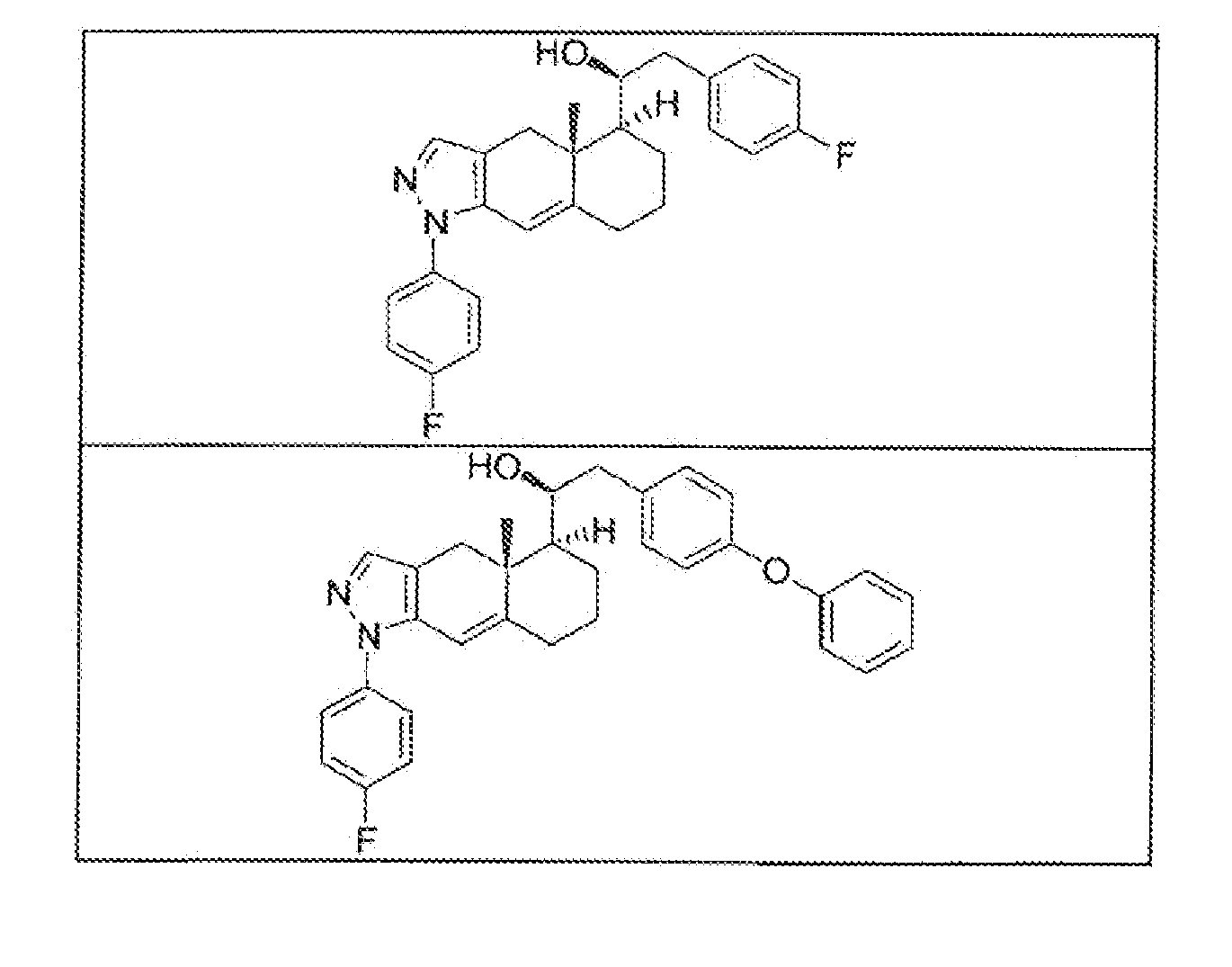


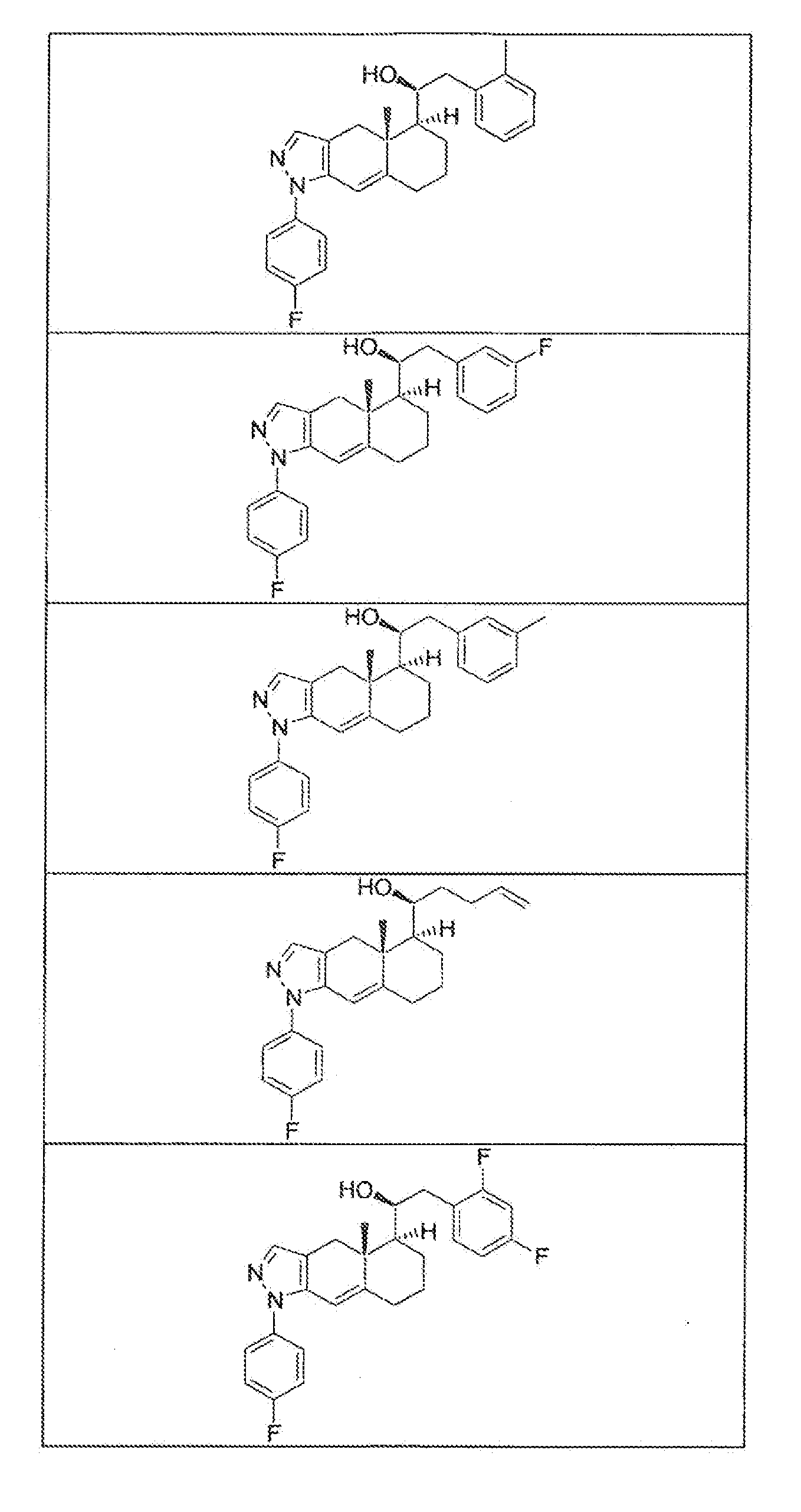




 ou un sel pharmaceutiquement acceptable de n'importe lequel de ce qui précède.
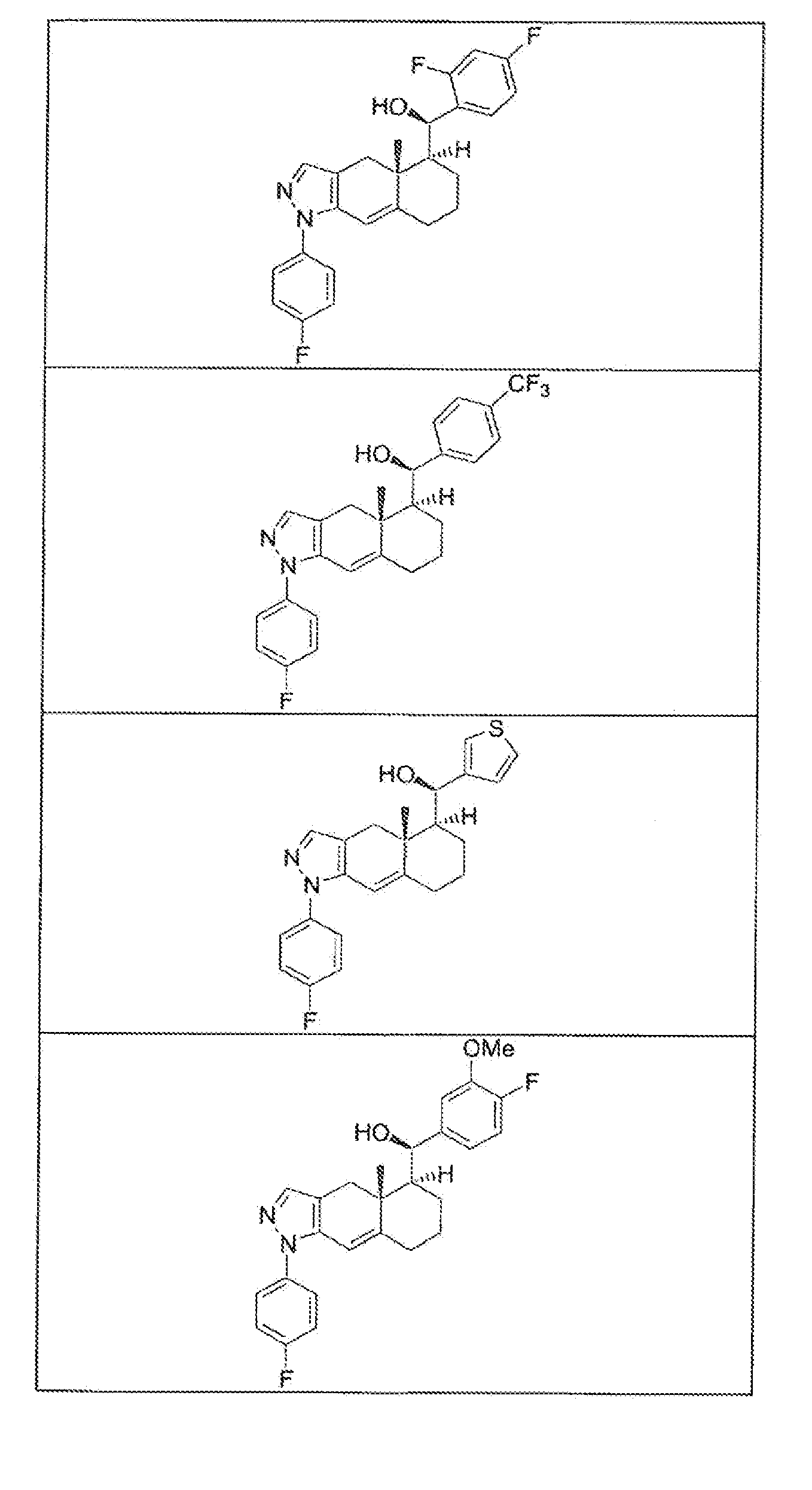
- Composé selon la revendication 1 choisi à partir d'un des tableaux suivants:
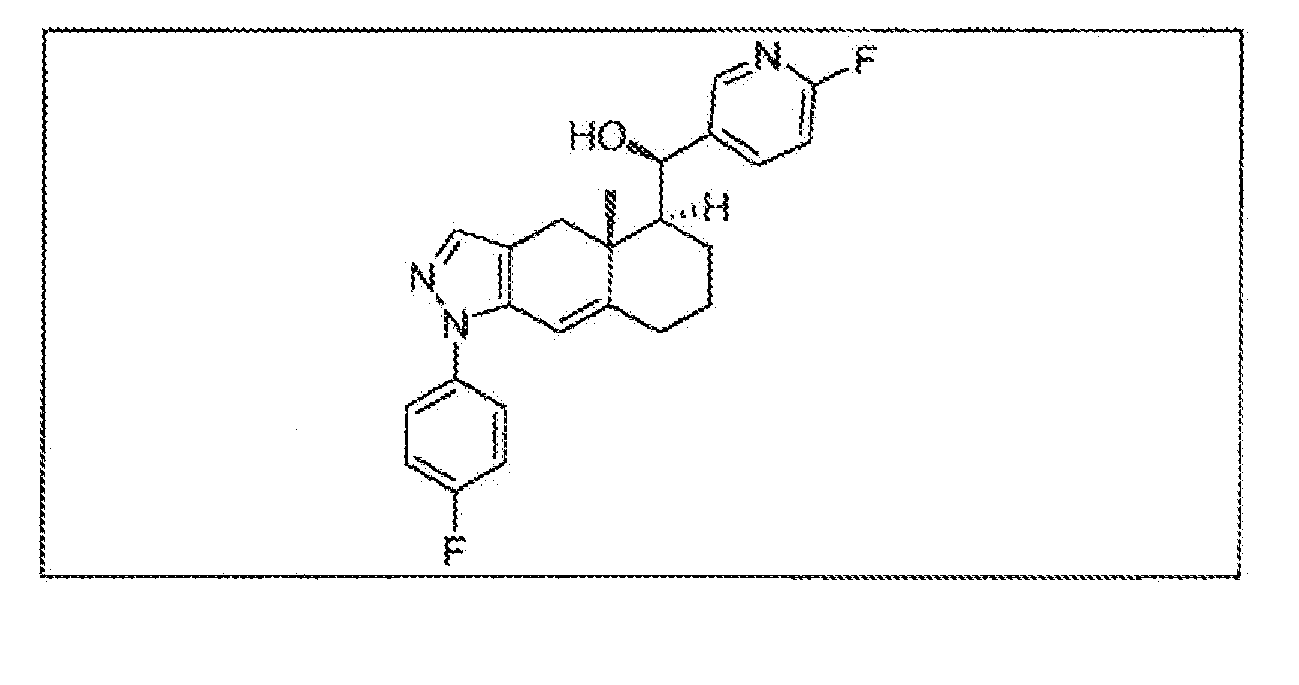

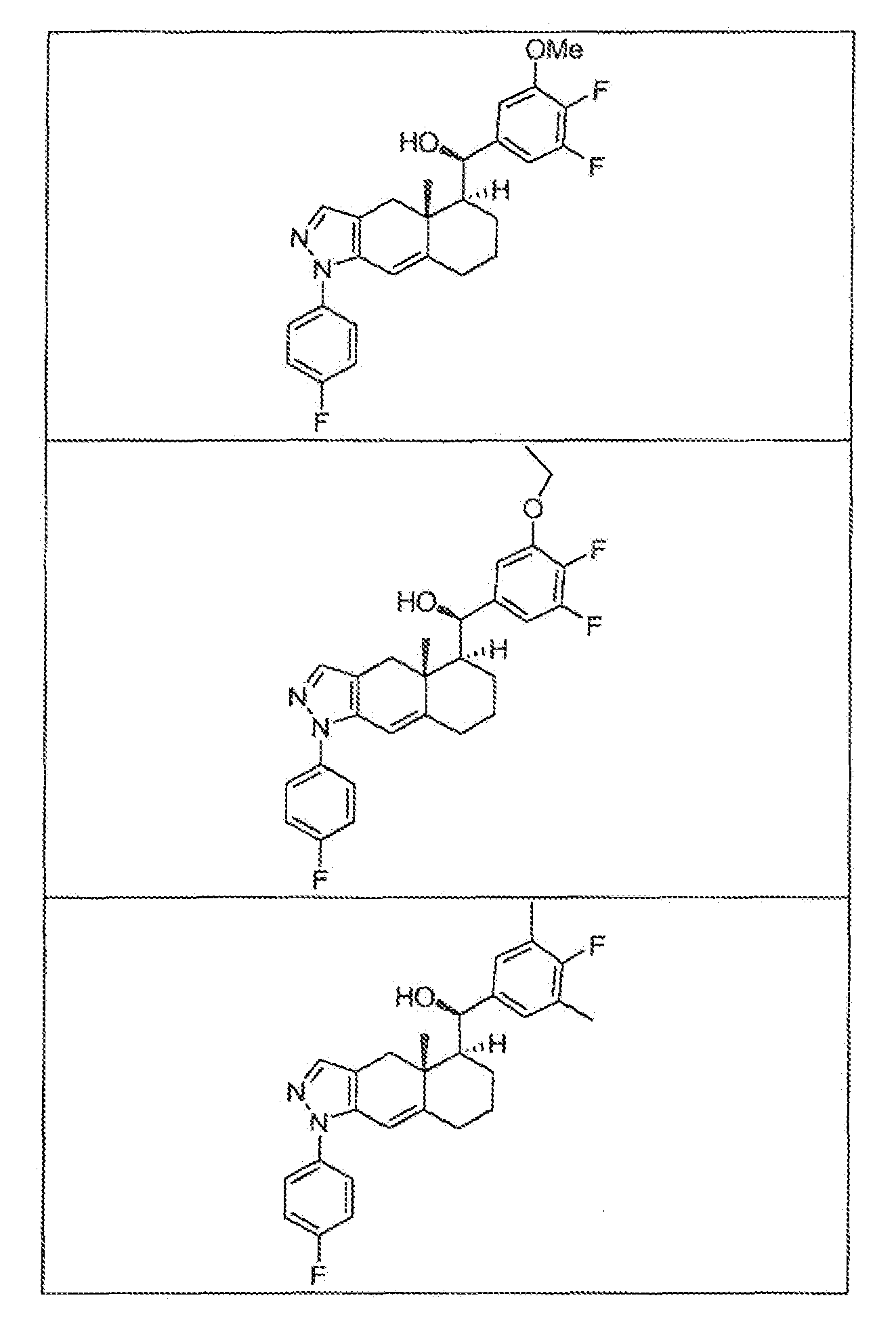


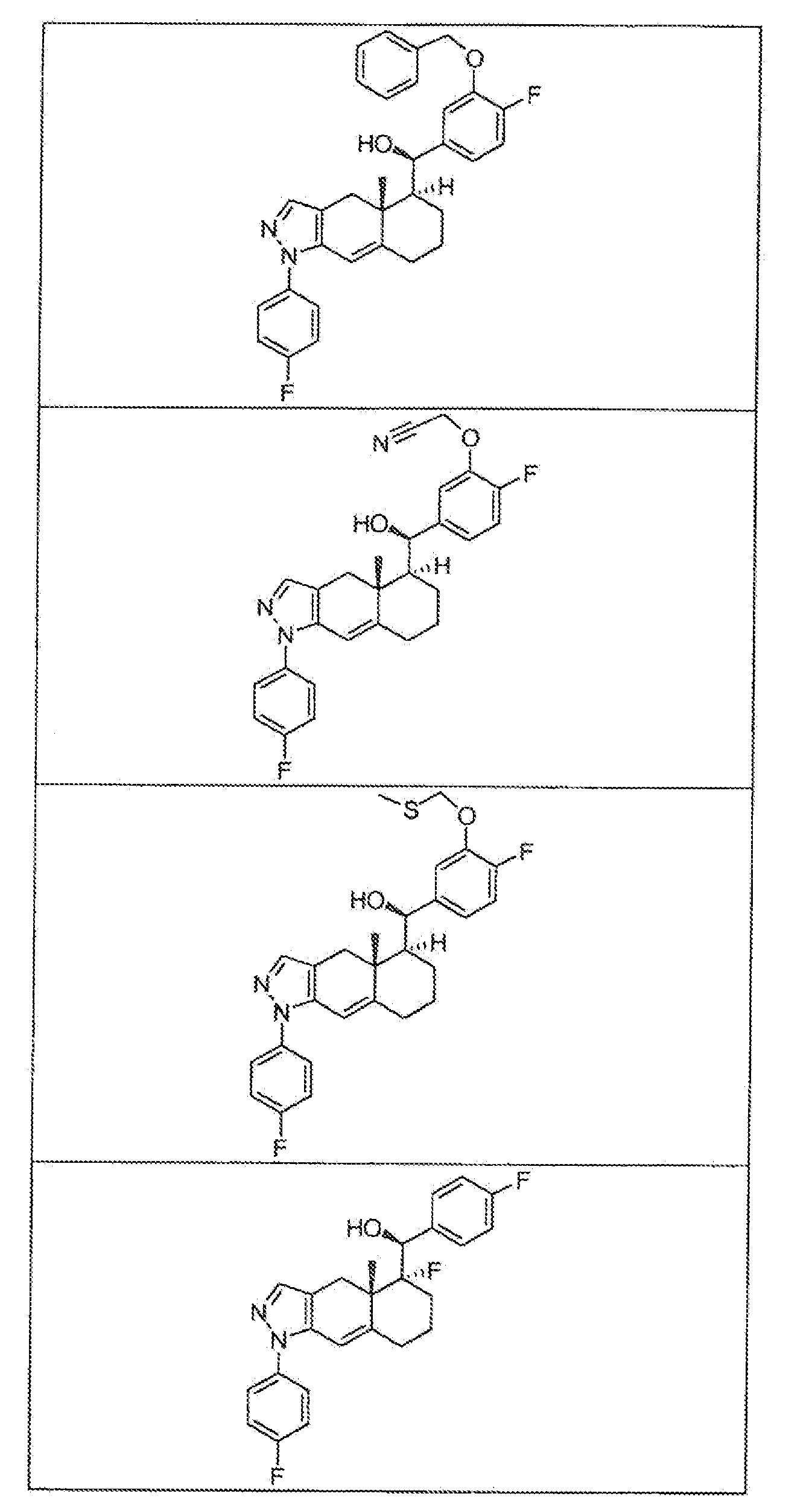


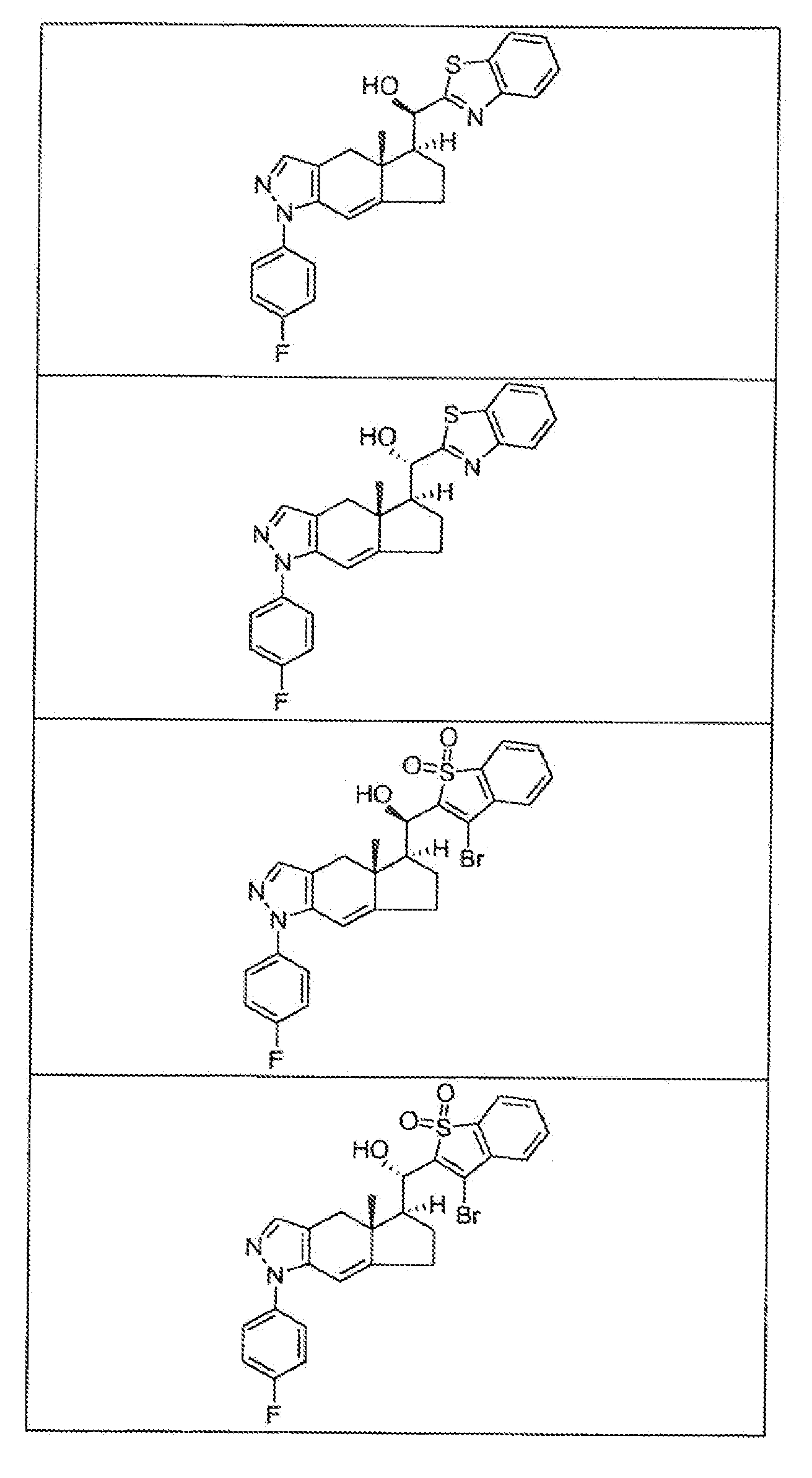


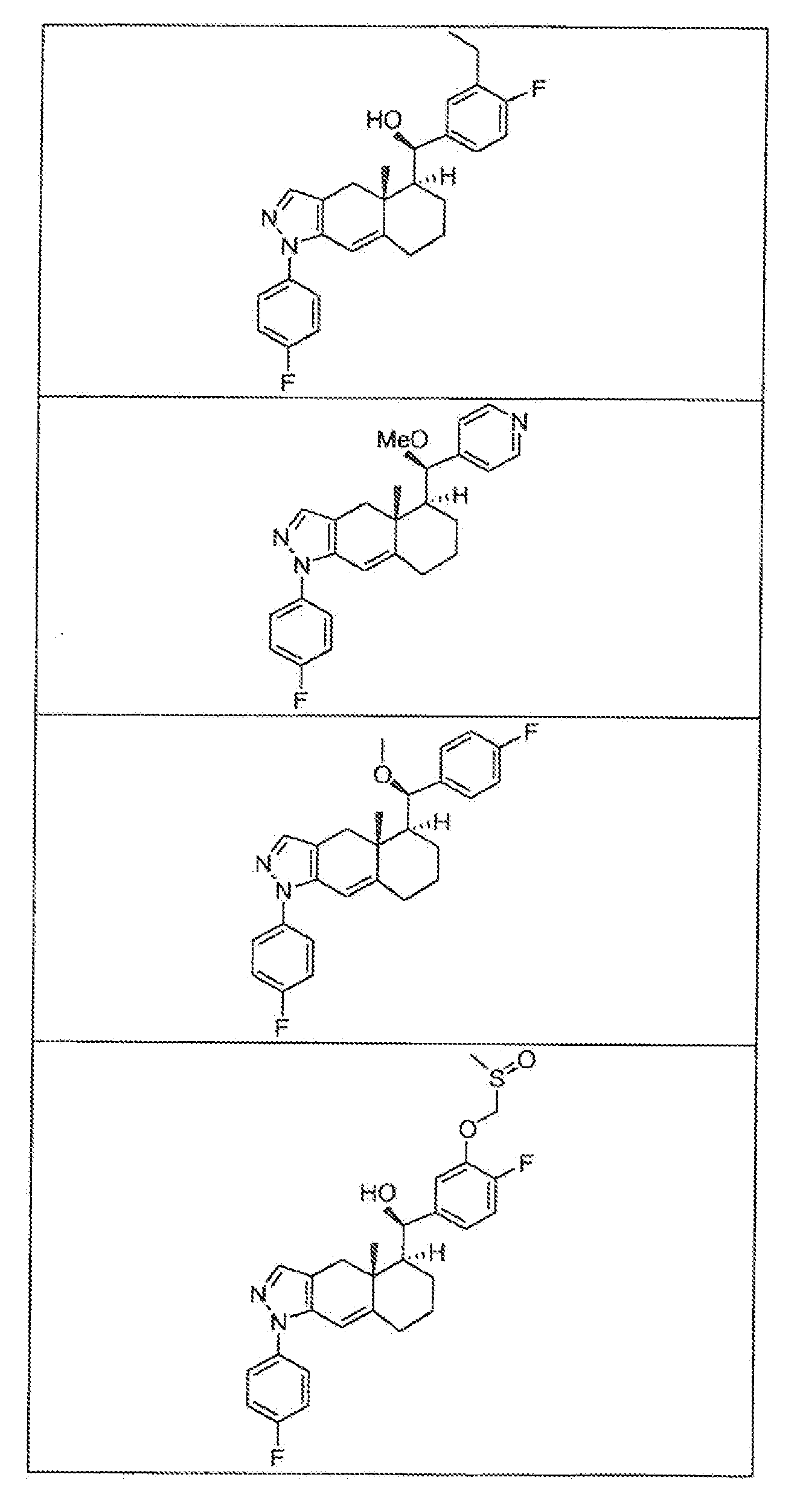 ou un sel pharmaceutiquement acceptable de n'importe lequel de ce qui précède.
- Composition pharmaceutique comprenant un composé selon l'une quelconque des revendications précédentes en combinaison avec un support pharmaceutiquement acceptable.
- Composé selon l'une quelconque des revendications 1-4 pour une utilisation dans le traitement d'une maladie ou d'une affection induite par un récepteur des glucocorticoïdes choisie dans le groupe constitué de: un rejet de tissu, leucémies, lymphomes, un syndrome de Cushing, une insuffisance surrénalienne aiguë, une hyperplasie surrénalienne congénitale, une fièvre rhumatismale, une périartérite noueuse, une périartérite granulomateuse, une inhibition de lignées de cellules myéloïdes, une prolifération/apoptose immunitaire, une suppression et une régulation de l'axe HPA, une hypercortisolémie, une attaque et une lésion de la moelle épinière, une hypercalcémie, une hyperglycémie, une insuffisance surrénale aiguë, une insuffisance surrénale primaire chronique, une insuffisance surrénale secondaire, une hyperplasie surrénale congénitale, une oedème cérébral, une thrombocytopénie, un syndrome de Little, une obésité, un syndrome métabolique, une maladie intestinale inflammatoire, un lupus érythémateux systémique, une périartérite noueuse, une granulomatose de Wegener, une artérite temporale, une polyarthrite rhumatoïde, une polyarthrite rhumatoïde juvénile, une uvéite, un rhume des foins, une rhinite allergique, un urticaire, un oedème angioneurotique, une maladie pulmonaire obstructive chronique, un asthme, une tendinite, une bursite, une maladie de Crohn, une colite ulcéreuse, une hépatite active chronique auto-immune, une transplantation d'organe, une hépatite, une cirrhose, une alopécie du cuir chevelu inflammatoire, une panniculite, un psoriasis, un lupus érythémateux discoïde, kystes enflammés, une dermatite atopique, un pyoderma gangrenosum, un pemphigus vulgaire, une pemphigoïde bulleuse, un lupus érythémateux systémique, une dermatomyosite, un herpes gestationis, une fasciite éosinophile, une polychondrite récurrente, une vasculite inflammatoire, une sarcoïdose, une maladie de Sweet, une lèpre réactive de type I, angiomes capillaires, une dermatite de contact, une dermatite atopique, un lichen plan, une dermatite exfoliatrice, un érythème noueux, une acné, un hirsutisme, une nécrolyse épidermique toxique, un érythème multiforme, un lymphome des cellules T cutanées, un virus de l'immunodéficience humaine (VIH), une apoptose cellulaire, un cancer, un sarcome de Kaposi, une rétinite pigmenteuse, une performance cognitive, une amélioration de la mémoire et de l'apprentissage, une dépression, une addiction, troubles de l'humeur, un syndrome de la fatigue chronique, une schizophrénie, troubles du sommeil et une anxiété.
Applications Claiming Priority (3)
| Application Number | Priority Date | Filing Date | Title |
|---|---|---|---|
| US37194802P | 2002-04-11 | 2002-04-11 | |
| US371948P | 2002-04-11 | ||
| PCT/US2003/010867 WO2003086294A2 (fr) | 2002-04-11 | 2003-04-08 | Derives de 1h-benzo[f]indazol-5-yl utilises en tant que modulateurs selectifs du recepteur glucocorticoide |
Publications (3)
| Publication Number | Publication Date |
|---|---|
| EP1496892A2 EP1496892A2 (fr) | 2005-01-19 |
| EP1496892A4 EP1496892A4 (fr) | 2006-01-25 |
| EP1496892B1 true EP1496892B1 (fr) | 2011-01-26 |
Family
ID=29250763
Family Applications (1)
| Application Number | Title | Priority Date | Filing Date |
|---|---|---|---|
| EP03718285A Expired - Lifetime EP1496892B1 (fr) | 2002-04-11 | 2003-04-08 | Derives de 1h-benzo(f)indazol-5-yl utilises en tant que modulateurs selectifs du recepteur glucocorticoide |
Country Status (8)
| Country | Link |
|---|---|
| US (2) | US7282591B2 (fr) |
| EP (1) | EP1496892B1 (fr) |
| JP (1) | JP4570878B2 (fr) |
| AT (1) | ATE496620T1 (fr) |
| AU (1) | AU2003221706B2 (fr) |
| CA (1) | CA2481320A1 (fr) |
| DE (1) | DE60335869D1 (fr) |
| WO (1) | WO2003086294A2 (fr) |
Families Citing this family (123)
| Publication number | Priority date | Publication date | Assignee | Title |
|---|---|---|---|---|
| CA2473886C (fr) | 2002-01-22 | 2012-08-21 | The Regents Of The University Of California | Ligands non steroidiens pour le recepteur des corticoides, compositions et utilisations desdits ligands |
| EP1599201B1 (fr) * | 2003-02-25 | 2010-04-14 | Merck Sharp & Dohme Corp. | Modulateurs selectifs de recepteurs de glucocorticoides non steroidaux |
| ATE447575T1 (de) | 2003-04-23 | 2009-11-15 | Merck & Co Inc | Selektive spirocyclische glucocorticoid-rezeptor- modulatoren |
| GB0316290D0 (en) | 2003-07-11 | 2003-08-13 | Glaxo Group Ltd | Novel compounds |
| GB0401334D0 (en) | 2004-01-21 | 2004-02-25 | Novartis Ag | Organic compounds |
| GB0411056D0 (en) | 2004-05-18 | 2004-06-23 | Novartis Ag | Organic compounds |
| PE20060272A1 (es) | 2004-05-24 | 2006-05-22 | Glaxo Group Ltd | (2r,3r,4s,5r,2'r,3'r,4's,5's)-2,2'-{trans-1,4-ciclohexanodiilbis-[imino(2-{[2-(1-metil-1h-imidazol-4-il)etil]amino}-9h-purin-6,9-diil)]}bis[5-(2-etil-2h-tetrazol-5-il)tetrahidro-3,4-furanodiol] como agonista a2a |
| TWI307630B (en) | 2004-07-01 | 2009-03-21 | Glaxo Group Ltd | Immunoglobulins |
| CN101198325A (zh) * | 2004-10-13 | 2008-06-11 | 默克公司 | 用于治疗高眼压的眼用组合物 |
| GT200500281A (es) | 2004-10-22 | 2006-04-24 | Novartis Ag | Compuestos organicos. |
| GB0424284D0 (en) | 2004-11-02 | 2004-12-01 | Novartis Ag | Organic compounds |
| GB0426164D0 (en) | 2004-11-29 | 2004-12-29 | Novartis Ag | Organic compounds |
| EP1841780B1 (fr) | 2005-01-10 | 2011-07-27 | Glaxo Group Limited | Derives d'androstane-17-alpha-carbonate pour utilisation dans le traitement de conditions allergiques et inflammatoires |
| MY145343A (en) | 2005-03-25 | 2012-01-31 | Glaxo Group Ltd | Novel compounds |
| PE20061193A1 (es) | 2005-03-25 | 2006-12-02 | Glaxo Group Ltd | DERIVADOS DE 3,4-DIHIDROPIRIMIDO[4,5-d]PIRIMIDIN-2-[1H]-0NA COMO INHIBIDORES DE QUINASA p38 |
| GB0507577D0 (en) | 2005-04-14 | 2005-05-18 | Novartis Ag | Organic compounds |
| US7888381B2 (en) | 2005-06-14 | 2011-02-15 | Bristol-Myers Squibb Company | Modulators of glucocorticoid receptor, AP-1, and/or NF-κB activity, and use thereof |
| GB0514809D0 (en) | 2005-07-19 | 2005-08-24 | Glaxo Group Ltd | Compounds |
| WO2007025303A2 (fr) * | 2005-08-26 | 2007-03-01 | The Regents Of The University Of California | Antiandrogenes non steroidiens |
| WO2007045477A2 (fr) | 2005-10-21 | 2007-04-26 | Novartis Ag | Molecules organiques |
| PE20071068A1 (es) | 2005-12-20 | 2007-12-13 | Glaxo Group Ltd | Acido 3-(4-{[4-(4-{[3-(3,3-dimetil-1-piperidinil)propil]oxi}fenil)-1-piperidinil]carbonil}-1-naftalenil)propanoico o propenoico, sales de los mismos, como antagonistas de los receptores h1 y h3 |
| GB0526244D0 (en) | 2005-12-22 | 2006-02-01 | Novartis Ag | Organic compounds |
| GB0601951D0 (en) | 2006-01-31 | 2006-03-15 | Novartis Ag | Organic compounds |
| MX2008013411A (es) | 2006-04-20 | 2008-11-04 | Glaxo Group Ltd | Nuevos compuestos. |
| PT2322525E (pt) | 2006-04-21 | 2013-12-26 | Novartis Ag | Derivados de purina para utilização como agonistas do recetor de adenosina a2a |
| GB0611587D0 (en) | 2006-06-12 | 2006-07-19 | Glaxo Group Ltd | Novel compounds |
| MX2009004385A (es) | 2006-10-23 | 2009-05-22 | Merck & Co Inc | Derivados de 2-[1-fenil-5-hidroxi-4alfa-metil-hexahidrociclopenta [f]indazol-5-il]etil fenilo como ligandos del receptor glucocorticoide. |
| TW200829578A (en) | 2006-11-23 | 2008-07-16 | Astrazeneca Ab | Chemical compounds 537 |
| JO2754B1 (en) | 2006-12-21 | 2014-03-15 | استرازينكا ايه بي | Amylendazoleil derivatives for the treatment of glucocorticoid-mediated disorders |
| RS51644B (sr) | 2007-01-10 | 2011-10-31 | Irm Llc. | Jedinjenja i preparati kao inhibitori kanal aktivirajuće proteaze |
| PE20081889A1 (es) | 2007-03-23 | 2009-03-05 | Smithkline Beecham Corp | Indol carboxamidas como inhibidores de ikk2 |
| CN101687851B (zh) | 2007-05-07 | 2013-02-27 | 诺瓦提斯公司 | 有机化合物 |
| WO2009058944A2 (fr) | 2007-11-01 | 2009-05-07 | Bristol-Myers Squibb Company | Composés non stéroïdiens utiles en tant que modulateurs de l'activité ap-1 et/ou nf-κb du récepteur des glucocorticoïdes et leur utilisation |
| CL2008003651A1 (es) | 2007-12-10 | 2009-06-19 | Novartis Ag | Compuestos derivados de 3,5-diamino-6-cloropirazinamida sustituida; composicion farmaceutica; combinacion farmaceutica; y uso en el tratamiento de una condición inflamatoria o alergica, en particular una enfermedad inflamatoria u obstructiva de las vias respiratorias. |
| JP2011513313A (ja) * | 2008-02-26 | 2011-04-28 | メルク・シャープ・エンド・ドーム・コーポレイション | 選択的グルココルチコイド受容体調節剤としてのヘキサヒドロシクロペンチル[f]インダゾールカルボキサミドおよびこの誘導体 |
| WO2009111214A1 (fr) | 2008-03-06 | 2009-09-11 | Merck & Co., Inc. | Sulfamides d’hexahydrocyclopentyl[f]indazole et dérivés de ceux-ci servant de modulateurs sélectifs de récepteurs de glucocorticoïde |
| UY31832A (es) | 2008-05-20 | 2010-01-05 | Astrazeneca Ab | Derivados de indazol sustituidos con fenilo y benzodioxinilo |
| MX2010012814A (es) | 2008-05-23 | 2010-12-20 | Amira Pharmaceuticals Inc | Inhibidor de proteina activadora de 5-lipoxigenasa. |
| ES2383246T3 (es) | 2008-06-05 | 2012-06-19 | Glaxo Group Limited | 4-amino-indazoles |
| US8163743B2 (en) | 2008-06-05 | 2012-04-24 | GlaxoGroupLimited | 4-carboxamide indazole derivatives useful as inhibitors of PI3-kinases |
| CA2727196A1 (fr) | 2008-06-10 | 2009-12-17 | Novartis Ag | Composes organiques |
| WO2010094643A1 (fr) | 2009-02-17 | 2010-08-26 | Glaxo Group Limited | Dérivés de quinoline et applications associées dans la rhinite et l'urticaire |
| JP5656880B2 (ja) | 2009-03-09 | 2015-01-21 | グラクソ グループ リミテッドGlaxo Group Limited | Pi3キナーゼの阻害剤としての4−オキサジアゾール−2−イル−インダゾール |
| WO2010102968A1 (fr) | 2009-03-10 | 2010-09-16 | Glaxo Group Limited | Dérivés d'indole comme inhibiteurs de ikk2 |
| EP2408769A1 (fr) | 2009-03-17 | 2012-01-25 | Glaxo Group Limited | Dérivés de pyrimidine utilisés comme inhibiteurs de ltk |
| EP2408458A1 (fr) | 2009-03-19 | 2012-01-25 | Merck Sharp&Dohme Corp. | INHIBITION INDUITE PAR ARN INTERFÉRENCE DE L'EXPRESSION DU GÈNE TRANSDUCTEUR DE SIGNAL ET ACTIVITATEUR DE TRANSCRIPTION 6 (STAT6) AU MOYEN D'UN ACIDE NUCLÉIQUE INTERFÉRENT COURT (ANsi) |
| US20120029054A1 (en) | 2009-03-19 | 2012-02-02 | Merck Sharp & Dohme Corp. | RNA Interference Mediated Inhibition of GATA Binding Protein 3 (GATA3) Gene Expression Using Short Intefering Nucleic Acid (siNA) |
| EP2408916A2 (fr) | 2009-03-19 | 2012-01-25 | Merck Sharp&Dohme Corp. | Inhibition médiée par arn interférence de l'expression génique de facteur de croissance de tissu conjonctif (ctgf) en utilisant un acide nucléique interférant court (ansi) |
| JP2012520684A (ja) | 2009-03-19 | 2012-09-10 | メルク・シャープ・エンド・ドーム・コーポレイション | 低分子干渉核酸(siNA)を用いたBTBandCNCHomology1(塩基性ロイシンジッパー転写因子1)(Bach1)遺伝子発現のRNA干渉媒介性阻害 |
| WO2010111497A2 (fr) | 2009-03-27 | 2010-09-30 | Merck Sharp & Dohme Corp. | Inhibition à médiation par l'interférence arn de l'expression du gène de la molécule d'adhésion intercellulaire 1 (icam-1) faisant appel à de courts acides nucléiques interférents (ansi) |
| EP2411520A2 (fr) | 2009-03-27 | 2012-02-01 | Merck Sharp&Dohme Corp. | Inhibition à médiation par l'interférence arn de l'expression du gène de la lymphopoïétine stromale thymique (tslp) faisant appel à de courts acides nucléiques interférents (ansi) |
| EP2411018A2 (fr) | 2009-03-27 | 2012-02-01 | Merck Sharp&Dohme Corp. | INHIBITION PAR INTERFÉRENCE ARN DE L'EXPRESSION DU GÈNE DE LA CHAÎNE BÊTA DU FACTEUR DE CROISSANCE DES NERFS (NGFß) AU MOYEN D'UN ACIDE NUCLÉIQUE INTERFÉRENT COURT (ANSI) |
| JP2012521760A (ja) | 2009-03-27 | 2012-09-20 | メルク・シャープ・エンド・ドーム・コーポレイション | 低分子干渉核酸(siNA)を用いたアポトーシスシグナル調節キナーゼ1(ASK1)遺伝子発現のRNA干渉媒介性阻害 |
| WO2010111471A2 (fr) | 2009-03-27 | 2010-09-30 | Merck Sharp & Dohme Corp. | Inhibition par interférence arn de l'expression du gène du signal transducteur et activateur de la transcription 1 (stat1) au moyen d'un acide nucléique interférent court (ansi) |
| AR076373A1 (es) | 2009-04-24 | 2011-06-08 | Glaxo Group Ltd | N-pirazolil carboxamidas como inhibidores de canales de calcio |
| EP2421834A1 (fr) | 2009-04-24 | 2012-02-29 | Glaxo Group Limited | Pyrazole et triazole carboxamides en tant qu'inhibiteurs du canal crac |
| LT2899191T (lt) | 2009-04-30 | 2017-10-25 | Glaxo Group Limited | Oksazolo pakeistieji indazolai kaip pi3-kinazės inhibitoriai |
| WO2011031574A1 (fr) * | 2009-09-08 | 2011-03-17 | Merck Sharp & Dohme Corp. | Ethanols d'hexahydrocyclopenta[f]indazole 5-yle et leurs dérivés utilisés comme modulateurs sélectifs des récepteurs des glucocorticoïdes |
| US20110098311A1 (en) | 2009-10-22 | 2011-04-28 | Vertex Pharmaceuticals Incorported | Compositions for treatment of cystic fibrosis and other chronic diseases |
| TW201118073A (en) * | 2009-10-30 | 2011-06-01 | Merck Sharp & Dohme | Hexahydrocyclopentyl [F] indazole pyridyl ethanols and derivatives thereof as selective glucocorticoid receptor modulators |
| WO2011067364A1 (fr) | 2009-12-03 | 2011-06-09 | Glaxo Group Limited | Nouveaux composés |
| WO2011067365A1 (fr) | 2009-12-03 | 2011-06-09 | Glaxo Group Limited | Dérivés de benzpyrazole comme inhibiteurs des pi3 kinases |
| JP2013512880A (ja) | 2009-12-03 | 2013-04-18 | グラクソ グループ リミテッド | Pi3−キナーゼ阻害剤としてのインダゾール誘導体 |
| EP3020393B1 (fr) | 2009-12-16 | 2020-10-07 | 3M Innovative Properties Company | Formulations et procédés de commande de distribution granulométrique mdi |
| CN101768608B (zh) * | 2009-12-31 | 2012-02-08 | 杭州师范大学 | 一种一锅法合成维兰德-米歇尔酮类化合物的方法 |
| WO2011087946A1 (fr) * | 2010-01-15 | 2011-07-21 | Rigel Pharmaceuticals, Inc. | Essai de criblage utilisant dex et gdf8 |
| WO2011110575A1 (fr) | 2010-03-11 | 2011-09-15 | Glaxo Group Limited | Dérivés de 2-[2-(benzo- ou pyrido-)thiazolylamino]-6- aminopyridine, utiles dans le traitement de maladies respiratoires, allergiques ou inflammatoires |
| US8247436B2 (en) | 2010-03-19 | 2012-08-21 | Novartis Ag | Pyridine and pyrazine derivative for the treatment of CF |
| GB201007203D0 (en) | 2010-04-29 | 2010-06-16 | Glaxo Group Ltd | Novel compounds |
| MX2013001612A (es) * | 2010-08-10 | 2013-07-05 | Abbvie Inc | Moduladores de trpv3 novedosos. |
| US9326987B2 (en) | 2010-09-08 | 2016-05-03 | Glaxo Group Limited | Indazole derivatives for use in the treatment of influenza virus infection |
| RS54286B1 (sr) | 2010-09-08 | 2016-02-29 | Glaxosmithkline Intellectual Property Development Limited | Polimorfi i soli n-[5-[4-(5-{[(2r,6s)-2,6-dimetil-4-morfolinil]metil}-1,3-oksazol-2-il)-1h-indazol-6-il]-2(metiloksi)-3-piridinil]-metansulfonamida |
| WO2012034095A1 (fr) | 2010-09-09 | 2012-03-15 | Irm Llc | Composés et compositions comme inhibiteurs de trk |
| UY33597A (es) | 2010-09-09 | 2012-04-30 | Irm Llc | Compuestos y composiciones como inhibidores de la trk |
| US8372845B2 (en) | 2010-09-17 | 2013-02-12 | Novartis Ag | Pyrazine derivatives as enac blockers |
| WO2012035055A1 (fr) | 2010-09-17 | 2012-03-22 | Glaxo Group Limited | Nouveaux composés |
| US9156791B2 (en) | 2010-10-21 | 2015-10-13 | Glaxo Group Limited | Pyrazole compounds acting against allergic, immune and inflammatory conditions |
| EP2630127A1 (fr) | 2010-10-21 | 2013-08-28 | Glaxo Group Limited | Composés de pyrazole agissant contre des troubles allergiques, inflammatoires et immunitaires |
| GB201018124D0 (en) | 2010-10-27 | 2010-12-08 | Glaxo Group Ltd | Polymorphs and salts |
| MA34969B1 (fr) | 2011-02-25 | 2014-03-01 | Irm Llc | Composes et compositions en tant qu inibiteurs de trk |
| GB201104153D0 (en) | 2011-03-11 | 2011-04-27 | Glaxo Group Ltd | Novel compounds |
| EP2683716A1 (fr) | 2011-03-11 | 2014-01-15 | Glaxo Group Limited | Dérivés pyrido[3,4-b]pyrazine en tant qu'inhibiteurs de syk |
| US9012651B2 (en) | 2011-03-24 | 2015-04-21 | Abbvie Inc. | TRPV3 modulators |
| JP2014527511A (ja) | 2011-06-24 | 2014-10-16 | アムジエン・インコーポレーテツド | Trpm8拮抗剤及び治療におけるそれらの使用 |
| EP2723718A1 (fr) | 2011-06-24 | 2014-04-30 | Amgen Inc. | Antagonistes de trpm8 et leur utilisation dans le cadre thérapeutique |
| US8883819B2 (en) | 2011-09-01 | 2014-11-11 | Irm Llc | Bicyclic heterocycle derivatives for the treatment of pulmonary arterial hypertension |
| WO2013038386A1 (fr) | 2011-09-16 | 2013-03-21 | Novartis Ag | Composés hétérocycliques destinés au traitement de la mucosviscidose |
| WO2013038373A1 (fr) | 2011-09-16 | 2013-03-21 | Novartis Ag | Dérivés pyrimidinamides |
| WO2013038378A1 (fr) | 2011-09-16 | 2013-03-21 | Novartis Ag | Dérivés pyridinamides |
| WO2013038381A1 (fr) | 2011-09-16 | 2013-03-21 | Novartis Ag | Dérivés d'amide pyridine/pyrazine |
| ES2882807T3 (es) | 2011-09-16 | 2021-12-02 | Novartis Ag | Heterociclil carboxamidas N-sustituidas |
| US8809372B2 (en) | 2011-09-30 | 2014-08-19 | Asana Biosciences, Llc | Pyridine derivatives |
| CA2850551A1 (fr) * | 2011-09-30 | 2013-04-04 | Endo Pharmaceuticals Inc. | Derives pyridines |
| WO2013062964A2 (fr) | 2011-10-24 | 2013-05-02 | Abbvie Inc. | Nouveaux modulateurs de trpv3 |
| US8809340B2 (en) | 2012-03-19 | 2014-08-19 | Novartis Ag | Crystalline form |
| US8952009B2 (en) | 2012-08-06 | 2015-02-10 | Amgen Inc. | Chroman derivatives as TRPM8 inhibitors |
| TW201422590A (zh) * | 2012-09-07 | 2014-06-16 | Abbvie Inc | 雜環核激素受體調節劑 |
| WO2014094357A1 (fr) | 2012-12-21 | 2014-06-26 | Abbvie Inc. | Modulateurs hétérocycliques des récepteurs nucléaires aux hormones |
| US9073921B2 (en) | 2013-03-01 | 2015-07-07 | Novartis Ag | Salt forms of bicyclic heterocyclic derivatives |
| US10155001B2 (en) | 2013-06-14 | 2018-12-18 | Inserm (Institut National De La Sante Et De La Recherche Medicale) | RAC1 inhibitors for inducing bronchodilation |
| KR20160060100A (ko) | 2013-09-22 | 2016-05-27 | 칼리토르 사이언시즈, 엘엘씨 | 치환된 아미노피리미딘 화합물 및 이용 방법 |
| RU2016112268A (ru) | 2013-10-17 | 2017-11-22 | Глаксосмитклайн Интеллекчуал Проперти Дивелопмент Лимитед | Ингибитор PI3K для лечения респираторного заболевания |
| WO2015055691A1 (fr) | 2013-10-17 | 2015-04-23 | Glaxosmithkline Intellectual Property Development Limited | Inhibiteur de pi3k pour le traitement d'une maladie respiratoire |
| WO2015148867A1 (fr) | 2014-03-28 | 2015-10-01 | Calitor Sciences, Llc | Composés hétéroaryle substitués et procédés d'utilisation |
| US9862711B2 (en) | 2014-04-24 | 2018-01-09 | Novartis Ag | Pyrazine derivatives as phosphatidylinositol 3-kinase inhibitors |
| BR112016024484A2 (pt) | 2014-04-24 | 2017-08-15 | Novartis Ag | derivados de aminopiridina como inibidores de fosfatidilinositol 3-quinase |
| CA2945212A1 (fr) | 2014-04-24 | 2015-10-29 | Novartis Ag | Derives amines de pyrazine utilisables en tant qu'inhibiteurs de la phosphatidylinositol 3-kinase |
| US20170100385A1 (en) | 2014-05-12 | 2017-04-13 | Glaxosmithkline Intellectual Property (No. 2) Limited | Pharmaceutical compositions comprising danirixin for treating infectious diseases |
| EP3180335B1 (fr) | 2014-08-11 | 2021-05-05 | Angion Biomedica Corporation | Inhibiteurs de cytochrome p450 et leurs utilisations |
| CA2970819A1 (fr) | 2014-12-31 | 2016-07-07 | Angion Biomedica Corp. | Methodes et agents pour traiter une maladie |
| JP2018527362A (ja) | 2015-09-11 | 2018-09-20 | サンシャイン・レイク・ファーマ・カンパニー・リミテッドSunshine Lake Pharma Co.,Ltd. | 置換されたヘテロアリール化合物および使用方法 |
| GB201602527D0 (en) | 2016-02-12 | 2016-03-30 | Glaxosmithkline Ip Dev Ltd | Chemical compounds |
| US20190161480A1 (en) | 2016-08-08 | 2019-05-30 | Glaxosmithkline Intellectual Property Development Limited | Chemical Compounds |
| CN111132964A (zh) * | 2017-04-11 | 2020-05-08 | 欧瑞克制药公司 | 糖皮质激素受体调节剂 |
| GB201706102D0 (en) | 2017-04-18 | 2017-05-31 | Glaxosmithkline Ip Dev Ltd | Chemical compounds |
| GB201712081D0 (en) | 2017-07-27 | 2017-09-13 | Glaxosmithkline Ip Dev Ltd | Chemical compounds |
| WO2019099311A1 (fr) | 2017-11-19 | 2019-05-23 | Sunshine Lake Pharma Co., Ltd. | Composés hétéroaryle substitués et leurs méthodes d'utilisation |
| KR102737185B1 (ko) | 2018-01-20 | 2024-12-05 | 선샤인 레이크 파르마 컴퍼니 리미티드 | 치환된 아미노피리미딘 화합물 및 이의 사용 방법 |
| US20220079924A1 (en) * | 2018-10-10 | 2022-03-17 | Oric Pharmaceuticals, Inc. | Glucocorticoid receptor modulators |
| CA3123490A1 (fr) | 2019-01-22 | 2020-07-30 | Akribes Biomedical Gmbh | Modificateurs selectifs du recepteur de glucocorticoides pour le traitement de la mauvaise cicatrisation de plaies cutanees |
| AU2020290094B2 (en) | 2019-06-10 | 2024-01-18 | Novartis Ag | Pyridine and pyrazine derivative for the treatment of CF, COPD, and bronchiectasis |
| AU2020338971B2 (en) | 2019-08-28 | 2023-11-23 | Novartis Ag | Substituted 1,3-phenyl heteroaryl derivatives and their use in the treatment of disease |
| WO2021191875A1 (fr) | 2020-03-26 | 2021-09-30 | Glaxosmithkline Intellectual Property Development Limited | Inhibiteurs de cathepsine pour la prévention ou le traitement d'infections virales |
Family Cites Families (12)
| Publication number | Priority date | Publication date | Assignee | Title |
|---|---|---|---|---|
| US4166452A (en) | 1976-05-03 | 1979-09-04 | Generales Constantine D J Jr | Apparatus for testing human responses to stimuli |
| US4256108A (en) | 1977-04-07 | 1981-03-17 | Alza Corporation | Microporous-semipermeable laminated osmotic system |
| DE2727367A1 (de) * | 1977-06-14 | 1979-01-04 | Schering Ag | Neue kortikoide |
| US4265874A (en) | 1980-04-25 | 1981-05-05 | Alza Corporation | Method of delivering drug with aid of effervescent activity generated in environment of use |
| US4349558A (en) * | 1981-02-19 | 1982-09-14 | Sterling Drug Inc. | Anti-inflammatory 8H-phenanthro-[2,3-c]pyrazole derivatives |
| US4349559A (en) * | 1981-02-19 | 1982-09-14 | Sterling Drug Inc. | Anti-inflammatory spiro-2H-indene-[2,3']-3H-pyrazolo[4",5":7',6']naphtho[2,1-b]pyran-1,3-dione derivatives |
| US4412995A (en) * | 1981-02-19 | 1983-11-01 | Sterling Drug Inc. | Pentacyclic phenylpyrazole compounds as anti-inflammatory agents |
| NZ199618A (en) * | 1981-02-19 | 1985-04-30 | Sterling Drug Inc | Spiro-((1)benzopyrano(5,6-f)indazole-3(2h),5'(2'h)pyrimidine)-2',4'6'-(1'h,3'h)-trione derivatives and pharmaceutical compositions |
| BR9907788A (pt) | 1998-02-13 | 2001-10-30 | Abbott Lab | Agentes antiinflamatórios seletivos paraglicocorticóides |
| US6506766B1 (en) | 1998-02-13 | 2003-01-14 | Abbott Laboratories | Glucocortiocoid-selective antinflammatory agents |
| CA2473886C (fr) * | 2002-01-22 | 2012-08-21 | The Regents Of The University Of California | Ligands non steroidiens pour le recepteur des corticoides, compositions et utilisations desdits ligands |
| EP1599201B1 (fr) * | 2003-02-25 | 2010-04-14 | Merck Sharp & Dohme Corp. | Modulateurs selectifs de recepteurs de glucocorticoides non steroidaux |
-
2003
- 2003-04-08 EP EP03718285A patent/EP1496892B1/fr not_active Expired - Lifetime
- 2003-04-08 JP JP2003583321A patent/JP4570878B2/ja not_active Expired - Fee Related
- 2003-04-08 AT AT03718285T patent/ATE496620T1/de not_active IP Right Cessation
- 2003-04-08 CA CA002481320A patent/CA2481320A1/fr not_active Abandoned
- 2003-04-08 AU AU2003221706A patent/AU2003221706B2/en not_active Ceased
- 2003-04-08 US US10/508,897 patent/US7282591B2/en not_active Expired - Fee Related
- 2003-04-08 WO PCT/US2003/010867 patent/WO2003086294A2/fr not_active Ceased
- 2003-04-08 DE DE60335869T patent/DE60335869D1/de not_active Expired - Lifetime
-
2007
- 2007-09-26 US US11/904,186 patent/US7625937B2/en not_active Expired - Fee Related
Also Published As
| Publication number | Publication date |
|---|---|
| JP2005528385A (ja) | 2005-09-22 |
| AU2003221706B2 (en) | 2008-02-28 |
| AU2003221706A1 (en) | 2003-10-27 |
| WO2003086294A2 (fr) | 2003-10-23 |
| DE60335869D1 (de) | 2011-03-10 |
| EP1496892A4 (fr) | 2006-01-25 |
| ATE496620T1 (de) | 2011-02-15 |
| US7282591B2 (en) | 2007-10-16 |
| WO2003086294A3 (fr) | 2004-07-15 |
| JP4570878B2 (ja) | 2010-10-27 |
| US20050256315A1 (en) | 2005-11-17 |
| US7625937B2 (en) | 2009-12-01 |
| CA2481320A1 (fr) | 2003-10-23 |
| US20080076795A1 (en) | 2008-03-27 |
| EP1496892A2 (fr) | 2005-01-19 |
Similar Documents
| Publication | Publication Date | Title |
|---|---|---|
| EP1496892B1 (fr) | Derives de 1h-benzo(f)indazol-5-yl utilises en tant que modulateurs selectifs du recepteur glucocorticoide | |
| CA2512987C (fr) | Derives cortisol de 17-carbamoyloxy utilises en tant que modulateurs selectifs des recepteurs aux glucocorticoides | |
| JP4520309B2 (ja) | 選択的糖質コルチコイド受容体調節剤としてのオクタヒドロ−2−H−ナフト[1,2−f]インドール−4−カルボキサミド誘導体 | |
| JP4648303B2 (ja) | 選択的非ステロイド系糖質コルチコイド受容体調節剤 | |
| JP4739191B2 (ja) | 選択的スピロ環式グルココルチコイド受容体調節物質 | |
| US20120172397A1 (en) | HEXAHYDROCYCLOPENTA[f]INDAZOLE 5-YL ETHANOLS AND DERIVATIVES THEREOF AS SELECTIVE GLUCOCORTICOID RECEPTOR MODULATORS | |
| US20120095055A1 (en) | HEXAHYDROCYCLOPENTYL[f]INDAZOLE 5-HYDROXYMETHYL ETHANOLS AND DERIVATIVES THEREOF AS SELECTIVE GLUCOCORTICOID RECEPTOR MODULATORS | |
| JP2008540657A (ja) | 選択的グルココルチコイド受容体リガンドとしてのd−ホモアンドロスタ−17−イル−カーバメート誘導体 |
Legal Events
| Date | Code | Title | Description |
|---|---|---|---|
| PUAI | Public reference made under article 153(3) epc to a published international application that has entered the european phase |
Free format text: ORIGINAL CODE: 0009012 |
|
| AK | Designated contracting states |
Kind code of ref document: A2 Designated state(s): AT BE BG CH CY CZ DE DK EE ES FI FR GB GR HU IE IT LI LU MC NL PT RO SE SI SK TR |
|
| AX | Request for extension of the european patent |
Extension state: AL LT LV MK |
|
| 17P | Request for examination filed |
Effective date: 20050117 |
|
| A4 | Supplementary search report drawn up and despatched |
Effective date: 20051214 |
|
| RIC1 | Information provided on ipc code assigned before grant |
Ipc: A61P 11/00 20000101ALI20051208BHEP Ipc: A61P 35/00 20000101ALI20051208BHEP Ipc: A61K 31/4439 20000101ALI20051208BHEP Ipc: A61K 31/4155 20000101ALI20051208BHEP Ipc: A61K 31/415 19850101AFI20041013BHEP Ipc: C07D 403/06 19900101ALI20051208BHEP Ipc: A61P 17/00 20000101ALI20051208BHEP Ipc: A61K 31/4178 20000101ALI20051208BHEP Ipc: C07D 231/54 19850101ALI20051208BHEP Ipc: C07D 409/06 19900101ALI20051208BHEP Ipc: C07D 405/06 19900101ALI20051208BHEP Ipc: C07D 417/06 19900101ALI20051208BHEP Ipc: C07D 401/06 19900101ALI20051208BHEP |
|
| 17Q | First examination report despatched |
Effective date: 20091202 |
|
| RAP1 | Party data changed (applicant data changed or rights of an application transferred) |
Owner name: MERCK SHARP & DOHME CORP. |
|
| GRAP | Despatch of communication of intention to grant a patent |
Free format text: ORIGINAL CODE: EPIDOSNIGR1 |
|
| GRAS | Grant fee paid |
Free format text: ORIGINAL CODE: EPIDOSNIGR3 |
|
| GRAA | (expected) grant |
Free format text: ORIGINAL CODE: 0009210 |
|
| AK | Designated contracting states |
Kind code of ref document: B1 Designated state(s): AT BE BG CH CY CZ DE DK EE ES FI FR GB GR HU IE IT LI LU MC NL PT RO SE SI SK TR |
|
| AX | Request for extension of the european patent |
Extension state: LT LV |
|
| REG | Reference to a national code |
Ref country code: GB Ref legal event code: FG4D |
|
| REG | Reference to a national code |
Ref country code: CH Ref legal event code: EP |
|
| REG | Reference to a national code |
Ref country code: IE Ref legal event code: FG4D |
|
| REG | Reference to a national code |
Ref country code: NL Ref legal event code: T3 |
|
| REF | Corresponds to: |
Ref document number: 60335869 Country of ref document: DE Date of ref document: 20110310 Kind code of ref document: P |
|
| REG | Reference to a national code |
Ref country code: DE Ref legal event code: R096 Ref document number: 60335869 Country of ref document: DE Effective date: 20110310 |
|
| REG | Reference to a national code |
Ref country code: CH Ref legal event code: NV Representative=s name: SERVOPATENT GMBH |
|
| PGFP | Annual fee paid to national office [announced via postgrant information from national office to epo] |
Ref country code: FR Payment date: 20110331 Year of fee payment: 9 Ref country code: CH Payment date: 20110328 Year of fee payment: 9 |
|
| LTIE | Lt: invalidation of european patent or patent extension |
Effective date: 20110126 |
|
| PG25 | Lapsed in a contracting state [announced via postgrant information from national office to epo] |
Ref country code: SE Free format text: LAPSE BECAUSE OF FAILURE TO SUBMIT A TRANSLATION OF THE DESCRIPTION OR TO PAY THE FEE WITHIN THE PRESCRIBED TIME-LIMIT Effective date: 20110126 Ref country code: GR Free format text: LAPSE BECAUSE OF FAILURE TO SUBMIT A TRANSLATION OF THE DESCRIPTION OR TO PAY THE FEE WITHIN THE PRESCRIBED TIME-LIMIT Effective date: 20110427 Ref country code: ES Free format text: LAPSE BECAUSE OF FAILURE TO SUBMIT A TRANSLATION OF THE DESCRIPTION OR TO PAY THE FEE WITHIN THE PRESCRIBED TIME-LIMIT Effective date: 20110507 Ref country code: PT Free format text: LAPSE BECAUSE OF FAILURE TO SUBMIT A TRANSLATION OF THE DESCRIPTION OR TO PAY THE FEE WITHIN THE PRESCRIBED TIME-LIMIT Effective date: 20110526 |
|
| PGFP | Annual fee paid to national office [announced via postgrant information from national office to epo] |
Ref country code: GB Payment date: 20110215 Year of fee payment: 9 Ref country code: DE Payment date: 20110126 Year of fee payment: 9 |
|
| PG25 | Lapsed in a contracting state [announced via postgrant information from national office to epo] |
Ref country code: FI Free format text: LAPSE BECAUSE OF FAILURE TO SUBMIT A TRANSLATION OF THE DESCRIPTION OR TO PAY THE FEE WITHIN THE PRESCRIBED TIME-LIMIT Effective date: 20110126 Ref country code: BG Free format text: LAPSE BECAUSE OF FAILURE TO SUBMIT A TRANSLATION OF THE DESCRIPTION OR TO PAY THE FEE WITHIN THE PRESCRIBED TIME-LIMIT Effective date: 20110426 Ref country code: CY Free format text: LAPSE BECAUSE OF FAILURE TO SUBMIT A TRANSLATION OF THE DESCRIPTION OR TO PAY THE FEE WITHIN THE PRESCRIBED TIME-LIMIT Effective date: 20110126 Ref country code: SI Free format text: LAPSE BECAUSE OF FAILURE TO SUBMIT A TRANSLATION OF THE DESCRIPTION OR TO PAY THE FEE WITHIN THE PRESCRIBED TIME-LIMIT Effective date: 20110126 Ref country code: AT Free format text: LAPSE BECAUSE OF FAILURE TO SUBMIT A TRANSLATION OF THE DESCRIPTION OR TO PAY THE FEE WITHIN THE PRESCRIBED TIME-LIMIT Effective date: 20110126 Ref country code: BE Free format text: LAPSE BECAUSE OF FAILURE TO SUBMIT A TRANSLATION OF THE DESCRIPTION OR TO PAY THE FEE WITHIN THE PRESCRIBED TIME-LIMIT Effective date: 20110126 |
|
| PGFP | Annual fee paid to national office [announced via postgrant information from national office to epo] |
Ref country code: NL Payment date: 20110420 Year of fee payment: 9 |
|
| PG25 | Lapsed in a contracting state [announced via postgrant information from national office to epo] |
Ref country code: DK Free format text: LAPSE BECAUSE OF FAILURE TO SUBMIT A TRANSLATION OF THE DESCRIPTION OR TO PAY THE FEE WITHIN THE PRESCRIBED TIME-LIMIT Effective date: 20110126 Ref country code: EE Free format text: LAPSE BECAUSE OF FAILURE TO SUBMIT A TRANSLATION OF THE DESCRIPTION OR TO PAY THE FEE WITHIN THE PRESCRIBED TIME-LIMIT Effective date: 20110126 |
|
| PG25 | Lapsed in a contracting state [announced via postgrant information from national office to epo] |
Ref country code: SK Free format text: LAPSE BECAUSE OF FAILURE TO SUBMIT A TRANSLATION OF THE DESCRIPTION OR TO PAY THE FEE WITHIN THE PRESCRIBED TIME-LIMIT Effective date: 20110126 Ref country code: MC Free format text: LAPSE BECAUSE OF NON-PAYMENT OF DUE FEES Effective date: 20110430 Ref country code: RO Free format text: LAPSE BECAUSE OF FAILURE TO SUBMIT A TRANSLATION OF THE DESCRIPTION OR TO PAY THE FEE WITHIN THE PRESCRIBED TIME-LIMIT Effective date: 20110126 Ref country code: CZ Free format text: LAPSE BECAUSE OF FAILURE TO SUBMIT A TRANSLATION OF THE DESCRIPTION OR TO PAY THE FEE WITHIN THE PRESCRIBED TIME-LIMIT Effective date: 20110126 |
|
| PLBE | No opposition filed within time limit |
Free format text: ORIGINAL CODE: 0009261 |
|
| STAA | Information on the status of an ep patent application or granted ep patent |
Free format text: STATUS: NO OPPOSITION FILED WITHIN TIME LIMIT |
|
| 26N | No opposition filed |
Effective date: 20111027 |
|
| REG | Reference to a national code |
Ref country code: IE Ref legal event code: MM4A |
|
| REG | Reference to a national code |
Ref country code: DE Ref legal event code: R097 Ref document number: 60335869 Country of ref document: DE Effective date: 20111027 |
|
| PG25 | Lapsed in a contracting state [announced via postgrant information from national office to epo] |
Ref country code: IE Free format text: LAPSE BECAUSE OF NON-PAYMENT OF DUE FEES Effective date: 20110408 |
|
| PG25 | Lapsed in a contracting state [announced via postgrant information from national office to epo] |
Ref country code: IT Free format text: LAPSE BECAUSE OF FAILURE TO SUBMIT A TRANSLATION OF THE DESCRIPTION OR TO PAY THE FEE WITHIN THE PRESCRIBED TIME-LIMIT Effective date: 20110126 |
|
| REG | Reference to a national code |
Ref country code: NL Ref legal event code: V1 Effective date: 20121101 |
|
| REG | Reference to a national code |
Ref country code: CH Ref legal event code: PL |
|
| GBPC | Gb: european patent ceased through non-payment of renewal fee |
Effective date: 20120408 |
|
| REG | Reference to a national code |
Ref country code: FR Ref legal event code: ST Effective date: 20121228 |
|
| PG25 | Lapsed in a contracting state [announced via postgrant information from national office to epo] |
Ref country code: GB Free format text: LAPSE BECAUSE OF NON-PAYMENT OF DUE FEES Effective date: 20120408 Ref country code: LI Free format text: LAPSE BECAUSE OF NON-PAYMENT OF DUE FEES Effective date: 20120430 Ref country code: CH Free format text: LAPSE BECAUSE OF NON-PAYMENT OF DUE FEES Effective date: 20120430 |
|
| REG | Reference to a national code |
Ref country code: DE Ref legal event code: R119 Ref document number: 60335869 Country of ref document: DE Effective date: 20121101 |
|
| PG25 | Lapsed in a contracting state [announced via postgrant information from national office to epo] |
Ref country code: FR Free format text: LAPSE BECAUSE OF NON-PAYMENT OF DUE FEES Effective date: 20120430 |
|
| PG25 | Lapsed in a contracting state [announced via postgrant information from national office to epo] |
Ref country code: NL Free format text: LAPSE BECAUSE OF NON-PAYMENT OF DUE FEES Effective date: 20121101 |
|
| PG25 | Lapsed in a contracting state [announced via postgrant information from national office to epo] |
Ref country code: LU Free format text: LAPSE BECAUSE OF NON-PAYMENT OF DUE FEES Effective date: 20110408 |
|
| PG25 | Lapsed in a contracting state [announced via postgrant information from national office to epo] |
Ref country code: TR Free format text: LAPSE BECAUSE OF FAILURE TO SUBMIT A TRANSLATION OF THE DESCRIPTION OR TO PAY THE FEE WITHIN THE PRESCRIBED TIME-LIMIT Effective date: 20110126 |
|
| PG25 | Lapsed in a contracting state [announced via postgrant information from national office to epo] |
Ref country code: HU Free format text: LAPSE BECAUSE OF FAILURE TO SUBMIT A TRANSLATION OF THE DESCRIPTION OR TO PAY THE FEE WITHIN THE PRESCRIBED TIME-LIMIT Effective date: 20110126 |
|
| PG25 | Lapsed in a contracting state [announced via postgrant information from national office to epo] |
Ref country code: DE Free format text: LAPSE BECAUSE OF NON-PAYMENT OF DUE FEES Effective date: 20121101 |