EP1497087B1 - Procede et materiel de production de produits polychromes en beton - Google Patents
Procede et materiel de production de produits polychromes en beton Download PDFInfo
- Publication number
- EP1497087B1 EP1497087B1 EP03724171A EP03724171A EP1497087B1 EP 1497087 B1 EP1497087 B1 EP 1497087B1 EP 03724171 A EP03724171 A EP 03724171A EP 03724171 A EP03724171 A EP 03724171A EP 1497087 B1 EP1497087 B1 EP 1497087B1
- Authority
- EP
- European Patent Office
- Prior art keywords
- concrete
- hopper
- color
- sections
- process according
- Prior art date
- Legal status (The legal status is an assumption and is not a legal conclusion. Google has not performed a legal analysis and makes no representation as to the accuracy of the status listed.)
- Expired - Lifetime
Links
- 239000004567 concrete Substances 0.000 title claims abstract description 228
- 238000000034 method Methods 0.000 title claims abstract description 29
- 230000008569 process Effects 0.000 title claims abstract description 29
- 239000003086 colorant Substances 0.000 title claims description 40
- 239000000203 mixture Substances 0.000 claims abstract description 46
- 238000004519 manufacturing process Methods 0.000 claims abstract description 36
- 238000002156 mixing Methods 0.000 claims description 19
- 238000000151 deposition Methods 0.000 claims description 7
- 239000011456 concrete brick Substances 0.000 abstract description 4
- 239000000047 product Substances 0.000 description 51
- 239000000049 pigment Substances 0.000 description 5
- XLYOFNOQVPJJNP-UHFFFAOYSA-N water Substances O XLYOFNOQVPJJNP-UHFFFAOYSA-N 0.000 description 5
- 239000003610 charcoal Substances 0.000 description 4
- 239000000463 material Substances 0.000 description 3
- 230000007246 mechanism Effects 0.000 description 3
- 238000000926 separation method Methods 0.000 description 3
- 239000004575 stone Substances 0.000 description 3
- 239000004568 cement Substances 0.000 description 2
- 230000008859 change Effects 0.000 description 2
- 230000002950 deficient Effects 0.000 description 2
- 239000004570 mortar (masonry) Substances 0.000 description 2
- 239000002994 raw material Substances 0.000 description 2
- 230000009467 reduction Effects 0.000 description 2
- 230000000284 resting effect Effects 0.000 description 2
- 239000002699 waste material Substances 0.000 description 2
- CWYNVVGOOAEACU-UHFFFAOYSA-N Fe2+ Chemical compound [Fe+2] CWYNVVGOOAEACU-UHFFFAOYSA-N 0.000 description 1
- 241000282376 Panthera tigris Species 0.000 description 1
- 241000718541 Tetragastris balsamifera Species 0.000 description 1
- 230000015572 biosynthetic process Effects 0.000 description 1
- 230000000740 bleeding effect Effects 0.000 description 1
- 239000011449 brick Substances 0.000 description 1
- 239000007795 chemical reaction product Substances 0.000 description 1
- 239000000945 filler Substances 0.000 description 1
- 239000012467 final product Substances 0.000 description 1
- 238000009472 formulation Methods 0.000 description 1
- 235000015220 hamburgers Nutrition 0.000 description 1
- 239000004615 ingredient Substances 0.000 description 1
- 238000000465 moulding Methods 0.000 description 1
- 239000008262 pumice Substances 0.000 description 1
- 239000011044 quartzite Substances 0.000 description 1
- 239000011435 rock Substances 0.000 description 1
- 239000004576 sand Substances 0.000 description 1
- 239000000126 substance Substances 0.000 description 1
- 230000032258 transport Effects 0.000 description 1
Images

Classifications
-
- B—PERFORMING OPERATIONS; TRANSPORTING
- B28—WORKING CEMENT, CLAY, OR STONE
- B28B—SHAPING CLAY OR OTHER CERAMIC COMPOSITIONS; SHAPING SLAG; SHAPING MIXTURES CONTAINING CEMENTITIOUS MATERIAL, e.g. PLASTER
- B28B13/00—Feeding the unshaped material to moulds or apparatus for producing shaped articles; Discharging shaped articles from such moulds or apparatus
- B28B13/02—Feeding the unshaped material to moulds or apparatus for producing shaped articles
- B28B13/0215—Feeding the moulding material in measured quantities from a container or silo
- B28B13/027—Feeding the moulding material in measured quantities from a container or silo by using a removable belt or conveyor transferring the moulding material to the moulding cavities
-
- B—PERFORMING OPERATIONS; TRANSPORTING
- B28—WORKING CEMENT, CLAY, OR STONE
- B28B—SHAPING CLAY OR OTHER CERAMIC COMPOSITIONS; SHAPING SLAG; SHAPING MIXTURES CONTAINING CEMENTITIOUS MATERIAL, e.g. PLASTER
- B28B13/00—Feeding the unshaped material to moulds or apparatus for producing shaped articles; Discharging shaped articles from such moulds or apparatus
- B28B13/02—Feeding the unshaped material to moulds or apparatus for producing shaped articles
- B28B13/0215—Feeding the moulding material in measured quantities from a container or silo
- B28B13/022—Feeding several successive layers, optionally of different materials
Definitions
- the invention relates generally to the production of concrete products. More specifically, the invention relates to a production process in which concretes of different colors are blended together in such a way that the final product is not a uniform color, but has a variegated appearance that might be describe as swirled, folded, or mottled. Most specifically, the invention relates to the production of such concrete products in a dry cast process. Concrete products to which the invention can be applied include, but are not limited to, architectural concrete blocks, concrete bricks, and concrete blocks that are suitable for use in landscaping applications, such as retaining wall blocks, pavers, and slabs.
- Concrete products can be produced without any coloring agents, in which case the resulting product will have a color dictated by the native colors of the raw materials, typically cement and aggregate, that have been used.
- the result is typically a shade of gray. It is possible to alter this gray color by introducing a coloring agent into the mixture.
- the coloring agent is typically a pigment, or a mixture of pigments, that will impart the desired color to the finished product.
- variegated color products will have two or more distinct colors visible in the finished product, with the colors folded, or swirled, or mottled in some fashion. This is a popular look in landscape products in particular, where the appearance of naturally-occurring, variegated colored stone is being sought.
- color blended will be used to refer to such a variegated color appearance.
- DE-20011041U discloses a device and a process according to the pre-amble of the independent claims 1 and 13.
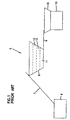
- FIG. 1 An example of a known dry cast concrete product production system 5 is illustrated in Figure 1 .
- the system 5 includes a mixer 6 in which a batch of the low slump concrete is mixed from known components. After mixing, the batch of uncured concrete is transported by a conveyor 7 to a surge hopper 8, with the concrete being deposited into the hopper 8-Uncured concrete is then metered from the hopper 8 onto a metering belt 9 which transports the metered amount of concrete to a production machine 10 which forms a plurality of concrete products from the concrete.
- the production machine 10 includes a hopper 15 that receives the concrete from the metering belt 9.
- the production machine 10 includes molds that are open at the top and bottom.
- a pallet is positioned below each mold to close the bottom of the mold, and the uncured concrete is delivered from the hopper 15 into each mold through the open top of the mold via one or more feed drawers.
- the uncured concrete is then densified and compacted by a combination of vibration and pressure.
- the mold is then stripped by a relative vertical movement of the mold and the pallet to remove the uncured concrete product from the mold.
- the uncured product is then transported to a location where it is cured.
- the production machinery needed to construct a system of this type is available from Besser Company of Avea, Michigan, as well as from a number of other sources, including Columbia Machine Company, Tiger Machine Company, Masa, Omag, Rikers, Hess, KVM, Zenith, and others. Batching and mixing equipment is available from a number of sources well known in the industry. Color pigments are available from a number of sources, including Bayer, Davis Color, and Hamburger Color Company.
- color blending has previously been achieved by preparing a batch of concrete of a first color and depositing a first colored concrete layer 11 in the hopper 8, preparing a batch of concrete of a second color and depositing a second colored concrete layer 12 in hopper 8 on top of the first layer of concrete 11, and, if a third color is desired, preparing a batch of concrete of a third color and depositing a third coloured concrete layer 13 in hopper 8 on top of the second layer 12.
- the first layer 11 can be black concrete
- the second layer 12 can be brown concrete
- the third layer 13 can be gray concrete. Blending of the three colors occurs within the hopper 8, as the concrete is metered from the hopper 8 onto the metering belt 9, on the metering belt 9 itself, and within the production machine 10 prior to being introduced into the molds.
- a difficulty with this previous blending process is that the blending of the different colors, and the resulting color blended look of the concrete product, are not controllable.
- the initial amount of concrete that is metered from the hopper 8 onto the belt 9 is mostly a single color from the layer 11. Therefore, concrete products made from the initial amount of concrete will have little or no color blending, and as a result, will have an appearance that is significantly different from concrete products that are formed firm later metered amounts of concrete. These initial products are often discarded due to insufficient blending.
- the final amount of concrete from the hopper 8 is often primarily a single color from the layer 13, so that product made from this final amount are also frequently discarded.
- the color blending that does occur in the hopper 8 and downstream from the hopper is random, as is the amount of each color contained in the concrete that is metered from the hopper 8 onto the belt 9. Therefore, products produced from one metered amount of concrete may have one look, while products produced from another metered amount of concrete may have an entirely different look. This can be a problem when it is desired to achieve a somewhat consistent color blended appearance.
- the design of the hopper 8 is such that the entire amount of concrete must be used up before new color layers 11-13 can be introduced. Therefore, if the decision is made to change the blended look of the products while concrete remains in the hopper 8, it is generally necessary to use up the remaining concrete in the hopper, or discard the remaining concrete entirely. The need to use up all of the concrete in the hopper 8 also slows down production, since the mixer 6 must then form each color batch for introduction into the hopper 8. While the hopper is being refilled, the production machine 10 may be standing idle Waiting for filling to be complete and for new concrete to be metered from the hopper.
- the colors can bleed together and produce areas on the resulting products having a color that is a mixture of two or more colors. This bleeding of colors can detract from the appearance of the product, by blurring the colors at the junctures between colors, which blurs the separation between colors in the resulting product.
- the invention relates to a process and equipment for high speed, mass production of multi-colored concrete products formed from a multi-color blend of concrete.
- the invention is used to produce concrete products that are suitable for use in landscaping applications, such as retaining wall blocks.
- the invention can also be used to produce color blended pavers, slabs, and bricks.
- the visible surfaces of a concrete product resulting from the multi-color blend have a variegated appearance, which, in the case of landscape products, may simulate natural stone or rock.
- the amount of each concrete color forming the multi-color blend is precisely controllable. As a result, a more consistent multi-color blend in the concrete can be achieved, so that the color blended appearance of the concrete products is more consistent, and the production of one-color, or otherwise insufficiently color blended products is reduced. The need to discard products due to insufficient color blending is therefore reduced. Further, the ratios of the concrete colors used in the multi-color blend can easily be changed, so that the resulting appearance of the visible surfaces of the concrete products can be readily altered.
- each concrete color that is to form the multi-color blend is held within a segregated section of a first hopper separate from the other concrete colors.
- Three monochromatic colors of concrete are used to produce the multi-color blend.
- a controlled quantity of each monochromatic concrete can be metered from each section of the first hopper, and delivered to a second hopper where the metered quantities of concrete are combined together to form the multi-color concrete blend.
- the multi-color blend is then used to produce the concrete products.
- the multi-color blend is generally repeatable, which permits generally repeatable production of blocks having a similar appearance.
- each batch of colored concrete is separated from the other colored batches of concrete within the first hopper, and blending of the colored concrete does not occur until just prior to formation of the products, separation between the colors in the resulting product is more distinct, with less blurring of the colors at junctures between colors, thereby improving the variegated appearance of the visible surfaces of the product.
- the resulting multi-color concrete blend can be altered, along with the resulting color blended appearance of the concrete products.
- the process and equipment of the invention results in a reduction of concrete waste by eliminating the need to dump an entire load of concrete from the surge hopper in the event of improper mixing of one of the concrete colors, such as the addition of excessive water. Instead, with the present invention, each colored concrete batch can be separately dumped in the event of improper mixing of the concrete color.
- the invention further results in a reduction in production stoppages, as each hopper section can be filled with additional concrete when a hopper section runs low on concrete.
- the present invention provides a process for producing multi-color blended concrete products, as well as to a system and equipment utilized in implementing the process.
- concrete products includes architectural concrete blocks that are assembled with mortar to build external walls, concrete bricks, modular concrete products that are suitable for use in landscaping applications, such as retaining wall blocks, concrete pavers, concrete slabs, and other concrete products.
- the preferred application of the process, system and equipment is in the dry cast production of blocks that are used in landscaping applications, particularly retaining wall blocks that are designed to be stacked on top of one another in multiple courses to form a retaining wall, without the use of mortar.
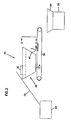
- FIG. 2 illustrates a dry cast production system 20 according to the present invention.
- the system 20 includes a mixer 22 that mixes batches of monochromatically colored concrete.
- the components of the concrete, and the ratios of the components, may vary depending upon the particular application, and the particular mix designs are within the ordinary skill in the art.
- the components are typically aggregates such as sand and gravel, cement and approximately 5% by weight of water.
- Other components depending upon the application, may include pumice, quartzite, taconite, and other natural or man-made fillers, and chemical to improve such properties as water resistance, cure strength, and the like.
- each batch of concrete mixed in the mixer 22 also contains color pigment to color the concrete.
- the ratios of various ingredients and the types of materials can be selected within the skill of the art and are often chosen based on local availability of raw materials, technical requirements of the end products, and the type of production machine being used.
- the mixer itself may be of any known type presently used in the industry, including pan-type mixers and ribbon-type mixers. In a currently preferred embodiment the mixer is of the ribbon-type, and the color pigment is C-grade color, available from Bayer Corp.
- the surge hopper 26 includes a plurality of sidewalls 27a-d and a bottom wall 27e defining an interior volume.
- the interior of the surge hopper 26 is divided into a plurality of sections by at least one dividing wall.
- two dividing walls 28, 30 divide the interior of the surge hopper 26 into three sections A, B, and C.
- the surge hopper 26 could be divided into only two sections, or more than three sections, if desired, depending upon the number of different colors that are to be blender
- Each hopper section A, B, and C receives a differently colored batch of concrete material.
- section A can receive concrete that is colored black
- section B can receive concrete that is colored brown
- section C can receive concrete that is colored gray.
- the size of the hopper sections A, B, and C can vary. Hopper sections A, B, C that each hold about 70 fr 3 (1.98 m 3 ) of concrete have been tested successfully:
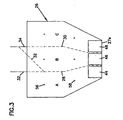
- the walls 28, 30 extend between and are fixed to the sidewalls 27a and 27c, as best seen in Figure 4 , and extend from adjacent the open top of the hopper to the bottom wall 27e as best seen in Figure 2 .
- the walls 28, 30 keep the colored batches separate from each other to prevent intermixing in the hopper.
- Means are provided for directing concrete that falls from the end of the conveyor 24 into selected ones of the hopper sections.
- the means for directing comprise deflection plates 32, 34 that are attached to the top edges of the walls 28, 30.
- the position of the conveyor 24 relative to the surge hopper 26 is such that the concrete from the conveyor 24 would be deposited into hopper section B.
- the plates 28, 30 are selectively positionable to deflect concrete material that falls from the end of the conveyor 24 into hopper sections A or C.
- the plates 32, 34 extend above the top of the surge hopper 26 toward the end of the conveyor 24. Further, as shown in Figures 2 and 4 , the plates 32, 34 extend only partially along the length of the walls 28, 30.
- the plates 32,34 are pivotally attached to the top edges of the walls 28, 30 so that the plates 32, 34 can each pivot from a generally vertical position to an angled position, as shown in dashed lines in Figure 3 for the plate 32.
- the plate 34 is moved to its angled position (not shown), so that the plates 34 is disposed underneath the discharge of the conveyor 24, with the free edge of the plate 34 resting against the plate 32, which remains vertical, for support.
- concrete from the conveyor 24 falls onto the angled plate 34 and, due to the angle of the plate, slides down the plate 34 into hopper section C. Therefore, by suitably controlling the positions of the plates 32, 34, concrete can be deposited into the appropriate hopper section A, B, or C.
- Movement of the plates 32, 34 is controlled by actuators 36, 38 connected to the plates 32, 34 and fixed to suitable support structure, such as the sidewalk 27b, 27d of the hopper 26 itself, as seen in Figure 4 .
- the actuators 36, 38 are preferably pneumatic or hydraulic actuators with actuating rods 40, 42 connected to the plates 32, 34.
- each hopper section A, B, C adjacent the bottom of the surge hopper 26 is a discharge opening that is controlled by a respective gate 44, 46, 48.
- the discharge openings and gates 44; 46, 48 are each associated with the sidewall 27a, adjacent the bottom thereof.
- the gates 44, 46, 48 control or meter concrete from each hopper section A, B, C through the respective discharge opening and onto a metering belt.50.
- the metering belt 50 then carries the metered concrete from the respective hopper sections to a concrete product production machine 52 which includes a hopper 54 .. into which the metered concrete is deposited to produce the multi-color blend.
- the production machine 52 then forms a plurality of blocks from the multi-color blend.
- the gates 44, 46, 48 are designed so as to be selectively openable to allow controlled deposit of colored concrete from each hopper section onto the belt 50. When closed, the gates 44, 46, 48 prevent further deposit of concrete onto the belt 50 until the gates are again opened.
- each gate is separately controllable. Therefore, one gate can be opened while the two other gates are closed, two gates can be opened and one closed, all gates can be opened, or all gates can be closed. As a result, controlled amounts of each color of concrete can be deposited onto the belt 50.
- the gates 44, 46, 48 are preferably mounted so as to be pivotable between a closed position, shown in Figure 3 , and an open position.
- Figure 2 illustrates gate 44 in the open position, with an arrow indicating movement of the gate 44 about a pivot 45 between the open and closed positions.
- the gates 46, 48 are likewise pivotable about respective pivots (not shown) between their closed and open positions.
- An actuator such as a pneumatic or hydraulic actuator (not shown), is preferably connected to each gate to control gate pivoting between the opened and closed positions.
- the gates could be mounted for movement other than pivoting.
- the gates could be mounted to slide up and down relative to the surge hopper 26.
- the sizes of the discharge openings and gates 44, 46, 48 are chosen to enable concrete to exit the hopper section when the respective gate 44, 46, 48 opens. Discharge openings and gates that are about 6.0 inches (15.24 cm) high and about 12.0 inches (30.48 cm) wide have been tested successfully.
- the belt 50 is driven by a suitable drive mechanism to deliver the concrete to the hopper 54. Because the belt 50 receives concrete from across substantially the entire width of the hopper 46, the belt 50 needs to be wider than conventional metering belts. Many conventional metering belts, such as the belt 9 in Figure 1 , have a width that is approximately 24 inches (60.96 cm). The belt 50, on the other hand, has a much larger width. A belt width that has been found useful is about 42 inches (106.68 cm). It is to be realized that a smaller or larger width could be used, as long as the belt 50 is wide enough to receive the concrete that is discharged from each hopper section.
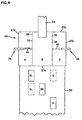
- Figure 4 illustrates an example of the metering function of the gates 44, 46, 48.
- hopper section A contains black concrete
- section B contains brown concrete
- section C contains gray concrete.
- the gate 48 is then closed, and the gate 46 is then opened so that an amount of brown concrete BR is deposited onto the belt
- the gate 44 can be opened at the same time to simultaneously deposit an amount of black concrete BL, as shown in dashed lines.
- the gate 46 is then closed and the gate 44 is opened to deposit an amount of black concrete. BL onto the belt 50.
- the gate 48 can be opened to deposit an amount of gray concrete G, as shown in dashed lines.
- the gates 44,46,48 control the resulting multi-color concrete blend that win be formed in the hopper 54, and thus the resulting multi-color composition of the blocks.
- the gates 44,46,48 control the resulting multi-color concrete blend that win be formed in the hopper 54, and thus the resulting multi-color composition of the blocks.
- the amount of each concrete color that is deposited onto the belt 50, and therefore the resulting multi-color blend of the blocks can be controlled. Gate opening times of between about 4-6 seconds for each gate have been tested successfully.
- the speed of the belt 50 also impacts the multi-color blend.
- a belt speed of about 52.0 ft/min (15.85 m/min) has been tested and has been found to achieve satisfactory color blending. If a different multi-color blend is desired, one or more of the gate opening times, gate opening sequence, and belt speed can be altered to achieve the desired multi-color blend.
- Anchor Highland stone TM block available from Anchor Walls Systems, Inc., the assignee of the present invention, the following parameters can be used.
- the concrete will be blended from three colored concretes: brown, gray and charcoal/black, with brown colored concrete being disposed in hopper section A, gray colored concrete disposed in hopper section B, and charcoal colored concrete disposed in hopper section C.
- the belt speed is approximately 52.0 ft/min (15.85 m/min).
- the multi-color blend is produced by opening gate 44 for a period of about 6 seconds, with the gates 46, 48 remaining closed. This results in the deposit of about 2.0 ft 3 (0.056 m 3 ) of brown colored concrete onto the belt 50.
- the gate 44 is then closed, and once closed, the gate 46 is immediately opened for a period of about 5 seconds, with the gate 48 remaining closed. This results in the deposit of about 1.75 ft 3 (0.050 m 3 ) of gray colored concrete onto the belt 50.
- the gate 46 is then closed along with gate 44 which was previously closed, and the gate 48 is opened for a period of about 6 seconds. This results in the deposit of about 2.0 ft 3 (0.056 m 3 ) of charcoal colored concrete onto the belt 50.
- the gate 48 is then closed along with the gates 44, 46.
- each concrete color is deposited onto the belt at a position that is different from the preceding deposit of concrete, so that the three concrete colors remains substantially separated during delivery to the hopper 54.
- the brown colored concrete will be the first color deposited into the hopper 54, followed shortly thereafter by the gray colored concrete, and followed by the charcoal colored concrete, to produce the multi-color blend.
- the Anchor Highland Stone TM block is then formed from the multi-color blend.
- Blocks produced from the multi-color concrete blend have a variegated, or mottled, appearance. Since the blending of the concrete colors occurs in the hopper 54, rather than in the surge hopper 26, there is less time for the colors to bleed together. Thus, the separation between the colors in the resulting blocks is more distinct, with less blurring of the colors at junctures between colors.
- each hopper section A, B, C includes high and low level sensors 56, 58 therein.
- a signal is sent to the mixer 22 to start mixing a new batch of colored concrete for that hopper section.
- the surge hopper 26 is prevented from metering further amounts of concrete from that section. Further, the system 20 knows that the section is now capable of receiving the entire batch of concrete from the mixer. Once mixed, the new batch is then delivered to the hopper section to replenish that color.
- the concrete in each hopper section can be continuously replenished as needed, without having to use up all of the concrete in the surge hopper 26, and production does not need to be halted to fill the surge hopper 26.
- the hopper section containing the defective batch can be emptied without having to empty the other hopper sections.
- this can be accomplished without having to empty the surge hopper 26.
- the multi-color concrete blend produced in the hopper 54 is used to produce one or more blocks in the production machine 52.
- blocks such as retaining wall blocks
- a pallet is positioned below a retaining wall block mold, having an open top and bottom, in the production Machine 52 to close the open bottom of the mold.
- the mold cavity can be designed to produce a workpiece that comprises a pair of blocks molded in face to face arrangement, with the workpiece being split after it is cured along the line of intersection of the faces to produce two blocks.
- the multi-color blended concrete is delivered from the hopper 54 into the mold through the open top of the mold via one or more feed drawers.
- the concrete is then densified and compacted by a combination of vibration and pressure.
- the mold is then stripped by a relative vertical movement of the mold and the pallet to remove the uncured workpiece from the mold.
- the uncured workpiece is then transported away to be cured, after which the workpiece is split in known manner to produce two blocks.
- Splitting mechanisms are known in the art.
- An example of a splitting mechanism that could be used with the invention includes U.S. Patent No. 6,321,740 .
- the multi-color blend is generally repeatable, which permits generally repeatable production of blocks having a similar appearance.
- Figure 5 is a color photograph of a portion of a wall 100 that is constructed from a plurality of multi-color concrete blocks 102 produced using the process and equipment of the present invention.
- the blocks 102 were produced using the multi-color concrete blend formulation discussed above for the Anchor Highland Stone block.
- Each block 102 includes a split front face that results from a splitting operation that occurs on a workpiece that comprises two of the blocks formed face to face as discussed above.
- the shape of the block 102 can take many forms, depending upon the intended end use of the block.
- the block 102 can include converging side walls, and an integral locator/shear flange (s) formed on the top and/or bottom face of the block,
- U.S. Patent No. 5,827, 015 discloses examples of blocks that could be formed utilizing the process and equipment of the present invention.
Landscapes
- Engineering & Computer Science (AREA)
- Manufacturing & Machinery (AREA)
- Chemical & Material Sciences (AREA)
- Ceramic Engineering (AREA)
- Mechanical Engineering (AREA)
- Devices For Post-Treatments, Processing, Supply, Discharge, And Other Processes (AREA)
- Press-Shaping Or Shaping Using Conveyers (AREA)
- Preparation Of Clay, And Manufacture Of Mixtures Containing Clay Or Cement (AREA)
- On-Site Construction Work That Accompanies The Preparation And Application Of Concrete (AREA)
Claims (15)
- Procédé pour produire un mélange de béton multicolore, comprenant les étapes consistant à transporter le béton à partir d'au moins deux lots séparés de béton jusqu'à une trémie (54) d'une machine de production (52), un premier desdits lots ayant une première couleur et un second desdits lots ayant une seconde couleur différente de la première couleur ; et déposer les quantités séparées de béton dans la trémie (54) de la machine de production (52) pour produire un mélange de béton multicolore, le procédé étant caractérisé par :l'étape de transport comprend l'étape consistant à transporter le béton de chaque lot comprenant des quantités séparées de béton qui sont séparées dans une direction perpendiculaire à une direction de transport.
- Procédé selon la revendication 1, comprenant l'étape consistant à transporter du béton à partir d'au moins trois lots séparés de béton jusqu'à une trémie, le béton transporté de chaque lot comprenant des quantités séparées de béton qui sont séparées dans une direction perpendiculaire à une direction de transport, et les trois lots ayant chacun une couleur qui est différente des couleurs des deux autres lots.
- Procédé selon chacune des revendications 1 et 2, comprenant en outre l'étape consistant à modifier la séquence de livraison des quantités séparées de béton à la trémie (54).
- Procédé selon l'une quelconque des revendications 1 à 3, comprenant en outre l'étape consistant à modifier la vitesse de livraison des quantités séparées de béton des lots à la trémie (54).
- Procédé selon la revendication 1, comprenant en outre l'étape consistant à doser séparément le béton d'au moins deux lots séparés de béton en quantités séparées qui sont séparées dans une direction perpendiculaire à une direction de transport ; et l'étape consistant à produire au moins un produit de béton (102) provenant du mélange de béton multicolore.
- Procédé selon la revendication 1, dans lequel les lots séparés de béton sont contenus dans une trémie tampon (26) qui est divisée en au moins deux sections (A, B, C) agencées côte à côte dans une direction perpendiculaire à la direction de transport, et une première desdites sections contient du béton ayant la première couleur et la seconde section contient du béton ayant la seconde couleur, et comprenant en outre l'étape consistant à doser le béton de la première section et l'étape consistant à doser le béton de la seconde section.
- Procédé selon la revendication 5, dans lequel les lots séparés de béton sont contenus dans une trémie tampon (26) qui est divisée en au moins trois sections (A, B, C) agencées côte à côte dans une direction perpendiculaire à la direction de transport, et chaque section contient du béton ayant une couleur qui est différente des couleurs présentes dans les autres sections et comprenant en outre l'étape consistant à doser séparément le béton provenant d'au moins deux desdites sections.
- Procédé selon la revendication 7, comprenant en outre l'étape consistant à doser le béton provenant de chaque section (A, B, C).
- Procédé selon la revendication 7, comprenant en outre l'étape consistant à doser chaque béton coloré par une ouverture associée à chaque section.
- Procédé selon la revendication 9, comprenant en outre l'étape consistant à contrôler le temps de dosage par chaque ouverture.
- Procédé selon la revendication 10, comprenant en outre l'étape consistant à contrôler les temps de livraison du béton dosé jusqu'à la trémie (54) de la machine de production (52).
- Procédé selon la revendication 6, comprenant en outre l'étape consistant à détecter (56, 58) la quantité de béton dans chaque section de trémie, et l'étape consistant à déposer le béton supplémentaire dans l'une desdites sections de trémie lorsque la quantité de béton dans ladite section de trémie est faible.
- Système de production (20) d'un produit de béton, comprenant un mélangeur (22) pour mélanger le béton ; une trémie tampon (26) ayant un espace intérieur qui est divisé en au moins deux sections de trémie séparées (A, B, C) ; une machine de production (52) ; un premier convoyeur (24) pour transporter le béton mélangé dudit mélangeur jusqu'à ladite trémie tampon ; des moyens (32, 34) pour diriger le béton provenant dudit premier convoyeur dans une section sélectionnée desdites sections de trémie, un second convoyeur (50) pour transporter le béton de ladite trémie tampon jusqu'à ladite machine de production, et des moyens (44, 46, 48) pour déposer le béton provenant de chacune desdites sections de trémie sur des zones séparées dudit second convoyeur ; le système étant caractérisé par :lesdits moyens pour le dépôt sont espacés les uns des autres dans une direction perpendiculaire à une direction de transport du second convoyeur.
- Système selon la revendication 13, dans lequel ladite trémie tampon comprend au moins une paroi de division (28, 30) disposée à l'intérieur de l'espace intérieur qui divise l'espace intérieur en deux sections de trémie (A, B, C), et lesdits moyens pour diriger (32, 34), comprennent une plaque fixée à ladite paroi de division.
- Système selon la revendication 13, dans lequel ledit second convoyeur comprend une courroie de dosage ayant une largeur d'environ 42 pouces (106,68 cm).
Applications Claiming Priority (3)
| Application Number | Priority Date | Filing Date | Title |
|---|---|---|---|
| US10/127,871 US6923565B2 (en) | 2002-04-22 | 2002-04-22 | Process and equipment for producing concrete products having blended colors |
| US127871 | 2002-04-22 | ||
| PCT/US2003/012530 WO2003089210A1 (fr) | 2002-04-22 | 2003-04-22 | Procede et materiel de production de produits polychromes en beton |
Publications (2)
| Publication Number | Publication Date |
|---|---|
| EP1497087A1 EP1497087A1 (fr) | 2005-01-19 |
| EP1497087B1 true EP1497087B1 (fr) | 2008-10-29 |
Family
ID=29215344
Family Applications (1)
| Application Number | Title | Priority Date | Filing Date |
|---|---|---|---|
| EP03724171A Expired - Lifetime EP1497087B1 (fr) | 2002-04-22 | 2003-04-22 | Procede et materiel de production de produits polychromes en beton |
Country Status (9)
| Country | Link |
|---|---|
| US (2) | US6923565B2 (fr) |
| EP (1) | EP1497087B1 (fr) |
| AT (1) | ATE412502T1 (fr) |
| AU (1) | AU2003231047A1 (fr) |
| CA (1) | CA2483032A1 (fr) |
| DE (1) | DE60324408D1 (fr) |
| MX (1) | MXPA04010490A (fr) |
| NZ (1) | NZ536350A (fr) |
| WO (1) | WO2003089210A1 (fr) |
Families Citing this family (26)
| Publication number | Priority date | Publication date | Assignee | Title |
|---|---|---|---|---|
| US6910796B2 (en) * | 2002-04-22 | 2005-06-28 | Anchor Wall Systems, Inc. | Process and equipment for producing concrete products having blended colors |
| US6923565B2 (en) * | 2002-04-22 | 2005-08-02 | Anchor Wall Systems, Inc. | Process and equipment for producing concrete products having blended colors |
| US20040121082A1 (en) * | 2002-10-22 | 2004-06-24 | Jack Dunnous | Method and apparatus for producing multi-color concrete |
| US7887738B2 (en) * | 2003-12-19 | 2011-02-15 | Breedlove Marc M | Brick and method for its manufacture |
| WO2006086629A2 (fr) * | 2005-02-10 | 2006-08-17 | Solomon Colors, Inc. | Procede et appareil de coloration de beton |
| US7572048B2 (en) * | 2005-04-21 | 2009-08-11 | Calstone | Apparatus for highly controlled color distribution in mass produced concrete products |
| US8550690B2 (en) * | 2007-04-13 | 2013-10-08 | Construction Research & Technology Gmbh | Method and device for dispensing liquids |
| US20110078978A1 (en) * | 2007-09-12 | 2011-04-07 | Wauhop Billy J | Retaining wall block, method of manufacturing retaining wall block and retaining wall comprised of retaining wall blocks |
| DE102008008279A1 (de) | 2008-02-07 | 2009-08-13 | Baustoffwerke Gebhart & Söhne GmbH & Co.KG | Vorrichtung zum Herstellen von Betonsteinen |
| EP2268466B1 (fr) * | 2008-03-20 | 2013-11-20 | Ness Inventions, Inc. | Système et procédé de fabrication de blocs de maçonnerie |
| US7849656B2 (en) * | 2008-04-18 | 2010-12-14 | Anchor Wall Systems, Inc. | Dry cast block arrangement and methods |
| US8888481B2 (en) | 2011-01-10 | 2014-11-18 | Stable Concrete Structures, Inc. | Machine for manufacturing concrete U-wall type construction blocks by molding each concrete U-wall construction block from concrete poured about a block cage made from reinforcing material while said block cage is loaded within said machine |
| DE102011050974A1 (de) * | 2011-06-09 | 2012-12-13 | Rekers Verwaltungs-GmbH & Co. KG | Betonsteinerzeugungsvorrichtung und Verfahren zur Herstellung wenigstens zweifarbiger Betonsteine |
| KR101136373B1 (ko) | 2011-12-05 | 2012-04-18 | 주식회사지이티-피씨 | 다색표면층 블록제조장치의 다색골재 공급장치 |
| USD791346S1 (en) | 2015-10-21 | 2017-07-04 | Pavestone, LLC | Interlocking paver |
| US10583588B2 (en) | 2013-06-21 | 2020-03-10 | Pavestone, LLC | Manufactured retaining wall block with improved false joint |
| US9701046B2 (en) | 2013-06-21 | 2017-07-11 | Pavestone, LLC | Method and apparatus for dry cast facing concrete deposition |
| US9644334B2 (en) | 2013-08-19 | 2017-05-09 | Stable Concrete Structures, Inc. | Methods of and systems for controlling water flow, breaking water waves and reducing surface erosion along rivers, streams, waterways and coastal regions |
| US9777442B2 (en) * | 2014-03-03 | 2017-10-03 | Weiler, Inc. | System and method of applying material to a surface |
| USD737468S1 (en) | 2014-05-07 | 2015-08-25 | Pavestone, LLC | Front face of a retaining wall block |
| CN106272934B (zh) * | 2016-09-30 | 2020-02-07 | 安徽省方大水泥制品有限公司 | 悬辊机的无线遥控接收器 |
| CN106493845A (zh) * | 2016-12-02 | 2017-03-15 | 黎明 | 带有振动装置的制砖布料机 |
| US10926966B2 (en) * | 2017-05-23 | 2021-02-23 | Northwestern University | Devices for and methods of forming segregated layers from mixtures of granular materials |
| CN110370595B (zh) * | 2019-06-25 | 2022-12-30 | 宁波禾隆新材料股份有限公司 | 一种木塑生产制造方法、系统、存储介质 |
| IL280802B2 (en) * | 2021-02-10 | 2023-05-01 | Ackerstein Ind Ltd | System and method for painting upper surfaces of bricks and concrete paving stones. |
| USD1037491S1 (en) | 2021-12-14 | 2024-07-30 | Pavestone, LLC | Wall block |
Family Cites Families (24)
| Publication number | Priority date | Publication date | Assignee | Title |
|---|---|---|---|---|
| US2741401A (en) * | 1952-01-23 | 1956-04-10 | Laclede Christy Company | Feeder construction |
| US3425105A (en) | 1965-09-23 | 1969-02-04 | Gulde Cement Co | Apparatus for making concrete facing bricks with varied color and texture |
| US3955907A (en) * | 1970-12-07 | 1976-05-11 | Keniti Yamasita | Apparatus for molding layered concrete slabs |
| JPS5230817A (en) | 1975-09-03 | 1977-03-08 | Komaki Kagaku Gijiyutsu Sougou | Apparatus for production of concrete plate with surface decoration |
| US4178340A (en) | 1978-06-26 | 1979-12-11 | A B C Concrete Products | Method and apparatus for making concrete brick having antique appearance |
| US4712919A (en) * | 1987-01-06 | 1987-12-15 | Bouldin & Lawson, Inc. | Continuous soil mixing apparatus |
| NL8701601A (nl) | 1987-07-08 | 1989-02-01 | Mosa Koninkl Bv | Set vloertegels, werkwijze voor het vervaardigen van een vloertegel behorende tot de set en inrichting voor het uitvoeren van de werkwijze. |
| US4802836A (en) | 1987-07-13 | 1989-02-07 | Gilles Whissell | Compaction device for concrete block molding machine |
| CA1284991C (fr) * | 1988-05-17 | 1991-06-18 | Nobuhisa Suzuki | Ensemble de malaxeurs pour la preparation du beton leger, et methode connexes |
| FR2636658A1 (fr) | 1988-09-16 | 1990-03-23 | Demler Sa Ets | Machine pour le moulage de produits en beton |
| US5215372A (en) * | 1991-02-19 | 1993-06-01 | Astec Industries, Inc. | Aggregate storage apparatus for use in producing asphaltic mix |
| JPH06102584B2 (ja) | 1992-03-24 | 1994-12-14 | 東横技研株式会社 | コンクリート用着色材とコンクリートの着色施工法 |
| JP2683481B2 (ja) | 1992-11-06 | 1997-11-26 | 東陶機器株式会社 | 装飾タイルの製造方法 |
| US5435949A (en) | 1993-08-20 | 1995-07-25 | Hwang; Chuan-Ho | Artificial scenic rock and its manufacturing method |
| JP2787281B2 (ja) | 1994-09-20 | 1998-08-13 | 株式会社ジェイエスピー | 凹凸模様を有するコンクリート面形成用化粧型及び凹凸模様を有するコンクリート面の形成方法 |
| JP2761857B2 (ja) * | 1995-06-26 | 1998-06-04 | 千代田技研工業株式会社 | 模様つきコンクリートブロックの製造法と製造装置 |
| JP2689963B2 (ja) | 1995-07-27 | 1997-12-10 | 株式会社ケイ | 積層断面を有するコンクリートブロックの成型方法 |
| JP2689962B2 (ja) | 1995-07-27 | 1997-12-10 | 株式会社ケイ | 斑模様断面を有するコンクリートブロックの成型方法 |
| JPH09123149A (ja) * | 1995-11-02 | 1997-05-13 | Chiyoda Tech & Ind Co Ltd | 色違い模様つきコンクリートブロックの製造装置 |
| US5971600A (en) * | 1997-07-18 | 1999-10-26 | North American Organics, Inc. | Transportable apparatus for combining waste material with a stabilizer material |
| US6382947B1 (en) * | 1998-11-24 | 2002-05-07 | Hengestone Holdings, Inc. | Color blending apparatus |
| DE20011041U1 (de) | 2000-06-21 | 2000-09-28 | OMAG Ostfriesische Maschinenbau AG, 26723 Emden | Vorrichtung zur Herstellung von Betonsteinen |
| US6923565B2 (en) * | 2002-04-22 | 2005-08-02 | Anchor Wall Systems, Inc. | Process and equipment for producing concrete products having blended colors |
| US7572048B2 (en) * | 2005-04-21 | 2009-08-11 | Calstone | Apparatus for highly controlled color distribution in mass produced concrete products |
-
2002
- 2002-04-22 US US10/127,871 patent/US6923565B2/en not_active Expired - Fee Related
-
2003
- 2003-04-22 WO PCT/US2003/012530 patent/WO2003089210A1/fr not_active Ceased
- 2003-04-22 EP EP03724171A patent/EP1497087B1/fr not_active Expired - Lifetime
- 2003-04-22 MX MXPA04010490A patent/MXPA04010490A/es active IP Right Grant
- 2003-04-22 NZ NZ536350A patent/NZ536350A/en unknown
- 2003-04-22 AT AT03724171T patent/ATE412502T1/de not_active IP Right Cessation
- 2003-04-22 DE DE60324408T patent/DE60324408D1/de not_active Expired - Lifetime
- 2003-04-22 AU AU2003231047A patent/AU2003231047A1/en not_active Abandoned
- 2003-04-22 CA CA002483032A patent/CA2483032A1/fr not_active Abandoned
-
2004
- 2004-12-17 US US11/015,370 patent/US20050099882A1/en not_active Abandoned
Also Published As
| Publication number | Publication date |
|---|---|
| WO2003089210A1 (fr) | 2003-10-30 |
| AU2003231047A1 (en) | 2003-11-03 |
| DE60324408D1 (de) | 2008-12-11 |
| US6923565B2 (en) | 2005-08-02 |
| MXPA04010490A (es) | 2004-12-13 |
| CA2483032A1 (fr) | 2003-10-30 |
| NZ536350A (en) | 2005-07-29 |
| US20030198122A1 (en) | 2003-10-23 |
| EP1497087A1 (fr) | 2005-01-19 |
| ATE412502T1 (de) | 2008-11-15 |
| US20050099882A1 (en) | 2005-05-12 |
Similar Documents
| Publication | Publication Date | Title |
|---|---|---|
| EP1497087B1 (fr) | Procede et materiel de production de produits polychromes en beton | |
| US6910796B2 (en) | Process and equipment for producing concrete products having blended colors | |
| US8147233B2 (en) | Apparatus for highly controlled color distribution in mass produced concrete products | |
| US6382947B1 (en) | Color blending apparatus | |
| AU2003281768B2 (en) | A composite material slab production system | |
| US20100159220A1 (en) | Method and apparatus for manufacturing articles in the form of slabs or tiles with chromatic effects such as veining and/or spotted effects | |
| KR20080030583A (ko) | 역암 또는 석재유사재료의 물품들을 시트 또는 블록 형태로제조하기 위한 방법 및 설비 | |
| EP1881886B1 (fr) | Procede et usine destines a la fabrication de blocs de roche ou de ceramique agglomeree | |
| US7887738B2 (en) | Brick and method for its manufacture | |
| CA2254301C (fr) | Appareil et methode pour le melange de couleurs | |
| WO2024194669A1 (fr) | Appareil de fabrication de briques multicolores |
Legal Events
| Date | Code | Title | Description |
|---|---|---|---|
| PUAI | Public reference made under article 153(3) epc to a published international application that has entered the european phase |
Free format text: ORIGINAL CODE: 0009012 |
|
| 17P | Request for examination filed |
Effective date: 20040913 |
|
| AK | Designated contracting states |
Kind code of ref document: A1 Designated state(s): AT BE BG CH CY CZ DE DK EE ES FI FR GB GR HU IE IT LI LU MC NL PT RO SE SI SK TR |
|
| AX | Request for extension of the european patent |
Extension state: AL LT LV MK |
|
| GRAP | Despatch of communication of intention to grant a patent |
Free format text: ORIGINAL CODE: EPIDOSNIGR1 |
|
| 18D | Application deemed to be withdrawn |
Effective date: 20070618 |
|
| 18RA | Request filed for re-establishment of rights before grant |
Effective date: 20080118 |
|
| D18D | Application deemed to be withdrawn (deleted) | ||
| GRAS | Grant fee paid |
Free format text: ORIGINAL CODE: EPIDOSNIGR3 |
|
| GRAA | (expected) grant |
Free format text: ORIGINAL CODE: 0009210 |
|
| AK | Designated contracting states |
Kind code of ref document: B1 Designated state(s): AT BE BG CH CY CZ DE DK EE ES FI FR GB GR HU IE IT LI LU MC NL PT RO SE SI SK TR |
|
| REG | Reference to a national code |
Ref country code: CH Ref legal event code: EP |
|
| REG | Reference to a national code |
Ref country code: IE Ref legal event code: FG4D |
|
| REF | Corresponds to: |
Ref document number: 60324408 Country of ref document: DE Date of ref document: 20081211 Kind code of ref document: P |
|
| NLV1 | Nl: lapsed or annulled due to failure to fulfill the requirements of art. 29p and 29m of the patents act | ||
| PG25 | Lapsed in a contracting state [announced via postgrant information from national office to epo] |
Ref country code: ES Free format text: LAPSE BECAUSE OF FAILURE TO SUBMIT A TRANSLATION OF THE DESCRIPTION OR TO PAY THE FEE WITHIN THE PRESCRIBED TIME-LIMIT Effective date: 20090209 Ref country code: BG Free format text: LAPSE BECAUSE OF FAILURE TO SUBMIT A TRANSLATION OF THE DESCRIPTION OR TO PAY THE FEE WITHIN THE PRESCRIBED TIME-LIMIT Effective date: 20090129 Ref country code: AT Free format text: LAPSE BECAUSE OF FAILURE TO SUBMIT A TRANSLATION OF THE DESCRIPTION OR TO PAY THE FEE WITHIN THE PRESCRIBED TIME-LIMIT Effective date: 20081029 |
|
| PG25 | Lapsed in a contracting state [announced via postgrant information from national office to epo] |
Ref country code: SI Free format text: LAPSE BECAUSE OF FAILURE TO SUBMIT A TRANSLATION OF THE DESCRIPTION OR TO PAY THE FEE WITHIN THE PRESCRIBED TIME-LIMIT Effective date: 20081029 Ref country code: NL Free format text: LAPSE BECAUSE OF FAILURE TO SUBMIT A TRANSLATION OF THE DESCRIPTION OR TO PAY THE FEE WITHIN THE PRESCRIBED TIME-LIMIT Effective date: 20081029 Ref country code: PT Free format text: LAPSE BECAUSE OF FAILURE TO SUBMIT A TRANSLATION OF THE DESCRIPTION OR TO PAY THE FEE WITHIN THE PRESCRIBED TIME-LIMIT Effective date: 20090330 Ref country code: FI Free format text: LAPSE BECAUSE OF FAILURE TO SUBMIT A TRANSLATION OF THE DESCRIPTION OR TO PAY THE FEE WITHIN THE PRESCRIBED TIME-LIMIT Effective date: 20081029 |
|
| PG25 | Lapsed in a contracting state [announced via postgrant information from national office to epo] |
Ref country code: EE Free format text: LAPSE BECAUSE OF FAILURE TO SUBMIT A TRANSLATION OF THE DESCRIPTION OR TO PAY THE FEE WITHIN THE PRESCRIBED TIME-LIMIT Effective date: 20081029 Ref country code: DK Free format text: LAPSE BECAUSE OF FAILURE TO SUBMIT A TRANSLATION OF THE DESCRIPTION OR TO PAY THE FEE WITHIN THE PRESCRIBED TIME-LIMIT Effective date: 20081029 Ref country code: BE Free format text: LAPSE BECAUSE OF FAILURE TO SUBMIT A TRANSLATION OF THE DESCRIPTION OR TO PAY THE FEE WITHIN THE PRESCRIBED TIME-LIMIT Effective date: 20081029 |
|
| PG25 | Lapsed in a contracting state [announced via postgrant information from national office to epo] |
Ref country code: CZ Free format text: LAPSE BECAUSE OF FAILURE TO SUBMIT A TRANSLATION OF THE DESCRIPTION OR TO PAY THE FEE WITHIN THE PRESCRIBED TIME-LIMIT Effective date: 20081029 Ref country code: SE Free format text: LAPSE BECAUSE OF FAILURE TO SUBMIT A TRANSLATION OF THE DESCRIPTION OR TO PAY THE FEE WITHIN THE PRESCRIBED TIME-LIMIT Effective date: 20090129 Ref country code: IT Free format text: LAPSE BECAUSE OF FAILURE TO SUBMIT A TRANSLATION OF THE DESCRIPTION OR TO PAY THE FEE WITHIN THE PRESCRIBED TIME-LIMIT Effective date: 20081029 |
|
| PLBE | No opposition filed within time limit |
Free format text: ORIGINAL CODE: 0009261 |
|
| STAA | Information on the status of an ep patent application or granted ep patent |
Free format text: STATUS: NO OPPOSITION FILED WITHIN TIME LIMIT |
|
| PG25 | Lapsed in a contracting state [announced via postgrant information from national office to epo] |
Ref country code: SK Free format text: LAPSE BECAUSE OF FAILURE TO SUBMIT A TRANSLATION OF THE DESCRIPTION OR TO PAY THE FEE WITHIN THE PRESCRIBED TIME-LIMIT Effective date: 20081029 |
|
| 26N | No opposition filed |
Effective date: 20090730 |
|
| REG | Reference to a national code |
Ref country code: CH Ref legal event code: PL |
|
| GBPC | Gb: european patent ceased through non-payment of renewal fee |
Effective date: 20090422 |
|
| REG | Reference to a national code |
Ref country code: FR Ref legal event code: ST Effective date: 20091231 |
|
| PG25 | Lapsed in a contracting state [announced via postgrant information from national office to epo] |
Ref country code: CH Free format text: LAPSE BECAUSE OF NON-PAYMENT OF DUE FEES Effective date: 20090430 Ref country code: LI Free format text: LAPSE BECAUSE OF NON-PAYMENT OF DUE FEES Effective date: 20090430 |
|
| REG | Reference to a national code |
Ref country code: IE Ref legal event code: MM4A |
|
| PG25 | Lapsed in a contracting state [announced via postgrant information from national office to epo] |
Ref country code: MC Free format text: LAPSE BECAUSE OF NON-PAYMENT OF DUE FEES Effective date: 20090430 Ref country code: GB Free format text: LAPSE BECAUSE OF NON-PAYMENT OF DUE FEES Effective date: 20090422 Ref country code: IE Free format text: LAPSE BECAUSE OF NON-PAYMENT OF DUE FEES Effective date: 20090422 Ref country code: FR Free format text: LAPSE BECAUSE OF NON-PAYMENT OF DUE FEES Effective date: 20091222 |
|
| PG25 | Lapsed in a contracting state [announced via postgrant information from national office to epo] |
Ref country code: GR Free format text: LAPSE BECAUSE OF FAILURE TO SUBMIT A TRANSLATION OF THE DESCRIPTION OR TO PAY THE FEE WITHIN THE PRESCRIBED TIME-LIMIT Effective date: 20090130 |
|
| PG25 | Lapsed in a contracting state [announced via postgrant information from national office to epo] |
Ref country code: RO Free format text: LAPSE BECAUSE OF FAILURE TO SUBMIT A TRANSLATION OF THE DESCRIPTION OR TO PAY THE FEE WITHIN THE PRESCRIBED TIME-LIMIT Effective date: 20081029 |
|
| PG25 | Lapsed in a contracting state [announced via postgrant information from national office to epo] |
Ref country code: LU Free format text: LAPSE BECAUSE OF NON-PAYMENT OF DUE FEES Effective date: 20090422 |
|
| PG25 | Lapsed in a contracting state [announced via postgrant information from national office to epo] |
Ref country code: HU Free format text: LAPSE BECAUSE OF FAILURE TO SUBMIT A TRANSLATION OF THE DESCRIPTION OR TO PAY THE FEE WITHIN THE PRESCRIBED TIME-LIMIT Effective date: 20090430 |
|
| PG25 | Lapsed in a contracting state [announced via postgrant information from national office to epo] |
Ref country code: TR Free format text: LAPSE BECAUSE OF FAILURE TO SUBMIT A TRANSLATION OF THE DESCRIPTION OR TO PAY THE FEE WITHIN THE PRESCRIBED TIME-LIMIT Effective date: 20081029 |
|
| PG25 | Lapsed in a contracting state [announced via postgrant information from national office to epo] |
Ref country code: CY Free format text: LAPSE BECAUSE OF FAILURE TO SUBMIT A TRANSLATION OF THE DESCRIPTION OR TO PAY THE FEE WITHIN THE PRESCRIBED TIME-LIMIT Effective date: 20081029 |
|
| PGFP | Annual fee paid to national office [announced via postgrant information from national office to epo] |
Ref country code: DE Payment date: 20130430 Year of fee payment: 11 |
|
| REG | Reference to a national code |
Ref country code: DE Ref legal event code: R119 Ref document number: 60324408 Country of ref document: DE |
|
| REG | Reference to a national code |
Ref country code: DE Ref legal event code: R119 Ref document number: 60324408 Country of ref document: DE Effective date: 20141101 |
|
| PG25 | Lapsed in a contracting state [announced via postgrant information from national office to epo] |
Ref country code: DE Free format text: LAPSE BECAUSE OF NON-PAYMENT OF DUE FEES Effective date: 20141101 |